Articles Archive - Page 342 of 928 - REMINET
REMI

EllisDon commits to carbon emissions reduction

EllisDon is responding to the urgent call for climate change action. The construction services company has committed to set targets across the entire value chain (Scope 1, 2, and 3) that will be consistent with keeping global warming to 1.5°C above pre-industrial levels. These goals put the company on the pathway to achieve net-zero emissions by 2050.

“By committing to science-based emissions targets, we are aligning ourselves with the right side of the future,” said Jody Becker, chief strategy officer, executive vice president infrastructure services & technology, EllisDon. “As leaders in sustainability, we are committed to driving a low carbon economy and providing innovative solutions for our industry.”

EllisDon will be setting verifiable science-based targets through the Science Based Targets initiative (SBTi). This organization independently assesses corporate emissions reduction targets in line with the goals identified in the Paris Agreement and current climate science.

As part of this initiative EllisDon will be actively:

Driving to zero emissions across business operations: Minimizing emissions from construction sites, assets, and products and services. This will include implementing efficiency measures and/or switching fuels to renewable resources for fleet vehicles, heavy equipment and buildings.

Driving to zero emissions in materials procured: Leveraging supply chain, trade partners and industry organizations to reduce the embodied carbon of the materials that go into the buildings and infrastructure that EllisDon builds, with a focus on structural materials, including concrete, steel and timber.

Driving to zero emissions in the operation of the projects built: Help EllisDon clients to target and deliver near zero emissions buildings by employing the full building services value chain to provide innovative, achievable and cost-effective solutions.

The successful delivery of high performance, low carbon buildings requires deep collaboration. EllisDon is committed to not only addressing the carbon impact of their own business operations, but to taking a leadership role in driving a low carbon economy for the entire built environment.

EllisDon is committed to publicly sharing their progress by reporting on their Scope 1, 2 and 3 emissions on an annual basis and sharing lessons learned to drive innovation and change across the industry.

Vancouver projects win copper architecture awards

Two Vancouver projects have received this year’s North American Copper in Architecture Awards. The awards by Copper Development Association (CDA) recognize the excellent use of copper in residential, educational and government buildings, built or renovated within the last three years in the United States or Canada.

The 12 winning projects were selected by leading experts in the use of copper in architecture.

“The 2021 winners have demonstrated the continual evolution of copper in design, showcasing how the metal’s versatility and beauty meets function, while answering the growing demand to meet increasing sustainable building standards,” said Stephen Knapp, the director of the Strip, Sheet, & Plate Council for CDA.

The Vancouver winning projects are:

St. Andrew’s-Wesley United Church

The church is an iconic example of the Gothic Revival style in Vancouver and Western Canada. Originally constructed between 1931 and 1933, it experienced long-term roof leaks that were negatively impacting the interior plaster elements.

This was the catalyst for the project and allowed the church to pay a homage to its heritage through a large-scale restoration, highlighting copper as a featured element. While reviewing roofing material options, copper was selected for its durability, being lightweight (compared to slate-important from a seismic perspective), its elegance and heritage value.

While reviewing roofing material options, copper was selected for its durability, being lightweight, its elegance and heritage value. Staying true to its design, many of the original gutters and downpipes were copper. The new copper roof and flashings show true to its time, reflecting the importance of its heritage while providing quality, durable roofing and flashing systems for decades to come.

Sun Tower

The Sun Tower is a notable landmark of 17 storeys capped by a Beaux-Arts dome and cupola built-in 1912 and designed by architect William Tuff Whiteway.

The tower is topped with a dome and cupola that were originally roofed with terracotta tiles that were painted at a later date to resemble patinated copper. The terracotta tiles had exceeded their practical service life, and it was time to replace the roof.

The fabrication contractor took samples of the original tile and custom-stamped large copper tiles that replicated the terracotta profile.

The restoration journey included replacing the existing terracotta main dome gutter with an exact replica in copper, a standing seam copper roof at the main dome cupola, and a custom copper flashing at the various levels of the tower.


Infrastructure holdings back Canadian pensions

Four Canadian pension plans rank in the global top 10 for value of their infrastructure holdings. Canada Pension Plan Investment Board (CPP Investments), Caisse de dépôt et placement du Québec (CDPQ), Ontario Municipal Employees Retirement System (OMERS) and Public Sector Pension Investment Board (PSP Investments) are slotted second, fourth, eighth and 10th respectively in recently released 2021 rankings from IPE Real Assets. No other country makes such a conspicuous showing on the list.

The global investment management firm, Allianz, takes the number one spot with USD $35 billion in infrastructure assets, followed by CPP Investments with USD $30 billion (CAD $38.4 billion). Allianz and CPP Investments were likewise among the top 10 global real estate investors in the rankings that IPE, a European-based institutional investment analyst and news service, released earlier this year. Three other investors — Abu Dhabi Investment Authority; Dutch pension plan manager, APG; and multinational insurance company, AXA — also made both lists for 2021.

Canadian investors stand out for a more sizable quotient of infrastructure holdings in their total assets. Notably, OMERS’ USD $17 billion (CAD $21.7 billion) worth of infrastructure equates to 20 per cent of its total asset value, making it the most deeply exposed to the asset class in the top 10. At the other end of the scale, AXA’s USD $16 billion in infrastructure holdings represents just 1.6 per cent of its total assets.

AustralianSuper, ranked seventh on the list, has the next largest stake with USD $18 billion worth of infrastructure representing 10.8 per cent of its total asset value. PSP Investments (8.9 per cent), CDPQ (8.7 per cent) and CPP Investments (8 per cent) follow, while none of the remaining top 10 have more than 4.5 per cent of their total assets in infrastructure.

With USD $25 billion (CAD $32 billion) in infrastructure assets, CDPQ is positioned between the Abu Dhabi Investment Authority (USD $29 billion) and National Pension Service of Korea (USD $23 billion). PSP Investments has USD $14.5 billion (CAD $18.5 billion) in infrastructure assets.

BC Hydro invests in $260M plan for electrification

BC Hydro and the Government of British Columbia have launched a new five-year electrification plan to encourage moving away from fossil fuels.

BC Hydro will invest more than $260 million to implement the plan over the next five  years, including nearly $190 million to promote fuel switching in homes and buildings, vehicles and industry, and more than $50 million to attract new industries to B.C.

“From heat waves to wildfires, we are already seeing the devastating effects of climate change. Here in B.C., we have accomplished a lot with North America’s most progressive plan to reduce carbon pollution – but the scale of the crisis means we must act with even more urgency,” said Premier John Horgan. “Working together with BC Hydro, we will help more people and businesses become less reliant on fossil fuels and use more affordable, made-in-B.C. hydroelectricity.”

BC Hydro estimates that if the electrification plan is fully realized, customer rates will be about 1.6 per cent lower by 2026 compared to what they would be if there were no plan.

The plan could result in incremental greenhouse gas (GHG) emission reductions of more than 930,000 tonnes per year by 2026. That is equivalent to taking approximately 200,000 passenger vehicles per year off the road.

The plan builds on existing BC Hydro and provincial rebates and customer supports for the installation of heat pumps and electric vehicle chargers and electrification measures from CleanBC, and new recommendations from Phase 2 of the BC Hydro Review, including the discounted CleanBC Industrial Electrification Rates that were announced in January 2021.

With as much as $20 million in incentives and study funding to support the production of hydrogen, the plan also helps to advance the B.C. Hydrogen Strategy released in July 2021.

ATCO to build largest urban solar projects in Calgary

The ATCO Group has acquired the rights to build two solar installations in Calgary. Once completed, the Barlow and Deerfoot solar projects will be the largest solar installation in a major urban centre in Western Canada, at 27 and 37 megawatts respectively.

The installations will provide clean, renewable energy to Alberta’s power grid and support the transition to lower-carbon energy. ATCO also recently acquired a solar project near Empress in eastern Alberta and completed two solar projects in Canada’s North.

“The acquisition of three major solar projects shows how important we believe it is to provide customers with the opportunity to decarbonize their energy consumption,” said Bob Myles, executive vice president, corporate development, ATCO. “Whether it’s the far North or an urban centre, ATCO is delivering on our strategy to help communities accelerate their transition to clean energy in a safe, affordable and reliable manner. These solar projects are also prime examples of the kinds of opportunities we’ll continue to pursue as we grow our renewables portfolio moving forward.”

The installations’ combined 175,000 bifacial solar panels, covering the equivalent of roughly 170 (Canadian) football fields, will generate enough renewable electricity to power more than 18,000 homes and offset 68,000 tonnes of carbon a year.

Through Canadian Utilities Limited, ATCO acquired the two Calgary solar projects from DP Energy, a privately held energy developer. Electricity from the projects will be sold into the Alberta power market, and ATCO is currently negotiating with potential customers to contract the facilities’ output.

The Deerfoot project, near 114 Avenue and 52 Street SE, is completing the permitting phase. The Barlow project, near Barlow Trail and 114 Avenue SE, has received its major permits and project execution is underway.

Construction for both projects is expected to occur during 2022, with commercial operations targeted for late 2022.


Community net metering demo set for Ontario

A 70-acre mixed-use development project in London, Ontario, will be a test site for an electricity generation and sharing model known as community net metering. Sifton Properties’ West 5 — now nearing buildout of approximately 2.5 million square feet of commercial and residential space in an array of low-rise to high-rise buildings targeting net-zero energy and water consumption — has been selected to demonstrate the possibilities, working in consort with London Hydro and with the backing of the Ontario government.

“This model is very important in the future of net-zero communities,” says Richard Sifton, president and chief executive officer of Sifton Properties.

The concept is an expansion of Ontario’s net metering program, which was enabled through a 2005 provincial regulation. More than 2,000 individual hydro account holders have agreements to generate on-site renewable power to meet part or all of their household/facility demand requirements, and are also connected to the electricity grid so they can pull or dispatch supply as necessary.

Net metered customers receive credits on their hydro bills for the power they send to the grid. However, until the Ontario government enacted a regulation earlier this year to authorize community net metering demonstration projects, there was no option to allocate those credits to other hydro accounts. The West 5 development will be the first to do so.

“Community net metering allows us to overproduce solar energy on one building, then use that energy in other buildings at West 5,” Sifton explains. “It allows us to continue exploring future opportunities from a community level, not building level. It opens the doors for micro grids, battery storage, high speed bus or car charging.”

As Ontario’s first demonstration project, West 5 is expected to be a learning opportunity for electricity utilities that will also derive insight and data on the environmental and economic impact of renewable energy collectives.

“London Hydro will develop innovative new tools and technology as well as gain valuable experience in installing and operating a microgrid,” predicts Vinay Sharma, the utility’s chief executive officer.

“Net metering innovation harnesses clean, green technology to save taxpayers money — a combination that we all can get behind,” says David Piccini, Ontario Minister of the Environment, Conservation and Parks. “I look forward to seeing the results of this demonstration and what net metering can mean for more projects that support a sustainable future.”

Lamoureux earns FGIA FenestrationMaster

Jennie Lamoureux, Alumicor‘s architectural representative based in Montreal, has earned the FenestrationMaster Professional Certification through the Fenestration and Glazing Industry Alliance (FGIA).

The FenestrationMasters program coursework covers a wide range of subject matters including performance standards on products, finishes and material types, energy efficiency considerations and code requirements pertaining to window, door, skylight, curtainwall, storefront and sloped glazing systems.

Working closely with Canadian architectural design professionals, Lamoureux assists with evaluation, selection and specification of aluminum-framed fenestration systems for commercial building envelopes. Drawing from her industry experience and Alumicor’s expertise, she helps support project goals for performance, appearance, sustainability, on-time scheduling and long-term value.

As a member of FGIA, Lamoureux represents Alumicor, Tubelite Inc. and Apogee Enterprises, Inc., and contributes to the Architectural Products Council’s Methods of Test Committee. She also serves as the board chair for the Montreal chapter of Construction Specifications Canada (DCC-CSC Section de Montréal).

Her dedication and contributions to the DCC were recognized with a CSC 2020 Chapter Award of Merit. Previously, she successfully completed CSC’s Principles of Construction Documentation (PCD) coursework.

Lamoureux also is an active member of the Association de vitrerie et fenestration du Québec (AVFQ, Quebec Glazing and Fenestration Association) and participates in the Technical Committee–Commercial Sector.

Ontario realtors call on government to update zoning laws

The Ontario Real Estate Association (“OREA”) is calling on the provincial government to cut red tape and build on the successful More Homes, More Choice Act, 2019 by ending Ontario’s exclusionary single-family zoning laws in high-demand areas.

Currently, it is illegal in Toronto neighbourhoods to convert a single-family home into a townhome, duplex, triplex or fourplex without a zoning by-law change—something OREA asserts delays projects, costs additional money, and leaves people stranded without affordable housing options. Calling them “outdated zoning laws that encourage NIMBY forces to drive up costs of homes,” OREA is encouraging the Province to use the Planning Act to implement as-of-right zoning in Ontario’s highest-demand urban neighbourhoods.

“In too many Ontario cities, it defies common sense that you can take a bungalow and turn it into a monster four-storey home for one wealthy family, but you cannot build affordable townhomes for multiple families without red tape, runaround, and exorbitant costs,” said OREA CEO Tim Hudak. “Exclusionary zoning policies are at the heart of Ontario’s housing affordability crisis in high-growth areas and it’s time the Province steps in to modernize these archaic laws.”

The association believes this zoning change would allow the seamless and legal development of gentle density, including duplexes, triplexes, and fourplexes, next door to existing density and close to subway and transit stations without unnecessary and lengthy case-by-case approvals.

“You cannot grow south into Lake Ontario or north into the Greenbelt, so we need to use the space in between to create more homes and give more choice to Ontarians,” said Hudak. “High home prices are evidence enough that there are not enough homes to accommodate growing families across the province. But archaic rules and regulations are holding up new developments and exacerbating the problem – keeping the Canadian dream of home ownership out of reach for millennials and young families.”

According to recent OREA research conducted by Abacus Data, almost 7 in 10 Ontarians say housing affordability should be a top priority for the government. The report also found that 78 per cent of Ontarians support minimum zoning in urban areas to encourage more homes.

OREA’s recommendations to implement as-of-right zoning is part of its plan to bring housing affordability home for young families in Ontario. It also proposes to reduce costs for first time home buyers, reduce approval times for builders, and permit innovative housing solutions.

“On the heels of a federal election focused on housing affordability, this issue remains top of mind for many who badly want all levels of government to help bring affordability home – and that starts with increasing and improving housing supply,” said Hudak.


Ontario gives $100-mil boost to tourism industry

Ontario is funnelling $100 million into its Tourism Recovery Program to revive the floundering industry, which has seen plenty of job losses over the past 18 months. Across Canada, tourism‐related industries experienced a loss of 94,000 jobs between August 2019 and August 2021, according to Statistics Canada’s Labour Force Survey.

Businesses that help drive employment and visitors to their regions are eligible to apply for the program. Eligible applicants include inns and lodges, boat tours, ski centres, live performance venues, cinemas, drive-in theatres, and amusement and water parks.

The Ontario Tourism Recovery Program will support tourism businesses that have experienced a loss of at least 50 per cent of eligible revenue in 2020-21 compared to 2019. Program funding will help applicants prepare to reopen safely, develop innovative tourism products, retain and create jobs, and support tourism recovery in their region and throughout the province.

Successful recipients will have the flexibility to apply funds to any eligible expenses and do what makes the most sense for their businesses. Expenses could include reopening and operating costs such as staff salaries and maintenance, health and safety measures for visitors and workers, tourism product and experience development, or marketing.

Applications for this program will open on October 13, 2021.


Photo by anna-m. w.

Popularity of small rental units back on the rise

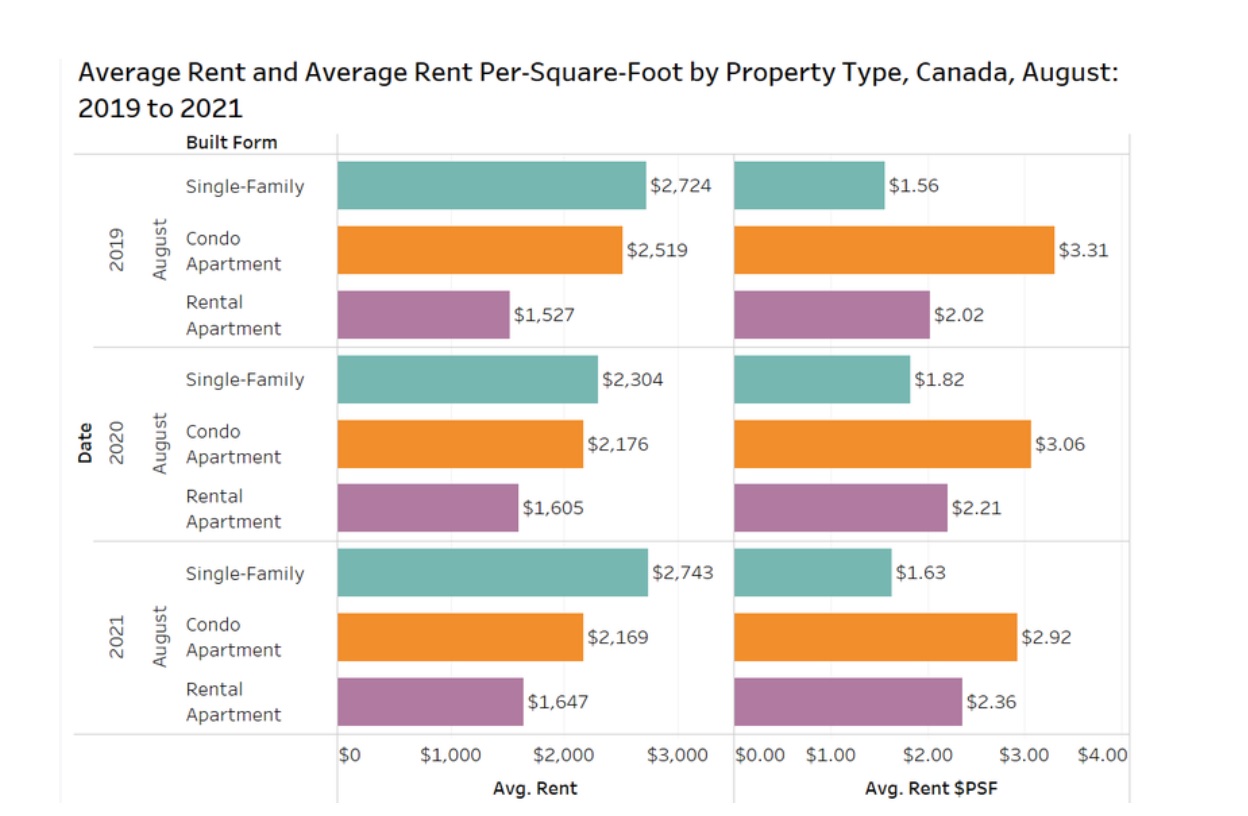
Average rents for all property types in the GTA increased nearly a full per cent in August over July, with small rental units climbing in popularity after more than a year of pandemic-related declines. This is the fifth straight month average rents have increased, according to the latest Bullpen Research & Consulting and TorontoRentals.com rent report. 

Even with the recent uptrend, the average rent is still down 4 per cent annually from $2,184 per month in August 2020, and 14 per cent from August 2019’s average rent of $2,450 per month. Despite worries about the fourth wave of COVID-19, the return to normalcy continues  with colleges and universities opening up, as well as primary schools, malls, stores, gyms, and downtown office buildings.

The majority of GTA cities and neighbourhoods experienced monthly increases in average rent in August, including Whitby, 6.6 per cent; Scarborough, 3.9 per cent; Richmond Hill, 2.6 per cent; Milton, 2.3 per cent and Mississauga, 2.1 per cent. Other cities and areas with slight month-over-month increases were: North York, up 1.3 per cent; York, East York and Brampton, all up 1 per cent; Vaughan up 0.8 per cent and Toronto, up 0.7 per cent.

“After several months of large rental units leading the recovery out of the pandemic-induced rental slump, smaller units were popular in August, with average rents for one bedroom units increasing by a whopping 5 per cent monthly in the GTA,” said Ben Myers, president of Bullpen Research & Consulting. “The market bottom is now clearly in the past, with many of Toronto’s most desirable neighbourhoods seeing average rents increase by $200 to $350 per month over the last six months.”

Rental condos & single-family homes

23 of 27 condo apartment projects with high activity on TorontoRentals.com in the GTA saw an overall average increase of 11 per cent in monthly rents in July and August over January and February of this year. The project with the highest increase was Axis Condos ($1,788 per month to $2,510 per month). This 38-storey building was completed in 2019 at 411 Church Street.

The average rent for single-family homes in the GTA has increased throughout 2021 in most markets. Rents for condos have not risen as quickly as those of single-family homes. Toronto, Etobicoke, North York, and Mississauga are all trending upward in terms of average rents, while York and Scarborough are trending flat.

Purpose-built rental apartments

The average rent for purpose-built rental apartments, after declining for most of 2020, have also shown increases throughout 2021.

The average rent for apartments in the former city of Toronto was $2,094 per month in August, up 8 per cent  from the March 2021 low of $1,938 per month. The postal codes with a high average rent per square foot were clustered in the downtown Toronto area,

The average rent for studio, one-bedroom, and two-bedroom units all experienced month-over-month increases in average rent in August. Small rental units such as studios increased 1.4 per cent monthly to $1,525 on average while one-bedroom units increased by 5.1 per cent monthly to $1,864. Meanwhile, two-bedroom units increased 1.3 per cent to $2,308 per month.

See the complete report here: National Rent Report

Housing for women project receives city approval

GBL Architects has received City of Vancouver Council approval for their new housing for women development at 546 West 13th Avenue.

The housing project is for the international non-profit organization and global volunteer organization Soroptimist International of Vancouver. The organization and Vancouver-based developer Purpose Driven Development have partnered on this innovative redevelopment project to bring 135 affordable rental homes to workforce women, senior women, and women-led families.

 This will be the first development project in Canada developed, designed, and delivered by an entirely female team, demonstrating women’s leadership in a male-dominated sector. 546 West 13th will help address women’s housing needs by providing affordable “Housing for Women By Women,” fulfilling the team’s goal of women at their best helping women be their best.

The design for the housing project balances social and environmental responsibility to fill gaps in the housing market to support women and women-led families in various living situations. The building design integrates an efficient envelope with a dynamic, fluid balcony expression that sets the building apart from its neighbouring rectilinear towers.

Landscaped terraces and planting at grade enhance the building’s appearance while contributing to engaging amenity spaces at multiple levels. Gardens, fostered by residents, will integrate spiritual, healing gardens planted with native species significant to women in various cultural traditions. The indoor and outdoor amenity spaces are designed to foster a strong sense of community among residents through a mix of flexible, communal areas and smaller contemplative spaces.

546 West 13th Avenue is designed to support a diverse community of residents. The project will create housing options to fulfill the community’s needs by supporting women and their families in achieving financial independence and housing security.

The mix of housing types includes fully accessible homes, large homes designed for family needs, efficient homes for professional women and seniors, and flexible living spaces for a wide range of tenants. Insightful design considerations tailor homes to their intended residents. Homes designed for families balance smaller bedrooms for children with larger living and dining spaces for families to gather and congregate.

Demand for cleaning products predicted to keep growing

The global market for surface-cleaning products is expected to grow significantly over the next decade, expanding at a compound annual growth rate of nearly five per cent according to a report from market research provider Fact.MR.

The North America surface cleaning products market is expected to account for approximately 30% of global sales in 2021.

The analysis’ conclusions reflect the fact the cleaning products market has gained massive importance due to the onset of the COVID-19 pandemic. The report also attributed the expected growth to increasing expenditure on preventive measures during the coronavirus pandemic and rising consumer awareness regarding the importance of cleaning and personal hygiene.

Chemical-based products

Some popular chemical-based surface cleaning products are:

  • Alcohol-based products
  • Chlorine-based products
  • Hydrogen Peroxide-based products
  • Quaternary Ammonium-based products

The use of alcohol and quaternary ammonium in surface cleaning products has increased since both have been found to be very effective in combating different disease-causing viruses and bacteria.

Rising demand for surface disinfectants has pushed manufacturers to find more effective disinfectants, and hence, research in this area has also accelerated. Use of chlorine and hydrogen peroxide in these products is expected to increase over the next 10 years as they are key to disinfectant preparations.

The liquid segment of the global market is expected to hold a dominant share in terms of value and sales, while the wipes segment is expected to account for an increase in demand over the next 10 years.

Innovation

Cleaning product manufacturers have been focusing on developing new and efficient products to cater to a wide range of consumers. Investments in research and development have increased to offer products that are eco-friendly in line with the trends of the cleaning industry and beyond.

COVID-19 has completely revolutionized the use of these products, and since sprays are a very effective way to deliver and apply cleaning solutions and disinfectants, their demand has increased substantially over the past year.

Sprays are gaining popularity due to their ability to apply the product to a broader area in a short span of time. The sprays segment is expected to register the highest CAGR over the decade. The increasing need for disinfection and sanitization is expected to majorly drive demand for surface cleaning product sprays globally.

e-commerce leads the way

e-commerce, as a sales channel, is anticipated to lead the sales of surface cleaning products. The COVID-19 outbreak has given further impetus to the already popular online shopping trend. Sales via e-commerce channels are anticipated to contribute to the majority of market share as the popularity of online shopping increases in the pandemic era.

Since 2020, when many nations were forced to go into lockdowns in order to contain the spread of coronavirus, sales through channels such as convenience stores, modern trade, and grocery stores saw a major drop.

However, as lockdown restrictions were removed and life returned to normalcy, there may be some stagnation in sales via e-commerce, and sales through modern trade and convenience stores will see some growth.

BentallGreenOak grows data centre portfolio

BentallGreenOak (BGO) has augmented its nascent data centre portfolio with the acquisition of a 200,000-square-foot facility in downtown Montreal. That continues the foray into the alternative asset class launched earlier this spring with the purchase of a 112,000-square-foot data centre in Markham, Ontario.

The move is part of BGO’s core strategy in Canada, focused on income-producing properties, which, in this case, are aligned with seeming voracious demand for technological services. Paul Mouchakkaa, BGO’s managing partner and head in Canada, terms it “unique, high-growth space” with a “compelling, long-term value proposition”. A $20-million power upgrade project is currently in progress at the Markham facility with an eye to supporting an additional 90,000 square feet of space that the site’s footprint could accommodate.

“Our investment management team is keen to intensify our efforts in this sector in the years ahead,” Mouchakkaa affirms.

CAT to handle disputes over nuisances in 2022

Several changes under the Condominium Act, 1998 (Condo Act) are coming into force on January 1, 2022. Changes to section 117 will prohibit conditions or activities in a unit or common element, which are likely to damage property or cause injury or illness to an individual.

Amendments will also prohibit any unreasonable noise that is a nuisance, annoyance or disruption, or other nuisances, annoyances or disruptions as prescribed in regulation.

Prescribed nuisances include: odour; smoke; vapour; light; and vibration.

According to condo lawyer Rod Escayola of Gowling WLG, the province had originally contemplated a sixth prohibited nuisance: Infestation by animal, virus, fungus, bacterium or other organisms. “This additional prohibited nuisance was included in the consultation process, which took place in December 2019 but did not make the cut. I wonder why,” he wrote in his blog last week. “Certain infestations (think of bedbugs, cockroaches and mould) can be quite problematic for condos and neighbours.”

Amendments to O. Reg. 179/17, will also expand the CAT’s jurisdiction to manage certain disputes related to nuisances or disputes over governing documents regulating nuisance.


Property tax premiums loom in Nova Scotia

Nova Scotia’s new provincial government is signalling looming property tax premiums for non-resident purchasers and owners. Incoming Finance Minister Allan MacMaster has been instructed to introduce a provincial deed transfer tax and to impose an additional levy equating to $2 per every $100 of assessed value for residential ratepayers who pay their income tax in other jurisdictions.

The two tasks are included in MacMaster’s mandate letter, one of the series of legislative to-do lists that Premier Tim Houston recently delivered to all his newly installed cabinet ministers following the Conservative party’s August 17th election victory. Plans for the new surcharges were first outlined in the new government’s campaign platform, which also cited 2018 Statistics Canada estimates that non-residents own 3.9 per cent of Nova Scotia’s housing stock (excluding purpose-built multifamily rental properties), a higher rate than in either British Columbia or Ontario.

“There is currently some legitimate concern that many properties are being purchased by non-residents, who may or may not plan to spend time in those properties,” the platform document states. “We will impose a new tax and property levy for buyers who do not pay income tax in Nova Scotia. These fees will limit purchases from non-Nova Scotia income taxpayers and, for those who do purchase, will bring in an added regular stream of revenue for the province.”

Some observers hypothesize the latter consideration is the more pressing motivation. New revenue could help offset the costs of other tax-related campaign promises. Those include a provincial income tax exemption on the first $50,000 of earnings for construction workers under the age of 30, and a pilot five-year 50 per cent rebate on provincial corporate taxes if companies pay the savings back to employees through new hires or salary increases.

“There is always commentary around potential changes in tax revenue or potential new opportunities for tax revenue. I think there’s been an especially high emphasis on that kind of thing given the pandemic and given the financial situations of governments and municipalities,” observes Ryan Hartlen, a real estate broker with RE/MAX Nova in Halifax. “A hot real estate market has contributed to the idea that not only would this probably be a pretty healthy amount of money, but it would probably be more acceptable for voters.”

Clarity lacking on targeted residential ratepayers

The proposed provincial deed transfer tax would be added on top of the one-time municipal deed transfer tax that all new purchasers submit to their applicable local government at rates varying from 0.5 to 1.5 per cent of the property sale price, depending on the municipality. Directions to the Finance Minister refer broadly to imposing the proposed new property levy on “every non-Nova Scotian taxpayer held property” although it has thus far been framed only as a measure to dissuade non-resident investors from speculating in the homebuyers’ market.

“Under the assessment legislation, residential property is a broad category that covers not only single-family homes, but also residential rental properties of all sizes, manufactured home communities and seniors housing,” explains Giselle Kakamousias, vice president, property tax, with the Atlantic Canada real estate advisory firm, Turner Drake & Partners. “We trust that in the details (of the legislation) the new government will target the taxes appropriately vis-à-vis its stated objective of improving affordability.”

“On the commercial side, there is a significant amount of investors that own real estate under holding companies outside of Nova Scotia. These companies (if included) would have to undergo additional cost to transfer their holdings into Nova Scotia holding companies,” advises Mathieu Maillet, senior director, property tax, for Altus Group in Atlantic Canada. “The proposal does nothing to promote investment and growth in our province.”

Hartlen estimates 20 to 30 per cent of the transactions he conducts are for out-of-province buyers from elsewhere in Canada and beyond. Many are former Nova Scotia residents with plans to return in the future. He suggests they’ll more likely react to an additional deed transfer tax, which will be immediately added to closing costs, than a property tax bill they may not receive until months after they’ve taken ownership, particularly if they are paying steeper property taxes on a principle residence elsewhere. There’s also a possibility that Nova Scotia-taxpaying short-term tenants could take on the burden.

“It could have the undesired impact of decreasing affordability in the instance where out-of-province developers and investors simply pass the additional tax onto the end-user,” says Neil Lovitt, vice president, planning and economic intelligence, with Turner Drake & Partners.

Meanwhile, given that non-resident purchasers face much higher land transfer tariffs in Vancouver (20 per cent) and Toronto (15 per cent) than the 5 per cent provincial deed transfer tax proposed in the Conservative campaign platform, he calls it a somewhat dubious deterrent on purchasers intent on speculation. Additionally, Vancouver is set to increase its vacant unit tax to 3 per cent on assessed values that are typically much higher than in Nova Scotia.

“To date, we have seen no analysis on this, but suspect they (the surcharges) will do a better job of raising funds than materially affecting market trends,” Lovitt submits. “It may have an impact in rural areas where out-of-province buyers are more likely to own recreational properties and not have Nova Scotia addresses.”

Fallout expected for recreational property owners and host municipalities

There’s general consensus that recreational property owners and the municipalities that host them will be hardest hit. Hartlen foresees a double-whammy of the new tax premium in step with upward spiking property values as assessments catch up with recent market trends.

“On certain properties, once you get to sizable value, it’s going to be a pretty heavy tax for some people. The worry is, what does it do to the people who have family cottages here? You’re going to have some people decide they’re not going to own those properties here anymore, especially if they can find similar type properties in other parts of Atlantic Canada,” he projects.

The Nova Scotia Association of Realtors (NSAR) reports an average residential sale price of $442,000 in Halifax in August 2021, a 19 per cent gain over August 2020. Although the average sale price was more modest, even greater year-over-year increases of upwards of 35 per cent were recorded in the Annapolis Valley, the Highland Region and Yarmouth. The 2021 RE/MAX Recreational Property Report pegged the average sales price of waterfront properties in the Halifax vicinity at about $698,000 during the first four months of this year, which, at the proposed rate of $2 per $100 of assessed value, would equate to almost $14,000 in extra annual property taxes for out-of-province owners.

“NSAR and our members believe this tax will be detrimental to out-of-province owners, many of whom are seasonal property owners and contribute significantly to economies of the communities they own property in,” says Roger Boutilier, the association’s chief executive officer.

“Residential tax rates in smaller municipalities would be significantly impacted and rendered non-competitive for outside investors, and a number of rural communities depend on out-of-province residence economic activity,” Maillet concurs.

The new premier has yet to announce the date for his government’s speech from the throne so there is still no indication of when the legislation may be introduced. The Finance Minister’s mandate letter states only that it is to be within the next four years.

Barbara Carss is the editor-in-chief of Canadian Property Management.

Squamish and Whistler tackle embodied carbon

The District of Squamish and the Resort Municipality of Whistler are collaborating on a new project to lower embodied emissions in new construction and develop an Embodied Carbon Guide for B.C. Municipalities. This project is being recognized as a potential “game-changer” by the Community Energy Association (CEA).

The Game-Changer program provides local governments with access to CEA’s staff expertise in order to develop a local climate action initiative that has the potential to drive change within communities. The program is new in 2021 and is part of a suite of CEA programs and services intended to provide enhanced support to communities during this decade of climate action.

“The Resort Municipality of Whistler is pleased to partner with the District of Squamish and the Community Energy Association on this important initiative,” said Whistler Mayor Jack Crompton. “Climate action is one of the Resort Municipality of Whistler’s focus areas, as we work towards an ambitious target of reducing our greenhouse gas emissions by 50 per cent by 2030. We know our buildings account for a significant amount of these emissions, so finding ways to lower their embodied emissions is critical to achieving our goals and lessening our community’s overall impact on climate change.”

CEA has previously worked with Squamish and Whistler on their local climate action plans, which were adopted by Squamish Council in April 2020 and Whistler Council in December 2020. Both plans include pledges to significantly reduce local greenhouse gas emissions (45 per cent in Squamish and 50 per cent in Whistler) by 2030. Both plans also recognize that buildings account for approximately one-third of local emissions.

While most of those emissions are associated with the ongoing heating and operation of a building, about one-quarter of emissions in current buildings are “embodied,” and associated with the manufacturing, transportation, installation, and disposal of the materials used in the construction of buildings.

In the future, as buildings become more energy-efficient, those embodied emissions are expected to account for more than half of a building’s total emissions. Currently, embodied emissions aren’t reported or measured in municipalities. Squamish and Whistler’s work on embodied emissions with CEA will lead to an Embodied Carbon Guide for B.C. Municipalities that will feature Squamish and Whistler as case studies.

The embodied carbon project has been approved by the councils of both municipalities.

All time low for industrial vacancy in Vancouver

Industrial vacancy in Metro Vancouver has hit another new record low and set another all-time high for lease rates. According to the new Q3 National Snapshot report from Colliers, the vacancy plunged 0.5 per cent, down from 0.7 per cent in Q2.

The report explains this is a 70 per cent year-over-year reduction. Colliers noted the historic low vacancy rate highlights a deepening crisis in a sector long fuelled by a shortage of land and a growing demand from e-commerce (especially since the start of the pandemic) and rising lease rates. It is the 19th consecutive quarter where vacancy has been below 2.0 per cent.

“The good news is that COVID has created all kinds of demand for logistics and industrial space, and many companies have benefited from that growth,” says Doug Pulver, EMD at Colliers Vancouver. “The bad news is that it’s driven up prices, pushing many businesses out of the market. Some are moving to smaller, more affordable cities in the Interior and Alberta. And some Ontario companies looking to expand their footprint in BC are now having second thoughts. Increasingly, companies just can’t find the space they need in Vancouver and as a result, lease rates and strata prices are going up dramatically.”

The new National Snapshot shows a further increase in industrial lease rates this quarter, with weighted average asking net rent reaching a new all-time high of $15.50 per square foot, up from $14.88 per square foot last quarter Q2 2021. This increase foreshadows yet more difficulties ahead for small- to medium-sized business wanting to locate or expand in the city. Industrial strata pricing has also gone up again to a new record high at $429 per square foot.

“These numbers are unbelievable and a serious call to action,” says Pulver. “Industrial rental rates are now so high they are competing with office rents in suburban markets. We are facing a real crisis and losing new and existing businesses that deserve to expand in B.C. We have to accommodate the growth, whether its municipalities, the provincial or the federal government, and there should be land getting re-designated for industrial.”