


Articles Archive - Page 330 of 928 - REMINET
REMI

Average GTA rents rose 1.6% in October 2021

October marked the first month since March 2020 that average GTA rents increased year over year, according to new data from Bullpen Research & Consulting and TorontoRentals.com.

Up 1.6 per cent for all property types, GTA rents reached $2,137 on average for the month of October compared to $2,103 a year ago. Having steadily declined throughout 2020 and into the early part of this year, average rents hit a low of $1,971 in March 2021 before slowly climbing.

The narrative that tenants are leaving the downtown core for larger units in suburban areas is still supported by the data. Average rents for Richmond Hill, Burlington, Ajax, and Markham all experienced annual increases of over 7 per cent in October, while  Toronto experienced an annual increase of 3.9 per cent.

The start of 2021 saw studio units, one-bedroom, two-bedroom, and three-bedroom units experience 14 per cent to 18 per cent year-over-year declines in average rental rates. Four- and five-bedroom units did not experience the same levels of decline.

The yearly declines have slowed in recent months, with October data showing that studio units were down 1.8 per cent  while one-bedroom units declined 0.7 per cent annually. Meanwhile, two-bedroom units decreased by 0.3 per cent year over year.

When comparing October figures to March, prospective tenants seeking a studio unit are looking at spending $60 more based on average asking rents. Tenants looking for a one-bedroom could spend $120 more than they might have in March, while two-bedroom units are nearly $160 more expensive per month than they were seven months ago.

“October marked a milestone in the COVID-19 recovery,” said Ben Myers, president of Bullpen Research & Consulting. “Average rents were up year over year for the first time since the pandemic started. For anyone who has looked for a rental apartment in the past, nothing is more normal than rising rents in the Greater Toronto Area. One- and two-bedroom condo and rental apartments units have been very popular, especially in the downtown postal codes of M5A, M5V and M5G. This is particularly impressive given that new condo and rental completions in the City of Toronto will finish 2021 at the second highest level in over 20 years (per CMHC data)”

Average monthly rents for single-family homes have risen 16.6 per cent since last October, an increase of more than $400 a month. Although average rental rates declined throughout most of 2020 for single family homes, rents in October have surpassed the peak levels of 2019.

The average rent for condo apartments rose 11.8 per cent since last October from $2,161 per month in 2020 to $2,416 per month this year. But the average investor-held condo for rent is still $145 per month cheaper than it was in October 2019, as the average rent steadily declined the latter half of 2019 and all of 2020.

Apartments have yet to experience the same levels of recovery as condo and single-family homes. Year over year, the average rental rate for apartments has declined 2.2 per cent from $2,013 in October 2020 to $1,969 this October. One caveat here is that incentives for apartments were high last year at this time, and many of those incentives are no longer offered. Many vacant units in higher-rent areas such as Toronto have now been leased, leaving a higher share of the listings in lower-rent areas.

Other key takeaways from the November Rent Report:

  • The average rent for apartments did not experience the same levels of decline as condo apartments, and have stayed steady throughout the pandemic. Condo apartments, after a long period of annual declines, are on the path to recovery as average rental rates are moving higher than the early 2020 levels.
  • The main downtown Toronto postal codes have all experienced significant annual rent growth, with two of the most active areas, M5V and M5A, seeing average rent increases of 13.6 per cent and 15.5 per cent respectively.
  • Average monthly rents for condo apartments increased 13.6 per cent year over year in Toronto in October, after being down 17.7 per cent in October 2020. In Etobicoke, average monthly rents for condo apartments increased 14.8 per cent year over year in October, after being down 15.2 per cent in October 2020.
  • Data from three active condo buildings shows the roller coaster ride of rents since 2019: Average monthly rent at Ten York declined 16 per cent year over year in October 2020 followed by an annual increase of 17 per cent this October. The average rent at Harbour Plaza – East Tower declined 25 per cent in October 2020 before increasing 12 per cent in October. Average monthly rent at 87 Peter decreased 15 per cent in October 2020 before increasing 10 per cent in October.

Click on the National Rent Report for more info.

Recent thefts draw attention to condo security

A wave of bike thefts is sweeping across Ontario. The Ottawa Police Services reported seeing an almost 70 per cent spike as of April 2021. In Toronto, nearly 4,000 bikes were reported stolen last year, the majority from residential buildings. Many condominiums have been targeted repeatedly, and one of the reasons is that, historically, they are very soft on security.

When a security problem or vulnerability arises, the traditional method of dealing with it is to look for the most cost-effective, or no-cost, method to address it, rather than the most security-effective solution. From a criminology perspective, this has some similarities, although not exact, with the broken window concept. Briefly, the broken window theory states that a security vulnerability unaddressed will attract further security incidents that will escalate both in severity and frequency.

Inevitably, condominiums are starting to change their position on security, and there are those that have taken a proactive strategy. A few Toronto-based condos authorized a “safety and security” committee, made up of owners, to research security concerns and solutions and advise the board of directors.

Part of the contributing factors to this systematic problem may be the incomplete advice that is being given to condominiums. Traditionally, when condominiums seek security advice, they tend either to seek out those municipal organizations that offer a “free security audit”, or they go to one of their security suppliers who offers to evaluate the security of the facility for free.

The issues that arise from these types of reviews is that they are quite often incomplete; municipal organizations do not provide security consulting as their core business.

Another concern is that the audits may not be impartial. If you are asking a security equipment provider to evaluate a need for extra security cameras, then there is certainly a very good chance that the report will have the condominium purchasing additional cameras.

This is not to suggest that there is anything unethical on the part of the supplier—they provide cameras and will usually be very confident of the level of security their product provides. The question is, will the proposed solutions be sufficient to reduce crime activities within the condominium?

Let’s take a quick look at what some experts say is necessary to reduce crime:

1. Address the underlying cause of crime.

2. Deter offending activity by ensuring the cost outweighs the benefits.

3. Reduce the opportunities.

Address the underlying cause of crime

This is a social-political conversation that would go beyond the ability of a condominium to address, even in their neighbourhood. One action that we are noting is that, in some neighbourhoods, several condominiums are bonding or forming associations in order to have more voices represented when they petition their city officials to take more active measures in protecting their areas.

That aside, in most cases, the condominium will have a limited ability to address the underlying cause of the crime. For instance, the underlying cause of bike theft is the shortage of bikes, potentially caused by the pandemic as more people decided to take up cycling as a means of travel and exercise.

A condominium does not have the ability to address the current shortage of bikes but is in a position to see what is taking place due to this shortage.

There have even been reports of bikes that were stolen at knifepoint. In the case of condominium management, forewarned is forearmed. By monitoring local crime trends—usually easily accessible from local police websites—board and committee members can keep abreast of what is taking place in their backyard.

In this case, condominiums may not be able to do anything to address a province-wide problem but being aware of the situation allows them to take steps to protect their facilities. This may be as simple as placing an extra layer of security around the magnets which are attracting the bad actors. By doing this, the condominium is ensuring that the cost, or risk, of obtaining the goods outweighs the benefits of getting them.

Deter offending activity

The condominium should make the risk of getting caught outweigh the joy the adversary will get from obtaining the goods.

For this to take place, look at the probability of detection and the potential response time of the condominium. Most condominiums are protected by surveillance cameras, as well as a key or fobbed entrance. If a bad actor is able to breach the perimeter or envelope of the building, the condominium should look at the likelihood that that breach will be caught in real time so that a security response can be organized.

To be effective, a security response must be organized and completed before the adversary has time to complete his/her objective. To deter the offenders, there has to be a very real risk that they may be caught and prosecuted for their bad behaviour. Some factors that may affect the adversary’s decision to attempt their objective (steal the bike) may include the visual security readiness of the building, the reputation of the condo in dealing with past attempts, and the difficulty or ease of gaining entry.

If an adversary is confident that he/she will not be interrupted in their commissioning of a crime, and that they have a high likelihood of success in accomplishing their objective, then they are more likely to attempt the theft. Condos that have a reputation of preventing crimes and making arrests will be less likely to be targeted because the cost is too high to the adversary.

Reduce the opportunities

In addition to discouraging the motivation of would-be thieves, condominiums should look for ways to reduce the opportunities for crime to take place.

Condominiums are forming associations within their buildings and their neighbourhoods in order to share information and look for methods of eliminating the vulnerabilities.

At a basic level, condos are commissioning security audits in order to assess their risk and to develop strategies to mitigate them. These strategies may include increased lighting, better locking mechanisms, mobile patrols, CCTV monitoring and response, static security guards, intrusion detection systems, and many more. Some condos are taking the extra step and implementing robust security master plans in their buildings.

By having a complete security plan in place, a property is able to determine what is working and adjust what is not. A security plan is a living document that may change when the property understands the underlying cause of crime.

Condos looking to reduce the crime in their buildings need to keep their thumbs on the pulse of the neighbourhoods. Look for ways to discourage criminal motivation, and reduce the opportunities to gain access to the building and its assets.

Scott Hill is the owner of 3D Security Services, a security company specializing in condominium protection and security services. Scott is an RCM with ACMO, a Physical Security Professional (PSP) with ASIS/GSX and a Certified Security Project Manager (CSPM) with the Security Industry Association.

The preceding article is an expanded and updated version of a previous blog post, 3 Steps for Reducing Crime in Condominiums,” as published on 3D Security Services.

Flyover Park in Calgary wins Parks Excellence Award

The first park of its kind in western Canada, Calgary’s Flyover Park received the 2021 Alberta Recreation and Parks Association (ARPA) Parks Excellence Award.

The park reclaims the forgotten space under the 4th avenue overpass, creating a vibrant and accessible gathering place where residents, commuters, and visitors can enjoy an active lifestyle and environmental learning year-round.

Flyover Park combines the core elements of collaboration, creativity, innovative urban design and community engagement. Inspired by innovative urban parks that reclaim “forgotten” spaces in cities such as New York, Boston, Miami, and Toronto, Flyover Park has become a recreational hub on the edge of downtown Calgary. Once dark and sometimes dangerous, the park is forging a new way to re-imagine park spaces in urban locations.

“Innovative urban parks like Flyover Park are the way of the future. We were able to leverage the dedication of the community and the imaginative spirit of local school children to create something extraordinary,” said Sheila Taylor, CEO, Parks Foundation Calgary. “Flyover Park came at exactly the right time. The pandemic has forced us to isolate away from our communities and a space like this helps Calgarians reconnect in a safe, healthy and fun way.”

The original concept of the park was championed by grade 6 students at Riverside School and landscape architecture students at the University of Calgary. With support from partners including The City of Calgary, The Alberta Government and the Bridgeland Riverside Community Association, the project also engaged the broader community to provide additional design input, with the final design created by Stantec.

The park design includes tiered seating, unique play features and artistic features to beautify the space. Specific features include: Hill slides, Creative high-impact lighting, Accessibility features, Family fun games (shuffleboard, ping pong, ladder toss) and murals

Alliance launches strata industrial in False Creek

Alliance Partners is launching a new industrial development in False Creek Flats. Frameworks will be a 173,000 square foot, five-storey commercial building with strata industrial and office for 85 small to medium sized businesses.

Frameworks features the only stacked industrial in the Flats with ramps for the first two floors of industrial space, providing direct access to loading for all first and second floor industrial users, in addition to freight elevators. These ramps provide a unique functionality and efficiency for industrial businesses with a manufacturing or showroom component. With office strata on the top two floors, there will also be significant outdoor and patio space and courtyard amenities.

“With ongoing low vacancy for industrial spaces in the city, we wanted to provide strata opportunities to serve the growing number of small and medium sized, local businesses who struggle with rising lease rates and finding secure, long-term space to grow and expand close to the city centre,” says Alliance Partners CEO, Gordon Yeh. “This is really an unparalleled location for growing a business.”

Designed by TKA+D Architecture, Frameworks will be a 71.7-foot-tall, horseshoe-shaped building with parking underground for 209 vehicles.

“This is a gateway site that commands more than the typical industrial concrete box. What excites me and my team is building an industrial development in an urban centre that does more than just meet a functional requirement. Frameworks is about creating community of like-minded industries and businesses that create enormous synergies out of working in a common space. This building will revolve around that community,” said Craig Taylor with TKA+D Architecture + Design.

Framework units start at 1,000 SF for office and 1,300 SF for industrial, all with flexible layouts and customized floor plates. Pricing for available units starts at $725 per square foot. Project is expected to complete in 2024, with construction starting early in 2022.

Alliance’s first stacked industrial project in Richmond, Vanguard, is now under construction and will complete in Q4 2022.

ISSA Show NA recognizes sustainability leaders

At the recent ISSA Show North America 2021 in Las Vegas, the Green2Sustainable (G2S) Sustainability Recognition Ceremony honoured ISSA member companies who are committed to sustainability.

The ceremony recognizes ISSA members who have proven their commitment to sustainability and are “doing well by doing good,” according to Katrina Saucier, program manager at G2S.

“These organizations set themselves apart by tracking [sustainability] performance, reducing consumption, waste, and reporting on their progress,” added Saucier.

Along with helping these members reduce their environmental footprint and their impact on climate change, participants typically report several cost benefits.

“G2S is all about improving efficiencies,” adds Saucier. “Most sustainably-focused organizations find they use less, waste less, and have a leaner operation. That’s when the cost savings materialize. “

This year, the G2S ceremony recognized companies including ABCO Products, Baker Paper & Supply, Imperial Dade, North American, Nyco, Servicon, Solaris Paper, and WAXIE.

RELATED: Numerous companies, individuals honoured at ISSA Show North America

“The jansan industry became a ‘Green’ leader twenty years ago with the adoption of Green Cleaning,” added Steve Ashkin, president of The Ashkin Group and G2S, and a leading advocate for green cleaning and sustainability in the professional cleaning industry, who presented the awards. “The industry realized it was not only a healthier way to clean but good business. A similar thing is happening now with sustainability. Operating in a sustainability-focused manner is smart business.”

Visit the ISSA Show North America website for more information on all awards and winners.

Renewed master plan vision for CF Sherway Gardens

Cadillac Fairview and DiamondCorp have collaborated on a renewed master plan vision for CF Sherway Gardens shopping centre that will transform the peripheral parking lands into a complete community with a mix of residential, office and retail.

A range of new parks, open spaces, a combination of private and public streets, and pedestrian and cycling connections will also take shape in the west Toronto neighbourhood.

The first phase of development is located on the north side of the shopping centre, fronting The Queensway. This phase is about 1.28 million square feet of mixed-use development, which will consist of four new buildings, two condominiums and two CF rental residential buildings, with retail and amenities.

A new public park is proposed as well as a pedestrian urban plaza and a large landscaped zone along The Queensway, which will include a multi-use path, planting and seating opportunities. The rezoning application required to permit the phase one development has now been filed with the City.

“As we reflect on the history of how CF Sherway Gardens has evolved in the past, we are very excited to plan for its future,” said Wayne Barwise, executive vice president, development, Cadillac Fairview. The master plan vision will help urbanize, enhance and create a thriving new mixed-use community.”

Rendering courtesy of Cadillac Fairview.

Shortlist announced for St. Paul’s research centre

Three proponents have been shortlisted to design and build a new clinical support and research centre at St. Paul’s Hospital.

The three teams shortlisted to participate in the RFP stage are Greystar Canada Real Estate, Oxford Properties and NorthWest Healthcare Properties. The successful proponent will design and build the centre in collaboration with Providence Health Care.

The RFP will be issued to the shortlisted teams in early 2022 and a successful proponent is expected to be revealed in mid-2022.

“The past 20 months of this pandemic have amplified the importance of turning research and innovation into clinical practice that help save people’s lives,” said Adrian Dix, minister of health, in a statement. “The clinical support and research centre at the new St. Paul’s Hospital and health campus will be a place for discovery, collaboration and learning, and will attract the best and brightest care providers, scientists and industry partners to deliver excellence and transform care.”

The clinical support and research centre at 1002 Station St. will be built directly adjacent to the future St. Paul’s Hospital at the Jim Pattison Medical Centre, with multi-building facilities that total approximately 74,000 square metres.

The project will feature an innovation centre, research and teaching programs, independent clinical researchers, infrastructure for emerging technology, such as 3D bio-printing, research data and analytics, medical offices for doctors and specialists and a 49-space day care centre.

“This new state-of-the-art facility will be the cornerstone of Vancouver’s newest hub for research and innovation,” said Fiona Dalton, president and CEO of Providence Health Care. “The clinical support and research centre will bring together Providence’s patients, physicians, researchers, clinicians, corporate staff and leaders, along with industry players, academic partners and startups into one place to share ideas, collaborate on discoveries and innovate new medical advancements that will change the world.”

According to the province, the cost of the new centre depends on the outcome of the RFP process and negotiations with the development partner, and will be shared between Providence Health Care, St. Paul’s Foundation and the development partner.

Highland Commons to rise in Scarborough

Highland Commons marks Altree Development’s first residential project in Scarborough. The developer announced the two mid-rise buildings with a preview of what the final condo complex will look like.

In 2020, Altree Developments acquired the Highland Creek Plaza with the vision of creating a centralized retail hub under the rebranded name, Shops at Highland Creek. Now the developer is expanding its role of placemaking by investing in Scarborough holistically.

Backing onto a naturally preserved ravine network, the eight-storey condos will be steps from immersive trail networks.

Highland Commons

Photo by Norm Li.

“There’s a story to be told about the livability of Scarborough. We’ve spent a lot of time as a team discussing the importance of this community and what our investments can offer to it,” ​​says Zev Mandelbaum, Founder of Altree Developments. “From the gorgeous landscapes to its proximity to the university and the retail high street, the location of this project is special. We worked extensively to configure a wide variety of unit types to cater to a diversity of buyers.”

Together, the buildings offer 539 resident suites ranging from studios to three-bedroom units with several variations of accessible layouts in between. To accommodate a variety of private outdoor space needs, expansive balconies or terraces are of a scale comparable to interior living spaces.

Highland Commons

Across both builds, a total of 13 amenities are offered. Photo by Norm Li.

Pairing the two buildings side by side, Kohn Architects detailed panel cladding to create distinction and movement in the structural façade. Creating a digestible building width and landscaping exterior frontages with shrubs and natural greenery are examples of the enhanced streetscape efforts that are a part of this new build.

Maximizing natural lighting and sightlines to views set to be preserved throughout time was core to the design approach. This principle is reflected in the vast window panelling that contrasts the masonry features.

“We started with the idea of a high street or a series of individual fronts that create a cohesive whole. We layered facades over facades to create distinction and separation across the width of the development with the end goal of enriching the pedestrian experience along Military Trail,” says Sean Lawrence of Kohn Partnership Architects. “Opening the rear of the building to the natural tranquillity of the surroundings adds a unique aspect to modern condominium living.”

Highland Commons caters to wellness-oriented amenities. Across both builds, a total of 13 amenities are offered, ranging from co-working spaces, a fitness centre, swimming pool, and party room to full-court basketball, ping pong, billiards room, life-size chess, a squash court, and more. Rooftop and rear lounge spaces also feature exceptional views on looking at the awe-inspiring ravine.

The connectivity of Highland Commons coupled with the vast number of amenities was really targeted at making it convenient for people to make the lifestyle choices they want on a day-to-day basis,” adds Jordan DeBrincat Mintzas, vice president of Altree Developments.

DesignAgency will craft interiors that reflect industrial and earthy tones. Brick-and-beam ground common spaces, with warm neutral tones throughout suite designs. A panelled dishwasher and fridge, in addition to stainless steel appliances, contrast the grey oak cabinetry and ivory kitchens to create a refined interior living space.

The two-phased community will launch this fall.

Feature photo by Norm Li

Canada and B.C. create supply chain recovery group

The devastating floods in British Columbia have not only jeopardized and displaced the lives of countless Canadians but have also affected Canada’s supply chain.

In response, the federal and B.C. governments announced the creation of a joint Federal Provincial Supply Chain Recovery Working Group to restore the flow of goods through the province.

Those invited to participate in the Federal / Provincial Supply Chain Recovery Working Group include several Government of Canada departments, Government of British Columbia ministries, the Vancouver Fraser Port Authority, the Vancouver International Airport Authority, the BC Marine Terminal Operators Association, the BC Trucking Association, the Retail Council of Canada, the Canadian Fuels Association, representatives from British Columbia’s tow boat industry, the Gateway Council of BC, the BC Chamber of Shipping, CN Rail, and CP Rail, among others.

“The B.C. government will work with all stakeholders to reopen our essential transportation corridors as quickly as possible, said Rob Fleming, minister of transportation and infrastructure. “We appreciate and value the support of the federal government as we secure supply chains to make sure people have the products they need.”

This Working Group is a first step in what will be an ongoing effort by all orders of government to ensure that the supply chain is re-established in a way that gets Canadians the goods they need and help mitigate against future incidents.

The Working Group is developing options for contingency transport and logistics for essential goods and materials. As infrastructure gradually reopens, the Working Group will prioritize and advise on the best routes and use of limited capacity for the movement of goods across all transportation modes, while balancing community needs and national economic interest. Furthermore, together they will consider options for diverting traffic or establishing new logistics chains in the province.

Transport Canada is actively engaging and working with the Province of BC, along with the Port of Vancouver, terminal, railway, air, towing and trucking sectors, to support the response to the flooding in B.C.


5 tips for navigating cold and flu season

With many experts warning of a potential resurgence in flu cases this winter, facility managers and cleaning staff must take action now to mitigate the effects of cold and flu season.

The U.S. Centers for Disease Control (CDC) estimates that influenza has resulted in between nine million and 45 million illnesses each year since 2010 and that these illnesses lead to 111 million lost workdays and cost businesses an estimated US$16.3 million annually.

To minimize the impact of the cold and flu season on your business this year, it is important to develop a comprehensive plan involving targeted hygiene, surface and skincare, and the right behaviours within your facility.

SC Johnson Professional has offered guidance with five steps that facility managers can take right now ahead of cold and flu season.

Develop a targeted hygiene program

To break the chain of infection in public facilities, follow targeted hygiene guidance that focuses on hygiene behaviour rather than just routine cleaning and disinfection. To prevent frequent recontamination, combine cleaning and disinfecting surfaces with effective hand hygiene at the eight high-risk moments when hands can become contaminated.

Encourage proper hand hygiene

Place signage in washrooms encouraging hand washing and reinforcing proper handwashing techniques. Make sure hand sanitizer is available in strategic locations where soap and water may not be available such as entrances/exits and hallways. Offer hand sanitizer that contains at least 60 per cent alcohol to help reduce the spread of germs. To prevent skin dryness, opt for products that contain moisturizers.

Commit to the right products

Facility managers should check product labels and choose appropriate products to clean and disinfect the surfaces present in their facility. Consider disinfectants that are effective against viruses like norovirus and influenza as well as SARS-CoV-2, the virus that causes COVID-19. Keep an appropriate amount of inventory in stock so staff does not run out at inconvenient times.

Read labels and follow application instructions

Kill claims for viruses and bacteria vary by product. Be sure to read product labels carefully and thoroughly before use and follow proper application instructions, maintaining recommended contact times to achieve the stated kills claim. Set aside time to train staff on proper cleaning and disinfecting techniques, in accordance with product instructions.

Encourage proper etiquette

Finally, it is important to promote proper etiquette among employees, occupants, and visitors. This includes practicing social distancing, covering the mouth when coughing or sneezing, washing or sanitizing hands at the appropriate times, and asking workers to stay home when they feel ill.

GBAC partners up with Allergy Standards

The Global Biorisk Advisory Council (GBAC) , a division of ISSA, is partnering with Allergy Standards on an educational initiative to help create healthier indoor environments.

Executive director Patty Olinger announced the collaboration from the floor at the ISSA Show North America 2021 in Las Vegas last week.

The partnership will provide all of ISSA’s membership and GBAC STAR facilities and service providers with the education and the tools needed to answer questions on air quality and allergies and come up with solutions that mitigate and solve problems and make air safe and healthier in indoor spaces.

Gavin Macgregor-Skinner, senior director at GBAC, noted that the council gets a lot of questions about air quality and allergies and is constantly looking for solutions to help empower, educate, and train the industry on these topics.

Meanwhile, GBAC has welcomed Michael Diamond, co-founder and executive director of The Infection Prevention Strategy (TIPS), to its leadership team. Diamond will serve as a senior director and lead efforts related to innovation, technology, and GBAC-TIPS.

“Michael is dedicated to raising awareness about global health issues and showcasing unique and effective methods that can help us overcome these challenges,” said Olinger. “He brings an immeasurable level of expertise to our leadership team, which in turn will have a positive impact on the organizations and individuals who rely on GBAC for the latest insights on cleaning, disinfection, and infection prevention.”

Prior to founding TIPS, Diamond spent a decade in executive positions with commercial cleaning companies around the world.

“I founded TIPS to share the science behind the innovations, ideas, and processes that are advancing global health,” says Diamond. “The COVID-19 pandemic has made the world more aware of the role that infection prevention and response play in protecting our wellbeing. I am honoured to join GBAC’s leadership team and look forward to supporting infectious disease preparation, response, and recovery.”

Provincial energy efficiency programs stalling

Provincial energy efficiency programs are generally less effective now than they were last decade. Newly released results from Efficiency Canada’s provincial energy efficiency scorecard show a downward trend in achieved incremental savings for the period from January 2020 to June 2021, which analysts with the national research and advocacy organization attribute largely to the dismantling of incentive programs in Ontario and Alberta.

Incremental energy savings are a measure of new savings achieved from currently offered programs — a volume that peaked at 23 petajoules Canada-wide in 2017 and dropped to roughly 14.25 petajoules in 2020-21. Notably, Ontario’s contribution to national electricity savings slipped from 58 per cent in 2017 to 18 per cent in 2020, with savings in the commercial/industrial sectors dropping from 1,105 gigawatt-hours (GWh) to 313 GWh in the two timeframes.

“Canada is coming out of the COP26 Climate Summit with the resolve to reach net-zero emissions,” observes James Gaede, senior research associate with Efficiency Canada. “The data shows that provincial energy efficiency progress is stalling.”

British Columbia retains top ranking among Canadian provinces for the third consecutive year for energy efficiency policies and outcomes, which are scored on 54 metrics pertaining to electricity, natural gas, codes and standards and transportation, and accounting for the residential, commercial and industrial sectors. Quebec, Nova Scotia and Ontario also hold on to the second, third and fourth positions, respectively, they earned last year.

Efficiency Canada analysts emphasize that even British Columbia’s leading score of 55 out of 100 possible points leaves plenty of room for improvement. From there, the tallies range from 48 for Quebec down to 13 for tenth placed Newfoundland and Labrador. Ontario merited 39 points this year, while Alberta attained 21.

“Ontario continues to do quite well, but that’s largely because of some legacy policies such as it’s the only province right now to have mandatory building energy reporting, and there’s continued interesting work by the IESO (Independent Electricity System Operator) on grid modernization, but it’s in the 2020 data that you can really see the impact of budget caps that were imposed on electricity programs,” Brendan Haley, Efficiency Canada’s policy director, reported during a webinar overview of the results. “You’ve got to look to municipalities and industry if you want to find some good energy efficiency news in Alberta.”

Saskatchewan, with a score of 18, gained one point over last year’s results, while New Brunswick remained static with a score of 27. All other provinces registered a decline, with Manitoba making the most severe drop from 29 down to 21 points.

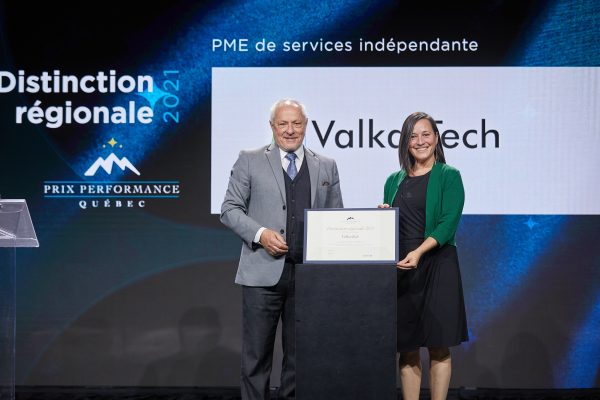
ValkarTech awarded Regional Distinction at Quebec Performance Awards

Montreal-based building hygiene and sanitation firm ValkarTech has been awarded a Regional Distinction at the Quebec Performance Awards.

The awards are part of the Mouvement québécois de la Qualité in partnership with the Quebec Ministry of Economy and Innovation and represent the highest distinction conferred annually by the Government of Quebec to private companies and public organizations that stand out for the quality of their management and their overall performance.

A ValkarTech press release notes the Regional Distinction is “a great honour” for the company.

“This award fills the entire team with pride and reinforces our commitment to promoting the importance of good janitorial practices and maintaining a hygienic environment for the benefit of all,” continued the statement. “This recognition is more than a congratulations for the quality of our work, it is an encouragement to continue to elevate a vital industry that was operating in the shadows before the pandemic struck.”

RELATED: Experience ValkarTech’s expertise

Serge Rioux, President and Founder of ValkarTech, added: “It is the sum of our values and expertise that allows us to achieve our mandates to our clients’ satisfaction, but it is the contribution of an entire team of enthusiastic and dedicated people that pushes us to pursue quality. For us, the greatest success is to make our clients shine!”

ValkarTech was established in 2014 and describes itself as the only expert firm specializing in buildings hygiene and sanitation that offers a full range of consulting services and innovative IT solutions to optimize the overall operations of the building hygiene component allowing for quality control of service delivery and improving the global performance of buildings.

The firm works with Canadian real estate leaders such as Manulife Investment Management to help validate the hygiene and wellness of commercial and residential buildings. The firm offers a multitude of services tailored to the management of janitorial operations, with a focus on technology and the integration of artificial intelligence into operations management.

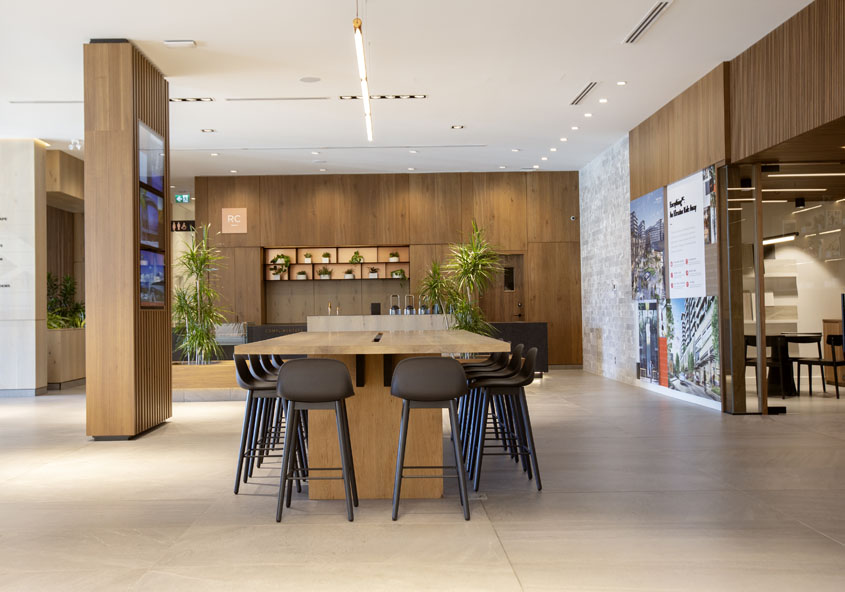
RC at CF Richmond Centre – Evoke International

RC at CF Richmond Centre is a new condo and townhouse development. The design objective for Evoke International was to create a highly program driven space to act as a sales centre for the development.

Separate from the display suites, the 5,700 square foot sales centre was required to act as a space to display and highlight project data and features, and for clients to meet and discuss among themselves and with sales agents. The spaces had to accommodate informal conversation and consideration, as well as more formal spaces to privately meet and formalize purchase.

The concept was inspired by modernist pavilions and the materiality of monolithic wood and stone with large scale elements repeated throughout, revealing selected views and housing various presentation elements. Private meeting rooms and informal gathering spaces are layered throughout an open-ended and functional driven space.

Quasi-urban and domestic space such as a cafe, planter benches, and built-in lounge seating are used to create space for informal meeting and conversation, while generous planting adds comfort and familiarity.

Custom long table seating provides a space for floor plan viewing and sales team meetings. Integrated architectural and accent lighting are tailored to each space.

The end result is a sophisticated space that successfully represents a seamless integration of the client’s programmatic requirements and identity that transcends the typical development sales centre. By creating a space that strives to embody the urban scale and essence of the development it is tasked with representing, it not only frames a unique and elevated presentation of the project, but provides an equally unique, elevated and personal sales experience for both the purchaser and the more casually interested public.


IDIBC AWARD OF EXCELLENCE
MULTI-RESIDENTIAL & SALES CENTRES

Interior Designer: David Nicolay, RID
Design Team: Adam Maitland
Photographer: Janis Nicolay


Burnaby planning a $200M new community centre

The City of Burnaby is planning to replace the aging Cameron Community Centre and Library with a modern and functional facility that will become the civic heart of Lougheed Town Centre.

The current community centre and library, located at 9523 Cameron Street near Lougheed Mall, has served northeast Burnaby residents for nearly 40 years but is no longer adequate as the surrounding area has grown and evolved.  Based on community input received over the past two years, the city has developed designs for a bright new centre that will better meet the needs of northeast Burnaby’s growing and changing population.

The proposed new design includes a range of learning, social, fitness and recreation amenities including:

  • new library
  • aquatic facility
  • double gymnasium
  • weight room and cardio facilities
  • indoor jogging and walking track
  • fitness studios
  • multi-purpose rooms
  • dedicated youth and seniors spaces
  • child minding and indoor and outdoor play areas
  • civic plaza.

The proposed new centre is designed to complement the existing park topography and natural features and will be surrounded by park and green space.

The new replacement Cameron Community Centre would quadruple the size of the community and recreational hub to more than 200,000 sq ft within three storeys.

The new facility includes a new 30,000 sq ft aquatic centre with a lap swimming pool, leisure pool with lazy river, and a large hot pool, as well as a 10,000 fitness gym overlooking the pools.

“We’re excited to see such a bold and modern design emerge from all the public input we received,” said Mayor Mike Hurley. “The new Cameron Community Centre and Library will be the civic centrepiece of northeast Burnaby. We look forward to sharing the plans and hearing what the community has to say.”

Construction is expected to start in 2023 with completion in 2026.

What’s trending in luxury condo design?

Alessandro Munge, founder and design director of Studio Munge, has inspired countless condominium and hospitality projects across the globe, evolving physical environments into memorable experiences for over 20 years. Here, he shares thoughts on creating livable spaces, timeless interiors, and trends in luxury condo design.

What are some elements of highly livable spaces?

Highly livable spaces are relevant and fit for purpose. In the context of global urban densification, condominiums offer an opportunity for many to afford a piece of real estate in prime downtown locations and is also an incredible opportunity to foster a sense of community. I love the word “condominium” because there is a notion of joined venture and community imbued in the word’s etymology instead of “apartments,” representing spatial division.

A well-developed multi-residential project doesn’t behave as boxes stacked in the sky; rather, it acts as an interconnected hive buzzing with life and positive energy. Before specifying a tile or the paint colour on a wall, a designer must first ask the hard questions. Gifted with the power of visualization, we must understand how people live today and project how they might live tomorrow.

Our responsibility is to lift communities by exploring the uncomfortable unknown, especially in the condo development sector. Only by taking chances in creating innovative design solutions can we genuinely contribute our expertise to society.

How can a condo achieve timeless décor?

Every decade sees its share of trends coming and going like champagne bubbles popping at the surface. Timelessness is achieved by creating meaningful and purposeful spaces—dynamic environments that evoke emotions and resonate on a much deeper level.

At Natasha The Residences, inspired by PR maverick Natasha Koifman, we immersed ourselves in our muse’s active lifestyle rather than applying design trends. We imagined all amenities as uber social spaces, as complete home extensions, all curated with inspiring art and bespoke furnishings. Using a predominantly monochromatic palette, we created a world where black completes white like a leather jacket thrown over a little black dress.

Catering to the modern urbanite, we curated the building with relevant and practical amenities, from a multimedia content production studio to a shared workspace. At the same time, there are lots of areas to relax and congregate in such landscaped garden terraces, a circular fire pit, an open kitchen with an integrated pizza oven and even a fashionable laundry mat to mingle in. Although timeless in the design execution, all those spaces bring much more to the building— a comfortable sense of home and a wonderful sense of community.

luxury condo design

Natasha The Residences by Lanterra Developments.

What does luxury design mean in 2021?

I always associate luxury with cravings and a desire for the extraordinary. It is whatever you want more of but can’t always access. Whichever way luxury is expressed, it is always personal to an individual. I always look deep into the personal lives of our clientele to understand what that word means to them, and ask myself how we can infuse this ephemeral concept into every detail—from immersive architectural volumes to experiential space planning all the way down to custom designed furniture pieces.

Our version of luxury isn’t opulence or a stamped and loud display of wealth in a traditional, passé and cliché combination of polished metals, crystal, and marble. We invite sophisticated details, understated quiet luxury expressed in the authenticity and quality of the materials alongside a true appreciation for craftsmanship and art.

At No 7 Dale in Toronto’s Rosedale neighbourhood, luxury is the uncompromised dedication to excellence, starting with the remarkable architecture by Siamak Hariri. It’s about creating not just structures, but homes, cultural landmarks, and valuable legacy investments for generations to come.

Exquisite yet intimate volumes emanate a great sense of privacy. The material palette evokes warmth and authenticity, featuring natural stone, dark walnut wood, and bronze accents. The 26 private homes are also developed using two distinct schemes to fit the buyer’s personal sensibilities, whether contemporary or transitional. No 7 Dale celebrates understated luxury and quality in all forms—from the macro space planning all the way to the artful engineering of all cabinetry.

luxury condo design

No. 7 Dale by Platinum Vista.

What elements should condo corporations invest in?

When it comes to condos as assets, I always tell developers and corporations to invest in the right team, invest in expertise and people that genuinely care. Wallpaper and corridor carpets can be updated, but the space planning and volumes’ quality are much harder to correct.

Alessandro Munge is the founder and design director of Studio Munge. Studio Munge brings to life luxury residential and hospitality projects in partnership with world-renowned architects, visionary global developers, and top-tier hotel operators from Beverly Hills to Hong Kong.

Feature photo: Glen Hill Condominiums by Lanterra Developments

Numerous companies, individuals honoured at ISSA Show North America

On the final day of the ISSA Show North America 2021 on November 18, the recipients of several achievement awards were announced, honouring numerous companies and individuals.

The Jack D. Ramaley Industry Distinguished Service Award, reserved for individuals with at least 10 years of outstanding service to the professional cleaning industry, was presented to Pierre Goudreault, president of Sani-Marc Group in Quebec. For more than two decades, Goudreault has led Sani-Marc Group, overseeing numerous acquisitions to make the company Canada’s leading distributor of sanitation solutions.

The Manufacturer Representatives’ Distinguished Service Award, which recognizes individuals who support manufacturer representatives, the industry, and ISSA, was awarded to Pat Cassidy, director of sales at Tolco Corp. Over the course of nearly 30 years, Cassidy has worked for three generations of the family-run business in a variety of sales roles that support manufacturer sales representatives and Tolco’s growth.

The ISSA NextGen Rising Star Award in Honor of Jimmy Core, which acknowledges emerging leaders who make positive contributions to their organizations and the industry, was given to Valérie Gagné-Cyr, marketing advisor at Cascades PRO. Gagné-Cyr was honoured for her commitment to educating wholesalers and distributors about safe and sustainable cleaning solutions, promoting ISSA Show North America, supporting ISSA Hygieia Network events, launching an experts panel on healthy, green solutions, and more.

ISSA Hygieia Network, an ISSA Charities signature program that is dedicated to the advancement and retention of women in the cleaning industry, announced its own 2021 award winners, including:

  • ISSA Hygieia Network Member of the Year, which recognizes a woman’s involvement in activities that align with Hygieia’s mission and vision, went to Heidi Solomon, Head of Global Strategy, Kimberly-Clark Professional, for her dedication to Hygieia and efforts to grow its impact over the past year.
  • ISSA Hygieia Network Rising Star of the Year, which honours a woman aged 45 or younger who has made significant achievements and demonstrated consistent upward mobility in her career within the industry, was presented to Charishma Kothari, Global Marketing Director, Essity, for her impressive career trajectory and achievements within the cleaning industry.
  • ISSA Hygieia Network Company of the Year, which celebrates a company’s involvement in activities that align with Hygieia’s mission and vision, was awarded to Kimberly-Clark Professional for its contributions to advancing the role of women in the cleaning industry and increasing diversity, equity, and inclusion in the workplace.

In addition to revealing this year’s winners, ISSA Hygieia Network acknowledged the 2021 Hygieia Scholarship recipient Maia Spallone, who is pursuing a degree at the University of California, Irvine. Hygieia also recognized the contributions of its volunteers and sponsors to a successful year of educational, mentoring, and networking programs.

Innovation Awards

Meanwhile, Tork, an Essity brand was honoured with the Innovation of the Year Award for its Interactive Training for Healthcare. The free interactive training tools address critical hygiene needs of infection control, healthcare, and environmental services professionals.

In addition, the Innovation Awards program recognized the latest advancements for the commercial, institutional, and residential cleaning industry.

The recipients of the five Innovation of the Year Award Honourees were:

  • Flex Scrub™ from Malish Corp., a bristled floor pad that blends the familiarity and easy installation of a traditional pad with the robust cleaning power of a brush for a deeper level of cleaning.
  • Force of Nature PRO from Force of Nature, an all-in-one cleaner, deodorizer, and disinfectant with no harmful chemicals that is an EPA-registered sanitizer and disinfectant that kills 99.9 per cent of germs.
  • Simple Check™ from Core America, an app that utilizes QR codes and cleaning industry checklists to log disinfecting task completion, monitor and validate cleaning efforts, and simplify reporting and log keeping.
  • The EZ CARE Floor Care System from SC Johnson Professional a simple, fast, and economical way to maintain flooring which delivers an efficient floor care system, saving time and labour costs.
  • The PureDri Sanitizing Hand Dryer from Bobrick Washroom Equipment Inc., which utilizes UVC technology to neutralize pathogens in the air and on surfaces, purify the air, and dry hands in restrooms.

And the recipients of the four Innovation Industry Choice Awards were also announced:

  • Distributor Choice Award: Aunt Flow’s Model R Recessed, Free-Vend Menstrual Product Dispenser, which helps facilities leaders meet demand to provide free period products in washrooms.
  • Facility Service Provider Choice Award: Diversey’s MoonBeam™3, an ultraviolet-C (UVC) disinfection technology with three pivoting UVC heads which has a rugged design and is extremely portable. This technology provides the ability to easily and correctly apply UVC energy to both horizontal and vertical surfaces for on-demand disinfection in as little as three minutes.
  • Manufacturer Representative Choice Award: Dial Complete® Clean + Gentle Antibacterial Hand Soap Refills from Dial Professional, Henkel Consumer Goods Inc., which effectively and gently cleanse, hydrate, and care for skin as they clean.
  • Residential Cleaning Choice Award: Ecolab Inc.’s Peroxide Multi-Surface Cleaner and Disinfectant, an EPA-registered cleaner and disinfectant with a comprehensive claim set that can disinfect surfaces in as fast as three minutes.

Visit the ISSA Show North America website for more information on all awards and winners.