Articles Archive - Page 309 of 928 - REMINET
REMI

NS incents EV chargers in multifamily buildings

Nova Scotia has allocated $1 million over two years to help subsidize electric vehicle (EV) charging stations in multifamily apartment and condominium buildings. Few details are yet available on the initiative, which was announced yesterday as part of a $9 million outlay from funds collected through the province’s cap-and-trade program earnings for 2021-22.

“Nova Scotia is committed to having 80 per cent of our electricity needs filled by renewable energy by 2030. We’re pleased to see programs that help with things like upgrading buildings to become more energy efficient, reducing energy bills and reducing greenhouse gas emissions,” says Tony Rushton, the provincial Minister of Natural Resources and Renewables.

In total, six projects will receive the last installment of nearly $45 million in cap-and-trade revenues raised in the fiscal year. Also of potential interest to the multifamily sector, $1.5 million over three years will be directed to a pilot program to support replacement of oil-based heating systems with electric-based alternatives.

Facilities managers with registered not-for-profit organizations, such as churches or foodbanks, will also be eligible for the rebates for solar installations similar to those already available for homeowners. $1.5 million will be available over two years.

Efficiency One, the not-for-profit coordinator and delivery agent of a range of energy efficiency initiatives will deliver all three programs. Meanwhile, multifamily building managers have one final day to apply for EV charger funding made available through the federal government’s Zero Emissions Infrastructure Program (ZEVIP), which has a pot of approximately $1.2 million to fund up to 250 level-2 EV chargers.

In that quest, which opened for applications in late February, they’ll have more competition. Multifamily buildings with at least three dwelling units are one of five categories for which the funds are targeted. Public venues, on-street sites, workplaces and organizations with light-duty vehicle fleets are also eligible.

Creating meaningful Indigenous partnerships

With a growing number of construction companies across Canada looking to build partnerships with First Nations, it is important to understand the dynamics of Indigenous communities and what they can bring to the table.

Indigenous engagement and partnerships can offer construction companies a competitive advantage, more efficiency, less risk and the answer to the industry’s aging demographic.

Indigenous youth could help solve the industry’s skilled labour shortage, according to Jesse McComrick, director of research, innovation and legal affairs for the First Nations Major Projects Coalition (FNMPC).

“We know Indigenous people are the fastest growing demographic in Canada. The federal government estimates 400,000 indigenous youths will be of age to enter the workforce in next decade. We hope many of those will be engaged in trades,” he said at the Canadian Construction Association annual conference held in Vancouver.

He advised that companies wanting to hire Indigenous workers should have a plan to address common barriers such as transportation, education attainment, and family obligations.

“It also requires concerted efforts to change cultures and expectations…changing the language of the job site so it is inclusive and provides for diversity. Those challenges are real, impacts are real, prejudices are real but can be fixed,” said McCormick, stressing inclusion starts at the top.

Recruitment strategies that companies can use include placing postings in areas where prospective Indigenous employees look for work; using firms specializing in Indigenous recruitment; and partnering with Indigenous employment training counsellors and educational institutions.

“Don’t look just for entry level opportunities. If you’re doing significant amount of work in and around Indigenous communities, and you don’t have Indigenous people in your senior leadership, then you’re doing something wrong,” said McCormick.

Enhancing the economic wellbeing of First Nations members, he explained, is the main goal of FNMP, a non-political and business focused coalition of more than 80 First Nations organizations.

“We’re working on a project portfolio of $17 billion – all of those involve equity positions for First Nations and First Nations partners,” said McCormick, who highlighted the Clark Lake Geothermal project as an example of what is possible when indigenous communities are empowered to lead and own major infrastructure projects.

Indigenous engagement is also about companies honouring the Truth and Reconciliation Commission’s Calls to Action. McCormick said Truth and Reconciliation is “significantly shaping government policy and relationships between Indigenous people and industry.”

“There’s a significant procurement advantage to having strong indigenous partnerships. Major resource companies, government departments and other public agencies look favourably on and sometimes require diversity. Your ability to demonstrate support of Indigenous partners can enhance your competitiveness and priority in the bidding process,” he said.

Creating meaningful inclusion and equity positions will ultimately bring benefits for everyone, said McCormick, and it’s important to show Indigenous youth they have opportunities and choices.

“Find a way to be a company that other companies look to as an example of how to work collaboratively with Indigenous people,” he said.


Cheryl Mah is managing editor of Construction Business.

Condos at high risk from reserve fund shortfalls

The growing crop of condo owners across Canada will likely encounter huge annual fee increases and lump-sum payments due to low reserve fund contributions, authors of a new research report are warning.

As detailed in the Canadian Institute of Actuaries’ 140-page paper, Longevity of Infrastructure – Reserving and Risk Management in Condo Maintenance in Canada, owners will ultimately absorb deferred contributions left behind by their unit-owning predecessors who rashly agreed to initial “artificially low” fees, particularly in condos constructed since 2000. In newer condos, once a reserve fund study is performed and unforeseen repairs pop up, annual increases will likely skyrocket compared to older buildings.

Data compiled from about 300 reserve fund studies from clients of engineering firm McIntosh Perry was examined through the lens of actuarial science. A mathematical stochastic model was created to assess the viability of reserve funds and understand how they evolve through time in existing condos, both high-rise and townhomes.

Corporations must reasonably fund these reserve accounts used for the major repairs and replacements of common elements, the cost of which is also rising higher than the rate of inflation, making it harder for boards to predict required funds 10 to 60 years down the road.

Owners will need more time to pay into the reserve account. As the analysis found, the typical 30-year coverage period of a reserve fund study isn’t enough. Sixty years would be more appropriate, as some common elements have a longer life cycle.

Authors Jean-Sébastien Côté, Fellow, Canadian Institute of Actuaries and Jon Juffs, Director, Facility Assessment and Restoration, at McIntosh Perry, propose solutions that boards should consider to protect their investments.

“Reserve funds are often looked upon as a necessary evil of condominium living, but they should be looked upon as a necessary investment in your home,”says Juffs. “A well-kept building will retain its market value.”

Rising expenditure costs creating more guesswork

The cost of goods and services used within condos—from building system components to contractors’ services—tend to be higher than inflation or the average salary.

As displayed in the report, the inflationary price of common elements between 2001 and 2020 neared to almost 90 per cent due to variables like pricier materials (or lack thereof) and labour cost increases.

Expenditure costs come in all forms. Sealant materials are just one example. As Juffs explains, caulking may contain silicone or oil industry-dependent polyurethane materials, which are rising dramatically in price. Silicone has doubled over the past three months.

“People may think it only costs a couple hundred dollars to seal joints around a window, but now it costs $400 and next year it will be $800,” he says. “As fossil fuels disappear from the production line, we’re going to have to come up with new and creative ways to seal joints.”

On a larger scale, sand used for glass is becoming more difficult to source, and glass manufacturers are looking for new ways to use less of it. Juffs says this change in glass performance will be challenging to evaluate. “Look at every new building; they’re nearly completely glass,” he says. “They are in high demand and they’ve got a dwindling supply of raw materials.”

The need for specialized equipment, primarily in downtown cores, is yet another concerning impact on future maintenance costs. Dismantling a mechanical system and moving components down an elevator takes substantial labour, as does steering them down the exterior side of a condo.

“Most buildings don’t have those original construction fasteners there anymore because they’re covered up in wall materials,” says Juffs. “These taller buildings are going to become an interesting challenge. To change out a $50,000 to $60,000 make-up air unit you might end up spending $100,000 to $150,000 in excess equipment to get to it and bring it down.”

A financial cushion for emergencies and unexpected market changes would be above what is required by a reserve fund study. Taking a risk management approach to reserve funds is what more condos should do, says Côté. Similar to the field of retirement planning in which he works as an actuary, problems arise when it comes to accumulating capital in condo reserves.

“Not many people save much for retirement and when they get there, they deplete their fund quite quickly at the beginning and are left with RPP and OAS,” he says. “Doing a budget for one year is easy. Managing assets over a long period of time, over decades; it takes dedication and knowledge and it takes the right people to tell you you’re wrong about the level of contribution you think is good.”

Many condo directors unprepared to manage assets over time

Condo corporations may house low pools of experienced owners or reluctant volunteers who need nudging to the board table. Owners who do find themselves in a governing position will need to be cognizant of reserve funds.

“This is a key point of education that is going to become more necessary as time goes on and as people continue to age in place,” says Juffs. “Most people who are retiring in their home don’t really want to be involved in going back to school again.”

In Quebec, like other locations across Canada, Côté explains owners aren’t required to take any courses. “If they are serious about their job, they will obtain education, but it’s not easily available,” he says. “There is a lack of finding proper ways to manage a condo and get information on how to apply some rules into the condominium.”

As it stands, Ontario is the only province that legislated mandatory director training through the Condominium Authority of Ontario. Even so, anyone who has fulfilled that online course likely became swiftly certified, without the chance to dig deeply into reserve fund studies.

In fact, in her value-for-money audit on condominium oversight in 2020, Ontario Auditor General Bonnie Lysyk flagged serious flaws in director education. At the time, the audit discovered more than 6,000 ineligible condo directors, who did not complete the designated training, continue to serve on boards.

Directors are also completing the course without reading the training materials. “If directors do not spend the time needed to properly review training content and gain an understanding of it to manage the obligations and finances of the condo corporation, they might not possess the necessary knowledge to fulfill their duties and obligations,” the audit stated.

“Most people need both the interaction of other students learning and instructors talking to them and engaging in the situation,” adds Juffs, who champions in-person, continuous education like associations offer, depending on the locale. “Have meaningful conversations about what applies and doesn’t. Interactive back-and-forth discourse with experts at the table helps an awful lot.”

Ongoing training is key in an ever-changing industry that must also keep up with the evolving needs of residents. For instance, forthcoming legislation related to the Accessibility for Ontarians with Disabilities Act, which will make existing and new buildings more accessible and inclusive by 2025, is another impending cost that might not be on a corporation’s radar. The law will soon dictate that walk-up condos accommodate persons with disabilities.

“I think vertical transportation of people is going to be a big concern,” says Juffs. “The Ontario Building Code is making a bunch of changes right now for the next edition of the Code that will affect new construction and major improvements, but if these buildings are left the way they are and people are trying to age in place, those condos will be facing human rights issues.”

Legislation for greater data transparency

There is a lack of data related to reserve funds. Increasing the availability and collection of this data would provide greater transparency for potential purchasers and help protect the value of condo infrastructure, the report concludes. This could come by way of a standardized form, administered by governments to gather more relevant data.

Ontario is currently inundated with forms, from annual reports to new owner information certificates. Juffs isn’t so sure the information on those forms is of much value and believes a repository of data is the way to go.

As he explains, this would be aggregated public information, administered by someone with authority, but without direct interest in the data. It wouldn’t be specific to a property, but rather a location.

A potential purchaser could gauge their ability to afford typical common expense fees for a specific area without realtor pressure weighing on the decision. They’d be able to compare and ask better informed questions to condo corporations about why their contributions are too high or too low.

“Eventually, once the data set is robust and readily available, people will start to come up with all sorts of ways to compare,” says Juffs. If pools are high on the list, a buyer could understand what kind of condo fees are associated with those types of buildings.

Reviewing minimum annual contribution and reserve fund balance

The strength of legislative requirements related to reserve funds varies across Canada. The report evaluated provinces and territories based on a number of contributing factors, leaving out Prince Edward Island and Nunavut, which are devoid of any requirements.

British Columbia and Saskatchewan sit at the bottom, but even in places like Ontario and New Brunswick, which garnered the most points, there is room for improvement.

Sustaining a minimum yearly contribution that is reasonable and a fund balance is just one element in all this. It’s advised the fund balance doesn’t dip below the amount of deductible for property damage on the corporation’s insurance policy.

The minimum annual contribution should be prescribed through an up-to-date reserve fund study, with a legally mandated review and update every three years. In absence of the study, the ‘bare minimum’ should be 1 per cent of the full reconstruction cost of the condo, the report emphasizes.

Provinces vary in this regard. Quebec determined that 0.5 per cent of the replacement value of the building is the right amount to contribute.

“The Condo Act in Ontario still allows developers to set up the initial contributions at 10 per cent of operating, which I think is absolutely the worst model,” says Juffs. “The right contribution is the one where you have enough money to pay for the future repair or replacement needs, but not so much, as this only comes back to the homeowners if the condo is dissolved.”

He estimates this to be in the $250 to $275 per unit per month range, although he feels that’s likely too high for most corporations, and spot on or a little low for others, and also depending on variables like pools and parking garages.

To grasp the urgency of reserve funds, all one needs to do is look at the repair oversights that surfaced from the condo collapse in Surfside, Florida last summer.

​​“We learn a lot from tragedy,” says Juffs. “What I would stress to Canadian condo corporations is don’t bury your head in the sand. Take the information, prioritize the work that is being identified—life safety is the priority—followed by functional use of the building and technical obsolescence.”

The concept of risk management throughout the report is what the authors hope their readers will grasp, as it identifies a low risk of concern in the immediate term, but impending shortfalls that threaten affordability.

“Is the need to contribute to a fund and afford common element repairs going to stop you from living in condos? No,” says Juffs. “But you should be cognizant and aware of the ever increasing risk of those costs going up dramatically, so you can manage your own personal circumstances and make sure you’re in the right place at the right time.”

The full report, Longevity of Infrastructure – Reserving and Risk Management in Condo Maintenance in Canada, is available here.




Keeping the water at bay

With winter making its slow retreat, now is an ideal time to ensure buildings aren’t susceptible to a springtime of water issues.

“Ontario has seen a significant amount of snow over the winter; and with temperatures fluctuating, much of this snow has now thawed and frozen, resulting in ice build up on the roofs and around the base of our buildings,” says Craig Smith, Director of Commercial Business Development with First Onsite Property Restoration.

True, the odd crack or clogged catch basin won’t seem like much at first glance. However, property operators who leave these building deficiencies off the radar for too long risk opening the doors to significant financial and safety risks down the road.
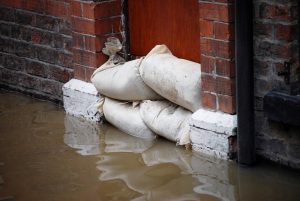
In short, Smith adds, it pays to get ahead of issues before they turn into disasters.

Plugging the source of water disasters

Where water damage appears in a building, costly repairs and safety risks are soon to follow. And after decades of responding to floods, extreme weather events, and water-related emergencies across the country, Smith and the team with First Onsite have seen how small leaks and breaches turn into oceans of trouble for building owners and residents.

Granted, not all water damage is created equal. According to First Onsite, the three main hazard categories for water include:

  • Clean water (Category 1): clear water that may come from overflowing sinks, broken water or steam lines, and rainwater which needs to be addressed 24-48 hours after detection to mitigate risks of contamination.
  • Grey water (Cat 2): water that comes from more contaminated water sources and therefore poses slight to severe health risks.
  • Black water (Cat 3), highly contaminated (and highly dangerous) water from exterior sources such as sewers, rivers, and other potentially hazardous sources.

FIRST ONSITENo matter the colour, it’s important to catch and mitigate water damage before the situation evolves. According to Smith, a good starting point is to have an inspector conduct a top-to-bottom assessment, explaining: “You want to start at the roof and inspect all the flashing and shingles for openings where water may get in, as well ensure waterproofing is intact. While up there, it’s important to remove large snowdrifts and any snow or ice build-up as this will reduce any stress on the roof structure.”

Most apartment/condominium buildings won’t have a sloped roof, he adds, but those that do pose additional risks of falling snow and ice. As such, it’s important that building occupants and visitors are alerted to these risks when walking below.

It’s also important to inspect for water damage at the base of the building. While there, inspectors should ensure that water is being directed to catch basins and that those basins are free from obstructions.

FIRST ONSITE“This is crucial in preventing costly water damage,” says Smith. “Also, you’ll want to keep an eye out for ice buildup where the foundation or base of the building meets ground level, as ice build-up here can lead to water entering and expanding in even the smallest cracks in the foundation, leading to potential water damage in the interior of the building.”

Building on this, it’s also important to inspect the building’s foundation for any holes or cracks and to repair these wherever possible as ice and snow begin to melt.

Leave it to the pros

Property operators have a lot on their plates at all seasons, meaning water damage prevention and mitigation isn’t always high on their list of things to do. As such, there is an advantage to working with a third-party water damage specialist who knows what to look for and who can step up in the event of a water emergency.

For its part, says Smith, First Onsite believes strongly in helping clients not only spot trouble before it occurs (e.g., mould development, leaks, etc.) and ensure issues are spotted and mitigated quickly and effectively.

“As with any potential water or weather damage issues, First Onsite is here to help, as a trusted partner in not only responding to costly repairs, but in helping our clients with preparation and prevention,” he adds.

FIRST ONSITE is a leader in water damage prevention, disaster remediation, property restoration, and reconstruction services, helping North America restore, rebuild, and rise after catastrophic events of every kind. Learn more at www.firstonsite.ca.

M City’s fifth tower debuts in Mississauga

Rogers Real Estate Development Limited and Urban Capital launched the fifth of eight towers planned for M City, which will bring more than 6,000 units to the Mississauga core by the community’s completion.

M5 is described as M City’s most exclusive building, with health and well-being at the forefront of architecture, interior design, and amenity programming. It follows M1, M2 and M3, which are all completely sold out, and the almost sold out M4, one of Canada’s most technologically advanced condos.

“As we welcome the first residents to M City and continue momentum on the site, we’re thrilled to reveal M5, an exclusive tower that will offer the best of Mississauga living, in the heart of its most exciting community,” says John Anderton, vice president, treasurer, Rogers Telecommunications Limited.

Global architecture firm IBI is once again helming the design of M5. This time around, the design establishes a sense of place by creating synergies with the adjacent parkland. On the ground floor, a pedestrian-first, shared street strengthens the building’s connection to its surroundings, while a new retail space features floor to ceiling glass windows to optimize views.

“The architecture at M City is very dynamic, with forms that move, twist and turn to create an exciting development. M5 is a counterpoint to that, grounded in its relation to the surrounding environment,” says Mansoor Kazerouni, global director of buildings, IBI Architects. “M5 is about being quietly confident, legible and simple in its formal disposition. It dwells on placemaking and a connection to the centrepiece of the community, M Park.”

With a focus on well-being, interior design firm Cecconi Simone incorporates biophilic materials and prioritizes a connection to nature and the outdoors throughout the interior spaces and amenities. The building is inspired by a Japanese aesthetic with interiors that celebrate simple, clean lines and a layered approach to materials, lighting, and design elements.

Understanding the increased desire for self-care and respite as we emerge from over two years in lockdown, amenities offer a spa-like experience for residents. This includes areas for meditation, a Hammam steam bath, individual infrared saunas, a massage room, and Zen Lounge. In addition, residents will have access to essential amenities such as a lounge, dining room, media room, gym, and kids’ playroom.

“M5 is markedly different from the other phases. It is smaller and quieter in its architectural expression, so a new approach to the interiors and amenities was crucial for this phase,” says Elaine Cecconi, Founding Partner, Cecconi Simone. “If we were to describe M5 as a persona, it is introspective, reserved and calm, offering residents the ability to choose to engage or to be solitary in the myriad of beautiful amenity spaces available.”

M5 will feature units ranging from 450 square feet to over 1,000 square feet, including studios, one-, two-, and three-bedroom options.

“Creating a walkable, mixed-use community that emphasizes the public realm has been at the core of our work at M City,” says Mark Reeve, partner, Urban Capital Property Group. “With M5, we’re bringing this to a new level, offering residents a living space that is inspired by the outdoors from the inside out.

Mississauga

The importance of professional service providers

Looking back on the past two years, it’s safe to say that businesses have faced many challenges that will forever change how they approach cleaning. Supply shortages throughout the pandemic showed businesses how much the supply chain influences day-to-day operations.

A supply chain study by Ernst & Young last year found that only two per cent of companies were fully prepared for the pandemic. Alternatively, serious supply chain disruptions affected 57 per cent of businesses, with 72 per cent reporting some form of negative effect.

As we move toward the post-pandemic era, additional challenges such as labour shortages pose a serious risk to keeping facilities clean. Heightened expectations around cleanliness are here to stay and using a professional service provider can help avoid lapses in cleanliness and instill confidence in customers, employees, and other building visitors as facilities return to full capacity.

The future of the industry

During the pandemic, consumers became more aware of germ transmission. Consumers expect businesses to take every precaution necessary to prevent the spread of COVID-19, as well as the “forgotten” viruses such as norovirus, influenza and rhinovirus. This will continue long after the pandemic is over. In fact, more than nearly two-thirds of Americans say they want to continue to see public facilities frequently disinfecting and sanitizing restrooms post COVID-19 pandemic.

Having the ability to source cleaning chemicals and essential supplies will continue to be important as businesses prepare for increased foot traffic. Professional service providers eliminate the hassle of tracking down supplies and can help ensure that facilities are adequately stocked.

The benefits to your bottom line

Partnering with an outsourced service supplier provides the following benefits:

  • Eases daily maintenance: Experiencing a disruption in the supply chain or panic-buying at retail stores can be avoided when partnering with a service provider. For example, some providers offer chemical dispensing systems, which connect directly to the waterline and dispense properly diluted chemicals at the touch of a button. This helps avoid improperly mixing dangerous combinations of chemicals and decreases spending on ready-to-use chemicals, which frees up capital and saves space.
  • Additionally, some service providers can offer periodic deep cleans with high-pressure cleaning and extraction equipment, specifically in washrooms, which eases daily washroom maintenance. Using intermittent high-pressure cleaning helps remove deeply embedded dirt and bacteria in washrooms. It also extracts soil and dirty water to prevent cross-contamination and odour-causing bacteria and removes build-up that can’t easily be reached by brushes and other conventional tools.
  • Cleaner facilities: Having an adequate stock of cleaning chemicals, washroom supplies and other tools such as microfibre wipes can help enable staff to clean washrooms effectively. Lacking these essential products can strain cleaning operations and detract from the facility’s overall cleanliness.
  • Premium offerings and services: Thorough and professional cleaning of facilities is critical in reducing the spread of germs. Most cleaning services only perform a quick wipe-down of high-touch surfaces or emptying of trash; and that’s assuming that businesses can find the labour. Professional service providers have the skills, knowledge, proper equipment and manpower to provide a quality clean that helps reduce the spread of infection.
  • Long-term cost savings: It’s critical that businesses avoid cutting corners on cleaning processes as it will cost more in the long run. For example, a negative online review about restrooms would deter 91 per cent of Americans from a hotel and 89 per cent from a restaurant, which can result in lost business. Additionally, 42 per cent of a floor’s finish can be removed within the first six feet of an entrance after only 1,500 people have entered the building. Floor replacements can be costly. Implementing a comprehensive mat rental program prevents dirt and debris from entering the building to help protect your investment.
  • Better first impressions: A clean facility can make or break a customer’s first impression. Washrooms made up 44 per cent of complaints in 2020, and 95 per cent of customers won’t return to an establishment with a dirty washroom. Items like toilet paper, paper towels, hand soap, sanitizers, trash bags, and other cleaning and hygiene supplies run out at uneven intervals. This makes them difficult to track and replenish regularly. Professional service providers regularly restock items and follow maintenance schedules, which keeps customers and employees happy and satisfied.

Ultimately, heightened awareness around cleaning will continue. The COVID-19 pandemic tested supply chains like never before, and an increase in foot traffic may have the same effect.

Using an outsourced service provider can help businesses meet heightened public expectations of cleanliness by helping to create a reliable supply chain and help instill confidence in customers, employees and others visiting their facilities.

John Engel is the director of marketing for the Facility Services division of Cintas and is currently responsible for product line management and development.

University of Calgary recognized for environmental stewardship

ISSA Canada, a division of the worldwide cleaning industry association ISSA, has announced that the University of Calgary is the 2022 recipient of the ISSA Canada Environmental Stewardship Award.

ISSA Canada’s Environmental Stewardship Award recognizes and honours organizations committed to environmental management and dedication to the value of clean. Each year, the association presents up to six awards (one for each region of Canada), where nominations have been submitted by a current ISSA Canada member company. Winners are selected by the association’s executive staff based on their ability to meet four of the six award criterion.

The University of Calgary is a leader in sustainability and safe, environmentally-conscious practices, says ISSA Canada. With an Institutional Sustainability Strategy (ISS) in place, the university has a clear vision to become a zero-waste leader amongst post-secondary institutions across Canada, and its goal is to divert 70 per cent of waste by 2025 and 90 per cent by 2030.

In addition to continuous training and engagement with caretaking staff, university faculty and students, the University of Calgary has implemented multiple programs and Standard Operating Procedures (SOPs) that not only illustrate its goal of sustainability, but also a commitment to health and safety.

“ISSA Canada has long been recognizing the outstanding initiatives that Canadian facilities have implemented to help the environment and reduce their carbon footprint,” said ISSA Canada Executive Director, Mike Nosko. “The University of Calgary is so involved with ISSA, and they have the most knowledgeable staff when it comes to cleaning procedures and environmental practices that I have ever seen. The ability of the university to meet the criteria for our prestigious award was simply off the charts.”

“We’ve worked really hard to not only implement systems but to change a culture, and that’s something that hasn’t been easy,” said University of Calgary Caretaking Director, Michael Love. “It has been an interesting journey that has taken a lot of effort from a lot of people. We are all really proud of where we are today within our department and with what the University is doing as a whole.”

Love added: “I am honoured to be accepting the Environmental Stewardship Award on behalf of the Caretaking team at the University of Calgary. This award highlights our commitment to sustainability, one of our eight core values. The Caretaking Department is proud to be recognized for our excellence in operational practices and our collaborations to create a world-class campus. In our work to care for physical spaces, we are always mindful of the impact on the planet and the contribution to the health and safety of the larger campus community, as well as the student learning experience.”

As well as implementing waste reduction programs such as Standardized Four Stream Waste Stations (to separate trash, refundable beverage containers, mixed recycling, and compostables); a Blue Bucket Program (for safe lab waste collection and disposal); a Washroom Paper Towel Program (to ensure paper products are diverted from waste collection to the composting stream); and a Green Cleaning Program (the use of green-certified, low-VOC products), the University of Calgary has also embraced technology with the use of both robots and efficient machines that require one-third less water and 70 per cent less chemical.

“It’s that commitment to healthy and safe facilities, environmental awareness along with the implementation of operational cleaning strategies to reduce carbon footprint that the University of Calgary has demonstrated which clearly outlines ISSA’s goal of ‘changing the way the world views cleaning’,” Nosko said. “It is such a great pleasure to present the University of Calgary and, perhaps more importantly, its staff with this year’s Environmental Stewardship Award.”

Image: University of Calgary

EllisDon hosts subcontractor security workshops

Important subcontractor security workshops were held across Canada by EllisDon along with five construction associations in January and February. The workshops, which attracted more than 200 virtual attendees, aimed to educate the industry on the Contract Security Program, targeting companies who had not yet applied for a security clearance or needed to upgrade their organization’s clearance level.

“In our experience with projects that had security clearance requirements in Alberta, we found that very few companies knew about and/or had clearance with the Contract Security program,” said Nicole Isinger, finance project accountant at EllisDon and one of the workshop’s presenters. “EllisDon wanted to help bring awareness and attention to this security clearance requirement for the upcoming projects.”

The free, 30-minute long virtual workshops were jointly held by the Mechanical Contractors Association of Canada (MCAC), Edmonton Construction Association (ECA), Vancouver Regional Construction Association (VRCA), Construction Association of New Brunswick (CANB), and Construction Association of Nova Scotia (CANS).

The presenters covered topics such as tendering processes, organizational/company and personnel clearances requirements, clearance procurement, and how to apply for security clearance projects. At the end of each workshop, attendees had an opportunity to provide feedback and ask questions. EllisDon provided each attendee with a copy of the presentation.

“We wanted to expand the opportunities to companies that are interested in working on projects that have security requirements by sharing EllisDon’s knowledge and experience,” said Brayden Mason, estimator at EllisDon and one of the workshop’s presenters. “We work with many subcontractors in this business, and we can get the job done better if we work together and knowledge share.”

EllisDon is scheduled to host another round of workshops in the coming months. The workshops are advertised through the various construction associations and EllisDon’s website and social media channels.

New Mississauga Hospital will become Canada’s largest

A full replacement of the new Mississauga Hospital from Trillium Health Partners (THP) will rise 24 storeys and 2.8 million square feet to become the largest hospital in Canada.

Stantec was selected to provide planning, design, and conformance services for the project, which will offer a new kind of healthcare for a growing and diverse community in the Greater Toronto Area city.

The new, more flexible hospital will nearly triple THP’s care capacity and respond to future healthcare challenges, feature modern hospital facilities and technology, and reflect the latest standards in infection prevention and control.

It will continue to deliver highly specialized care through regional programs, such as the regional centre for advanced cardiac surgery and neurosurgery services among others.

To meet the needs of the growing Mississauga community, the replacement facility will offer more than 950 beds. The number of operating rooms will increase to 23, up from the current 14.

Mississauga Hospital

Mississauga Hospital South View.

THP’s emergency department, one of the busiest in Canada, will significantly expand to improve patient experience and reduce wait times. Also housed in the new hospital will be advanced diagnostic imaging facilities and a new pharmacy and clinical laboratory.

“Critical health infrastructure, like Trillium Health Partners’ Mississauga site, are essential to advance quality healthcare in Ontario and keep our diverse communities healthy,” said Suzanne Crysdale, principal for Stantec. “We are exceptionally proud to design a place which enhances community cohesion and where patients feel welcomed, safe, and comforted while receiving advanced care.”

Stantec’s work for THP includes two of several major healthcare projects the firm has designed in Ontario in recent years, including Cortellucci Vaughan Hospital’s new 1.2 million-square-foot facility, Cambridge Memorial Hospital’s new patient care wing, Brockville General Hospital’s Phase 2 Complex Continuing Care, Mental Health, and Rehabilitation project, and Centre for Addiction and Mental Health’s Phase 1C Redevelopment.

Greening your washroom for the good of the planet

March 21, 2022, is International Day of Forests, which encourages everyone to engage in sustainable activities that help the health of forests.

While that is just one day, its core message is one that should be recognized every day of the year.

Sustainability and environmental consciousness have become key objectives and performance indicators for companies in all industries in recent years, and that is certainly no different for facility management.

There are numerous ways to reduce a facility’s negative impact on the environment, and focusing on washrooms is one of them. Whether it’s limiting water use, reducing wasted resources, or focusing on increased use of recyclable products,

“Forests are a vital aspect of our ecosystem and must be protected,” said Fabio Vitali, Vice President of Marketing at Sofidel, a global provider of paper for hygienic and domestic use. “By following best practices for sustainable cleaning and using restroom products that limit waste, organizations can help limit their impact on the environment.”

Sofidel is just one of a number of cleaning product suppliers that are leading the way in sustainability. Recently, it was recognized in the Leadership band of the CDP Supplier Engagement Rating Report 2021 for its supplier engagement in the fight against climate change. It is also one of the first companies to participate in the “Forests Forward” initiative by WWF to consolidate the timber procurement policy.

Here, Vitali shares four tips for operating a more sustainable washroom:

  1. Consider adding automatic dispensers. Some automatic dispensers are specially designed to help facilities save costs and reduce waste by curbing the amount of paper towel that washroom guests use. The dispensers accomplish this by allowing facility managers to customize the length of towels.
  2. Choose restroom products made from renewable sources and/or recycled materials. Using recycled plastics, rather than producing new plastic materials, significantly minimizes greenhouse gas emissions. There are washroom products made from plastic waste that are also incredibly durable, like paper towel and toilet paper dispensers.
  3. Limit water consumption. Choose toilets that help minimize water waste during the flushing process. Options include dual-flush toilets, like WaterSense toilets that meet Environmental Protection Agency (EPA) certifications and low-flow toilets.
  4. Use sustainable products. There are several third-party certification groups, including Green Seal, that objectively evaluate products to ensure they have been sustainably produced. Using certified products can help businesses reduce CO2 emissions, volatile organic compound (VOC) pollution, and organochloride pollution.

U.S. UPRREIT pioneers cryptocurrency options

NOYACK Logistics Income, a private, non-traded fund specializing in alternative real estate asset classes, is forging a pioneering path in the United States through the acceptance cryptocurrency payments. The investment platform has announced a new partnership with BitPay that will allow investors to convert a dozen designated cryptocurrencies — including Bitcoin, Dogecoin, Ethereum, Shibu Inu and five stablecoins pegged to the U.S. dollar — into shares.

Investors will now have the option to use cryptocurrency, conventional currency or a combination of the two. Buyers will also be able to make their investments via mobile devices. Stephen Pair, chief executive officer of BitPay, projects consumers will make USD $55 billion in purchases and investments using cryptocurrency over the coming year, and he reports growing demand for allocations to asset ownership structures such as REITs.

“We see the future of financial transactions on the blockchain and this is another example of moving crypto mainstream with bridges to traditional financial services,” he maintains. “The option to transact in crypto puts them at the forefront of alternative investment management.”

NOYACK Logistics Income is an umbrella partnership real estate investment trust (UPREIT) launched in the fall of 2021 with USD $30 million of NOYACK Capital’s industrial and parking assets. It is focused on life sciences, temperature-controlled and dry storage warehouses, health care facilities; and mobility hubs, and has stated objectives to qualify as a REIT and acquire USD $500 million in properties. That also involves deployment of proprietary analytics and market research to identify opportunities aligned with autonomous vehicle infrastructure, same-day delivery and other logistics-related uses.

“For any investor looking to redeploy crypto gains into dividend-producing investments, our partnership with BitPay makes it a reality and a seamless transaction,” asserts CJ Follini, managing principal of NOYACK Capital. “We see it as an essential way to connect with today’s investors who include investment real estate and cryptocurrency in their retirement accounts such as Roth IRAs and 401(k)s.”

IAQ: Today’s property management priority

To say Indoor Air Quality (IAQ) has taken over the property management conversation would be an understatement. In the wake of the pandemic, the ability to maintain clean and hygienic indoor environments has become central to keeping occupants safe, comfortable and willing to remain in their spaces.

“Property operators have always prioritized indoor air quality to some extent, but now they recognize that it’s a top consideration for their occupants and the building’s operations,” says Tom Mannsfeldt, Senior Manager, Commercial Sales at Enercare Commercial Services. It makes sense that IAQ is high on building occupants’ radars.

As the world returns to “normal”, many office workers, residents, and building visitors alike are still anxious about sharing their office or living space without the heightened  pandemic measures (e.g., masks, social distancing, etc.) that have been in place over the last two years.

As such, property managers are compelled to implement technologies and protocols that will ensure everyone who walks through their doors feels safe and comfortable.

“Naturally, the first goal of IAQ is to protect tenants and visitors in a time when risks of airborne illnesses are still very real. By doing so, however, you also address another goal of IAQ in property management, which is to keep building vacancy rates low,” adds Mannsfeldt.

A breath of fresh air

Enercare CPMMany factors contribute to poor indoor air quality within a commercial or multifamily building. Public spaces such as lobbies, meeting rooms and offices are prime territory for pollutants to be tracked in through the door or created by any number of activities (e.g., cleaning, equipment, cooking, etc.). Left unchecked, these pollutants can take their toll on occupants. Here’s where taking several steps to clear the air can make a world of difference:

  • Eliminate the sources: Bolstering IAQ begins with identifying and eliminating the sources of pollutants. For example, says Mannsfeldt, “If we know that harmful particulates are coming in through the front lobby doors, we can look at ways of minimizing that by, perhaps, installing an air curtain. Similarly, if we find out that certain cleaning processes are leaving harmful elements in the air, we can look at practices or technologies that can mitigate that as well.”
  • Enhance filtration and fresh air delivery: Despite best efforts, there will always be the risk of airborne pollutants or illnesses. At the same time, we can always use filtration and fresh air delivery technologies that will work around the clock to trap and eliminate harmful indoor elements and keep clean air cycling through the building. Even still, adds Mannsfeldt, “We see a lot of buildings that have fresh air delivery already, but they’re either underperforming or not being maintained. In some cases, they’re turned off completely to save expenses, which is a problem because that means clean air isn’t being brought into the space.”
  • Monitor your environment: Maintaining healthy IAQ requires visibility into environmental conditions. To that end, there are benefits to using IAQ systems with sensor technology that can monitor various air quality factors and provide real-time reports to building staff.
It takes a custom solution 

Healthy IAQ requires a tailored strategy. For this reason, there are advantages to working with indoor air quality specialists who can assess and address a building’s unique requirements.

Enercare CPM2For example, says Mannsfeldt, “What we can do is come in, conduct a site audit, and use that data to map out an IAQ approach that works best for that particular space. It may be a building-wide approach, but it may be just certain areas more than others. Either way, we can map out what is needed and provide a report and action list detailing how to achieve an ideal IAQ.”


This custom-made approach is essential, he adds, as it ensures that investments in IAQ align with the facility’s actual needs and budget: “If you’re going to spend money on the solution, you obviously want to solve the problem. And so that means targeting your pain points in a way that’s most effective and budget-friendly.”

Safe, comfortable buildings
Much has been said about IAQ in the wake of the pandemic, and for good reason. As the world returns to work, keeping workforces healthy and confident in their surroundings is critical to protecting lives and the bottom line.

Putting IAQ first in facility management

In the world of facility management, Indoor Air Quality (IAQ) reigns supreme. Clean, hygienic environments are now all but essential for protecting workers, easing anxieties, and keeping operations on track.

“Maintaining a high indoor air quality has always been important, but with heightened risks of airborne illness, it’s right up there on the list of priorities for warehouse and facility teams,” says Tom Mannsfeldt, Senior Manager, Commercial Sales at Enercare Commercial Services. It makes sense that IAQ is dominating the conversation. With warehouse activity ramping up, the inability to protect facility occupants from airborne illnesses can quickly lead to workforce challenges.

“There’s no question that the first goal of IAQ is to keep workers safe and confident in coming to work; and when you do that, you also address the second goal, which is to maintain warehouse productivity in a time when activity is ramping up,” says Mannsfeldt.

No doubt, between a surge in online shopping and supply chain backlogs, now is no time for fulfillment centres and production lines to go silent. And in busy environments where workers often work in close quarters, this means ensuring the best IAQ strategies, protocols and technologies are being used to provide everyone with a breath of fresh air.

“There’s already enough disruption in the world right now,” says Mannsfeldt. “Prioritizing IAQ is one way of minimizing an increasingly common business disruption that can otherwise impact safety and a facility’s operations.”

It takes a game plan

Facilities are particularly susceptible to indoor air quality issues. Any number of harmful particulates can be produced during the course of production or assembly operations, while exhaust from nearby trucks can be pulled into the environment without proper controls. Without proper mitigation strategies, these pollutants can collect in a warehouse environment and take their toll on anyone who enters the space. Thus, it’s critical to create healthier indoor spaces through several key steps:

  • Eliminating the sources: Improving IAQ means identifying and removing the sources of pollutants. For example, says Mannsfeldt, “So if we know that the facility’s doors are staying open a long time, and that this is causing exhaust from idling trucks to enter the building, then we can look at ways to minimize that, whether it’s through scheduling,  putting in air curtains or simply making facility managers aware this is happening.”
  • Enhance filtration and fresh air delivery: The risks of airborne pollutants or illnesses will never go away. That’s why it’s important to implement technologies and resources that will work at all hours to trap harmful pollutants and keep fresh air in rotation to minimize those risks. Even still, adds Mannsfeldt, “We see a lot of buildings that have fresh air delivery already, but they’re either underperforming or not being maintained. In some cases, they’re turned off completely to save expenses, which is a problem because that means clean air isn’t being brought into the space.”
  • Monitor your environment: Maintaining healthy IAQ requires visibility into environmental conditions. To that end, there are benefits to using IAQ systems with sensor technology that can monitor various air quality factors and provide real-time reports to building staff.

No IAQ strategy is the same

Healthy IAQ requires a tailored strategy. For this reason, there are advantages to working with indoor air quality specialists who can assess and address a building’s unique requirements.

Enercare IAQFor example, says Mannsfeldt, “What we can do is come in, conduct a site audit, and use that data to map out an IAQ approach that works best for that particular space. It may be a building-wide approach, but it may be just certain areas more than others. Either way, we can map out what a client needs and provide a report and action list detailing how they can achieve an ideal IAQ.”

This custom-made approach is essential, he adds, as it ensures that investments in IAQ align with the facility’s actual needs and budget: “If you’re going to spend money on the solution, you obviously want to solve the problem. That means targeting your pain points in a way that’s most effective and budget-friendly.”

Taking a breath

Much has been said about IAQ in the wake of the pandemic, and for good reason. As the world returns to work, keeping workforces healthy and confident in their surroundings is critical to protecting lives and the bottom line.

Enercare Logo

B.C. implements skilled trades certification

New skilled trades certification in B.C. will be implemented in phases between 2022 and 2024.

The new legislation — the Skilled Trades BC Act which received royal assent on March 10, 2022 — will require people to register as an apprentice or be a certified journeyperson to work in one of the 10 initial mechanical, electrical and automotive trades.

People will have at least one year to register as an apprentice or challenge an exam to certify as a journeyperson, allowing uncertified workers time to access any additional supports they may need while continuing to work.

In addition, 25 apprenticeship advisors will help workers register to certify and aid them with accessing support provided by the government, such as financial assistance for child care, lost wages, travel and living expenses.

Among the supports available to trades workers looking to certify, the province is providing $5 million to the Industry Training Authority to address waiting lists for priority trades programs.

The new legislation replaces the Industry Training Authority Act and transforms the Industry Training Authority into SkilledTradesBC. The modernized Crown agency is responsible for skilled trades training in B.C.

The initial trades that will require certification are:

  • mechanical: gasfitter Class A and B, steamfitter/pipefitter, refrigeration and air-conditioning mechanic, and sheet metal worker;
  • electrical: powerline technician, industrial electrician and electrician (construction); and
  • automotive: heavy-duty equipment technician, automotive service technician and autobody and collision technician.

Ontario disburses electrician training funds

The Ontario government is injecting more than $13 million into electrician training in an effort to steer more apprentices and journeypersons to construction, maintenance and network cabling jobs. Funds have been pledged to the Ontario Electrical Industry Training Trust Fund, the National Electrical Trade Council and four Ontario locals of the International Brotherhood of Electrical Workers (IBEW) to sponsor classroom-based, online and jobsite programs for both entry-level and upskilling training candidates.

Approximately half of the new funding will be deployed through the Ontario Electrical Industry Training Trust Fund in an effort to boost registration in the network cabling training track, reach out to underrepresented groups and urge employers to hire apprentice electricians. Another $4.2 million is earmarked for two programs sponsored by the National Electrical Trade Council to provide specialized hands-on training on electrical vehicle charging stations and new options for immersive virtual reality training for apprenticeships and journeypersons.

The remaining $2.6 million will go to IBEW locals in Thunder Bay, Sudbury, Hamilton and London for a range of programs targeting upwards of 1,000 trainees. Of note, Local 120 in London has received approximately $1.2 million to train members of the Chippewas of the Thames and Munsee-Delaware First Nations. Program participants will receive a $120 daily stipend and at least 25 are promised post-training employment.

Local 1687 in Sudbury has received $467,500 to underwrite free online training for 625 registered apprentices in remote northern regions, including First Nations communities. Local 105 in Hamilton will use its $303,000 allocation to sponsor 40 electricians in a 12-week welding recruitment and retention program.

Raising the bar on rooftop safety and compliance

The building design process includes many considerations for how it will serve the occupants working or living within it. And often, the technology required to optimize building safety, comfort, and efficiency ends up being installed on the roof.  These components may be necessary, but any piece of equipment added to a roof poses a degree of risk for those who may need to work in that space. And with rooftop footprints and configurations in constant flux, considerations for safety cannot fall through the cracks.

“Like every building component, roof footprint, features, and conditions can evolve over time; these changes can introduce challenges with accessing equipment,” says Vernon Ghinn a roof access and safety specialist at Skyline Group. “That’s why rooftop safety isn’t a set it and forget it responsibility; it is something that should be reviewed and improved upon quarterly to ensure you’re staying in compliance and keeping  everyone safe.”

Evolving hazards

Working at height comes with numerous risks. More and more, those risks include having to navigate access points (e.g., ladders or hatches) or rooftop equipment (e.g., HVAC systems, ducts, solar panels) that’s been installed throughout the space and – more frequently – near roof edges.

Skyline GroupFor example, says Ghinn, “At times, rooftop units are installed at the edge because that happens to be the quickest and easiest location for the installers to place the unit. The challenge lies in servicing those units, however, as a safety solution will be required to create a safe perimeter and working environment.”
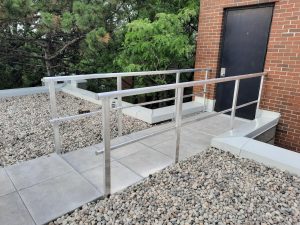
Roofing layouts can also pose risks. For instance, flat roofs can become slippery to walk on when wet depending on the roofing membrane. Added to these traditional hazards are the ones that appear over time. For example, building upgrades that affect the roof structure and design can also impact its elevations, requiring new safety equipment and considerations.

“That’s why it is important to understand the future state of your roof and how the roof is being accessed,” says another safety rep with Skyline. “Corridors are provided inside the building for safe access, so the same consideration should be given to the safety personnel required to keep the building running while accessing the roof.”

Another trend impacting roof safety is that rooftops are becoming more crowded. As land prices rise and available space in populated areas decreases, organizations are optimizing their investment by making more use of their available space. Some of that focus is being turned to rooftops, where building operators are turning their rooftop into a publicly accessed space (e.g., a garden or patio) or investing in energy-efficient technologies (e.g., green roofs or solar panels). The result is a packed environment that requires safer access to all roof areas and increased awareness of potential fall hazards.

“Ultimately, it is important that your roof access and safety solutions stay up to speed with your roof as it goes through different transformations,” adds Skyline’s rep.

Staying compliant amidst regulation changes

As building envelopes adapt, so do safety compliance obligations. This is also true of roof and height safety standards, which are constantly adapting to reflect emerging hazards.

Skyline Group“The number of roof fall-related injuries is alarming, so it’s only natural that local and national standards are getting stricter,” says the Skyline safety rep, explaining, “Today, more and more third-party service providers have their own safety guidelines that prevent employees from working on roofs unless the right safety equipment and protocols are in place.”
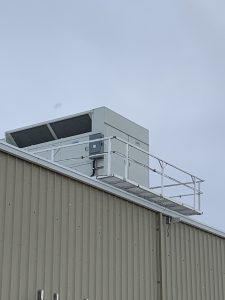


Aligning with such standards is a necessary challenge, especially since failing to keep a building compliant or ensure an installation is done to local safety guidelines can lead to serious injuries and costly liabilities. As such, it’s important to recognize hazards as they emerge and never lose sight of one’s safety responsibilities.

“It’s about accessing the roof safely, while working in a hazard-free environment, in order to get back down from the roof safely,” says Ghinn, adding, “The fact is that the number of roof fall-related injuries is alarming, meaning there is room to improve on safety. The good news, though, is that the risks we’re seeing out there today can be mitigated with the right partners and height safety solutions that are readily available.”

Rising to the challenge with the right safety equipment

No doubt, modern rooftop hazards require modern safety solutions. For
example, says the Skyline rep: “We see too many access ladders that are cut short at the bottom, requiring an extension ladder to gain access to the actual roof access ladder itself. This is often done to restrict access to the public, but climbing a small ladder to grab the roof access ladder to then climb onto it is just simply dangerous.

Skyline Group

That’s why we developed a lockable gate to block the first five feet of steps and restrict unwanted access. ”The ability to manufacture ladders, guardrails, walkways, and various other rooftop safety solutions in modular sections is also proving to be a benefit for today’s contractors. These solutions can be transported to the roof via a service elevator versus renting a crane, while also being installed in a fraction of the time. All while offering the capability to customize a solution that best fits the needs of the roof and local guidelines.“The savings become quite substantial for all parties,” says Skyline’s rep, explaining, “Our non-penetrating permanent guardrail system, for example, is designed to be lightweight and modular, making it quick and simple to install without needing to fasten into the existing roof frame. This eliminates the need to reseal the roof membrane for old or newly warrantied roofs after an installation.”

Protecting workers and staying in compliance means understanding your rooftop hazards before heading up onto the roof, while having a solution in place to mitigate the risks as they unfold. After all, adds Ghinn, “Nobody should discover safety by accident.”

Skyline Group is a leader in roof access and safety compliance and contributed to this article. For more information on their rooftop safety solutions and their complimentary lunch & learn program, visit www.skylinegroupintl.com.

Taking advantage of virtual staffing

Finding back-office talent was a challenge for property management firms long before the pandemic. And while the crisis is beginning to fade, staffing issues will likely remain  a top concern for many teams. Fortunately, one thing employers have learned throughout COVID’s working restrictions is that virtual staffing is more effective than ever at filling workforce gaps.

“The past two years have erased a lot of the concerns and misconceptions around hiring and working with remote talent,” says Akan T. Rajah, Managing Partner with Assetsoft. “A lot of employers realized that their team members didn’t have to be physically within the office to do their work effectively, and that was especially true for back-office functions like accounting.”

Employers are also turning to virtual staffing to solve a never-ending talent shortage. The reality is that back-office professionals are in extremely high-demand, and finding local recruits means offering more than the competition. With virtual staffing, however,
employers can access qualified and experienced labour pools worldwide.

AssetSoft

No doubt, virtual staffing is a modern solution for a modern challenge. And it’s one that Rajah and his team at Assetsoft bring to the property management community And whether his team is being asked to assume routine tasks or assist with more intellectual responsibilities, Rajah says the result is always the same: “Once they see how quickly we learn their business and integrate with their workforce, they start seeing us as part of the team.”

The truth behind virtual staffing myths

There are quantifiable benefits to virtual talent handling back-office functions. Even still, there are myths and misconceptions that continue to hold employers back from making a decision that could save them manpower, money, and headaches. For example:

Myth: Virtual staffing poses data security risks
Reality:
Data security and privacy are always a prime concern when employees work remotely. In recent years, advances such as expanding internet connectivity, virtual machines, VPNs, and fine-grained data control which enable secure access from anywhere, have put those anxieties to rest.

“During COVID, a lot of companies realized that Software as a Service (SaaS) platforms and virtual machines allow their employees to work securely with sensitive data from remote locations,” says Rajah. “At the same time, virtual staff providers like ourselves upped their data security capabilities to make sure their clients’ data was well protected.”

For example, he adds, “The team works from our premises with 24/7 video surveillance and physical access restrictions. As well, a ban on mobile phones in the work area, enterprise-grade firewalls, blocked USB and card ports, regular copyright training, and other data security practices also ensure that the data accessed by virtual staff is secure and never leaves the office.”

AssetsoftMyth: Virtual accountants won’t have the same level of industry knowledge

Reality:
Working in property management requires an innate understanding and proficiency in back-office systems (e.g., Yardi), accounting standards, Canadian Tax Laws, and specific property operations.

Today, these are all skills that today’s virtual accountants can bring to the table. “Our people may not be in the office, but they’re experts in what they do, and they’re experts at learning a client’s operations and becoming part of the team,” adds Rajah.

Myth: Virtual teams outside of Canada mean different time schedules
Reality: 
Many third-party service providers work around their client’s schedules and time zones, ensuring they’re accessible no matter their location.

Myth: Virtual staffing means losing control
Reality:
Virtual teams like Assetsoft may assume responsibility for accounting, rent collection, vendor management, lease audit/abstraction, bookkeeping, reporting, treasury management, or any number of tasks, but that doesn’t mean they assume control.

For example, Rajah adds: “Our virtual staffing model ensures the client has direct control on their business outcomes. Our client can establish their very own team without worrying about all legal, human resource, and technical requirements.”

AssetsoftMyth: Remote employees won’t feel part of the team cohesion

Reality:
It can be odd to think of teams being split across Canada or overseas. Still, many companies, large and small, have done exactly that during the pandemic to considerable success. Now that employees are being welcomed back into the office, many continue to embrace a remote or hybrid working model, recognizing that employees don’t need to be physically in the same room to be an integral part of the team.

Myth: It’s too expensive to hire virtual accountants
Reality:
It’s actually the reverse. Virtual staffing enables companies to offload all the hiring, training, onboarding, and staff management responsibilities to their virtual staffing partners, saving them the expense and time it would take to tackle these HR functions internally.

“We look after all the hiring and ongoing HR concerns, so they don’t have to,” says Rajah. “The whole idea is to provide the support that ultimately frees up client resources.”

Blame it on shifting attitudes. Pin it on pandemic disruptions. Whatever the cause, the “Great Resignation” has left employers struggling to find people who know what they’re doing and are willing to work. True, embracing virtual accounting partners may have been a challenge in years past, but the technologies, skills, and third-party partners are in place today to make it a welcome and beneficial part of any business strategy.


The Assetsoft team encourages any questions and inquiries. Email them at [email protected] or visit their website at www.Assetsoft.biz.