Articles Archive - Page 308 of 928 - REMINET
REMI

CDPQ flexes for green infrastructure allocations

Green infrastructure has been tapped as a strategic asset within Quebec’s pension fund holdings. The newly released provincial budget announces a planned amendment to the Act respecting the Caisse de dépôt et placement du Québec (CDPQ), aligned with targets for a 60 per cent reduction in the carbon intensity of its real estate and infrastructure portfolio by 2030.

Currently, real estate is the sole asset class in which CDPQ — through its subsidiary, Ivanhoé Cambridge — can hold 100 per cent of a company’s shares. Otherwise, the Act restricts CDPQ funds to a 30 to 51 per cent ownership stake. The proposed amendment will also remove the holding limits on infrastructure assets, with the stipulation that no single infrastructure allocation can account for more than 3.5 per cent of CDPQ’s total asset value.

“In the context of the fight against climate change, in particular, institutional investors such as the Caisse are placing increasing importance on infrastructure,” the budget document observes. “This asset class generates attractive returns, particularly when the investor is in a controlling position, and generally offers good protection against inflation. Additional premiums may also be generated when operational value is created.”

To justify the amendment, the budget document maintains it will “make the Caisse more agile and more competitive in the infrastructure investment sector” and support a goal to hold $54 billion in green assets by 2025. The ability to acquire larger stakes of infrastructure projects is expected to convey more flexibility to expand a green portfolio in what’s termed an “increasingly competitive” investment environment.

The move is also framed as complementary to CDPQ’s status as a prominent global institutional investor and the growing sway of climate change and ESG (environmental, social, governance) considerations in financing and investment returns. “The proposed changes will allow the Caisse to position itself favourably among its peers on the world stage in strongly growing investment sectors that will be crucial in the future,” the budget document states.

A breakdown of the CDPQ portfolio, included with the budget, shows 8.5 per cent of total asset value was allocated to infrastructure as of December 31, 2020. Real estate accounted for 12.5 per cent.

Rooftop Unit Replacement Projects

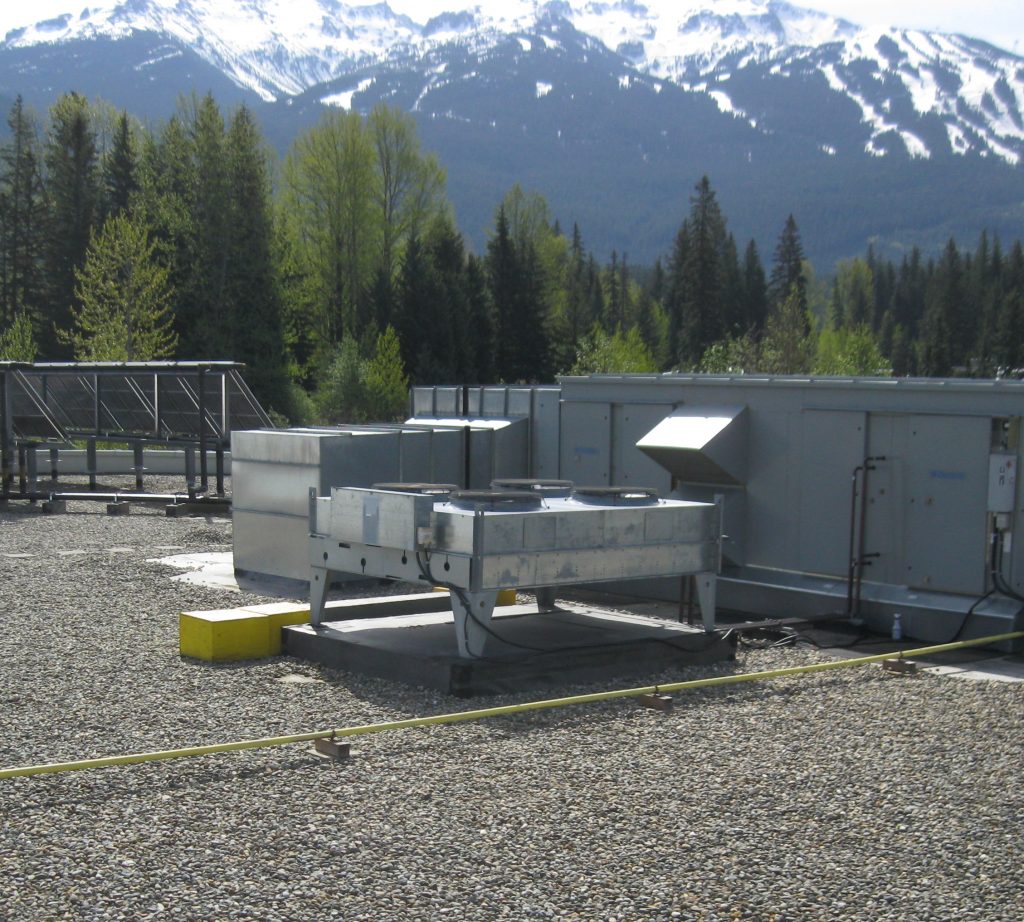
Rooftop unit (RTU) replacement projects don’t happen very often, but when they do, building owners and facility managers should know that it’s not always as simple as swapping out the old with the new. Codes, technology, and even snow load requirements can change on a regular basis — meaning, it’s good to be prepared for some variances to your original plan and footprint.

“RTUs are pre-packaged, self-contained HVAC units you commonly see on flat-roofed commercial buildings and warehouses,” said Nicole Babuik, Associate, RJC Engineers. “In terms of types of units, there’s a plethora of options available, and because of the way flat roof buildings are made, specific issues can arise if the owner isn’t adequately prepared.”

Built to provide both heating and cooling for large industrial spaces, most rooftop HVAC units typically have a lifespan of 20 to 30 years. When replacing older units, the tendency among building owners is to adopt a “like-for-like” approach in an effort to minimize costs and complications. But for the consultants and mechanical engineers helping with the project, “like for like” can mean very different things.

“Owners typically want to replace the old unit with a newer model that offers the same or better heating and cooling capacity,” she said. “But what they don’t always realize is that the dimensions and the weight of the unit may change. Structurally, the building will feel and react differently to a larger unit, especially if it hovers around the threshold for snow accumulation.”

Here in Canada, snow accumulation is an important consideration when performing any roofing system alteration, and a larger RTU may trigger the need for structural upgrades to support the additional weight.

“While in some cases, structural upgrades might be possible with minimal interior work,” said Bubuik, “it would still require substantial roof work and considerable additional costs. If it’s necessary to upgrade the structure entirely from inside, interior spaces and daily operations will be impacted—which adds an additional level of disruption and cost implications.”

According to Bubiak, the reason is that some of today’s roof structures are tightly designed in such a way that load-checking can be challenging and trigger additional investigation work. “You can’t necessarily just grandfather in a replacement unit and attribute it to maintenance,” she said. “There are a lot of subtle things that must be checked off from a structural perspective that many building owners aren’t aware of.” 

Aside from snow loads, duct work is something that shouldn’t be overlooked. The supply and return air ducts that feed into the RTU need to up to code, and in some areas, seismically retrained. Before a RTU replacement project, Bubuik advises owners to investigate the existing ductwork and perform any necessary maintenance or seismic upgrades to ducts and other ancillary services to ensure the equipment is up to standard. Doing so will reduce costs and ensure the new unit is secure and functional for the long haul.

In summary, here are Babuik’s top 3 tips for undergoing a successful rooftop unit replacement project:

  1. Understanding that a “like for like” replacement from an HVAC cooling and heating perspective does not mean the dimensions and weight of the unit will be the same. The difference should be established before moving forward with the purchase of a new unit if you want to avoid structural upgrades to the roof.
  2. If you do require a larger unit that exceeds the weight and/or footprint of the current unit, be sure to hire a structural consultant to ensure the roofing system can handle the additional load.
  3. Schedule any other maintenance work at the same time as the RTU replacement project to avoid issues and reduce the overall costs associated with the upgrades.

“Each project is different,” she warned. “Unexpected issues can always arise. It’s good to be as prepared as possible. In fact, don’t be surprised if a building inspector asks for a visual or acoustical screen. Screening requirements vary by municipality, the rules around rooftop units are not as straightforward as you’d think.”

For more information on Rooftop Unit Replacement Projects, visit www.rjc.ca, or contact Nicole Babuik directly at [email protected]

New EV chargers coming to Saskatchewan

A $2-million investment in the Saskatchewan Power Corporation will bring up to 40 electric vehicle (EV) fast chargers to the province by December 2023.

The Saskatchewan Power Corporation will select recipients through a transparent process, based on demand. The EV chargers will then be installed in public places, multi-unit residential buildings, on streets, at workplaces or at facilities for servicing light-duty vehicle fleets.

This investment is funded through the Natural Resources Canada’s Zero-Emission Vehicle Infrastructure Program (ZEVIP).

“Though there are still a relatively small number of EVs on Saskatchewan roads, it’s expected that this market will grow,” said Troy King Acting President and CEO, SaskPower. “It’s important to prepare for a future where more customers drive electric vehicles and expect the infrastructure to be in place to do so.”

Since 2015, Canada has invested $1 billion to make EVs more affordable and chargers more accessible. These investments are supporting the establishment of a coast-to-coast network of chargers in local areas, while federal rebates of up to $5,000 are helping more Canadians make the switch to an EV.


New Brunswick uncorks delayed property tax cuts

New Brunswick is now ready to deliver the delayed property tax cuts it first promised two years ago. The newly released provincial budget confirms the initial decrease will show up on 2022 tax bills, collectively saving residential and non-residential ratepayers $45 million.

After COVID-19 derailed the envisioned 2021 launch of a four-year phased reduction — to ultimately eliminate 50 per cent of the tax burden for residential landlords and provide a 15 per cent discount for other residential and non-residential property owners — the initiative has been scoped into a three-year period. Ernie Steeves, New Brunswick’s Finance and Treasury Board Minister, projects a $112 million province-wide reduction by the 2024-25 fiscal year.

“This important tax initiative will support the development of additional units in the province and provide tax relief to landlords, many of whom are facing significant assessment increases as a result of the vibrant real estate market,” he asserted in yesterday’s budget speech.

For residential landlords, the first installment of property tax relief will come in sync with a one-year restriction, retroactive to January 1, 2022, capping allowable rent increases at no more than 3.8 per cent. The new budget also announces pending legislation that would require landlords to show cause before terminating residential tenancies and would enable displaced tenants to claim compensation where such causes are not provided.

In unveiling those measures, Steeves explained they are meant to “ensure that tenants are protected and benefit from the property tax reduction”, while reiterating the provincial government is “confident that the market will catch up with demand”, in part with the help of the property tax cuts.

“The vacancy rate continues to fall and rents continue to climb,” he said. “Our government acknowledges that more needs to be done for renters.”

The 2022-23 budget also announces: a $6.3 million boost to provincial spending on affordable housing; a wage increase for human services workers in a range special care housing; and an increase on the daily rate the province pays to providers of adult residential facilities. Steeves additionally summarized two recent policy changes potentially influencing social assistance recipients’ housing costs.

“Social assistance recipients will no longer have their benefits reduced if they are also receiving child support payments, the Canada-New Brunswick Housing Benefit or compensatory money related to personal injury,” he recounted. “Recently, reforms to the Household Income Policy were announced which allow roommates to be assessed separately. This change aims to improve access to affordable housing for social assistance recipients by allowing them to share accommodations.”

Developing an asset approach to risk management

Over the past 30 years, the facilities management industry has experienced building science innovations, more complex codes and the integration of technology into everyday operations. One key function that hasn’t seen much improvement is risk management programs, which are now of utmost importance.

Risk assessment is a foundational service for a facilities management team to deliver. With boots on the ground, these teams have functional insight into the entire organization.

Unfortunately, it is all too common for a company to conduct a business impact analysis (BIA) and omit a site and facility risk assessment. When a business creates a continuity plan by elevating one function such as IT or finance above other departments, believing the business cannot function without it, this may bring additional risk to the whole organization. This single-silo approach does not address the reality that site and function are uniquely linked.

“Despite all the talk about the importance of the risk assessments being the foundation for the development of a facility’s security program, it has been my experience that, relatively speaking, very few are actually done,” writes security professional Dr. Glen Kitteringham.

Why are there few risk assessments?

One reason might be that every facility manager faces a whirlwind of daily and sometimes hourly events that require their attention, from emergencies and reports to customer concerns. In order to handle these situations, exceptional management skills are required.

Secondly, the task appears to be quite daunting. To complete a full assessment and address the concerns found could potentially take up to five years, depending on the complexity of the business, changes in business operations and, most importantly, will power. Facility managers thrive on quick problem solving and thinking on a dime. There are very few key performance indicators that could be used to measure the effectiveness of the work and program at hand.

First things first

In order to be able to complete a risk assessment, a facility manager should have senior management’s full support—both financial support and also a commitment to see the assessment as part of the BIA and reinforce the business continuity strategy.

The facility manager must also be willing to carve out time and resources towards meaningful progress. Having a set of goals that can help to track advancement is imperative. What is important to understand though, is not all the steps are needed at the beginning.

Where to start?

A facility manager needs to build internal relationships with:

  • Human resources to support facilities expansion concurrent with company growth;
  • The IT department for technology integration;
  • Finance to assist with the implementation of capital planning and funding;
  • Purchasing for vendor management and procurement services; and
  • Production department to support the creation of the final product.

A facility manager needs to build external relationships with:

  • Engineering consultants to provide advice and services related to facility operations and improvements;
  • Maintenance contractors to provide services in support of the business continuity program;
  • Suppliers of materials and products for daily operations; and
  • Regulators and inspection services to remain in code and regulation compliance.

Identification and elimination

When approaching the risk assessment, use the three most valuable asset categories of every business. In each of the three categories, ask: what are the primary threats you believe need to be addressed and what is the effect on the business if the threat is realized? This will help identify the first steps or areas to evaluate and the level of importance.

People

People deliver services and bring ideas and creative energy to all elements of a business. They need to feel safe in and around the facility. For example, they expect a manager to have control over who and what enters the building. This control, to a varying degree, might be needed to protect the production environment and to secure inventory and intellectual property.

Data

This is information about what the business does, how it is operated and what future plans may arise, either in digital or physical form

Information is becoming increasingly more difficult to protect and preserve. A facility manager may not have the responsibility to protect against an outside cyber attack; however, they can protect the space in which this data is housed. From physical access control, protection from natural disasters, to climate-controlled server and data processing rooms, these all are part of the risks that require reviewing in order to implement the right resolution.

Facilities

This is where the business is conducted, where people and data are woven together to form the tapestry of the business, and risk within the facility can extend to the suppliers.

The challenge for facility managers is to look past typical building elements, such as roofing and windows, or services such as power, HVAC, and water. The risk could be caused by a natural hazard, but also a poor thought-out design.

Arnie Wohlgemut is the senior consultant and president of KP Mylene & Associates, a leadership development and facilities management consulting company. He is passionate about supporting facility managers to become successful leaders within their organizations.


Toronto city staff endorse backyard hen-keeping

Torontonians with backyards may be able to add another kind of nest egg to their residential holdings. City staff have recommended broader allowance for hen-keeping, as a four-year pilot program in designated central neighbourhoods nears completion.

A report to Toronto’s general government and licensing committee cites the potential food, education and mental health benefits of a wider rollout of the backyard hen-keeping program. The 102 registered pilot locations, hosting a total of 307 hens, engendered just three noise complaints and two odour complaints in the period from March 2018 to late January 2022. However, sites were never proactively inspected and it’s not known if all the households that initially signed up still keep hens.

“The pilot program was not based on a cost-recovery model and it was implemented and managed within existing staff resources,” the report advises. “The City does not currently charge a registration fee and staff do not conduct a site inspection as a condition of registration. Enforcement investigations are complaint based.”

Under pilot program rules, participating households are limited to a maximum of four hens (roosters are prohibited), which must be kept in backyard coops that provide a specified amount of space per bird and comply with municipal zoning and setback requirements. Flocks are to be solely for non-commercial egg production. The hens cannot be consumed as meat; nor can their manure be sold. Owners are also expected to take measures to safeguard against and discourage predators.

In future, the staff report proposes that hen-keepers would have to formally register, pay license fees and be subject to inspections and fines for non-compliance. An initial $151 license fee and subsequent $34 annual renewal are recommended. Participants would also have to submit site plans and receive approval for their backyard coops, and complete the Ontario Ministry of Agriculture, Food and Rural Affairs’ (OMAFRA) approved online course, which is offered through the Poultry Industry Council.

“There is public support for hen-keeping among residents across Toronto and the majority of stakeholders consulted did not oppose program expansion. Many jurisdictions in Ontario and North America more broadly have successful hen-keeping programs with comparable program rules,” the staff report states.

It’s estimated a citywide program would generate about $274,000 from registration fees during the first two years and about $47,600 in annual renewal fees thereafter. The staff report also projects a requirement for three additional animal control officers, equating to up to $347,000 in new annual operating costs.

A survey of pilot program participants found they made an average investment of $1,375 to obtain and accommodate their flocks. Similar backyard hen-keeping programs are allowed elsewhere in Ontario, in Brampton, Guelph, Kingston and Niagara Falls, and in other larger Canadian cities, including Vancouver and Edmonton.

Anthem, Kingsett acquire mixed-use site in Burnaby, BC

Anthem Properties Group and KingSett Capital announced they have jointly acquired an 8.34-acre mixed-use site at Willingdon Ave and Dawson Street in Burnaby, BC.

Located in the active Brentwood Town Centre, one of the fastest growing, transit-oriented nodes of Metro Vancouver, the site will be redeveloped into a mixed-use, master-planned community in alignment with the City of Burnaby’s Official Community Plan. Rezoning for the entire property is close to final approval and phase one sales are anticipated to commence in late 2022.

Future plans for the site include 2,100 market condominiums, 340 rental units, and 60,000 square feet of new retail and office space across five residential towers and two woodframe mid-rise affordable rental buildings.


Viewed as a major green node, construction will be phased around a one-acre park that will serve as both a Town Centre destination and a key linkage between Brentwood Town Centre SkyTrain Station and the Urban Trail, connecting east to the future Woodlands Park and south towards B.C.I.T.

“With this acquisition, we are thrilled to be able to build upon Anthem’s long history of developing large-scale mixed-use projects in the City of Burnaby,” said Eric Carlson, CEO of Anthem. “In a supply-constrained region undergoing population growth, the project will create a significant amount of housing supply aiming to address the market’s needs at multiple levels.”

This will be Anthem’s second development within the Brentwood Town Centre plan, following their completion of Tandem in 2007, a three-tower mixed-use community. More recently, Anthem completed sales and construction on Station Square’s five residential towers in Metrotown. Since it was founded in 1991, the group has developed more than 60 communities across 7,400 acres of land in Alberta, British Columbia and California.

KingSett is Canada’s leading private equity real estate investment firm with $17 billion of assets under management. KingSett continues to seek  opportunities to invest in a wide range of real estate properties, developments, joint ventures, and mortgage lending.

More information on the Burnaby project is available here: Anthem and KingSett Acquire an 8.34 Acre Mixed-Use Site in (globenewswire.com)

Toronto Public Library to relocate St. Lawrence branch

Planning for the new St. Lawrence branch of the Toronto Public Library is set to begin later this year for a public opening in 2027. The relocation and expansion at 125 The Esplanade will be more than six times the size of the current facility.

The new district branch will be about 30,000 square feet and bring enhanced library services to the area, namely: better access for equity-deserving groups, expanded and multi-functional public and community spaces, and new environments that connect communities and offer opportunities for partnerships, civic engagement and resident participation.

“This new library branch will be a remarkable place of learning, exploration and connection for residents and visitors alike,” said Councillor Kristyn Wong-Tam (Toronto Centre). “My staff and I will continue to work with the St. Lawrence Market Precinct Advisory Committee and all the neighbours on this exciting project to ensure the community is served well into the future.”

Branch design, programming and services will be identified through the library’s planning and public consultation processes.

The current St. Lawrence Branch at 171 Front St. E. is 4,833 square feet was previously slated for the First Parliament site down the street, but the province expropriated it for transit-communities and development timelines of at least 15 years. The site change will allow the new branch to be operational in a condensed timeframe of about six years at a cost of $34 million.

Calgary planning new Ingelwood fire station

The City of Calgary is partnering with local developer RNDSQR to build a mixed-use fire station in the community of Inglewood. The project is using a new integrated approach to facility planning under the city’s Corporate Facility Planning & Delivery Framework.

The original site was purchased by the city in 1986 and supplemented by an additional purchase in 2010 for the purposes of an emergency response station.

“Previously, city facilities were often planned independently according to their specific needs and service lines,” says Ryan Meier, acting manager, Facility Planning. “By changing our facility planning approach to this integrated approach, we can increase efficiencies, maximize value for investment, create opportunities for partnerships, and better collaborate with community partners to build facilities that truly reflect our thriving and evolving neighbourhoods.”

The city and RNDSQR are working with a multi-disciplinary local team of planning, design, and engineering professionals. Core members of the team are CivicWorks, a Calgary-based planning and urban design firm specializing in inner-city redevelopment; and S2 Architecture, an architectural firm with a track record of designing mixed-use developments in Calgary and more than 20 fire station and emergency service projects in Alberta and British Columbia.

The team will be exploring development concepts to support: a high-quality, mixed-use outcome with a focus on realizing a fire station that meets the goals and objectives of the city; new housing options that take advantage of the transit-oriented location of development; and ground-level retail options to activate the 11 AV SE and 12 ST SE streetscape and contribute to the overall vitality of the community.

The building is scheduled to begin construction in 2023 and open in 2024.

CAGBC takes over LEED green certification

LEED green building certification and professional credentialling in Canada has been consolidated under the Canada Green Building Council (CAGBC).

The move enables project teams and professionals using LEED, Investor Ready Energy Efficiency (IREE), and TRUE standards for certification and credentialing to work directly with CAGBC.

The change is part of CAGBC efforts to aid the Canadian building sector’s transition to zero-carbon green buildings. CAGBC will continue collaborating with Green Business Certification Inc. (GBCI) and the U.S. Green Building Council (USGBC) to support the success of green building projects and professionals in Canada and across North America.

“By integrating GBCI Canada’s certification and professional accreditation programs, CAGBC is consolidating green building services and support for the benefit of Canada’s building sector,” said Thomas Mueller, president and CEO of CAGBC. “The market asked us to simplify access to certification and focus on customer service. This move ensures the building sector can continue to use GBCI’s world-leading green building rating systems and services like LEED and TRUE, as well as CAGBC’s Zero Carbon Building Standards, all under one roof.”

GBCI Canada was established through a partnership between CAGBC and GBCI, making it unique among regional GBCI offices. The consolidation of certifications under CAGBC reflects Canada’s specific market needs and conditions while retaining the strong customer focus and commitment to timely certification delivery GBCI Canada has championed. This transition only affects Canada. GBCI will continue to maintain its regional presence in China, Europe, India, MENA, Mexico and the U.S. to support other customers worldwide.

“We look forward to continuing our longstanding partnership with CAGBC, while simultaneously making LEED and other sustainability programs more accessible in Canada,” said Peter Templeton, president and CEO, USGBC and GBCI. “We will continue supporting the work of CAGBC and delivering third-party certification and credentialing services that recognize the leadership of organizations and professionals worldwide in sustainable building performance and practice.”

No additional effort is required to transition projects currently contracted under GBCI Canada to CAGBC. CAGBC will communicate with existing customers about this change.

Residential rents continue to push higher

Residential rents for all Canadian properties listed on Rentals.ca in February averaged  $1,820 per month, an increase of 6.2 per cent since this time last year according to the latest National Rent Report from Rentals.ca and Bullpen Research & Consulting.

Nationallly, average monthly rents hit a high of $1,954 in August 2019, then during the worst of the COVID-19 pandemic declined to a low of $1,676 in April 2021 before coming back to the low $1,800s at the beginning of this year.

“The rental market overall in Canada continues to trend upward in the post-vaccine pandemic period, with continued strength in the market for larger suites,” Ben Myers, president of Bullpen Research & Consulting. “Growth in average rents for one-bedroom units lags other bedroom types, with two-, three- and four-bedroom units exceeding February 2020 pre-COVID-19 rent levels last month. British Columbia, specifically Vancouver, and downtown Toronto are leading the market recovery, pushing rents up nationally.”

Residential rents could continue to push higher in the near future because of increasing demand reinforced by supply chain disruptions, record inflation, increasing interest rates and much higher gas prices.

In terms of priciest cities, Toronto finished second behind Vancouver for average monthly rents in February for both one- and two-bedroom apartments. Year over year, rent was up 12. 7 per cent for a one-bedroom and 15.1 per cent for a two-bedroom.

Toronto had the second highest annual change in average monthly rents for condo rentals and apartments, rising year over year by 16 per cent to $2,312. This was a big turnaround through the pandemic, as the city’s annual average rent had declined 20 per cent in February 2021 to $1,994.

Etobicoke was fourth for average monthly rents for condo rentals and apartments in February with an annual increase of 12 per cent to $2,155, after being down 15 per cent in February 2021. Other GTA cities and areas on the list include Mississauga, up 6 per cent; Scarborough, up 2 per cent, and North York, down 1 per cent after being down 12 per cent in February 2021.

Other takeaways from the March National Rent Report:

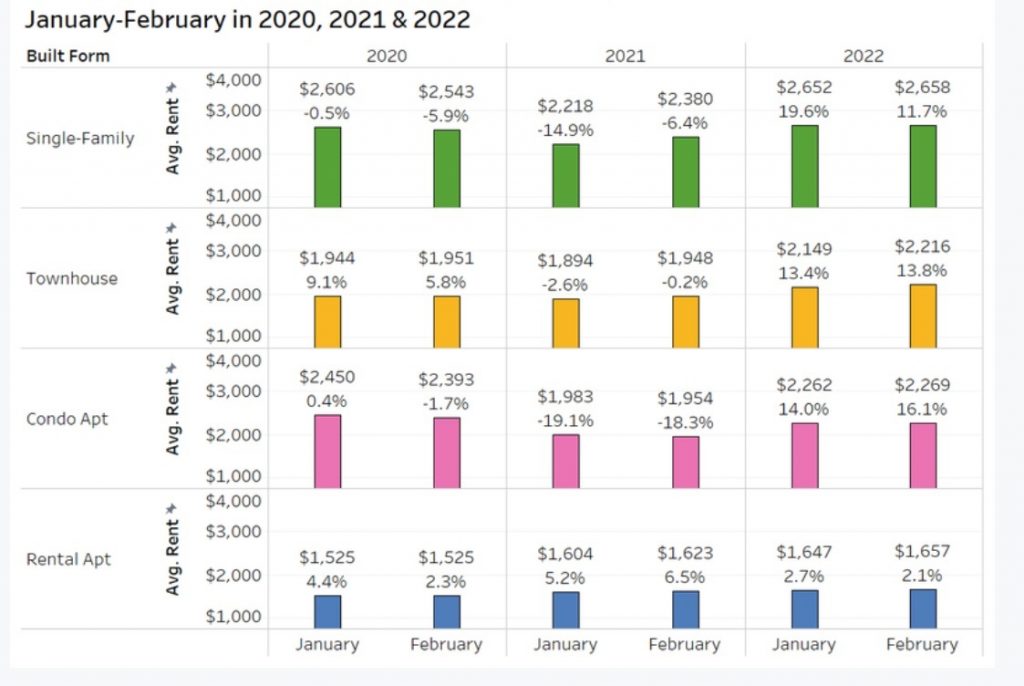
  • Average monthly rent for condo rentals in Canada increased 16.1 per cent year over year in February to $2,269. Townhouse average monthly rents rose 13.8 per cent to $2,216 while average monthly rents for single-family homes increased 11.7 per cent to $2,658.
  •  Year-over-year, average monthly rents in Canada for studios, one-bedroom homes, two-bedroom homes, three-bedroom homes and four-bedroom homes all increased in February. Three-bedroom units had the largest annual increase in February of 9.8 per cent from $2,129 to $2,337.
  • Annual average rents for condo rentals and apartments for studios, one-, two- and three-bedroom homes rose in Ontario, British Columbia and Quebec, while average rents for these bedroom types lagged in Alberta. A
  • Average rent for a one-bedroom condo rental in British Columbia rose 19 per cent year over year in February, while in Ontario, annual average rents for one- and two-bedroom condos increased 18 per cent.
  • Average monthly rent for a studio apartment in Quebec in February was up 19 per cent year over year.

Virtual hearings ahead for Manitoba rent panels

Manitoba’s Residential Tenancies Commission should soon have flexibility to hold virtual hearings or to link in some appeal panel participants from remote locations. The enabling legislation is part of an omnibus bill introduced in the provincial legislation assembly last week, which proposes to amend 10 provincial statutes with the aim of removing cumbersome barriers or redundant requirements in regulatory administration and procedures.

“The past two years have also provided lessons in how meetings and documents can better be managed through technology, which are incorporated in these changes,” observes Manitoba’s Justice Minister, Kelvin Goertzen.

The proposed changes to the Residential Tenancies Act clarify that commissioners officiating on a review panel can attend in person, by telephone or via other electronic channels. Nor would parties to the appeal have to be physically present.

Other proposed amendments would address requirements under the Real Property Act, the Workers Compensation Act and Personal Property Security Act, and allow for documents and orders related to the Employment Standards Code to be served by email. The legislation also proposes to establish a new committee of the Manitoba cabinet “to oversee and coordinate the proposed legislative and regulatory initiatives of the government and government agencies”, which is to be known as the Statutes and Regulations Review Board.

New property valuation board slated for Manitoba

Manitoba is moving to establish a single property valuation board to deal with property tax assessment appeals, compensation for land expropriation and applications for surface rights. Currently, three different bodies deal with these issues.

As set out in proposed legislation, which was introduced in the provincial legislative assembly last week, the new board would assume oversight of property tax assessment appeals from the Municipal Board. It would also take over the functions of the Land Value Appraisal Commission, which determines landowners’ compensation for expropriated properties and government acquisitions, and the Surface Rights Board, which adjudicates disputes between holders of minerals rights and the owners of land where mineral claims are situated. Both of the latter entities are to be dismantled.

“The Real Property Valuation Board Act will create a single window for stakeholders seeking resolution of land value disputes,” said Reg Helwer, Manitoba’s Minister of Labour, Consumer Protection and Government Services, as he tabled the enabling Bill 24. “This action will improve board services to Manitobans and create a simplified, fair, transparent and streamlined process for the public to interact with government on matters related to land value.”

As proposed, the provincial Cabinet will appoint a minimum of five board members for staggered three-year terms, and will also designate a chair and at least one vice-chair. Board members will have access to support staff and technical advisors, and will be eligible to serve up to four consecutive terms. The Manitoba government will establish the remuneration rate.

“In appointing board members, regard is to be had to the range of expertise and experience required for the board to carry out its responsibilities effectively, Bill 24 states. “The rules of procedure may be different for different types of applications or appeals within the board’s mandate.”

What people want from public washrooms in 2022

Public washrooms are one of the key areas in which facility visitors and residents want to see enhanced standards of cleaning and hygiene in 2022.

Bradley Corp’s recent Healthy Handwashing Survey found that despite ongoing COVID-19 outbreaks, most Americans have not been deterred from using public bathrooms. In fact, 41 per cent of Americans report using public washrooms as often as they did before COVID-19 came on the scene. Interestingly, 27 per cent say they use them more now than previously.

“Thanks to the pandemic, more people are paying closer attention to various elements in public restrooms – how clean they are, how easy they are to navigate without touching surfaces and how they can be improved,” said Jon Dommisse, vice president of marketing and corporate communication for Bradley Corp., a global manufacturer of commercial restroom equipment.

From the survey results, Bradley Corp. identified five key trends currently being seen around public washroom hygiene:

Washroom maintenance gets approval

Half of the U.S. population now believes public washrooms are cleaner and in better condition than before the pandemic. More men (55 per cent) give a thumbs-up to the cleanliness of restrooms than women (47 per cent).

“Prior to COVID-19, upwards of 70 percent of Americans reported having an unpleasant restroom experience,” Dommisse explains. “Evidently, increased cleaning protocols and stocking of supplies is being observed and appreciated by restroom users.”

Further, 79 per cent think a posted and updated cleaning schedule in a washroom is important. “Signage goes a long way in helping to reassure visitors the facility is taking steps to ensure a clean environment and cares about keeping them safe,” he said.

Unclean washrooms tarnish the overall business

Americans increasingly think poorly of a business when they encounter a messy washroom, with 51 per cent of Americans saying an unclean washroom shows poor management, up from 39 per cent in 2021. Respondents also say neglected washrooms lowers their opinion of the establishment (43 per cent) and shows the business doesn’t care about customers (38 per cent).

Touchless washrooms in high regard

84 per cent of Americans believe it’s important for public washrooms to be equipped with touchless fixtures and 63 per cent say they are more likely to return to a business that offers no-touch capabilities in its washrooms.

“In fact, Americans view touch-free technology as the number one feature that makes them feel safer from germs in restrooms,” Dommisse said. “Touchless features are also Americans’ most requested improvement in restrooms. More cleaning/restocking takes second place.”

Touchless faucets, soap dispensers, flushers, and entrance doors were cited as the four most sought-after touchless features.

Better washrooms = more money spent

Americans are even willing to put their money where their mouth is when it comes to washroom cleanliness. Almost 60 per cent say they are likely to spend more cash at a business with clean, well-maintained washrooms, and a similar proportion (58 per cent)  will take washroom breaks at a business they know has “good” washrooms.

Pandemic concerns persist, in general

Finally, the majority of Americans (78 per cent) continue to be in an elevated state of germ consciousness as a result of the pandemic.

“Certain types of facilities cause more trepidation about coming into contact with germs,” Dommisse added. “Specifically, Americans are most concerned about germs in stores (50 per cent), medical facilities (39 per cent), restaurants (34 per cent), and gas stations (28 per cent).”

How aerosolized hydrogen peroxide can help reduce hospital infections

A new study published in the American Journal of Infection Control has concluded that adding aerosolized hydrogen peroxide (aHP) to hospital infection prevention protocols can reduce C. diff infections (CDIs).

CDIs are one of the most common infections found in healthcare facilities and cause significant fatality rates in healthcare facilities worldwide, notes the report.

The US CDC reports that CDIs cause approximately 223,000 HAIs per year, resulting in more than 12,000 deaths and US$6.3 billion in costs in the US. A key factor is that C. diff spores are so easily spread through contact with high-touch surfaces in hospitals, including bed rails, equipment, and door handles. Problematically, the spores are resistant to hand sanitizers and most disinfectants.

As a result, hospitals require enhanced protocols for hand hygiene and environmental cleaning to prevent C. diff spread and infection. However, even with consistent implementation of these measures, it is difficult to remove the pathogen from hospital surfaces.

Researchers analyzed CDI rates at a large acute-care facility in Philadelphia over a 10-year period to assess the effectiveness of touchless aerosolized hydrogen peroxide disinfection systems. The systems generate an aerosolized dry-mist fog containing hydrogen peroxide to all exposed room surfaces to kill any C. diff spores that remain after physical cleaning.

The researchers compared the incidence of CDI at the facility before implementing the aerosolized hydrogen peroxide system compared with after implementation. Over a 27-month period prior to implementation of the system, the facility recorded 120 CDIs; following implementation, it reported 72 cases over a 33-month interval, reflecting a 41 per cent decrease in the rate of infection.

Over a five-year period of consistently using the aerosolized hydrogen peroxide system, along with an environmental cleaning program, researchers saw a 74 per cent reduction in hospital-onset CDIs.

“Our study showed that persistence in utilizing an aerosolized hydrogen peroxide system had a significant impact on reducing C. difficile infections hospital-wide,” said Dr. Christopher L. Truitt of Wayland Baptist University of Planview, Texas, the study paper’s lead author.

Ultimately, the report concludes that the addition of a touchless aHP whole-room disinfection system as part of terminal cleaning can result in a significant reduction in CDI rates that have been sustained year after year.

Imperial Dade expands into Canada with Veritiv acquisition

Imperial Dade, the New Jersey-based paper, packaging, and janitorial products distributor, has entered into a definitive agreement to acquire Veritiv Corp.’s Canadian business division, Veritiv Canada.

The purchase, which is the 47th acquisition for the company under its current leadership, will mark the company’s official expansion into Canada. It includes Veritiv’s Toronto headquarters as well as 11 other locations throughout Canada.

Georgia-based Veritiv Corp. markets and distributes facility maintenance supplies, packaging systems, and printing and business-imaging papers throughout North America. Veritiv Canada is a full-service provider of janitorial and hygiene products print and foodservice packaging solutions.

The transaction is subject to Canadian regulatory approval and is expected to close prior to the end of the second quarter. Per the terms of the deal, Veritiv’s approximately 900 employees in Canada will become Imperial Dade employees.

“We are extremely excited to be entering the Canadian marketplace with such a reputable organization,” said Jason Tillis, Imperial Dade president. “We look forward to partnering with the Veritiv Canada team and continuing to provide customers with a world-class value proposition and service offering under the Imperial Dade banner. This acquisition is an exciting next step in our ability to serve customers across all of North America.”

“This sale aligns with our strategy to focus on higher-growth, higher-margin businesses and geographies and further invest in building on our industry-leading Packaging and Facility Solutions capabilities,” added Veritiv Chief Executive Sal Abbate.

Founded in 1935, Imperial Dade already serves more than 75,000 customers across North America.

Fraser River erosion protection project complete

The stabilization of the river bank along the Fraser River in Chilliwack is now complete. The two phase project began three years ago.

Approximately 210 metres of rock armouring (riprap) has been installed along the Fraser River just downstream from the Camp Hope Intake, completing a multi-year, multi-phase Fraser River erosion protection project. As part of Chilliwack’s Flood Response Plan, this rock armouring stabilizes the river bank, to protect it from heavy river flows.

In 2019, a 485-metre section of river bank just downstream from the Camp Hope Intake was identified for erosion protection. That same year, as the first phase of this project, rock armouring was completed along 275 of the 485 metres.

Construction on phase 2 began in January 2022, following agency approvals for the Provincial Water Sustainability Act, Dike Maintenance Act and Federal Fisheries and Oceans.

“Chilliwack has an extensive diking network along the Fraser and Vedder River systems,” said Mayor Popove. “Our dikes are inspected and maintained on a regular basis, as part of the City’s Flood Response Plans, and this long-planned riprap is a welcome addition to the infrastructure that keeps our community safe.”

The $918,000 phase two project was funded in part through a $750,000 provincial grant from the Community Emergency Preparedness Fund, provided by the BC Ministry of Public Safety and Solicitor General and administered by the Union of BC Municipalities.

Now that it is complete, the Camp Hope Intake bank erosion protection project will increase the stability of the adjacent diking, located approximately 15 metres from the banks of the Fraser River.