Articles Archive - Page 228 of 928 - REMINET
REMI

Make your business pest-free this season

As temperatures continue to warm up, more people will be out and about seeking retail therapy and your business needs to be pest-free. From restaurants to markets, food shoppers judge stores for various reasons, including their selection of fresh produce, food quality, overall product appeal, and shopping experience. No doubt you are working hard to entice customers by providing a wide array of products in your storefront. It’s these very products that may come with pests or attract pests in search of a food source. There’s nothing worse than ruining a great customer experience with a cockroach or mouse scurrying across the floor, so consider pest management as part of your spring cleaning program.

An Integrated Pest Management (IPM) program can help protect your store or restaurant from the threats pests pose to public health, including food safety and customer satisfaction.

IPM in grocery stores and restaurants focuses on removing or minimizing the elements that attract pests to the building. Namely, pests need access to food, water, shelter, and comfortable temperatures, so eliminating or modifying these elements will prevent infestations. With regular, practiced sanitation and a properly maintained facility, you can keep pests out and minimize the need for chemical treatments.

Working with a pest management professional is the first step to pest prevention by designing and implementing the following IPM techniques:

  • Develop and follow a comprehensive, written sanitation program to eliminate food, water, breeding, and shelter sources for pests in all food preparation areas including the deli, bakery, and meat processing and packaging areas.
  • Immediately clean all spills and wipe down equipment daily. Use organic cleaners in drains to remove the grease and grime that can feed and act as a breeding ground for small flies such as drain flies and phorid flies, roaches, and other pests. Regularly clean dead spaces or voids in food prep equipment or machines, hard-to-reach areas such as under prep counters, cart wheels, behind appliances, and grease traps. These dead ends provide shelter and breeding grounds for pests because they tend to go unnoticed.
  • Keep storage areas dry, cool, and organized. Store all products on wire-backed shelves off the floor and away from the wall. In addition, if products are packed in bulk, store them in closed containers to prevent spills and pest attraction. Use products on a first in, first out (FIFO) basis and immediately discard any deteriorated or spoiled product. If products are stored on skids or pallets on the floor, maintain an inspection aisle between the pallets and perimeter spaces along the walls to allow for effective housekeeping and pest monitoring. Don’t forget to inspect incoming shipments for pest activity before you accept them.
  • Line and seal all trashcans and remove trash daily from inside the store. Position dumpsters as far away from the building as possible and clean and rotate them regularly. Also, place them on concrete pads instead of directly on the ground. This will stop rodents from burrowing underneath, as well as prevent flies from breeding.
  • Empty recycling bins on a weekly basis. This includes hosing them down to prevent fly breeding.
  • Keep all doors shut when not in use. Install door sweeps on the bottoms of doors and weather stripping around entrances to provide a secure seal. In areas of heavy traffic, such as shipping and receiving docks, consider using plastic strip doors or air curtains as an additional barrier to pests. Have a professional check to ensure the air curtain is installed properly and have it serviced regularly to ensure maximum efficiency.
  • Seal or screen all openings, gaps, and cracks in the exterior of the building with rodent-resistant sealant to prevent pest entry. Pay special attention to areas around exterior utility penetrations.
  • Monitor regularly for signs of pest infestations, such as droppings, insect frass, trails, webbing, damaged product, live or dead pests, and sounds. Notify your pest management professional immediately of any pest sightings.

It’s also important to establish an open line of communication that encourages all employees to report pest sightings immediately. This will help prevent pest activity in areas such as breakrooms, the kitchen, or the dining area. Fostering an open line of communication will help restaurateurs and retailers get ahead of any pest issues and related health and safety threats. Remember, employees can bring pests into the restaurant on their belongings from home, so having workers inspect their residences for pest activity regularly is a proactive step in preventing infestations from outside sources. It’s also important that they know about pest sighting reports and are encouraged to help prevent unwanted visits.

When it comes to pest control, prevention is key to help avoid a costly infestation. Since each situation is different, it’s vital to have an ongoing IPM program and to consistently monitor the process. With a bit of knowledge, effort, and time you can help prevent pests from becoming the primary guests in your store or restaurant.

Alice Sinia, Ph.D. is the quality assurance manager of Regulatory/Lab Services for Orkin Canada, focusing on government regulations pertaining to the pest control industry. For more information, email Alice Sinia at [email protected] or visit orkincanada.ca.

Canada’s average asking rent up 20% since 2021

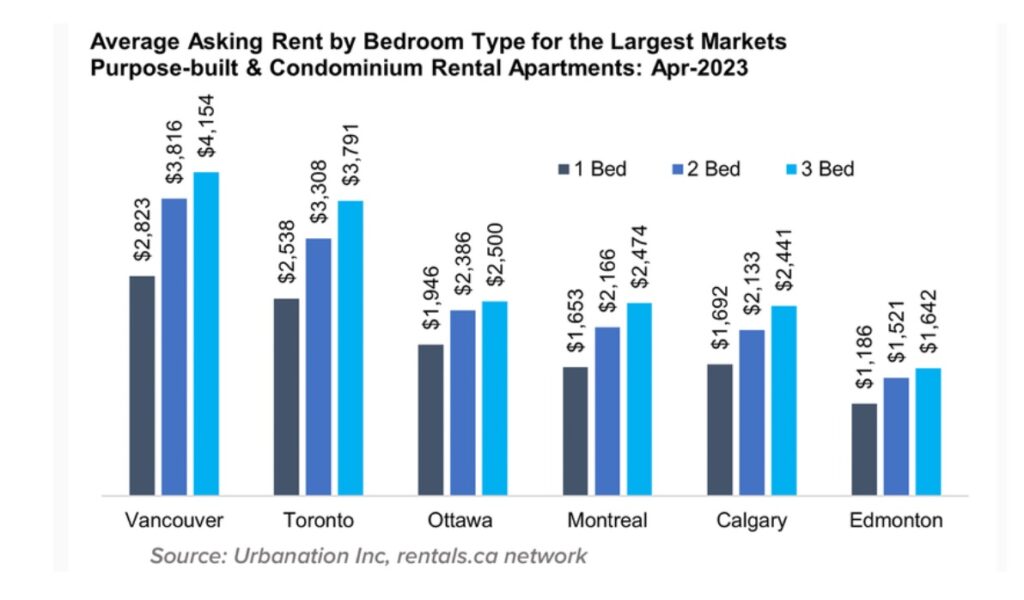
Canada’s average asking rent has risen dramatically since the pandemic low of April 2021, up 20 per cent to $2,002 representing an increase of $340 per month. Year-over-year, the national average asking rent was up 9.6 per cent but remained unchanged from a month ago.

“Rents continued to face upward pressure across Canada during April, with the strongest growth felt in markets that see the highest levels of immigration,” said Shaun Hildebrand, president of Urbanation. “Tenants that signed leases during the pandemic may be facing rent increases of 20 per cent or more if they decide to move, causing reduced turnover that is exacerbating the low supply situation.”

Each of Canada’s six largest rental markets continued to see rents rise by more than 10 per cent over the past year. Compared to the pandemic low in April 2021, rents for condominium and purpose-built apartments have increased the most in Vancouver, up 47 per cent, and in Toronto, up 41 per cent.

Twelve Ontario cities saw significant increases in asking rents with three GTA markets in particular exceeding 30 per cent in one year: Scarborough at 31.9 per cent, Brampton at 31.2 per cent and Markham at 30.3 per cent. All three markets have been affected by high levels of immigration. Oakville was the most expensive medium-sized market in Canada in April for condo rentals and apartments with average monthly rents at $3,413.

“Canadians have become accustomed to increasing rents after the pandemic,” added Matt Danison, CEO of Rentals.ca Network. “Record immigration with most newcomers renting, high interest rates keeping first-time home buyers on the sidelines, and inflation are all drivers of rising rents, increasing demand and low vacancy rates.”

The rankings for annual rent growth for purpose-built and condominium apartments among Canada’s largest markets were unchanged in April from the previous month. For the third consecutive month, asking rents increased fastest in Calgary, up 22.9 per cent annually to $1,924. Toronto maintained its second place standing with annual rent growth of 21.2 per cent, reaching an average of $2,822. Vancouver, the most expensive of Canada’s largest markets, recorded the third fastest annual rent growth of 16.8 per cent in April, pushing average asking rents up to $3,236.

For the complete National Rent Report looking at average asking rents across Canada, visit: Rentals.ca May 2023 Rent Report

HVAC-related infection controls considered

A first-ever standard for mitigating the airborne spread of infectious pathogens in indoor spaces has been released for public review. ASHRAE standard 241P sets out minimum HVAC-related requirements for a range of occupancies including residential, office, classroom, hospitality, and health care spaces.

“The entire world was touched by the effects of the pandemic and we learned that an effective way to protect ourselves from the spread of pathogens is to improve the indoor air quality and ventilation in the buildings that we occupy,” says Farooq Mehboob, 2022-23 ASHRAE president.

The standard addresses the installation, commissioning, operation and maintenance of ventilation and filtration systems to reduce long-range transmission of infectious aerosols. It also includes specifications of air-cleaning system design. It establishes minimum thresholds for equivalent outdoor air in 13 categories of occupancy, and provides guidance for developing building readiness plans and HVAC system operation in during periods of high risk.

The new standard is built on many of the experiences of the COVID-19 pandemic and related guidance from ASHRAE’s epidemic task force. It applies to both new and existing buildings.

“It is a ground-breaking document that we expect to have significant impact. We look forward to the public’s comments as we work to complete the final version of the standard for publication,” says William Bahnfleth, who chaired the 241P standard development committee.

Comments will be accepted until May 26, and the standard is slated to be finalized this summer.

RJC joins largest mass timber seismic testing

RJC Engineers (RJC) is participating in the seismic testing of the Natural Hazards Engineering Research Infrastructure (NHERI) TallWood project in San Diego, California.

Funded by the National Science Foundation, the NHERI TallWood project aims to investigate mass timber buildings’ earthquake resilience by simulating large earthquakes on a 10-storey mass timber building, the tallest ever tested on a shake table.

The building includes three storeys of enclosure systems to assess their interaction with the structure to develop and validate seismic design methodology, while also researching the impact on building enclosure. This first-of-its-kind initiative is expected to transform sustainable building design, and reduce the carbon impact of the construction industry in Canada.

RJC will be studying the impact of the earthquake testing, ranging in magnitude from 4 to 8, on the integrity of windows, a critical component to the overall energy efficiency and safety of a building. Insights gleaned from the testing are particularly crucial in British Columbia, where new code changes require developers to commit to greenhouse gas intensity targets, with Canada as a whole currently targeting harmonized implementation by the 2030 code cycle.

“We are thrilled to be involved in testing the windows of the record-breaking NHERI TallWood project,” says Dennis Gam, principal, RJC Engineers. “The opportunity to observe testing of a potential future mass timber archetype and examine its influence on energy performance is a vital step forward in reducing the world’s carbon emissions.”

RJC’s participation in the NHERI TallWood project test is vital in furthering the understanding of the impact of seismic events on sustainable building design, in particular, in Canada.

The research will inform the possible need to alter the architectural detailing of a building enclosure, to assure resilient performance through natural building movements from use and seismic events, and will help pave the way for a more sustainable and resilient future that meets B.C. Energy Efficiency and Zero Carbon Step Code targets.


Surrey and New Westminster win parks awards

Outstanding design of park spaces was recognized by the BC Recreation and Parks Association (BCRPA) with two projects earning a 2023 Parks Excellence Award.

The City of Surrey for Edgewood Park and New Westminster’s Sixth Street Play Area at Westminster Pier Park were both singled out for design excellence for using natural elements and accessibility.

New Westminster’s Sixth Street Play Area at Westminster Pier Park was honoured for its innovative design to support improved connectivity to the riverfront, an expanded play program, and opportunities for social connections.

Sixth Street Play Area, New Westminster

“The Sixth Street Play Area is a great example of how recreational amenities and infrastructure can be combined to create a connected public realm, and increase opportunities for healthy living and social activity.” said Mayor Patrick Johnstone. “Congratulations to New Westminster’s Parks and Recreation staff on winning BCRPA’s excellence award.”

The Sixth Street Play Area was constructed in spring 2021 at the west entrance of Westminster Pier Park, adjacent to a new accessible pedestrian/cyclist overpass and ramp. Integrated into the design of the Sixth Street ramp and overpass, the new linear play area provides a unique recreational experience with the added benefit of sun and rain protection from the ramp above. The play area also includes native and adaptive trees, resilient play surface made from recycled and natural materials and feature lighting.

Edgewood Park in South Surrey’s Grandview Heights neighbourhood features an accessible playground and is bordered by a natural corridor planted with native tree species and understory shrubs and groundcover.

Edgewood Park is also part of Surrey’s city-wide Biodiversity Conservation Strategy to be a healthy, livable, and sustainable city. A pollinator meadow was added adjacent to the playground with educational signage and has subsequently drawn in volunteer groups, such as Surrey’s Natural Areas Partnership (SNAP).

“The City of Surrey embarked on an innovative redesign that successfully preserved and utilized the community’s natural resources to benefit all residents,” says Katie Fenn, CEO of BCRPA. “Surrey is well deserved of BCRPA’s Parks Excellence Award for its accessibility and success of the pollinator meadow.”


Vancouver landscape architects lauded

Projects by Vancouver landscape architects dominated the 2023 CSLA Awards of Excellence with five honours. A total of 15 projects received a national award.

The winning projects illustrate the range of what landscape architects do and how landscape architects are helping to reshape our communities by defining the places where we live, work, and play.

The five winning projects are:

2023 | Planning and Analysis
Iona Island Wastewater Treatment Plant and Regional Park Projects
space2place design inc.

The conceptual design for the IIIWWTP Project was developed through a multidisciplinary integrated design process and with input from Musqueam Indian Band, neighbours and stakeholders. This project is a transformative opportunity to integrate urban infrastructure with ecological restoration, climate change adaptation and Indigenous reconciliation to create a significant and ongoing legacy for the region.

2023 | Communication
Co-creating the St. George Rainway
City of Vancouver

“Co-creating the St. George Rainway” was a two-year public engagement process to envision how a buried stream in Vancouver could be re-imagined on the surface of a four-block neighbourhood street using green infrastructure.

2023 | Planning and Analysis
Vancouver Board of Parks and Recreation – CitySkate, Skateboard Amenities Strategy
Van Der Zalm + Associates (VDZ+A)

VDZ+A set out to meet the needs of this vibrant and growing community in Vancouver and define a 20-year plan. Over a year of community engagements, inter-departmental workshops and strategic planning lead to Vancouver CitySkate.

2023 | Small-Scale Public Landscapes
Rainbow Park
Dialog

“Rainbow Park” serves 30,000 neighbours through complex terracing, elevated walkways and an integrated café pavilion that makes space for a vibrant and diverse community to come together. The result is a deeply connected, multi-dimensional experience that bridges nature and culture, past and future.

2023 | Residential Landscapes
Peitree Yaoliang Eco Resort
PFS Studio

Peitree Resort is a well-executed example of the meaningful shift in interest emerging within the hospitality industry in China. This eco-resort clearly moves away from the more ubiquitous, large-scale and highly embellished Chinese tourism experiences and welcomes guests into a setting with a more Zen-like relationship between landscape and built form, between people and nature, and between history and modernity.

The Jury’s Award of Excellence was awarded to The Ring by Montreal based CCxA. The award is given to one project annually which best demonstrates the CSLA’s vision – of advancing the art, science, and practice of landscape architecture.

The Awards of Excellence Ceremony will take place during the 2023 CSLA-SALA Congress in Saskatoon this June.


Multifamily asset values hold steady

Multifamily asset values appear to be holding steady through recent economic tumult. Valuation data from Altus Group shows a 0.01 per cent year-over-year upswing in the 12 months between the first quarters of 2022 and 2023 across 94 institutional-grade income properties contributing to the benchmark.

That pales against the 9.5 per cent value gain across 269 industrial assets in the benchmark during the same period, but stands in contrast to an 11 per cent drop in office values and a 5.7 per cent slip for retail assets. Drilling down further during a webinar last week, Mike Helm, senior director of national portfolio management with Altus, highlighted how the key valuation components — cash flow and yield — are cancelling each other out in the multifamily context.

He charted a 3.95 per cent year-over-year gain in cash flow alongside a 3.94 per cent negative impact on yield. That’s a similar albeit more muted pattern to the industrial benchmark, which saw a 21.9 per cent jump in cash flow coupled with a 12.4 per cent year-over-year hit to yield. Helm also noted some differences in how appraisers interpret value factors for the two asset classes.

“I think we find that multi-res has less alignment in the industry when it comes to stabilizing NOI and forecasting cash flows versus a fully leased triple-net asset in industrial. That may be contributing to the more cautious approach we’ve seen to valuation change in multi-res,” he said.

Helm and other Altus colleagues participating in the webinar acknowledged that a steep decline in transactions since early in 2022 is complicating the exercise. Conventionally, appraisers look to cap rates from recent sales to peg yield, but there is currently a much shallower pool to draw from and it is considered to be less reflective of the market.

“It’s difficult to transact today. It is difficult to finance your real estate, it’s difficult to underwrite real estate and, quite frankly, there is a notable bid-ask spread between vendors and purchasers,” observed Jonas Locke, vice president of Altus Canadian business advisory services. “There’s certainly not the volume that we’re used to seeing and many of them aren’t as clean as we’d like to see. A lot of the transactions we are seeing, there’s a story behind them. So you need to understand that story.”

Colliers Canada’s recently released Q1 capital markets snapshot reports slightly less than $109 million in multifamily deals for the first three months of 2023, or about 5 per cent of the $2.1 billion investment volume in Q1 2022. Across five surveyed asset types (office, industrial, retail, multifamily and hotel), Colliers registers a 49 per cent year-over-year drop in investment value, with multifamily seeing the lowest deal volume of any sector.

“Borrowing costs dragged down the market,” Colliers analysts state. “Apartments remain one of the more interest-rate-sensitive commercial assets as, in Canada, multifamily is a very decentralized market with many small-scale investors.”

Raymond Wong, vice president of the Altus data and research division, noted that many of the Q1 transactions stem from agreements made in Q4 2022 or earlier. Rising interest rates and associated market challenges have been disruptive in the interim with some purchasers struggling to get the required financing, while vendors remain reluctant to make concessions.

“Whether or not there’s a vendor take-back to help get the deal across the finish line, as well as to maintain certain pricing, sellers right now do not want — unless they really have to because there are other certain circumstances — to lower their prices for the transactions,” Wong said. “The deals that we see over the next two quarters will be reflective of the deals that were exacted in the first quarter. Based on the challenges with the U.S. banks and the credit risk, I think that’s going to slow down the market.”

Helm hypothesized the current bid-ask spread is partly due to prospective purchasers accounting for the risk of rising interest rates. The gap should start to narrow as rates come down again, at least for sectors like multifamily that enjoy strong fundamentals.

“Tied back to office, flat interest rates are not going to create confidence in cash flows,” he asserted. “Downside risks remain high.”

Meanwhile, the upside for multifamily landlords is well documented as Canada grapples with a housing supply-demand imbalance that’s seemingly entrenched for the long term. Inflation and rising interest rates have created obstacles for development, but various levels of government, nationwide, are offering inducements for new purpose-built rental and/or energy and sustainability upgrades in existing stock.

Locke pointed to the City of Calgary’s incentive program to encourage conversion of downtown office buildings into residential units, which is progressing toward a targeted 6 million square feet of repurposed space. “Will programs like that surface in other markets? I think they probably will,” he mused.

Concurrently, more multifamily markets are capturing a share of immigration as newcomers increasingly move out from the predominant entry points of Toronto, Vancouver and Montreal.

“I think that’s largely driven by affordability,” Locke said. “That’s another piece of this puzzle where new demand from immigration is now spreading itself a bit more around Canada than in the past.”

Barbara Carss is editor-in-chief of Canadian Property Management.

How cleaners can still thrive with lower building occupancy

As businesses continue to adapt and change in this post-pandemic landscape, remote work has had a significant impact on building occupancy. How does this affect the cleaning industry?  ISSA’s Straight Talk! with Jeff Cross covers this topic, along with offering ways that commercial cleaners can still thrive through these changes.

Randy Burke, founder and CEO of DCS Global explains that because occupancy is down to 50 per cent on average since the pandemic, making scaled-down, more efficient cleaning models necessary. “The pandemic is over, but the post-pandemic reality is here,” Burke says.

He suggests companies need to get creative in addressing spaces that are vacant or less full, with a flexible approach. As an example, he has created an “occupancy credit calculator,” which along with accounting for common areas, looks at where cleaning is necessary when workspaces are empty. The sliding scale looks at the pre-pandemic occupancy levels and compares them to today’s occupancy to be able to allocate resources accordingly.

He also mentions alternate day cleaning as a way to maintain building cleanliness appropriately for its traffic. Daylight cleaning is one approach that cleaners and maintenance managers are taking, where some of the cleaning takes place in empty spaces during the day to maximize efficiency.

In an attempt to manage costs, companies are often looking for company-wide cleaning programs, where cleaners schedule visits for maximum ease and efficiency. Because these occupancy levels are regularly shifting, Burke suggests a monthly approach, where the schedule is adjusted and confirmed a month ahead, based on predicted occupancy.

Using things like visual tent cards to indicate whether a desk has been used can help cleaners address areas in need, limiting time spent on areas that remain vacant.

What are some of the ways that commercial cleaners can find success in this ever-changing market? “Transparency and flexibility are the two key elements that contractors can bring into their business, making them part of their culture so that they can survive and thrive,” says Burke.

Communicating clearly with clients, talking about the “new normal,” and keeping them informed of upcoming changes and how you are maintaining your margins helps companies understand each other.

Flexibility is also key, as the environment is still changing. While some companies are allowing more employees to work from home, other companies are calling everyone back. Cleaners need to be able to pivot their services accordingly and be ready when needed.

With the current tight labour market, companies may be more willing to consider alternative systems to avoid any more disruption to their cleaning services. Maintaining a transparent and flexible approach can help cleaners to succeed as building occupancy continues to shift.

French tax administrator collects property info

Residential property owners in France have until June 30 to register with the national tax administrator, after which they’ll be a liable for a fine of 150 euros (CAD $220.50) per unreported dwelling unit. The requirement arises with France’s abolition of a tax on principal residences beginning in 2023.

An estimated 34 million owner/occupiers and landlords are now obligated to submit information through an online portal so that France’s general directorate of public finance can distinguish the secondary residences and rental investment properties where housing tax will still apply. Declarations will be gathered for approximately 73 million residential units, but will only need to be updated in the future when a property is sold or its occupancy status changes.

The declaration portal has been open since January. It’s presumed many French taxpayers will already have an online account and will simply need their tax numbers and password to gain access. Property owners who do not yet have an online account will have to set one up.

Much of the required information should already be preloaded and will then just have to be confirmed. Property owners must state the occupancy status of each dwelling unit, but, for landlords, reporting of unit rents is optional.

BC senior facility receives WELL Precertification Award

Vendure Retirement Communities is the first senior living facility in the country to receive WELL Precertification for its Waterview project in Nelson, BC.

The WELL Building Institute (IWBI), leading authority for transforming health and well-being with its people-first approach to buildings, organizations, and communities, uses evidence-based research to link the spaces in which people live, work, and reside, with positive health outcomes.

“Achieving the WELL Precertification for the Waterview project speaks volumes to the focus on wellness that went into designing this property, and it is our great pleasure to be a part of creating a space that will have a long-lasting positive impact on the health of all occupants,” said Trish Matthews, principal and CEO of Matthews Design Group. “Matthews Design Group is proud to have worked alongside Vendure properties on this transformative project, which, once complete, will provide a wellness-oriented space that will ensure the well-being of residents and families, and reduce employee stress and burnout. We’d like to congratulate the entire Vendure team on this incredible achievement.”

Canadians aged 85 and older is one of the country’s fastest-growing age groups. The demand for safer, accessible living spaces where seniors can age in place will increase exponentially in the future, as the demographic grows. Under the consultation and guidance of MDG, Vendure has incorporated WELL Building Standards into the design philosophy of the Waterview Retirement Resort to create a sustainable and accessible community where residents can feel safe, healthy, and happy for years to come.

WELL Precertification is an optional step in the certification process for WELL projects, which allows registered projects to review the work already completed and confirm that they are on the correct path toward achieving full WELL Certification. Provided the project maintains the standards and directives it has proposed, the Waterview Retirement Resort is on track towards achieving full WELL Certification following its completion.

“At Vendure, creating healthy spaces for our residents is paramount, and this achievement of WELL Precertification for our Waterview project demonstrates our commitment to global leadership in building health,” said Cindy Shaw, marketing director of Vendure. “We are deeply appreciative to have Matthews Design Group’s guidance on sustainability and wellness-oriented design throughout this process and we look forward to achieving full WELL Certification. The Waterview development will be a first-class senior facility that fosters the health and well-being of our grandparents, parents, and loved ones, as well as those who work in this space to care for them, and we look forward to welcoming the community.”

The Waterview Retirement Resort consists of five commercial, residential-style development care facilities, offering 125 spacious, well-appointed suites, in one-bedroom, two-bedroom, and studio layouts. It is expected to be completed in 2024.

For more information, visit matthewsdesigngroup.ca.

ARCSI rebranding as ISSA Residential

The Association of Residential Cleaning Services International (ARCSI), a Division of ISSA, is pleased to announce that it has formally rebranded as ISSA Residential. This move is designed to strengthen the association’s residential cleaning members as active participants of the greater ISSA membership community, which represents the entire cleaning industry value chain.

Members that previously joined the association under the ARCSI name will immediately transition their membership to ISSA rather than maintaining a separate division identity. While the name changes, the core values remain the same by continuing to prioritize the needs and concerns of the residential cleaning community, and provide the resources, support, and networking opportunities members expect.

RELATED: Online learning platform for residential cleaning

“ISSA Residential membership provides a vibrant professional community and continues to strive to be the competitive advantage for residential cleaning companies by delivering valuable tools, content, education and certifications, networking, and commercial opportunities,” said ISSA Residential Program Manager Erin Lasch. “Additionally, we will be the leading voice of the profession by advocating for government policies that align with our members’ needs.”

ISSA Residential members represent a flourishing and essential community within the worldwide cleaning association. They complement the entire industry value chain and connect the residential segment to an influential consumer audience.

The ISSA Residential Cleaning Council, a group of volunteer ISSA Residential-member business leaders, has been instrumental in leading this transition.

“The residential cleaning community has become more connected than ever to everything happening at ISSA and taking advantage of the many resources available to them,” said ISSA Residential Cleaning Council Chair Jeannie Henderson. “The timing is perfect to clarify who we are within the association—we are the home cleaners for the worldwide cleaning industry.”

ISSA Residential will continue to focus on residential cleaning companies by:

  • Facilitating ongoing education, networking, and commercial opportunities for members
  • Providing members with the highest quality, industry-specific, relevant news, content, and information
  • Offering the most widely accepted resources for professional best practices to help members establish the scientific connection on cleaning for health
  • Leading the way to establish a global residential cleaning community.

For more information, contact ISSA Director of Communications Jill Nuppenau at [email protected]; phone, 847-982-0800 Ext. 1367.

Tornado research uncovers risks for homeowners

Canada’s tornado risk is more widespread than once thought, according to a growing body of research that, for the first time, tracks the occurrence and aftermath facing property owners across the country.

The data, being gathered since 2017 by the Northern Tornadoes Project at Western University, comes as Canada’s rising population encroaches onto underdeveloped lands outside of cities. Just last year, the population grew by over one million, according to the latest record from Statistics Canada. With more density, comes more eyewitness accounts of tornadoes that would otherwise go undetected.

“As we spread out, things aren’t going to get better; things are going to get worse, and we don’t quite know what climate change is doing to that yet,” says Dr. Gregory Kopp, project leader and professor of civil environmental engineering at Western.

Unlike heatwaves, there is currently no proof of how global warming figures into the prevalence and power of tornadoes. Still, their location and timing are shifting course.

Tornadoes have long posed a threat to a stripe of the United States known as Tornado Alley, which spans across Texas, Oklahoma, and Kansas, but they seem to be edging eastwards into more densely populated areas. “There are also fewer days of tornadoes, but when they happen, it’s worse and there are more outbreaks with multiple tornadoes happening on a given day,” says Kopp.

In Canada, his colleague, Dr. David Sills, a professor in atmospheric sciences at Western and the project’s executive director, discovered big tornadoes are shifting later into the summer from the historical mid-July point into late August. “The earth’s weather system has many scales on it so we can’t quite attribute that to climate change yet,” Kopp says. Collecting more data, though, might one day reveal more evidence.

Tornadoes thrive in North America. Canada likely experiences more than any other country with the exception of the United States. The majority occur in Ontario, but severe weather investigations are tracking them in other regions, from British Columbia to Newfoundland and even beyond the 60th parallel in the Northwest Territories.

“Our goal is to try and find every tornado that occurs in Canada and then find all the ways that they affect us,” says Kopp. “We think there are a lot more happening than previously documented. Historically, Canada said we have about 60 tornadoes a year. Our current estimates are at least double that.”

During the 2022 season, the NTP captured 117 tornadoes, tying 2021 for Canada’s highest-ever single season on record.

If a tornado doesn’t hit anything, though, it’s challenging to find. Seventeen tornadoes in 2021 were just discovered this year after damage paths were identified through satellite imagery. Those events had occurred in heavily forested areas, from Saskatchewan to Quebec, so there hadn’t been any real-time civilian reports.

The first year the project launched, satellite imagery and radar imagery from storms revealed, after the fact, an outbreak of more than 20 tornadoes in Quebec that no one had experienced.

Much of the database information relies on social media tools—Twitter, Facebook, etc.—alongside radar networks and satellites that capture continuous images of the earth. “Tornadoes leave scars through forests and urban areas when they hit cities,” says Kopp. “But the remote ones we find with satellites.”

When they occur, field teams conduct surveys. Drones capture aerial imagery to determine the length of a tornado and what was destroyed. Structural engineers assess any damage of buildings that were hit.

To expedite the process and make it less human intensive, teams will soon begin using modern tools like LiDAR, an acronym for light detection and ranging, to create complete 3D computer models of damage.

Building better and smarter

As awareness increases, how concerned should homeowners be?

Tornadoes can occur anywhere thunderstorms erupt. They are random. In Ontario, they tend to occur along a wide and scattered path that follows the 401 corridor, from Windsor to Toronto to Montreal. There are also quite a few in the boreal forest, north of Lake Superior in cottage and fishing country.

The rotating columns of air come in all shapes and sizes, from ropey to wedge-like. When moving through dusty, dirty landscapes, they swallow debris that darkens their appearance. They are hard to see when wrapped in rain and come without visual warning at night.

A tornado’s intensity and wind speed are estimated by studying the damage it leaves behind, to which the Enhanced Fujita (EF) Scale assigns a rating. The scale comes with various damage indicators that range from milder (think flying eavestroughs and shingles) to complete destruction.

“EF-2 tornadoes are most commonly associated with damage in wood-frame houses, where the roof comes off in its entirety,”says Kopp. “When that happens, the structure is more vulnerable to collapse; people are very vulnerable if they’re inside.

“The most intense would be an EF-5. That’s when a wood-frame house that is well built is completely swept away; there is nothing left on the foundations, just bare concrete.”

Real-life examples include the EF-3 Goderich tornado in 2011 that demolished 35 residential buildings with peak winds between 253 and 330 km/h and left 283 buildings in need of repair, or the Barrie tornado in 2021— a set of EF-2 strength twisters in the range of 200 km/hour that called into question updates to the Ontario Building Code and tornado protection construction practices. An EF-4 tornado had previously ravaged the city in 1985, killing 20 people.

After the 2021 Barrie event, signs of posttraumatic stress disorder began to surface within the community. So, while the NFP wants to understand what tornadoes damage, they’re also starting to document the impacts on people.

“It’s a very stressful time when you lose your house,” says Kopp. “Even if you have insurance and you’re rebuilding it, there are still so many other things that will affect your life for a long time. We’re at the early stages of trying to understand that.”

In an event, townhomes and three- to five-storey wood-frame structures have similar vulnerabilities as detached wood-frame houses. This was the case in Ottawa in 2018, where low-rises on an apartment block had windows broken and walls collapse. “When the roof comes off, that’s when the walls are very dangerous,” says Kopp.

High-rise condos, on the other hand, are less vulnerable. The risk would be severe winds blowing loose furniture off balconies and equipment off roofs, and window breakage from debris and rocks, followed by rain and wind entry into units.

“But these buildings would be safe structurally. I can’t imagine a high-rise blowing over in a windstorm,” he says. “There’s lots of evidence that even in the strongest tornadoes steel-framed buildings tend to survive, but all the windows get blown out.”

High-wind service calls on the rise

Restoration companies that service buildings, including condos and townhomes, are seeing an increase in high-wind event calls in general. ServiceMaster Canada said significant May windstorms in 2018 and 2022 represented 38 per cent of its assignments in Ontario, compared to the average 14 per cent from 2019 to 2021.

This past February, consumer research from emergency restoration company First Onsite, found 52 per cent of Canadians are concerned about facing the effects of tornadoes and straight-line wind events known as derechos. Ontarians were second in the country (56 per cent), following Atlantic Canada (60 per cent).

“Recent events, such as the tornado in Barrie and the widespread derecho have certainly demonstrated the vulnerability of our housing stock,” says Jim Mandeville, senior vice-president, Large Loss Canada for First Onsite Property Restoration. “The intensity of these events, specifically, straight-line wind events, also seems to be escalating. We are also seeing the impact of these events hitting an ever wider geographic area.”

Damages were historically limited to roofs that were older and dilapidated, he observes. “What we are seeing now is damage to new roofing and exterior systems, windows, vehicles, and healthy mature trees. Obviously with these more extreme damages come drastically higher price tags in terms of monetary repair costs as well as the amount of time and interruption faced by homeowners and business owners.”

Insurance costs are another factor. A condo corporation has a policy to cover the external structure of the building and any common elements. Owners can also purchase personal condo insurance to protect their interior belongings. An event could trigger claims for both the corporation and individual owners.

John Cooke, president of ServiceMaster Restore of Ottawa and Daniel Loosemore, the company’s chief of sales and operations, said over email that as wind claims increase, the cost of insurance must be considered along with the self-insured retention.

“Where things become challenging is the increase in frequency of wind events that triggers claims activity,” they said. “If the self-insured retention is increased to keep premiums at acceptable levels and the reserve fund is low, any added financial pressure of the corporation is passed along to each owner through a special assessment.”

The building industry has been exploring ways to mitigate damage, while advocating for resilience. Canada has a good building code and code inspection regimes, says Kopp, but wind continues to be ‘a weak link.

While the National Building Code set out requirements for fastening the walls to the foundation following deadly tornado events in the mid 1980’s, a key oversight is holding the roof down, he explains. A roof left intact could ultimately preserve the walls of homes.

Roofs in Canada are strong, designed to handle heavy snow loads in winter to prevent collapse. “Wind is the exact opposite; it wants to lift the roof up,” he says. “Wood roofs are very light. What’s holding them down are the nails that go into the walls, and that’s the most vulnerable point of the structure during a windstorm.”

Simple measures are in the details, he adds. Hurricane straps in place of toe nails cost about $200 per home and keep the roof from flying off in EF-2 tornadoes. Wind-rated garage doors can be sourced from hurricane regions in the U. S. To keep the roof structurally sound and prevent rain and wind entry, longer nails could hold sheathing onto the roof.

Exterior building materials have come a long way in regards to harsh weather. As Cooke and Loosemore explain, in constructing asphalt composite shingles, a common roof material, a thicker, tear resistant base mat can be used to ward off the risk of damage.

“While these solutions cost more up front, many insurance companies see value in these building materials and often consider a reduction in insurance premiums,” they add. “In addition, the heavier base material coupled with better fasteners and improved bonding strips on the shingles reduces the damage caused by high winds.”

Windows are also evolving in areas historically susceptible to tornadoes. Laminated glass capable of withstanding high winds and flying debris could lower the risk from windstorms or, alternatively, metal roll-up shutters, which are often used in other parts of the world.

“These materials offer better protection and will likely become more common as the construction industry adapts further to our changing environments.”

To follow along with the Northern Tornadoes Project as it tracks and researches tornadoes across the county, visit: https://www.uwo.ca/ntp/

Building Resiliency Recommendations

ServiceMaster Restore Canada

  • The building code is a baseline for building principals. Consider working with a designer or architect who has experience with building more resilient buildings.
  • Source and hire qualified and certified trades people.
  • Use products with severe wind ratings and ensure manufacturers specifications are met during installation.
  • Apply a full secondary water barrier beneath the roof cover to mitigate water damage.
  • Use hurricane clips on roof sheathing.
  • Fasten roof sheathing with screws rather than nails.

First Onsite Property Restoration

  • Installing reinforcements during the framing stage of construction can dramatically limit the amount of damage wood-framed buildings sustain during tornadoes and other extreme wind events.
  • Select more resilient roofing systems (specifically metal) which can also dramatically reduce the frequency and intensity of wind-related roofing damage.
  • Take extra care in maintaining roofing and exterior cladding systems on existing buildings to reduce damage. Any loose material should be repaired immediately. Roofing systems (specifically shingles) should be replaced once the tabs begin lifting.


BCIT opens Beedie Plaza as new campus gateway

The Beedie Plaza at BCIT has officially opened, serving as the new landmark gateway for the Burnaby campus. Made possible by a $5 million donation from the Beedie Foundation and led by Ryan and Cindy Beedie, the plaza will enhance the experience of BCIT students by providing expansive outdoor space where students can connect, study, or collaborate.

“Getting to be a part of the new Student Plaza at BCIT is a big moment for my family and the Beedie Foundation,” said Ryan Beedie. “With so many of our family members, friends, employees, and Beedie Luminaries having attended the school, BCIT holds such a big place in our hearts. I’m really looking forward to seeing the plaza become a place for students, faculty, and visitors to connect for decades to come.”

Completed in April, the Beedie Plaza covers an area of 4,000 square metres. It features an Indigenous-designed walkway that anchors the plaza. The mass timber canopy connects to Campus Square, opening up this central part of campus, while the landscaped green space and new seating provide areas for relaxation and reflection or places for gathering. An efficient irrigation system reduces wastewater and supplies the plaza’s rain garden.
Located at the entrance on Goard Way at Willingdon Avenue, the plaza provides a welcoming experience which improves access for pedestrians and transit users who are traveling to and from the Burnaby Campus.

“The partnership between BCIT, the Beedie family, and the Beedie Foundation is a unique example of our shared commitment to enhancing education and strengthening the student community beyond the classroom,” said Paul McCullough, Interim president, BCIT. “The plaza invites learners to realize their potential and symbolizes a gateway to future opportunities. It instills a sense of identity and pride for all who pass through this inspiring space.”


Consortium named for Green Line LRT

Bow Transit Connectors (BTC) has been selected as the Green Line LRT development partner in Calgary.

BTC brings together Barnard Constructors of Canada, LP, Flatiron Constructors Canada Ltd, and WSP Canada Inc, along with their financial advisor EllisDon Capital Inc. Collectively they will bring shared expertise in underground, above-ground structures, and LRT design and construction to deliver Phase 1 of the Green Line LRT Project.

“The selection of our development partner and launch of the development phase is an important milestone as we move forward with BTC to design, build and finance the Green Line LRT. The Green Line Board has confidence in BTC and their ability to work collaboratively as we collectively ensure we balance costs and risks with the long-term city shaping benefits of Green Line” said Don Fairbairn, chair, Green Line Board.

At 18-kms, Phase 1 is the longest LRT project and largest infrastructure investment in Calgary’s history, creating almost 20,000 jobs throughout construction, $2.2B in long-term city-shaping benefits and more than $6B in property value uplift by 2040.

“As part of the Bow Transit Connectors team, we look forward to bringing our expertise in delivering large scale transportation projects to the Green Line LRT Project. We are proud to share the trust of the City of Calgary as we significantly improve mobility for Calgarians” said Ken Tanner, VP of operations for Flatiron Constructors.

The first phase of the project will have 13 stations, including four underground stops downtown and two elevated stations in the southeast.

The development phase will include design work and agreement on project costs, risks and schedule between the city and BTC before a project agreement is signed.

As part of negotiations, Green Line agreed to extend the development phase from approximately 12 months to 16 months to allow for greater design progression and cost certainty. The implementation phase remains on track to begin in 2024.


Data centre hubs grow in scale and number

Data centre hubs in the United States, Europe and Asia Pacific are tapped to expand further as demand for digital capacity accelerates. JLL’s recently released global overview of the sector reports that the number of hyperscale sites — which house thousands of servers and equate to upwards of 100 megawatts (MW) of power demand — grew from 259 in 2015 to 700 by 2021, and is set to surpass 1,000 over the next 12 to 20 months with the completion of 314 facilities currently under construction.

“The capex trends of leading cloud service providers like Amazon, Google, Meta, Microsoft, Apple, Alibaba and ByteDance led to a sharp rise in the number of hyperscale data centres globally,” the report advises. “In 2023, data centre builds announcements of over 100 MW are not uncommon, whereas a decade ago 10 MW was a large requirement.”

The United States is home to 53 per cent of global hyperscale sites and is expected to retain its predominance. However, Canada is among nine countries where JLL analysts identify a surge in hyperscale development. The others include China, India, the United Kingdom, Ireland, Spain, Italy, Israel and Australia.

For now, though, Canada does not figure in JLL’s list of leading global data centre markets, which are defined as offering at least 600 MW of capacity. Northern Virginia, Chicago, Northern California and Dallas-Fort Worth are the four largest hubs in North America, collectively boasting 5,660 MW of existing capacity and 1,660 MW under development. Singapore, Tokyo and Hong Kong are the top players in Asia-Pacific, while London, Frankfurt and Amsterdam are the leaders in Europe.

Land scarcity, power constraints and rising costs for both commodities pose some challenges and are helping to fuel demand in secondary markets like Atlanta, Berlin and Dublin, but JLL analysts note that incumbent markets like North Virginia — the world’s largest with more than 3,440 MW of existing capacity and another 641 MW in development — have some entrenched advantages.

“It is difficult for other markets to build up the dense enterprise ecosystems, network connectivity infrastructure and service provider capabilities of these hubs. Enterprises and hyperscalers will plan to centralize or consolidate low-latency workloads from throughout the region into these hubs to enjoy economies of scale, minimize excess capacity and centralize governance,” they advise.

The general global slowdown in real estate transactions has also affected data centre deals, but the asset class continues to attract investor interest. “Due to high development costs and strong demand, supply continues to closely track absorption, keeping vacancy at record lows and allowing operators to keep strong pricing,” JLL analysts observe.

Sustainable condo community coming to Barrie

A new 73-unit townhome and condo community is coming to Barrie that will be sustainably heated and cooled using a dedicated geothermal system.

The system is designed, built and operated by Enbridge Sustain, which is partnering with developer SEAN on the project. In addition to a geothermal heating and air conditioning system, the eco-friendly units include solar shading devices, biophilic balconies, a smart home system, cross laminated timber, an optional ev-charging station and solar panels.

SEAN has been building sustainable communities across Ontario, with a portfolio of more than 1,000 homes in Barrie. “We’re utilizing geothermal through Enbridge Sustain who took on the up-front capital costs enabling us to start on early infrastructure to then lease to the customers over time without increasing the cost,” said Sean Mason, vice president of sales, land acquisition and marketing, sustainability initiatives.

Once complete, the community will include 38 condos that use geothermal for HVAC and 35 townhomes that use geothermal HVAC, as well as hot water. Geothermal systems are said to save up to 60 per cent on heating costs and up to 50 per cent on cooling costs.

Higher capital costs are one barrier that comes with adopting clean energy technologies. As Enbridge Sustain Vice President Mark Irvine noted maintenance and operations are other issues. We’re helping to make the adoption of sustainable energy technologies convenient and hassle free through a suite of affordable and dependable turnkey solutions including geothermal, solar, electric and hybrid heating and electric vehicle chargers,” he said.


Lawn mower maintenance tips for spring

As the weather steadily warms up, outdoor maintenance often takes centre stage in a facility manager’s daily duties, and your lawn mower can be a critical tool in that endeavour. Keeping your lawn neat and tidy is important for pest control and drainage, as well as presenting a professional outdoor appearance for your building.

RELATED: Why curb appeal matters (and how to create it)

What are the best ways to keep your lawn mower in tip-top shape through the spring and summer?

Maintenance

Keeping your equipment in working order means avoiding unexpected surprises or the possibility that it becomes unreliable, and a maintenance checklist can help. Things like worn belts and brakes, loose bolts, faulty wiring, and insufficient tire pressure are some of the issues that challenge the use and longevity of your lawn mover.

You may even have different models and types of mowers, and in that case, you may need to create different checklists that are specific to each piece of equipment you’re maintaining.

Well-maintained equipment helps to avoid early replacement and improve efficiency. Some manufacturers recommend changing the blades after 25 hours of use, so take a look at the manufacturer’s maintenance recommendations to create a working schedule.

Completing weekly audits, documenting any work or upgrades, and planning for professional maintenance, repair, or replacement is also an important part of your maintenance practice. If you have several mowers it can be difficult to coordinate maintenance schedules, so develop a system that works for you to ensure that all your equipment stays consistently maintained.

Use

Using your equipment appropriately is important for maintaining your lawn mower, so make safety a priority. Safety features are continually improving, with additions like automatic shutoffs, ergonomic hand controls, noise reduction, roll bars, seat belts, safety sensors, and more. Incorporating these into your budgeting allows you to keep safety top of mind and improve your efficiency.

Upgrades may also be an option to improve your lawn mower performance and your productivity. Adding things like deflectors or guards can help protect your property and other equipment from damage if things fly off your lawnmower through the season.

Storage

Storing your lawn mower properly is a key component in extending the life of your lawn mower. Storing it indoors keeps it protected from the elements, providing stable temperature and humidity, which can lessen the chance of rust or corrosion to your equipment or damage to the electrical system.

Covering your lawn mover when you store it will also help keep it in good shape by protecting it from dirt and dust.

It’s likely that your lawn mower gets a lot of use through these next few months and it’s important to ensure that it performs at its best to keep your property safe, pest-free, and efficient.