Articles Archive - Page 201 of 927 - REMINET
REMI

BC road builders commit to carbon reduction

DevvStream Holdings, a technology-based sustainability company, and the BC Road Builders and Heavy Construction Association (BCRB) has announced a groundbreaking carbon offtake agreement.

DevvStream has committed to pre-purchasing 25,000 carbon credits generated by BCRB’s greenhouse gas reduction program, a revolutionary carbon offset project poised to make a substantial impact on global carbon emissions in the transportation sector.

The BCRB program is a forward-thinking initiative aimed at reducing carbon emissions associated with road construction and maintenance activities, a significant contributor to the transportation sector’s emissions. With transportation responsible for approximately 25 per cent of the world’s energy-related emissions in 2020, this program represents a crucial step towards a more sustainable future.

Under this agreement, DevvStream will pre-purchase 25,000 carbon credits generated by BCRB’s offset project during 2024 and 2025, and have a right of first refusal for any additional credits generated by BCRB. The program is designed to enable road construction and maintenance organizations across Canada and the USA to generate carbon credits by implementing eligible activities, including electrification of fleets and upstream equipment, as well as use of low-carbon materials including asphalt. This ambitious project boasts one of the largest geographical footprints globally, covering activities that go above and beyond regulatory requirements.

The BCRB Program is set to become operational by early next year, with the first verified carbon credits expected to be delivered by late 2024. This partnership represents a significant stride toward a more sustainable future, aligning with DevvStream’s mission to advance sustainability through the development and monetization of environmental assets.

“This partnership with DevvStream is a testament to our commitment to sustainability and innovation. We believe that our greenhouse gas reduction program will set a new standard for the industry while contributing significantly to global efforts to combat climate change,” said BCRB vice president Matt Pitcairn.

Roberts Bank 2 receives environmental certificate

The British Columbia government has issued an environmental assessment certificate for the proposed Roberts Bank Terminal 2 in Delta, following federal approval.

The environmental assessment was conducted by a federal review panel on behalf of both levels of government. It involved extensive consultation with technical experts, federal and provincial agencies, local governments, 48 First Nations and the public. The federal government approved the project on April 20, 2023, imposing 370 requirements within its jurisdiction to address environmental effects.

The B.C. ministers noted that with the project almost entirely on federal lands, within federal jurisdiction and approved by the federal government, a decision not to issue a B.C. certificate could not prohibit the project from going forward. Issuing the certificate with provincial requirements safeguards provincial interests.

The the B.C. Environmental Assessment Office (EAO) also established an advisory provincial review team for the project, made up of provincial and local government staff with expertise on relevant provincial matters, who contributed to the provincial report.

The government has set out 16 conditions to offset harm the expansion will have on the area, including a wetland management plan, a wildlife management plan and a greenhouse-gas reduction plan for emissions.

Roberts Bank Terminal 2 is a proposed three-berth marine container terminal that would expand the existing container terminal currently located at Roberts Bank in Delta. It would also involve widening the existing causeway to accommodate additional rail infrastructure, adding road connections and utilities and expanding the existing tug-boat basin.

According to the Vancouver Fraser Port Authority, the project will deliver substantial economic benefits, including more than 18,000 jobs during construction; more than 17,300 ongoing jobs; an estimated $3 billion in GDP annually once built; and $631 million in tax revenue to support services for Canadians. 


Common maintenance misconceptions for concrete floors

Concrete floors play a crucial role in commercial buildings, offering the appeal of low maintenance, durability, and aesthetics. Because of these traits, polished concrete floors are one of the fastest-growing floor types, however, there are many misconceptions when it comes to how to properly care for these floors. As winter approaches, take a proactive approach to maintaining your concrete floors with the information you need to succeed.

Here are some of the more common myths about maintaining these floors and what you need to know about their true maintenance requirements.

Myth #1: Concrete floors are “maintenance-free”

It is commonly believed that once concrete floors have been installed, you can forgo any maintenance. This is false. Building service contractors (BSCs) need to have a complete understanding of how to properly maintain concrete floors, creating a regular cleaning schedule with the right products to help floors keep their shiny appearance and extend their lifespan.

This is especially important as the weather starts to turn and the floors are exposed to snow, ice, and more through the winter.

Myth #2: Polished concrete maintenance is more costly and time-consuming

Maintaining polished concrete floors is not costly or time-consuming; it can be done during the day, often with existing tools and equipment. Instead of shutting down an entire facility to replace or strip the floors, the refurbishment process can occur during the workday with an automatic scrubber. Implementing a daily maintenance system minimizes workplace disruption, allowing employees to carry on with their day, along with keeping maintenance manageable and saving on labour.

Ultimately, it comes down to ensuring the appropriate cleaners and pads are used. Selecting the right system can help reduce costs, minimize the time it takes to maintain a high-shine finish, and bring life back to a floor that has become worn or dulled.

Myth #3: you can strip and wax concrete

Stripping and waxing concrete floors requires extensive labour and time. If it is not done correctly, the floors will deteriorate over time, requiring additional stripping waxing as the shine dulls or deteriorates, creating a costly maintenance issue. Wax is non-breathable, which means that the porous concrete beneath cannot breathe, and leftover moisture will be trapped inside. This could create issues with blemishing and wear patterns on the flooring, diminishing the look of the concrete.

The average cost to strip and wax floors is about $2.25 per square foot. Costs can increase or decrease based on the finish, the condition of the floor and the time it takes to complete the process.

When concrete floors are properly maintained throughout the year using a daily maintenance system, stripping and waxing becomes unnecessary.

Myth #4: Any floor cleaning products can be used on concrete floors

It’s important to understand the chemistry behind stain protection on concrete floors. When any cleaner comes into contact with the concrete surface, the Ph levels of the cleaner change. Check the cleaner to ensure it will not create a harmful chemical reaction to your floors.

Consider using a full-system approach for stain protection and maintenance to prevent any confusion and to achieve your desired results.

Embrace the benefits of proper floor care

Concrete floors are easily maintained and implementing a daily maintenance system can help increase the durability and longevity of your floors. Don’t skimp on using the correct products and equipment because that will end up costing more money down the road, with damage or increased maintenance. Understanding the proper maintenance techniques creates a cost-effective way of making sure your floors look great and are durable for years to come.

Justin Brown is a technical support specialist for Ameripolish, a leading provider of architectural concrete products for prepping, strengthening, coloring, protecting and maintaining concrete floors.

CAGBC launches free low carbon training

The Canada Green Building Council (CAGBC) is launching a free Low Carbon Training Program in partnership with industry associations to help the building sector take advantage of opportunities and investments.

The Low Carbon Training Program, the first of its kind in Canada, will give professionals working in architecture, engineering, construction and commercial real estate, including building owners and operators, a common language and understanding of low-carbon strategies and solutions.

“The needs of the building sector are changing quickly, increasing demand for skills in low carbon construction and retrofits. The industry can no longer afford the status quo where these skills are not integral and required,” says Thomas Mueller, CAGBC president and CEO. “The Low Carbon Training Program is designed to improve collaboration among leading industry associations and increase reach into the industry to effectively build knowledge and skills for low-carbon solutions. Companies who upskill their employees will have a competitive advantage in the market.”

Partially funded by the Government of Canada and provided to the industry at no cost, the Low Carbon Training Program was developed by CAGBC in partnership with the Canadian Construction Association (CCA), Climate Risk Institute (CRI), Royal Architectural Institute of Canada (RAIC), Building Owners and Managers Association (BOMA), and the Real Property Association of Canada (REALPAC) in consultation with leaders in the Canadian building sector.

The comprehensive curriculum encompasses the fundamental principles of low-carbon building that can be applied to new construction and building retrofits.

Customized to meet the needs of specific professionals in the sector, a variety of different courses within the Low Carbon Training Program cover topics including the business case for low-carbon building and retrofits and how carbon is being considered and measured by evolving codes and regulations during the life cycle of a building, from planning and design to construction and building maintenance and operation.

Courses in the Low Carbon Training Program will begin to roll out in October and will be available for free through to March 31, 2024, and do not require any previous training in sustainability.

IFMA honours industry excellence

The facility management industry gathered at the World Workplace Conference and Expo in Denver, Colorado last week for IFMA’s 2023 Awards of Excellence presentation. The annual awards recognize exceptional contributions to the association, outstanding examples of facility management initiative, and innovative FM projects, practices and solutions.

IFMA’s Awards of Excellence winners were recognized in 14 categories. Nominees were scored individually across a variety of category-specific criteria by judging panels comprised of industry experts.

Canada was represented on the stage as the Greater Toronto & South Central Ontario Chapter of IFMA took home the award for Chapter of the Year, Large Chapter.

Other winners representing several other countries around the world include:

  • Chapter of the Year, Small Chapter: West Michigan Chapter of IFMA.
  • Facility Management Innovation Award: ThermaClear, ECM Technologies.
  • The Sheila Sheridan Award for Sustainable Facility Operations and Management: ESFM / Compass Group USA.
  • George Graves Award for Facility Management Achievement: JLL@Google.
  • Emerging Professional Award: Richard Gunpat, Airports Authority of Trinidad and Tobago; Vice President, Trinidad and Tobago Chapter of IFMA; Board Member, IFMA Environmental Stewardship, Utilities and Sustainability (ESUS) Community.
  • Associate Member Award: Matthew Korytko, New York City Chapter of IFMA.
  • Student Chapter of the Year Award: Greater Phoenix Student Chapter of IFMA.
  • Chapter Award of Excellence in Web Communications: Greater Phoenix Chapter of IFMA.
  • Council of the Year: Public Sector Facilities Council of IFMA.
  • Distinguished Educator Award: Shukri Habib.
  • Distinguished Author Award: Book: Lisa Whited for “Work Better. Save the Planet: The Earth-first Workplace is Good for People, Great for Business.”
  • Distinguished Author Award: Research Paper; Roger C.K. Law for “COVID-19: Research Directions for Non-clinical Aerosol-generating Facilities in the Built Environment.”
  • Distinguished Author Award: Social Media: Delia Burl of SCLogic.

IFMA Foundation Trustees Awards

Individuals and groups who not only answer the call to make a difference but create dynamic opportunities through inspired projects and programs are recognized each year by the IFMA Foundation Board of Trustees.

Global Workforce Initiative of Excellence: Denny Mulgrew and Brian Holt of Sodexo, Irene Thomas-Johnson of Jones Lang LaSalle, Tony Pucci and Angela Johnson Culver of ABM, and Luis Morejon of Newmark.

Community Involvement of Excellence: Edgar Montezuma

Global Workforce Initiative Partnership of Excellence

Denver’s Office of Climate Action, Sustainability and Resiliency and Office of Economic Development and Opportunity – Goodwill of Denver

IFMA Foundation Component of Excellence: New York City Chapter of IFMA

IFMA Foundation Volunteer of the Year: Brent Ward, FMP, SFP

The ceremony was hosted by IFMA Fellow and past IFMA Board Chair (2009-10) Thomas L. Mitchell, Jr., CFM. Current IFMA Board Chair Dean Stanberry, CFM, SFP congratulated recipients and acceptors on stage.

“Thousands of IFMA members and volunteer leaders around the world are ready and able to serve,” said Mitchell. “We share our expertise, ideas and tips freely. We write articles, author books, educate, instruct, mentor and innovate. We apply our talent and skills to benefit our chapters and councils, students and young professionals, fellow FMs and the association itself. We don’t do it for recognition, but it is gratifying when recognition is received. Today, we offer that appreciation.”

Stanberry awarded IFMA EMEA Managing Director Lara Paemen with the 2023 Board Chair Citation for her leadership in elevating IFMA and FM throughout Europe, the Middle East and Africa; for aligning IFMA’s European chapters to a global standard, providing each with a deeper sense of purpose and connection to the association; and for her vision and enterprise as a co-producer in reinventing World Workplace Europe to be of the utmost interest and benefit to European FMs. “She is the face, heart and soul of IFMA in EMEA,” said Stanberry.

Greenwin and partners to redevelop Toronto’s Palace Arms Hotel

Greenwin and Intentional Capital have entered into a joint venture with Windsor Private Capital to redevelop Toronto’s historic Palace Arms Hotel into a mixed-use residential housing development.

Located at 950 King St. West, the Palace Arms Hotel is one of the area’s most iconic landmarks, constructed in 1890. Plans for the project include conserving and rehabilitating the building’s existing principal facades along with its heritage brick masonry, window openings, variegated roof lines and masonry chimneys.

The new development is expected to consist of one 14-storey residential tower totalling 219 rental units on a 15,000 square foot lot; it will feature a mix of unit sizes, including affordable studio rental suites. Amenities at the property will include a fitness facility, co-working space, a social room, an automated parcel management system, bike lockers, a pet wash station, a yoga studio, a rooftop patio with BBQs and a children’s play area. The location is directly on the King West TTC line and within walking distance to Liberty Village, Trinity Bellwoods Park and the Financial District.

“We’re thrilled to see the City supporting new development and look forward to bringing this landmark project to market,” said Kevin Green, President and CEO, Greenwin.

“By integrating the architecture of the existing structure with a reimagined contemporary rental experience, we hope to safeguard a treasured piece of Toronto’s historic landscape while responding to a critical need for housing,” continued Rod Bell, Managing Director & Co-founder, Intentional Capital.

“We are particularly excited to partner with developers who have a long-standing history of bringing much-needed rental housing stock to the market,” added Jordan Kupinsky, Managing Partner, Windsor Private Capital. “This partnership is a natural extension of our companies’ shared vision and commitment to building and supporting some of the GTA’s most vibrant communities.”

For more information on the Palace Arms Hotel redevelopment project, visit www.greenwin.ca.

New study sheds light on rental affordability

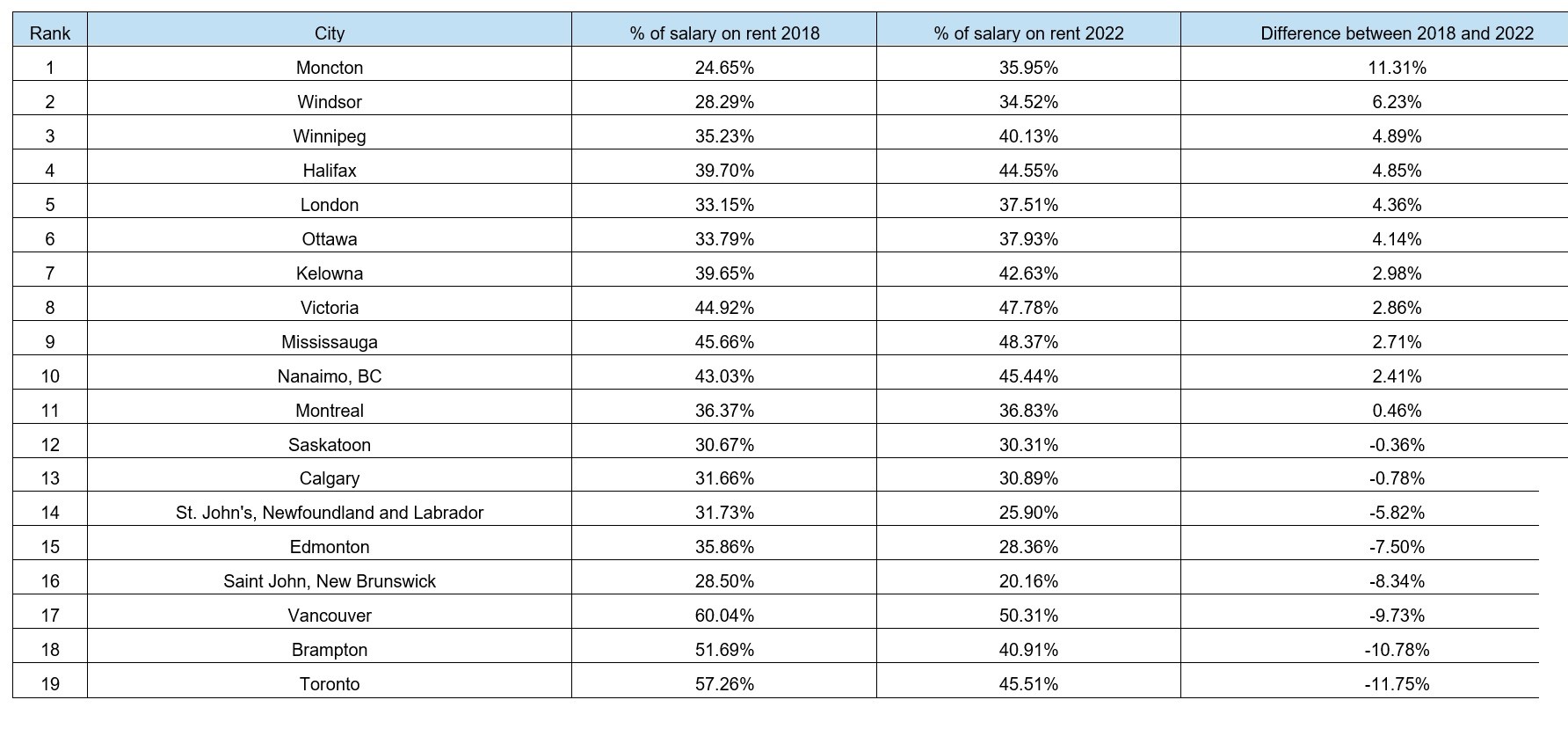
A new study by Online Mortgage Advisor compares the average monthly salary in hundreds of cities worldwide with the average monthly rental fee for an apartment located within each city market to calculate the change in rental affordability since 2018.

Surprisingly, Toronto had the biggest positive change in rental affordability in Canada — and on the North American continent. According to the study’s findings, renters in Toronto in 2018 were paying 57.26 per cent of their salaries on rent, whereas in 2022, it dropped to  45.51 per cent. Meanwhile, Moncton, NB, is experiencing the largest shift in the opposite direction, with renters now paying 36 per cent of their incomes on rent, representing an increase of 11.3 per cent since 2018. Windsor, ON, Winnipeg, MB, and Halifax, NS, also recorded substantial increases.

Canadian cities by-the numbers:

But Canadians aren’t the only ones facing higher rent prices in relation to their incomes; globally speaking, 45.5 per cent of the cities included in Online Mortgage Advisor’s study became less affordable for renters between 2018 and 2022, with Sharjah, United Arab Emirates, taking the prize. Since 2018, average rent vs. income in Sharjah soared from 44 per cent in 2018 to 438 per cent in 2022, making it the most expensive rental market in the world.

In terms of purchasing a property, Edmonton ranked second globally as an affordable option for average income earners in 2022 versus 2018, while Calgary placed sixth on the list. Johannesburg, South Africa, saw the biggest increase in property affordability worldwide.

Vancouver commits to housing targets

The City of Vancouver announced its full commitment to aligning itself with the province’s recently unveiled housing targets.

“Vancouver is ready to take the lead on building new housing. We have said getting homes built requires an all hands on deck approach, and we are pleased to see clear support from the province to build the homes that we need to tackle the housing crisis head on,” said Vancouver Mayor Ken Sim. “The City of Vancouver is fully committed to do what it takes to make sure we have attainable housing for everyone who calls our city home.”

Over the next five years, the city will be working diligently to meet or exceed the provincial target of 28,900 new completed units of housing.

“Targets involving completion will require the joint effort of the city and the province to manage factors that are outside many municipalities’ control,” said City Manager Paul Mochrie. “These include access to funding and financing for market and non-market developers, high interest rates, increased cost of construction and availability of labour. While municipal governments, including Vancouver, cannot control many of the factors affecting completion of housing projects, we can control approvals and we are focused intensely on simplifying and expediting that process.”

The city has already taken substantial steps to improve housing approvals, including by introducing new technologies and simplifying regulations to streamline permitting. Recently, council also approved a proposal to evolve low-density zones to allow multiplexes and enable missing middle housing. Together, these initiatives will make it easier to build new housing with simpler rules and processes, supporting council’s 3-3-3-1 Permit Approval Framework.


Smith Crossing pedestrian bridge opens

The City of Edmonton announced that the new Smith Crossing Pedestrian Bridge is now open, on budget and ahead of schedule.

The Smith Crossing Pedestrian Bridge, located along 23 Avenue, forms a key link in Edmonton’s river valley trail network as it provides a safe crossing over Whitemud Creek and access to the MacTaggart and Larch Sanctuaries.

“The Smith Crossing bridge is a beloved destination for many Edmontonians and provides an important link to the beautiful trails around Whitemud Creek,” said Sam El Mohtar, director, Transportation Infrastructure Delivery. “The new structure is a tied arch bridge with a slender, open design that helps it fit within the natural area. It will provide a safe connection to the surrounding trails for many decades to come.”

The $6.3 million project involved replacing the more than 100-year-old bridge with a new structure that meets current structural and safety standards. The new bridge is installed higher from the ground to improve the bridge’s resilience to floods while also allowing larger animals such as moose or deer to walk under the bridge.

The new bridge is in the same location as the old bridge which reduces its impact on nature and strengthens ties to the existing trail network. Protecting the environment while creating new ways for residents to connect with nature is part of The City Plan vision.

Built in 1914, the original Smith Crossing Bridge was named after the Smith family, who were pioneers in the area. It was a vehicle bridge until 1961 when it was changed to a pedestrian bridge. A piece of the old bridge has been used in a new interpretive plaque near the bridge.


Store your cleaning supplies safely

Are you storing your cleaning supplies in the best way? There are many things to consider when evaluating your supply storage, from temperature to ease of access to safety, and more. Often supplies are stored in a closet without much thought to creating protocols to ensure that your staff stays safe, they can use what they need efficiently, and that you get the most out of those products.

Scheduling an annual assessment of your supply storage allows you to stay in-the-know about your inventory, increase efficiency, and manage safety. The consequences of storing your cleaning supplies range from inconvenient to dangerous, so keep the following considerations in mind when evaluating your current storage system:

  • Stay organized with all supplies in one place. That way if there is a situation like a spill, where you need something in a hurry, you know exactly where everything is located.
  • A cart with your most-used supplies can help transport them easily through your building, simplifying, and quickening the cleaning process. If your closet is large enough, tuck the cart into the corner for easy access.
  • Store cleaning chemicals in a cool, dry location, as some can become combustible if they heat up. Also, keep harmful chemicals away from HVAC intakes where the fumes could be sent through the rest of your building.
  • If you have shelving, store heavy bottles at eye lever or lower to lessen the risk of dropping or spilling something when reaching for it on the top shelf.
  • Keep a close eye on your inventory to ensure that you maintain the supplies you need, as well as monitoring the harmful and corrosive chemicals you store on site.
  • OSHA recommends using “signal words” to note levels of danger. Label your shelves or products with “danger” or “toxic” so cleaners using the products are aware of the risks.
  • Ensure that all products are properly labeled so they are not used incorrectly by mistake. This includes containers like spray bottles, supplying a smaller amount of product transferred from a larger container.
  • Discard any chemicals that are old or past their date, making sure to read the labels for recommended safe disposal.

RELATED: Why reading chemical labels has never been more important

Safe and responsible cleaning product storage is crucial. Schedule annual assessments to ensure that the protocols you have in place are still being practiced and still make sense for your business to ensure safe use and storage for your cleaners.

Reconciling through design at Centennial College

Rarely are post-secondary spaces constructed with poetry in mind. Yet when architecture firms were competing on a design for A-Building, the recently completed $112-million expansion project at Centennial College, the school handed them a book, “Living in the Tall Grass: Poems of Reconciliation,” by Chief Stacey Laforme.

“They said, make the building be an embodiment of this poetry and represent and embody Indigenous culture,” says Craig Applegath, partner at DIALOG, which ultimately won the bid. “I thought, I’ve never in my whole career had an assignment like this. . . it’s wonderful.”

Anishinaabeg-led Smoke Architecture consulted on various Indigenous design elements for the 133,000-square-foot addition on the Scarborough, Ontario campus, and worked alongside DIALOG to physically manifest teachings from the school’s first Indigenous Outreach Coordinator Joseph McQuabbie, who passed away during the process, as well teachings that resonate through the book.

“If you read those poems it’s all about how we’ve come through a difficult pathway of where our original intentions towards each other, towards the land, have become obscured at times,” explains Principal Architect Eladia Smoke. “But then they reveal themselves in glimpses and we see the truth of how wonderful it can be if we returned to those commitments once more.”

As people pass through the space, they will catch these glimpses of cohesion and obscurity, she says. Along the ceiling of Wisdom Hall—a knowledge sharing space modeled after the Midewigan and Anishinaabe teaching lodge—artistic panels with graphic pictorials move east to west, telling the Anishinaabe creation story. Moving from west to east, are artist’s representations of the Haudenosaunee creation story. The directions of the stories symbolize how these nations move in ceremony.

“Those artists’ expressions of creation are sliced into panels,” Smoke elaborates. “As you move under them you will see glimpses of the creation story happening through time but the rest becomes fragmented and that is how life is. You kind of lose track of where you’re going sometimes, but then you’ll catch a glimpse of where you’re headed. . . that’s how we can again come together and find our way.”

The acoustic baffles upon which the art is displayed curve to mimic the pattern of Highland Creek that flows behind the building and connects the Morningside and Progress Avenue campuses.

To enter the A-Building, a ceremonial east entrance reflects the sunrise and new beginnings and honours The Beaver Bowl pattern from the Dish with One Spoon wampum covenant. A set of public stairs with peer seating mirrors the natural rise of the earth outside.

Moving up through the building, people will find a student touchdown area for communal learning and Wisdom Hall, which leads to a north teaching garden with Indigenous plantings.

On the fourth floor, Dehwigan Café overlooks the Balance Centrestone—a prominent spot at the northwest corner of the building with seven columns that represent sacred teachings. “The building actually structurally depends on that element,” says Smoke. “We thought it was a powerful expression—a promise that the building is making to abide by our commitments to each other as humans and to all of those other life systems that support us.”
Centennial

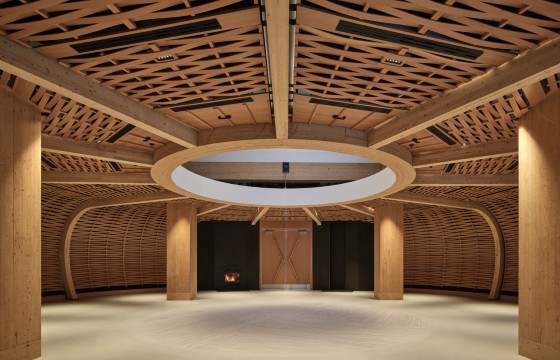
A circular room for ceremony inside Indigenous Commons. Photo by Riley Snelling.

At the heart of the facility is Indigenous Commons with a sacred wood-burning fireplace at the east entrance.

The dome-shaped room, for drumming and ceremony, is wrapped in a basket weaving of wood slats to reflect the principles of the Anishinaabe Roundhouse. “It feels like being on the interior of a wood ship,” says Applegath, with a colour scheme of white against wood tying into the natural organic feel of the building.


The room opens onto an administration suite modeled after Kookum’s Kitchen (grandma’s kitchen), with activity zones mirroring the patterns of a Haudenosaunee longhouse. An outdoor courtyard is easily accessible for ceremonies and events, with seating terraces that reference the four levels of creation with Anishinaabemowin words.

An outdoor classroom lies in the middle of the courtyard. “When it’s a full moon and the noonday sun falls in that circle, you’ll see the line of the shadow fall on the Anishinaabemowin name for that moon,” says Smoke. “That reminds us of what we do out on the land during that time of the year and how we connect to all these living systems.”

Indigenous design continues along the building’s exterior as the facade lifts up to reveal the structure of glass—a metaphor for pulling the skins back from a teepee. Indigenous geometry graces the envelope in back-and-forth diagonals. “It’s very special,” says Applegath. “You won’t see any other geometry like this on a building anywhere else in the world.”

Between the windows, white painted steel presents like scales of fish. “The white reflects sunlight so the building doesn’t heat, but it also means that during the day, the windows appear darker compared to the white skin so they stand out geometrically,” says Applegath. “In the early morning or at dusk, when the sun is low, the building comes alive with light from inside.”

Zero Carbon Commitments

Sustainability played a predominant role in the project as it also aligns with Indigenous values. This included meeting the CAGBC’s net-zero carbon requirements and using the most contemporary methods of mass timber structural design.

As Applegath explains, the walls and roof are heavily insulated. The curtain wall is triple-glazed for a U-value of .28. To reduce heat gain in summer, the white painted steel cladding not only reflects the light, but the roof is covered with white calcite ballast.

The building inputs energy through electrical systems. The generator, when tested, is the only source of gas in the building along with a tiny amount of natural gas in the kitchen. All lighting is LEDS for ultra low energy demand.

“To add energy that is zero carbon the building uses two systems,” he adds. “One is an electrical photovoltaic array on the roof to add electricity to the system. We also have water reheat through roof-mounted water heaters that capture the sun’s heat.”

Such is a large feat that doesn’t come without obstacles. “The biggest challenge in any building for zero carbon is you’re going to have to use some energy, typically outside of what you generate with photovoltaics,” he says. “This is a six-storey building, so although the roof is covered in photovoltaics, it’s not enough energy to cover all the electrical demands.”

Some of this electrical energy comes from the grid. “In Ontario the electrical grid is very, very low in carbon, but there is still some carbon,” he says. “That means the college has to have a contract with a carbon offsetter.”

Showcasing Mass Timber 

The glulam post-and-beam structure and CLT floors maximize the use of mass timber, a material that has 15 to 20 per cent less embodied carbon than steel or concrete and integrates Indigenous belief systems with regards to nature.

“One cubic metre of wood is equivalent to one tonne of sequestered carbon so it’s a really, really important material,” says Applegath. “Some might argue that wood stores biogenic carbon that will one day release back into the atmosphere, but I’d argue there is a climate emergency now and the building is going to last more than 25 years. “We’ve got to do everything we can to lock up carbon over the next 25 to 30 years. After that, if we haven’t figured it out, we’re in big trouble.”

The value of wood extends beyond carbon. Across all settings, but particularly within post-secondary facilities, being surrounded by wood is conducive to learning. “I suspect it’s because wood causes a biophilic reaction in us,” Applegath suggests. “When we are in nature we get a bit of a dopamine jolt in our brains, and I think that wood is a substitute for that.”

Building with wood also brings care and concern to construction sites, which are typically littered with coffee cups and other garbage. “A mass timber building feels different,” he says. “It’s a quiet construction. There’s a sort of respect, like building in a church.”

Collaborating Respectfully

Back in 2018, when the school’s Indigenous Strategic Framework was released in the wake of the Truth and Reconciliation Commission Report, physical spaces like the refreshed A-building didn’t exist at the school, says Sean Kinsella, first director of the Eighth Fire and current co-chair of Centennial College’s Indigenous Working Group.

“One thing institutions tend to do is they silo Indigenous faculty and Indigenous student support, where they sort of segment those different parts out,” they explain. The team worked on bringing the various needs of Indigenous faculty, students and staff under one roof, while ensuring the treaty process was honoured.

The group engaged with internal Indigenous stakeholders then branched out to the Aboriginal Education Council and other community members. “We did have Anishinaabe and Haudenosaunee people in our working group to make sure a variety of perspectives were captured, particularly as it pertains to the treaty folks for this area,” they add. “And not just the modern treaties, but also the historical context of Toronto as a gathering space.”

As it stands, there are critical gaps in the Greater Toronto Area. “There’s not a lot of internal ceremonial space that exists for community members, particularly in Scarborough, they say. “A lot of the Indigenous agencies tend to be centred downtown.”

To respectfully engage with local Indigenous groups, Kinsella advises that design teams determine who the space is for, how it will be used, and barriers to accessing the space, and create room around tight deadlines for robust conversations. “Give way more time than you’ll think you need. “We talked about design elements for hours and hours and hours.”

When Indigenous community leaders reach a high level of success they can be pulled in multiple directions. “Ask them how much time they can contribute, how they would like to stay involved with the project and what’s the easiest way to communicate with them,” advises Smoke. “And then be very rigorous in how you record the conversations, checking back with people to make sure you didn’t misunderstand.”

Continuously showing how the project is capturing and responding to what is conveyed will respectfully involve people through the entire process.

“There is so much work to do,” says Smoke. “ As a country we’ve been struggling along without our Indigenous Peoples, without input and wisdom and knowledge systems. We as Canadians have a right to those knowledge systems and we’ve been denied that right through the forces of colonialism that have sublimated and obscured those teachings. We need them now because they are tremendously important for our survival as a species.”

Feature photo by Riley Snelling.

BOMA Canada honours the industry’s best and brightest

On September 28th, 2023, the Building Owners and Managers Association of Canada (BOMA Canada) honoured members of the Canadian commercial real estate industry at their annual national awards gala event. Taking place in Edmonton, AB, within the traditional lands of Treaty Six Territory and the Métis homelands, the evening kicked off with a reception, followed by welcoming remarks, dinner, entertainment, and the awards ceremony.

The association honoured nine recipients with the prestigious TOBY Awards for Outstanding Building of the Year, recognizing quality in commercial real estate buildings and excellence in building management.

In the Corporate Facility category, the award went to Toronto’s 56 Wellesley Street West, owned by The Canada Life Assurance Company & The Canada Life Insurance Company of Canada, and managed by GWL Realty Advisors Inc.

Enterprise Square in Edmonton, owned by the University of Alberta and managed by BentallGreenOak was the winner in the Historical Building category.

The Industrial category was won by 6975 Creditview Road in Mississauga, owned by MNBP Single and Flex Holdings Inc., and managed by QuadReal Property Group.

Burlington’s 1111 &1122 International Boulevard, owned by 1111 International Nominee Inc. and 1122 International Nominee Inc., and managed by Fengate Asset Management, took home the award for top Suburban Office Park.

Edmonton’s Commerce South Office Park – Building B, owned by Sun Life Assurance Company of Canada, and managed by BentallGreenOak won the award for properties under 100,000 square feet.

155 University Avenue in Toronto, owned by The Canada Life Assurance Company and managed by GWL Realty Advisors Inc., won for buildings in the 100,000 to 249,999 square feet category.

Taking the top prize for buildings between 250,000 and 499.999 square feet was Toronto’s 720 King Street West, owned by 2095891 Ontario Inc., and managed by Triovest Realty Advisors Inc.

In the category of buildings from 500,000 to 1,000,000 square feet, One York Street in Toronto, owned by One York Street Inc., and managed by Menkes Property Management Services Ltd. took home the award.

The award for buildings over 1,000,000 square feet went to Toronto’s 483 Bay Street, owned by Northam CCPF Tenco (BTS) Limited, and managed by Northam Realty Advisors Ltd.

PINNACLE AWARDS

The Pinnacle Awards recognize companies that represent a standard of excellence to which all BOMA member should aspire, focusing on innovation, teamwork, and outstanding service and commitment to clients.

In the Above and Beyond category, celebrating those go beyond the call of duty in their commitment to service excellence, was awarded to Edmonton’s Bee-Clean Building Maintenance.

Recognizing those who elevate the customer service experience, the Customer Service category honoured Englobe, in Laval, QC.

In the Innovation category, Precise ParkLink Inc., in North York, ON, took home the prize in recognition of its innovation-driven culture and leadership leveraging technology to deliver efficiency, convenience, and value to the commercial real estate industry.

INDIVIDUAL AWARDS

In the individual categories, past BOMA Canada Chair Award recipient Cheryl Grey announced that Curtis Dorosh, from the Ministry of SaskBuilds & Procurement in Regina, SK, won the Elaina Tattersdale Sustainability Champion Award for continually striving for sustainability and inspiring others.

The Sunderland Scholarship Award honoured Madeline Krieger, from Fallsview Casino Resort in Stevensville, ON.

Jarrett Young of Edmonton’s ONE Properties received the Emerging Leader of the Year award, while the award for Randal Froebelius Member of the Year went to Deb Beurling from Toronto-based BentallGreenOak.

The event’s most prestigious award, The BOMA Canada Chair’s Award, was awarded to Linda Larsen, in recognition of her exemplary service to the organization and the industry.

BOMA BEST AWARDS

Earlier this year, BOMA Canada introduced its new BOMA BEST awards celebrating high scoring achievement in each of the BOMA BEST certification asset classes. Henry Chamberlain, President & Chief Operating Officer of BOMA International, proudly highlighted the following buildings:

  • Vital Centre (AB), managed by BentallGreenOak, in the Enclosed Shopping Centre category.
  • Sierra Springs Shopping Centre (AB), managed by BentallGreenOak, in the Open Air Retail category.
  • Milton District Hospital (ON), managed by Halton Healthcare Services Corporation, in the Health Care category.
  • Hoskins (BC), managed by GWL Realty Advisors Inc., in the Light Industrial category.
  • 44 Charles St. (ON), managed by Manulife Investment Management, in the Multi-unit Residential Building category.
  • Commerce Place Edmonton, managed by QuadReal Property Group, in the Office Under 1,000,000 Square feet category.
  • Southcore Financial Centre (ON), managed by QuadReal Property Group, in the Office Over 1,000,000 Square feet category.
  • Forensic Services and Coroners Complex (ON), managed by Dexterra, in the Universal category.

RICK HANSEN FOUNDATION ACCESSIBILITY CHALLENGE AWARD

Launched in 2019, BOMA Canada partnered with the Rick Hansen Foundation to recognize members who are working towards creating a world without barriers through meaningful accessibility. Rick Hansen representatives Sarah McCarthy, Vice President, Strategic Initiatives, and Marco Pasqua, Accessibility Consultant, presented the award to the Newton Community Branch of Vancity Vancouver City Savings Credit Union.

In addition, a new Buildings Without Barriers accessibility challenge was announced, open to all commercial building and multi-unit residential building owners and managers who commit to having at least three sites rated in the first half of 2024.

ACCREDITED VENDOR CERTIFICATES

Following last year’s creation of the Accredited Vendor Program, reflecting exemplary services from janitorial providers, the event honoured Allen Maintenance/Controlnet of QC/ON in this category.

Members can look forward to next year’s gala, taking place September 23rd to 25th in Vancouver, at the unceded Coast Salish territory of Musqueam, Squamish and Tsleil-Waututh peoples. Announcing the event details, Mike Bishop, President of Asset Management, promised that “Cutting edge ideas will meet breathtaking natural beauty,” as members explore innovative insights and network with industry leaders against the stunning backdrop of the Pacific Northwest.

For the full list of this year’s winners, please visit this link.

Avoid slip and fall accidents on your property

Winter brings snow, ice, and an increased risk for slip and fall accidents in your facility. Minimizing these risks and keeping your facility clean is something most maintenance managers will need to consider as the temperatures drop, and the snow starts falling.

There are several things you can do to stay vigilant in keeping your floors dry and safe and decreasing the risk of slipping and falling this season:

  • Although there is no formal requirement from OSHA (Occupational Safety and Health Administration), your workers need to be retrained each season on the hazards and practices to avoid slip and fall accidents on site.
  • Train your staff to be on the lookout for water on the floor, mopping it up quickly and using clear signage to warn visitors that the floors are wet.
  • Ensure that your lighting is adequate, keeping lightbulbs in working order so any temporary water or snow on the floor is easily visible.
  • Install matting from your front door throughout your facility to help trap water, dirt, and debris to keep surfaces clean and mitigate the risk of water on the floor.
  • Consider installing a temporary vestibule or pergola and outdoor matting to help try to keep snow and ice away from your building.
  • Ensure that all eavestroughs drain far enough away from your building that if that water re-freezes, it is not in the path of your entrance. These should be checked as part of your fall maintenance before the temperatures drop.
  • Be aware of all the ways slipping and falling can happen on your property and address each issue accordingly. Workers should avoid getting on a ladder with wet shoes, ice melt and snow removal should be a regular part of your outdoor maintenance program, and mats need to be cleaned and dried regularly to avoid any slippery build up.
  • Include clear signage on the exterior of your building, too, in areas that may be hazardous due to the weather.
  • If your facility is open 24 hours, ensure that you schedule cleaning at low-traffic times to make it easier for staff to clean safely and efficiently.

Keeping your workers and visitors safe is an important part of your maintenance program and winter brings additional risks with wet and icy weather. Be proactive in protecting the people in your building and mitigating the risk of slip and fall accidents this season.

Call to action 92 premised on truer partnership

Call to action 92 – the Truth and Reconciliation Commission’s call for economic development endeavours to be grounded in meaningful consultation and respectful relationships with Indigenous peoples – can be seen as an invitation to commercial real estate and other industries to build profitable partnerships that deliver better outcomes. Speaking this week at BOMEX, the Building Owners and Managers Association (BOMA) of Canada’s annual conference, Bryce Starlight, vice president, development, with Taza Development Corporation, offered insight from both his business activities and cultural experience.

“People hear Call to action 92 and go running under the table to hide. It sounds scary,” he observed. “It sounds like a mandate, an order.”

However, he suggested that Call to action 92 should be interpreted as a starting point to explore Indigenous people’s objectives in the context of the power and economic imbalances they have historically confronted. Truth and reconciliation is about much more than addressing the residential school legacy, and involves drilling down to consider ongoing inequitable access to the societal opportunities and resources that most Canadians see as their due.

“It also has a lot to do with how Indigenous communities developed over the last 50 to 70 years and understanding how the institutions have actually helped to create an imbalance in the way that (Indigenous) communities work with society and with their partners,” Starlight said. “It’s important to see what the gaps are and to understand what’s needed to get over those gaps.”

That’s unlikely to be accomplished through a rigid top-down plan. “A lot of time, Indigenous communities know full well that the conversation is going to be: We know better than you and you’re going to listen to us and, if you don’t, then we’re done with you,” he maintained.

Yet, typically, more productive relationships are derived from two-way conversations, in which business proponents pitch what they have to offer, inquire what their prospective partners would like in return, and then negotiate from there. Very few communities anywhere are receptive to outsiders posing as saviours. Rather, as Call to action 92 underscores, communities tend to be more accepting when they see genuine evidence that they are valued for what they can contribute.

In the case of Indigenous communities, Starlight reiterated that they can offer their business partners a source of local labour, access to government contracts and, of course, profits. Call to action 92 also presents opportunities for businesses to re-examine their own processes and values, and learn more about themselves and the world in which they operate.

“As a company, you don’t have to do this. You can keep on keeping on. You don’t have to do it, but it just means that, again, if you’re not adapting, you’re falling behind,” Starlight reflected. “When it comes to reconciliation, don’t try to do everything, but avoid doing nothing.”


LSQ2 condo launches in North York

Almadev has unveiled LSQ2, its second condo rising in the 15-acre Lansing Square development in North York.

The 30-storey tower will bring another 338 units to the Sheppard and Victoria Park community alongside LSQ1, a 462-unit condo that was announced earlier this year. The LSQ mixed-use community is taking shape in the Consumer Road Business Park neighbourhood and will  bring commercial and retail space to the area in addition to 1,600 residences.

North York

LSQ2 is the second building coming to Lansing Square.

Amenities at LSQ2 include dedicated children’s play areas, a games room, sauna and steam facilities, an indoor-outdoor fitness area,  indoor and outdoor lounges and party areas, a BBQ area, a dining room, a co-working lounge, a recording/podcast studio, a pet wash station and a media room and sports lounge.

There will also be mail and parcel storage, lockers, dedicated concierge services, on-site bike storage, electric vehicle charging stations, and exclusive resident-only shuttle service connecting the community to Don Mills TTC Station.

Wallman Architects, with interiors by Truong Ly Design, is envisioning an outdoor courtyard, that easily connects the two condos and leads directly to the community’s 1.2-acre public park with public art. Retail space grounding LSQ2 will open out to the courtyard.

“ LSQ2 and LSQ1 are both aligned under the same vision, setting the architectural standard for the entire community,” said Rod Pell, architect at Wallman Architects. “With a shared commitment to creating visually-captivating and functional living spaces, we’ve strived to craft buildings that not only complement its surroundings but enhance it.”


Giving hybrid meetings a second thought

​​​​If you care for a condo corporation that consistently shows up when it’s time to vote, consider yourself lucky. Most corporations have struggled to reach quorum at some point in time, especially when things are going well. Owners don’t have issues to bring up, so they simply don’t come.

Voter apathy is a costly problem for condominium corporations

Condo managers know that voter apathy is more than a minor complication for corporations. It’s a costly challenge that directly impacts the efficiency of operations. Without enough votes, important condo business gets delayed.

Corporations also need to use more resources and money to reschedule the AGM or member meeting and there’s no guarantee that quorum will be reached on the second try. Costs also add up when meetings have to be rescheduled.

Generally speaking, a building of 100 units spends anywhere from $600 to $1,000 for one in-person meeting, and another $600 to $1,000 each time it needs to be reorganized. And considering how thin 2023 budgets have been spread, this is not a great time to incur avoidable expenses.

Virtual meetings advanced new possibilities when traditional meetings were not an option

When the 2020 pandemic hit, Ontario condo corporations were granted permission by the provincial government to hold meetings virtually, as applicable, notwithstanding certain restrictions or requirements, even if their bylaws did not explicitly allow them. AGMs would not have to be cancelled after all, but managers who had never hosted a virtual meeting before may have wished that they were.

Fortunately, companies that build software for condominiums were able to connect managers and their corporations to very simple, user-friendly virtual meeting solutions. People who had never attended an owner meeting before were suddenly showing up because they could participate from the comfort of their suites.

Legislation was previously revised to give corporations the option to host meetings electronically until September 30, 2023. Bill 91, the Less Red Tape, Stronger Economy Act, 2023, received royal assent in June and becomes law on October 1, 2023, allowing condo corporations to hold virtual meetings and permit e-voting without a by-law.

Hybrid meetings: The best of both worlds

Not everyone loves virtual meetings. There are managers, boards and owners who prefer to keep things the same because, for the most part, they worked. There’s no need to acquire audio and visual hardware or remind someone they are on mute.

The majority of corporations do seem to prefer the virtual option. So why not seize the opportunity to make everyone happy? It doesn’t happen often, but hybrid meetings can help.

While it sounds like twice the work, the reality is that once a hybrid meeting system is up and running, it will save a lot of time and maybe money, too. You won’t need to reserve such a large meeting space, or you can have it in your corporation’s party room if you have one. You won’t have to print out so many AGM packages, and you may reach quorum before the meeting begins since owners can submit votes ahead of time.

If one primary meeting objective is to get enough votes without excluding owners who prefer in-person meetings, then hybrid is the way to go. Just make sure there is a quality internet connection before this process begins. Bad internet will ruin a hybrid meeting.

The process might be a little bit different for every corporation, but here’s an idea of what some managers have experienced when they launched their first hybrid meeting:

Choose your meeting date

You’ll need to select a date, which virtual meeting package you’d like to have, and sign a contract detailing the terms and conditions. Meetings can be hosted in the evenings, but we encourage you to secure a morning or afternoon spot if that suits your owners better.

Hybrid meeting orientation email

Once the contract is completed, you will get an introductory email that contains important information about deadlines for preliminary notices, notice of meeting, and practice session availability. These deadlines are important because they ensure our team has enough time to get information to your owners and set up for the big day.

Prepare preliminary notice

Send over your preliminary notice. We can review the notice together before it goes out. Once you’re happy with it, the notice is distributed to owners. If you have a digital communications system, the notice can be shared through this avenue as well as mailed out to owners who prefer to receive hard copies of documents.

Prepare notice of meeting

Send over your notice of meeting. When we have this information, we can set up the e-voting module for you. I’d advise managers to schedule a short session with us to go over all of these details before the notice of meeting documents is finalized and sent out to owners.

See how automation increases participation

Once setup is complete, owners will get an introductory email, as well as reminders (up to 10) if they do not send an RSVP or cast votes by certain dates. Each email will contain a link that is unique to every owner (this is done to prevent voter fraud). The link will take them to a secure e-voting portal. From here, owners can read the cover letter for the AGM, download attachments, see meeting details for both in-person and virtual attendance, and RSVP or cast a vote.

Monitor votes

Managers have access to the e-voting dashboard before the meeting takes place. The dashboard lets them see how many votes have come in, and how close they are to reaching quorum.

The meeting

Getting a moderator for your meeting is strongly recommended. If you do, it will be one of the least stressful AGMs you’ve ever attended. All you will need to worry about is the setup for the in-person portion of the meeting. Everything on the virtual side will be handled by the moderator. They will do things like let the chairperson know if any virtual hands are raised, and un-mute participants when it is their turn to talk.

Hybrid meetings give owners more ways to participate in condo business and provide managers with more control over the entire process. There are so many benefits to this model.

Juliette Hunter is a customer success manager at Condo Control who currently holds her General License with the Condominium Authority of Ontario. She previously worked as a commercial and condominium manager, and then held head office roles at multiple condominium management companies. She has a keen understanding of the condo management industry and what types of solutions managers need in order to excel in their roles.