



Articles Archive - Page 202 of 927 - REMINET
REMI

Giving hybrid meetings a second thought

​​​​If you care for a condo corporation that consistently shows up when it’s time to vote, consider yourself lucky. Most corporations have struggled to reach quorum at some point in time, especially when things are going well. Owners don’t have issues to bring up, so they simply don’t come.

Voter apathy is a costly problem for condominium corporations

Condo managers know that voter apathy is more than a minor complication for corporations. It’s a costly challenge that directly impacts the efficiency of operations. Without enough votes, important condo business gets delayed.

Corporations also need to use more resources and money to reschedule the AGM or member meeting and there’s no guarantee that quorum will be reached on the second try. Costs also add up when meetings have to be rescheduled.

Generally speaking, a building of 100 units spends anywhere from $600 to $1,000 for one in-person meeting, and another $600 to $1,000 each time it needs to be reorganized. And considering how thin 2023 budgets have been spread, this is not a great time to incur avoidable expenses.

Virtual meetings advanced new possibilities when traditional meetings were not an option

When the 2020 pandemic hit, Ontario condo corporations were granted permission by the provincial government to hold meetings virtually, as applicable, notwithstanding certain restrictions or requirements, even if their bylaws did not explicitly allow them. AGMs would not have to be cancelled after all, but managers who had never hosted a virtual meeting before may have wished that they were.

Fortunately, companies that build software for condominiums were able to connect managers and their corporations to very simple, user-friendly virtual meeting solutions. People who had never attended an owner meeting before were suddenly showing up because they could participate from the comfort of their suites.

Legislation was previously revised to give corporations the option to host meetings electronically until September 30, 2023. Bill 91, the Less Red Tape, Stronger Economy Act, 2023, received royal assent in June and becomes law on October 1, 2023, allowing condo corporations to hold virtual meetings and permit e-voting without a by-law.

Hybrid meetings: The best of both worlds

Not everyone loves virtual meetings. There are managers, boards and owners who prefer to keep things the same because, for the most part, they worked. There’s no need to acquire audio and visual hardware or remind someone they are on mute.

The majority of corporations do seem to prefer the virtual option. So why not seize the opportunity to make everyone happy? It doesn’t happen often, but hybrid meetings can help.

While it sounds like twice the work, the reality is that once a hybrid meeting system is up and running, it will save a lot of time and maybe money, too. You won’t need to reserve such a large meeting space, or you can have it in your corporation’s party room if you have one. You won’t have to print out so many AGM packages, and you may reach quorum before the meeting begins since owners can submit votes ahead of time.

If one primary meeting objective is to get enough votes without excluding owners who prefer in-person meetings, then hybrid is the way to go. Just make sure there is a quality internet connection before this process begins. Bad internet will ruin a hybrid meeting.

The process might be a little bit different for every corporation, but here’s an idea of what some managers have experienced when they launched their first hybrid meeting:

Choose your meeting date

You’ll need to select a date, which virtual meeting package you’d like to have, and sign a contract detailing the terms and conditions. Meetings can be hosted in the evenings, but we encourage you to secure a morning or afternoon spot if that suits your owners better.

Hybrid meeting orientation email

Once the contract is completed, you will get an introductory email that contains important information about deadlines for preliminary notices, notice of meeting, and practice session availability. These deadlines are important because they ensure our team has enough time to get information to your owners and set up for the big day.

Prepare preliminary notice

Send over your preliminary notice. We can review the notice together before it goes out. Once you’re happy with it, the notice is distributed to owners. If you have a digital communications system, the notice can be shared through this avenue as well as mailed out to owners who prefer to receive hard copies of documents.

Prepare notice of meeting

Send over your notice of meeting. When we have this information, we can set up the e-voting module for you. I’d advise managers to schedule a short session with us to go over all of these details before the notice of meeting documents is finalized and sent out to owners.

See how automation increases participation

Once setup is complete, owners will get an introductory email, as well as reminders (up to 10) if they do not send an RSVP or cast votes by certain dates. Each email will contain a link that is unique to every owner (this is done to prevent voter fraud). The link will take them to a secure e-voting portal. From here, owners can read the cover letter for the AGM, download attachments, see meeting details for both in-person and virtual attendance, and RSVP or cast a vote.

Monitor votes

Managers have access to the e-voting dashboard before the meeting takes place. The dashboard lets them see how many votes have come in, and how close they are to reaching quorum.

The meeting

Getting a moderator for your meeting is strongly recommended. If you do, it will be one of the least stressful AGMs you’ve ever attended. All you will need to worry about is the setup for the in-person portion of the meeting. Everything on the virtual side will be handled by the moderator. They will do things like let the chairperson know if any virtual hands are raised, and un-mute participants when it is their turn to talk.

Hybrid meetings give owners more ways to participate in condo business and provide managers with more control over the entire process. There are so many benefits to this model.

Juliette Hunter is a customer success manager at Condo Control who currently holds her General License with the Condominium Authority of Ontario. She previously worked as a commercial and condominium manager, and then held head office roles at multiple condominium management companies. She has a keen understanding of the condo management industry and what types of solutions managers need in order to excel in their roles.

B.C releases housing targets for 10 municipalities

British Columbia has issued provincial housing targets for the first 10 municipalities selected as part of the Housing Supply Act. The City of Vancouver has been asked to build the most at 28,900 housing units over the next five years.

“While municipal governments, including Vancouver, cannot control many of the factors affecting completion of housing projects, we can control approvals and we are focused intensely on simplifying and expediting that process,” said City Manager Paul Mochrie.

The province is giving local governments a slew of resources, including $10 million to continue implementing the Development Approvals Process Review and developing a new digital permitting process. This is funding in addition to the $1-billion Growing Communities Fund launched in February 2023 and the recently announced $51 million to support local governments in meeting new density initiatives.

“We’re taking action and working with municipal partners to make sure more homes are built in communities with the greatest housing need,” said Ravi Kahlon, Minister of Housing. “The targets include thousands of below-market rental units for the largest and fastest-growing communities. This means more people will be able find a home in the community they love.”

The first 10 municipalities were selected for housing target assessment in May 2023. The province consulted with the selected municipalities during the summer to set the final housing target orders. These housing targets are net new units to be completed within five years.

  • City of Abbotsford – 7,240 housing units
  • City of Delta – 3,607 housing units
  • City of Kamloops – 4,236 housing units
  • District North Vancouver – 2,838 housing units
  • District of Oak Bay – 664 housing units
  • City of Port Moody – 1,694 housing units
  • District of Saanich – 4,610 housing units
  • City of Vancouver – 28,900 housing units
  • City of Victoria – 4,902 housing units
  • District of West Vancouver – 1,432 housing units


Great Gulf unveils newest active house in Ontario

An active house that sets new standards for indoor comfort, energy efficiency and sustainable building practices was recently on display in Bradford, Ontario. Last week, Great Gulf unveiled Summerlyn Active House, a third of its kind in Canada, but the first production and sale home.

The customizable design will soon be available in select communities across the province. Those who choose to live in one are promised a better quality of life—sleep, moods, concentration, productivity—while simultaneously reducing their impact on climate change.

Brussels-based Active House Alliance—founded by Great Gulf and Danish-based manufacturing company Velux—came up with the design’s methodology ahead of the world’s first certified active house launch in Etobicoke seven years ago. Since active house principles and specifications were defined in 2011, they have been applied to numerous building types: single-family and multi-family residential, social housing, offices, schools and more.

Tad Putyra, president of Great Gulf Low-Rise & Home Technology, calls it a paradigm shift in building design. “After years of research to understand residents’ experiences living in these homes, we’re thrilled to roll out this innovative approach to building design across Ontario,” he said. “The Active House label is a signal to homeowners that their house is designed to improve their overall well-being, and future-proofed for their evolving needs.”

Great Gulf

A work-from-home space with access to natural light. Photo courtesy of Great Gulf

An active home reduces energy usage and carbon emissions. Due to an abundance of natural light there isn’t as much use for artificial light during the day.

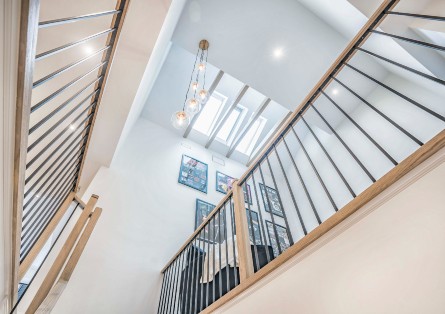
Indoor air quality and thermal climate are also higher quality. Some hallmark features include oversized windows and operable skylights for natural light to pour through. Natural airflow moves through the rooms and insulated walls, while floors and exteriors reduce unwanted noise.

Designed by in-house architects and constructed in Great Gulf’s 200,000-square-foot Toronto manufacturing plant, the house is built with prefabricated, CSA-certified wood panels using a robotically precise 3D computer modelling process that pre-emptively eliminates issues before they arise. The parts are then transported to the site for just-in-time assembly.

Inspiration comes from active house projects in China, Germany, the Netherlands as well as Great Gulf’s own active houses in Toronto and Thorold. “Active House has the potential to transform the homebuilding sector the same way electric vehicles have revolutionized the auto sector,” added Shaun Joffe, executive director, sustainability and building sciences at Great Gulf.

active houseA multi-year partnership with Georgian College will provide scholarships and give students exclusive access to Great Gulf’s facilities for applied research.

“This new collaboration between Great Gulf and Georgian College will encompass various initiatives, including developing next generation talent for the sector, experiential learning opportunities for students, and exploring research collaborations,” said Dr. Bill Angelakos, dean of Design and Visual Arts, Computer Studies. “As part of the collaboration, Great Gulf is extending utilization of Bradford’s Summerlyn Active House as a living laboratory rich with applied research possibilities to help evolve people-centric, and sustainable approaches to homebuilding.”

Feature photo, from left to right: Shaun Joffe, Councillor Joseph Giordano, Kathleen Schofield, Dr. Bill Angelakos, Dr. Yael Katz, Tad Putyra, Bill Tresham, Mayor James Leduc, David Bell, Amanda Wilson Watkins. Photo Credit: Tanja-Tiziana. 

The legacy of Sen̓áḵw

Sen̓áḵw is one of the largest low-carbon residential and Indigenous-led real estate developments in Canadian history. Currently underway at the south end of the Burrard Bridge in Vancouver’s Kitsilano neighbourhood, 11 towers will soon soar from the 10.5-acre reservation, filling a diverse range of housing needs in an area desperate for supply. But the project is ground-breaking for more reasons than that: setting new standards for collaboration, green building design, and long-term income for the Squamish Nation, Sen̓áḵw is a powerful testament to Indigenous land ownership and an economic legacy that’s expected to generate upwards of $10 billion in revenue over its 100-year lifespan from rental income alone.

“Sen̓áḵw is not just about real estate; it’s rooted in a story of the shared journey of our people coming home,” says Mindy Wight, CEO of Nch’ḵay Development Corporation, the economic development arm of the Squamish Nation. “Sen̓áḵw is reconciliation in action.”

SenakwEnvisioned with future high-density development in mind, the plans for Sen̓áḵw—which can be interpreted as “The place inside the head of False Creek”—were heavily influenced by what the surrounding area could look like a century from now, with towers soaring over 50 storeys, accessible green spaces, and energy efficiencies exceeding today’s standards. The striking renderings evoke a re-imagined ‘Towers in the Park’ feel, with bright, open courtyards, a multi-tiered landscape for social and commercial uses, and plenty of space to roam on foot or bike.


“The project is also part of the solution to Vancouver’s housing crisis,” Wight says. “With the goal of 6,000 rental homes—including 1,200 affordable homes—it will ease Vancouver’s rental housing shortage.”

History of the land

For thousands of years, the fertile lands beneath the new Sen̓áḵw development were home to members of the Squamish Nation. Once an important hub for trade, commerce, social relationships, and cultural practices, the arrival of the European settlers in 1791 ignited industrial expansion in the area and put pressure on the residents to vacate. In 1913, the Government of British Columbia forced the illegal surrender of the lands, and the families at Sen̓áḵw were displaced across the inlet to other Squamish reserves. Since the 1970s, efforts by the Squamish Nation to reclaim Sen̓áḵw have been underway, with multiple court battles and little success until 2003 when the Federal Court of Canada finally returned a small portion of the original reserve to its rightful inhabitants.

Sen̓áḵw’s proximity to downtown Vancouver, along with its rich, complicated history, contributed to the ensuing plans for a mega-mixed-use housing development that will bring continued value for the Squamish Nation.

“A project of this magnitude comes with unique challenges,” Wight points out, adding that the arrival of COVID-19 less than a year into the process didn’t help matters. “One of the largest challenges, however, was securing the right partnerships, multi-stakeholder interests, and navigating approval processes. At this scale and complexity, a diverse, highly experienced team is required to realize the project’s full potential successfully.”

This reality prompted the Squamish Nation to seek out a partnership with Westbank, an international development practice based in Vancouver. The Nation, Nch’ḵay̓ and Westbank have since been working together to lead the development of Sen̓áḵw with support from a consulting team of globally renowned development and construction professionals.

“The partnership has allowed us to accelerate the project and deliver more housing and amenities in a shorter amount of time,” Wight says. “Moving forward, we continue to face the same challenges that other developments face, such as rising inflation and interest rates, and labour shortages.”

Challenges aside, the project is well on its way to a completion date of 2030, with many notable milestones still to come. Sen̓áḵw will be Canada’s first large-scale net zero operational carbon residential development—one of only a few in the world—with aspirations to be 100 per cent GHG-free. All Sen̓áḵw’s heating and cooling will be produced by a new 10MW district energy system fed by waste heat from Metro Vancouver’s adjacent sewer infrastructure, and 45,000 square feet of mass timber construction will help reduce embodied carbon by 50 per cent compared to typical concrete construction.

Meanwhile, Nch’ḵay̓ has been making significant strides in contributing to the growth and well-being of the community since its establishment in 2018. Although Sen̓áḵw is a major project for the growing team based in Vancouver, it’s not the only development in the pipeline.

“Unfortunately, we cannot share any details at this time about our other projects due to ongoing negotiations and due diligence,” Wight says. “All we can say is… stay tuned!”

Additional project details:

Sen̓áḵw promotes a deep connection to urban living and nature by bringing together the four essential pillars of city-building: built environment, culture, transportation, and energy, creating a unique development for the City of Vancouver.

Sen̓áḵw is…

  • currently the largest Canadian residential partnership with any First Nation
  • the largest net zero residential project in Canada
  • a historic economic development opportunity that will set the Squamish Nation on a path to complete economic independence
  • a lasting example of Coast Salish architecture and design, and a cultural legacy for the Squamish Nation and for Canada
  • a project that will lead to hundreds of jobs and entrepreneurial opportunities for the Squamish Nation membership in design, construction, and operations
  • projected to be complete in 2030

About the Squamish Nation

Consisting of 23 villages, the Squamish Nation is comprised of descendants of the Coast Salish Aboriginal people who live in the present-day Greater Vancouver area, Gibson’s Landing and Squamish River watershed. The Squamish Nation has occupied and governed the territory since beyond recorded history. The culture is rich and resilient, with customs and traditions that are strongly interconnected with the traditional territory.

Renderings courtesy of the Squamish Nation.
Design Architect: Revery Architecture; Architect of Record: Kasian Architecture, Interior Design

Find out more about this landmark project at: Sen̓áḵw.com

Haskayne Legacy Park opens in Calgary

Haskayne Legacy Park, Calgary’s first regional park in more than 10 years, celebrated its official opening.

The new space features Calgary’s first net-zero 2,400 square-foot pavilion building – a ground-breaking achievement in sustainable development and the first in the city’s building portfolio. The park’s pavilion building draws power from a solar array which is designed to provide 33.6 kW of electricity.

Other features include a sheltered outdoor space equipped with large harvest tables, a gas fireplace, and seating nooks for family and friends to gather. Granular nature trails in the north area of the park offer visitors a walking loop and the chance to meander through scenic expanses of grasslands with spectacular views of the Bow River and foothills.

Nestled along the banks of the Bearspaw Reservoir, the park protects 126-hectares of a serene prairie environment.

“Haskayne Legacy Park is not just a park; it’s a testament to our commitment to preserving and connecting Calgarians with the valuable ecological and cultural heritage in the area,” said Kyle Ripley, director of parks and open spaces. “We are so happy to add another great regional park to our vast open space system and are confident that Calgarians will really enjoy this place.”

The development of the regional park is the result of the collaboration and partnership between Dick and Lois Haskayne, the City of Calgary, and Rocky View County. The northwest boundary of the park borders Glenbow Ranch Provincial Park which includes approximately 1,300 hectares of grasslands. Together, Haskayne Legacy Park and Glenbow Ranch Provincial Park will create a continuous greenway along the Bow River valley.

The park came to be when Dick and Lois Haskayne donated a portion of the land to the University of Calgary, which was then acquired by the City of Calgary in 2006 through the ENMAX Legacy Parks Program. Development of the park cost approximately $16 million, not including land acquisition and public access road improvements.


New poll sheds light on Manitoba housing issues

A recent opinion poll conducted by Rentals.ca sheds light on Manitoba housing issues and other rental-related policies as voters prepare to cast their ballots on October 3rd.

Out of the respondents surveyed, a significant 62 per cent identified themselves as renters, while an additional 25 per cent said they are actively seeking rental accommodations. When questioned about the significance of rental housing policies in their voting decisions, 66  per cent claimed that these policies were “very likely” to influence their choice, while 26 per cent indicated they were “somewhat likely.”

A resounding 78 per cent of participants pinpointed high rental prices as the most pressing problem in Manitoba’s current rental market. This concern underscores the economic hardships experienced by many Manitobans and underscores the urgent need for policymakers to address this issue.

In response to the recent announcement by the Manitoba Government regarding the 2024 rent guideline, which sets a 3 per cent increase, Rentals.ca sought to understand the potential impact on voters’ decisions. A substantial 78 per cent of respondents said  they believed that this increase would place a “greater financial burden on tenants without significant benefits.” Additionally, 29 per cent expressed concerns about a potential rise in evictions as a consequence of this policy change.

In addition, a significant 66 per cent of respondents said that strongly agreed that “it is crucial for elected officials to address the shortfall of rental housing supply in Manitoba.”

As the election date looms, 30 per cent of survey participants revealed that they remain undecided about which party to vote for, with 13 per cent of participants stating they do not plan on voting at all.


Expanding your customer base with lead generation

Building your cleaning company means growing the accounts you have, as well as generating leads to add customers to your list, but it can be tough to find new business while you are busy running your company, managing labour, and negotiating industry challenges.

On a recent episode of ISSA’s Straight Talk, Dean Mercado, CEO of Online Marketing Muscle, offers three strategies to fill that pipeline and keep revenues flowing in.

Short-term strategy

This is a strategy for a time period of zero to 30 days in the future, where you are in need of business quickly. An example of this approach would be paid advertising, which can often yield fast and effective results. Mercado explains that customers experience three stages in the buying process: recognizing they have a problem to solve, deciding to address that issue, and then making a call on who they will choose for the project. Often, customers are already in that last stage when they see your advertising, and you can capture that business in their time of need.

If you don’t have the budget for advertising, Mercado suggests you may need to invest your time into cold outreach, where you contact cold leads via phone or email to try and generate business.

Mid-term strategy

When you have a bit of breathing room, 30 to 90 days, for example, it’s time for the mid-term strategy, which involves content marketing like social media, YouTube videos, and blogs – these are all ways to reach your audience. The key is knowing your audience and where they will most likely see your content.

This is also a great way to position yourself as an expert by providing interesting, informative content with this longer-term strategy. Once you determine the route you want to choose, focus on creating content for that space to best reach your prospects within your comfort zone.

Long-term strategy

When you are thinking long-term, look at a strategy to plan for 90 days and beyond to keep that revenue flow continuous and reliable. A long-term strategy means leveraging referrals as a result of building relationships and developing trust with your clients so that they refer you to their contacts. Building those relationships, though, and asking for their referrals takes time so this is a strategy that is certainly not a quick fix. It’s necessary, though, to engage with your customers and turn them into clients who want to refer your business.

Lead generation is a must for commercial cleaners. As Mercado says, “No leads, equals no sales, which equals no business. That’s how critical your lead generation process is.”

ETRO Construction wins Groundbreaker Award

Burnaby’s ETRO Construction has won the 2023 Groundbreaker Award for Excellence in Workforce Development. Procore’s Groundbreaker Awards celebrate the top companies, projects and individuals that drive excellence across the construction industry.

“The Groundbreaker Awards acknowledge that behind every remarkable project lies a team of exceptional individuals. These awards shine a spotlight on our trailblazing customers who are making a positive impact on the construction industry day in and day out,” said Tooey Courtemanche, president, founder, and CEO of Procore. “Congratulations to all of the deserving winners who continue to demonstrate excellence, innovation and dedication in their field.”

Etro is the sole Canadian winner this year. The company previously won a Groundbreaker Award in 2021 for Excellence in Excellence in Innovation.

Since its founding in 2015, ETRO Construction has made it a priority to initiate positive change within the construction industry. From its beginning with only eight employees to its current workforce of more than 100, ETRO stands as a pillar of effective workforce development.

The company’s growth is not just in numbers, but also in innovation and commitment to inclusivity. ETRO’s core values — authenticity, curiosity, progressiveness and love — resonate deeply within its company culture, with ‘love’ being the value that centres the company’s philosophy as a “people-first” organization.

The company’s commitment to creating an outstanding workplace is evident through programs such as its People Builder Program, which offers ongoing mentorship, and its ETRO University Series, providing continuous education resources. The company celebrates its team’s contributions and further invests in its workforce’s development through a comprehensive Benefits Program that includes health and wellness initiatives, RRSP matching, generous parental leave policies, donation matching, and more

The full list of 2023 winners can be found here.

Call for B.C. governments to adopt zero carbon

Leaders in the provincial and national building industry want to see B.C. lead Canada in making all new buildings zero-carbon.The Pembina Institute has sent a letter signed by more than 30 members of the industry to local government mayors and councillors across British Columbia, calling on them to vote to adopt the province’s new voluntary Zero-Carbon Step Code (ZCSC). The letter is a specific call to not only adopt but adopt early, and at the highest level by 2025, rather than the currently scheduled 2030. Early adoption would avoid unnecessary and costly retrofits in the future by ensuring new homes and buildings are built right the first time.Municipalities have an important regulatory role in setting enhanced building performance standards and the ZCSC is an important new tool that enables local governments to meet climate targets associated with buildings by putting carbon pollution standards in place for all new homes and buildings constructed within their communities. “We have the experience and know-how to build highly energy efficient low- and zero-carbon homes in communities across B.C. As practitioners, professionals and advocates in the buildings sector, we are urging local governments to recognize these capabilities and adopt the highest tier of Zero Carbon Step Code,” reads the letter, which also states that all-electric buildings can be designed and constructed with zero to minimal additional cost.If adopted this code would ensure new buildings are heated and cooled by energy-efficient equipment such as heat pumps, rather than traditional furnaces and boilers, while also ensuring they meet high standards for insulation and ventilation. These standards would significantly reduce emissions while also reducing the energy and costs required to keep occupants comfortable and safe from increasingly extreme weather.

The signatories include organizations that build commercial, institutional and residential buildings (from high end private homes to affordable housing) across Canada, B.C., and locally in the Kootenays, Mainland/Southwest and Vancouver Island/Coastal regions.

8 Steps to Decarbonization

Decarbonization has become an essential objective for organizations striving to reduce their carbon footprint. But for those just setting out, the path forward may seem daunting. While the benefits of making a positive impact on the environment are well known and documented, decarbonization strategies must be multi-layered with strict, ambitious targets if an organization hopes to significantly reduce their carbon emissions.

And it’s no longer a matter of choice, but a necessity.

“Everyone has a responsibility to do their part in the face of climate change, particularly property owners and facility managers dealing with large, aging assets,” said Kelly Christensen, Manager, Strategy & Pursuits, Energy & Sustainability. “Pursuing decarbonization strategies that take into account everything from building construction through to operations and end-of-life is the best, and only way forward.”

As global efforts to decarbonize the world’s cities, communities, buildings, and facilities pick up speed, the 2021 Canadian Net-Zero Emissions Accountability Act provides a framework for Canada’s commitment to achieving net-zero emissions by 2050. But meeting the critical targets set out in the Act won’t be possible unless each organization commits to decarbonization goals of their own.

For those embarking on this complex journey, here are eight recommended steps:

  1. Establish a carbon footprint baseline.

Every decarbonization journey begins with a baseline year and calculation of an organization’s scope 1 and scope 2 emissions. As a multi-trade service provider, Black & McDonald can support this important first step by determining the methodology for your baseline calculations and collecting your company’s emissions data.

  1. Set reduction targets.

Once your carbon footprint baseline is established, it’s time to set attainable carbon emission reduction targets that align with local government policies. Black & McDonald recommends adhering to guidelines such as the Net-Zero Standard, which promotes science-based emission reduction targets.

  1. Maximize carbon emissions reductions.

This step involves identifying your organization’s highest-emitting assets and equipment and replacing them with lower-emitting alternatives. Typically, equipment powered by fossil fuel sources are the highest polluters. Transitioning to electrically powered alternatives, such as electric vehicle fleets and low carbon HVAC systems can significantly reduce emissions.

  1. Incorporate energy optimization strategies.

Optimizing energy consumption in your facility can be achieved in numerous ways. This includes enhancing your building envelope through measures like improved insulation to reduce heat loss/heat gain and decrease the strain on the building’s HVAC system, adding automated controls to optimize indoor conditions to reduce operating costs, and commissioning and recommissioning.

  1. Take advantage of renewable energy.

Renewable energy sources offer an indefinite amount of energy while releasing virtually zero carbon emissions. Integrating a renewable energy source on site will substantially reduce energy costs and emissions while enhancing the resiliency of the facility. Black & McDonald has the expertise and supplier relationships needed to determine the most cost-effective mix of renewable energy sources to meet your facility’s specific requirements.

  1. Purchase green energy.

Opting for green energy, generated through 100% renewable sources, is another effective way to decrease carbon emissions. Black & McDonald can facilitate conversations between your organization and local green energy providers to initiate this process.

  1. Reduce Scope 3 emissions.

Once you have successfully reduced scope 1 & 2 emissions, it’s time to tackle the more complex Scope 3 emissions. Scope 3 emissions typically occur outside of the organization’s primary site of work and may involve changes in employee behaviour or supply chain changes. Scope 3 emission sources that can be targeted include: business travel; employee commuting; waste generation; material transportation; end-of-life treatment; and more.

  1. Utilize carbon offsets.

In cases where reducing emissions becomes challenging due to limitations in funding or available technology, purchasing carbon offsets is a viable option. Carbon offsets or carbon credits act as a counterweight against your organization’s carbon footprint baseline. Black & McDonald can guide you through the purchasing process and consult on the most suitable carbon offsets that align with your organization’s goals.

“At Black & McDonald, our mission is to provide a path to successful decarbonization and net-zero energy for our clients and our operations,” said Christensen. “We embed energy conservation and sustainability best practices into all our business activities, applying innovative solutions to everyday projects, operations, and facilities. Through our commitment to sustainability and integration of cutting-edge technologies, we help our clients seamlessly make the shift to clean energy sources while maximizing the value of performance data generated by assets, people, and processes.”

To learn more about how Black & McDonald can help you on your decarbonization journey, visit www.blackandmcdonald.com


Dream announces plans to develop 5,000 new rental units

Less than a week after the federal government announced it would be removing GST on the construction of new apartment buildings, Dream Unlimited Corp shared plans to deliver 5,000 new purpose-built rental units in urban centres across Canada.

According to Dream, this and other steps by the federal and provincial governments have helped establish “a newfound ability for the entire development industry ecosystem” to form key partnerships and collectively address the affordability crisis by increasing the amount of market and affordable rental units available to Canadians.

“With Thursday’s introduction of new legislation formalizing the removal of GST, Dream is positioned to move forward on 5,000 net new purpose-built rental apartment units in Ottawa, Saskatoon, Calgary and Toronto collectively,” said Michael J. Cooper, President and Chief Responsible Officer, Dream Unlimited. “This legislation is a game changer for the development industry, and more importantly for Canadians. The housing crisis has impacted every urban centre from coast to coast. What this legislation unlocks is our ability to get shovels into the ground quickly at a time when it’s never been more critical to build new homes.”

Over the next six months, Dream says it is poised to advance several shovel-ready projects. In Ottawa, this includes 1,010 units of which 43 per cent will be affordable. Rents for the Ottawa units will range from 59 per cent of median market rent to market rents, contributing to 7 per cent of the city’s targeted annual construction starts of 15,000 units. In addition, Dream will bring 340 units in Saskatoon.

By 2025, Dream will be able to advance another 3,700 units across Ottawa, Toronto, Calgary, and more in Saskatoon.

The substantial progress in Ottawa is largely due to a unique partnership between Dream and the Multifaith Housing Initiative of Ottawa (MHI), a Canadian non-profit charitable organization founded in 2002 that is a coalition of 80 faith communities. This partnership has enabled the organizations to deliver an integrated rental community that will include affordable housing, transit connectivity and unprecedented sustainability targets. Located on the Library Parcel of LeBreton Flats, the development is an innovative, net-zero, mixed-income community that includes 608 rental units, 41 per cent of which will be dedicated as affordable. Dream and MHI will also develop integrated programs and support systems, creating a sense of belonging, fostering wellbeing, and paving the path for upward mobility for all residents in a sustainable, inclusive community in a transit-oriented development.

Multifaith Housing Initiative strongly supports the legislation tabled by the federal government on Thursday to eliminate the GST from new purpose-built rentals and encourages all provincial governments to proceed with the exemption of the PST,” said Suzanne Le, Executive Director, Multifaith Housing Initiative. “The elimination of GST/PST will allow projects and innovative partnerships between private and non-profit sector, like the one at LeBreton Flats between Dream and Multifaith Housing Initiative.”

According to Le, these partnerships are essential to scale the delivery of affordable housing and to strengthen capacity in the non-profit sector in our country. And while the GST waiver is a substantial step for those looking to build, all participants and all levels of government will benefit from the creation of new housing, with meaningful opportunities for community-building and huge social impacts for Canadians across the country.

ISSA recognizes innovation with this year’s awards

World-wide cleaning association, ISSA, will be honouring winners of the Innovation Awards Program, presenting the awards at the conference is Las Vegas, being held from November 13 to 16 at the Mandalay Bay Convention Center. These awards recognize companies in the commercial, institutional, and residential cleaning community that are addressing challenges with new products and services.

Members are encouraged to vote online for products and services with the most significant impact on the cleaning industry by November 13. Distributors, wholesalers, manufacturer representatives, building service contractors, residential cleaners, and in-house service providers may submit up to three product votes.

These awards celebrate as many as 50 products or services in the industry featuring four category awards, including Distributor/Wholesaler Choice, Residential Cleaner Choice, Manufacturer Representative Choice, and Facility Service Provider Choice. Voters should consider the following criteria as they vote for the Innovation Awards: impact, practicality, sustainability, competitive advantage, and originality of the product or service.

Winners will be announced at the convention on November 16 at 1 p.m. at booth #2247, followed by a celebration champagne toast during happy hour.

Other awards being announced include the Industry Choice winners, being announced on November 14 at 4 p.m. and Environment and Sustainability Awards, being announced on November 16 at 1 p.m.

To view this year’s submissions, please visit this link.

Image: Mandalay Bay

Infrastructure frailties imbue on-reserve risks

Climate-related risks compound the infrastructure frailties that many of Ontario’s Indigenous communities already confront. The recently released provincial climate change impact assessment (PCCIA) concludes that on-reserve buildings, utilities, storm water management, transportation links and communications networks are highly vulnerable to extreme weather events and climate volatility now, and are likely to be very highly at risk within a few decades.

The Ontario government released the commissioned technical report, prepared by the Climate Risk Institute, in late August. The infrastructure assessment considers key asset types for both current condition and capacity to adapt, with particular focus on the potential fallout from extreme precipitation events, extreme hot days and wildfire, along with various other climate-related possibilities. These are ranked on a four-point risk exposure scale — low, medium, high and very high — for six geographic regions of the province.

Currently, storm water management systems are deemed to be highly exposed to risk in all regions — the far north, northeast, northwest, eastern, central and southwest — while other asset types are at medium risk. That scenario is projected to change by the 2050, when buildings, transportation and utilities will also be at high risk in some or all of the regions.

Ratings are calculated based on various consequences and costs arising from climate-related stresses and damage, including: increased maintenance, repair and replacement; shortening of assets’ lifecycle; added demands for technical/professional expertise; spinoff economic costs of disruptions to the services that the assets support; and the need to relocate occupants of vulnerable or damage housing. Medium risk suggests that 20 to 40 per cent of assets could be compromised in some way; high risk is pegged at 41 to 60 per cent of assets; and very high risk is upwards of 60 per cent.

For Ontario’s Indigenous population, climate risks are often layered onto other shortcomings related to infrastructure, particularly for about 58,000 on-reserve residents. Inadequate housing and contaminated water supply are two of the most pressing issues. As of the fall of 2022, for example, water was unfit for consumption in 19 Indigenous communities, representing the highest number of boil-water advisories in any Canadian province. Nationwide, it’s estimated that a $30 billion investment is required to bring on-reserve infrastructure up to the current average level in Canada.

“The direct and indirect impacts of climate change on Indigenous communities in Ontario are far-reaching and complex, from increased populations with a need for relocation or evacuation during extreme weather events, to disruptions in cultural and community land-based practices, and reductions in access to health care and social services during extreme events,” the PCCIA warns.

The current capacity to adapt is deemed to be low, based on the underlying poor status of existing infrastructure, the cost and logistics of undertaking required work in remote areas, and barriers of economic and health disparity in the Indigenous population. At the same time, Canada’s recently released national climate change adaptation strategy looks to traditional Indigenous knowledge for insight and pledges to better enable First Nations, Inuit and Metis peoples to lead climate action on their lands and within their communities.

BCIT raises $33 million for new trades complex

BCIT has raised $33 million in private funding towards a new state-of-the-art Trades and Technology Complex.

More than 45 BC industry leaders and individuals across a range of sectors, including development, electrical, engineering, mining and forestry, have contributed funds towards the $220 million project through BCIT’s INSPIRE Campaign, the largest fundraising campaign in the Institute’s history.

“The BCIT curriculum is developed in close consultation with industry, and delivered by faculty with direct, hands-on experience in their fields,” said Dean of the BCIT School of Construction and the Environment Dr. Guido Wimmers. “The BCIT INSPIRE Campaign will allow us to continue to lead in providing applied learning opportunities. BCIT students learn through practical experience in unique environments that integrate real-world settings, equipment, and technology from the workplace. These include state-of-the-art classrooms, shops, labs, simulators, broadcast studios, green roofs, energy grids, forests, and waterways.”

The Trades and Technology Complex will increase access for students pursuing a trades and technology education and career, which will help the Province of BC meet the demand for an estimated 85,000 new trades jobs expected over the next 10 years.

The $220 million Trades and Technology Complex will provide an adaptive, innovative, and flexible learning environment through leading-edge, energy-efficient, sustainable design. The Complex will have capacity for 700 new full-time student spots annually, alleviating waitlists, and delivering the trades training needed to meet the labour needs of the province. The Complex will serve as a living lab where students from different disciplines–such as engineering, architecture and construction – interact, collaborate, and undertake projects together.

Key spaces within the Complex will include the Concert Properties Centre for Trades and Technology, the Robert Bosa Carpentry Pavilion, and the Marine and Mass Timber Workshop. Features for advancing education through the Trades and Technology Complex will include:

  • Four covered work yards.
  • Simulation-based learning areas.
  • Cross-disciplinary sim labs for trades and technology collaboration.
  • Power engineering sim lab–Kongsberg system.
  • Welding simulation lab.
  • Industrial network sim lab–industry partnership space.
  • Media centre lab–for remote/ online/ narrowcasting education delivery.
  • Classrooms, student commons, demonstration, observation, auxiliary and atrium spaces.


A bold vision for Winnipeg Hudson’s Bay building

The iconic Hudson’s Bay building in downtown Winnipeg is undergoing a multi-phased, $130-million transformation, making it one of the largest redevelopment projects of its kind in Canadian history. Led by the Southern Chiefs’ Organization (SCO) in consultation with the Hudson’s Bay Company (HBC), federal, provincial, and municipal Treaty partners, and Number Ten Architectural Group, plans for the site include 300 affordable housing units, an art gallery, offices for Indigenous entrepreneurs, a healing centre, a memorial for residential school victims and survivors, restaurants, a museum, and more.

Marking an important act of reclamation and a significant step in corporate Canada’s reconciliation journey, HBC transferred ownership of the aging department store to SCO after permanently closing its doors in November 2020. Since then, plans have been underway to repurpose the landmark building into something equally historic—a hub of economic opportunity for the city of Winnipeg and a celebration of First Nations heritage and culture for years to come.

“Many of our leaders and communities embrace a holistic approach to economic development—an approach in which the primary value of development is in providing a means to reinvest in the community for the benefit of all,” said Grand Chief Jerry Daniels. “Today can be another step toward that brighter vision, where we can work together on building the future our ancestors dreamed of—one with hope and opportunity for all.”

Hudson's Bay Called “Wehwehneh Bahgahkinahgohn”—which means “it is visible”— plans for the building involve maintaining the exterior heritage features such as the concrete structure, limestone cladding, bronze storefront windows and entries, while the interior is to be repurposed completely.


Environmental sustainability will be championed throughout the project, which aims to reduce energy consumption by 35 per cent and greenhouse gas emissions by 80 per cent, exceeding National Energy Code requirements. In the meantime, the project will create significant long-term employment opportunities with over a million working hours estimated for the construction phase alone—and once complete, it will become a catalyst for revitalizing and repopulating Winnipeg’s downtown core.

“As we considered the future for the Winnipeg building, it was important to ensure a sustainable plan for the site that also had meaningful purpose for the city of Winnipeg,” said Richard A. Baker, Governor and Executive Chairman of Hudson’s Bay Company. “HBC’s Truth and Reconciliation journey requires actions that demonstrate our commitment to moving forward together with Indigenous communities. We believe SCO is the right steward for this location and can create a new community landmark that will help advance reconciliation.”

Vancouver Island projects receive PacifiCan funding

Vancouver Island and Coast communities will receive more than $2.6 million for 16 projects to revitalize public spaces and enhance tourism experiences.

The federal PacifiCan funding includes $750,000 for one project funded through the Canada Community Revitalization Fund and more than $1.9 million for 15 projects funded through the Tourism Relief Fund.

The K’όmoks First Nation is receiving $750,000 through the Canada Community Revitalization fund to help build a community park and gathering space in Comox, B.C. New amenities will include a playground, gazebo, washroom, and outdoor kitchen. This will be the first outdoor gathering space for the K’όmoks First Nation.

The Greater Victoria Harbour Authority  is receiving $549,000 to help establish a place in Victoria’s Inner Harbour to showcase Lekwungen culture and history. The initiative is a partnership with the Songhees and Esquimalt Nations, and will feature interpretative backdrops and artwork by local Indigenous artists.

Chims Motel and Guest House is receiving almost $100,000 to construct an Indigenous cultural centre and revitalize lodgings at the Chims Motel and Guest House in Port Alberni. The guest house is an anchor attraction in the Tseshaht First Nation Territory offering educational Indigenous experiences such as plant walks, healing gatherings, and seafood dinners.

“From unique outdoor adventure and cultural experiences to breathtaking parks, lakes and heritage sites, Vancouver Island and the Coast of B.C. is a world-class place to visit or call home. Investing in shared public spaces and tourism experiences will bring communities together and ensure that the island and coastal regions thrive well into the future,” said Harjit S. Sajjan, minister of Emergency Preparedness and minister responsible for the Pacific Economic Development Agency of Canada

Upgrading existing infrastructure and building new public assets means British Columbians and visitors have better access to recreational programs and facilities.


Distressed asset sales remain a steady fraction

Distressed asset sales were a nominal and relatively consistent fraction of the Canadian investment property market in the first half of 2023, accounting for less than 2 per cent of total transaction volume. JLL’s newly released fall outlook on commercial real estate calls this “low by historical standards” and suggests lenders are key to the divergence from default trends seen in the United States.

Total deal value from distressed properties is lagging from earlier in the decade, hovering below $200 million for the first six months of this year. That compares to $920 million over 12 months in 2021 and about $800 million in 2020, when distressed asset sales equated to 2.6 per cent of the overall commercial transaction value.

The more modest sales volume from January to June also reflects a general slowdown in deal-making and a shift in buyers’ profile. Small investors and developers have driven a growing share of activity as institutional investors and REITs pull back, resulting in more deals in the $5- to $50-million range. “Asset sales over $50 million are accounting for the lowest amount of transaction volume in over a decade,” JLL analysts report.

They also hypothesize this new dominant segment of investors is well positioned to snag any appealing distressed assets that might come along, noting: “These groups are not subject to the same internal reporting structures as pension funds, REITs and fund managers, and are therefore able to transact faster and take advantage of more opportunities during a time of market dislocation.”

Looking at previous times of economic upheaval, dispersal of distressed properties peaked at 2.7 per cent of total sales volume in 2009 following the global financial crisis, while another upward surge occurred with the collapse of oil prices in 2014-2015. Throughout much of the rest of the past dozen years, 1 to 2 per cent of total transaction value has arisen from distressed properties.

JLL analysts typify Canadian lenders as more conservative than their American counterparts, tending to give more credence to historical and current data than to projections for forward-looking markets. As well, recourse loans are more prevalent in Canada, while prospective borrowers with dubious histories are more likely to be known and shunned given the smaller and more interconnected lending community.

Along with those structural controls, JLL analysts foresee a general reluctance to trigger receivership sales in the current market. “In the case of non-recourse loans, where the lender can only rely on the property for repayment, we anticipate lenders will work with borrowers to avoid taking back assets,” they submit.

That also appears to be the case in the U.S., where DBRS Morningstar has been tracking an upward tick of delinquent loans packaged in commercial mortgage-backed securities (CMBS). For August, the credit rating agency reports a delinquency rate of 4.1 per cent. That varies fairly significantly by property type, at: 0.3 per cent for industrial; 1.5 per cent for multifamily; 4.9 per cent for office; and 6.7 per cent for retail.

There have been more than USD $1 billion (CAD $1.35 billion) in newly delinquent loans in each month since the first quarter of 2023, and, each time, that volume has exceeded the balance of cured loans. For August, office properties underpin about 44 per cent of the new delinquencies with retail adding 39 per cent. The month also saw about USD $1.5 billion (CAD $2 billion) in loans transferred to special servicing to work towards resolving defaults, with about 51 per cent of that tied to office properties.

Distressed asset sales to liquidate nearly USD $419 million (CAD $565 million) in loans resulted in losses of about USD $218 million (CAD $294 million) for the month. DBRS Morningstar highlights similar sinking values of properties in newly delinquent loans — citing the Aon Center in Chicago, which now carries an appraised value of USD $414 million (CAD $559 million), down by about half from when the loan was issued.

“Many special servicers continue to hold on to the debt for longer and work out situations with borrowers,” DBRS Morningstar analysts observe.

Additional recent commentary from the credit rater projects that it will be challenging for many borrowers to refinance office properties. About USD $11.5 billion (CAD $15.5 billion) in office-backed CMBS are due to mature in 2024 in an environment with the highest vacancy rates in multiple decades, average asking rents often about 30 per cent lower than in the pre-pandemic era and expectations that valuations will drop lower as the market continues to respond to rising interest rates.

Older unrenovated buildings look particularly vulnerable. DBRS Morningstar finds that nearly two thirds (246 or 382) of properties facing loan maturity in 2024 were constructed prior to 2000. They also represent about 60 per cent or nearly USD $6.7 billion (CAD $9 billion) of the loan balance.

“Lease rollover will likely take a toll at all but the most recently built properties,” the analysis states. “Roughly 75 per cent of office loans maturing through 2024 will have trouble refinancing based on our analysis because of interest rates that are 3 to 4 per cent higher than when the loans were originated, higher expenses and waning demand.”