





Construction has always focused on efficiency. Contractors spend enormous amounts of time managing schedules, negotiating material costs and keeping projects on budget. Yet one area has received little attention: waste management.
For decades, the process has remained unchanged. Materials arrive at a construction site, crews use what they need, and whatever is left over goes into a dumpster. When the dumpster fills, a truck hauls it away. The contractor receives an invoice, and the materials disappear from view. Most construction professionals accept this as a necessary cost of doing business. But artificial intelligence is challenging that assumption.
Turning Waste Into Actionable Information
The biggest problem with traditional construction waste management isn’t necessarily the waste itself. It’s the lack of information about what’s being discarded and whether those materials still have value.
Consider a large commercial construction project. Over several months, hundreds of dumpsters may leave the site carrying wood, metal, cardboard, plastics and other materials. Project managers know how many dumpsters were hauled away and how much they paid. What they often don’t know is what was inside or whether the materials could have been recovered.
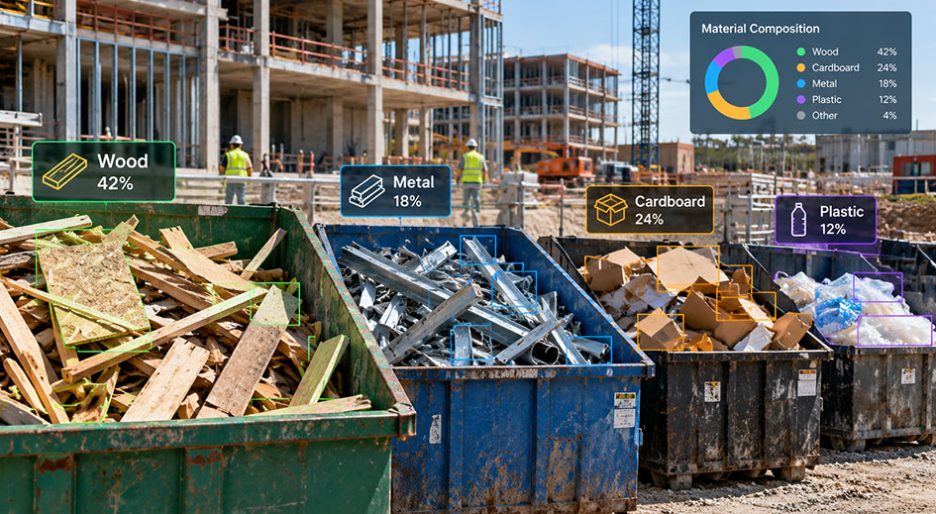
AI changes that equation. Using cameras, image recognition and machine learning, it’s possible to identify and categorize materials as they’re deposited into dumpsters. Instead of relying on manual inspections or estimates, contractors can develop a clearer picture of their waste streams during construction.
That information can reveal patterns that would otherwise go unnoticed. Perhaps one construction phase produces excessive wood waste, or recyclable materials are being mixed with general debris, increasing disposal costs. Once contractors recognize these patterns, they can reduce waste before it happens.
A Financial Opportunity Hiding in Plain Sight
There’s a tendency to discuss construction waste primarily as an environmental issue. Reducing landfill disposal and recovering usable materials delivers environmental benefits. But the financial opportunity deserves just as much attention.
Waste is expensive. Contractors pay to purchase materials, transport them to the job site, handle them and eventually dispose of whatever remains unused. They’re effectively paying twice for the same material: once when it arrives and again when it leaves.
AI-driven waste management can interrupt that cycle. By understanding waste composition, contractors can recover valuable materials, improve recycling rates and reduce unnecessary hauling. Historical data can also help teams forecast waste volumes and plan deliveries.
These improvements don’t require dramatic changes to construction practices. Sometimes the greatest savings come from simple decisions supported by better information. Waste management becomes something contractors can optimize rather than an expense they absorb.
Finding New Value in Discarded Materials
One exciting development is the recognition that construction waste can serve as a resource for other industries.
Wood provides an example. Depending on its condition and composition, discarded wood may be suitable for reuse, remanufacturing, recycling or conversion into energy. Metals can return to manufacturing supply chains, while cardboard and certain plastics can be processed into new products.
The challenge has always been identifying, separating and directing these materials efficiently enough to make recovery economically practical. AI can provide accurate information about material types, quantities and locations. Combined with appropriate logistics and processing infrastructure, this intelligence can connect construction sites with organizations capable of putting recovered materials to productive use.
The goal shouldn’t simply be to divert material from landfills. It should be to identify the highest and best use for each material, prioritizing reuse and remanufacturing before recycling or energy recovery where appropriate.
Why Data Centre Construction Matters
The rapid expansion of AI infrastructure is making these questions increasingly urgent. Data centre construction has become a major area of commercial development, and these projects generate waste streams that differ from conventional buildings.
Beyond construction materials, data centres require enormous quantities of sophisticated electronic equipment. That equipment often arrives surrounded by protective packaging, including wood, cardboard and plastics. Multiply that packaging across thousands of components and multiple buildings, and the volume of recoverable material becomes significant.
For developers facing pressure to deliver projects quickly while demonstrating environmental responsibility, intelligent waste management can address both priorities. It also creates a connection between waste and energy. Certain recovered materials, when unsuitable for higher-value uses, may become feedstocks for energy production. As electricity demand grows alongside AI infrastructure, recovering energy from appropriate waste streams deserves greater consideration.
From Reporting to Prediction
The next major advancement will come when AI moves beyond documenting waste and begins helping contractors prevent it.
Imagine a project manager receiving an alert that material waste is trending above expectations, or a procurement team using historical waste data to adjust purchasing quantities. AI systems could connect waste information with construction schedules, procurement records and project budgets, revealing where resources are being lost.
Technology alone won’t deliver these results. Contractors need reliable data, practical workflows and recovery partners capable of handling the materials identified. AI is only valuable when it leads to better decisions and measurable financial returns.
Managing resources intelligently will become a competitive advantage. The companies that benefit most won’t necessarily have the most sophisticated technology. They’ll be the ones willing to rethink practices that have remained unchanged for decades.
The dumpster may seem like an unlikely place for the next construction revolution to begin. But sometimes the greatest opportunities are hiding in the parts of a business we’ve stopped questioning. It’s time we started paying attention to what we’re throwing away.
Todd Thomas is the founder and CEO of Woodchuck, an AI-driven company transforming construction waste into renewable energy while helping contractors and developers reduce costs, recover valuable materials and measure environmental impact.