
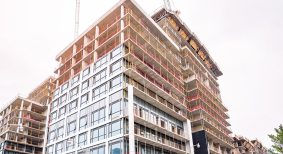



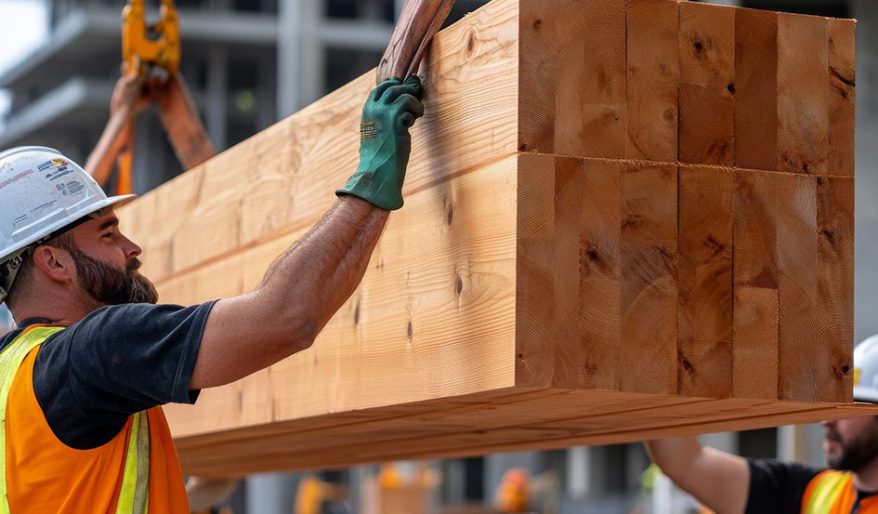
As mass timber construction continues to build momentum, critical lessons learned on jobsites are emerging to ensure successful project outcomes. The aesthetics and many benefits of mass timber are well known, but bringing these projects to life involves significant technical and logistical challenges. Common issues that need careful consideration include moisture management, lack of experience, site logistics, safety and more.
“The single most important time in any mass timber project – and where most mistakes are made – is early involvement,” said Scott Comfort, president of Seagate Mass Timber. “You can never talk about mass timber too early in your project. Always have an engineer lifting and bracing plan in place – absolutely critical for the safety of the job and for it to do well.”
He stressed lift engineering requires special attention to ensure safe site practices, citing that 90 per cent of lifting screws are single use but that 75 per cent of people use them multiple times.
“You want to use them more than once but you absolutely can’t – they are single use design and can cause very catastrophic problems,” said Comfort, who was a speaker at Buildex Vancouver.
Other items to be discussed on a mass timber project include confirming schedule, robust temporary works plans, crane size and access, rigging, supplier constraints, member sizing, sequencing and installation.
“How fast can you get material there versus how fast you can install onsite,” he said, noting his team always makes sure that drawings contain tolerance and does a survey prior to installation to check every existing connection is as shown in those drawings. Onsite rework and the need for modifying materials lead to high cost and poor quality.
“Mobilizing before design is complete rarely works. That’s the worst thing you can do for a mass timber building,” he said, explaining for example installers can pass the design and leave timber sitting exposed to the weather.
Another lesson shared was unless there are multiple cores, mass timber cannot be installed under concrete or steel going vertical. “You have to be very conscientious about safety concerns. You cannot be forming concrete core for an elevator and have your timber guys one-two floors below that. Concrete can rain on them and beams are going to get damaged,” said Comfort.
Of course, moisture management ranks as the top concern for mass timber projects. “Insurers are scared of it. People don’t understand it. There is not one method for managing moisture on a job,” he said. “Planning for mass timber erection in the summer or sunny months is not a plan. Everyone knows projects can and often encounter challenges.”
The plan should include setting and clarifying expectations early; looking for standardized procedures; and a design for passive drying.
He explained the 40/60 rule when it comes to passive water removal versus active removal. “If you’re doing active removal, meaning people removing water from the site with brooms…they are there a maximum of 40 per cent of the time. The rest of the time, materials are exposed to water. A passive system removes water for you. It’s more cost upfront but trust me…it will save you money in the long term.”
Moisture management also needs to be managed by the general contractor – they must take the lead, he told the audience.
“Speed of construction is the best prevention for moisture problems,” continued Comfort. “The faster you can get the roof on, the faster you can get that next floor on – the better you will do with moisture management.”
To help the industry with moisture management, best practices are being explored by the Canadian Wood Council and FPInnovations.
Seagate is currently working with Canadian Wood Council on creating a standardized practice for moisture management that provides scope and cost clarity for mass timber projects across Canada, said Comfort, and once that is complete, the complimentary guideline will be made available to the industry.
“We are also working with FPI on demonstration projects to understand the effects of moisture long term on mass timber including remediation,” he said.
Conditioning mass timber after installation is also critical to prevent moisture-related damage and structural issues.
“One of the most important times for mass timber is when you close it in. Use air and not heat to dry. If you just crank the heat and close the building in, you’re going to have problems,” said Comfort.
Cheryl Mah is managing editor of Construction Business.