



Articles Archive - Page 643 of 929 - REMINET
REMI

Record Q1 GTA condo sales cause inventory to drop

In the first quarter of 2017, 9,932 new condominium apartments were sold across the Greater Toronto Area, an increase of 73 per cent year-over-year, a new high for the quarter, according to Urbanation Inc.’s Q1-2017 market results.

Activity climbed significantly during the first few months of the year due to record levels of demand and a doubling of new launches compared to 2016. A total of 6,293 new units were launched for presale in Q1, compared to 3,061 one year ago. With demand continuing to far surpass new supply, the inventory of unsold condos in development fell by 61 per cent year-over-year to 6,481 units, the lowest it has been in 15 years. With only 2.5 months of inventory on the market, new launches would need to significantly outweigh sales in the future to bring the market into a balanced state of 10 months.

The average price of newly launched condominium apartments in Q1-2017 was $733 per square foot in the City of Toronto and $608 per square foot in the 905 region, causing the GTA average of $694 per square foot to climb five per cent over new launch prices compared to Q4-2016 ($659 per square foot). At the end of the quarter, remaining inventory had increased in price by 20 per cent annually to $719 per square foot.

A record 94 per cent of units in development were presold in Q1-2017, rising from 86 per cent in Q1-2016 and 84 per cent in Q1-2015. A total of 80 projects were completely sold out during the quarter, more than three times the number of projects that were entirely sold out during the same period one year ago (25). Among projects with inventory remaining, the average number of unsold units was 25, with a median of 10 available units per project. Both figures are less than half of what they were over the past two years.

New condo apartment sales far surpassed resales in Q1, which increased 24 per cent year-over-year to 6,203 units. Resale condo activity was restrained by a seven per cent decline year-over-year in total listings to 8,360 units. The sales-to-listings ratio reached a quarterly high of 74 per cent, up from 56 per cent in 2016, while the average days on market fell to an all-time low of 15 days, which is less than half the average (31) in Q1-2016. The average selling price increased 24 per cent annually to $510,000, while the average value per square foot rose 28 per cent to $598.

Following the recent strength in condo price appreciation, Urbanation noticed an increase in resale activity within newly completed buildings as well as more units transacting twice within shorter periods of time. Within new projects completed and registered over the past two years, there were 1,059 sales in Q1, representing 17 per cent of total resales during the period and increasing by 69 per cent over the 625 units resold in Q1-2016 within projects registered in the preceding two year period. In addition, 249 resale units in Q1-2017 were sold for the second time within the past 12 months, up 53 per cent year-over-year. The share of total Q1-2017 resales that were bought and resold within the past three months was 0.8 per cent (compared to 0.6 per cent in Q1-2016), within six months was 2.1 per cent (1.6 per cent), within 12 months was four per cent (3.3 per cent), and within 24 months was 9.4 per cent (7.2 per cent).

“The shortening of holding periods for some condo buyers is an outcome of the rapidly accelerating market,” said Shaun Hildebrand, Urbanation’s senior vice president, in a press release. “Although the share of short-term condo market participants still appears relatively low, it will be important to monitor the situation closely going forward as market conditions evolve.”

Plans revealed for Laval’s Aquablu Phase 2

Following the successful launch of the first phase of Aquablu, a luxury waterfront condominium located on the shores of Riviere des prairies in Sainte-Dorothee, Laval, the developer has teamed up with Claridge/Ivanhoe Cambridge to launch a second, larger phase to market.

Aquablu is a residential project being developed in three phases and will include condominium towers, riverfront villas and executive and penthouse suites. The $250 million project’s first phase was completed last fall and is almost completely sold out. Plans for the 21-storey tower were revealed at an April 28 VIP launch event, with some of the 130 condo units going on sale the following day.

“The best part for most of our buyers is being right on the water, with 1,000 feet of shoreline,” said John Garabedian, project promotor and president of Garabedian Development Inc. “Every single unit has ceiling heights of 10 to 11 feet, floor-to-ceiling glass walls, large balconies and terraces offering panoramic views of the river.”

Amenities at Aquablu include an existing heated outdoor swimming pool, hot tub, outdoor lounge area with private cabanas, an indoor pool and hot tub, sauna and fitness centre, 24-hour concierge, heated indoor garage with available enclosed private parking spaces and private boat slips. All outdoor amenities are located atop a 20,000 square-foot terrace overlooking the river and a 3,000 square-foot sunset terrace on the western side of the development. In addition, pedestrian walkways link the neighbourhood to the waterfront, and a park will be added to the site as well.

Phase 2 of the development adds a new feature, The Cube, which will be a glass-enclosed three-storey ground level structure with panoramic water views. The ground floor of The Cube will be home to a recreation area featuring a golf simulator, billiard table and wine tasting room. A social lounge will be built on the second floor, while the third floor will provide space for a Yoga and Pilates studio. A second outdoor pool and hot tub will be added to the expanded terrace, connected to The Cube and Phase 1.

Finishes in Phase 2 units include Poggenpohl kitchen cabinetry, Bosch and Gaggenau appliances, Toto toilets and Bertolotto Italian doors.

Suites in Phase 2 will vary between 880 and 1,950 square feet, while executive and penthouse suites will be as large as 5,000 square feet. Waterfront villas will be sized between 1,350 and 1,900 square feet, and may include a balcony and terrace on the ground floor. Prices per square foot will vary by location and finishing level, starting at about $400 per square foot.

Initiative could fuel Ontario’s FM talent pipeline

An IFMA Foundation initiative designed to plug holes in the FM talent pipeline could be coming to Ontario. Jeff Tafel, executive director of the IFMA Foundation, speaking Wednesday at Facility Fusion Canada in Toronto, said that bringing a project piloted in the U.S. to the province was on the agenda in morning meetings.

“We’re just starting an Ontario-specific initiative. We want to do the same kind of things we did in California here, and at this point we’re seriously looking into the likelihood of actually starting an IFMA Foundation of Canada,” said Tafel. “It will be the same mission, the same effort, the same templates, but we’ll be able to raise money here in Canada, keep the money here in Canada, to make this all happen here.”

The pilot project came as part of the IFMA Foundation’s global workforce initiative, which has the goal of making facility management a career of choice. Too few people plan to enter the field, Tafel said, so the initiative has focused on reaching high school students and professionals in other fields, related or not, contemplating a career switch.

Carried out in San Bernardino, California, the pilot project was instructive for the IFMA Foundation in figuring out how to get into classrooms to showcase facility management as a possible career path. The challenge, said Tafel, was that high school teachers wanted to know where, locally, to refer interested students for education and training before introducing them to the profession. However, local colleges and universities wanted assurance that there was a pool of interested students before rolling out education and training.

The IFMA Foundation eventually found an education partner in San Bernardino County. The partner identified other stakeholders that would need to be involved to gain traction, said Tafel, such as key employers who could create internship opportunities.

Tafel said that since then, the IFMA Foundation’s Essentials of Facility Management materials have become available to all 113 schools in California’s community college system. So far, one community college in San Bernardino is on board to introduce the materials to its curriculum, with another eight community colleges poised to launch two-year facility management programs.

Through the pilot project, Tafel said the IFMA Foundation also learned that facility managers were in such short supply in southern California that hiring managers were primarily promoting from within. As a result, there was a need for training applicable to these mid-career professionals. This has created an impetus to ensure a full range of options, from the Facility Management Professional (FMP) designation to four-year programs, are available at colleges and universities.

The initiative has since rolled out to Texas, where progress has been swift now that the IFMA Foundation has a formula for success, said Tafel. Identifying existing facility management programs at colleges and universities is part of that formula.

The initiative is also being introduced in the northeastern corridor, and now Ontario is on the horizon.

“Our goal is to have a number of colleges and universities within 24 months offering all levels of education programming,” Tafel said of the Ontario-specific initiative.

The IFMA Foundation is also developing materials to support volunteers who go to speak to students in programs such as science, technology, engineering and math (STEM) about the facility management profession, he said. And a website designed to inform students about careers in FM is due to go live in time for World Workplace in the fall.

Beedie Group breaks ground on business park

Construction has begun on Delta Link Business Park, one of Western Canada’s largest private industrial projects currently under development.

Beedie Development Group’s Delta Link Business Park is located along the Fraser River in the Tilbury area of Delta, BC. It was home to a chemical facility from the 1960s to the early 1990s. Environmental remediation on portions of the site began more than 20 years ago, and by 2013, the brownfield site was fully remediated to Ministry of Environment standards for redevelopment.

In 2015, Beedie purchased the site and rezoned it from chemical-plant use to industrial use, allocating 84 acres for development, 15 acres for parkland, and 4.4 acres for new municipal roads and public space.

Beedie is currently building one million square feet distributed across seven buildings, all of which are in various stages of development. According to real estate consulting firm Site Economics, a 100,000-square-foot industrial building creates anywhere from 100 to 200 permanent job spaces.

“Without question, the current industrial market is the strongest Beedie has experienced in its 63-year history,” said Ryan Beedie, the company’s president. “Delta Link Business Park is already 70 per cent sold or preleased, which is an unprecedented level of commitment. We are excited to be creating hundreds of job spaces on a site that has been largely vacant for 20 years.”

Commercial real estate brokerage CBRE says Metro Vancouver’s industrial vacancy is just 2.2 per cent, while space completing this year is already 55 per cent preleased or sold. In 2015/2016, demand for industrial space was three times greater than total new space added to the market.

In recognition of Beedie’s ongoing contribution to the community, the Corporation of Delta will name a new road at Delta Link Business Park, Beedie Way.

“As a leader in industrial development, Beedie is proud to draw long-term investment to our province,” said Beedie. “A strong economy created by the provincial government’s competitive tax structure, balanced budgets and investment in transportation has allowed us to do that, and Delta Link Business Park will build on that foundation in the coming years.”

Delta Link Business Park’s first tenants are expected to move in this year. Leon’s Furniture will move into a 434,000-square-foot facility, while Swiss Water Decaffeinated Co. will headquarter at Delta Link Business Park. North Delta Seafoods is expanding its processing facility from its current 9,000-square-foot facility to 51,900 square feet at Delta Link Business Park.

All seven buildings will be complete by early next year with more buildings planned.

B.C. report shows procurement drives innovation

The British Columbia Construction Association (BCCA) has published a follow-up to its Innovation Report (February 2016), which revealed B.C.’s construction sector lags behind other jurisdictions when it comes to innovation.  The new report is called “Procuring Innovation” and lays out the case for the sector to recognize the procurement process as the key for driving innovative projects and sector development.

“The culture of lowest bid does not drive innovation in our industry,” observes Chris Atchison, president of the BCCA. “Margins are tight and businesses have to operate profitably, yet if we don’t innovate we’re in danger of undermining our collective ability to compete.  The sector has to introduce whole-life value to the process.”

The “Procuring Innovation” report acts as a comprehensive overview of the types and methods of procuring construction services, assesses emerging procurement practices being developed elsewhere and offers recommendations for different approaches based on the unique circumstances of the project.

“We hope readers will gain a new sense of the key role that the approach to procurement plays in setting the foundation for a project,” says report author Helen Goodland of Brantwood Consulting. “There are tremendous benefits to incorporating new technologies, processes and solutions into construction projects, but innovation has to be championed by clients and owners who are committed to achieving the best value for their project.”

The report is intended to offer owners and clients best practice examples and help architecture, engineering and construction firms set up their competitive response processes, so they can bring their best to projects that push technical and logistical boundaries.

Using mass timber as a case study, the authors demonstrate how the procurement process can be best deployed to accommodate project specific R&D, allow for new technologies and processes and encourage project team creativity.

A full copy of the Construction Innovation Project Report can be downloaded at www.bccassn.com.

Class B and C commercial buildings eyed for CDM

Conservation keeners and stragglers are both vital if Ontario is to meet the ambitious target to cut 7 million megawatt-hours (MWh) from province-wide electricity consumption before 2021. These seemingly divergent constituencies will be key to sustaining performance in buildings that are already energy-efficient and capturing unexploited savings in buildings where few or no conservation and demand management (CDM) incentives have been deployed to date.

Toronto Hydro and the Building Owners and Managers Association (BOMA) of Greater Toronto have joined forces on strategies to reach owners/managers in both categories. Together, the two organizations will soon launch a second iteration of the popular Race to Reduce — which inspired participating owner-tenant teams in the GTA to an impressive 12 per cent reduction in energy use in the 2011-15 period — now rebranded as race2reduce. They also plan to have an emissary on the job as early as this summer to proactively target the city’s Class B and C commercial buildings.

“Our preliminary analysis reveals there are about 800 buildings within Toronto Hydro’s service area that could participate in Save on Energy programs, but are not participating,” reports Bala Gnanam, director of sustainable building operations and strategic partnerships with BOMA Toronto. “That’s a significant population of untapped customers. Definitely, there is an opportunity to find savings there.”

Resources to facilitate incentive programs

BOMA Toronto is now accepting applications for a conservation consultant — a position that will largely replicate the outreach work roving energy managers perform for many of Ontario’s electricity utilities. It’s expected to be something of a hybrid role, calling for marketing savvy to engage uninitiated building owners/managers, technical expertise to identify energy-saving measures that could have favourable paybacks, and project management skills to steer proponents through application and reporting processes.

For Toronto Hydro, a conservation consultant specifically tasked with bringing more commercial buildings on board is another step toward achieving its mandated 1.6-million-MWh share of the provincial conservation target. The new partnership continues tag-team efforts begun in 2007-10 when BOMA Toronto piloted what later became province-wide CDM incentives for the commercial real estate sector, and leverages BOMA’s profile as a sponsor of education and advocate for the industry’s interests.

“We will basically be an enabler,” Gnanam says. “Typically, the Class A buildings are way ahead. Class B and C are the ones with the resource constraints. So rather than doing this on their own, they will have access to BOMA’s resources.”

Although an engineering degree and/or certified energy manager (CEM) accreditation is a prerequisite for BOMA Toronto’s new position, there will be more liaising than hands-on technical work. The conservation consultant will conduct an initial walk-through audit — a good first step to gauge what’s expected to be abundant potential for low-cost and no-cost improvements in Class B and C commercial buildings — then facilitate the next steps. BOMA’s own roster of allied members with energy management expertise is a good example of its resources and the connections its new consultant will be well placed to coordinate.

The work will also have something of a grassroots organizer component since it will entail meeting and building relationships with owners/managers who haven’t previously been involved in industry associations. “As we connect with this segment of the buildings sector, it provides exposure for BOMA’s education role so we can promote other best practices,” Gnanam adds.

Finding and sustaining energy savings

The Save on Energy program categorizes energy managers as part of the “process” of CDM. First introduced in the 2011-2014 suite of incentives, funding for energy managers has been a successful carryover into the 2015-2020 term.

Roving energy managers have conventionally been employees of local distribution companies who work, free of charge, with multiple smaller or mid-sized customers to find energy efficiency improvements in their operations. Energy managers are expected to hit a minimum threshold for energy savings across their client base. In turn, these clients must commit to invest some of their own capital in energy efficiency measures, relying on Save on Energy incentives for no more than 70 per cent of the cost of projects.

This is the approach BOMA Toronto’s conservation consultant will take, with funding for the position coming from Toronto Hydro. Meanwhile, larger customers can be subsidized to hire their own in-house energy manager. This funding will either come from an LDC or, in the case of a business that operates facilities in more than one LDC’s jurisdiction, directly from the Independent Electricity System Operator.

“One of the best ways for companies to reduce their operating costs and therefore increase a property’s value is to implement energy savings initiatives, but the challenge is that energy savings are not necessarily a primary focus for any one individual in the organization. The energy manager program allows a company to hire an expert who can exclusively focus on generating savings,” says Andrew Pride, an energy management consultant who was an influential proponent of the program in his previous role as vice president of conservation with the now-dismantled Ontario Power Authority. “History has shown the savings are tangible and other benefits, such as better systems and comfort, usually come in parallel.”

“Energy managers are part of the philosophy of continuous improvement,” concurs Jennifer Grado, Toronto Hydro’s lead on CDM business development. “The learning curve is intrinsic to the role. Initially, there may be a lot of savings found, while the sustained savings come from the understanding they develop of the facility’s function.”

CDM strategists also plan to spread and reinforce this message through the new race2reduce challenge. BOMA Toronto is aiming to have at least 100 buildings enrolled ahead of the program launch on June 6th, but more are expected, and certainly welcome, to sign up in the coming months. Participating teams will officially set off toward the goal — a collective 10 per cent reduction in energy use over a course of three years — in January 2018.

BOMA’s new conservation consultant is expected be both a recruiter and a coach — encouraging more Class B and C buildings to join in and counselling all teams on energy-saving strategies. Looking to past experience, organizers also expect the line between team rivalry and sharing of best practices will be fairly porous.

Barbara Carss is editor-in-chief of Canadian Property Management.

New High Prairie Health Complex opens

Residents from High Prairie, Alta. and the surrounding regions now have access to expanded health care services, including more acute care and continuing care beds, due to the newly-opened High Prairie Health Complex.

The $228-million facility includes a state-of-the-art emergency department, an acute care clinical building, a continuing care centre and the High Prairie Community Health and Wellness clinic. The new facility features 67 continuing care beds, which doubles the number of continuing care spaces in the community.

“This beautiful, modern facility brings expanded health care services closer to home for residents of High Prairie and surrounding communities,” said Sarah Hoffman, Minister of Health, in a press release.

The health complex will feature a new computerized tomography (CT) scanner, which means patients can stay in High Prairie to use this service, unlike before. The High Prairie and District Health Foundation raised funds to help purchase this equipment.

The continuing care wing of the health complex was designed with a focus on patient-centred care. All rooms are private, equipped with lifts, accessible bathrooms and large windows. The facility brings the majority of health services for the region under one roof, including outpatient, Indigenous health, addiction and mental health and home care. It also offers diagnostic imaging, laboratory and inpatient pharmacy services. There is also space which can be used to develop a labour and delivery unit, surgical services and a dialysis unit.

The land for the healthcare facility was contributed by the Peavine Metis Settlement.

“Members of the Peavine Metis Settlement have always taken pride in being contributors to the High Prairie and surrounding area,” said Chairman Iner Gauchier. “The donation of land to support the building of this exceptional new facility was a way of continuing this tradition. The partnerships that were developed with the Government of Alberta leading the way are extremely significant. This facility will be instrumental in the delivery of quality health care services to the residents of the area, including the three Metis Settlements and First Nations communities.”

A full range of public health services will also be available when the Community Health and Wellness Clinic opens in June, including chronic disease management, early childhood development and health promotion.

Backup power critical to hurricane preparedness

The start of hurricane season is around the corner and it’s important that facilities are prepared. In fact, May 15 to 21 is Hurricane Preparedness Week.

Many facilities rely on backup power when a natural disaster occurs. Backup power, while critical for hospitals and government facilities, is for anyone who doesn’t want their business to experience downtime due to a hurricane. Ensuring backup generators are regularly serviced will keep systems running.

The following suggestions are not just for hurricanes, but also for tornadoes and other naturally occurring disasters that have the potential to knock out a facility’s prime power source.

Backup power sources

Hurricanes or large storms don’t typically wipe out infrastructure, but they can cause widespread power outages for significant periods of time. Tornadoes can wipe out the infrastructure and create major delays in getting prime power working again. Having power when a natural disaster occurs is not just for comfort but critical needs as well.

That’s why it’s important to make sure that facilities have a backup generator. When functioning and regularly serviced, this equipment will mitigate any risks associated with prime power failure. Managers of facilities that don’t have a backup generator in place can reach out to their local generator distributor to have one sized accordingly.

Long-term preparedness

Facility managers need to make sure that backup generators are regularly serviced according to the manufacturer and distributor’s recommendations. This will deter many of the potential problems that can occur, particularly when a disaster is imminent.

During a routine generator service, a technician will inspect for wear and tear of the belts; leaks and cracks in the fuel system; broken gauges and warning lights on the control panels; and loose connection, corrosion and general condition of the batteries. The technician will also check the operation of the battery charger and block heater as well as the coolant and engine oil levels.

Annual and semi-annual services are much more detailed. These services include regular preventative maintenance of systems throughout the generator.

Semi-annual services include inspecting and maintaining the cooling system; fuel system; air induction and exhaust; lube oil system; starting system; engine monitors, safety controls and control panel; generator/gas engines; and automatic transfer switch.

Annual services include changing the oil and filters as well as the fuel filters; maintaining the water separator; sampling oil as scheduled; lubricating the fan pulley; greasing the generator bearings; and taking a coolant sample.

It’s also recommended that generators undergo annual load bank testing if the unit does not run at 50 per cent or greater load at least one hour monthly. Load bank testing eliminates wet stacking by burning off un-burnt fuel, oil and carbon in the cylinders and exhaust system. It also exercises and tests the unit’s fuel and cooling systems and causes moisture from inside the generator and engine to evaporate.

Additionally, regularly test and make sure the transfer switch is functioning properly. Depending on the facility, have a plan in place to deploy mobile generators to job sites. Those mobile generators should follow the same service schedules as the backup generator.

Imminent danger preparedness

Step one: Call the facility’s service provider, who will walk the facility manager through subsequent steps that need to be taken. This will include firing up the generator and checking for any fault codes. If the facility has a diesel generator, make sure it’s full of fuel. If the facility has a natural gas generator, make sure the gas line is working properly. Checking the transfer switch will ensure the backup power kicks in the moment primary power goes down.

With hurricane season starting June 1, it’s important that facilities in locations prone to this type of disaster are prepared. That said, hurricanes are just one of the potential disasters that can knock out the power in a facility. Ensure the lights stay on and all systems work with a backup generator that has been properly serviced and maintained.

Clayton Costello has been working at CK Power, a leading manufacturer of power units and power generation solutions for a variety of markets and customers, for over five years, with a focus in account management and operations. This article originally appeared on the CK Power learning center.

Kasian acquires interior design studio MartensGroup

MartensGroup, an award-winning Calgary-based interior design studio, is joining Kasian, one of the world’s top 100 integrated design firms with offices in Vancouver, Calgary, Edmonton, Toronto and Qatar. MartensGroup is led by Principal Sharon Martens and Senior Associates Kim Green and Douglas Niwa. The team will bring their knowledge and expertise to Kasian’s local and national clients.

MartensGroup, a design firm with a 26-year history, has a diverse client base including firms in the energy, financial, legal, corporate and government sectors, while Kasian’s expertise lies within corporate, retail, hospitality, multifamily, healthcare and institutional design.

“The addition of MartensGroup to our growing national interior design team reinforces our commitment to interior design,” said Don Kasian, founder and president of Kasian, in a press release. “The acquisition enhances our ability to deliver excellence across integrated projects in all market sectors.

“We are proud to join this well-recognized international firm,” added Sharon Martens. “We’re confident that our clients will benefit from the expanded complement of services offered by the merging of MartensGroup with Kasian.”

Ontario’s investment in affordable rental housing

Addressing Toronto’s affordable housing crisis, Minister of Housing Chris Ballard, joined Judy Sgro, Member of Parliament for Humber River-Black Creek and Councillor Ana Bailão, Chair of the City of Toronto’s Affordable Housing Committee, at Casa-Emery Village in Toronto to highlight a $58.8 million investment from the province and federal government in affordable rental housing in Toronto.

Casa-Emery Village received funding from the Government of Canada and Government of Ontario through the Investment in Affordable Housing (IAH) agreement, delivering 348 affordable housing units for those in need, including seniors and recent immigrants.

“Ontario continues to be a strong partner to the City of Toronto, delivering efficient, people-centred housing programs for residents so they can continue to put down roots in the neighbourhoods they love,” said Ballard. “Working together, we can ensure that every family has an affordable place to live in the city they call home.”

An additional 110 affordable rental housing units are being created at other developments across the city as part of this investment.

Over the next three years, the province will invest more than $600 million in housing and homelessness programs across the city, including:
•  $340 million over the next three years for homelessness prevention to help Toronto’s most vulnerable residents
•  $130 million over the next three years to build and expand affordable housing options for people in Toronto
•  $130 million over the next four years to make repairs and retrofits to Toronto’s aging social housing.

As part of Ontario’s Fair Housing Plan, the government is also unlocking provincial land worth up to $100 million to build new affordable rental units in the city, with pilots at 27 Grosvenor Street and 26 Grenville Street in Toronto.

Investment quick facts:

• Casa-Emery Village received nearly $36.7 million from the province and the federal government.
• Since 2003, Ontario has invested $5 billion in affordable housing across the province, including nearly $1.4 billion in the City of Toronto.
• Other projects in Toronto receiving investment through the IAH program include:
o Fifty units of affordable housing at 230 Sackville St. as part of the Regent Park Revitalization Plan, which received more than $14 million.
o Forty units of affordable housing at 180 Sackville St., also part of the Regent Park Revitalization Plan, which received $4.8 million.
o Twelve units of affordable housing for off-reserve Indigenous residents at 22-26 Norwood Road, which received $2.1 million.
o Four units of affordable housing at 1330 Wilson Ave., which received $597,750.
o Four units of affordable housing at 3207 Kingston Rd., which received $547,200.

Over the next three years, Ontario will invest $2 billion in affordable and sustainable housing across the province, with more than $600 million going towards the City of Toronto.

Ontario action plan promotes construction safety

Ontario has announced the implementation of a Construction Health and Safety Action Plan to help prevent workplace injuries, illnesses and fatalities for workers on construction sites across the province.

About 30 per cent of all work-related traumatic fatalities and occupational disease fatality claims for workplaces in Ontario occurred in the construction sector, but it only accounts for 6.7 per cent of all provincial employment and 8.4 per cent of WSIB-insured employment.

The action plan was created with input from construction employees, workers and other industry stakeholders. It contains 16 recommendations to strengthen the prevention of work-related injury and illness for construction workers on sites of all sizes in Ontario.

Ontario has already made progress on some initiatives of the Construction Health and Safety Action Plan, including: developing a web tool and mobile app to help employers and workers understand their health and safety obligations and rights for specific construction projects; building an online portal that allows building inspectors to report unsafe work practices to the government; and increasing awareness about working-at-heights training requirements, among other initiatives.

“This Action Plan is designed to ensure the health and safety of all construction workers through more targeted enforcement, exploring opportunities to expand the application of tickets, enhanced worker awareness and training by building partnerships and ensuring effective outreach strategies,” said George Gritziotis, chief prevention officer, in a press release. “We are working towards full implementation.”

Green projects join CaGBC’s Zero Carbon Building Pilot Program

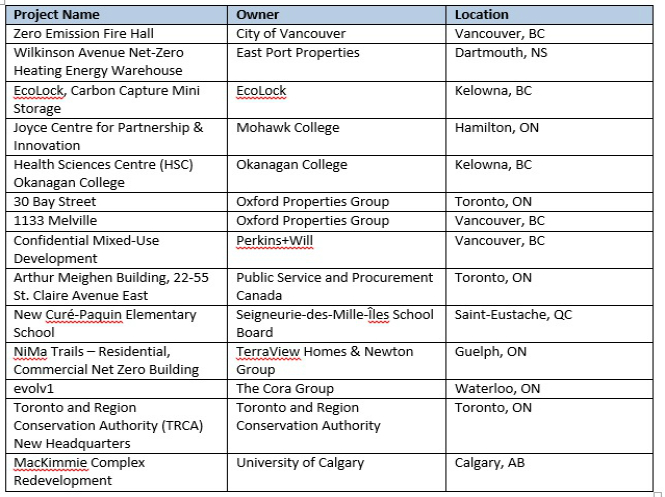
The Canada Green Building Council (CaGBC) has picked a diverse set of 16 green building projects across Canada to participate in a two-year pilot of its Zero Carbon Building Standard.

The standard, which assesses the carbon performance of commercial, institutional and multi-family buildings and warehouses, will be formally released on May 29 in Vancouver.

The projects showcase the broad applicability of the program, with both new and existing buildings, ranging from 20,000 to 1.3 million square feet. Projects were chosen for their “ambitious environmental leadership and potential to aggressively raise the bar for carbon emissions reduction in Canada.”

“The CaGBC Zero Carbon Building Pilot Program was designed to recognize leadership excellence in Canada’s building industry, and I am pleased to say that these projects truly meet that ideal,” says CaGBC President and CEO Thomas Mueller. “We have great diversity in these pilot projects, demonstrating that zero carbon buildings are achievable in all regions across Canada. It is the combination of innovation and the broad adaptability of this Standard that will contribute to the shift to a low-carbon economy.”

The CaGBC Zero Carbon Building Pilot Program projects are listed below, with the exception of those who wish to remain confidential at this time. To view project profiles, renderings and other details on the Pilot Projects, visit cagbc.org/zerocarbonpilots

zero carbon


Industry is encouraged to attend the Net Zero Carbon Buildings Summit on May 30 in Vancouver, which will discuss the new standard in detail, along with a full stream of education content focusing on Zero Carbon Buildings at Building Lasting Change 2017, which begins the following day, May 31.

For ongoing updates about the CaGBC Zero Carbon Building initiative and standard as it becomes available, visit cagbc.org/zerocarbon.

Vancouver real estate marketer donates art

Vancouver real estate marketer and art collector Bob Rennie has donated $12 million in art to the National Gallery of Canada. Paintings, sculptures, and mixed-media pieces made by some of the most well-known and established Canadian and international artists comprise the collection.

A gift to the nation in celebration of Canada’s 150th birthday, the donation of artwork by Rennie, is one of the largest gifts of contemporary art ever received by the Gallery.

“For a few years now, we have wanted to make a gift from our collection to Canada, to the nation. With Canada’s 150th anniversary celebrations taking place across the country, we decided this is the moment to do it, to showcase and support the rich and diverse accomplishments of artists,” said Rennie.

Some of the major, iconic pieces were created by internationally renowned artists, such as Colombian Doris Salcedo, as well as important Vancouver-based artists Brian Jungen, Damian Moppett, Rodney Graham, Ian Wallace, and Geoffrey Farmer, who is Canada’s selection for the 57th International Art Exhibition, La Biennale di Venezia, opening to the public Saturday, May 13, 2017. This important donation enriches and complements the Gallery’s collection by these artists.

“This remarkably generous gift transforms the National Gallery of Canada into the collection of record for some of our country’s most outstanding artists,” said Marc Mayer, director and CEO of the National Gallery of Canada. “It deepens the exhibition and the lending possibilities for a museum whose mission is to preserve and disseminate our country’s most exceptional artistic achievements.”

In appreciation of Rennie’s generous gift, the National Gallery of Canada will name the Upper Contemporary exhibition gallery (B204), the Galerie RENNIE Gallery.

Rennie, a real estate marketer and principal of the Rennie Foundation, is active in the Vancouver and international art communities. He is a former chair of the Tate Modern’s North American Acquisitions Committee and a member of the Tate International Council and the Board of Trustees for the Art Institute of Chicago.  He also sits on the Dean’s Advisory Board of the Faculty of Arts at the University of British Columbia. In 2008 he was recognized with an honorary doctorate from Emily Carr University and in 2014 he was appointed to the Order of British Columbia for his distinguished leadership and exceptional dedication to strengthening and enhancing arts and culture in British Columbia.

“Mr. Rennie is renowned as a serious connoisseur of art,” said Thomas d’Aquino, chair of the National Gallery of Canada Foundation. “His collection is highly regarded for its range and depth, so it is exciting that he would bestow upon our national collection such a significant number of works.”

Industrial market shows regional disparity: Q1

Canada’s two-billion-square-foot industrial market continued to experience robust demand in Q1 2017, as specific areas with diverse and growing tenant bases are nearing full occupancy.

Avison Young’s Spring 2017 North America and U.K. Industrial Market Report looked at the market from a regional perspective and states that Vancouver qualified for the top 10 development markets and has the lowest vacancy rates in Canada. Toronto, Regina, Winnipeg and Ottawa also have the 10 lowest vacancy rates, while Regina and Edmonton claimed two of the 10 highest average asking net rental rates.

By the end of Q1, the country’s industrial vacancy rate was 3. 7 per cent, down 30 basis points from Q1 2016. Halifax retained both the highest rate (14.7 per cent) and greatest year-over-year change, while Winnipeg (3.1 per cent) recorded the biggest decline.

“Canada’s industrial market continues to operate under the weight of a supply shortage, despite regional disparities in performance,” says Bill Argeropoulos, principal and practice leader, research (Canada) for Avison Young. “Clearly, the supply shortfall in existing product and land supply has kept developers busy, but they remain prudent in delivering product to meet the market’s changing needs. A competitive bidding environment persists and, although demand levels differ from one market to the next, rental rates are either holding firm or moving higher as tenants seeking alternative premises face diminishing options.”

The national average net asking rental rate increased marginally from one year earlier to close the first quarter of 2017 at $8.05 per square foot.Year-over-year, rents grew in seven of the 11 markets (with four markets posting rents above the national average).

Uncertainty around U.S. government trade policy prevails, which could pose a risk to the industrial market. However, current trends, like e-commerce, are really defining the market right now.

“Like everywhere else, e-commerce is driving much of the new development, featuring modern, technologically advanced distribution facilities – with higher clear heights, large bays and ample trailer parking space – near urban centres,” Argeropoulos adds. “However, not to be forgotten, older product in urban centres, once deemed obsolete, remains a hot commodity, offering timely and cost-effective solutions to shorten the last mile of the supply chain.”

BIG’s Serpentine Pavilion finds home in Vancouver

Bjarke Ingels Group’s (BIG) Serpentine Pavilion will soon find a new permanent home in downtown Vancouver. In 2016, developer Westbank sponsored Bjarke Ingels’ design for the Serpentine Pavilion and subsequently purchased the Pavilion, with the intention that it would serve a purpose beyond one exhibition.

The Pavilion created is for an annual commission by the Serpentine Galleries in London. The commission is an opportunity for the greatest architectural talent in the world to express their creativity, by reimagining a traditional space and giving the public access to explore it.  The iconic annual structures reside for four months – from June to October – on the Galleries’ lawn in London’s Kensington Garden.

Ingels’ design, the ‘unzipped wall’, sought to reconcile aspects commonly perceived as opposites, creating a space that is both free-form and structured; modular yet sculptural. The resulting structure transforms from a straight line into three-dimensional space, creating a dramatic undulating form of stacked rectangular frames made out of glass fibre.

The space can be explored and experienced in a variety of ways, inside and outside. The unzipped wall creates a cave-like canyon lit through the fibreglass frames and the gaps between the shifted boxes, as well as through the translucent resin of the fibreglass.

After planned stops in New York and Toronto, the Pavilion will occupy a site adjacent to Wesbank’s office in Shaw Tower. The undulating structure will become part of the pedestrian streetscape, acting as a tunnel connecting the city to the waterfront.

“Westbank has a well established and growing relationship with Bjarke and his team at BIG,” said Ian Gillespie, founder, Westbank. “Purchasing the Pavilion was a very natural extension of that partnership and we want to give Bjarke’s creation the most interesting afterlife of any of the previous pavilions.”


rendering courtesy of BIG

Quebec municipal building to become community centre

The governments of Canada and Quebec are providing joint funding to transform a municipal building in the Municipality of Morin-Heights into a community centre.

Both the federal and provincial governments will be contributing $533,333 for the transformation, as part of the New Building Canada Fund, Provincial-Territorial Infrastructure Component – Small Communities Fund. The Municipality of Morin-Heights will also invest $533,333, bringing the total investment in the project to over $1.6 million.

The project involves transforming a municipal building into a community centre that can accommodate skiers and snowshoe enthusiasts in the winter, and cyclists in the summer, while developing multi-purpose rooms to host recreational and cultural activities. The centre will also house storage spaces and administrative offices.

“We are delighted that the governments of Quebec and Canada are supporting us in order to provide Morin-Heights citizens with a community gathering place in the centre of our municipality. The cultural and sporting needs of seniors and youth will therefore be met at a reasonable cost,” said Tim Watchorn, Mayor of Morin-Heights, in a press release. “I would like to thank our provincial member, Yves St-Denis, and our Member of Parliament, Stéphane Lauzon, who have believed in our project and worked steadfastly with their colleagues to great success.”

The goal of the Small Communities Fund is to provide financial support to Canadian municipalities with less than 100,000 residents to develop infrastructure that can enhance the community through culture, sport, recreation and tourism or to safeguard public assets. As part of the federal budget for 2017, $21.9 billion has been proposed to support social infrastructure in Canadian communities.

Ontario invests $9-bil in hospital infrastructure

As part of the 2017 budget, Ontario plans to invest an additional $9 billion to support the construction of new hospital projects across the province, bringing its total planned investment in hospital infrastructure to more than $20 billion over the next 10 years.

These new investments will allow hospitals to renovate existing facilities and construct new ones, addressing a growing demand for health care services and a need for innovative models of care. Essential facility improvements and expansions would include emergency rooms, surgical facilities and patient spaces in big cities and remote communities across the province.

Some of the approved major hospital projects include:

  • Trillium Health Partners — Broader Redevelopment Project
  • Niagara Health System — New South Niagara Capital Project
  • Windsor Regional Health Centre — New Greenfield Hospital Project
  • Hamilton Health Sciences — Hamilton Redevelopment Project
  • Weeneebayko Area Health Authority — Replacement Hospital Project

“With this commitment to hospital infrastructure, we are addressing future health care needs in communities across the province,” said Dr. Eric Hoskins, Minister of Health and Long-Term Care, in a press release. “This will allow us to plan for sustainable development in the hospital sector so they can continue to deliver high-quality care for generations to come. It will also foster investments in new and innovative models of care, ensuring patients receive the best care based on the best evidence and advances in technology.”

Hospital funding in the province has increased by more than 58 per cent, rising from $11.3 billion in 2003-04 to $18 billion in 2017-18. At the 141 hospitals in Ontario, there are about 34 major hospital projects either under construction or in the planning stages.
