


Articles Archive - Page 640 of 929 - REMINET
REMI

Whiterose Janitorial Services: Pure and Simple

The 1980s are often remembered for big hair, synth music and power suits with over-exaggerated shoulder pads, but the decade was about more than just pop culture. It was a time of entrepreneurship, when people left their nine-to-five office jobs to run their own business. Some said goodbye to the security of a regular paycheque on their own accord, motivated to take the risk in order to be their own boss; others were pushed by company layoffs and mergers during the global economic recession of the early ‘80s. Then there were those like Albert Crimi who, from his earliest recollections, always wanted to launch his own company.

It was while Albert was in college that he gave starting a new business serious thought. At first, he contemplated opening a fast food franchise, which seemed like a natural progression having worked in the industry for four years. But upon greater consideration and some sage advice from then-girlfriend, now wife, Sandra, he set his sights on the cleaning industry.

“Sandra and I have always valued cleanliness and order, rooted in our strong beliefs that they aid in living a healthy lifestyle, so it made sense,” he explains.

In 1986, one year after graduating from Humber with a diploma in business administration, Albert combined his interest in improving people’s well-being with his passion for entrepreneurship and launched Whiterose Janitorial Services Ltd. By day, he worked as an accountant for what’s now the world’s largest package delivery company, UPS. At night, he handed out business cards in the hope they would drum up interest in Whiterose and eventually land him an account. Albert’s dedication and perseverance soon paid off. Just two months into his new business venture he inked his first contract with Amerella of Canada Ltd., a leading importer and distributor of fashion apparel. To mark the occasion, Albert bought a key ring “to hold all the keys of the properties I’d soon be cleaning,” he says, adding he still has it to this day, stored away in a lockbox at his house for safekeeping.

“I told Sandra about the key ring and she thought I was a bit of a dreamer back then,” he continues with a laugh. “But I was serious. I was very ambitious.”

Within two short years, the key ring was full – thanks in part to Albert’s partner in life and work, who not only supported his business aspirations but worked closely with him to keep the company going in its formative years. Today, Sandra serves as the company’s vice-president of operations, overseeing the day-to-day operations to support Whiterose’s growth and add to its bottom line. Albert remains focused on the company’s big-picture goals – a strategy that has worked for him for more than three decades, though it was a juggling act in the beginning.

“I spent my evenings and weekends managing sales and marketing whilst cleaning in the commercial sector,” reminisces Whiterose’s president and CEO. “I’ll never forget the countless days I’d spend driving around with my kids’ car seats in the backseat and cleaning supplies in the hatchback.”

Whiterose Janitorial Services

President and CEO Albert Crimi, with his wife and Vice-President of Operations, Sandra.

By the early ‘90s, the company had grown to a point that Albert was comfortable enough to stop straddling two jobs and plant both feet in his blossoming business. Around this time, he stepped away from his role as sole cleaner, hiring someone to fill his shoes so that he could focus on running and further developing the company. Then, in 1997, he received a phone call that unbeknownst to him at the time would change the course of the business.

“A condominium requested a quote for a cleaning contract, which was a first because Whiterose was focused on the commercial, retail and industrial markets,” explains Albert. “We got the job and our reputation for providing top-quality cleanliness led to another and another. The company took on new life and has seen successive growth year after year for the past 20 years.”

Today, Whiterose’s core business involves providing cleaning and live-in/live-out superintendent services to the condominium sector. The company maintains numerous condos in the Greater Toronto-Hamilton area (totalling millions of square feet of cleanable space), including the two tallest in Canada – Aura, which rises 79 storeys in Toronto’s downtown core, and the nearly completed and partially occupied One Bloor (previously One Bloor East) located in Yorkville, one of the country’s most exclusive shopping districts.

The Secret to Outstanding Service

Like all successful cleaning companies, Whiterose’s commitment to delivering topnotch customer service has been key to its longevity. For Albert, excellent client care involves being proactive, not reactive; listening carefully to customers’ needs; ongoing communication; and providing proper instruction to, and supervision of, its workforce.

“I have always seen myself and each employee of Whiterose as part of a team, where the company as a whole is only as strong as each individual working in it,” he explains. “With this in mind, I have focused on improving training and supervision amongst staff.”

Early on, supervision involved weekly site visits to ensure the job wasn’t just done but it was done right. While regular inspections are still an integral part of the company’s quality assurance program – Albert himself routinely walks through the properties the company maintains and even personally performs the ‘white glove test’ for dust as part his hands-on approach to the business – Whiterose recently implemented a customized software program that provides real-time GPS tracking of employee movements, including attendance, hours worked and time spent on specific tasks. The cloud-based platform is also a crucial operational tool that assists with inventory control, processing work orders, personnel management and worksite scheduling.

“We customize work schedules for every site and regularly review the needs of each site, updating as required, so it’s going to make us more efficient,” says Albert about the software program. “It’s also going to strengthen our relationships with our customers.”

Soon to be accessible through Whiterose’s website, the platform will be an information and communication hub for clients. It will allow them to monitor their portfolio 24-7, providing complete transparency of contract service delivery, and, with mobile integration, enable clients to directly contact a supervisor/superintendent, if the need arises.

A Little Goes a Long Way

Now in its thirty-first year of operation, Whiterose has come a long way since the company was a one-man show run out of Albert’s home in Woodbridge, Ont. Today, it boasts hundreds of employees, including seven supervisors, and an office in the heart of downtown Toronto. Whiterose also now offers a full range of turnkey cleaning and building maintenance services, though Albert consciously chose not to diversify the company’s offerings beyond its area of expertise because “a jack of all trades is a master of none.” However, it does provide its customers carpet, garage and window cleaning as a convenience, upon request.

“I strongly believe that it is our obligation to alleviate the day-to-day cleaning tasks so that our clients can focus on what really matters to them,” says Albert, who acknowledges that this commitment to putting customers’ needs above all else couldn’t be achieved without the company’s dedicated staff.

“The strength of our business is our people,” he adds.

To maintain a positive work environment, Whiterose provides competitive compensation and benefits. Albert also makes a point of recognizing and rewarding employees for their hard work, often handing out prepaid gift cards.

“It’s a small thing but it goes a long way,” he says. “That’s one of the three (pillars) that make a business successful … If you treat your employees with respect and dignity, remember where you came from and are humble at all times, then everything else will fall into place.”

Clare Tattersall is the editor of Facility Cleaning & Maintenance

Photos by Robyn Russell
Airport workers worried about dirty screening areas

A recent submission from the International Association of Machinists and Aerospace Workers (IAM) expresses safety and health concerns related to airport pre-board screening areas under the control of the Canadian Air Transport Security Authority (CATSA) and Transport Canada (TC).

The IAM, the largest union in the air transport sector in Canada and North America, sent a list of recommendations to the Standing Committee on Transport, Infrastructure and Communities (TRAN) that include concerns over the amount of dust in security screening work areas and within machines.

“It causes health and safety issues for the pre-board screening officers, flight crew and passengers using the system across the country,” states the IAM. “In British Columbia, a partial solution has been put in place to address this situation. A cleaning company has been hired to clean the work area, but not the machines because they are not allowed to tamper with security equipment.”

Address dust issue

Part of the problem has been solved but the machines are still very dirty, causing complaints among many passengers. In Toronto, both problems have yet to be addressed by the Greater Toronto Airport Authority (GTAA). The IAM recommends that CATSA and service providers work together to address the “dust issue” in screening areas on a weekly basis.

Ongoing construction at Toronto’s Pearson International Airport is causing dust to collect, which is mainly debris falling from the ceiling. Screeners have to work in an environment where the air is full of dust, but are not allowed to wear dust masks. Dust is also coating the top of x-ray machines and surfaces below, like carpets and tables.

Passengers and screeners are then exposed to the dust after touching luggage, the machines and surfaces. The IAM says the GTAA hasn’t yet addressed the situation, perhaps because screener protocol involves reporting dust to the Health and Safety Committee.

Address poor test results on equipment

Screeners are also concerned about leaking x-ray machines. They have a strong feeling the machines are leaking, but feel that the testing NAV Canada is conducting isn’t transparent. When CATSA is questioned, there is no feedback and the matter is often referred to routine testing in accordance with Safety Code 29: Requirements for the Safe Use of Baggage X-Ray Inspection Systems.

“It seems that CATSA is not taking their findings seriously,” states the IAM. In B.C., the IAM has asked for the test results done by Nav Canada who services and maintains the equipment. So far, they have not been successful either. This obviously could have an impact on how machines work and impact the safety of workers along with passengers being processed.

The IAM recommends CATSA address poor test results on equipment as they are responsible for these machines and discuss the matter with service providers in order to find a solution, improve the quality of equipment and make sure the safety of airports is maintained.

How to negotiate landscaping contracts

What should condominium corporations look for in landscaping contracts?

Experience suggests the most successful relationships between condominium corporations and landscape contractors always involve two things: a contractor who knows condominiums and good communication between all involved — management, board, committees and contractor. Here are a few critical considerations to make when negotiating contracts:

Condominium experience

When searching for a new landscape contractor, give priority to those that have worked with condominiums. They will understand unique requirements such as heightened security concerns, the longer decision-making process and the numerous players involved. A contractor needs to be comfortable collaborating with all of them and accept that the relationship will take more of its time.

If a property is in a congested urban area, a contractor who is familiar with the big-city challenges of parking, confined spaces and gardens that are often on rooftops makes the owner’s job easier.

Consistent crews

Knowing the condominium’s gardener is about good, consistent communication. When negotiating, stipulate that the corporation wants the same crew leader and team every visit. Ideally, representatives of the corporation should meet that crew leader before committing. The corporation will ideally find a crew leader who wants to collaborate with the corporation and take ownership of its property’s landscaping.

A related point: consider establishing a landscape committee or point person that can work with the contractor’s personnel. A constant exchange of ideas makes for the best gardens.

Detailed plans

The typical landscape contract is long on legal protections, but often does not spell out what is to be provided — certainly not in enough detail. This is particularly true of annual plantings. The contractor should give the corporation a detailed planting plan for each season: what plants, where, and roughly how many. Here again, the corporation’s landscape committee can play a role in creating those plans. It is the one certain way of getting what the corporation wants.

Also require the contractor to specify its rates and charges for work not included in the contract. Additional work always arises and the corporation needs to know the basis for the quotes.  Needless to say, never agree to additional work without a firm specification and quote.

It’s important to secure both cost and time commitments for all work. Make sure the contract specifies when work is to be done and when it is to be completed. There is nothing more frustrating than a summer planting that doesn’t get completed until August.

If the corporation’s staff is to perform any landscape work (e.g. watering container plantings), make clear who is responsible for what.

The contract should also specify who is responsible for paying to repair inadvertent damage to features such as irrigation and lighting, which will almost certainly occur.

Finally, the contract must specify specific days and times of service visits.

Contract length

Consider negotiating a multi-year contract. Landscapers are happy to avoid the time and expense entailed in quoting annually and are often willing to commit to modest increases year over year. An added benefit: the corporation should receive better care as the landscaper develops a grasp of plant health, project development, long-term property goals and corporation preferences.

What about a four-season contract? There are obvious advantages in having one contractor and one contract. For example, a corporation can avoid that annual spring argument between landscape and snow contractors over who is responsible for the winter kill. One potential drawback to note: the corporation needs an experienced gardener who knows the property and its plants. All-season contractors may not have that expertise on staff.

Warranty coverage

Pay attention to the fine print. Ideally the landscaper commits to replacing plants that are either dead or ‘failing to thrive.’ The warranty should be one year from date of planting — possibly longer for mature plants. Make sure that both the cost of the replacement plant and the cost of labour to install it are included in the warranty.

While a corporation can always ask, do not expect a contractor to warrant tender plants such as bulbs, roses and annuals.

Due diligence

All contractors should provide the corporation with their WSIB number and a certificate of insurance naming the corporation as an insured party. Also ensure the contractor has adequate liability coverage — in this contractor’s opinion, a minimum of $1 million.

The contract must require that the contractor adhere to all applicable legislation, including that relating to pesticide application, occupational health and safety and WHMIS.

As an added security measure, consider requiring all landscape staff to be neatly attired in a clearly identifiable uniform.

Needless to say, a contractor may not agree to all of the above, but there is no harm in negotiating for them!

Allan Kling is president of Urban Garden, a Toronto-based company specializing in the design, construction and maintenance of landscapes for condominiums. Allan is a Certified Landscape Professional, a member of Landscape Ontario, ACMO, BOMA Toronto, and the Canadian Nursery Landscape Association. He is also president of Toronto Botanical Garden and sits on the board of Landscape Ontario’s Toronto Chapter. Allan can be contacted at [email protected] or 416-805-0703. 

Ontario peak electricity price fails to shock

Old data colours the conclusions of a recent University of Waterloo study on the effectiveness of time-of-use (TOU) electricity pricing in Ontario’s residential sector, but energy management specialists say the research still raises some issues worth discussing. In promoting the study findings, the university highlights the relatively unremarkable reduction in demand after an electricity utility in southwestern Ontario activated smart meters for 20,000 household accounts. However, this is a snapshot from nearly five years ago.

Waterloo researchers compared consumption from nine months before and nine months after the November 2011 introduction of smart meters — finding a 2.6 per cent decrease in demand during the on-peak period and a 2.4 per cent decrease during the mid-peak period once meters were in place to enable TOU rates. Initial prices in November 2011 were 9.2 cents per kilowatt-hour (kWh) for mid-peak and 10.8 cents/kWh for on-peak power, or 30 to 40 per cent lower than they would be by 2016.

Knowledgeable practitioners of demand-side management suggest that the early results are actually somewhat impressive given the narrow timeframe for peak prices and fairly insignificant financial penalty incurred. Other jurisdictions designate 12 or more hours of the day for premium prices, while the Ontario peak electricity price doesn’t even align with highest demand in the summer months, which typically occurs around 6 p.m.

“Most TOU savings from smart meters occur with non-residential accounts where there is someone charged with controlling utility costs as part of his or her job. The vast majority of residential users don’t adjust their habits as long as the bill doesn’t noticeably jump,” observes Lindsay Audin, a U.S. based energy management consultant. “I’d say Ontario’s 11 a.m. to 5 p.m. peak price period is far too lenient to make a difference so I’m surprised any improvement was seen.”

More up-to-date and in-depth analysis sponsored by Ontario’s Independent Electricity System Operator (IESO) reveals a greater degree of load shifting in 2012 — in the range of two to five per cent — among residential accounts of four surveyed local distribution companies (LDCs). However, this rate declined in the two subsequent years, even as the survey scope broadened to eventually include more than 150,000 residential accounts under the auspices of eight LDCs.

The IESO’s contracted researchers confirm there was a “statistically significant reduction” in province-wide consumption during the hours from 1 to 7 p.m. in the months of June, July and August, which nevertheless decreased incrementally each year between 2012 and 2014. In the absence of further study, they offer “informed speculation” for this trend in residential customers’ performance.

“One possible explanation is that over time customers learned that their bill savings from engaging in load shifting was not as large as they had originally imagined (owing to the low peak-to-off-peak differential). Alternatively, enthusiasm may have waned after the initial publicity accompanying TOU rates died down,” the researchers theorize.

On the flipside, customers who are engaged enough to shift energy-intensive household tasks to off-peak hours could be helping to exceed program expectations.

“The TOU rates are designed to encourage a behaviour shift from peak to off-peak, with no contemplation of energy savings. What’s interesting is that many consumers tend to conserve energy when they shift,” says Andrew Pride, a consultant specializing in energy management and strategic conservation planning. “That’s likely due to higher awareness of energy use in their home or business, but for a deeper across-the-board savings, we would need a more pronounced price spread between on-peak and off-peak.”

Ontario’s recent electricity price adjustments have narrowed the gap between the on-peak and off-peak rates, while stretching the mid-peak to on-peak range a little farther apart. Prior to May 1, the on-peak rate was 9.3 cents/kWh greater than off-peak, but this has now shrunk to 8 cents/kWh. The previous 4 cents/kWh premium for on-peak versus mid-peak has now climbed to 4.4 cents/kWh.

Apartment Market Highlights: Q2 2017

Above average transaction volumes, persistent demand and foreign capital have been driving Canada’s commercial investment property market in 2017, according to a recent report issued by Morguard Corporation.

The abundance of capital available for investment, in combination with the overall attractiveness of the market, is resulting in multiple-bid scenarios and higher prices. Consequently, there is downward pressure on yields, particularly regarding Canada’s premium assets. Modest price increases are expected to persevere for the near-term.

While the Canadian market may appear small on the international stage, it is garnering significant attention from international investors. Investment volume hit a record high in 2016 and foreign capital continues to support above-average transaction volumes and prices. There are risks to the market, which include the new U.S. administration’s protectionist threat, possible interest rate hikes, a potential prolonged commodities slump and the knock-on effects of a breakup of the European Union. Despite these, in Canada, demand for commercial real estate continues to outstrip the supply.

“We see the current phase of the commercial real estate as durable,” said Keith Reading. “Canada’s federal budget contained few surprises. The national inflation rate was unchanged for the (first) quarter and our continued confidence in the U.S. economy lead us to believe that current market conditions for commercial real estate will remain supportive for the foreseeable future. In this environment, investors will look to enter into forward purchases, and pursue creative development and redevelopment opportunities.”

Despite peak pricing levels, investors continue to target purpose-built multi-suite rental properties across the country. Low interest rates and easy access to debt and equity capital are driving investment activity.

“Some investors are turning to forward purchases and development as sources of core investments,” said Reading.  “Yields are holding at record lows for assets in prime locations. Investment demand continues to outdistance the supply of assets available for acquisition in major markets.”

Reading also notes that development activity will continue to increase in the coming year, but oversupply risk is low.

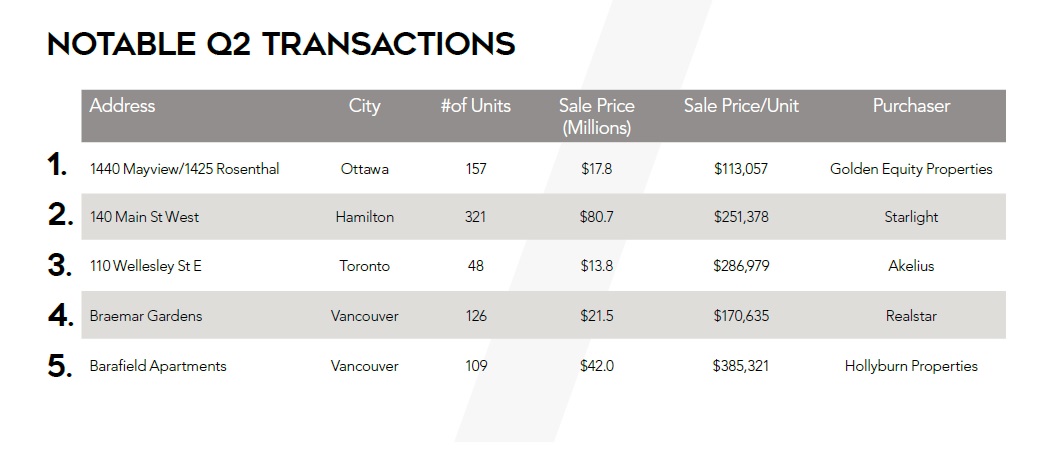
Notable Q2 apartment transactions:

Q2


CAPREIT acquires B.C. townhouse complex

Canadian Apartment Properties Real Estate Investment Trust (CAPREIT) announced that it has completed the acquisition of Brookside Gardens, a 44-unit townhouse complex in Maple Ridge, BC, in the northeastern section of Metro Vancouver.

Situated in a park-like setting with well-landscaped grounds, each spacious two-storey rental townhome features three bedrooms, a fenced-in backyard and covered parking.

CAPREIT paid $10.9 million for the townhouse complex, financed with an assumption of an existing $3.71 million mortgage maturing on October 1, 2020 bearing an interest rate of 1.94% and remaining with its Acquisition and Operating credit facility.

“We are pleased to complete this acquisition in the strong British Columbia market,” commented Thomas Schwartz, President and CEO. “The addition of this property demonstrates our commitment to diversifying our portfolio to reduce risk and strengthening our presence across Canada’s strongest rental markets.”

Brookside Gardens is located along Dewdney Trunk Road between 208th Street and Rosewood Street in a strong residential area of West Maple Ridge. Various amenities are within walking distance on Dewdney Trunk Road, including the Westridge Centre and Save-On-Foods. Schools in the area include Westview Secondary, Maple Ridge Christian School, and Fairview Elementary. Lougheed Highway and the Golden Ears Bridge enable easy access to surrounding communities, and public transportation is readily available with buses along Dewdney Trunk Road and at the Westcoast Express station just south of Lougheed Highway,

As one of Canada’s largest residential landlords, CAPREIT is a growth-oriented investment trust owning interests in 49,073 residential units, comprising 42,622 residential suites and 31 manufactured home communities comprising 6,451 land lease sites located in and near major urban centres across Canada and The Netherlands. For more information about CAPREIT, its business and its investment highlights, please refer to our website at www.caprent.com.

CBRE first in Vancouver to earn WELL certification

CBRE’s Vancouver office is the first in the city to receive WELL Certification, which focuses on enhancing employees’ health and wellness through the built environment.

The office, which occupies four floors in Oxford Properties’ MNP Tower, earned certification at the gold level for New and Existing Interiors. The space incorporates more than 100 wellness features, such as universal access to natural light for all employees, ergonomic sit-stand desks and noise-cancellation diodes to reduce stress-inducing background noise.

WELL Certification

In Canada, CBRE has been pioneering the standard, which assesses, monitors and tests spaces across seven wellness categories: air, water, nourishment, light, fitness, comfort and mind. CBRE is responsible for four out of the first 10 WELL-certified projects in the country.

“Our decision to be first-movers in pursuing this pioneering certification reflects our belief that the office environment can, and should, add to the health of your people, and that true market leadership is about taking bold steps for the future,” said CBRE Canada President and CEO Mark Renzoni.

 WELL Certification

To comply with the standard, the office made sure that internal air quality was within the top one per cent globally. When its filtration system detects a need for fresh air, it pumps in new air from outside the building, as opposed to recycling old air. The office also stopped eating at desks during lunch to encourage stress-free screen breaks at the Rise café, and connect with colleagues.

“Since 2015, in offices that have undergone our workplace transformation, we have seen our total employee turnover rate fall by almost a third and, in the same period, we’ve doubled our hiring rate of new talent,” says Ashley O’Neill, vice-president of corporate strategy. “Not only is WELL Certification helping to differentiate us as an employer that is prepared to invest in the health and wellness of its people, but, as it represents the leading edge of office design, it’s also differentiating us as a commercial real estate advisor.”

Concert’s David Podmore retires as CEO

David Podmore has announced his retirement as CEO of Concert Real Estate Corporation. Effective June 2, 2017, Brian McCauley assumes the role of president and CEO for Concert Real Estate Corporation and all related entities – Concert Properties Ltd., CREC Commercial Fund and Concert Realty Services Ltd.

“After 24 years as Concert’s chief executive officer, it’s time to pass the baton to Brian McCauley,” says Podmore, who is widely recognized as one of the most influential contributors to Greater Vancouver’s real estate industry.

“Continuing under Brian’s executive leadership, with support from the entire Concert team, I am confident the company will continue to be highly successful, grow and provide solid returns to our shareholders – all while protecting Concert’s ethics, values, and reputation for integrity and excellence.”

Under Podmore’s 28 years of leadership, Concert grew from a vision into a national enterprise with nearly $2.4 billion in committed equity and more than $5 billion in owned assets and assets under management. Podmore will continue from the Vancouver office as board chair for CREC, Concert Properties Ltd. and the CREC Commercial Fund Investment Committee, as well as board chair and CEO of Concert Infrastructure Ltd.

McCauley joined Concert in 1994 and has played a key role in the development of some of Concert’s largest mixed-use projects and was instrumental in the company’s geographic diversification. In 2002 McCauley led the development of assured rental housing in Toronto in a joint venture with OMERS, guiding Concert’s expansion into Ontario.

A passionate supporter of the real estate development industry, and an experienced and sought after speaker on real estate-related matters, McCauley presently serves on the board of the Urban Development Institute (UDI) Pacific Region as Vice Chair at Large, is a Director on the board of Junior Achievement BC and is a past Director of the Building Industry and Land Development Association of Toronto (BILD).

Co-founded by Jack Poole and Podmore in 1989, Concert has developed over the years nearly 12,000 rental and condominium homes and built or acquired 11.5 million square feet of income-producing properties. The next 15 years will see the development of approximately 5,500 condominium homes, 1,500 rental homes, 600 seniors homes and 500,000 square feet of commercial property.

“Concert is well-capitalized, with an exceptional pipeline of projects secured and a very supportive shareholder base,” says Podmore. “Under Brian’s leadership, I am confident Concert is entering a promising new chapter.”

Kiko Water Systems wins Green Building Product of the Year

The Canada Green Building Council (CaGBC) presented Kiko Water Systems with the 2017 CaGBC Green Building Product of the Year Award for their Water Systems Cartridges, during a gala dinner last night that was part of the Building Lasting Change national conference.

Kiko’s Water System Cartridges was chosen by the jury because of their ability to reduce energy consumption and carbon emissions at a minimal capital expense and disruption to the owner, along with a short payback period. The product’s applicability was also noted, with the ability to be implemented in a broad spectrum of building types including new and existing buildings.
Product submissions were assessed based on four key areas: sustainability, transparency and verification, innovation, and application.

Kiko Water Systems Cartridges makes boilers, chillers, cooling towers, heat exchangers and heat pumps all operate more efficiently, as a nanotechnology that is green and not chemical Buildings with their technology save an average of more than 20 per cent of their HVAC energy consumption. The technology also helps equipment to not work as hard, which reduces maintenance costs and extends equipment lifespan.

“Since we started, our mission has been to provide clients with an easy, effective way to reduce GHG emissions, extend equipment lifespans, lower operating costs and monitor equipment performance without disruption.,” said Jeff Addison, managing director, Kiko Water Systems. “By being recognized by the CaGBC, we are able to further our mission and create a more sustainable future.”

Kiko has installed their proprietary technology in hundreds of HVAC systems spanning millions of square feet, and boasts a 100 per cent success rate for reducing energy consumption. This had led to GHG emissions reductions in large commercial, residential and hotel towers since 2013.

“Creative products like this are an example of business transforming the industry by offering not only an innovative solution for the reduction of energy consumption and carbon emission but also costs for buildings owners,” said CaGBC President and CEO Thomas Mueller.

The honour was presented by Shyam Ramrekha, product manager of UL Environment, who once again sponsored the award. Runners up were CarbonCure Technologies for CarbonCure Concrete, a technology that recycles waste carbon dioxide to make affordable, greener concrete products. Cascadia Window Ltd also won for The Cascadia Clip, a thermal spacer made from low-conductivity fiberglass material, which reduces thermal bridging, improving the effective thermal resistance of the exterior wall.

Kiko Water Systems now has the right to use a CaGBC Product of the Year crest on its marketing materials and product website.

Building a business case for, with IT solutions

As facility management and information technology become increasingly intertwined, there are business cases to be made both for and with IT solutions. Computer-assisted facility management (CAFM) systems can be used to track trends in data, identify opportunities to improve processes and report back the results.

Presenters of the educational session Making a More Effective Business Case to the C-suite for FM utilizing IT recently shared how to do this at IFMA Facility Fusion in Toronto. One of the key takeaways was that cost savings is not the only compelling argument for executives to approve funding for a project.

“I’ve seen powerful business cases for what sort of inventory of parts should we keep within our properties so we don’t have to go out to Home Depot and buy new light bulbs as we need them,” said Simon Davis, vice president of business development at Serraview.

Improving FM with technology

Davis discussed how to show the benefits of enhancing processes with technology, highlighting the importance of aligning business cases with corporate strategy. He pointed to a large investment bank he worked with in New York, where all facilities requests required at least a response, if not a resolution, within 15 minutes — a performance target that could be measured and managed.

“As an organization, they didn’t care about efficiency or cost savings, they cared about the satisfaction of the employees on the floor,” said Davis.

But there are efficiencies and cost savings to be had, with support from technology, for organizations that do have these goals. For example, systems with heat maps are being used to identify to the most and least used areas on floors to tailor cleaning schedules to the space, said Davis. Another trend he is seeing is organizations wanting to maximize their space utilization, which could lead to savings if a lease can be collapsed when it comes up for renewal.

Davis worked with an organization that was able to grow substantially within its existing real estate footprint by raising its space utilization from 49 per cent to 92 per cent.

“It’s not necessarily a cost savings, but a cost avoidance,” he noted. “They literally added 8,000 people without adding a single square foot of space.”

Davis recommended asking the following questions when reviewing a process:

  • Is it effective?
  • Can it be computerized?
  • Will it justify the effort?
  • What are the risks?

The business case for adopting a CAFM system can fall apart if the risks of roll out are not mitigated, Davis explained.

Building effective business cases

Kevin Janus, business manager, Maximo CoE, Computerized Facilities Integration, said that the data accumulated through technology can reveal trends and guide FM efforts based on what initiatives stand to have the greatest impact.

Janus echoed Davis in underscoring the strategic value of crafting pitches to the current objectives of the organization, whether they’re cost-cutting or growing. He added that FM goals, such as risk mitigation, can be framed in a way that speaks to the corporate goals of the day.

“If we see a crack in the sidewalk, we know that someone can trip, fall, break their leg on it, lawsuit,” said Janus in another example. “But if the company is more about persons’ experience, the crack in the sidewalk could actually show a lack of caring about the appearance of the company or the experience of someone walking over that.”

In addition, he said that when making the case for an initiative to the C-suite, anything that is intangible must be translated into something that is tangible.

“I’ll show you how, by changing the hot dogs to better quality in the cafeteria, you’ll have more people spending time in house, eating lunch, which will increase productivity,” Janus offered by way of example.

He also noted that different messages may be required for different audiences, depending on how the FM department reports up to the C-suite. Finding allies in stakeholders such as HR can help pave the way for approval, especially if it means executives are hearing a similar message from more than one group.

Janus offered further tips for preparation, including anticipating possible alternative solutions and leaving room to negotiate, so there is at least an opportunity to start small and prove success to be able to build on an initiative.

Post-approval follow up

Janus recommended following up with the C-suite to communicate the outcome of initiatives that secured funding, whether positive or not-so-positive. It’s a matter of maintaining credibility and providing transparency, he said.

“You don’t always want to go there with your hand out,” said Janus. “You want to go there and show results of the business cases.”

Michelle Ervin is the editor of Canadian Facility Management & Design.

Big data backs medium-density development

The development of more courtyard apartments, multiplexes and town homes could be among the building blocks of better housing affordability in Ontario and the Greater Toronto and Hamilton Area (GTHA), according to big-data analysis. Collectively referred to as the ‘missing middle,’ these housing types hold the potential to help mediate a mismatch between supply and demand, according to a report released last week.

Understanding the forces driving the shelter affordability issue builds on research into the complex web of factors influencing the housing market. In this latest phase of its work, the Canadian Centre for Economic Analysis (CANCEA) used computer simulations to model the various effects of different events. The independent study was sponsored by the Residential Construction Council of Ontario, the Residential and Civil Construction Alliance of Ontario, the Ontario Association of Architects and the Ontario Construction Secretariat.

In its initial phase of work, CANCEA produced a new measure of affordability, aimed at more completely capturing the many forces affecting the ability of households to meet their basic housing needs. The shelter consumption affordability ratio (SCAR) index represents all costs associated with shelter divided by the amount of disposable income left over after covering other necessities.

In Ontario, one in four households have a SCAR index of more than 60, which is the threshold for unaffordability. In the GTHA, it’s one in three households.

Population growth, paired with the shrinking average size of household, has contributed significantly to the rising SCAR index in the last 10 years, the research found. Debt was also a major factor in increasing affordability pressures. At the same time, increasing average wages, diverging ownership and rental prices, and growing government transfers acted as mitigating forces.

The research found that demographic factors and diverging ownership and rental prices also have the potential to have an outsized impact on the SCAR index looking ahead. So do average wages, employment rates and the mismatch between shelter demand and supply.

Industry groups have characterized housing affordability as a supply problem, but Paul Smetanin, president of CANCEA, cautioned that it would be a mistake to discount the demand side of the supply-demand equation. With the region projected to require $100 billion to $150 billion worth of construction in the next decade, the research points to the importance of the suitability of supply.

“This is not about necessarily increasing the volume of what we’re currently building,” said Smetanin. “This is about changing what we build, and starting to look at the productivity of land being used.”

Gentle-density options, somewhere between single-family home and sky-scraping condo, would give households an opportunity to ‘right-size’ their home based on their needs, he explained. As it stands, a similar scenario is playing out in communities across the GTHA, where empty nesters tend to be sitting on extra bedrooms while households of five or more tend to be short on bedrooms.

This finding was eye-opening for city councillor Ana Bailao, who chairs Toronto’s affordable housing committee and represents Ward 18 Davenport. It suggested that a provincially and federally supported city program designed to help seniors age in place might be less than constructive with respect to housing affordability.

“We’re actually incentivizing people to stay longer in their homes, paying for renovations and so on,” said Bailao, speaking on a panel following the release of CANCEA’s report. “So now we have all this data in front of us that should tell us maybe this is not the best way to actually invest that money.”

Smetanin also noted the lack of attractive alternatives available to baby boomers who might otherwise downsize from detached homes. What’s conspicuously absent on the market is what has come to be known as the ‘missing middle.’

“One part of the community is rat, pack and stack, and the other part of the community is very flat,” he said.

The CANCEA report cites zoning as a contributing factor, with vast swaths of residential land limited to detached homes in Toronto. It goes further to suggest that adding gentle density to serviced, well-located areas such as Danforth Avenue could be a cost-effective way to increase housing.

It’s not just about building the right size of units, but providing the right mix of tenures. A cultural fixation on home ownership has pushed ownership levels far beyond those found in most modern cities, said Smetanin, while the construction of purpose-built rentals has stagnated, until recently.

“Every time we turned down the supply of rental, we started to see frothiness, and we started to see bifurcation toward basically people in good situations and people in bad situations,” he said of the computer simulations.

The availability of attractive rental options also facilitates right-sizing by giving consumers who sell their homes the option of renting if no homes meeting their needs are on the market at that time, said Smetanin.

Renewed interest in constructing purpose-built rentals was just picking up steam when the provincial government announced plans to lift the previous 1991 cut-off on rent control.

“One of the great tragedies of what we’ve seen over the last month or so is that Greater Toronto and Hamilton Area was on the verge of a massive expansion of purpose-built rental,” said Jim Murphy, president and CEO of the Federation of Rental-Housing Providers of Ontario, speaking on a panel following the release of CANCEA’s report. “And a lot of those [units] are now at risk.”

Meanwhile, condos have outpaced purpose-built rental construction in the GTHA by more than 10 fold over the last two decades, according to the CANCEA report. As a result, condos have acted as a stopgap in the rental market, with one in three of the units in Toronto currently rented.

However, development timelines that stretch years cause a lag in responses to consumer demand and prompt builders to depend heavily on investors, observed Diana Petramala, economist, real estate, TD Economics.

“[Builders] are primarily selling to investors at pre-construction stage, and they’ve got to sell about 60 to 80 per cent of their units before they can actually start or get the funding for a building,”  said Petramala, speaking on a panel following the release of CANCEA’s report. “That means that investors, particularly foreign investors, are determining our future supply — what the size looks like.

“Do we need to tax them and do we need to cut that off right away? No, because we don’t have anything its place.”

The CANCEA report flagged the agility of developers to respond to demand — which hinges on timely regulatory approvals, among other things —  for particular attention as well as speculation that results in empty units or over-bidding. In addition to right-sizing and tenure-matching, these were identified as behaviours likelier to respond to policy intervention.

The CANCEA report projected that the cumulative effect of curbing speculation, stimulating rental supply and demand, and tempering over-housing could be to bring the SCAR index below 1990s levels. Just getting developers to deliver right-sized units and getting consumers to match their shelter to their needs could bring the SCAR index below 2000s levels.

Michelle Ervin is the editor of CondoBusiness.

Starlight acquires two new Ontario rental properties

Starlight Investments announced it has begun the process of acquiring 283 apartment units in two recently constructed, multi-residential properties located at 325 Lakeview Drive in Woodstock, Ontario (“Sally Creek”) and 1042 Paisley Road located in Guelph, Ontario (“Paisley Square”).

In addition, Starlight expects to complete the acquisition of an additional 304 apartment units in three newly constructed concrete buildings adjacent to Paisley Square by way of forward purchase contract over the next eighteen months.

“Starlight is pleased to expand its presence in Guelph and Southwestern Ontario with the addition of two newly constructed luxury properties,” stated Daniel Drimmer, Starlight’s Chief Executive Officer. Sally Creek and Paisley Square represent Starlight’s third and fourth multi-residential forward purchase contract acquisitions in recent months. Together, the Properties exemplify Starlight’s robust pipeline of newly constructed properties acquired by way of forward purchase contract.”

Paisley Square is comprised of 180 units in a high-rise, ten-storey concrete building with surface and underground parking, a state-of-the-art fitness facility, party room, theatre, guest suite and storage lockers. Each unit offers spacious layouts, modern designs and premier finishes such as stainless steel appliances, contemporary kitchen cabinetry, hardwood floors, private balconies, in-suite washers and dryers and modern lighting fixtures. Paisley Square is ideally located in close proximity to Highway 6 and Guelph Transit in an area that that boasts amenities such as the Margaret Greene and Earl Brimblecombe Parks, West End Community Centre, St. Francis of Assisi School, Taylor Evans Public School, shopping and access to the Guelph downtown core.

Sally Creek is comprised of 106 units in a mid-rise, five-storey, concrete building with covered-surface parking, a state-of-the-art fitness facility, party room, lounge, modern elevators and storage lockers. All units include in-suite washers and dryers, stainless steel appliances, modern lighting fixtures, contemporary kitchen cabinetry and private balconies. Sally Creek is situated near the Tollgate neighbourhood amongst the Villages of Sally Creek in close proximity to Woodstock Meadows Golf Centre, the Thames River, hiking trails, Tollgate Central Public School, the Cowan Park Multi-Purpose Facility, Roth Park, shopping and the Woodstock downtown core with access to Highway 59.

The Properties will be managed on-site by Greenwin Inc.

International Executive Housekeepers Association votes to merge with ISSA

The International Executive Housekeepers Association (IEHA) has voted to merge with ISSA, a leading trade association for the global cleaning industry.

An agreement to merge was previously supported among IEHA’s board of directors because they felt it was the best way to sustain the association for the long term.

The IEHA is a 3,500-plus professional member organization for executive housekeepers who manage and direct housekeeping programs in commercial, industrial or institutional facilities.

“The size and stature of ISSA offers IEHA and all its members’ opportunities and advantages that IEHA would not have on its own,” said IEHA President Michael E. Patterson. “Also, it makes sense for all facets of the cleaning industry to be gathered under the same umbrella.

ISSA’s in-house staff will take over some tasks, he adds, giving IEHA staff more time to interact and help its members. Additionally, ISSA’s legislative staff keep tabs on laws that affect businesses.

“There is also a lobbying arm to make the interests of the cleaning industry known to lawmakers,” notes Patterson.

IEHA members will have access to global ISSA membership and benefits. These range from market exposure and networking to business tools and customer focused information like magazines and online data.

“ISSA’s mission is to change the way the world views cleaning in all sectors of the industry,” said ISSA Executive Director John Barrett in a press release. “The merger of ISSA and IEHA is yet another move toward creating one strong, unified industry.”

CaGBC launches Zero Carbon Building Standard

In an effort to help meet Canada’s climate change commitments, the Canada Green Building Council (CaGBC) has launched the country’s first Zero Carbon Building Standard.

The highly-anticipated Standard evaluates carbon use in commercial, institutional and multi-family buildings in Canada. In order to achieve large-scale market transformation, it was designed for application across many types of new and existing buildings across the country. The Zero Carbon Building Standard is also the only program of its kind to list carbon reductions as the key indicator for building performance.

Focusing on carbon is vital, as the most important factor in the carbon footprint of a building is often not energy performance, but the carbon intensity of the local electrical grid and the fossil fuels used. Recognizing these differences is therefore critical to accurately judge impacts and guiding investments in energy efficiency, heating technologies and renewable energy.

“While there is no doubt that Canada’s building sector has been dramatically transformed over the last two decades, the time has come to be bolder and more ambitious,” said Thomas Mueller, president and CEO of the CaGBC, in a press release. “The CaGBC’s Zero Carbon Building Standard brings focus to carbon emissions reduction, and defines new levels of building performance. This Standard will help the building industry to show leadership in eliminating emissions from buildings and contribute to shaping of Canada’s climate future.”

The Zero Carbon Building Standard is part of a larger CaGBC Zero Carbon Building Initiative, created to support the move to lower-carbon buildings to aid Canada’s efforts to cut greenhouse gas emissions by 30 per cent by 2030.

The Standard was developed by CaGBC and Integral Group, in extensive consultation with representatives from over 50 industry organizations, utilities, governments and companies across the country. CaGBC is also working with 16 of Canada’s most sustainable projects in the Zero Carbon Building Pilot Program. Participating projects will help further develop the Standard and accompanying resources and education.

The full requirements for the Standard are now available for download on the CaGBC website. Project registration will open on Sept. 5, along with full pricing and additional program details.

Additional honours presented at OAA Awards Gala

The Ontario Association of Architects (OAA) recently held its annual Ceremony of Excellence at the Westin Hotel in Ottawa, celebrating the best of the industry in the province. At the event, in addition to the announcement of the 10 Design Excellence Award winners, the OAA announced the winners of additional awards.

The Michael V. and Wanda Plachta Award, presented to a project under $8 million, was presented to Kohn Shnier Architects for Toronto’s Rosemary Residence; the Lieutenant Governor’s Award for Design Excellence in Architecture went to Saucier + Perrotte Architectes/ZAS Architects Inc. in joint venture for River City – Phase 1 & 2 in Toronto; and the People’s Choice Award, voted on by the general public, which was presented to Sweeny &Co Architects Inc. for Queen Richmond Centre West in Toronto.

“All of this year’s OAA Awards winners truly represent the innovative thinking, design and solutions architects bring to communities across Ontario,” said John Stephenson, OAA president, in a press release. “The use of the winning buildings this year also shows how responsive architects are to the evolving needs of communities throughout Ontario and the world.”

The 2017 OAA Awards winners are:

Design Excellence 

Boulevard Club West Wing Replacement, Toronto, ON
Teeple Architects Inc.

Centennial College Ashtonbee Campus Library & Student HUB, Toronto, ON
MacLennan Jaunkalns Miller Architects Ltd.

Conestoga College Student Recreation Centre, Kitchener, ON
MacLennan Jaunkalns Miller Architects Ltd.

Eva’s Phoenix, Toronto, ON
LGA Architectural Partners (formerly Levitt Goodman Architects)

Mike & Ophelia Lazaridis Quantum-Nano Centre, University of Waterloo, Waterloo, ON
KPMB Architects

Queen Richmond Centre West at 134 Peter Street, Toronto, ON
Sweeny &Co. Architects Inc. (formerly Sweeny Sterling Finlayson &Co. Architects Inc.)
Project was commenced by Sweeny Sterling Finlayson &Co. Architects Inc. and completed under Sweeny &Co. Architects Inc.

River City – Phase 1 & 2, Toronto, ON
Saucier + Perrotte Architectes / ZAS Architects Inc., in joint venture

Rosemary Residence, Toronto, ON
Kohn Shnier Architects

Story Pod, Newmarket, ON
Atelier Kastelic Buffey Inc.

Williams Parkway (Phase 1), Brampton, ON
Rounthwaite Dick & Hadley Architects Inc.

Best Emerging Practice

blackLAB architects inc.

Concepts

Forwards and Backwards
Jennifer Davis (Intern Architect) and Jon Sasaki

Shobuj Pata – Multi-Unit Residential Development
Studio JCI Inc.

Landmark Designation

Ontario Science Centre, Toronto, ON
Moriyama & Teshima Architects

The Fielding Memorial Chapel of St. Mark, Thornloe University, Sudbury, ON
Arthur Townend & Carl Skerl,Townend Stefura & Baleshta Architects

G. Randy Roberts Service Award

J. William Birdsell

Order of da Vinci

Sheila Penny

Michael V. and Wanda Plachta Award

Rosemary Residence, Toronto, ON
Kohn Shnier Architects

Lieutenant Governor’s Award for Design Excellence in Architecture

River City ‐ Phase 1 & 2, Toronto, ON
Saucier + Perrotte Architectes / ZAS Architects Inc., in joint venture

People’s Choice Award

Queen Richmond Centre West, 134 Peter Street, Toronto, ON
Sweeny &Co Architects Inc.

Miller Thomson opens legal knowledge centre in Vancouver

Canadian business law firm Miller Thomson has completed the build out of a new, multimillion dollar legal knowledge centre in Cadillac Fairview’s Pacific Centre complex in downtown Vancouver.

The 48,000 square foot facility is designed to serve as a platform for the firm’s business, startup and public agency clients seeking legal solutions.

“We are redefining how legal solutions are formulated and accessed,” said Mike Walker, Miller Thomson’s managing partner for B.C. “We will be offering educational programs, hosting round tables, and seeking new ways to work with our clients. We want clients to impact our thinking on a daily basis, while we in turn impact theirs.”

A “first of its kind” in Canada, the new legal centre format was designed on the principles of knowledge access and client engagement. The whole facility is housed on a single floor and the majority of personnel, including lawyers, working in flexible, open-plan layouts.

“Our emphasis is on human interaction, mobility and gaining advantage through the application of leading-edge technology,” said Walker. “At our core, we are a knowledge business. Creative thinking and information exchange are essential ingredients to our success. This one-of-a-kind space gives us opportunities to open our doors to entrepreneurs, thought leaders and community builders.”

Neighbours in the same complex include Microsoft and Sony Imageworks.

“We are excited about the possibilities that this new approach in Vancouver opens up,” added Kent Davidson, chair of Miller Thomson. “This is just one step we will be taking to make legal solutions more accessible to our clients and communities in which we live and work.”

GBCI Canada created to rev up green building

Canada Green Building Council (CaGBC) and Green Business Certification Inc. (GBCI) are forming a Canadian joint venture called Green Business Certification Inc. Canada (GBCI Canada).

Beginning in early 2018, GBCI Canada will deliver all of the current and future GBCI offerings including certification and professional credentialing services for LEED v4, WELL, SITES, PEER, Parksmart, Zero Waste and GRESB in Canada. The new organization is being established to more effectively support the Canadian market.

Both organizations will be managed by CaGBC President and CEO, Thomas Mueller, to ensure seamless integration and the effective advancement of both organizations. Through growth of various programs and services, revenue from GBCI Canada will support CaGBC’s mission. LEED will remain well-supported in Canada. CaGBC will continue to certify all LEED Canada projects. GBCI Canada will deliver LEED v4 and all GBCI rating systems via LEED Online and Arc, using Canadian staff and knowledge to provide support.

“The urgency of addressing climate change requires bold and innovative new approaches to doing business,” said Thomas Mueller, President and CEO, CaGBC. “Forming GBCI Canada is a critical step in CaGBC and GBCI’s strategy to scale up green building market transformation and impact. Members of the CaGBC, and the industry at large, will benefit from this new organization dedicated exclusively to the delivery, enhanced service and market support of a broader range of green business solutions.”

GBCI is the premier organization independently recognizing excellence in green business industry performance and practice globally. Through its rigorous certification and credentialing standards, GBCI drives the adoption of green business practices that foster global competitiveness and enhance environmental performance and human health benefits.

“GBCI and CaGBC complement each other by bringing unique strengths to the joint venture that together will help accelerate market transformation one project at a time,” said GBCI President and CEO Mahesh Ramanujam.

This new venture will serve to facilitate the growth of USGBC’s LEED program and GBCI rating systems and provide additional on-the-ground support for the country. GBCI Canada is now the third incorporation of GBCI including GBCI Europe and GBCI India, but the first partnership with an established green building council.