Articles Archive - Page 599 of 929 - REMINET
REMI

Apartment market trends and transactions

Avison Young released its annual commercial real estate forecast earlier this month and predicts change and opportunity will abound in 2018. According to the report, Canada’s commercial real estate sector continues to possess varying, but largely healthy, property market fundamentals across the country’s regions and asset classes—supported by a stable economy, which is the envy of the G7 countries.

“Despite the favourable market conditions, there is a sense that we are late in the cycle and a slowdown is inevitable,” commented Bill Argeropoulos, Principal, Practice Leader, Research (Canada) for Avison Young. “The commercial real estate sector is having to re-evaluate challenges and opportunities in a technologically transforming world – a world that Canada appears to be making a concerted effort to lead, rather than follow.” Residential tower has started.

Downtown Winnipeg will be seeing major changes this year, as several multifamily and commercial mixed-use projects are set to reach completion in 2018. More than $900 million has been invested in the city’s downtown core during the last decade. Phase 1 of the $400 million True North Square project is already taking shape, and construction on a $165-milion, 40-storey commercial/residential tower has begun.

In Toronto, a vast amount of capital chasing limited product continues to keep prices high and cap rates low. Scarcity of product is pushing some investors toward more challenged assets, and/or locations, to capitalize on redevelopments or future growth, requiring buyers assume some risk.

In Halifax, the multifamily investment sector is more active than ever. Many developers are local, family-owned businesses, strategically building and selling assets to publically traded companies and organized syndicates that are both local and from abroad.

The major markets in western Canada are beginning to show signs of recovery. In Calgary the total investment dollar volume of transactions were up compared with 2016, with a high proportion of investment coming from groups that do not have existing exposure to the local market. An increasing number of transactions in 2018 are expected to drive investment dollar volume to its highest level in three years.

Looking back at Q4 2017

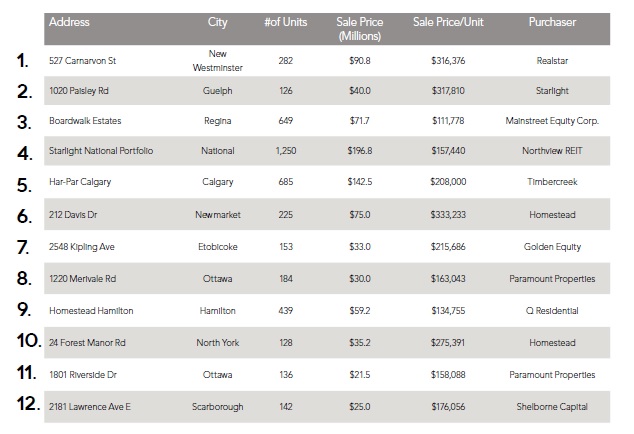
The apartment market in 2017 ended with a flurry of activity, which, according to Morguard’s Keith Reading, will likely result in a new record high for apartment sales volume. Reading also noted that public and private capital sources have been very active, with pricing held at the peak for the cycle resulting in record-low yields for prime assets. As with previous quarters, the supply of assets available for purchase—particularly in cities like Toronto and Vancouver—continues to fall short of capital availability.

Here’s a look at some of the top apartment transactions for Q4 2017:

Q4 2017

New U.S. tax rules alter competitive landscape

Toronto lacks a tax advantage that the 19 other contenders on the short list to host Amazon’s second headquarters now enjoy. The recently adopted U.S. Tax Cuts and Jobs Act (TCJA) provides companies based in the United States with an effective tax rate of 13.125 per cent on a portion of earnings derived from selling services and/or intellectual property into foreign markets.

Even while acknowledging the World Trade Organization might characterize this as “overtly protectionist”, Paul Seraganian, managing partner in Osler, Hoskin & Harcourt LLP’s New York office, cites it as one example of how far-reaching the overhaul of the U.S. tax system is likely to be. “The rules just reshape the competitive landscape,” he told seminar attendees in Toronto earlier this month.

“It’s changing things, certainly. The (U.S.) corporate tax rate is going down to 21 per cent so that should definitely improve investment returns,” concurs Bruno Godin, a partner and national leader, U.S. corporate tax, with the accounting and business advisory firm, Grant Thornton LLP. “Historically, on average, factoring in state and local taxes, you were looking at a corporate tax rate of just under 40 per cent from the U.S. perspective versus under 30 per cent from the Canadian perspective. If you were going to invest money for the purpose of earning a gain on it, it was much more beneficial to invest that money here than in the U.S.”

Observers familiar with the evolution of tax policy and the pace of U.S. law-making marvel at the TCJA’s speedy progress from Nov. 2 introduction, through the usually cumbersome process of reaching consensus in the House of Representatives and the Senate, to Dec. 22 presidential affirmation. Previously, some adjustments to tax law — including one that had positive implications for Canadian pension funds investing in U.S. real estate and infrastructure — were approved during President Barack Obama’s tenure, but few major changes have occurred since President Ronald Reagan last tackled reforms.

“I think it is fair to characterize this reset as the biggest transformation in the last 30 years,” Seraganian said. “We’re learning these rules alongside everybody. Because this was rushed through, there is still a lot do.”

The significant reduction in the corporate tax rate — slashed to 21 per cent from the previous 35 per cent — is straightforward to grasp, but it comes with a swath of other new directives pertaining to credits, deductibles and international activities, now in place for the 2018 tax year. Just like follow-up regulations guide the implementation of Canadian legislation, the U.S. Internal Revenue Service is tasked with providing further clarification and interpretation of the TCJA’s intent.

“There will be a series of aftershocks over the next few years as the regulations come out,” Seraganian predicted.

Unsettling the cross-border dynamic

Commercial real estate operations within Canada could experience fallout from the new U.S. tax rules simply due to the interconnectedness of the two economies, while companies with holdings on both sides of the border may be pushed to reassess some of their current financing strategies and structures. Osler’s tax experts speculate the new tax regime could boost the equity value of U.S. based companies, giving them an edge over Canadian and other international players when it comes to securing capital, and that the traditional case for incorporating in Canada could be shifting.

“For many years, the value of a $1 deduction in the U.S. was, all other things being equal, greater than a $1-deduction in Canada. This simple reality has directed the flow of billions of dollars of cross-border arrangements and payments across the Canada-U.S. border,” they advise. “The domestic U.S. tax changes unsettle that simple premise in ways that are not yet fully appreciated.”

Among instruments potentially in flux, Seraganian identifies the leveraged blockers that have enabled Canadian investors in U.S. real estate funds (and other kinds of investment funds) to minimize tax impact and avoid filing U.S. federal income tax. Conventionally, non-U.S. investors acquire debt and equity capital in the blocker, which is structured as a limited liability company that acts as a corporation for U.S. income tax purposes. The blocker, in turn, invests in the real estate fund, but the new rules diminish tactics for lowering the blocker’s effective tax rate.

When the real estate fund distributes proceeds down to the blocker, the portion of the distribution allocated to interest on investors’ debt can be deducted as an interest expense. However, the TCJA now places a more restrictive limit on the interest expense deductible — previously based on 50 per cent of adjusted taxable income, but now lowered to 30 per cent — and stipulates that it be calculated at the fund level, not at the blocker.

This presents what Seraganian calls a “double whammy” hit. “Just by virtue of the new methodology, people will feel a squeeze on their interest deductions,” he said.

Many of the other rules could prompt new kinds of decision-making. For example, Osler’s tax experts suggest a five-year window, to 2023, for 100 per cent expensing of tangible depreciable property (excluding land and buildings) could affect the timing of acquisitions or be an incentive to purchase assets in order to trigger the eligibility.

Partnerships could also become a preferred option, ahead of incorporation, based on the new rule that allows individuals, trusts and estates to deduct 20 per cent of qualified business income received through pass-through arrangements. This includes real estate, but excludes professional services or “any trade or business where the principal asset is reputation and skill of one or more of the employees or owners”.

Together, these rules could raise the profile of some business approaches. “I think we are going to see partnerships take a greater role in the cross-border M&A scene,” Seraganian said.

FIRPTA unchanged

Despite some earlier calls for moderation, few changes have been made to withholding tax that applies under the U.S. Foreign Investment in Real Property Tax Act (FIRPTA). With the exception of one sizable and active group of institutional investors defined in U.S. tax law as “qualified foreign pension funds” — granted an exemption as part of the 2015 Protecting Americans from Tax Hikes Act — Canadian investors are subject to FIRPTA withholding tax on capital gains on: the direct sale of U.S. properties; sales of U.S. property fund shares; and fund and REIT distributions resulting from the disposition of U.S. properties.

As the name suggests, buyers, REITs or real property holding companies are required to withhold and submit a percentage of the value to the IRS. Subject investors can claim back any amounts that exceed their actual tax liability by filing a U.S. tax return — arguably making it more of an administrative than financial disincentive to investment.

“Generally, in a lot of transactions, the withholding tax is mostly a timing issue. In some cases you may be able to apply to have the withholding reduced if you can demonstrate that the actual tax will be lower than the withholding amount,” Godin explains. “That could happen more and more with the reduced tax rate.”

Real estate analysts likewise theorize that Canadian and other foreign investors will have few complaints. “While the FIRPTA rules would not be materially revised, many non-U.S. investors in U.S. real estate would see significant rate reductions under the TCJA. Since the FIRPTA rules effectively subject non-U.S. person to U.S. taxation on sales of real U.S. real property interests, the lower rates for U.S. taxpayers would apply to non-U.S. persons,” a pwc whitepaper examining the TCJA’s impact on real estate affirms.

“A broader exemption would have been a very nice gift,” reflects Brooks Barnett, manager, government relations and policy for REALPAC, which represents Canada’s largest commercial real estate companies and institutional investors. “For Canadian investors outside pension funds, it would have made U.S. property and infrastructure more attractive. But the fact that FIRPTA remains unchanged is actually, I think, a good outcome at a time when we’re facing some uncertainty around NAFTA.”

Barbara Carss is editor-in-chief of Canadian Property Management.

Accessible fire safety tips for property managers

Buildings are unprepared for increasing disability rates in Canada, raising concerns among accessibility advocates who see the built environment as a laggard when it comes to fire safety.

The rate of disability changes dramatically as people age, and this year there are more Canadians 65 and older than under the age of 14. By 2030, it’s expected that this age bracket will make up almost 30 per cent of the county’s population. The number of people with disabilities is set to skyrocket. Disabilities also transcend age and many people don’t report having one. They range from vision and hearing loss, developmental and mental disabilities to mobility and body function.

A seminar at PM Expo reviewed how universal design must have a broader approach when it comes to saving the lives of occupants and their clients. Even non-English speakers in a community are at risk during a fire when faced with information they cannot understand. The speakers, Martin Day, president and co-owner of Safety Media, and Thea Kurdi, associate at DesignABLE environments, offered resources on accessibility in the built environment and how property managers can support people with disabilities before and during a fire event.

The duo offered ten tips for accessible fire safety practices. Here are several highlights from the discussion.

1. Seconds matter

When a fire breaks out in a building, seconds, not minutes, matter. Interior finishes in buildings are now more toxic, whether it’s a desk or table made from cardboard stuck together with glue or foam couches, causing fire to move faster than ever before.

2. You are required to act unless you can show undue hardship

Understanding accessibility from a legal context can be daunting. Canada has moved from an era of exclusion, where people with disabilities were a burden to society, to what Kurdi calls an era of integration and inclusion, where “people are starting to recognize that a diversity of changing abilities can happen to anyone over their lifetime.”

“Accessibility is like the law in the wild west,” she noted. “Every town has an additional set of accessibility requirements, which leads to confusion.”

In Ontario, there are municipal standards and requirements under the Accessibility for Ontarians with Disabilities Act (AODA); however, the Ontario Human Rights Code has primacy over these laws. According to the Ontario Human Rights Commission, failure to provide for accessibility in the short term can result in a human rights complaint. The Ontario Human Rights Tribunal has reported that if someone makes an Ontario Human Rights complaint against a building, an owner is expected to do more, unless they can prove they would go bankrupt in the process.

“Unfortunately we don’t know what more looks like because no one has defined it,” said Kurdi. “It’s an interesting challenge, with advocacy groups asking the government to do a better job defining how to make a building accessible to the point of undue hardship, along with protecting them from Ontario Human Rights Code complaints when they thought they were doing the right thing by following the laws.”

3. Building codes and standards will tell you what needs to be done

Several standards were created under the AODA to help property managers make Ontario accessible by 2025. The Information and Communication Standard focuses on signage and helps satisfy the need for dignity and equality. Customer service is also a factor when thinking about providing accessible services. At the end of this year, the AODA requires every business to submit an accessibility plan, which should provide access for service animals and support people and notice for temporary disruption of services. Public emergency information should be made accessible, along with quickly establishing a process for receiving and responding to feedback and training for staff and contact workers.

The Design of Public Spaces Standard includes implementing visual and tactile notifications, among other guidelines.

Areas of Refuge

An area of refuge is a fire safety equity place which could be part of a stairwell. It should allow for two-way communication and space for two wheelchairs in every exit stair. Elevator lobbies, which are smoke proof, are good spots in older buildings that don’t have room in exits stairs. There are many signage requirements around identifying these areas.

“With elevators not in use, tragic accidents have occurred in aging homes because there were no areas of refuge,” said Kurdi. The areas don’t have to be elaborate, but should offer a protected area in a space where people can be identified and called for help.”

Emergency elevators

Designated supervisory staff have control over the elevators until the fire department arrives. Depending on the size of the building, they may be able to evacuate some people who otherwise wouldn’t be able to get out.  After the 9/11 attacks, 25 per cent of the surviving occupants said they benefitted from having access to an elevator or would have. The presence of emergency elevators are slowly gaining ground, but more traction is expected in the next few years.

Develop and find accessible means of egress

Exits in older buildings weren’t designed to be accessible, but their location needs to be identified, along with knowing what exits are accessible at ground level. The building code has changed to include a visual alarm as part of the auditory alarm system, and bed shaker smoke alarms help people feel an alarm.

People with disabilities must rely on others as an alternative to elevators. Many don’t want to leave expensive equipment and assistive devices behind, making an exit even more difficult. The NIST Investigation into the 9/11 attacks at the World Trade Centre showed that having a mobility impairment or assisting someone who did were among the factors that increased the likelihood of death.

4. There is a large market requiring accessibility

In Canada, 1,000 people turn 65 every day. The population of a building is changing, along with disability rates, which are not always accurate.

In Ontario, 1.8 million people are willing to report they have a disability; however, 70 per cent of these disabilities are invisible and many go unreported or are temporary, such as a broken leg.

“Instead of thinking about these special people we are going to be nice enough to help, why don’t we think about the lifetime changing needs and abilities we have for all of us,” said Kurdi.

5. There is a business case you can write for your specific situation

Property managers have a lot of responsibilities, such as ensuring a business continues to make money. The question they have to answer is can they market a building that has better safety and increase performance factors, said Day. Looking at different age groups and people within the continuum of accessibility offers a marketable opportunity. Tenant safety and increasing tenant satisfaction and engagement are other benefits.

Legal risks often outweigh the benefits. Building owners can face Ontario Human Rights Tribunal fines in a public court of up to $50,000. Risk in one building can also spread across a portfolio.

“The press isn’t going to forget about the portfolio when they talk about the building,” said Day. All buildings can take steps to improve accessibility and fire and life safety, reducing both legal and regulatory risks. Tenants are starting to expect this.”

Smaller, short-term investments can improve accessibility, such as modernizing signage, changing sprinklers, modifying a lobby and changing an egress path from a construction point of view. These updates shouldn’t take away from all the other work a property must undergo.

6. A fire safety plan is for everyone

An accessible fire safety plan? All buildings that require a fire safety plan — all determined by building code and classification of the building — have a persons-required special assistance list, that the property manager is required to keep up to date.

When the fire department arrives, they retrieve the list and information from the plan and start from there. However, most people won’t confirm their disabilities so they wouldn’t be on the list. Neither would building visitors with disabilities. There are individual fire safety plans that can be written that account for a specific disability for a specific person and “try to bring everything together in one continuum.”

7. Inclusive evacuation planning and drills can help save everyone’s life

One of the best ways to make sure a building is ready if something goes wrong is to engage an inclusive evacuation planning and drills. Invite people with disabilities to tell you what they think. See how it works. Turn off all the elevators and see how people are going to get out and challenge your tenants to engage in the plan.

“It’s an opportunity, if you practice it from an accessible point of view, to improve the plan for everyone,” said Day. “Everyone needs to get out, but if we work all together, we can make it better for everybody.”

8. Accessible evacuation maps can help save critical time

During the presentation, it was revealed that there are few building with accessible evacuation maps. Most include every detail about the building, such as closets, washrooms, exits and doors, but should use limited but important information.

“They have a ton of text,” Day noted. “I would challenge anyone in an emergency to read that; some of them are really hard to follow; so make it simple.”

Maps should be tactile and use Canadian braille. The CSA B651 standard highlights type one where all letters are written out, rather than type two: contracted braille, which is a more sophisticated braille used in the United States. The maps should be placed in a high-traffic location and be large enough to read. Day suggests approaching it from the perspective of a visitor and see how easy it is to exit and understand what is happening.

9. Signage

Signage is one of the cheapest ways to update a fire safety plan, but requires a lot of thinking. CSA B651 – Accessible Design for the Built Environment, outlines best practices for signage. These include using a consistent style and location (overhead and wall mounted) throughout a building. Font should be san serif, upper and lower case, high contrast and a minimum 25 millimetres (mm) in height. Avoid shadows and glare that often arises from materials like stainless steel. Use tactile, braille and pictograms for regulatory, warning and identification signs, with text raised between 0.8 mm and 1.5 mm. Pictograms should have at least 150 mm in field height. Wall-mounted tactile signs should have a centre-line 1,500 mm from the floor and a leading vertical edge 150 mm from the door jamb.  They should also use Canadian braille.

Accessible exits clearly marked with both braille and tactile are not currently in the code. Make sure areas of refuge are clearly differentiated; it doesn’t help if someone cannot find the refuge. Language barriers are a “fairly easy problem to solve” with the use of quality response codes (QR codes) that link to an accessible version of a web page.

10. Go beyond the minimum. Get help if needed

“We’re not recommending massive changes to a building; we’re recommending that you rethink fire safety as being accessible and consider what you can do to make it more accessible for people of all abilities and disabilities,” said Day.

Low-cost options for improvement and fire safety practices are continuing to evolve very quickly. Getting help when needed will help keep tabs on changes. With that in mind, fire departments like Toronto’s are becoming more aggressive and far more likely to lay charges if fire safety isn’t up to standard.


Zeidler announces new partner for Calgary office

Zeidler Partnership Architects has announced that the company’s Calgary partnership team has expanded, bringing on architect James Brown. Brown, who spent 19 years working for Bing Thom Architects as a director, project architect, started his new position at Zeidler on Jan. 8, 2018.

Brown will be working in collaboration with other Calgary partners including Vaidila Banelis, Stephen Bugbee, Bill Mitchell, Jean Guy Beliveau and Sean Crawford.

Brown has worked as an architect since completion of his Masters of Architecture from the University of British Columbia in 1998. He has professional affiliation with Architect AIBC, Alberta Association of Architects and is a member of the Royal Architecture Institute of Canada.

“We are excited to welcome James Brown to our expanding Calgary Partnership Team,” says Vaidila Banelis, executive partner. “For more than 60 years, Zeidler has offered clients a dedicated team of creative minds whose craft and vision is shaped and informed by sound practical expertise. James will bring a wealth of experience and knowledge to his new position.”

Zeidler is based in Toronto, Ontario and has an international reach with offices in Calgary, Victoria, London, Berlin, Beijing, Chengdu, and Abu Dhabi. Their portfolio includes a range of work including civic and academic buildings, commercial and residential properties, healthcare and research facilities, performing arts centers, and hotels and resorts.

Singleton Urquhart expands into Toronto

Vancouver-based law firm Singleton Urquhart LLP has expanded into Toronto with a new office and the new name Singleton Urquhart Reynolds Vogel LLP. The firm will operate as Singleton Reynolds.

The name change reflects the addition of two high-profile names in construction law. Partners Sharon Vogel and Bruce Reynolds are the anchor partners in the Toronto office. Their associate, James Little, also joins the Construction and Infrastructure practice group.

“We are looking forward to expanding the firm’s already well-established footprint in the construction industry,” said Vogel, “particularly given the explosive growth of infrastructure development in recent years.”

Peter Wardle, one of Canada’s pre‑eminent civil litigators, will become a leading member of the Commercial Litigation practice group.

The new firm will be handling some of the construction industry’s most complex cases and will be at the forefront of developing public policy that will have significant impact on the construction industry through its public policy mandates. Reynolds and Vogel were named by Canadian Lawyer Magazine as two of the Top 25 Most Influential Lawyers in Canada given their work in reforming Ontario’s Construction Lien Act.

“We are very excited about this next step in our firm’s history,” said managing partner and founder John Singleton, Q.C. “The addition of this highly experienced team in Toronto means we have deepened our bench strength both nationally and internationally within the construction and infrastructure sectors, as well as added significant experience to our commercial litigation practice.”

In addition to expanding the firm’s expertise and reach in the construction and infrastructure sectors and bolstering its commercial litigation practice, Singleton Reynolds will continue to serve its clients with an extensive range of legal services in the areas of commercial real estate, corporate commercial, insurance defense, professional liability, product liability, workplace law, and business immigration.

Property Managers’ Guide to Ethics in Real Estate

Even the most seasoned property managers find good decision-making to be a life-long learning experience in an ever-changing industry. While there are basic rules to knowing what is right and wrong, peer-to-peer dilemmas are ripe with grey areas that require closer examination and a lot of well-tuned gut instinct.

For Gareth Jones, faculty member and national vice-president of corporate development at the Real Estate Institute of Canada (REIC), respect and trust are key components when it comes to ethics and decision making.

“If you have strong integrity and character, and demonstrate true leadership, people will know what to expect from you,” he says. “A leader strives to consider all the people impacted by a decision, which creates confidence and trust among your peers and in the industry. The consequences of any decision will be far-reaching, and you may be setting a precedent for others to follow. You must be consistent in your approach to decision making.”

To help position property managers as industry leaders and enhance their professional ethics, REIC offers the CERTIFIED PROPERTY MANAGER® (CPM®) and ACCREDITED RESIDENTIAL MANAGER® (ARM®) designation programs. At the core of both programs is a strong understanding of professional codes of ethics and business standards. Ethics in Business Practice is a required course for both programs, and helps students develop ethical values and refine their decision-making skills using real-world situations. The course also highlights fiduciary duties to clients, including confidentiality, full accountability, protecting best interests, disclosure, loyalty etc. The course also examines duties owed to third parties, including tenants and contractors.

Here are just a few items the course delves into:

Going Beyond Basic Codes

Regulatory Codes provide the basic guidelines for making the right decisions, but conclusions are not always black and white. Codes are intentionally vaguely written to allow interpretation and application in a variety of situations. It would be impossible to write a code that covers every scenario.

“Good property managers know that they may have the legal right to do something, but will ask themselves if it’s the best decision to make. They take their responsibility to the next level,” says Jones.

Law is the bare minimum, designed to level the playing field. From there, property managers should always analyze the whole situation, discover the facts, understand the consequences of their actions, and know who the decision will impact. Ensuring there is fairness and respect of all parties involved is of upmost importance. There is always opportunity to rationalize decisions, making them self-directed and to your benefit. A true leader always demonstrates respect for the other parties, making decisions inclusive of other positions.

It also helps to know one’s personal values, customs and traits, as well as the culture and values of an employer, what is expected of them, and the morals which society imposes on people inside and outside of business.

Courts will often look at the consequences and impact of a decision – asking if a property manager explored all alternatives and collected all the facts.

“If your gut tells you something is wrong you should re-examine the situation.”

Building Trust and Character

“Quite often,” says Jones, “dilemmas can arise when there are two different property managers. One may have lost a contract or is seeking a contract for a property they didn’t previously acquire, and may feel the need to “put down” the skills and integrity of another property manager relating to fees, services, or how they conduct their business.

Making derogatory comments about professionals within a business is not a good way to handle things,” he cautions. “You have to be very careful in the business community because these situations tend to come back and haunt you. It’s a smaller world than you can possibly imagine. Making such comments shallows your short-term thinking. You want to be better than that, rise above and remain professional at all times.”

The biggest asset in property management is your reputation. It steers your career path.

Be Qualified

Part of ethical decision-making requires management professionals to be qualified. Most real estate codes state that individuals should not step out of their areas of expertise.

“If you don’t have the expertise to complete a task, don’t do it,” says Jones. “People will get lured into the completion of a transaction because they have a certain title like property manager, but you should never pretend you’re something you’re not – and always be prepared to call in qualified help when you need it.”

Courts and professional standard committees are clamping down on professionalism, knowledge, skills and expertise to ensure that competent services, knowledge, skills, disclosures, fairness and loyalty are provided to clients who entrust their property manager to look after their asset. It is becoming increasingly important to remain qualified and to conduct yourself with absolute honesty and integrity.

In order to be truly successful at what you do, ask yourself these two questions:

  • What do you know about your job, and what expertise and technical skills are required?
  • How do you do your job? This extends to reputation, credibility and respect and trust for others and oneself.

What Are Your Goals?

When thinking about human interaction and conducting business with other people, property managers should be able to identify their goals and come to a decision. Let these goals lead you to your decision. Here are three points that act as a methodology for arriving at the right decision:

  • Strive to do good or, at least, do no harm. Ask how the decision makes you feel about yourself.
  • Make sure whatever you’re doing is legal and complies with all existing codes of ethics, laws, policies and professional standards.
  • Respect all individuals involved in the decision-making process, and ensure that it is balanced and fair.

Those who endeavor to meet ethical standards set themselves apart from others in the industry.

“When you are acting as a legal agent and your client is putting their trust in you as their fiduciary, court findings show that you may or may not have known about a situation, but you ought to have known,” says Jones. “The courts are finding people just as guilty for their inactions as they are for their actions.”

To learn more about the Ethics in Business course and the CERTIFIED PROPERTY MANAGER® (CPM®) and ACCREDITED RESIDENTIAL MANAGER® (ARM®) designation programs, please visit: www.reic.ca


Laurier Québec shopping centre gets major boost

Ivanhoé Cambridge is investing $60 million to enhance Laurier Québec, a shopping destination on Quebec City’s busy Laurier Boulevard.

“Laurier Québec holds a dominant position in the region and we are very pleased to invest in its modernization,” said Claude Sirois, president of retail at Ivanhoé Cambridge. “This initiative is part of Ivanhoé Cambridge’s strategy of investing in its shopping centres to maintain and strengthen their competitive positioning in their respective markets.”

The redevelopment is set to include a quality rental spaces and a complete revitalization of common areas by modernizing the interior through a major renovation. The property’s parkade will feature brighter lighting and the installation of a parking management system similar to the one already in operation at Place Ste-Foy. Each parking space will be equipped with a digital sensor to inform drivers of available and occupied places.

The Laurier Québec redevelopment announcement follows an initial investment of $18 million to modernize its food court. Ivanhoé Cambridge says that renovation has paid off with a sales increase of more than 14 per cent.

Program plugs electric vehicle use in workplaces

Employers, commercial building owners and managers interested in enabling their employees and tenants to charge their electric vehicles (EVs) while at work just got a boost from the Ontario government. Steven Del Duca, still acting as minister of transportation at the time, last week announced an incentive program through which these groups can apply to receive funding for as much as 80 per cent of the costs of buying and installing EV charging stations, capped at $7,500 per charging space.

“Workplaces are a very common place where EV drivers choose to charge their vehicles,” Monte Kwinter, MPP for York-Centre, said in a press release announcing the program. “Building more charging stations at workplaces and commercial buildings across Ontario will undoubtedly offer employees added convenience as they go about their daily lives.”

The Workplace Electric Vehicle Charging Incentive Program comes as part of a broader push by the province to curb greenhouse gas emissions. It also follows proposed regulatory changes designed to make it easier to install electric vehicle charging stations on condo properties, as well as roughly $2.2-million in incentives delivered through a program that has seen 2,600 home charging stations installed.

Up to $5-million in funding has been allocated to the new program offering incentives to install electric vehicle charging stations at workplaces. Applications are now being accepted and will be considered on a first-come, first-served basis.

To qualify for the incentive, applicants have to either own or directly control the parking spaces in question and provide them mainly for employee use at workplaces with 10 or more employees. The program calls for level 2 charging stations, which run on a 240-volt system and take around four to eight hours to completely recharge electric vehicles.

The number of incentives available to a particular location is limited to two spaces or four per cent of employee parking spaces, whichever is greater. The number of incentives available to a particular applicant is limited to 50 annually.

Commercial building owners and managers applying for the incentive for parking spaces that are available but not exclusive to their tenants’ employees are to make the four-per-cent calculation based on half of their parking spaces. Tenants applying for the incentive for leased parking spaces have to show that they have the property owner’s permission to install charging stations.

Recipients will have six months after securing approval of their application to get their charging stations up and running and report back to the ministry to claim their incentive.

The program requires incentive recipients to operate charging stations for no fewer than five years and maintain them in working condition throughout that time, setting a two-week deadline for repairing out-of-service stations. Incentive recipients who relocate before that five years is up are expected to pay out of pocket to bring the charging stations with them.

During the five-year period, incentive recipients will have to fulfill annual reporting requirements, which will include providing data such as the number of different employees who used the charging stations and the gross revenue generated by user fees, which may be levied to recover related electricity costs but no more than that.

Canada’s industrial market foresees strong demand

Strong demand is forecasted for the Canadian industrial market over the next 12 months as tight conditions prevail.

According to Avison Young’s 2018 commercial real estate forecast report for North America and Europe, there are regional differences, but overall vacancy levels are half of those in the office markets.

E-commerce is driving a diverse and growing tenant base, pushing the sector to quickly adapt as some markets face a decreasing supply of developable land.

“While the industry has been focusing on fulfilling consumers’ infatuation with faster last-mile delivery of goods to where they live or work, stakeholders will also have to prepare for the sheer volume of inevitable merchandise returns, which may require a different type of facility to process,” said Bill Argeropoulos, principal, practice leader, research (Canada) for Avison Young.

At the end of 2017, Canada’s two-billion-square-foot-plus industrial market displayed an overall vacancy rate of 3.9 per cent. Demand is expected to hold the vacancy rate below 4 per cent in 2018. With the exception of Halifax, single digit vacancy rates are the norm, with six of the 11 markets surveyed at or below the Canadian average.

Vancouver claimed the nation’s lowest vacancy rate at 1.6 per cent and second-lowest among North American industrial markets in 2017. Vancouver and Toronto accounted for 73 per cent of total development last year. Both cities remain “magnets for new industrial development.”

Though it is expected to improve in 2018, vacancy in Halifax was the highest and also posted the greatest year-over-year change. Eastern markets make up 70 per cent of Canada’s industrial stock. They declined in vacancy to 3.5 per cent near the end of 2017 compared to the end of 2016. This rate is expected to be repeated by year-end 2018.

Western markets are projected to see vacancy retreat marginally in 2018.

In the North American context, Vancouver, Toronto, Winnipeg and Ottawa claimed four of the 10 lowest vacancy rates in 2017. Avison Young expects Waterloo Region to join these markets in 2018.

Broccolini buys $100 million site in downtown Montreal


Broccolini has purchased a 135,000 square foot site in downtown Montreal for $100 million. The firm says this is the last largest space available for development in the area.  


Located at the junction between downtown and Old Montreal and bordered by Robert-Bourassa Boulevard and Saint-Jacques, and Notre-Dame and Gauvin streets, the site will complement a number of large-scale projects already in the works.


Broccolini is already at work shaping the heart the city. 628 Saint-Jacques, a 35-storey residential tower, is scheduled for completion in the summer of 2021. Work is also being done on the 50-storey L/Avenue located opposite the Bell Centre and the tallest mixed-use residential tower in the city.


The firm is also the builder and owner of the new media complex Maison de Radio-Canada. Situated on the corner of René-Lévesque Boulevard and Papineau Street, it is set to open in 2020. 

Most Canadian office markets record 2017 upswing

A 13 per cent national vacancy rate at the end of 2017 cloaks divergent dynamics across the 10 major Canadian office markets CBRE analyzes. Downtown Class A space is scarcest in Toronto where availability fell by 40 basis points (bps) to 3.2 per cent and the average net rent jumped $1.11 per square foot, to $30.96, over the course of the fourth quarter. Downtown Calgary presents another picture as nearly 23 per cent of the Class A inventory is now empty and average net rents have shrunk $0.60, down to $17.89 per square foot, since September.

Downtown Class A vacancy rates of 4.6 per cent in Vancouver, 5.4 per cent in Ottawa and 8.4 per cent in Montreal also outperform the national average. As in the third quarter, Vancouver records the highest average net rents among surveyed markets — climbing another $0.94 over the fall months to reach $31.77 per square foot.

“With only two options over 50,000 square feet currently available downtown, large occupiers currently in the market are finding themselves with limited alternatives,” CBRE reports. “The last major wave of construction from 2015, which resulted in 1.6 million square feet of additional space, has now been almost completely absorbed.”

Overall, the office market saw about 1.8 million square feet of positive absorption in a year when only about 220,000 square feet of new space came onto the market. About 820,000 square feet of new supply is now under construction in downtown Vancouver with another 950,000 square feet in progress in the suburbs.

Montreal’s fifth Class AAA building was completed in the fourth quarter of 2017, adding 470,000 square feet to the downtown office inventory and helping to boost the city’s new supply tally to more than 1.3 million square feet for the year. Leasing activity translated into nearly 2 million square feet of positive absorption, topping all surveyed markets, and CBRE analysts see little nervousness about the 1.7 million square feet of new supply — 700,000 square feet downtown and 1 million square feet in the suburbs — still under construction.

“Landlords remain optimistic in spite of several major blocks of space coming to the market within the short term,” they observe. “This optimism even extends to refusing deals they consider too small despite significant vacancies within their buildings.”

Average net rents for downtown Class A space fell $0.60 during the quarter, to $22.22 per square foot. That’s still above the national average of $21.91.

More than 5 million square feet of new office space is now under construction in Toronto, two-thirds of which is slated for downtown. Nevertheless, CBRE analysts foresee at least a few more years of low vacancy, particularly as technology firms join the traditional mix of financial and blue chip professional services seeking downtown addresses.

“With substantial new supply not slated to arrive until 2020, when CIBC Square and 16 York are due for completion, little relief is expected for tenants in the near term and tight conditions will persist,” they project.

Calgary’s recovering economy may not ripple through to office demand in the short term, but what’s termed as a “relatively flat second half” has market observers hopeful that the downward spiral is reversing. A 70 bps bump up in the overall vacancy rate since Q4 2016 appears fairly modest in light of the 1.8 million square feet of new supply that hit the market in 2017. The earlier rampant pace of emptying office space — amounting to 2.3 million square feet in 2016 — has slowed considerably with just 105,000 square feet of negative absorption in the downtown market last year.

“The majority of space given back to the market came from consolidation efforts by GE Canada, Pengrowth and Shell,” CBRE reports. “Transactions under 15,000 square feet accounted for a majority of Q4’s downtown leasing volume. In an effort to compete in the current downtown environment, landlords have been cutting up larger floorplates to accommodate smaller-sized tenants.”

Most of the product in the construction pipeline when Alberta’s economic downturn began has now been completed. About 650,000 square feet is still due to hit the market — 430,000 square feet downtown and 220,000 square feet in the suburbs.

In other western markets, Edmonton’s overall vacancy rate neared 19 per cent at the year end, but downtown Class A space was somewhat tighter at 17.7 per cent vacant, which also represents an 110 bps improvement since the third quarter. Average net rent for that downtown Class A space was $22.16 per square foot.

Average net rents for Winnipeg’s downtown Class A space matched Calgary at $17.89 per square foot. This was a very slight tick down from $17.92 in the third quarter, while the downtown Class A vacancy rate rose 80 bps to 6.8 per cent.

Looking east, Halifax is a national anomaly with a vacancy rate in downtown Class A space that’s more than 5 per cent higher than across its overall market. Space is tighter in the suburbs, which registers a 13.5 per cent vacancy rate versus 18.5 per cent downtown. Downtown Class A commands the highest average net rent, at $19.43 per square foot, despite its 20.7 per cent vacancy rate.

Canadian children lack accessible play spaces

Despite the fact that 92 per cent of Canadians agree that accessibility for people with disabilities is a basic human right, playgrounds across the country continue to leave children on the sidelines with design and maintenance practices that are not fully inclusive.

Playgrounds develop important social and emotional skills that can have life-long effects. When children with or without disabilities play, they learn to solve problems, experiment, generate ideas, invent and build relationships with peers. Exercise also encourages both mental and physical health and reduces the risk of more than 25 health conditions. According to Physical & Health Canada, 38 per cent of Canadian children with a disability almost never get physical exercise after school compared to 10 per cent of typically developing children.

This statistic is one reason why playgrounds should offer a range of materials and activities that allow children and their caregivers to interact with the environment, said Thea Kurdi and Dawn Campbell, while presenting a seminar at IIDEX on the importance of inclusive play spaces.

“Children with disabilities are also at high risk of social isolation, are often excluded from play and spend more time alone watching television and playing on the computer,” said Campbell, teacher and senior coordinator of marketing and partnerships for the Rick Hansen Foundation School Program at Rick Hansen Foundation.

“53 per cent of kids who have disabilities have zero or only one close friend.” Report from Holland Bloorview Kids Rehabilitation Hospital.”

At the same time, kids are more likely to play with children with disabilities if the activity hardly interferes with participation. Inclusive play spaces help solve this problem.

During the course of their seminar, the women outlined what makes a playground accessible, putting a plan in motion, common mistakes and how these spaces benefit the whole community. Much of the discussion referred to the newly revised Let’s Play ToolKit, a Rick Hansen Foundation resource for schools and the general public, which looks beyond the national symbol of disability — the wheelchair — to also focus on cognitive and sensory disabilities and vision and hearing loss.

Inclusive community

While children without disabilities learn valuable lessons on inclusive playgrounds (everyone has differences and similarities), accessibility also allows parents, grandparents and all members of the community to enjoy access.

As it stands, one in seven Canadians has a disability and that number is expected to rise to one in five by 2036. This statistic doesn’t account for those who haven’t identified as disabled on the census or those with temporary disabilities. Many don’t identify because they feel like a burden or prefer not to view themselves as being unable.

But according to Kurdi, associate at DesignABLE Environments Inc., asking what percentage of the population is disabled is kind of a “nonsense question.”

“Over the course of one’s life there are a range of different needs,” she said. “Think about people in your life who are aging, those with vision and hearing loss, arthritis and loss of stamina. There are all kinds of disabilities we don’t consider.”

Right now, Canadians over the age of 65 are a larger percentage of the population than those under 14. Every day, 1,000 people turn 65 in Canada. This “huge shift” in demographics is one reason why a new minister of sports and persons with disabilities has been tasked to compile new legislation for Canadians with disabilities. More caregivers within this population will be accessing playgrounds in the future — if they are even able to.

Plan in motion

For Campbell, it is “heartbreaking” when she hears about a parent council spending a lot of time and money on a new playground that ends up being inaccessible. To avoid this oversight, there are a number of resources to help clarify the path to inclusivity.

A CSA course is available to help understand tactile requirements of designing, installing, inspecting and maintaining accessible play space, while the Let’s Play ToolKit lays out a set of steps to put a plan in motion.

They include, planning and research, collecting bids, determining a budget and final plan and creating a funding plan, which could stem from sponsorships, grants and fundraising events.

Throughout the process, hold a workshop to gather creative ideas and consult with disability organizations as well as the people who will access and enjoy the play space — children, their parents and caregivers. Use caution when working with a play space designer, said Kurdi. Everyone hasn’t been educated on how to properly approach accessibility.

What an accessible playground looks like

To help clarify what accessibility looks like, a minister of sport and persons with disabilities has been tasked with developing and introducing an ambitious and new federal accessibility legislation. Also, the Accessibility for Ontarians with Disabilities Act (AODA) is milestone legislation, but does not outline how facilities can make playgrounds more accessible. Much is expected for this ever-evolving area of research. Kurdi and Campbell laid out some ideas of how inclusivity materializes on a playground, using information from the Let’s Play ToolKit.

Accessible walkways:  Getting to the play space is also important Walkways should connect directly to the space from buildings, sidewalks and parking lots. Play happens along walkways and pathways, and attention should be paid to the design and maintenance of the route, including places to sit. If provided, parking areas should allocate at least one space for people with disabilities (3.7 metres wide and 7.5 metres deep, including a 1.2 metre-wide walkway) with a safe, curb-free route to the main walkway.

Play surfaces: Many existing play spaces have been built with non-accessible surfacing materials (pea gravel and sand), excluding many children and caregivers with mobility challenges. Wood chips are not very accessible but rather bumpy and uneven, so make sure they are broken down to provide a smoother surface. Ruts that are not smoothed out in play surfacing create inaccessible areas. Fall surfacing should also be maintained to adequate height to work with access points on equipment and around the play space. Seventy per cent of all playground injuries are related to falls to the surface. Equipment also poses problems. For example, plastic slides have replaced metal slides on many playgrounds; however, the plastic creates static that can blow out a cochlear implant for those who are deaf or hard of hearing.

Equitable access to play: There should be a mix of both ground surfaces and transfer benches so people can transfer from a wheelchair to a slide. A site does not need to be level to make it wheelchair accessible. To add interest and stimulation, use existing slopes and excavate the site to create a shallow depression or add a slight slope to flat terrain. Slopes should not be at a steeper grade than five per cent to remain wheelchair accessible. Elevated sandboxes allow everyone to play, whether it is a child in a wheelchair or an adult who cannot bend down. Features many playgrounds haven’t considered are generational swings and teeter-totters, which help adults participate with a child and allow more than one or two people to participate.

Entry points: Include entry points anywhere along a border to a play area. This is provided through flush access with a maximum of ½” drop from the adjacent path onto the play surface. Some school districts are working towards adopting an equipment installation standard to provide universal access. Also, examine what equipment is on the market. Merry-go-rounds now provide level entry points so everyone can play on them.

Colour and tactile features: These are great for safety, and not only help people find the play space and know where each step starts and ends, but also help navigate items like hand rails.

Sensory gardens and stand-alone features: Children on the autism spectrum often have various sensory needs, for instance, quiet, personal space. Consider adding a sensory or sound garden with drums, chimes and bells, or a rock climbing area where kids can play independently when they crave alone time. Sensory gardens with scented flowers and plants are wayfinding features for those with vision loss.

Accessible resting and drinking areas: Rest areas are covered by the AODA, which doesn’t give much advice on how to achieve them. Make sure the bench is colour-contrasted so it can be found on the path. It should have a backrest and armrest for those who need help standing up or sitting down. Benches and seating areas are important components of a play area. They offer important social spaces for students, caregivers and teachers.


Top photo courtesy of the Rick Hansen Foundation

CMRAO looks to fill discipline committee seats

Industry insiders and outsiders alike have a chance to put their names forward for seats on discipline and appeals committees that will hear complaints about license holders in the condo management sector. The Condominium Management Regulatory Authority of Ontario (CMRAO), which was set up to oversee the sector under new legislation, said in postings on its website that it will be accepting applications for the positions until Feb. 16.

The Condominium Management Services Act introduced mandatory licensing for both condo managers and condo management companies, who have until Jan. 29 to file an application to keep operating as such. Regulations under the new legislation will establish a professional code of ethics as well as complaints and discipline procedures effective Feb. 1. The section of the new legislation that empowers the CMRAO’s registrar to refer complaints about license holders to a discipline committee is scheduled to come into force the same day.

Sitting in panels of three or more, members of the discipline committee will be tasked with evaluating allegations that license holders have violated the code of ethics after weighing the evidence. Panels will have a range of ways to protect the public in cases where they determine a violation has occurred, including requiring the license holder to pay a fine or complete more education. Both the person who filed the complaint and the license holder who faced the complaint will have the ability to appeal a discipline committee panel order.

Sitting in panels of three or more, members of the discipline appeals committee will be tasked with measuring the fairness of orders made by discipline committee panels against the evidence. Panels of the discipline appeals committee will have the ability to uphold, alter or overturn the original order, or issue an alternative order, in written decisions with reasons.

Members of both committees, who will have to pledge to carry out their job objectively in oaths of office and respect confidentiality requirements, will receive guidance from an independent legal counsel on following policies and procedures during hearings.

The CMRAO said it will be selecting at least five people to sit on each committee for renewable terms of up to three years. Committee members will be compensated at a rate of $50 per hour and be expected to meet on an as-needed basis for orientation and hearings.

Condo managers, including designated principal condo managers, and directors and officers of condo management companies are eligible to apply for seats, but one seat on each committee is reserved for a member of the public who has not served in any of those roles or been an employee or shareholder of a condo management company.

RAIC Foundation names new executive director

The RAIC Foundation has named Jim Taggart, FRAIC, of Vancouver as its new executive director.

Taggart received his Master’s degree in architecture from the University of Sheffield, England and worked in architecture and construction in the UK and Canada for 12 years. In 1993, he left professional practice to pursue parallel interests in education and communications. Since then, he has been involved in a wide variety of related activities, with the aim of broadening public engagement with the profession, and fostering excellence within it. For the past 12 years, Taggart has served as editor of the award-winning Sustainable Architecture and Building magazine (SABMag).

He was inducted into the RAIC College of Fellows in 2010 and was the recipient of the Premier of British Columbia’s Wood Champion Award in 2012.

“On behalf of the Trustees of the RAIC Foundation, I am pleased to welcome Jim Taggart, FRAIC, as our executive director,” says foundation chair Stuart Howard, PP/FRAIC. “Jim has been a long-term advocate of architecture and architects, as a practicing architect, educator, and writer. I look forward to working with Jim on the Foundation’s many programs.”

Taggart spent seven years with the communications department of the Architectural Institute of British Columbia, where he initiated the Architects in Schools and Architects in the Community programs. They also include 14 years teaching part-time in the Bachelor of Architectural Science program at the British Columbia Institute of Technology, where he has developed courses in history, theory, sustainability and wood design.

His book Toward a Culture of Wood Architecture won an independent publishers’ (IPPY) award in 2012. He has also presented professional development seminars in more than 40 cities across North America, as well as in the United Kingdom, Europe, and Australasia.

The RAICF is a charitable organization governed by a Board of Trustees and its Executive Committee. The RAICF administers various programs in the architectural field including scholarships and research.

Construction giant Carillion goes into liquidation

U.K-based construction and services giant Carillion has gone into liquidation, putting thousands of jobs and millions of pounds’ worth of British government contracts at risk. Carillion employs more than 6,000 people in Canada and 40,000 around the world.

Philip Green, the company’s chairman, said in a statement: “This is a very sad day for Carillion, for our colleagues, suppliers and customers that we have been proud to serve over many years. Over recent months huge efforts have been made to restructure Carillion to deliver its sustainable future.”

Carillion has been struggling to reorganize for the past six months amid debts of about 900 million pounds (CAD$1.54 billion) and a pension deficit of 590 million pounds. Carillion’s share price has plunged 70 per cent in the last six months.

Carillion Canada is the country’s largest road service contractor. Canadian contracts range from highway snowplowing in Ontario and Alberta, to property maintenance for hospitals, airports and malls across the country.

Carillion Canada says it’s not in liquidation and it’s business as usual in Canada despite the parent company’s collapse on January 15, 2018.

“Our employees, subcontractors and suppliers in Canada continue to be paid and we remain committed to delivering safe, quality services for our clients. Our Canadian leadership is currently assessing the situation and working with stakeholders to ensure continuity of operations,” according to company spokesman Cody Johnstone.


Tenants remain outsiders in condo communities

How do condo managers refer to the people who live in the communities they manage? Are they categorized as owners and tenants, or are they simply called residents?

For Bill Thompson, president of Malvern Condominium Property Management, this language choice is telling. Little has changed in the way condo communities and their leaders treat tenants in the last few decades, he suggested, speaking last fall in a Condo Conference seminar on tenant issues.

“Rental units have been part of our reality for over 25 years and they still are not part of the community,” Thompson said as he reflected back on sentiments he shared in a 1992 article.

At the time, he said, roughly three out of every 10 condo units (29 per cent) from Oakville to Ajax Pickering and up to Georgian Bay served as rental units.

Last fall, Urbanation, a real estate market research and consulting firm, found that close to a third of condo units (32.7 per cent) in the GTA served as rental units in a review of 2017 Canada Mortgage and Housing Corporation (CMHC) data. If large tenant populations in condo communities seem like a more recent development, it may be because that figure is up from 18.8 per cent 10 years ago. What’s more, many newly completed condo units are making their way onto the tight GTA rental market.

Tenants appear likely to remain a fixture of condo communities, so what can condo communities do to help tenants shed their outsider status?

The people behind the stereotype

Brian Zander, president of his Humber Bay condo corporation and a tenant himself, has some ideas about how to make renters feel more welcome. He recommended making an effort to relate to tenants on a personal level rather than relying on stereotypes of renters as the resident trouble-makers.

“It’s not like they just showed up one day hoping to make problems for the property manager,” said Zander. “Most of them chose to live in that building.”

He spoke, for example, of Elise, a divorcée who, after falling in love with the Lakeshore area while visiting a friend, opted to rent in a pet-friendly condo building there as she sorts out her retirement plans in the next several years. And of Lee and Jessica, newlywed professionals who decided to rent downtown while their house is being built in Oakville — and for whom only a new condo could offer the amenities on their must-have list. As well as of Michel, who moved into a North York condo after being transplanted from Montreal to Toronto in just weeks for a new job, and who faced the possibility of having to relocate again in the indeterminate future.

These tenants hardly fit the caricature of renters as hard-partying transients. They are professionals who have something to offer their condo community, said Zander, whether that’s in a formal or informal capacity.

“Not every tenant is going to be super excited about participating on the board or in a committee,” he acknowledged, “but if you get to know them as people … I think that would help with engagement and help them feel like they’re respected, and they will in turn respect the rules of the corporation.”

Why are renters breaking the rules?

Tenants have to be aware of the a building’s rules to be able to follow them, as Thompson illustrated with some “fictional but familiar” examples that, on passing glance, might be easy to write off as renters behaving badly.

Consider the case of a condo board that creates and regularly updates a community website, which includes a copy of the corporation’s rules, he said. If the board restricts access to owners, is the ensuing parade of complaints about rule-breaking tenants surprising?

Or, he said, take an owner who neglects to share their condo community’s regulations, exposing their unwitting tenant to a flurry of enforcement by building management and security staff. In his first few days, the tenant feels targeted after receiving written warnings cautioning against parking in the visitor spaces (people helping him move) and to follow recycling protocol for disposing of cardboard boxes (his last building’s rules were different), along with a verbal warning from security to shut down a late-night get together due to noise complaints (housewarming party).

And there are instances where tenants are living with mental illness, unbeknownst to building management. Thompson painted a scenario involving unexplained banging noises, yelling and a broken window, which were ultimately traced back to a renter suffering from schizophrenia and who was put up in the unit by a family member.

“I find more and more often these days that people are leaving their relatives in a condo environment thinking that this is a relatively safe environment for the semi-vulnerable,” he said. “Well, semi-vulnerable generally means disruptive to the community.”

People living with mental illness are protected from discrimination under the Ontario Human Rights Code, although there are rare cases when efforts by condo corporations to accommodate individual needs cross the legal threshold of undue hardship.

Courts weigh in on tenant issues

Of course, there are instances when tenants are well aware of the rules and choose to flout them. Greg Marley, partner at Deacon, Spears, Fedson & Montizambert, recommended looping in owners as soon as possible when addressing rule-breaking renters. Not only can owners act as allies in obtaining compliance, but this positions the condo corporation to recover its enforcement costs.

Marley observed that in the recent case of TSCC No. 2032 v. Boudair, et al., the judge cited the over-eagerness of the condo corporation to bring a compliance application. The tenants, who were willfully ignoring the community’s smoking ban despite the owner’s best efforts to get them to follow the rules, were ordered to pay fixed costs to the corporation and the owner. However, Marley added, the corporation retained the right to charge back the owner for its costs because it had laid the groundwork to lean on a provision of the Condominium Act that leaves owners on the hook for the actions of their occupants.

In the Boudair case, the tenants agreed to an order terminating their lease. Another recent case, NNCC v. Temedio, confirmed that eviction orders, like forced unit sales, are “draconian” and “extreme.”

In the Temedio case, the tenant was found to have violated a rule prohibiting excessive noise over a period of two years. For Marley, it was notable that the judge denied the Niagara condo corporation’s request for an eviction order in favour of a compliance order despite the length of the infraction.

However, Marley added, recent reforms to the Condominium Act, which are not yet in force, might streamline the process of obtaining eviction orders. The reforms call into question the existing two-step process of obtaining a compliance order, and then returning to court to ask for an eviction order following continuing non-compliance. New wording will restrict the availability of eviction orders to cases where a judge determines that it is the only order capable of compelling compliance.

“There’s no guidance yet as to what another order that would be adequate to address the situation is,” he explained, “so we’re in a grey zone right now and we’re going to have to wait until we have some condos that unfortunately have to take this through the court system.”

More work to be done on inclusion

Thompson suggested there’s more work to be done to include tenants in condo communities, pointing out that there is an economic imperative to do so: it will help improve property values by making them more attractive places to live and thereby making it possible for owners to charge higher rents.

“What changes would you make in your management style to help make this change possible?” he asked.

Choosing to call the people who live in a condo community residents rather than categorizing them as owners and tenants might be a simple place to start.

Michelle Ervin is the editor of CondoBusiness.

Canadian home sales climb in December

According to statistics released by the Canadian Real Estate Association (CREA), national home sales rose 4.5 per cent from November to December, the fifth consecutive monthly sales increase.

Activity in December was up in nearly 60 per cent of all local markets, led by the Greater Toronto Area (GTA), Edmonton, Calgary, the Fraser Valley, Vancouver Island, Hamilton-Burlington and Winnipeg.

Actual (not seasonally adjusted) activity climbed 4.1 per cent year-over-year. While activity remained below December 2016 levels in the GTA, the decline there was more than offset by some significant year-over-year gains in the Lower Mainland of British Columbia, Vancouver Island, Calgary, Edmonton, Ottawa and Montreal.

“Monthly momentum for national home sales activity gained strength late last year and further expected economic and job growth with buoy sales activity this year despite slightly higher expected interest rates,” said Andrew Peck, CREA president, in a press release. “Even so, momentum for home sales differs depending on location and type.”

“National home sales in December were likely boosted by seasonal adjustment factors and a potential pull-forward of demand before new mortgage regulations came into effect this year,” added Gregory Klump, CREA’s chief economist. “It will be interesting to see if monthly sales activity continues to rise despite tighter mortgage regulations that took effect on January 1.”

The number of newly listed homes increased by 3.3 per cent month-over-month in December. As in November, the national increase was largely due to rising new supply in the GTA.

New listings and sales have both trended higher since August, resulting in the sales-to-new listings ration remaining in the mid-to-high 50 per cent range since that time, indicating balanced national housing market conditions. Based on a comparison of the sales-to-new listings ratio and its long-term average, more than two-thirds of all regional markets were balanced in December 2017.

The Aggregate Composite MLS Home Price Index climbed 9.1 per cent year-over-year in December 2017, marking the eighth consecutive deceleration in year-over-year gains and the smallest year-over-year increase since February 2016.

The slowdown in year-over-year price gains is mostly due to trends among Greater Golden Horseshoe housing markets tracked by the index, especially for single-family homes. On an aggregate basis, only single-family homes experienced slowing price increases on a year-over-year basis. By comparison, annual price gains were seen in both townhouse/row and apartment units.

In December, the average price of an apartment unit climbed 20.5 per cent, followed by townhouse/row units (up 13 per cent), one-storey single family homes (up 5.5 per cent) and two-storey single family homes (up 4.5 per cent).

Benchmark home prices were above year-ago levels in 9 of the 13 markets tracked by the MLS Home Price Index, with Calgary, Oakville Milton, Regina and Saskatoon all experiencing falling prices.

The national average sale price of a home sold in December 2017 was just over $496,500, up 5.7 per cent compared to December 2016. The national average price is heavily skewed by sales in Greater Vancouver and Greater Toronto Area, two of the country’s most expensive markets. When removing these two markets from calculations, the national average price falls by nearly $116,000 to become $381,000.