Articles Archive - Page 59 of 928 - REMINET
REMI

BoC’s rate cut triggers hope and concern in housing sector

The Bank of Canada (BoC) cut its interest rate by 25 basis points, lowering it from 2.50% to 2.25%. This marks the central bank’s second consecutive rate cut, following the same reduction in September.

“With ongoing weakness in the economy and inflation expected to remain close to the 2% target, Governing Council decided to cut the policy rate by 25 basis points,” the bank announced on October 29. “If inflation and economic activity evolve broadly in line with the October projection, Governing Council sees the current policy rate at about the right level to keep inflation close to 2% while helping the economy through this period of structural adjustment. If the outlook changes, we are prepared to respond.”

This latest rate cut has stirred commentary within the real estate and homebuilding sectors, reflecting both concern and optimism about the cut’s impact on new housing and future homebuyers.

Concerns for housing industry

Leor Margulies, partner of the commercial real estate and development group at Robins Appleby LLP., believes the central bank is underestimating the severity of the current downturn in the new home sector and is urging more decisive action.

“The BOC is finally waking up to the fact the economy is in serious trouble,” he says. “It does recognize the challenges the Canadian economy is facing, but it still seems to be soft selling the problems in not recognizing the terrible impact of the uncertainty from the tariffs on industries as a whole, and the huge downturn in the new home market in Canada.”

He points to the Greater Toronto Area’s new condo sales numbers for September. They total 155 units, representing a level that is 90 per cent below the 10-year average.

“From all accounts this real estate recession is even worse than the 90 – 95 recession which I thought could not be worse having lived and suffered throughout,” he adds. “The low-rise side in GTA and elsewhere is not substantially better.”

Margulies warns that this continued weakness underscores the urgent need for more aggressive rate cuts to help the new home market recover.

“What it has not factored in is the coming downturn in the construction industry next year when all of the existing projects are substantially done and there is nothing in the pipeline, either on the low-rise or the hi-rise side,” he predicts. “The residential construction industry is one of the top five or 6 industries in Canada and when it shuts down, as it will next year and following, the impact will be severe.”

He adds that the half-point rate cut coupled with newly announced tax breaks for first-time homebuyers could boost the market, but the BOC’s caution is holding it back.

Potential confidence booster

Meanwhile, Ross McCredie, CEO and Chairman of Sutton Group, described the cut as beneficial, although it hasn’t translated to cheaper mortgages.

“While the September inflation numbers created some uncertainty, the latest rate cut was both expected and welcome,” he says. “However, it’s important to note that the recent rate cuts haven’t significantly impacted many Canadians’ mortgage rates. That said, this move may help restore some confidence for buyers who have been waiting on the sidelines, which is particularly important given the stagnating market conditions across Canada.”

Rishard Rameez, CEO and Co-Founder of Zown, suggests something similar. Although affordability hasn’t yet improved, the rate cut sends a message to first-time buyers that the cycle is turning. “Confidence tends to return before affordability does, and that shift in sentiment can gradually thaw activity in what’s been a frozen segment of the market,” he says. “The key question now is whether optimism can hold if prices start rising faster than incomes through the next year.”

Echoing this sentiment, James Innis, president of Sutton Group, notes that the Bank of Canada’s fourth rate cut this year extends the current easing cycle, providing ongoing support for homeowners while addressing tariff uncertainties, affordability challenges, and inflation concerns.

“For the roughly 1.8 million Canadian households facing upcoming mortgage renewals in the next twelve months or those contemplating their first home purchase, this easing helps restore confidence and improve affordability,” he notes. “Still, as the nine cuts over the cycle have shown, monetary policy alone cannot solve Canada’s housing challenges. Meaningful progress for Canadians will depend on coordinated action from all levels of government to expand supply, support homeowners and improve affordability.”


Restroom upgrades that enhance the experience

Restrooms are much-used, important spaces in the building, and prioritizing those spaces can improve employee and guest perception, lower costs, increase efficiency, and offer an elevated experience at your business. In past years, restrooms have often been overlooked in company budgets, but research shows that people care about these spaces, so companies should, too.

Company image

The way in which people perceive your business – whether they are guests or staff – is vital for your success, and your restrooms play a role in that perception. Your restrooms should be an extension of your brand and your business, echoing the vibe and amenities from the rest of your building.

Research shows that 60 per cent of people believe that an unclean restroom equals poor management, 56 per cent say that they leave with a diminished opinion of the facility, and about 50 per cent would not return to the business at all. Poor design, overflowing garbage cans, clogged toilets, missing supplies, and damaged or non-functioning fixtures can all result in a negative restroom experience.

83 per cent of people feel that the condition of a restroom reflects how much a company cares about employees and guests. As many companies try and get staff back to the office, negative restroom experiences can be a deterrent for staff.

Inventory management

Improved inventory management means fewer complaints and less time spent checking supply levels for teams. Technology like sensors, touchless features, and updated cleaning logs can help improve the experience by enhancing sanitization, monitoring and offering consistent inventory, and providing peace of mind to visitors, so they know that the space is regularly checked and cleaned.

RELATED: Smart technology in commercial cleaning

Improved design

Restroom design should incorporate a balance of aesthetics, functionality, and accessibility. The space should be designed with cleaning simplicity in mind to save time and labour.

Design elements can increase hygiene along with improving the restroom experience. Adding features like touchless faucets, soap dispensers, toilet flushing, and hand dryers reduces contact points, which enhances the perception of cleanliness and safety, enhances sustainability by saving energy and water use, and shows users that your company is progressive and willing to invest in the restroom experience.

Accessibility is also a design feature that can leave a lasting positive impression on guests and staff. Features like countertops at varying heights, wide aisleways and stalls, visual cues, and tactile features for the visually impaired help make your restrooms available to and enjoyable for everyone.

Upgrading your restroom is a winning strategy for building your brand, encouraging repeat visits, standing out among your competition, improving efficiency, and providing an elevated experience for guests and staff.

Hines launches West House in Toronto

Global real estate firm Hines has officially unveiled the amenities at its latest multifamily development, West House, located at 88 Bathurst Street in Toronto’s King West neighbourhood. With leasing now underway, the project marks a significant addition to the city’s high-end rental market.

Strategically positioned in one of Toronto’s most desirable urban districts, West House is a 307-unit rental residence designed by internationally acclaimed Danish architecture firm 3XN. The building’s architecture and programming are tailored to meet the growing demand for upscale, lifestyle-oriented housing in the heart of the downtown core.

“West House reflects Hines’ vision to deliver best-in-class rental housing where design excellence, lifestyle, and community intersect,” said Syl Apps, Sr. Managing Director, Head of U.S. Midwest and Canada for Hines. “The building’s strong leasing performance since launch highlights the market’s appetite for elevated, luxury lifestyle-centered homes in Toronto’s most sought-after neighbourhoods.”

West House terraceWest House offers an extensive suite of amenities aimed at enhancing residents’ daily lives. Highlights include:


  • Rooftop retreat with panoramic 360-degree views of Lake Ontario and the Toronto skyline
  • 25,000-square-foot club floor featuring a full-service fitness center, outdoor exercise zones, and wellness spaces
  • Coworking hub with private meeting rooms and quiet focus areas
  • Speakeasy-style lounge for social gatherings and events
  • 24/7 lifestyle services to support convenience and comfort

In a major commercial milestone, Hines also secured a 38,000-square-foot lease with luxury fitness brand Equinox earlier this year, further anchoring the property as a lifestyle destination. According to Apps, “With its blend of architectural sophistication, premium amenities, and community-focused design, West House is poised to become a flagship example of next-generation rental living in downtown Toronto.”

Hines, a global real estate investment, development, and management firm headquartered in Houston, Texas, operates in over 30 countries and oversees a diverse portfolio that includes office, retail, industrial, and residential properties. With more than 100 multifamily properties worldwide, the company is rapidly expanding its residential footprint  in Canada.

For more information, visit: Global Real Estate Investment Manager – Hines

North Vancouver swimming deck unveiled

The City of North Vancouver has unveiled plans to build a floating swimming platform along its waterfront that will feature a salt water pool by 2027.

The swimming structure will be located in Burrard Inlet off Waterfront Park. A fully accessible ramp will connect the swim deck to the park, and the conceptual plan for the deck calls for generous, protected swimming areas, an accessible shallow pool, 50-metre swim lanes, diving platforms, and lounging and seating areas throughout

“We are beyond thrilled to announce this first-of-its-kind project in B.C. that will transform our oceanfront into a vibrant destination for active living, connection, and joy,” said City of North Vancouver Mayor Linda Buchanan. “The addition of the city’s first outdoor seawater swimming amenity exemplifies council’s commitment to building a more vibrant community while proudly celebrating our connection to the marine environment.”

The $21 million project is a partnership between the city and national charitable organization, Swim Drink Fish.

Construction is expected to start in 2026 pending approvals. The city will be responsible for the design, build and operations of the deck, including lifeguarding, security, and ongoing maintenance.

The project announcement also marks the launch and flagship project of the charity’s WAVE Prize – an initiative that aims to improve urban waterfront areas and strengthen the well-being of local communities. The WAVE Prize seeks to provide up to five grants of $3 to 15 million each to local governments and First Nations in B.C. to help build natural water swimming structures.

“Communities have worked for decades to clean up their waters,” said Mark Mattson, president, Swim Drink Fish. “As a result, there is a generational opportunity to reimagine urban waterfronts and create places where people can swim, connect, and celebrate clean water.”


CCA report shows modest construction growth

The Canadian Construction Association (CCA) has released its fall 2025 Construction Quarterly Economic Insights report, revealing that while Canada’s economy contracted in the second quarter of the year, the construction industry continued to post gains growing by 0.24 per cent and outpacing the broader economy.

“Canada’s construction industry continues to show remarkable resilience — but that is not without its challenges,” said Rodrigue Gilbert, CCA’s president. “We’re seeing growth in construction activity, fueled by the federal government’s nation-building focus, but rising costs, workforce shortages, and trade uncertainty are making it harder for companies to plan, bid, and deliver projects that Canadians depend on.”

CCA’s economic report warns that new “Buy Canadian” procurement rules for federal projects, which are expected to take effect in November, could have mixed effects on project timelines and costs. CCA emphasizes that consultation with downstream industries, including construction, is critical to ensuring that domestic sourcing policies strengthen rather than constrain Canada’s ability to build.

“Building strong communities, trade corridors, and critical infrastructure remains a national priority and a priority for our industry, but protectionism adds friction to that mission,” said Gilbert. “We need coordinated trade, procurement, and investment policies that make it easier to build, not harder.”

Looking ahead, CCA anticipates that rate cuts from the Bank of Canada and the launch of Build Canada Homes could provide a modest lift to residential construction and housing-infrastructure in late 2025. However, weaker pre-sales and regional disparities — especially in Ontario and British Columbia — signal that the road to sustained recovery remains uneven.


Canadians join GRESB Americas sector leaders

Seven different Canadian companies have emerged as 2025 GRESB sector leaders in the Americas region, denoting top scores within various categories of property types and ownership structures in the annual global assessment of ESG performance in commercial real estate portfolios. As well, an asset manager headquartered in the United States earns the accolade for a property fund portfolio made up of Canadian properties.

“GRESB sector leaders set the pace for the industry, showing how strong fundamentals, effective management and measurable performance can create long-term value and drive progress for the market,” says GRESB chief executive officer Sébastien Roussotte.

The sector leader designation is awarded to the portfolio that attains the top score within each property category, and to other portfolios with scores that are within one point of that top performance. In the Americas, those leaders are drawn from a total of 567 reporting entities that include direct real estate, third-party managers, property funds and real estate investment trusts (REITs) spread across Canada, the United States, Mexico, Brazil, Chile and Columbia.

This year, three Canadian REITs — Primaris REIT, RioCan REIT and SmartCentres REIT — share Americas sector leader status for listed retail portfolios.

On the non-listed side of the equation:

  • Crown Realty Partners’ core fund is the sector leader for office portfolios;
  • Fengate Asset Management’s commercial income fund is the sector leader for diversified office/industrial portfolios; and
  • Cadillac Fairview Corporation is the sector leader for diversified office/retail portfolios.

U.S.-based Harrison Street Asset Management is an Americas leader for diversified portfolios for its Canada alternative fund, and Sun Life Assurance Company of Canada/BentallGreenOak is the Americas sector leader for diversified real estate development.

This is the sixth time, including every year since 2020, that Cadillac Fairview has been an Americas sector leader. “Our success in GRESB enhances our credibility, demonstrating that prioritizing sustainability and responsible management can contribute to long-term value for our stakeholders,” says Sal Iacono, the company’s president and chief executive officer.

Cadillac Fairview and Crown Realty are the only two Canadian companies to achieve a GRESB five-star rating for achieving scores in the top quintile, or 20 per cent, across the entire database of 2,382 reporting entities. This year, those scores ranged between 97.7 and 89.5 out of a possible 100 points — well above the overall average of 79.

Crown Realty actually hit that threshold twice, earning five-star ratings for both its core fund office portfolio and corporate core fund mixed-use portfolio. The company has been in the five-star ranks every year since 2019.

“This is a meaningful achievement given the distinguished group of international peers Crown is benchmarked against,” observes Tom Idzal, head of Americas for GRESB. “Being named a regional sector leader and achieving a five-star rating for the seventh consecutive year is a testament to Crown’s unwavering focus on sustainability and transparency.”

The Oceania region, comprised of Australia and New Zealand, has the most impressive profile in the five-star quintile. More than one-third, or 45 of 132, of its reporting entities achieved the top ranking this year.

Construction underway on Nanaimo cancer centre

Construction is underway on the new BC Cancer centre in Nanaimo. Located on the Nanaimo Regional General Hospital site, the new BC Cancer centre is expected to open in 2028 and will offer cancer treatments, such as radiation therapy and chemotherapy, all in one location.

“The new BC Cancer centre in Nanaimo will transform cancer care for people across central Vancouver Island,” said Minister of Infrastructure Bowinn Ma. “This facility is a generational investment in health care for the central Island. It will deliver better care for cancer patients for many years to come by providing vital services closer to home, so patients won’t have to travel long distances for treatment.”

Designed by Stantec, the new three-storey centre will include:

  • 16 treatment bays and two treatment rooms for systemic therapy administration and consultations with care teams;
  • advanced imaging tools, including CT and PET/CT scanners, to help doctors find cancer and plan treatment more precisely;
  • an oncology ambulatory care unit with 12 exam rooms, four consult rooms and space for medical physicists and radiation therapists;
  • four linear accelerator vaults used to safely deliver radiation treatment;
  • more parking, including a parkade and surface lot; and
  • a new oncology pharmacy designed to meet the National Association of Pharmacy Regulatory Authorities standards.

Once the cancer centre opens to patients in 2028, it is expected to host 11,000 patient radiation consults and followup appointments annually. In its opening year, the centre is expected to provide approximately 20,000 treatments for as many as 1,600 patients. This will save patients and their families time, stress and the burden of long-distance travel during care.

The new facility will be operated by BC Cancer in partnership with Island Health. The estimated cost of the project is $311 million, shared between the province, through Island Health, the Nanaimo Regional Hospital District and the BC Cancer Foundation.


AFBC celebrates design excellence

The winners of the AFBC Architectural Awards of Excellence were announced October 27th in Vancouver. The bi-annual awards represent the highest level of architectural award in British Columbia, celebrating design excellence for projects across the province.

The Lieutenant Governor of British Columbia Awards in Architecture recognize excellence in completed architectural projects and went to two projects this year:

  • Northern Secwepemc Cultural Centre by McFarland Marceau Architects.
  • The Butterfly + First Baptist Church Complex by Revery Architecture.

Eleven projects received a Design Excellence Award:

  • Focal on 3rd, PH5 Architecture
  • sθәqәlxenәm ts’exwts’áxwi7 – Rainbow Park by Dialog BC Architecture Engineering Interior Design Planning
  • Hall Street Pier, The Marc Boutin Architectural Collaborative with
    Stanley Office of Architecture
  • sʔitwənx Child Care, Public Architecture + Design
  • təməsew̓txʷ Aquatic and Community Centre, HCMA Architecture and Design
  • Monos Flagship, Leckie Studio Architecture + Design
  • Kicking Horse Café, The Marc Boutin Architectural Collaborative
  • Salal Apartments, Office of Mcfarlane Biggar Architects & Designers
  • The Granary, Motiv Architects
  • Arbour House, Patkau Architects
  • Fluevog House, Marianne Amodio and Harley Grusko Architects

Hall Street Pier, The Marc Boutin Architectural Collaborative with
Stanley Office of Architecture

The Emerging Firm Award went to Eitaro Hirota Architecture. The Innovation Awards went to Chief Leonard George Building by GBL Architects and 105-Storey Zero Carbon Hybrid Wood Tower Prototype and Hybrid Timber Floor System (HTFS) by Dialog BC Architecture Engineering Interior Design Planning.

Two Equity Awards were handed out to: “Masque: A Modern Beaux Arts Ball” by The Field Collective and Daylu Dena Council Multipurpose Cultural Centre by Scott M Kemp Architect.

Special Jury Awards went to: Broadhurst & Whitaker Block by Marianne Amodio and Harley Grusko Architects and Museum of Anthropology Great Hall Seismic Renewal by Nick Milkovich Architects.

A new addition for 2025 is the Bing Thom Legacy Award for Architectural Excellence. This award honours contributions of individuals or teams whose completed work embodies the spirit of Bing Thom’s practice and legacy.

Fraser Mills Presentation Centre by Patkau Architects was selected as the winner of the inaugural Bing Thom award.

cwc


Slumping new condo sales have ripple effect

A fix to revive slumping new condo sales will be tricky to execute in current market conditions. It’s a matter of the right product at the right price, advises Peter Norman, vice president and economic strategist with Altus Group, and neither is easy to come by in the former investment hotbeds of Toronto and Vancouver.

“The model whereby a lot of sales go to investors — which ultimately get flipped over to end-users — has kind of hit the skids right now because investors don’t see potential value coming through that model,” he observed during the commercial real estate advisory firm’s recent online overview of 2025 market conditions. “I think we’re going to have a lot of challenges through 2026, at least in Toronto and Vancouver.”

Sales of new homes in the Greater Toronto Area, both condo apartment and single-family, have plummeted by about 90 per cent from the 2022 peak. As investors vanish, the preponderance of small units in new condo inventory is increasingly out of sync with what prospective purchasers are seeking.

Meanwhile, developers focused on high-rise projects that take years to deliver to the market have suffered a sustained run of bad timing that’s brought soaring construction costs, escalating interest rates, diminished land values and, now, faltering consumer demand. In 2024, nearly $598 million in residential lands sales in the Greater Toronto Area were due to financially stressed vendors, while Greater Vancouver saw nearly $319 million worth of similar transactions.

Joining Norman for the online presentation, Ray Wong, Altus Group’s vice president of research and data analysis, noted that many defaulters borrowed to purchase land that has since lost value, got hit with higher costs on refinancing and couldn’t hold on long enough to complete projects, close unit sales and garner payment. Others lost skittish investors or “failed to pivot” in the blast of volatile market forces.

“We’ve had quite a few distressed transactions over the last 18 to 24 months, and this will likely continue going into next year,” Wong projected.

Solvent investors appear to either be scooping up big bargains or simply not buying. Altus reports transaction values are down from last year’s levels for all asset types except hotels, but the steepest decline is the 47 per cent drop in residential land. As of Sept. 30, 2025, $4.7 billion worth of deals had been recorded, compared to $8.9 billion in sales over the first three quarters of 2024.

Builders voice pessimism

The larger share of developers who will hold on to complete their in-progress projects are nevertheless struggling to eek out a profit and remain competitive. The Canadian Home Builders’ Association (CHBA) pegs the sector’s outlook on multifamily market conditions at 16.8 on a scale of 100 in its newly released Q3 2025 housing market index. The record-low rating has dipped since hovering around 22 throughout 2024, and plunged from the 87-to-89 range in late 2021 and early 2022.

Just 4 per cent of CHBA’s nationwide panel of regularly surveyed industry insiders characterize current selling conditions as “good” and just 7 per cent expect they’ll be good in the next six months, while 68 per cent call current selling conditions “poor” and 61 per cent do not expect that status will improve over the next two quarters. The vast majority (80 per cent) report traffic from prospective buyers has been low or very low, while 3 per cent say they have seen a high or a very high level of interest.

“The resale market has had a big price adjustment and is certainly picking up. On the new construction side, one of the challenges is that the product is still priced above the market,” Norman maintained.

He suggests builders in markets outside Toronto and Vancouver, where lower land costs make mid-rise developments and larger units more feasible, may have more leeway to close the gap. There will be continuing new housing demand, even with recent immigration policy adjustments expected to dramatically slow the pace of population growth, including pent-up demand that improved affordability could unleash.

“I think the market is going to come back when we have the right kind of product to appeal to end-buyers. Initially, that will tend to be smaller projects with larger units that can be delivered to the market more quickly,” Norman hypothesized. “Once we see a regular price coming forward that’s more like $700 to $800 per square foot, as opposed to $1,100, that may be something that stimulates the market a little bit.”

Thus far in 2025, Altus figures show that Vancouver’s new condo sales have dropped 61 per cent from last year’s rate, while Toronto has experienced an even sharper 64 per cent decline. Year-over-year sales are also down 65 per cent in Calgary and 16 per cent in Montreal. Edmonton is the outlier with a 9 per cent increase in condo unit sales, in contrast to the 21 per cent decrease in single-family home sales in that market.

Future lags and prospects

That’s not expected to fully flow through to construction employment and the development supply chain until later this decade. New housing (single-family and apartment) starts have dropped off to a greater degree in the GTA, but are expected to be largely on par with 2024 — surpassing 250,000 units — nationally.

“The starts that are happening this year are sales that took place in the frothy period of 2022-2023. They’re still getting going in many markets,” Norman said. “The decline in sales is not going to be fully reflected yet. That will come ahead, but we’re still seeing a relatively robust housing environment, at least for the next couple of quarters.”

Canada-wide, multifamily construction starts are steadily shifting to purpose-built rental projects, which account for about 70 per cent of development that has broken ground to date in 2025. Investors also continue to favour existing rental apartment buildings. Multifamily residential in suburban Vancouver emerged as the top choice among 30 possible combinations of asset types and markets in Altus Group’s Q3 2025 survey of 400+ clients’ attitudes toward investment.

Norman warns that slower population growth is going to eat into the 20-to-35-year-old demographic of apartment dwellers, but points to a source of potential renters that could be tapped.

“Whether or not there’s going to be an excess supply of really small units depends on how quickly the pricing of that supply unleashes a lot of the pent-up demand,” he mused. “We may not have a lot of net growth of people in the ages of 20 to 35 in the next 10 years, but those of them who are living in their parents’ houses right now is where a lot of our demand is going to come from, if an adjusted rent can incentivize them to move out of those houses.”

Recognizing the risks of harmful toxins in commercial cleaning products

Commercial cleaning products can present a risk to janitorial staff and building inhabitants, so it’s important to know what’s in the products you’re using, the potentially harmful ingredients, and substitutions you can make for a safer environment. While greener choices can often be made, when harsh chemicals are being used, cleaning staff and managers need to be aware of the dangers and the factors involved to be able to make choices that lessen those risks, without compromising results.

According to the Canadian Centre for Occupational Health and Safety (ACCOHS), there are several factors that can affect the level of risk associated with a cleaning product, including:

  • The individual ingredients of the product
  • How the product is used or stored
  • The ventilation in the area when it is being used
  • If the product can be splashed or spilled
  • If the product comes into contact with the skin or eyes
  • If mists, vapours, or gases can be released

When working with strong chemicals, cleaners need to take steps to minimize risk factors and use products safely and effectively by:

  • Knowing the hazards of that product before use
  • Reading the label or safety data sheet
  • Following the instructions or training for dilution, usage, and storage
  • Asking for help if the label is unreadable
  • Working in a well-ventilated space and taking fresh air breaks as needed
  • Knowing what to do if there is a spill or emergency.
  • Wearing PPE, such as gloves and goggle.
  • Storing products in their original containers and following the manufacturer’s instructions.
  • Checking containers for leaks or damage.
  • Knowing how to call a poison centre or health care provider if someone has been harmed. Be sure to have the container or label available to tell the health care provider what products were used.
  • Using cleaning scrubbers or mops that do not require hands to come into contact with the cleaning solution.
  • Washing hands with water after working with a cleaner, and always wash before eating, drinking, or smoking.
  • Disposing of unused products as per municipal guidelines for chemicals and hazardous waste. Ensure that staff does not reuse empty containers that could cause dangerous chemical combinations.

While some companies are switching out harsh chemical products for more sustainable options that contain natural, organic ingredients, many potentially dangerous chemical cleaners are still found in custodial closets. Managers and janitorial staff need to follow safe practices, read labels, and work towards minimizing exposure to these harmful products.

Homebuilder sentiment drops to record lows

The data from Canada’s latest Housing Market Index (HMI), published quarterly by the Canadian Home Builders’ Association (CHBA), fell yet again in Q3 to new record lows. This reflects a growing concern among builders over sales, trade uncertainty, and a lack of supportive government policy for homeownership.

CHBA’s single-family HMI fell to 23.3 out of 100, while the multi-family HMI was 16.8, pointing to big challenges for the government’s goal of doubling housing starts.

So far in 2025, housing starts for ownership are down nearly 10,000 compared to last year. This decline is driven by low consumer confidence, rising construction costs, and punitive taxation at all government levels.

Despite federal promises to address the housing shortage, which in turn will support affordability, federal policy is currently primarily focused on rental housing and government-subsidized units, with limited recent action on homeownership—especially for younger generations.

“If we don’t continue to reform housing policies to better support ownership—including reducing taxation—homeownership rates will keep falling. Doubling housing starts to 500,000 units per year is impossible if middle-class Canadians can’t afford homes,” said CHBA CEO Kevin Lee.

CMHC’s Fall 2025 Housing Supply Report underlines this issue: “The drop in ground-oriented construction in high-cost markets may signal a lasting decline in homeownership rates and a prolonged slowdown in housing starts.”

The next generation assumes that good jobs will make homeownership possible, but without urgent policy changes, declining ownership rates will widen the divide between those who hold assets and those who do not. CHBA says Budget 2025 is a critical opportunity, but decisive measures remain uncertain.

The industry is also facing significant employment challenges. Falling starts in key regions are resulting in layoffs, which will leave industry without capacity if/when the market rebounds.

After months of sluggish activity and delays in promised GST rebates for first-time buyers, 41 per cent of HMI builder respondents report layoffs nationally, with Ontario hardest hit at 64 per cent. Residential construction payrolls show the steepest 12-month decline since the 2009 sub-prime crisis, excluding the pandemic.

In response to market pressures, 39 per cent of builders have shifted or are considering shifting to rental developments, in addition to those that built rental previously. While Canada needs housing of all types, the drop in ownership-focused construction—from 70 per cent in 2021 to just 50 per cent today—risks undermining Canadians’ long-held ownership aspirations.

Momentum from previous federal initiatives, like the 2024 Canada’s Housing Plan that was making important policy steps to support homeownership, has stalled in 2025. The promised GST relief for first-time buyers remains unpassed, stalling construction and sidelining buyers over recent months. Immediate passage and expansion of that GST relief to all buyers is essential, especially in provinces like Ontario, to revive housing starts and stabilize the market. Local development taxes, up over 700 per cent in two decades, also require urgent reform.

“Canada needs much more housing of all kinds to address housing affordability challenges, and housing policy cannot focus only on affordable housing and purpose-built rental without also having supportive policy for homeownership for the average Canadian,” said Lee. “Without action, falling homeownership rates will intensify pressure on rental and social housing, and the pursuit of doubling housing starts will be futile. Patience is running out for middle-class Canadians who expect they should be able to own a home, but don’t see more action that will directly support them.”

Keeping the heat in your building once temperatures drop

As winter rapidly approaches, many maintenance managers are busy winterizing their buildings to keep the heat in and the cold out. Not only will this keep tenants and employees more comfortable, but it will also save on heating costs and improve building performance.

There are several things maintenance managers can do to keep the cold out of the building and save money this season:

  • As part of your seasonal HVAC maintenance, check for any issues, clean all heating equipment, replace filters, and lubricate moving parts to ensure optimal performance. If your unit is old, consider upgrading to a high-efficiency unit or adding that into your budget planning.
  • Test and calibrate thermostats if necessary to ensure that your temperature control is accurate through the colder months.
  • Inspect ductwork for leaks and seal as required to minimize heat loss and improve energy efficiency.
  • Experts estimate that by properly sealing air leaks, maintenance managers can reduce heating and cooling costs by up to 20 per cent. Assess your building envelope for leak points in the window and door frames, utility penetrations, and joints where surfaces meet. Use appropriate sealants to close the gaps, including caulking, weatherstripping, expandable foam, and specialized tapes for ductwork and HVAC connections.
  • If windows and doors are old, performance could be an issue, and upgrades like double or triple-pane windows with low-E coatings can help reduce air leakage and keep the heat in. Similarly, door systems with effective weatherstripping, storm windows, or thermal curtains for existing windows can all help optimize performance.
  • Modern window technologies incorporate gas fills, thermal breaks, and specialized glazing that dramatically outperform older units. If replacement isn’t practical, consider investing in window films and interior storm panels that can enhance performance.
  • Your door upgrades should focus on tight seals, proper thresholds and, where appropriate, vestibule arrangements that create air locks at frequently used entrances. These improvements reduce air infiltration during operation while maintaining accessibility.
  • Consider upgrading insulation where applicable. Choose from options like fibreglass, mineral wool, spray foam, rigid foam boards, and eco-friendly alternatives like cellulose, depending on where it is required.

As temperatures cool, maintenance managers focusing on eliminating heat loss will offer a better interior environment, improve building performance and cut down on heating costs.

B.C. making amendments to reduce red tape

The B.C. government is making 187 amendments to 38 regulations across 10 ministries to reduce red tape, improve permitting timelines and make government services more efficient and accessible.

This work is part of Better Regulations for British Columbians (BR4BC) amendment package, which has led to more than 2,000 amendments since 2016. This year’s focus is on expediting permitting and approval timelines.

By streamlining approval processes, the province is aiming to making it easier to do business. Examples include removing construction permit requirements for very small private water systems, simplifying the level of authority needed for special-use forestry permits, and eliminating outdated provisions related to soil relocation and open burning activities.

Other changes this year include expanding the use of digital records and clarifying regulatory language. These updates will help businesses benefit from clearer rules and reduced costs, allowing them to focus on growth and innovation.

The changes also support more inclusive, efficient and accessible government services for British Columbians.

More examples of regulatory changes include:

  • Contaminated Sites Regulation:
    Amended to modernize site remediation requirements, add exemptions to streamline processes, and update outdated forms.
    More than 1,200 gravel pits and quarries will benefit from simplified soil relocation rules, allowing materials to be moved without submitting a seven-day notice. Sites already certified as clean from soil relocation requirements are now exempt from notification processes, reducing administrative burden.
  • Provincial Forest Use Regulation:
    Amended to shift approval authority for special-use permits from the ministerial level to district managers, making it easier for permit holders to carry out deactivation and remediation activities on Crown land.


Multifamily holds steady in economic headwinds

With vacancy rates climbing, rent growth slowing, and the smallest second-quarter population increase in nearly eighty years, Canadian apartment owners are facing a cooling rental market. Still, according to Yardi’s Q4-2025 Multifamily Report, it’s not all bad news. Demand remains solid in many urban centres, offering cautious optimism for operators and investors despite six consecutive quarters of rent growth deceleration.

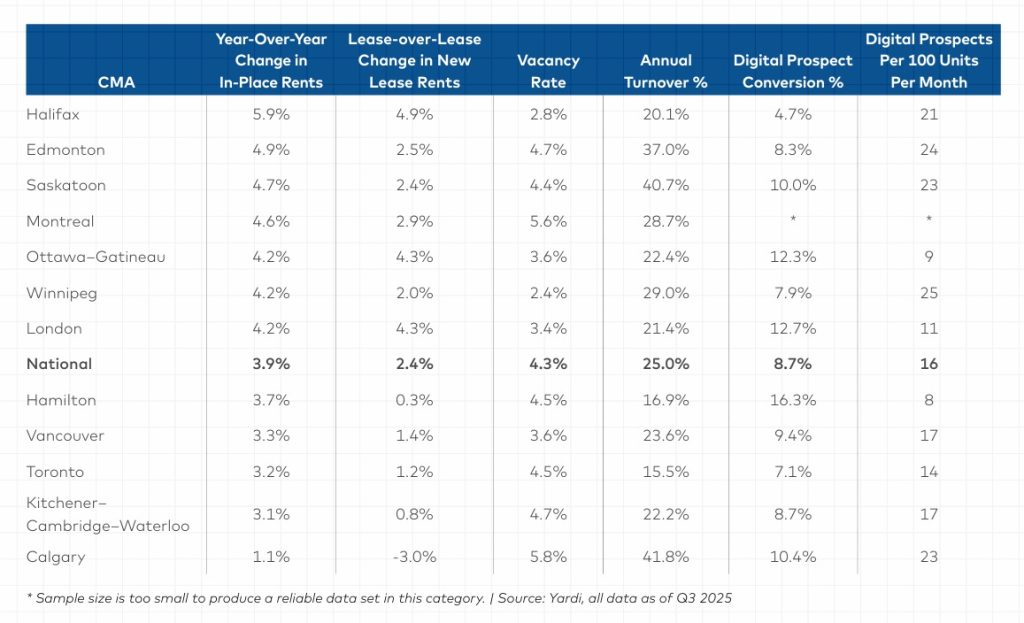
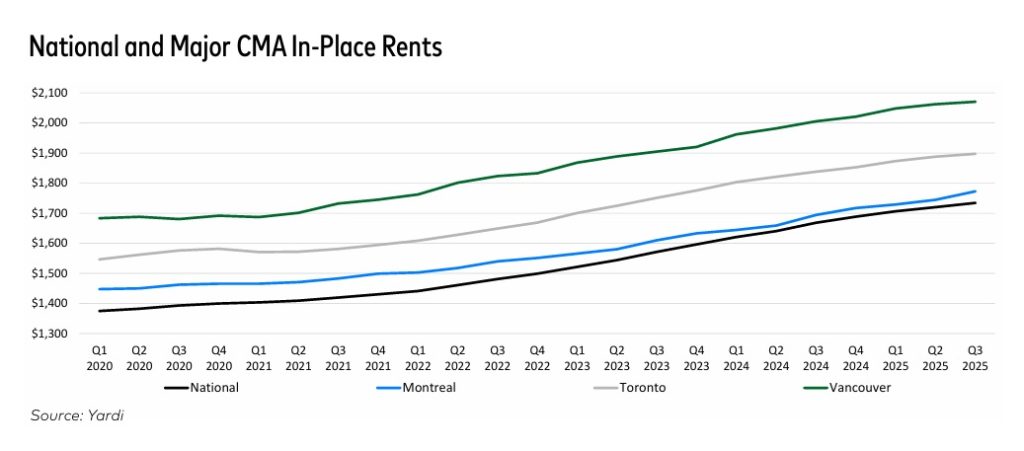
“After several years of above-trend rent increases, growth is diminishing,” Yardi analysts wrote—noting that the average national in-place rent rose by $14 in Q3 2025 to $1,734, while the annual growth rate declined 90 basis points from the previous quarter to 3.9 per cent. In-place rents reflect the aggregate of all rents within a given Census Metropolitan Area (CMA), including new leases, renewals, and existing agreements.

multifamily reportRegionally, Halifax led the country with 5.9 per cent year-over-year rent growth, buoyed by its expanding technology sector. Edmonton (4.9%), Saskatoon (4.7%), and Montreal (4.6%) also posted strong gains. At the other end of the spectrum, Calgary (1.1%), Kitchener–Cambridge–Waterloo (3.1%), and Toronto (3.2%) recorded the slowest increases.
This isn’t a surprise, however, given the backdrop of economic turbulence. Since Q2, tariffs imposed by Canada’s largest trading partner have weighed heavily on exports—especially steel and aluminum, where rates remain as high as 50 per cent. Moody’s Analytics estimates the effective tariff rate at 12 per cent, prompting the Bank of Canada to cut its benchmark interest rate to 2.50 per cent in an effort to stimulate consumer activity.

While GDP posted a modest 0.2 per cent gain in July—driven by mining, manufacturing, and wholesale trade—this followed a sharp 1.6 per cent annualized contraction in Q2, largely due to a 7.5 per cent drop in exports. Employment figures have also faltered, with job creation averaging just 8,000 per month year-to-date, well below the long-term norm. However, a strong September showing offers a glimmer of hope for recovery.

For apartment owners, the key challenge lies in adapting to shifting fundamentals: slower population growth, reduced inflows of non-permanent residents, and economic uncertainty. Yet, with interest rates easing and demand holding firm in many regions, the multifamily sector continues to offer stable return.

National and regional vacancy rates 

Lease-over-lease rent growth—an important gauge of market momentum based on newly signed leases for vacated units—continued to decline in Q3 2025. The rate fell to 2.4 per cent, down 40 basis points from the previous quarter and sharply lower than the 9.1 per cent recorded in Q3 2024. Yardi notes that this deceleration reflects a combination of slowing population growth and reduced affordability following several years of elevated rent increases.

The national apartment vacancy rate also continues to rise, though most markets remain relatively tight. The overall vacancy rate reached 4.3 per cent in Q3 2025, up 20 basis points from the previous quarter and 110 basis points year-over-year.

Calgary maintains the highest vacancy rate at 5.8 per cent, though it declined 90 basis points quarter-over-quarter. Winnipeg (2.4%) and Halifax (2.8%) posted the lowest rates, while Toronto’s bachelor unit vacancy rate climbed to 8.9 per cent.

Montreal saw the largest quarterly increase, with its vacancy rate rising 100 basis points to 5.6 per cent. The city added 3.3 per cent to its purpose-built rental stock in 2024 and another 2,136 units in Q1 2025, according to CMHC. Despite this influx, rent growth remains strong, with in-place rents up 4.6 per cent year-over-year.

Tenant turnover and lease renewals

Shifts in immigration policy have further influenced housing demand, contributing to softer rent growth and increased turnover. The national annual turnover rate rose to 25.0 per cent in Q3 2025—up 220 basis points year-over-year and the highest level in three years. Turnover increased quarter-over-quarter in every major market except Calgary, reflecting loosening conditions driven by reduced immigration and a weaker job market.

At the same time, tenant tenure is lengthening: the average length of stay rose to 36 months nationally, up from 34 months a year earlier. Tenants stay longest in Toronto (47 months), Hamilton (41), and Halifax (40), and shortest in Calgary and Saskatoon (26).

Despite legislative efforts to accelerate housing development, CMHC forecasts a decline in purpose-built rental starts in 2025 compared to 2023 in Vancouver, Toronto, and Ottawa. In contrast, Calgary, Edmonton, and Montreal are expected to see increases, highlighting regional differences in construction activity and market fundamentals.

Renewal lease rates—typically more stable due to provincial rent control—also showed signs of cooling, falling 40 basis points to 3.0 per cent nationally in Q3. Calgary, which does not impose rent control, saw renewal rates turn negative year-over-year at -2.2 per cent. The city’s elevated level of new deliveries and slowing immigration are contributing to this downward pressure.

The full Yardi Multifamily Report is available for download: https://info.yardi.com/multifamily-market-reports-for-canada

Advocates call for proactive inclusion in the workplace

Employees report that having to disclose their disabilities can hinder workplace inclusion, according to new research from The Conference Board of Canada and MentorAbility Canada, an initiative of the Canadian Association for Supported Employment.

Many organizations still take a reactive approach to accessibility, often relying primarily on accommodations for individual employees as their accessibility tool. This model places the onus on the employee to disclose and seek support, which is a challenging decision for most.

Fears of negative repercussions, such as discrimination or lost opportunities, as well as previous negative experiences with disclosure are factors that heavily influence an employee’s choice. As a result, disclosure often occurs only when absolutely necessary to explain or address performance-related concerns.

“For many employers, workplace inclusion is dependent on individual disclosure,” said Joanna Goode, executive director at the Canadian Association for Supported Employment. “True inclusion means that employers have moved beyond reactive, disclosure-driven accommodations. Instead, they have adopted proactive practices that have embedded accessibility into all aspects of the workplace, where possible.”

The research emphasizes the greater impact of completely reducing the need for disclosure. Embedding inclusion into policies, spaces, technologies and culture allows employees to thrive without revealing personal information to access support.

The results also point to mentorship as a pivotal tool for advancing the cause. Mentors can support employees with disabilities in navigating labour market entry, career transitions, and advancement—yielding positive outcomes, whether the relationship was formal or informal.

Lindsay Coffin, principal research associate, Human Capital, at The Conference Board of Canada, said the research series offers practical guidance support employers in such cases.

“Canada needs more accessible workplaces, but too often people with disabilities face systemic barriers that prevent them from fully participating in the workforce,” she said. “By removing these barriers and adopting inclusive practices, organizations can better support their employees, while also strengthening talent acquisition, innovation, and retention.”


New rental co-op tower kicks off in Scarborough

Options for Homes, one of Canada’s largest non-profit housing developers, has begun construction on The Cedars, a 783-unit master-planned community in Scarborough. The first phase includes a co-operative rental building with 245 units offered at below-market rates and under rent control.

According to key stakeholders, the project aims to create the kind of mixed-income, mixed-tenure housing Toronto urgently needs. It was fast-tracked through partnerships with the City of Toronto, including the Housing Secretariat and CreateTO. It also benefited from recent provincial legislative changes that support and incentivize non-profit housing development.

“We are building The Cedars for the broad range of Torontonians who have been priced out of the housing market,” said Options for Homes CEO Daniel Ger at the ground-breaking event. “The people who live in our communities are working families who need good, stable housing in neighbourhoods that allow them to grow and flourish. We are excited to be building a community that has both co-op rental and attainable homeownership options. The Cedars will help fill a big gap in the housing market.”


“We’re bringing co-ops back,” added Mayor Olivia Chow. “The City waived fees and taxes and fast-tracked approvals and permits to get shovels in the ground to build The Cedars, Toronto’s first major co-op in nearly 30 years. Together with Options for Homes, we are turning a once-vacant City-owned site into a vibrant, mixed-income co-operative where people can build a home and future.”

Construction on the co-op rental tower is expected to be complete in 2028.

A form of housing that is run by residents (or co-op members), the co-op model is designed to provide residents with stable, long-term affordable housing by ensuring rents are based on the actual cost to operate and maintain the building without the need to return a profit.

Located near Markham Road and Eglinton Avenue East, The Cedars is walking distance from Eglinton GO Station. The 21-storey rental co-op building will feature a diverse mix of units, ranging from studios up to three-bedroom suites, and will be operated by the Co-op Housing Management Network (CHMN).

Toronto-based architecture firm RAW designed the rental co-op and worked closely with landscape architects O2 on the larger four-phase masterplan community, which will comprise a total of four residential towers as well as townhomes. The masterplan is organized around a 40,000-square-foot central courtyard that will connect to a new 1.1-acre public park at the east end of the site.

Options for Homes plans to build attainable homeownership housing across three additional phases at The Cedars. Homeowners will be able to access Options’ Ready Program, which offers down payment support of up to 15 per cent. Once complete, The Cedars will be one of the largest attainable ownership housing communities in Canada.

Office leasing resurgence heralds staff return

Companies readying for a shift away from remote staff have spurred an office leasing resurgence in some cities and economic sectors. Most noticeably, CBRE Canada reports 1.6 million square feet of positive absorption in Toronto during the third quarter of 2025, primarily occurring in downtown Class A space. Drilling deeper, Altus Group pegs the availability rate for premium downtown office space in Class AAA buildings at 7.9 per cent, down from 10.6 per cent about a year ago.

“A lot of the activity that we’re seeing right now is facilitating back-to-the-office. It’s banks and other organizations that are trying to accommodate employees who are coming back because of company mandates,” Ray Wong, vice president of research and data analysis with Altus Group, reported during an online presentation last week. “We’re seeing some competition among some of these tenants for securing the space, and certain firms being outbid for certain locations. We’re definitely seeing a decrease in tenant inducements.”

After 2.3 million square feet of new office supply came onto the downtown Toronto office market in 2024, just 53,000 square feet has arrived thus far this year. Large blocks of contiguous space are becoming rarer in AAA buildings, where the direct vacancy rate is now 1.6 per cent (down from a high of 4.1 per cent in Q1 2022). Wong speculates the next tier of Class A space “that is slightly less amenitized compared to the triple-A” could be positioned to gain from a leasing uptick that’s expected to continue into 2026 given that many employers, including the Ontario government, have set a January start-date for required five-day-a-week office presence.

That said, 1.86-million square feet of office space is still under construction in downtown Toronto and he predicts a shortage of Class AAA space is at least three to five years in the future. Nor is the return of remote staff reflective of companies in growth mode. If anything, Peter Norman, vice president and economic strategist with Altus Group, hypothesizes it’s a symptom of economic uncertainty.

Clash of agendas

“When the labour market is weak like it is right now with high unemployment, that’s when we’re going to see more work-in-office mandates. When labour markets get tight again, which they will pretty quickly, that’s when we’re going to see more flexibility,” Norman said during the Altus online overview of 2025 market conditions.

Illustrative of some employees’ preferences, the central employee relations committee (CERC) of the Ontario Public Service Union has filed an application with the Ontario Labour Relations Board to challenge the provincial government’s return-to-office mandate, arguing that it is “premature” and violates the collective agreement. The committee is also encouraging workers to file individual grievances.

“CERC wants to be clear: we do not support this mandate! It is disruptive, inequitable and dismissive of the proven success of remote and hybrid work models that OPS members have managed effectively for years,” a recent statement declares.

Meanwhile, a majority of recent survey respondents (57 per cent) support the federal government’s hybrid approach that requires non-executive employees to spend at least three days per week in the office and executives to be on-site at least four days per week. Those results are gleaned from roughly 1,900 respondents the Angus Reid polling firm surveyed in July 2025, which included a mix of workers in the private, public and not-for-profit sectors.

“On the issue of a full return to office for federal workers, there appears to be differences of opinion among those who have experience working from home, and along generational and gender divides,” the accompanying analysis observes. “Those who have some experience working from home are more likely to be opposed (64 per cent) than those who have never done so (47 per cent). As well, public sector employees express more opposition (53 per cent) than those employed in the private sector (44 per cent). A majority of older Canadians (59 per cent) and half of men (52 per cent) believe hybrid work for federal civil servants should end. Women and Canadians under 35 are less in favour of ending remote work for the federal public service.”

Norman argues the COVID-19 pandemic rapidly accelerated a trend that was already in progress and, moreover, proved that organizations can function effectively with a combination of on- and off-site staff. The sudden shift to home-based work perhaps also minimized employee pushback that might otherwise have slowed the rollout of space rationalization strategies. Many office workers are now returning to a fait accompli.

“Remote work is part of the issue of slow absorption in the office market, but another big part of it has been the efficiency revolution of space,” Norman submitted. “That’s ongoing and something that’s going to continue to be felt.”

Yet, some employers may now be discovering they’ve squeezed their footprints too tightly. That’s a scenario senior real estate executives recently contemplated during a larger discussion about the state of downtowns during the Building Owners and Managers Association (BOMA) of Canada’s annual national conference, BOMEX.

“Some of those that gave up some of their office space are now finding out they don’t have enough space for their people. They’re getting congested and the quality of the experience is not as good,” said Ben Young, president and chief executive officer of Southwest Properties Ltd.

Mix of influences

BOMA Canada’s 2024 yearbook flags downtown vibrancy and the impact of remote and hybrid work among four issues that are keeping the commercial real estate industry awake at night. (ESG requirements and technological disruption are the other two.) There is something of a circular cause-and-effect to both concerns since downtown dynamics typically influence workers’ attitudes about the office, while workers’ presence, or absence, affects the liveliness of downtown districts and the prosperity of other types of businesses located there.

“The back-to-office movement has lagged in Ottawa and the retail there is really struggling. So how do they keep those retailers alive to get the downtown revitalized?” Young mused.

Setting the context for the panel discussion, BOMA Canada’s president and chief executive officer, Benjamin Shinewald, suggested that this year’s BOMEX host city, Halifax, stands in contrast to many Canadian cities for its vibrant, clean and safe downtown. Concomitantly, Class AA downtown office buildings in Halifax and Vancouver are the only two categories of office property to achieve positive investor sentiment in Altus Group’s Q3 2025 survey of 400+ clients’ attitudes toward 30 different combinations of asset types and markets. (Nine other categories of office and five categories of office land are ranked in the bottom 15.)

“At BOMA Canada we’re spending a lot of time talking about how to build coalitions around downtown revitalization, working with other organizations as well,” Shinewald advised. “It matters to the vibrancy of our economy, partly because our assets are heavily downtown-based. If they start falling in value, that’s bad for the economy, and it becomes a vicious cycle because the property taxes will only rise to make up for the difference.”

Traffic congestion and downtowns that are devoid of attractions or perceived to be unsafe can make the office a tough sell to workers who have the option to avoid it. That’s particularly true for workers who aren’t engaged with their colleagues, whether due to the nature of their work, personal preference or organizational inadequacy.

“If you factor those things, the majority of population will default to convenience if they have a good work-from-home situation,” acknowledged Michael Bansil, senior vice president, business excellence and innovation, with GWL Realty Advisors.

Return-to-office mandates now present some potential to lure back the reluctant, along with the risk of reinforcing their disenchantment. While it is primarily employers’ role to foster workplace culture, their landlords provide operational basics that can enhance or undermine how workers function and feel about their environment.

“We can’t dictate whether tenants have in-office mandates. We can control our assets,” Bansil reiterated. “That’s making sure that our assets are high-quality; they’re well amenitized; we have strong customer service; we have strong technology that helps with the customer experience, etc.”

Looking at where government investment could help, Judy Wall, president of East Port Properties, calls for public transit improvements and logistical innovation, such as harnessing artificial intelligence (AI) to better manage downtown traffic flow. She urges local governments to explore options to adjust traffic light intervals or switch from one-way to two-way street directions in real-time as needed.

“One of the reasons people don’t want to go downtown is because it’s congested. It’s hard to get around; they lose too much time; maybe it’s all one-way streets or there aren’t any lefthand turns,” she said. “We need to figure out how to move people around more effectively. That’s quite separate from the issue of whether we have an oversupply or undersupply (of office), but it all works together to make a downtown.”

Management flexibility can also be part of the formula. Young cited his company’s allowance for staff to choose their start and departure times to skirt peak traffic periods, but noted that such policies can come with the risk that early-leavers or latecomers will feel judged and defensive for being out of sync with other colleagues’ hours.

“It’s a cultural thing. You have to create that sense of comfort that you trust your employees and that everybody’s going to work a full day,” he maintained.

BOMA Canada’s recent survey of young commercial real estate professionals uncovered similar issues, with some respondents lamenting that their supervisors unduly value physical presence in the office over substantive contribution. However, a majority of participants rated their employers’ flexibility around hybrid work as either “very good” or “excellent”.

Even so, some of the same savvy young professionals endorse in-office work for its career-building spinoffs. While addressing key issues for emerging leaders during another BOMEX forum, they characterized the office as a venue for structured and casual interaction that supports the development of both hard and soft skills.

“I think it’s important for the next generation to be back at the office. You need that daily touch-point with your team,” asserted Raisa Hussain, a senior property manager with Colliers Canada.

“I do think remote work is lovely, but return-to-office is essential for young people to learn from the people around us,” concurred Michelle Kinsella, director of integrated program delivery for RBC’s Canadian retail branches. “It’s really hard to do that remotely. You miss a lot of those quick conversations with colleagues that you learn so much from in the office.”