





Articles Archive - Page 569 of 929 - REMINET
REMI

Data signals strengthening Alberta market

Recent data released from the Altus Group indicates that the Alberta market is showing signs of economic recovery. Alberta’s two largest cities both experienced a strong 2017 despite the breakdown of investment dollars differing heavily per sector.

While the apartment sector in Calgary saw a significant improvement last year, increasing by 17 per cent on the back of a particularly strong fourth quarter, the office sector suffered the largest dollar drop, falling by $230 million. Meanwhile in Edmonton, the retail and office sectors surged while apartment sales entering 2018 were off to a slower start.

Edmonton apartment market highlights

Townhouse and apartment sales in Edmonton totaled 2,120 units in 2017—a 35 per cent improvement from 2016, but still well below the recent peak of almost 3,400 units in 2014, according to Altus Group data.

The improvement was primarily due to new apartment units (up by 63 per cent) although townhouse sales also posted a modest gain (7 per cent) at least in part attributable to builder incentives for standing inventory.

The severe winter weather and tighter lending criteria discouraged new project launches in Q1, which resulted in a sharp drop in sales in Q1 2018 compared to Q1 2017.

While total multifamily sales have trended down (Q1 marked the 4th straight quarter of decline), the slow start to the year is expected to increase pressure on builders for continued incentives—particularly in the suburban apartment market, which has seen the supply of vacant and unsold inventory increase.

The West submarket was the only Edmonton area to not record an improvement in new multifamily sales in 2017. All submarkets were down in Q1 2018 compared to a year earlier.

Calgary’s residential land market

Residential land is where Calgary received much of its investment last year, compared to Edmonton where the office sector posted the largest increase in 2017.

The residential land market posted the largest absolute volume year-over-year increase—more than doubling to $561 million. This pushed the total value of land sales over the $1 billion threshold for the first time since 2014.

Medium density land was the largest contributor, with $183 million, accounting for almost one third of overall residential land investment. High density land posted the largest year-over-year increase, more than quintupling to $128 million.

Calgary Q1 2018 transactions

First-quarter investment activity in Calgary’s multifamily market was largely consistent with that seen one year prior, at eight transactions completed versus nine during Q1 2017. Dollar volume, however, decreased to $26.4 million versus $30 million as a result of smaller properties, averaging 15 units, changing hands.

The largest deal of Q1 2018 was Metropia’s acquisition of Trinity Hills, a 24-acre high density residential development site.

The most significant multi-residential transaction was Timbercreek’s purchase of a 44-unit apartment building (“Hillcrest Manor”) for $10 million, accounting for about one-third of the total apartment investment in the quarter.
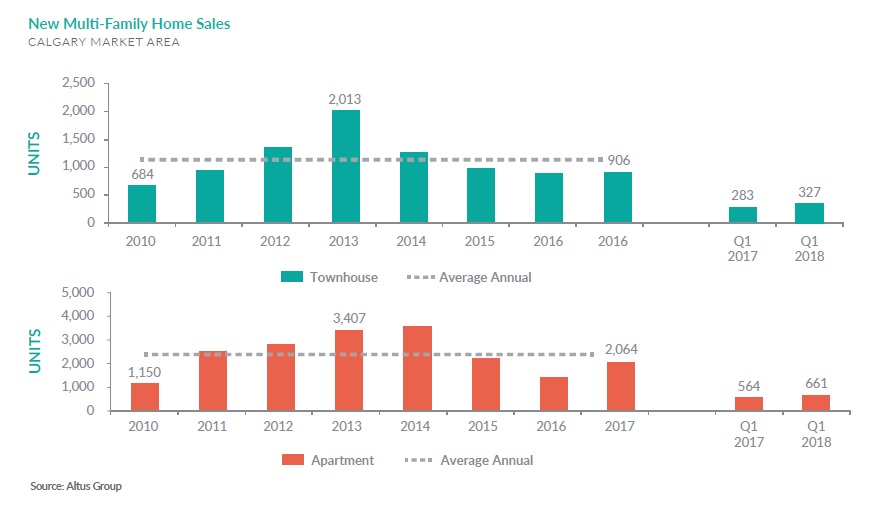
Alberta market multifamily 2017

Renting vs. buying

Homebuying intentions are down slightly in Calgary, according to Altus Group’s FIRM Survey. While many younger renters indicated they would prefer to buy a home, 26 per cent said saving for a downpayment is delaying that process.

Changes in mortgage lending criteria over the past year have made saving for a larger downpayment a necessity for many renters in order to be able to qualify for a mortgage. The current economic situation is a deterrent for many potential first-time buyers, with only 1 in 6 renters under 45 indicating that they simply prefer the renter lifestyle.

Download the complete reports at: http://www.altusgroup.com


Stantec names Brian Yates B.C. regional leader

Brian Yates has been named regional leader for Stantec’s British Columbia team, accountable for the region’s operations, financial performance, and overseeing community engagement activities.

Yates previously held the role of vice president environment and geosciences at SNC-Lavalin. He has more than 26 years of experience in leading large-scale environmental assessments and consultation efforts for a range of energy, ports, mining, and linear infrastructure clients.

He is a recognized leader in the renewable energy industry in British Columbia, and previously supported SNC-Lavalin’s clean power business as key account manager for BC Hydro, where he was responsible for coordinating efforts across several business lines.

“I am excited to be joining Stantec and look forward to supporting our teams throughout British Columbia,” says Yates. “I am looking forward to expanding our business, maintaining and building relationships with clients, and spending time supporting our communities.”

As regional leader, Yates will be taking a more active role in business development, building on his existing relationships and knowledge of communities across British Columbia.

With more than 900 staff in 10 offices located throughout the province, connecting with communities is a key growth driver for Stantec in B.C. The complexity of design needs in the region is mirrored by Stantec’s equally varied practice areas available in British Columbia including buildings, Community Development, Environmental Services, Power, Mining, Oil and Gas, Transportation, and Water.

“Brian is a strong leader and is a welcome addition to Stantec and our British Columbia operations,” says Stantec executive vice president, Russ Wlad. “Brian’s work in the community and his experience in our key business lines will set our teams up for success as they continue to do work that enhances the communities we serve.”

Canadians earn plaudits for 2017-18 ASHRAE term

Canadian ASHRAE members were recognized for outstanding research, contribution to their local chapters and overall distinguished service earlier this week at the Society’s annual conference in Houston, Texas. Wrapping up the 2017-18 ASHRAE term with a slate of technical seminars on the wide range of concerns pertinent to sustainable technology and the built environment, attendees also celebrated the year’s achievements and ushered in the new executive officers for 2018-19, as Sheila Hayter assumed the presidency.

Darryl Boyce, assistant vice president, facilities management and planning, at Carleton University in Ottawa, now moves into the office of president-elect for a one-year term. Two other Canadians, Jeff Clarke, chief executive officer of Enviroair Industries Inc. in Montreal, and Russell Lavitt, senior mechanical engineer with Stantec in Winnipeg, have joined the board of directors for a three-year term.

Michael Roth, director and co-founder of Klimaat Consulting & Innovation Inc., in Guelph, Ontario, received the Crosby Field Award for the best paper presented to ASHRAE in 2017-18: Updating the ASHRAE Climate Design Data for 2017.

Mohammad Rafati Nasr, a test engineer at CORE Energy Recovery Solutions in Vancouver, and Carey Simonson, a professor at the University of Saskatchewan, received an award for their technical paper, Experimental Measurement of Frosting Limits in Cross-flow Air-to-Air Energy Exchangers. The paper also garnered the Willis H. Carrier Award, which is bestowed to an ASHRAE member who is no older than 32, for Nasr.

Abhishek Khurana of Brampton, Ontario, received the Chapter Program Star Award for contribution to ASHRAE’s Toronto chapter. Adam Graham, a member of ASHRAE’s Ottawa Valley chapter, won the William J. Collins Jr. RP Award for his fundraising acumen.

Five Canadians were among this year’s 21 recipients of ASHRAE’s Distinguished Service Award. This includes the new members of the board of directors, Jeff Clarke and Russell Lavitt. The three other honourees are: Roland Charneux, energy department director with Pageau Morel in Montreal; Isabelle Lavoie, general manager with Johnson Controls in Saint-Laurent, Quebec; and Cedric Trueman, an ASHRAE Life Member and now retired P.Eng. in Victoria, B.C.

ISSA receives Silver Level Power of A award

ISSA, the worldwide cleaning industry association, has been awarded the Silver Level Power of A award.

The organization received the ASAE award specifically for its Cleaning for a Reason program.

“Cleaning for a Reason absolutely enriches lives,” said Lou Centrella, ISSA director of digital marketing. “Since its inception in 2006, the program has facilitated free cleaning of the homes of around 30,000 women battling cancer.”

ASAE will now promote the ISSA’s Cleaning for a Reason and provide the organization with proprietary marketing tools to use in promoting the award.

ASAE will be engaging in a number of promotional activities throughout the summer and fall to celebrate the initiative.

“ISSA Charities is poised to take things to the next level,” Centrella revealed. “This type of recognition and support helps elevate Cleaning for a Reason as a program and will help us grow it in the coming years.”

One of the growth opportunities ISSA Charities will pursue is fundraising.

“Attaining third-party validation of Cleaning for a Reason’s activities allows ISSA to justify continued investment in the program and promote participation from membership, volunteer leaders, and other stakeholders, even outside the association,” Centrella explained.

Attention from a large association like ASAE will help spread awareness of ISSA’s Cleaning for a Reason beyond its previous reach, helping to put a spotlight on the cleaning industry and, more importantly, the volunteers who make the program work.

“Congratulations to the 2018 Power of A Award winners,” said John Graham, president and CEO of ASAE. “There are very few things that get done, very few ideas that get implemented, without an association being involved at some point in the process. That’s a story we can all be proud of, and one that deserves to be shared with others to create a deeper understanding and appreciation for associations and their role in the world.”

ISSA previously won a Power of A Award in 2015 for its Value of Clean® program.at have students with certain health conditions should consider more frequent desk cleanings.

Canada’s TOBYs reflect broad based excellence

Canadian properties captured nearly a third of The Outstanding Building of the Year (TOBY) awards handed out earlier this week at the Building Owners and Managers Association (BOMA) International annual conference and expo in San Antonio, Texas. The five winners also reflect the broad based excellence of Canada’s commercial real estate sector, representing five distinct pairings of owners and managers for buildings located in three different provinces.

Randal Froebelius, founder and president of Toronto-based Equity ICI Real Estate Services and a past chair of BOMA Canada, was named 2018 recipient of the BOMA International Chair’s Award at the same event. This annual recognition of one individual’s contribution to the betterment of the commercial real estate industry is the highest honour the BOMA International Chair can bestow.

A total of 16 BOMA International TOBYs were awarded. This year’s Canadian TOBY winners include:

  • RBC WaterPark Place, in Toronto, in the Earth category. Oxford Property Group manages the property on behalf of its owners, 85 Harbour Street Holdings and CPP Investment Board Real Estate Holdings.
  • Montreal’s Édifice Sun Life Building in the Historical Building category. Bentall Kennedy (Canada) LP manages the property for its owner, Sun Life Assurance Company of Canada.
  • Also in Montreal, the Pierre Elliott Trudeau International Airport, in the new TOBY category of Public Assembly Building. Aéroports de Montréal manages the airport on behalf of Transport Canada.
  • 165 Commerce Valley Drive West, in Markham, Ontario, in the category of buildings less than 100,000 square feet. Northam Realty Advisors Limited manages the property for the owner, Northam CCPF Tenco (CVD) Limited.
  • 980 Howe, in Vancouver, in the category of buildings of 100,000 to 249,999 square feet. Manulife Real Estate owns and manages the building.

The five winners advanced to the 2018 BOMA International TOBY competition after attaining 2017 BOMA Canada TOBY honours.

Don Fairgrieve-Park’s new status as a BOMA Fellow was also officially conferred in San Antonio. The executive vice president for QuadReal Property Group’s British Columbia region was one of just 10 BOMA members from across North America to receive the designation this year.

“The individuals honoured as BOMA Fellows have displayed exemplary and sustained contributions to the industry, their profession, the community and BOMA at all levels and have continually answered the call to leadership and service throughout their careers,” BOMA International affirms.

RAW Design celebrates 10 years with annual installation

On June 27, Toronto-based architecture firm RAW Design celebrated its 10th anniversary with RAW X, its annual summertime installation. Created and curated by RAW Design’s founder, Roland Rom Colthoff, RAW X engaged developers, engineers, planners, city officials, designers, urbanists and artists through an immersive installation designed to provoke new ideas about city nightlife. This year’s installation aimed to provoke thought into how light infrastructure will improve our housing, mobility and culture, among other questions.

“As Toronto moves toward becoming a 24-hour city, we need to manage our relationship to light after hours,” said Colthoff, in a press release. “By and large, our public spaces are conceived for daytime. There is a tremendous opportunity to shape urban life after dark by focusing on engagement.”

Although Colthoff says that the number of activities that take place in Toronto after dark are growing, such as evening markets and outdoor movies to light fests and DJ nights, designers are positioned to impose a more permanent impact on the city’s nightlife.

“The canvas of the city after dark is ripe with possibilities. By exploring ways to manipulate light and dark in urban centres, we can influence how and where engagement occurs,” added Colthoff. “Light is a symbol of spectacle and freedom. People are drawn to it, and we should be exploring its potential. Even though Toronto has great nightlife, it’s still a relatively dark city.”

This year’s installation was located in Riverside, at the base of a new tower developed by Streetcar Developments. The active construction site was transformed into a testing ground for activating the night. Guests were treated to a series of interactive installations created to transform the anonymous concrete backdrop of the construction site into an evening playground. A laneway of lightboxes guided guests into the site, which featured colourfully lit foods, glowing orbs and illuminated furniture made out of bubble wrap, among other ideas.

“Riverside is a microcosm for the entire city,” said Colthoff. “You used to have a clear distinction between established single-family residences on side streets, and more active uses along Queen. With new developments coming into the area, those distinctions blur. Streetcar has contributed to the reinvigoration of the area at night, with the introduction of The Broadview Hotel, and they have also been leading the charge in terms of developing the east end.”

RAW, which is celebrating its 10th anniversary as an architecture practice, has chosen venues for its annual parties that are central to the story as their installations. Venues, which have ranged from boxing rings to bakeries, storage lockers to parkade rooftops, are transformed in an effort to tell a visual story about altering public space and the built environment.

RAW X was sponsored by Streetcar Developments, Sweetgrass Brewing Co., Interface, Sali Tabacchi, Astley Gilbert, Strewn Winery and The Broadview Hotel, with music curated by Norm Li and DJ Starting from Scratch.

Starlight and Blackstone form joint Canadian venture

Starlight Investments and an affiliate of Blackstone Property Partners announced they have formed a joint venture to acquire a portfolio of six multifamily buildings comprised of 746 units.

The portfolio is a mix of high- and low-rise concrete buildings strategically located in the urban cores of Montreal and Toronto, both markets that continue to benefit from strong employment and solid population growth. Five of the buildings are located in Toronto.

“Blackstone is excited about the opportunity to enter the multifamily sector in Canada with a partner that has a national presence and proven track record,” said Olivia Hamlet, Managing Director at Blackstone. “We believe in the multifamily fundamentals in Canada’s major cities and hope to do more in the space.”

Blackstone is a global leader in real estate investing, with approximately $120 billion in investor capital under management. Its real estate portfolio includes hotel, office, retail, industrial and residential properties in the U.S., Europe, Asia and Latin America.

Starlight currently manages $8.5 billion of multifamily and commercial properties for joint venture partnerships with institutional investors, Northview Apartment REIT, True North Commercial REIT, Starlight U.S. Multifamily (No. 5) Core Fund and Starlight U.S. Multi-Family (No.1) Value-Add Fund and for private investors. Starlight’s portfolio consists of approximately 36,000 multifamily units across Canada and the U.S. and over 5.3 million square feet of commercial properties.

A New Age for Sustainable Projects

To reach Canada’s and Ontario’s environmental commitments, the property management industry needs to renovate 3 per cent of its existing stock every year for the next 33 years. It’s no easy task, and it’s one that all stakeholders are committed to improving building efficiencies, reducing energy usage, and making other eco-forward investments.

“We’ve known for a while that if we want to get moving on these environmental goals, we need to be focusing on existing buildings,” affirms Duncan Rowe, Associate, Building Science and Restoration with RJC Engineers.  “Every year that we don’t address these buildings, we add another 3 per cent to the next year.”

Fortunately, the tide is turning. Industry trends point to a renewed focus on sustainability, both to the benefit of owner budgets and tenant comfort. Those trends include:

Going beyond status-quo

Installing LED fixtures and low-flow toilets are low hanging fruit. Now, stakeholders are tackling more complex and impactful retrofit projects. It’s not just about replacing light bulbs, it’s about re-arranging floor plates, tenant engagement, and integrated projects that holistically reduce operational costs and greenhouse gases.

“You don’t need consultants to tell you to change your light bulbs or install low-flow toilets. Today, everyone just does that now,” says Rowe. “What we need to be pursuing are the deeper, more interesting and meaningful retrofits like upgrading the building’s mechanical, cladding, and glazing systems.”

Pension push

Many pension funds now require greater transparency for environmental, social, and governance in portfolios. This is largely responded to by GRESB creating a strong demand for sustainability projects. In short, now’s the time to pitch large-scale sustainability initiatives.

sustainable projects

“A lot of pension funds have sustainability targets but with all the easy stuff being done the focus has turned on larger retrofits with greater, long-term impact,” says Rowe.

Campus investments

Ontario has issued $200 million in funding for Colleges and Universities to conduct sizable retrofit initiatives provided those projects result in a significant reduction of greenhouse gasses. Expect activity in this sector to ramp up in the next year

Institutional push

It’s not just engineers and consultants bringing sustainability ideas to the fore. Today, large institutional owners want properties across their portfolio to produce energy savings. That means opportunities for property managers to take the lead.

“The appetite for doing these larger, more in-depth sustainability retrofit projects is growing,” notes Rowe. “There’s a culture change occurring where property managers and owners are looking at their portfolio and saying, ‘How do we make this building last for the next 30 years.’”

Certainly, the tide is changing. Interest in sustainable building projects is growing. Discover the options and learn more about the science of building retrofits by visiting www.rjc.ca.

How germs and bacteria thrive on school desks

Bacteria and fungi found on school desks comes overwhelmingly from the children sitting at them, a new study has revealed.

Looking at the microbial communities that grow on students’ desks, a team of Yale researchers also found that, even after a desk cleaning, the microbes were back in full force within a few days.

The results, published in the Journal of Applied Microbiology, suggest that in times of outbreaks or for children sensitive to allergens, school officials should consider more rigorous desk-cleaning practices.

The research team in the lab of Jordan Peccia, the Thomas E. Golden, Jr. Professor of Chemical & Environmental Engineering, analyzed samples from the surfaces of classroom desks from three Connecticut schools, grades 7 to 12, in one school district. Each desk was tested before cleaning and then tested five times over a period of 21 days during the school year.

Analyses of samples taken 30 minutes after the desks were cleaned found that only about half of the bacteria and fungi were cleared. Within two to three days, the microbial communities were as plentiful as before the cleaning. Also, their makeup was close to what was found in the initial sample. Between 70 to 80 per cent of the microbes were of human origin – specifically, from the skin, mouth, and gut.

Sarah E. Kwan, a Ph.D. candidate in Peccia’s lab and lead author of the study, said they were surprised to find that there was almost no change in the microbial makeup over all of the samples.

“That means the bacteria and fungi are coming from one dominant source – humans,” she said. “It’s not coming down from the air, not from environmental factors – the kids at the desks are depositing the microbes on the desk.”

The desks, used by multiple students each day, are normally washed once per semester.

“That means these desks are a tremendous vehicle for the exposure of one person’s microbiome to another,” Kwan said. “That might not mean anything if the students are healthy and have a good immune system, but it could have a profound effect on the health of children with compromised immune systems, or if there is some kind of outbreak in the school.”

The good news is that, under normal circumstances, parents of children in schools shouldn’t worry too much – exposure to microbes can even be beneficial. However, other studies have shown a correlation between the cleanliness of classrooms and how frequently students are out of school due to illness. Kwan said, schools experiencing a viral outbreak or that have students with certain health conditions should consider more frequent desk cleanings.

Solar panels installed at outdoor pool in Mississauga

Solar panels have been installed at an outdoor pool in Mississauga as part of a pilot programme.

The Mississauga Credit Valley Lions Club’s pool recently became the first in the city to be heated using the panels, with the goal of saving energy and reducing greenhouse gas (GHG) emissions.

The City of Mississauga said its staff will monitor the pool’s performance over the summer months to verify the anticipated benefits.

“Information collected will allow the City to gather knowledge, lessons learned, requirements, constraints and prepare for future installations of solar panels at other indoor and outdoor pools,” they said in a press release.

Savings of approximately 5,650 m3 gas, which translates to a reduction of 10.7 tonnes of GHG emissions, are anticipated.

“The pilot demonstrates the City’s leadership in green initiatives to help transform Mississauga into a ‘net zero’ carbon city. This initiative will also be an opportunity to educate residents on renewable energy and encourage them to consider alternate energy sources,” they added.

The City said it was also working on a number of other conservation initiatives that will see the use of energy efficient technology. This included heat recovery systems at four indoor pools, block heater control, cold water ice resurfacing system, ice plant optimization and building automation system upgrades.

Major summer projects set for Calgary roads

Close to 30 major infrastructure projects and more than 40 road repaving jobs will take place this summer across Calgary. A total investment of $441 million dollars is going into Calgary’s infrastructure network this year alone.

“With this investment, we are keeping Calgarians moving while also supporting our economy by creating over 3,500 jobs,” said Mayor Nenshi. “Once completed, this work will lead to improvements in travel, mobility and safety for people who walk, drive and cycle, also enabling continued development and growth in our city. Construction is never convenient while it’s happening, but the results of all this work will be worth it.”

With construction work taking place in every quadrant of Calgary, the city has put measures into place to ensure citizens can still get where they need to go. Such measures include the coordination of projects and detours around the city, staged work during off-peak commute times to minimize impacts over rush hour, and where possible, geometric changes to the roadway and temporary alignment changes in order to keep the same number of lanes open.

Troy McLeod, director of roads, said his crews and contracted staff are preparing for a busy season which includes paving work at more than 40 locations, covering about 212 lane-kilometers of road. Some of the major projects include the repaving of 14 Street, Barlow Trail, Memorial Drive and Heritage Drive.

In  addition, there will be various concrete repairs, traffic signal construction, streetlight repairs, bridge repairs and traffic safety improvements to help make life better for Calgarians. “All of this work will ensure safe and smooth roads for all modes of transportation,” he said.

Wēv Collection lighting wins Gold at Best of NeoCon

Barbican, an award-winning provider of high-end commercial lighting, has been awarded Gold at the Best of NeoCon Awards for its third new line of 2018, the Wēv Collection.

The Best of NeoCon 2018, which is sponsored by Contract Magazine, judges new contract furniture products that are being showcased at NeoCon. Award jurors are comprised of architects, designers and facilities management executives. The selection process begins with jurors reviewing digital entries, which is followed up with a visit to NeoCon showrooms in teams at the Mart prior to the opening day of NeoCon.

The Wēv Collection by Barbican provides a unique option for commercial lighting. The collection features washable, woven fibreglass fixtures available in a variety of shapes, sizes and colours. Lit by a six-sided extrusion, the Wev Collection offers consistent output performance throughout the fixture. Many models of the lightweight, durable and flexible lighting fixtures can be suspended by only a power cord.

The Icicle, a Wēv pendant fixture, features a high output that is able to provide enough light to the primary source in a space in its classic white form. With this fixture, customers can design artistic or geometric configurations using specialized connectors, or create clusters in different lengths to form a unique focal point.

For more information on pricing and options in this collection, please contact Barbican.

Recreational cannabis use to become legal this fall

Is it time for condo boards and property managers to brace for reefer madness? It may depend on which condo lawyer they ask.

Many condo boards in Ontario are hurrying to ban pot in their buildings before recreational cannabis becomes legal in Canada on Oct. 17. Shawn Pulver, partner at Macdonald Sager Manis LLP, says, in the absence of opposition, passing a rule is a low-risk way to set expectations ahead of the roll-out of federal and provincial laws that will converge to make it permissible to spark up in apartment units and on balconies.

But is yet another rule needed to address the potential side effects of the legalization of recreational cannabis, such as pungent odour and smoke migration? Robert Mullin, partner at SV Law, points out that, between the Condominium Act and their governing documents, condo corporations have a number of tools at the ready to deal with nuisance complaints and safety concerns, including charge backs, dangerous activity prohibitions, non-interference clauses and suite entry rights.

These different approaches were among the range of options presented to condo boards and property managers in the recent CAI Canada seminar Waiting in the Weeds … Everything You Need to Know About Marijuana and Condos.

What the laws say

Recently passed federal legislation will allow Canadians of the minimum age — in Ontario, 19 — to buy and possess up to 30 grams of cannabis for personal use starting this fall as well as grow up to four plants per household for the same purpose.

Accompanying provincial legislation will add another layer of jurisdiction-specific rules, including provisions governing where cannabis can be consumed. Public and workplaces are among the areas that will be off-limits to activities such as pot-smoking.

“Cannabis consumption can be thought of as an expansion of the rules for alcohol in the Liquor Licence Act, so where you can’t drink, you can’t smoke,” said Det. Sgt. Tony Melaragni, Peel Regional Police.

However, Det. Sgt. Melaragni added, this handy point of reference won’t apply in all cases. Take, for example, he said, patients who are authorized to use marijuana for medical purposes, which has been legal in Canada since 2001. This is the kind of scenario where the duty to accommodate may come into play, as the condo lawyers discussed, imposing on condo corporations the obligation to work with residents who have a demonstrated need to find a solution that doesn’t negatively impact their neighbours.

Considering the community

Many communities have likely had some exposure to cannabis use, whether it’s the legal medical kind or the currently illegal recreational variety. One of the unknowns facing condo corporations is whether the coming legalization will change the status quo.

Condo lawyer Mullin encouraged condo boards to take the temperature of their community, whether that’s through an owners meeting or survey. He also said communication and education could be potentially potent tools in addressing recreational cannabis use in condos.

“Did you know that you’re in a high-density condo? Did you know that if you leave your windows open while you smoke it might go into your neighbour’s unit?” Mullin offered by way of example.

Mullin said that, if there’s no call for action on recreational cannabis, the corporation may want to postpone intervention, instead reviewing the issue every month at board meetings and in manager reports, watching out for increases in complaints. If there is a call for action on recreational cannabis, he recommended taking a measured approach, looking at passing a rule before amending the declaration. Rules can be passed within 30 days if no owners object, but they also have to be reasonable. Time will tell whether cannabis prohibitions will meet this test if subject to a court challenge.

“Let’s say you do pass that rule prohibiting cannabis in units, and you get that,” Mullin added. “Be careful what you wish for, because now the enforcement is going to be upon you.”

Rules can become unenforceable if they are not enforced consistently. The alternative to passing a rule, amending the declaration, is less prone to court challenge, because it doesn’t need to be reasonable, but it also requires more support from unit owners. The condo lawyer cautioned that efforts to prohibit pot this way could backfire if the board fails to capture the affirmative votes of at least 80 per cent of owners and ultimately reinforces the forthcoming rights of residents to consume recreational cannabis.

Production and distribution

Rather than legitimize Ontario’s many illicit dispensaries, the outgoing provincial Liberals set in motion plans at Queen’s Park to restrict the sale of recreational cannabis to government-run retail outlets similar to the LCBO. Whether premier designate Doug Ford might change course remains to be seen.

Even if procuring recreational cannabis is as easy as going to the Ontario Cannabis Store, some people, including condo residents, will want to grow their own product. The decision to go DIY could stem from a desire to avoid higher retail prices or to take it up as a craft hobby, observed Max Zavet, co-founder of Emblem Cannabis, a licenced producer of medical cannabis.

Whereas a commercial operation such as Emblem’s is run from a high-security facility equipped with expensive HVAC and irrigation systems that work to prevent mould, mildew and pests, a home-grow operation in a condo might consist of little more than a plant, small fan and tent, said Zavet. He also noted that the odour from a single plant has the potential to permeate multiple floors in apartment buildings.

“Four weeks after you see a seedling, you’re going to start smelling the plant,” said Zavet. “On top of that, if somebody has done something to the electricity to circumvent electricity costs or to get more amp-age out of their unit, that could obviously cause fire, and flooding as well if they have some kind of irrigation system that’s jerry-rigged.”

Under the current plan, the Ontario Cannabis Store will also give consumers the option of purchasing product online, which puts concierges in condos in the position of intercepting these potentially pungent packages on behalf of residents.

“That’s another thing to keep in mind if your buildings are looking to take more active steps to go beyond what’s in your current rules and declaration — having language in there about the use of the marijuana, the growing of the marijuana, but also the storing and delivery of the marijuana,” said condo lawyer Pulver.

Getting ahead of legalization

The way Pulver sees it, establishing a rule serves to clarify how the general tools condo corporations have for addressing pot-related problems such as nuisance complaints and safety concerns specifically apply to recreational cannabis, narrowing the scope of what’s open to interpretation by the courts.

Condo communities eying pot bans may want to get ahead of legalization on Oct. 17 in order to head off requests from residents to be grandfathered (i.e. exempted) from retroactive rules.

“If a building decides they don’t want it, and they pass a rule, and it’s not objected, the timing shouldn’t be critical, but it would be better to do it before if they plan on it,” said Pulver.

Michelle Ervin is the editor of CondoBusiness.

CN Tower unveils its most extensive renovation

On June 26, the 42nd anniversary of its opening, Toronto’s CN Tower unveiled a $16 million renovation that has transformed the iconic landmark’s 14,000-square-foot main observation level.

Designed to modernize and enhance the guest experience while making the tower more accessible for all visitors, the space has been revamped to provide guests with an open, modern look and feel. This renovation is the tower’s most significant since its opening in 1976.

A new Glass Floor has been installed directly above the original, providing viewers with a two-tier vertical view from 1,136 feet above the ground. New floor-to-ceiling glass “Window Walls” have been installed across three separate sections of the observation level, providing unobstructed panoramic views. These Window Walls allow children and people with mobility challenges to fully enjoy the views from the CN Tower.

“It’s essential that CN Tower’s renovation and upgrades tie into our commitment to accessibility,” said John McBain, president and CEO of Canada Lands Company, the owner and operator of the CN Tower. “The Window Walls and new Glass Floor take the visitor experience to the next level and ensure it remains thrilling and unique among the world’s greatest towers.”

Also new to the CN Tower are three food bistros, which offer guests the opportunity to sample Canadian food and beverages while taking in the views from the observation level. The updated observation level also features scalable space that can be customized to host events for up to 800 guests.

Along with the renovation of the main observation level, the CN Tower also launched a new, free Viewfinder App for mobile devices. The app features day and night 360 degree panoramic images of Toronto and surrounding areas. The app is available in five languages – English, French, Spanish, Korean and Mandarin – and is available for download at the App Store and Google Play.

Federal and B.C. governments sign 10-year housing agreement

The federal and B.C. governments announced a 10-year housing agreement to invest more than $990 million toward the protection, renewal and expansion of social and community housing, as well as the support of housing repair, construction, and affordability in a new plan under the National Housing Strategy (NHS) called “Homes for BC.”

The Honourable Jean-Yves Duclos, Canada’s Minister of Families, Children and Social Development and Minister Responsible for Canada Mortgage and Housing Corporation (CMHC), and the Honourable Selina Robinson, British Columbia’s Minister of Municipal Affairs and Housing made the announcement in Vancouver on June 26th.

“The Government of Canada is committed to ensuring that every Canadian has a safe and affordable place to call home,” said Duclos. “Long-term, predictable funding for housing has been needed for more than a decade. Today, with the British Columbia government, we have taken a significant step toward our goal of building strong communities where Canadians can prosper and thrive, now and for the future. The federal government, in partnership with British Columbia and other provinces and territories, is working towards a 15% expansion in new affordable housing units and renewing 20% of existing community housing units across the country.”

The governments of Canada and British Columbia will also work together on the design and implementation of a new Canada Housing Benefit for the province, to provide affordability support directly to families and individuals in housing need. The new agreement marks the beginning of a partnership that will be supported by long-term and predictable funding starting April 1, 2019.

“This agreement will help more British Columbians find homes they can afford,” said Robinson. “The new investment from the federal government will build on the $7 billion investment that the Province is making as part of our 30-point housing plan. I look forward to continuing to work closely with Minister Duclos on building the housing that the people in our province need.”

The $991.1 million‎ cost-shared investment is in addition to in $705 million previously planned federal housing investments in British Columbia through the Social Housing Agreement (SHA) over the next 10 years. Aside from new construction, the funds will target the preservation of at least 34,491 existing community housing units in British Columbia.

The NHS is a 10-year, $40-billion plan that aims to remove 530,000 families from housing need across Canada; create 100,000 new housing units, as well as repair and renew more than 300,000 housing units and reduce chronic homelessness by 50 per cent.

More information on the 10-year housing agreement can be found here: news.gov.bc.ca/factsheets/bc-government-addressing-housing-affordability-challenges

Climate risk serves up shocks and stressors

Risk management based solely on insurance coverage is a bad gamble in an era when resiliency specialists warn “water is the new fire”. Speaking at a special breakfast event in conjunction with Canada Green Building Council’s (CaGBC) recent annual national conference in Toronto, they categorized measures to avoid or minimize flood damage and prepare for long-term power outages among the most cost-effective design decisions and capital investments that building owners/managers can make.

South of the border, 2017 was the year of Hurricanes Harvey, Irma and Maria, while, just last month, British Columbians and New Brunswickers alike suffered severe flooding from a calamitous combo of heavy rain and spring runoff. Blair Feltmate, head of the University of Waterloo’s Intact Centre for Climate Adaptation, noted that Canadian insurers have paid out more than $1 billion in claims related to natural disasters in eight of the past nine years — a marked upward spike from the annual average of $200 to $500 million during the previous 25 years.

“I can absolutely guarantee you that things are going to get worse going forward,” he said. “Canada has not experienced the flooding that is coming.”

“Who is talking about resilience? Not fringe groups,” concurred Chris Pyke, a research officer with the U.S. Green Building Council (USGBC) and the driving force behind a new GRESB module, now in the data collection stage, aimed at plotting real estate portfolios’ ability to withstand and recover from climate triggered crises. “Over the last year we have had some of the greatest single-year weather losses ever. The best available scientific data says these things are going to get more severe.”

Nevertheless, the old fire still wields sway over regulatory and design parameters. Michelle Xuereb, a senior associate and sustainability strategist with Quadrangle Architects, commended the work now underway to update Canada’s model national codes, revise historical climate data that is no longer an accurate gauge for expected wind, rain and snow loads, and address new types of emergencies, in which building occupants will need refuge rather than a means of quick exit.

“Current building codes are built around fire. It’s all about evacuation,” she explained. “The sheltering in place piece, there’s no code that tells us how to do it.”

With prompting from the discussion moderator, REALPAC chief executive officer Michael Brooks, the three panellists sketched out their own stake in resiliency via design, investor awareness and best practices for climate risk assessment and mitigation. All are focused on helping to prevent loss at the decision-making stage — how to buttress and cull portfolios; where and how to build; where to locate critical infrastructure, etc. — and bring a range of informed perspectives to the larger issue of vulnerabilities in the existing built environment.

“The question is about the capacity to survive in the face of shocks and stressors,” Pyke acknowledged.

Investment-level considerations

While insurers are keenly aware of the threats, Feltmate urges lenders and credit rating agencies to pay more attention to both climate risk and diligent countermeasures. For example, best practices such as those his research team has developed with the sponsorship of the Standards Council of Canada provide a checklist that could augment other customary analyses of property deals and investor soundness.

“Banks are more or less asleep at the switch on this file,” he submitted. “This is a new stressor in the system that they have never had to deal with.”

Working primarily with institutional investors, Pyke arguably sees a more attuned demographic that is increasingly focused on how environmental, social and governance (ESG) factors affect the performance and value of their portfolios. Fear of stranded assets is one powerful driver, but so, too, is the gaining flipside notion that there are opportunities for enhanced returns. He cited the example of U.S. based Boston Properties.

“Resilience is a pitch they think their brokers can sell,” Pyke reported. “We get broad based recognition on the investment level that this is something they should know more about. On the owner side, I think we get recognition that these are reasonable questions.”

Building-level responses

For new development, some solutions are inescapably apparent. “Step number one is don’t build on flood plains,” Feltmate asserted.

Xuereb advises building owners, developers and designers to identify flood risks upfront and pay particular attention to thermal performance and how the building will retain or reject heat if mechanical HVAC systems are not operational. Key equipment should be housed above the projected flood line; materials below that line should be mould resistant, if possible. Minimizing the window-to-wall ratio and incorporating features to promote passive airflow will better resist infiltration of outdoor temperatures.

“It’s about really creating the best quality envelope your building can afford,” she said.

A designated area of refuge with its own dedicated power source could be forged in either new or existing buildings. Landlords or condominium corporations will need to consider what that power source should be, what other resources — food, water, phone chargers etc.— should be in readiness, and how building occupants will know about and make their way to the refuge if normal channels of communication are disrupted.

In this, word of mouth, as neighbours check in on each other, can be invaluable. Social connections are a no-cost, albeit intangible component of resiliency that Xuereb highly endorses. “Knowing the people around you is the best situation you can have in the case of an emergency,” she observed.

Also on the list of low-cost interventions, Feltmate recommends reconfiguring downward slopes that could channel storm runoff into a property — advice that extends to the numerous staircases to the Toronto Transit Commission’s downtown stations. “Right now, you just have a conduit for water flowing down to the subway,” he said.

Pegging the tipping point

The best practice guidelines his team has developed thus far focus on residential development, pertaining to homes, new subdivisions and existing communities, but similar standards are in the works for commercial buildings. That will include consultation with the organizations like REALPAC and CaGBC. “It has to be informed by the people in this room,” Feltmate told the gathering.

For now, panellists tallied a varying level of buy-in, from some very influential champions, like the Financial Stability Board’s Task Force on Climate-related Financial Disclosure, to greater numbers of disinterested or oblivious onlookers.

“The core problem is complacency. We think we have time, and we do not,” Feltmate reiterated. However, Pyke predicted the spur to action could be imminent.

“What is the tipping point where the evidence piles up and can’t be ignored?” he mused. “I think we are close.”

Barbara Carss is editor-in-chief of Canadian Property Management.

TREB supports two new housing decisions

The Toronto Real Estate Board (TREB) has publically stated it is in favour of two separate housing decisions that, if approved, could have a positive impact on the housing market for all Torontonians: the creation of an all-encompassing Housing Committee, and the permitting, regulating and setting of guidelines for laneway suites.

According to TREB president Tim Syrianos: “TREB has always been advocating that no matter the housing mix, from affordable to luxury housing, from single detached homes to ‘missing middle’ options to high-rise towers, housing should be a priority for the success of the city as a whole, to ensure its residents enjoy a better quality of life and continue to live and work here.”

On June 19, the City’s Executive Committee unanimously passed Mayor Tory’s recommendation to establish a Standing Committee on Housing whose primary focus would be the housing and accommodation of Torontonians, with a mandate to monitor and make recommendations on housing and shelter in the city.

TREB says it is encouraged by this decision and urges City Council to pass this motion as a clear sign that it recognizes the importance of housing to the overall economic prosperity of the city.

It addition, it also applauds the Toronto and East York Community Council’s decision to unanimously pass the report “Changing Lanes: The City of Toronto’s Review of Laneway Suites,” clearing the way for permitting, regulating and setting guidelines for laneway suites across Toronto and East York.

As a desirable location that continues to attract new people to the region, rental demand in Toronto has remained strong, creating heightened competition between renters in an ultra-low vacancy environment. According to TREB, this situation could be further exacerbated by the rent control provisions contained in the Ontario Government’s 2017 Fair Housing Plan, and might have negative implications on the rental supply over the long-term.

If passed by Council, TREB believes the permitting of laneway suites will help create new supply of affordable rental stock and alleviate some of the need, while the Housing Committee will ensure that housing issues are given the attention and cross-divisional planning they require for a better quality of life for all Torontonians.

