Articles Archive - Page 521 of 929 - REMINET
REMI

Toronto’s tech-boom attracting Millennials, creating condo trends

Toronto’s “tech boom” will fuel the city’s condo market in 2019 (and beyond). This is according to a Condo Chick report which cites the city’s influx of technology jobs and Millennial preferences as key factors behind condo purchases, which accounted for 74% of Toronto’s home purchases in 2018 alone.

What does this mean for the real estate community? According to the report, “peak Millennials” (ages 25 to 35) are flocking to Toronto’s tech sector opportunities in increasing numbers and bringing their habits, desires, and digital inclinations along for the trip. This is giving rise to several trends within the condo real estate market, including:

Social media influences
The National Association of Realtors’ trend report indicated 99% of Millennials have taken their search for a home online, relying on real estate apps and local real estate social media channels to source and compare their options.

“We are finding more and more buyers looking on social media when shopping around,” says Erica Smith, Broker of Record and Co-Founder of Stomp Realty and Condo Chicks. “This trend has been increasingly popular since younger generations are more comfortable with their smartphones.”

Picture perfect
For Millennials, it’s not enough to read about their new home. According to Condo Chick’s study, 83% of home buyers want to see pictures of potential properties. In response, more and more condo sellers are using drones to take aerial images and videos of their properties and posting them online via visual platforms like Facebook and Instagram to reach Millennial audiences.

Location, Location, Location
Whether renting or buying, Millennials place a high value on location. Busy Millennials are increasingly drawn to condos within walking distance to life necessities (e.g., work, groceries, services, nightlife, hobbies, etc.), and are using apps like Walk Score that can point them to properties that deliver.

Making local connections
For tech-savvy demographics, accessibility to fast and reliable internet or cable TV service is a significant factor when selecting a condo. As such, many scan websites condo real estate to ensure their preferred service provider is offered and that their service is on par (or better) than the competition.

“Now more than ever, people are looking for fair pricing and hassle-free service that larger providers don’t offer,” says Dan Armstrong, CEO/CTO and Founder of Beanfield Metroconnect, a Toronto-based telecom company.

Support announced for Canada’s first-time home buyers

The Government of Canada has revealed plans to provide additional support for Canadian home buyers. At a March 25 press event in Maple Ridge, British Columbia, Prime Minister Justin Trudeau detailed several measures within Budget 2019 that will make housing more available and affordable to citizens across the country.

“Too many Canadian families are being priced out of buying or renting where they live because there are not enough homes to keep up with the demand,” he said. “Safe, affordable homes give Canadian families the stability and opportunities they need to thrive in their communities. Our government is taking action to increase the housing supply in communities across the country, make housing more affordable for more Canadians, and make sure our cities remain great places to live, now and into the future.”

Those actions include launching the First-Time Home Buyer Incentive, which will see the Canada Mortgage and Housing Corporation (CMHC) provide interest-free loans to eligible first-time homebuyers equaling 10% of the purchase price of their newly built home, or 5% of a resale. The Government has earmarked $1.25B towards this “shared equity mortgage” strategy, which is meant to help first-timers take our smaller mortgages and lessen their monthly payments. More details are expected to arrive this fall.

Additionally, first-time buyers will be able to withdraw up to $35,000 from their Registered Retirement Savings Plan to pay for a down payment without adding to their annual income – an increase from the previous $25,000 limit. The Canadian Government will also bolster support for the Expert Panel on the Future of Housing Supply and Affordability, and issue a “Housing Supply Challenge” to municipalities and organizations as a means to generate “innovative solutions to get more homes built.”

“Together, these measures will help housing prices grow at a more moderate pace and make it easier and more affordable for more Canadians to rent or buy a home, while keeping markets accessible for future generations,” states the government’s press release, adding, “They will play a key role in our plan to help all Canadians build a better future for themselves and their families.”

Montreal’s QuinzeCent condo breaks ground

Montreal developers Brivia Group and Tianqing Group have kicked off construction of the QuinzeCent condominium project. The partners attended a ground-breaking ceremony on March 21 to mark the start of the 36-floor project, which will take shape in the city’s core at 1500 René-Lévesque Boulevard West.

“Brivia Group is executing its fourth major project in downtown Montréal in less than five years and helping to develop an area that has long been neglected by the real estate sector,” said Kheng Ly, President and CEO of Brivia Group, adding, “Located between the river and mountain, the iconic glass tower will offer an exceptional lifestyle.”

The QuinzeCent is designed by Menkès Shooner Dagenais LeTourneux architectes, the firm behind numerous global projects and Montreal’s YUL Condominiums. When complete, the building will offer 428 units of various configurations (micro condos, penthouses, 1 to 3 bedrooms), an indoor pool, fitness centre, a sauna, outdoor amenities, a movie-watching space, and a lounge area with kitchen for private functions. It will also make a solid first impression with a spacious, all-glass lobby and several commercial outlets on the lower floors.

Han Qing, President of Gansu Tianqing Group Real Estate Co. says the QuinzeCent’s location will also be a draw for condo-buyers, adding, “The QuinzeCent is a unique project located close to two major universities, has great market appeal, and will certainly attract interest, especially from international students.”

To date, 50 per cent of the QuinzeCent’s units have been sold. Its doors are slated to open in 2022.

Industry associations team up on FM training framework

The Association for Facilities Engineering (AFE), ASHRAE and ISSA (International Sanitary Supply Association) have announced their intent to work together on IFMA Foundation’s FM training and development framework.

Introduced in January 2019, the goal of the training is to establish holistic guidelines for the FM industry — particularly in the technical fields. AFE will provide training, education and certifications for facility engineers; ASHRAE will offer its expertise in the category of HVAC and building energy controls; ISSA will offer its training products for cleaning operation.

“ASHRAE is pleased to collaborate on this groundbreaking training,” said 2018-2019 ASHRAE President Sheila J. Hayter in the press release. “Through the development of this framework, facilities management professionals will be equipped to demonstrate outstanding expertise in the areas of HVAC&R and building energy controls and approach their responsibilities with greater knowledge, improved efficiency and more confidence.”

John Barrett, executive director of ISSA, added: “cleaning is an integral part of quality facility management and we’re happy to collaborate with such an esteemed collection of partners to set that standard moving forward.”

“Momentum is building as more and more organizations throw their weight behind the FM Training and Development Framework,” said IFMA Foundation Chair Nancy Johnson-Sanquist, IFMA Fellow. “These early adopters are setting the bar for the future of the FM industry and its component industries.”

Blackstone eyes Bentall Centre for the long term

Vancouver’s iconic Bentall Centre is set to have prominent new ownership. Blackstone Property Partners will acquire an 80 per cent interest in the four-tower, 1.45-million-square foot office-retail complex, while its joint-venture partner, Hudson Pacific Properties, will hold a 20 per cent interest and assume the role of property manager.

The deal is expected to close in the second quarter of 2019, after which Hudson Pacific will oversee planned renovations. The acquisition represents the first foray into the Vancouver market for both joint-venture proponents.

“This transaction represents a continuation of our global strategy of acquiring high-quality, well-located office buildings in high-growth innovation cities around the world,” affirms Nadeem Meghji, head of real estate, Americas, with Blackstone. “We are making this acquisition through BPP, our core-plus strategy, which is a permanent capital vehicle, and plan to own and invest in this property for the long term.”

The site can also accommodate a fifth tower, presenting a rare opportunity for further large-scale office development in the city’s financial district. To begin, the new owners plan to renovate the retail promenade and upgrade common areas in all four towers. Hudson Pacific has been focused on “premier West Coast epicentres of innovation, media and technology” and labels Vancouver and Bentall Centre’s Class A towers, tenants and amenity mix a good fit with that mandate.

“We have always viewed Vancouver, with its proximity to Seattle, growing tech and media industries, high quality of life and favourable immigration policies as a natural expansion market for our office and studio portfolios,” says Victor Coleman, chairman and chief executive officer of Hudson Pacific. “The acquisition will provide us with immediate scale in the city’s financial core, as well as the opportunity to create substantial value through Hudson Pacific’s tailored repositioning strategy and the eventual development of additional premier office space.”

This will be the fifth Blackstone-Hudson Pacific joint venture in recent years, including the USD $3.5-billion purchase of Equity Office Properties’ San Francisco peninsula and Silicon Valley office portfolio in 2015. “We are excited to again work with Hudson Pacific and its top-tier team,” Meghji says.

Consumers polled on restroom cleanliness

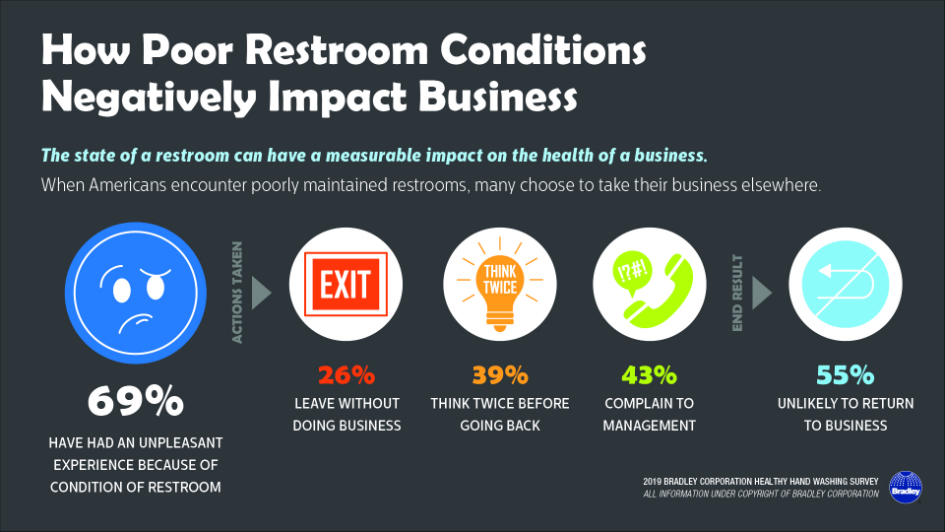
A recent survey conducted by restroom fixture manufacturer, Bradley Corporation revealed why public restroom cleanliness is good for business. One in two Americans said they are willing to fork out more cash at businesses that have clean, well-maintained restrooms.

The survey polled 1,264 adults about their hand washing habits in public restrooms and concerns about germs, colds and the flu and found that 64 per cent of consumers make a conscious decision to choose a business based on their high-quality restrooms.

“So, when a customer encounters a messy restroom, their perception of that business and its products and services are tarnished. Even worse, 55 per cent are unlikely to return to a business after a bad restroom experience, which can have a devastating effect on sales,” said Jon Dommisse, director of strategy and corporate development for Bradley Corp in the press release.

In fact, upstanding restrooms are so desirable that one in three Americans say they’d pay to use a restroom if they were assured it was clean and well-stocked.

HowPoorRestroomConditionsImpactBusiness

Ten years of handwashing insights

“In all, 80 per cent of people regularly use public restrooms. As odd as it may sound, for many of us, public restrooms are an important part of our everyday lives,” Dommisse said.

According to the survey public restrooms also provide functional space beyond the necessities of using the toilet and washing hands such as to check appearance, blow their nose or cough (40%), as a respite or getaway (27 %) and to use their cellphone (25%).

Respondents report an increasingly high degree of aggravation with restrooms. Their top aggravations include toilets that are clogged or not flushed (85%), empty or jammed toilet paper dispensers (83%), and partition doors that don’t latch (78%). In all, nearly 70 per cent of Americans reported having an unpleasant restroom experience.

“Based on these pain points, it makes sense that American’s top requests for improvements are keeping restrooms cleaner and better stocked,” Dommisse said.

“Well-maintained restrooms attract customers who reward those businesses with increased spending. It simply makes good business sense to keep restrooms clean and modern-looking so customers come back.”

Images courtesy of Bradley Corporation.

RIH Patient Tower named best infrastructure deal

The Royal Inland Hospital (RIH) Patient Care Tower project in Kamloops was named the 2018 North American Social Infrastructure Deal of the Year at the Infrastructure Journal Global Awards in New York City.

The $288M Patient Care Tower is being delivered by an all-EllisDon team comprising the sole equity investor, design-builder, and service provider under the design-build-finance-maintain model. The project reached financial close in November 2018.

The IJGlobal Awards celebrate the best-in-class transactions to have closed over the past calendar year across the international infrastructure and energy sectors, while recognizing the organizations that play central roles in these deals. Working in partnership with industry experts, the IJGlobal Awards undergo a rigorous selection process to recognize excellence in the delivery of challenging deals.

Royal Inland Hospital Patient Care Tower project is a two-phased project that consists of a new, nine-storey patient care tower as well as significant renovations to the existing emergency department, pediatrics, post-anesthetic recovery unit and morgue. The new tower is approximately 27,000 square metres and will be constructed on the existing RIH campus.

This project is designed to achieve LEED Gold Certification, helping to create a healthy and healing patient environment and workplace. EllisDon began early works in September 2018 during preferred proponent stage, with full construction activities commencing upon Financial Close.

Construction is slated for completion by early 2022 and renovations by 2024. In April 2019, EllisDon Facilities Services will commence facilities maintenance and lifecycle responsibilities for the existing hospital campus and the new Patient Care Tower, once complete, for a 30-year term.

Avmor launches podcast series for cleaning professionals

Avmor, a leading Canadian manufacturer of professional cleaning solutions announced the launch of a new masterclass podcast series.

The podcast will feature training, education, and best practice topics.

“These are not ‘product sell’ podcasts — far from it,” said Mike Watt, head of training and product development at Avmor in the press release.

“These are very practical training programs that every cleaning worker encounter on a regular basis. Our goal is to promote safety, make the job of the cleaning worker a bit easier, reduce time, lower costs, and give our customers a competitive advantage.”

Avmor’s first podcast in the series explored how to wash a wall. Watt said other topics to be discussed over the next couple of months include the following:
• Removing a Stubborn Stain from a Carpet
• Why Does My Drain Smell?
• Removing Gum on Carpet.

The podcast is available at Avmor’s Media Center or can be listened to on Google, Spotify and soon on iTunes.

A new topic will be discussed every other Wednesday on a continuing basis.

For more information on the podcast series email [email protected]

Feds promise more funds for new rental supply

The federal government has promised to pour more funds into its low-cost loan fund to support construction of rental housing. The second top-up in as many years was recently announced in the 2019 budget and, if realized, would amount to $10 billion dollars over nine years.

Ultimately, the government envisions 42,500 units of new rental supply will be built Canada-wide for tenants with modest to low incomes, leveraging the Rental Construction Financing Initiative. Thus far, five projects encompassing 500 units have been approved under the program launched in 2017, but the 2019 budget reports “more than 50 projects have been prioritized to receive a loan”.

Another $300 million will be disbursed to municipalities and other stakeholder groups through the new Housing Supply Challenge. Infrastructure Canada and Canada Mortgage and Housing Corporation (CMHC) have been tagged to jointly oversee the merit-based competition for proposed “new ways to break down barriers that limit the creation of new housing.” More details are promised for the summer of 2019.

“We have heard from Canadians in communities of all sizes, including our largest cities, like Toronto and Vancouver. They have told us that finding an affordable place to call home is not just a challenge. For too many hard-working Canadians, especially for young people, it feels like an impossibility,” Finance Minister Bill Morneau told the House of Commons as he introduced the budget. “There aren’t enough houses for people to buy, or apartments for people to rent. That makes finding a good place to live too expensive — beyond what many people can afford. In this budget are measures to increase the supply of housing, because we know this is the most effective way to address affordability in the long run.”

Two smaller funding commitments are meant to trigger and inform creative problem solving. CMHC will receive $5 million over two years to be directed to “state-of-the-art housing supply modelling and related data collection”, while $4 million over two years goes to support the recently established Expert Panel on the Future of Housing Supply and Affordability. The latter is a joint effort with the government of British Columbia, focusing on ways to boost the province’s housing supply.

The budget confirms pending introduction of legislation that would require the federal government to maintain a National Housing Strategy that places a priority on “the housing needs of the most vulnerable”. That would also include a mandate for regular progress reports.

CBRE announces sale of the Toronto Plaza Hotel

Toronto Plaza Hotel, located at 1677 Wilson Avenue (formerly Ramada and a Days Inn) has been sold, announced CBRE Hotels.

The hotel had not operated as a traditional one since February 2016 with the City of Toronto leasing the rooms to help shelter the homeless and refugees. According to CBC, despite the city paying millions to rent the facility, the hotel still faced financial problems and its owner (Virk Hospitality Corp.) fell under receivership after failing to make good on mortgage payments for the hotel.

CBRE was retained by Grant Thornton Limited in its capacity as receiver of Virk Hospitality in the sale.

According to the announcement, CBRE generated multiple offers, with the ultimate buyer having no conditions and the ability to close the transaction expeditiously.

The hotel features an indoor pool, hot tub, sauna, business centre and outdoor courtyard.

Kathleen Kurtin named OAA president

The Ontario Association of Architects (OAA) has announced the election of Kathleen Kurtin, OAA, MRAIC, to serve as OAA president for a one-year term.

“I wanted to give back to the profession,” she says. “Architecture has provided me with an exciting and rewarding career. I feel that it is important to ensure the next generation has those same opportunities.”

Kurtin registered with the Ontario Association of Architects in the early 1980s, launching her independent practice, Kathleen Kurtin Architect. Over the next decade, the firm distinguished itself as a mid-sized architectural practice specializing in renovation within Toronto’s downtown core.

With projects ranging from very small to upward of 500,000 square feet, her work included various building and client types, including retail, industrial, commercial, institutional and residential. The firm had a reputation for innovative and cost-effective solutions, and provided the foundation for the City of Toronto’s Live/Work guidelines.

In the mid-1990s, Kurtin joined Scotiabank as its Chief Architect and Director of Design, leading a group of in-house and external architects and designers in the design and development of the bank’s real estate portfolio, both domestic and international. On retiring from Scotiabank in 2014, she re-established her independent practice.

Having participated on the Toronto Society of Architects executive in the 1990s, Kurtin went on to become a member of OAA Council in 2013, and has taken on increasing responsibilities ever since.

She became president in January 2019, with previous roles including senior vice president and treasurer as well as VP Regulatory and VP Practice. Kurtin has chaired the association’s Audit, Practice and Interns Committees and participated in the Policy Advocacy Coordination Team and Building and Education Committees. She was instrumental in establishing the Safe Work Places Committee, which has sought ways to make the practice of architecture for women more equitable.

Maintaining and repairing condo elevators

Users of the approximately 19,900 residential and institutional elevators in Ontario take approximately 655,000 elevator trips in a single day, according to Delta Elevator. And elevators are essential to the mobility of many of these users, who include residents and guests of condominium corporations.

As such, it’s important to ensure users who rely on elevators to get around have access to this vertical transportation when needed. Part of that is maintaining and repairing elevators as well as replacing them altogether when the time comes, to avoid unplanned downtime.

However, these activities may also require planned elevator down-time. There are certain factors that should be considered when preparing for both planned and un-planned elevator down-time.

Maintaining and repairing elevators

Preventative maintenance helps keep elevators up and running in good working order. And it’s not just about ensuring that they undergo regularly scheduled inspections.

Preventative maintenance includes receiving feedback from the elevator mechanic on potential repairs. Quotes should be included with the reports when suggested or mandatory repairs are found.

Managers may then take measures to get these repairs completed. When planning for elevator down-time, managers should consider all other possible changes that may be needed, including ensuring the elevator is up to current code requirements. Having all repairs scheduled at one time is the best way to utilize an elevator mechanic’s time.

Ensuring that the preventative maintenance is effective is also crucial.

Having a third-party consultant perform a maintenance evaluation will ensure that all areas of a building’s elevator needs are being addressed. Elevator mechanics have several units on their routes, which can cause items to be missed. It is important to get a second opinion when there are concerns about a particular elevator. Sometimes a second set of eyes can simply see something the first set did not.

A maintenance evaluation is different from a safety inspection. This does not mean that a safety inspector does not look at maintenance. However, while they may write up a dirty pit, they lack extensive maintenance and mechanical knowledge. A maintenance evaluation will make sure elevators are being properly serviced.

Maintenance logs should also be reviewed regularly. Don’t be afraid to ask questions or meet with the mechanic on site to get a better understanding of the building’s elevators and their condition.

Replacing and updating elevators

At a certain point in the life cycle of an elevator, it will come time to consider full replacement in order to continue providing reliable elevator service in a building. A full elevator replacement may seem difficult to justify, but due to new code requirements and parts of older model elevators becoming obsolete, it may be something to consider sooner rather than later.

A replacement project takes extensive planning. Seeking feedback from the consultant’s previous clients may assist managers in covering areas they may not have considered. Consulting with the condo corporation’s fire protection company on this type of project is also important, to ensure that the fire panel is compatible with the update. Many elevator modernizations end up requiring a new fire panel that can pinpoint exact locations of trouble signals, whether it’s the elevator room or a smoke alarm. Having this information as a part of the bid process will save headaches when attempting to finish the project.

If there is a generator that allows an elevator to continue to operate during a power outage, including the generator company on this project will ensure that the generator is compatible to offer this service during a power outage.

Lastly, don’t forget keep the budget and financial adviser up to date on the project, including about additional items such as the fire panel and generator that may require changes.

It is important to have all parties involved with the project attend a “pre-construction” meeting to put all inquiries on the table and make sure everyone is on the same page. Having surprises during the middle of a lengthy project just adds stress to the project managers, clients and residents.

Planning for elevator down-time

On-site time for elevator installation crews ranges from about two weeks for an accessibility lift, to four weeks for a hydraulic elevator, to six weeks for a traction elevator. Reviewing the accessibility concerns of occupants in the building prior to starting a project of this size is crucial — especially if there is only one elevator.

Users may also be seniors with mobility issues, and it is important that their needs are considered if an elevator is out of service. Installing a stair lift for the duration of a project would be beneficial if many of the users are seniors.

Also consider scheduling projects for when a building is least active. If many residents of a building go away in the winter, this may be the best time to make the changes.

Alert all residents or commercial clients to elevator down-time with notices, which should also be posted on every level the elevator services prior to the date of work and for the duration of down-time. The notices should also advise occupants of alternate options for users with mobility issues or who require assistance transporting large items.

Update notices weekly to keep residents and commercial clients aware of the progress of the project. And consider including a penalty for every day that the contractor is behind schedule, but also offer a bonus if the contractor comes out ahead of schedule.

Supporting the users who rely on elevators comes down to being proactive with maintenance and repairs, planning carefully when full replacements are required and providing a flow of communication before and during scheduled down-time.

Courtney Cartmill is a property manager at Wilson Blanchard Management Inc. 

Attracting young people to skilled trades

As the demand grows for skilled labour throughout Ontario, recruiting and retaining young people in the trades is a topic at the forefront of key stakeholders’ minds. Earlier this month the Residential Construction Council of Ontario (RESCON) and the Ontario Residential Council of Construction Associations (ORCCA) hosted an event in downtown Toronto to examine the issue of the skills shortage in the construction industry.

Setting the tone for the event, Ontario’s Education Minister Lisa Thompson reinforced the government’s commitment to supporting students and guiding them into successful careers in the trades sector.

“We need to build a foundation for guidance counsellors and students so that they know there are opportunities ahead when they embrace construction,” Thompson said in her keynote speech.

Promoting a culture shift
“What I hear from our members in the construction sector is that the number one challenge that they have is a shortage of talent,” Janet De Silva, Toronto Region Board of Trade president and CEO said in the panel discussion.

In order to harness the full potential of skilled trades, Northumberland-Peterborough South MPP David Piccini told attendees that key players in the industry need to have the courage to implement a real “culture shift.”

“If we don’t act we’ll have over 5,000 jobs that will go unfilled by 2021,” Piccini warned.

According to a report Retaining Employees In The Skilled Trades (REST), prepared by Job Talks and Q.I Value Systems Inc., the trades boast high job satisfaction levels. Yet, recruitment remains a challenge. The research finds that many construction workers and industry stakeholders agree that the industry has a marketing problem.

Here are some of the recommendations highlighted in the REST report to attract young people to the skilled trades industry:

  • Leverage the industry’s massive network in recruitment;
  • Integrate construction early in the education system;
  • Invest in high-quality media production; and
  • Mobilize companies and associations to address retention.

The panellists added to these suggestions when Janet McFarland, a Globe and Mail reporter who served as moderator of the panel discussion, polled them on how the industry can overcome the stigma that trades are not for straight A students or the academically inclined.

“Challenge the ingrained bias against the trades from a grassroots level,” De Silva urged.

Lindsay McCardle co-author of The Behavioral Economics (BE) approach to recruitment report, agreed. Aside from stigma, negative parental influence is a major deterrent for young people considering a career in skilled trades.

“Having the general public including parents have a better understanding of what is involved in these jobs can change the misconceptions that employees in the trades industries lack intelligence or problem-solving skills,” said McCardle.

Co-written by James Stewart, this report highlights steps guidance counsellors, career development organizations and training institutions can implement to attract young people to the skilled trades through eight best-practice examples.

McCardle said BE principles can be applied to recruitment in construction in a tangible way by getting the community to think “trades first”. This kind of pre-commitment will have a big impact on students.

“Get into schools as early as the elementary stage to enhance access to information,” agreed Patrick McManus, director of government relations and communications at Ontario Sewer and Watermain Construction Association and chair of Ontario Skilled Trades Alliance. “And put more direct information into the hands of guidance counsellors.

“There are more options than plumbing, carpentry and electrical. There are hundreds of trades and were not advertising them well enough,” he added.

The next steps in closing the skills gap in the trades industry
“The crux of the skilled trades gap issue is that we’ve lived with the mantra that wage will draw growth in our sector,” McManus said.

In his opinion, the industry needs to find more innovative approaches to attract young people to skilled trades.

“I’m sure most people in this room go home and continue to work; that’s become more common,” he pointed out. “Promote that there is true work-life balance in the construction industry.”

McManus also emphasized the importance of moving towards stackable and modular training and competency-based training to continue to remove barriers of entry into the trades.

McCardle noted that guidance counsellors are strapped for time and don’t get to do a lot of career guidance because they’re focused on supporting mental health and handling crises for example. She calls for a distinct type of guidance counsellor, solely focused on careers.

“Separating those two roles and responsibilities could help to place more emphasis on professional development,” she said.

The youngest panellist, Julia Zahreddine, site supervisor, Bridgecon Construction Ltd, recalled that the careers class in her high school didn’t highlight any skilled trades. She was drawn to the industry when the Heavy Construction Association of Toronto came to her class for a school visit.

“I’m here because I had the opportunity to apply for a scholarship,” Zahreddine said.

As a recent graduate and a young person who has worked in the heavy civil construction industry for more than a year now, she insisted investment in scholarships, co-op programs and active marketing will influence and attract a diverse group of young people to the industry. As one example, she cited an interview series profiling careers in the skilled construction trades, produced by Job Talks, in which she appears.

Currently, the average age of an apprentice is 27. As a wave of retirements looms, it’s important to help people interested in the trades find the applicable career pathways much sooner,  at 18 or 19 years old.

Panellists explored several ideas on how to continue to introduce trades to young people as a viable career option. As a final thought, they all agreed that pathways into the industry need to be improved and simplified by focusing and centralizing information in order to successfully target millennials and ensure a future workforce.

Zandile Chiwanza is the online editor of Facility Cleaning and Maintenance and Canadian Property Management. 

Photo courtesy of Aonghus Kealy, director of communications, RESCON. 

Let’s build something better together

In times of need, Canadians band together like no one else.

As a nation, we are facing a lack of affordable housing that has contributed to a level of chronic homelessness that we cannot accept and has left around 1.7 million Canadian families without a home that meets their basic needs and that they can afford. The time is now to create Canada’s next generation of affordable housing across the country.

Enter the National Housing Strategy, the largest and most ambitious federal housing program in Canadian history.

The NHS is a $40billion investment in our shared future. It is driven by a variety of funding and financing initiatives designed to address challenges across the housing continuum and the spectrum of housing needs. These initiatives include the $13.2-billion National Housing Co-Investment Fund, the $200-million Affordable Housing Innovation Fund, and Federal Lands.

shutterstock_485712322_72

A national strategy aligned with Canadian values
Clearly, more up-to-date housing is needed across Canada. The Strategy includes initiatives that are focused on the creation of a new generation of housing. Over the next 10 years, the NHS aims to create 100,000 new housing units and repair and renew more than 300,000 existing units while reducing chronic homelessness by 50 per cent.

But the Strategy is about more than just housing units. The NHS includes initiatives that will help create more livable communities and promote more diverse communities across Canada. What’s more, they will build housing that is more sustainable, more accessible, with mixed-income and mixed-use, and that will be located close to transit, work and public services.

They will make Canada a better place to live.

shutterstock_567035638_72

With such ambitious goals, we need to work together. The NHS will promote partnerships and the alignment of efforts in order to achieve positive change that will impact many Canadians. They will provide technical assistance, tools and resources to help build capacity in the community housing sector. They will provide funds to support local organizations. And they will help elevate the entire housing sector by supporting relevant research efforts, knowledge sharing, and capacity building while recognizing excellence and innovation in housing research.

We can accomplish more together. For the next decade, let’s band together to build a more inclusive and sustainable housing future for those most vulnerable among us — and for all Canadians.

You can learn more about the National Housing Strategy initiatives and how they may apply to you at http://www.cmhc-nhs.ca/.

NHS-Logo-1        CMHC Logo - En

Edward Sonshine to retire from RioCan

RioCan Real Estate Investment Trust (RioCan) chief executive officer, Edward Sonshine, announced plans to retire on March 31, 2021 or 2022.

Upon his retirement, Sonshine has agreed to become the non-executive chairman of the Board of the Trust for two years to ensure an orderly transition with his successor. Paul V. Godfrey, chair of the board, has agreed to step down at that time to become lead trustee.

“The members of the Board of Trustees are all very pleased that Sonshine has agreed to remain as CEO of the Trust… He continues to bring a tremendous amount of leadership to the management team as he guides RioCan in its strategic vision for continued growth,” Godfrey said in the press release.

Chief operating officer promoted
RioCan is also pleased to announce that Jonathan Gitlin, chief operating officer, has been promoted to the president and chief operating officer of RioCan effective immediately.

According to the press release, Gitlin joined the real estate investment trust in 2005 and has been the head of the Trust’s investment team since 2007 where he has played a major role in the tremendous growth of RioCan and has lead RioCan’s ongoing $2 billion disposition program as part of its accelerated major market strategy and execution of the Trust’s residential program.

“Since his assumption of the role of COO in August of 2018, Jonathan has been a key contributor to our leadership team and to the ongoing success of the major initiatives that RioCan has underway. I am confident in his abilities to lead our operations as we move towards the next phase of our growth and development”, Sonshine added.

SFU breaks ground on outdoor stadium

Construction has begun on a new stadium at Simon Fraser University’s (SFU) Burnaby Mountain campus.

Scheduled for completion in August 2020, the stadium will include seating for 1,800 spectators, an accessible concourse and washrooms, spectacular sightlines, broadcast and media facilities, an integrated sound system, a fully accessible VIP/sponsor box, coaches booths, improved access from the Lorne Davies Centre to the Terry Fox Field and Track, all covered by a roof canopy over top of a large portion of the seating.

The first ever permanent outdoor home for SFU Athletics, the stadium is expected to transform campus life, creating a vibrant meeting place that connects students, alumni and the community.

Along with the Student Union Building, the stadium has been designed by Perkins and Will, and the planning process included multiple consultations with students and stakeholders. Chandos Construction is building the new covered stadium on the hillside of Terry Fox field.

“The stadium is going to be a tremendous addition to campus life,” said SFU president Andrew Petter. “Not only will it be a great place to come and watch some fabulous sports activities, and our football and soccer teams compete in the NCAA, but it will also mean the Terry Fox field can be used for other events like concerts or gatherings, as well as a whole bunch of student orientation events.

The SFU Stadium is jointly funded by SFU and Simon Fraser Student Society (SFSS), with students voting in favour of a student levy needed to bring both projects to life.

As Canada’s only university competing in NCAA, the stadium will play an instrumental role in supporting SFU student-athletes, and raise the profile of the University.

“It’s not just going to be for athletes to come out and practice, it’s going to give students a reason to come out to events,” said Samer Rihani, the acting president of the SFSS. “It’s going to give students a purpose to want to come out, regardless of weather and conditions. Our athletes are still going to be performing at that really high level, so we should have a stadium that is also at a high level as well.”

Ontario reroutes CDM program delivery

Ontario electricity customers with monthly bills in the range of $1.6 million have been promised savings of about $15,000 in a first step toward transferring the funding mechanism for conservation and demand management (CDM) from electricity rates to general provincial revenues. Greg Rickford, Minister of Energy, Northern Development and Mines, introduced legislation yesterday to realign CDM program delivery in a phased process that begins with cancellation of eight distinct incentives and consolidation of all administrative oversight under Ontario’s Independent Electricity System Operator (IESO).

“I have directed the Independent Electricity System Operator to discontinue the 2015-2020 Conservation First Framework and establish a scaled down Interim Framework for the balance of 2019 and 2020,” Rickford wrote in a letter to energy management service providers. “I have also directed the Ontario Energy Board and provided it with the authority to amend or revoke conservation related license conditions for electricity distributors.”

No applications will be considered for current programs after April 1, while oversight of approved in-progress contracts will be transferred to the IESO. The IESO will then begin to accept applications — scheduled for May 1 — for a new selection of programs under the Interim Framework.

“It’s a full program reset,” explains Andrew Pride, an engineer and consultant specializing in energy management and strategic conservation planning. “Everything is shutting down. Some things are going to start back up.”

These directives do not require approval of the legislature and are projected to strip as much as $442 million out of electricity costs over a three-year period. The proposed package of hydro-related measures in the associated Bill 87 includes the legislative amendment that would give the government more direct control over CDM budgets.

“Amendments are being proposed to the Electricity Act, 1998, that would enable the IESO to accept government revenues to fund conservation programs and other procurement contracts, should the government decide to do so in the future,” Rickford advised. “The amendments would provide the flexibility to take further costs out of the rate base.”

Centralized administration of fewer programs

Local distribution companies (LDCs) have been the prime drivers of the Conservation First Framework, tasked with collectively attaining 7 million megawatt-hours (MWh) of energy savings in the 2015-2020 period. Each of Ontario’s 68 LDCs has an assigned target and budget for achieving their share of that goal. They serve as the administrators of provincially designed programs and also have the option to offer specially tailored programs of their own.

They’ve now been instructed to wind down their efforts. In doing so, they forego previously promised bonuses for hitting or surpassing their targets, which is presented as a potential $150-million chunk of the cost savings. However, Pride, who was an influential contributor to CDM program design in his previous role as vice president, conservation, with the Ontario Power Authority, questions that assumption.

“LDCs delivered conservation at under 1.7 cents per kilowatt-hour (kWh) in 2017, an efficiency level that has historically never been seen in Ontario or neighbouring jurisdictions,” he adds. “Typically, central or private sector operated programs operate at 3 to 6 cents per kWh.”

The IESO has been instructed to present a plan later this spring for how it will singularly fulfill the CDM program delivery mandate. The Ministry of Energy, Northern Development and Mines’ backgrounder lists eight programs “expected to be discontinued”: Business Refrigeration Incentive; Audit Funding; High Performance New Construction; Existing Building Commissioning; Monitoring and Targeting; Point-of-Purchase Incentives; Heating and Cooling; and Residential New Construction.

It also lists eight programs that will be retained in some form, including some of the most popular with commercial customers such as the Retrofit Program, Energy Manager Program and Energy Performance Program.

“We are thankful for the government’s decision to continue the high-value Retrofit programs that have proven successful. That was something we suggested on our list of policy recommendations to the Ministry,” says Bala Gnanam, vice president, energy, environment and strategic partnerships, with BOMA Toronto. “However, the lack of transparency leading up to the announcement was not desirable. We are all in it together. As an industry association representing commercial real estate, we are committed to work with the government to address our mutual concerns and we are in full agreement that we need to overhaul conservation programs to achieve cost efficiencies and to bring greater value to Ontarians.”

Pledge to reduce electricity bills underpins Provincial action

The Ministerial directives and proposed new legislation are tied to the government’s election campaign pledge of a 12 per cent reduction on electricity bills. (Bill 87 also addresses the Regulated Rate Plan for residential and small business customers — introducing a new structure to replace the previous government’s mechanism for curbing the global adjustment — and the mandate of the Ontario Energy Board.) Current levels of CDM investment are deemed unnecessary.

“Today’s customers understand the value of conservation and require fewer initiatives to realize reductions on their electricity bills,” the Ministry of Energy, Northern Development and Mines backgrounder states. “The proposed changes will have no effect on the environment, will lower system costs and will reduce hydro rates for medium and large employers, increasing competitiveness and opportunities for growth.”

That argument comes with examples of potential savings. Notably, an auto sector company consuming 15,000 megawatt-hours (MWh) per month will now save $15,000 while a mining operator using 50,000 MWh will save $30,000.

Based on the 2018 average price of $111.50 per MWh (11.15 cents/kilowatt-hour), that discount would come on bills that previously could have been as much as $1.67 million for the automotive sector company or $5.75 million for the mining operator for the commodity cost of electricity alone, before adding regulated charges. Even if their bills were lower due to participation in the Industrial Conservation Initiative (ICI), promised new savings are modest in the context of their total costs.

“It has to be expressed in terms of huge, atypical loads to even get a number worthy of a sound bite,” Pride suggests. “The savings will be negligible for almost all commercial buildings.”

The Ontario government projects the pullback on CDM spending will save $442 million over three years, while reducing projected electricity savings by 0.82 terawatt-hours (TWh). That’s 820,000 MWh or 820 million kWh, worth approximately $91.4 million at last year’s average price, that will continue to be embedded in annual electricity system costs.

“Energy efficiency is the best bang for the buck for the people of Ontario. Saving a kilowatt-hour is cheaper than spending to generate one,” maintains Corey Diamond, executive director of Efficiency Canada. “Cuts to energy efficiency means reducing the lowest cost option in our electricity system.”

“Sound energy efficiency policies create jobs and they are very important for our efforts toward curbing greenhouse gas emissions,” Gnanam concurs.

Barbara Carss is editor-in-chief of Canadian Property Management.