Articles Archive - Page 509 of 929 - REMINET
REMI

Sodexo promotes food waste management

Sodexo has partnered with the bio-cleantech company, Genecis Bioindustries Inc., taking a big step toward a circular economy and promoting food waste management.

Based in Toronto, Genecis is a cleantech startup that uses programmed bacteria to digest food waste and turn it into biodegradable plastic granules. Those granules can be later used to make compostable tableware and containers.

This partnership strengthens Sodexo’s goal to reduce food waste by 50 per cent from its operations by 2025 and to reduce our carbon footprint by 34 per cent.

“Of all the companies we came across, Sodexo is among the rare few who has deeply embedded concepts of sustainability and food reduction into their corporate structure, development, and in every major decision. We cannot be more delighted to partner with Sodexo and collaborate towards building a better tomorrow,” said Luna Yu, CEO Genecis Bioindustries Inc.

Genecis and Sodexo began working together over a year ago. A pilot project in the Toronto area diverted more than 1,430 kilograms of food waste and 1,210 kilograms of CO2 gas emissions in six months.

“We’re excited about the future of this partnership with Genecis. We are continuously evolving our services to improve quality of life, and this requires innovation and collaboration with cutting-edge startups like Genecis,” said Suzanne Bergeron, President Sodexo Canada in a press release.

Experts discuss technology at breakfast panel

The Independent Contractors and Businesses Association (ICBA), along with Procore Technologies, hosted a sold out breakfast panel on Construction Technology: Reshaping the Industry on June 4th in downtown Vancouver.

Four very accomplished industry leaders shared their perspectives on how to adapt and navigate organizations through unprecedented change coming to the industry. Technological challenges and advances come quickly, and businesses need to be ready.

The panel included (photo L-R) Pitt Meadows Plumbing and Mechanical owner Steve Robinson, Scott Construction president Darin Hughes, Sheryl Staub-French, professor UBC department of civil engineering and Procore Technologies CEO Tooey Courtemanche. Moderator was Helen Goodland, managing principal at Brantwood Consulting.

Acton Ostry Architects name new principals

Vancouver-based Acton Ostry Architects (AOA) has named new principals and associates at the firm. Alan Davies and Alex Percy have been promoted to principal, with Mark Simpson and Matt Wood promoted to associate principal. Michael Fugeta and Matthew Fellows have been named as new associates, joining Milos Bejovic, Ruth Chau, Derek Fleming, and Nate Straathof as associate members of the AOA leadership team.

“The new leadership structure marks the beginning of the next phase in the evolution and growth of Acton Ostry Architects,” says founding principal Russell Acton.

Michael Fugeta, associate has been with AOA since 2010. Michael was project lead for The Duke, an award-winning rental residential project completed in 2018 under the City of Vancouver Secured Market Rental Housing Policy. Michael continues to contribute his creativity and expertise to the realization of affordable rental housing projects in Vancouver.

Matthew Fellows, associate joined AOA in 2012. Matthew is currently the project lead for the new Sir Sandford Fleming Elementary School and Child Care scheduled for completion in the Fall. Matthew has an expertise with educational projects, previously overseeing completion of Vancouver Talmud Torah, the city’s largest Jewish elementary school.

Founding principal Mark Ostry adds, “These talented individuals have honed design and leadership skills with AOA over many years and will guide the way forward for a new generation of talented architects.”

Acton Ostry Architects is a leading Canadian design practice recognized for the creation of eloquent and innovative community, public institutional and mixed-use residential projects, and as leaders in the advancement of tall wood buildings. AOA has received more than 100 local, national, and international design awards. Notable projects include Brock Commons Tallwood House, The Arbour, The Sauder School of Business, York House Senior School and the UBC Aquatic Centre.


2019 BOMA BC Award winners announced

Top property management firms, individuals and suppliers in the commercial real estate industry were honoured at BOMA BC’s 2019 Awards Gala held in downtown Vancouver. A total of five awards were handed out.

Keynote speaker, Terry Small, gave an incredibly memorable and humorous presentation on The Leadership Brain, and provided the crowd with practical tips on how to be better leaders.

“BOMA BC is very proud of the calibre of companies that are part of our association. They raise the bar every day and we are happy to recognize them for their outstanding service and professionalism,” said Damian Stathonikos, president of BOMA BC.

“Hopefully the Awards Gala inspired others to enter for an award. Next year will be a particularly exciting year as BOMEX, BOMA Canada’s national conference, will be held in Vancouver. We hope to have multiple local winners recognized at the national level.”

QuadReal Property Group’s team at Broadway Tech Centre was recognized with the Building Operations Team award, which recognizes a high level of expertise in scheduling preventive maintenance; improves general building operations; ensures maximum energy efficiency; and leads by example.

2019 BOMA BC AWARD WINNERS:

Building Operations Team
QuadReal Property Group’s Broadway Tech Centre team

Tenant Improvement
Wesgroup Properties

Supplier/Contractor
Paladin Security

Young Professional
Sean Hamilton, Haakon Industries

Outstanding Volunteer
Jillian Mann, GWL Realty Advisors Inc.

Q Management LP acquires 911-suite property in Oshawa

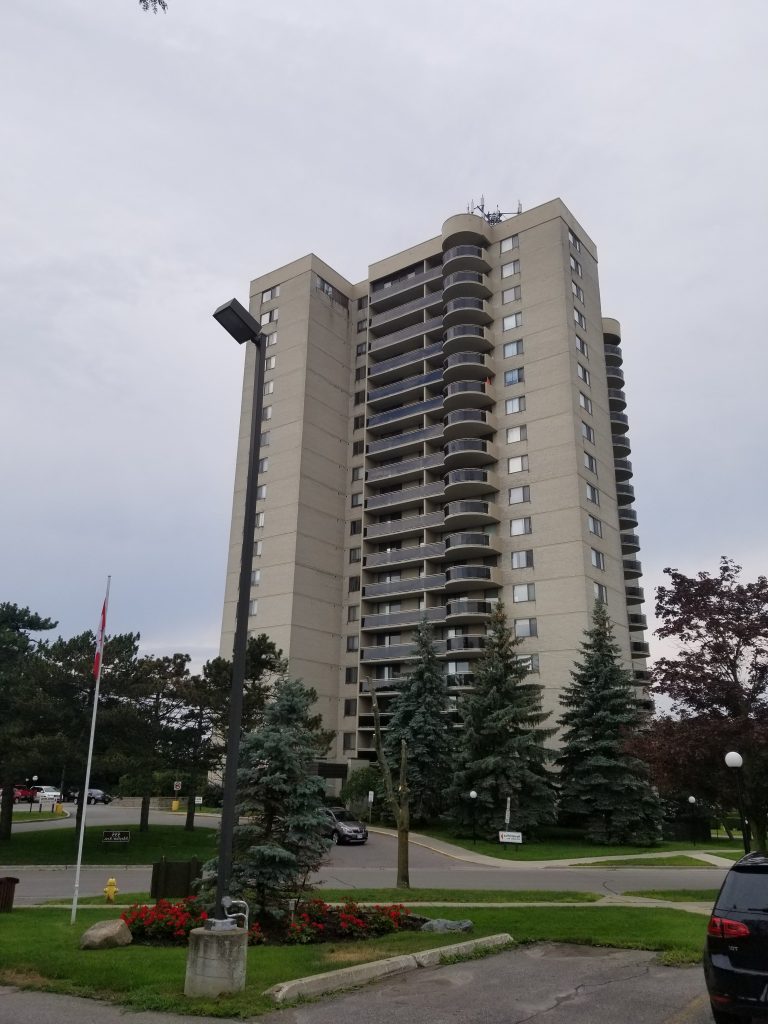
Q Management LP announced it has acquired Rossland Park Residential Community in Oshawa, Ontario, from H. Kassinger Construction Limited for $220 million. The 911-suite property includes three high-rise buildings, two-low rise buildings and four townhouse complexes.

555 Mayfair exterior1“This acquisition aligns with our strategy of assembling multifamily residential properties in large, growing Ontario urban centres,” said Dan Argiros, President and CEO of Q Management LP. “Oshawa has strong demand for residential rental homes. Combined with the five properties we already manage in Oshawa we now have approximately 1,400 units in the Oshawa market.”

The acquisition is the second for Q Residential Property Income Fund V (QRPIF V). QRPIF V is the fifth fund in the multifamily sector launched by Q Management LP. The Fund is open to Canadian and international investors.

“Rossland Park Residential Community is well operated, highly sought-after by tenants and is in a region where we have tremendous confidence,” said Argiros. “It is a great addition to our existing portfolio in Oshawa as we will be able to deliver valuable management efficiencies.”

All tolled, Q Management LP now owns and manages almost 11,000 suites located in cities across Ontario including the Greater Toronto Area, Oshawa, Ottawa, London, Hamilton and St. Catharines.

Photo: 555 Mayfair, courtesy of Q Management LP. 


Preparing for common condo emergencies

Warmer months are a great time to reassess disaster readiness for “predictable” condo emergencies. The time to start preparing for these risks is always now in order to best prevent suffering later.

Risk management and disaster planning for most properties has a lot to do with where a property is located, but very generally, the main hazards to plan for include fire, flooding, tornados, earthquakes and severe storms. Condo managers have to ensure they are properly prepared for these “predictable” hazards. Below are some precautions that can be taken:

Fire prevention

Consulting with a fire protection company is recommended in order to find out what types of sprinklers, alarms, devices and extinguishers are required in the building and ensuring the property is up to code. In many areas of the country, fire codes have recently been substantially upgraded, and major changes and improvements have been made to the minimum requirements for condominiums and apartments. It is always a good idea to keep storage areas organized and clear and ensure places such as common areas, laundry rooms and recreational areas have smoke alarms and are free of any electrical hazards.

Flood

Waterproofing the building is essential. A property does not have to be completely flooded in order to suffer damage, as smaller water leaks can cause harm throughout the building. Preventive measures can include sealing off any cracks and weaknesses in your structure and installing water alarms and flood sensors. It is also important to clean out gutters and downspouts surrounding the property. Failing to keep these areas clear can force water back into the structure.

Lastly, install a backflow valve on the main waste line and any storm lines to prevent sewage backups. Buildings located in urban areas and areas where infrastructure is aging can be especially vulnerable to this type of loss. Storm water infrastructure in many parts of the country that were designed many decades ago are now not capable of handling the ever-increasing amounts of run-off in the spring.

Tornado / Wind

According to Environment Canada, Canada reports an average of 62 tornadoes per year. Though they seem uncommon, the Ottawa – Gatineau tornadoes that swept through southern Ontario last fall demonstrate the impact they can have.

It is imperative property managers monitor local weather apps, stations or sources and communicate any tornado-related threats to their residents. The construction or designation of a safe room should also be considered, according to International Code
Council guidelines. All exterior doors and windows should be closed so high wind, rain and debris does not come in.

For any existing structures, consider retrofitting the building for greater wind resistance and structural reinforcement. Clearing branches or trees surrounding buildings and power lines will also help mitigate the risk of falling limbs causing
damage during a tornado. Have the roof and building inspected for any loose pieces and damaged areas. Look into repairing any weaker areas that could give out if there were high winds or a tornado.

Earthquake

Canada is affected by 5,000 earthquakes annually. Most earthquakes reported are of low magnitude and do not surpass seven on the Richter Scale. Although the likelihood of encountering an earthquake may be low, precaution remains important.

The best prevention against earthquake damage is understanding your specific building risks. Many preventive measures can be implemented during design and construction of a building but for properties that exist today, it is best to consult a
structural engineer who specializes in this field. Your goal is to understand your unique structural risks and plan accordingly.

Severe storms

Canadians are no strangers to severe winter conditions. A major storm can be anything from a thunderstorm, rain or hail to ice storms and heavy winds.

It is important to make sure HVAC systems are in good condition and do not require any maintenance or repairs. Severe storms may have damaged vents or clogged them with debris. Over time, the ducts can have a build up of dust, dirt and debris which can affect air quality throughout the building. Although this last point may not relate directly to a storm, it is a good time to consider the health of your residents.

Planning for a power outage should also be considered. Between seasons, have a professional inspect the power generator and fuel storage. Additionally, it’s important to check for cracked pipes, issues with electrical and water systems or other mechanical issues. Regular maintenance and checkups on these items will help prevent property managers from spending extra dollars on future damage.

The longer minor damages are left unattended, the more expensive and complex the repairs could ultimately be. It’s important to get ahead of the problem in order to protect residents and your budget.

Margo Malowney is vice president of marketing and communications at FirstOnSite Restoration.

SIOR elects Canada regional director

Society of Industrial and Office Realtors (SIOR) elects Devencore’s principal & executive vice-president, global client solutions, Rob Renaud as Canada regional director.

Renaud brings over 23 years of commercial real estate advisory and brokerage experience.

“We are extremely proud of Rob’s achievement,” said Jean Laurin, President and CEO of Devencore. “The recognition of Rob in this important endeavour is a testament to our company’s continuing success and emerging leadership position in the Canadian corporate real estate community.”

According to the press release, Renaud is an industry veteran who continues to make his mark as a trusted advisor to tier-one clients across a number of industry verticals in the global knowledge economy.

A SIOR member since 2005, Renaud has served in a variety of leadership capacities over several years, including the president, vice-president and secretary and treasurer for the Canada Central Chapter and a member of the SIOR Technology Committee. He is also the current chairman of the SIOR Canada Central Chapter SIOR Broker of the Year Awards. Renaud was honoured with one of these prestigious awards in 2011, that recognizes the superior performance and achievement of a real estate brokerage advisor, based on the size, value and volume of transactions completed in a single calendar year.

SIOR is the leading global professional office and industrial real estate association. With more than 3,200 members in 686 cities and 36 countries, SIOR represents today’s most knowledgeable, experienced, and successful commercial real estate brokerage specialists.

“I owe much of the success in my career to SIOR and the connections I’ve made,” said Renaud in a press release. “I’m honoured to give back to the organization in this capacity.”

Breathing life into outdoor spaces

When the spring comes, it’s inevitable that people will want to be outside, basking in the warm, fresh air. But for multi-residential building residents, finding that comfortable outdoor space isn’t always easy. Not all apartment units come with balconies and not all properties are designed with shared spaces in mind.

So what are the basics of creating inviting, communal outdoor spaces that will attract residents and give them that open-air refuge they deserve? According to Jase DeBoer, Senior Category Marketing Manager, Deckorators, it all comes down to safety, aesthetics and functionality.

Lighting the way…

Rooftop patios, meandering walkways and strategically placed benches amid beautiful gardens can be attractive havens for tenants, day or night, provided they are well-lit for both ambiance and safety.

Cap lights are a popular way to add lighting to any deck space, says DeBoer. “Both solar and low voltage options are available and will add ambiance to any property, while step lights and decorative post sconces are equally stylish and effective.”

Another method commonly used to enhance a property is “spotlighting”. By shining a light on key exterior features, like fountains, flowerbeds, shrubs or signage, the other benefit is that crucial sightlines are created for residents out strolling in the evening hours, while acting as a deterrent for unlawful activity.

Poolside safety

For apartment buildings equipped with outdoor swimming pools, the arrival of summer means these cordoned-off areas are about to become hubs of boisterous activity. But appealing as they are,  swimming pools can be burdensome and costly to maintain.

Aside from the upkeep of the pool itself, the surrounding area must be beautifully landscaped, well-lit, comply with all safety standards, and designed with a surface area built to withstand moisture while providing great traction to avoid slip and falls.

DeBoer advises property managers to invest in decking material and technology that will withstand the elements while putting the safety of residents first.

“Composite decking technology has evolved, delivering greater surface traction than traditional materials,” he says. “Perfect for pools, hot tubs, docks and more, composite decking is incredibly strong and lightweight, making it an ideal solution for balconies and shared patio spaces.”

Railing options that provide safety without obstructing the view is also something DeBoer recommends. A variety of styles are available today—from sleek, contemporary aluminum railings in brushed titanium finishes, to classic rails in colours and tones that blend well with the scenery, railings can enhance a pool area while still fulfilling the important function of keeping residents safe.

“To help create a cohesive space, consider incorporating the same decking material for built-in planters and benches or even on top of the railing,” he says. “This offers a larger surface area for setting down beverages or snacks when entertaining.”

Same space, different tastes

Shared spaces brings many competing tastes and colour preferences – in other words, catering to a building full of residents isn’t easy. For this reason, most designers will encourage building owners to opt for simplicity in their décor and landscaping choices. Seasonal planters add a lovely touch to an entranceway but they shouldn’t be too busy or require significant upkeep.

On the deck-front, while many decking options feature trend-forward colours and textures, a safe bet may be something timeless and appealing to all. It’s also important to keep durability in mind. DeBoer notes, “Shared spaces often come with a great deal of use, therefore you will want products that will last while being beautiful and functional. Consider products that offer extended warranties to ensure the space looks good for years to come.”

Jase DeBoer is Senior Category Marketing Manager at Deckorators.

U.S. multifamily investment surges in Q1 2019

Building on a record-breaking 2018, U.S. multifamily investment is experiencing its most active start to a year, with $38.3 billion in transactions in Q1, according to the latest report from leading professional services firm, JLL.

The multifamily sector was the only asset type to post year-over-year gains, lifting its share of total U.S. real estate transaction volumes to 41.5 per cent.

With multifamily absorption keeping pace with unit completions, allowing fundamentals to strengthen for the sixth consecutive quarter, the report cites that nearly 300,000 units were leased up over the past year. The expanding renter base has pushed vacancy rates to a new low of 4.6 per cent, marking a 30.0-basis-point decline from one year ago.

Urban multifamily submarkets saw rent gains accelerate for the seventh consecutive quarter, at 3.3 percent as of Q1 2019. That said, urban submarkets still lag the national growth rate of 4.5 per cent due to heightened completions of luxury and Class A multifamily assets in the urban core.

As a region, the Sun Belt commanded the highest average effective rent growth at 5.5 per cent, led by Las Vegas, Phoenix and Tampa. Concurrently, the Northeast corridor witnessed the largest effective rent growth gains, up nearly 175 basis points from Q1 2018.

Transactions

U.S. multifamily transactions totaled $38.3 billion in the first quarter of 2019, representing a 13.0 per cent increase from Q1 of last year. The quarter saw an 8.8 per cent increase in single-asset transaction size on an annualized basis, while strong liquidity among domestic private and institutional investors has driven the groups’ average transaction size by 13.0 and 14.4 per cent, respectively.

On an annualized basis, portfolio sales accounted for 25.4 per cent of multifamily activity, the largest share since 2016, as investors seek to gain exposure to the sector at scale.

Primary markets, which recorded a rebound in investment in recent quarters, saw their share of activity decline in Q1 2019. This was largely driven by concerns over exit price assumptions, which led investors to seek to gain exposure outside of top markets.

Tertiary markets captured a growing share of capital, accounting for 21.8 per cent of deal flow, challenging the previous cyclical high. Annualized growth in liquidity was notable in Cleveland, Columbus and Cincinnati, which notched $2.6 billion in transactions over the past year.

As investors recognize strong multifamily fundamentals, positive economic conditions and a balanced supply-demand environment in the Northeast and Mid-Atlantic, this region’s share of quarterly investment grew to the highest proportion in over three years.

Private investment continues to pour into the space, representing 72.2 per cent of total multifamily volumes in Q1 2019. Rising appetite for midrise assets contributed to the increase in private capital, as Class B assets are expected to outperform other asset classes in the mid-term.

Rising 23.8 per cent from one year ago, annualized cross-border investment activity remains near record levels at $14.6 billion. Canada-, Bahrain- and Singapore-based investors drove continued investment, contributing 67.5 per cent of quarterly foreign capital in Q1 2019. Additionally, growing familiarity with non-gateway markets has led to growth in foreign investment in secondary and tertiary markets.

With completions expected to peak in the coming quarters, select asset types are expected to experience short-term imbalances. Even though average national vacancy rates in urban locations have declined in recent quarters, the heightened development pipeline in select urban submarkets is expected to cause multifamily demand fundamentals to soften in the near term.

Ottawa condo builders fined $677,500 after worker fatality

Several construction firms and supervisors have been fined a total of $677,500 after a worker was killed during excavation for a new Ottawa condo development.

The incident took place during the construction of a 46-storey condominium with a nine-storey underground parking garage at 505 Preston Street in Ottawa’s west end. The project was being carried out by Claridge Homes with Bellai Brothers covering structural concrete work. It involved the excavation of a 30-metre deep basement, one of the deepest of its kind in Canada.

On March 23, 2016, 24-year-old Olivier Bruneau was struck by a large piece of ice shortly after going into the excavation area. Despite efforts by emergency workers, the Gatineau man succumbed to his injuries shortly thereafter.

Efforts had been taken to protect the excavation site from the falling ice caused by cold temperatures. Companies were hired to power wash the ice with hot water from pump trucks and scrape the ice from the lower portions of the wall with an excavator, while Bellai Brothers also stepped in periodically to knock ice from the walls. Metal netting and tarps were also hung approximately four metres down near the top of the south excavation wall face.

Further precautions were also taken when a worker and safety rep with Bellai Brothers was struck in the back from falling ice from the south wall on February 4, 2016, and received minor injuries. A same-day investigation by the Ministry of Labour determined no further precautions were needed; however, a fence was erected along the south wall and workers were routinely cautioned.

The fatal incident occurred days after crews removed the excavated rock pile in front of the south wall, but did not re-install the snow fence. Bruneau was over 20 feet from the south wall when he was struck. According to the Court Bulletin, the defendants, “failed to ensure that a wall of an excavation was stripped of loose ice that that may slide, roll or fall upon a worker, contrary to section 232(1) of Ontario Regulation 213/91, the Construction Projects Regulation.”

Following guilty pleas, Claridge Homes and Bellai Brothers were each fined $325,000 while site supervisors Leo Simard and Michael Lwow were fined $15,000 and $12,500, respectively. Additionally, the court imposed a 25 per cent victim fine surcharge as required by the Provincial Offences Act, which is credited to a special provincial government fund to assist victims of crime.

SickKids receives $100M donation for redevelopment

The $100-million donation made by the Peter Gilgan Foundation will go in part toward the redevelopment of SickKids campus including two new buildings called the Patient Support Centre and the Peter Gilgan Family Patient Care Tower.

According to the press release, the first building, the Patient Support Centre, will house the SickKids Learning Institute with 1,200 world-class trainees, a Simulation Centre for hands-on teaching, and provide 6,000 professionals, management and support staff with up-to-date spaces to do their best work.

The second building, the Peter Gilgan Family Patient Care Tower, will house critical care and inpatient units, private one-family rooms, dedicated mental-health beds, a state-of-the-art blood and marrow/cellular transplant therapy unit, specialty operating theatres, advanced diagnostic imaging facilities, and a vastly expanded emergency department.

“Our vision for the children’s hospital of the future includes the construction of a state-of-the-art building, matching our world-class care with family-friendly spaces for patients and their loved ones. This gift is unparalleled and will help ensure our vision becomes reality,” said Dr. Ronald Cohn, President and CEO, SickKids in a press release.

“In conjunction with a commitment from the Government of Ontario, and support from other donors, this gift will help SickKids continue to advance children’s health through exemplary clinical care, breakthrough research, and teaching excellence both at home and around the world.”

“To continue to have the opportunity to support SickKids is an honour and is also very humbling,” added Peter Gilgan, chief executive officer of Mattamy Homes.  “I’m in a privileged position to be able to make this gift, and I know it’s going to be used to help children today and in the future live longer and healthier lives.”

SickKids will break ground on the first of two buildings in October 2019.

Procore doubles number of subcontractor users

Procore Technologies, Inc., a leading provider of construction management software, has nearly doubled the number of subcontractors on the Procore platform within the past 12 months across Canada, the U.S., the UK, and Australia and New Zealand.

Procore’s commitment to providing solutions that support the needs of everyone in construction has yielded strong adoption rates among subcontractors. Today, more than 1,200 companies are utilizing Procore to manage their businesses while hundreds of thousands of tradespeople access Procore on jobs annually to save time and money through streamlined communication and business processes between the field and office.

“Specialty contractors work on multiple jobs for various general contractors and owners. Because of this high volume, multi-project environment, specialty contractors need a single source of truth for all their work. Procore helps ensure they have access to all the information they need to do their jobs — quickly and easily,” said Jas Saraw, vice president, Canada at Procore. “In addition, we help them collaborate with their teams to improve processes, minimize costs, be more efficient and work safely.”

British Columbia’s Pitt Meadows Plumbing says its partnership with Procore has improved its processes. “There’s real value in our installers having up-to-date information at their fingertips,” said Austin Wilson, assistant project manager, Pitt Meadows Plumbing.

“It was easy for me to adjust to,” added Shalana Morton, senior project manager, Pitt Meadows Plumbing. “What says it all is that we have people who are now using Procore and they have been working here for more than 25 years.”

The Procore mobile app allows contractors to easily communicate from any jobsite back to the office, reducing the amount of time spent driving from jobsite to the office and between other in-progress jobs. The Procore platform makes it possible to connect accounting systems like Quickbooks, Sage 100, Sage 300 and others directly into the Procore account so there’s real-time access to job costs and profitability.

“We’ve seen immeasurable improvements in accuracy of labour data. We used to spend hours every week organizing time from different crews and jobs that was sent in on scraps of paper and cardboard box lids,” said Brandon Lopez, field operations manager, ABLe Communications. “With Procore’s timesheets tool, our foremen enter accurate crew time and select correct cost codes every day. The approvals features then give us a built-in checks and balances for accuracy before payroll processing.”

Additionally, people entering the construction workforce through educational courses at trade associations are being taught using the management software. Thousands of tradespeople are entering the workforce with the knowledge of how to utilize the platform on their jobs through strategic partnerships between Procore.org and organizations like the United Brotherhood of Carpenters, United Association, Ironworker Management Progressive Action Cooperative Trust, Operative Plasterers’ and Cement Masons’ International Association, and the electrical training ALLIANCE.

CaGBC honours green building leaders

Canada’s leading green building projects and innovators were honoured at the Canada Green Building Council (CaGBC) Leadership Awards Gala Dinner on May 29, 2019. The ceremony was held at the Vancouver Conference Centre as part of CaGBC’s National Conference and Showcase, Building Lasting Change.

The 2019 Leadership and Green Building Excellence Awards recognize individuals and organizations that demonstrate outstanding industry leadership and who have made significant contributions to the CaGBC’s mission and goals in advancing green building in Canada.

“Every year we are recognizing those individuals that are making a difference and affecting/leading change in Canada’s green building industry,” says Thomas Mueller, President and CEO of the CaGBC.

“This year’s award winners are indicative of the passion, commitment and innovation that drives our industry to keep moving forward in delivering change on the ground. This year’s Lifetime Achievement Award winner, Daniel Pearl, embodies those traits. Both as a practicing architect and an educator, he has influenced the sustainable design and delivered groundbreaking projects for decades.”

Other winners include:

  • Public Services and Procurement Canada – Government Leadership Award
  • Lisa Westerhoff, Integral Group – CaGBC Green Building Champion Award
  • Professor Cheryl Fryers, Southern Alberta Institute of Technology, Architectural Technologies – CaGBC Inspired Educator Award
  •  Roland Charneux, Pageau Morel et associés inc. – CaGBC Green Building Pioneer Award

Click here to view the full list of winners.

Photo courtesy of CaGBC. Daniel Pearl awarded lifetime achievement by Thomas Mueller. 

IREM appoints innovator-in-residence

MIT Real Estate Innovation Lab (REIL) lead researcher James Scott has been appointed innovator-in-residence of the Institute of Real Estate Management (IREM).

REIL merges MIT’s school of real estate with its technological capabilities to create an innovative real estate tech research platform. Among other projects at REIL, Scott has been responsible for creating a global database of all real estate-oriented technology companies and has identified over 1,800, with that number continuing to rise. His experience with this project further validates the impact of technology on the world of real estate.

In this role, Scott’s goal is to identify innovations that can help IREM members operate their buildings more efficiently, improve their properties’ competitive positioning, and better serve tenants and clients.

“Scott brings to the position both a background in commercial real estate and a passion for technology,” said Greg Cichy, IREM senior vice-president in the press release.

“With his help, our goal is to deliver the tools, services and support our members need to add value to the companies they work for, and the properties they manage.”

MPC lobbies Ottawa for less restrictive mortgage rules

Representatives from Mortgage Professionals Canada (MPC) united in Ottawa this May to lobby for changes to Canada’s federal mortgage eligibility and financing laws which “unnecessarily impact Canadians and the economy.”

The group included mortgage brokers, lenders, and insurers from across Canada who were intent on meeting with key decision makers to highlight the negative impact of the B-20 mortgage “stress test” on domestic home buyers and the economy in whole.

“Canadians, especially younger and new Canadians, have found it increasingly difficult to buy a home as a result of recent federal regulations,” said Paul Taylor, President and CEO of MPC. “As we continue to say, the current regulatory framework is decreasing competition and increasing costs, and ultimately reducing accessibility for consumers.”

MPC says housing affordability, availability and accessibility are topics of growing concern for both the public and politicians alike as election season nears. To that end, it is committed to providing industry knowledge and research to help elected officials provide a path forward for those Canadians struggling with the housing market.

“We ask that the federal government listen to Canadians, and read the research illustrating how current regulations are preventing many Canadians from achieving their dream of homeownership,” said Claude Girard, MPC Board Member. “We agree on the first steps to fixing housing access in Canada: adjust the stress test to an appropriate level and allow the mortgage industry to offer more accessible products, in order to help those who want to become homeowners achieve their Canadian dream.”

1 Square Phillips to be Montreal’s tallest condo

A site near Montreal’s Phillips Square will soon host the city’s tallest residential tower. This May, Brivia Group revealed the first look at 1 Square Phillips, a 61-storey residential building that will rise 220 metres above sea level between Place Phillips Street and Saint Alexandre Street near the iconic downtown area.

“More than ever, Montrealers are keen to live in this district,” said Kheng Ly, founder, president and CEO of Brivia Group. “We are targeting local, business and foreign buyers. We believe we can offer them a product that meets their expectations and specific needs. It’s a unique project, and we’ll go all out to ensure it is our best achievement so far.”

The tower will be developed over three phases totaling nearly $1 billion. It will feature a stylish nine-cornered design, cutting-edge amenities, views of the nearby St. Lawrence River, and a garden and additional landscaping by landscape architect Claude Cormier of Claude Cormier + associés.

“The landscape architecture of 1 Square Phillips is a world unto itself, a tribute to the history of Phillips Square while at the same time integrating the latest designs,” noted Cormier. “The interior garden, which will feature a combination of bonsai and evergreens, will pay tribute to King Edward VII and to fashion on Sainte Catherine Street. It will have a unique signature that creates a feeling of well-being in a vibrant urban setting.”

All told, 1 Square Phillips will introduce 500 new residential units to the popular downtown area, significantly contributing to the district’s ongoing revitalization. Plans are also in place to add an upscale hotel in future phases.

Construction on 1 Square Phillips will begin in 2020, with the occupation of the first phase in 2024.

Luis Almeida joins Lee & Associates Toronto

Luis Almeida joins Lee & Associates Toronto as a partner and senior vice-president of commercial real estate sales and leasing.

Almeida brings over 10 years of diversified commercial brokerage and real estate management experience, most recently as one of Cushman & Wakefield’s Top 10 Brokers in Toronto.
“The opportunity to join a firm with such a progressive brokerage model is incredibly exciting,” Almeida said in the press release. “Lee & Associates offers our employees the opportunity to participate in the company’s financial success. We are cultivating an environment and culture that motivates our team to work with everyone’s success in mind. A truly refreshing change compared to most other commission-based sales organizations. As the brokerage community becomes more familiar with our model it will be seen as a true game-changer.”

The Lee & Associates Toronto office opened in April 2019, and “the addition of incredible brokerage talent like Luis Almeida to our new Toronto presence allows us to build a very strong base and makes Lee & Associates a very competitive firm in the important GTA,” said Lee & Associates CEO, Jeff Rinkov.

“We expect to continue to grow our Toronto presence under the impressive leadership provided by Mark Cascagnette. We believe this local leadership and our unique model will be attractive to both clients and outstanding brokerage talent.”