Articles Archive - Page 508 of 929 - REMINET
REMI

Study ranks condo prices along Toronto’s subway stations

A Toronto study has revealed the varying price of condominium units along the city’s TTC subway line. The research was conducted by real estate search engine firm Homes.ca, which assessed the sale price of condos near TTC subway stops to determine a square foot average for each. It then used that data to determine the least and most expensive stops to live near.

According to the results, Toronto’s top 5 least expensive areas by station were as follows:

1. Kennedy ($450 per sq.ft.)
2. Yorkdale ($475 per sq.ft.)
3. Ellesmere ($476 per sq.ft.)
4. Lawrence East ($499 per sq.ft.)
5. Victoria Park ($502 per sq.ft.)

“The best deals on condos can be found on the east end,” the report states. “Kennedy station, for example, has the lowest average price per square foot. Those looking for a more central location can also find good deals in the North York area.”

Alternatively, the top 5 most expensive areas by TTC subway stops are:

1. Bloor-Yonge ($1,151 per sq.ft.)
2. Queen’s Park ($1,169 per sq.ft.)
3. Bay ($1,197 per sq.ft.)
4. St George ($1,234 per sq.ft.)
5. Museum ($1,289 per sq.ft.)

Homes.ca launched the study to help condo buyers compare key hubs along the popular transit line, noting, “TTC access plays an increasingly important role in the day to day life of Torontonians. Looking at the average price per square foot is the best way to do a comparison and ultimately determine what you’re getting for your money.”

Graham announces passing of CEO Grant Beck

Graham Construction has announced the sudden passing of Grant Beck, Graham’s president and chief executive officer. Beck served as president since 2012 and had been with the company 29 years. He is survived by his wife, Mavis, and their children, Stuart, Jason and Christine.

Throughout his 40-plus-year construction career, Beck gained broad operational experience in civil industrial, multi-unit, institutional and social infrastructure, successfully completing projects across Canada and the United States. His professional expertise spanned all contract sizes and methods from small fixed price contracts and construction management to complex multi-billion-dollar, design-build-finance and maintain P3 projects.

Beck earned a Bachelor of Science in Civil Engineering from the University of Saskatchewan in 1977 and achieved his professional engineering status in 1979. He held numerous Canadian construction industry positions and was a member of the Construction Industry Round Table (CIRT) Association in the United States and a Board member for Graham Group Ltd. He also held many community chairmanship and board positions.

Beck had recently announced his retirement from the role of president, which had been scheduled to occur early in 2020. Andy Trewick has been named as his successor. Trewick has been serving as Graham’s chief operating officer and had originally joined the company to lead the infrastructure division. With full support of Graham’s executive leadership and its board, the transition will take effect immediately.

The company will be paying tribute to Beck’s exceptional career and many accomplishments in the coming days.

Calgary adopts new land sale policy

Calgary City Council announced it has adopted a new land sale policy allowing for the sale of up to 10 parcels of City land to non-profit affordable housing developers every two years beginning in 2019.

The new policy is designed to help develop capacity among non-profit housing providers to invest in building more non-market housing in Calgary. By partnering with the non-profit housing sector, the City hopes to help close the gap of 15,000 affordable housing units needed to meet the national average of non-market housing in urban centres. Currently, nearly one in five households in Calgary are struggling to pay for shelter costs.

The plan was tested through a pilot program involving six sites between 2017 and 2018. With all six development projects successfully underway, 160 new affordable units will soon be coming to market—80 of which will target Calgary’s most vulnerable populations.

The land sold through the pilot program at a combined $6.4 million discount helped the developers leverage over $30 million in funding, including private philanthropy, representing a 460  per cent return on the City’s investment.

Based on this success, the new land sale policy regularizes and streamlines the process for future sales, allowing potential partners to plan ahead for development, and reducing the amount of “red tape” approvals needed for future sales, while getting the units to market faster.

“This is a historic milestone. We’re proud of our success in engaging the non-profit sector to increase production of new housing in Calgary,” said Sarah Woodgate, Director of Calgary Housing and President of Calgary Housing Company. “We have a real need for more affordable housing in this city, and we have organizations with development pipelines ready to partner with us to help fill that need. We’re very excited to make more of these developments a reality, we’re thrilled to have found a cost-effective way to do it.”

“The lack of affordable housing in Calgary is consistently among our citizens’ top concerns,” said Mayor Naheed Nenshi. “This policy supports the City’s strategy to get our non-profit housing partners building more units more quickly. Contributing surplus City land is part of The City’s commitment to supporting shovel ready projects, along with the provincial and federal governments, to improve the lives of Calgarians.”

For more information on Calgary affordable housing policy, visit calgary.ca/housing.


Inclusionary zoning prompts debate in T.O.

Inclusionary zoning has become a heated subject once again in the wake of the Ford Government’s “More Homes, More Choice” action plan, otherwise known as Bill 108. Designed to reduce red tape and eliminate many of the barriers waylaying new construction, Ford’s plan has been largely embraced by housing developers, while other groups are calling it a detriment to the city’s future. And if there’s one policy sure to ignite controversy among the forces at work in the housing sphere, it’s inclusionary zoning.

Introduced by the previous Liberal government in April, 2018, Ontario’s inclusionary zoning bylaw mandated that all new residential buildings include an affordable housing component tailored to meet the needs of each jurisdiction. But with Bill 108 receiving Royal Assent on June 6th, inclusionary zoning will no longer apply to all multi-residential buildings in the downtown core; rather just those close to major transit hubs.

At a recent Land & Development Conference in Toronto, Paul Morassutti, CBRE Canada Vice Chairman, spoke about the impacts of the divisive policy and primarily its effects on land value.

“I’m a supporter of inclusionary zoning, and I think we need more of it. But supply is not the root cause and inclusionary zoning is not a complete solution,” he said. “The disparity between those who can afford to buy or rent in Toronto and those who can’t is going to keep growing as we shift to a knowledge-based, tech-driven economy.”

As affordability worsens, Morassutti stressed his opinion that policy-makers need to consider the impact regulations like inclusionary zoning will have on development pro-formas and land values — pointing out that, “Amid ever-increasing construction costs and development charges, inclusionary zoning could make affordable housing even less attainable.”

To demonstrate the impact of inclusionary zoning on land values and overall development viability, Morassutti referenced the recent sale of a government-owned site at 26 Grenville St. and 27 Grosvenor St., acquired by Choice Properties REIT and Greenwin Inc.

The property was sold with the condition that it be redeveloped for rental housing and include more than 200 affordable units, or 30 per cent of the total units at 80 per cent of CMHC average market rents. The site ended up selling for $53 per square feet buildable. Had it sold unencumbered with no affordable housing requirement, Morassutti estimated the property could have achieved closer to $250 per square foot buildable.

This drop in value is the result of land values being extremely sensitive to changes in the pricing of the residential units, and adding an affordable component has a dramatic effect. “Incentives will be required to make the development of affordable housing in Toronto viable,” he said. “Otherwise, the risk is that you dissuade development rather than incentivizing it. This will only intensify the affordability problem, and then we risk becoming Manhattan, where cops, firefighters, nurses, teachers, can’t afford to live in the city. I don’t think any of us want that.”

In support of inclusionary zoning

Meanwhile, advocates of inclusionary zoning are of the mind that mandating an affordable housing component supports the creation of integrated, mixed-use communities wherever market housing is built, giving everyone a better opportunity to find housing in proximity to where they work.

Calling it “an important tool in the toolbox to help build affordable housing” the Cooperative Housing Federation (CHF) sees it as a solution to Toronto’s multifaceted housing challenge and points to the numerous communities in the U.S. and the U.K. that have successfully built thousands of units of new affordable housing as a result of implementing the policy.

Deputy Mayor Ana Bailao, who’s been vocal about the City’s intent to move forward with its inclusionary zoning efforts despite Ford’s incoming Bill 108, told the Toronto Star that the change could “set the zoning process back another two years and comes at a time when no affordable unit can be spared.”

Since last April, the municipal government has been studying affordable housing policies worldwide in an effort to build a framework for the city’s new mandatory requirements.

According to Toronto’s Planning and Housing Committee, “Issues of housing affordability have grown exponentially in recent years, impacting not only the city’s most vulnerable residents, but increasingly low and moderate income households. The city’s renters, particularly households looking for housing in today’s market, have been most impacted by increasing housing affordability issues and are more and more often left with little choice but to pay more than 50 per cent of their income on rent in order to live within access to transit, jobs and services.”

As such, the City says it aims to develop a program that would satisfy the social component without deterring new development. Recommendations outlined in the Proposed Official Plan include making inclusionary zoning mandatory in sites with 100-plus units or an equivalent amount of gross floor area in the city’s strong downtown markets. Outside those neighbourhoods, the same requirements would apply to buildings with 140-plus units.

But with the recent passing of Bill 108, the number of buildings impacted could be greatly reduced.

Behind the divisive policy

Inclusionary zoning – also known as inclusionary housing – is an American term which refers to municipal and county planning ordinances that require a given share of new construction to be affordable for those with low to moderate incomes. Generally, housing is considered “affordable” when households do not pay more than 30 per cent of gross income on annual accommodation costs, or when the rent is at or below the average market rent.

According to www.inclusionaryzoning.ca the concept was first introduced during the early 1970s and is now used in approximately 400 communities in a dozen-plus states, as well as in several jurisdictions in Australia and the U.K. Manitoba, British Columbia and Quebec all have their own versions of “inclusionary programs” to support the development of mixed-income communities, however these are largely voluntary or incentivized versus mandated by the government.

Learn more about the City’s plan at: https://www.toronto.ca/city-government/planning-development


NEMA publishes guide for surge protective devices

The National Electrical Manufacturers Association (NEMA) has published NEMA SPD 1.1-2019 Part 1— Surge Protective Device Specification Guide for Low-Voltage Power Distribution Systems.

According to the press release, the guide is the first in a new series intended to provide guidance on the evaluation, specification, and use of surge protective devices (SPD) deployed in low-voltage power distribution system applications.

“This specification guide is primarily for those who use or specify SPDs and others affiliated with the low-voltage SPD marketplace so that uniformity of specifications and parameters will improve comprehension, application, and utilization,” said Saad Lambaz, global standards manager at Littelfuse, Inc., NEMA Low Voltage Surge Section Member in the press release.

The guide includes SPD ratings related to the operating system and performance, a specification checklist, and information on surge current ratings, modes of protection, and general grounding practices.

NEMA SPD 1.1-2019 is available in hard copy and as an electronic download on the NEMA website.

RAIC announces 2019 award winners

The Royal Architectural Institute of Canada (RAIC) has announced the 2019 recipients of three awards: Young Architect, Architectural Firm and emerging Architectural Practice. The awards recognize excellence in architecture, service to clients, and contributions to the profession, education and community.

The Young Architect Award goes to Ken Borton of Winnipeg, MB and Jessie Andjelic of Calgary, AB. The RAIC Young Architect Award recognizes architects 40 years or younger for excellence in design, leadership, and service to the profession. The award is intended to inspire architectural graduates to become licensed and to strive for excellence in their work.

In just 11 years at the Winnipeg firm 5468796, Borton has been a design and project architect on various award-winning projects, including Bloc_10, James Avenue Pumping Station, Guertin Boatport, the Art Gallery of Greater Victoria design competition, as well as contributing to nearly all the office’s projects. Borton has also taught and curated several architectural exhibits.

In 2013, Andjelic co-founded the SPECTACLE Bureau for Architecture and Urbanism in Calgary. She works as a design studio sessional instructor at the University of Calgary, regularly lectures on architecture and urbanism, mentors intern architects, and volunteers with various organizations. Exhibitions in the United States, Canada, the United Kingdom, Italy, Bulgaria, and Estonia have shown her work.

Toronto based LGA Architectural Partners wins the Architectural Firm Award. The Emerging Architectural Practice award goes to UUFie of Toronto.

The annual awards will be presented at the RAIC Festival of Architecture in Toronto, taking place October 26 to 30, 2019.

Teresa Neto appointed Granite CFO

Granite Real Estate Investment Trust (Granite) has announced the appointment of Teresa Neto as the chief financial officer (CFO). Neto succeeds Ilias Konstantopoulos who left Granite to pursue other opportunities earlier this month.

Neto has over 13 years of real estate experience and has held previous CFO positions at publicly-traded real estate investment trusts in Canada, most recently at Pure Industrial Real Estate Trust and prior to that at Northwest Healthcare Properties REIT.

Neto has a chartered professional accounting designation (CPA, CA) and is a member of the Institute of Corporate Directors.

“Teresa is a seasoned and well-respected public REIT CFO and will be a great addition to our leadership team,” said Kevan Gorrie, president and chief executive officer of Granite in the trust’s press release.

Neto will commence her new position on July 8, 2019.

Edmonton shortlists teams for Valley Line West LRT

The City of Edmonton has shortlisted three teams for the next stage of the Valley Line West LRT project. The 14-kilometre extension from downtown to Lewis Farms is the largest single infrastructure project in the history of Edmonton.

“We’re excited the Valley Line West LRT has reached this procurement milestone and that we are another step closer to building this transformational project for our city,” said Bruce Ferguson, manager of the City’s LRT Expansion and Renewal Branch. “We look forward to working with each of the shortlisted teams over the next year to find a project contractor who can meet the rigorous technical and financial requirements of this project.”

The teams selected to participate in the Request for Proposals (RFP) stage of the process are:

1.Flatiron | AECON | Dragados Valley Line West Joint Venture, with the following team members and guarantors:

  • ACS Infrastructure Canada Inc. (with Dragados Canada Inc.)
  • AECON Concessions (with AECON Infrastructure Management Inc.)
  • HOCHTIEF PPP Solutions North America (with Flatiron Constructors Canada Limited)

2.Urban Mobility Partners, with the following team members and guarantors:

  • Eurovia Infra (with Carmacks Enterprises Ltd., I&S Mobility May Inc., and
  • Rail Cantech Inc.)
  • Graham Capital Partners LP (with Graham Infrastructure LP)
  • Parsons Inc.

3.WestLINK Group, with the following team members and guarantors:

  • SNC-Lavalin Capital Inc. (with SNC-Lavalin Constructions (Pacific) Inc. and SNC-Lavalin Inc.)

The teams were selected based on an evaluation of their qualifications, experience and proposed approach to the project.

The Valley Line West procurement process began in March, when the city released the Request for Qualifications (RFQ). The city expects to announce the preferred team in 2020. Construction on the Valley Line West will begin after that, with operation anticipated to begin in 2026-27.

Chuck We heads Hudson Pacific’s Vancouver team

Chuck We has been named senior vice president, Western Canada for Hudson Pacific Properties’ new Vancouver office.

We previously led Vancouver operations and leasing, and was significantly involved in acquisitions and development for Oxford Properties Group, the real estate investment arm of OMERS, one of Canada’s largest pension plans.

We will now oversee Hudson Pacific’s expansion into the Vancouver market, including renovation of the 1.45 million-square-foot Bentall Centre office and retail complex. The purchase is a joint venture between Hudson Pacific and Blackstone Property Partners.

Hudson Pacific rounded out its Vancouver team by hiring David Haugen as leasing director. Haugen’s experience includes oversight of leasing for large office and industrial portfolios for Canderel, Bentall Kennedy, and the Canadian government’s real estate division.

Victor Coleman, chairman and CEO of Hudson Pacific, said: “We are thrilled to officially open our Vancouver office, and to welcome Chuck and David to the Hudson Pacific team. Their extensive experience, established relationships, and deep market knowledge will facilitate our growth in Vancouver, and enable us to replicate the success we have enjoyed across all our west coast markets.”

Prior to Oxford Properties Group, We held real estate management positions at Bentall Properties, Royal LePage Commercial and BCI. He currently serves on the board of the Downtown Vancouver Business Improvement Association (DVBIA). We earned both a Bachelor of Business Administration in Finance, Marketing and International Business, and a Master of Business Administration from Simon Fraser University.

Headquartered in Los Angeles, Hudson Pacific Properties is a real estate investment trust that owns and operates more than 19 million square feet of office and studio properties.

QPAREB appoints president and CEO

The Quebec Professional Association of Real Estate Brokers (QPAREB) announces the appointment of Julie Saucier as the president and chief executive officer of the Quebec Professional Association of Real Estate Brokers (QPAREB).

Saucier succeeds Éric Charbonneau, who has headed the QPAREB since it’s inception at the beginning of the year. Charbonneau will resume his full-time duties as president of Société Centris inc. – the association’s technology subsidiary.

Saucier holds a bachelor’s degree in urban planning from the Université de Montréal and is known for her extensive management experience and her ability to build strong and efficient teams. She has worked in the insurance industry for over 20 years with companies such as Travelers Canada, Blue Cross and TD Insurance Meloche Monnex.

Prior to joining the QPAREB, Saucier was executive director of the Institut d’assurance de dommages du Québec.

“The QPAREB board of directors is extremely proud to have someone of Ms. Saucier’s calibre lead our organization,” said Nathalie Bégin, president of the board of directors in the association’s press release. “Ms. Saucier is a sharp and strategic thinker, and she is eager to put her talents to work in the real estate industry.”

Saucier began her new position on June 3, 2019.

Alberta energy efficiency programs in question

The official repeal of carbon tax as of May 30 eliminates the original funding source for Alberta energy efficiency programs. However, by the new provincial government’s own election campaign calculations, there should still be about $630 million in the pot for the fiscal year 2019-20 and $570 million thereafter to support greenhouse gas (GHG) reducing initiatives.

Conservation advocates are making the case for an ongoing share of it, citing economic projections for a resulting $5.1 billion average annual contribution to the provincial GDP. They argue that Energy Efficiency Alberta — the provincial agency established just two years ago to spearhead energy conservation — is still in the very early stage of building public awareness and energy-saving momentum.

“Energy efficiency makes fiscal sense,” a coalition of 20 non-governmental environmental organizations wrote in a recent open letter to Alberta Premier Jason Kenney and the Ministers of Energy and Environment. “We urge you to implement meaningful energy efficiency policies and programs to ensure continuity for businesses, non-profits and Albertans.”

What’s certain for commercial and residential landlords is that the $1.517 per gigajoule (GJ) surcharge on natural gas no longer applies, at least until the federal government might impose a replacement levy. Lifting of this tax, and those attached to more than 20 other types of fuel, will leave only designated large emitters, producing more than 100,000 tonnes of carbon dioxide equivalent (CO2e) annually, to pay a per-tonne fee for output in excess of an incrementally declining threshold. That’s currently $30 per tonne, but the new United Conservative Party (UCP) government pledged to lower it to $20 during this spring’s election campaign.

Two incentive programs from the existing slate of offerings — subsidies for solar installations and free replacements of unduly energy-intensive household items — appear targeted for shutdown, while the status of product rebates and custom retrofit programs for the manufacturing, health care and post-secondary education sectors is still unknown. Taking questions in an online forum last month, Environment Minister Jason Nixon passed sentence on the former, but left the door open for the latter.

“If you’re asking if we’ll still be subsidizing solar projects or showerheads and light bulbs, the answer is no,” he said. “But we’re working with the department right now to understand the other parts of Energy Efficiency Alberta before we make a final decision.”

Carbon tax applied in period of low natural gas prices

The 29 months of carbon tax collection — pegged at $1.011/GJ for 2017 before increasing to $1.517 in 2018 — coincided with a period of low natural gas prices. Natural Resources Canada reports an average Alberta wholesale price of $4.18 per million British thermal units (MMBTU), equating to $4.43/GJ in the years from 2007 to 2016, while Alberta Utilities Commission data shows regulated rates rarely surpassed $3/GJ in the coldest months of 2017, 2018 and 2019 and more often remained below $2/GJ.

Although the carbon tax supplanted operational savings that owners/managers might otherwise have enjoyed from a falling commodity price, it didn’t push costs above levels of preceding years. Still, that’s little solace for rental housing landlords dealing with other aspects of Alberta’s prolonged economic downturn.

“The carbon levy has cost our members an average of 30 to 50 per cent more on natural gas billings since implementation,” advises Donna Monkhouse, executive director of the Alberta Residential Landlord Association (ARLA). “With high vacancies and large incentives (to attract renters) in the market, owner/operators were unable to pass any of this cost increase through to tenants. The carbon tax directly reduced their bottom line.”

Commercial real estate players are less definitive.

“NAIOP Calgary does not have a formal position on the provincial carbon tax or its repeal,” says Robert Homersham, president elect of the association geared to development, asset management and other disciplines related to office, industrial and mixed-use properties. “Amongst our landlord and tenant members there is likely not a consensus position that would guide our organization’s views.”

Looking at Ontario’s somewhat comparative experience — albeit with a lower carbon levy of about 3.3 cents per cubic metre, equating to $0.886/GJ — energy management specialists hypothesize that low natural gas prices effectively muted real estate industry discontent with the province’s short-lived cap-and-trade system, which a new provincial government dismantled in the summer of 2018.

“In Ontario, the impact that the price on carbon had on natural gas prices was almost irrelevant in the grand scheme of things. I don’t think anyone really noticed when it got added (in 2017) or really noticed when it was removed,” suggests Eric Chisholm, an engineer and principal/co-founder of Purpose Building Inc., specializing in the green building services.

Savings momentum builds over time

Industry experience with energy efficiency incentives differs more markedly in the two provinces. The Ontario government has recently cut funding and realigned administrative oversight of conservation and demand management (CDM) initiatives, but the legacy of more than a dozen years of programming remains. That’s reflected in a deep pool of resources like service providers and in-house energy managers, and in measurable achieved savings that have won industry confidence and buy-in.

In contrast, Alberta energy efficiency programs have had little time to capture public or capital planners’ attention. “Not all of our members were even aware of any rebates,” Monkhouse says.

“Generally, it can take six months to adequately engage customers and 12 to 18 months to transact due to most organizations’ budget and procurement cycles,” observes Andrew Pride, speaking from his experience as the former vice president, conservation, with the Ontario Power Authority and a key contributor to the design of Ontario’s CDM programs.

“It takes probably a year just for the market to start to understand what’s available, let alone react to it,” Chisholm concurs. “In the real estate realm, it’s not at all shocking to have a two- to four-year budget timeline for what seems like fairly simple projects.”

Energy Efficiency Alberta’s commercial program rollout was arguably a good match for that reality, beginning with product rebates and an emphasis on lighting to align with simpler upgrades and quicker paybacks. Geoff Bouckley, president of the Calgary section of the Illuminating Engineering Society and a lighting designer with SMP Engineering, cites examples of both commercial and municipal building operators factoring the rebates for lamps and sensors into their business cases for lighting retrofits and/or installing higher-performance products.

“I can tell you, for sure, when the program was introduced there was a tremendous amount of interest in it,” Bouckley reports. “I was involved in a number of projects in which our clients were able to secure some pretty nice rebates.”

Energy management specialists caution that, in scrutinizing Energy Efficiency Alberta’s achievements thus far, the Alberta government won’t yet see the best proof of energy-saving outcomes. Drawing from Ontario’s annual progress reports, first released in 2009, Chisholm tracks a steady upward trajectory.

“In 2017, we conserved 300 per cent of what we conserved in 2009,” he notes. “But in every single year, the cost to conserve energy was lower than the cost to produce it. Ontario’s conservation programs have saved money for end-users and saved money for provincial power grids. Without them, our high cost of electricity would be even higher.”

Staking a claim on TIER funds

Energy efficiency advocates urge the new Alberta government to consider the Ontario evidence as it contemplates allocation of revenue from its proposed Technology Innovation and Emissions Reduction (TIER) fund. As outlined during the recent election campaign, the TIER fund is envisioned as a replacement for the $30/tonne levy that the Carbon Competitiveness Incentive Regulation (CCIR) exacts from large emitters.

For now, the CCIR, instigated by the previous government, is still in place and is projected to collect more than $487 million this year. The TIER Fund is projected to garner an additional $142 million once it’s invoked, and about $570 million in 2020-21.

“The first $100 million in revenues and 50 per cent of remaining revenues paid into the TIER Fund will be used for new and cleaner Alberta-based technologies that reduce carbon emissions even further, including new and improved oil sands extraction technology and supporting research and investment in carbon capture and storage,” the UCP election platform states.

Groups like Efficiency Canada — a non-governmental organization promoting the dual economic and environmental benefits of energy and water conservation — argue Alberta could reap even more spinoff benefits investing in energy efficiency. That’s in line with findings in the recently released study, Energy Efficiency Employment in Canada, that the sector employs 436,000 workers in 51,000 businesses nationwide.

“We know energy efficiency workers help families save money, enable small businesses to create jobs and even improve learning environments at schools,” adds Corey Diamond, Efficiency Canada’s executive director.

Alberta landlords and tenants could likewise see benefits.

“Our members are always in favour of well-thought-out and balanced programs that make it economically feasible to improve energy efficiency and reduce consumption of resources in our buildings,” Monkhouse says. “Incentive or rebate programs should be easy to access, fairly distributed and financially viable.”

Barbara Carss is editor-in-chief of Canadian Property Management.

Cleaning industry calls for the removal of tariffs

ISSA, the worldwide cleaning industry association, strongly urges the U.S. federal government to remove the tariffs on cleaning-related products and materials – ending the trade war.

According to ISSA, components of mops and brooms, vacuum cleaners, sanitary paper products, manufacturing equipment, cleaning product formulations, raw materials, and much more that are imported from China are being subjected to a 25 per cent tariff. In addition, U.S. President Donald Trump recently announced he would impose a five per cent tariff on Mexican imports in the coming weeks unless actions were taken by Mexico to address immigration-related issues.

ISSA is concerned about the negative impacts the tariffs are having on the cleaning industry, employees, and consumers.

“These tariffs are not just affecting manufacturers of cleaning products but rather the entire supply chain of the cleaning industry'” the release says.

ISSA wants the administration to address the unfair trade practices China is using by pursuing strategic trade negotiations that generate enforceable trade agreements that protect the legitimate interests of U.S. businesses.

In its previous comments submitted to the U.S. Office of the United States Trade Representative (USTR) late last year, Bill Balek, ISSA general counsel, wrote,

“Manufacturers and distributors that sell their products to institutional and commercial customers often are contractually locked into a price and are not able to raise prices to cover tariffs that exceed their margins. Consequently, these companies must look at cost-cutting measures, which usually translates into layoffs and reduced hiring, along with decreased capital investment.”

The ongoing tariffs could also compromise the ability of many facilities to maintain safe and sanitary conditions. With the increased costs throughout the supply chain, cleaning and sanitizing facilities will become more expensive.

ISSA vows to continue monitoring and weighing in on tariffs and other trade issues and encourages those impacted by tariffs to:

  • Submit comments by June 17 on the fourth round of tariffs;
  • Contact elected officials urging them to stand up against tariffs and let them know how higher tariffs are affecting business; and
  • Engage customers and employees about how tariffs are impacting business.

RioCan to acquire KingSett’s stake in Yonge Sheppard Centre

RioCan has announced plans to acquire KingSett Capital’s 50 per cent stake in Yonge Sheppard Centre (the Centre) for an estimated $331 million.

The one million square foot, urban mixed-use property, consists of 299,000 square feet of retail, 401,000 square feet of office, and 257,000 square feet of residential rental space.

As part of the transaction, KingSett will take a material equity position in RioCan through an investment of $100 million in RioCan units with a one-year lock-up agreement.

The residential rental component is a 361-unit, 36-storey tower known as Pivot which is currently under construction – with substantial completion expected in July 2020.

According to the press release, a massive renovation of the Centre’s retail and office space is almost complete. The renovations include recladding the façade of both the office tower and shopping centre, as well as various interior improvements to modernize the overall look and feel of the property.

“The acquisition of the remaining 50% interest in Yonge Sheppard Centre is an important step forward in our continuous transformation to a major market, mixed-use focused REIT,” said Edward Sonshine, chief executive officer of RioCan. “KingSett’s investment of $100 million in RioCan units positions them amongst RioCan’s larger institutional unitholders, and we are pleased with this demonstration of confidence in the long-term value of RioCan.”

The transaction is expected to close by the end of August 2019.

Image courtesy of RioCan.

Bird Construction makes changes to executive team

Bird Construction Inc. has announced Ian Boyd will be stepping down as president and CEO effective June 30, 2019. He will assume the role of executive vice president, major projects and provide senior executive leadership of the company’s major projects including securement, staffing, execution and profitability.

Terrance McKibbon, currently chief operating officer of the company, will take over as president and CEO. McKibbon joined Bird Construction in June 2017 as COO, having more than 30 years of experience in the construction industry including serving as CEO of a large publicly traded construction company.

“After leading the company and guiding it through a period of significant transition since 2015, it is time for new leadership to drive the company forward. Teri was an important addition when I recruited him two years ago and he is now ready to take the helm.  I look forward to continuing to support Bird’s diversification strategy in my new role, focusing on what I am most passionate about – major projects,” said Boyd.

McKibbon will provide overall executive leadership of the company’s business, strategic development and profitability including direct responsibility for the company’s district operations and all corporate functions.

Paul Charette, chairman of the board, said, “Bird Construction is fortunate to have two very experienced and capable senior executives, with complementary but different areas of expertise. As we continue along the path of the diversification strategy that we embarked on in 2016 we have determined that a realignment of the responsibilities of these two individuals will better support the continued execution of that strategy.”

IESBC celebrates 2019 Vision Award winners

The Illuminating Engineering Society of British Columbia (IESBC) has awarded its 2019 Vision Award recipients, which honours outstanding B.C. lighting designers for their work. The gala event was held at CBC Studio One on May 30.

“The lighting projects received this year showcased a variety of organizations utilizing new lighting technology to create new spaces and upgrade existing ones,” says Marty Geusebroek, IESBC’s chair member and account manager at CDM2.

“From universities to public outdoor areas, it’s remarkable to see how subtle lighting additions can enhance texture, emphasize colour, and support the structure of the built environment.”

This year’s IESBC’s Vision Award and Award of Merit recipient is: šxʷƛ̓ənəq Xwtl’e7énk Square Pavilion by EOS Lightmedia (photo). Formerly The Vancouver Art Gallery North Plaza, the project won for Outdoor Lighting Design.

Additional Award of Merit recipients include:

Energy and Environmental Design
Richmond Olympic Oval event hall lighting upgrade
Prism Engineering Limited

Outdoor Lighting Design
Whistler Gateway Loop
AES Engineering

Interior Lighting Design
UBC Aquatic Centre
AES Engineering

Interior Lighting Design
St. Michaels University School Sun Centre Dining Hall and Student Commons
AES Engineering

Interior Lighting Design
Robson Court Renovation 840 Howe Street
AES Engineering

The BC Hydro Power Smart Lighting Redesign Award recipient is The Vancouver Convention Centre exhibition areas lighting upgrade, Prism Engineering. This year’s honourable mention is the Origo Club, Joy Chao & Michelle Tse for Interior Lighting Design.

Submissions for the IES Vision Awards open yearly in January and projects are judged based on how well the lighting design meets the program criteria. It is not a competition, and it is stage one leading up to IES’s national Illumination Awards’ which will be presented on August 8 at the IES Conference in Louisville, KY.

For more information on IESBC, seminars and membership, visit www.iesbc.org

photo by Ema Peter

CRE investment in Vancouver lagging: Report

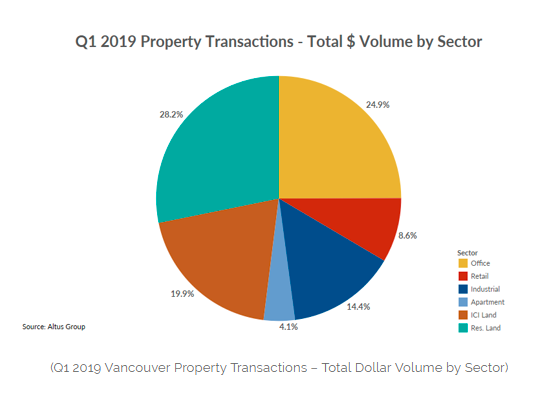
Commercial real estate investment in Vancouver has declined across all sectors except for office, according to a new report from Altus Group.

Overall, the first quarter saw 322 sales transactions for the Vancouver area, representing a 49 per cent decrease from a year ago and the lowest transaction volume in the last 18 quarters. The total number of transactions has also slowed from the pace of last year with a decline of 36 per cent from Q1 2018.

“The lowest transaction volume since Q1 2013 is reflective of the gap between vendor and purchaser price expectations and the lack of product, resulting in decreased market activity,” commented Paul Richter, Director, Data Solutions at Altus Group.

Notably, the residential land sector, which is typically Greater Vancouver’s strongest performing sector, had a slow first quarter. This reduction in activity greatly impacted the region’s overall performance.

Q1 2019 Vancouver

For the first time in 13 quarters, residential land activity dipped under the $1 billion mark to just $446 million, representing a decrease of 68 per cent (in dollar volume) from the previous quarter and 66 per cent year-over-year. Transaction volume witnessed a drop of 35 per cent from Q4 2018 and 53 per cent from the same quarter last year.

Meanwhile, Vancouver’s industrial and retail sectors both experienced similar declines, with the latter recording 35 transactions worth $136 million — down 47 per cent in dollar volume from the previous quarter, and down 78 per cent from Q1 2018.

For its part, Vancouver’s office sector saw 26 deals take place in Q1 — up from 16 transactions in the previous quarter — making it Vancouver’s only net positive sector.

Cap rates

Overall cap rates for the greater Vancouver area remained relatively stable in Q1  Office, retail and industrial each settled at 4.0 per cent, while the apartment market is expected to decompress slightly to an overall average of 3.5 per cent.

The complete report can be found here: https://datasolutions.altusgroup.com/vancouver-investment-stats-q1-2019/

Design revealed for ASHRAE’s new HQ

ASHRAE has revealed design details of its new net-zero energy efficient headquarters building located at 180 Technology Parkway in metro Atlanta, Georgia.

The two-story building, including a partial base­ment, will be designed to provide space for approximately 125 occupants and will have a serviceable life of at least 50 years. Selected materials will be capable of withstanding Atlanta’s hot, humid weather conditions.

According to the press release, some other key project goals are:

  • To demonstrate how to transform older existing buildings from dated workplace environments to high-performance workplace environments;
  • To showcase an affordable, net-zero energy strategy;
  • To provide energy, demand and environmental data from HQ building through web interface;
  • To provide additional sensors and monitoring capability in spaces such as conference rooms, so the data obtained can support investigations and experimental work for ASHRAE research. This includes electronic data storage and manipulation capability and a meteorological monitoring station;
  • To showcase an ASHRAE Building EQ A+ rating;
  • To provide a building environment that sets new standards for worker productivity and wellness through superior visual acuity, daylight, acoustics, thermal comfort and air quality.

“ASHRAE’s global headquarters will inspire our industry to incor­porate energy-efficient and environmentally sustainable practices that reflect an understanding of the high-per­formance building movement,” said Jeff Littleton, ASHRAE executive vice-president.

“The new web presence will provide a step-by-step look into this design project and give visitors an engaging view of ASHRAE’s vision and goals.”

The renovation project is overseen by both a building ad hoc and a technical committee comprised of ASHRAE volunteers. McLennan Design, Houser Walker Architecture and Integral Group have been selected as the design team. The project team also includes Collins Project Management (project management), Skanska (construction manager at risk) and Epsten Group (commissioning agent).

ASHRAE will move to the new headquarters in October 2020.

Image courtesy of ASHRAE.