Articles Archive - Page 503 of 929 - REMINET
REMI

Cannabis use in condos: A case study

It was recently reported in the media that a Mississauga condominium corporation enacted a rule that requires all residents who wish to smoke cannabis in their units to register with the corporation within 30 days of the effective date of the rule. The rule also states that only those who have registered will be allowed to smoke cannabis in their units. However, the rule has an exemption for those who use cannabis for medical or therapeutic reasons.

This rule has caused some controversy among residents. One resident has concerns that the registry infringes on the privacy of residents. However, section 55 of the Condominium Act, 1998 protects information relating to specific units or owners. As the registry will contain information relating to specific units, the registry will not form part of the records of the corporation that owners, purchasers and mortgagees can request to examine.

That same resident also expressed concern that the registry will vilify cannabis users, while tobacco smokers and alcohol drinkers are free to continue these activities without having to register. It appears that the condominium corporation has decided going forward to prohibit residents from smoking in their units and has created the registry in order to grandfather those who were smoking cannabis prior to the enactment of the rule. While the requirement for cannabis users to register with the corporation may be novel, some condominiums have required pet owners to register their pets in order to grandfather existing pets not in compliance with the pet provisions in the condo documents and to assist the corporation in enforcing the pet restrictions in the condo documents.

Prior to the legalization of cannabis, condominium corporations could rely on provisions in the declaration or rules prohibiting illegal activities to prevent or halt the recreational use or cultivation of cannabis on the condominium property. Once the federal government took steps to pass legislation to legalize the recreational use of cannabis, many condominium corporations rushed to enact rules prohibiting cannabis smoking in the units prior to the legislation being enacted. By having the prohibition in place prior to the legalization of cannabis, those corporations would not have to grandfather existing cannabis smokers, as anyone smoking cannabis in the units prior to its legalization was engaging in an illegal activity.

Even though federal legislation has legalized the recreational use of cannabis and the cultivation of cannabis for personal use, condominium corporations can enact reasonable rules or amend the condominium declaration to create provisions that will regulate or restrict these activities on the condominium property.

Amending the declaration is difficult as it requires the written approval of the owners of at least eighty per cent of the units in the corporation.

However, the board can make reasonable rules that promote the safety, security or welfare of the owners and the property and assets of the corporation or prevent unreasonable interference with the use and enjoyment of the common elements, the units or the assets of the corporation. Upon enacting a rule, the board must send a copy of the rule to the owners, along with a statement that the owners are entitled to requisition a meeting. If no meeting is requisitioned within 30 days of the notice being sent, the rule becomes effective on the 31st day. If a meeting of owners is requisitioned the rule will become effective only if the majority of owners at the meeting do not vote against the rule. While all the tenants and residents in the condominium are bound by the rules only the owners have the opportunity to requisition a meeting to challenge a rule.

Denise Lash is Founder of Lash Condo Law.

Surrey courthouse opens with improved features

The renovated provincial courthouse in Surrey has officially opened with new courtrooms and other features to further support access to justice in the rapidly growing lower Fraser Valley.

The $33.5M courthouse expansion began in 2016. Three new courtrooms and two hearing rooms were added, including a high-security courtroom for special-situation trials and a high-volume courtroom for preliminary and bail hearings. New features, which are consistent with technology used by counsel and police, such as touch-screen monitors for advanced evidence presentation, are available in the new courtrooms.

“Our government is committed to providing a justice system that serves all British Columbians,” said Attorney General David Eby. “The Surrey Courthouse has one of the largest caseloads in the province, and this expansion project will help deliver a court system that is able to hear and resolve these cases in a timely manner.”

To boost building security, metal detectors and a walkthrough personal screener have been added to the courthouse’s redesigned front entrance. A ballistic glass wall in the high-security courtroom divides the public gallery from the main courtroom.

The expanded courthouse will house a new Justice Access Centre (JAC), which will provide comprehensive services designed to address family and civil non-family issues. The Surrey Courthouse has the highest number of family law applications in the province, leading to a significant demand for Family Justice Services and community resources. The variety of services offered by the JAC are well suited to meet the needs of the community.

Other new courtroom features include: enhanced video and audio feeds for the public and media to view evidence and courtroom proceedings from the public gallery and media room; videoconference equipment and audio recording systems that are highly integrated with the evidence presentation system; wheelchair-accessible witness boxes; and barrier-free environments for the hearing impaired.

Alberta enables long-term property tax breaks

Local governments in Alberta can now offer property tax breaks on commercial and industrial sites for up to 30 years. Newly adopted amendments to the province’s Municipal Government Act extend provisions that were initially devised to support the rejuvenation of derelict brownfields to all non-residential properties.

To take advantage of the new legislation — which was introduced on June 4th and attained Royal Assent on June 28th — municipal councils will have to adopt a bylaw that sets out parameters for bestowing property tax exemptions or deferrals “for the purpose of encouraging the development or revitalization of non-residential properties for the general benefit of the municipality”. Concessions for qualifying ratepayers would be assured for 15 years, after which councils could renew the incentives for an additional 15 years. Alternatively, councils could cancel the incentives at any time if property holders fail to meet the requirements spelled out in the bylaw.

“This legislation would empower municipalities to attract investment, create jobs and realize their full economic potential,” Kaycee Madu, Alberta’s Minister of Municipal Affairs, remarked last month when the amendments were tabled in the Legislative Assembly.

That’s couched as a means to stand out among North American jurisdictions. The accompanying government communiqué points to five-year and 10-year programs in neighbouring Saskatchewan and British Columbia, as well as shorter term initiatives in Texas and Louisiana. However, others caution the new option could aggravate imbalances within Alberta.

“Definitely, there’s a risk of inter-municipal rivalry,” says Kyle Fletcher, executive vice president, prairie region, for Altus Group’s property tax division. “There is a risk for any city that is not going to implement these changes of losing investment to one that does.”

“If a number of municipalities in Alberta adopt this power, it may attract more employment-based development to the province, but there will be less incentive for that development to locate on brownfield sites than is currently the case,” reflects Luciano Piccioni, president of RCI Consulting, a specialist in brownfield planning and economic development strategies. “If municipalities can defer or exempt property taxes on all non-residential development, it will make brownfield sites less appealing to developers.”

Risks of inter-municipal rivalry and ratepayer resentment

Few local governments have completed the required steps to authorize property tax incentives for brownfield sites in the 18 months since that enabling legislation was added into the Municipal Government Act. Those interested in pursuing the new opportunity will similarly need time to get supporting policies and approvals in place. Knowledgeable observers also speculate that at least one big player is unlikely to make any sudden moves.

“The municipality would have to be in a good fiscal position to start offering these kinds of incentives and, right now, Calgary is not,” observes Dave Mewha, who’s based in the city as Altus Group’s senior director, property tax. “Keep in mind, the property tax system is a closed circle so when you’re offering an incentive to one ratepayer, somebody else is picking up the cost.”

Tax shifts have already walloped many existing commercial ratepayers in Calgary as the sliding assessed value of downtown office towers reallocates the tax burden to smaller and suburban properties. Council recently approved a tax credit program, for the third consecutive year, to soften 2019 shift-related tax increases for approximately 12,000 non-residential ratepayers, which city staff pegged at about $10,000 on a property valued in the $5-million range.

While it may not be politically opportune for some, or many, local governments to consider locking in preferred property tax rates for a select group of investors, the new option positions other municipalities to take advantage of their neighbours’ struggles. For example, Fletcher and Mewha note that tax rates in suburban Rocky View County have been consistently lower than Calgary’s.

“Calgary has a disadvantage in competing for development dollars. If Rocky View implemented these kinds of incentives, that would just hurt Calgary more,” Fletcher says.

Economic development impact unclear

Enid Slack, director of the Institute on Municipal Finance and Governance at University of Toronto’s Munk School of Global Affairs and Public Policy, foresees property tax incentives influencing prospective investors’ choices within rather than between metropolitan regions. Most of the available evidence comes from American studies since property tax incentive programs are more common and longstanding in the United States. From an economic development perspective, analysts suggest the labour market, transportation networks and corporate income tax typically exert greater sway in location decisions, while property tax is more likely to become a consideration after a larger locale is targeted.

“The literature is really mixed. One question is: would the business have established there anyway in the absence of a property tax incentive?” Slack muses. “Businesses locate based on a number of factors and I don’t think property tax is the top one.”

There’s also a concern that municipalities may undercut their residents and businesses in an attempt to undercut each other. “When municipalities start to compete by lowering their property taxes, it’s a downward spiral. At the end of the day, services and infrastructure are going to be affected,” she maintains.

Thus far, there has been little feedback from Alberta’s commercial real estate industry. “Quite a few other things are happening that have overshadowed this and there aren’t a lot of details yet. Nobody has really raised any specific issue that has got anybody really on board or really against it,” Mewha reports.

In an online response to the amendment, reviewers from the Fraser Institute agree that municipalities should have more fiscal flexibility, but label property tax incentives “corporate welfare” that unfairly favour certain businesses and land uses. Meanwhile, the Alberta Urban Municipalities Association (AUMA) advises local governments won’t exercise the option lightly given that property tax is their primary source of revenue and property taxpayers are their political constituents.

“When considering property tax incentives, municipal leaders must be vigilant in how they apply them to ensure all local ratepayers are treated equitably,” it stated just after the Alberta government introduced the legislation. “AUMA appreciates the province’s efforts to offer an additional taxation tool for municipalities and for continuing to respect the principles of local autonomy in how municipalities choose to use those tools.”

Structured, transparent process takes municipal commitment

Alberta municipalities have actually already had an avenue to convey property tax relief for all property types. Section 347 of the Municipal Government Act, which was likewise added as an amendment during recessionary times (1994), gives authority to: cancel or reduce tax arrears; cancel or refund taxes; defer tax collection; or phase in increases or decreases arising from reassessment “if a council considers it equitable to do so”. Some municipalities have used it to support particular projects and/or precincts where they are trying to encourage development.

Legal practitioners suggest the new amendment could effectively take precedence, becoming the established and expected mechanism for providing non-residential property tax concessions. That would also be more transparent for prospective recipients and the public at large.

“There may be challenges to the way municipalities deal with tax incentives for brownfield and non-residential property if sections 364.1 or 364.2 are not followed,” says Jacquelyn Stevens, a partner with Willms & Shier Environmental Lawyers who is called to the Bar in both Alberta and Ontario. “The new incentives will require municipalities to establish criteria and create a structured process rather than having a developer approach a municipality and saying: I want to do this; can I get an incentive?”

Conversely, it could pose a greater obstacle for redeveloping brownfield sites in municipalities that don’t have incentives in place.

“If municipalities don’t feel they need to do anything to support brownfield cleanup, they are unlikely to invest the time and money to establish the criteria and pass the bylaw,” Stevens says. “It becomes an extra challenge, which many municipalities do not have the technical resources to deal with. It’s one more thing on the municipality’s plate for budgets that are already stretched.”

“The problem for municipalities right now isn’t how to provide incentives. It’s how to meet their budget,” Mewha concurs.

Barbara Carss is editor-in-chief of Canadian Property Management.

B.C. building projects win net-zero challenge

Eleven building projects in B.C. have won the Net-Zero-Ready Challenge, one of many CleanBC programs aimed at making buildings all over the province more comfortable and energy-efficient.

“By using more clean energy and using it more efficiently in our buildings, we’re taking action to improve air quality and reduce energy costs for British Columbians,” said Michelle Mungall, Minister of Energy, Mines and Petroleum Resources.

“Part of our CleanBC plan, the Net-Zero Energy-Ready Challenge is showcasing best practices in building design and providing support to leading innovators across the province. Congratulations to all of the final winners.”

Net-zero energy-ready buildings are designed and built to be so efficient that they could meet all or most of their own energy consumption requirements with renewable energy technologies.

The competition received 51 expressions of interest which included more than 170 different organizations as proponents, suppliers or partners. In January 2019, 16 of those projects were selected as winners of the design incentive portion of the competition. The winners were then asked to submit more detailed applications for the construction incentive portion of the competition.

The $2.5-million program provides up to $390,000 in financial incentives to offset a portion of the cost to build to the highest energy performance standards.

The final 11 winners are:

  • Corvette Landing, Esquimalt, Standing Stone Developments
  • The Narrows, Vancouver, 51565 BC Ltd
  • Vanness, Vancouver, Community Land Trust
  • OSO, Golden, Viddora Developments
  • 825 Pacific, Vancouver, Grosvenor Americas
  • UVic Student Housing/Dining, Victoria, University of Victoria\Skeena Residence, Kelowna, UBC Properties Trust
  • SFU Parcel 21, Burnaby, SFU Community Trust
  • 2150 Keith Drive, Vancouver, Bentall Kennedy
  • Peat Commons Phase 2, Langford, Peat Commons Inc.
  • Carrington View – Building A, Kelowna, Highstreet Ventures.

Winners will showcase their winning designs and share design best practices at an open house event to take place later this year.

Partnership urges Canadians to rethink plastics

Canadian Geographic and Recycling Council of Ontario have partnered to launch Canada’s commitment to rethink plastics through an innovative plastic engagement program funded by the Government of Canada – 10,000 Changes.

“We all recognize that we have reached the tipping point in our history when it comes to waste, and specifically, plastic pollution,” says Jo-Anne St. Godard, executive director, Recycling Council of Ontario. “10,000 Changes offers Canadians the information and tools they need make simple changes about plastics, specific materials, and alternatives; and serves as a vehicle to recognize innovation, leadership, and most importantly, action to mitigate plastic waste.”

According to the press release, over the next 12 months, 10,000 Changes will:

  • offer a series of resources to help citizens, corporations, and businesses reduce their plastic waste;
  • provide important tools and resources to help shift behaviour through engagement;
  • provide Canadians with the tools they need to make informed decisions about plastics, and celebrate corporate innovation and individual action.

“Canadians and Canadian businesses are concerned about the impact of plastic pollution on our environment,” says John Geiger CEO of The Royal Canadian Geographical Society and Canadian Geographic Enterprises. “Through 10,000 Changes, Canadians now have a one-stop resource to learn about alternatives to plastic products that Canadian businesses are innovating to reduce our dependence on plastics.”

ECCC looks to expand protections for migratory birds

Environment and Climate Change Canada (ECCC) recently proposed changes to the  Migratory Birds Regulations (Regulations), which will replace the existing regulations under the Migratory Birds Convention Act (Act).

According to the ECCC’S statement, the new Regulations contain many changes that can be classified as modernizing or administrative in nature, some of which will provide clarity that has been previously lacking. However, there are also proposed changes to the prohibitions which, if registered and enforced as written, could have a significant impact on industrial, commercial and individual activities across Canada.

The conditions which allow the hunting of migratory birds have been modernized and the additional circumstances where birds may be deliberately killed or scared when they are causing damage have been clarified and slightly expanded. But the Regulations have not been amended in a way that would enable permits or other regulatory instruments to allow for activities that result in non-direct, incidental harm to birds or their nests.

The expanded prohibition on incidental harm to birds has the potential to cause significant challenges for practically any activities carried on outdoors in Canada. If implemented as currently proposed, clearing land, operating heavy machinery, farming, operating energy projects, building high-rise buildings, using nighttime lighting, setting off fireworks, or even driving cars, all have the potential to cause the prohibited harm to birds and result in contravention of the Act.

Read more about the proposed changes here.  ECCC is seeking input on the proposed new regulations until July 31, 2019.

CBRE selected to manage B.C. government portfolio

CBRE has been selected to provide facilities and project management and related services across the Province of British Columbia’s 17-million-square-foot real estate portfolio.

Managed through the Province’s Ministry of Citizens’ Services (Ministry), the portfolio contains a mix of leased, owned and managed assets. Under the five-year contract, the company will provide repairs, maintenance, landscaping, janitorial and construction services at government facilities, such as courthouses, warehouses, correctional centres and government office buildings.

The Ministry’s Real Property Division is responsible for providing innovative, responsive and cost-effective real property services to the public sector. Through a fair, open and collaborative procurement process, the Ministry identified CBRE as the service provider that would deliver maximum value to the Province through high service quality, innovation and a broad range of experience in implementing industry-leading best practices.

“The goal of our bid process was to identify a service provider to deliver services that align with our key government priorities, like our Clean BC Government Buildings Program,” said Sunny Dhaliwal, Assistant Deputy Minister, Real Property Division, Ministry of Citizens’ Services.

“This new agreement will ensure British Columbians get the best value for money, provides social benefits to people and businesses, and creates good-paying jobs while improving the condition and performance of our buildings. We’re confident we’ve found a strong partner with CBRE.”

Werner Dietl, President and CEO of CBRE Limited said, “We’re excited to support the Ministry in its mission of delivering efficient and effective services. We also are eager to implement the solutions we’ve developed from managing 6.1 billion square feet of facilities globally and from managing other large, prominent, public portfolios in Canada.”

The five-year contract, which starts in April 2020, will earn the firm $190 million a year. It also allows for two optional five-year renewals.


Communication tips for building service contractors

When you’re working in the service industry,  internal communication is absolutely critical to success. The smoothest-running building service contractors (BSCs) have consistent communication plans within their teams to ensure that everyone is aware of the needs of each building, problem areas, timelines, training schedules and more. But what about your communication plans with your customers? Have you taken a look at the ways you are keeping your clients up to date on all that you’ve been doing to take care of their buildings? To ensure that you keep clients for years to come, you will want to have a well-defined plan for continuous communication with each and every one of them.

Here’s why: They need to understand what your team is developing for them, what the timeline looks like, and why some options were chosen while others were avoided. You need to know their expectations, needs and goals. You can spend time, energy and resources on making buildings cleaner, safer and healthier, but if your customers don’t know what you’re up to, you’re missing the mark.

Customer Satisfaction Surveys
First, you’ll want to get a very clear understanding of your clients’ goals, values and needs. How do you find that out? We suggest a periodic survey, either via email or over the phone. Or, better yet, incorporate a questionnaire into in-person meetings. In this survey, you will want to ask customer satisfaction questions, but also include questions that help you better understand your clients’ needs and circumstances. Make sure to include a few open-ended questions on your survey. This will allow your customers to respond with honesty and authenticity, and may just reveal certain truths you never considered. It’s best to follow up shorter questions with a “Why?” and to keep your open-ended questions toward the end of your survey.

Remember, it has been shown that up to one-third of respondents will lie on surveys. You’ll also have to accept that people won’t always respond to surveys. In-person surveys are always your best bet for ensuring participation and honesty. However, that’s not always possible. To encourage customers to respond, consider offering a special promotion for respondents, especially one tied to saving money.

After you have received your feedback, what will you do? The great news is that you are armed with data to make important decisions at your BSC now. Communicate that data to your customers! Personalized communication that says, “This is what we learned about you,” followed by ways your business can help customers solve problems and meet goals is going to be ideal. But how do you do that?

Add a Personal Touch
No matter which medium you choose to communicate your goals and accomplishments with your clients, remember to be personal. Especially in this digital world, a handwritten note, personal call or—better yet—in-person visit can make a significant impact on your relationship.

If you notice a client has expressed certain needs or goals in their customer survey, respond in kind. Call out their responses and give them some information on how you can meet their needs.

For example, did one of your bigger facilities rate safety as the highest priority in their buildings? Then you should follow up with communication that clearly explains the ways you prioritize safety in the important work you do. Floorcare would be an excellent subject to discuss. Find options to reduce slip-and-fall options with your floor care program, and discuss these options with your customer. Then show them the data you’ve found or experienced regarding safety to prove that this is important to you, too. Keep that dialogue personalized and continuous.

Be Prompt and Accommodating
After you send your survey and receive feedback, update your clients rather quickly. You don’t want to keep them waiting for months before you remind them you took their answers seriously. We recommend following up no longer than six weeks later, tops. One month would be ideal.

You know your clients best. Adapt your communication medium to best suit their styles. If you’re sending emails to a client that’s never at a desk, you will be wasting your time. Perhaps you would like to include a question about preferred communication styles in that survey you send!

Sometimes a collaboration tool can be a welcome avenue of communication beyond just another email in an inbox. Trello, Slack, GoToMeeting and so many more tools can be customized to work for you and your clients as an interactive way to keep in constant touch, track building issues and progress, and keep tabs on goals and expectations. No matter what medium you choose for your daily communications, keep phone calls and in-person meetings in the mix. You’ll want to hop on the phone periodically to be able to have open and transparent conversations about your work and to get up-to-date feedback from your clients.

By asking the right questions of your clients to better understand their needs and goals, choosing the right channels and making sure your message is clear, relevant and personal you will be on your way toward lasting relationships with your customers.

Charlotte Products is a manufacturer of cleaning products with manufacturing facilities in Canada and the U.S.

Whitehorse compost facility undergoing green upgrades

The Government of Canada has earmarked $3.3M from its Green Infrastructure Stream (GIS) program to support upgrades to Yukon’s Whitehorse Compost Facility.

The funds will go towards several sustainability upgrades and improvements, including an improved storm management system, mechanical upgrades, and enlarged gravel and concrete surfaced working areas – the combination of which will allow for more organic waste to be collected and processed through the building.

“Investing in green infrastructure solutions is an essential part of building livable, modern communities. The project we are celebrating today will provide the City of Whitehorse with improved compost management capabilities, and a cleaner environment,” said Marie-Claude Bibeau, Minister of Agriculture and Agri-Food, speaking on behalf of François-Philippe Champagne, Minister of Infrastructure and Communities. “This is an excellent example of what Yukoners can do when we work together at all levels of government to build stronger, more self-sustaining communities.”

The Government of Yukon is contributing $1.1M to the project, and the City of Whitehorse itself has pledged $40,000 to the initiative. Whitehorse Mayor Dan Curtis says the project will further the region’s goals to achieve a waste diversion rate of 50 per cent, adding, “Now is the time to expand the facility, so that we can manage the increased volume of organic waste, continue exercising responsible environmental sustainability and process our compost, which has been OMRI certified for organic use.”

Federal support for the project comes as part of the Government’s Investing in Canada infrastructure plan, which will see more than $180B invested in green infrastructure, transit projects, social infrastructure, and both rural and northern communities over the next 12 years.

Energy exposure fuels Calgary office woes

Key service centres for the oil and gas industry are at differing junctures in Canada and the United States. JLL’s newly released overview of office and industrial space trends in North American energy hubs contrasts the shale boom bolstering U.S. economic activity with the logistical constraints squeezing Canadian producers — and also flowing through to Calgary and Edmonton’s commercial real estate markets.

“Canadian WCS oil has been stuck in transit,” JLL analysts observe. “There is a lack of capital spending and a struggle to attract foreign investors to the sector until the pipeline capacity and exporting issues are addressed.”

The report underscores Calgary’s deep exposure to the volatile sector. Even with the 25 per cent downtown vacancy rate largely attributable to persistent low oil and gas prices and massive layoffs in the sector, energy-related tenants still account for nearly 39 per cent of office occupancy. That’s about 17 million square feet in a total inventory of 43.7 million square feet.

Houston also hosts a high concentration of energy tenants, filling 60 million square feet of the total 168 million square feet of office inventory. JLL analysts lump both cities into the hard-hit category, whereas the Dallas and Denver office markets are deemed to be landlord-friendly.

Of the latter, Dallas has a relatively small contingent of large energy players, including Exxon, Pioneer and Kosmos, that comprise less than 3 per cent of the city’s more diversified tenant base. Denver has the smallest office inventory at 30.2 million square feet with 1.1 million square feet under construction. Meanwhile, about 430,000 square feet of office space is still under construction in Calgary and 3 million square feet is under construction in Houston.

Relocation and downsizing typify leasing deals

“While the macroeconomic environments in markets like Houston and Calgary have seen improvements over the last quarter, the office inventories there still struggle and occupiers will retain negotiating leverage in upcoming years,” the report projects. “Weak demand and enormous inventories of vacant space remain.”

Energy firms drove Calgary office leasing deals in the first quarter of 2019, but in a way that had few landlords celebrating. The largest transactions involved companies relocating and downsizing into smaller spaces so that 1 million square feet of leasing resulted in a more modest 381,000 square feet of net absorption.

Notably, Nexen left more than twice as much space behind when it moved into 300,000-square-foot quarters in the Bow building. TransAlta similarly filled less than half the footprint it had vacated when it moved into 124,000 square feet in the beltline’s Keynote Tower.

Energy firms have dumped 55 per cent of the approximately 2.7 million square feet of sublease space now on Calgary’s market. There has been even greater offloading in Houston, where they’ve contributed nearly three quarters of 7.7 million square feet of sublease space.

Gulf Coast drawing investment

However, turning to industrial, the dynamics are more robust in Houston. Energy-related tenants have leased 3.1 million square feet of space since the first quarter of 2018, contributing significantly to 5.4 million square feet of industrial absorption in the same period. Average asking rent in the first quarter of 2019 was USD $5.76 (CAD $7.54) per square foot. The average lease size was more than 82,000 square feet versus 20,000 square feet in Calgary or 30,000 square feet in Edmonton.

Much of the Houston activity is tied to petrochemical products rather than resource extraction. “There has been $60 billion in petrochemical investments in recent years along the Gulf Coast and many of these products are processed, refined or packaged in the Houston area. Additionally, Houston handled over 40 per cent of the nation’s resin exports in 2018 and further growth is expected in the period ahead,” the report advises.

That’s a significant part of the bigger national picture. “Since 2010, natural gas from shale formations is driving a projected $204 billion in new capital investment across 330 chemical industry projects, according to the American Chemistry Council. This processing, refining and packaging of plastics and resins is occurring largely along the Gulf Coast, though significant ethane production will also come online in Pennsylvania in 2021 with the completion of Shell’s $6 billion cracker plant,” the report explains.

Logistics and distribution emerging

Industrial also offers a more upbeat story in Calgary, but it doesn’t have an energy narrative. Over the past year, 350,000 square feet of leasing from energy tenants made a fairly modest contribution to 3.3 million square feet of net absorption. The average asking rent for Q1 2019 was CAD $9.35 (USD $7.10) per square foot.

“Growth in the industrial sector is strongly centred around it being a desired location for distribution,” JLL analysts conclude. “This can be viewed as cause-and-effect based on a tight Vancouver market, in addition to the geographical location of Calgary, making it accessible to large markets in a 24-hour drive time. Investment in Calgary remains consistent and is continuing to trend in a positive direction. Again, this investment is focused on speculative-built, institutional grade distribution facilities.”

Edmonton industrial facilities have been more conventionally tied to upstream oil and gas production, and have suffered accordingly as energy-related employment in the sector declined by more than 12 per cent since 2015. Energy-related tenants filled about 750,000 square feet of the 1.6 million square feet of industrial absorption since the first quarter of 2018.

As with Calgary, JLL points to the emergence of distribution and logistics to diversify a “highly energy concentrated” tenancy, but projects it will remain a tenants’ market until 2021. Even so, Edmonton’s 5.8 per cent industrial vacancy rate is just 20 basis points higher than Calgary’s and it commanded a higher average asking rent of CAD $9.45 (USD $7.18) per square foot in the first quarter of 2019.

Strathcona offers new hybrid mixed-use typology

Strathcona Village, designed by GBL Architects, is a mixed-use industrial and residential development considered the first of its kind in North America.

The 300,000 square foot building covering almost an entire city block is located on East Hastings Street in Strathcona, one of Vancouver’s oldest neighbourhoods. The site of the development, near the downtown core, on the edge of the Port of Vancouver, has historically been one of industry.

An innovative approach was called for to maintain existing industrial space while increasing the local housing supply in the area. The Strathcona Village project successfully pioneered the integration of previously considered incompatible programs into a new hybrid mixed-use typology for Vancouver.

The development is a sustainable community model, providing much needed affordable housing, while maintaining and generating light industry in the neighbourhood where approximately thirty percent of its population work locally. The building includes 70 units of city-owned social housing, 23 of which are rented at shelter rates in addition to 17 that are designed for families with young children, meeting the Downtown Eastside Housing Plan.

“Strathcona Village’s mix of uses, combining much-needed affordable homes with job spaces in PDR (production, distribution repair) demonstrates how innovation in planning and development can help us achieve our city’s sustainability and economic goals,” said Kira Gerwing, former City of Vancouver planner, currently senior manager of community investment, Vancity Credit Union.

“This project represents a model of revitalization without displacement in a neighbourhood that still strives for meaningful development policies that enable economic inclusion coupled with safe and adequate housing. This model for mixed-use projects that retain light industrial businesses should scale to other urban centres in our region. We know these uses are critical to building a robust, diverse, and sustainable urban economy.”

The building’s mass is distributed across three low rise residential towers that sit atop a substantial multilevel mixed-use podium. By taking advantage of the site’s one-storey topographic drop between the main street and the laneway, the industrial program in combination with retail and office spaces, are located at grade across two, double-height levels of podium.

“Incorporating these light industrial uses on the ground level allowed us to accommodate a significant portion of the development to residential use without altering the character of the neighbourhood,” explained Daniel Eisenberg, project lead, GBL Architects.

Careful design considerations and programmatic distribution create an animated cadence along the building’s main public elevation with the industrial spaces, defined as Production, Distribution, and Repair (PDR) interspersed with residential entrance lobbies. The robust and lively nature of the PDR space is celebrated through the inclusion of large doors and windows that open directly onto the main street providing superior working conditions within and enhancing interchange with the public realm.

The street elevation zigzags along its length, emulating the historic ‘sawtooth’ massing pattern of the main street. This articulation provides open space at grade for residents in addition to creating a generous south facing public plaza at the eastern end of the development.

The 3,000 sf plaza is a focal point for activities at street level, with a pedestrian access route through the building the public is invited to access the industrial spaces, which may include ancillary retail, and to share breathtaking mountain views overlooking the Port.


Electrical code changes property managers should know

On May 16, Ontario’s new Electrical Safety Code took effect and there are some changes that building owners and managers should know. The Ontario code adopts, by reference, the Canadian Electrical Code, and adds on top of that Ontario-specific amendments. Among the changes that could affect building owners and property managers:

  • Requirements for installing an identified (neutral) conductor at each control (switch) location of permanently installed luminaire;
  • Alignment with the Ontario Building Code to prevent the installation of high-voltage conductors over buildings;
  • Providing adequate working space for electrical workers to undertake necessary repairs, maintenance and installation of transformers greater than 50kVA;
  • Prohibiting of installation of cables in concealed locations in metal corrugated roof decking
  • Adding requirements for Energy Storage systems; and
  • Facilitating the use of Power over Ethernet (POE) cables to provide a pathway for sources of electricity.

All electrical work must align with the Ontario Electrical Safety Code

Property owners are required to regularly maintain and repair electrical systems to ensure they are in safe working order. That means that as they conduct repairs and ongoing maintenance to the electrical systems within their building, it’s important to ensure that they’re operating according to the most up-to-date standards available—that means that all electrical work must be done in accordance with the most recent version of the Code.

Unfortunately, that doesn’t always happen. A survey[1] of property managers in Ontario conducted in 2015 indicated that close to 35 per cent didn’t realize the Code applies to electrical work in their buildings. But it does. In fact, the Code must be followed for ­all electrical work – maintenance, repair and new projects.

The best way to ensure that work is up to code is to work with a Licensed Electrical Contractor (LEC). LECs are familiar with the Code and they’ll ensure that the necessary notifications (also referred to as permits) are obtained to facilitate review of the electrical work by inspectors from the ESA.

The dangers of unlicensed work
For building owners and managers who don’t do their due diligence, the implications can be catastrophic. First, by working outside the safety system, you put tenants at risk. According to the Office of the Fire Marshall and Emergency Management[2], between 2012 and 2016, there was an average of 23 fire injuries per year where the ignition source was electrical wiring—working to Code ensures that your electrical system is as safe as possible.

Next, fixing bad work can be far more expensive than doing it right the first time. If an inspector comes across work that’s not up to Code, they can shut off the connection to the grid if the risk is high enough. To get the building back up to Code as soon as possible, you may need to do emergency rush work, which costs a significant premium.

Ageing infrastructure a growing problem

As a modern regulator, ESA is committed to identifying potential threats and mitigating risk quickly as issues emerge. We’ve identified ageing infrastructure as one such emerging issue. [3]

When new innovations are introduced, buildings don’t simply throw away what existed before. There are millions of buildings and houses across Canada operating with old electrical systems that haven’t necessarily been upgraded to meet modern safety standards. This is especially true of large multi-residential buildings.
According to the Canada Mortgage and Housing Corporation (CMHC)[4], three-quarters of the country’s primary rental stock was built before 1980, with 25 per cent built before 1960. This means that the majority of rental properties built in Canada are at least 40 years old, with many of those buildings much older than that. In Ontario, 85 per cent of purpose-built rental units are more than 35 years old[5].
Property owners or managers can be proactive in maintaining their building’s electrical system by working with a LEC to create a preventative maintenance plan. A LEC partner should be selected based on their experience working with buildings of a similar type, age and with similar equipment. Their plan would include scheduling inspections regularly to ensure that issues are addressed, and their systems are up-to-date.

By following the updated Code and working with trained professionals, you’re doing your part to keep people safe while also limiting your own liability. It’s a win-win for all of us, we all want to be safe in our homes and at work

Dr. Joel Moody is the chief public safety officer at the Electrical Safety Authority.

[1] Electrical Safety Authority survey of Property Managers in Ontario from November 30 to December 14, 2015.
[2] The Office of the Fire Marshall and Emergency Management, Ontario Residential Fires: Injuries 2012 to 2016.
[3] Electrical Safety Authority, Ontario Electrical Safety Report, 2017.
[4] CMHC, A Profile of Purpose-Built Rental Housing in Canada, April 2016.
[5] Federation of Rental-housing Providers of Ontario; Ontario Rental Market Study: Measuring the Supply Gap, September 2017.

Samuel De Champlain Bridge opens in Montreal

The Samuel De Champlain Bridge has officially opened in Montreal. The $4.4B bridge is one of Canada’s largest infrastructure projects.

The bridge was built and will be operated for the next 30 years through a public-private partnership between the Government of Canada and Signature on the Saint Lawrence Group.

T.Y. Lin International, in a joint venture with International Bridge Technologies and SNC-Lavalin, served as the managing partner and lead designer for the 3.4-kilometer-long replacement bridge. The Samuel De Champlain Bridge opened in two phases, with the northern lanes toward Montreal opened on June 24, 2019, and the southern corridor toward Brossard opened on July 1, 2019.

Designed by a team composed of Arup and architects Dissing+Weitling and Provencher Roy & Associates, the new bridge has a projected useful life of 125 years.

Serving as a major gateway into the City of Montreal, the Samuel De Champlain Bridge comprises three independent superstructures supported by common piers. These include the 529-meter-long, asymmetric cable-stayed bridge signature span, with a main span of 240 meters; the 762-meter-long East Approach, with a maximum span of 109 meters; and the 2,044-meter-long West Approach, with a typical span of 80.4 meters.

Project partners had to meet an aggressive design-build schedule. Along with stringent design and performance criteria, the project came with various site constraints and hazards. These included construction under Montreal’s severe winter conditions, wind and seismic hazards, navigational requirements, no-construction zones, construction in a densely developed urban center, and strict compliance to the architectural requirements of the project.

The Samuel De Champlain Bridge replaces the old Champlain Bridge, which opened to traffic in 1962 and stood as one of Canada’s busiest crossings. The new bridge will carry approximately 50 million crossings each year, representing international trade valued at $20 billion.

Rental prices leveling out in major European cities

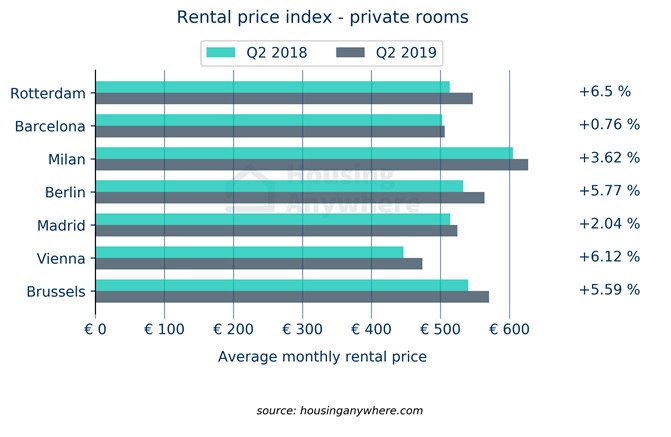
After continuous, and sometimes steep, increases in rent in major European cities over the past few years, prices seem to have plateaued and are leveling out this quarter, according to the HousingAnywhere International Rent Index for July 2019.

The HousingAnywhere International Rent Index analyses data from over 88,417 rental listings covering a timespan from Q1 2018 to Q2 2019 in major European cities, including: Barcelona, Berlin, Brussels, Madrid, Milan, Rotterdam, and Vienna.

“We already caught a glimpse of rental prices reaching a ceiling in the past quarter, but now the trend has been substantiated,” says Djordy Seelmann, CEO of HousingAnywhere. “Tenants are simply not willing or able to pay higher rents, even though the scarcity on the housing market remains as concerning as it was a year ago.”

While all markets saw rental prices increase once again in Q2 of 2019, the rise was considerably less steep than in previous quarters. Across all the cities indexed for rental prices, Barcelona has shown the biggest overall increase year over year. But looking at this past quarter, Barcelona is now among the cities showing the smallest overall increase.

“A ceiling is being approached, but this slowdown is not caused by a rise in the number of apartments, studios, and rooms on offer,” Seelmann says. “There is still an urgent need for solutions that increase the number of apartments and rooms, to solve the European-wide problem of housing for young professionals and students.”

Europe rental prices 2019

Markets continuing to climb

Across all of the cities indexed for rental prices, Barcelona has shown the biggest overall increase year over year. Prices for apartments have risen by 10.07 per cent, studios by 7.17 per cent, and private rooms by 0.76 per cent. Prices are leveling out however, as a ceiling seems to have been reached: solely looking at the past quarter, Barcelona is among the cities showing a small overall increase.

Rotterdam, as compared to 2018, shows rising prices across the board with a 3.27 per cent increase for apartments, 7.31 per cent for studios and 6.50 per cent for private rooms. With an average rent of EUR 1287 per month, Rotterdam is the most expensive city in the HousingAnywhere International Rent Index.

Brussels remains one of the cheapest cities to rent in, but compared to 2018, this city witnessed an increase in apartment prices by 2.93 per cent, studio prices by 8.99 per cent and private rooms by 5.59 per cent. The wide availability of housing, and the flexible attitude of the municipality regarding project development and building transformation, ensures a healthy rental market, for both tenants and landlords.

Rental cap: “Not a long-term solution”

Following the news that Berlin was going to apply an ‘emergency cap’ to rent, the demand for such a measure grew in other European cities. In the Netherlands, the option is currently under examination by the House of Representatives, and the ‘emergency cap for middle segment rents’ is widely supported.

But, although a rental freeze could stop rental prices from increasing further, Seelmann argues it does not change what is on offer. “If real estate developers earn less, the housing market becomes a less appealing investment option. We already see an effect on the number of real estate deals that are closed,” he said, referring to statistics cited in the Europe Capital Trends report by Real Capital Analytics. “The European average in real estate deals is down by 32 per cent – its lowest point in six years. Stimulating new construction remains the best solution to real-estate scarcity. In the shorter term, the re-development and -design of existing buildings can also offer some room for breathing. There is an urgent need for dialogue between the stakeholders – that is; tenants, landlords, property investors, and politicians. Only then can a long-term and sustainable solution for the housing market can be found.”

Multi-unit construction boosts housing starts in June

The trend in housing starts was 205,838 units in June 2019, compared to 200,530 units in May 2019, according to CMHC. This trend measure is a six-month moving average of the monthly seasonally adjusted annual rates (SAAR) of housing starts.

“The national trend in housing starts increased in June, primarily due to higher trending row and apartment starts, in urban areas,” said Bob Dugan, CMHC’s chief economist. “The strong surge in the SAAR of apartment starts in April is also contributing to the high level of the trend measure of total housing starts in June”.

Monthly Highlights:

Vancouver

Vancouver Census Metropolitan Area (CMA) housing starts trended higher in June, due to increased housing starts in the multi-unit sector. The majority of the multi-unit housing starts were concentrated in the City of Vancouver and the City of Richmond. Overall, the year-to-date starts increased by about 25 per cent, supported by population growth and continuous strengthening of economic fundamentals.

Edmonton

Housing starts in Edmonton CMA trended higher in June, with single-detached starts declining slightly while multi-units starts doubled compared to the same month last year. With a high level of unsold inventory, the year-to-date starts saw a decline compared to the same period last year, as builders shift focus from starting new projects to completing existing ones while the economy continues to recover from the economic downturn.

Lethbridge

In the Lethbridge CMA, total starts trended higher in June 2019 compared to the previous month. The respective trend increased across all types of housing units in June. Construction activities picked up as the demand for new homes increased supported by growth in the millennial population.

Saskatoon

The trend measure of total housing starts in Saskatoon rose further in June after homebuilders increased the pace of multi-unit construction. While the trend moved higher, actual starts of all housing types decreased by 16 per cent during the first six months of 2019, compared to the same period in 2018. A number of factors, including higher construction costs and weaker new home demand, have contributed to builders scaling back production of new housing units so far this year.

Winnipeg

In June 2019, the trend in total housing starts in the Winnipeg CMA trended higher compared to the previous month. For the first half of 2019, total starts trended 15 per cent higher compared to same period the previous year, driven mainly by apartment starts. The 89 per cent increase in apartment starts for the first half of 2019 supports the growing demand for rental accommodations in the CMA. Single-detached, semi-detached and row starts all trended lower in the first half of 2019 compared to the same period in 2018.

Greater Sudbury

The trend for overall housing starts in the Greater Sudbury CMA moved higher in June, owing to an increase in the trend for semi-detached starts. Semi-detached units are not readily available in the local resale market and tend to come at a more affordable price point for prospective first-time buyers looking for a new build.

Kingston

Following a strong performance in 2018, the actual total starts in Kingston CMA during the first half of 2019 were down 14 per cent from a year earlier. The decline was most pronounced in the multi-unit segment due to substantially lower starts of semi-detached and rows, while the number of apartment starts was almost on par with the previous year. In response to the persistently low vacancy rates over the past ten years, all apartment starts through June 2019 were rental.

Toronto

The total housing starts trend in the Toronto CMA remained virtually unchanged in June from the previous month with row and semi-detached home starts trending slightly lower, while apartment and single-detached homes trending slightly higher. Overall, multi-unit home starts continue to dominate construction so far this year as more homebuyers choose lower priced condominium apartments and row houses over higher priced single-detached homes.

Kitchener-Cambridge-Waterloo

Total housing starts in Kitchener-Cambridge-Waterloo trended up in June. The increase came from higher starts of multi-unit homes (semi-detached, rows and apartments), as single-detached starts went in the opposite direction. Apartment starts continue to dominate, largely owing to the development occurring around the new light rail transit line. The moderation in single-detached starts can be linked back to low pre-construction sales in the second half of 2018.

Sherbrooke

Residential construction in the Sherbrooke CMA has been particularly strong since the beginning of the year. In fact, 984 housing units were started in the area during the first half of 2019—the highest level in over 30 years. The increase in activity was attributable mainly to the rental housing segment, as both purpose-built and seniors’ rental housing projects got under way. Overall, residential construction in the area has continued to be supported by the rise in full-time employment, migration and the aging of the population.

Québec

From January to June 2019, foundations were laid for nearly 2,600 housing units in the greater Québec city area, a number similar to that recorded during the same period in 2018. Once again this year, activity was supported mainly by the construction of rental housing, which accounted for about two thirds of the dwellings started. This market segment has been stimulated by several factors, including greater demand for apartments due to the aging population.

Halifax

Total housing starts in Halifax continue to gain momentum in June, expanding by 45 per cent year-over-year. The apartment segment remains the dominate driver of residential construction as strong population growth, especially apparent in the young adult population, and historically low vacancy rates support demand. The number of apartment units that broke ground this month reached the highest peak since 2015, as multi-unit starts year-to-date climbed by 62 per cent compared to the same period last year.

CMHC uses the trend measure as a complement to the monthly SAAR of housing starts to account for considerable swings in monthly estimates and obtain a more complete picture of Canada’s housing market. In some situations, analyzing only SAAR data can be misleading, as they are largely driven by the multi-unit segment of the market which can vary significantly from one month to the next.

The standalone monthly SAAR of housing starts for all areas in Canada was 245,657 units in June, up 26 per cent from 196,809 units in May. The SAAR of urban starts increased by 26 per cent in June to 234,238 units. Multiple urban starts increased by 31 pe cent to 185,804 units in June while single-detached urban starts increased by 8 per cent to 48,434 units.

Rural starts were estimated at a seasonally adjusted annual rate of 11,419 units.


Government invests in deep energy retrofits

A new government-funded project led by The Atmospheric Fund will invest $5.75 million toward deep energy retrofits, including heating, cooling, lighting systems, and other measures to reduce wastage in four multi-residential buildings in the cities of Toronto and Hamilton.

These deep energy retrofits are expected to reduce energy consumption by 40 per cent in the buildings, cut energy bills and improve resident comfort. The four properties include Toronto’s “Palace Place” at Palace Pier Court, an apartment complex at 155 Wellesley Street E, and two community housing buildings located in Hamilton.

“The Government of Canada and the Federation of Canadian Municipalities work together to support green infrastructure projects that are building healthier and cleaner communities now and for future generations,” said Marco Mendicino, Parliamentary Secretary to the Honorable François-Philippe Champagne. “Through partnerships like this we are helping provide solid 21st-century infrastructure to communities across the country. This housing retrofit in Toronto and Hamilton will help reduce greenhouse gas emissions, lower energy costs and tangibly improve the quality of life for the residents who live there.”

The upgrades are in line with the City of Toronto’s TransformTO Climate Action Strategy, a long-term approach to reducing greenhouse gas emissions in the City by 80 per cent by 2050.

Through green infrastructure, the communities are improving the environment, gathering and sharing important lessons to maximize municipal resources, and improving the lives of citizens.

The Green Municipal Fund is funded by the Government of Canada and delivered by the Federation of Canadian Municipalities.

“Energy efficiency saves money, creates jobs and reduces pollution,” said The Honourable Amarjeet Sohi, Canada’s Minister of Natural Resources. “Our government will continue to work with the Federation of Canadian Municipalities to make Toronto and Hamilton’s buildings more energy efficient. Together, we are lowering buildings’ energy costs and maintenance requirements while contributing to Canada’s clean energy future.”

Mayor John Tory was also on site as the official announcement was made July 8th in Toronto.


Innovative ways to fill units faster

The rapid pace of innovation in the real estate industry has given rise to disruptive technologies. In recent years, the market has started to shift nearly every aspect of the rental process, from standard communications to leasing applications. The digital transformation has affected all stakeholders in real estate.

With this immense transition, modern marketing technologies have changed as well. Real estate investors and property managers now have access to novel tools that help them outpace the competition. Through the latest systems and software, they can attract attention to their rentals and increase occupancy rates.

Of course, this isn’t sudden, and early innovators like Zillow and Trulia have been providing real estate information online for some time. That said, newer innovators have taken a different approach, expanding on earlier marketing technologies and methods. They’ve harnessed data to enhance analytics while increasing efficiency for apartment seekers.

In 2019, marketing technologies have only continued to improve. Real estate professionals have a wide variety of advanced options to assist them in achieving their goals. This article seeks to explore and examine those options, assessing the value of the marketing solutions available today.

Mobile apps for listings

More than 90 per cent of people searching for their next place to live look online first, and more than 60 percent browse on mobile. This statistic speaks to the importance of digital literacy for investors and property managers, capitalizing on apps that have made the search process faster and easier.

Oliver is only one example of a real estate startup that has empowered tenants through technology. The group has launched a platform that seamlessly connects renters with apartments, simplifying the experience for everyone involved. The way the app works is comparatively simple and straightforward.

By aggregating real-time rental inventory directly from landlords and property managers, the app enables renters to browse and filter listings, schedule showings and use a calendar feature. The removal of inefficiencies and third parties has created convenience for both real estate professionals and those they serve.

3D architectural renderings

Virtual staging is a valuable asset that assists in the presentation of a property. When a potential tenant is browsing rentals online, a real estate professional can use the software to illustrate various aspects of a building and the surrounding area. Developments in 3D architectural rendering have refined this strategy.

With 3D architectural rendering, real estate professionals can now show how a property will appear after any necessary repair work wraps up. Clients can also see what the interior of a property will look like with rugs, furniture and wall hangings. It’s a technical advancement that allows apartment seekers to envision themselves within a space.

As an example, real estate professionals who are marketing units under construction or renovation can quickly illustrate proposed modifications to existing plans, showcasing listings before they’re available for in-person viewings. A few clicks of a mouse can create a 3D image, reducing the chance of human error as the project proceeds. No guesswork is necessary.

Drone photos and videos

With the approval of drones for commercial use, they’ve seen adoption across a diverse range of industries. Real estate professionals have started to employ them for aerial photography and videos, an affordable way to better market their listings. However, this type of aerial imagery wasn’t always as accessible.

Before drones, real estate professionals collected aerial photos via satellite imagery. They would also hire airplane and helicopter pilots for brief, expensive sessions. Now, companies provide drone photography and videos for far less money, making it easier for investors and managers to advertise their properties.

Consider some of the benefits of drones for marketing purposes:

  1. Ideal for large properties that don’t photograph well from ground level
  2. Captures a greater expanse of land and brings attention to surrounding features
  3. Helps buyers get a stronger sense of what a property “feels” like
  4. Even with these advantages, drone technology has downsides. Among these drawbacks, residents in neighbouring properties have raised the issue of privacy. Real estate professionals who choose to employ drones should speak with those involved and seek their approval before proceeding with photography.

Real estate chatbot platforms

Chatbots serve as digital representatives who answer questions on behalf of landlords and property managers. When they’re not working — at 1 a.m., for example — a chatbot can take their place. Those who are too busy in their day-to-day lives can delegate some of their responsibilities to these bots.

With improvements in artificial intelligence, chatbots can now learn based on customer inquiries. They can synchronize with additional data, communicate more conversationally and respond to questions with greater precision. In today’s digital landscape, these bots have proven valuable.

As context, 51 per cent of people say they want companies to answer their questions and concerns 24 hours a day. Additionally, 49.4 per cent of people would prefer to contact a company through messages, rather than through a phone conversation. A chatbot covers both of these areas, acting as the perfect assistant.

Several chatbot platforms are presently on the market, including:

  1. Structurely provides two platforms for real estate professionals, “HomeChat” and “Holmes”
  2. X.AI can determine the best time and location for meetings, adding an invitation to the user’s calendar
  3. Botsify integrates a chatbot in Facebook Messenger, which has more than 1.2 billion monthly active users
  4. No coding skills are necessary for the integration of a chatbot. Many of these platforms don’t require real estate professionals to have any knowledge of programming whatsoever. With this in mind, investors and property managers should consider the value of these systems for initial communication.

The future of real estate marketing

The rapid pace of innovation in real estate has given rise to disruptive technologies, and the four examples above are only a fraction of the larger picture. As real estate professionals move through 2019 into the next decade, they should evaluate the potential of these systems and programs for their rentals.

Whether they choose to integrate drone photography and videos, chatbots or 3D architectural rendering, it’s critical to keep current with the latest techniques and marketing methods. In doing so, they’ll remain relevant in an increasingly connected industry, evolving with each passing year.

Holly Welles is a freelance writer covering real estate trends for Rental Housing Journal, Apartment Guide and other web publications. More of her work can be found at www.therealestateupdate.com