Articles Archive - Page 486 of 929 - REMINET
REMI

TSSA aims to improve compliance with safety standards

Ontario’s Technical Standards and Safety Authority (TSSA) is now offering a support and education program aimed at improving compliance with safety standards.

According to the TSSA’s press release, the new Compliance Support Program is focused on assisting owners and operators to meet their obligations with minimal impact on their business, leading to safer outcomes. This voluntary, innovative initiative was developed with input from an industry working group who were tasked to find ways to improve safety while reducing unnecessary regulatory burden.

The program will be offered to all operators and owners regulated by TSSA including elevators, amusement devices, ski lifts, boilers and pressure vessels, gas stations, propane facilities and contractors.

“Inspections and enforcement and even prosecutions are simply not enough to significantly reduce the number of accidents in Ontario,” said Bonnie Rose, TSSA President and CEO in the organization’s press release.

“The program is the first major move in TSSA’s transformation to an Outcome-Based Regulator that will see TSSA transition from inspection and enforcement-based organization to one that also uses collaboration, partnerships and education to improve compliance with safety standards.”


Wood on the rise in residential and hotels

Advancements in construction technology, modernized building codes, and a demand for sustainable design are making wood the right choice for a variety of residential and hotel projects. Wood products from B.C.’s sustainably managed forests are also helping to meet the growing demand for affordable housing; wood is well-suited for economical and timely construction — notably in hard to reach places, including downtown sites and remote locations.

One way to build economically with wood is modular prefabrication, which can speed up construction schedules and reduce overall costs. Manufacturing wood-frame modular units off-site means there’s less noise and less disruption for neighbours at the building site.

“A lot of time and energy is put into planning how we’re going to build before we even start. That means the timeline is shorter,” said Tim Epp, director of manufacturing at Metric Modular, based in Agassiz, B.C.

“The second the site foundation is done, we can start craning finished modules on to the site, and then it’s just a matter of interconnections, some of the exterior, and you’re away to the races. You can literally take half the time out of the process.”

Epp said modular construction not only meets building codes, it’s built for the added demands of site transportation and craning.

Whether using light-frame wood, mass-timber, or hybrid construction, wood is a building block for safe, comfortable and quality buildings. Wood construction provides numerous benefits to multi-family residential and hotel developers: warm aesthetics, high building-volume-to-surface-area ratio for generous interiors, natural insulation that offers thermal advantages, and the ability to flex during an earthquake. All buildings, whatever the material type used in construction, must conform to the same safety standards, which includes incorporating sprinklers, firewalls and fire detectors into the structure.

Camas Gardens, a publicly funded supportive housing project in Victoria, was built using wood prefabrication technology. The exterior wood-frame walls were assembled off-site to reduce construction time and waste. It’s an example of cost-effective housing that also delivers on quality and aesthetics.

The Heights in Vancouver is Canada’s largest building to earn Passive House certification. The mixed-use structure is five storeys of light wood-frame on one storey of concrete, with commercial space on the ground floor and rental suites above. Wood is the ideal material for Passive House construction because it’s a natural insulator. The Heights incurs heating and cooling costs that are 80 to 90 percent less than a standard building.

Speed of construction was particularly important when building the West Wing of the Penticton Lakeside Resort in the Okanagan, as the owners wanted to open in time for the resort’s busy summer season. After being built off-site, each floor took an average of one week to install. The entire building was finished in just under a year. The six-storey, 70-unit hotel set a new standard for the use of mass timber in hospitality projects. Each floor consists of 70 locally produced cross-laminated timber (CLT) panels, making it the largest mass-timber project in the region. The exposed timber structure is made of a Douglas-fir glue-laminated timber (glulam) post-and-beam frame with CLT floors, roof, shear walls, stairwells and stairs. Due to the compromised soil conditions of the floodplain site, lightweight wood lowered the construction costs compared to concrete.

Universities in critical need of student housing have found a fast and economical solution in prefabricated and modular construction.

In Vancouver, the University of British Columbia’s Brock Commons Tallwood House is one of the tallest contemporary mass-timber hybrid structures of its kind in the world. The 18-storey residential tower is home to more than 400 students. The design is deliberately straightforward, demonstrating that timber construction can be a safe and repeatable approach to high-rise construction. Brock Commons was built using parallel-strand lumber (PSL), as well as Douglas-fir glulam posts that support CLT floor panels. Erected in just over two months, the superstructure has prefabricated exterior wall panels with wood-fibre-and-resin cladding.

SB1_4691-text

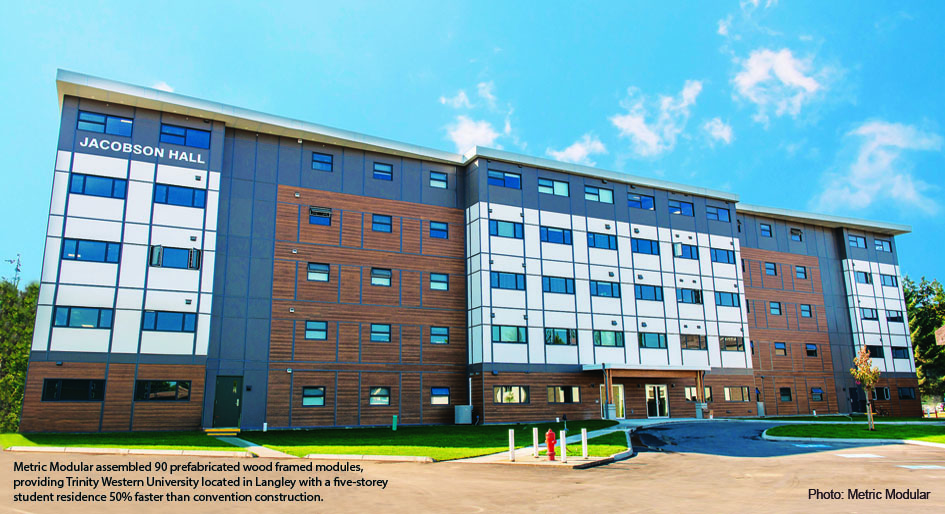
At Langley’s Trinity Western University, Jacobson Hall was built in only nine months using wood-framed modular construction. The five-storey student residence was the tallest building of its kind when construction was completed in 2018 and added beds for 220 students.

These projects and others are featured in a newly released book, Naturally Wood, which showcases British Columbia’s cutting‐edge wood architecture and design. The beautifully illustrated, 160-page publication contains more than 65 innovative wood buildings and projects, including how wood is being used in multi-family residential projects and accommodations. Four continuing education units have been developed based on the book. They are recognized by the Architectural Institute of British Columbia and are available at naturallywood.com/naturally-wood-ceus.

Download Naturally Wood digital copy here.

ISSA Canada forms alliance with TIPS

In an effort to connect with the healthcare and hospitality sectors, ISSA Canada has formed an alliance with The Infection Prevention Strategy (TIPS).

“Our ongoing goal is to unite the industry, and TIPS is at the top of the scale when it comes to infection control and prevention,” said ISSA executive director Mike Nosko in the association’s press release. “In addition to the infection control piece, they are also dedicated to the health and wellness of the building environment which is why this alliance is so important.”

“The main goal of TIPS is to communicate, and we need partners in order to do this successfully,” said TIPS co-founder and executive director, Michael Diamond. “We see our alliance with ISSA Canada as an outstanding opportunity to tap into a new market and grow our outreach.”

In addition to providing a host of peer-reviewed articles, white papers, and industry support, the TIPS advisory board brings together leading industry professionals well-versed in infection control and prevention. ISSA Canada will offer its healthcare and hospitality members access to this knowledgeable resource. TIPS will also be front and centre during industry trade shows and conferences, by providing speakers targeting relevant issues to this industry sector.

New mixed-use rental buildings coming to Ottawa

Regional Group of Companies and Fengate Asset Management are pleased to announce they are partnering in the development of two new rental buildings located at the entrance of Regional Group’s master-planned waterfront community, Greystone Village, in Ottawa. Fengate is managing the joint venture with Regional Group in the two buildings on behalf of the LiUNA Central and Eastern Canada Pension Fund.

The buildings will include retail at the ground level and 245 units of high-quality rental housing. When complete, Regional Group will be managing the properties on behalf of the investors. Building amenities will include roof-top terraces with gardens and dog areas, fitness facilities, state-of-the-art building security and mail rooms, underground vehicle and bike parking, storage, and gathering areas.

Greystone Village is Regional Group’s LEED master-planned community of over 1,000 homes. It is located between the Rideau Canal and Rideau River, and is within walking distance to trails, parks, the new Ottawa LRT (Lees Station), and Lansdowne Park.

“We are genuinely excited for the opportunity to partner with LiUNA and Fengate to deliver this much-needed choice of housing in Greystone Village and Old Ottawa East. This phase of the development will add vibrance, texture and life to Main Street and the community,” stated Dave Wallace, COO, Regional Group.

“LiUNA is proud of our strategic investment to meet rental housing needs in the Ottawa-Gatineau region, creating hundreds of construction-related jobs and investing in the economic growth of the community,” said Joseph Mancinelli, LiUNA International Vice President and Regional Manager for Central and Eastern Canada. “This development is essential to meeting the rental demand in Ottawa-Gatineau and LiUNA is proud to be at the forefront as an investor of this essential infrastructure build in partnership with Regional Group.”

“We are very pleased to partner with Regional Group, such an innovative, forward-thinking and highly experienced partner, on developing much-needed purpose-built rental apartments in Ottawa-Gatineau,” said Jaime McKenna, Managing Director and Group Head, Real Estate, Fengate. “Greystone Village is a unique and visionary community for the region, and we are pleased to be a part of this important development.”

Since 1958, Regional Group has been shaping real estate in Ottawa and throughout Canada’s National Capital Region. Today, the company has evolved into a unique real estate platform with extensive experience handling every aspect of the real estate environment. They create, develop, manage, and assess real estate value for their clients, partners, and investors. For more information visit regionalgroup.com.


September sees national home sales rise: CREA

National home sales rose 0.6 per cent month over month in September, according to statistics released today by the Canadian Real Estate Association (CREA).

Actual (not seasonally adjusted) sales activity was up 15.5 per cent year over year, with transactions rising in Canada’s largest urban markets, including the Lower Mainland of British Columbia, Calgary, Edmonton, Winnipeg, the Greater Toronto area (GTA), Hamilton-Burlington, Ottawa and Montreal.

“National sales activity has begun to rebound in recent months,” Jason Stephen, president of CREA, said in a news release. “That said, all real estate is local, so there’s a lot of variation in the strength of the rebound depending on the housing type, location and price segment.”

The number of newly listed homes dipped by 0.6 per cent. This small decline in new supply combined with the small increase in sales tightened the national sales-to-new listings ratio to 61.3 per cent in September, increasingly rising above its long-term average of 53.6 per cent. CREA reports this measure remains in balanced market territory, but is favouring sellers more than buyers.

The MLS® Home Price Index (HPI) climbed 1.3 per cent year over year in September. In recent months, home prices have been stabilizing in the Lower Mainland and the Prairies, where they were previously falling. Meanwhile, price growth has begun to rebound among markets in the Greater Golden Horseshoe, rejoining the ongoing price gains in housing markets located further east.

The national average home sale price was around $515,500 in September, up 5.3 per cent from the same month last year. This increase drops to 4.1 per cent for an average home sale price of less than $397,000 when excluding the Greater Toronto and Greater Vancouver markets.

Tips for an ergonomic office and workspace

Having an ergonomic office means ensuring your working environment is designed for efficiency and comfort. Herein, promoting healthy workspace designs and practices is key to maximize productivity by minimizing employee fatigue and discomfort.

Key features of good workspace posture
Although equipment and technology have advanced and changed, basic good posture when seated at a desk in front of a keyboard has not. However creative your workspace, these are the main points to promote among those who use your office.

Chair

  • Adjust the chair height so that when seated, your knees are more or less level with your hips, i.e. your thighs are parallel with the floor.
  • Your feet should be resting flat on the floor or a footrest when of correct chair height and the distance. Do not cross your legs – ever. This will misalign your spine and cause neck aches and muscle pain, as well as blood circulation issues in your feet and legs.
  • If your chair has armrests, your elbows and forearms should be gently resting on them when you are sitting up straight with your shoulders relaxed.
  • Ideally, you should be able to sit up straight without the need for back support. Very few of us are that disciplined, however, so, do ensure that you have a chair with a backrest that supports the small of your back, and your general shape when sitting with the base of your spine touching the backrest.

Monitor

  • The monitor should be an arm’s length away from your eyes. When sitting up straight, your eyes should be level with the top of the screen (not the middle of the screen, as some erroneously think).

Keyboard

  • When you type, your wrists should be straight (neither bent back nor bent forward) and your hands should be below elbow level.
  • If the level of your desk surface simple does not oblige, then often a keyboard tray is the solution. Keyboard trays these days come with adjustable tilt and swivel and can be fitted to most office tabletops.

Visualizing your ergonomic office
Look at this visual guide to get a better idea of workstation ergonomics. Remember to place things like telephone and other things employees might need within easy reach so that they do not have to stretch for anything while at the computer.

No matter how good one’s posture might be, it is always a good idea for employees to get up from their desk, walk around, and stretch at least once every hour or 90 minutes during the day. This is the key to staying healthy and being able to go the distance when your schedule and deadlines demand it.

And while you’re making sure that all your furniture is made to measure the people in your office, how about introducing a little color to your life with a modest office makeover? Once you’ve made sure you’ve got the basics covered, that is.

Ignoring ergonomic advice
There’s a long list of health problems arising from poor workspace organization, poor posture and from not having an ergonomic office. They include headaches, pelvic pain, lower self-esteem because of poor posture, fatigue, joint pain in the hips, knees or ankles, stomach issues such as acid reflux/heartburn, and arthritis.

Get it right every day
Following this simple guide will make a positive difference in the long term and you will stay healthy for longer – to enjoy life when you’re away from the desk. You’ll have an ergonomic office and a happier team.

This article was originally published by AZ Big Media.

IFMA launches CFM practice exam

The International Facility Management Association (IFMA) has revealed an online practice exam for industry hopefuls pursuing their IFMA Certified Facility Manager (CFM) certification.

Launched on October 15, the CFM Practice Exam is an optional preparation resource available to individuals seeking their designation, which defines the “industry standard for ensuring the knowledge and competence of practicing facility managers.” The online test includes 90 questions covering 11 core competencies of facility management, as well as rationales for each question.

“Test anxiety is often a major obstacle to effective test performance,” said Laurie Gilmer, Second Vice Chair of IFMA’s Global Board of Directors. “The new practice exam is designed to give certification candidates an idea of what to expect in terms of questions and the opportunity to experience a computer-based exam.”

The CFM Practice Exam is one of numerous certification exam resources on offer from the IFMA. Others include a self-evaluation and a one-day CFM Exam prep workshop.

Since the certification program’s launch in 1992, the exam has been passed by over 3,100 facility managers from 32 countries.

HCMA Architecture names Di Pasquale as associate

Vancouver-based HCMA Architecture + Design welcomes Steve Di Pasquale and Lynn Curtis to the leadership team. Di Pasquale has been an integral member of HCMA for almost 10 years and becomes an associate, while Curtis joins as director for human resources.

Since joining in 2010, Di Pasquale has worked on some of the firm’s most notable projects, including Jasper Place Branch Library in Edmonton, AB; Grandview Heights Aquatics Centre in Surrey, BC; and Minoru Centre for Active Living in Richmond, BC.

Alongside his project work, he has also played a significant role in developing a number of other initiatives, including the Artist in Residence program and HCMA Days, and is a strong voice in the firm’s push for interdisciplinarity.

Outside of the office, he is an artist, curator, musician, and writer, and has been published by the likes of Canadian Architect and Twenty + Change.

As a senior practitioner, Curtis will be a strong strategic partner, employee advocate, and mentor for staff at all levels. She is already underway improving recruitment and new staff onboarding strategies, and will help ensure HCMA maintain its culture of compassion and curiosity.

HCMA Architecture + Design challenges the traditional boundaries of architectural practice by asking one question. “How do we achieve the maximum positive impact through design?” That curiosity leads to technological innovations, valuable community engagements, and ultimately to positive changes in people’s lives.

Hilton expands soap recycling program

To mark Global Handwashing Day, Hilton hotels announced the expansion of its soap recycling program which helps fight the hygiene epidemic plaguing underserved communities due to a lack of access to basic sanitation.

Hilton also announced the successful completion of its 2019 Clean the World Challenge to collect enough soap by Global Handwashing Day to be sterilized and recycled into 2 million new bars of soap for communities in need.

“In a world where too many children die of hygiene-related illnesses, Hilton and its soap recycling partners are turning guest room waste into life-saving treasure,” said Katie Fallon, Hilton’s Global Head of Corporate Affairs in the hotel group’s press release. “We are now expanding our industry-leading, global soap recycling program to all of our brands as part of our commitment to send zero soap to landfill.”

The initiative also contributes to reducing Hilton’s overall environmental impact, which the company has set a goal to cut in half by 2030.

To bring awareness to the vital role soap plays in reducing the risk of hygiene-related illnesses, Hilton is opening the doors to an art exhibit in New York City on October 15 and 16 – The World’s Most Valuable Collection at the Soap Museum.

Image courtesy of Hilton.

Ontario rental rates highest in Canada

As the federal election inches closer, Canada’s skyrocketing rental rates continue to be a hot button issue, with recent data from rentals.ca underscoring the need for more balance within the housing market.

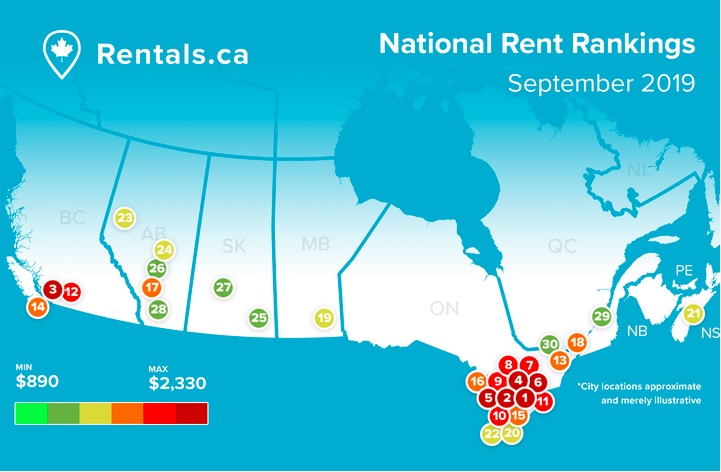
According to the latest National Rent Report, the average monthly rent for a one-bedroom home is down month over month in Toronto but still the highest in Canada, while a growing Ottawa suburb, Kanata, takes the top spot for highest rent for a two-bedroom at almost $3,000 a month.

Average monthly rent for a one-bedroom home in Toronto in September is $2,304, down from $2,330 in August, while a two-bedroom goes for $2,908. Average monthly rent for a two-bedroom for the hi-tech centre Kanata hit $2,998, while a one-bedroom goes for $2,169.

rental rates September 2019

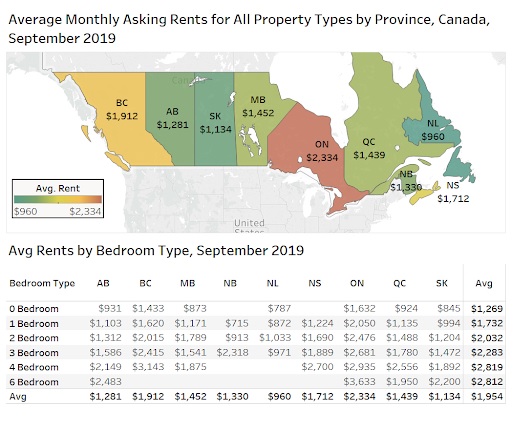
The average Canadian property was listed for $1,954 per month in September, an increase of 2.1 per cent compared to August. The national rental rate in September just topped the previous high-water mark for the year of $1,953 in June, according to Rentals.ca data.

On a provincial level, Ontario had the highest rental rates in September, with landlords seeking $2,334 per month on average (all property types), an increase of 0.5 per cent from August ($2,321).

As the graphic below indicates, a studio unit in Ontario is more expensive to rent than a three-bedroom home in Alberta, Manitoba and Saskatchewan.

Sept 2019 rents

Median rents

The median rent was the same or higher in Q3-2019 versus Q2-2019 in most of the major municipalities on the east side of Canada, while many geographic areas on the west side of the country, including Vancouver, Calgary, Edmonton, Saskatoon, Regina and Red Deer all experienced declines.

“Housing affordability continues to be a hot button issue with voters going into the federal election,” said Ben Myers, president of Bullpen Research & Consulting. “And potential policy changes that would make it easier for first time-buyers to purchase a home may take pressure off the rental market, which continues to rise nationally, despite the market softness in the prairie provinces.”

The National Rent Report charts and analyzes national, provincial and municipal monthly and quarterly rental rates and market trends across all listings on Rentals.ca for Canada.


Wales McLelland breaks ground on Porsche Centre

Wales McLelland has broke ground on the new 75,000 square foot flagship Porsche Centre Richmond, which will be one of the largest Porsche dealerships in Canada. Located at the Richmond Auto Mall, the project is scheduled for completion in 2020.

The four-level retail and service centre will feature Porsche’s infamous curved building design and will accommodate a full range of new electric vehicles. The facility will also include an expansive service and parts area with 15 service bays, a service drive through and specialized delivery area, and a massive new and pre-owned showroom. The new centre will staff approximately 40 employees in the areas of sales, service, management and administration.

Wales McLelland is the construction manager for the multimillion-dollar Porsche AG designed project. At the peak of construction, Wales McLelland will have just over 100 personnel on site. This specific site will have limited space to complete the construction, as the building covers a large portion of the site, therefore, material storage onsite will be limited, and Wales McLelland will be scheduling on-time deliveries.

This project will also include steel and concrete structures, including columns, walls, floor systems, and roof systems. This will require two structural trades to design temporary measures to support upper floors when concrete is being placed.

Porsche Centre Richmond will represent the ninth of its kind in Western Canada. It will become the second Porsche location for both Dilawri Group of Companies and OpenRoad Auto Group who collaborated on this project.

Marcus & Millichap expand Canadian presence

Marcus & Millichap, Inc. (Marcus & Millichap) furthers its penetration of Western Canada.

The leading brokerage firm specializing in commercial real estate investment sales, financing, research and advisory services, has acquired Form Real Estate Advisors Inc., a leading commercial real estate services firm based in Vancouver, British Columbia, specializing in retail transactions and advisory services.

Founded in 2010, Form Real Estate Advisors has developed a highly respected brand and extensive market presence in the retail segment. The addition will be synergistic with Marcus & Millichap’s retail brokerage business in the U.S. and other Canadian markets.

Form’s top-tier team of 11 real estate professionals including its founding partners, David Morris, Derick Fluker, Jon Buckley and Jack Allpress are joining Marcus & Millichap.

Canada’s office co-working market booming

It’s a Canadian co-working revolution, and it’s transforming the business landscape. According to the latest stats from CBRE Canada’s Canadian Flexible Real Estate Report, flexible office companies have expanded their office leasing footprint by 303% in just five years, growing from 1.5 million sq.ft. in 2014 to 6.1 million sq.ft. in 2019.

“We haven’t seen a new type of office tenant emerge with such speed and dominance since the dot-com boom,” says CBRE Canada Vice Chairman Paul Morassutti. “The rise of flexible office operators reflects the pace at which work and the workplace are evolving along with new technology, changing demographics, and an overall push for innovation. This has led to the birth, adoption and replication of agile real estate strategies at a remarkable pace.”

Flexible office solutions (aka ‘co-working environments’) are defined as workspaces wherein freelancers, entrepreneurs, remote workers, and small teams from varying organizations share the same environment and amenities. Operators of such spaces accounted for four of the ten largest office deals nationally in the first half of 2019 alone. They have also driven down vacancies in major urban centres such as Toronto, where flexible real estate operators now occupy 3.1 million sq. ft. of available office space (1.8% of the total stock); Metro Vancouver, where flexible real estate represents 1.7 million sq.ft. of office space (3.3%); and Montreal, where co-working environments account for 959,000 sq. ft. of leasable office space (1.2%).

“Flexible real estate is taking off across Canada, and it’s not hard to see the appeal for office occupiers and owners,” says Morassutti. “Occupiers are able to deliver high-performing workplaces to their employees and ensure their portfolio can adapt to the changing needs of the organization. And office building owners and investors can utilize flexible solutions to modernize and future-proof their assets by incorporating new and innovative building features, maximizing returns in the long run.”

Toronto, Vancouver, and Montreal may host the lion’s share of flexible office space, but the trend is picking up in jurisdictions across the country. Read CBRE’s full report for the latest stats on this growing real estate trend.

Smart, life-saving fire safety solutions

Apartment fires in Canada are still all too common, despite the steeper fines for Fire Code infractions and persistent efforts by authorities and building stakeholders to mitigate fire hazards through education and emergency preparedness. As technology advances and buildings become better equipped to detect, contain and alert occupants of a pending hazard, the prevalence of fire-related tragedies are diminishing. Even older apartment buildings can benefit from new and improved technology.

Given October is National Fire Prevention Month, we reached out to Michael Hugh, Field Sales Engineer, Johnson Controls about smart, responsive fire systems and best practices for mitigating fire hazards in multi-residential buildings.

How has smart technology helped improve fire safety? 

Smart technologies, such as integrated fire detection systems and sensors, can help improve fire safety within apartment buildings by communicating emergencies with occupants who could be impacted. Building codes require smoke alarms to be installed in each apartment unit, which provide a local-sounder to alert occupants of smoke or fire in the individual space. Modern-day fire alarm systems offer the option to replace traditional smoke alarms with individual “smart” smoke sensors. These sensors can serve each individual unit, but when connected to the building-wide fire alarm system, other building occupants – like residents, building managers and superintendents – could be notified in the event of an emergency.

These smart sensors can also identify carbon monoxide. CO is highly lethal, but because it is invisible, tasteless and odorless, it can be left unrecognized. When CO is detected in a unit, the building-wide fire alarm system can notify unit residents and building management, who could then take necessary actions to resolve the issue. This kind of system operation may provide a greater level of safety, especially for occupants who may face mobility challenges. When emergencies occur, it is crucial that integrated systems communicate to one another in all areas of the building, including fire alarm networks, mass notification systems, emergency lighting and HVAC controls.

What are some key steps all apartment owners/managers must take to prevent fires from spreading? 

Fire safety begins with initial detection through the use of integrated systems. By connecting the building’s fire alarm network to all other technologies, each individual system is able to monitor and maintain their own status. Rather than utilizing disparate alarms for each individual unit or space, integrated systems are able to communicate to one another and act on emergencies as soon as they happen.

Mass notification and emergency communication systems can be connected with other systems, such as light sensors and HVAC sensors, to assist occupants as they navigate their way out of the building safely while alerting emergency response teams. This results in faster reaction times, ultimately saving lives and building assets from further destruction.

What are the most common sources of apartment fires?

According to the National Fire Protection Association (NFPA), cooking is the number one cause of apartment fires. Other sources of apartment fires can range from unattended fires, like candles and smoking, to arson. While fire safety education is key in preventing these types of fires, an integrated fire and life safety infrastructure can help. Should an emergency occur, sensors integrated with a mass notification system can alert occupants and use real-time insights to guide them to a safe location. When connected with an emergency communications system, local first responders can be notified immediately, reducing response times.

Is technology moving in a direction that fires in multi-residential buildings will someday become a thing of the past?

To say fires in multi-residential buildings will become a thing of the past is hard to predict; but, integrating fire and life safety solutions with additional building systems – like HVAC controls – can help reduce the spread of fires and improve emergency response times. Additionally, with the implementation of artificial intelligence (AI) and machine learning, predictive analytics can be useful in determining more efficient evacuation routes. For example, when a fire erupts and first responders react, the information provided by integrated building systems can help determine how, or if, occupants are evacuated out of the building.

Has there been one innovation in particular that has significantly raised the bar on fire safety?

Integrated fire and life safety technologies have enhanced fire safety within multi-residential buildings, but without the National Fire Code of Canada – a legal requirement and comprehensive reference guide for property owners and managers – buildings could be left vulnerable to life safety threats. The Fire Code is continuously improving safety standards to keep up with advancing technologies and ensure property owners are fulfilling testing and inspection requirements for the various fire and life safety features within their building. This includes, but isn’t limited to: fire sprinkler systems, fire alarm systems, fire extinguishers and emergency lighting.

Modern fire alarm systems retain historical data, which can serve as an electronic record of when fire alarm inspection companies have completed the work they professed to have done – and likely charged for. When a service team claims that they have tested every fire alarm detection device in the building, the log should have retained an entry for every one of those tests. For property owners who are liable if Fire Code requirements are not fulfilled, this data collection serves as a comprehensive record of when maintenance or inspections have been performed. This provides owners with greater insight into when another inspection will be required or when a sensor may need replacing, resulting in proper code compliance and safer, more efficient facilities.

for more information, visit: www.johnsoncontrols.com/fire-detection

 

Summit acquires $588M light industrial portfolio

Summit Industrial Income REIT (Summit) is going to acquire a light industrial portfolio that comprises 37 properties in Alberta for approximately $588 million.

Totalling over 3.3 million square feet, 22 of the properties (1.8 million square feet) are in Edmonton, 14 properties (1.4 million square feet) are in Calgary, and one property is in Grand Prairie. The purchase also includes one parcel of land (which is leased) in Edmonton.

“This important acquisition significantly increases the size and scale of our total portfolio to 145 properties aggregating 16.9 million square feet with an asset value of approximately $2.5 billion,” commented Paul Dykeman, chief executive officer in the REIT’s press release.
“We are also pleased to have quickly and accretively recycled the funds generated from the sale of our non-core data centre properties into our core light industrial business where we have a proven track record of creating value for our Unitholders.”

According to the press release, the portfolio contains a mix of single-tenant and multi-tenant properties. Approximately 67 per cent of the portfolio consists of modern Class A space.

BMO Capital Markets Real Estate Inc. is acting as an exclusive advisor on the transaction expected to close on or about November 1, 2019.

EU also feels affordable rental housing pinch

Affordable rental housing is in high demand on both sides of the Atlantic Ocean. London landlords continue to set the steepest rents for available apartments posted on the online platform, HousingAnywhere — an average of 1,730 Euros or CAD $2,526 during the third quarter of 2019 — and there is a consistent upward trend in 17 other European markets contributing data to the leasing facilitator’s analysis.

“Lack of supply is a factor predominantly in the lower-price segments — those particularly sought after by students and young professionals,” observes Djordy Seelmann, chief executive officer of Rotterdam-based HousingAnywhere. “Political inertia on the matter of boosting development of affordable housing is not alleviating the housing problem in European cities.”

Recently released data is drawn from approximately 88,400 rental availability listings during the period from Jan. 2018 to Oct. 2019. This encompasses cities in the Netherlands, Scandinavia, Spain, Italy and Germany, along with London, Vienna and Brussels.

In the third quarter, just five of the 18 surveyed markets posted a monthly average for available apartments lower than 1,000 Euros (CAD $1,460). The best deals were found in Turin, Italy, at an average rate of CAD $1,270.

Q3 average listed prices for room rentals surpassed CAD $1,000 in Stockholm, Copenhagen and London, and dropped below CAD $600 only in Valencia, Spain. Valencia also offered the lowest-cost studios — averaging CAD $864, or roughly half of London’s priciest average rate of CAD $1,663 — and the second lowest average price for apartments.

Amsterdam, Munich, Stockholm and Copenhagen consistently figured in the five most expensive surveyed markets for both apartments and studios. Helsinki cracked the top five for private room rents, displacing Amsterdam. Meanwhile, Seelmann points to trends that may resonate with Canadian landlords and apartment hunters.

“While some municipalities are deploying measures to keep prices from rising even further, such as rental caps, they often overlook the real problem: the lack of supply,” he submits. “Despite initiatives aimed at putting an end to the spiralling prices, estate agencies are warning that the lack of rental properties on offer is only aggravating the situation.”

The most significant year-over-year rent increases since Q3 2018 were seen in Barcelona (8.5 per cent) and Berlin (7.4 per cent). The most gradual rate increase was in Florence (2.7 per cent). Average rents for available apartments and studios were higher in Barcelona than in Madrid; whereas Berlin’s average rates — CAD $1,653 and $1,283 respectively— stayed considerably lower than CAD $2,200 and $1,496 for comparable units in Munich.

Spain and Italy each count two cities in the lowest third of the rental rate-spread, while Vienna and Brussels make up the balance. With the exception of Amsterdam, Dutch cities — Rotterdam, Utrecht and The Hague — place in the middle. Scandinavian cities — Stockholm, Copenhagen and Helsinki — are bunched in the top third.

“Across Spain and in Berlin especially, initiatives to steer the real estate sector toward new investments has come to a halt due to political indecisiveness,” Seelmann says. As with most other sectors of the United Kingdom’s economy, Brexit-related uncertainty is deemed to be dampening the outlook for supply in London.

Infrastructure report calls for urgent investment

Canada’s public infrastructure requires urgent attention in the coming decades in order to reverse the current state of disrepair, according to the 2019 edition of the Canadian Infrastructure Report Card (CIRC).

“Data from the report revealed that Canada’s public infrastructure is at serious risk,” said Mary Van Buren, CCA president. “It will require rehabilitation and replacement in the next few decades to ensure services provided continue to meet the needs of communities.”

The report, released by founding CIRC partners (CCA, Canadian Public Works Association, Canadian Society for Civil Engineering and the Federation for Canadian Municipalities), provides a timely update on the state of Canada’s public infrastructure across all core public infrastructure asset categories: roads and bridges; culture, recreation and sports facilities; potable water; wastewater; stormwater; public transit; and solid waste.

The Canadian Urban Transit Association, Canadian Network of Asset Managers and Association of Consulting Engineering Companies (ACEC) also participated in the 2019 edition.

Key takeaways and next steps

Evidence informing the 2019 report shows that a concerning amount of municipal infrastructure is in poor or very poor condition. Infrastructure in this condition represents an immediate need for action, as the rehabilitation or replacement of these assets is required in the next five to 10 years to ensure that the services it provides continue to meet the community’s expectations.

An even larger proportion of municipal infrastructure is in fair condition. Infrastructure in this condition represents a view of things to come in the medium- to long-term. This infrastructure will continue to deteriorate over the next decade, falling into poor and very poor condition if rehabilitation or replacement actions are not taken.

CIRC partners are unanimous in calling upon all parties competing in the 2019 federal election to commit to addressing these shortfalls in their respective infrastructure platforms.

“CCA has made infrastructure a cornerstone of its #Construction4CDNs advocacy campaign,” said Van Buren. “Today’s release of the CIRC only strengthens our resolve in calling for a long-term 25-year blueprint for infrastructure spending in this country to ensure assets are routinely monitored and restored, preventing them from falling into such serious states of disrepair.”

The 2019 Canadian Infrastructure Report Card can be found online at canadianinfrastructure.ca.