Articles Archive - Page 442 of 928 - REMINET
REMI

BC LNG Alliance changes to national name

BC LNG Alliance has rebranded as the Canadian LNG Alliance (Canadian LNGA). The now national trade association’s members continue to be LNG Canada, Kitimat LNG (Chevron Canada), Woodside Energy, Woodfibre LNG, ExxonMobil, FortisBC, AltaGas and Enbridge.

The name change is aimed at reflecting the critical role liquefied natural gas (LNG) has to play in Canada’s COVID-19 economic recovery, economic reconciliation with Indigenous communities and clean energy transition.

The Canadian LNGA says it is committed to building an inclusive and positive dialogue around Canada’s role and opportunity for leadership in the world’s energy future.

Construction of the $40 billion LNG Canada project is currently underway. The project is the largest private infrastructure investment in Canadian history and is providing jobs, trades training, business and procurement opportunities for Canadians at a time when getting back to work, safely, is a top priority.

Additional LNG projects are awaiting final investment decisions and together, these projects will provide tens of billions in investment in Canada, thousands of jobs for Canadians and new revenue for governments for generations.

The LNG industry is collaborating on a new model of Indigenous participation in the natural resource sector in Canada.  From the beginning, Indigenous Nations have partnered with the LNG industry in B.C. on unique initiatives, including an unprecedented Nation-led environmental assessment process and agreements with First Nations bands in place for jobs, training, and procurement opportunities with the shared goal of working towards economic reconciliation.

“LNG is Canada’s opportunity. By all of us working together– governments, industry, Indigenous Nations, workers, and communities – to responsibly build an LNG industry, we can provide a significant and much-needed economic boost to our country,” said Bryan Cox, president and CEO of the Canadian LNG Alliance.

“Importantly, through our low-emission LNG, Canada will make an outsized contribution to reducing global emissions and particulate matter, while investing in the infrastructure for our continued transition to a cleaner energy future.”


Public disclosure could foil energy reporting

Winnipeg’s call for voluntary disclosure of energy use and greenhouse gas (GHG) emissions could attract a disproportionate share of high-performance buildings. City officials have invited commercial building owners and institutional facility managers to affix their Energy Star Portfolio Manager results on a publicly accessible map, but the spectre of uninformed scrutiny may hold little appeal for some of the sought-after participants.

To begin, public sector buildings are a large majority on the newly unveiled energy disclosure map, which divulges each building’s name and address; size, year of construction, energy use intensity in gigajoules per square metre (GJ/m2), GHG emissions in kilograms of carbon dioxide equivalent per square metre (kgCO2e/m2) and Energy Star score, if available. In turn, the Building Owners and Managers Association (BOMA) of Manitoba cautions that such transparency needs context.

“In our opinion, the public disclosure element will lead to a lot of building comparisons that are not ‘apples-to-apples’ comparisons,” says Tom Thiessen, executive director of BOMA Manitoba. “Comparing data for two buildings that are used very differently is not a useful exercise, and we wouldn’t want that type of information to be misinterpreted.”

BOMA Manitoba’s sister chapter in Toronto voiced a similar argument in 2015 when the Ontario government of the day first moved to mandate energy and water use reporting and benchmarking (EWRB). The association endorsed the practice as a means to identify where efficiency could be improved, while alerting against exposing members to undue criticism. “It will be very disruptive to publicly disclose performance that creates apples-to-pears-to-oranges comparisons,” BOMA Toronto predicted at the time.

Ontario is now the only Canadian jurisdiction where energy/water benchmarking and reporting are compulsory. As per the enabling regulation, data from the first phase of enrollees — commercial buildings of 250,000 square feet or greater — is due to be released this year. However, the provincial government recently extended the deadline for the final group of designated buildings to join the exercise. The first reporting period for commercial and multifamily buildings in the range of 50,000 to 99,999 square feet has been pushed to 2022, with data to be submitted by July 1, 2023.

“Benchmarking is the right thing to do, but it can be much more difficult than people might think,” reflects Scott Rouse, managing partner of the consulting firm Energy@Work, who has been working with Ontario building owners/managers to fulfill reporting obligations. “And there will be resistance.”

Winnipeg’s newly launched Building Energy Disclosure Project augments a few similar voluntary initiatives across Canada, including the Canada Green Building Council’s (CaGBC) national challenge, a province-wide impetus in British Columbia and two other programs with civic parameters in Toronto and Edmonton. Looking to the United States, New York City enforces one of the most stringent mandatory disclosure programs and there are several voluntary options.

“In terms of uptake, the sustainability leaders are usually the first to join,” observes Kristopher Kolenc, manager of research and sustainability with REALPAC, which counts many of those early joiners among its membership of large commercial landlords, property funds and institutional investors. “Larger owners are more likely to have their own sustainability teams and the resources to participate in such programs. Smaller owners may need more support and tools to understand why they should report and how to report.”

More discreet benchmarking options already draw wide participation

Winnipeg’s voluntary program is open to buildings of at least 20,000 square feet. The new effort aligns with the municipal climate change action plan and is supported with funding from the federal Ministry of Natural Resources. The Manitoba CaGBC chapter is partnering with the city to provide free workshops and assistance in registering for Energy Star Portfolio Manager and/or applying for Energy Star certification. Participants are also promised civic recognition for making the commitment to benchmarking and transparency.

“With the Building Energy Disclosure Project, we hope to enable building owners to better understand the energy performance of their buildings, while supporting overall reductions in GHG emissions in our community,” maintains Councillor Cindy Gilroy, chair of the city’s standing policy committee on water and waste, riverbank management and the environment.

However, there are already opportunities to do that more discreetly. Notably, Energy Star Portfolio Manager, which is the platform for Winnipeg’s public disclosure initiative, provides the same personalized scorecard and comparisons with similar-sized buildings, but keeps the details private.

Although guidance for prospective registrants in Winnipeg’s program promises: “Each participant will be given an opportunity to summarize the nature and extent of their building information; the efforts undertaken to improve energy efficiency and reduce GHG emissions, and providing a greater level of data transparency”, Thiessen expresses concern that casual map viewers won’t look beyond the easily found numbers.

“Energy usage is dependent on a number of factors, and building usage is a key factor,” he says. “The numbers can be misinterpreted. Has the data been normalized for vacancies, for example? Or reduced hours? Or what about for hybrid uses of office space like data centres? Data centres can use a lot of servers, computing power and cooling power. Will those types of uses be accounted for?”

Buildings that boast above-average performance will have a opportunity to enjoy some positive attention. Winnipeg officials are highlighting the “showcase” aspect of the program, which could give the general public more insight into and appreciation for commercial real estate’s sustainability profile, although Thiessen suggests programs like BOMA BEST provide a more well-rounded picture of a greater number of environmental management issues.

“If participants end up providing data only for buildings that ‘show’ favourably — buildings that are relatively new, with tenants that are low-intensity energy users — then that defeats the purpose of the program, in our opinion,” he asserts. “It will also create unrealistic expectations for owners of older buildings, many of whom are already doing their best to improve their buildings from an energy usage and sustainability standpoint.”

Nevertheless, consumers’ expectations are always a factor in the marketplace regardless of whether they can be deemed realistic. Kolenc frames energy reporting in the context of competing in a transitioning economy, and in light of Canada’s targets to reduce GHG emissions to 30 per cent below 2005 levels by 2030, with all newly constructed buildings to be net-zero-energy-ready (NZER) by that year.

“We may eventually see some jurisdictions transition to a mandatory (reporting) program or this could even be the case at a national level some day,” he notes. “Going public shows a commitment to sustainability and willingness to improve. Owners who participate are more likely to be aided by the program’s tools and they can also publicly demonstrate improved performance over the years.”

Barbara Carss is editor-in-chief of Canadian Property Management.

Saskatchewan launches employee training subsidy for reopening businesses

The government of Saskatchewan has announced a new temporary training subsidy that will help companies educate employees in safety protocols surrounding COVID-19 prevention and adjust their business models as they reopen.

The Re-Open Saskatchewan Training Subsidy (RSTS) program will reimburse eligible private-sector employers 100 per cent of employee training costs related to the reopening of their company, including training for new cleaning protocols, up to a maximum of $10,000 per business. The application deadline is July 31, 2020.

“This program is another tool to support Saskatchewan businesses through this challenging period by fully funding the costs of the short-term training necessary to reopen and adapt to the post-COVID environment,” said Jeremy Harrison, Immigration and Career Training Minister, in a statement. “Through this program and other initiatives, we remain committed to working with businesses during this period of economic recovery throughout the Re-Open Saskatchewan plan.”

A spokesperson from the province’s Ministry of Immigration and Career Training said a wide variety of programs fall under the eligibility requirements for the subsidy, explaining that “employers are encouraged to pursue training that will support the viability of the business, such as new health and safety requirements or adopting innovative practices to help the business adapt to social distancing requirements.” Programs surrounding the prevention of COVID-19 outbreaks within facilities through a focus on proper cleaning protocols may be eligible if the proposed training meets the eligibility parameters of the RSTS and is provided by a third-party training provider.

The $2 million RSTS program was created to support the short-term training of employees, focusing on areas such as health and safety requirements and the adoption of social distancing practices. The program is a temporary emergency response for employers in the province that are on the province’s list of critical public services and businesses allowed to operate during the state of emergency, as well as companies that will reopen in a confirmed phase of the Re-Open Saskatchewan plan.

Climate projections show Ottawa will get warmer, wetter

Ottawa will continue to get warmer and wetter year-round, with a greater chance of extreme weather, according to recent climate projections for the nation’s capital region until 2100.

The city received advanced climate modelling used to predict changes in temperature, precipitation and seasons.

Winter will be shorter, causing seasons to shift. Fall will start later while spring will start earlier. Days that are hotter than 30 C will be more common and precipitation will increase in volume and intensity. Climate variability from year to year will continue, with some years being much warmer or wetter than others. The greater the increase in global greenhouse gas emissions, the warmer it will be.

The city says the projections will help it to better understand the impact of climate change on its communities, infrastructure, economy and natural environment. Using these projections, staff will determine Ottawa’s vulnerabilities and assess adaptation measures. Staff will also develop a climate resiliency strategy next year to prepare Ottawa to adapt to changing climate conditions.

A first phase of a proposed bylaw to protect urban trees, known to help reduce heat island effect, was expected to roll out in May with stiffer fees and penalties. However, the city’s response to COVID-19 has delayed this work. The committee recently approved a motion to accelerate part of phase two, which reduces the size of distinctive trees. That will come into effect with phase one on Friday, January 1, 2021.

Achievements in tall wood buildings

In the history of architecture and construction, there has never been a building material that has had as rough a ride as wood.

This is not without reason. It has a limited record of use from ancient history simply because of its inability to withstand the ravages of time. Furthermore, its combustibility has out and out vilified it. By the end of the nineteenth century, cities all around the world had had their own devastating version of the Great Fire of London in 1666, in which 80 per cent of that city’s building stock was lost. For this reason alone, building codes around the globe have not seen significant change in regards to the use of wood for some time. This is reflected in Canada where, since the 1950’s (and up until just recently), wood buildings have not been permitted to be built above four storeys.

Prior to the reformation of poor forestry management practices of the 1970s, concrete and steel was touted in the construction industry as preferable to wood because of the issue of mass deforestation. Here in British Columbia, with images of clear-cutting practices still fresh in the minds of environmentalists, new urban construction has primarily been predominated by concrete and steel, relegating wood to the single family house construction sector. Perhaps not since Louis Kahn uttered his famous remark about what a brick wants to be, has there been a need to bring wood back into the mainstream conversation.

For as pointed out in this new edition of Tall Wood Buildings by architects Michael Green and Jim Taggart, just the advancement in the last four years alone around the science of fasteners, connections, and glues has become a game-changer, enabling wood to now compete with all the material strengths and efficiencies of concrete and steel, without any of the environmental fallout. At an urban scale, and as cities continue to grow in size and numbers around the world, the ramifications are understandably huge—certainly as renewable resources are being eyed by municipalities, with wood and mass timber technologies possibly able to be one of several needed solutions to mitigate climate change.

As such, the authors of this new book have provided an updated introduction and conclusion to the original 2017 edition, to discuss more recent achievements and breakthroughs in tall wood building science, including five new case studies added to the original book’s thirteen. And already it appears the book will require a third edition, to provide for how municipal building codes are being updated, and how this will impact on the development and construction industry. Following the recent change in our national building code which now permits 12-storey mass timber construction, the book’s authors point out that in the U.S. 18-storey mass timber construction has been permitted for some time now.

Just recently, Vancouver City Council approved an increase of mass timber buildings from six storeys to 12, made possible by the aforementioned recent changes at the national level. As the trailblazer for the Metro Vancouver region, this move by Vancouver most certainly will prompt other municipalities in the region to follow suit, which in turn will have a huge ripple effect through the province’s construction industry.

Green and Taggart’s book then arrives at a poignant moment, as it can help the many building officials, fire marshals, and municipal planners to understand wood construction better, and that when used properly, it can effectively reduce the carbon footprint of a building, while offering the same level of fire and seismic protection as steel or concrete.

The book also provides an update to the current and upcoming tall wood projects that industry professionals, planners, and scientists have been following since 2004, when the European Union endorsed Eurocode 5: Design of Timber Structures. For this reason, many of the case studies featured in both editions of Tall Wood Buildings include examples of tall wood design from Sweden, Finland, Norway, Germany, Austria, Italy and the U.K. More recent examples in North America and Australia are also being watched closely, especially those that have had to contend with harsh local conditions, whether cold winter months in Canada or fire and termites in Australia.

Also apparent in the updates to this book is the fact that the prescriptive nature of building codes are the biggest hurdle to building taller in wood. By adopting objective-based building codes in the global marketplace, Green and Taggart believe the industry could be transformed when it comes to tall building construction. And with the many engineered wood products featured here in the materials chapter now accepted and available in the construction industry, the time is right to look at building taller.

Other highlights include an updated diagram in the book’s opening pages, placing all 18 buildings featured in the case study section in ascending order of height, graphically demonstrating their place in comparison to a 60-metre tall Douglas fir. Only the recently completed HoHo Wien in Austria and Mjostarnet in Norway are taller—effectively illustrating that there is still a long way to go before we see monuments like the Empire State Building constructed of wood. But this is precisely where the authors of the book think we can, and should, be going.

In Canada, with tall building design predicated by the need for fire tested and rated two-hour building assemblies—and while large wood EWPs (Engineered Wood Products) can withstand the two hours—it is the connections and glues that hold the products together that cause the failure. This is where tall-building science will require more rigour if we are to build structures beyond the tallest (85.4 metres) featured in the book.

The outcome of the featured case studies will also help to direct the future conversations about building our cities out of wood, a subject which both authors have had much experience in. For Michael Green, this book is a fitting companion to his Case for Tall Wood Buildings (2020), as well as a continuation of Jim Taggart’s own discourse on the subject in his Toward a Culture of Wood Architecture (2011).

With the updated introduction remarking on current trends in forestry science, the opening chapter provides much on the state of global forestry management, and how forest plantations are providing new and exciting opportunities for understanding the relationship between a building material’s life-cycle and its connection to the biosphere. And with transportation infrastructure starting to shift to renewable energy, one case study in the book demonstrates its ability to have a smaller carbon footprint with CLT panels fabricated off-site and transported from a neighbouring country, than to construct the building of cast-in-place concrete.

Tall Wood Buildings also features three much lauded Canadian projects, including Brock Commons Tallwood House at UBC by Acton Ostry Architects, the new Earth Sciences Building also at UBC by Perkins + Will, along with Michael Green’s own and much celebrated Wood Innovation and Design Centre in Prince George. As such, the book is an important update to the discussion around tall wood design, advocating for its use in tall office and residential tower construction, and how the wood industry is now poised to be a panacea to our environmental woes, by providing a much needed earth friendly choice to the GHG-heavy conventional materials tall towers have traditionally been made of.

An indispensable resource on this timely topic, as Jim Taggart sees it:

“Beyond the prerequisite for third party certified sustainable forest management, it is new products and technologies, building science and fire engineering that really underpin the whole tall wood initiative. We see this book as adding momentum to the evidence based approach that will ultimately inspire market confidence and drive industry transformation.”


Sean Ruthen is a Metro Vancouver-based architect and the current RAIC regional director for B.C. and Yukon. For more information on Tall Wood Buildings – Design, Construction, and Performance (2nd edition), visit the Birkhauser website.

Chris Phillips: CSLA Lifetime Achievement Award

Chris Phillips, founding partner of PFS Studio in Vancouver, will receive the Canadian Society of Landscape Architects’ (CSLA) Lifetime Achievement Award.

The Lifetime Achievement Award is awarded annually to a member of the CSLA whose lifetime achievements and contributions to the profession have had a unique and lasting impact on the welfare of the public and on the environment.

Phillips has directed a diverse range of acclaimed projects ranging from broad-scale community and campus master plans to the design of parks, open spaces, and the public realm of major urban developments.

PFS Studio has received more CSLA design awards than any other firm in Canada, many for projects that Phillips has led.

Central to his design philosophy is the importance of public open space in place-making, as a locus of urban public life and culture, and as an opportunity for ecological diversity. Phillip’s design approach seeks to reflect regional and site context, collaborate with affected communities and civic decision-makers, demonstrate sustainable innovation, and create inclusive public spaces that enhance and animate city life

The CSLA President’s Award will be given to Eha Naylor, a partner at Dillon Consulting where she leads the landscape architecture and environmental design practice nationally. She has earned numerous awards recognizing her expertise in environmental and site design for both public and private sectors.

The CSLA Recognition Awards honour the work and commitment of Canadians to the profession of landscape architecture. The awards will be given at the CSLA Gala to be held during the 2021 CSLA Congress in Ottawa, Ontario.


Strickland named CBTU executive director

Sean Strickland is the new executive director of the Canada’s Building Trades Unions (CBTU), effective July 6, 2020.

Strickland will join the CBTU after spending the previous three years as the director of business development and industry relations with a large general contractor. In this role, Strickland developed strong industry relationships, helping to solidify the contractor’s status as one of the top five in the country. Strickland also holds the elected position of regional councillor in his home City of Waterloo, a position he has held since 1997.

“Sean is a respected senior construction executive with the strong leadership experience and understanding of the Building Trades needed to carry on the important work we do and to effectively represent Canada’s skilled trades workers at the national level,” said Sean McGarvey, president, North America’s Building Trades Unions.

Strickland will work closely with 15 international affiliated unions and provincial councils across the country and implement the four strategic pillars: government relations, workforce development, capital strategies and communications.

“Moving ahead, CBTU stands ready to work closely with government and our industry partners to help rebuild our economy as we recover from the effects of this pandemic,” he said.

Strickland has a Bachelor of Arts in Political Science from the University of Waterloo, and is a graduate of the Executive Management Program at Wilfrid Laurier University as well as Leadership Development from Harvard University.

Saskatchewan invests $80M in construction, renewal of long-term care facilities

The government of Saskatchewan is investing more than $80 million in the construction and maintenance of long-term care facilities across the province.

$73 million of the funds are earmarked for new long-term care facilities in Grenfell and La Ronge while more than $7.2 million will be applied to 82 renewal projects for 51 of the province’s long-term care facilities, to be conducted in 2020 and 2021.

“Our government is taking action to meet the need for long-term care services in rural and northern areas,” said Warren Kaeding, Rural and Remote Health Minister, in a statement. “We kept our promise to build 13 new long-term care facilities across the province, with the final facility now under construction in Meadow Lake. These new investments reaffirm our commitment to Saskatchewan seniors.”

Previously, $18.7 million in funding was provided in the 2020-21 budget. The government has since given approval on the two new long-term care facilities, including a replacement of Grenfell Pioneer Home and a replacement of La Ronge’s current facility. These new investments are in addition to the $15.7 million provided in the 2020-21 budget to continue the construction of a new 72-bed long-term care facility in Meadow Lake.

The 82 renewal projects receiving funding will improve 51 of the province’s operational long-term care facilities, including flooring and window replacements, heating and air conditioning upgrades, and water and sewer line replacement. This investment is in addition to the funds available through the 2020-21 Life/Safety and Emergency Infrastructure grant which supports maintenance in these healthcare facilities, to a total of approximately $24 million.

Polycarboxylate polymers pose low risk to waterways: ACI

A common ingredient used in detergents and cleaning products poses a low ecological risk to waterways, according to a new study from the American Cleaning Institute (ACI).

“Environmental risk assessment of polycarboxylate polymers used in cleaning products in the United States,” published in the journal Chemosphere, was conducted by ACI, Integral Consulting, Inc., and The Procter and Gamble Company to examine the effects of these ingredients on the health of waterways.

Water-soluble polymers like polycarboxylate polymers provide multiple functions and offer unique performance benefits when included in cleaning products, the ACI noted in a release announcing the study results. Laundry products and automatic dishwashing products contain polycarboxylate polymers to improve performance by preventing the redeposition of soil, and in recent years these polymers have been replacing phosphates as they were phased out of products.

Acrylic acid homopolymers and acrylic acid-maleic acid copolymers were evaluated using historical ecotoxicity data available from the past three decades. An environmental exposure assessment based on the occurrence of these ingredients in cleaning products and market sales data for cleaning products sold in the U.S. was also included in the evaluation.

Researchers found the ecotoxicity of polycarboxylate polymers to be generally low, with the PEC-PNEC (predicted environmental concentration – predicted no effect concentration) ratios <1 for all conditions evaluated, indicating a negligible risk. The study concluded that the potential environmental risks associated with their use in cleaning products are low even when applying very conservative assumptions.

Study author Kathleen Stanton, associate vice president, technical & international affairs for ACI, commented, “The alignment of findings from this screening level risk assessment with assessments by authoritative bodies from around the world supports the conclusion that current uses of polycarboxylate polymers in cleaning products do not pose a significant risk to the aquatic environment.”

Plans submitted for West Don Lands rental towers

Toronto’s developing West Don Lands community could see a pair of high-rise rental towers in the not-so-distant future, to be designed by Henning Larsen Architects. Submitted plans for the site known as 125R Mill Street, include: 198 affordable housing units proposed across 54,455 m² of residential space.

The development is being pursued by WDL 20 LP, a partnership between developers Dream Unlimited, Kilmer Group, and Tricon Capital Group.

The two rental properties, located east of Cherry Street and the streetcar loop, south of Mill Street, west of “Block 32” and north of the rail corridor, will offer substantial indoor and outdoor amenities, including a ‘Skylounge’ wrapping around the mechanical penthouse of the taller 45-storey west tower. At ground level, a six-storey podium will contain 23,872 m² of office space and 481 m² of at-grade retail uses.

The project marks the first major office development in the West Don Lands area and the third development to deliver affordable rental housing. Currently, a total of 682 affordable rental units are planned for the downtown neighbourhood, which has undergone enormous transformation throughout the past two decades. Today, it’s hard to believe the 88-acre lakefront site was once stagnant industrial lands before development commenced in the years leading up to the 2015 Pan Am Games.

West Don Lands southeast view

View looking southeast from Cherry Street


Class action commenced against Woodbridge senior home

Thomson Rogers has issued a class action proceeding claiming $15 million in damages on behalf of the residents and families of a Woodbridge senior home. Woodbridge Vista Care Community, a long-term care home owned by Sienna Senior Living, has been the site of dozens of COVID-19-related deaths due to what plaintiffs are calling neglect.

According to a press release issued June 15, 2020, by Thomson Rogers, Sienna’s Executive Vice President of Operations, Joanne Dykeman, made “disparaging and mocking comments” about Woodbridge Vista residents and their families during a virtual meeting on June 3rd and was consequently dismissed from her position.

On June 5, 2020, the Ontario government appointed William Osler Health System as interim manager of Woodbridge Vista, thereby removing control of the facility from Sienna. On or about June 7, 2020, the Canadian Armed Forces were deployed to Woodbridge Vista to assist in the provision of care. On June 12, 2020, the president and CEO of Sienna, Lois Cormack, resigned from her position.

“This is the second action Thomson Rogers has advanced on behalf of residents at a Sienna Senior Living facility,” said Stephen Birman a partner involved in both class actions. “The reported conditions at Woodbridge Vista and the Altamont Care facilities are appalling. As a community we trust these facilities to take care of our loved ones with an expectation that the needs of our most vulnerable are looked after.”

In addition to the class action, Thomson Rogers has contacted the offices of Prime Minister Trudeau and Premier Ford to insist that tax payers are not required to pay the significant costs associated with the Canadian Armed Forces deployment and William Osler Health System’s involvement at the Sienna facilities. “These costs should be fully reimbursed by Sienna and not shouldered by the tax payers of Ontario and Canada,”  Birman said.

Plaintiffs of the class action suit are seeking compensation for their tragic losses, and according to Thomson Rogers, are in support of the proposed independent commission into Ontario’s long-term care system.


On the road to recovery

New data from Altus Group, Morguard, and Rentals.ca show a slump in apartment sales and declining rental rates as we ease our way down the uncertain road to recovery.

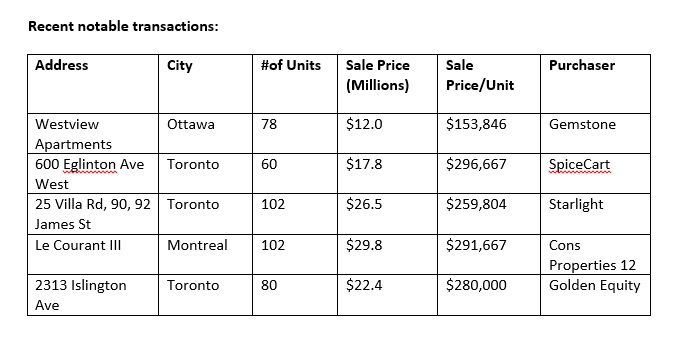
Looking back at March transactions, sales of purpose-built rental apartments were down by almost half from February on a combined basis for most major Canadian markets. Although nationally sales were up slightly in April, Altus Group reports that this was largely due to one sizable transaction worth $300.2 million, consisting of three properties in Hamilton, Cambridge and Kitchener, for a total of 750 units.

“The COVID-19 pandemic has caused many larger rental investors to delay or postpone buying decisions that had already been made, and many others are reviewing their investment strategies,” the June report said. However, according to Altus Group’s new Key Assumptions Survey, one in three investors see this as “a good time for opportunistic buying.”

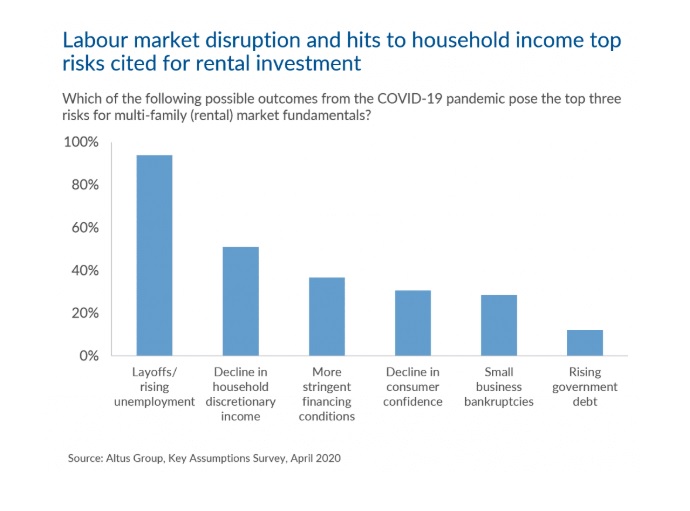
As of April, the top risks perceived for rental market fundamentals are impacts to consumer demand as a result of job losses and hits to income. Another factor, according to Altus, is the potential impact of lower immigration throughout the pandemic, with some regions across the country more heavily impacted than others.

Keith Reading, Director of Research at Morguard, concurs with these observations. “Sales activity has slowed significantly since the March outbreak began,” he said. “Despite healthy rental market fundamentals investors are still concerned about the near-term and the ability of tenants to pay rent.”

In the meantime, managers of rental properties are focusing on the health and safety of their residents and staff. “As clarity with regards to the economic outlook increases over the next several months, investors will once again return to the market and drive activity levels higher,” he said.

COVID-19 market receovery

Average rents

As for rental demand and monthly rental rates, new data from Rentals.ca shows that the average monthly asking price for all property types in Canada was down 1.4 per cent in May over April, and 7.2 per cent overall from its peak level in September. This is the third consecutive month rental rates have been on the decline.

“Tenants have been more dramatically impacted by pandemic-related job losses than homeowners, and are not currently looking for apartments or other rental accommodation,” said Ben Myers, president of Bullpen Research and Consulting. “This sharp drop in demand has resulted in landlords lowering their asking rents in most major markets across the country.”

The average rent for apartments in Toronto declined by 0.5 per cent in May to $2,290 per month, following a 5.9 per cent monthly decline in April. Rents were also down in Winnipeg, Montreal and Victoria.

But some markets saw an uptick in monthly rents – including London (up 2.9 per cent) and Edmonton (up 1 per cent) – in May over April, when both cities registered declines of 11 per cent.

Apartment searches

Despite the ongoing effects of the pandemic, tenant searches are on the rise with pageviews for listings on Rentals.ca having increased for the third consecutive month since March.

In terms of regions drawing interest, the firm Local Logic observed that Canadians are beginning to expand away from city centres and include markets further afield. “We captured an increase of 24 per cent in commute distances by car in Montreal,” said Guy Tsor, data scientist at Local Logic. “And a 19.7 per cent increase in Toronto in a span of just two months from users looking for a new house or apartment.”

“Toronto searchers who use public transit have shown a 33 per cent increase in how far they are willing to commute compared to March,” added Vincent-Charles Hodder, CEO of Local Logic. “Possibly because of the pandemic, people are now willing to live a bit farther out of the centre, to avoid higher density areas.”

Other key takeaways from the June National Rent Report:

  • Condo apartments experienced the steepest decline, with average rents offered by private investors falling by 9.4 per cent year-over-year.
  • The average monthly rental rate in Ontario was down 0.6 per cent monthly, while Saskatchewan was down 1.1 per cent and Quebec was down 1.9 per cent. But rents increased in May over April in Alberta, Manitoba and British Columbia.
  • In downtown Toronto, the Entertainment District, Cityplace and King West saw average monthly rents come down a reported $118 to $2,630 from January to May
  •  Per-square-foot rent for units from 400 square feet to 800 square feet have declined by 8 per cent to 14 per cent annually in Canada, while units from 900 square feet to 1,500 square feet have declined by between 3 per cent and 8 per cent annually.


Public transit wariness makes the core edgy

Commuters’ willingness to jump on the bus, light-rail car or subway is expected to be a driving factor in repopulating office space in some major North American markets, including Toronto, Montreal and Vancouver. Public transit wariness emerged as a common sentiment among respondents to JLL’s survey of COVID-19-related workplace concerns earlier this spring, prompting the firm’s newly released examination of potential ripple effects for employers, businesses, parking demand, traffic congestion and the urban environment.

“While at first it may appear that only a small number of North American cities have a heavy reliance on public transportation for their workforces, in reality, a considerable portion of the office market is concentrated in such cities,” the report observes. “This concentration of office space and office-using employment in transit-oriented markets highlights the challenge that may accompany a return to work in North America’s largest cities.”

Recent studies in various major world cities have found little evidence to link public transit to COVID-19 clusters. Decline in ridership is apparent, however, with a new report from the International Energy Agency citing a 50 to 90 per cent drop globally, translating to an estimated €40 billion (CAD $60.8 billion) revenue loss for transit authorities in the European Union alone. The perception of risk poses yet one more challenge for Canadian commercial landlords.

Toronto, Montreal, Vancouver, Ottawa and Calgary are listed among 12 markets deemed to be transit-oriented and where approximately one third of the North American office inventory is concentrated. Notably, Toronto and Montreal rank in the top five of the 25 metropolises JLL scrutinizes for the sheer numbers and the percentage of employees reliant on public transit.

More than 13 per cent of the labour force in both urban regions are transit users, or nearly 740,000 workers in Toronto and nearly 468,000 in Montreal. Toronto registers the third highest average tally (after New York and Chicago) of weekday transit trips, at 1.66 million; Montreal has the fifth busiest system with an average of 1.34 million weekday trips recorded.

“People must continue to exercise caution when on public transit because physical distancing will be a challenge,” Christine Elliott, Ontario’s Minister of Health, acknowledged last week as the Province released a new guidance document for transit authorities. “I urge everyone to follow our public health guidelines. They may seem simple, but they are effective in helping to prevent the spread of COVID-19.”

Strategies to reassure and welcome consumers

A coalition of Canadian business organizations, including the Building Owners and Managers Association (BOMA) of Canada, is similarly emphasizing the oft-repeated mantra of social distancing, hand-washing, vigilant disinfection of frequently touched surfaces and collective obligation for mitigating risks to others. They’ve joined forces to endorse the POST Promise — an acronym for People Outside Safely Together — a voluntary pledge with an accompanying illustrative logo, which businesses serving the public are invited to take to reinforce and signal their commitment to public health.

To do so, they can register online by affirming they will adhere to five principles to safeguard the health of staff and customers, and will make formal efforts to convey supporting information to all users of the venues they oversee. In turn, POST promise declarants will receive confirmatory signage to alert their customers.

“The idea is to create POST Promise as a touchstone. It’s an indication that businesses are aware of their responsibilities, and that applies as much on main street as on Bay Street,” explains Benjamin Shinewald, president and chief executive officer of BOMA Canada, who sits on the board of directors of the new not-for-profit initiative. “It’s not a certification and it’s not a BOMA Canada program. It’s a reassurance to customers, but the logo could also be a reminder to customers that they’ve got an equal role to play in public health.”

Other participating organizations include the Business Council of Canada, the Canadian Federation of Independent Business, the Canadian Global Cities Council, the Retail Council of Canada and Restaurants Canada. “Public confidence is essential to a successful economic restart,” reiterates Goldy Hyder, president and CEO of the Business Council of Canada.

Shinewald notes transit authorities would also be welcome to participate since they are literally delivery agents for key players of the post-pandemic recovery.

“The economy has been on pause,” he reflects. “Now, as we draw close to restarting the economy, it’s time to think about how we welcome people back to commerce.”

Accordingly, Ontario’s newly released guidance document outlines how transit authorities can support: smoothly flowing passenger traffic through stations and on and off vehicles; onboard social distancing; heightened sanitation; and ongoing communications with commuters. “This guidance for transit agencies will provide consistent, clear and practical information that transit agencies can use to help stop the spread of COVID-19 and keep Ontarians moving safely,” suggests Ontario Transportation Minister Caroline Mulroney.

Ottawa’s public transit authority, OC Transpo, will require passengers, with some exceptions, to wear face masks beginning June 15. The Toronto Transit Commission (TTC) will invoke a similar policy as of July 2.

“Our customers and our employees all need to see and feel that everything is being done to make the TTC as safe as possible and to protect them during this pandemic. Making face coverings mandatory is one more way we can do that,” notes Jaye Robinson, chair of the TTC.

Meanwhile, Société de transport de Montréal (STM) “strongly recommends” the practice and plans to distribute 300,000 complimentary reusable masks from its subway stations before the end of June. The STM website also features video instructions on how to wear and how to make face masks.

Anticipating more personal vehicles and active commuting

Along with Toronto and Montreal, the JLL report ranks Vancouver and Ottawa among the 10 major North American urban regions with the highest share of habitual transit riders in their workforces — equating to 11.7 per cent in Vancouver and 11 per cent in Ottawa. That drops off to 8.8 per cent of the workforce in Calgary and 7.2 per cent of workers in Edmonton. However, less than 5 per cent of the workforce relies on public transit in 10 of the surveyed metropolises, all in the United States.

Traffic congestion gives Toronto and Montreal less flattering standing in the top 10 cities where commuters lose the most time during their annual travels — pegged at 135 hours per year in Toronto and 117 in Montreal. JLL analysts point to potential tightening of that gridlock if more workers switch from transit to personal vehicles. “Even in cities with lower percentages of transit ridership, any shift in commute patterns toward cars could further exacerbate previously existing challenges with congestion and traffic,” they conclude.

This is not the first crisis-triggered decline in transit use during the 21st century, but it is arguably the most universal and long-lasting. JLL analysts foresee an eventual rebound like those following the September 2001 terrorist attacks and outbreaks of other infectious diseases like SARS and H1N1 influenza, and that transit-oriented development will continue to hold sway in the market.

In the shorter term, they predict dual-locations or even wider networks of dispersed office nodes, employer-sponsored shuttle services, ride-sharing initiatives and cycling infrastructure investment could all be on the rise. Demand for parking may not subside to the extent that transit-oriented development plans have envisioned, but competing demands for space are expected at street level.

“Owners and developers should review existing parking capacity and take into consideration commuters who may want to take advantage of bike and scooter share programs to avoid trains and buses,” JLL analysts advise. “Changes to the pedestrian path could encourage more walking if sidewalks are widened or cleared of obstructions, converted to pedestrian-only traffic or made safer through better sanitation and sidewalk lighting to take advantage of alleyways.”

The International Energy Agency likewise tallies a number of major global cities that are reassigning space previously reserved for vehicle traffic.

“As the COVID-19 crisis disrupts mobility routines, some regional governments and cities are seizing what they perceive as a unique opportunity to promote potentially lasting new mobility behaviours that favour active mobility,” the IEA report states. “Policies being pursued include speed limits and car-free zones in city centres, making road reallocation permanent and investing in new infrastructure such as bicycle lanes, bicycle parking and expanded walkways. Cities are also providing rental services and subsidies for the purchase and maintenance of traditional and electric bicycles.”


Poll shows majority support for fair bidding in B.C.

A new poll released by Merit Canada and the Independent Contractors and Businesses Association shows that the majority of British Columbians support fair bidding at 83 per cent. Those surveyed support giving all construction companies a fair chance to land taxpayer-funded work, regardless of how their workforce is organized. Canada-wide, support for fair bidding hits 88 per cent.

“The building trades unions represent fewer than 15 per cent of B.C. construction workers, yet they are given preferential treatment by the NDP Government,” said ICBA president Chris Gardner. “While British Columbians overwhelmingly support giving all construction companies in B.C. a fair chance at taxpayer-funded work, the province has effectively cut a special deal with their long-term supporters at the expense of B.C.’s construction workers and taxpayers.”

In the poll, not a single age group, gender, education level, or income bracket supported directing work to unions and cutting out open shop contractors.

ICBA and several other business associations, progressive unions, construction contractors and workers will be in front of the B.C. Court of Appeal July 16-17 challenging this policy.

“British Columbians understand that fair, open bidding – a level playing field for government work – is the best way to keep costs down and deliver the infrastructure we need in B.C. to keep our economy strong and improve our quality of life,” said Gardner.

The basis of the legal challenge is the significant consequence and inherent unfairness of the NDP Government’s decision to exclude the 85 per cent of the 250,000 men and women in construction who do not belong to a building trades union from working on government projects.

“Through the COVID-19 crisis, we’ve heard repeatedly – and we agree – that we are all in this together,” said Gardner. “So, it follows that we all need to be together in the recovery too – no one should be left behind in the middle of a global pandemic. Every construction worker in B.C. deserves a fair shot at taxpayer-funded work. No one is asking for a special favour, just a fair shot and a level playing field.”


Charlotte Products hires new regional sales manager

Andrew Knopp has joined the Charlotte Products sales team as regional sales manager covering the Southeast United States.

From his Orlando, Florida base, Knopp will represent Enviro-Solutions, with a focus on the company’s terrazzo/concrete floor care program. He brings with him nine years of experience in polished concrete and terrazzo, beginning in 2011 when he worked as an installer.

In his role as project manager for Tom Krider and Associates, he installed polished concrete across much of the United States and counted Discount Tire Co and O’Reilly Auto Parts among his main national accounts. Later in his career, Knopp was hired by Universal Polishing Systems as regional sales manager where he was responsible for managing over 100 North American accounts. During his time at the company, he helped develop accounts in Honduras and the Cayman Islands, most notably with one of the largest construction companies in Honduras.

Jeff Schwantes, Charlotte Products’ vice president of US sales, said in a statement: “We are excited to have Andrew on board. Andrew brings a lot of product knowledge and passion to the industry having gained experience as an installer, project manager, estimator, and account manager with a vast knowledge of how tooling is manufactured. With that knowledge, Andrew plans to help Charlotte Products expand their presence in North America by creating safe and healthy spaces throughout the Southeastern United States.”

SOURCE: Charlotte Products

ISSA: Back-to-work bonus will attract US cleaning workers

The ISSA has expressed its support of a proposed US$450 bonus for American workers returning to the job following the COVID-19 pandemic.

At the Senate Finance Committee hearing held on June 9, Rob Portman, the Ohio senator behind the proposal, cited a recent study by the American Action Forum and University of Chicago which reported that “between 60 and 70 per cent of individuals currently on unemployment are making more than they did in their prior job thanks to [the $600 a week in supplemental federal unemployment benefits].”

The $450 amount was suggested by Portman as it would supplement the wages of low-income workers to bring them in line with what they would receive on unemployment insurance. The program would last for six weeks as a way to help transition Americans back into the workplace.

“ISSA believes it’s critical to have a workforce that’s ready to step into their old jobs or newly available jobs as the economy reopens,” said John Nothdurft, ISSA Director of Government Affairs, in a statement announcing the organization’s support of the bonus. “Senator Portman’s provision should be included as part of the next coronavirus response stimulus legislation Congress considers. Cleaning companies and professionals are playing a critical role in maintaining clean and healthy environments for employees and customers. The demand for increased cleaning and disinfection requires more of these critical workers. This proposal would help fill these essential jobs.”

Portman’s full statement on the return-to-work bonus can be viewed on his official YouTube channel.

Colliers: CRE rent collection on downward trend

Colliers Canada reveals that 16 per cent of Canadian commercial tenants paid no rent in May 2020 as rent collection continues to decrease during the COVID-19 pandemic.

The Rent Collection and Relief Status report resurveyed 7,100 tenants across Canada in May as a follow-up to an April survey.

The company’s latest report shows:

  • 39 per cent of tenants who asked for rent relief in April did not make any payments for May, while 19 per cent provided partial payments and 42 per cent made full payments.
  • 21 per cent of retail, industrial and office tenants requested rent relief amid the ongoing financial impact of the COVID-19 pandemic.
  • Rent collection deteriorated by 1 per cent in March, 10 per cent in April and 13 per cent in May from February’s baseline.

A further decline in June’s rent collections is anticipated before improving in July and August, assuming the reopening of businesses continues.

Colliers anticipates a lag of six weeks between reopening dates and an uptick in collections due to businesses and consumers taking time to assess the situation as conditions start to return to normal.

“There are several factors contributing to the decline in rent payments from April to May,” says John Duda, president of Real Estate Management Services at Colliers Canada. “These include overall deterioration of conditions that many businesses are facing due to closures or decreasing demand, and the fact that some tenants and owners have been in a holding pattern regarding rent payments and deferral discussions while learning more about the Canada Emergency Commercial Rent Assistance (CECRA) program, which recently opened for applications.”

The May report also examined the duration of rent relief requests, and revealed these additional findings:

  • Of the tenants who requested rent relief, 23 per cent were able to negotiate direct relief agreements with their landlords outside of CECRA. Of that number, 94 per cebt were granted deferrals and 6 per cent were granted rent abatements.
  • The most common relief duration is three months, with 46 per cent of tenants being granted this length of relief, 28 per cent granted two months of relief and 18 per cent granted one month of relief.
  • Retail tenants are most likely to have come to an agreement on rent deferrals (18 per cent), followed by industrial tenants (14 per cent) and then office tenants (11 per cent).

CECRA Program Impact

Colliers believes that the impact of the CECRA program on collections won’t be clear until July. The Government of Canada opened applications for the program to provide financial support for Canadian small businesses on May 25, but it will likely take until July for owners and tenants to know where they stand with the program. There are also still areas that require further clarification, particularly around the administrative process and flexibility of legal agreement requirements.

“It is in everyone’s best interests to work together to ensure a safe and successful reopening,” says Duda. “Tenants and landlords are familiarizing themselves with the government’s rent relief supports, and many landlords are taking proactive action to find mutually beneficial solutions.”