Articles Archive - Page 416 of 928 - REMINET
REMI

Vancouver architect Peter Cardew passes away

Vancouver architect Peter Cardew, who passed away on October 26, will be remembered for his indelible impact on the city.

After graduating from Kingston School of Art Department of Architecture in London and working in the office of Max Bächer in Stuttgart, Cardew arrived in Vancouver in the late 1960s. Through his work with Rhone & Iredale Architects and later his eponymous practice, Peter Cardew Architects, he has created some of the city’s most well-loved spaces.

The firm has worked on a wide range of projects from schools, galleries, libraries, residences, and commercial buildings, building an international reputation for timeless, quality design.

While always maintaining a practice of modest scale, the office produced an extraordinary variety of projects, encompassing the programmes that would construct an entire city.

Among Cardew’s successful projects are the Morris and Helen Belkin Art Gallery, Lignum Forestry Building, the Crown Life Tower, False Creek Townhouses, the Lack Klan School of Industrial Arts, the Stone Band School, and the Kamloops Art Gallery as well as numerous single-family houses.

Apart from his own practice, he was an active participant in Vancouver’s Urban Design panel and contributor to debate regarding the city and design issues within the profession.

Cardew also made longstanding and profound contributions to UBC’s School of Architecture and Landscape Architecture (SALA), specifically in the MArch program. He served on graduation project committees, led option studios, and participated on innumerable design review juries. In recent years, he was a committed member of SALA’s Advisory Council, providing the school with invaluable advice.

His mentorship extended beyond academia. Many of the colleagues in his practice have gone on to form their own, taking with them the strengths of Cardew’s meticulous dedication.

Cardew was the recipient of many awards throughout his career, including the prestigious RAIC Gold Medal in 2012. The jury citation describes his impact on the profession:

“The quality of his work is consistently high, consistently thoughtful, and timeless. His commitment to the fundamental importance of the ‘art’ of architecture is evident in the poetry of the forms of his projects and his dedication to the broader community and profession is demonstrated through his teaching and design review panel work. Peter Cardew is an architect to be admired and emulated.”

Wavefront Centre scores highest accessibility rating

Wavefront Centre for Communication Accessibility has achieved the highest national accessibility rating to date under the Rick Hansen Foundation Accessibility Certification (RHFAC) program. With a score of 96 out of 100 points (96 per cent), the RHF Accessibility Certified Gold rated building has set the Canadian benchmark for meaningful accessibility in the built environment.

“Wavefront Centre has raised the bar for accessibility building standards across Canada through this outstanding achievement, and we are delighted to celebrate with them. We encourage other organizations to look at Wavefront Centre for inspiration in reviewing the meaningful accessibility of their buildings, and begin the journey towards creating a more inclusive future for everyone,” said Rick Hansen, Founder of the Rick Hansen Foundation.

Wavefront Centre’s Gold rating demonstrates the organization’s commitment to removing barriers for people with disabilities creating an inclusive and highly accessible office space. Key innovative accessibility features (widely praised by RHFAC professionals) that led to Wavefront Centre’s benchmark Gold rating include:

  • Rounder corridors for improved sightlines. Wider corridors so people can walk side by side and face each other when signing or speaking.
  • Acoustic baffles, ceiling tiles, wall panels to reduce reverberation (echo) and for improved sound absorption.
  • Door and wayfinding signs in high contrast and braille.

“Wavefront Centre for Communication Accessibility is proud to receive the highest national accessibility rating under the RHFAC program,” said Christopher T. Sutton, Chief Executive Officer at Wavefront Centre for Communication Accessibility. “As the leading provider of services that break down barriers to communication for people who are Deaf, DeafBlind, hard of hearing and hearing, we wanted to build an inclusive environment that showcased the best in universal design for our clients, employees and community. To achieve this high standard, we brought experts from around the globe together to ensure this facility was a space that welcomed everyone.”

Cleaning vs. Disinfecting: Seeing the “bigger picture”

Cleaning and disinfecting have become critical priorities for building and facility stakeholders. And, with little room for error, the pressure is on cleaning professionals to ensure environments not only appear clean but uphold the highest standards of hygiene. Here to discuss this evolving role and how healthcare industry leaders are rising to the challenge is Melissa Balinsky with A.M.G. Medical Inc.

Cleaning vs. disinfecting: Melissa Balinsky

A.M.G. Medical Inc.’s Melissa Balinsky

How have you seen the role of cleaning staff evolve throughout the pandemic?

I don’t think the role has changed, per se. If anything, the pandemic has heightened awareness of how important environmental services professionals are and how critical it is to protect them. Whether they’re in a school, hospital, office, or retail environment, people are more conscious of the fact that their health and wellbeing literally rests in their hands. Cleaning and disinfection are so top of mind that you can’t help but look at the staff charged with conducting those tasks with more respect and admiration.

You speak to your clients about the difference between cleaning and disinfecting often. Can you explain what separates these two activities?

People tend to lump cleaning and disinfection together, but they aren’t the same thing. The main difference is if you’re cleaning something, you can use a lot of sensory cues to guide you in identifying and addressing sources of dirt, dust, stains, and other noticeable items that require cleaning. You can touch the dust, you can see stains, and you can sometimes smell the debris and other elements. So, with cleaning, you really are using your senses to tell when the job is done.

Disinfection, on the other hand, is the exercise of killing and eliminating something that you can’t necessarily see or smell or hear. These can be harmful bacteria and viruses that, if missed or not fully disinfected, can remain on a surface for days, weeks, or even months. Unfortunately, you don’t really know they’re even there until people start getting sick, food starts to spoil, and bacterial odours begin to appear.

We have to remember that facility maintenance teams already have a lot on their plate. And, when they’re tasked with both cleaning and disinfecting a space, they are actually being tasked with very different and time-consuming exercises on top of their day-to-day responsibilities. So it’s helpful to understand the distinction between both of these activities in order to get the job done thoroughly and efficiently the first time out.

What is “contact time” and why is it important to the disinfection conversation?

Contact time refers to the amount of time a disinfecting agent needs to be acting on a pathogen like bacteria or a virus to kill it. Anything that is supposed to disinfect something has a contact time, whether it’s chemicals or UV light.

Think about a room with a single table, for example. A cleaning professional can’t just take out a wipe, rub the surface, and call it a day. Even if they are using a disinfectant with a contact time of five minutes, that means that every single spot on that table has to remain wet with the active ingredient for five minutes. Moreover, if they miss just one spot, they aren’t achieving total disinfection. Only places that come in contact with or are exposed to the disinfecting product or agent are accounted for.

Now, take a step back and think about how complex and time-consuming it can be to apply that level of effort to everything else in that room – every centimetre of every chair, door,  fixture, or piece of furniture in the space. It becomes very daunting and stressful for maintenance teams that are already busy as it is, and also likely anxious about spending that amount of time in a potentially risky environment.

How have cleaning products and services evolved to capture that “bigger picture”?

There are several ways the industry is stepping up. There are people like myself working with facilities and cleaning professionals to understand the current risks, navigate the regulatory environment, and work through all the myths and misconceptions. We’re also adapting the way we share information by having our representatives consult with clients virtually instead of face-to-face meetings.

We’re also helping bring awareness to how our products can be used not just in high-risk environments like hospitals, but in schools, malls, stores, government facilities, and other public areas.

Our Nocospray Disinfection System, for example, is an automated room disinfection system that can disinfect an entire space on its own and with zero human interaction. Staff still need to conduct that initial clean, but this allows them to activate the system, leave the room, and focus on other tasks with confidence that the environment is being disinfected thoroughly. The System will address the hard-to-reach, often-forgotten areas – all the hard surfaces in the space. The idea is to reduce the amount of time individuals are being exposed to potentially contaminated environments while saving costs and ensuring more complete disinfection.

Again, both cleaning and disinfecting are critical, but when it comes to the disinfecting element, we need more awareness and tools like Nocospray to keep cleaning professionals and building stakeholders safe.

How do you see attitudes towards cleaning evolving beyond the pandemic?

Ultimately, the pandemic has caused a seismic shift in awareness. The level of panic will eventually subside, but the awareness of the value of attention to effective, accessible, and cost-effective disinfection won’t go anywhere.

We have seen other events have a big-bang effect on infection control products and concepts before. We don’t return to the baseline; we hold on to the change.

A.M.G. Medical is a Canadian-owned company focusing on the health of our valued customers. Please click Nocospray to learn more about this revolutionary disinfection system which is effective for all types of facilities. If you would like to discuss Nocospray or any other of our products, please feel free to call us at 1-800-361-2210.

BCCSA updates best practices for presumptive cases

Since the start of the pandemic, the BC Construction Safety Alliance (BCCSA) has been issuing and developing COVID-19 guidance for employers, and resources to distribute or use as the basis of toolbox talks and safety meetings.

The construction industry has adapted well with enhanced safety practices and protocols, but must continue to be vigilant.

“Although construction has done well, we can’t let our guard down. There’s been a huge push for everyone to just ‘get back to normal’ as schools are reopening and B.C. is currently in Phase Three of the reopening plan,” says Mike McKenna, BCCSA executive director. “However, the industry can’t be complacent because there’s still a way to go with COVID-19 and our new way of working. It is crucial for all employers to just keep their foot on the pedal and continue to uphold the protocols and health and safety guidelines that have been developed.”

The safety association is committed to providing the industry with up-to-date information needed to navigate these challenging times. BCCSA recently updated its general best practices when someone on site is presumed to have COVID-19.

BCCSA notes that a positive COVID-19 diagnosis is a medical diagnosis and is to be treated as having confidential medical information. The infected employee should not be identified by name as having contracted the virus, while employees and other people on site should be notified of what has been done to protect them.

What to do when someone who has been on site is presumed to have COVID-19

Follow the below procedures if someone on site meets any of the following criteria:

  1. Has been tested for COVID-19 in the past 10 days and the results of the test are not yet available.
  2. Has tested positive for COVID-19 within the past 10 days.
  3. Has developed symptoms of COVID-19 within the past 10 days and has not yet been tested for COVID-19.

This individual will be referred to as the “presumptive case.”

When can the presumptive case return to site?

Until COVID-19 testing results are available, the presumptive case should not be permitted back on site until they are no longer experiencing symptoms of COVID-19 AND 10 days have passed since they developed symptoms. Individuals experiencing symptoms of COVID-19 must seek testing for COVID-19.

If the test result is negative, they may be able to return to work before the end of the 10-day isolation period if they are no longer experiencing symptoms. Follow the guidance from medical professionals when available.

The presumptive case can use the BC COVID-19 Self-Assessment Tool (https://bc.thrive.health/covid10/en) or call 8-1-1 for more information about testing.

If the presumptive case is hospitalized or otherwise under the care of a medical professional, they should not return to work until the medical professionals determine that it is appropriate.

How should we clean the site?

Clean and disinfect all touch-surfaces in the area where the presumptive case was present. Follow the BCCSA procedures for Enhanced Cleaning and Disinfection.

If the presumptive case has tested positive for COVID-19 consider using a specialized biohazard remediation abatement company for professional disinfection.

Should other teams or workers be isolated?

Identify any individuals who have been in close contact with the presumptive case. These individuals should self-isolate for 14 days.

Close contact means:

  • Provided care for the presumptive case without consistent and appropriate use of PPE.
  • Lives with the presumptive case.
  • Had direct contact with infectious body fluids of the presumptive case (e.g. was coughed or sneezed on)
  • Had close contact (within 2 meters) with the presumptive for more than 15 minutes while the presumptive case was exhibiting symptoms or up to 48 hours before the presumptive case developed symptoms.

While awaiting testing results for the presumptive case, these close contacts may continue to work unless they develop symptoms. During this time, they should maintain physical distance (2 meters) from other workers and self-monitor for symptoms.

If the presumptive case tests positive for COVID-19 close contacts should self-isolate and monitor for symptoms for 14 days since their last contact with the case. Public Health can provide further information on what to do in the event of a positive test result.

  1. Wherever possible, the presumptive case’s work crew should work separately from other work crews (e.g. in a different room, on a different shift) until test results are available or, in the case of a positive test result, for 14 days after the presumptive case developed symptoms.
  2. If any workers who have had close or non-close contact with the presumptive case develop symptoms, then they should also be considered as presumptive cases and the steps should be repeated.

Notify all staff and any other people who were on site at the same time as the presumptive case so that they can self-monitor for symptoms.


Feds release new details about Rapid Housing Initiative

The federal government has provided new details about the Rapid Housing Initiative (RHI), a program it says will expedite the creation of up to 3,000 new affordable housing units across the country.

Launched earlier this fall, the $1 billion RHI fund will be used to quickly develop new modular multi-unit rentals, convert non-residential buildings into affordable multi-residential homes, and rehabilitate buildings that are abandoned or in disrepair into affordable multi-residential homes. Costs to purchase land and buildings will also be eligible under the new initiative.

“No Canadian should ever be without a place to call home,” Trudeau said in the official statement. “By making smart and substantial investments in affordable housing and providing funding directly to municipalities, we’re creating jobs, strengthening our communities across the country, and helping the most vulnerable.”

The $1 billion in funding will be provided through two streams:

  • Major Cities Stream: $500 million in immediate support for pre-determined municipalities. The municipalities were determined based on metrics including the levels of renters in severe housing need and of people experiencing homelessness;
  • Projects Stream: $500 million for projects based on applications from provinces, territories, municipalities, Indigenous governing bodies and organizations, and non-profit organizations. Applications will be accepted starting today and until December 31, 2020.

The RHI is part of the government’s plan to create jobs and support economic recovery, while eliminating chronic homelessness in Canada. We will continue to support all Canadians, and especially those most vulnerable, as we work to build a more resilient country that is safer, fairer, and more inclusive for everyone.

“This initiative will help keep safe some of Canada’s most vulnerable people and families,” said Garth Frizzell, President, Federation of Canadian Municipalities. “This is real, measurable progress toward our shared goal of ending chronic homelessness and gives us a model we can scale with the ambition required to deliver on that mission.”

The RHI will be delivered by the Canada Mortgage and Housing Corporation (CMHC), under the National Housing Strategy (NHS).

Funding under the Major Cities Stream is allocated as follows:

    • Toronto: $203.3 million
    • Montréal: $56.8 million
    • Vancouver: $51.5 million
    • Ottawa: $31.9 million
    • Region of Peel: $30.4 million
    • Calgary: $24.6 million
    • Edmonton: $17.3 million
    • Surrey: $16.4 million
    • Capital Regional District (British Columbia): $13.1 million
    • Winnipeg: $12.5 million
    • Hamilton: $10.8 million
    • Halifax: $8.7 million
    • Region of Waterloo: $8.2 million
    • London: $7.5 million
    • Québec City: $7.1 million

Under the Projects Stream, applications can be submitted from October 27 until December 31, 2020. CMHC will review applications within 30 days from the close of the application window. Projects must be completed within 12 months of a signed agreement, and unused funds will be re-allocated to other projects.


Property tax ratios epitomize commercial burden

Vancouver and Calgary took significant steps to narrow their commercial-to-residential property tax ratios in 2020, and Ottawa and Toronto also continued to incrementally close the gap that still sees commercial property owners in those cities taxed at two-and-a-half to three-and-a-half times the rate applied to residential households. In contrast, Montreal’s commercial ratepayers were apportioned an even larger share of the property tax burden than in 2019.

Newly released results of the annual Canadian Property Tax Rate Benchmark Report, produced by Altus Group in partnership with REALPAC, finds the commercial property tax rate continues to be at least double the residential rate in eight of the 11 surveyed cities, with commercial ratepayers in Montreal, Toronto and Quebec City shouldering the most disproportionate shares. In addition to Montreal — where the commercial property tax rate is now more than four times greater than the residential rate — the commercial-to-residential ratio widened in Quebec City, Halifax and Saskatoon. However, Saskatoon still boasts the narrowest gap of the 11 cities at 1:72-to-1.

“COVID-19 has accelerated the need to reduce the commercial-to-residential tax ratio given the significant added pressure currently facing businesses,” maintains Terry Bishop, president of Altus Group’s Canadian property tax division. “Municipalities should recognize that bringing down the commercial-to-residential tax ratio will not only help provide some much-needed relief to struggling businesses during this time, but will also make their cities more appealing to businesses going forward.”

To some extent, 2020 reflects that approach. Averaged across the 11 cities, commercial property tax amounts to $23.57 per $1,000 of assessed value, while the average residential property tax rate equates to $8.98 per $1,000 of assessed value. That is represented in the 2020 average commercial-to-residential property tax ratio of 2:65-to-1 — an improvement over the 2019 ratio of 2:84-to-1.

Significant adjustments in Vancouver and Calgary

Much of this year’s improvement flows from upward adjustments of the residential property tax rate in Calgary and Vancouver. In Vancouver, a tax increase of 36.5 cents per $1,000 of residential value brought a corresponding decrease of nearly $2.60 per $1,000 of commercial value, and translated into a commercial-to-residential ratio of 2:301-to-1 in place of the previous 3:64-to-1. Calgary’s 2020 commercial-to-residential ratio of 2:58-to-1 increased the residential levy by nearly 87 cents per $1,000 of assessed value while cutting $2.61 per $1,000 of value from commercial tax bills.

That follows long stretches in the property tax benchmark report’s 17-year history when Vancouver was commonly listed in the three cities with tax ratios most lopsided in favour of residential ratepayers. Much of this year’s tax largesse can be attributed to the British Columbia government’s 70 per cent reduction in the school tax portion of the commercial mill rate, which was implemented as a COVID-19-related relief measure, but it reinforced a trend that was already unfolding.

“Since 2017, the city’s ratio has decreased from a survey high of 4.87 down to 2.30, representing a 52.8 per cent drop over the course of three years. Vancouver now sits below the average for the first time,” the benchmark report observes.

Calgary likewise implemented a reversal after four consecutive years of increasingly widening gaps between the commercial and residential rates. That occurred as the city tried to balance out the impact of diminishing value of office towers due to the oil and gas industry’s sustained downturn and spinoff high vacancy rates.

“This decrease is the result of the City (of Calgary) realizing that continual pressure on commercial taxpayers is unsustainable,” the benchmark report states. “Calgary City Council has had no choice but to shift more of the tax burden to residents due to the skyrocketing taxes on small businesses over the last three years.”

Residential ratepayers in both cities still pay less than the national average, amounting to $7.52 per $1,000 of assessed value in Calgary and $2.93 per $1,000 of assessed value in Vancouver. Toronto is the only other city where residential ratepayers are taxed below the national average rate, equating to $6 per $1,000 of assessed value. Nevertheless, the seeming discrepancy with higher residential property tax rates elsewhere, notably nearing $12 per $1,000 of assessed value in Winnipeg and Halifax, must be seen in the context of significantly differing residential values among the cities.

Edmonton’s commercial-to-residential property tax ratio also nudged slightly tighter in 2020 — to 2:38-to-1 — working out to $22.22 per $1,000 of commercial assessment. Elsewhere on the prairies, Winnipeg, Regina and Saskatoon are the rare three cities where commercial ratepayers are levied at less than the double the rate applied to residential assessment.

Provinces make COVID-19-related interventions

Montreal’s 4:11-to-1 ratio translates to a levy of $36.99 per $1,000 of commercial assessment versus $9.01 per $1,000 of residential assessment. The tax gap widened by nearly 4.5 per cent compared to the 2019 ratio of 3.93-to-1. Commercial ratepayers in both Montreal and Quebec City did get some COVID-19-prompted relief from the Quebec government, however, through a reduction of the school tax rate. Local councils in both cities have also introduced a property tax freeze for 2021.

Toronto and Ottawa are continuing on a protracted path to targeted narrower tax ratios, with Toronto’s ratio now at 3:62-to-1 and Ottawa’s at 2:46-to-1. This year’s adjustment is the 16th consecutive reduction in Toronto’s commercial tax rate as the city nears the 2023 pledged timeline to hit 2.5-to-1. However, Altus analysts suggest council will have to pick up the pace in order to hit that mark.

Ottawa is one of four cities, along with Montreal, Quebec City and Halifax, where the commercial tax rate exceeds the national average — equating to $26.64 per $1,000 of commercial assessment. Ottawa’s residential ratepayers are also among the most highly taxed. They absorbed a tax increase of nearly 9 cents per $1,000 of assessed value this year and pay the third highest rate of the 11 cities, at $10.85 per $1,000 of residential assessment.

Altus analysts note that Ontario’s provincial education levy is a significant contributor to commercial taxes in both Toronto and Ottawa. “Without significant downward movement in the provincial ratio both Toronto and Ottawa will be challenged to bring their overall ratios down,” the report concludes.

Assessed values in Toronto and Ottawa will remain static for the 2021 tax year after the Ontario government postponed its scheduled reassessment earlier this year. The Manitoba government has also added an extra year to what’s normally a two-year assessment cycle, pushing the start-date of the next cycle to 2023.

“We commend governments across the country for their early and continuing commitments to tax fairness during the pandemic, including deferral programs and payment forgiveness,” says Michael Brooks, chief executive officer of REALPAC. “We encourage municipalities going forward to limit the commercial-to-residential property tax ratio to a maximum of 2-to-1, avoiding the temptation to burden businesses alone with deficits. With the likely economic impacts of the COVID-19 pandemic having lasting effects on municipal and provincial budgets and financing, it has never been more important for governments to maintain healthy and predictable tax rates.”

Chartwell begins construction of new long-term care home

Chartwell Retirement Residences announced it has received approval to commence construction on a new 224-bed long-term care home located in Ajax, Ontario. Once complete, the new structure will replace an existing 100-bed facility. Residents at the home will continue to receive care and services throughout construction.

The $65.2 million development is expected to open in the spring of 2023 and is designed to the Ministry of Long-Term Care’s current standards. The building will include 134 private rooms with the remaining rooms providing semi-private accommodation.

“This project has been over five years in the making and became a reality through the tremendous efforts of many Chartwell people,” said Vlad Volodarski, Chartwell’s Chief Executive Officer.  “I want to extend my deepest gratitude to them for their hard work, expertise and tenacity, and express my congratulations on achieving this important milestone.”

Volodarski also extended Chartwell’s thanks to the Ontario Government for its support through the Ontario Long-Term Care Home Capital Development Funding Policy 2020, as well as the assistance it received with obtaining the necessary approvals in a timely manner.

“Chartwell is proud to partner with Chandos Construction, a reputable builder with long-standing experience in the sector,” added Teresa Fritsch, Chartwell’s Senior Vice President, Real Estate and Investments. “This project is expected to create approximately 200 construction and trade jobs and 300 permanent jobs in the community.”


Three types of empathy for workplace leaders

In 2016 when Microsoft launched Tay.ai—an artificial intelligence bot hosted on a Twitter account—it quickly suffered one of the company’s most embarrassing moments.

Within hours of the launch, the Tay became wickedly rude due to a coordinated attack by hackers. Tay began spewing profane and racist comments, including a denial that the Holocaust ever happened. The world was aghast at the vitriolic hate it began to disseminate. The company was forced to issue a public apology and the team responsible was left with a customer relations nightmare. Just 16 hours after launch, Tay was taken offline.

A few days after the Tay debacle, Satya Nadella, CEO of Microsoft entered the picture. Instead of berating the team responsible for Tay, Nadella chose the empathic route. In fact, he depended on three specific types of empathy in his dealings with the situation.

Wait, there are three types of empathy?

Columbia University psychologists Jamil Zaki and Kevin Ochsner define empathy in three distinct ways. Mentalizing is how we explicitly consider and understand someone else’s “states and sources.” Experience sharing is when we vicariously share “targets’ internal states.” The third type of empathy, prosocial concern, is when we express “motivation to improve targets’ experiences.”

While Zaki and Ochsner’s definitions are academically sound, we might take the liberty of refining them into plain language: cognitive empathy, emotional empathy, and sympathetic empathy. With further refinement, we can classify them ever further as head, heart and hands.

When we use our head, we are intellectualizing how someone else is thinking about a situation, problem or task. When we use our heart, we are embracing someone else’s emotions in a given scenario. And finally, if we use our hands we take sympathetic action on what we have gleaned from the head and heart metaphors. At its root, the three types of empathy are how all leaders should operate with their team members.

Back to Microsoft and the situation with Tay. The company’s CEO, Nadella, demonstrated all three types of empathy by first putting himself in the shoes of developers to understand how they were thinking and how they were feeling. He then took sympathetic action. He wrote directly to the group of developers responsible.

In an email he said, “Keep pushing, and know that I am with you.” He went on to remind them that the “key is to keep learning and improving.” In an interview with USA Today shortly after the incident, Nadella said, “It’s so critical for leaders not to freak people out, but to give them air cover to solve the real problem. If people are doing things out of fear, it’s hard or impossible to actually drive any innovation.”

Nadella cuts to the heart of the issue. If we do not exhibit the three types of empathy during our leadership, inevitably the team’s productivity will wane. Ever since the Tay issue, Microsoft has continued to press technological advancement through bots like Tay. The Microsoft Bot Framework, introduced in 2016 shortly after Tay, is now being used by more than 130,000 developers. I’m quite certain the success of the framework would not have occurred were it not for Nadella’s demonstration of the three types of empathy.

Sadly, empathy does not get the credit it deserves as a key leadership trait in the workplace. In their 2019 Workplace Empathy survey, technology firm Businessolver discovered that 82 per cent of employees would consider leaving their job for a more empathetic organization while 85 per cent believe empathy is highly undervalued. 58 per cent of CEOs say they struggle with consistently exhibiting empathy in the workplace — and their employees agree: employees consistently rate their peers as more empathetic than their CEO.

Henry Ford was quoted in Dale Carnegie’s 1937 book, How to Win Friends and Influence People: “If there is any one secret of success, it lies in the ability to get the other person’s point of view and see things from that person’s angle as well as from your own.” Over 80 years ago, Ford put himself in the shoes of regular citizens and felt their pain. It was not a faster horse that was needed but an economical motor vehicle, something that could help others in society.

Empathy and the act of being more humane is mission critical for leaders not only during a pandemic, but in their everyday leadership style. When we demonstrate perspective or put ourselves in the shoes of others—using our head, heart and hands—there is a greater possibility for success. It makes for a more engaged workplace, too.

By being empathic, you are looking out for those you work with as well as those you might be serving while you are completing a goal. When we empathize, we are observant of patterns that may affect our desired result.

When we are empathetic, we have truly become a caring leader.

Dan Pontefract is the former Chief Envisioner at TELUS, and is a leadership strategist. He is the author of LEAD. CARE. WIN. How to Become a Leader Who Matters.

Condo design takes cue from commercial facilities

Modern condos weren’t designed to cope with life during a pandemic. But widespread closures of offices and public spaces have left people isolated at home, emphasizing the multi-functional and psychological needs of units and common areas. Taking cue from commercial facilities like workplaces, hospitals and hotels, condo design is expected to take a greater turn towards health and wellness.

Freddy Mak, vice-president of business development at Trulife Developments, has seen a big uptick in demand for clean living spaces in condos, arising largely from the pandemic.

Along with Constantine Enterprises Inc., his company is building the first condo to rise in the Uplands neighbourhood of Thornhill, with plans for advanced building systems to address health and wellness. Their 8188 Yonge project will include upgraded air filtration units to filter fine particles, advanced water purification systems to help remove heavy metals and UV technology to halt bacteria growth.

Design considerations trendier in non-residential settings are starting to show up in people’s homes, in turn, making condos more livable post pandemic.

“Things won’t necessarily be the same, and that is not a bad thing,” he says. “As developers, we are listening and adapting our projects to take into account the new normal, and focus on cleanliness protocols for our residents to feel safe in the place they will call home.”

With so many people unable to travel, Mak sees outdoor amenities becoming “a bit more unique and robust in their offerings,” to include a “luxury, hotel-inspired” experience, with features such as longer pedestrian-friendly paths and outdoor meditation and yoga space.

condo design

Plans for 8188 Yonge call for 30,000-square-feet of outdoor amenity space, including a lush garden pathway. Rendering by Norm Li.

There’s also renewed interest in balconies as daily life reshuffles. “With typical balconies across the GTA, you’ll see concrete floors and glass railings,” says Mak. “Nothing wrong with that, but we’ve found through our extensive market research and community outreach initiatives, especially during the pandemic, there is now a huge demand from real estate buyers to purchase units with private-use spaces that are not just for practical use, but are aesthetically pleasing.”

Customizable balcony packages—one offering at 8188 Yonge—are equipped with flooring, lighting, furniture and accent pieces, with a choice of three themes.

Elements like this are said to bring a sense of well-being in their attempt to fill a void that surfaced during periods of social isolation. A vast majority of Canadians feel that COVID-related stress and worry has negatively impacted their mental health, according to a survey conducted by The Conference Board of Canada and the Mental Health Commission of Canada. Much of this is attributed to anxiousness, loneliness and well-being concerns.

A Flexible Focus

The idea that design can curb chronic disease and promote mental health echoed through an Urban Land Institute webinar in June. Looking at impacts on human health and third-party certifications like Fitwel, panelists delved into pandemic-shaping residential design trends.

Andrea DelZotto, director and executive vice-president of community development at Tridel, said a more hybrid approach to work will shape design. She sees large-enough suites incorporating more home office space, and co-working areas in buildings with smaller units.

Connectivity will also grow increasingly important as more people work and learn from home. In most of its buildings, Tridel has already invested in distributed antenna systems, which provide clear service for mobile devices on every floor.

“That is the number one amenity we provide, and they expect it everywhere in the building now,” she says. “It’s not just good enough in a suite.”
condo design

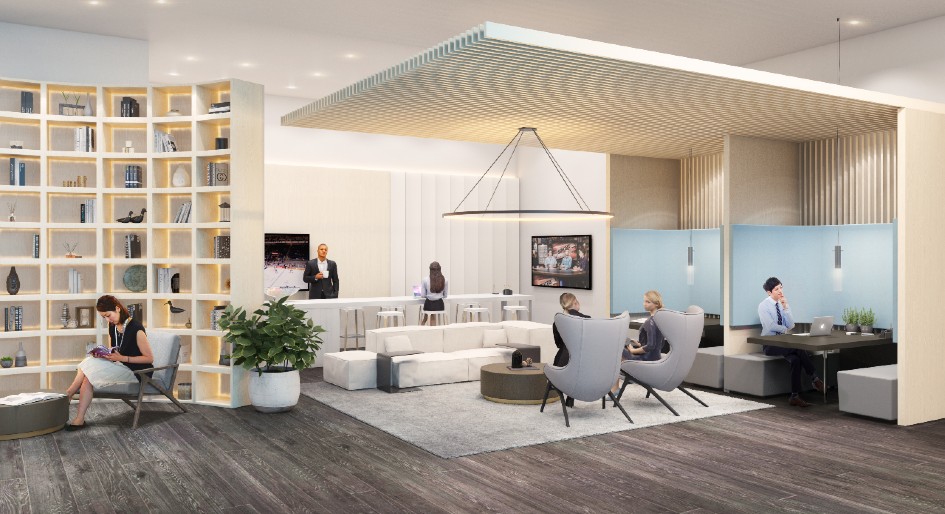
Co-working space designed for 181 East in North York will serve a growing population of office-free residents. It comes with private workspaces and a meeting room.
Rendering courtesy of Stafford Homes.

Implementing a public health perspective early on is a change moving forward—taking cues from hospitals and incorporating elements such as hand-washing sinks in common areas. Design is shifting to different finishes that people choose in their homes, antimicrobial surfaces, for instance, and also smart home systems with low-touch, voice-activated technology. Hands-free smart toilets and faucets, items more likely to be found in commercial washrooms, are just two features Tridel added to its innovation suite in the Ten York condo tower.

As designers at architectural firm Quadrangle worked remotely, they visualized their homes serving multiple purposes. Prioritizing columns over shear walls allows for easy interior conversions, moving plumbing out of the space to create uber-flexible main living areas. Using principles of industrial design, modules could fold out and become a desk or bed, depending on the needs of the day.

“There was an idea that suites are only designed to be outward facing, but what if you started to animate the corridors and provide a slide light so you could have light coming from both sides, and start to encourage connections,” said Michelle Xuereb, director of innovation at Quadrangle. “Walking down the hallway, you would be able to tell if your neighbour was home or not home.”

A balcony that closes inwards during certain times of the year, like a sunroom of sorts where one could grow vegetables, is an idea Xuereb visualizes. “Imagine, you could open them to the outside and close them in the winter time, so you have this buffer space.”

The fresh air a balcony provides, also a key factor of wellbeing, is accessible through green roofs and community gardening, which will add to the social aspect at Tridel’s MRKT Alexandra Park, Aqualina, and Evermore at West Village in Toronto. DelZotto said these spaces should remain flexible for programming. “If we have outdoor amenity space that’s only really usable in the summer, find ways to make it adaptable through four seasons,” she suggested.

condo design

Community gardening will add to the social aspect at Evermore at West Village.

Just as universities harvest produce from their rooftop gardens to supplement food for other parts of the campus, so can multi-res buildings, as Xuereb imagines. Adding fruit trees is one way to integrate food into a community.

Transforming Underutilized Spaces

Looking at revitalizing areas that often go unrecognized, Xuereb envisions distributing amenity space on every floor within the building, spread throughout corridors to make them usable, with little niches of space to spend time in. “Our hallways and elevators are really just treated like super highways,” she noted. “We really need to start thinking about those spaces in between so we can think about community building as a part of it.”

Those in-between spaces extend to stairways, swapping concrete and steel handrails for colour and natural light—perhaps even music—as a way to connect people and encourage physical activity.

New additions to common areas, as DelZotto imagines, include Zoom rooms for people working remotely, retreat spaces for mental health and personal mobility in the form of e-bike sharing programs.

“The days of putting in amenities and a property manager are long gone; you need to program these spaces,” she said. “These benign spaces are really underutilized and we have this amazing community. How do we let them benefit from it? How do we connect the people in it?”

Referring to MLS systems, engagement in a building might one day become criteria similar to WiredScore or a Walk Score.

“It’s important to a lot of people and lifesaving in some circumstances,” she added. “The more urban and dense we live, the more isolated we are—ironically. That is something important that we solve for and that we really try to put a measurement around.”

Fitwel for Condos

“Where you live has a direct and measurable impact on all aspects of health: your physical health, mental health and social cohesion, trust with neighbours, for instance,” said Joanna Frank, president and CEO of the Centre for Active Design.

As an advocate of Fitwel certification, she discussed how to shape residential living to prioritize health, much like a company would do with its corporate interiors to amplify workplace wellness.

Fitwel came onto the scene in 2017 as a way to measure the physical, emotional and mental well-being of employees through targeted improvements to design and operational policies. Much of the same can apply to a condo. It promotes strategies shown to have the greatest impact on health, which can be woven through an existing building or during construction. Two years ago, a new version of Fitwel was launched for multifamily residential.

Some design elements include outdoor access, enhanced indoor air quality, on-site health promotion programming, soliciting feedback from residents to integrate into management practices and adding and maintaining greenery. For example, higher levels of neighbourhood green spaces are associated with lower rates of depression, anxiety and stress. How well they’re maintained is a crucial indicator whether someone is going to trust you or not, noted Frank. Greenery on a property that is well maintained will increase levels of trust by eight per cent. Poor maintenance lowers levels by -11 per cent.

There are also specific strategies to help residents optimize their space for sleep. Thermal control, air quality, acoustic comfort and managing exposure to outdoor light are a few. Encouraging the use of daylight for work-from-home spaces and established cleaning schedules are also key.

“It is very important that cleaning staff are visible and are also prepared and understand the underlying strategies you’re using to protect residents,” she said. “It will not only mitigate viral transmission but build trust and solidify that relationship between you and your tenants. If property management has enhanced cleaning practices and implemented efforts to improve air quality, but no one knows about it, the potential mental health impacts are being lost.”


 

Minto pilots high-rise air leakage testing

Minto Communities GTA was recently recognized with an EnerQuality Award for Building Innovation for their air leakage testing project completed at their Minto Yorkville Park high-rise.

This test which measures air leakage, is one of the first completed in the GTA and makes Minto the first developer in Ontario to complete a baseline measurement for high-rise air leakage, with plans to incorporate findings into future projects.

While air tightness testing for high-rise buildings is not practiced or mandatory in Ontario or the GTA, it offers a range of benefits to residents and building performance such as energy consumption levels.

Through this process, the building’s barrier where thick plastic is installed to prevent leakage is tested for its effectiveness. Minto in partnership with experts from RDH Building Science completed guarded air tightness testing, which involves isolating individual floors and capturing air leakage through the building enclosure only.

The test floor and the floors above and below are pressurized and depressurized identically throughout the process.

“Testing the air tightness of a building is an important metric because it helps us understand its longevity over the years as it’s used, as well as the comfort of residents in their homes,” says David Robins, division president, Minto Communities GTA. “We decided to do our air tightness testing at Minto Yorkville Park during construction, which allows us to make improvements while we’re still completing our work. We were really pleased to see results well below standard rates in regulated municipalities, showing us our build quality and material selection meet our own high expectations.”

Minto Yorkville Park is a luxury 25 storey high-rise tower recently completed in the heart of the Yorkville community. Though this was the first time Minto Communities GTA has completed air tightness testing.


Legislative changes to condo guide roll out next year

Last year, the Ontario government tabled the Rebuilding Consumer Confidence Act, which aims to strengthen consumer protection and ensure stronger oversight of several administrative authorities, including the Condominium Authority of Ontario (CAO). One piece of legislation related to the condo guide is now expected to roll out on January 1, 2021.

Once in force, the changes require the CAO to develop a plain language condo guide for buyers and require developers to provide it at the point of purchase, along with the currently required disclosure statement.

Other changes to the Condo Act will ensure that any agreement of purchase and sale entered into by a developer (or a person acting on behalf of or for the benefit of the developer) is not binding on the purchaser until the developer has delivered a copy of the guide and disclosure statement. Amendments will also allow a buyer who receives a copy of the guide from the developer to revoke the purchase and sale agreement before accepting a deed to the unit in certain instances.

The condo guide is expected to become available by late fall 2020 to give stakeholders, including condo developers, time to familiarize themselves with it and the related requirements.

The proposed guide is expected to better equip potential purchasers of residential condos with information on condo ownership and on the condo purchase process to assist their understanding of the risks involved in buying pre-construction condos. The guide will cover a wide range of topics relevant to purchasing and owning property in a condo, such as common expense fees and board governance. However, developers would be required, under the Condo Act, to provide it only to purchasers of residential pre-construction/new condos.

COVID-19 prompts mortgage refinancing: survey

COVID-19 is driving some homeowners to refinance their mortgage. It is estimated that 10.2 per cent plan to refinance in the next 12 months and 9.5 per cent plan to refinance for other reasons, according to a new survey from RATESDOTCA.

Data was collected from 3,500 Canadians aged 18 years or older between August 31 to September 17, 2020. Another recent RATESDOTCA poll by Forum Research Inc. conducted between September 24 and October 1, 2020, surveyed 1179 respondents across Canada and found that one in eight mortgagors say it is “likely” or “somewhat likely” they will not be able to pay their mortgage in the next 12 months, resulting in them having to ask their lender to postpone their mortgage payments.

Homeowners who have been relying on deferral plans due to COVID-related hardship will soon see a large number of deferrals coming to an end in October and November. The amount of people refinancing could increase as a result, but there could also be more resistance from lenders to approve COVID-impacted applicants.

For owners who cannot get approved with a traditional lender, here are RATESDOTCA’s top options to consider:

Talk to a broker: they have dozens of alternative lending options for those with 20 per cent equity or more (in big cities like Toronto, sometimes only 10 per cent equity is required, albeit the rates are much higher).

Use “skip-a-payment”: some lenders allow one monthly payment to be skipped per year. If your deferral didn’t invalidate that option (policies vary by lender), then skipping one additional payment could buy you more time.

Use back-up resources: these options must be considered carefully as they have consequences that may not be palatable, such as negative impact to personal finances and retirement and tax implications. If you have access to low-cost “promotional” credit card cash advances or a secured/unsecured credit line, tapping those can be a short-term bridge until your income is restored. If absolutely necessary to save their home, homeowners with temporary income interruption may have to withdraw from RRSPs to make their mortgage payments.

Worst case, sell: if you can’t keep up with your payments, you’re likely better off selling on your own terms than on your lender’s terms (that’s especially true when home values are strong, like they are right now).


Reserve fund budgeting: A fan coil unit retrofit

One of the most under addressed issues in aging condominiums is the fan coil unit (FCU). Residents often take an “out of sight, out of mind” approach because FCUs live behind the walls, forgotten until an issue arises.

Some of the most common issues that bring awareness to larger FCU problems include inconsistent temperatures, motor noises, mechanical failure, odours, excessive condensate causing leaks and in bad situations, flooding and the worst, mould. These issues can create substantial problems for a condominium because an FCU is connected to other aspects of the building, including the riser systems, boilers, chillers and make-up air units, all of which control the overall indoor air comfort and quality. Retrofitting FCUs in an entire condominium is a significant undertaking, costing anywhere between $500,000 to more than $2 million, depending on the size of the building.

FCUs are typically managed one of two ways. They can be owned by either the individual suite owner or the corporation. If owned by the suite owner, he or she is individually responsible for repairs and replacement, and the corporation is only responsible for common area units. But because of potential damage caused by flooding, the corporation often takes responsibility for maintenance.

“It’s a grey area and should be clearly defined,” says Adrian Abramovic, P.Eng. of Trinity Engineering & Consulting Inc. “In the majority of buildings, the corporation will cover bi-annual maintenance to ensure the inspections are being completed. Preventative maintenance is very important, on new and older FCUs; as one FCU’s neglect may have negative consequences for the entire building.”

Abramovic has experience working with corporations who took ownership of the in-suite FCUs and funded the complete retrofit.

Reserve Fund Budgeting

If the corporation owns the FCUs, it is responsible for maintenance, repairs and retrofitting the entire building. This ensures the FCUs are reliable, limits property damage and allows for budgeting end-of-life replacement. Based on engineering opinions, roughly 10 to 40 per cent of condo corporations in Ontario own their FCUs. In these buildings, boards need to account for retrofit project costs through their reserve funds, not operating budgets. Creating a fan coil retrofit line item in the HVAC category of the reserve fund can proactively account for a project. The general life expectancy of an FCU is 20 years.

“The reserve fund is for major replacement or overhaul of common elements,” says Andrew Potter, P. Eng., owner of IN Consulting. “We have seen some condos use reserve funds for general maintenance and repair, which should come out of the operating budget. This leads to a shortfall in reserve funds, which will require a significant increase in future contributions or even a special assessment when a major repair is required”.

In the event a condo board has not adequately allocated funds, it may have to consider doing the following: hire an external expert to perform a special assessment, replace the fan coil units in phases, raise maintenance fees, raise contributions to the reserve budget fund or all the aforementioned.

Replacing in phases can be problematic as managers and contractors change over time, and consistency is important to a successful project. This can also lead to maintenance issues as different manufacturers use different components.

One of the main ways a board contributes to its reserve budget is through maintenance fees, but how much can you increase fees to compensate for a project of this magnitude? The Condominium Act of Ontario mandates all registered condominiums perform a reserve fund study every three years. If you are underfunded, consider the age of your building and the FCUs so you can begin allocating funds, starting the next reserve fund study, to prevent the need of a special assessment or increased maintenance fees.

All buildings—aging or new construction—should perform regular reserve fund studies and include fan coil replacement as a line item under HVAC equipment. Doing this early will ensure boards are financially set up to perform the retrofit when the existing units reach the end of their life expectancy. Including specific line items within your reserve fund with proper funds allocated over years will prevent potential emergencies that could result in liabilities, lawsuits, insurance claims and damages.

Melissa Kois is the manager of marketing and business development operations at Unilux CRFC Corporation.

Toronto and Vancouver outdo most U.S. markets

Canada has a numerically slight presence with disproportionate weight in Lee & Associates’ newly released third quarter commercial real estate results. The overview of 44 markets across the United States along with Toronto and Vancouver purports to be a North American report — encompassing about 2.1 billion square feet in office, industrial and retail assets and 600,000 multifamily units in the two Canadian cities, and 36.7 billion square feet of the same property types and 17.3 million multifamily units in the U.S. markets.

For comparison, the report combines Toronto and Vancouver into a scoped Canadian index to be held against the 44 markets lumped into the U.S. index. From this nation-to-nation perspective, Canada generally stands out with lower vacancy rates, higher market rents, higher sales values and lower cap rates.

Toronto notably registers the lowest industrial vacancy rate — pegged at 1.3 per cent — while also hosting the fifth largest inventory of industrial space at nearly 837 million square feet. However, with about 10.4 million square feet of new space under construction, it lags the development pace of U.S. markets like Dallas, Atlanta and Chicago where more than double that volume is now in progress.

“Industrial real estate in the Greater Toronto Area continues to see rising demand from e-commerce fulfillment, food and beverage and paper products,” notes Daniel Smith, vice president and principal with Lee & Associates. “Average asking net rental rates continue to trend upwards quarter-over-quarter with landlords pushing for high watermarks specifically related to premium mid-to large-bay space.”

Similarly, Maria Fayloga, Lee & Associate director of research, points to strong demand for distribution/logistics space in Metro Vancouver — seen in the 3.7 million square feet of new development now in progress, including multi-storey facilities in Vancouver and several projects in the suburban cities of Richmond, Surrey, Delta and Langley.

“The industrial rental and investment market continues to experience growth with stable rents and steadily increasing market prices,” she says. “The industrial real estate sector is expected to remain strong heading forward with vacancy rates at 2.1 per cent this quarter.”

That represents the second lowest industrial vacancy rate in the 3rd quarter survey. In addition, Vancouver boasts: the lowest industrial cap rate, at 4.6 per cent; the lowest retail vacancy rate, at 1.6 per cent; the second lowest office vacancy rate, at 3.6 per cent; the second highest office market rent per square foot, at USD $45.03; and the highest office sales price per square foot at USD $671.

Toronto also cracks multiple top-5 lists in the office sector with: the fifth lowest vacancy rate, at 5.1 per cent; the fourth highest market sales value at USD $435 per square foot; the second highest tally of space under construction at nearly 13 million square feet; and the second lowest cap rate at 5.5 per cent. A retail vacancy rate of 2 per cent is the second lowest in the survey, after Vancouver.

Canadian pension funds buy U.S. multifamily assets

Multifamily vacancies are likewise tighter in Toronto and Vancouver — at 1 per cent and 2.6 per cent respectively — than the 6.7 per cent average across the U.S. index. Market rents, at USD $1,710 in Toronto and USD $1,680 in Vancouver, are also well above the U.S. index average of $1,364, but fall out of top-five range and trail far behind list-topping rents of USD $2,712 in New York City and USD $2,414 on Long Island.

Vancouver records the highest per unit sales price at USD $462,000 and the lowest average cap rate at 2.5 per cent. Toronto’s cap rate of 3.9 per cent is also lower than in most U.S. cities, while an average per-unit sales price of USD $276,000 surpasses the U.S. index average of USD $204,749.

Canadian pension funds are among the purchasers in the U.S. market. Alberta Investment Management Corporation (AIMco) acquired a 275-unit building in Miami for USD $89.6 million and a joint interest in a 184-unit in Pasadena. The latter USD $16.8-million acquisition is listed as the second priciest multifamily deal in the Los Angeles/Tri-Cities area during the third quarter. In a more substantive outlay, Oxford Properties Group paid USD $320 million for a 461-unit building in Seattle, representing the largest multifamily deal in that city in a 12 month period.

Turning to new product, approximately 51,000 units under construction in Vancouver and Toronto amount to less than 9 per cent of the tally in U.S. markets. However, at the city level, Vancouver has the third highest number of new multifamily units in progress, at 31,996, after New York and Dallas-Fort Worth.

Industrial growth slows, while office sector loses last year’s gains

As in Canada, industrial has remained the steadiest U.S. sector throughout 2020. While 104.5 million square feet of net absorption across the 44 U.S. markets Lee & Associates surveys is the most sluggish growth since 2012, nearly half of that space — 51.9 million square feet — was taken up in the third quarter. A 5.7 per cent vacancy rate as of September 30 demonstrates a 20 basis point increase since Q2, but also reflects the delivery 67 million square feet of new space to the market over the summer. And there is much more new space coming.

“Most of the record 331 million square feet under construction is spec logistics product. Some 200 million square feet is slated for delivery over the next two quarters, a high-water mark in the current cycle,” the Lee & Associates report states. “Nevertheless, industrial property should continue to outperform other commercial real estate categories. There’s also speculation that much of the sudden growth in e-commerce may be sustained after the pandemic ends.”

Highest market rents are found in California and New York, with San Diego enjoying the chart-topping USD $16.62 per square foot. The top five record average market rents well above Vancouver’s USD $13.88 per square foot or Toronto’s USD $11.81 per square foot. However, more modest rates across the entire U.S. index pull the average down to USD $8.86 per square foot. The average market sales price sits at USD $109 per square foot across the 44 U.S. cities versus an average of USD $174 per square foot in Toronto and Vancouver.

In contrast to the continued growth in the industrial sector, 55 million square feet of office has been returned to the market thus far this year, with 61 per cent or 33.6 million square feet of that negative absorption occurring in the third quarter. That pushed the U.S. index vacancy rate up 50 basis from Q2 to rest at 10.8 per cent. More than 153 million square feet of new office space is currently under construction, with about 53 million square feet of that scheduled to hit the market by spring 2021. Meanwhile, an uptick in sublease space mirrors trends in Canada.

“There has been a dramatic rise in available sublease space, now at 144 million square feet with 60 million square feet added since March,” the report tallies. “Leasing activity in August was 50 per cent less than at the start of the year. Since July, fewer than 150 leases have been signed for blocks of space larger than 10,000 square feet.”

New York records the highest market rent at USD $57.72, with the average across the U.S. index at USD $34.30. New York also registered the highest market sales price at USD $661 per square foot, while the U.S. index average was USD $316 per square foot.

Nominal retail rent growth as vacancies increase

Nearly 38 million square feet of negative absorption thus far in 2020 contributes to the 5 per cent retail vacancy rate in the U.S. index. Across nearly 11.6 billion square feet of inventory, that represents more empty space than Toronto and Vancouver’s combined retail inventory of 569 million square feet.

Among 18 markets specifically spotlighted in the report — including New York, Los Angeles, Chicago and Toronto — only two leasing deals in excess of 100,000 square feet were inked during the third quarter. The majority of transactions involved less than 50,000 square feet, and that’s certainly the case in the Greater Toronto Area, where the largest reported deal of the quarter was for 9,349 square feet in suburban Newmarket.

“The Toronto retail industry seems to have reached a tipping point, allowing e-commerce to emerge as the logical successor to traditional brick-and-mortar models. Due to the lockdown and warnings to avoid high-traffic indoor areas, many shopping malls and underground pathways will inevitably see a large reduction in shoppers for the foreseeable future,” muses Nicole Moniz, vice president, retail, with Lee & Associates. “Foot traffic in assets with essential-based retailers remains high, as well as neighbourhood street-front. ‘Shopping local’ has gained momentum and the perception of safety is higher.”

That’s a general outlook throughout the North American retail industry. Across the entire database, rents have not actually declined, however 0.1% rent growth in the third quarter is the slimmest margin since 2009. Across the U.S. index, average market rent is pegged at USD $21.61 per square foot, while New York commands the highest market rent at USD $43.46 per square. Market rent of USD $31.31 and USD $30.50 respectively in Vancouver and Toronto once again exceed the U.S. index average.

Construction starts have fallen to historical low levels in 2020, although more than 52 million square feet of new retail space is under construction in the 44 U.S. markets Lee & Associates surveys. Only New York, with 3.4 million square feet in progress has more retail construction underway than Toronto, where more than 3 million square feet is in the pipeline.

“Long term, there’s anxiousness whether merchants will regain their share of lost trade after the pandemic as online purchasing of consumer goods has become routine for more shoppers,” the report states. “Acquisition, underwriting and financing activities are challenged to accurately assess risk in a post-COVID environment. Nevertheless, a considerable amount of well-financed investors are on the sidelines, raising capital and alert to distressed opportunities.”

Sooke library construction underway

Construction of a state-of-the-art new library for the District of Sooke is underway. When complete in 2022, the community will have access to more than 13,000 square feet of space to browse materials, conduct meetings and access technology.

The iconic circular design is by architectural firm HDR, and the general contractor is Nanaimo-based Island West Coast Developments. Initial work includes preparing site surveys, clearing trees and brush, cutting in an access road, and mobilizing construction sites.

“I expect the people of Sooke will watch with interest and excitement as this important capital project takes shape. In a year like no other, it is especially heartening to move forward with such a well needed and long-awaited community amenity,” says Brenda Leigh, chair of the Vancouver Island Regional Library (VIRL) board of trustees.

The plan for the new $7.5 million two-storey library encompasses all aspects of the project, including construction, furniture, IT infrastructure, and more. The library will be built on one-acre of a five-acre lot, along Wadams Way, owned by the district.

“We have a clear vision for the future development and growth of our community,” says Sooke Mayor, Maja Tait. “A vibrant and modern library was an important piece in our plans — I have full confidence that with this library, we are setting the wheels in motion for ongoing and sustainable development of Lot A, the Wadams Way corridor, and surrounding area.”

Once built, Sooke will have a state-of-the-art library with the following features and amenities:

  • 13,412 square feet will offer a diverse collection, multiuse spaces, and more;
  • Increased staffing;
  • Expanded hours of operation;
  • Expanded program schedule;
  • Vibrant children’s area, fireplace lounge area;
  • Laptop bar, study space, bookable rooms.

“This new library will evolve and complement Sooke’s ongoing transition into a destination of choice for people living and visiting south of the Malahat,” says Rosemary Bonanno, VIRL’s executive director.

Report suggests new building codes aren’t tough enough on energy efficiency

New Canadian building codes that are currently under review by a National Research Council committee would potentially facilitate designs that are less energy-efficient than they could be, according to a Carleton University study.

The federal-provincial Pan Canadian Framework on Clean Growth Climate Change (PCF) calls for all new buildings to be Net-Zero Energy Ready (NZEr) by 2030. However, a report published by Efficiency Canada, an energy efficiency research and advocacy organization at Carleton, outlines how this may fall short.

In particular, the report, which was based in part on interviews with representatives from the government and other institutions, notes a disconnect between Canada’s climate commitments and new “stretch” model building codes. A lack of mandatory air leak testing, an ineffective approach to measuring energy code compliance, and less stringent best-practice standards for large buildings, for example, present obstacles to NZEr buildings.

Air leakage is reportedly considered to be the greatest source of heat loss in buildings and a big contributing factor in a building’s energy use for heating or cooling. As such, mandating these tests would go a long way towards reducing a building’s energy consumption.

Researchers noted that improved air sealing, increased insulation levels, and high-performance windows and doors are integral to buildings aiming for net-zero readiness.

“We need our building standards to reflect our expectations of a net-zero emissions future,” said the study’s lead author Kevin Lockhart. “That big change — from a minimum standards mentality towards showing where we need to go — requires a new policy framework.”

In summary, the report’s authors have two key recommendations: clearer federal direction for building codes to reach national net-zero emissions goals, and identifying a policy “champion” within the government to integrate building codes into wider policy on climate.

John Power, a spokesperson for Innovation, Science and Industry Minister Navdeep Bains, stated that building codes “assure Canadians that their health and safety have been fully considered in the construction and renovation of homes and workplaces. He added that the government made national building codes free to save students, workers, and businesses “costs and complications.”

New education program for condo managers

On November 1, 2021, the authority for setting education and examination requirements necessary for condo managers to qualify for a General Licence will be transferred to the Condominium Management Regulatory Authority of Ontario (CMRAO).

In 2017, the Minister of Government and Consumer Services designated the courses and challenge exams developed by the Association of Condominium Managers of Ontario (ACMO) as the necessary requirements.

Over the last year, the CMRAO says it has prepared for this transition by developing Ontario’s first competency profile for the condominium management profession, and by developing a roadmap and course curriculum that incorporates the identified competencies within the educational requirements.

The new curriculum features six courses, the first of which is Excellence in Condominium Management. The roadmap for condo managers and course blueprints are now available on the CMRAO website.

CMRAO’s Transition Plan

All applicants for a General Licence who have enrolled in or have completed any of the original educational requirements for a General Licence prior to November 1, 2021, and who successfully complete all of these requirements by October 31, 2022, will be deemed to have complied with the educational requirements for a General Licence.

The Request for Prior Learning (RPL) assessment process for all applicants for a licence on or after November 1, 2021, will be based on the new educational program.

All applicants for a Limited Licence who apply for a licence on or after November 1, 2021, shall complete the “Excellence in Condominium Management” course as part of their application. Applicants will be required to successfully complete this course in order to be granted a Limited Licence.

All applicants for a General Licence who have enrolled in or have completed any of the original educational requirements for a General Licence prior to November 1, 2021, and have not successfully completed all of these requirements by October 31, 2022, will be subject to the new educational requirements set by the Registrar.