Articles Archive - Page 377 of 928 - REMINET
REMI

Calgary approves $200M for downtown plan

The City of Calgary has approved an investment of $200 million for the Greater Downtown Plan.

The plan, developed through extensive engagement with citizens, the downtown business community, and community associations, is the vision, roadmap and commitment to build a more thriving, future-focused downtown.

“We need to create an even-more thriving downtown community that moves beyond the traditional office-based downtown central business district and instead is a dynamic, vibrant 24/7 centre of our city,” said Mayor Naheed Nenshi. “This means taking bold action and making intentional investments in public spaces, supporting vibrant neighbourhoods, and ensuring we continue to create a downtown that people want to live and work in.”

The initial investment of $200 million is earmarked for actions that will address office vacancy, improve downtown vibrancy, and support the development of thriving neighbourhoods.

  • $45 million in financial incentives for office conversion, office replacement and new residential development.
  • $5 million in financial incentives to offset +15 Fund contributions for residential development.
  • $55 million for impactful capital projects to improve public spaces, improve vibrancy and support complete neighbourhoods.
  • $5 million to activate downtown public spaces with festivals, events and community spaces to build vibrancy.
  • $80 million for Arts Commons Transformation Phase 1.
  • $10 million over four years for a dedicated City of Calgary Downtown team.

The 10-year implementation of Calgary’s Greater Downtown Plan will require a collaborative approach to enhance Calgary’s downtown. The city has been working with its downtown strategy partners (Calgary Economic Development, Calgary Municipal Land Corporation, the University of Calgary, and the downtown business improvement areas) along with members of the real estate and business community to create an investment package that will have an impact on downtown’s greatest concerns.

The investment in Calgary’s downtown required from 2021 to 2031 is estimated at $1 billion. The initial investment package represents only 20 per cent of the overall need over the next decade. The city will require support from all levels of government to help address this 80 per cent funding gap.

Updating your property management toolkit

Unlike other professions, the property management sector is known for ignoring new technologies and processes longer than in should in favour of the status quo. The reason is, property managers are driven by the singular objective to maximize revenues—and there are only two ways of doing it: by reducing operational costs, or by increasing the amount that tenants pay. That’s why savvy property managers are worth their weight in gold.

Still, technology shouldn’t be ignored, and those who explore and embrace new methods can gain a real advantage. Of course, every property management professional has a mobile phone, but it is still incredibly common for tasks to be done the old way, sometimes even with pen and paper rather than mobile devices and computers. This approach may save money in the short run, and it certainly cuts down on training time for new technologies, but it’s not good for the bottom line.

Here’s a look at some of the antiquated processes that are still standard in the property management industry and how they should be updated to maximize efficiencies:

1. Property inspections

Everyone knows how critical it is to check over recently vacated units, making sure that everything is in working order. This allows companies to pay the damage deposit back to former tenants, make necessary repairs, and get empty units quickly turned around. Given the importance of this process, it’s amazing that most inspections are actually done using a printed checklist. On paper (literally), this isn’t a terrible thing. After all, it still captures relevant information. But what it doesn’t show is when damage occurred, causing the list to be almost useless when it comes to a dispute over deposit refunds. A great way to mitigate this is to use apps such as Happy.co. Effective property managers use iPads and cell phones not only to record the condition of properties but to take and archive timestamped photographs. Accurate documentation gives property managers the upper hand when they can prove that units were pristine before a resident moved in.

2. Ordering supplies

Even in an age of sophisticated technologies, most purchasing is rather ad hoc. If property managers run low on supplies, they just head out to the local Home Depot to buy more nails, cleaner or floor mats. This isn’t a terrible approach because companies can buy whatever they need relatively quickly. However, owners then have almost no visibility into spending—and no control over seemingly small expenses that can add up in a hurry. Savvy property owners that want bulk discounts and consistency in their expenditures should look into platforms such as Yardi or RealPage that offer advanced catalogue tools, where all purchases are initiated and tracked in a single system.

3. Apartment tours

Apartment tours are difficult to arrange in the best of times, and almost impossible to schedule during a pandemic. Most people search for rental units online, and when they find a place that meets their criteria, they call the leasing office to schedule a conversation and perhaps even a visit. Again, this is not a terrible approach. The problem is that most people do their searches at night when rental offices are closed. This means that a potential tenant who is ready to sign a lease has to send an email or leave a voicemail and then wait for 12 hours or more for a return message. Access to a leasing agent directly correlates to revenue because people tend to look at multiple units then take the first one available. First mover advantage is everything, which is why technology platforms like MeetElise use AI-powered bots to automatically respond to inquiries or schedule visits within a matter of seconds. So even if a property management professional is off-line for the evening, prospective tenants are reeled in long enough for a live agent to take over the next day.

4. Tenant approval or denial decisions

Finding a tenant is only a positive if he or she is able to pay rent in full every month. It costs property owners money if they approve a tenant only to find out that the rent isn’t going to be paid on time, or there is illegal activity, or damage to the premises. The best way to prevent costly and time-consuming evictions is to find quality tenants. For the last 30 years or so the industry standard has been a credit check, which allows property companies to make sure that prospects have a good financial score. It’s a fine idea in theory, but credit checks miss many crucial details, including employer and income data, bounced checks and average bank balance. In short, they just don’t get the job done. Over the next few years, these kinds of inquiries are ripe to get replaced by technologies that use artificial intelligence to predict whether or not a prospect will make a good resident. That’s why bank checks are primed to become the industry standard for third-party verification: they actually answer questions that credit checks don’t even ask. By getting a complete snapshot of an applicant’s financial health and not just credit card payments, landlords can make intelligent, data-driven decisions that result in better tenant selection.

There’s no single technology that’s going to solve every problem. After all, there really are too many issues to tackle simultaneously. What is needed is a willingness to let go of old approaches and adopt new technologies that will not only save time and improve efficiency, but ultimately increase profits as well. If you already have a smart phone in your pocket, you’re 90 per cent of the way there.

Rentify.com Chad Guziewicz is Co-Founder of Rentify, the leader in bank checks, an instant screening tool used to verify tenant application data by landlords and property managers across North America. 


Large-scale long-term care homes ‘strongly discouraged’

Protecting long-term care residents from outbreaks requires different infrastructure, proper staffing conditions and a culture of quality assurance, researchers at the University of Waterloo have determined.

In, “Reflecting on the COVID-19 Themes from Long Term Care,” published last week in the Journal of the American Medical Directors Association, experts said designing smaller, more homelike spaces would minimize the spread of viruses while promoting better health and quality of life for residents.

“Community outbreaks and lack of personal protective equipment were the primary drivers of outbreak occurrence in long-term care homes, and the built environment was the major determinant of outbreak severity,” George Heckman, a professor in Waterloo’s School of Public Health and Health Systems and Schlegel Research Chair in Geriatric Medicine with the Research Institute for Aging, said in a press release.

“We need to distinguish between small-scale living and small-scale housing, using architectural features to create uncrowded and home-like spaces – but within a sufficiently resilient infrastructure to avoid critical staff shortages such as those experienced by some very small homes in Italy and the United States.”

In the U.S., data from geospatial analysis and cellphone tracking showed that outbreaks were more likely when staff commuted from neighbourhoods with high viral circulation, and in large homes with more staff traffic.

The researchers said that in the case of Ontario, simulations found that 31 per cent of infections and 31 per cent of deaths could have been prevented if all Ontario long-term care residents had had single rooms. However, 30,000 new private rooms would have been needed.

“Policymakers need to reimagine long-term care infrastructure in a post-pandemic world, keeping in mind that smaller homes support better resident outcomes and are more resilient against infectious outbreaks,” Heckman said. “New large-scale long-term care home developments should be strongly discouraged.”

Other factors that would improve resident well-being and curb the spread of viral infections include a dedicated infection control officer in all long-term care homes, proper staffing conditions and high-quality assurance frameworks.

Hong Kong, for example, learned from the 2003 SARS outbreak and implemented several policies that led to success when it came to COVID-19. They developed guidelines for the prevention of communicable diseases in long-term care, including that all homes have an infection control officer, conduct annual outbreak drills and have a permanent stockpile of personal protective equipment and establish visitation rules that address hygiene and PPE use.

In addition to robust infection control and communication technologies used in Hong Kong, Heckman believes full-time positions, paid sick leave and mental health and well-being supports for staff would make a big difference.

Ontario, and most Canadian provinces, already have the required information infrastructure to achieve a learning health system. Based on standardized international Resident Assessment Instrument systems, developed by an international consortium of which Waterloo is a principal leader, their use by communities of practice has led to reductions in inappropriate antipsychotic use and better health outcomes for long-term care residents.


Cogeneration systems to lose tax enticement

Fossil-fuel-fired cogeneration systems are losing their status as clean energy equipment for the purpose of Canada’s accelerated capital cost allowance (CCA) tax incentive. While the newly released 2021 federal budget commits $142 million over five years to immediately expand the list of capital investments that qualify for the special tax measure, it also names various combined heat and power (CHP) applications that will be delisted after 2023.

“Reforming eligibility for this tax incentive will help reduce pollution and greenhouse gas emissions in Canada,” the budget document states.

Under current rules, 19 categories of property defined as “clean energy” or “energy conserving” are designated for accelerated CCA, allowing acquiring businesses to deduct either 30 or 50 per cent of its value, depending on its energy efficiency rating. An enhanced time-limited condition also gives businesses that purchase such items in the period between November 20, 2018 and December 31, 2023 the option of deducting the full value in the first year of ownership.

“Providing accelerated CCA is an exception to the general practice of setting CCA rates based on the useful life of assets. Accelerated CCA provides a financial benefit by deferring taxation,” the budget document notes. “In addition, certain intangible project start-up expenses (e.g. engineering and design work, and feasibility studies) are treated as Canadian Renewable and Conservation Expenses. These expenses can be deducted in full in the year incurred, carried forward indefinitely for use in future years, or transferred to investors using flow-through shares.”

Some of the qualifying equipment with applications in commercial buildings include: cogeneration systems; active solar heating equipment and ground-source heat pump systems; heat recovery equipment; photovoltaic electrical generation equipment; geothermal energy equipment; equipment related to district energy systems; electrical energy storage equipment; and electric vehicle charging equipment.

As of budget day, April 19, six new categories of equipment will be added to the list. However, only one is likely to be pertinent for building owners or facilities managers. That is: “active solar heating systems, ground source heat pump systems and geothermal energy systems that are used to heat water for a swimming pool”.

Similarly, with the exception of cogeneration systems, the equipment slated to lose eligibility for accelerated CCA after 2023 is predominantly found in industrial or public works operations. These include: combined gas and steam turbines; waste-fueled electricity generating systems with capacity to produce upwards of 3 megawatts of electricity; and waste-fuelled heat production equipment or gas generating equipment that relies on fossil fuels for more than 25 per cent of energy input.

Although cogeneration is credited for using heat that would otherwise be wasted, systems that rely on fossil fuels are now afoul of the federal government’s target to achieve net-zero energy emissions. Meanwhile, technologies not yet common when the tax incentive was first introduced have since emerged as alternatives.

“The eligibility criteria for these systems have not been modified since they were first set approximately 25 and 15 years ago,” the budget document advises.

Along with changes to the accelerated CCA incentive, the budget introduces new tax credits for the manufacturers of zero-emission technology, some of which is expected to become increasingly prevalent in commercial buildings.

Beginning in the 2022 tax year, these businesses will be eligible for a 50 per cent reduction in the general corporate tax rate and/or small business tax rate on income derived from qualifying manufacturing or processing activities until 2028, followed by a gradually decreasing phase-out of the benefit over the next three year tax years until the close of 2031. It’s projected the federal government will forego $45 million in tax revenue due to this measure over the next five years.

“These proposed tax rate reductions will enhance Canada’s competitiveness in attracting investment in zero-emission technology manufacturing, while also supporting existing businesses in the sector,” the budget document submits. “In addition, the government will undertake an analysis to ensure that Canada keeps pace with the U.S. and other jurisdictions in providing the appropriate tax structures and incentives to encourage clean economy businesses to invest, grow, and deploy solutions here in Canada.”

For now, 12 business activities are identified, including manufacture of solar, wind, hydroelectric and geothermal equipment, as well as equipment related to ground source heat pumps, electrical storage of renewable energy, and electric vehicle charging systems. Other emerging technologies may be added in the future.

Commercial building owners/managers are also potential stakeholders in another budget allocation related to electric vehicle charging stations. That will provide $56 million to Measurement Canada over the next five years to develop codes and standards for retail zero-emission vehicles (ZEV) charging and fueling stations.

“While charging ports are now available in more and more places — from shopping centres, to office buildings, to curbside parking — the measurement and pricing of the energy being sold is not always clear to drivers,” the budget document observes. “This measure would provide regulatory certainty to providers of charging services and facilitate the development of the charging network.”

Bell Centre becomes first Canadian hockey arena to achieve GBAC STAR accreditation

A year after GBAC STAR Facility Accreditation was introduced by ISSA, Canadian facilities of all purposes and sizes continue to achieve certification as a method of communicating their cleanliness and infection control best practices.

Now, sports arenas are beginning to join the party.

Montreal’s Bell Centre, the home of the Montreal Canadiens, recently secured accreditation, becoming the first Canadian hockey arena to do so.

“Since the start of the pandemic, our priority as an organization is to do everything possible to ensure that we create a safe and reassuring work environment for our employees, our teams as well as for the opposing teams who will have to use the Bell Centre,” says Daniel Trottier, Executive Vice President, Guest Services and Facilities Operations at the arena’s operator, Groupe CH.

“Our teams have worked tirelessly for several months to establish safety and risk management protocols that meet the highest standards of safety and compliance with health measures as requested by the Public Health authorities. This GBAC STAR accreditation validates our teams’ excellent work. The Bell Centre therefore obtains the same third-party validation as the Pierre-Elliott-Trudeau International Airport in Montreal, ensuring that the building is ready to welcome the return of hockey in complete safety.”

Bell Centre isn’t the first sports stadium to achieve the accreditation, which is focused on ensuring a clean, safe, and healthy environment in public and commercial facilities, and outlines best practices, protocols, and procedures to control risk factors associated with infectious disease, including SARS-CoV-2.

Back in September 2020, Vancouver’s BC Place became the first Canadian stadium to become accredited. Meanwhile, south of the border, numerous U.S. baseball stadia as well as several NBA and NHL arenas have also become GBAC STAR accredited venues.

Committing to a cleaner Canada

Those sports stadia only scratch the surface of the level of uptake that has been seen in Canada, however. There have been numerous groundbreaking firsts in recent months.

In February, Manulife Investment Management was the first Canadian real estate landlord to achieve accreditation, getting seven of its Montreal office facilities accredited.

Last month, TO Live became the first Canadian performing arts organization to commit to achieving GBAC STAR accreditation for its venues, which include iconic Toronto venues Meridian Hall, St. Lawrence Centre for the Arts, and Meridian Arts Centre.

Given the extent to which the COVID-19 pandemic has transformed both the mechanics of cleaning and the communication and visibility of infection prevention measures, there’s reason to suggest the future may be in wider accreditation.

In mid-March, Explore Edmonton, the visitor economy and venue management organization for the Albertan city, announced a collaborative initiative to pursue city-wide GBAC STAR accreditation. That would make it the first and only Canadian destination to obtain accreditation for its entire metropolitan area, and one of only two destinations in North America.

Edmonton’s city-wide certification would encompass Edmonton International Airport; Edmonton Destination Marketing Hotels (EDMH), which oversees 38 properties across the city; Rogers Place; the Oilers Entertainment Group; and the already-accredited Edmonton Convention Centre and Edmonton EXPO Centre.

At the time of that announcement, Maggie Davison, acting CEO of Explore Edmonton, said: “Edmonton’s tourism, hospitality, and events industries will play an important role in our region’s post-COVID-19 recovery, getting people back to work, welcoming travellers back to the city, and delivering important economic and social benefits to our region. Edmonton’s GBAC STAR accreditation will ensure our international airport, major venues, and hotels are all working toward the same standards for cleanliness and outbreak prevention. By working in partnership, Edmonton can safely reopen for business and provide one of the safest travel experiences in North America, from arrival to departure.”

Just how wide the uptake could be is still to be seen.

In the U.S., for example, as well as a wide, wide variety of stadia, hotels, offices, convention centres, and others, the Central Ohio Transit Authority has achieved accreditation for all of its transport centres and administrative offices.

GBAC STAR accreditation details

To achieve GBAC STAR accreditation, facilities must follow specific performance and guidance criteria to show compliance with the program’s 20 elements, which range from standard operating procedures and risk assessment to personal protective equipment (PPE) and emergency preparedness and response measures.

“GBAC STAR is the gold standard of safe facilities, providing third-party validation that ensures facilities implement strict protocols for biorisk situations,” said GBAC Executive Director Patricia Olinger. “Accreditation empowers facility owners and managers to assure workers, customers, and key stakeholders that they have proven systems in place to deliver clean and healthy environments that are safe for business.”

Apply for GBAC STAR facility accreditation today at gbac.org/star. See which facilities are accredited or are working towards accreditation via the GBAC STAR Facility Directory.

ISSA and GBAC also recently announced it has launched a new Services Accreditation to run alongside the Facility Accreditation, with Colorado-based CCS Facility Services becoming the first business in the world to achieve it.

MediaEdge is a proud reseller of the GBAC STAR and GBAC fundamentals online course. Please see the program details and links below.

  1. Commercial facility owners looking for GBAC STAR accreditation can follow the link here.
  2. ISSA has also released a new GBAC fundamentals online course specifically designed for cleaning workers on the frontlines of the coronavirus fight. Please click here to register.

For additional program details and information, please email [email protected] or contact him at (416) 803-4653.

Can purchases help reverse global warming?

The growing intensity of climate change adds new urgency for educational institutions to specify low-carbon materials and integrate greenhouse gas emissions (GHG) reductions into their overall practices and missions.

Typically, conversations around the development of positive learning environments outline a few obvious aspects: fostering safety, enhancing indoor air quality, improving speech intelligibility and reducing absenteeism. This can all be improved through careful material choice. However, the power of purchasing decisions regarding impacts on public health is often overlooked.

Embodied carbon and its impact

According to the World Health Organization and the CDC, climate change is the greatest threat to human health of the 21st century. The building and construction sector is responsible for nearly 40 per cent of global GHG emissions, so it plays a vital role in eliminating carbon dioxide emissions.

There are two main boundary sets associated with buildings. Embodied carbon includes the impacts associated with materials: raw material extraction, manufacturing, transportation and the construction process. Operational carbon includes the GHG emissions associated during the use of a building.

While it is crucial to reduce both emission types, reducing embodied carbon is the most urgent opportunity. This is because the manufacturing of building materials makes up 11 per cent of total GHG emissions, which cannot be reduced over time.

Choosing low-carbon building materials

By choosing vendors that align with the school’s sustainability vision, mission and values, the school moves the needle in favour of carbon neutrality. In doing so, institutions are closer to meeting their own goals while also reducing the emissions impact of their projects and spaces.

What’s more, schools can establish a model for other vendors to follow, placing the economic demand for responsible practices onto the suppliers and making low-carbon products the standard—not the exception.

For an upcoming renovation project, think about insisting on building materials with high-recycled content, which many manufacturers offer. This also supports the efforts to achieve LEED accreditation.

A product’s total recycled content comes from a combination of pre- and post-consumer content. In fact, products may contain a mix of post-consumer recycled content (materials collected from the waste stream after their intended use), pre-consumer recycled content (waste material generated from a manufacturing process), virgin materials (resources extracted from nature in their raw form) and bio-based materials (substances derived from living, or once-living, organisms).

When considering products with recycled content, pay attention to the types of recycled materials that are in them. For example, recycled plastic (like the nylon in carpet) reduces climate impact more than some other recycled materials you might find (like limestone), since virgin nylon is very energy intensive to make.

Taking one big step toward a reduced carbon footprint

Flooring can be one of the largest contributors to the carbon footprint of interior renovation projects, and schools should take responsibility for the embodied carbon in their flooring supply chain by specifying carbon neutral flooring products.

Manufacturers and specifiers who put a product into a space should also have a plan for those products when they leave the space. Ask if products taken back are actually recycled, what percentage of the old product’s materials can be repurposed, how much of a new product is actually produced and what third party verifies a recycling process claim.

By choosing low-carbon products, education institutions can help restore the health of the planet and reverse global warming, while placing a call to action on other building material manufacturers to shift their operations and consider their opportunity to foster positive impacts.

Lisa Conway is the vice-president of sustainability at Interface, a global flooring manufacturer. She is passionate about bringing awareness to the interconnectedness of environmental sustainability and human health. Along with her team, she is responsible for regional activation of the company’s mission: Climate Take Back. To drive understanding around the impact of carbon on human health, Lisa and her team provide educational programming on the need for transparency and prioritization of embodied carbon in specifications within the building industry. She co-founded the Materials Carbon Action Network (materialsCAN) in 2018 to mobilize this effort. She also serves on the sustainable advisory board for Penn State University’s Smeal College of Business and is on the board of directors of the non-profit Building Transparency.

How Canada can learn from Taiwan in beating COVID-19

While things appear to be inching better regarding COVID-19, we still are hearing far too many stories of countries experiencing new variants of the coronavirus. Furthermore, there are still news reports telling us of places where the number of cases and deaths are rising.

Missing are the success stories of countries where the virus either never took hold or had a significant impact. Some might think we are discussing Australia and New Zealand. They appear to have conquered the disease, reporting few new cases.

Yet these two countries did have lockdowns. As in many parts of the world, entire cities were closed for months at a time.

However, there is one country that has been quite successful in dealing with COVID-19 without the need for lockdowns. That country is Taiwan, just 81 miles from China, the epicentre of the pandemic.

Now, international public health authorities are taking a close look at Taiwan. How was this island of 23 million people able to protect its citizens and even more than that, allow them to go on about their business — working in offices and going to schools — as usual?

Some of their success is attributed to early and strict border controls: the country banned foreigners from visiting, and those that were able to enter were subjected to mandatory quarantine. And, virtually from the start, citizens were required to wear masks. Because wearing masks is not uncommon in many parts of Asia, this measure was relatively easy to enforce.

Additionally, Taiwan did the following:

  • Required that office and school schedules be adjusted to help minimize the number of people in a facility at one time.
  • Developed health monitoring systems; citizens were to report any respiratory symptoms immediately and then self-isolate.
  • Implemented routine and random temperature checks.
  • Installed hand sanitizers in all facilities and encouraged everyone to wash their hands frequently.
  • Reconfigured work and school spaces so that there was more space between people and installed partitions around work and study areas.

If all this sounds familiar, it should. Most of these same steps were undertaken in Canada and other countries around the globe. However, these other countries were far more seriously impacted by COVID-19.

What did Taiwan do differently?

According to Mike Sawchuk, a Canadian consultant working with the professional cleaning and facilities management industries, one key difference was that Taiwan “knew when it was time to act.”

According to Sawchuk, the 2003 SARS (Severe Acute Respiratory Syndrome) outbreak seriously impacted the country. “They were caught off guard. But as soon as they heard reports out of China of an unusual flu-type outbreak, they took significant steps immediately.”

In other words, they implemented many of the measures mentioned above sooner than almost any other country in the world.

Taiwan also activated its Central Epidemic Command Center (CECC), created in 2009 when the country was concerned about the swine flu. Few countries around the world have such a centre, which once again makes Taiwan stand out. But even more, this command centre has teeth. It works with the military to boost such things as mask-wearing, crowd control, and to ensure people possess and wear other forms of protective gear.

Another factor, according to observers, was that the country was one of the first to discuss openly the potential dangers of the disease. “They started daily briefings sometimes twice per day, long before similar briefings were happening in Canada or the U.S.,” says Sawchuk. “They were very transparent about the disease, and [the briefings] helped encourage the people of Taiwan to trust their government.”

Enhanced cleaning

Another step the country took as soon as news reports about COVID-19 started coming out of China was to actively improve and enhance cleaning protocols.

“Surfaces such as tabletops, chairs, floors, restrooms and restroom fixtures were cleaned more frequently and thoroughly,” says Drew Bunn with Kaivac Canada, manufacturers of cleaning systems designed to help stop the spread of infection. “Often this was followed up by regular inspections by building managers and facility administrators.”

While sanitizers and disinfectants were part of the enhanced cleaning protocols, Taiwan and Hong Kong learned from SARS that overuse of these products can prove detrimental to the health of people and the environment. Indeed, just recently, the U.S. Centers for Disease Control and Prevention (CDC) reported concerns about the excessive use of these products. Since the pandemic began, according to the CDC, there has been “an increase in poisonings and injuries from [the] unsafe use of disinfectants.”

What many facilities in Asia and around the world have done to improve cleaning effectiveness since the beginning of the pandemic, without resorting to the excessive use of disinfectants, is to turn to spray-and-vac type cleaning systems. Studies report that at least one such system is 30 times more effective at removing surface soils when compared to traditional cleaning methods using sprayers and rags.

Further, while disinfectants should be used when and where needed and properly, “studies have shown some spray-and-vac [cleaning] systems can remove pathogens from surfaces without the use of disinfectants,” adds Bunn.

Overall, it appears the reason Taiwan was so successful at blunting the worst of COVID-19 is that they learned from experience.

“Whether it involved mask-wearing, work scheduling, or cleaning, they acted fast and effectively, and it paid off,” Dunn says. “I suspect Canada will take similar steps and be better prepared should we experience something like this ever again.”

Robert Kravitz is a frequent writer for the professional cleaning industry.

Dale Posein named head of Ledcor’s pipeline groups

Dale Posein, chief operating officer, constructors has been appointed the head of Ledcor’s pipeline and industrial construction groups, plus its Fort McMurray operations unit. He takes over the reins with the retirement of Bill Partington, who was with the company for 15 years.

These three long-standing Ledcor operating groups construct and maintain large diameter mainline energy pipelines, build and maintain complex industrial facilities, and service oil sands operations in Western Canada for numerous energy, pipeline, and natural resource companies.

“I look forward to leading Ledcor’s oil and gas focused teams, as we evolve to face the new challenges and opportunities that face the industry,” said Posein. “I especially look forward to working with our long-standing clients, our global partners and local suppliers to deliver world-class petroleum energy infrastructure for Canada that is safe, reliable, efficient and sustainable.”

His previous role was COO, pipeline, responsible for operations, project management, project leadership and project execution for all pipeline contracts. He is currently serving on the board of directors for the Canadian Energy Pipeline Association Foundation (CEPA) and sits on the CEPA Foundation Planning Committee.

Ledcor’s pipeline, industrial and Fort McMurray units build and maintain large diameter mainline energy pipelines and industrial facilities, as well as service oilsands operations in Western Canada.

“I am very pleased to announce this promotion of Dale Posein within our constructors group. He is a proven leader with over three decades of construction experience with Ledcor in road-building, mining, SAGDs, fibre optics, and pipeline,” said president Tom Lassu. “Dale has been a very effective project executive on many complex builds, especially as energy project design, engineering, and construction methods have become more complex, demanding, and scrutinized.”

Soundproofing tips for condo flooring

When wall-to-wall broadloom flourished in the 1970s and ‘80s, high-rise residential properties experienced little to no impact noise complaints resulting from flooring.

But as hardwood flooring emerged in the marketplace, so did the increase in calls to property managers about noisy neighbours upstairs—walking around, dropping items and moving furniture.

Even with all the recent technological advancements, noise complaints remain a top issue facing residential buildings today.

It’s fair to say some common sense needs to be considered. Let’s be honest; when stacking people above one another, up to 70 stories, the possibility of hearing sounds coming from the unit above is not far-fetched. Then there is the issue of what can be noisy to one person, may not be to another individual. Noise is certainly subjective.

Perhaps legislation needs to be strengthened when it comes to the Ontario Building Code. Currently, builders in Ontario do not have to meet a requirement, only a recommendation of IIC 55. IIC stands for “Impact Insulation Class.” It is a test conducted in a laboratory in a controlled environment. It measures the degree of soundproofing of the impact noise of a floor/ceiling assembly.

FIIC stands for “Field Impact Insulation Class.” This test is conducted in the field, and the rating offers a more realistic representation opposed to a laboratory IIC test. It is carried out in buildings and holds the same principles. The higher the FIIC, the better acoustic performance is achieved.

Will an acoustic membrane eliminate all noise complaints? No. But you may want to review your renovation agreement. Condo boards and managers who take a closer look at their renovation agreement will find they can often do much better to minimize future noise complaints.

Renovation agreement review

Renovation agreements act as a preventative measure against owners and contractors looking to skimp on the acoustic membrane required to be installed under flooring. This document, which is often overlooked, is a direct measure in deterring noise and vibration transfer between residential suites.

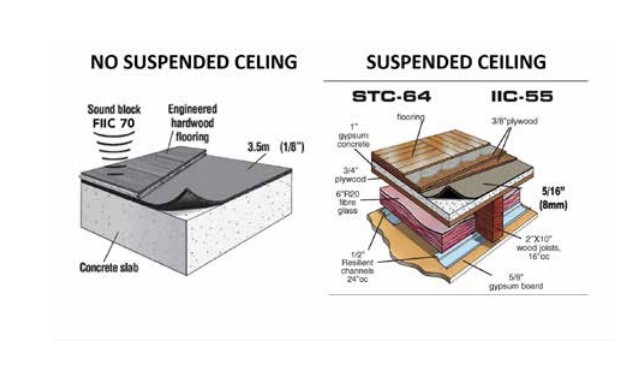
Suspended ceilings are one factor to consider. Sometimes called dropped ceilings, suspended ceilings function as a second ceiling that hangs below the original or structural one. This type of system can improve acoustics in a room by adding in more absorptive materials, such as foam panels, acoustic insulation and a double layer of drywall. Most high-rise residential properties in Toronto, however, do not have a dropped ceiling assembly. They are typically built of eight-inch concrete slabs alone.

flooring

A case study was conducted in July 2020. The purpose was to research the acoustic properties of underlayment sold at major big box stores compared to an accredited flooring specialist who distributes a variety of acoustic underlayments. It was determined the products sold by the big box stores were all tested with dropped ceiling assemblies, while the flooring specialist opted to distribute only those products tested without dropped ceilings and specifically made for high-rise condos.

Boards and managers often need a little assistance in this area as they are not acoustic or flooring specialists. To demonstrate compliance, there are three items they should look at.

First, confirm the property’s floor-ceiling assembly. Do the units have dropped ceilings? Second, update the renovation agreement to comply with the building’s floor-ceiling assembly. Lastly, request the products testing documents and proof of purchase for your file. This will eliminate the bait and switch of any type of inferior products.

Managers do not have the time to physically inspect every renovation taking place to ensure that correct products are being installed. Their role often goes beyond the call of duty; at times they are called to wear more hats than the entire Toronto Blue Jays organization. Many properties do not have a concierge or security at the main entrance; therefore, owners and contractors can conduct entire renovations without notifying managers of the work or products being installed. This is an ongoing problem.

Here is a summarized template that can be altered to meet any property’s building design. It was created specifically with a residential high-rise property in mind, with no dropped ceilings:

Where a hard surface floor finish such as hardwood, laminate or vinyl is to be installed in a suite as a replacement for carpeting or another hard surface, an owner shall ensure that a sound attenuation barrier is installed that will achieve an acoustical sound proof standard of a minimum Field Impact Isolation Class rating of FIIC 70.

A sample of the underlay and its spec sheet must be provided with this form prior to starting any renovations. The underlay must have the test documentation from the manufacturer that indicates that it was tested over an eight-inch concrete slab and with no suspended or dropped ceiling (FIIC 70 minimum).

Upon receiving approval, we require proof of purchase in the form of an invoice for our file.

This kind of approach will not only reduce noise complaints but will also improve a building’s reputation and enhance the overall quality of living for everyone.

Steven Vasconcelos is the principal of The Floor Studio Inc. and an accredited NWFA Wood Floor Inspector who specializes in wood flooring and acoustical membranes. [email protected], 416-533-2855.


Connect LA design fosters health for St. Paul’s Hospital

Connect Landscape Architecture (Connect LA) is part of the PCL Construction Team picked to build the new St. Paul’s Hospital in Vancouver. The firm is tasked to create a landscape design to foster both user and community health.

“Our truly public vision supports holistic healing and promotes health and wellness weaving together principles of place, healing and resiliency,” said Ken Larsson, creative director at Connect LA, “Not only at the level of the individual but also through connections to the community and the land, while acknowledging the Site’s history, culture, and ecology.”

According to the government, the new St. Paul’s Hospital is the largest hospital redevelopment project in B.C.’s history. It will be a patient-centered campus of care focused on sustainability and resiliency. Public spaces such as parks and plazas as well as community infrastructure will integrate this new facility with the community it serves.

The design goal was to create a therapeutic environment that not only fosters user health, but also focuses on healing the site. House posts are prominently located as gateways, representing the four nations, four seasons. Ethnobotanical plantings provide connections to First Nations healing landscapes.

Biophilic design principles have been employed, and access to nature has been maximized to healing gardens for patients, visitors, and staff. Diverse healing environments contribute to the creation of reflective and active spaces, promoting wellness and offering therapeutic function at a variety of scales throughout the campus.

The landscape is designed to be resilient and adaptive to a changing environment. The design anticipates climate change, rising water levels, and fluctuations in rainfall intensity and events through an on-site water retention strategy and focuses on landscapes which are  drought-tolerant and low-maintenance.

The team at Connect has worked on its share of health care facilities, including the Teck Acute Care Centre at BC Children and Women’s Hospital and St. Mary’s Hospital in Sechelt.

Power system revenue transcends lockdown relief

It appears that seven weeks of COVID-19-related electricity rate relief for residential and small business customers did not adversely undermine Ontario power system revenue. Even after the regulated price plan (RPP) was frozen at the lowest time-of-use (TOU) rate of 8.5 cents per kilowatt-hour (kWh) from January 1 to February 22, electricity prices are set to dip slightly on May 1 when a new six-month rate cycle begins.

“Any variance between forecast and actual costs, whether a surplus or shortfall, is factored into the next price-setting. Prices are going down due to a surplus that has accumulated,” the Ontario Energy Board (OEB) confirms in a release outlining the pending semi-annual RPP adjustment.

Nevertheless, most customers won’t notice because a corresponding decrease in the Ontario Electricity Rebate (OER) will keep costs steady with current levels. The new rate schedule shaves 0.6 cents per kilowatt-hour (kWh) off both peak and mid-peak TOU rates and cuts 0.3 cents/kWh from the off-peak TOU and tiered price options, while reducing the rebate on pre-tax electricity use and transmission/distribution charges by 2.3 per cent.

“The government’s intention is that, for residential and small business customers, the reduction in the electricity price will be offset by the change in the OER,” the OEB advisory states.

As of May 1, TOU rates per kWh will be: 17 cents for peak; 11.3 cents for mid-peak; and 8.2 cents for off-peak periods. Residential customers opting for tiered rates will pay 9.8 cents/kWh for the first 600 kWh of consumption and 11.5 cents/kWh for usage above that threshold. Small business customers on tiered rates will pay 9.8 cents/kWh for the first 750 kWh of consumption. In turn, the electricity rebate will shrink from 21.2 per cent to 18.9 per cent.

RPP customers have not been offered rate relief during the current provincial stay-at-home directive, instigated April 3.

GTA’s Q1 2021 investment sales surpass Q1 2020

Industrial assets and development land accounted for more than 50 per cent of investment sales value in the Greater Toronto Area (GTA) during the first quarter of 2021, with trade activity in both sectors far outpacing deal-making in the comparable period of 2020 back before the full impact of the COVID-19 pandemic hit. Avison Young’s newly released investment market overview tallies $3.9 billion worth of transactions across all commercial real estate sectors, representing the best Q1 sales performance since 2018.

Office was one the sector in which activity did not surpass Q1 2020 levels. Retail enjoyed an upswing coming off a year when investment sales value dropped to an eight-year low. Meanwhile, the continuing compression of multifamily cap rates demonstrates that lower deal volume is due to supply constraints rather than a lack of purchasers.

“Flush with cash and supported by favourable borrowing costs, eager investors continue to seek out opportunities in what is shaping up to be another unpredictable year,” Avison Young’s accompanying analysis surmises. “Mass vaccinations offer a ray of hope and the prospect of an eventual return to pre-pandemic capital flows into what is otherwise a relatively sound property market.”

For now, investors are keenly chasing industrial assets. A sales tally of $1.4 billion represents 36 per cent of total Q1 investment deal value, and a 45 per cent increase over industrial sales value in the first three months of 2020. Triovest Realty Advisors inked the priciest deal at $125 million, equating to $239 per square foot, for a 22-acre logistics facilities in the west end of Toronto — acquired from Mantella Corporation. However Amazon’s $40-million purchase of the Pickering Markets at 1400 Squires Beach Road in Pickering comes in at $290 per square foot.

“The unrelenting adoption of e-commerce reinforces solid fundamentals for the acquisition of highly coveted last-mile warehouse and distribution space, even if it means demolishing an existing facility and building new,” Avison Young analysis observes.

Industrial demand and the surging housing market are identified as underpinning factors in the 33 per cent quarter-over-quarter jump in sales values for development land. Deals tallied $807 million, up from $606 million in Q4 and $451 million in Q1 2020.

Blackwood Partners’ and Nicola Wealth’s joint $108-million purchase — at more than $1 million per acre — for 2955 King Road in York Region’s King Township represented a 13 per cent chunk of that total. The vendor, King Hill Inc., acquired the 105-acre site in 2019 for $55 million.

Meanwhile, Q1’s second largest transaction garnered nearly four times more land at less than one-quarter of the cost per acre, as RICE Group paid Infrastructure Ontario $93.5 million for a 420-acre site on Peel Region’s Torbram Road. On the flip side, the York Catholic District School Board shelled out the highest per-acre price of the quarter with its $33.5-million purchase of a Whitchurch-Stouffville site from Greenpark Homes, which equated to more than $2.2 million per acre.

RioCan REIT also enjoyed upside returns on its 50 per cent interest in a 36-storey midtown Toronto multifamily rental building — purchased in 2019 for $114 million and sold for nearly $151 million in Q1. The purchaser, Woodbourne Capital, paid more than $647,000 per unit, outdistancing Q1’s other multifamily deals in both transaction value and per-unit price.

The quarter saw $642 million in multifamily investment transactions, down from $877 million in trades during Q4, but up from $615 million in Q1 2020. Cap rates continued to trend downward, providing evidence that investors aren’t expecting the current parallel downward rent trend to last and contrasting with the skittishness Avison Young analysts see in the office market.

“An expensive housing market and the eventual return to higher immigration levels post-pandemic have investors squarely focused on the stable but supply-constrained multi-residential sector,” they conclude. “Investors are still seeking greater clarity in the office sector as stakeholders grapple with a multitude of survey results on what the future workplace will look like. availability and vacancy rates are on the rise and the wait-and-see approach by occupiers has kept investment capital largely at bay.”

The quarter’s $349 million in office transactions represented 9 per cent of total investment sales, and is a decline from $531 million in Q4 and $429 million in Q1 2020.

“Continuing a trend from 2020, suburban assets attracted most of the capital,” Avison Young reports. Accordingly, the quarter’s largest deal saw Soneil Investments acquire 55 and 105 Commerce Valley West from Northam Realty Advisors for $115 million, equating to $304 per square foot.

However, two smaller downtown transactions yielded considerably higher per-square-foot earnings for the vendors. Sutter Hill Management purchased a 50 per cent interest in 110 Yonge Street from BentallGreenOak, translating to $723 per square foot. Dream Office REIT paid $806 per square foot to acquire 76 Stafford Street and 850 Adelaide Street West from Hullmark.

In turn, Hullmark paid the highest per-square-foot rate for a retail property at $3,351 for a 9,400-square-foot low-rise property at 147 Spadina Avenue in Toronto’s downtown west area. Meanwhile, Ingka Group’s $100-million acquisition of the 132,000-square-foot retail podium at 388 Yonge Street was the largest retail transaction of Q1 and opens the way for a new Ikea store in the downtown core.

“Retail investment increased for the third consecutive quarter with $693 million in first-quarter sales – up 25 per cent quarter-over- quarter and 30 per cent year-over-year,” Avison Young advises. “The top five sales reveal a mix of urban and suburban asset types ranging from traditional regional and community shopping centres to street-front and freestanding offerings.”

New B.C. industry survey identifies top concerns

BC Construction Association (BCCA) has released a new industry survey for Construction Month 2021 that identifies top concerns and a more diverse workforce.

Over the course of this pandemic year the top issues of concern to construction contractors shifted somewhat, although availability of skilled workforce remains the number one challenge regardless of labour affiliation. The chronic lack of prompt payment jumped from third to second place and worries about safety took the number three spot this year despite not being in the top five in past years. COVID-19 bumped out small business taxes from the number four spot, and public sector procurement practices remained at number five in the list of top concerns.

The BCCA survey results also show an increasingly diverse workforce, where workers’ overall satisfaction rose 118 per cent from the prior year. Part of that increase can be attributed to financial health, with 18 per cent of workers reporting improvements year over year.

Women are showing increasing gains in this traditionally male industry, with 65 per cent of female respondents reporting an increase in income and 53 per cent reporting that they changed jobs for more pay over the past year.   Women are more likely to have trade credentials and reported a higher overall satisfaction with the industry, resulting in women being 130 per cent more likely to recommend the construction industry as a career path than men.

Part of this positivity is coming from an improved culture overall, with 83 per cent of employers reporting they have a policy in place that addresses the need for fair and equal treatment of all workers, compared to 60 per cent in 2017.

Despite the pandemic, 35 per cent of employers reported an increase in the size of their workforce, which is less of a gain than prior years but still significant. More than half of employer respondents say they’re offering more hours this year, and 90 per cent are paying overtime wages.

“Our industry has been through a lot this past year, but amidst the challenges we can see that our workforce is getting more diverse, which will help our skilled labour shortage” says Chris Atchison, BCCA president. “The BC Budget 2021 has raised concerns for our contractors, who were anticipating more fulsome investments in infrastructure to offset extraordinary cost increases, and we continue to highlight the urgency of prompt payment legislation to alleviate the burden of late payments on competed work.”

For key findings and more details from the latest BCCA Construction Industry Survey go to www.bccassn.com/stats.

Feds greenlight ‘vacant home’ tax for foreign buyers

The Liberal government made good on its promise of a sweeping speculation tax on foreign buyers of residential real estate, introducing the measure in its federal budget.

Nestled into the 739-page document in chapter 10, the proposed federal “vacancy tax” follows similar policies that other provinces and cities have previously implemented to grow the middle class.

As of January 2022, the government is applying a 1 per cent annual tax on the value of non-resident and non-Canadian owned properties that are “vacant or underused.” Complementing this tax are affordable housing investments of an additional $2.5 billion over seven years to the Canada Mortgage and Housing Corporation, along with reallocating $1.3 billion of previously announced funding, both of which are expected to bump up the amount of affordable units.

As housing prices climb, supply fizzles and buyers begin snapping up condo units in specific regions (not just single-family dwellings) more readily, it’s clear that Canada can no longer be a place where foreign buyers purely speculate in the housing market, as Finance Minister Chrystia Freeland put it this week.

What isn’t clear is how the vacancy tax will help new homeowners enter a sellers’ market they cannot afford.

Impact of foreign tax on housing market

“The federal government will always have challenges finding lasting solutions when it comes to the real estate industry through policy changes,” says Freddy Mak, president of Ferrow Real Estate, a firm based in Ontario. “Changes like new taxation measures can create knee-jerk reactions in the marketplace, as we saw in Q2 of 2017. The rebound tends to be fast and furious from these market reactions.”

In April 2017, Ontario introduced its Fair Housing Plan with 16 cooling measures, including a 15 per cent tax on non-resident buyers. This prompted some buyers to delay purchasing, while many home owners listed their homes amidst a perceived peak of price growth. The number of new listings that month rose to record levels in areas like the GTA and Hamilton-Burlington where supply had been especially tight.

“The long-term effects of this new tax seems negligible,” says Mak. “Rental demand, particularly in the Toronto market, has been and will continue to be resilient. Let’s use the tech sector job growth in Toronto as an example (currently one of the highest paid and highest demand professions). These professions are often on contract base, meaning one to two year rentals would be in line with their tenure. Immigration to the city will continue to fuel rental demand. Often, families newly immigrating will rent for a few years before deciding where to buy and settle down.

“All of this is to say, vacant property will likely never be a prevailing issue, be it foreign owned or locally owned property. A tax on neglected property is good, for a few reasons, but likely will not move the needle long term as far as cooling the hot housing market.”

Issues that need clarifying; new information filing requirement

Also on the table are myriad issues related to enforcing this tax measure across jurisdictions and tracking compliance; some of which are expected to be addressed in a consultation paper the government plans to release in the next few months.

A group of lawyers from legal firm Gowling WLG recently noted other issues that will need sorting out, namely: “defining ‘non-resident, non-Canadian’ ownership in the context of partnerships, corporations, and trusts; addressing issues of joint or co-ownership of property; defining key terminology such as ‘residential property’, ‘vacant or underused’, and ‘qualified tenant’; figuring out the value of the home; and carving out exemptions, whether by geographical area or by owner, for instance ‘satellite families.’

“It therefore remains to be seen how integrated or punitive this federal “vacancy tax” will be when applied to jurisdictions that may already be subject to more than one such tax,” stated the lawyers. “For example, in some jurisdictions such as Vancouver, British Columbia, the existence of two similar regimes has already led to inconsistent results, where one property may be occupied for the purposes of one regime yet vacant for another.”

Beginning with 2023, an information filing requirement is also proposed for all owners of Canadian residential property, other than Canadian citizens and Canadian permanent residents.

According to Gowling WLG, this information return or declaration will require the owner to list each Canadian residential property that they own, and to provide more information such as the property value, their ownership interest in the property, and whether the owner is eligible for an exemption. Not filing the declaration could result in a loss of any exemption for future years and the application of penalties and/or interest, in addition to exposing the taxpayer to an unlimited assessment period.

By Rebecca Melnyk

Radiation cleanup crews to be offered payouts

Long overlooked cleanup crews have been offered compensatory payouts more than six decades after nuclear contamination incidents at Atomic Energy of Canada Limited’s (AECL) Chalk River Laboratories. The newly released federal budget includes $22 million to be dispersed over the next two fiscal years to “recognize” former AECL workers who responded to radiation leakage mishaps in 1952 and 1958.

The program is to be modelled on a circa 2008 federal initiative, which offered ex-gratia payments of $24,000 to Canadian military veterans who had been exposed to documented radiation risks through their participation in nuclear weapons testing or deployment to assist in the two Chalk River cleanup operations. It was estimated that about 200 military personnel had participated in the latter exercises.

The budget document confirms the newly announced program is meant “to provide similar recognition to those Atomic Energy of Canada Limited employees who worked to clean up these dangerous incidents and protect Canadians”. Natural Resources Canada has been designated to establish the recognition program, which is to receive a budget allocation of $7 million in 2021-22 and $15 million in 2022-23.

Even the youngest qualifying candidates for recognition are likely to be in their mid to late 80s now.

Seven tips for building trust in condo communities

It is unlikely that the condo’s declaration, bylaws, rules, or policies include any reference to trust; yet good governance cannot be achieved without it. Directors might assume that meeting their fiduciary responsibilities is enough, but specific actions that provide the evidence on which trust is built are also required.

In communities where trust exists, the condo hums with vibrant energy. These condo boards are active, directors debate vigorously amongst themselves, owners question the board at every opportunity, and meetings are well-attended and lively. People are satisfied with their boards and know that they are well informed and the property is well managed.

The opposite is true of communities where a lack of trust exists. Directors must spend a lot of time defending their decisions, responding to owners who complain continually about everything, and coaxing owners to attend meetings. Directors in these communities become frustrated because they can never seem to get beyond defending themselves, and move from being reactive to proactive.

No one wants to live in the latter community. Read on to learn how to build trust in condo communities.

Speaking with one voice

Condo boards must speak with “one voice.” This means that directors may disagree and debate at board meetings, but once a decision is made, the directors end their disagreements and wholeheartedly support the decisions made. Most often, boards speak via “official channels.” It is the only practical way that a board, composed of individuals, can speak with “one voice.” This ensures that the voice of the board is accurately reflected in any communications with owners.

It also means that directors never discuss board business with anyone– not even a spouse. Directors, especially new directors, may need guidance in this area. It is easy to start chatting with neighbours and then veer into a discussion about board business.

In theory, following this principle is easy; in practice, it is much more challenging. It helps if the director already knows what to say when the situation arises. A potential answer is to politely explain that he or she can’t discuss board business outside of meetings because doing so would be a breach of the condo’s code of conduct.

Keeping owners up-to-date

Any time the board has news, it is essential for the board to update the owners and send it to everyone simultaneously (as much as this is possible). Owners must know that everyone has the same information, and no one is receiving preferential treatment in getting information that others do not get.

Making documents available

Owners are the stakeholders and shareholders in the condo corporation and pay the corporation’s operating costs. It follows that the corporate records be available to owners, minus any documents with personal information.

Digitizing the condo’s records makes it possible to provide documents easily, quickly, and at no charge. Better still is to utilize an online service that provides 24/7 access to documents.

Making owners wait for weeks after requesting documents via the process created by the Condominium Authority of Ontario (CAO) is unnecessary if all the documents are already available online. Even more annoying is making owners wait for documents to be mailed to them and charge a photocopying and postage fee.

Giving more notice than required

The Condominium Act provides precise guidelines for the number of days notice that must be given to owners for events such as meetings or special assessments. The standard specified in the Act should be interpreted as the minimum. The Act does not prohibit a board from providing more notice than the minimum, so it is a good practice to do so anytime it can be provided.

When a special assessment is required, the more notice that can be given the better. More notice gives the owners additional time to arrange for financing, if necessary, or to arrange for payment—something that also takes time for some owners.

Asking owners for input

Condo boards are not required to ask owners for their input or opinions. The exception is at annual general meetings or special meetings when owners have a responsibility to attend and vote. This does not mean that boards can’t ask for input from the owners, only that they are not required to do so. A better approach would be to ask for input on things that will affect them. With the many free online tools available, it is easy to create a survey and ask owners their opinions.

Being nice

It is not helpful when owners, directors, or property managers fail to be civil. Nothing destroys trust faster than nastiness in emails, meetings, chats on the property, or at the property manager’s office. Good manners remain essential at all times.

Stopping negative talk

Gossip is a part of everyday life. Anyone who shares false information or maligns directors or owners needs to be stopped immediately. By providing regular updates of accurate information, negative gossip can be held in check. Informal townhall-style meetings are excellent venues to discuss updates and offer owners opportunities to ask questions on anything condo related. It also provides owners with lots to gossip about with positive and accurate talk.

Getting it done

Even after implementing all of the recommended tips, it may still take time to build trust in the community. This is especially true if it has been lacking for many years. Taking time is expected, and boards must persevere because the results will be worth the board’s efforts.

Pat Crosscombe is the founder and CEO of BoardSpace, a company that provides board management software for condo boards and property managers.

Reflections on Earth Day

Earth Day provides an opportunity to reflect on what we as individuals can do to restore and care for our planet. To no surprise, at the Canada Green Building Council, it is something we think about each and every day.

There is almost no other sector here in Canada or globally that has a more pronounced and far-reaching impact on both the environment and people than the building sector. Mitigating and, where possible, eliminating any negative impacts is at the core of the green building movement.

The benefits of green building are tremendous, ranging from well-known solutions like increasing energy efficiency and promoting health and well-being to innovative opportunities including zero carbon performance and resiliency in the face of a changing climate. The LEED rating system has been a game changer and remains the most widely used green building certification in the world.

Through GBCI Canada, we are also seeing the benefits of other complementary systems, like the Sustainable Sites Initiative, a rating system designed to promote sustainable and resilient landscape development, or TRUE Zero-Waste which targets circular economy solutions and waste reduction practices.

Our world-leading Zero Carbon Building Standard offers Canadian projects an opportunity to find a pathway to zero carbon emissions from building operations. It balances rigorous targets with flexibility to achieve zero emissions outcomes for different building types and climatic regions. As a result, a wide range of buildings have now been certified under the standard – from schools and office buildings to hockey arenas and warehouses.

It is clear now that buildings play a critical role in keeping the planet from warming beyond the 1.5 degree target set in the Paris Agreement. Over this decade leading up to 2030, zero-carbon buildings must become the norm – and not just new buildings, but existing ones. Deep energy retrofits at scale must become a priority if we are to meet Canada’s carbon targets and have any hope of slowing the rise in global temperature.

In the recent federal budget and in pre-budget announcements, the government signaled the  importance of retrofits with billions in funding to accelerate energy-efficiency projects. From large commercial buildings to home retrofit programs, the government is betting on retrofits to not only contribute to carbon reductions, but to also to create new jobs and kick-start the economy. Retrofit at scale is the heavy and most significant lift to reduce carbon emissions leading up to 2030.

The green building sector will need to grow its workforce to meet the demand for new green buildings and retrofits. Newly announced federal programs focus on training the new entrants to the building industry along with the current workforce to meet the demand for zero-carbon building construction and retrofit. Industry-led initiatives like the Workforce 2030 coalition will move the needle forward and, at the same time, look to address inequalities by prioritizing underrepresented populations, like women, youth, indigenous and racialized communities as we build jobs around the low carbon economy.

This year’s Earth Day theme centres on restoring and caring for the Earth. Green building is moving in the direction of zero impact and is starting to offer a way to become regenerative with positive impacts on the environment, jobs and economic prosperity, diversity and inclusion in the post-COVID era. It is a process I’m excited to help advance with you as we build our way forward together.

Thomas Mueller is president and CEO, Canada Green Building Council.