Articles Archive - Page 378 of 928 - REMINET
REMI

Reflections on Earth Day

Earth Day provides an opportunity to reflect on what we as individuals can do to restore and care for our planet. To no surprise, at the Canada Green Building Council, it is something we think about each and every day.

There is almost no other sector here in Canada or globally that has a more pronounced and far-reaching impact on both the environment and people than the building sector. Mitigating and, where possible, eliminating any negative impacts is at the core of the green building movement.

The benefits of green building are tremendous, ranging from well-known solutions like increasing energy efficiency and promoting health and well-being to innovative opportunities including zero carbon performance and resiliency in the face of a changing climate. The LEED rating system has been a game changer and remains the most widely used green building certification in the world.

Through GBCI Canada, we are also seeing the benefits of other complementary systems, like the Sustainable Sites Initiative, a rating system designed to promote sustainable and resilient landscape development, or TRUE Zero-Waste which targets circular economy solutions and waste reduction practices.

Our world-leading Zero Carbon Building Standard offers Canadian projects an opportunity to find a pathway to zero carbon emissions from building operations. It balances rigorous targets with flexibility to achieve zero emissions outcomes for different building types and climatic regions. As a result, a wide range of buildings have now been certified under the standard – from schools and office buildings to hockey arenas and warehouses.

It is clear now that buildings play a critical role in keeping the planet from warming beyond the 1.5 degree target set in the Paris Agreement. Over this decade leading up to 2030, zero-carbon buildings must become the norm – and not just new buildings, but existing ones. Deep energy retrofits at scale must become a priority if we are to meet Canada’s carbon targets and have any hope of slowing the rise in global temperature.

In the recent federal budget and in pre-budget announcements, the government signaled the  importance of retrofits with billions in funding to accelerate energy-efficiency projects. From large commercial buildings to home retrofit programs, the government is betting on retrofits to not only contribute to carbon reductions, but to also to create new jobs and kick-start the economy. Retrofit at scale is the heavy and most significant lift to reduce carbon emissions leading up to 2030.

The green building sector will need to grow its workforce to meet the demand for new green buildings and retrofits. Newly announced federal programs focus on training the new entrants to the building industry along with the current workforce to meet the demand for zero-carbon building construction and retrofit. Industry-led initiatives like the Workforce 2030 coalition will move the needle forward and, at the same time, look to address inequalities by prioritizing underrepresented populations, like women, youth, indigenous and racialized communities as we build jobs around the low carbon economy.

This year’s Earth Day theme centres on restoring and caring for the Earth. Green building is moving in the direction of zero impact and is starting to offer a way to become regenerative with positive impacts on the environment, jobs and economic prosperity, diversity and inclusion in the post-COVID era. It is a process I’m excited to help advance with you as we build our way forward together.

Thomas Mueller is president and CEO, Canada Green Building Council.

Soprema Canada commits to a 71% GHG reduction

Soprema Canada is committing to reduce its greenhouse gas (GHG) emissions by 71 per cent while decreasing their intensity 50 per cent by the year 2030. The announcement of these GHG reduction targets is a major first for the company, which has been redoubling its efforts in the fight against climate change since 2018.

Through this commitment, Soprema Canada is taking part in the transformation of the construction industry and is helping reduce the carbon footprint of buildings. This will decrease GHG emissions by approximately 73,667 metric tonnes of carbon dioxide equivalent (Mt CO2 eq.) compared to the reference year (2018).

“The construction sector accounts for over 10 per cent of total GHG emissions in Canada. As a manufacturer of construction products, we must assume our responsibilities and take concrete action in the fight against climate change. Our reduction targets are ambitious, and what makes me the most proud is that our employees are already working to implement concrete solutions that will enable us to reach them,” said Richard Voyer, vice-president and CEO of Soprema.

This reduction in GHG emissions focuses on Sopremas’s operations and facilities in Canada. Four targets in activity sectors are:

Buildings and equipment -20%
Product transport – 17%
Employee travel – 33%
Processes and products – 93%

To achieve this, several initiatives are already underway. These include improving the energy efficiency of buildings through the addition of heat recovery systems and passive solar walls, the use of less polluting vehicles and modes for transporting products, the replacement of energy-consuming corporate vehicles with hybrid and electric vehicles, and the introduction of substances with low or zero global warming potential.


Health care providers contemplate plastic waste

Toronto’s University Health Network (UHN) and health care facilities in British Columbia’s lower mainland are piloting an effort to curb the volume of personal protective equipment (PPE) and medical single-use plastics (mSUP) discarded to landfill. The initiative, sponsored by the Canadian Coalition for Green Health Care, is one of five projects recently receiving federal funding to advance approaches to reduce plastic waste and recapture it for new purposes.

“Ultimately, we hope to demonstrate that applying a circular economy lens to purchasing decisions in hospitals can both save money and our planet,” explains Neil Ritchie, executive director of the Green Health Care Coalition.

To do so, project partners and advisors will explore options to reduce, reuse and recycle PPE and mSUP before disposal. They will study the feasibility of, and develop protocol for, reclaiming various materials that have previously been viewed as single-use items. That also involves working with waste services providers to identify required processing capacity at recycling facilities, as well as required collection and storage procedures within health care facilities, and measures for safe handling at all points of the circular journey.

“We will conduct important first-person research that can inform the sector on best practices for PPE waste management. It will also help develop operational expertise among the various stakeholders engaged in the acquisition, use/re-use, recycling and disposal of PPEs and selected mSUPs,” Ritchie affirms.

All interested parties are invited to learn more about the project’s scope during a webinar scheduled for May 11. The federal government has allocated about $250,000 to underwrite the project. The four other grant recipients are:

  • Conference Board of Canada, awarded $390,000 to conduct research and develop a convening platform to inform Canada’s transition to a circular plastics economy;
  • Scout Environmental, granted $300,000 to develop a network that will be used to facilitate industry collaboration to reduce plastic waste;
  • Ontario Ministry of the Environment, Conservation and Parks, receiving $250,000 to improve the management of compostable products and support the development of new standards for bioplastics; and
  • Bluenose Coastal Action Foundation, allocated $100,000 to study the link between single-use plastic pollution and microplastic accumulation, and to develop strategies for preventing plastic pollution in Atlantic Canada.

Edmonton approves new energy transition strategy

City of Edmonton has approved a new Community Energy Transition Strategy with targets aligned with the Paris Agreement. It also outlines economic local opportunities.

“We are already seeing the consequences of climate change,” said Stephanie McCabe, deputy city manager, urban form and corporate strategic development. “Energy transition is a way to create local jobs today, while reducing emissions and avoiding the most catastrophic impacts like increased wildfires and urban flooding that science has warned us about.”

To become carbon neutral by 2050, the new strategy is designed to accelerate change in four transformational areas:

  1. Renewable and Resilient Energy Transition
  2. Emissions Neutral Buildings
  3. Low Carbon City and Transportation
  4. Carbon Capture and Nature Based Solutions

The new Community Energy Transition Strategy will help shape Edmonton’s future economy and the way Edmonton is built—transforming how energy is generated, how people move around the city, how buildings are constructed.

The new plan builds on the Community Energy Transition Strategy from 2015 to limit the rise of global average temperature increase to 1.5 degrees Celsius. This ambitious target aligns with Edmonton’s long term vision of transitioning to a low-carbon future, outlined in ConnectEdmonton and The City Plan.

“The Energy Transition Strategy is a jobs, public health and quality of life plan, as much as it is a climate response,” said Mayor Don Iveson. “This strategy builds on our proud heritage as energy problem solvers here in the heart of Canada’s traditional energy economy, to remain prosperous through the transition to a carbon-neutral economy.”

Breaking down Budget 2021’s affordable housing funds

The federal government’s much-awaited Budget 2021 includes funds to address Canada’s need for more affordable housing. In total, the budget proposes an additional $2.5 billion over seven years to the Canada Mortgage and Housing Corporation, broken down as follows:

  • An additional $1.5 billion for the Rapid Housing Initiative, of which 25 per cent would be used towards women-focused housing projects. Overall, this would add about 4,500 new affordable units to Canada’s housing supply, building on the 4,700 units already funded in the 2020 Fall Economic Statement through its $1 billion investment.
  • $600 million over seven years, starting in 2021-22, to renew and expand the Affordable Housing Innovation Fund, which encourages new funding models and innovative building techniques in the affordable housing sector. To date, this program has helped create over 17,600 units. The new funding would support the creation of up to 12,700 more, bringing the total to over 30,000 units.
  • $315.4 million over seven years, starting in 2021-22, through the Canada Housing Benefit, to increase direct financial assistance for low-income women and children fleeing violence to help with their rent payments.
  • $118.2 million over seven years, starting in 2021-22, through the Federal Community Housing Initiative, to support the delivery of long-term housing to  vulnerable Canadians.

In addition to these new investments, Budget 2021 proposes to advance and reallocate $1.3 billion of previously announced funding, including:

  • $750 million under the National Housing Co-Investment Fund to accelerate the creation of 3,400 new units, and the repair of 13,700 units.
  • $250 million i under the National Housing Co-Investment Fund, which will be allocated to support the construction, repair, and operating costs of an estimated 560 units of transitional housing and shelter spaces for women and children fleeing violence. This targeted funding is being reallocated—including advancing $200 million to 2021-22 and 2022-23—to make sure the government delivers on its commitments, and reinforces the government’s efforts to address gender-based violence, including the measures outlined in the forthcoming National Action Plan to End Gender-Based Violence.
  • $300 million in 2021-22 and 2022-23 from the Rental Construction Financing Initiative, which will be allocated to support the conversion of vacant commercial property into housing. As the demand for retail and office space has changed due to COVID, some landlords, particularly in major urban cores, are facing higher vacancies. The government says this is an opportunity for property owners and communities to explore converting excess space into rental housing, enhancing the livability and affordability of urban communities. The funding will  target the conversion of excess commercial property space into 800 units of market-based rental housing.

Budget 2021 also includes $25 million for the government of the Northwest Territories to support the construction of 30 new public housing units, and $25 million for the government of Nunavut to support its short-term housing and infrastructure needs.

Visit Budget 2021 for complete details.

Feds amplify funding for accessibility upgrades

A $100-million injection to Canada’s Enabling Accessibility Fund will significantly amplify funding to support universal navigability of the built environment. The newly released federal government promises an extra $50 million in each of the next two fiscal years, to be added to the annual budget of $20.65 million allocated in the 2017-18 budget.

“Organizations want to become more accessible but costs can be prohibitive, especially for smaller organizations,” the budget document states. “The Enabling Accessibility Fund provides funding for renovation, construction, and retrofit projects — from building ramps, to support for the hearing impaired, to automatic door openers — that make communities and workplaces more accessible for persons with disabilities.”

Businesses, not-for-profit and Indigenous organizations, municipal and territorial governments are eligible for grants of up to $100,000 for small projects or up to $3 million for mid-sized projects. The application intake period for 2021 is yet to be announced.

A year like no other for campus cleaning

From retail to offices, healthcare to foodservice, there isn’t a sector of society that hasn’t been heavily impacted by the COVID-19 pandemic and the challenges and changes it has brought on. In short, while the foundations of cleaning and infection control remain the same, the practicalities of the job have seen fundamental shifts.

That is certainly no different in the complicated field of post-secondary education cleaning and maintenance. In fact, this is a uniquely difficult situation. Higher education campuses are often expansive and sprawling, and that’s without even taking into account institutions that are spread out over one or even multiple cities.

Post-secondary campuses consist of an almost incomprehensibly wide range of facilities for cleaning, maintenance, and janitorial staff to tackle. Classrooms and residences and break rooms are a given, but in many cases, there are also food and beverage outlets, on-site healthcare buildings, sporting and recreational amenities, retail stores, childcare, and much, much more.

That results in an environment like no other that has long presented a particularly stern test for staff to overcome.

“We’re a very, very diverse environment, particularly as a larger university, more so than most other facilities and areas,” says Christopher Bumbacco, Director of Building Services and Facilities Management at the University of Western Ontario (Western). “We have residences, office space, classrooms, recreational spaces, labs, event and bookable spaces for both internal and external events, medical facilities like our dental surgery, food and beverage. That’s undoubtedly the biggest challenge: there’s such a wide variety of things you’re maintaining in a wide variety of areas.”

Bumbacco notes that even the very structures themselves vary dramatically. Western, which has its primary campus in London, Ont., has some buildings that date back over 100 years, and others that opened last year. That results in different maintenance challenges: those buildings differ in surfaces, accessibility, electrical systems, and so on.

These large-scale campuses differ even from other educational facilities. An elementary or high school, while still a challenging site to maintain, tends to be more self-contained, with a smaller range of facilities. On post-secondary campuses, not only is everything more dispersed but there’s also the foot traffic factor. Many campuses are open to the public: people uninvolved with the college itself can walk through the site, stop to grab a coffee or use the recreational amenities. This adds yet another layer to an issue that is already deeply complex.

Providing pandemic response

When COVID-19 hit, all those difficulties were exacerbated. One thing the onset of the pandemic did, though, was highlight how the extensive challenges of post-secondary education cleaning and maintenance gave good preparation for such a situation.

“We have always been structured to have an annually reviewed pandemic plan in place,” says Don Forster, Senior Manager of Sustainability and Operations at Seneca College, which has several campuses spread across the Greater Toronto Area and Peterborough, Ont. “We have seasonal cleaning procedures like a flu season plan wherein we increase our common-area cleaning. So, when the pandemic hit, the teams already knew we had a procedure in place. It wasn’t too big of a change for us on the cleaning and maintenance side; more so for students and faculty.”

In short, the work put in over the years behind the scenes by operational staff paid off in a pinch. “We’d already started focusing on cleaning for health at Western and that really helped us when COVID-19 hit,” notes Bumbacco.

That is not to say that certain, often significant, adjustments were needed. The widely-cited transition to “cleaning for health” may have been already underway, but it quickly became the new primary focus. Ensuring the health and safety of everyone on-site – students, faculty, other operational staff, the maintenance service teams themselves – was paramount.

While higher education facilities are unique in their requirements, there were naturally certain consistencies with other industries as the pandemic unfolded. Securing PPE was key. Social distancing was installed and maintained. Technology like electrostatic sprayers became key components of the job. Essentially, the bar were raised.

“At Seneca, we implemented a stringent return-to-campus procedure,” explains Forster. “When they walk into a classroom or a lab, students and faculty pick up a spray bottle and cleaning cloth and they’re responsible for cleaning and wiping that area they’re working in. We then launder the cloths, refill the bottles, and between classes our team goes in and does a complete high-touch clean including spraying with an electrostatic sprayer ready for the next group of students. In a way, that was more of a challenge for students and faculty than for our cleaning and maintenance teams, and they bought into it really quickly.”

Forster adds that Seneca saw some of the inevitable supply chain challenges, particularly early on in the first wave of the pandemic. But both he and Bumbacco note that their respective facilities’ longstanding relationships with suppliers and vendors came through for them when they needed them.

There was also a combination of proactive pre-planning and fortuitous timing. Part of Seneca’s pre-pandemic plan involved identifying optimal strategic locations for hand sanitizer dispensers, says Forster. Meanwhile, Bumbacco notes Western’s teams took deliveries of electrostatic sprayers at the turn of the year, planning to test them in some common areas. They ordered more before the demand surged. “We got a bit lucky there,” Bumbacco acknowledges. “We have a very large faculty of medicine and dentistry and these sprayers make cleaning and disinfecting so much easier and quicker. Spraying doesn’t mean we don’t clean; it enhances the pre-existing cleaning. Those things became invaluable during COVID-19 as we started doing more touchpoint cleaning.”

campus

Western University’s University College tower

Major operational changes

Many industries have had to deal with the situation changing repeatedly in the last 12 months, often at short notice. In general, though, at universities and colleges, on-campus traffic has decreased notably with more courses now being offered online, out of either preference or necessity. Fewer students are electing to remain on campus.

As a result, an early step was overhauling residences. “When COVID-19 was first starting, we wanted to provide distancing for everybody,” Bumbacco says. “With many students staying off campus, we were able to start dispersing the remaining students. Normally, Western’s residence population is close to 5,300. We were able to start using double rooms as single rooms, reducing washrooms to just two people, and so on. We had about 3700 students in residence back in September, and some have left since then as the situation in Ontario has changed several times. It really allowed us to re-densify things.”

At Seneca, the resident population is smaller, but the situation was similar. Seneca has a residence of 500 rooms on one of its smaller campuses, and 1,100 rooms on its main campus. “Right now, there’s only 500 or so in total on those campuses,” notes Forster.

A major effect of having fewer students and faculty on-site, and fewer courses being offered in traditional in-class fashion, is that the day-to-day flow of cleaning and maintenance operations has been revamped. These changes have been extensive. Many buildings have shut down completely, with no need to remain open, while others have extended their services.

While many studies could be easily transposed to virtual classes, others necessitate in-person studies, particularly more practical courses like healthcare and nursing. Forster explains that when it came to classrooms, labs, and other study areas at Seneca, that meant reallocating cleaning and maintenance staff and resources to focus on areas that had to remain open.

“We haven’t opened up anything we haven’t needed to,” he says. “For the buildings that are open, we have designated paths to and from classrooms, designated washrooms. Everything else is locked down to enable cleaning staff to follow behind individuals or groups and clean up and maintain those areas. We have tight restrictions, you can’t enter the building unless you are coming for class, you pre-screen and then go directly to and from your work areas.”

Forster adds that Seneca has invested in technology that sends real-time room occupancy data to custodial supervisors to aid the prioritization process. “If a threshold for a particular room is exceeding capacity for a given time, the supervisor can investigate and allocate extra resources to that area. Combine this technology with pre-scheduled cleaning routines and you have a valuable tool to help combat the spread of infection pathogens.”

At Western, too, it has been a case of prioritizing. For instance, Bumbacco notes some campus labs were actually working on COVID-19-related items. “There’s much more in-person teaching taking place in our classes related to medicine and dentistry and some of the clinical studies areas, so we needed to know who was here and where they were to prioritize our cleaning rotation. That’s true even now.”

That has the understandable knock-on effect of changing the hours of cleaning and maintenance work. “On the resident side,” Bumbacco notes, “our staff end later because we want to do that extra late-afternoon or early-evening common area clean before the night. On the academic side, with classes cancelled, we were able to clean classrooms and offices earlier. That will likely change because students are clamouring for spaces like libraries to be able to study on campus. If we start opening up a variety of other things on campus again then there’s going to be more demand for the cleaning. Universities have become almost 24-hour operations now; knowing what’s going on and being able to clean around that is so crucially important.”
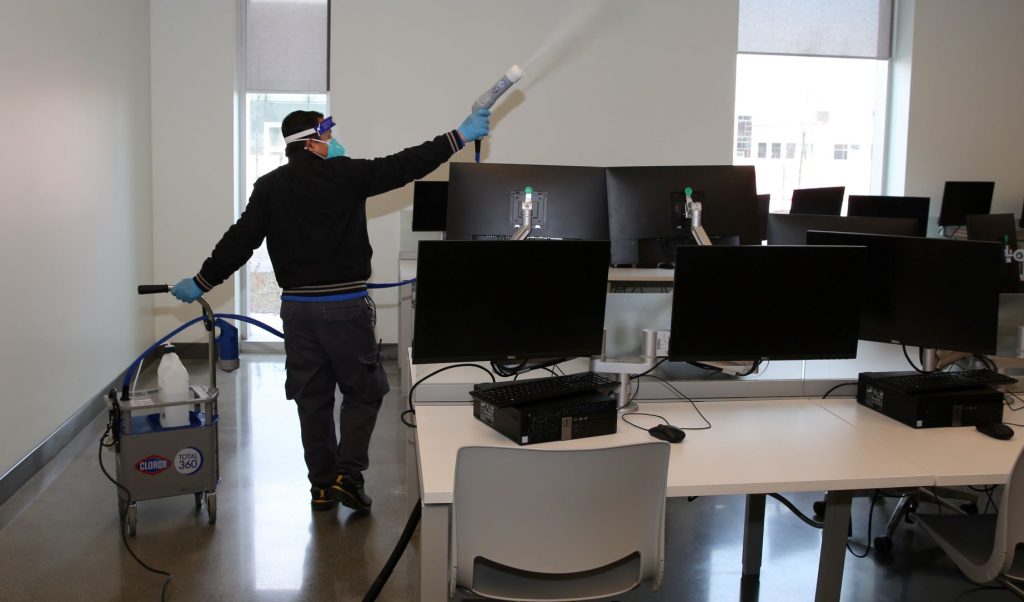
Boosting the visibility of cleaning has been important

Boosting visibility and accountability

With the push for enhanced cleaning standards, increasing communication and clarity has been vital. Before this pandemic, the important work done by custodial teams was often overlooked and taken for granted: that has changed drastically. Now, people not only want to know that measures are being taken, but they also want to see janitorial teams in action as visual confirmation of what is being done to keep them safe.

Forster notes Seneca has met that demand head-on. Videos showing the cleaning processes have become a core part of the orientation process. “When you’re coming on campus for classes, you must watch this video and check off saying you’ve understood,” he explains. “That’s been very helpful because we get feedback.”

Forster adds the increased visibility helps people understand just how thorough the processes are and goes a long way to keeping people informed and feeling comfortable and safe. “I don’t think anybody on campus goes more than 10 minutes without seeing custodial staff walking around spraying, wiping, doing something,” he says. “It provides comfort but it also keeps things upfront, holds us accountable. You have everybody’s eyes on you now. It’s that heightened awareness that we are one of the main pillars that keeps the campus going. This pandemic is validation of cleaning and maintenance and I think that will last long-term.”

A renewed challenge will come when campuses open up more broadly again, acknowledges Bumbacco.

“We wanted to make sure our staff and students understood their safety was paramount at Western,” he says. “But whenever extra events start coming back and outside groups come back on to campus, it’s going to be harder to keep up the same level of frequency we are implementing now. A lot of it will have to be about long-term education: everybody wants to sanitize but there are washrooms everywhere where you can practice the proper hand hygiene we’ve heard so much about in recent months. There are so many places to go on a campus – we can’t put sanitizers everywhere, so new standards will have to be maintained and built upon.”

It’s the maintaining of those new standards, the continuation and extension of the policies and procedures that have come out of this pandemic, that will be key to ensuring a cleaner campus future.

“Students learn better in a safe, clean environment,” concludes Forster. “They feel more comfortable, more engaged, and feel more comfortable. We’re all doing everything we can to perpetuate that.”

This feature story appeared in FC&M’s Spring 2021 magazine. Read the full issue.

Wetstyle products receive Good Design Award

Wetstyle has received Good Design awards for its Mood bathtub, Stellé Vanity collection, and Feel shower base collections.

“We are proud to be recognized by such a prestigious body for the innovation and quality of our product lines,” says Mark Wolinsky, president of Wetstyle. “It’s a validation of the passion and tireless effort of our entire team, from conceptual design, to the handcraftsmanship behind every finished Wetstyle product.”

The Good Design awards, organized annually by The Chicago Athenaeum Museum of Architecture and Design, in cooperation with the European Centre for Architecture, Art, Design and Urban Studies, and Metropolitan Arts Press, Ltd., recognizes the advanced innovation and design of consumer products.

The winning collections feature refined design elements from Pierre Bélanger and the Wetstyle Design Lab, embodying the essence of freshness and purity.

“Wetstyle is focused on contemporary product design that favours simplicity of forms and relevance to trending fashions,” said Pierre Bélanger, a senior member of the Wetstyle Design Lab.  Designer for Wetstyle. “The result is the creation of timeless collections that adhere to our motto of durability, finesse, and quality.”

Mood’s offsetting ellipses provide an infusion of aesthetic, functional, and structural elements to foster an ambiance of comfort and relaxation. The soaking tub’s fluid, elliptical design adds functional deck space to the inviting tub, with a side rim storage shelf that blends into the tub’s refined appearance.

The Stelle collection introduces classical beauty to the modern home, with floor-mount vanities designed to embrace the LAB collection’s drop-in sinks. Inspired by historic monoliths, the minimalist design converts that inspiration into compact, urban elegance that fits easily into any size of powder room or bathroom.

With its single slab construction and customizable availability, the Feel collection of pre-cast shower bases embodies the leading edge of shower base design and installation by leveraging refined moulding techniques that enable textures to be replicated on shower base surfaces.

ICBA: Budget falls short in key investments

The economic devastation and dislocation of the COVID-19 pandemic reinforce how important it is for the B.C. government to make investments today in the infrastructure  needed to lock-in long-term prosperity, said the Independent Contractors and Businesses Association (ICBA) in response to BC Budget 2021.

Among the vital infrastructure projects left out of the budget were a replacement for the Taylor Bridge in northeast B.C., North Shore rapid transit, the Massey Tunnel replacement, the Brunette Highway 1 interchange, and the Quesnel Bypass.

“We need to get to yes on some of the most important infrastructure needs in B.C., projects that are key to the provincial economy,” said Chris Gardner, president of ICBA. “For example, the Taylor Bridge is 60 years old, in rapid decline, and a vital connection between the north and south Peace River regions. At a time when natural gas royalties from that area are booming and providing an important boost to the provincial economy, now is the time to re-invest in the region.”

The Massey Tunnel replacement was also pushed off another year, with no substantial money for construction in the budget. Four years ago, the province cancelled a replacement bridge that was tracking well under budget and would have opened in 2022; since then, Massey has been delayed again and again, forcing commuters south of the Fraser to navigate one of the worst traffic bottlenecks in Canada.

The importance of speeding up approvals of construction projects was highlighted earlier this year when the World Bank published its annual rankings of competitiveness. In the category of “dealing with construction permits”, Canada ranked number 64 in the world.

“We simply wait too long to pull the trigger and make the investments we need in the infrastructure to power our economy and improve our quality of life and, as a result, we continue to fall behind compared to other parts of the world,” said Gardner.

The construction industry accounts for nearly 10 per cent of the provincial economy. Last year, the industry weathered a 16 per cent drop in housing, along with drops in building permit values of 26.6 per cent for commercial and 22 per cent for industrial.

By far, the biggest issue in the construction industry is the shortage of construction workers. Taking into account people retiring and the demand for new workers, the construction industry in B.C. will need 60,000 more workers between now and 2030. The association noted the budget should have included major investments in trades training and for the expansion of trades and technical related programs and training institutes.

In addition, said the association, the government should have scrapped its community benefits agreements (CBAs) scheme and instead focused on maximizing value for every taxpayer dollar.


BC Building Trades pleased with B.C. Budget 2021

The BC Building Trades (BCBT) applauds the BC NDP government Budget 2021 for investing in essential infrastructure, jobs and skills development.

Budget 2021 commits a record $26.4 billion to capital spending over three years. This investment in hospitals, housing, schools, roads, bridges and other infrastructure is projected to create more than 85,000 direct and indirect jobs during construction alone.

“These commitments directly and positively impact the thousands and thousands of construction workers who have dedicated their careers to building our province,” said Brynn Bourke, interim executive director of the BC Building Trades. “We are encouraged that even in a pandemic year, our government has delivered a budget that is prudent, optimistic and compassionate.”

Capital projects include the new Surrey hospital and cancer centre and new urgent and primary care centres across B.C. Meanwhile, the Cowichan District Hospital replacement – a four-year build under the Community Benefits Agreement – is expected to start construction in 2022.

The budget also forecasts a final decision on the scope, budget, delivery and schedule for a George Massey Crossing in Delta, planning for the Surrey-Langley SkyTrain, and Highway 1 widening from Langley to Abbotsford.

Capital projects need skilled workers. Bourke praised investments in skills training to support unemployed and under-employed people entering high-demand sectors such as construction.

“We have a shortage of skilled trades workers in B.C., and commitments like this that place more people in family-supporting, life-long careers will help manage that shortage.”

Total capital spending on schools, hospitals, roads, bridges, housing, hydro-electric projects and other infrastructure is expected to total $39.5 billion over the three-year fiscal plan.

Budget confirms 16-week CERS extension

The Canada Emergency Rent Subsidy (CERS) will now be available until at least September 25, but at gradually declining levels after July 3. The newly released 2021 federal budget earmarks approximately $1.9 billion for an additional 16 weeks of CERS coverage and also opens the potential for a further extension to November 20.

Under current rules, to qualify for the maximum subsidy covering up to 65 per cent of fixed property expenses — capped at a maximum of $75,000 per single location or $300,000 for entities with more than one location — tenants and businesses in owned premises must have suffered at least a 70 per cent drop in revenue compared to the pre-pandemic period. From there, all businesses and organizations registering a decline in revenue are eligible for subsidies on a sliding percentage scale. In addition, eligible CERS recipients forced to curtail business operations for COVID-19-related public health reasons qualify for lockdown support, which covers an extra 25 per cent of fixed property costs, including rent, mortgage interest and insurance.

“To date, these measures have provided $2.6 billion in support to Canadian businesses,” the budget document states. “To bridge Canadians through the rest of this crisis to recovery, continued support is needed.”

As outlined, CERS will be offered at the current level for the first four weeks of the extension, from June 6 to July 3. It will dip to a maximum of 60 per cent for the July 4-31 period then drop more precipitously to a maximum of 40 per cent for August 1-28 and a maximum of 20 per cent in the four-week term ending September 25. After July 3, the program will only be open to applicants that have experienced at least a 10 per cent revenue decline relative to the pre-pandemic period.

Lockdown support will hold steady at 25 per cent of fixed property costs until September 25. The budget document also announces the government’s intension to enact regulations to extend CERS for an additional eight weeks, to November 25, “should the economic and public health situation require further support”.

Meanwhile, the Canada Emergency Wage Subsidy will also be extended until September 25 with a similar incremental curbing of maximum disbursement in the periods after July 3. That also comes with some new stipulations for publicly listed companies, which will call for partial to full repayment of allocated subsidies if a corporation’s aggregate executive compensation in 2021 exceeds the aggregate in 2019.

Paul Mochrie named Vancouver’s new city manager

Paul Mochrie has been named as the new city manager for Vancouver. He has been with the city since May 2011 when he joined as the general manager, human resource services.

“I’m thrilled to have Paul Mochrie take on the critical role of Vancouver’s city manager at precisely the moment when our city needs someone of his professionalism, talent, and dedication to the community,” said Mayor Kennedy Stewart. “Paul’s attention to detail and relentless focus on making our city work for everyone will be crucial as we build back from the COVID-19 pandemic stronger than before.”

Mochrie has been serving as acting city manager since the departure of former city manager Sadhu Johnston in early January. Prior to taking on this acting role Mochrie was deputy city manager, a position he was appointed to in October 2015.

In this role, he provided oversight for a broad portfolio of municipal services, including: fire and rescue services; emergency management; development, buildings and licensing; arts, culture and community services; technology services; and human resources.

Mochrie demonstrates ongoing commitment to equity and reconciliation, and played a key role in the establishment of the city’s equity office within the office of the city manager with a mandate to decolonize and remove barriers to inclusion across the organization.

Mochrie has broad experience in the public sector, including appointments with the Government of British Columbia, regional health authorities and employers’ associations. Immediately prior to joining the city, he worked with the BC Ministry of Health and led the business relationships between the PharmaCare program, pharmaceutical companies and retail pharmacies.

Mochrie holds a Bachelor of Commerce from the University of British Columbia and an MBA from Queen’s University.

As the administrative head of the city, he oversees a $1.6 billion operating budget and a city-wide team of approximately 7,700 employees.

Budget includes millions for correctional facilities

Federal correctional facilities are getting a $154.6-million cash infusion beginning this year and carrying though to 2022, as many face cases of COVID-19 among inmates and staff. The money will also allow for safe access to rehabilitative services, and includes the procurement of PPE, better cleaning protocols, and support for increased use of IT for remote work during the pandemic.

Ahead of the Liberals committing millions, Canada’s correctional investigator revealed in a report late February that COVID-19 cases more than doubled in federal prisons during the second wave of the pandemic. Since the virus began, just over 10 per cent of the inmate population has tested positive— “a significantly higher rate of infection than in the general population.”  Indigenous inmates accounted for almost 60 per cent of all cases since November 2020.

On the provincial-territorial level, prisons have also become more crowded as a third wave of COVID-19 surges behind bars. Findings emerged in a March report through the Prison Pandemic Partnership, which brings together researchers who study corrections and the Canadian Civil Liberties Association (CCLA).

Since the virus began, the authors have been calling upon governments to end segregation-like conditions and increase prisoner access to PPE, as well as cleaning and hygiene supplies, to limit transmission risks. At the end of January, the group reported that cases in both provincial and federal correctional facilities had passed the 5,000-case mark, with at least 4,000 prisoners and 1,100 staff members having contracted the coronavirus. At the time of detection, close to 98 per cent of infected male prisoners were locked in medium-security units.

Abby Deshman, director of the criminal justice program for the CCLA, said most prisoners haven’t been offered a vaccine. “Ontario, for example, is imprisoning significantly more people at a time when more infectious COVID-19 variants are spreading,” she said. “Higher incarceration rates also increase the likelihood that prisons and jails will rely on inhumane and torturous conditions of imprisonment to respond to possible or confirmed cases of COVID-19, including prolonged solitary confinement.”

More recently, COVID-19 has spiraled through the Regina Correctional Centre in Saskatchewan where, as of this week, the case count is almost near 200. Despite concern in early April from the SGEU Public Service/Government Employment (PS/GE) bargaining unit that called Saskatchewan’s lack of rapid testing and vaccine priority in the facility a “callous approach,” the cases continue to mount.

“These essential workers can’t work from home – they have no choice but to report to work every day where they are at high risk of exposure to COVID-19,” said Chair Barry Nowoselsky. “Even worse, the government’s refusal to take appropriate action affects not only the staff in these facilities, but also jeopardizes the health and safety of their families and those they interact with in their communities.”

As affirmed in its newly tabled budget, the federal government noted the Correctional Service of Canada has worked to limit the spread of the virus within its institutions since the pandemic began. Yet the document also asserts the responsibility in overseeing the safety of staff and inmates who are disproportionately Indigenous and Black, thus earmarking the funds for limiting the spread of COVID-19.

Raising the alarm: The need for certified fire safety support

Avoidable disasters and regulatory changes have underscored the need for stronger fire prevention measures in recent years. And for facility owners and managers, this means applying extra due diligence when adopting the fire safety systems, training, and certified professionals to keep occupants safe.

“Fire prevention is an important component of a health and safety program,” states the Workplace Safety  & Prevention Services. “An effective prevention program will provide your employees with the tools and information they need to work safely and protect themselves and your business from the devastation of fire.”

What does an effective fire prevention program look like? The nuances can vary from one building to the next, but by and large, it means providing consistent training and messaging to occupants and guests on how to properly respond when a fire breaks out. Moreover, it’s one that embeds the protocols, prevention guidelines, and evacuation strategies that align with one’s industry-specific legislations.

Yet, while awareness and training are crucial to fire safety, they are not the complete solution. When an emergency strikes, occupants must be alerted immediately. Herein, it is critical to combine fire response training with fire safety systems that are correctly installed, tested, and maintained.

“Both sides of the fire equation put their life on that fire alarm system,” says Essa Fire Chief and president of the Ontario Association of Fire Chiefs, Cynthia Ross Tustin. “The people in the building rely on it for themselves and their children to be notified to get out of the building, and the fire department relies on the quality of that fire alarm system – that it’s installed properly, maintained properly.”

“For us, it’s easier to fight a fire in a building that’s empty,” she adds. “We want to arrive when everyone’s been notified and waiting on the lawn for us.”

Certified support
Ontario’s facility stakeholders are not alone in managing crucial fire safety responsibilities. Today, they have access to certified fire safety system installation and maintenance professionals who can help ensure systems will perform to expectation and that buildings (and their teams) meet the most up-to-date Fire Code regulations.


“That’s where our Certi-Fire program comes in,” says Cathy Frederickson, a spokesperson with Electrical Contractors Association of Ontario (ECAO). “The fire alarm and protection industry is continually changing, and one of the key changes has been in legislation regarding the installation and testing of fire alarm systems. It is important to keep up with technology by undergoing comprehensive training with new skills and standards. Hence, we are proud of our certified fire alarm electricians, and to provide them with the professional training and certification approved by the OFM to meet the requirements and resolve all types of fire alarm concerns.”

The Certi-Fire Program has evolved over 20 years to meet the requirements of the Ontario Fire Code O. Reg. 213/07. It is also one of only two fire system certification courses of its kind recognized by the Ontario Fire Marshal. Through the four-level program, 309A licensed electricians undergo 160 hours of intense academic and hands-on training covering all facets of fire system installation, testing, verification, and maintenance, as well as Fire Code regulations. Recertification (Level 5) is mandatory every five years to stay current with changes of the code and standard.

“Typical life safety systems — your smoke detectors to your carbon monoxide detectors – that’s all you see. But how it was installed, and how it was wired behind the walls, is what makes the system function and keep you safe,” says Dave Kester, Certi-Fire electrician with ProWave Electric, adding, “Certi-Fire ensures not only that your [building’s] life safety outside of your walls is in good working order, but ensures the installation itself is good.”

“Fire alarm systems are complicated and different from typical electric work,” adds Mark Llyod, T. Lloyd Electric, an ECAO Registered Fire Alarm Contractor. “Participating Certi-Fire ensures our clients have a fully functional, code-compliant system.”

With required recertification every five years, the intent of ECAO’s Cert-Fire program is to produce electricians who can not only provide a full breadth of electrical services but tackle a building’s full fire safety needs. And to date, the program has certified nearly 2450 professionals to do just that.

It takes a team

Fire safety is as much about systems as it is people. It’s programs like ECAO’s Certi-Fire and the Association’s additional facility manager awareness training initiatives that are working to unite all building stakeholders in turning down the heat.

“Certi-Fire training is critical,” insists Monte McNaughton, Ontario Minister of Labour, Training and Skills Development. “It’s very important that we protect families, people, and businesses right across the province. It’s all about that consumer protection, and this training is essential to that goal.”

Certi-Fire is supported by the Joint Electrical Promotion Plan (JEPP), which is managed and funded by the Electrical Contractors Association of Ontario (ECAO) together with the International Brotherhood of Electrical Workers Construction Council of Ontario (IBEW CCO). Learn more about ECAO’s Certi-Fire program at www.certifire.org and find more building owner/manager fire safety training initiatives at https://www.ecao.org/all-your-fire-alarm-needs.

Federal budget 2021 supports skilled trades training

Canada’s federal budget 2021 lays out some important groundwork for a strong economic recovery including notable investments to recruit and train workers to meet the growing demand in the skilled trades sector.

Budget 2021 proposes to provide $470 million over three years, beginning in 2021-22, to Employment and Social Development Canada to establish a new Apprenticeship Service. The Apprenticeship Service would help 55,000 first year apprentices in construction and manufacturing Red Seal trades connect with opportunities at small and medium-sized employers.

Employers would be eligible to receive up to $5,000 for all first-year apprenticeship opportunities to pay for upfront costs such as salaries and training. In addition, to boost diversity in the construction and manufacturing Red Seal trades, this incentive will be doubled to $10,000 for employers who hire those underrepresented, including women, racialized Canadians, and persons with disabilities.

“Working primarily with sector associations and employers, funding would help design and deliver training that is relevant to the needs of businesses, especially small and medium-sized businesses, and to their employees,” reads the budget. “This investment will help connect up to 90,000 Canadians with the training they need to access good jobs in sectors where employers are looking for skilled workers…It will also help diversify sectors by ensuring that 40 per cent of supported workers are from underrepresented groups, including women, persons with disabilities and Indigenous people.”

Creating a program to temporarily subsidize new hiring at $1,100 per month for every new employee and continuing the wage and rent subsidies will help small and medium-sized businesses in Canada’s construction sector contribute to employment, job creation and economic growth.

The budget also commits several changes to improve labour standards, strengthening Employment Insurance and amending immigration rules to help address Canada’s labour needs.

Since 2014, Canada has seen a decline in new apprentices for well-paying middle class jobs. In 2019, it was estimated Canada needs to attract 167,000 new apprentices over the next five years just to align with existing levels of demand.

Every year, the Government of Canada provides about $90 million through 60,000 grants to support apprentices—but more is needed to ensure that those apprentices can find valuable work experiences and that employers can tap into this pool of skilled workers.

Other proposals include increased support for green and trade-enabling infrastructure investment, a commitment to beginning a 25-year infrastructure plan and investment to advance innovation in construction.


The rising cost of multi-residential construction

Multi-residential construction costs are rising in Canada due to the pandemic’s far-reaching impact on everything from labour and material costs to shifting supply and demand dynamics. According to new research from Altus Group, housing developers in the Greater Toronto Area will likely feel the greatest strain with overall costs associated with construction projected to rise by 5 per cent by the end of the year. Meanwhile, other Canadian markets will see slightly lower cost increases ranging from 1 to 4 per cent.

“The pandemic has impacted many factors that contribute to construction costs,” observes David Schoonjans, Senior Director, Cost & Project Management at Altus Group. “Labour productivity has suffered due to physical distancing requirements and workflow interruptions, with the reduced productivity resulting in more labour hours and thus higher labour costs.”

In terms of material costs, Schoonjans says COVID-19 restrictions are continuing to disrupt global supply chains, causing some material costs to escalate. Shifting patterns of demand have also contributed to shortages and increased costs. As an example, he points to the heightened lumber demand we’ve seen throughout 2020 and 2021 fuelled by the shift to single-family home construction and rampant home improvement projects—a trend that continues to exacerbate supply as lockdown measures persist. In fact, a recent report from RE/MAX reveals that more than half of Canadians renovated their homes in 2020 to enhance their lifestyle during lockdown, or to increase its market value for the purpose of sale.

Regardless, the culminating reality is that multi-residential housing developers are faced with additional hurdles and prohibitive costs at a time when the need for affordable rental housing is more urgent than ever. If anything, the pandemic has put a spotlight on the continued (and growing) necessity for quality housing to meet the demand.

“Even in the best of times, managing construction cost is a challenge and cost escalation an ever-present concern,” Schoonjans says. “With the addition of pandemic-fuelled cost escalation, the challenge of managing construction cost has become even more difficult and much less predictable. This is likely to continue to be the case until the pandemic is under control, disruptions to supply chains have passed, and supply and demand imbalances have been negated.”

Robust demand, strained resources

For the past several years, multifamily residential in the Greater Toronto Area has experienced a higher rate of construction cost escalation than any other city in Canada. With its persistent housing shortage, and immigration numbers that are likely to recover as soon as pandemic restrictions are lifted, Schoonjans says there is little chance the market will see a significant change in this cost trend for the next several years.

“Even if new condo sales were to drastically decline—which seems unlikely—it would still take years to complete the glut of projects already under construction and those soon to break ground and thus free up capacity,” he says. “And even once pandemic-related cost escalation has subsided, the GTA will still be dealing with robust demand and strained resources for the next several years.”

Multi-residential construction in other markets

According to Altus Group’s research, Vancouver construction costs will likely increase by 3 per cent by the end of the year before falling back to approximately 2 per cent by 2023 given the pace of construction in Q1.

Similarly, Calgary and Edmonton construction costs will likely increase between 2 and 3 per cent by year’s end, where it will remain steady through 2023. In these cities, Altus Group says cost increases will be supported by the ongoing construction of some of the mega projects underway including the BMO Centre expansion, the new Calgary Event Centre (arena), the new Green Line public transit project in Calgary, and the South Edmonton Hospital and Blatchford Metro Line Extension in Edmonton.

In Ottawa and Montreal, the group expects overall construction costs to increase between 3 and 4 per cent for the year, with an estimated range between 2 to 5 per cent that may moderate somewhat by 2023. In Halifax, overall construction costs will likely increase between 2 to 3 per cent where it will remain for the next two years.

For more information on multi-residential construction costs in Canada, and other real estate data, please visit www.altusgroup.com.


Vestcor forges further bond with Crown Realty

Vestcor Inc. has acquired a minority interest in Crown Realty Partners, further advancing the relationship between the real estate investment manager and public sector pension plan administrator. Vestcor, which is jointly owned by the New Brunswick Public Service Pension Plan and New Brunswick Teachers Pension Plan, is already an investor in Crown’s limited partnership funds.

“We anticipate that this strategic relationship with Vestcor will strengthen Crown’s ability to be the manager of choice for institutional investors in commercial real estate,” submits Les Miller, a managing partner with Crown. “An institutional partner also reinforces Crown’s commitment to its fiduciary duties, good governance and ESG.”

Miller and fellow operating partners — Jamie Christie, Mark Dimmell, Emily Hanna, Gary Summers and Scott Watson — will continue to hold the majority of Crown’s shares.

“We are pleased to partner with such an experienced team,” says Dan Goguen, vice president, private markets at Vestcor. “Crown, with its value-add focus, is well positioned to benefit from potential dislocations in the commercial real estate market. We look forward to a long-term relationship of continued success.”

Vestcor currently oversees about $19 billion in assets under management, providing administrative services to 15 public sector pension plans and four employee benefit plans.