Articles Archive - Page 352 of 928 - REMINET
REMI

Bike sharing trends hint at commuter uptake post COVID

Toronto’s bike sharing program was most popular at stations along recreational trails in 2020 as riders predominately used the system for leisure, rather than traveling to work. A new report from the Centre of Urban Research and Land Development at Ryerson University suggests this increase in people using Bike Share for outdoor adventure and exercise might mean they will choose this mode of transportation for their daily commute upon a return-to-the-office.

Senior Economist Diana Petramala and Research Assistant Daniel Bailey used daily Bike Share ridership data by location, available from the City of Toronto website, to track how ridership patterns changed between 2019 and 2020. In the course of their study, seven mobility shifts emerged in the way the program was used.

As stated in the report, financial data from the Toronto Parking Authority shows “annual membership revenue was stronger than expected in the first half of 2021, suggesting that the threat of COVID-19 may actually encourage more Bike Share usage relative to transit as the economy starts to reopen.”

Pre-pandemic, the majority of riders in the bike sharing system held an annual membership, but the number of casual riders increased significantly in 2020, accounting for 37 per cent of all rides last year—up from 20 per cent in 2019. Rides among casual members rose by just over 400,000. The number of annual members remained flat, although weekend usage increased more for this group.

Riders flocked to stations near recreational trails such as the Don Valley Bike Trail and Tommy Thompson Park. The waterfront trail attracted a quarter of the increase in ridership last year, with more than 530,000 rides taken along this route; whereras, rides declined by 50 per cent for the Bike Share near Union Station, which once held a top spot in 2019. Other stations in James Town and Regent Park met a similar fate last year.

Both researchers anticipate this heightened leisure use could “be a gateway into more Torontonians using Bike Share as a main mode of commuting, even when the pandemic is over.”

Readers can access this report here for more detailed data.

Photo by Andre Furtado


Hamilton Health Sciences officially opens new stem cell facility

Hamilton Health Sciences’ Juravinski Hospital and Cancer Centre has officially opened a modernized stem cell unit to expedite high-quality cancer care for adult patients in Ontario.

Expanded facilities at the Ron and Nancy Clark Stem Cell Transplantation and Cellular Therapies Unit include: 15 new impatient beds, so more than 75 additional patients can access blood cancer treatments every year; five new treatment bays for hospital day patients, which bring the total number of treatment bays to 35; two new lounge areas for family and friends equipped with kitchens; and expanded lab and pharmacy space.

Back in 2019, the hospital received a $25 million provincial investment for the project. The hope, at the time, was to expand hospital capacity and alleviate hallway health care. Despite the challenges of COVID-19, the expansion was completed and welcomed its first patients in November 2020. By March 2021, more than 122 stem cell transplants took place.

“With this additional capacity, Hamilton Health Sciences staff and physicians will continue to build on more than 50 years of pioneering treatment, research and innovation in this specialty area of care,” said Dr. Ralph Meyer, vice-president of oncology and palliative care at Hamilton Health Sciences, and regional vice-president of Cancer Care Ontario.  Expanding the reach of the program and its clinical expertise is tremendous news for patients across Ontario.”

The newly expanded stem cell unit is part of the province’s commitment to invest $22 billion in hospital projects across Ontario over the next 10 years that will lead to more than $30 billion in hospital infrastructure and expanded capacity to support high-quality patient care.

During COVID-19, Ontario increased the hospital’s operating funding for the third straight year, with more than $22.5 million in additional funding starting in 2021/22.This represents an increase of 2.5 per cent to the funding of over $910 million received by the hospital in 2020/21.

Photo by Hamilton Health Sciences

Funding for Burnaby pedestrian overpass

The governments of Canada, British Columbia and the City of Burnaby announced funding to build a pedestrian and cyclist overpass over Highway 1 in Burnaby.

The new overpass will improve active transportation in the area by connecting Burnaby Lake Regional Park and Deer Lake Park. The project will connect existing trails at either end of the bridge, and will also include landscaping and fixed park furniture. Users, including pedestrians, cyclists, and low-speed mobility device users, will benefit from increased mobility options in the Highway 1 corridor, south of Burnaby Lake.

“This overpass project is really a bridge to so many benefits for the community of Burnaby and the people and visitors who spend time here,” said Janet Routledge, MLA for Burnaby North. “Active transportation is essential for British Columbians seeking an alternative to driving from place to place, and now pedestrians, cyclists, and wheelchair users will be able to easily connect between two popular parks, while enjoying the healthy benefits of being outdoors.”

The Government of Canada is investing more than $3.7 million in the project through the Investing in Canada Infrastructure Program. The Government of British Columbia is investing more than $3.1 million, and the City of Burnaby is contributing more than $2.5 million to the project.

“As we continue to move forward with a new vision for transportation in Burnaby, this overpass will make it easier for Burnaby residents to choose active transportation options to move throughout our community, thereby reducing carbon emissions in Burnaby. We’re pleased to have the support of our federal and provincial partners on this project,” said Burnaby Mayor Mike Hurley.

Purpose-built rental pro formas under pressure

Already tight margins in purpose-built rental pro formas have become even more precarious during the COVID-19 pandemic. Developers are now facing escalating material costs, supply chain disruptions, labour shortages and — perhaps most surprisingly from a demand perspective — climbing vacancies and falling rental rates that were not contemplated 18 months ago. Even so, market analysts report that strong fundamentals continue to draw investors to the sector.

“There’s just an insatiable demand amongst institutional capital to be in the multifamily space, to have a higher allocation to multifamily space than they have traditionally had, and to own really good product,” Paul Morassutti, CBRE Canada’s vice chair, valuation and advisory services, observed during a recent webinar examining Canadian commercial real estate dynamics. “Buying brand new apartment buildings, certainly at scale, is virtually impossible so there’s now this desire to create product. If the initial returns are skinny, I don’t think they care because, down the road, they will own the type of assets that they’d like to own.”

Proponents with shallower resources and/or shorter horizons for investment returns have a tougher business case. Citing a recent report from the consulting firm, Finnegan Marshall, which found that construction costs rose by 53 per cent over the past five years, Morassutti estimated that additional increases in development charges, contributions procured through Section 37 of Ontario’s Planning Act and spiking land prices have actually pushed up costs by as much as 75 per cent since 2016. Typically, developers need about a 3 per cent gain in revenue to balance out a 10 per cent jump in costs.

“On the condo side, revenue has also increased, so the condo industry has been able to absorb a lot of these costs and continue forward,” Morassutti acknowledged. “The pressure has been most acute on the purpose-built rental side and that’s because, even pre-pandemic, the returns for that type of development were very skinny. You have a combination of construction costs going up and revenues not moving so it is really making a lot of these pro formas difficult to pencil out.”

Rental revenue slippage is expected to be short-lived once COVID-18 wanes, and is already climbing back up from pandemic lows. A return to pre-pandemic immigration levels and the resumption of on-campus post-secondary learning should bolster demand for rental accommodation relatively soon. Looking farther into the future, homeownership affordability barriers are likely to keep a growing portion of urban dwellers in rental accommodations.

Morassutti also speculates that many of today’s asset-rich homeowners will feed an uptick in demand for purpose-built projects that offer secure tenure. In particular, he points to a largely uncounted but presumed significant cohort of near-retirees who have inadequate savings for the future.

“I think a lot of those households will cash out of their houses and move into rental product, and they’re not going to move into a 400-square-foot condo with an owner who can evict them at any time,” he submitted.

Meanwhile, Benjamin Tal, deputy chief economist with CIBC World Markets, theorized that the base of prospective renters and owners has been undercounted and that upwards of 165,000 potential permanent residents weren’t identified as new arrivals during the course of the pandemic. That includes about 150,000 international students who became automatically eligible to stay in Canada after their visas expired and 16,000 to 17,000 repatriated citizens who returned from Hong Kong.

“Demographically speaking, we are doing better than advertised,” Tal said.

Flight to the suburbs, or even farther afield, is likewise projected to abate as urbanites are again immersed in the lifestyle that drew them downtown in the first place.

“The cities are back,” Tal asserted. “The premium of living in a city when the city is shut down is zero. When you open back up, the premium is all of a sudden much more significant.”

On that theme, Morassutti concurred that only a dramatic upward spike in interest rates is likely to quell the housing markets in cities like Toronto and Vancouver. “We have a finite supply of single-family houses and we have increasing demand every year. That is a fundamental supply-demand imbalance that is not going to go away,” he stressed.

That’s all factored into investors’ outlook and willingness to contemplate less favourable purpose-built rental pro formas.

“When you speak to most of the capital that’s moving into that space, they will tell you that you can’t look at those developments as a one-off development with a going-in yield that’s going to be a homerun,” Morassutti recounted. “They are executing on the strategy, not necessarily the individual deal. I think they all feel confident that they are creating brand new rental product in a sector that they all want to be in. Ten years from now, 15 years from now, they will own great quality product with rents that will have grown, and they’ll be in a very good space.”

Barbara Carss is the editor-in-chief of Canadian Property Management.

60+ companies achieve ISSA CIMS certification

More than 60 companies achieved ISSA’s Cleaning Industry Management Standard (CIMS) certification in 2021, the association reports.

The certification is designed to help organizations improve the quality and efficiency of their business and cleaning operations by outlining the primary characteristics of a successful cleaning organization.

Created by the industry for the industry, ISSA describes CIMS as the cleaning industry’s first consensus-based management standard. It assists cleaning organizations in developing an operational system that improves cleanliness outcomes and contains costs at the same time.

CIMS applies five core elements of management best practices—quality systems; service delivery; human resources; health, safety and environmental stewardship; and management commitment—and requires a cleaning company or in-house cleaning department to meet 100 per cent of the mandatory elements and 60 per cent of the recommended elements, per section.

The green building certification, CIMS-GB, can also help organizations earn points under the U.S. Green Building Council’s LEED for Existing Buildings: Operations & Maintenance (LEED EB: O&M), thereby supporting customers seeking LEED certification.

For CIMS and CIMS-GB, an ISSA-accredited third-party assessor conducts an on-site review to ensure the organization’s activities are consistent with the documented systems and processes.

Canadian-based companies to have achieved or renewed their certification this year include Alpine Building Maintenance in Delta, B.C., the Calgary Board of Education, Envirosafe Janitorial, Inc. in Surrey, B.C., Exclusive Maintenance in Laval, Queb., Oxford Properties Group in Toronto, Queen’s University in Kingston, Ont., Reliable Maintenance Products Ltd. in Sudbury, Ont., St. Francis Xavier University in Antigonish, N.S., Ultra-Tech Cleaning Systems in Vancouver, the University of Toronto, and Westcare Facility Services Ltd. in Calgary.

“We’re excited to welcome both new and renewing companies to our growing list of CIMS-certified organizations,” said ISSA Executive Director John Barrett. “It has never been more important for businesses to showcase their commitment to facility cleanliness, and these firms that have achieved CIMS certification understand that to the fullest.

“We applaud all of these organizations that have chosen to elevate their standards of cleanliness and management best practices to deliver quality results consistently.”

For more information, visit www.issa.com/cims.

The private side of security cameras in condos

Security versus privacy remains a growing concern among condo corporations, especially as it relates to security cameras.

A condominium should be guided, in part, by the Personal Information Protection and Electronic Documents Act (PIPEDA), which provides guidance for the collection, use, and disclosure of personal information. This act makes a condominium responsible for the information it collects in the process of securing the facility. PIPEDA mandates that the information that is collected must be necessary to the operation of the facility and that it is not to be disclosed without consent or unless required by statute—the prime example being the Condominium Act.

Condominiums usually use overt cameras, as opposed to covert (hidden) ones. It is highly recommended and required that condominiums install signage to advise residents and visitors of the presence of these cameras, even if they are overt. In addition to protecting the condominium, the presence of this signage may act as a deterrent for unwanted intrusions. The reason for the liability is that these cameras may record personal information of the residents (appearance and vehicle information), as well as actions such as comings and goings and with whom they may associate.

There has been much discussion on hidden cameras in condominiums. In 2019, a court case confirmed that a condominium cannot allow police officers to install hidden cameras in the building without a warrant. Several important points emerged in the case ruling, highlighting what a condominium should consider if ever discussing hidden or covert cameras.

The basic premise is that a resident is entitled to expect that their movements are not under surveillance if there is no visible camera, and they have not been told that there are any cameras. Similarly, at the time of writing, a court decision stated that cameras installed in the peephole of doors may violate the privacy of the residents for the same reasons above. Hidden cameras should be considered only as a last resort and condominium corporations should consult with their legal council before installing any such device.

Obviously, even overt cameras should not be installed in any area where a resident would have a reasonable expectation of privacy. Many condominiums struggle with the presence of cameras in either a public pool or fitness area. These areas are considered common elements and, as such, there is no expectation of privacy. However, due to the nature of activities and clothing worn in these areas, some condominium corporations feel that these areas should not be under surveillance.

Security cameras should also be located in such a manner that they do not record activities outside the condominium’s property line. Special care must be taken that they do not record actions of any adjacent properties or homes. This is particularly important with PTZ (pan-tilt-zoom) cameras, whose view can be modified from the control room, usually using a joystick.

Cases out of Surrey, B.C. in recent years have raised the issue about cameras being used for purposes other than security. There is a case where a strata levied $40,000 in fines due to breaches of the facility rules within a single month. Security cameras were used to track the actions of the residents and thereby impose fines, such as $200 for driving away before the gate was closed or $200 for each incident of improper disposal of garbage. In this case, there were three cameras installed in the garbage room alone. The residents of this building are making a strong case that these cameras may have been used inappropriately.

Cameras are a defensive security tool, put in place to protect the condominiums and all who reside within. Cameras should not be used as an offensive tool to monitor the actions of the residents of the condominium, except where such actions compromise the safety and security of the building. Having clear guidelines on the usage of security cameras will go a long way towards ensuring that the cameras are operated both ethically and in the best interest of the condominium owners who paid for them through their common element fees.

Five items to consider including in the Condominium Security Privacy Policy

1. The purpose and location of each camera installed within the complex.

2. Under what circumstances will the video be reviewed and who is authorized to view it.

3. What happens when and if an owner requests to review the video collected.

4. How will the video be achieved and how long will it be kept before being deleted.

5. How will owners and residents be notified of changes or expansions to the existing camera system.

Scott Hill is the owner of 3D Security Services, a security company specializing in condominium protection and security services. Scott is a RCM with ACMO, a Physical Security Professional (PSP) with ASIS/GSX and a Certified Security Project Manager (CSPM) with the Security Industry Association.

Disclaimer: We are not lawyers and are not in the position to provide legal advice in this (or any other) matter. Rather, the article is a summary of the best practices seen or researched in the security industry.


Homes prices off the charts in most regions

Home prices across the country have gone haywire over the past year, particularly in Atlantic Canada and more recreational locations.

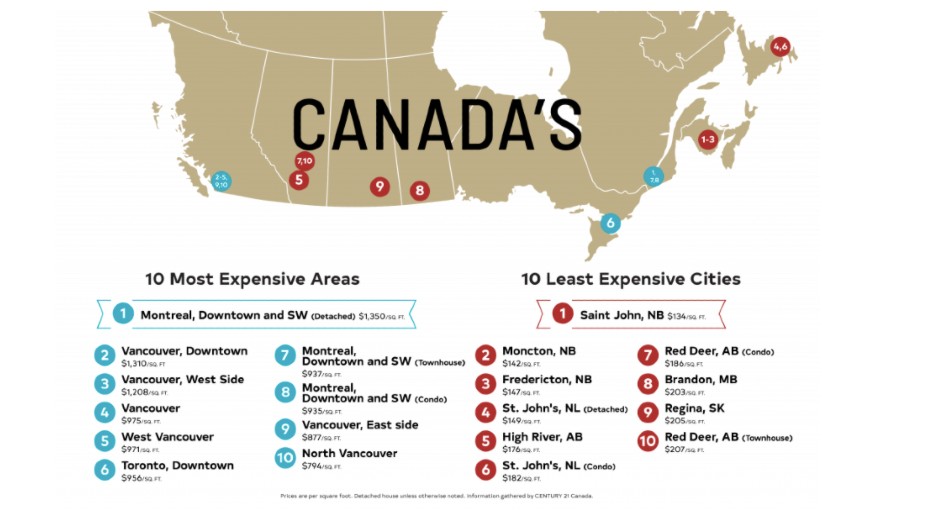
In its annual, nationwide “Price per Square Foot” study, CENTURY 21 Canada compared the price per square foot of properties sold between January 1 and June 30 this year, compared to the same period last year.

Brian Rushton, executive vice-president of CENTURY 21 Canada, says it’s still a seller’s market from Victoria to St. John’s, and there isn’t one region that hasn’t seen price growth.

“When the pandemic began in 2020, the market became uncharted territory,” he says. “But because of low inventory and high demand from buyers looking for a larger space, prices have steadily climbed for the past year, particularly for detached homes outside of urban centres.

“That shifted as the year went on, with growth in home prices slowing and condo prices starting to increase again.”

After an initial dip last spring, pent-up demand for housing, particularly detached homes, increased prices throughout last fall and earlier this year, in part due to a lack of supply. As evidenced in the data, prices in central major metros have been softer than those in traditionally less expensive markets like Owen Sound and Atlantic Canada, in particular for condos.

Rushton says prices have moderated over the past couple of months. “This is typical of what we see through the summer months, but all signs are pointing to another busy fall as inventory across the country continues to be low with plenty of buyers waiting to make a move as soon as they can.”

Home prices in Atlantic Canada

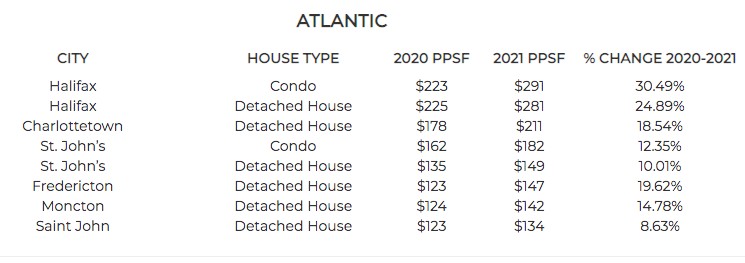
Once the most affordable place to buy a home, Atlantic Canada has seen prices consistently increase as working from home is becoming a viable option for many Canadians. Most of this is happening in Halifax, but Charlottetown, Fredericton, Moncton and St. John’s are all seeing double-digit increases.

“Because we are still affordable, people are flocking here,” says Paul Burns, manager at CENTURY 21 A&T Countryside Realty. “Between people from Ontario finding that they can afford a home in Atlantic Canada, newcomers increasingly locating here, and locals who want to stay, this region is seeing prices we’ve never seen before.”
home prices

Data chart by CENTURY 21 Canada

Home prices in Ontario

Prices in downtown Toronto condos were actually slightly down for the first six months of the year, but are coming back strong. 2021 started with lower prices seen in the early days of the pandemic, but have increased as the year went on. Ottawa condos were also down year-over-year, but they are also rebounding as 2021 continues.

In Owen Sound and Grey Bruce, prices are up more than 80 per cent as more people moved to suburban areas.

“Demand has been off the charts,” says Mike Seiler, owner of CENTURY 21 In Studio Realty. “Our clients are moving up from Toronto now that they can work from home. People are also realizing how much more space you can get once you get out of the metro area.”

Suburbs have all seen double-digit increases in prices, with the highest in those communities that are just a little outside a regular commute. “Now that people are commuting a few times a week rather than every day, they’re willing to be a bit further from their jobs in order to secure a bigger home at a more affordable price,” says Eryn Richardson of CENTURY 21 Heritage Group.

British Columbia

B.C. real estate remains the most expensive in the country. Prices in the outskirts of Greater Vancouver saw with largest increase, with Chilliwack prices up over 40 per cent to $406 per square foot, Delta up 38 per cent to $570 per square foot and White Rock/South Surrey up 44 per cent to $625 per square foot. Kelowna also saw solid increases with prices up anywhere between 20 and 30 per cent, depending on the home type.

Prairies

The slowest-growing areas of the country, price wise, are in the Prairies. Many markets in Alberta saw decreases in previous surveys but are up anywhere from three to 15 per cent depending on the city and home type.

Saskatoon homes are up nearly 20 per cent to $314 per square foot, while condo prices remained flat. Regina properties only saw minor increases in prices. Winnipeg saw the biggest gains with homes up as much as 20 per cent to $293 per square foot for a house and $241 per square foot for a condo.

Even Yellowknife properties are more expensive. Both houses and duplexes have seen double digit increases while other house types have seen more subtle changes.

“This is the fifth consecutive year we have done this survey and while previous years showed that real estate is a local story, we have seen widespread increases across the country this year,” says Rushton. “Real estate is security—both emotional and physical—and after the pandemic people continue to want to invest in the places they want to spend the most time.”
home prices

Prices are per square foot. Detached house unless otherwise noted. Information gathered by CENTURY 21 Canada. See here for more info.


 

Tapping in to Next-Gen Intercoms

It takes more than a static directory and buzzer to manage front door activity. That’s why many multi-residential managers and residents are seeking smarter and more secure ways of controlling building access. And with visitor traffic only increasing, old-fashioned intercom systems might not be up to the task.

The demand for smarter building access solutions is driven by several factors. Top among them is a rise in online shopping that is bringing more and more packages to the front doors of condos and apartments across Canada. In fact, a June 2021 study by PayPal reveals that Canadians upped their monthly online shopping spend by $2 billion during the pandemic, resulting in record-breaking activity for package delivery companies across the sector.

“Lately, we’ve seen some of our multi-residential clients’ intercom systems covered in dozens of notices from delivery services and couriers who tried to drop off a package but couldn’t gain access,” says Neil Denney, Executive Vice-President for Inlight Solutions, a GTA-based provider of smart, eco-forward solutions. “And because those systems require recipients to be in the building to ‘buzz them up’, there are a lot of missed connections.”

The volume of deliveries isn’t expected to slow down any time soon, Denney notes. As pandemic restrictions lift, multi-family buildings are likely to see even more visits from friends, family members, and service providers (e.g., healthcare workers, dog walkers, food deliverers, etc.). As such, dealing effectively with everyone seeking entrance, even when residents aren’t there, requires a more tech-savvy approach.

Re-thinking the intercom

It’s a wireless, streaming, app-driven world. It only makes sense that intercom systems follow suit. Recognizing this, the proptech innovators at HIVE recently introduced the Hive Smart Video Intercom system as a way for property teams to stay ahead of the trends.

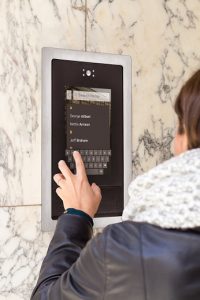
Distributed and installed exclusively in Ontario by InLight Solutions, the Hive Intercom enables residents to see and communicate with whoever is requesting access to their building through the Hive Intercom mobile app.

“Now, whether you’re home or not, you can answer that visitor request remotely through the HIVE app remotely from anywhere in the world,” explains Amin Damyar, President & Co-founder of HIVE. “From there, you can see exactly who is asking to be let it and decide to share a ‘digital key’ to the building or provide other directions.”

HIVE IntercomThe benefits of a “smarter” intercom extend beyond remote access and real-time connectivity. The ability to see and track multi-residential visitors also embeds a welcome layer of security and accountability for property managers.

“Every time a visitor interacts with the Hive Intercom, the device takes a clear snapshot of the user and logs the details of their interaction,” Damyar explains. “That image and data is then recorded and stored so if there’s ever an incident, the manager can go back into those logs and find out who came into their building, their time of visit, and other key details.”

Of course, seeing who is at the front door adds also delivers peace of mind for residents. According to Jinesh Patel, resident and co-owner at Lofts St-James: “After using Hive Intercom, it only makes answering more secure, especially with a video camera to get a glimpse before unlocking the door.”

Privacy is also a priority within multi-residential buildings. To that end, Hive intercom users can choose to remove their names and personal details from the touchscreen directory and respond to requests anonymously.

Speaking to Hive’s value offering for unit owners and renters overall, Denney adds: “Not everyone can afford to have a concierge, so this is an inexpensive and user-friendly way for residents to know you’re letting the right people in and out.”

Generating Buzz

HIVE’s Smart Video Intercom offers a glimpse at how residential and commercial buildings alike are tapping into digital solutions to keep pace with modern demands. And thanks to its ease of installation, user-friendly design, and low cost of entry compared to traditional intercom systems, HIVE’s front door innovation is catching on.

“We launched Hive into the market in early 2021 and the interest has been very high,” Damyar reports. “Part of that early buzz is the fact that property owners and managers are looking for technologies that make their operations smarter and more streamlined, while building occupants are gravitating to any technology that keeps them more connected and in control of their environment.”

Certainly, says Denney, requests to install Hive among condos, apartments, and office buildings have been climbing, especially as property teams pursue ways to keep pace with modern demands.


“At the end of the day, Hive is about intercoms catching up with the smartphone world, and everyone is recognizing the benefits,” he adds.
Learn more about InLight and the HIVE Smart Intercom at https://inlightsolutions.ca/hive-x-inlight. 

Concord plans world’s largest condo bike facility

A 50,000-square-foot bike facility is being planned for the Concord Metrotown, a three-tower development in Burnaby. Concord Pacific says it will be the world’s largest and most comprehensive bike amenity ever planned for a condo development.

“Amenities like this not only support sustainable commuting, they foster healthy micro communities within the development and encourage residents to get outside and take advantage of the outdoors together.  Significant biking infrastructure and accessibility will be an important piece of all our next generation communities,” said Peter Webb, Senior Vice-President, Concord Pacific Developments Inc.

The facility will feature a gear room, indoor bike loop, spin studio, two bike lounges, a washing bay and change and shower facilities with massive skylights bringing in nature from above.

As well, the development will include secure storage for 1,500 bicycles and premium storage featuring closed partition walls for added privacy and security, interlocking wall panel system for efficient storage solutions and electrical outlet for E-bike charging.

“We wanted to create a welcoming space that fostered a sense of community that encouraged human interaction and connection – something inspired by the Burnaby biking community itself, and something that was much needed after the pandemic,” said Olivia Lam, principal, LIV Design.

“We were able to work with landscaping and architecture to allow as much natural lighting as possible into the space underneath the park. Not only that, it allowed us to manage nuances like lighting temperature against the chosen materials to evoke a warm and inviting space.”

The project is located on the site of the former Sears department store in Metropolis at Metrotown and will include B.C.’s tallest tower. The entire project is expected to reach completion by 2025.

IBI Group is the prime consultant responsible for the master plan and rezoning and is the architect for the first three towers and podium.

Sienna Living launches new retirement platform “Aspira”

In a recent operations update, Sienna Living announced plans to launch a new retirement platform called “Aspira” in late 2021 or early 2022. The new brand will be supported by its own designated website and will provide a wider range of choices for residents.

“Over the past year, we conducted an in-depth assessment of our retirement operations and identified opportunities that will set us apart in a competitive market,” said Nitin Jain, President and Chief Executive Officer of Sienna. “Under the Aspira brand, our goal is to provide residents with a wider range of choices. At the centre of our new brand is the conviction that seniors should be able to live the life they desire and deserve, with an increased emphasis on being a vital part of the local community.”

In addition to announcing the new retirement platform, Sienna also provided second quarter financial details and an update on a new joint venture development in Niagara Falls. Sienna’s estimated capital investment in the property is approximately $50 million, with an expected development yield of approximately 7.5 per cent. It’s share of this 150-suite joint venture development is 70 per cent.

Meanwhile in North Bay, the company hosted a ground-breaking ceremony at its 160-bed redevelopment site that was attended by senior government officials, including the Premier of Ontario. Sienna’s estimated capital investment for this redevelopment to be named “Northern Heights Care Community” is approximately $55 million.

COVID-19 update  

In terms of operational changes as COVID restrictions ease, Sienna is reporting an improvement in occupancy coinciding with the resumption of in-person tours at Sienna’s retirement residences, as well as an increase in admissions to its long-term care communities.

Retirement – Same property occupancy up 240 basis points to 80.6% as at June 30, 2021 from March 31, 2021.

Long-term Care – Average occupancy up 130 basis points to 81.6% in Q2 2021 compared to Q1 2021.

Vaccination Rates – According to most recent vaccination data, approximately 96% of Sienna’s residents have received at least one dose of vaccine, with 95% fully vaccinated. 88% of Sienna’s team members have received at least one dose of vaccine, with 79% fully vaccinated.

COVID cases – As of August 10, 2021, none of Sienna’s 83 owned or managed residences had active cases of COVID-19.

The Goode condo set for Distillery District debut

The Goode promises heritage-inspired urban living as it takes shape on Parliament street in the Distillery District. Steps from the cobblestone pathways that lead to galleries, shops and artisanal markets, the condo, as its name implies, will be a salute to the early 19th-century Gooderham & Worts, once one of the world’s largest distilleries.

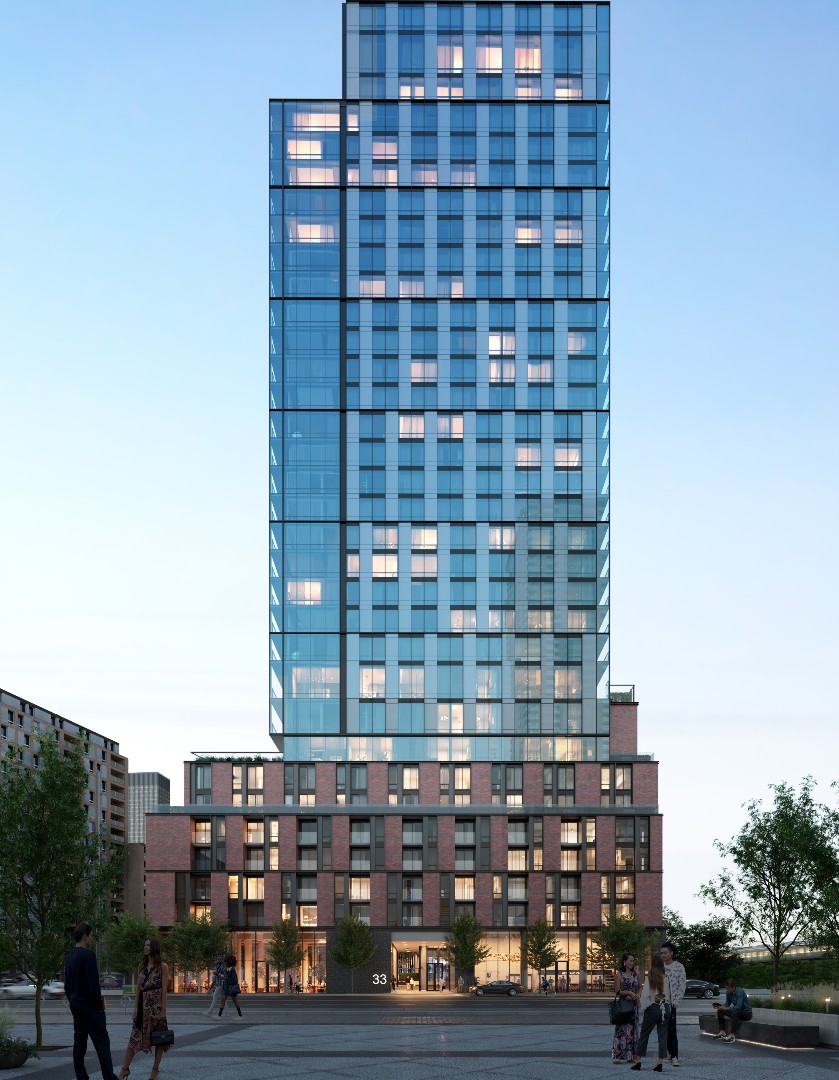
Expected to rise 32 storeys, with a mixed-use podium, the project is the brainchild of Graywood Developments and designer architectsAlliance. Once complete, the condo will make history of its own, standing on one of the last parcels of residential land in the district.

Inside, suites will range from singles to three-bedrooms. Amenities will cater to young professionals and families, and include a multi-purpose room, a co-working area, fitness studio, bicycle repair room, makers table and pet wash. A large roof terrace with a swimming pool and rooftop garden stand atop the 10-storey podium overlooking Distillery Lane.

The Goode

Amenities at The Goode include a swimming pool that sits atop the 10-storey podium with striking view across the city and lake.

Outside the Distillery District, the nearby Port Lands redevelopment is bringing 25 hectares of publicly accessible greenspace and parkland, and a naturalized river and new island to the east end. The future rapid transit Ontario line, that connects to overall subway service, will include a stop in Corktown. As Graywood Developments’ President and CEO Stephen Price, says, “From the new Parliament Slip, to the extension of transit, the naturalization of the Don River, and more, the rate of change in this part of the city is unmatched.”

As designer of three existing condos in The Distillery District, architectsAlliance is looking forward to working, once again, amongst “one of the largest assemblages of industrial heritage buildings in Canada.”

“The Distillery has emerged as one of the most desirable residential neighbourhoods in the city, while realizing its vision as a flourishing cultural and entertainment centre,” said Peter Clewes, managing partner and design director, architectsAlliance. “It’s been rewarding for us to revisit our initial concept – while individual design expressions evolve over time, our underlying design principle is constant: to preserve the soul of this remarkable place.”

What the Toronto firm has envisioned is a design that uses masonry alongside glass and metal, which ties the podium to the Distillery’s distinct aesthetic and complements the existing character of the neighbourhood.

On the tower, repetitive metal bands frame windows on every other floor, breaking up the massing and getting more granular with height, while a pattern of windows adds playfulness and texture to the exterior.

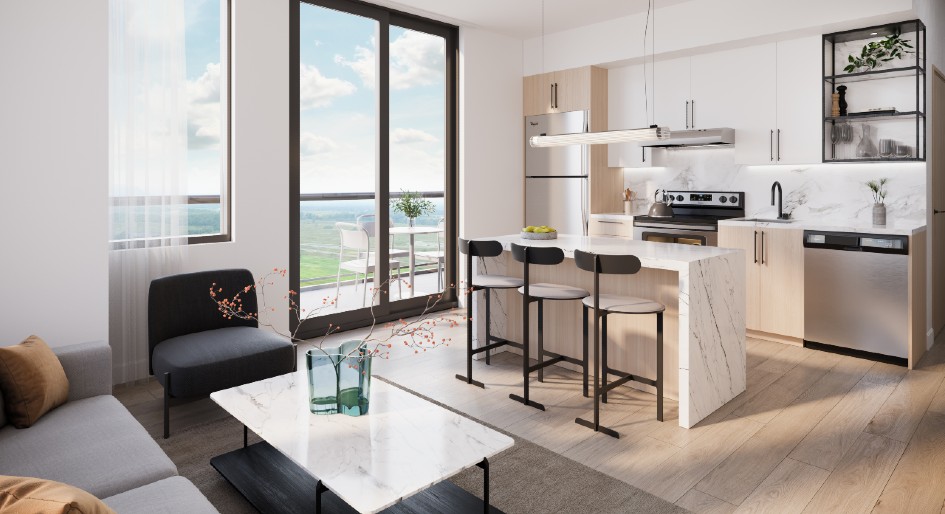
For the interiors, DesignAgency took references from the site’s history, while adding a modern spin. Dramatic black and white moments are complemented by clean and modern materials with neutral palettes, while pops of amber are drawn from the timeless brick and glass design of The Distillery and used along with fresh yellow accents.

“Understanding the diverse lifestyles our future residents will live, we introduced spaces for people to socialize, relax and work throughout the building,” said Carolyn Roche, senior designer at DesignAgency. “We wanted to draw from the cultural elements that define the area and infuse it into our designs.”

Physical connections between the building and The Distillery will be realized through the L-shaped podium that carves out new publicly accessible space behind The Goode. To tie the project to its surroundings, a partnership sparked between Graywood and partners Cityscape Holdings and Dream, the current owner-operators of The Distillery, who will be taking over the retail portion of the development.

Studio pricing is starting from the $400,000s. One-bedroom pricing is starting from the $600,000s.

The Goode

Standing 32-storeys, the architectsAlliance-designed building will be one of the last residential condos to come to The Distillery District.


Feature photo: The Goode will animate Parliament Street and The Distillery District, with crisp architecture and a podium that blends seamlessly into its surroundings. 

Realm condo project launches in Burlington

Adi Development Group recently launched Realm, a modern community of condos and townhomes in Burlington’s Alton Village neighbourhood. Geared to younger urban residents, the homes respond to a demand for suburban living spaces—away from the costly confines of a city.

Earlier this year, a Statistics Canada report found that Toronto, Montréal and Vancouver all experienced record-high population losses as a predominantly under-45 crowd opted to move outside these urban centres. This occurred between July 2019 and July 2020, but this trend has only snowballed throughout the pandemic as housing costs rapidly increased.

From new families to young couples and beyond, Realm directly supports a younger cohort looking to settle down outside of Toronto and the like. While pricey single-family homes are out of reach for many in the GTA, Realm provides cozy practical living alongside playful amenities and expansive outdoor spaces.

The project is made up of two 16-storey high-rise condo towers and 20 townhomes for a total of more than 400 suites starting at $400,000. Suites range from 446 to 1163 square feet, with options of one, two, and two bedrooms plus den with open-concept layouts.

Realm

Outdoor rooftop terrace at Realm.

The community comes with a range of amenities including a fully-equipped fitness centre with a movement studio, social and youth spaces, a playful kids’ zone, a work-from-home lounge with office pods and breakout rooms, a calming indoor garden, an outdoor basketball court and lounge on the 6th-floor terrace, and easy access to the Burlington GO Station as well as Highway 407 and the QEW.

Realm

A playful kids’ zone is one amenity at Realm.

With clean lines and a crisp aesthetic, its modernist architecture is an example of sophisticated and thoughtful residential design. Centered around a landscaped park, with open-concept suites, Realm balances form with function, light with space and design with nature.

Realm

The clean lines and crisp aesthetic.

Real estate investment universe expands in 2020

Canada’s real estate investment universe moved up a notch in the global rankings in 2020 as MSCI pegged the inventory of professionally managed real estate held for investment purposes at nearly USD $364 billion (CAD $546 billion), representing a USD $2.9 billion (CAD $3.6 billion) gain in market size from 2019. That places the Canadian market as the seventh largest among the 33 that the Global Property Index producer monitors for its annual report gauging the size of the professionally managed global real estate investment market.

Making way for Canada’s ascendance, the Hong Kong market slipped to eighth following a USD $22-billion loss in market size, trimming it to USD $356.3 billion. It was one of just three markets, along with Brazil and South Africa, on a downward trajectory.

Overall, MSCI estimates global market size grew 9 per cent to reach USD $10.5 trillion in 2020. That’s up from USD $9.6 trillion in 2019. The United States was a significant contributor to that tally, registering a USD $232.5 billion increase in market size over the course of the year. Other strong performers include Germany, Sweden and Switzerland.

“The real estate market’s convincing expansion in the face of the COVID-19 pandemic seems to underscore investors’ resolute search for returns across asset classes,” René Veerman, MSCI’s head of real estate, asserted in his foreword to the recently released report.

Although he attributes some of the value gain to currency fluctuation, he notes 2020’s “subdued” transaction activity and asset value growth — concluding that the growth in market size stems more from new additional investment than dynamics of the pre-existing holdings. Across the global market, asset value fell 1.3 per cent relative to 2019, in contrast to the 2.9 per cent gain in 2019 relative to 2018. Currency movement pushed market size up by 3.9 per cent in 2020 versus just 0.1 per cent in 2019.

Those effects were not felt evenly among the 33 surveyed markets. Canada saw one of the steepest declines in capital growth of any nation — at negative 7.8 per cent — yet still achieved 1.1 per cent asset value growth. Ten markets recorded positive capital growth, led by Norway with a gain of 5.2 per cent. The U.S. recorded negative 2.8 per cent capital growth with 1.2 per cent asset value growth, while the United Kingdom suffered steeper losses, with capital growth at negative 6.5 per cent and more moderate asset value growth at 0.5 per cent.

After the U.S., which alone accounts for a nearly 35 per cent quotient of the global real estate investment universe, the next largest markets are Japan, the United Kingdom, Germany, China and France. The U.S., Canada and Brazil, which together are defined as “the Americas” accounted for nearly 39 per cent of market size in 2020 versus about 35 per cent for nations identified as EMEA (Europe, Middle East and Africa) and 26.5 per cent for Asia-Pacific nations.

5 steps to safer & healthier entertainment venues

As the live sports and entertainment industry finally begins to emerge from the devastation of the pandemic, managers of entertainment venues will be faced with an assortment of challenges, with safety and cleanliness top of mind for everyone involved.

Art Rodriguez, VP of Operations, Sports and Entertainment at ABM, highlighted for CleanLink five elements that managers can focus on to create and maintain a healthier venue moving forward.

1. Authoritative Guidance

The guidance from the Centers for Disease Control and Prevention (CDC), the World Health Organization (WHO), and the Occupational Safety and Health Administration (OSHA) should be the starting point for any disinfection program, stresses Rodriguez.

The challenge will be in translating that guidance into practical protocols and staying on top of the latest information. As experts learned more about COVID-19 and how it’s transmitted, the CDC, WHO, and OSHA’s recommendations have evolved, and they will likely continue to do so. Being adaptable to these changes will be key.

2. Occupant Assurance

Cleanliness and safety are top of mind for all building occupants, and it’s vital that employees feel safe coming to work and visitors feel safe entering facilities. Rodriguez notes that in March 2021, nearly two-thirds of Americans said they believe attending a sporting event represents a large or moderate risk. That represents an improvement upon earlier in the pandemic, though; it is 20 per cent less than the number of fans who had reservations about sporting events in May 2020.

As fans become more open to attending events, venue operators can help them along by implementing visible disinfection protocols, particularly focused on cleaning high-touch points and restocking hygiene supplies, as well as ensuring there is adequately clear and informative signage. Boosting confidence will be vital.

3. Training

Cleaning personnel must be properly trained and educated on how cleaning for health and hygiene differs from typical cleaning tasks. Other venue personnel, such as parking attendants and ushers, will also need training on how to minimize hand-to-hand contact and maintain safe distances with guests and each other, as well as potentially on how to use disinfection supplies to clean their areas safely and effectively.

4. Pre- and Post-Event Protocols

To ensure that the facility is ready for each event, disinfection should start before fans enter the venue and continue after they leave. Incorporating additional pre- and post-event measures will help minimize the potential spread of infection. These precautions can be as simple as propping open bathroom doors to reduce touchpoints, or as advanced as using electrostatic spraying for broader disinfection.

5. It All Starts with a Facility Assessment

Even if the venue has been partially open during the pandemic to serve as a testing and vaccination site, a long-term plan for how to address facility health is still advisable. It’s best to assume that occupants’ concerns will persist well beyond the pandemic. A facility assessment will help identify which practices should become a regular part of the cleaning program, along with the supplies and personnel needed to implement them, and will go a long way to creating a healthy and safe environment that inspires confidence.

Antiseptic & disinfectant market could reach $200B in 10 years

A new report from market research firm Fact.MR predicts that the global antiseptic and disinfectant market will reach US$160 billion (CAD$200 billion) by 2031.

The report estimates that the global market will expand at a 21 per cent compound annual growth rate (CAGR) over the next decade.

The antiseptic and disinfectant market is expected to close at US$24bn (CAD$30bn) by the end of 2021, with a CAGR of about six per cent registered from 2016 to 2020.

Unsurprisingly, the growth in the market has been spurred by the outbreak of COVID-19, which has necessitated the increased use of antiseptics and disinfectants.

The report adds that it’s expected that the usage of these products in hospitals and other healthcare sectors will be responsible for over two-fifths of the global revenue share of the market.

The report also found:

  • Alcohol-based antiseptics and disinfectant demand is expected to surge at a 20 per cent CAGR
  • Quaternary ammonium compounds (quats) are expected to hold a high revenue share, exceeding 30 per cent
  • Antiseptic and disinfectant sales for domestic use are likely to generate three out of 10 sales

Ina addition the report identified 3M, Reckitt, Kimberly-Clark Corp., Cardinal Health Inc., Bio-Cide International, BD, STERIS plc, and Johnson & Johnson, as key players in the antiseptic and disinfectant market.

Fenelon Lakes Club brings more condos to the waterfront

City-dwellers flocking to cottage country for post-pandemic living space will see pricey, single-detached homes aplenty, many of which are geared to vacationers. Rarely are new condo developments with waterfront access up for grabs, which is why Fenelon Lakes Club is rising up in the Kawarthas.

In Fenelon Falls, Ontario, on Cameron Lake, Fenelon Lakes Club promises to bring luxury, resort-style condominium living to the waterfront—for those looking for something more affordable.

MDM Developments broke ground this week on 86 residences that include 66 condo units, 10 waterfront townhomes and 10 bungaloft townhomes, which are located near the Victoria Rail Trail and Byrnell Golf Club. Prices start from the mid $700,000s, with suite sizes ranging from 1,000 to 2,500 square feet.

Fenelon Lakes Club

Some amenities are an outdoor pool and entertaining space, racquetball courts and fireside lounge. As it stands, the developer has sold 85 per cent of Phase 1 in less than three weeks, and is currently 65 per cent sold in Phase 2.

“Knowing there is little on the market for boutique waterfront residences, we wanted future residents to experience the ultimate in cottage living without the hassle of actually owning one,” said Doug Gray, president of MDM Developments. “We’re proud to be part of the growth in the Kawarthas and our goal as a company is to add even more value to the beautiful and growing communities in this area.”

Located near major highways, Fenelon Lakes Club is flanked by 355 feet of waterfront with western exposure, so residents can experience expansive lake views.

“With the pandemic came a shift in typical purchasing habits we’ve seen dominate the market over the last decade,” said Luke Wilson, partner at MDM Developments. “In the last year and a half we have seen a heightened demand for outdoor space, and waterfront properties afford residents with the best of both worlds: condominium living and proximity to nature.”

Fenelon Lakes Club is projecting completion by Fall 2022.

Fenelon Lakes Club

Bill Davis held rare BOMA membership status

Former Ontario Premier Bill Davis was an honorary member of the Building Owners and Managers Association (BOMA) of Greater Toronto. The special membership status, which is exceptionally rare in BOMA Toronto’s 104-year history, was conferred in 1992.

Chuck Stradling, who served as both BOMA Toronto’s top elected official in 1997-98 and its senior staff officer (then carrying the title of executive vice president) from 1999 to 2009, recalls that he was relatively new to the board of directors when it adopted the motion to induct Davis. Today, BOMA Toronto is once again paying tribute to Ontario’s 18th Premier who died at age 92 earlier this week.

“Former Premier Bill Davis led a full life dedicated to public service, making many contributions to the province of Ontario and the commercial real estate industry,” says Susan Allen, president and chief executive officer of BOMA Toronto. “His legacy will live on.”

That’s a sentiment other commercial real estate organizations reiterate.

“FRPO remembers Bill Davis as a great Minister of Education and a great Premier who faced many difficult challenges with wisdom and balance,” concurs Tony Irwin, president and chief executive officer of the Federation of Rental-housing Providers of Ontario. “His legacy of achievement transcends any single policy that resulted from his time in office.”

Well-versed students of public policy — even those born after Davis had stepped down from office — point to the continuing evidence of his influence.

“In many ways, this is still Bill Davis’ Ontario,” reflects Brooks Barnett, director of government relations and policy with REALPAC. “He can be credited with building the modern Ontario that exists today, including the architecture of some of the most important institutions and arms of government.”