



Articles Archive - Page 344 of 928 - REMINET
REMI

Pandemic expands an aging workforce

The pandemic is pushing people to reconsider their post-work-life ambitions. According to a study last fall by investment firm, Edward Jones, nearly eight million Canadians are now reconsidering when they will retire with more than 30 per cent planning on retiring later due to financial reasons. Another poll conducted by Scotiabank this year found a similar percentage of people plan on working longer than expected due to COVID-19-related loss of income.

This aging demographic of workers, which was already growing pre-pandemic, will ultimately provide organizations with unique opportunities, such as the retention of experienced employees who typically have lower absenteeism than younger workers and a sharp customer focus, which will be a key benefit for companies going forward as restrictions are lifted.

Yet the natural impacts of aging will likely impact older employees’ performance. With age comes a decline in muscular strength and range of motion, reduced ability for prolonged heavy labour, a diminishing of posture and balance, and changes with vision and hearing over time. Chronic conditions and comorbidities also increase, including diabetes, heart disease, arthritis, and cognitive decline like dementia. With workplace experience, job knowledge, and a longer working career, older workers can still inspire younger employees to work safer and be more productive.

According to the Canadian Centre for Occupational Health and Safety, older workers have a lower incidence of workplace injuries; however, once they are injured, the injuries are more severe and recovery takes much longer than their younger co-workers. Therefore, it is important to take an ergonomic approach to support the entire workforce to allow them to work safely each day. At the heart of ergonomics is designing workplaces and tasks to fit the workers. The first step is to create a workplace that reduces the chance of injury for all employees, regardless of age, years of experience, or knowledge. This includes utilizing workplace design concepts to create an environment that supports older employees through design opportunities and enhancements to indoor lighting, auditory privacy, and equipment adjustability.

Indoor lighting

As people age, they can experience natural vision changes to depth perception, reading distances, resistance to glare, and even colour perception. The workplace should include a variety of lighting sources that reduce glare and highlight elevation transitions such as steps and thresholds between spaces. Areas such as photocopy rooms and workstations should include adjustable task-type lighting for reading and reduced eye strain. In spaces which face either east or west, the inclusion of adjustable blinds can also reduce glare at specific times of the day.

Auditory privacy

Hearing and auditory deficits occur with age, including overall hearing loss and the inability to listen to specific sounds or someone talking with loud background noises. To support auditory changes there needs to be a blend of open and closed workstation and meeting room areas, specifically when multiple individuals must collaborate together. In the design and choice of workspace materials, softer and sound absorbing materials will minimize distracting background noise such as echoing.

Adjustability

Adjustable furniture is the key to good ergonomic design. Not every employee is the same size; neither should furniture they use. It is important to provide all employees with height-adjustable task chairs, keyboard trays, lighting, and other types of adjustable equipment as needed. The strain of repetitive motions can be higher in older workers. Organizations should also look at providing hands-on education and training on how to properly adjust the equipment to fit each worker and how to recognize the signs and symptoms of musculoskeletal injuries.

Individuals are working longer in life due to a variety of reasons. Retaining employees provides many benefits, but must also be balanced with the changing physical needs of aging workers. By focusing on how the work environment can reduce the risk of injury, good ergonomic design can support everyone to be safe and productive—increasing organizational performance.

Aaron Miller is an ergonomics consultant based in Kelowna, B.C. As a Canadian Certified Professional Ergonomist (CCPE), Aaron specializes in leading design and corporate initiatives to improve organizational efficiency, effectiveness, and opportunities for change. Aaron can reached at [email protected]
Rize Alliance introduces new rental property division

Rize Alliance has unveiled Comma Properties, a new division focused on building better rental communities. Motivated by the need for uplifting rental that promotes social interaction, Comma will bring an integrated approach to rental property management, residential community programming, and retail leasing. Comma will deliver both residential and commercial spaces across the Lower Mainland as well as in Los Angeles.

“With Comma we want to shift the perception of what rental housing can be in our cities,” says Benn Duffell, VP of development at Rize. “We are inspired to build communities where rental will no longer be seen as lesser than homeownership. Comma’s rental properties will be design-forward, vibrant, and will strive to facilitate meaningful connections among residents.”

Rize is expanding its portfolio to the US and developing a co-living rental project in Sawtelle Japantown, Los Angeles. Comma will bring the best of LA rental culture to its rental developments in the Lower Mainland.

“As a progressive city for renters, Los Angeles is home to a thriving co-living scene where social programming and shared living are at the core of its community,” continues Duffell. “We have been inspired by other cities with strong rental cultures and this is informing our work in Vancouver.”

The company’s first rental project, located in Fraserhood, broke ground in late 2020 and is expected to be move-in ready by spring 2023. This six-storey purpose-built rental will have 104 total homes including below-market rentals and 13,500 square feet of commercial retail space.

Comma projects underway includes:

  • A 104-unit, purpose-built rental with 13,500 square feet of commercial retail space on Fraser and 19th in Vancouver.
  • A 392-unit, mixed-use residential and heritage revitalization project along King George Boulevard in Surrey.
  • An innovative 168-unit rental project in UniverCity village on the SFU campus in Burnaby.
  • An 80-bedroom, 18-unit fully co-living rental project in Sawtelle Japantown, Los Angeles.

ER expansion at Eagle Ridge Hospital complete

Construction is complete on Phase 1 of the $38 million emergency department expansion project at Eagle Ridge Hospital in B.C. The hospital serves Port Moody, Port Coquitlam, Coquitlam, Anmore and Belcarra.

“When Eagle Ridge Hospital opened in 1984, the hospital’s emergency department had about 20,000 patients seeking emergency care every year. That number has more than doubled to 50,000 patients per year,” said Minister of Health Adrian Dix. “As the Tri-Cities continue to grow, a larger emergency department is needed to keep pace with the increasing demand for emergency services in the region. Our government recognized this and moved quickly so people can get the care they need when they need it.”

The first phase includes new separate entrances for walk-in patients and ambulances, a redesigned registration and triage area to improve privacy and flow of patients, and a designated separate area for patients with mental-health and substance-use support needs.

Once finished, the expanded emergency department will have 39 new treatment spaces, up from 19. It will include four new isolation rooms for people with infectious illnesses and two new trauma resuscitation bays. Walk-in patients and ambulances will have separate entrances, a decontamination area will help with chemical contamination and additional handwashing stations will help reduce the risk of infection.

The new space is approximately three times larger, increasing from 714 square metres to 2,206 square metres.

To expand the emergency department, health records were moved to the basement of the hospital, and diagnostic cardiology services have expanded into some of the existing health records area. Community outpatient services have been relocated to another part of the hospital, and rehabilitation services have moved to the existing community outpatient services area.

The project includes work from Phase 2 that began in August 2021. Further Phase 2 renovations for future rehabilitation space are expected to begin in October 2021 with completion in March 2022.

2021 national landscape awards winners revealed

Winners of the National Awards of Landscape Excellence (NALE) were announced virtually. The awards celebrate the best-of-the-best in landscape and horticulture, recognizing the outstanding work of companies across the country that are raising the level of professionalism in the Canadian landscape industry.

Presented by the Canadian Nursery Landscape Association (CNLA), the awards consist of five landscape awards, with each provincial association nominating members from its own provincial awards of excellence competition.

In addition, the Green for Life Community Award recognizes incredible projects within communities that benefit the public through the construction or maintenance of green spaces.

Two new awards were added this year: the CNLA Grower of the Year Award, and the CNLA Garden Centre of the Year Award.

The winners are:

Caterpillar National Award of Landscape Excellence for Commercial Construction
Aden Earthworks, Musee Picass
Toronto, ON

Caterpillar National Award of Landscape Excellence for Residential Landscape Construction
Fossil Landscape Construction, West Vancouver Estate
Vancouver, B.C.

HortProtect National Award of Excellence for Landscape Design
VisonScapes, Lotus Gardens
Calgary, AB

HortProtect National Award of Landscape Excellence for Commercial Landscape Maintenance
Strathmore Landscape Contractors, Rideau Canal Corridor
LaSalle, Que.

HortProtect National Award of Landscape Excellence for Residential Maintenance
The Cultivated Garden, Ivey Residence
Toronto, ON

CNLA Grower of the Year Award
Eagle Lake Nurseries,
Strathmore, AB

CNLA Garden Centre of the Year Award
Millcreek Nursery
Edmonton, AB

Green for Life Community Award
Para Space Landscaping, Granville Island Project
Burnaby, B.C.


Fewer Canadians report ‘sense of belonging’ at work 

The work-from-home movement has garnered much applause for its flexibility and commute-free model, but new findings suggest people are at risk of feeling less connected to their organization and colleagues, and their mental health is faltering.

The latest Mental Health Index from total wellbeing solutions provider LifeWorks recorded a negative mental-health score among Canadians for the 17th consecutive month, and the highest since the index launched in April 2020.

“When transitioning to a virtual setting during the pandemic, many employees lost the spontaneity of conversations that they may have found invigorating,” noted Stephen Liptrap, president and CEO of LifeWorks. “To ensure a successful return to the workplace, employers should consider innovative ways to lessen feelings of isolation and create a culture free from bias, regardless of work location. “Connections and the social support they offer are important to wellbeing and we need to ensure that this is not lost.”

The monthly survey was conducted online from July 30 to August 5, 2021, with 3,000 respondents in Canada. Seventy-three per cent of respondents said that prior to the pandemic, they felt a sense of belonging and acceptance at work, but only 65 per cent felt the same during the past month.

Meanwhile, 26 per cent of respondents indicated that before the pandemic, they were unsure or did not feel a sense of belonging, compared to 35 per cent feeling the same during the past month.

This trend is seen across all age groups, however, the proportion of employees who report feeling a sense of belonging and acceptance at work increases with older age groups.

The majority of employees (68 per cent) who are working at a job site feel a greater sense of belonging and acceptance at work than those who work from home or in a hybrid workplace. Isolation scores among those working exclusively from home are worse (-9.6) than those working in a hybrid model (-7.6) or from the job site (-7.3).

Employees report working while unwell on weekly basis

More than half of Canadians are also doing their job when feeling unwell at least one day per week. The mental health scores among this group are significantly below those who report never working while feeling unwell.

“We know that when people are feeling unwell, their productivity at work suffers,” said global leader and senior vice president, research and total wellbeing, Paula Allen. “We also have clear data that indicates an organization’s culture of wellbeing and investments in workplace mental health make a difference in the overall health of the workforce.

“As we move forward in the next phase of the pandemic, there will be more change and added strain as a result. This is not the time to ease our focus on employee mental health and wellbeing. The need continues and the productivity risk is significant.”

Surrey awards three major infrastructure projects

The City of Surrey has awarded contracts for three major infrastructure projects from the Surrey Invests initiative.

A project management contract for the Chuck Bailey Recreation Centre Expansion and a design contract have been awarded for the 152 Street and Nicomekl River Bridge Rehabilitation and Twinning project, while a development permit was approved for the Cloverdale Sport and Ice Complex.

“Surrey is the fastest growing in the province and it is vital that public amenities keep pace with our growth,” said Mayor Doug McCallum. “Since the budget was passed last December, council has made tremendous headway in advancing the Surrey Invests initiative as quickly as possible. The three major infrastructure projects that we have moved forward is proof that council is committed to delivering these much-needed improvements to our residents in the shortest time possible.”

Turnbull Construction was awarded a contract for the project management of the Chuck Bailey Recreation Centre Expansion. COWI North America Ltd. was awarded the design contract of the 152 Street and Nicomekl River Bridge Rehabilitation and Twinning project and council approved a permit for the development of the Cloverdale Sport and Ice Complex.

The projects are part of the 20 plus major capital projects approved by city council for the Five-Year (2021-2025) Financial Plan in the 2021 budget. Other projects include the Newton Community Centre Facility Project and widening of Fraser Highway as part of the early work for the new Surrey Langley SkyTrain project.


Two western projects earn Cornerstone Awards

Two projects in Western Canada have earned 2021 Ecclesiastical Insurance Cornerstone Awards. The awards from the National Trust for Canada honour contributions to community, identity, and sense of place.

The Queen Elizabeth II Planetarium restoration project in Edmonton and The Shipyards in North Vancouver won in the transformative project category which recognizes projects that have creatively renewed or transformed historic places or landscapes for new or traditional use.

Queen Elizabeth II Planetarium

Located in Coronation Park, is the first of its kind in Canada and an important historical landmark in Edmonton.

This transformative restoration is a tribute to the city’s commitment to retain and adaptively reuse its historic resources, and an excellent example of strong collaboration with a community partner to ensure a sustainable project.

“We are thrilled to deliver exceptional work for Edmontonians, and to ensure the heritage and history of this facility endures for the next generation,” said Darren Giacobbo, project manager, Facility Infrastructure Delivery. “This planetarium – once a first of its kind in Canada – has a rich legacy of opening up the stars to Edmontonians, and we’re proud that this restored space can continue to serve our communities.”

The restoration project of this 60-year-old building included the restoration and refurbishment of the exterior and interior of a facility that has been out of service for over 30 years. It also featured modern upgrades such as LED lighting and new mechanical equipment to bring it up to code and the City’s sustainability standards. The planetarium opened in summer 2021.

The Shipyards

This redevelopment of a waterfront site retained its industrial character, balanced with the new functions of a much-needed waterfront public amenity.

A reimagined machine shop, known as “Shipyard Commons,” is at the centre of the design, featuring a public skating plaza in the winter and a splash park in the summer. The retractable roof on the west side emulates the character of structures familiar within the vernacular of the Shipyards area. The second structure – housing a boutique hotel and restaurant – adopts a contemporary form and act as a foil to the heritage character of the machine shop.

Since opening in July 2019, it has become a thriving hub of activity, unifying a key part of the city’s once-disjointed waterfront and bringing life to a long-dormant industrial space.

Green Seal launches LEED-compliant certification

Green Seal is launching a certification standard for paints and coatings that fully aligns with the latest version of the LEED green building rating system.

Products certified to Green Seal’s updated paint standard are designated by the U.S. Green Building Council (USGBC) as complying with the requirements for the LEED v4 and v4.1 low-emitting materials credit. The certification indicates a paint or coating product is safer for people and the planet than similar products while providing uncompromising performance. Green Seal restricts VOC chemical content and requires VOC emissions testing to ensure healthier indoor air quality.

Green Seal’s paint certification is the only mark in the marketplace to automatically qualify products for both LEED v4.1 credit requirements and Amazon’s Climate Pledge Friendly badge, making it simple for health-focused buyers to identify safer products.

The updated GS-11 Standard for Paints, Coatings, Stains and Sealers is also compliant with WELL v.1 and Fitwel standards.

“Green Seal’s paint standard has rewarded leading manufacturers for low-VOC content, safer formulas, and effective functional performance since it was first issued nearly 30 years ago,” said Doug Gatlin, CEO of Green Seal. “With our latest standard update, purchasers, facility managers, and consumers can confidently choose paints that fully align with LEED v4.1 green building certification and are verified to the highest standard of health, safety, and functional performance.”

According to Melissa Baker, SVP, LEED Technical Development, USGBC, LEED certification encourages the uptake of sustainable practices, including the use of low-emitting indoor materials that protect human health. “Green Seal’s updated paint certification raises the bar for protecting indoor environmental quality and offers a simple and effective path for complying with our most health-protective requirements in LEED,” added Baker.

Unlike single-attribute certifications that focus solely on VOC emissions, Green Seal’s standard also restrict the following:

  • Carcinogens
  • Reproductive toxins
  • Hazardous air pollutants
  • Preservatives that emit formaldehyde
  • Heavy metals
  • Alkylphenol ethoxylates, and a host of other harmful chemicals, ensuring certified products are safer for building occupants while providing uncompromising functional performance.

In addition, Green Seal ensures that certified products use environmentally preferable packaging materials and contain ingredients that are safer for water bodies.

During a time of increased concern about indoor air quality, Green Seal-certified products are trusted and specified by institutional purchasers and facility managers across the world.

In 2020 alone, paints and coatings certified to Green Seal standards prevented more than half a million pounds of VOC pollution throughout at least 120 million square feet of LEED-certified building space.

Destructive TikTok challenge creating work for school cleaners

A viral TikTok challenge is making a mockery of the dangers of infection and causing a headache for school cleaning and maintenance staff.

Called “devious licks”, the trend sees middle-school, high-school and even college students vandalize school property, particularly washrooms, and post their results, which include graffiti, stolen urinals, smashed floor tiles, broken faucets, and missing soap dispensers.

Digital anthropologist Giles Crouch told CTV News that the trend has spread from the U.S. and is now being seen all across Canada. He said students likely see it as a prank rather than vandalism that can cause health and hygiene risks. “They are more concerned about getting social acceptance,” he added.

In B.C., The Chilliwack School District told Global News that 42 soap dispensers have gone missing as of September 16. “Unfortunately, this is occurring at a time when there is a worldwide supply issue, partly due to this trend and partly due to supply issues around plastic,” the district said in a statement. “It is therefore difficult to replace all of the missing dispensers.”

The District’s Gerry Slykhuis told City News: “There’s certainly a significant labour cost involved in each of these as well as the frustration, because our maintenance staff are already really busy and it’s a waste of their time to have to do these very unproductive tasks when they could be fixing things they’d like to get fixed.”

North Vancouver’s school district also said it has seen a rise in these incidents. “Soap dispensers, paper towel dispensers and signage have been forcibly removed from walls, wall mirrors have been damaged, and a number of classroom-based items have been stolen,” Brad Baker, the district principal, said in a letter. “As we have shared with our school district community throughout COVID-19, the health and safety of our students and staff are a priority. When soap dispensers and paper towel dispensers, which are necessary to facilitate good hand hygiene, are removed from bathrooms, and particularly, single-stall bathrooms, bathroom spaces become unusable.”

The trend is also being seen on the east coast of Canada. “Soap dispensers coming out of the walls,” said Reign Sherrington, the brother of a Halifax-area student, per CTV News. “I heard at Halifax West High School, they had sinks coming out of the walls.

In response, some schools in the U.S., such as two middle schools in Ohio, have tried to prevent damage by locking washrooms and monitoring their use for large portions of the school day. North Vancouver’s Baker suggested that students and staff should expect reduced bathroom access while the district waits for replacements and supplies to arrive.

However, while school counsellors and child psychologists have shown sympathy to school custodial staff, they have warned that restricting washroom use is not only harmful to students’ health but also punishes all students for the actions of a few.

Recognizing the toll this is having on cleaning staff at educational facilities, who are already under pressure like many of their colleagues in other facilities at a time when proper handwashing is a critical component of facilities’ efforts to remain open during the ongoing COVID-19 pandemic, some equipment manufacturers are stepping up to help.

GP PRO, a division of Georgia-Pacific, has announced it is providing replacement dispensers at no cost to schools that have suffered as a result of the TikTok challenge. Schools interested in receiving this offer can contact GP PRO until September 30, at 1-866-435-5647 or online.

“Schools have been through so much over the past 18 months and are doing all they can to provide a safe and healthy learning environment now that students and staff are back to in-person learning. This defacing of school property, particularly property that is so important to health and hygiene, is just really the last thing they need to be dealing with,” said Julie Howard, vice president and general manager of GP PRO’s towel, skincare.

“We want schools that have been affected by this unfortunate trend to know that we have their backs. We are ready and willing to take care of their dispenser issues so they can remain focused on educating our students during these challenging times.

Making it easier for cleaning professionals

If it seems the pandemic is without an end, you aren’t alone. While Canada is inching closer to leaving COVID-19 behind, new variants and fluctuating case counts are continuing to present risks in public spaces. As a result, the pressure is on cleaning professionals to keep our classrooms, offices, hospitals, homes, and public spaces safe.

“Since our wellbeing is often in their hands, we want and need those cleaning professionals to succeed,” says Melissa Balinsky, Manager with AMG Medical. “The good news is that by equipping them with tools that augment their abilities and simplify the more difficult aspects of their jobs, we can empower them to do their best work.”

Empowering cleaners

Cleaning staff play a critical role in protecting our physical health and wellbeing, and expectations are only rising. According to a recent Leger survey, 84 per cent of Canadians believe that public spaces have a moral obligation to improve their disinfection practices for post-pandemic life, and a majority of Canadians expect public spaces to continue enforcing many measures; primarily, providing sanitizers (72 per cent) and disinfecting their spaces and surfaces (67 per cent).

Even when life returns to “normal”, over half of Canadians believe that public spaces should continue to clean and disinfect at the same rate as at the height of the pandemic. Comparatively, only 13 per cent of Canadians say they are fine with public spaces returning to pre-pandemic levels in terms of their disinfectant practices.

Meeting these heightened standards is a challenge for the cleaning community. According to Balinsky, this is where applying a ‘human factors discipline’ to cleaning and disinfecting regimens can significantly improve outcomes: “When you design cleaning processes and products around the human experience, then you not only get positive quantitative outcomes, like compliance, but also qualitative outcomes, like staff morale, which we know has long-term positive effects.”

Putting cleaners at the core

Adopting a “human factors discipline” means putting human habits, preferences, and safety at the heart of designing and implementing processes. In the case of keeping schools and facilities safe and hygienic, that means embedding methods, products, or evaluation tools that consider human psychology and physiology to maximize the likelihood of cleaning staff being successful.

Consider the following ways to make cleaning and disinfecting tasks more accessible and successful for staff:

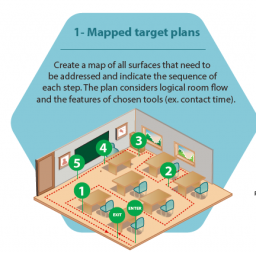
Mapped target plans: Cleaning professionals work safer and more effectively when entering an environment with a map of all surfaces that need to be addressed and a logical cleaning sequence to follow. That cleaning sequence works best when informed by factors like the room’s layout, staff capabilities, and features of the chosen cleaning tools (e.g., contact time).

Decontamination charts: These charts detail the products, equipment, and personal protective equipment that cleaning professionals need to succeed in their cleaning roles. Supplying a chart with this level of clarity helps teams establish more positive routines and habits, thereby boosting their confidence levels.

Feedback-based training: The more knowledge and awareness a cleaning professional has going into an environment, the better. Herein, there’s value in taking extra steps to ensure staff learns about the products they’re using, the reasons behind the protocols and processes they’re following, and the risks they may face while on the job. It’s also important to use training platforms that support common learning styles and leverage quantitative data to reach better outcomes.

Tech assists: Consider what technologies or systems can aid your team. This could include mobile cleaning apps, automated tools, task management software, data analytics tools, or anything that promotes collaboration and continual improvements.

Human-centric products: Cleaning professionals work best (and less stressed) when they know they’re doing the best job possible. That means hitting everything that needs to be cleaned and doing so with the right contact times. Here’s where using the right products and technologies can provide that peace of mind by assuring staff that all aspects of an environment are being cleaned and disinfected to the best of their ability.

AMG Medical’s Nocospray Disinfection System is an apt example of human-centric cleaning products. The device is an automated room disinfection system that can be activated within an environment and left alone to disinfect an entire space with zero human interaction.

“Staff still need to conduct that initial clean, but the Nocospray system allows them to activate a simple device, leave the room, and focus on other tasks with confidence that the environment is being disinfected thoroughly,” explains Balinsky. “The idea is to reduce the time individuals are being exposed to potentially contaminated environments while saving costs and ensuring a complete disinfection.”

“You don’t have to wonder if it worked,” she adds. “ It’s designed to do its job and set cleaning professionals up for success.”

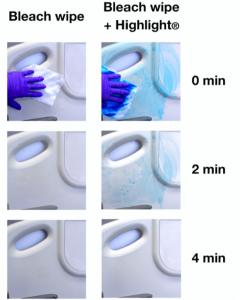
This philosophy is also behind why AMG Medical worked with Kinnos to bring the Highlight® for Bleach Wipes to Canada. The wipe colouring system applies a specially developed ink to the wipe so as the wipe is used it shows staff that they have completely covered a surface. The device fits on top of tubs of wipes and holds a proprietary ink cartridge that applies the ink to wipes as they are dispensed.

“Then, when you wipe with that wipe, you will see the blue colour where you touched before it fades away within a few minutes,” explains Balinsky. “The idea is to show people if they’ve adequately covered an area in real-time, and it can also be used as a training tool to teach team members good wiping technique so they are more likely to achieve the right contact time and disinfection.”

‘By letting people clearly see where the surface is covered and where it is not in real-time, you help them get better results,” explains Balinsky. “Then, the colour fades in a few minutes. It makes for one less thing staff have to figure out.”

Tools like this also go beyond the on-the-job feedback, she adds, noting, “Training sets the stage for how people will do. When you train or retrain staff on how to use wipes, you can see what skills are there and what may need to be reviewed.”

Each to their own

Returning to “normal” may take longer than any of us hoped. And with Canadians set on returning to safe and hygienic environments and less likely to settle for “pre-pandemic” standards, cleaning professionals have a lot of responsibility on their hands. Here’s where embracing human-centric principles can ease tensions, empower professionals, and keep everyone safe.

AMG Medical is a Canadian-owned company focusing on the health of our valued customers. For more about AMG products and services, please feel free to visit www.amgmedical.com or call 1-800-361-2210.

Gift underwrites net zero technical assistance

The Urban Land Institute’s net zero mission has received a boost with a USD $1 million donation from Owen Thomas, the chief executive officer of U.S.-based Boston Properties Inc.. The gift will help underwrite technical assistance panels, which will work with select portfolios of buildings worldwide to develop decarbonizing strategies.

“Real estate is responsible for 40 per cent of global greenhouse gas emissions. We must take immediate action to mitigate emissions and stem the devastating impacts of climate change,” asserts Thomas, who is also a past global chair of the Urban Land Institute (ULI). “I have every confidence that ULI will effectively execute on the goals of the gift and help lead the global conversation about how we can decarbonize the built environment.”

As envisioned, panels drawn from ULI’s roster of expertise will be established in multiple global locations every year to develop net zero roadmaps for the host portfolios. Institutions and organizations that oversee large building portfolios — including local government, universities and business improvement districts — are invited to apply for the technical assistance. Strategies and experiences from the efforts will also be compiled into how-to guides for building owners/managers in general.

“Owen made tackling climate change a focus of his tenure as our global chair, and we look forward to continuing that work in the years to come, thanks to his generosity,” says Ed Walter, ULI’s global chief executive officer.

Justin Trudeau promises “real and important change”

Liberal Leader Justin Trudeau has been elected for a third term in an outcome that closely resembles that of the 2019 federal election. With a vow to deliver “real and important change” to Canadians, major themes on this year’s campaign trail included pandemic measures, Indigenous issues, climate change, and to a large degree, housing affordability.

Throughout recent weeks, the hot-button topic of housing has received plenty of air-time as major party leaders actively promoted the measures they would implement to address concerns, like chronic rental undersupply.  The Liberals’ platform includes:

  • a 2-year ban on foreign home buying;
  • the construction and repair of 1.4 million home units over the next four years, including conversions of underused commercial space into affordable rentals;
  • investment into Indigenous housing and senior facilities;
  • renovation tax credits to add affordable residential rental space to existing units;
  • introducing a Home Buyer’s Bill of Rights that will regulate “house-flipping” and impose surtaxes to discourage “renovictions”, among other key measures.

According to a recent report from JLL, these proposed measures are nothing new: “They reaffirm Budget 2021’s $1.3 billion funding allocations to increase the stock of affordable units through the National Housing Co-Investment Fund and the Rental Construction Financing Initiative.”

It is also likely that several key federal support programs, including the Canada Emergency Wage Subsidy (CEWS) and the Canada Emergency Rent Subsidy (CERS) may be extended beyond the October 23 expiry date to facilitate broader recovery gains.

Rates of other hospital-acquired infections increasing

While healthcare facilities have been focusing on preventing the spread of COVID-19, it’s likely that the rates of other healthcare-associated infections have risen.

That’s according to a study published in Infection Control & Hospital Epidemiology based on the work of researchers from the U.S. Centers for Disease Control and Prevention (CDC) looking at the rates of infections including central-line-associated bloodstream infections (CLABSIs), catheter-associated urinary tract infections (CAUTIs), ventilator-associated events (VAEs), select surgical site infections, Clostridioides difficile (C. diff), and methicillin-resistant Staphylococcus aureus (MRSA).

The researchers found significant increases in the U.S. national standardized infection ratios (SIRs) for MRSA, CLABSI, CAUTI, and VAE in 2020 compared with 2019.

The report on the study cited several factors as likely contributors, including a “laser focus” on COVID-19. It noted that while infection control staff were working constantly to ensure their healthcare colleagues, patients, and visitors were protected from SARS-CoV-2, these infection control practices “did not always lend themselves to better infection prevention”. Examples include the reuse of PPE and the use of double gowning or loving.

Because of limited capacity and staffing shortages, some hospitals suspended their infection prevention activities altogether or redirected them entirely toward the prevention of SARS-CoV-2 transmission. This ultimately resulted in spikes in multidrug-resistant organism activity as much of the effort typically given to traditional hospital infection prevention and control activities received less intense scrutiny than before the pandemic.

The report added as a qualifying factor that healthcare has been impacted hard by the pandemic, as hospitals across North America and the world have dramatically altered their business and operational practices and stretched to breaking point.

“As a discipline, we need to develop strategies that can be effective in maintaining the highest possible quality of infection prevention and control activities while still supporting a pandemic response,” included the report. “Basic infection control practices must be hard-wired into practice so that they are less vulnerable when the healthcare system is stressed. Healthcare epidemiology teams need to be actively involved in pandemic preparedness planning. One approach might be to designate clinical staff to be added to the hospital epidemiology team to allow for rapid expansion of effort to support a pandemic response.”

BOMA BEST criteria introduce multifamily tweaks

BOMA BEST criteria for multifamily buildings will be updated beginning in January 2022. Landlords and condominium corporations participating in the environmental performance benchmarking and certification program will have to comply with an expanded list of best practices, which are consistent with existing prerequisites for office buildings and enclosed shopping centres. Additionally, attainable point tallies have been adjusted and new point-gaining measures have been added to reflect pandemic-related operational considerations and building performance advancements.

Among the new best practice expectations, building management must prepare and adopt an overarching environmental policy to guide their efforts. To secure BOMA BEST certification, buildings must have a stated energy reduction target and a plan to reduce water consumption. Waste audits must be conducted on a three-year cycle, which will inform the compulsory waste management plan and the edict for separate bins for landfill waste and divertible materials. Buildings must also have indoor air quality (IAQ) monitoring plans and green cleaning programs.

In response to COVID-19-related experiences, the BOMA BEST points systems will place more emphasis on ventilation systems, controls and monitoring. There are also new point allocations for air sanitation, air quality monitoring, MERV 13 filters and relative humidity considerations. As well, owners/managers are encouraged to analyze the difference in energy and water consumption for the 12-month period prior to the pandemic’s onset in March 2020 versus the pandemic period.

BOMA BEST administrators foresee slight downward pressure on scores once the new questionnaire goes into effect on January 18, 2022.

“Buildings currently earning BOMA BEST Silver may see a reduction of 2 to 3 per cent in the total score. Gold and Platinum level certifications may see a reduction of 1 per cent,” they project. “While this may impact scores, few will experience a change in certification level.”

Building well-rounded vaccination policies

Mandatory vaccination policies are currently top-of-mind among Canadian business owners, including those within the multi-residential housing sector. For landlords, it is highly recommended that the following two seperate policies are implemented to best protect residents and operations: 1) policies for employees, and 2) policies relating to the use of non-essential indoor amenities.

Part of a well-rounded risk management strategy, these distinct vaccination policies will enable landlords to better protect occupants and employees from the spread of COVID-19, while also lowering their liability risk.

Workplace policies

Many businesses, organizations, universities and colleges across Ontario have made similar announcements, or have released their policies requiring all employees, contractors and visitors to be vaccinated. Universities and colleges have also implemented policies requiring proof of vaccination for students living in on-campus housing. Any vaccination policy applying to employees must comply with the Occupational Health and Safety Act, the Ontario Human Rights Code and privacy laws.

In strongly recommending that all employers have a vaccination policy, Toronto Public Health identified minimum requirements that should be part of any vaccination policy:

  • Workers to provide proof of vaccination series approved by Health Canada or the World Health Organization
  • Unvaccinated employees to provide written proof of a medical reason from a physician or nurse practitioner that includes whether the reason is permanent or temporary
  • Unvaccinated workers to complete a vaccination education course on the risks of being unvaccinated in the workplace

In addition to the above minimum requirements, it will be necessary for employers to consider what precautions or protections will be required for those who are unvaccinated in the workplace (PPE, submitting to regular COVID-19 testing, etc.).

These recent announcements and legislative directives have elevated the standard of care when it comes to employers’ obligations under health and safety legislation and are also important measures to facilitate the prompt and necessary vaccination against COVID-19 for all eligible Ontarians.

Indoor amenities

The provincial government has advised that, as of September 22, 2021, Ontarians will need to be fully vaccinated (i.e., two doses plus 14 days post-second vaccine) and will need to provide their proof of vaccination along with photo ID in order to access certain public settings and facilities.

Though the text of the proposed regulation has not yet been published, the government has confirmed to industry associations that apartment buildings and condominiums will not be considered public settings or facilities for the purposes of the government’s vaccination requirement.

Having said that, apartment buildings and condominium corporations may still want to implement their own vaccination rules and policies with respect to the safe use of their non-essential amenities. Multi-residential landlords and condominium boards will need to consider a number of factors in deciding whether to implement rules, and the form of those rules, including:

  • liability for failing to take steps;
  • financial considerations;
  • how the rule will be implemented (e.g. self-reporting, controlled access system, etc.);
  • and, the physical aspects of their particular buildings.

It is strongly recommended that any vaccination policy for indoor spaces clearly distinguish between “essential” indoor spaces (e.g. garbage rooms, mailroom, laundry facilities) and “non-essential” indoor spaces (e.g. pool, gym, lounge area). Landlords should also consider how they will accommodate individuals who cannot get vaccinated on the basis of a prohibited ground of discrimination (e.g., a disability or a religious objection to vaccination).

Privacy considerations

Finally, it is important to remember that any vaccination policy must comply with applicable privacy laws. Privacy considerations should be explicitly included in each policy by providing information about how someone’s vaccination status will be collected, used, and how long the information will be retained. Generally, organizations should consider ways to limit the information that they collect and how long that information is retained.

Landlords and condominium boards should consult with their legal counsel in deciding whether to implement a policy or rule with respect to their workplaces and amenity areas; to discuss what the contents of any rules or policies will be; and how the rules or policies will be implemented.

Kristin Ley and Laura Gurr are partners with Cohen Highley LLP in London. Cohen Highley LLP represents landlords, property managers, non-profit housing providers, co-op housing providers, and condominium corporations. 


B.C. providing $10M for 60 new playgrounds

B.C. has announced $10 million for 60 new playgrounds in school districts around the province.

The province is doubling its annual investment in the Playground Equipment Program (PEP) to help schools design playgrounds that better support accessibility for all students.

“We cannot underestimate the vital link between play and learning. Students are more focused in class when outdoor play is part of their school routine, and they learn important life skills like co-operation and patience while improving their major motor skills,” said Minister of Education Jennifer Whiteside. “Doubling our playground fund investment helps support students, staff, families and communities, and takes the fundraising burden off parents so they can spend more time playing with their children.”

The funding for each project has been increased by $40,000 to a total of $165,000 to better support accessible components – like ground cover, ramps and/or transfer platforms that connect to the play structure – to ensure a place for all students to play.

“Parents are truly appreciative of the Playground Equipment Program, which relieves some of the burden placed upon parent advisory council parents who would have had little choice but to spend copious hours fundraising. All playgrounds must have accessible and inclusive equipment for children to enjoy. For many schools in our province, this means having to upgrade or even replace aging playground structures. Parents strongly believe that accessible programs or structures should never be dependent on the individual school’s ability to fundraise,” said Andrea Sinclair, president, BC Confederation of Parent Advisory Councils.

Playgrounds are funded based on greatest need. Priority is given to schools where there is no playground at all, then to schools where the existing playground is aging. School districts that did not receive funding this year may reapply next year.

The new playgrounds are expected to be built within the next year.


Chandos joins in mandatory vaccine for employees

Chandos Construction will require all employees across the country to be fully vaccinated for COVID-19, following similar announcements by other major Canadian contractors.

“Over the past 18 months, Chandos, in partnership with trades and clients, has worked hard to implement the most effective preventative measures against COVID-19,” says Sean Penn, chief operating officer.

“Vaccines now represent the best tool we have to help reduce the spread of the virus. It’s our duty to protect the health of not only our team members but of all those we serve including customers and trade partners. We proudly stand alongside PCL Construction and EllisDon in establishing this early mandate for our industry.”

The company said vaccine requirement will be effective November 15, 2021. Exemptions may be granted, according to medical and human rights grounds. In addition, Chandos will continue to follow local, provincial, and national guidelines for safety at all its locations, including physical distancing and masking protocols.

“We’ve taken a leadership role from the beginning of the pandemic by mandating masks at all of our locations – even before governments made that decision,” says Tim Coldwell, president, Chandos. “This is a necessary next step.”

Coldwell urged the entire industry to follow suit and do the right thing. “Make vaccines mandatory. For everyone’s safety.”