Articles Archive - Page 325 of 928 - REMINET
REMI

Forum Equity Partners launches “REIIF” fund

Forum Equity Partners announced it has launched REIIF, a private, open-ended fund for investment opportunities within the Canadian residential rental real estate.

Focused primarily on multifamily apartments, purpose-built student accommodations (PBSA), and co-living communities in supply-constrained markets, initial funding was completed with a $125 million capital raise and will be used to acquire a $240 million seed portfolio of residential rental real estate across Canada.

“REIIF capitalizes on the growing demand for residential rental real estate, helping to address housing affordability that has been made challenging by population growth and increasing housing prices across Canada,” said Aly Damji, Partner, Real Estate. “With a focus on high-growth sectors of multifamily apartments, PBSA, and co-living communities in supply-constrained Canadian markets, REIIF is supplying sustainable, desirable, and convenient accommodations to a wide variety of tenants.”

The fund will also strive to deliver a sector-leading impact and ESG-driven portfolio that will enhance yields, asset values and future-proof the portfolio.

“The seed portfolio, with properties located in Toronto, Ottawa, Montreal, and Vancouver, offers attractive cash flow and growth prospects with a lower risk profile than other assets given how the portfolio has been designed and constructed,” said Rajeev Viswanathan, CFO and Partner. “In addition, REIIF benefits from a spread between an attractive property yield and low cost of debt capital achieved through CMHC insured property mortgages.”

Why an impact fund?

Given the current market volatility, low-interest rates and undersupply of affordable housing, REIIF was launched to address these challenges and help with the creation of much-needed rental housing. In 2022 alone, current estimates predict that 411,000 permanent residents will be admitted into Canada.

Also, believing that socially conscious property owners and strong financial performance are intertwined, ESG targets have been incorporated into REIIF’s strategy. According to the release,  “Investing in REIIF means having a meaningful positive impact in the communities we serve while owning high-quality real estate that addresses the housing challenges people face in Canada.”


Nothing average in premium office rent data

There are no averages to be found in JLL’s premium office rent tracker report, which ranks global markets on the basis of the highest achievable rent for space in the premier building within the city’s or sub-market’s most prestigious office district. The resulting picture may reveal more about the nature of premium tenancies than their host markets, but JLL analysts conclude pinnacle prices are generally in line with trends in Class AAA and Class A markets.

“Rents for premium buildings have fallen slightly in major office markets since 2020 by an average of 0.8 per cent in local currency terms. This compares to a decline of 0.7 per cent in net effective rents for the broader grade A office market,” the report notes. “Rental movements are also aligned within global regions, with the Americas showing growth in rents for both the premium office segment and the broader grade A market, while both Asia Pacific and EMEA (Europe, Middle East and Africa) have seen decreases in rents.”

The three Canadian entries in the 2021 list of 127 priciest spaces fall well down from the leaders — Central Hong Kong and Midtown New York, which are tied with a premium rent of USD $261 per square foot (psf). However, the summits of the Toronto, Montreal and Vancouver markets are steeper than in dozens of surveyed cities scattered throughout North and South America, Europe, Africa and Asia Pacific.

Toronto and Montreal deemed “mid-level”, Vancouver called a “value” market

Toronto and Montreal are ranked among 37 markets defined as “mid-level” on JLL’s scale, with premium rents in the range of USD $99 to $61 psf. Vancouver is lumped with the larger and much more wide-ranging group of 66 “value” markets with premiums rents of USD $60 or lower psf. An elite group of 24 markets commanding rents of USD $100 or greater psf are categorized as “high-end” premium spaces.

Toronto is highest ranked of the Canadian markets with a premium rent of USD $77 (CAD $98.50) psf, in lock step with the premium rent in Washington, DC. Montreal is next at USD $66 (CAD $84.50) psf. That’s sandwiched between Chicago at USD $67 and Hong Kong’s Kowloon East district and Edinburgh, both at USD $65. Vancouver’s priciest rent, at USD $55 (CAD $70.40) psf, sits under the bunched pack of Leeds, Glasgow and Dallas, all at USD $56, and just above Auckland, at USD $54 psf.

Within the top five markets, premium rents drop sharply from the twin frontrunners to Beijing’s Finance Street at USD $196, London’s West End and USD $191and Silicon Valley at USD $174 psf. Beijing’s central business district, Tokyo’s Marunouchi district, New York’s midtown south, Shanghai’s Pudong district and Beijing’s Zhongguancun district round out the top ten.

The United States is home to seven high-end markets, followed closely by China with six. Japan has four; Hong Kong, the United Kingdom and India each have two; and Singapore is a stand-alone member of the high-end group. Paris tops the mid-level rankings with a premium rent of USD $97 psf; San Diego is the last entry at USD $61 psf.

Of the 26 U.S. markets surveyed, 10 boast premiums that surpass Toronto’s, while 11 cities are rank below Vancouver. Premiums in Washington DC, Chicago, San Diego, Los Angeles’ central business district and Dallas are most comparable to those in the three Canadian markets. Austin may be most surprising market to outdistance Toronto — priciest space in the Texas capital goes for USD $89 psf, on par with Berlin and a notch above Geneva.

Detroit at USD $28, Minneapolis at USD $34 and Charlotte at USD $37 psf offer the best bargains on U.S. premium office space. Looking east, premiums for the thrifty in Europe can be found in: Bratislava (USD $19); Bucharest (USD $23) and Prague (USD $28).

Sustainability certification and flex space draw top-flight tenants

The offices commanding the highest rents typically boast sustainability certification; house financial, technology, legal or professional services occupancies; and are more likely to offer flex space than is the market norm. JLL analysts note that flex space, such as co-working areas or serviced offices, can be particularly attractive for tenants currently dealing with pandemic-related uncertainties about their future space needs, but the demand is expected to outlast the pandemic.

“Flexible space adoption is set to accelerate substantially as demand shifts from fixed long-term commitments to more agile and hybrid options,” the report projects. “Moving forward, flexible workspace is likely to grow from a low proportion of the overall market to a critical and mainstream element of commercial real estate.”

High-end premium office buildings appear somewhat ahead of the curve, with 63 per cent providing some form of flex space versus 38 per cent at mid-level and 39 per cent in the value range. That may also be reflective of the higher quotient of technology-based tenants in high-end premium spaces.

Overall, technology firms — both online platforms and hardware/software specialists — occupy 15 per cent of the premium office space, but they account for 21 per cent of occupancy in high-end premises. Notably, online platforms are much more conspicuous, filling 17 per cent of high-end premium offices versus 8 per cent of total premium space surveyed.

In contrast, mid-level premium space accommodates a smaller fraction of technology tenants, at just 3 per cent, and a disproportionately larger share of banking and financial service tenants, at 68 per cent. Legal services are more evident in the value premium space, representing 15 per cent of tenancies versus just 4 per cent of high-end and 3 per cent of mid-level premium space.

Interestingly, 100 per cent of high-end premium offices are located in buildings with sustainability certification such as LEED or BRREAM. However, the percentage of offices in buildings with wellness certification, such as WELL or Fitwel, is higher at mid-level — at 16 per cent versus just 8 per cent of high-end premises. Across the entire list of markets, 84 per cent of premium office spaces can be found in buildings with sustainability certification compared to 13 per cent with wellness certification, but JLL analysts suggest momentum is growing for the latter programs.

“Owners and occupiers are placing greater emphasis on healthy building credentials, which should lead to more certifications in the coming years,” the report posits.


BCCA honours Builders Code Champions

The BC Construction Association (BCCA) is recognizing four employers with five Builders Code Champion Awards this year for leading the way in advancing the workforce culture of B.C.’s industrial, commercial, and institutional construction sector

The Builders Code Champion Awards were launched in 2019 by the BCCA to recognize employers that are taking positive, proactive measures to successfully eliminate discrimination, hazing, bullying and harassment on worksites. The Builders Code baseline code of conduct standard assists employers by promoting the importance of psychological as well as physical safety for all workers, making sites safer and more productive

This year, 19 nominations were reviewed by Minerva BC, the BC Construction Association (BCCA), and the Builders Code Employer Advisors. While a celebration event will not be held due to the COVID-19 pandemic, videos showcasing the award winners’ approach to culture change, and the role Builders Code plays in that change, will be available in the new year. The winner videos from last year are available on the Builders Code website.

The 2021 Builders Code Champion Award categories and winners are:

  • Community Champion (Large Employer Category): RAM Engineering
  • Community Champion (Small and Medium Employer Category): Lacey Construction
  • Contractor of the Year: Westcana Electric
  • Loyalty Champion: Houle Electric
  • Workplace Culture Champion: Westcana Electric

Of this year’s winners, only Lacey Construction is a first-time honoree. Westcana Electric from Prince George is receiving its fifth Builders Code Award and has become an inspiration for others in the construction industry as an example of positive growth through workforce diversification.  RAM is receiving its third, and Houle its second award.

“On behalf of everyone at BCCA, Minerva BC and all our Builders Code partners, sincere congratulations to all the winners and nominees for their leadership in shaping a new workplace culture for construction,” said Chris Atchison, president, BCCA. “Across BC, hundreds of employers have adopted the Builders Code and are using its valuable resources to achieve great things. As a result, they’re also gaining an important operational advantage with tradespeople increasingly seeking out Builders Code employers that are demonstrating their commitment to safe and inclusive workplaces.”

Breathing new life into a historic landmark

Vancouver’s monumental St Andrew’s-Wesley United Church, just a decade shy of its forthcoming centennial, is reinvigorated with new life by international design practice Ryder Architecture, in collaboration with prime consultant, RJC Engineers. The renewal of this significant civic and architectural landmark celebrates the church’s historic features while promising longevity for the structure through key improvements to envelope performance, seismic resiliency, occupant safety, and accessibility.

Originally built in 1927, St Andrew’s-Wesley United Church boasts a Gothic revival style using sturdy locally sourced materials such as Nelson Island granite and Haddington Island stone by brothers and architects Twizell & Twizell.

While built with rigour, the historic stone-clad concrete structure has suffered years of natural deterioration and has resulted in leaking roofs, requiring intermittent repairs. The decline of the once elegant, plastered church interior initiated a broader investigation of opportunities for preservation.

RJC’s long-standing relationship with St Andrew’s-Wesley allowed the project team to envision a holistic approach for a successful restoration. Ryder leveraged its building information modeling (BIM) expertise to facilitate an integrative design and construction process.

Adam James, principal at Ryder Architecture, describes the process as “using a 21st-century skill set to analyze and facilitate remediation and upgrades that retain the building’s heritage value for the next 100 years.”

Analog drawings and 3D digital scans created a detailed model of the most up-to-date existing conditions. The ability to visualize the model as layers of structure and better understand site conditions through digital excavation informed significant design decisions.

“The entire team understood the importance of maintaining the building’s historic character while providing a revitalized structure that meets the Church’s vision for a modern-day gathering place,” explains Michael MacLean, project lead and associate at RJC.

The project’s comprehensive scope involved seismic retrofitting and substantial architectural, heritage, structural, building enclosure as well as electrical, mechanical, code, and acoustical upgrades. “It was an exciting opportunity to combine RJC’s in-house services and work with a solid consulting team with design expertise in heritage buildings. The team was deeply committed to working together, recognizing that this collaboration played a critical role in making the revitalization project successful, enjoyable, and something we, and the Church, will look back at with pride for years to come,” says MacLean.

Ryder and RJC considered the church’s history at the heart of the restoration process, respecting its character and charm while offering the most current amenities of a revitalized modern-day building. The locally quarried granite and stone façades were repaired and fortified on the exterior while a new copper roof was installed to resolve recurring leaks.

Copper was selected for its durability, visual appeal, and historical compatibility. Structural work on the interior involved removing plaster from the walls and vaults; a meticulous casting process allowed the seamless replacement of surfaces and ornamental details. Other implementations include accessibility and mobility aids such as ramps and upgrades to audio and visual systems.

St Andrew’s-Wesley United Church officially reopened its doors after two years of renovation on November 14th. Executive director of operations at St. Andrew’s-Wesley, Diane Mitchell, credits the team led by Ryder and RJC with “navigating the complexity of the project and delivering a beautiful result that the church can be immensely proud of.”

As the first large-scale renewal in its history, the building showcases a seamless integration of old and new, inspiring a new architectural narrative as it continues to invite local congregants and international visitors to come together, worship, and experience the beauty of its exquisite sanctuary.

Archilume creates stunning lighting installation

Canadian-based lighting studio Archilume were brought in by Studios Architecture to create a stunning lighting installation for the Watt Plaza in California. The result is a striking constellation of 350 individually mounted P1M LED luminaires.

Archilume called the P1M its marquee pendant that will set the stage for what is now the brand’s design ethos: “Innovating by combining science with beauty.”

The studio was founded in 2013 as a creator of glare-free decorative luminaires. It was one of the first companies to use energy-efficient LED chip-on-board technology in a luminaire and, with the P1M, helped lead the way with the application of total internal reflection optics in decorative LED lighting.

Lighting design specialists Banks Landl Lighting Design (previously Hiram Banks Lighting Design) were brought on board the project. BLLD designed a template system for the overall 15’x19’ lighting cove area in the ceiling with which the contractor could simply layout the individual mounting points and required wiring. BLLD’s lighting design template was projected from the floor, using a laser to mark each of the installation positions. Each fixture was then mounted at a different cable length.

This was a critical component to the overall design success of the installation as the pattern needed to be exact and simple enough for the installation to be efficient, but random enough for the overall mass to look unified.

“We’re thrilled to have worked with BLLD and Studios Architecture. Not only did this design project truly tap into our core design philosophy, but the Watt Plaza Lobby lighting installation also showcases the breadth of our product capabilities. We expect designers to explore and create limitless site-specific lighting installations for their projects. It’s like LEGO for light!” said Saleem Khattak, Archilume.

Since Watt Plaza was the first LEED Platinum-certified office high-rise building in Century City, California, it was integral to the project to incorporate integrated features to maintain this status. Using Archilume’s P1M low wattage, low output fixtures in a large, focalized quantity, allowed for the surrounding connective spaces to have reduced power consumption, effectively allowing the design to be compliant under the stringent CA Title 24 code, and contributing to the overall LEED goal.

Swish Group selling its US division to Envoy Solutions

The Swish Group of Companies, a diversified manufacturing, distribution, and technology company, has agreed to sell its USA distribution division – Swish White River Ltd. – to Envoy Solutions, a well-positioned distribution company in Glenview, Ill.

The group said in a release it is grateful to its Swish White River Ltd. associates who, over the last 20 years, have been instrumental in establishing the company as the leading distributor of jansan, paper, and packaging products in the Northeastern U.S.

“With this change, the Swish Group of Companies’ focus is to continue accelerating as industry leaders,” said Anthony Ambler, Chair. “We believe there are great opportunities in the market that fit our existing and future business, and we are looking forward to growing.”

Swish Maintenance Limited (Canadian Division), Charlotte Products Ltd. (North American manufacturing), and OptiSolve (precision cleaning technology) are not part of the transaction.

The Canadian division will continue to expand its distribution across Canada through organic growth and strategic acquisitions.

As part of the transaction, Charlotte Products Ltd. will continue to manufacture and supply its best-in-class cleaning chemistry brands Swish, Enviro-Solutions, and ServClean for Envoy/Swish White River.

“Charlotte has best-in-class R&D, manufacturing, and a great portfolio of brands,” said Matt Strano, CEO of Charlotte Products Limited. “We’re really excited to expand our relationship with Envoy Solutions.”

OptiSolve will promote “precision cleaning” through its quality management software and proprietary surface imaging and reporting technology allowing management to track cleaning trends in their facilities by areas, surfaces, and employees.

RISE Properties closes 2021 with 7th acquisition

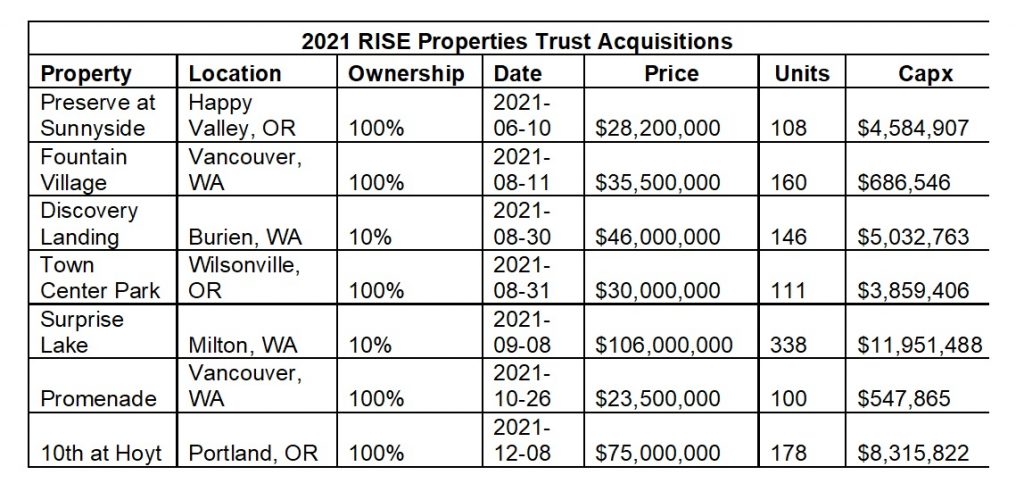
Canadian investment company RISE Properties Trust announced it has finished off a busy year with the purchase of its seventh rental property located in the Pacific Northwest.

RISE has been investing in multifamily communities for close to a decade. After launching, the Victoria-based company began purchasing rental buildings in and around Seattle, Washington, before expanding into other U.S. markets. It now owns approximately 5,900 units across 34 multifamily properties in the Pacific Northwest with a total real estate valuation of $2.3 billion.

“We have seen property values continue to surge along with consistent population growth throughout Washington and Oregon states over the past decade,” said Barrett Sigmund, RISE Properties Trust Principal and President. “The multifamily communities that RISE has acquired are positioned in areas with strong employment opportunities and continue to be desirable locations for renters. We’ve been searching for an urban asset to diversify our Portland portfolio and couldn’t be more pleased with 10th @ Hoyt. This property is significant for several reasons.  It represents the largest wholly-owned community for RISE.  It also is the first wholly-owned urban community for RISE and brings our equity in urban deals to roughly eight per cent.”

In addition to acquiring properties, RISE invests in renovations to “create exceptional living spaces and communities” for its residents.  After purchase, each newly acquired building receives upgrades to existing suites and common areas.

“As a vertically integrated and highly focused multifamily platform, we are excited to continue identifying opportunities throughout the Pacific Northwest that create value for our investors, limited partners and the communities we invest in,” said Sigmund. “Our expansion into the Oregon market coincides with strong corporate organizations seeing the value in these locations and in turn we see opportunities for growth.”

RISE has been recognized as a best-in-class owner and operator of multifamily holdings in the Pacific Northwest region, and continues to work with select institutional equity partners as sponsors of joint-venture opportunities.

For more information, visit: https://risepropertiestrust.com/portfolio/.

Green scorecard planned for seniors’ facilities

Long-term care homes and retirement residences in Ontario are getting an environmental performance benchmarking tool specially tailored for seniors’ facilities. Work is now underway on adapting the Canadian Coalition for Green Health Care’s established green scorecard for hospitals, which provides health care facilities Canada-wide with a means to assess their own environmental performance and compare themselves to their peers.

Participating facilities managers in the long-term care and retirement home sector will have access to a standardized platform for reporting operational data such as electricity and natural gas consumption, solid waste generation and greenhouse gas (GHG) emissions. That will come with a real-time reporting dashboard to present a timely and comprehensive picture of where opportunities for energy savings or waste and emissions reductions can be found.

“It will also provide operators with access to an evaluation tool to measure their internal environmental performance, and allow them to see where they stand relative to peer organizations,” explains Neil Ritchie, executive director of the Green Health Care Coalition.

Funding to develop the new green scorecard comes from Ontario’s Independent Electricity System Operator (IESO) through its Save on Energy programs, and from Environmental Careers Organization Canada. Operators of seniors’ facilities should be able to begin inputting data for the new scorecard by early 2023.

Its role model, the Green Hospital Scorecard, is now in its ninth year, with crunching of 2020 data now underway. More than 30 health care campuses, predominantly in Ontario, contributed to the 2019 edition.

New report urges Ontario to end exclusionary zoning

The Toronto Region Board of Trade has released a report outlining how the provincial government can eliminate exclusionary zoning policies that prohibit even modest forms of density such as triplexes or small apartment buildings in most residential neighbourhoods. Entitled  ‘Meeting in the Middle: A plan to end exclusionary zoning and tackle Ontario’s housing crisis’ the report arrived just ahead of a scheduled housing  summit, which has since been postponed over concerns related to the omicron variant.

“Housing affordability is a critical issue in Ontario – our competitiveness in attracting talent, driving innovation, and realizing the potential of the climate economy depends on solving the housing shortfall,” the Board contends. “Allowing more types of homes in more places will help address the region’s affordability crisis and enable a host of other economic, environmental and social benefits.”

The proposed framework outlines an approach that eliminates exclusionary zoning, supported by additional policies such as bringing development charges for a four-unit building in line with a single detached house.

“High housing prices are already costing our economy up to $8 billion per year – the time for action is now,” said Jan De Silva, President & CEO of the Toronto Region Board of Trade. “Ending exclusionary zoning will increase our housing supply and ensure working families can afford to live here. This helps companies recruit and retain talent which, in turn, will draw innovative companies to invest in Toronto.”

“The elimination of exclusionary zoning policies has a host of benefits beyond housing affordability,” said Craig Ruttan, Policy Director, Housing. “This framework would provide opportunities to help address systemic racism, maximize existing infrastructure and deliver environmental benefits—it’s a winner across the board.”

The new framework follows the Board’s ‘Priced Out’ report, which raised concerns that the 114,000 manufacturing jobs forecast to be added in the Toronto region by 2050 are at risk if workers continue to be priced out of the housing market. The work also addresses the challenges laid out in the Board’s “Housing a Generation of Workers” series, which identified that high housing prices are already costing our economy up to $8 billion per year.

To read the full framework, click here.

MacNeil appointed RAIC vice president of practice

Gregory MacNeil has been appointed RAIC vice president of practice. MacNeil will serve as a key member of the senior leadership team on operational decision-making and will be responsible for practice support and practice advocacy.

The portfolio includes management of practice queries, maintenance and creation of standard agreement documents, maintenance of existing publications (e.g.Fee Guide, CHoP), leadership and management of the Practice Support Committee, advisor to RAIC continuing education as well as advocacy and representation on pan-professional committees including but not limited to the Federal Real Property Advisory Committee, Construction Industry Consultative Committee, and more.

MacNeil is a licensed architect, a member of the Nova Scotia Association of Architects, a past president of the Nova Scotia Association of Architects and a qualified Maritime Lumber Bureau Licensed Grader. Before he joined RAIC, he was a firm director at Jerry MacNeil Architects Limited overseeing measured and image-based documentation and wood investigations. He has been involved with new design, adaptive reuse, forensic investigation, and conservation projects for institutional and corporate clients, with emphasis on churches and similar places for worship and nursing homes.

His education includes a Bachelor of Arts degree in International Relations from Acadia University, Bachelor of Environmental Design Studies and Master of Architecture degrees from the Technical University of Nova Scotia, postgraduate studies at Harvard University Graduate School of Design, the Norwegian University of Science and Technology (ICCROM 12th International Course on Wood Conservation Technology), the Catholic Theological Union in Chicago and on-site training courses conducted by English Heritage in Building Survey, Archaeological Survey, and Measured Survey for Cultural Heritage in the UK.

He has been published, carried out historic building conservation work in Canada, Germany, and the United States, and has presented papers in Canada, Norway, the United States, the United Kingdom and the Czech Republic.


Custodial training improves more than just sanitation

Work environments are still critical areas due to the pandemic. Housekeepers have a direct responsibility for the safety of the premises, and it must be recognized that their work is of utmost importance. It is therefore the responsibility of managers to ensure the professionalism and thoroughness of their frontline teams. Some managers mistakenly postpone custodial training because the priority is to focus on field operations.

But now is the time to upgrade knowledge to get everyone on the right track, ensure that the highest industry standards are met, and teach them how to properly use the new equipment and chemicals that have been added to protocols.

The return on investment of a training session is very advantageous because the long-term benefits are felt on many levels, and many people are benefiting. Not only is the overall quality of the cleaning service directly improved, but the level of satisfaction of the users or tenants of the premises is higher.

As more and more people likely return to offices in 2022, it will be important to meet the expectations and requirements of the building’s occupants in order to reduce their concerns and reassure them.

Providing well-targeted training to employees also helps demonstrate the importance that employers attribute to their role and is a good way to show appreciation for their work. An employee who perceives this recognition is much more committed, more motivated and participates actively and positively in the accomplishment of tasks and in the improvement of practices in general.

The importance of offering a specific training plan for housekeeping employees has always been prioritized at ValkarTech. In addition to training sessions on basic janitorial techniques, many other relevant topics have been developed by our experts and are delivered by our experienced trainers, all of which can be customized for custodial teams or building managers.

How to conduct internal audits? How to establish effective work routes? How to develop and update an emergency response plan? You can even offer training on ergonomic principles to properly adapt posture and movements when learning to handle new equipment and to minimize the risk of injury.

At ValkarTech, all training sessions are designed according to the latest industry trends and meet the standards set by internationally recognized authorities. All training is approved by our Training Director, who recently obtained the Healthy Hospital Environmental Services certification issued by the IEHA, attesting to her expertise in the integrated management of cleaning in healthcare facilities, but more importantly, demonstrating her determination to support and equip our clients to the best of her ability so that they can face and remedy a pandemic, or any other epidemiological situation, and ensure clean and safe premises.

Nathalie Thibault is the Training Director of ValkarTech, a Canadian consulting firm that guides, supports, and advises its clients on ways to optimize the operational performance of their organizations in terms of building hygiene and sanitation. For more information, please email [email protected], visit https://en.valkartech.com/ or call 514 316 6723.

Plans unveiled for new BC Soccer complex in PoCo

BC Soccer has unveiled plans for a new world-class soccer facility that will also serve as the association’s head office in Gates Park, Port Coquitlam.

The project will include a new state-of-the-art synthetic turf field built to FIFA international competition standards, a covered grandstand and floodlights, along with dressing rooms and storage. The two storey, 12,500 square foot pitch-side building would be BC Soccer’s new head office featuring appropriate space for storage, meetings, classrooms for courses and clinics, along with the Soccer Hall of Fame of British Columbia in the main foyer.  There would also be a viewing gallery for the main field.

“We’re very excited to be able to announce this potential opportunity to the community. It would bring so many benefits to Port Coquitlam including access to a state-of-the-art sports field and amenities for kids and families, increased opportunities for our residents to stay active and healthy, and a new dynamic public space. The project would also support the revitalization of our downtown and deliver economic spinoffs for local businesses,” said Mayor Brad West.

“Being the new home for BC Soccer would help raise our community profile, further demonstrate Port Coquitlam’s leadership in amateur sport, and give kids and families in our community affordable access to soccer, field lacrosse and other sports.”

The development involves approximately 10 hectares of land, including a new warmup area, public plaza, washrooms and other amenities, along with improved access and parking. The new complex is surrounded by an athletic park hosting multiple grass and synthetic turf fields, ball diamonds, and tennis courts.

“We’re thrilled about the prospect of working with Port Coquitlam to relocate our head office to a dedicated soccer specific home for the association at Gates Park,” said Jason Elligott, executive director for BC Soccer. “Aside from the many benefits for the community, we see this as a big step forward for not only the association but the soccer community in B.C.”

Air filtration improvements in line for rebate

A proposed new federal tax credit would provide a rebate on air filtration improvements for qualifying small businesses making investments between September 1, 2021 and December 31, 2022. Finance Minister Chrystia Freeland has announced plans for the 25 per cent rebate, to a maximum of $10,000 per upgrade or installation, as part of the government’s Economic and Fiscal Update.

As outlined, the refundable tax credit would apply on stand-alone equipment that employs high-efficiency particulate air (HEPA) filters to improve air quality or for specified HVAC investments. In the latter case, newly installed HVAC systems must either outperform a MERV 8 rating for air filtration or deliver MERV 8 equivalency in combination with the outdoor air supply exceeding the minimum building code requirements. The tax credit would also be available for retrofits of existing HVAC systems to bring them up to MERV 8 air filtration capability.

Unincorporated sole proprietors and Canadian controlled private corporations with less than $15 million of taxable capital in the previous tax year would be eligible, and could potentially obtain rebates on expenditures in multiple commercial locations to a maximum total of $50,000. The Economic and Fiscal Update proposes a total budget of $241 million for the tax credit, with the bulk of that funding to be expended in the 2022-23 budget year.

“As Omicron has reminded us, COVID-19 threatens us still,” Freeland observes. “As 2021 draws to a close, finishing the fight against COVID-19 remains our most important national project.”

Toward that end, healthy building champions commend the government’s focus on indoor air quality, but acknowledge that ventilation enhancements can represent a significant financial commitment. Bala Gnanam, vice president, sustainability, advocacy and stakeholder relations, with the Building Owners and Managers Association (BOMA) of Canada, notes that Canadian small businesses are now carrying an average debt of more than $170,000.

“Paying 75 per cent of the cost of implementing measures to improve air quality could be a further burden on business owners who have already been hit hard by the pandemic,” he says. “Another approach would have been to offer them the same amount of tax credit without a 25 per cent threshold, but with requirements for proof that appropriate equipment has been purchased and installed by a licensed service provider.”

The Economic and Fiscal Update also promises some top-ups to existing funds for improving ventilation in schools and community buildings. That includes an additional $100 million to be allocated to the provinces and territories through the Safe Return to Class fund, plus $10 million to First Nations for on-reserve schools. Beginning in budget year 2022-23, $70 million over three years will be allocated for ventilation improvements in public buildings such as health care facilities, libraries and community centres, with the major share of spending slated for 2023-24.

Real estate lending set to ramp up in 2022

Real estate lending holds promise for 2022, particularly for borrowers with multifamily and/or grocery-anchored retail acquisitions in mind. More than two-thirds of Canadian lenders participating in CBRE’s recent annual survey indicated plans to increase allocations to real estate, equating to an estimated 10 to 20 per cent boost in availability of capital compared to 2021.

“The survey results represent a significant shift in lender sentiment from caution to opportunity and real estate lenders are ready to support businesses and investors looking to finance real estate transactions,” maintains Carmin Di Fiore, executive vice president with CBRE’s debt and structured finance team.

The survey was conducted in October and early November of 2021 and draws findings from 30 finance companies that collectively have more than $200 billion in loans under management. It generally shows improved lender confidence in 14 of 17 identified asset sub-classes, while regional malls in secondary markets and Class B office buildings, both downtown and in the suburbs, now inspire more consternation than they did in the fall of 2020.

Those three categories currently carry the most pessimistic outlook in lenders’ views. Hotels aren’t exactly inspiring zeal, with more than 65 per cent of respondents indicating concerns, but they have improved standing from 2020 and a small percentage of lenders reports plans to increase budget allocations to the asset class in 2022.

Meanwhile, experiential retail, which was also ranked in the bottom three asset classes last year, has made the most notable gains in lenders’ estimation. Slightly more than 30 per cent of respondents labelled it a cause for concern this fall versus nearly 70 per cent in the fourth quarter of 2020. Regional malls in central business districts, retail power centres and value-add retail are also considered in a markedly more optimistic light than 12 months ago. Overall, the survey found the most upbeat perspective on retail since 2018.

“Last year, the vast majority of lenders saw the disruption in retail as a sign of a permanent structural shift, but this year, lenders are now evenly split on whether it is permanent or temporary,” the report notes. “In order for lenders to proceed with a retail deal, it appears that NOI (net operating income) durability is paramount. The top two most important factors for securing a retail loan were the credit worthiness of the tenant(s) and the existence of a food or necessity-based anchor.”

Looking to the most favoured asset classes, lenders express little to no concern about multifamily apartment buildings or grocery-anchored retail. For industrial, the miniscule uptick in concern compared to 2020 might relate to the highly competitive market.

In 2021, 34 per cent of surveyed lenders were under their envisioned budget for industrial loans. They recorded the next largest shortfall on multifamily, with 15 per cent failing to meet their budgets. At the same time, 48 per cent of lenders reported they surpassed their envisioned allocation to multifamily in 2021, 28 per cent were over budget on industrial loans, and 75 per cent of respondents have plans to increase allocations to both those asset classes next year.

Ambitions to expand real estate lending in 2022 occur in the context of 2021’s record-setting investment volume and expectations for a competitive deal environment heading into the new year. In response, survey respondents expect to employ a range of tactics, with refinancing within their existing loan portfolio emerging as the most popular option.

“Over the latter half of 2021, 60 per cent of lenders reported experiencing a moderate increase in competition for real estate deals, while a further 27 per cent found the increase in competition to be material. This momentum is expected to continue into 2022, where lenders expect Canadian domestic banks, insurance companies and pension funds to be the most aggressive in securing deals next year. Normal levels of competitiveness are expected from foreign banks and trust companies,” the report affirms.

In addition to the 70 per cent of lenders expecting to expand real estate lending through refinancing, 59 per cent plan to pursue a wider array of borrowers; 41 per cent promise more competitive rates; 37 per cent are targeting additional property markets and/or more geographic locales; and 22 per cent are looking at alternative property types such as student housing, life science facilities, data centres and other non-conventional asset classes.

New chair of Residential Cleaning Council named

ISSA, the worldwide cleaning association, has appointed Jeannie Henderson, CEO of Jeannie Cleaning, as chair of the ISSA Residential Cleaning Council.

The Council represents the residential cleaning industry through the Association of Residential Cleaning Services International (ARCSI), a Division of ISSA. ARCSI assists residential cleaning service owners in starting, promoting, building, and expanding their businesses, and merged with ISSA in January 2017. It brings together members in Canada, the U.S., and across the world by providing valuable information and opportunities to ensure the growth and development of its members’ businesses through education, networking, and collaboration.

“Through her many volunteer commitments, Jeannie puts her passion for supporting business owners and giving back to her community into action,” said Erin Lasch, ARCSI Program Manager. “Her leadership and wealth of entrepreneurial experience will help ARCSI to better enable our members to start, promote, build, and expand their businesses.”

Henderson started her career building and operating over 30 franchise restaurant locations before founding Jeannie Cleaning, located in Kalamazoo, Michigan. She joined the ISSA Residential Cleaning Council in 2021 and served as a 2021 ISSA Innovation Awards Judge.

In 2020, Henderson became the first Certified Cleaning Business Fundamentals Coach to provide coaching to business owners throughout the U.S. and internationally.

Ontario announces new protocals for long-term care homes

The Ontario government announced it will be implementing new safety measures at long-term care homes in Ontario to protect vulnerable residents against the increasing threat of the omicron variant. Among the new measures, general visitors who aren’t fully vaccinated won’t be allowed to enter long-term care homes, with exceptions for palliative visits and medical reasons.

Thoughout 2020 and 2021, long-term care homes were hit especially hard by the pandemic, resulting in the tragic loss of more than 4,000 lives and sparking 15,600 infections. According to Long-Term Care Minister Rod Phillips, the current priority is to protect long-term care residents  “using the best scientific and medical advice.”

Announced December 14th, Ontario’s new long-term care home measures include:

  • Testing of all fully vaccinated staff, students, volunteers and caregivers two times a week, beginning December 17th. Negative tests will be required on entry, unless a negative test from the previous day is presented.
  • Full vaccination requirement for all general visitors to a facility. Caregivers must now have a first dose of COVID-19 vaccine by Dec. 20 and a second dose by Feb. 21 for entry. Outdoor, masked and distanced visits will be permitted for unvaccinated visitors and caregivers.
  • The requirement for all fully vaccinated residents to be screened or isolated after day absences, with no overnight absences for social reasons will being allowed.
  • PCR testing and enhanced screening for any transfers from another health-care facility that is not in outbreak. Negative PCR tests will be required on arrival and after seven days. Residents will isolate until there is a negative test result.

In an effort to slow community transmission, all individuals aged 50-plus are  encouraged to schedule a booster dose appointment effective immediately, with eligibility expanding January 4th to anyone over 18.

Visit the Ontario website for these and other measures to combat the omicron variant. 

Calgary Cancer Centre construction on track

Construction on the new two million square foot Calgary Cancer Centre is on track with handover to Alberta Health Services expected in the fall of 2022 for building commissioning.

The Calgary Cancer Centre features 13 above-grade levels and five levels of underground parking.

When open in late 2023, the $1.4-billion Calgary Cancer Centre will be one of the largest and most modern health facilities of its kind in the world. It will increase cancer care capacity in Calgary by bringing together and offering more world-class cancer care.

“The progress on the Calgary Cancer Centre is great news for Albertans,” said Premier Jason Kenney. “This huge project is part of Alberta’s Recovery Plan, creating jobs now while building Alberta’s future.”

PCL Construction Management Inc. was awarded the design-build contract for the project in 2017. Currently, the site has 900 construction and trades workers working around the clock to keep the project on schedule despite the pandemic and supply chain issues.

“The Calgary Cancer Centre is an economic generator and job creator in the Calgary region,” added Minister of Infrastructure Prasad Panda. “As of October, it’s estimated that this project has generated over seven million hours of work, reflecting our government’s commitment to saving lives and livelihoods by keeping Albertans working.”

Roughly 90 per cent complete, the building envelope is nearing completion and exterior hard landscaping has started. The interior fit out of flooring, walls, ceilings, millwork and some minor medical equipment is well underway as well. And the major mechanical and electrical systems – heating, ventilation, air conditioning and power – have been installed.

The next stage will see the ongoing quality control and inspections completed and major pieces of medical equipment such as linear accelerators and MRIs will be installed.