


Articles Archive - Page 326 of 928 - REMINET
REMI

Survey flags cybersecurity ignorance among Canadians

A new survey by the cybersecurity company NordVPN reveals that 83 per cent of Canadians worry about being tracked online, and 32 per cent think they are being monitored almost all the time.

However, experts say that people make themselves trackable by accepting cookies, using public Wi-Fi, and even having a smartwatch: these are just some of the many ways to collect their data.

“It’s not only cybercriminals who want your data,” adds Daniel Markuson, a digital privacy expert at NordVPN. “Social media networks, ISPs, third-party organizations, websites, and governmental institutions regularly collect users’ personal data and browsing habits for marketing or other purposes. They frequently use cookies to track your digital footprints.”

Most Canadians believe that they are mostly tracked by criminals (67 per cent) and social media giants like Facebook (53 per cent). They also feel that Facebook (80 per cent), WhatsApp (20 per cent), and Instagram (40 per cent) collect the largest amount of their users’ data. Ironically, all three services belong to the same company. More than half of Canadians (65 per cent) feel that apps ask for more information than necessary.

Canadians also worry about brands or advertising agencies, information and advertising aggregators like Google, and the government (41 per cent) following their activities online.

Canadians are most afraid of getting their banking or financial information hacked

The survey also showed that Canadians are most afraid of getting their banking or financial information and passwords hacked. They are also anxious about hacked emails, personal or intimate photos, videos, and addresses.

Almost half, though, save their banking log-in details on various devices, which is dangerous.

“Entering your credit card details every time you buy something online might not seem convenient, but this is the right thing to do,” says Markuson. “The internet is not a safe place, and you shouldn’t trust third parties with your details.”

How are Canadians tracked?

People use smartphones all day, every day—for work, fun, to get in touch with friends, or to order groceries. Yet they believe that their mobile phones are the best way to track them online, along with laptops or desktop computers and tablets.

Few people consider smart home appliances capable of spying — they were named the least likely culprits.

When it comes to the utilization of people’s online data, the majority of Canadians believe it is used for targeted ads and sold to other companies. While thinking that cybercriminals track Canadians the most, people also assume that their data is analyzed to steal their identity.

The study also found 14 per cent of Canadians always allow cookies, and 29 per cent do so unless it looks suspicious—only 4 per cent never accept them.

“Another area where people often get caught out is accepting cookies,” says Markuson.

“They can track and collect data from your browser and send that data back to the website owner,” adds Markuson. “If you don’t decline third-party cookies, the website can sell your browsing data to those third parties,” Wi-fi gets people online in exchange for valuable personal sign-up data.

“When you use free Wi-Fi, there is a good chance it’s managed by a third-party provider, which gets you online in exchange for your valuable sign-up data such as email address, social media profile, and phone number.”

Some hotspot providers quietly track millions of users’ whereabouts even after they have left the establishment, he reveals.

Canadians are most likely to log into their personal emails and use social media channels with auto log-ins while on public Wi-Fi. Additionally, many people used public Wi-Fi to log into other accounts and buy from online retailers.

“While we are always tracked in one way or another whenever we go online, you can and should minimize it,” affirms Markuson. “Get a VPN to hide your IP and location, use a privacy browser, ditch Google which tracks a lot of data about you, and just be more careful online. Keep your good cyber hygiene habits to stay safe.”
 

Average rents projected to rise in 2022

Rents will continue to rise in most Canadian cities in 2022, according to the latest projections from Bullpen Research & Consulting and Rentals.ca. The forecast calls for average rents in Toronto to bounce back 11 per cent next year, while Mississauga will see a seven per cent rise by December 2022. The 11 per cent projected increase for Toronto would take average rents up to $2,495—a rise similar to what we saw in 2021 following a year of major declines.

Meanwhile in Vancouver, average rents will likely increase by six per cent overall, with Montreal expected to post an annual increase of five per cent.

“The forecast prepared by Bullpen and Rentals.ca for 2022 sees continued growth in the rental market following the unprecedented declines experienced from April 2020 to April 2021,” said Ben Myers, president of Bullpen Research & Consulting. “Despite the continued upward trend next year, Toronto, Mississauga, Montreal and Calgary are expected to finish next year below their peak rent levels from late 2019 and early 2020.”

While this reflects a positive outlook for the industry, the analysts point out that forecasting is “a tricky business” due to the everchanging landscape of new government regulations affecting supply, immigration affecting demand, and the COVID-19 omicron variant creating more uncertainty around the world.

Digging into the data

The average monthly rent for all Canadian properties listed on Rentals.ca in November was $1,817—up 3.6 per cent year over year and up monthly by one per cent. This marks the seventh straight month of rent increases since April when average rents hit $1,675, following a year of COVID-19 pandemic-induced declining rents.



The rental market in Canada is returning to levels seen at the start of 2020 but remains $137 below the peak rent of $1,954 in September 2019.

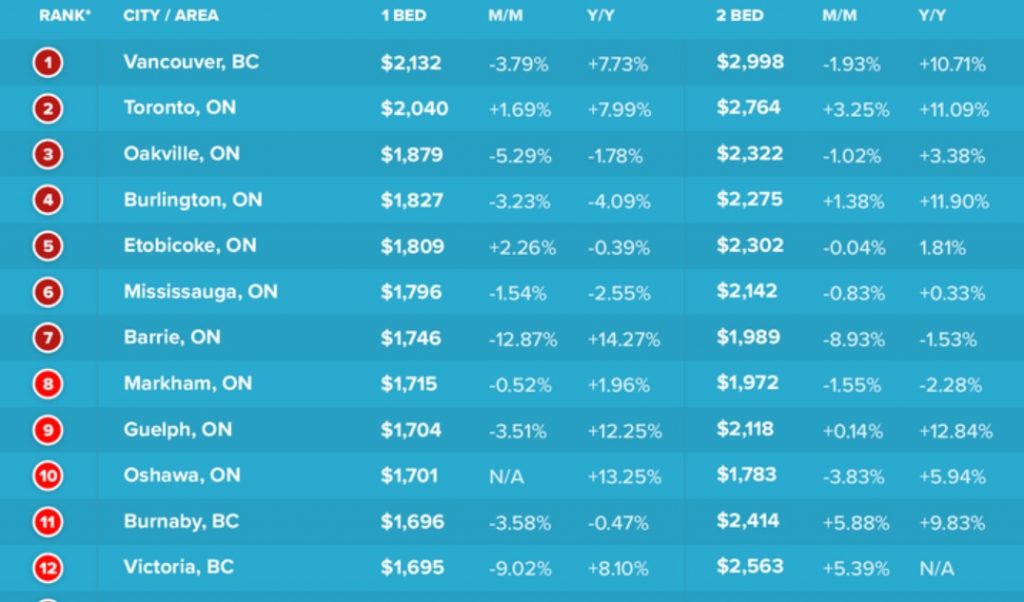
In terms of specific markets, Toronto finished second on the list of 35 cities for average monthly rent in November for a one-bedroom at $2,040 and for a two-bedroom at $2,764. Year over year, average monthly rent in November for a one-bedroom in Toronto was up eight per cent and up 11 per cent for a two-bedroom. Month over month, average rent in Toronto was up 1.7 per cent for a one-bedroom and up 3.3 per cent for a two-bedroom.

Oakville came in third on the list for average monthly rent in November for a one-bedroom home at $1,879 and fifth for average monthly rent for a two-bedroom at $2,322.

Year over year, average monthly rent in November for a one-bedroom in Oakville was down 1.8 per cent and up 3.4 per cent for a two-bedroom. Month over month, average rent in Oakville was down 5.3 per cent for a one-bedroom and down one per cent for a two-bedroom.

Burlington finished fourth for average monthly rent in November for a one-bedroom home at $1,827 and seventh for average monthly rent for a two-bedroom at $2,275.

In Vancouver, average rent for all property types on Rentals.ca rose 12 per cent year over year to $2,492 in November. Annual average rent fell last year by 12 per cent in Vancouver to $2,216 in November 2020.

Montreal remains a bright spot for landlords in Canada, with rents rising annually by one per cent in November to $1,689, after also rising year over year by three per cent to $1,668 in November 2020.

Calgary’s average annual rent was up by four per cent to $1,438 in November, but rents did not change significantly on an annual basis in November 2020, with the average listing available for $1,379.

The average rent in Mississauga increased year over year by two per cent to $2,125 in November, after a 13 per cent annual decline to $2,088 in November 2020.

Unit types and sizes 

Most bedroom types experienced annual increases in average rent in November. But with many Canadians continuing to work from home, at least part of the time, larger units experienced stronger annual increases in average rent. Some tenants used their “commuting” money toward higher rent for the extra workspace.

Also, demand for luxury rental homes helped cause a 15 per cent annual increase in average rents for six-bedroom units. Average annual rents in November for five-bedroom units, four-bedroom units and three-bedroom units were up seven per cent, nine per cent and six per cent respectively.

One-bedroom units were the only bedroom type to experience an annual decline in average rent at -1 per cent, while two-bedroom units were up $5 on average from one year ago. During the heart of the pandemic lockdowns in November 2020, all bedroom types experienced annual declines, except six-bedroom units, which increased five per cent.

Other takeaways from the report:

  • The average rent for single-family homes was up 14 per cent annually in November, and has already moved higher than November 2019 levels, showing a strong recovery from the pandemic. The average rent for townhouses was up 16 per cent year over year in November.
  • Condo apartments’ average rent rose eight per cent in November after experiencing the largest annual decline in average rent at 19 per cent last year. The recovery has not been as strong for condos as single-family homes and townhouses.
  • In the fourth quarter so far (October and November only), the average rent in British Columbia was the highest in Canada at $2,182, followed by Ontario at $2,090 and Nova Scotia at $1,825. Next were: Quebec ($1,667); Manitoba ($1,361); Alberta ($1,235); Saskatchewan ($1,011) and Newfoundland and Labrador ($977).

Visit www.rentals.ca for more info.


Vancouver earns PH certification for tallest building

The City of Vancouver announced it has received certification for a new seven-storey Passive House project that is the tallest in the province. Located at 825 Pacific Street, this City-owned facility is an all-electric, near zero-emissions building that will be operated by a not-for-profit arts and culture organization.

“Vancouver’s new Passive House arts and culture hub is an exciting new space in our city, made possible by Community Amenity Contributions. This new affordable space means more artists will be able to create and tell their stories instead of worrying about their rent,” said Mayor Kennedy Stewart. “It also aligns with our efforts to reduce carbon pollution and do our part to respond to the urgency of the climate crisis by moving away from burning fossil fuels to heat our buildings and produce hot water, while also making buildings more resilient.”

The 825 Pacific Street project uses an electric air source heat pump to efficiently deliver domestic hot water heating, along with heating in the winter and cooling in the summer. A heat recovery ventilator filters indoor air, helping to protect occupants during smoke events.

“By requiring the building to be designed and certified to the Passive House standard, and use no fossil fuels, this project will produce nearly zero carbon emissions in its operation”, said Craig Edwards, manager of energy and utilities, City of Vancouver. “The building will meet the city’s requirement that all new city-owned facilities are constructed to a zero emissions standard, helping the city lower the carbon pollution of our city-owned portfolio of buildings, and act as a demonstration project to show how others can design and build commercial buildings to achieve near zero emissions in their operations.”

The city currently has approximately 10 Passive House projects in development or recently completed, including Firehall 17, Gastown’s Water View and Portside childcare centres and the Marpole Community Centre. All of these buildings will have the benefits of the Passive House standard – indoor comfort with as little energy consumption as possible – with design flexibility and only slightly higher construction costs that will translate into big savings in operation costs.

Wayne Davidson elected new MCAC president

Wayne Davidson, president of Burnaby-based Davidson Brothers Mechanical Contractors, has been named president and chair of the Mechanical Contractors Association of Canada (MCAC). Davidson is past president and secretary treasurer of the Mechanical Contractors Association of B.C. Davidson replaces Dave Holek, of Belle River, Ontario.

“I am extremely proud to be stepping into the role of MCA Canada president and chair as we look ahead to 2022,” said Davidson. “For a national association representing close to 1,000 members across the country, this marks a great opportunity to begin reconnecting with our members as we transition to more in-person events. I see tremendous opportunity for MCA Canada to engage with our members in a meaningful way over the coming year, and I am excited about what we can accomplish.”

Throughout the past year, MCA Canada has focused its endeavours in several key areas, including the adoption of a new strategic plan for the association. This, combined with its ongoing advocacy efforts, education initiatives, and steps to address industry practice issues, has established the framework for association priorities.

The new strategic plan also places particular emphasis on a close partnership between MCA Canada and its provincial/zone MCA partners across the country. As the industry is faced with several important issues, this ongoing collaboration will remain critical for the association moving forward.

“Our message has been, and will continue to be, that a vibrant and capable mechanical contracting sector is critical to a healthy economy, and to the health and safety of Canadians,” added Davidson. “Working together with our partners will help us deliver this message nationally, while focusing on key issues for the betterment of our sector and our members.”

For MCA Canada, there are several issues on the horizon that will need to be addressed, including federal prompt payment, skilled labour shortages, standard practice issues, and supply chain issues and price volatility. The association has reoriented its board committee structure to ensure these issues remain top of mind, while ensuring new and ongoing concerns for members can continue to be addressed.


Many workers may quit if office cleaning lacks

People are now so concerned about office cleaning and hygiene that more than one-third would consider quitting if they felt their workplace was not being cleaned properly.

That’s according to a new survey conducted by the Cleaning Coalition of America, which found that American workers are placing an increasing value on enhanced and visible office cleaning.

Overall, 93.4 per cent of vaccinated respondents and 82.2 per cent of unvaccinated respondents said workplace cleaning protocols are important to them as they return to the office. In addition, 77.2 per cent of workers want to see their workplace cleaned daily.

More than four in 10 Americans say they still have lingering concerns about returning to the workplace, and 38.3 per cent of respondents insist they would consider changing their jobs if the workplace was not cleaned properly.

Visibility of this cleaning is important to many people. Nearly two-third (62.1 per cent) say that seeing professional cleaners at the workplace would make them feel safer and more protected from contracting COVID-19. In addition, 47.1 per cent cite regular disinfecting of shared spaces as the most important step employers can take to make workers feel safe, and 47.5 per cent have asked their employer about their company’s cleaning protocols.

RELATED: Flu season and cleaning — the proof is in the pudding

“American workers experienced a turbulent year that has forever changed their expectations around workplace safety,” Cleaning Coalition of America President Josh Feinberg said. “As employees return to the workplace, it is more critical than ever that businesses rethink their cleaning best practices and adopt a more holistic view of safety that prioritizes worker well-being. Both current and prospective employees need to know that their employer will not sacrifice worker health for an improved bottom line.”

Inside the reboot of Hootsuite’s Vancouver HQ 

Bright-coloured furniture curves around a stone fireplace in the lounge of Hootsuite’s newly transformed Vancouver headquarters that was downsized during the pandemic.

The collaborative area reflects the social media management company’s new distributed workforce model, which reimagines global offices as inclusive creative hubs. The Vancouver office is piloting this model based on observations directly stemming from workers’ own choices.

Last year, when the pandemic disrupted its office culture, one hinging heavily on in-person connections, the organization surveyed employees to assess the impacts of remote work and to inquire about return-to-work preferences.

With offices in 14 cities across the globe, responses varied depending on the location. Employees missed connecting with colleagues, but treasured the flexibility of working from home, particularly in larger cities like Vancouver, Toronto, London and Mexico City where workers were commuting up to four hours a day.

“What we’ve given our workforce now is the control and ability to decide where you work and when you work,” says Carol Waldmann, director of global facilities and real estate at Hootsuite.

The impetus to rethink the Vancouver office began before the pandemic as 50 per cent of assigned desks across two floors were unoccupied on most days due to remote work. A new design materialized after the employee survey revealed eighty-nine per cent of Vancouver-based employees wanted to work in-house a few days each week or month.

From those findings, 150 new work points were created within the 27,000-square-foot space, including personal pods, team pods, and luxurious living areas. Extra lounge furniture and scrum spaces with floor-to-ceiling whiteboards have replaced rows of assigned desks.

“When we reopened the office at a reduced capacity in September, we had some people come in, but it wasn’t that busy,” says Waldmann. “Now, we’re finding the more people come in, the more they are talking to their friends, saying the office is actually really cool; it’s gaining momentum, and so far, it’s been a success.”

Hootsuite

Black and white photos of employees grace the walls of the living room. Photo by Upper Left Photography.

Before the redo, the office touted a ski-inspired Canadiana theme, with plaid and natural wood—an aesthetic not every worker could relate to. Few windows contributed to a darker setting and the living room was filled with bean bag chairs. “That’s great when you’re 21, but our workforce is starting to grow up,” says Waldmann. “Many people are saying that their back cannot take working in a bean bag chair for eight hours a day.”

Fresh white walls now brighten the space to reflect as much natural light as possible, with biophilic elements to calm and energize oxygen levels. Sit-stand desks, adjustable monitor arms, and ergonomic chairs add comfort. The meeting rooms, also called cabins, have been painted matte black to reflect the trendy, yet ancient, Japanese technique known as yakisugi, which consists of charring the outer layer of wood to make it more durable.

An inclusive transformation

Various amenities support the mental health of employees—a priority that figures highly into the company’s culture. The space, designed by Mak Interiors and the Hootsuite brand team, harnessed a concept based on inclusion and wellbeing, while working alongside a diversity, equity and inclusion consultant who reviewed the floorplan.

Artwork throughout the space reflects various cultures—of employees throughout the years or branding in general—so people can “see themselves on the walls.”

Braille signage graces the meeting rooms, of which there are a wide variety so people can choose from a number of spots to work throughout the day. Within these spaces, dimmable LEDs accommodate for light sensitivity, while private pods allow for heads-down work and a place for listening to music or meditation apps.

The wellness room is a single-use spot to relax, with a domestic feel of soft blue tones, calming murals and velvet curtains and blankets. There is light therapy for seasonal affective disorder, a green wall and lavender diffuser. The room serves multiple purposes: for nursing mothers with a fridge and sink, a place for prayer and meditation, or an area to retreat for those suffering from migraines.

“If you’re at work and you feel like you need a break, or you have sensory overload, you can go to this room and take a quiet moment,” says Waldmann. “It gives you an oasis of calm.”

Hootsuite

Various meeting areas allow workers to choose where they work throughout the day. Photo by Upper Left Photography.

To attract more diverse job candidates, other elements like fully automatic doors and gender-inclusive washrooms are physical representations of the culture Hootsuite is building, which also extends to its benefits that were redesigned this year. These include increasing coverage for mental health to six times the previous amount, fertility treatments, gender affirmation surgeries, culturally appropriate counselling, and global pay equity—achieved across the entire company in 2021.

Hootsuite also shut down its entire operations for its inaugural Wellness Week in July, where employees were given a week off—separate from their vacation allotment. The idea was to help rebuild the mental health of its employees as stress in the workplace is hindering wellbeing at exceptional rates due to the pandemic. They’ve also re-introduced wellness week for 2022.

Greater autonomy of where one works also lends to mental wellbeing. But with embracing a hybrid approach comes the challenge most companies are grappling with—how to foster equity between in-office and work-from-home teams.

At Hootsuite, Waldmann says the issue is front-and-centre. All events are virtual for the foreseeable future, from the company’s recent 13th birthday to town halls and team get-togethers where everyone meets via their laptop with headsets to achieve a similar experience.

“We are constantly thinking of and trying to engage the folks working from home,” she says. “It’s not easy, but it is something that will continue to evolve.”


Study finds elevator fans fail to eliminate pathogens

A new study conducted by Henderson Building Solutions LLC has found that standard elevator cabin air filtration systems fail to remove the most dangerous airborne pathogens from inside the cabin, including those with the properties of COVID-19.

The study notes that standard elevator filtration consists only of ventilation fans that fail to filter out the fine and ultrafine particles that are the most dangerous to human health. The study also found that installing advanced air purification technology can remove 77-99 per cent of airborne contaminants from an elevator cabin’s air, with a mean particle reduction of 88 per cent.

The study measured the number of pollutants in elevator cabin air both with and without the installation of advanced air purification technology. The control cabin included a simple ventilation fan with a minimum efficiency reporting value (MERV) rating of 13. The other cabin was outfitted with ACTIVE Particle Control (APC) technology, which conditions harmful particles to bind together, making them more susceptible to air movement and allowing them to be easily filtered out. The results found that the use of APC caused significant reductions in particle mass, indicating that using such systems can reduce exposure to particulate pollutants and also reduce airborne transmission of viral or bacterial disease between elevator passengers.

The U.S. CDC notes that the confined space inside an elevator cabin creates a greater risk for the transmission of diseases, and recommends that office buildings add supplemental air ventilation or local air treatment devices to cabins to protect riders from COVID-19.

RELATED: Ontario advances elevator repair legislation

On average, each of the 1.03 million elevators in America moves 20,000 people per year, according to the National Elevator Industry Inc., a U.S. trade association.

Is your condo board prioritizing properly?

Thirty-five minutes to select the flower arrangement in the lobby for the holiday season, balanced by a five-minute update on the $500,000 HVAC renovation. Sound familiar?

Many condo corporations struggle to prioritize. In fact, it’s a challenge facing several organizations across industries, from a board level, right down to day-to-day task assignments. Condo boards and their management teams are no different.

Over the past three years prioritization figured highly into responses from Ontario-based condo board members, via an online diagnostic tool, which subsequently generated insight into board issues. (1) Almost half (48 per cent) of respondents identify that prioritization is an issue, and 52 per cent are confident that more important items are given priority.

Other findings reveal personal priorities often trump the greater good. Forty-six per cent of condo board members reported a unified board working in the interests of the condo community, but 54 per cent reported individuals, or several people, trying to drive personal agendas, rather than put the needs of the community first.

So, what does a condo board director or manager do when they feel condo priorities aren’t balanced correctly?

The easiest solutions lie in the condo board meeting. Here are five simple tips that can have any condo board or condo manager prioritize better.

1. Draft an agenda that indicates the time expected to spend on each topic. Slot 15 minutes for the flower arrangement conversation and 40 minutes for the expensive infrastructure project.

2. Beyond time on a topic, give thought to the order of items on an agenda. Board meetings can be long and tiresome. Leaving a complex issue for the end of a long meeting almost assures a rushed decision.

3. Allow people to speak their perspectives in a meeting, but encourage people to avoid restating what others have already said to keep to timelines. As the chair of the meeting, ask, “Does anyone have anything new to add to the conversation?”

4. When points have been made, but discussions carry on, ask for a straw poll. You may find everyone is in agreement and the board can move forward with a vote quickly and efficiently.

5. Create a parking lot for good ideas that require time at another meeting. Record these ideas as part of a rolling agenda so that when time allows, these ideas can be given their due.

While the above five tips on prioritization will help your board deal with some issues, some more holistic foundational solutions may be required for long-term success. For those boards who really want to step things up, nothing is more effective than a strategic plan.

Strategizing long-term

Strategic plans for condos are not done nearly enough. With data collected from the diagnostic, just 17 per cent of condos report any sort of strategic plan, 44 per cent use their reserve fund as a strategic plan and 39 per cent simply tackle issues as they arise.

A strategic plan is important because it allows a condo to thoughtfully plan and prioritize short-term, medium-term, and long-term projects. It helps a board and management team work together to take planning beyond a long to-do list or simply react to problems as they occur.

For boards going down the path of creating a strategic plan, here are a couple things to consider.

First, collect some data from the condo to give your board insight into what owners and residents care about. A three- or five-person board can’t possibly have insights into what the whole population of the condo is thinking about on different topics. So ask. Survey tools have never been easier and cheaper to use. Look to Survey Monkey, Google Forms, or your in-house communications software to get a pulse on your community’s perspectives.

Second, during the strategic planning process, account for what you’re not going to do. As your board and management make plans, lots of ideas will be tabled and dismissed or allocated for a distant future. Be sure these items are identified and the board’s rationale recorded as to why the items are not prioritized. Share these as part of documentation to your ownership. They’ll appreciate the insights and transparency.

Finally, be sure to share your plans with the condo through a town hall event or at the AGM. Be prepared for a good idea to arise that your team may have missed. This will have given everyone an opportunity to participate, voice their opinions, and play a role in the future of your condo.

Steve Ilkiw is the principal and founder at CondoHive and Bedford Hill Consulting. A driven leader and project manager, Steve helps organizations grow through strategic planning, research, and related initiatives. Combining his business acumen and research skills, Steve has led numerous projects designed to engage, provide insights, and facilitate data-based decision-making.

[1] A free online diagnostic tool via the CondoHive website gathered intel from 150 condo board directors over a three-year period. Data was gathered from a series of questions that condo board members answer to receive a score determining their board’s efficiency

GBAC offers new training on infectious disease prevention

The Global Biorisk Advisory Council™ (GBAC), a Division of ISSA, has launched a new GBAC Academy training course focused on increasing the all-around knowledge of cleaning for health and infectious disease prevention for individuals in all businesses and industries.

The new course, “Infectious Disease Awareness in the Workplace: COVID-19 Considerations,” highlights how pathogens spread and cause illness and the role that proper hygienic cleaning and disinfection play in infection prevention.

The 30-minute online course provides an overview of the chain of infection and how to break it through effective cleaning and disinfection practices, indoor air quality considerations, and other key mitigation strategies. The course also discusses the benefits of workplace infectious disease or communicable disease prevention programs, as well as the importance of risk assessments, the hierarchy of control, and personal protective equipment (PPE).

The course is available in English, Spanish, French, Chinese, and Italian.

“The global COVID-19 pandemic continues to present challenges, such as the emergence of new variants. As a result, cleaning for health needs to remain a priority in the built environment,” said GBAC Executive Director Patricia Olinger. “This new course will help individuals in any business environment understand infectious disease principles, and how cleaning and disinfection support health, safety, and regulatory compliance.”

“Infectious disease knowledge will continue to be in demand during and after the pandemic,” added Olinger. “Regularly offering training courses showcases to employees that your business cares about their career development and wellbeing, and enables them to better manage today’s and tomorrow’s biorisks.”

To register or fore more information including pricing, visit gbacacademy.org/awarenesscourse.

GBAC Academy also offers additional training resources such as the GBAC Online Fundamentals Course 2.0, the pathway to the “GBAC-Trained Technician” designation.

Lakeview Village set to transform waterfront

Once the site of the Lakeview Generating Station, a coal-burning station known for its “Four Sisters” smokestacks, Lakeview Village in Mississauga is on its way to becoming a vibrant, mixed-use community. Since July 2018, the partnership at the helm of the evolving development has been actively pursuing green technologies while engaging in the revitalization of the area’s natural environment.

Future plans for the site include a range of housing options, spaces for education and offices, an innovation district, multicultural recreational programming, direct access to local transit, and an extensive parks system with access to the neighbouring 64-acre Jim Tovey Conservation Area.

“In 2018, we purchased the brownfield site and began working with passionate locals on a shared vision for what this incredible transformation could bring to Mississauga’s waterfront,” explained Brian Sutherland, Vice-President of Development, Argo Development Corp and development lead for Lakeview Village. “Today we are building a vibrant and sustainable mixed-use community with solutions to address climate change, energy resiliency, waste management and mobility challenges.”

Lakeview Community Partners Limited (LCPL) is comprised of several leading community builders, including TACC Construction, Greenpark Group, CCI Development Group, Branthaven Homes, and Argo Development Corporation. Supporting LCPL is a team of experts in architecture, planning, urban design, placemaking, and transportation engineering—all galvanized by the same goal of seeking out viable, sustainable, low carbon green technology and solutions.

According to Sutherland, district energy is among the technologies currently under review. In late-November, LCPL announced it had partnered with Enwave to evaluate the environmental benefits and technical and financial feasibility of a district energy system based on the thermal energy produced at the nearby G.E. Booth Wastewater Treatment Plant.

“If implemented, the effluent heat recovery system would be the first application of its kind and scale in North America,” said Sutherland. “The system at Lakeview Village would have the ability to provide for over 6,000 tonnes of carbon savings annually with the elimination of traditional (gas powered) heating and cooling systems in buildings.”

Additionally, LCPL has been working with Envac, the City of Mississauga, and the Region of Peel to explore the technical and financial feasibility of incorporating a vacuum waste system at the new community. If adopted, the system would replace traditional curbside waste, recycling and organics pick-up, subsequently improving waste diversion rates and diminishing truck traffic in the community. Other critical benefits would include the elimination of overflowing garbage receptacles in parks and the reduction of plastics in the great lakes.

Finding green inspiration in Sweden

In 2019, key members of the LCPL team, along with Mississauga Mayor Bonnie Crombie and other city and regional staff, travelled to Sweden on a fact-finding mission to observe green technologies in practice and to meet with industry-leading developers.

“In Gothenburg, we visited an Innovation District and saw first-hand how the deployment of data-rich living labs will guide and inform our future development practices, as well as how Lakeview Village can provide statistically relevant data to address civic challenges,” said Sutherland. “In Stockholm, we experienced district energy and vacuum waste systems in practice. In Malmö, we explored how to implement world-class sustainable practices right on the waterfront. Our goal was to gather this knowledge and bring that level of world-class technology and leading-edge community planning to Canada.”    

Restoring the natural habitat

Meanwhile at home, LCPL has undertaken several key initiatives to restore the natural habitat that pre-dated the coal-burning days of the late 1950s, when the Lakeview Generating Station was constructed. LCPL’s efforts to undo decades of damage include a multi-year coastal habitat project which aims to create a green oasis for local wildlife, flora and fauna.

To date, LCPL has excavated and donated over 250,000 tonnes of concrete to help construct the foundation and breakwater for the Jim Tovey Lakeview Conservation Area. Additionally, Serson Creek—a degraded piped water course that runs under the G.E. Booth Wastewater Treatment Plant—is being restored with a new low-flow channel to divert flows out from underneath the treatment plant. The corridor, which leads out to Lake Ontario, was designed to create a fish and wildlife habitat and promote ecological connectivity.

“This restoration approach is anticipated to create a source of native biodiversity that, over time, will spread into other adjacent areas and benefit many species of native fish and wildlife,” Sutherland said.

Field of a million sunflowers

In 2019, LCPL planted a field of one million sunflowers to help remediate the site’s soil and reduce the concentration of contaminants in the surrounding environment. Aside from its obvious beauty, local residents are now enjoying the return of native butterflies and bees—pollinators that play a critical role in every aspect of the ecosystem, supporting the growth of vegetation and providing food and shelter for local wildlife.

“Very soon, Lakeview Village will be a place where we can welcome local residents and people from around the world to show them our amazing accomplishments in responsible, environmentally conscious development,” said Sutherland. “We are in an incredibly unique position to take the site of a former coal refinery and turn it into a future ready, sustainable community, right on the shores of Lake Ontario, while propelling Canada’s leadership position on climate and sustainability on the international stage.”

Housing plans for Lakeview Village

In terms of what can be expected on the residential front, current plans include a mix of housing options creating more than 8,050 much-needed units. “We’ve entered into a commitment with the City of Mississauga to make five percent of the housing (over 400 units) affordable,” said Sutherland. “This commitment will be delivered in a variety of different forms throughout the development and will be accomplished through various phases of construction.”

Key structures within the Lakeview Village development are already underway, including the Discovery Centre, a multi-storey event and learning space. When complete, the 20+ acre Lakeview Village Innovation District will be a centre for employment and cross-sector business innovation in the GTA. LCPL is anticipating the creation of 9,000 long-term jobs in partnership with the City of Mississauga’s Economic Development Office.

To learn more about Lakeview Village and how it is bringing a sustainable 15-minute community to Canada, visit: www.mylakeviewvillage.com  


UBC expedites net-zero target

A new climate action plan at the University of British Columbia aims to accelerate emissions reductions and achieve net-zero emissions by 2035—15 years ahead of the previous target date.

At its Vancouver campus, UBC will expand its district heating system, make campus buildings more efficient, improve waste management and promote sustainable modes of transportation, among other measures.

The university’s Climate Action Plan 2030 (CAP 2030) builds on the success of two previous climate action plans. It also incorporates principles recently outlined in UBC’s 2019 declaration on the climate emergency and its climate emergency task force report.

“We have made significant progress on reducing greenhouse gases generated through campus operations, but there’s still more work to do given the urgency of our climate crisis,” says UBC President and Vice-Chancellor Prof. Santa J. Ono. “CAP2030 builds an accelerated roadmap for further emissions reductions – allowing UBC to contribute further to the goal of capping global warming at 1.5 C, which was set in the Paris Agreement.”

UBC has reduced its greenhouse gas emissions by about 30 per cent since 2007. The new plan aims to get to net zero faster through a combination of measures.

The Bio-energy Research and Demonstration Facility, which burns clean wood waste from outside sources to heat buildings across the campus, is undergoing a $27.4 million expansion that when complete will allow it to heat more buildings. This will further reduce reliance on non-renewable energy sources. Ultimately, the plant is projected to help reduce total emissions by up to 60 per cent compared to 2007 levels.

Within the next decade, 100 per cent of the district energy used to heat campus buildings is projected to come from such low-carbon sources.

A climate-friendly plan 

New buildings will use low- environmental-impact materials and operated sustainably to produce zero emissions, while existing buildings will be retrofitted to use less fossil fuels.

UBC will also develop a comprehensive electric vehicle charging strategy for its campus fleet, and any new vehicles added to the fleet will be zero-emission whenever possible. To reduce emissions generated through commuting to campus, commuters will be offered incentives to use sustainable modes of transportation. Cyclists will also benefit from improved bike storage and bike lanes and expanded bike sharing programs.

Other measures listed in the plan include reducing business air travel and improving food and waste management.

Flu season and cleaning — the proof is in the pudding

We may be approaching the end of the year already (yes, really) but it’s worth remembering that, officially, winter hasn’t even started yet. Facility managers, employees, residents, and tenants, along with cleaning staff and the general public, need to ensure they are taking adequate measures to safeguard against a flu season that experts have been warning may be one of the most severe in recent years.

Widespread influenza was virtually non-existent last winter due to lockdowns and public health measures aimed at cutting down COVID-19 cases. Last year, the Public Health Agency of Canada (PHAC) reported just 79 lab-confirmed cases of influenza in its 2020-21 season. The year before that, PHAC noted 54,000 cases.

However, a resurgence could be likely over the next two months or so due to far looser health restrictions and the effects that a lack of exposure to standard viruses over the last 12 months has likely had on people’s immune systems.

Already, the World Health Organization has been reporting a clear rise in influenza cases worldwide.

A “twindemic” of flu and COVID-19 was feared last winter but never materialised as a result of that nonexistent typical flu season. However, if the flu comes back with a vengeance this year, it could have dire consequences. Not only are people’s immune systems less resilient after over 18 months of extraordinary levels of protection from transmissible disease, but spikes in both flu and COVID-19 cases could see health facilities and services overwhelmed.

RELATED: 5 tips for navigating cold and flu season

Brian Sansoni, Senior Vice President at the American Cleaning Institute (ACI), notes gratefully that the 2021-22 flu season has “by and large been manageable” so far, but stressed the importance of nobody – particularly facility managers and cleaning service providers and staff – taking their eyes off the ball.

“As well as getting their COVID-19 and flu vaccines – still a key step in the safeguarding process – as an industry, we must keep providing the constant reminders of the importance of cleaning and good hygiene that have been extraordinarily enforced during the pandemic,” Sansoni tells FC&M. “The increased focus on hygiene continues to be a helpful factor, but it needs to be paired with the right processes and education. We need to be diligent about smart and targeted hygiene, cleaning and disinfecting of no-touch surfaces, and so forth.”

At face value, the signs are good on that front.

A recent ACI survey found that 86 per cent of adults said they will either increase or maintain the heightened cleaning habits they started as a result of the pandemic, while three-quarters of respondents said they are likely to continue key hygiene behaviours over the next few months like proper handwashing, disinfecting high-touch surfaces.

However, Sansoni has one major concern.

As well as an extremely lenient flu season, 2020-21 had the advantage of many people being at home for the majority of their time. However, schools are now back to some form of “normal” in most jurisdictions and, as 2022 begins and stretches on, more and more people will be heading back into the office, to events, or to other facilities outside of the home. That poses the risk of creating a whole new challenge altogether.

“For those responsible for commercial cleaning, that presents a new challenge,” continues Sansoni. “BSCs and cleaners may have been cleaning buildings that only had a couple of offices open, but by spring or summer, those same buildings may have a dozen offices open.”

That is likely to cause a significant amount of trepidation among the general public as people return to offices for the first time in two years, even if they are vaccinated and have good faith that others are too. Sansoni urges the industry to be “resurgent and diligent in our smart cleaning practices and protocols”.

What exactly can facility managers, cleaning companies, and cleaning staff do to help enforce this diligence? While there is no need to panic-clean or over-clean, cleaning well and regularly and transparently is crucial. As well as the obvious – clear signage and reminders, making sure soap dispensers are filled at all times, etc. – Sansoni stresses that communication and training remain integral components.

“If you’re a janitorial service or building operator, it’s in your best interest to communicate that you are undertaking these smart hygiene practices because you care about your people,” emphasizes Sansoni.

“Facility managers and staff can say as many times as they like that people’s safety is their priority, but the proof is in the pudding. The bar has been raised and the little things matter. People want to have confidence that everyone is doing their job and these things are taking place on a daily basis. The presence of more people narrows the margin of error and facility managers, real estate landlords, and cleaning crews all need to be prepared for that.”

RELATED: Post-COVID infection prevention strategies

Some measures can be double-edged swords. Sansoni cites the example of “hoteling” workspaces, a process whereby one person is in an office space one day and another is there another day. While that can help to manage the flow and the load, it can also cause nervousness and challenges. But the risk of negative impacts can be mitigated by ensuring disinfection protocols and supplies are ever-present, available, and visible for individuals to use, not just cleaning crews.

For too many years, Sansoni notes, people largely took cleaning, sanitation, hygiene for granted. “Sadly, it took a pandemic to remind people how critical simple, basic practices and use of products are to everyday health, not just due to COVID-19 but to prevent the general spread of infectious disease in all settings. “

Thankfully, that is now on people’s radar more than ever. The pandemic has forever changed how people view cleaning outside the home, and it’s on their mind wherever they are – the office, the supermarket, a restaurant, a transit station.

“These are the things we are doing to keep you clean and safe.’ We can never take cleaning for granted ever again.” “You can never take your foot off the pedal; you can’t afford to get sloppy. There’s no excuse for that now whatsoever,” concludes Sansoni. “It’s a continual education for us all. We’re all in this together.”

New project tackles accessibility of heritage buildings

Human Space is tackling the challenge of addressing accessibility of heritage buildings while preserving historical integrity.

The Toronto-based inclusive design consultancy will draw from Accessibility Standards Canada’s funding to create Heritage for All, a project that will research, propose and test new ideas aimed at developing accessible strategies for federally-owned heritage properties, with the hopes of advancing future national accessibility standards.

“Our nation’s heritage buildings exist for everyone’s enjoyment, and they provide keys to understanding our history,” says Human Space Director and Architect, Jesse Klimitz.

“Therefore, it is essential that we work together to make them accessible to all people, regardless of their disability. Modifying heritage buildings while preserving their historical integrity is difficult work. However, with collective discussion and thought, we will find solutions that will enable access, while also responsibly caring for these important places.”

The two-and-a-half-year project will be funded by the Accessibility Standards Canada’s Advancing Accessibility Standards Research Program. The project will involve examining national and global precedents and guidelines. A series of hybrid on-site workshops with individuals who experience an array of physical barriers — including users of mobility devices, persons hard of hearing or deaf, persons with low vision or blind, neurodiverse individuals, older adults, children and their attendants or caregivers— to help develop a deep understanding of a broad spectrum of experiences.

Human Space will test the solutions with user groups and develop a publicly available report of the research and findings showing how the conversions can be a practical reality.

Participating organizations will include the KITE Research Institute, Easter Seals Canada, The
Canadian Association of Heritage Professionals, Canadian Disability Foundation, Phil
Goldsmith Architect and National Trust for Canada to seek and better understand the issues,
challenges, and opportunities of improving accessibility within various historic contexts.

Ethics, etiquette and excellence in management

When the Condominium Authority of Ontario introduced a set of mandatory forms to be distributed to owners of condominium units, property management offices who hadn’t thought to include a cover letter in their mailings and electronic distribution began receiving a number of calls.

“What is this form for?” callers would ask. “Is there something I need to do?” Without a proper written explanation to accompany the documents, the New Owner Information Certificate (for example) presented itself as a somewhat difficult to understand housewarming gift. With sparse information included in the form itself explaining the purpose of what was being received, owners were often confused—especially in the instance of first-time condominium owners.

The capacity to create effective and well-written business communications — letters, emails, reports and minutes — is lacking in many new managers, and even in some experienced ones. In a digital age where the craft of communication is limited to email bursts or social media blurbs, adeptness at explanation is a field requiring additional honing. To be able to both explain and interpret critical information is a fundamental skill set needed from anyone considering a career in property management.

The role of a property manager is so diverse that, while an experienced manager may have a perfect understanding of the mechanical and physical aspects of the building, explaining the hierarchy of control or aspects of the declaration limiting the corporation’s responsibility may come with tangible difficulty.

As of November 1, 2021, anyone considering a career in property management will be required to complete the Condominium Management Regulatory Authority of Ontario’s (CMRAO) Excellence in Condominium Management course. This course will introduce some key elements to prospective managers and highlight the importance of working with an ethical mindset.

The course is devoted to opening the door to prospective managers so that they have a basic understanding of the requirements of the role, prior to beginning the course proper. In addition, more focus has now been placed on the vast array of relationships that need managing as part of a condo corporation’s governance.

Each of these relationships requires a slightly different skew when communicating. Successful management companies integrate a standard model for the presentation of monthly manager and financial reports, with an expectation ​​that communications are written in plain, easy-to-digest language.

In a world circumvented by spellcheck, there is no excuse for poorly worded, disjointed emails. Likewise, lengthy and arduous pieces of detailed explanation can be too bulky to be properly absorbed when read, or may get pushed aside completely.

One of the most important relationships is with our boards of directors, with whom we converse daily in the course of providing support and maintenance review. While the CAO’s initiation of the valuable ‘Director Training’ courses has proved substantially valuable, it is impossible to role-play all potential scenarios which come their way. For each new situation which arises, proper presentation of the problem at hand must be provided, together with clear commentary regarding possible solutions.

This is primarily a people business, with the property itself as the common ground. It also requires 24/7 commitment, with the reality being that wages are often in no way commensurate with the responsibility and hours devoted to the role. It is important to understand that anyone entering the field needs to be willing to work on their interpersonal skills. In many ways, people skills are more valuable than academic credibility when it comes to longevity in the role.

Good property managers take great pride in their professionalism when ensuring boards and owners have the tools they need to make informed decisions to enhance and improve quality of life and the assets of their condominium corporation. Established management companies rely heavily on an educated and knowledgeable support team who also understand the complexities of the Condo Act. It is important that all employees working in property management share a desire to learn. This is an industry which demands continual growth, and the evolution of the CMRAO courses are a reflection of that.

The CMRAO’s Condominium Management – Relationship Building course introduced as of November 1 addresses some of the more challenging aspects of property management that previously had not been dealt with. Now, prospective managers are provided a toolbox to handle issues such as dealing with the sudden death of a resident, conflict resolution, and mental health concerns.

Additionally, they now learn the fundamentals of etiquette in communication: how to communicate clearly and concisely, and importantly — how to adapt communication strategies dependent on the audience. It is not enough to send a chargeback letter demanding payment for reimbursement of costs incurred from a contractor — the owners deserve to understand why reimbursement is being requested, where it states within the declaration that the cost is their responsibility, when that payment is due, and what the consequences are if they refuse to pay.

When communication fails completely, the results can be tragic. Ninety-eight lives were lost in the collapse of the Champlain Towers South condominium in Surfside, Florida — lives that could potentially have been saved if the board of directors had fully comprehended the urgency behind the engineering reports provided to them. Although occurrences such as the Champlain Towers collapse are rare, the disaster shows clearly the importance of establishing clarity and assertiveness when conveying important information.

Managers and executives have a duty to keep informed regarding their industry and to be ever cognizant of their adeptness in communication, whether it be by letter, email or report. Clarity in communication can save time and confusion — affordable, cloud-based writing assistants such as Grammarly can be particularly helpful to catch small grammar mistakes, ensuring that messages are delivered with clear intent.

It’s okay to run a spellcheck on that doc before you email it or to have a coworker take a look. Ask yourself, “If I knew absolutely nothing about condominiums, would this letter still make sense?”

As author George Bernard Shaw once said, “The single biggest problem in communication is the illusion that it has taken place.” You can save the phone calls, emails and headache in the office by getting it right the first time.

Greg Fraleigh is President of The Enfield Group Inc.

How to tell it’s time to upgrade cleaning supplies

Throughout the pandemic, facility managers and building service contractors have had to act quickly and prioritize cleaning measures to keep visitors and employees safe. A recent study found that 88 per cent of consumers pay close attention to the cleanliness levels of the businesses they frequent. Additionally, 86 per cent of consumers also value seeing proof that these places, including retail stores, restaurants, offices, gyms, or schools, are cleaned often.

In response, business leaders ramped up cleaning to give consumers and employees confidence while visiting their facilities. In fact, job openings for cleaning workers jumped 75 per cent from March 2019 to March 2020 due to the increased demand. To properly complete their work, these cleaning professionals need a range of cleaning supplies at their disposal. Knowing how to use them and when to refresh or replace them is equally essential.

Using and replacing cleaning tools correctly

Cleaning tools are responsible for the proper application of cleaning and disinfecting products. These may include mops and buckets, brushes and brooms, microfibre cloths, and more. Given the number of tasks that cleaning teams are now expected to complete daily, it can be easy to forget when these tools need to be replaced or upgraded. However, doing so on a regular basis is one of the keys to upholding the highest standards of cleanliness in commercial facilities.

There are a few telltale signs that a cleaning tool may no longer suit the requirements of cleaning staff. Consider the following “commandments of cleaning supplies” to ensure that employees have everything they need to successfully clean and disinfect.

  1. If it’s broken, fix it or replace it

The easiest way to determine if a cleaning tool needs to be replaced is to assess whether it can still be used in the way a manufacturer intends. For example, if the handle of a broom is cracking, a bucket has a leak or broken handle, or a microfibre cloth is fraying and has holes, you need to either fix the item or replace it. In some cases, repairs may make more sense financially. In other cases, purchasing a new tool is easier.

Broken tools can lead to injury, as they’re not able to be used correctly and employees may modify their movements or how they perform a certain task. In 2019, janitors and their employers reported over 18,600 workplace injuries, likely resulting from faulty equipment. Common injuries cleaning staff face include slips and falls, chemical exposure, skin allergies, and more. In order to keep these dedicated workers safe, regularly check inventory to make sure all items are in good working condition. Keeping replacements in stock and easily accessible by staff can help prevent potential injuries and the resulting time away from work.

  1. Avoid cross-contamination at all costs

When a staff member isn’t adequately trained on proper cleaning procedures, there can be serious, negative consequences, like cross-contamination. Cross-contamination, also called cross-infection, occurs when germs that cause diseases are transferred via unhygienic processes, thus leading to harmful health effects. A common example is when someone cleans the top of a toilet seat with a rag, then uses the same rag to wipe a sink or door handles.

To minimize the risk of cross-contamination, consider adding colour-coded rags, mop heads, and buckets to your team’s roster of cleaning supplies. Each area within a facility, like the kitchens, washrooms, and common areas, should be cleaned from top to bottom with a different-coloured set of cleaning tools to minimize cross-contamination. Additionally, once a towel has been used and folded over a few times for cleaning, it should be replaced with a fresh, clean cloth to reduce the spread of germs.

After each shift, ensure items are stored properly in a janitorial closet that has significant ventilation or airflow to help items dry well and avoid the growth of harmful bacteria. If tools need laundering, complete this process and be sure that clean mop heads and cloths are ready for the next shift.

  1. Switch to sustainable options

In some cases, your cleaning team may be equipped with tools that are working properly; however, now is the time to ask yourself if those tools are meeting your facility’s sustainability goals. Some of those goals could include producing less waste, increasing recycling metrics, achieving zero emissions by a certain date, and so on. If your current cleaning supplies aren’t meeting the goals you’ve outlined, consider upgrading to cleaning tools that are constructed in a more environmentally friendly way and help reduce water, chemical and energy consumption once implemented in your facility.

In 2019, nine in 10 consumers said they would hold an organization accountable for their environmental impact. Therefore, selecting a sustainable cleaning tool manufacturer with responsibly made solutions, like those that are Green Seal-certified, can improve brand reputation. Making a small change, such as switching to durable and sustainable cleaning tools, can have a positive, lasting impact on the environment as well.

Invest in your cleaning supplies

Overall, there are several examples of why a cleaning tool might need repair, replacement, refreshing or upgrading. Facility managers and building service contractors must remember that the tools that a cleaning team uses represent their facility or customer’s facility, and the brand as a whole. Therefore, it’s recommended that leaders keep a close eye on inventory and have open communication with staff to determine which improvements are needed and which upgrades best serve their needs. With the latest and most effective tools, you can improve your cleaning team’s experience and your commitment to cleanliness.

Carlos Albir Jr. Is Director of Operations at ABCO Cleaning Products, a leader in sustainable cleaning tools. ABCO is a family-owned, Certified Minority Business Enterprise with Green Seal certified products, headquartered in Miami, Fla.

Manitoba to remould scrap metal transactions

Scrap metal transactions will undergo heightened scrutiny in Manitoba if newly introduced legislation is adopted. Bill 9, the proposed Scrap Metal Act, would require sellers to provide personal identification and account for the source of their wares, while purchasers would take on monitoring and record-keeping obligations.

The proposed legislation, which largely replicates a private member’s bill that Manitoba Liberal leader Dougald Lamont introduced in 2020, identifies seven “restricted” categories of items containing aluminum, brass, bronze, copper, iron, lead, steel, stainless steel, tin or other metals or alloys that might be prescribed by regulation. Metallic wire that has had insulation or casing removed and catalytic converters top the list, which also includes: municipal infrastructure such as street and traffic lights, and sewer grates and covers; grave markers and public plaques and monuments; and metal that bears identification of ownership.

Manitoba Justice Minister Cameron Friesen suggests the legislation would pose “barriers” for transgressors attempting to obtain quick cash for stolen goods. Indeed, it would prohibit cash payments for any of the restricted categories of items or sale values greater than an amount to be established in the enabling regulations.

Scrap metal purchasers would be required to record and retain information about suppliers and their offerings. That includes making efforts to determine the origin of items for sale and documenting license plate details of the vehicles used to deliver metal items.

This information would have to be kept on the premises for a minimum of two years and made available if inspectors request it. Purchasers would also be required to immediately contact a law enforcement agency if they have reason to believe materials offered for sale have been stolen.

“Metal theft is an increasing concern in Manitoba that affects public safety and can be extremely costly to individuals and business owners,” Friesen asserts — citing particular concerns in the electricity, construction, telecommunications and industrial sectors.

The proposed legislation includes exemptions for sellers that are incorporated businesses in Manitoba and for dealers, salespeople or recyclers under the provincial Drivers and Vehicles Act. Metal cans used for food, beverages, paint or household products, coins, bullion and jewellery would also be exempt from the proposed requirements.

Directors and officers coverage poised for change

When the dust had settled after the partial collapse of Champlain Towers South in Miami earlier this year, the story that emerged was one of total disarray inside the condo board.

Although the board had called for structural repairs back in 2018, those repairs were to be paid for through special assessments imposed on the owners. Five of the seven board members resigned over the issue but the repairs were never scheduled.

As a result of those decisions, the condo building’s board members can actually be sued for decisions they made on behalf of the homeowner’s association (HOA). In fact, several dozen lawsuits have been filed against the HOA and the board of the Champlain Towers. And any other condo association facing a disaster can be held responsible for a decision that left the condo at risk.

What’s more, in today’s litigious environment, it’s not hard to imagine a scenario in which a series of lawsuits filed against HOA board members and regulatory investigations could quickly surpass the limits of the building’s property and casualty (P&C) and directors and officers (D&O) coverage. And for those boards that are lacking appropriate D&O coverage, each individual board member’s personal assets may be at risk.

When it comes to condo boards of directors, it’s important to consider all angles. Protecting your board of directors is critical, and D&O coverage is just one component of that.

A Changing D&O Landscape

In the coming months, the D&O insurance landscape is expected to change in several ways, including:

1. Expect far tighter underwriting. Boards preparing for renewals will have to make themselves an attractive risk to insurers. Underwriters will be looking for healthy reserve funds and may decline to cover buildings without adequate reserves. They are also likely to scrutinize individual board members, looking carefully at their experience, their decision-making abilities and their financial acumen. Insurers may deny D&O coverage to boards that aren’t up to par.

2. Qualified board members will be scarce. Ontario began to require training for new board members back in 2017, but this measure seems to have encouraged inexperienced candidates to apply for the positions. While the training does help, it can’t compete with years of experience or an appropriate management background. Meanwhile, existing, experienced board members, knowing they may be held personally responsible for poor decisions, may possibly reconsider their positions.

Matthew Studley, CFA, is senior vice president, complex risk, for global insurance brokerage Hub International. He is a recognized expert in financial risk management, executive liability and the mitigation of specialty risks through insurance and insurance-linked securities. He consults on a variety of liability matters and risk transfer options, and advises clients on corporate governance issues, investor lawsuits, regulatory investigations and claims management.

Dru Douglas is an account manager for the Ontario region for global insurance brokerage Hub International. He specializes in insurance and risk solutions for the office, retail, industrial and multi-family sectors of commercial real estate.