




Articles Archive - Page 321 of 928 - REMINET
REMI

Shifting toward a circular economy

British Columbia’s construction sector is tackling the challenge of climate change and thinking differently about the environmental impact of materials they specify. They’re looking for ways to change from a ‘take-make-waste’ approach to a more circular economy. When designed with this in mind, buildings, like biological processes themselves, can have a more regenerative life cycle. And naturally renewable products, such as wood, have an important role to play in this shift to more enduring, climate smart design.

Circular entrepreneurism sparking change

“We’ve been committed to the circular economy since our company’s inception. That’s really the basis of our dual enterprises … This year, we’re already diverted over 5,000 tons of wood and other materials, so it’s quite substantial. We’ve expanded into the commercial deconstruction game. We’re completely all in on the circular economy,” Adam Corneil, CEO of Unbuilders and Heritage Lumber.

Unbuilders, as its name suggests, take timber buildings apart to minimize waste. Its sister company Heritage Lumber is a reclaimed wood brokerage specializing in old-growth Douglas-fir and western red cedar that is salvaged from old buildings, barns, and structures.

Corneil is an example of a growing number of eco-conscious entrepreneurs in the province looking to change how we construct and deconstruct our buildings. This includes a number of B.C.-based construction projects, along with their design teams, taking full advantage of prefabricated light-frame and mass timber construction. They want to see a shift to more regenerative, less wasteful methods whether it’s single-family homes, multifamily projects, or even larger public and commercial infrastructure.

What is a circular economy?

But what exactly is meant by the term ‘circular economy’? While the principles are not new, the term reflects momentum within the industry to more seamlessly connect sustainable building efforts, according to Paul Shorthouse, an economic development expert who has been at the forefront of advancing the green and circular economy for over a decade. He serves as managing director for Circular Economy Leadership Canada and led the completion of the recent report Circular Economy & The Built Environment Sector in Canada.

“The circular economy is about shifting away from the linear model of inputs and outputs. It’s about extracting raw resources with the entire life cycle in mind. It’s thinking in a more regenerative way about how you can build products and assets so they last longer, are more durable and repairable over time. It ensures we get the full value out of those resources at the end of their life. It’s about coming full circle and getting materials back into the supply chain for secondary or tertiary use,” Shorthouse explains.

B.C.’s home advantage when it comes to building a circular economy

Wood, bamboo, hemp, straw, and other agrifiber are naturally renewable, reusable, and biodegradable materials. From this view, sustainably harvested and manufactured naturally renewable products fit well into the circular economy—something B.C. has right in its backyard.

“Timber offers some significant advantages in the circular economy. Wood products have an environmental benefit from being able to sequester carbon. They don’t take a huge amount of input energy to produce—trees are grown by sunlight and manufacturing can be powered using renewable biomass. As a lighter material, it can cut down on transport emissions. And B.C. has an advantage with a supply of sustainable wood products here at home,” explained Shorthouse.

Designing timber buildings for easy assembly, disassembly and reuse

StructureCraft Facility was built as a kit of parts to make for easy assembly, disassembly and reuse. Photo credit: Calvin Owen Jones courtesy of StructureCraft

To fully realize a circular economy, and timber’s potential contribution, experts point to the growing need to boost optimization across the entire industry, with each player in the supply chain working together with greater integration. This includes thinking of buildings as a kit of parts that can be assembled and disassembled for future use.

StructureCraft, an engineer-led B.C. fabricator of innovative timber structures, did just that. The company’s 4,700 square-metre Abbottsford-based manufacturing facility combines a variety of mass timber and engineered wood products, including dowel-laminated timber (DLT), laminated strand lumber (LSL), nail-laminated timber (NLT), and glue-laminated timber (glulam) to form an entirely demountable structure.

“We believe there’s a more efficient and effective way to construct the industrial buildings of the future using these [prefabricated mass timber] methods. The new facility was designed to explore what could be possible using wood for a simple industrial building with a tight budget,” said Gerald Epp, president and chief engineer at StructureCraft.

In just one week, all four walls and the roof were installed and the company estimates about the same time for deconstruction. Buildings like this makes it easy to expand or move the facility to a new location.

Over 700 kilometers north of B.C.’s lower mainland, in Prince George, the Wood Innovation and Design Centre showcases a deep focus on repeatable, reusable, prefabricated timber construction. It features wood floor slabs made of overlapping panels of 3- and 5-layer cross-laminated timber (CLT) joined together with adhesives and a mesh connector, reducing the amount of concrete needed and making much of the structure easier to disassemble and reuse. In fact, the vast majority of the building—including CLT panels and glulam timber columns and beams—can be disassembled at the end of its functional life, and the wood products used in a future structure.

Optimizing B.C.’s wood construction for a more circular economy

Along with designing for disassembly and reuse, a growing number of B.C.-based projects, along with their design teams, are helping advance the optimization of mass timber construction. This includes just-in-time construction and digital technologies.

“Optimization tools like building information modelling (BIM), modular construction, the circular economy, and mass timber—all of these components are incredibly synergistic,” said George Patrick Richard Benson, manager, Economic Transformation Decarbonization & the Just Transition at the Vancouver Economic Commission.

“It makes it easier for a building to be disassembled or adapted to new uses, and enables an entire industry to collaborate more effectively,” he adds.

BIM and virtual design and construction (VDC), along with digital twins (DT), played a central role in the design of one of the world’s tallest wood buildings, Brock Commons Tallwood House. From design modelling through to construction modelling for onsite assembly, the design team leveraged the full capacity of these tools to test, troubleshoot, and ultimately streamline the entire construction process end-to-end.

A number of other mass timber projects are also showcasing what is possible when it comes to optimization of prefabricated timber construction. 1 Lonsdale Avenue Commercial Building, constructed entirely out of CLT and glulam, made use of advanced BIM and virtual design tools helping to mitigate the challenges of a zero-lot line. When it comes to the circular economy, the project shows how renewable building materials—in this case CLT—can be used as a firewall in place of more energy-intensive materials.

B.C.-based companies Naikoon Contracting Ltd., Hemsworth Architecture, Timber Engineering, MCW Consultants, and Peel Passive House worked together to fully leverage the benefits of these digital tools. Team members credit new, more collaborative methods as critical to the collective success of such mass timber projects.

Coming full circle: Where do we go from here?

“The economic incentive is becoming clear. With the old model of ‘take-make-waste’ we’re leaving money on the table. We need to fix that and therein lies the opportunity with a circular economy,” said Benson.

And made-in-B.C. timber products have an important role to play and momentum is mounting, according to Benson. Continued focus is needed on waste reduction; optimization; digital technologies; and design for durability, disassembly, and reuse.

“The thing about the circular economy that’s so exciting here in B.C. is we have strong expertise in wood and mass timber and there is some real tangible potential for positive change. We have the capacity to advance mass timber potential and ultimately contribute to a more circular economy overall. There is something really coming alive right now about the circular economy in our province, particularly in the buildings and construction world. We’ve just got to keep our eye on that prize.”
Expanded sustainability team to steer BOMA BEST

The Building Owners and Managers Association (BOMA) of Canada has added three new members to its sustainability team. Jani Loots steps into the newly created role of senior director, sustainability, while Joanna Sugunathazan and Josimar Herrera join the staff as BOMA BEST project coordinators.

Loots was formerly Canadian director, climate change, resilience and sustainability, with the global engineering consulting firm, WSP, and was directly involved in the development of BOMA BEST 3.0. She is an architect with a career-long commitment to energy performance and sustainable design and is now actively applying her expertise to promote climate resilience and decarbonization in the built environment. She will lead the BOMA BEST program for BOMA Canada and work closely with vice president, sustainability, advocacy and stakeholder relations, Bala Gnanam, to support BOMA members as they navigate the low-carbon transition.

Sugunathazan is a recent graduate from the University of Waterloo’s Business and Environment program. She looks forward to applying and augmenting her student experience in environmental engagement and working with public and private sector stakeholders on sustainability initiatives.

Herrera is a chemical engineer who holds a Master’s degree in Management and Engineering of Environment and Energy from Sweden’s KTH Royal Institute of Technology. He comes to BOMA Canada with eight years of professional experience in the energy-intensive steel and automotive industries, where he worked with multiple stakeholders to develop and implement energy and sustainability projects and also became well versed in sustainability certification programs and greenhouse gas (GHG) reporting.

TRU plans campus district energy system

Thompson Rivers University (TRU) and Creative Energy have announced a new partnership to design, build, own and operate an on-campus district energy system for TRU’s main campus in Kamloops.

The system is expected to offset more than 100,000 tonnes of greenhouse gas emissions over 30 years, the equivalent to planting a 4,000-acre forest, approximately 16 times the size of TRU’s Kamloops campus.

“This project is integral to TRU’s commitment to achieve carbon neutrality,” said Brett Fairbairn, TRU president and vice-chancellor. “Partnering with Creative Energy, an experienced operator of district energy systems in British Columbia, is an excellent step to reaching this ambitious goal.”

The new district energy project will tailor the design and delivery of clean energy to seamlessly integrate with existing campus buildings. Low-carbon energy will be provided by a two-stage air source and water source heat pump system, powered by renewable electricity from BC Hydro.

Taking inspiration from TRU’s academic operations, the design will also include a “living lab” to provide students a glimpse into state-of-the-art energy technology in action.

Once connected to the district energy system’s low-carbon energy heat source, each building will have its existing natural-gas boilers decommissioned.

“Higher education institutions across North America have an opportunity to meaningfully respond to the realities of climate change,” said Krishnan Iyer, Creative Energy president and CEO. “We’re delighted to partner with TRU to renew their energy infrastructure, introduce district energy to the next generation of leaders and significantly reduce greenhouse gas emissions. Using innovative systems designed to match the existing campus buildings and surrounding environment, TRU’s Kamloops campus will continue to be a comfortable learning environment for both faculty and students for many years to come.”

As a regulated public utility, Creative Energy will seek approval for the project from the BC Utilities Commission. The district energy system at TRU will be completed in phases, with the first phase energized by 2024 and offsetting 95 percent of carbon emissions from the connected buildings.


Next gen of energy sector tenants incubating

A successor generation of energy sector tenants could soon be incubating within Calgary’s beleaguered downtown office market. The federal government has committed $2.1 million to underwrite a new innovation centre for clean energy start-ups, operating under the joint administration of the University of Calgary and its private sector partner, Avatar Innovations.

“This generous funding takes us another step toward establishing Calgary as Canada’s hub for the transition to a low-carbon energy future,” says Ed McCauley, president and vice chancellor of the University of Calgary. “This effort plays a vital role in revitalizing Calgary’s economy, and we’re proud to be a part of this entrepreneurial solution.”

The new space is envisioned as a venue for Alberta’s traditional energy industry players and emerging enterprises to find common ground to collaborate. The hub will offer access to specialized equipment, expert guidance and training to help facilitate creation of new businesses and back the commercialization of low-carbon technologies, products and services.

In addition, $900,000 will be allocated through Economic Development Canada’s prairies region for the Foresight Clean Technology Accelerator Centre to deliver training and initiatives to attract investors. Both announcements are in line with the Alberta Energy Transition Study, published last fall, which projected the clean technology sector could create 170,000 jobs and account for $61 billion of GDP output in the province by 2050.

“Our support for an energy transition centre in the heart of downtown Calgary, and a proven accelerator for clean technology companies, will help ensure that Alberta businesses can capitalize on these advantages and capture significant global market share in the clean technology sector,” maintains Daniel Vandal, Canada’s Minister of Northern Affairs and Minister responsible for Prairies Economic Development Canada.

Ontario tower Passive House retrofit a world first

The Ken Soble Tower in Hamilton by ERA Architects and PCL Construction has become the world’s largest residential building retrofitted to the Passive House standard, achieving the renowned EnerPHit certification. The tower also marks the first retrofit of its kind in North America. As an example of Canada leading in large scale net-zero retrofits, the 18-storey, 146-unit CityHousing Hamilton building achieved a 94 per cent reduction in greenhouse gas emissions and a 91 per cent reduction in heating energy demand. At its peak, the total energy required to heat and cool a unit would be equivalent to the energy needed to power three incandescent light bulbs. “We could not be more thrilled that the Ken Soble Tower project has achieved Passive House – EnerPHit certification. With over 10,000 towers across Canada in need of deep energy retrofits, the team at ERA Architects, PCL and CityHousing Hamilton have shown great leadership and we congratulate them on this tremendous achievement,” said Chris Ballard, CEO, Passive House Canada.

Using the Passive House EnerPHit standard, the Ken Soble Tower was retrofitted to support resident health and climate resilience, with embodied carbon in the building’s structure being saved through building re-use and revitalization of 146 units of affordable senior’s housing that will continue to serve the community for generations to come. The retrofit also included a reconfiguration of all indoor and outdoor spaces to accommodate aging-in-place. Over 20 per cent of apartment suites now meet barrier-free standards, with expanded community facilities that support seniors’ programming.

“We are very proud to have worked alongside CityHousing Hamilton to realize the renewal of the Ken Soble Tower as affordable and resilient housing, and one of the largest EnerPHit projects in the world,” says Graeme Stewart, Principal, ERA Architects. “Showcasing that low carbon retrofits are the path for a resilient future, offering health, safety and comfort to residents, the Ken Soble Tower is a true model for addressing the growing climate and housing crises of our time.”

EA Sports office complex in Burnaby begins ascent

EA Sports will anchor one of two new buildings in Burnaby, B.C., which will add 300,000 square feet of office space adjacent to the gaming technology company’s existing 12.6-acre campus.

DIALOG has designed the two buildings, now under construction. The expanded footprint of the north campus will accommodate more than 1,000 employees and contribute to the region’s growing reputation as a key technology employment hub.

The expansion site for EA Sports is less than 30 minutes from downtown Vancouver and most recently functioned as an under-utilized surface parking lot.

“We focused on activating the street frontage with a landscaped south-facing plaza offering views to the north shore mountains,” said Martin Nielsen, partner with DIALOG. “Large central atria connect and animate the three floor levels of both buildings to provide daylight into the expansive floor plates designed to accommodate the evolving technology of the industry.”

A new skybridge over Sanderson Way will provide access for EA employees to the north campus with a seamless connection to the existing main campus buildings to the south. New amenities will include a cafeteria, cafe, as well as bike storage, end-of-trip facilities with lockers, change rooms, and 900 parking stalls within three underground levels. Bicycling access has been an especially significant transit focus within the Burnaby community.

Kingswood Capital Corporation developed the new buildings with Canadian Turner Construction Company leading the construction work through a design-build partnership with DIALOG.

The first of the two buildings is scheduled to complete construction in early 2024, with interior work completed by the end of that same year. The second building is slated for completion in early summer of 2024. The collaborative design and construction team has developed the project under a collaborative LEAN construction model, minimizing waste and construction timeline inefficiencies.


Nexus rebrand to reflect REIT’s portfolio focus

Nexus Real Estate Investment Trust plans to rebrand as Nexus Industrial REIT to better reflect its portfolio focus. The REIT, which graduated to the TSX last February, acquired 24 industrial properties over the course of 2021, adding 4.7 million square feet of gross leasable area to its holdings.

“Nexus began as an industrial focused REIT and the REIT has solely acquired industrial properties over the last several years. We feel that the new name better reflects the nature of the REIT’s current portfolio and its strategy of being a pure play industrial REIT,” says Kelly Hanczyk, the REIT’s Chief Executive Officer.

To begin 2022, Nexus has completed the acquisition of a 180,000-square-foot multi-tenant industrial facility on a 22-acre site in Regina. The $28 million deal is the first of six transactions already set to close this year, with the remaining five representing a $208 million outlay for nearly 1.3 million square feet of industrial space. Those properties, located in Montreal, Edmonton and London, Ontario, will boost the REIT’s inventory by nearly 14 per cent.

The REIT is also contracted to acquire a 550,000-square-foot distribution centre, which is currently under construction, as well as a London, Ontario facility where a 175,000-square-foot addition is now in progress. Both are expected to be completed in 2023.

The  name change is subject to approval from the TSX.

Coquihalla Highway reopens to regular traffic

The Coquihalla Highway has reopened to regular vehicle traffic between Hope and Merritt.

This will be a much more convenient route for people who need to travel between the Lower Mainland and the Interior, and is another significant milestone in the province’s recovery from the devastating storms.

Temporary repairs to the Coquihalla are in place while the ministry plans permanent repairs to the damaged sections. This means travel-pattern changes and reduced speed limits, with the trip between Hope and Merritt taking about 45 minutes longer than normal. This is a high-mountain route that can experience adverse weather and rapidly changing conditions that could require closure with minimal notice.

Flooding and washouts associated with the November rain event damaged more than 20 sites along 130 kilometres of the Coquihalla Highway between Hope and Merritt. This included seven bridges where spans completely collapsed or were otherwise heavily damaged.

More than 300 workers using 200 pieces of equipment moved more than 400,000 cubic metres of gravel, rock and other material to repair and reopen Highway 5 to commercial vehicle traffic in 35 days.

In the Fraser Canyon, Highway 1 has partially reopened from Kanaka Bar south of Lytton to Spences Bridge. Drivers can expect delays on this section of Highway 1.

Highway 1 between Kanaka Bar and Hope remains closed. Record snowfalls and recent avalanche risks had delayed work around Jackass Mountain. However, crews are back on site and it is expected the highway will reopen to all vehicle traffic before the end of January.

Construction of permanent replacements to damage portions of Highway 1, 5 and 8 will begin in the spring.

“The designs will incorporate construction techniques and practices and design specifications to withstand climate change and the impacts of severe weather events,” said Transportation Minister Rob Fleming at a news conference.

The delicate balance of social media in condos

Almost every condominium corporation has a social media site, which is the domain of the residents. Often, the owners themselves, or sometimes management, initiate this. Some people view it as a positive tool and are very excited about it, while others have concerns.

How can we work with this platform to find a way for owners, residents, boards and management not to be afraid, but to enjoy the benefits it brings?

Set initial goals with social media

An important first step is to define what creating this tool attempts to achieve. Be clear as possible about who should administer the site, not control it, and who should be allowed to participate.

Should the administrators be a mix of non-board owners, a board member and a property manager? Or, should there be another structure for administration? Selecting the right people will prove useful and help to resolve future issues which may arise.

Clarify what the function of social media is in the life of the condominium community. Such a tool can introduce the owners and residents to each other and to the board and management. Some may feel the site should be reserved only for owners, but when management is invited to participate, it could be helpful.

The site can allow owners to take initiative in creating social events, such as dinners, parties, lectures, movie nights, the sale of personal items, etc., which can enhance the social life of a condominium community’s residents.

A safe venue for transparency

A social media forum can also be a venue to express opinions and issues concerning the management of the community. This freedom of expression should never be restricted; however, it is possible to cross the line.

In certain circumstances, where anger and frustration may escalate, it is never justifiable to post an offensive message of foul language, as is sometimes the case. There is no room for such behaviour in a community.

How should residents present their thoughts and ideas on social media without offending people? Differing opinions and concerns are welcome, but in a respectful way. Administrators are primarily responsible for determining if one’s language has gone beyond what is proper and are there to handle troubling situations and diffuse a message’s unwelcome tone.

A proper guideline, which each owner receives, should outline what is acceptable to post on social media. It is essential this guide is updated on an ongoing basis and is clear to avoid any misunderstandings.

The appointed administrators, in turn, should have the authority to delete any offensive postings and also have a set of guidelines themselves to dictate what it deemed “dangerous” and “offensive”. Legal advice may also be suggested. But posting on social media comes with responsibility and freedom; understanding this delicate balance helps avoid any legal dilemmas.

Sometimes, before raising an issue with management, residents might take to social media to voice concerns over maintenance, such as window leaks or balcony repairs, as a way to determine if issues are their responsibility or a common element. Sometimes, they may even voice a concern about management itself.

Managers should be willing to accept that social media is a likely platform where owners and residents discuss such affairs, and that regulating the issue is the priority—not taking apparent criticism to heart. This social platform is restricted to a particular community of which the management company is an integral part. In turn, management should likely participate in a condominium’s social media platform.

Living in a condo brings advantages and challenges. Social media should not serve to offend, but rather be a tool to enhance the lives of owners and residents.

Shlomo Sharon is the CEO of Taft Management Inc.


GTA rental construction surged in 2021

Despite the unprecedented challenges of 2020 and 2021, the GTA rental market effectively rebounded by the end of Q4 with rental construction increasing to more than a 30-year high. According to a new report from Urbanation, the average vacancy rate fell back below 3 per cent in all property types in Q4, while purpose-built rental apartments completed since 2005 saw a decline of 2.4 per cent—down from 5.7 per cent a year ago.

In the former City of Toronto, vacancy rates returned to a balanced level of 3.1 per cent after reaching 7.4 per cent in Q4-2020 and 9.0 per cent in Q1 of 2021. In the outer-416 regions (Scarborough, Etobicoke, and North York) and 905 GTA markets, vacancy rates effectively returned to pre-pandemic levels at 2.3 per cent and 1.1 per cent respectively.

“The GTA rental market downturn that occurred during 2020 as a result of the initial effects of COVID-19 quickly reversed in 2021,” said Shaun Hildebrand, President of Urbanation. “While an expected record high for condominium completions and a multi-decade high for purpose-built rental completions in 2022 may help to keep some level of balance in the market this year, expect rents to continue growing on record high immigration, rising incomes, and low homeownership affordability.”

In the case of the 905 region, vacancy never rose above 2 per cent during the pandemic. The incentives in place since the pandemic began have been effective for rental operators, but they became less necessary as the market tightened and shifted back towards a landlord’s market. Less than half (47 per cent) of surveyed purpose-built rental buildings were offering some type of financial incentive to new tenants in Q4-2021, down from a 70 per cent share a year ago.

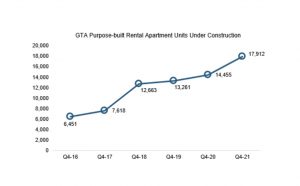
Meanwhile, purpose-built rental apartment development rose to its highest level in decades as 6,720 units started construction in 2021, nearly doubling the five-year average of 3,379 starts between 2016 and 2020. As of year-end 2021, 17,912 rentals were under construction and 93,321 rentals were proposed for development.

Rental Demand Shifts Back Into the Core

Total condo apartment lease transactions in the GTA rose 24 per cent in 2021 to a record 47,737 units. As a result, total active rental listings at year-end dropped 73 per cent from a year earlier to 2,158 units, equal to only 0.7 months of supply based on Q4 lease volume. The downtown markets were the growth leaders last year, with lease activity up 27 per cent annually in 2021 within the former City of Toronto.

Furthermore, rental activity once again favoured small units, as lease volume in 2021 grew fastest for rentals under 600 sf with 29 per cent annual growth.

Condo Rent Growth Rises into Double Digits

Condominium rents for leases signed during Q4-2021 rose 10.8 per cent year-over-year to an average of $3.27 per square foot ($2,361), led by a 15.9 per cent annual increase in the former City of Toronto to $3.64 psf ($2,456). Rents in the outer-416 markets increased 8.9 per cent annually to $3.03 psf ($2,277), while 905 region rents were up 9.4 per cent to $2.95 psf ($2,282).

GTA rents were down 3.5 per cent when compared to the pre-pandemic average in Q4-2019, with City of Toronto rents down 4.5 per cent but 905 region rents growing 4.1 per cent over the two-year period. The rent recovery over the past year was strongest for studios units, which increased 15.9 per cent annually in Q4- 2021 to an average of $4.31 psf ($1,771), compared to annual growth of 12.5 per cent for one-bedrooms to an average of $3.44 psf ($2,117), 9.6 per cent for two-bedrooms to an average of $3.08 psf ($2,741) and 6.3 per cent for three-bedroom units to an average of $2.80 psf ($3,382).

For more infomration, please visit Urbanation.ca


Construction company fined in GTA bid-rigging scheme

Construction company CPL Interiors Ltd. was fined $761,967 after pleading guilty before the Ontario Superior Court for its role in a criminal condo refurbishment bid-rigging conspiracy in the Greater Toronto Area.

The company admitted to conspiring with several competing businesses to allocate customers and fix bid prices on 31 refurbishment contracts issued by private condominium corporations between 2009 and 2014.

The value of the contracts totalled more than $19 million. Bid-rigging schemes result in victims paying higher prices for goods and services.

Following a Competition Bureau investigation, criminal charges were laid in March 2021 against CPL Interiors as well as three other companies and their owners. Court proceedings are ongoing against the remaining accused.

CPL Interiors received leniency in sentencing for its full cooperation throughout the Bureau’s investigation and its agreement to testify in any resulting prosecutions.

Those who believe they are involved in an illegal agreement with their competitors can come forward to seek immunity or leniency in return for their cooperation with the Bureau’s investigation through its Immunity and Leniency Programs.

“Cracking down on criminal conspiracies that harm Canadians and the Canadian economy is a top priority for the Competition Bureau,” said Matthew Boswell, Commissioner of Competition. “We will continue to pursue all those who plot to increase their profits through criminal bid-rigging schemes.”


Condo amenity closures during Omicron

As Ontario’s modified Step Two measures have shuttered most indoor sports and recreational facilities, members of the industry are weighing in on condo amenity closures amidst the highly contagious Omicron variant and pandemic-fuelled fatigue.

In a general email to CondoBusiness last Thursday, the Ontario Ministry of Health responded that “condos are not subject to requirements for indoor sports and recreational fitness facilities outlined in O. Reg 263/20.” And that they “have the ability to implement restrictions on the use of their own gyms, pools or other amenities and may wish to consult their legal counsel if doing so.”

Josh Milgrom of Lash Condo Law, said in an email, that the regulations, however, do not make the distinction between public and private settings. “As we know, COVID-19, too, does not make the distinction between public and private (or quasi-private) settings—transmission can occur in a condo just like it can in a “public setting”.

“The regulations require the person responsible (i.e. the board) for facilities for indoor sports and recreational fitness activities and indoor recreational amenities to close (subject to limited exceptions).”

Condo lawyer Denise Lash concurred. “If the intent was to let condo corporations decide for themselves as to whether to open their amenities or not, then the regulation should be changed,” she said via email.

The issue of amenity closures was further analyzed in the context of Ontario during a webinar last Wednesday night, hosted by condo lawyer Rod Escayola of Gowling WLG. In his opinion, if the regulation asserts the judgment that it does not apply to condos, then this proposition must be officially stated for clarity. “The Ministry of Health does not draft or interpret regulation; that’s the job of a judge,” he added.

As it stands, the regulation applies to businesses, places and organizations, with no reference to size or capacity. Each person responsible for a business or place that is required to be closed under Schedule 2 must close that place, he said, unless there is an exception. “Unless we are going to take the position that condos are this abstract concept or an idea. . . we are all going to have to agree they are a place. And the regs required places to close their indoor facilities.”

Exceptions for indoor sports and fitness facilities currently include use by professional, semi-professional and elite athletes, early years and childcare services, mental health and addiction support, and social services.

The consensus going forward?

In the context of Toronto, CCI Toronto advises boards to consult with their lawyer of record, whose advice they regularly follow. As CCI Toronto President Murray Johnson noted during the webinar, “they’d be the ones who would have to defend you under D&O insurance if it was challenged.”

On January 10, Toronto Public Health took the stance that the regulations do not apply, yet “strongly recommended” that condos close non-essential common areas, such as gyms, pools and playrooms. The Reopening Ontario Act requires organizations to comply with public health guidance.

Condo lawyer Graeme Macpherson of Gowling WLG said following recommendations from local public health officials, as well as the chief medical officer, is ultimately what communities should do, which includes advice about physical distancing, screening and cleaning methods.

In other jurisdictions, City of Ottawa By-law stated, on January 5, that persons responsible for condominiums and rental units ought to align their practices and policies with respect to party rooms and other indoor recreational areas accordingly.

The Condominium Authority of Ontario and board members at CAI Canada also advise that indoor sports and fitness facilities be closed with limited exceptions.

Chandos and Bird enter Building Good partnership

Chandos Construction and Bird Construction have entered into a three-year strategic partnership for the Building Good initiative. Established in 2021, Building Good is a thought leadership initiative that aims to catalyze owners and industry partners to change the way the architecture, engineering, and construction (AEC) industry designs and builds for the betterment of people and the planet.

Through this partnership, Chandos and Bird will drive sustainable change through the promotion, discussion, and execution of Building Good’s three focus areas: industry transformation, equity and inclusion, and sustainability.

“Every business can and should make the world a better place. The construction industry in particular has a significant opportunity to take the lead,” said Tim Coldwell, president of Chandos. “Together, we can be forces for good.”

Through Building Good’s key channels, including the Building Good blog and podcast, partners and industry guests will discuss AEC’s biggest challenges, innovative solutions, and the opportunities that these changes bring AEC organizations, government, and the public.

“Bird strives to positively impact the communities in which we live and work, and we are excited for this opportunity to promote meaningful change across our industry,” said Gilles Royer, chief operating officer of Bird. “Building Good aligns to our approach of maximizing social and environmental impact.”

How to Prevent Common Basement Leaks

Basement leaks are a common issue in older, smaller residential buildings. Annoying and potentially costly for owners, they aren’t necessarily a sign that the building was poorly constructed.

“Time works against older buildings,” explains Violet Lim, Project Engineer with RJC Engineers. “However, new builds are also susceptible to leaks. Concrete foundation walls can be just as vulnerable as those made of masonry or concrete block units.”

In most cases, Lim says leaks are a result of an unfortunate combination of time and forces of nature. Concrete inevitably cracks at some point in time, and often these cracks will extend the width of a basement’s foundation wall (known as “through-cracks”), allowing water in saturated soil to seep through.

According to Lim, basement leaks are typically caused by one, or a combination, of the following:

  1. Hydrostatic pressure

This occurs when the soil below the foundation and/or around the foundation walls is saturated with water, creating pressure against the foundation slab from below or against the walls. If the walls are not adequately waterproofed, or if there are through-cracks present and the water isn’t properly drained away from the foundation wall via a weeping tile system at the foundation’s footing, water is forced into the basement.

“Some soils, like sand or loam, absorb little water and allow fast drainage, while clayey soils are very absorptive and potentially expansive when saturated,” says Lim. “If water is not adequately discharged via weeping tiles to a municipal storm drainage system, surface soil can become saturated during heavy rain or snowmelt events.”

Additionally, blocked or clogged gutters and downspouts that do not extend away from the building will discharge large volumes of water adjacent to the foundation.

  1. Seepage

If the top of a foundation wall is below the surface soil grade, seepage is likely to occur over the top of the wall during heavy rain or snowmelt events.

  1. Backsloping

Sometimes a negative-sloped yard that slopes towards the building rather than away from it, will direct large volumes of water to the exterior wall and create hydrostatic pressure. “If that wall is not adequately waterproofed, and if cracks are present, the water will have nowhere else to drain,” warns Lim. “If there is no weeping tile system at the foundation footing to direct water to a storm sewer system, then leaking will occur into your basement.”

  1. Poor reinforcement

A foundation wall that has too little steel reinforcement sometimes results in structural cracks that extend the width of the wall, allowing water to seep through. Bowing foundation walls and/or horizontal cracks at or near the mid-span of the basement wall are indicative of inadequate steel reinforcement within the walls.

“However, the most common source of water seepage is actually through non-structural cracks in a concrete wall,” Lim says. “Both structural and non-structural cracks are caused by different mechanisms and require different repairs or combinations of repairs.”

  1. Clogged window wells

While most window wells come with drains in case water accumulates from heavy rain or snowmelt events, these drains may become clogged or may be missing entirely, in which case water will enter around the window.

basement leaksPreventative maintenance and repair tips


Typically, basement repair leaks can be performed from the inside or the outside as needed, and they can be done on concrete, cement block, or masonry foundations. According to Lim, there are several ways to repair existing leaks and prevent future ones from occurring.

  1. Install a waterproofing membrane on the exterior side of the foundation wall. This would require excavation of soil to facilitate the installation. At the same time, if not already installed, Lim recommends adding an exterior weeping tile or drain system. This is a belt-and-suspenders system designed to reduce hydrostatic pressure during heavy rain or snowmelt events, and to direct large volumes of water away from the foundation wall to the storm sewer system
  2. If the grade is backsloped towards the house, it should be properly re-sloped away from the building.
  3. If there are structural cracks present in the concrete wall, this could be a sign that the structure is shifting or sinking, or that there is inadequate steel reinforcement within the wall. Consult a structural engineer, as structural repairs may be required. If the engineer deems that the cause is inadequate steel reinforcement within the wall, the wall then needs to be stabilized, usually in the form of supplementary steel reinforcement installed in the basement interior. Both structural and non-structural cracks can be sealed from the interior via expanding polyurethane crack injections, which is an expanding, flexible material that fills and seals the crack. If the cracks are narrow enough, they can be bridged with an exterior waterproofing membrane.
  4. Window wells that don’t have drains should have them installed to direct water to the weeping tile system below or away from the building. Clogged drains should be inspected regularly and cleaned of debris. Window well covers keep out debris and minimize the chances of a drain from being clogged.

Implications of unchecked water leakage

Water is the source of most building issues, and these can exacerbate or compound over time. For buildings that have gypsum board drywall covering interior basement foundation walls, the presence of water promotes the growth of mould, which is dangerous and harmful to your occupants’ health. Additionally, leaks can cause further structural damage if not dealt with in a timely fashion, potentially rendering the foundation and the building unsafe. As such, Lim says it is crucial to detect any moisture ingress as early as possible.

For more information on preventing basement leaks, please visit www.rjc.ca or contact Violet Lim directly at [email protected]


Canada’s clean energy efforts garner plaudits

Canada’s clean energy efforts have been deemed exemplary among oil and gas producing countries. A newly released report from the International Energy Agency (IEA) generally commends the federal government’s targets and policies for reducing greenhouse gas emissions and identifies Canada as a potential key player in the transition to low-carbon energy sources — both as a stable supplier of the fossil fuels that will be needed in the interim and as a leader in curbing emissions from oil and gas production.

As an oil and gas exporter, Canada is in the minority of the IEA’s 30 member nations. However, IEA executive director Fatih Birol suggests that gives it strategic influence in the Organisation of Economic Cooperation and Development (OECD), with which the IEA is affiliated, and the wider global context. One of the world’s most stringent emission taxes — currently at $50 per tonne, but set to increase in annual $15-increments until it reaches $170 in 2030 — a recent pledge to cut oil and gas methane emissions to 75 per cent below 2012 levels by 2030, and committed investment in energy-related research and development (R&D) are all cited as indicators of serious intent.

“We still need oil and gas for years to come and, therefore, somebody has to produce it. I prefer that fuels are produced by countries that: a) produce them in a clean way; and b) are reliable partners for the consumers.” Birol observed during an online media briefing in conjunction with the release of the IEA’s report. “We follow many oil and gas producing countries around the world, looking at their plans, programs and the concrete steps they are making. I can very easily and comfortably say, in terms of transformation and taking it seriously, Canada is definitely in the top league of all those oil producing countries when it comes to addressing our climate challenge.”

“The IEA is one of the world’s most trusted voices on energy and it’s both rewarding and reassuring to have the agency acknowledge our impressive leadership, as they put it, on climate action, while commending our conscious efforts and historic investments to get Canada to net-zero emissions by 2050,” responded Canada’s Minister of Natural Resources, Jonathan Wilkinson, who also participated in the online briefing.

That said, the report identifies many opportunities for improvement and makes recommendations for priority actions as part of a comprehensive review of energy policy, programs, infrastructure, demand pressures, components of supply and resulting environmental implications. The IEA conducts such in-depth assessments of all its member nations on an ongoing basis, and last scrutinized Canada’s energy landscape in 2015.

For 2022, IEA analysts highlight three fundamentals of the low-carbon transition —energy efficiency, renewable energy, and R&D and innovation — which are further emphasized in two of the report’s four overarching key recommendations. They call for increased federal funding for emerging clean energy technologies and the development of a national energy efficiency strategy that establishes targets for the buildings, transportation and industrial sectors.

Muted energy efficiency role model

Energy efficiency plays a central role in reducing GHG emissions and is frequently tapped as a logical economic driver of the low-carbon transition through investment in retrofitting homes, commercial and institutional buildings and industrial facilities. In contrast to Birol’s flattering characterization, it’s also a category in which Canada stumbles as an international role model.

“Canada, in 2019, still had the highest energy intensity of GDP among IEA member countries and the second highest energy intensity per capita,” Divya Reddy, IEA analyst and lead author of the Canada review, confirmed during the online briefing.

That equates to 119 tonnes of oil equivalent (toe) per USD $1 million compared to the IEA average of 65 toe/USD $1 million, and 5.47 toe per capita versus the IEA average of 2.9 toe per capita. However, in the decade between 2009 and 2019, Canada’s GDP grew by 24 per cent, while, reflective of more efficient performance, energy intensity of GDP decreased by 10 per cent. Energy intensity per capita remained fairly steady, albeit rising by 0.05 per cent, over the same period, as the population grew by 12 per cent.

“Canada’s energy system today is still heavily dominated by fossil fuels and in 2020 the largest source of energy supply was natural gas, which accounted for 39 per cent of supply, followed by oil at 33 per cent,” Reddy noted. “Total consumption of energy increased by 12 per cent between 2009 and 2019, driven by economic growth, and in line with that, energy-related carbon dioxide emissions have also been steadily increasing in recent years.”

Buildings account for slightly less than one third of total final energy consumption, although, at 67 million tonnes of oil equivalent (Mtoe), it’s a roughly comparable portion to the other two predominant end uses, industry (71 Mtoe) and transport (68 Mtoe). Residential dwellings represented about 53 per cent of the sector’s energy demand in 2019 with the remainder in commercial and institutional buildings. Sector-wide, 58 per cent of energy demand was attributable to space heating, equating to more than 35 Mtoe and far outdistancing other uses such as water heating, lighting and cooling.

Looking at where more impetus is needed, the report points to the familiar Canadian complication of shared federal-provincial jurisdiction and urges the federal government to use its leverage to prompt more action and/or better results. IEA analysts recommend: faster rollout of national building and energy codes with requirements to meet retrofit and net-zero-energy-ready standards; tying federal funding for energy efficiency in buildings to “outcome-based” targets and ensuring that energy poverty is addressed; and introducing incentives and/or regulations to drive the adoption of energy management systems and implementation of energy audit recommendations in industry.

Those are in line with policy directions that Efficiency Canada, a national research and advocacy organization promoting the dual environmental and economic benefits of resource conservation and climate action, has actively endorsed. Brendan Haley, Efficiency Canada’s policy director, maintains that some federal measures are languishing, while others need refinement to draw more uptake and achieve better results.

“The emphasis on energy management systems is something that has received little federal policy attention, despite a federal policy goal to see 75 per cent of industrial energy demand benefiting from energy management systems by 2030,” he notes. “The recommendation to ‘set outcome-based targets for each financial programme targeting energy efficiency in buildings’ highlights that federal programs, such as Greener Homes and the Canada Infrastructure Bank, are providing incentives without net-zero emissions compatible standards to guide them. Existing programs are supporting incremental energy and GHG savings more than the scale required for net-zero.”

Exploring technologies for clean and conventional fuels

In other prioritized elements of the low-carbon transition, Canada ranks third among the 30 IEA member nations for the percentage of its GDP — 0.6 per cent — it invests in R&D and supporting commercialization of innovative energy technologies. That includes a focus on hydrogen, nuclear small modular reactors and, closely tied its conventional fossil fuel resources, carbon capture utilization and storage (CCUS).

“Canada is already a global leader in CCUS with four of the world’s 26 commercial projects in operation as well as extensive expertise in research and development, and these technologies can notably play an important role in decarbonizing upstream crude oil production,” Reddy advised.

Accordingly, Birol ranks carbon capture and storage in the top three of approximately 800 technologies contemplated in the IEA’s roadmap for the low-carbon transition. “In the absence of CCUS, reaching our climate goals will be much more difficult, if at all possible,” he said.

It also aligns with the role he sees for Canada as “an important supplier of oil and gas to the global market”. Meanwhile, Wilkinson sketched out the prospects for a continued strong presence heading into and on the other side of the energy transition.

“Canada faces challenges and opportunities that are unique — our climate, our geography, our demographics and, certainly, our economy. Our climate action has to reflect that,” he maintained. “Canada is blessed with an abundance of natural resources that position us to be a global leader in clean energy. We have ample land for solar and wind farms, vast water systems for hydroelectric power, geological formations to sequester captured carbon, critical minerals for clean technologies, uranium needed for nuclear energy and, of course, significant traditional sources of energy.”

Barbara Carss is editor-in-chief of Canadian Property Management.

Construction drug crisis services expand in B.C.

Vancouver Island Construction Association (VICA) has received a provincial grant of $1 million to expand its Tailgate Toolkit project, a harm-reduction program to prevent toxic drug poisoning in B.C.’s construction industry.

“We are eager to continue the work that we have been piloting over the past year and would like to thank the Ministry of Mental Health and Addictions for entrusting the Vancouver Island Construction Association with this funding,” said Rory Kulmala, chief executive officer, Vancouver Island Construction Association.

The project will reduce the stigma associated with substance use and raise awareness of pain management, pathways to treatment and other information about mental health and substance use.

“The toxic drug crisis continues to take lives at a tragic rate. In cases where we know where someone worked, nearly 20 per cent of those who died worked in trades, transport or as equipment operators,” said Sheila Malcolmson, minister of mental health and addictions.

The expanded toolkit will allow workplaces to educate staff about substance use to help prevent toxic drug deaths, as well as harm-reduction and recovery strategies and employee resources. Workers with substance-use challenges will also have access to weekly support groups facilitated by front-line workers with lived experience of substance use and working in the construction industry.

The toolkit will include training for managers and responders to recognize and provide support for people with substance-use and mental-health challenges, including mental-health first aid, naloxone training, pain management and more.

As part of this project, construction associations throughout British Columbia, including the Vancouver Regional Construction Association (VRCA), the Southern Interior Construction Association (SICA) and the Northern Regional Construction Association (NRCA), will host dedicated harm-reduction co-ordinators. They will also provide access to print and digital resources developed in consultation with regional health authorities to highlight the harm-reduction and recovery services available to workers within and beyond their benefit packages.

“This is another important example of how construction leaders are leaning in to support the industry’s essential workforce. By creating safe and accessible resources that help destigmatize the realities of mental-health and addictions issues, we can further demonstrate our commitment to the communities in which we live, work and build,” said Chris Atchison, president, BC Construction Association.

Average rental rates for December 2021

Average rental rates for all Canadian properties in the final month of 2021 reached $1,789 per month — up 3.8 per cent from a year ago, according to the latest report from Rentals.ca and Bullpen Research & Consulting. December was the fourth consecutive month average asking rents were positive since the onset of COVID-19, which sparked 16 consecutive months of annual declines.

“Average rental rates moderated in December after rents surged following the April market bottom, where rents had fallen by over 9 per cent annually,” said Ben Myers, president of Bullpen Research & Consulting. “It is too early to tell if Omicron will have a prolonged deflationary impact on the rental market, but Bullpen Research & Consulting and Rentals.ca still believe there will be significant upward growth in rents in 2022 in Canada’s major markets.”

Vancouver topped the list of 35 cities for average monthly rents in December for both one- and two-bedroom homes. Coming in at $2,176 and $2,983 respectively, these numbers represent an annual increase of 13.2 per cent and 9.7 per cent, and a month over month increase of 2.1 per cent.

Toronto finished second for monthly rents in December with one-bedrooms averaging in at $2,013 and two-bedrooms at $2,715. Year over year, Toronto was up 9.2 per cent for one bedrooms and 11.6 per cent for two-bedrooms. Month over month, rent in Canada’s largest city was down 1.4 per cent and 2 per cent respectively.

The majority of municipalities in Canada, including Montreal, Calgary and Mississauga, saw an increase in average rents since December 2020, while North York, Scarborough, Hamilton, and Edmonton were the few centres that experienced a decline. Regina had the lowest average rent out of all the municipalities with an average of $1,014 per month, unchanged from the previous year.

“December is typically one of the slowest months for rental activity every year, and 2021 appears to be no exception,” said Myers.

Apartment types 

The national average for a single-family home in December was $2,570 per month – an annual increase of 8.9 per cent, but still below pre-COVID-19 highs. (The average rent had declined 9.3 per cent in the pandemic-impacted 2020 to $2,360.)

Condominium apartments experienced an annual increase of 11 per cent to $2,227 per month in December. Condos were hit the hardest during the early pandemic period as some tenants fled the big cities, causing  condo rents to fall by a whopping 18 per cent over the course of 2020.

Meanwhile, rental apartments have not experienced the same levels of increases as single-family homes and condo apartments, increasing annually just over 1 per cent from $1,603 per month in December 2020 to $1,623 per month this December.

For the full report, click here: Rentals.ca January 2022 Rent Report