Articles Archive - Page 307 of 928 - REMINET
REMI

Ontario raising foreign homebuyer tax to 20 per cent across the province

The Ontario government is increasing the foreign homebuyer tax from 15 per cent to 20 per cent, to help first-time homebuyers and crack down on tax avoidance.  The new rate takes effect on March 30, 2022, and will expand across the province.

Currently, the non-resident speculation tax only applies to homes purchased in the Greater Golden Horseshoe Region by foreign nationals, foreign corporations and taxable trustees.

Plans are to focus NRST relief eligibility to only newcomers who commit to laying down roots in the province long-term.

Rebates for new permanent residents of Canada and related exemptions will be available to eligible newcomers. Foreign nationals studying and working in Ontario who become permanent residents will have the opportunity to apply for the rebate.

The province is also working with municipalities that are looking to establish a vacant home tax. The authority for municipalities to implement such taxes exists in the Municipal Act. The City of Toronto has introduced a vacant home tax. Ottawa is also preparing to implement similar taxes. A working group will be formed with municipal representatives to facilitate the sharing of information and best practices.

“There is no silver bullet to solving the housing crisis,” said Minister of Municipal Affairs and Housing Steve Clark. “Addressing the housing supply crisis is a long-term strategy that requires long-term commitment and coordination with our partners and between all levels of government.”

As well, Ontario will consult on potential measures to address concerns related to land speculation, such as exploring ways to discourage construction slowdowns that may be artificially driving up prices of new homes for families.


Data centre leasing hits record level in North America

Large cloud service providers and social media companies are fuelling demand for North American data centres, as leasing reached record levels in 2021.

CBRE’s latest North American Data Center Trends Report shows that there was 493.4 megawatts (MW) of net absorption in the seven primary U.S. data centre markets last year. This represents a 31per cent increase over 2019’s then-record level, and up 50 per cent from 2020.

Montreal and Toronto markets remain unchanged in H2 2021, though they have 69.0 MW and 40.0 MW, respectively, under construction. This new construction is largely due to cloud service providers growing their presence in the Canadian markets. Montreal’s construction pipeline remained the same from H1, while Toronto’s grew by 35.0 MW in H2 2021. Future supply is  23.2 per cent pre-leased in Montreal and 77.5 per cent pre-leased in Toronto.

Calgary market buzz

Calgary is listed as the only Canadian market that is currently creating a “buzz” within the  North American data centre world.

The city is said to benefit from its proximity to the West Coast, along with offering more affordable land costs than Vancouver, while growing the network connectivity serving that region of Canada. While Montreal and Toronto continue to see their markets grow, Calgary will see growth driven by its geography, low risk of natural disasters and the need for western expansion, CBRE forecasts.

More options for occupiers in North America in 2022

Overall, despite a 17 per cent year-over-year increase in primary-market inventory, vacancy fell to just 7.2 per cent. Occupiers in need of data centre capacity in markets with low vacancy are expected to have more options this year, with 727.6 MW of facilities under construction.  However, 44 per cent of this space has been pre-leased.

“We expect continued strong data centre demand from cloud service providers and social media companies in 2022 as these firms race to build out their digital infrastructure to support demand for cloud services and metaverse and other digital communities,” said Pat Lynch, executive managing director, Data Center Solutions, CBRE. “We also anticipate increased appetite for highly connected colocation space from enterprise users, and pricing increases and longer lead times for available capacity in certain markets due to power constraints and supply chain challenges.”


6 ways to help workers recover from COVID-19 burnout

For many Canadian workers, the burnout is real.

A recent survey found that 84 per cent of Canadian employees have experienced burnout, with 34 per cent reporting high or extreme levels.

Will easing public or workplace restrictions around COVID-19 automatically reverse employees’ pandemic-related burnout? Particularly for frontline staff such as cleaning and maintenance workers, it may not be that easy.

Kart Vyas, Workplace Safety and Prevention Services (WSPS) Specialized Consultant, defines burnout as “physical, emotional, and/or mental exhaustion resulting from persistent, prolonged unresolved stress that may take time and effort to heal and recover from.”

WSPS notes that much of this burnout has been fueled by pandemic worry, aggravated by increased workloads, longer work hours, isolation, and little vacation time. Employees who are experiencing burnout often have less energy, are less productive, have difficulty concentrating, and feel less motivated.

“Well-being is composed of physical health, social health, and mental health. It is important that we support and engage in activities that incorporate all three aspects of well-being in our routine,” explains Vyas.

What can you as a facility manager or janitorial service provider do to help your employees recover from COVID-related burnout? Because many different factors may contribute to COVID-related burnout, take a multi-faceted approach. Your end goal is to provide a physically and psychologically safe and healthy workplace.

WSPS advises considering these six opportunities:

  1. Ask employees how they’re doing. Conduct a comfort survey asking workers about their mental health and whether they are experiencing burnout. “Just participating in a well-thought-out comfort survey will provide mental relief for some employees by making them part of the decision-making process,” says Vyas.
  2. Share the survey results, and how you plan to address employee issues and concerns, such as returning to work and devolving COVID requirements. Engage workplace stakeholders in identifying solutions.
  3. Raise awareness of COVID-related burnout. Educate employees on how to recognize symptoms, anticipate and adjust to difficulties, and set priorities. Introduce them to self-help techniques that focus on emotional, physical, intellectual, social and mental health. “Consistent daily routines help increase a sense of control in people with burnout,” notes Vyas. Reassure employees they can speak in confidence with supervisors or HR about how to accommodate their needs.
  4. Assess workload levels. Prioritize tasks and keep expectations reasonable: base assignments and deadlines on each employee’s abilities, proficiency and experience. Encourage employees to speak up if they have questions or feel overwhelmed. Be open to employees’ ideas about how to do things better.
  5. Actively support work-life balance. Infringements on family time because of longer workdays, virtual schooling and expectations of being always available have contributed to COVID-related burnout. “Ensure employees are able to disconnect from work at the end of their prescribed workday, and that your company culture supports this,” adds Vyas. Encourage employees to take vacation time and proper rest breaks. Allow for flexible work arrangements so employees can meet personal or family needs.
  6. Put a mental health first aid policy in place. Train your employees to recognize the signs and symptoms of mental disorders, provide access to resources, and educate yourself on how to respond to a mental health emergency.

B.C. realtors warn cooling-off reg will inflame competitive housing market

New legislation in B.C. will allow for a cooling-off period before a home purchase to give buyers time to get financing in order and undertake an inspection. But the BC Real Estate Association is giving a thumbs down to the government regulation that was approved yesterday as part of the Property Law Amendment Act.

A recent independent survey of 1,157 British Columbians shows that only 35 per cent of consumers support introducing such a policy, BCREA said in a statement released today.

“A cooling-off period will likely increase competition for any given property, has the potential to increase prices and does not clearly take risks to sellers into account,” says BCREA Chief Executive Officer Darlene K. Hyde. “Given that the government has again announced plans for policy changes without publicly stated and evidence-based reasoning or proper consultation in advance of committing to the direction, it’s no wonder that consumers don’t have confidence in what they’ve proposed.”

BCREA is calling on the government to consider the following before proceeding with regulatory change:

  • Any new policies should protect both buyers and sellers equally. Sellers often become buyers in a real estate transaction and the cooling-off period exposes sellers and the market in general to greater risks and uncertainty.
  • Provide evidence-based reassurance that the government’s cooling-off period won’t unintentionally worsen affordability.
  • Ensure that consumers and the real estate professionals who support them are appropriately supported during the transition.
  • BCREA rejects any suggestion that realtors are not invested in consumer protection and housing affordability. On behalf of realtors, in February 2022, BCREA presented the B.C. government with a white paper with more than 30 recommendations on how to improve housing affordability and strengthen consumer protection.

Instead of a cooling-off period, a key recommendation in the white paper, A Better Way Home: Strengthening Consumer Protection in Real Estate, is the introduction of a pre-offer period of a minimum of five business days from listing during which prospective buyers could hire home inspectors of their choice, review important documents, ensure financing and complete any other due diligence prior to making an offer.

“The realtor profession does not benefit from over-heated market conditions that leave most of their clients frustrated and discouraged, as they lose out again and again on their homeownership dreams,” says Hyde. “It’s time to let go of that harmful preconception and acknowledge the important contributions realtors can make to better protecting consumers and improving housing affordability.”

Report illuminates workers’ mental health struggles

Canadian office workers are struggling with their health and wellbeing more than two years into the pandemic, As organizations welcome employees back to the workplace in various forms, a new report says they would be wise to consider amping up mental health supports as soon as possible.

As Manulife’s 2021 Wellness Report found, 48 per cent of employees are experiencing at least one work-related mental health risk factor.

“Employee mental health patterns could be K-shaped as we move through the next phase of the pandemic,” said Dr. Georgia Pomaki, Director, Mental Health Best Practices, Manulife. “One arm of the K represents employees who are excited about reopening and returning to the office—the other represents a group of employees who are facing mental health challenges and significant fatigue: for this group, a return to office may feel overwhelming. Organizations need to consider both groups to design effective and supportive return to office programs.”

56 Manulife Group sponsors participated in the 2021 Wellness Report and 6,141 employees responded to the online surveys. The Wellness Report surveys were conducted in February, May, and October 2021.

The report highlights that 16 per cent of working hours (41 days) were lost in 2021 due to absences and presenteeism. Lack of work-life balance is the number one mental health risk factor, while work-related stress affected employees’ sleep the most. Workers also said they’re not making healthy choices mainly due to mental fatigue.

These findings suggest employers should consider placing significantly more focus on culture and wellness programs in 2022 and beyond, particularly as large employee populations return to Canadian offices in the near future.

Dr. Pomaki suggests mental health supports like virtual psychotherapy, employee assistance programs, and mindfulness sessions to improve employee health and well-being.

“Organizations can help employees by removing barriers to accessing these benefits, increasing communications about available products and services, and helping reduce the stigma around their use,” she said. “Given what we have been living through the past two years, if there’s ever a time to accelerate these efforts, the time is now.”


Unlock free building energy with AI

There’s free energy to be harnessed from every building. The trick is taking advantage of thermodynamics through artificial intelligence (AI).

It may sound like science fiction at first, but the idea has been around for decades. Since the 1970s, academic researchers have been fine-tuning the process of using a building’s natural thermal mass to influence internal temperatures. And today, one company out of Halifax is bringing the benefits of that research to help building operators achieve more efficient, eco-friendly, and cost-effective HVAC operations in the form of an AI solution.

That company is EcoPilot Canada | USA, a proud “carbon crusader” that uses AI-driven software of the same name to optimize HVAC systems in real-time to deliver the greatest energy efficiency possible.

“Think of it as a brain that can be added to any building automation system to unlock this free energy that’s always been there,” says Jennie King, Commercial Director with the Halifax-based company.

Here’s how it works.

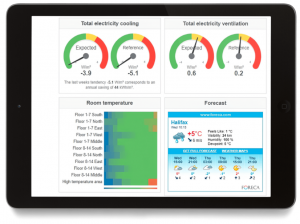
Ecopilot®’s program constantly monitors a building’s static (e.g., thermal mass) and fluid elements, the latter of which include internal heat sources (e.g., people, computers, and lighting) or external weather (e.g., temperatures, wind speed, humidity, solar incident radiation, etc.). Every two minutes, the AI then analyzes these factors along with predictive data (e.g., weather forecasts) to calculate the variable balance point  temperature of a building.

Pinpointing that specific balance point temperature is step one. Next, Ecopilot® shares that number with the building’s existing BMS system, where it is used to align prescribed HVAC set points so that they react with the real-time balance point temperature. Doing so reduces HVAC fluctuations and eliminates unnecessary system overlaps, such as heating and cooling an environment in the same day or at the same time.

“Essentially, Ecopilot® uses all this real-time data to continuously re-commission the HVAC system every two minutes,” explains King. “The result is that these systems start running far more efficiently, use less energy, and reduce their carbon emissions – all while keeping people a lot more comfortable.”

Proven in the field

Ecopilot® has spent over a decade bringing its AI tech to property stakeholders across Canada and the world. And while King admits there can be some upfront hesitation to bringing AI into building operations, those that make the upgrade are quick to reap the rewards.

In June 2018, for example, Crombie REIT’s Cogswell Tower, a 50-year-old concrete office building in Halifax implemented Ecopilot® to help save energy across its 14-storey, 200,000 sq. ft. asset. Doing so reduced energy costs by 26.5%, generating a return on their investment under two years. Moreover, Pat Poirier, Manager of Engineering and Sustainability, reported they had reduced energy consumption by over one million kWh, exceeding their expectations for their entire campus of buildings.

EcopilotMore recently, MINTO PROPERTIES implemented the tech at a multi-unit residential property at 150 Roehampton Ave in Toronto. Speaking to early reservations, Joanna  Jackson, Director of Sustainability & Innovation at MINTO PROPERTIES, recalls: “We were concerned about not achieving the expected energy savings. However, Ecopilot®’s minimum savings guarantee ensures that the project will be successful from a financial perspective.”Fast forward to now, and Jackson reports that the Ecopilot® system has succeeded in optimizing the building’s operations and reducing its electricity and natural gas consumption, noting, “The system also identifies if the equipment is not operating properly. That allows us to react faster to maintenance issues and improve residence satisfaction by minimizing system down-times.”

EcopilotImplementing AI into MINTO’s BAS seemed like a leap at first, she adds, but the outcomes have alleviated any doubt: “As we move towards low-carbon technology and attempting to minimize greenhouse gas emissions, it becomes more important to operate the equipment as efficiently as possible. Smart building technologies bridge the gap between design and actual operating efficiency.”

Success stories like MINTO’s are adding up. Over its 13-plus years, Ecopilot® has seen its system installed in over 1,200 buildings worldwide, improving building efficiencies by up to 40% annually with a three-year ROI.

Unlocking the energy within

AI and smart machines are recoding virtually every facet of property management. Ecopilot® is among the innovations merging established building science with cutting-edge tech to create future-ready assets.

Ecopilot
Learn more about Ecopilot®. Visit www.ecopilotai.com.

Unlock free building energy with AI

There’s free energy to be harnessed from every building. The trick is taking advantage of thermodynamics through artificial intelligence (AI).

It may sound like science fiction at first, but the idea has been around for decades. Since the 1970s, academic researchers have been fine-tuning the process of using a building’s natural thermal mass to influence internal temperatures. And today, one company out of Halifax is bringing the benefits of that research to help building operators achieve more efficient, eco-friendly, and cost-effective HVAC operations in the form of an AI solution.

That company is EcoPilot Canada | USA, a proud “carbon crusader” that uses AI-driven software of the same name to optimize HVAC systems in real-time to deliver the greatest energy efficiency possible.

“Think of it as a brain that can be added to any building automation system to unlock this free energy that’s always been there,” says Jennie King, Commercial Director with the Halifax-based company.

Here’s how it works.

Ecopilot®’s program constantly monitors a building’s static (e.g., thermal mass) and fluid elements, the latter of which include internal heat sources (e.g., people, computers, and lighting) or external weather (e.g., temperatures, wind speed, humidity, solar incident radiation, etc.). Every two minutes, the AI then analyzes these factors along with predictive data (e.g., weather forecasts) to calculate the variable balance point  temperature of a building.

Pinpointing that specific balance point temperature is step one. Next, Ecopilot® shares that number with the building’s existing BMS system, where it is used to align prescribed HVAC set points so that they react with the real-time balance point temperature. Doing so reduces HVAC fluctuations and eliminates unnecessary system overlaps, such as heating and cooling an environment in the same day or at the same time.

“Essentially, Ecopilot® uses all this real-time data to continuously re-commission the HVAC system every two minutes,” explains King. “The result is that these systems start running far more efficiently, use less energy, and reduce their carbon emissions – all while keeping people a lot more comfortable.”

Proven in the field

Ecopilot® has spent over a decade bringing its AI tech to property stakeholders across Canada and the world. And while King admits there can be some upfront hesitation to bringing AI into building operations, those that make the upgrade are quick to reap the rewards.

In June 2018, for example, Crombie REIT’s Cogswell Tower, a 50-year-old concrete office building in Halifax implemented Ecopilot® to help save energy across its 14-storey, 200,000 sq. ft. asset. Doing so reduced energy costs by 26.5%, generating a return on their investment under two years. Moreover, Pat Poirier, Manager of Engineering and Sustainability, reported they had reduced energy consumption by over one million kWh, exceeding their expectations for their entire campus of buildings.

EcopilotMore recently, MINTO PROPERTIES implemented the tech at a multi-unit residential property at 150 Roehampton Ave in Toronto. Speaking to early reservations, Joanna  Jackson, Director of Sustainability & Innovation at MINTO PROPERTIES, recalls: “We were concerned about not achieving the expected energy savings. However, Ecopilot®’s minimum savings guarantee ensures that the project will be successful from a financial perspective.”Fast forward to now, and Jackson reports that the Ecopilot® system has succeeded in optimizing the building’s operations and reducing its electricity and natural gas consumption, noting, “The system also identifies if the equipment is not operating properly. That allows us to react faster to maintenance issues and improve residence satisfaction by minimizing system down-times.”

EcopilotImplementing AI into MINTO’s BAS seemed like a leap at first, she adds, but the outcomes have alleviated any doubt: “As we move towards low-carbon technology and attempting to minimize greenhouse gas emissions, it becomes more important to operate the equipment as efficiently as possible. Smart building technologies bridge the gap between design and actual operating efficiency.”

Success stories like MINTO’s are adding up. Over its 13-plus years, Ecopilot® has seen its system installed in over 1,200 buildings worldwide, improving building efficiencies by up to 40% annually with a three-year ROI.

Unlocking the energy within

AI and smart machines are recoding virtually every facet of property management. Ecopilot® is among the innovations merging established building science with cutting-edge tech to create future-ready assets.

Ecopilot
Learn more about Ecopilot®. Visit www.ecopilotai.com.

Cases shed light on maintenance and repair obligations in condos

There is no doubt that a condominium corporation has maintenance and repair obligations; however, the extent of those obligations is often debated and results in a court dispute to be decided by a judge.

Maintenance and repair obligations of both owners and condo corporations are defined in the Condominium Act, which sets out the minimum default obligations. These default obligations can be redefined by a condominium’s declaration.

As such, when examining the extent of the corporation’s obligations, in terms of maintenance and repair, one must look to sections 89 to 92 of the Act and then your specific declaration. However, to fully understand the repair and maintenance obligations of a corporation it is always helpful to look to the courts as well, to see how they have interpreted and defined these obligations.

Here are three cases over the last year which shed some light on what condos should and should not be doing to fulfill their maintenance and repair obligations.

The Court in Berman v. YCC No. 99 (Oct 2021) dealt with the issue of the reasonable expectation of owners regarding maintenance and repair of common elements. In this case, the issue was the replacement of a bedroom window. The owner, Mr. Berman, wanted his bedroom window replaced as he felt it was too drafty. He expected that it would be replaced when he said it needed replacement. The condo did not agree that the window needed immediate replacement as suggested by the owner but had the window on its list of windows to replace in the next year.

The condo was a 160-unit condo. It was 50 years old and everyone wanted new windows. The condo was replacing windows as needed and replaced them in priority depending on the amount of age and wear. The condo had a window replacement policy. Mr. Berman’s window was scheduled to be replaced in 2021. Mr. Berman began his court application for oppression under s. 135 of the Condo Act in November 2020. The window was replaced in March 2021 as originally promised. Despite this, Mr. Berman continued his court action for damages as the temperature in his bedroom was a few degrees colder than the rest of his unit.

The court dismissed the owner’s application and held that an owner cannot expect more from the board other than for the board to manage the condo honestly, in good faith and with due diligence as required of them under s. 37 of the Act. The court found that the condo had an economically responsible and sensible window replacement policy. It inspected the owner’s window multiple times over the years. It did not ignore his unit. It replaced a bathroom window when needed and re-caulked when needed. The court found that the owner could not show that the condo behaved unreasonably or oppressively. There was no evidence that the window failed or needed to be replaced before it was replaced. The condo met their obligations to repair and maintain the common elements.

An earlier case from April 2021, which was referenced in the Berman case, set out the factors a court will take into account when assessing the corporation’s duty to repair. These factors are:

  • Relationship between the condo corporation and the unit owners.
  • Opinion of the unit owners.
  • Wording of their contractual obligations.
  • Nature of the condo development.
  • Objective standards of quality and workmanship.
  • Replacement cost of the facility to be repaired.
  • Economic and budgetary constraints.
  • Need for repairs.
  • Nature of the work required to effect the repairs.
  • Timetable for effecting the repairs.
  • Benefit that may be acquired if the repairs were done compared to the detriment that be occasioned by the failure to undertake the repairs

The court emphasized that the standard a corporation must meet will be fact specific but it will not be perfection. The standard is one of reasonableness and given that it is fact specific, it will be a flexible test taking into account specific circumstances. The court noted, in the above case, that the COVID-19 pandemic affected the progress of anything in Ontario and as such a condominium corporation could not be faulted for the delay in implementing its plans to repair the common elements of the building. The court noted that the condo must balance the private interests of individual unit owners with the communal right of all and some deference should be afforded to a condo’s repair and maintenance obligations. The court found that the condo was not slow to act and their actions were not unreasonable.

A very recent case regarding winter maintenance, Musa v. Carleton Condominium Corporation No. 255 (Feb 2022) addressed the importance of following industry standards. In this case, the court was dealing with a negligence claim for a slip and fall in a condo’s parking lot. The condo corporation and the snow removal contractor were sued. The contractor acknowledged that all the condo’s obligations with respect to winter maintenance was completely delegated to it by contract and as such for the purposes of the court action the contractor was deemed the “occupier” under the Occupier’s Liability Act and liable for damages.

The issue in this case came down to the contractor’s delay in spreading salt which was found to be unreasonable as it was not in accordance with industry standards. The expert who testified referenced two specific industry standards. The first being the “Best Management Practices for Salt Use, Technical Bulletin No. 6,” Canadian Parking Association, CPA, 2006 and the second being the “Best Practices Road Salt Management, Salt Use on Private Road, Parking Lots and Walkways,” Transportation Association of Canada, April 2013. 2. The court found that the contractor did not follow these standards and as such his actions were not reasonable.

These cases illustrate some very important lessons for condo directors, owners, property managers and contractors. 

1. As your buildings start to age and major components (such as windows) require replacement but the cost of replacing them all at once is not feasible, develop an “economically responsible and sensible” policy for replacement of those items as the condo did in Berman and make sure you follow the policy. The court in Berman placed a great deal of weight on the policy that the board developed and followed when finding that the condo did not breach any duties. Rely on professionals to advise you as to what factors should be taken into account when determining what is a priority.

2. Take note that the court is not going to hold condos to the standard of perfection. There are a variety of factors, as described above, that the court will look at when assessing whether or not the condo breached its duty to maintain and repair. The test is fluid and very fact specific. If there are extenuating circumstances that are delaying repairs and maintenance (such as the COVID pandemic, supply chain issues, availability of contractors, etc.), make sure you properly document these extenuating circumstances and consider getting letters from contractors and suppliers to confirm that these are reasons why things are delayed. You never know when those letters will come in handy to show that the specific circumstances the condo was dealing with was out of their control. These letters could provide useful evidence in case an owner commences a court application complaining that the condo is not repairing things quickly enough.

3. The importance of carefully drafted written contracts with contractors, especially in terms of winter maintenance but definitely applicable to all types of contracts, cannot be overstated. If you are expecting the contractor to assume any type of legal liability that would normally fall on the condo, be sure to include clear language in your written contracts stipulating this and make sure you are not taking on any of the duties or work that the contractor is being contracted to do and you are not directing the contractor on how to do the work.

In terms of winter maintenance contracts, from a condo’s perspective, it is important that the entire obligation to maintain the roads and walkways is delegated to the contractor and the condo does none of this work and does not tell the contractor how to do this work. The contractor should not be taking any direction from the condominium or its management. The potential short-term savings of doing some of the work yourselves and leaving other parts to the contractor does not help the condo in the long run when a condo is facing a negligence claim for slip and falls. Neither does telling the contractor how they should do their job.

If you are trying to limit your liability, assign the entire maintenance obligations to the contractor under a clearly written contract with properly drafted indemnification provisions as the condo did in the Musa case. In addition, it would be a good idea to ask your winter maintenance contractors if they follow the most current industry standards and incorporate these standards into your written contracts as the standard you are expecting the contractor to meet.

Sonja Hodis is a condominium lawyer based in Barrie who practices condominium law in Ontario. She advises condominium boards and owners on their rights and responsibilities under the Condominium Act, 1998 and other legislation that affects condominiums and represents her clients at all levels of court, various tribunals and in mediation/arbitration proceedings. Sonja can be reached at (705) 737-4403, [email protected] or you can visit her website at www.hodislaw.com.



Construction insurance is still going up

Insurance will cost more this year. In fact, the construction industry has been dealing with inflationary pressures for the past three years. The insurance industry has typically rotated from inflationary cycles to deflationary cycles as part of the competitive nature of the business.

The insurance business globally is part casino and part risk selection. When times are good, insurance companies compete aggressively for new business. Rate reductions soon follow. Over competition ultimately results in poor risk selection and inadequate pricing. Once financial results deteriorate broadly, capacity shrinks as companies exit unprofitable business segments. This is where we are today. What seems to be different this time is that we have layered onto this inflationary phase of the business cycle increasingly severe weather events, climate change and supply chain disruption. The industry is now looking for good clean business with focused risk selection and higher prices. In short, competition is flat. Insurance companies will continue to avoid non-standard business as they push for increased pricing in nearly all insurance lines this year.

There are three main things to consider when purchasing construction insurance. Firstly, does the coverage meet the requirements of the project contract or subcontract? Secondly, are the limits of coverage and deductibles reasonable given the risk profile of the buyer? Lastly, is the overall cost of the insurance acceptable given the potential profits for the business?

Often times, the insurance requirements for a project have been copied and pasted from another project with little thought about their appropriateness. While it is always best to clarify these requirements at the tender stage, there can be an opportunity to renegotiate these terms before the project begins. Reducing insurance limits and coverage can be a good way to lower overall insurance cost. ICBC has used this approach very effectively in the past year by shifting mandatory auto coverage to a no-fault insurance plan. This has reduced coverage, resulting in substantial cost savings through lower claims.

Raising deductibles can also be an effective way to reduce insurance costs. Insurance companies have also been using this as an effective technique to limit their exposure on accounts with small frequent claims while at the same time, keeping premium increases modest. We have seen them use this approach in condo insurance to lower strata insurance costs, as well as for roofers and highway maintenance contractors. Certain construction activities such as demolition, roofing, snow clearing and long haul trucking are attracting significant price increases. For those who dabble in these activities, it makes sense to analyze the profits earned from these activities in light of the new higher insurance premiums that come with this work.

The insurance business is composed of numerous layers of Insurance companies, re-insurance companies, finance companies, government regulators, brokers, wholesalers and various other parties who collectively influence pricing. This global network of companies, people and entities compete, interact and partner to create global pricing and coverage for a wide range of business risks. While not perfect, this approach has worked reasonably well for many decades.

Insurance is the grease in the machine that helps business grow and evolve. Recently, technology companies, called Insuretechs, have raised capital to build software and AI systems to capture some of the insurance business. These new players have found some success in the simpler insurance lines such as home and auto insurance. Their goal is to create a software algorithm that improves the risk selection approach of the current market. While it is not yet clear if they will succeed, they are certain to exert downward pressure on pricing in some segments.

Almost every large insurance company is also analyzing its data in hopes of deciphering how they can best select their clients to avoid claims. Many companies have increased their reliance on software solutions to assess risk. Many are relying much less on the complex network of interpersonal relationships that have historically helped shaped price and coverage in the past. Some skilled underwriters have been reduced to data entry clerks. Personal credit checks, used as an indicator of possible future claims frequency is one such approach. Interestingly, while some carriers rely less on their professional broker network, there has been a significant increase in the role of managing general agents, who in simple terms, are wholesale brokers for retail brokers. Insurance companies who sell their products through specialist MGA’s say they get statistically better claims results than if they used retail brokers.

Private equity is also snapping up smaller retail brokers in search of yield and economies of scale. Sometimes this results in lower service for clients. The insurance market is transitioning to a new way of doing business. It will be incumbent upon government regulators to make sure that these changes benefit all stakeholders.

While the rate of price increases seems to be slowing for many insurance lines, a return to a competitive and lower priced marketplace does not seem likely for 2022. This being said, the industry is complex and dynamic. New insurance carriers, products and players are constantly working behind the scenes, striving to create a better, less costly way to transfer risk. Construction insurance is not easy. As the industry changes and evolves, it has never been more important to use an experienced, knowledgeable, and adaptable insurance professional. Fortunately, nothing stays the same for long.


Steve McConnell, vice president construction services, is a veteran insurance and surety professional with the InsureBC group of companies.

Ontario residential building permits jumped 15% in 2021

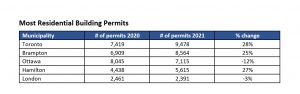
For the second year in a row, Ontario saw a significant increase in residential building permits according to the latest data from Municipal Property Assessment Corporation (MPAC). In total, more than 122,000 permits were issued across the province in 2021 for both new development and home improvement projects, representing a 15 per cent increase from the year prior.

“COVID-19 restrictions were likely a major factor again, with people focused on their home because they were spending so much more time there,” said Carmelo Lipsi, MPAC Vice President and Chief Operating Officer. “In every category of home improvement – additions, renovations, swimming pools, garages, decks and sheds – the numbers were up, in many cases by double digit percentages.”

Notably, the increases in 2020 and 2021 represent a marked shift from previous years, reinforcing the notion that pandemic restrictions were a driver of home improvement decisions. By comparison, in 2019 home improvement permits were up by just 5 per cent with overall building permits increasing marginally by 0.3 per cent. Meanwhile, in 2018 they decreased by 15 per cent

In terms of total building permits, 22,334 were issued across Ontario, with Toronto leading the way with 9,478 (up 28 per cent from 2020). The Township of Severn saw the largest percentage increase of any municipality, jumping 467 per cent in one year.

By category: 

  • Residential Home Improvement – 69,488 permits were issued province-wide in 2021, representing an increase of 18 per cent from 2020. Brampton took top place with 7,382, up by 29 per cent from 2020. Severn Township again led in percentage increase, issuing 545 per cent more home improvement permits compared to the year before.
  •  Residential Renovations/Additions – 38,399 were issued in 2021, up 19 percent from the previous year.  Brampton was the provincial leader with 7,133 renovation/addition permits,  an increase of 29 per cent.
  • Residential Swimming Pools – 9,059 total permits were issued in 2021, up 33 per cent continuing a trend that saw a 53 per cent increase from 2019 to 2020. As in 2020, Ottawa was Ontario’s swimming pool capital, with 1,372 pool permits issued, reresenting a 47 per cent jump.

“This is an interesting trend to watch, to see if it continues once pandemic restrictions have been lifted for good,” Lipsi said. “Many indicators suggest that working from home will be more prevalent than it was pre-pandemic, and we’ll see if that continues to translate to more spending on the home.”

For additional information, visit www.mpac.ca


B.C. moves forward on Hwy 5 permanent repairs

B.C. is moving forward on permanent repairs to the Coquihalla (Highway 5), marking another milestone in the province’s recovery following the significant flooding event in November 2021.

“Our crews worked hard to get the Coquihalla reopened after the severe flooding event and were able to do so in short order about a month after the storm. The pace of reconstruction to get the Coquihalla back open to traffic was impressive and beyond anything we could have imagined,” said Rob Fleming, minister of transportation and infrastructure. “We are excited to move forward on the permanent reconstruction of this key route. We will be making our infrastructure more resilient to climate change and future weather events so it remains reliable, safe and efficient for people and as our key goods movement corridor for now and for years to come.”

The ministry has issued a request for proposals (RFP) to select contractors who qualified through the Highway Reinstatement Program request for qualifications (RFQ) process, inviting these companies to take part in the competitive selection process to design and construct permanent repairs needed at three sites:

  • Bottletop Bridges, 50 kilometres south of Merritt.
  • Juliet Bridges, three kilometres south of Bottletop.
  • Jessica Bridges, 48 kilometres south of Juliet.

The RFP for the repair project closes in mid-April with the contract expected to be awarded in late April or early May. Construction is expected to begin in summer and be completed by the end of this year.

The ministry will also be proceeding in the coming months with the repair of the Othello washout area 10 kilometres east of Hope. A tender package will be prepared and made available for contractors. The ministry is focused on permanent repair efforts on these four Coquihalla sites as a first priority, as they have been operating with temporary repairs following November’s flooding.


Quebec budget boosts climate action spending

Quebec is injecting an extra $1 billion over five years into climate action spending thanks to additional revenue generated from its cap-and-trade system. The newly released 2022-23 provincial budget outlines broad commitments for what’s now a $7.6-billion strategy — including $758 million to reduce greenhouse gas (GHG) emissions in the buildings sector — with further details to be announced in an implementation plan later this spring.

Other budget measures of interest to the real estate, development and facilities management sectors include: $232.5 million over five years to help universities and colleges rent additional space for their operations; $267 million over five years for school maintenance and asset management programs; $43 million over five years to underwrite 1,600 additional subsidized units in private rental housing; and funding to help municipalities encourage brownfield redevelopment, heritage building preservation and housing renovations.

“A Québec experiencing strong economic growth is also a Québec that must take care of the environment,” Finance Minister Éric Girard declared, as he introduced the budget in the legislative assembly last week. “Protecting the environment, for everyone’s benefit, is a priority for the government.”

More than three-quarters of the pledged funds will be directed to GHG reduction with the remainder allocated to climate change adaptation. The budget commits $85 million for the buildings sector in 2022-23, but apportionments will increase in the coming years and will exceed $200 million in both 2025-26 and 2026-27.

Approximately $168 million is promised to Quebec’s two largest cities over the next three years, prioritizing fuel-switching, electric vehicle (EV) charging stations, mitigating urban heat islands and managing storm water runoff. Montreal is to receive more than $117 million, which will partly go toward deploying 800 EV charging stations in public locations. Quebec City will apply its $49 million share of the funds to municipal buildings and infrastructure and the installation of 95 public EV charging stations, but will also use a portion “to support the decarbonization of private sector buildings.”

“Similar measures benefiting other municipalities will also be announced at a later date,” the budget document states.

Municipalities are also promised $10.5 million over the next three years to help cover some costs for protecting and managing heritage properties, which have recently been transferred from the provincial government — with Montreal and Quebec City slated to get $6 million of that pot. As well, the provincial government has earmarked $2.7 million in contingency funding for urgently required repairs in cases where owners have neglected the upkeep of heritage properties.

Meanwhile, $20 million will be available over the next two years toward preliminary costs of rehabilitating contaminated sites with redevelopment potential. That’s in response to the new rules for the provincial brownfields redevelopment program, known as ClimatSol-Plus.

“By modifying current program standards and extending funding for the rehabilitation of both municipal and private land, the government will achieve economic as well as environmental objectives,” the budget document notes.

Funding for rent supplements and renovation assistance

The funding for additional rent supplements will boost Quebec’s supply of subsidized dwellings within the private rental market to nearly 20,000 units. Under program rules, tenants pay a portion of the rent equivalent to 25 per cent of their gross household income during the previous year and receive a subsidy to cover the remainder.

To provide needed accommodations, local social housing administrators may procure units at up to 120 per cent of the median market rent in the area. The 2022-23 budget also provides $24.2 million for 600 emergency rent supplements, providing urgently needed shelter for homeless people or people fleeing from violent living situations. In such cases, local housing providers may procure units at 150 per cent of the median market rent in the area.

“The construction of new housing requires lead times that do not allow for the rapid provision of affordable housing units for lower-income clienteles,” the budget document observes. “This investment will provide housing bureaus with greater predictability for finding units in the private market.”

Other housing expenditures include $52.3 million in 2022-23 to renovate aging public housing, plus $159 million over five years to continue programs to help low and moderate-income homeowners upgrade their dwellings. The latter amount will flow to three programs: $33 million for Rénovation Québec, which provides funds to municipalities to support housing upgrades in economically disadvantaged areas; nearly $62 million for the RénoRégion program, which provides funds for owner-occupiers with low to moderate incomes to make required major repairs to homes in rural areas; and $64.4 million for the Residential Adaptation Assistance Program, which funds accessibility improvements to allow people with disabilities to continue to live in their homes.

The budget also pledges $14.4 million for a five-year extension of free services to assist elderly renters in private seniors’ housing. This has been provided through community organizations known as centres d’assistance et d’accompagnement aux plaintes (CAAPs), which have a mandate to act on behalf of clients of Quebec’s health care and social services institutions.

“Elderly people living in private seniors’ residences (PSRs) also experience difficulties understanding their rights and obligations regarding their lease,” the budget notes. “Accordingly, the Ministère des Affaires municipales et de l’Habitation has mandated the CAAPs so they can provide elderly persons living in PSRs with: information about their housing rights and obligations; assistance in order to reach an agreement; and support at a conciliation session or at a hearing before the Administrative Housing Tribunal.”

Sapperton District Energy System receives funding

Plans for the Sapperton District Energy System are heating up thanks to a new green collaboration between the City of New Westminster and Metro Vancouver Regional District.

“The Sapperton district energy project will provide its users with secure and affordable energy to meet future needs, while also addressing climate change,” said Mayor Jonathan Coté. “Sewer heat recovery allows us to tap into a previously unutilized renewable energy source, while reducing greenhouse gas emissions. We’re pleased to be partnering with Metro Vancouver to move this project forward.”

The Sapperton District Energy System is planned to provide affordable, low-carbon energy for new development around the Sapperton and Braid SkyTrain stations and along East Columbia Street, as well as the Royal Columbian Hospital expansion.

The system will recover heat from the sewer system and channel it through a network of pipes to provide space and water heating for homes and businesses. The system will reduce carbon dioxide-equivalent greenhouse gas emissions by approximately 8,600 tonnes per year compared to existing, conventional heating sources, and over the course of its lifespan would reduce emissions by over 125,000 tonnes. The project supports Metro Vancouver’s climate action goals, the city’s Environmental Strategy and Action Plan, and Council’s seven bold steps to address climate change.

Metro Vancouver has committed up to $18 million in funding for the Sapperton District Energy System, and is actively exploring future opportunities to support a number of similar projects around the region.

“Metro Vancouver is committed to fighting climate change by leveraging our sewer infrastructure to support sustainable district energy projects,” said Sav Dhaliwal, chair of Metro Vancouver’s board of directors. “We are excited to partner with the City of New Westminster to pursue cost-effective energy options, lower emissions and create energy efficient communities.”

New Westminster Council recently gave first reading to a new District Energy Bylaw, which will enable implementation of the Sapperton project. Further funding from other orders of government is being sought to allow the project to proceed. The city and Fraser Health are also working to confirm participation of Royal Columbian Hospital as the major user of the new system.

Mill rate adjustments for Saskatchewan EPT

Saskatchewan’s commercial ratepayers will see a 1.6 per cent increase in the education portion of their property taxes this year, but the newly released provincial budget couches some associated mill rate adjustments as an improvement in the overall fairness of the levy. For 2022, the commercial/industrial mill rate will be set at 6.86 — up from 6.75 last year. However, the spread has been tightened between the highest and lowest mill rates applied to Saskatchewan’s four property tax classes.

Province-wide, Saskatchewan will collect an extra 1.8 per cent in education property taxes (EPT) attributable to the new mill rates. Factoring in new assessment, the budget projects 2.6 per cent revenue growth to bump total EPT collectibles to about $804 million.

The upward adjustment in the residential mill rate — which rises to 4.54 from 4.46 — aligns closely with the provincial average, equating to a 1.79 per cent increase. The mill rate for agriculture property will climb 4.4 per cent, from 1.36 to 1.42, while resource properties are slated for a 0.9 per cent increase, with the mill rate bumped up from 9.79 to 9.88.

Last year, EPT fell about $4.1 million short of the forecast, with approximately $780.7 million collected versus the $784.8 million foreseen in the budget. In contrast, the budget document reports an unanticipated $13.3 million gain due to “higher-than-expected actual sales” of Crown land during 2021-22.

UXBorough breaks ground in Calgary

Western Securities Limited’s newest development will feature mixed-use commercial, medical and residential spaces in northwest Calgary, adjacent to the new Calgary Cancer Centre and Foothills Medical Centre.

UXBorough will be an extensive multi-building redevelopment that revitalizes the site previously known as Stadium Shopping Centre, to create a vibrant community with five unique buildings and thoughtfully designed public spaces.

As a centralized hub for its residents, tenants and the surrounding communities, the redevelopment of the site will create more than 1,000,000 estimated hours of labour for construction management, trade labour and suppliers.

The completed development will also provide additional ongoing employment opportunities in retail, restaurant, hospitality, medical and professional services; create housing for more than 400 residents; support the Calgary Cancer Centre and Foothills Medical Centre with 189 hotel rooms and a conference facility; and connect the wider community with its purposeful design of gathering spaces and variety of amenities.

“The revitalization of this site will provide Calgarians with local jobs to positively impact our economy and be a vibrant and inclusive place for all to create connections,” said Mike Brescia, chief operating officer, Western Securities. “The project will be different than any other taken to the market and we cannot wait to welcome Calgarians to experience all of its offerings.”

UXBorough will pursue LEED-ND V4 certification (Leadership in Energy and Environment Design for Neighbourhood Development).

Phase one of the redevelopment includes the completion of an eight-storey, 146,000 square-foot medical office building, with a direct link to the Calgary Cancer Centre and Foothills Medical Centre by a pedestrian bridge. The building’s main floor will house commercial tenants as well as a 10,000 square-foot daycare facility. Also included in phase one is a 14-storey, 203 unit residential tower with an extra 15,000 square feet of retail and restaurant space, a temporary amenity plaza, as well as underground and surface parking.

Phase one of the development is scheduled to be completed in 2024.

Ontario consulting on condo cancellation regs

The Ministry of Government and Consumer Services is asking for feedback as it consults on proposed regulations to address condo cancellations in Ontario.

Regulations are being proposed under the Condominium Act, 1998 (Condo Act), the New Home Construction Licensing Act (Licensing Act) and the Ontario New Home Warranties Plan Act (Warranties Act). Proposed changes include:

  • Condo Act – Increasing the amount of interest payable in certain circumstances to purchasers on their deposits/payments for the purchase of a new or pre-construction condo unit from a developer.
  • Licensing Act – Requiring in regulation that vendors must provide the Condominium Information Sheet to buyers of new and pre-construction condo units.
  • Warranties Act – Providing additional information about condo projects and cancellations to the Home Construction Regulatory Authority (HCRA) to post on the Ontario Builder Directory.

The ministry is also seeking feedback on potential future regulatory proposals under the Licensing Act that could:

  • Require in regulation that vendors provide information to the HCRA related to price adjustments to purchase agreements.
  • Restrict vendors from selling or transferring, or offering to sell or transfer, a new home for a specified period of time after terminating a purchase agreement.

Anyone interested in submitting comments can use the Regulatory Registry or to [email protected] or [email protected].

IICRC joins the Professional Certification Coalition

The Institute of Inspection Cleaning and Restoration Certification (IICRC), the global Standard Developing Organization (SDO) and credentialing body that certifies individuals in 20+ categories within the inspection, cleaning, and restoration industries, has announced it has become a member of the Professional Certification Coalition (PCC).

Through this partnership, the IICRC is teaming with more than 100 other leading organizations to serve as the voice of the certification community with respect to state-level legislative or regulatory actions that would affect the value of certifications.

Organized by the Institute for Credentialing Excellence and the American Society of Association Executives, the PCC aims to advance the best interests of all who rely on professional certifications to demonstrate proven credentials in a given field or profession.

The PCC is focused on stemming and counteracting harmful legislative initiatives such as:

  • Barring professionals holding certifications from using the titles “certified” or “registered”
  • Eliminating existing state regulations that recognize or require private certification
  • Establishing governmental certification programs to supplant or devalue existing private certification programs

“We are excited to join other members of the Professional Certification Coalition in advancing legislative and regulatory actions that promote, rather than restrict, professional certification,” said Michael Dakduk, IICRC President/CEO. “This new partnership reflects the IICRC’s commitment to educating government officials and the public on the value of professional certifications within the restoration, cleaning and inspection industries.”

With nearly 50,000 Certified Technicians and 6,000 Certified Firms in 22 countries, the IICRC, in partnership with regional and international trade associations, represents the entire industry.