Articles Archive - Page 306 of 928 - REMINET
REMI

Reusing building materials featured at Buildex

Reusing building materials was a central theme at Buildex Vancouver 2022 where Unbuilders and MGA (Michael Green Architecture) created an experiential display called ReGrow. It confronts the largest single contributor to our overflowing landfills – construction and demolition waste.

Current practices of construction and demolition produce 40 per cent of the solid waste in Canada – equal to 4M tonnes of waste per year.

According to the team, the display demonstrates that this ‘waste’ is actually one of the greatest tools the industry has to build a net-zero future.

The installation itself is a visual display of the circular economy. Starting with a large pile of waste from demolition – the issue of waste within the industry is brought to the forefront. The story of what needs to change from the traditional linear economy model of take, make, dispose.

As an alternative, a pile of carefully de-constructed building materials is presented.  These timber materials can be saved, sorted and re-used. Within this material lies huge value, the timber is a natural carbon storage system.

Rising from the pile of waste, a large canopy spans above the exhibition. The structure is designed to be built and deconstructed. The structure provides a roof canopy, vertical walls and floor – an abstracted tree. A representation that buildings are not just shelter, they are material banks. Touring around the base of the canopy, the story of the circular economy is presented. A story from tree to extraction, to fabrication, to building, to “waste”, to the opportunity to build again, and envision our future.

The wood material is celebrated in various finishes from its most raw, salvaged state, all the way to a refined finished quality within high design furniture elements.

“The material within buildings has real value, both as a carbon storage, and as pieces of our history. Just as every tree in our forest is unique and has a unique story, every piece of thoughtfully deconstructed material has a story to tell.”

Raising the bar on rooftop safety and compliance

The building design process includes many considerations for how it will serve the occupants working or living within it. And often, the technology required to optimize building safety, comfort, and efficiency ends up being installed on the roof.  These components may be necessary, but any piece of equipment added to a roof poses a degree of risk for those who may need to work in that space. And with rooftop footprints and configurations in constant flux, considerations for safety cannot fall through the cracks.

“Like every building component, roof footprint, features, and conditions can evolve over time; these changes can introduce challenges with accessing equipment,” says Vernon Ghinn a roof access and safety specialist at Skyline Group. “That’s why rooftop safety isn’t a set it and forget it responsibility; it is something that should be reviewed and improved upon quarterly to ensure you’re staying in compliance and keeping  everyone safe.”

Evolving hazards

Working at height comes with numerous risks. More and more, those risks include having to navigate access points (e.g., ladders or hatches) or rooftop equipment (e.g., HVAC systems, ducts, solar panels) that’s been installed throughout the space and – more frequently – near roof edges.

Skyline GroupFor example, says Ghinn, “At times, rooftop units are installed at the edge because that happens to be the quickest and easiest location for the installers to place the unit. The challenge lies in servicing those units, however, as a safety solution will be required to create a safe perimeter and working environment.”

Roofing layouts can also pose risks. For instance, flat roofs can become slippery to walk on when wet depending on the roofing membrane. Added to these traditional hazards are the ones that appear over time. For example, building upgrades that affect the roof structure and design can also impact its elevations, requiring new safety equipment and considerations.

“That’s why it is important to understand the future state of your roof and how the roof is being accessed,” says another safety rep with Skyline. “Corridors are provided inside the building for safe access, so the same consideration should be given to the safety personnel required to keep the building running while accessing the roof.”

Another trend impacting roof safety is that rooftops are becoming more crowded. As land prices rise and available space in populated areas decreases, organizations are optimizing their investment by making more use of their available space. Some of that focus is being turned to rooftops, where building operators are turning their rooftop into a publicly accessed space (e.g., a garden or patio) or investing in energy-efficient technologies (e.g., green roofs or solar panels). The result is a packed environment that requires safer access to all roof areas and increased awareness of potential fall hazards.

“Ultimately, it is important that your roof access and safety solutions stay up to speed with your roof as it goes through different transformations,” adds Skyline’s rep.

Staying compliant amidst regulation changes

As building envelopes adapt, so do safety compliance obligations. This is also true of roof and height safety standards, which are constantly adapting to reflect emerging hazards.

Skyline Group“The number of roof fall-related injuries is alarming, so it’s only natural that local and national standards are getting stricter,” says the Skyline safety rep, explaining, “Today, more and more third-party service providers have their own safety guidelines that prevent employees from working on roofs unless the right safety equipment and protocols are in place.”

Aligning with such standards is a necessary challenge, especially since failing to keep a building compliant or ensure an installation is done to local safety guidelines can lead to serious injuries and costly liabilities. As such, it’s important to recognize hazards as they emerge and never lose sight of one’s safety responsibilities.

“It’s about accessing the roof safely, while working in a hazard-free environment, in order to get back down from the roof safely,” says Ghinn, adding, “The fact is that the number of roof fall-related injuries is alarming, meaning there is room to improve on safety. The good news, though, is that the risks we’re seeing out there today can be mitigated with the right partners and height safety solutions that are readily available.”

Rising to the challenge with the right safety equipment

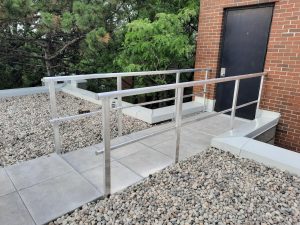
No doubt, modern rooftop hazards require modern safety solutions. For
example, says the Skyline rep: “We see too many access ladders that are cut short at the bottom, requiring an extension ladder to gain access to the actual roof access ladder itself. This is often done to restrict access to the public, but climbing a small ladder to grab the roof access ladder to then climb onto it is just simply dangerous.

Skyline Group

That’s why we developed a lockable gate to block the first five feet of steps and restrict unwanted access. ”The ability to manufacture ladders, guardrails, walkways, and various other rooftop safety solutions in modular sections is also proving to be a benefit for today’s contractors. These solutions can be transported to the roof via a service elevator versus renting a crane, while also being installed in a fraction of the time. All while offering the capability to customize a solution that best fits the needs of the roof and local guidelines.“The savings become quite substantial for all parties,” says Skyline’s rep, explaining, “Our non-penetrating permanent guardrail system, for example, is designed to be lightweight and modular, making it quick and simple to install without needing to fasten into the existing roof frame. This eliminates the need to reseal the roof membrane for old or newly warrantied roofs after an installation.”

Protecting workers and staying in compliance means understanding your rooftop hazards before heading up onto the roof, while having a solution in place to mitigate the risks as they unfold. After all, adds Ghinn, “Nobody should discover safety by accident.”

Skyline Group is a leader in roof access and safety compliance and contributed to this article. For more information on their rooftop safety solutions and their complimentary lunch & learn program, visit www.skylinegroupintl.com.

New quiz-reality show tests Toronto way-finders

A new hybrid quiz-reality show will test teams on their knowledge of Toronto’s evolving streetscapes. When Did They Build That? premieres on the Real Estate & Development Outreach (REDO) Network today.

The two-part challenge begins with an in-studio trivia round to pose questions about place names, iconic addresses and historic site occupancies. Action then ramps up when contestants move outdoors for the obstacle course and scavenger hunt, in which they race to complete a checklist of tasks while navigating construction detours, traffic congestion and ever-changing cartography.

REDO’s managing producer, N. Phil Denzetti, explains the concept came to him last fall when he took his skates to be sharpened, only to find that the retail block he’d been patronizing for decades had been transformed into the podium of a 55-storey condominium tower.

“As it turns out, the outdoor rink was actually remade into a micro off-leash dog park,” he recounts. “So what I really needed was a Yorkshire Terrier.”

The new show fits into REDO’s lineup of fact-based urban fun and drama, which includes favourites such as: the rapid-round quiz match, What’s My Zone?; the travelogue and lifestyles review, Day-trippers’ Guide to Legal Non-conforming Uses; and the compelling view of homeowner aspirations and the frailties of neighbourliness uncovered in Cross-Ontario Committee of Adjustment Highlights.

“If there are 8 million stories in the naked city, there’s got to be a billion stories, not to mention storeys, in an elaborately outfitted one,” Denzetti asserts. “REDO’s mission is to assess and develop that potential. We are confident there are still heights to hit, depths to plumb and a missing middle to flesh out.”

He also hints there will be more cinéma vérité efforts in the near future. Last year, the documentary, The Mistaking of the Residents — following the non-occupant owner, Victor Jamais, through his 12th consecutive unsuccessful bid to get elected to his condo corporation’s board of directors — was one of REDO’s top streaming requests and also won the 2021 Property Managers’ Choice Award.

New 2020 national building, fire codes released

The 2020 National Model Codes have been released. The new codes include the National Building Code of Canada 2020, the National Fire Code of Canada 2020, the National Plumbing Code of Canada 2020, and the National Energy Code of Canada for Buildings 2020.

The new codes incorporate more measures to address climate change, safety and accessibility and include new requirements such as strengthened protections for openable windows in residential occupancies to minimize the risk of falling; safety glazing in windows and doors for schools and similar buildings to reduce the hazards of wired glass; updates to evaporative equipment and drain pans to minimize the growth and transmission of legionella and other bacteria; and the introduction of encapsulated mass timber construction to allow for the construction of wood buildings up to 12 storeys tall.

“These new codes are more reflective of the current world we live in,” said Canadian Commission on Building and Fire Codes (CCBFC) chair Kevin Griffiths. “Thanks to these updates, it will be easier for Canadians with accessibility considerations to navigate different spaces; large farm buildings are now included in the Codes to reflect the evolving agricultural sector; and energy performance levels have been introduced to make buildings more energy efficient.”

The industry is invited to download the codes and review the changes. The 2020 codes include nearly 400 changes.

Current provincial and territorial building, fire, plumbing and energy regulations will remain in effect until the 2020 codes are adopted, with or without modifications, by the provincial or territorial authorities having jurisdiction.

The National Model Codes are developed by the CCBFC on a five-year cycle and are published by the National Research Council of Canada.

New study sheds light on shifting renter behaviours

A new study by Entrata looks at shifting renter behaviours and patterns over the past year, shedding light on the pandemic’s impact on the Canadian rental market.

Among its findings, Entrata, a maker of multifamily operating systems, revealed that 29 per cent of its 1,000 respondents moved within the last year, while 51 per cent said they planned to move once their current lease was up. Two-thirds of respondents said that renting “fit with their current lifestyle” versus owning a home.

“The last two years have been life-changing for people, industries and businesses across the globe,” said Chris Harrington, Entrata’s chief revenue officer. “Our survey of Canadian renters shows that many have moved to larger spaces to accommodate work from home needs, moved back to hometowns and some even moved to the city to take advantage of lower rental rates. We’re seeing a shift in the industry as renters look for more flexible leasing options and think differently about apartment amenities.”

To rent or buy?

Canadian renters’ plans have changed in recent years, with the majority (two-thirds) stating they are currently satisfied with their renting lifestyle and have no plan to pursue homeownership. Almost half said they will likely stop renting within the next three years in order to buy a home.

A whopping 43 per cent said “the need for more space”, possibly to accommodate ongoing work-from-home needs, is what would drive them to seek new accomodations. The main reason cited for renting vs. owning was cost-related — i.e. the inability to afford a down payment and to maintain a home.

The role of amenities

With more time at home since COVID-19, many Canadian renters are now placing a higher priority on apartment building amenities. Nearly 38 per cent said that on-site amenities are “why they love renting.” The most important on-site amenity for today’s renter is high-speed internet with controlled secure building access, followed closely by in-unit laundry facilities.

Nearly all respondents said they care more about on-site amenities now versus before the pandemic, and 13 per cent said building amenities could “make or break” a rental property.

COVID-19’s impact

An overwhelming majority of respondents who moved in the past year said they experienced moving difficulties due to the pandemic. Top hardships cited were:

  • Difficulty finding rental units in the right price range
  • Family and friends being unavailable to help with moving
  • Not being able to find a rental offering the desired terms

Because of the pandemic, one-third said they would switch to month-to-month payments, including half of millennial respondents and 39 per cent of Gen Z respondents. All tolled, nearly a quarter said their interest in month-to-month rent payments has increased; with nearly half saying “it’s nice to have more financial flexibility” and 37 per cent saying they “like not having to worry about picking a place they’ll be forced to live in for a year.”

To read the full report, click here.

New renderings of tallest Gehry-designed building

New renderings of two residential towers in Toronto, designed by Frank Gehry, offer a glimpse at what will be the architect’s tallest project in the world. Located downtown at 266-284 King Street West, the mixed-use development, crowned with the name Forma, will also feature commercial and retail spaces and a new space for OCAD University.

Developers Great Gulf Group, Dream and Westdale Properties announced that one tower will be 73 storeys and the other will be 84 storeys, with a total of 2034 condominiums.

Gehry’s work has been considered among the most influential in contemporary architecture. A few of his most notable projects include the Guggenheim Museum in Bilbao, the Walt Disney Concert Hall in Los Angeles and Fondation Louis Vuitton in Paris.

Named for the Latin and Italian meaning for form, shape and appearance, and inspired by the towers’ dancing movement, Forma marks a bold, yet timeless masterpiece that will forever impact the way that visitors and residents experience Toronto.

“As we continued to meet with Frank, his team and our partners, we couldn’t help but be drawn to the name, Forma,” stated Amanda Wilson Watkins, senior vice-president, sales and marketing of Great Gulf Group. “The ‘form’ – in true Gehry fashion – reflects, both literally and figuratively, the City of Toronto, and pays homage to where Mr. Gehry grew up.”

Gehry’s unique art forms are the hallmark of his international recognition, and the design of Forma’s towers creates a sense of movement that will transcend the building. Forma’s iridescent façade and twisting shape will reflect the colours of the sun and the form of the surrounding buildings to change Toronto’s skyline.

“Forma will be an exceptional addition to the city’s downtown Entertainment and Financial District,” said Krystal Koo, head of marketing and sales at Dream Unlimited Corp. “By collaborating with a full team of local and internationally recognized design talent, Forma brings inspiration from around the world and will become a new landmark for the city’s skyline, elevating Toronto on the global stage.”

Mitchell Cohen, chief operating officer of Westdale Properties, said the team will reveal more details and launch sales later this year.

Gehry

Renderings by The Boundary

Renderings by The Boundary

Housing in the Greater Golden Horseshoe

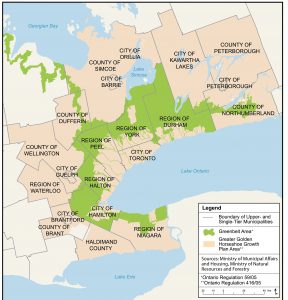
Ontario’s Greater Golden Horseshoe (GGH) is expected to grow substantially by 2051 at a projected rate of one million people every five years. In late March, the provincial government rolled out a transportation plan addressing gridlock issues and infrastructure, an investment that should trigger a boon in housing development particularly in neighbourhoods connected by transit. But will this intensification include enough affordable housing, and will municipalities say yes to vertical growth?

With transit and transportation pushing the vision forward, housing development is sure to follow—because mobility and connectivity are the foundation of any thriving community. In 2019, Ontario’s A Place to Grow document painted a picture of vibrant GGH urban centres characterized by “compact development patterns” and buildings that would support climate change mitigation. Future housing supply would be dependant on each market’s geography—built-up, greenfield and rural areas—with zoning determined by the municipality.

Since then, Ontario’s “Vision for Mobility” was released, and some are seeing red where they should be seeing green. Not everyone is in favour of a plan that would take away fertile farmlands, transplant more single-family homes, and cut a massive highway through the Paris Galt Moraine, a 130-kilometre geological feature formed by glaciers some 12,000 years ago. Furthermore, many believe it doesn’t go far enough to address the province’s housing woes. In recent days, “No Sprawl” groups have taken to social media to fight Ford’s vision and criticize his lack of regard for both the environment and affordable housing.

“Stop sprawl, create housing that people need – rental housing, supportive housing, well-designed accessible housing in or near our existing cities/transit,” tweeted Friends of the Greater Golden Horseshoe, a group advocating for good land-use planning, affordable housing, sustainable transportation, and productive farmlands. “Suburban sprawl is bad for the economy. If people can’t afford to live in cities where the economy is most productive, our collective gains are muted.”

Steve Lafleur, Senior Policy Analyst at the Fraser Institute, points to the stress that the rapidly growing population is already putting on housing prices. “Not just in Toronto, but all throughout the GGH region,” he said. “We can accommodate that demand by building upwards, outwards, or both. Given that the province is committed to restricting sprawl development in the Greenbelt, that leaves us with primarily building upwards. However, municipal governments don’t appear to be all that open to intensifying existing areas.”

Lafleur referenced a recent report by the Ontario Housing Task Force that proposed allowing landowners the right to build up to four units on their residential lot as-of-right to bypass local political opposition. “That would be a major step towards freeing up the housing market to respond to demand,” Lafleur said. “The Minister of Municipal Affairs and Housing announced he will consult with municipalities about building more ‘missing middle’ housing. This is a positive sign, but there’s nothing that difficult about building more duplexes and triplexes.”

In fact, other jurisdictions have already introduced similar zoning changes, including Edmonton and Minneapolis, so making the move wouldn’t be unprecedented. “We’re in a housing crisis, therefore some urgency is warranted,” he said. “While steps to speed up the approval process are justified, giving people more freedom to build on their own land is a critical part of the solution.”

Inside Ford’s GGH transportation plan

Entitled, Connecting the GGH: A Transportation Plan for the Greater Golden Horseshoe, the province’s vision for improving mobility throughout Canada’s busiest economic hub includes moving forward with the controversial Highway 413 and the Bradford Bypass, and building the largest subway system in Canadian history. Ontario’s Transportation Minister, Caroline Mulroney, prefaces the document with: “A well-functioning transportation system is critical to Ontario’s economic prosperity and the quality of life for the nearly 15 million people who will call the GGH home by 2051.”

It’s hard to argue against improved transportation infrastructure. But the question remains, will the right mix of housing come of it? Recent data shows that many hot markets outside the Greater Toronto Area had been suffering from housing shortages well before COVID-19. While the pandemic diminished rental demand in the short-term, that demand is back, and some suburban markets are hotter than ever thanks to the rise of home offices and the continued exodus from downtown in seek of more affordable, spacious dwellings. Although recent Urbanation data reveals there’s a surge of housing development underway, including purpose-built rental construction, it won’t be enough to offset the growing need.

In the meantime, Premier Ford is focusing on transportation and the prosperity it will bring to the fast-growing Greater Golden Horseshoe region for years to come: “Our government is saying ‘yes’ to building the roads, highways and public transit needed to unlock our full economic potential and keep our province moving forward,” he professed in March. “As we attract more skilled workers to Ontario, we need to build more roads and highways to keep up with population growth. Highway 413 and the Bradford Bypass are a critical part of our plan to build Ontario as we connect communities, reduce gridlock, and get goods to market sooner.”

Wayne Emmerson, Chairman and CEO, The Regional Municipality of York, concurred: “Investments in transportation help support our growing communities and provide residents and travellers with an enhanced transportation network whether walking, cycling, taking transit or driving. Projects like the Bradford Bypass will make life easier for people by alleviating gridlock that already exists on our roads and highways.”

“A place to Grow” framework

Ontario’s “A Place to Grow” plan aims to address the needs of the region’s growing population, diversity, people and priorities, with policies intended to:

  • Build communities with a diverse range of housing types
  • Support a robust economy with many different job opportunities
  • Provide better transit connections between where people live and work
  • Support a thriving agricultural sector and community
  • Protect local water systems, wetlands, woodlands, plants and animals

Visit www.ontario.ca for more information on the Greater Golden Horseshoe growth plan and related housing policies.

U.S. proposes to mandate GHG disclosures

The United States wants to make it a legal requirement for businesses to disclose their greenhouse gas (GHG) emissions.

The U.S. Securities and Exchange Commission (SEC) recently voted three-to-one to propose regulations requiring businesses to disclose their GHG emissions.

Under the rules, companies will be required to include certain climate-related disclosures in their registration statements and periodic reports, including information about climate-related risks that are reasonably likely to have a material impact on their business, results of operations, or financial condition. companies must also explain to investors how climate-related risks can affect the business finances.

Those potential risks include the rising frequency of severe weather, the potential costs of transitioning from fossil fuels, and a company’s own efforts to limit its carbon footprint. Companies will calculate these potential costs from data they already compile for regular disclosures to investors and will need to provide certain climate-related financial statement metrics as part of their audited financial statements.

The requirement would include disclosure of GHG emissions, which have become a commonly used metric to assess a registrant’s exposure to such risks. The regulations categorize GHGs into three categories. Scope 1 emissions are the amount of GHG emissions directly produced through their own business operations, such as manufacturing; while Scope 2 emissions encompass the energy, such as electricity, they purchase to keep their business running.

In addition, some companies must report their Scope 3 emissions, which include emissions from the goods and services they purchased, but will not face penalties if that latter category of emissions has mistakes or miscalculations. Only companies that have set up Scope 3 emissions reduction goals or consider these emissions to be part of their material would be required to disclose these emissions, according to Axios. Critics believe these could allow companies to avoid disclosing Scope 3 emissions, which can often be the largest share of a company’s climate footprint.

For registrants that already conduct scenario analysis, have developed transition plans, or publicly set climate-related targets or goals, the proposed amendments would require certain disclosures to enable investors to understand those aspects of the registrants’ climate risk management.

“Today, investors representing literally tens of trillions of dollars support climate-related disclosures because they recognize that climate risks can pose significant financial risks to companies, and investors need reliable information about climate risks to make informed investment decisions,” said SEC Chair Gary Gensler. “Today’s proposal would help issuers more efficiently and effectively disclose these risks and meet investor demand, as many issuers already seek to do. Companies and investors alike would benefit from the clear rules of the road proposed in this release.”

The proposing release will be published on SEC.gov and in the Federal Register. The comment period will remain open for 30 days after publication in the Federal Register, or 60 days after the date of issuance and publication on sec.gov, whichever period is longer.

Ontario announces “More Homes For Everyone” Act

Announced March 30th, 2022, the Ontario government’s proposed new bill, “The More Homes for Everyone” Act, aims to increase the province’s housing supply by cracking down on speculators who are driving up the cost of housing, protecting homebuyers from predatory development practices, and creating more housing options for homeowners and renters by accelerating development timelines.

Built on recommendations from the Housing Affordability Task Force and the first-ever Provincial-Municipal Housing Summit, the plan aims to deliver both near-term solutions and long-term commitments to provide more attainable housing options for Ontario families.

“Ontario is the best place to live, start a business and raise a family, but we can only build on our success if all hardworking Ontarians and their families are able to find the home they need and want,” said Premier Doug Ford. “As Ontario’s population and our economy continue to grow, building more homes is another way that we’re keeping costs down for families across the province.”

Proposed solutions include:

  • Increasing the non-resident speculation tax rate to 20 per cent, expanding the tax beyond the Greater Golden Horseshoe to apply provincewide and closing loopholes to fight tax avoidance, effective March 30, 2022. The tax applies to homes purchased anywhere in Ontario by foreign nationals, foreign corporations or taxable trustees.
  • Working with municipalities to identify and enhance measures that will crack down on land speculation and protect home buyers. This is in response to feedback the province solicited from municipalities regarding projects that are approved by the municipality, but unbuilt by the developer.
  • Strengthening consumer protections for purchasers of new homes by doubling fines and extending building license suspensions to address unethical conduct by developers, while ensuring penalties for cancelled projects are aligned with the impact on homebuyers. The government is also proposing to enable Tarion to extend warranties on unfinished items in a new home.
  • Supporting municipalities with resources, tools and standards to provide timely review and adjudication processes by both extending legislated timelines for decisions while focusing the decision-making process.
  • Creating a new tool specifically designed to accelerate planning processes for municipalities. The Community Infrastructure and Housing Accelerator would help municipalities expedite approvals for housing and community infrastructure, like hospitals and community centres, with clear requirements for both consultation and public notice. The tool could not be used in the Greenbelt, maintaining the government’s commitment to protecting this valued area.
  • Investing more than $19 million to help the Ontario Land Tribunal (OLT) and the Landlord and Tenant Board to reduce their backlogs. This funding will enable the tribunals to appoint new adjudicators, have resources on hand for mediation, and resolve land use planning and tenant and landlord disputes more quickly. This will also allow the OLT to expand their digital offerings to further enhance efficiency and provide more e-services.
  • Conducting consultation on the concept of a multi-generational community, which will begin the process of implementing “missing middle” housing policies that will work to implement gentle density and multi-generational homes on the ground across different types of municipalities.
  • Making it easier to build more community housing by making better use of provincially-owned lands for non-profit housing providers. To preserve the existing stock of community housing and modernize the system for those who depend on it, the government has established a new regulatory framework under the Community Housing Renewal Strategy that encourages housing providers to stay in the system and help vulnerable Ontarians get back on their feet.

“Through consultations with the public, the first ever Provincial-Municipal Housing Summit, and the Housing Affordability Task Force, we heard that speculative behavior in the market and long, drawn-out approval processes are making it too difficult for Ontarians to realize the dream of home ownership,” said Housing Minister Steve Clark. “Our government’s plan proposes smart, targeted measures to protect consumers, and make the process work better and faster.”

“Our government is cracking down on bad actors and defending future homeowners from unethical and egregious practices, ensuring developers looking to make a quick buck will think twice before trying to take advantage of hard-working Ontarians,” added Ross Romano, Minister of Government and Consumer Services. “These changes will not only improve access to housing but will also protect Ontarians making one of the biggest purchases of their lives – a new home.”

Click here for more infomation on the proposed new bill: Ontario is Making It Easier to Buy a Home | Ontario Newsroom

A perfect storm of labour and cost challenges

An acute labour shortage, cost increases, supply chain challenges and mental health are all top issues for the B.C. construction sector in 2022.

“Competition for talent is intense,” said Independent Contractors and Businesses Association (ICBA) president Chris Gardner during the annual CEO Breakfast at Buildex Vancouver 2022. “Prices for materials are at historic levels. Everything is more expensive. We’re in a perfect storm of labour shortage and input costs.”

According to ICBA’s annual survey, the majority of member companies expect 2022 to be as busy or busier than 2021. Nearly 56 per cent said they will do more work this year which will compound the labour shortage challenge, said Gardner.

“There are only two ways to really deal with the labour shortage. Technology – so being more productive, doing more with less and immigration,” he said.

Gardner went on to emphasize how red tape and regulations continue to delay projects and cripple Canada’s competitiveness. “It’s very difficult to do business in this country and in this province. When it comes to infrastructure, we’re astonishingly short sighted. We simply take too long to build critical pieces of infrastructure.”

Canada ranks 64th globally for how long it takes to process a construction permit according to the World Bank, which Gardner called “embarrassing.” Because the result is: businesses and investors take their ideas, their people, and their capital elsewhere. It is felt acutely when it comes to housing permits at city halls.

“Why does it take as long to approve a permit as it does to build it? It doesn’t make any sense,” he said.

Workplace wellness came up for the first time in the annual survey. Gardner said the association saw a gap in the marketplace to help construction contractors and employees specifically and rolled out its free Workplace Wellness Program last year to address concerns in the industry.

He explained ICBA consulted with contractors, construction workers, and wellness experts to develop a workplace wellness program that focuses on the construction worker. Everything is designed for the unique challenges and pressures of construction.

For 2022, ICBA has taken another step by partnering with former Canucks goaltender and mental health advocate Corey Hirsch for speaking tours around the province to “normalize the conversation” about mental wellness..

Rennie Group president Greg Zayadi and vice president of intelligence Andrew Ramlo were guest speakers at the breakfast and shared similar insights on the tight labour market and construction costs as well as immigration and impacts on the real estate market.

Zayadi said he gets regular calls from companies looking for “talent at every level” so it’s not just construction that’s feeling the pinch. He also noted skyrocketing construction pricing is causing developers to hesitate about taking projects to market. The dramatic construction increase in Metro Vancouver is the single biggest unknown proformas for developers.

“The construction number is now the largest number in that proforma,” said Zayadi.


Cheryl Mah is managing editor of Construction Business.

Cleaning is caring — it’s not rocket science

Entering the third year of the pandemic, everyone – from cleaning and janitorial service providers to the general public – could be forgiven for showing signs of mental exhaustion. We’ve had two full years of research, messaging, iteration of protocols and practices, conclusions, lessons learned.

In such a climate, effectively a war of mental attrition, how does the cleaning industry ensure it remains fresh, focused, effective, and exemplary, particularly as we move into spring and a full-capacity reopening for many retail and hospitality facilities?

Brian Sansoni

Though diligence and communication are paramount, it’s largely as simple as practising the basics of hygiene of infection control, says Brian Sansoni of the American Cleaning Institute (ACI), which plays a leading role in helping to advise, define, and shape the cleaning industry in the U.S. and Canada, and whose members include the manufacturers, formulators, suppliers, and distributors of cleaning products used in household, commercial, industrial, and institutional settings.

FC&M spoke to Sansoni about the challenges retail and hospitality facilities face amid higher foot traffic and loosened restrictions, and what service providers, staff, and facility owners and operators must keep in sharp focus to ensure the high standards of the pandemic are retained.

Some responses have been edited for length and clarity.

What does cleaning for health mean now, in the third pandemic year?

“For some time now, we’ve been far beyond cleaning for appearance – it has been, and still is, all about cleaning for the health and safety of your employees, the folks on the front line, and for your customers. For those shops, hotels, restaurants etc. that are now open at full capacity, it’s crucial to re-evaluate their place of business.

“The basics are that you should be disinfecting high-touch surfaces and objects and high-traffic areas on at least a daily basis, whether that’s elevator buttons, escalators, basket and trolley handles, seats, checkout and payment areas. Continue to promote hygiene and disinfection with your staff – everything from washing hands to handling deliveries with care and hygiene. Keep safety top of mind.”

How does the lifting of restrictions in many jurisdictions change the nature of the game?

“There will be a lot of folks who haven’t been comfortable venturing out much, and there will be a pent-up demand for wanting to get out and about, whether that is shopping, eating out, travel. From a facility operators’ point of view, if a customer hasn’t been in your store or your facility for a long time, you need to make sure they see that you care. Make sure cleaning processes are visible, sanitizer stations are refilled, your washrooms are clean, you have wipes on offer – instill that confidence in them.

“The due diligence never stops – this all needs to be happening when the customers aren’t there, too. It’s your next chance to make a great impression. Cleaning and hygiene are still front and centre for millions of consumers and customers and diners and visitors. With restrictions being lifted in a lot of jurisdictions, it’s important that the cleanliness of your store is apparent and that customers can recognize that.”

What are the particular challenges of managing the cleanliness of retail and hospitality facilities?

“Sanitation and hygiene are heightened concerns in retail and hospitality because there is so often food involved. There are all kinds of food safety concerns just as a recourse of doing business; in an ongoing pandemic, those are multiplied. So, I think there should and will be heightened precautions taken in those businesses.

“Also, a lot of the problems the industry sees around cleaning products and chemicals stem from improper storage in commercial settings. Again, that concern is magnified where there’s food involved, like hospitality and retail. Standards have always had to be so, so high, but that need has become more acute.”

Many industries have struggled with labour challenges in recent months. What can be done to mitigate that as foot traffic increases?

“Make sure your cleaners – whether they are your in-house staff or a hired third-party cleaning service – are properly and adequately trained in how to handle cleaning products, chemicals, and so forth. You cannot cut corners. We have seen a lot of people in the hospitality and retail sectors realize the staff constraints, and they have primarily adjusted their hours accordingly.

“Sometimes, you have to make tough decisions because you can’t compromise health and safety and hygiene. You just can’t. Restaurant owners, grocers, etc. will continue to make decisions based on those standards. How many staff are needed to fulfill the health and safety and hygiene brief? How must your processes change to meet the demands of the latest situation? I think it’s inevitable that staffing levels will dictate how you go about these things. Primarily, though, and especially in this labour market, you want to show that you care about your employees and your customers.”

What needs to be the focus now, in the third pandemic year?

“Our surveys have shown that the attention consumers are paying to how commercial facilities are showcasing cleaning and hygiene practices has remained perfectly high. Hygiene and safety remain key concerns for consumers. Just as the public’s own personal practices and standards have remained high on the agenda, so have their expectations from businesses and facilities. The trauma of the last two years is sticking with people, and it’s sticking with businesses and facilities too. We’d be very unwise to see cleaning and hygiene become a lower priority. These things were taken for granted a lot before the pandemic but now we’ve raised standards and raised awareness, that can’t be allowed to drop.

“It’s not about being obsessive, it’s just about being smart: reminders of common-sense situations. It’s those smart, targeted practices that are really important in retail settings, hospitality settings, restaurant settings. That’s how to keep customers, visitors, and employees in your workplace safe and how to keep your business and your facility successful. There should be a high level of permanence there.”

Finally, are there any myths that still need dispelling around cleaning?

“The too-clean myth still persists in some cases. Even setting aside the pandemic, you still see a not insignificant number of people affected by foodborne illness or by hospitality-acquired infections, caused in no small part by insufficient cleaning and disinfection practices. I don’t want to hear that you can clean too much. I think what got lost in some of this ‘too-clean’ stuff is common sense. Of course, you don’t need to clean every five minutes, but you do need to wash your hands numerous times a day, particularly where food is involved. You do need to disinfect high-touch and high-traffic areas numerous times a day.

“I think the ‘too-clean’ myth is detrimental to the idea of smart cleaning, which is integral to public health. This is not rocket science. A lot of the basics remain the same; have those materials and procedures, and if your employees recognize and partake in those, that’s half the battle. It’s all well and good having the chemicals and the products, but you must use them the right way and store them correctly. This all comes back to that ‘cleaning is caring’ mantra, and that will continue to be a very important platform. Show that in your business. Use the right products in the right way at the right times.”

This interview was also published in the Spring 2022 issue of FC&M magazine.

B.C. teams to undertake innovative retrofit projects

Six teams have been selected to develop retrofit designs for low- to mid-rise social housing buildings in Kamloops, Coquitlam, New Westminster, North Vancouver, Vancouver and Victoria.

The Reframed Lab initiative is a partnership between the province, BC Housing, the City of Vancouver, the Metro Vancouver Housing Corporation (MVHC), the BC Non-Profit Housing Association and the Pembina Institute.

The design teams will exchange ideas on cutting carbon pollution (including technological solutions such as heat pumps, heat-recovery systems and low-carbon materials), driving down energy demand and improving climate-change resiliency, and will explore innovations in seismic upgrades and on-site solar generation.

The retrofit projects aim to reduce annual energy demand by more than 50 per cent and carbon emissions by approximately 80 per cent. Work is scheduled to begin in fall 2022.

The design teams, selected through a request for proposals process undertaken in 2021, will create solutions for their assigned buildings with support from dozens of other construction-sector partners.

Design teams, assigned buildings and locations are:

  • Read Jones Christoffersen Ltd.: Crossroads Inn, Kamloops, operated by ASK Wellness Society.
  • Evoke Buildings Engineering: Le Chateau, Coquitlam, operated by MVHC.
  • Williams Engineering Canada: Crown Manor, New Westminster, operated by MVHC.
  • Morrison Hershfield: Manor House, North Vancouver, operated by MVHC.
  • Entuitive: Dany Guincher Place, Vancouver, operated by Tikva Housing Society.
  • Low Hammond Rowe Architects: Medewiwin, Victoria, operated by Pacifica Housing.

The province is supporting the design and capital costs of this project through funding from the Capital Renewal Fund, a 10-year $1.1-billion investment committed to preserving and improving B.C.’s 51,000 units of social housing.

The City of Vancouver will be providing technical and regulatory guidance to support the work, which aligns with the city’s climate and housing affordability goals. The cities of Kamloops, Coquitlam, New Westminster, North Vancouver and Victoria are also providing regulatory support for the projects in their communities.

Infrastructure leaders commit to decarbonization retrofits

The Canada Infrastructure Bank (CIB) and Johnson Controls (JCI) have signed an agreement that commits more than $125 million to accelerate private sector decarbonization retrofit projects across Canada.

CIB will invest up to $100 million toward commercial, industrial, manufacturing and multi-residential buildings leveraged through Johnson Controls OpenBlue Net Zero Buildings.

The sustainable retrofit projects will simultaneously make facilities smarter, safer and healthier for occupants, all while preserving capital for investment in core strategic priorities. This offering also provides an important tool to mitigate the increased price of many carbon-based fuels.

Over the next five years, the CIB’s and Johnson Controls’ collaboration is expected to reduce greenhouse gas emissions by more than 48,000 tonnes per year, resulting in significant decarbonization of retrofitted buildings. In addition, the projects, that Johnson Controls will identify and manage, are expected to create more than 900 jobs in the trade sector.

“We are delighted to partner with Johnson Controls, one of Canada’s largest energy service companies to enable large-scale retrofit projects that will be carried out with no upfront investment from building owners,” said Ehren Cory, CEO, Canada Infrastructure Bank. “This is another CIB investment that fits perfectly with our $2 billion green infrastructure priority sector and will have a long-term material impact on Canadian infrastructure.”

The financing represents 80 per cent of the overall capital cost of projects. An equity investment representing no less than 20 per cent of the capital cost will be provided by Johnson Controls and its affiliate, Johnson Controls Capital Canada Inc.

Royal Inland Hospital tower reaches completion

Construction is complete for the Phil & Jennie Gaglardi Tower at Royal Inland Hospital (RIH), which will improve access to health care services in Kamloops and throughout the Thompson, Cariboo and Shuswap regions.

EllisDon was selected by Interior Health in 2018 to design, build, partially finance and maintain the tower. Facilities maintenance at Royal Inland Hospital has transitioned to EllisDon Facilities Services Inc., which will provide maintenance services at RIH for 30 years.

“Our government is a proud supporter of this major project,” said Adrian Dix, minister of health, “When this new tower opens to patients in July 2022, residents in this region will have access to quality public health care in a modern, state-of-the-art facility.”

Designed with direct input from local health-care workers, the nine-storey tower will help streamline the way people access services in the hospital. There will be one main entrance and a spacious facility that will allow staff to provide world-class care in a space designed to modern standards. The tower includes single-patient rooms with their own washrooms, large spaces for families to gather and the ability for Indigenous smudging practices to occur in patient rooms.

There will be a new operating room and surgical services suite, more beds, medical surgical inpatient units, respiratory therapy services and a new rooftop helipad that will eliminate the need for an ambulance as patients can be brought directly to the trauma rooms in the tower.

As well, the tower will have a mental-health and substance-use inpatient unit, child and adolescent mental-health services, obstetrical services, labour, delivery and a neo-natal intensive-care unit as well as a first-floor atrium and patient registration area.

Each floor will feature a spirit animal motif as selected by Secwépemc Elders and supported by Tk’emlúps te Secwépemc Chief and Council. The first floor will also feature a cultural wall, which will be an artistic representation of the Indigenous communities that make up Secwepemcúlecw.

Once the tower opens, Phase 2 will begin to include renovation and expansion to the emergency department at the hospital as well as enhancements to pediatrics and post-anesthetic recovery.

The cost of the project is approximately $417 million. The provincial government contributed $203.5 million, the Thompson Regional Hospital District contributed $172 million, Interior Health contributed $21.6 million and the RIH Foundation provided $20 million, which will go toward the purchase of equipment.