




Articles Archive - Page 305 of 928 - REMINET
REMI

Toronto frees up city-owned properties for affordable housing

The City of Toronto is reducing its office footprint from 55 to 15 locations and freeing up eight city-owned properties for affordable housing and other building priorities.

Toronto City Council approved the next phase of ModernTO, which was launched in 2019 to make sure the city is using its office space as efficiently and effectively as possible.

The COVID-19 pandemic has accelerated this move to a hybrid office environment, where office hubs will be created in civic buildings including City Hall, Metro Hall and the civic centres in Scarborough, North York, and Etobicoke.

This unlocks an estimated land value of $450 million for city-building purposes at various locations, including: 610 Bay Street; 277 Victoria Street; 931 Yonge Street; 33 Queen Street E.; 75 Elizabeth Street; 1900 Yonge Street; 18 Dyas Road and 95 The Esplanade.

The plan proposes to deliver between 500 to 600 affordable rental and ownership homes in prime downtown and midtown locations, as well as infrastructure and service improvements and new institutional and civic spaces while contributing funds towards future strategic land acquisitions through the LARF.

While redevelopment opportunities for each site are not yet fully determined, CreateTO, the City’s Corporate Real Estate Management division, City Planning and other City agencies have undertaken a preliminary due diligence and site visioning process which has informed the overall portfolio objectives and proposed outcomes.

“Repurposing the sites at 610 Bay Street and 931 Yonge Street present an exciting opportunity for the City to transform two underused City assets to increase access to affordable housing and to deliver other City priorities,” said Councillor Mike Layton (University-Rosedale). “In addition to prioritizing housing, CreateTO will be seeking innovative proposals to reimagine the Toronto Coach Terminal, which will also accommodate a Toronto Paramedic Services Hub, new retail and commercial space, while incorporating and preserving the existing heritage structure and providing public realm and streetscape improvements.”


Montreal area home prices rose significantly in March

Housing prices in March increased significantly in the Montreal Census Metropolitan Area (CMA), compared to the same period last year. The average single-family home is up 18 per cent at $565,550, while condos now cost 16 per cent more, at $402,600.

A tight market continues to be an advantage to sellers as buyers compete for declining inventory. In fact, overbidding occurred in half of all transactions, according to the Quebec Professional Association of Real Estate Brokers (QPAREB). In its residential statistics for the month of March, QPAREB said lower-priced properties are still being squeezed out of the CMA.

Charles Brant, director of market analysis says this could be the last surge before the prices begin moderating.

“This new feverish surge, against a backdrop of overbidding, may be one of the very last ones,” he says. “Indeed, the number of active listings tends to stabilize, or even increase in certain sectors and categories, after the steady decline recorded since the beginning of the pandemic.

Sales continue declining across the region

Sales in the region of Montreal continued to decline when compared to the same period last year, with a 13 per cent decrease in residential sales in March 2022.

The decrease in sales was comparable across all residential categories, with a decline of -14 per cent for single-family homes, -12 per cent for small income properties (two to five units) and -11 per cent for condominiums.

Across the region, sales declined in Montreal and Vaudreuil-Soulanges by -10 per cent and -15 per cent in the North Shore. Saint-Jean-sur-Richelieu, however, experienced a particularly significant slowdown, with a 37 per cent decrease.

The lack of active listings is a continuing trend, with a 10 per cent drop compared to March 2021. The inventory seems to have reached its low point in the region, yet there was a significant increase on the Island of Montreal (8 per cent) and on the South Shore (7 per cent).

“The new increase in key interest rates anticipated for April 13 should help calm things down as more selling homeowners may put their property on the market to take advantage of a still very favourable market climate,” he adds. “However, in this context of rising rates, the pool of potential buyers is shrinking, while prices are reaching new highs.”

Dream unveils major upgrades to “Residence at Weston”

Dream announced it has successfully secured a $153-million loan under CMHC’s new MLI Select insurance product to finance affordable units and energy retrofits at the Residence at Weston apartment complex in Toronto.

The new MLI Select multi-unit insurance product, released earlier this year, uses a points-based system to incentivize a borrower’s commitments to social and climate-related outcomes. Designed with support from Dream, the product will assist building owners as they set out to transform their aging buildings into resilient, affordable, and accessible homes working with their approved lenders.

Using the funds, Dream has already begun converting 137 units at the Residence at Weston to affordable units and retrofitting the building to achieve its decarbonization targets. Work includes: implementing new boilers, mechanical and plumbing systems; enhancing balcony insulation; and, installing high-performing doors and windows.


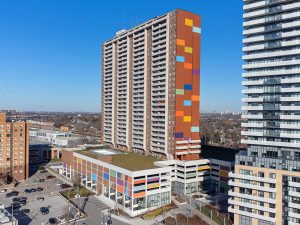
Residence at Weston, part of the Weston Common mixed-use complex in the Weston Mount Dennis neighbourhood, is a 30-storey rental tower built in 1974.  The retrofit is expected to take place over the next two years with minimal disruption to building residents.

“We’re so pleased to work with Dream and TD to bring more affordable housing to Toronto,” said Romy Bowers, President and CEO of CMHC. “The introduction of MLI Select is another important tool that will help transform existing supply into sustainable and affordable housing across the country.”

“Apartment complexes like Residence at Weston require a meaningful approach to ensure they are healthy and resilient homes for generations to come,” added Michael Cooper, President and Chief Responsible Officer at Dream. “Our work at Residence at Weston serves as an example that retrofits are a critical piece of our housing stock and can preserve much-needed affordable and accessible housing while addressing climate change,” “The most sustainable building is one that already exists, and it’s incumbent on us all to find new ways of working with what we have and bring them up to a high level of performance.”

New programming also coming 
In addition to the announcing these upgrades, Dream unveiled new programming that will soon be coming to Weston Common using funding from the Dream Community Foundation. Programs are set to launch in April, including free community fitness classes, free weekly breakfast and coffee socials, and subsidies for Toronto’s Bike Share memberships. Later this spring, additional programming will be rolled out, including free art classes for seniors and youth, free skills training classes, and free tutoring and homework help for yonger residents.

According to Dream, these programs showcase a “first-of-its-kind model” whereby a building owner has electively integrated a robust range of not-for-profit programming within a mixed-income community. The programs will be delivered by a dedicated Community Ambassador on-site at Weston Common, as well as non-profits partners.

“These programs have been created alongside Weston Common residents who expressed a desire for a diversity of programming and strong social connections within the Weston-Mount Dennis neighbourhood,” said Krystal Koo, Chair of the Dream Community Foundation Board. “We are excited to introduce an extensive slate of year-round programs and services that can improve socio-economic, health and cultural outcomes for all residents.”

Supercharging FM teams during a labour shortage

Many organizations have been experiencing a labour shortage due to leave of absence, sicknesses, early retirement, and job changes. COVID-19 has also challenged facility professionals with adhering to protocols and safety measures, dealing with constant shifts and the opening and closing of the economy—all of which are impacting managing the facility.

We all want to retain and employ well-qualified staff and create a strong and healthy work culture within our FM departments. But how can we also develop a high-performance team that will stay in the company?

How do you keep your FM team engaged and committed amidst a labour shortage when other companies are actively recruiting qualified candidates to join their workforce and leaving gaps in your FM operations?

Instill a sense of value and purpose in FM work at the office and develop strategies to maintain this purpose is important. The most important ingredient in maintaining high-performance staff is knowing how healthy the company’s culture is. You will recruit and retain valued team members when the purpose of your company addresses its culture within.

Impactful and meaningful company action attracts and retains professionals that are interested in playing an active role, not only in the inner workings of the company, but brands the product and services your company provides. If your office culture has a shared purpose with strong values and goals, it will develop strong meaningful relationships within internal and external stakeholders. This will carry forth to your customers.

Here is a list of ideas to help maintain and motivate your current FM team

  • Regularly review company values; the challenges and transformations.
  • Encourage collaboration, trust, camaraderie, and connections, thus empowering your team to make necessary decisions should challenges arise.
  • Recognize successes.
  • Open lines of communication with feedback will maintain motivation, positive reinforcement, interest, and cooperation and provide room for discussion on the team’s standards and accountability.
  • Set up collective goals and performance evaluations.
  • Offer discussions about any changes or challenges.
  • Acknowledge health and wellbeing practices at home and/or the office environment.
  • Detect early possibilities of conflict and set up conflict resolutions that are key to keeping the lines of communication open and trustworthy.
  • Discuss and assess with your teams the last couple of years: lessons learned, what the team is proud of, progress, and the impact of their efforts.
  • Plan virtual and/or face-to-face team building sessions.
  • Encourage professional development through seminars and courses.
  • Recruiting the right people with a diverse range of expertise and backgrounds: agile personalities to take on new challenges, people who know how to be a team player, and managers that can instill team leadership are critical as we move towards the next normal.

Being attuned and maintaining best practices in the workplace will further reinforce team retention. Here are some to consider:

  • A four-day work week with blended responsibilities amongst the department.
  • A blend of working in the office and remote working.
  • Higher wages, perks, and benefits aligned with team priorities.
  • Excellent compensation and competitive salaries.
  • Adequately sharing wealth that employees bring to company (this relates to societal change/culture).
  • Desire to work towards common goals and opportunities.
  • Regular performance coaching and mentorship.
  • Career coaching and training: internal advancement opportunities, a path for career growth within the company and upskilling and professional development opportunities.

It’s an employer’s market out there. Keep your company and FM team vital. Have your eye on creating retention and job stability within. Keep work interesting so it encourages communication and connection between everyone on the FM team and the company’s purpose. Creating a sense of community and belonging will increase staff retention and make the work environment a pleasant one to be in.

Marcia O’Connor is president of AM FM Consulting Group. She is a strategic-minded leader with more than 20-plus years of progressive experience in corporate real estate, asset management, and integrated facilities management. Marcia has a passion for mentoring young professionals, and helping people, teams, and organizations see their potential. She is the lead instructor for the University of Toronto School of Continued Studies’ facilities management courses, including the FM Certification Program and many others.

Visits to flexible office spaces up 45 per cent in March

New data from flexible office and co-working space provider IWG shows that visits to their 130 in-person office locations across Canada increased by 45 per cent from January to March 2022. Wednesday was found to be the most popular day in the office, followed by Tuesday and Thursday.

As companies and workers adapt to new hybrid working models, splitting their time between home and office, suburban locations, including Spaces and Regus locations, saw a substantial surge in office visits, particularly in Dartmouth, Hamilton and Waterloo.

All major cities witnessed similar increases in people working from the office with Toronto visits up 43 per cent since January, followed by Montreal (42 per cent), Vancouver (42 per cent) and Calgary (41 per cent).

“We are seeing in real time more and more people in our spaces, not only in Canada, but across the more than one hundred countries that we operate in,” says Wayne Berger, CEO, IWG Americas. “The data shows there is a strong appetite to spend part of the time in an office environment, whether that’s at a local flex space or a central HQ. The growing popularity of hybrid working means workers now have the freedom and flexibility to choose a location to work that best suits their lifestyle.”

Wednesdays are most popular days to go to the office

The most popular day to work from the office as part of a hybrid working week is Wednesday, which increased by 31 per cent in March compared to January. Tuesday and Thursday are also popular days to work flexibly, with visits to centres increasing by 32 per cent and 29 per cent respectively, compared to January.

As more Canadians turn their backs on long daily commutes, and instead choose to work flexibly from nearby coworking centres, demand for suburban and rural locations continues to rise. Earlier research from IWG in the UK revealed that employees are four times more likely to choose an office close to home than in a city centre, with 82 per cent saying the lack of a daily commute was a key benefit of hybrid working.

EVS market expected to grow healthily by 2026

The U.S. health care environmental services (EVS) market is projected to reach US$8.7 billion by 2026 from $6.6 billion in 2021, expanding at a compound annual growth rate (CAGR) of 5.8 per cent during the forecast period, according to a new report by MarketsandMarkets.

The “US Healthcare Environmental Services Market By Type” report shows the janitorial/core-cleaning services segment of the market is expected to grow at the highest CAGR primarily due to the need for regular cleaning and keeping health facility premises clean to prevent the spread of infection among patients and staff.

COVID’s impact

According to the report’s analysis, the key factors playing a foundational role in shaping the growth of the market include:

  • Factors such as the increasing demand for hospital beds and ICUs in the US, proliferation of isolation facilities, increasing awareness among consumers about maintaining cleanliness and hygiene within the healthcare facilities, and the fact that preventative healthcare has greatly boosted the demand for environmental services.
  • In-hospital systems are becoming overwhelmed with the rapidly increasing number of COVID-19 patients, which is weighing heavily on the cleaning industry in the US.
  • EVS companies have taken strategic developments to introduce COVID-19 specific services, sustain their revenues, and nullify the impact of COVID-19 on their operational capabilities
  • Moreover, the overwhelming adoption of strict measures to reduce the infection spread and the government mandates for reducing hospital-acquired infections are likely to drive the growth of the healthcare environmental services market during the forecast period.

Based on services type, the market is segmented into janitorial/core-cleaning services, infection control and prevention services, enhanced cleaning technology, front-of-house cleaning and brand experience, and other services.

The acute-care facilities segment accounted for the largest share of the market and is expected to grow at the highest CAGR during the forecast period. The market is segmented into acute-care, post-acute care, and non-acute care facilities.

The growing adoption of various outsourced cleaning services has helped acute-care facilities reduce in-house administrative costs such as the buying and maintenance costs of various cleaning technologies and supplies. These are the major factors driving the growth of this segment, says the report.

Knowing your way around absorbent compound cleaning

Absorbent compound cleaning can be a highly useful tool in cleaning, maintenance, and restoration — as long as you know how best to use it.

Absorption means, in essence, infusing substances into a solid, and the absorbent compound cleaning method uses only absorption and adsorption.

Jim B. Smith, an IICRC-approved instructor and a senior practicing inspector and part of the voting consensus of the IICRC S1OO cleaning stan­dard for textile floor coverings, writes for Cleanfax that dry compound extraction is an under-utilized method because it is not actively being taught properly.

Put simply, the method should include vacuuming soil removal, lightly applying a liquid pre-conditioner as needed, applying the dry compound according to manufacturer recommendations, performing manual or mechanical agitation, and then post-vacuuming either immediately or after an appropriate dry time.

Absorbent compound cleaning includes no soil suspension but a unique requirement of pre-vacuuming. It is common for some systems to use brushes without suction due to hydrogen bonding, which is the attraction created by water to physically bond particulates to its surface. Brush action alone will not adequately break this bond.

What are the benefits?

Smith writes that absorbent compound cleaning has the strong benefit of removing absorbed soils and is a preferred choice when cleaning flat-weave cellulosics. The absorbent compound method also can add many points to LEED certification in areas such as waste deposal, water usage, and energy consumption.

Plus, after using the method, the carpet is ready to go back in service immediately after cleaning, and it is also suitable for cleaning hard surfaces using alternate brushes.

Perhaps most importantly, the absorbent compound cleaning method can perform deep restorative cleaning as well as, if not better than, other methods. It also rarely runs the risk of overwetting, shrinkage, bleeding, crocking, wicking, slip-and-fall accidents, or villainous residues.

Norovirus threat grows as COVID-19 restrictions wane

While reduced restrictions and increased foot traffic are good news in many ways for facilities, that climate poses new and renewed cleaning and hygiene challenges. One of those is a rise in norovirus cases.

Outbreaks of norovirus, commonly known as the stomach flu or stomach bug, have been increasing since January, according to the U.S. Centers for Disease Control and Prevention (CDC).

From August 1, 2021, to March 5, 2022, there were 448 norovirus outbreaks reported, up from only 78 cases during the same period the year before. The fact that there were so few last year is unsurprising, given prolonged periods of full or partial facility closures and the prevalence of other health measures that have since been eased, such as mask-wearing.

The number of outbreaks reported during the 2021-22 seasonal year is below the range reported during the same period over the previous eight years, but facility managers and cleaning staff must still be aware of the risks posed.

Norovirus is not spread by respiratory droplets as coronavirus is, but the increase in outbreaks is likely at least a partial effect of relaxed infection control measures at a time when social distancing measures have also been eased.

Many notable outbreaks of norovirus occur in high-density facilities and areas such as schools, care centres, and nursing homes.

Halting norovirus in its tracks is tough. It is possible to spread billions of microscopic norovirus particles on surfaces and through contaminated food or water, and it takes just a few of those particles to make someone sick.

As with many diseases, the key to stopping the spread is strong preventative measures such as a diligent and detailed cleaning and disinfection plan.

Other basics that have been reiterated throughout the COVID-19 pandemic are highly relevant, too.

Dr. Robert Atmar, a professor of medicine and infectious diseases expert at Baylor College of Medicine in Houston, Tex., told NBC News that the best way to avoid norovirus is with good hand hygiene. For cleaning surfaces, he recommends a diluted bleach solution for decontaminating affected areas.

Construction starts on 1166 West Pender

Demolition of 1166 West Pender (former CRA building) in downtown Vancouver has begun. The new office tower will be 32 storeys and total 344,000 square feet with 12,000-square-foot office floor plates. The tower will be defined by a distinct contemporary architectural expression that is crowned by spacious landscaped outdoor terraces cascading down the building with sweeping views of the mountains and ocean.

“With continued growth of the tech sector in Vancouver and steady demand for quality office space, we are confidently proceeding with construction,” said Jon Stovell, president and CEO of Reliance Properties. “We designed 1166 West Pender to be an employee-centric building because we know the office of the future must be a destination to enable companies to effectively recruit and retain high-quality talent.”

According to the team, this is the first office building to begin construction in the downtown core since the onset of the global pandemic and the first designed for a post-COVID work environment. Vancouver developer Reliance Properties and global real estate firm Hines announced that EllisDon is the general contractor leading construction and that CBRE will lead leasing.

Designed by Hariri Pontarini Architects, the tower will target WELL, LEED Gold, and WiredScore Platinum certifications.

“1166 West Pender will be a mark of excellence in many ways,” said Syl Apps, senior managing director for Hines. “Health and wellness are woven through every feature and every floor, providing an environment where people will feel their best and function at their best. The outdoor terraces will be a key draw for top talent and forward-thinking businesses.”

Amenities will include an activated employee lounge and collaboration area, modular conferencing facilities, a professionally managed co-working floor, and a club-quality fitness facility. 1166 West Pender is walking distance to all modes of public transportation – SkyTrain, sea planes, the sea bus – plus dining and entertainment destinations.


P.E.I. announces Community Housing Fund recipients

Six different organizations in Prince Edward Island (P.E.I. )will receive funding to support affordable housing, assisted living or planning and research supports related to housing.

Cooperative housing, residential housing for Islanders with disabilities, transitional housing for Islanders in recovery and affordable housing options for veterans and their families are all being funding through the 2021/22 Community Housing Fund administered through the Canadian Mental Health Association – PEI Division.

Organizations and funding include:

  • Valley Cooperative – $10,000
    Valley will create and distribute a guidebook that would help those interested in creating cooperative housing. This “how-to” guide would outline the process of creating and registering a cooperative as a governance structure for people to collectively purchase and inhabit a home.
  • Community Inclusions – $50,000
    Pre-construction support to research and develop new day program space, a Snoezelen Room and specialized residential units for persons with intellectual disabilities in the Tignish region.
  • Lennon House – $50,000
    Pre-construction support to investigate the development of transitional housing for individuals that have successfully completed a recovery program and need assistance integrating into the community.
  • Royal Canadian Legion – $50,000
    Pre-construction support for the design and planning of affordable housing project targeted to veterans and their families.
  • Stars for Life – $200,000
    Help to purchase a supportive housing location in the Charlottetown area that will service individuals with autism spectrum disorder.
  • Sticks and Stones Development – $317,000
    Construction support for a 17-unit housing project in Hunter River; 6 units of which will be affordable.

The provincial government is also investing $3 million in the Community Housing Fund, a partnership with the Canadian Mental Health Association (CMHA), to provide a third round of funding. Non-profits, community-based service organizations, municipalities and developers can apply for support to help create affordable housing options for Islanders in need.

Of this new funding, $500,000 will be dedicated to advancing Indigenous housing projects.

Why clean indoor air must be made a priority

The U.S. Environmental Protection Agency’s new Clean Air in Buildings Challenge provides building owners and managers with guidelines and recommendations to help improve indoor air quality in their facilities.

However, according to Steve Ashkin, president of The Ashkin Group, a cleaning industry advocate for Green Cleaning and sustainability, while the EPA says cleaner air can help prevent the spread of “infectious diseases like COVID-19,” it did not go far enough into why cleaner air is so important.

“For one thing, they forgot to mention that the World Health Organization estimates there are seven million deaths each year due to poor outdoor and indoor air,” says Ashkin.

To make up for this oversight, Ashkin offers building owners and managers the following reasons for focusing on clean indoor air as a priority:

Maximize profits

Poor indoor air quality can cause people to feel unwell at work, negatively impacting their cognitive abilities and productivity. This decline in performance costs employers billions of dollars annually.

On the other hand, the Harvard T.H. Chan School of Public Health reports that improving IAQ increases worker productivity by $6,500 per employee, enhancing profits for businesses and organizations.

Improves mood and morale

Poor indoor air quality adversely impacts moods, morale, and motivation in school and work settings. This also lowers worker productivity and the ability of students to learn. All of these issues can be minimized or eliminated by enhanced IAQ.

Stop the spread of disease
The EPA acknowledges that improved IAQ could help prevent the spread of COVID. But there are other diseases associated with poor IAQ. These include the following:

  • Allergies, headaches, and in schools, asthma
  • Loss of coordination
  • Nausea
  • Damage to liver, kidneys, and the central nervous system
  • Potential hazards to pregnant women
  • Lung disease
  • Cancer

Lengthens life spans

Four years after China declared war against air pollution in 2014, the Energy Policy Institute at the University of Chicago (EPIC) estimated that if it continued, life spans in China would increase from 2.5 to as much as 5.3 years.

“Green Cleaning is the best way the professional cleaning industry can improve IAQ,” adds Ashkin. “Green Cleaning solutions contain low- or no-VOCs. Volatile Organic Compounds negatively impact IAQ. Properly maintained, high-performance vacuum cleaners, dusting with microfibre and similar materials that capture dust, and installing impurity-catching soft entryway mats, have all helped our industry protect indoor air.”

B.C. expands whistleblower law for public sector organizations

More workers in British Columbia’s public sector are now protected under expanded whistleblower protections at various agencies, boards and commissions.

The government is phasing in more organizations under the Public Interest Disclosure Act (PIDA). PIDA allows employees to confidentially share information about a serious wrongdoing that affects the public interest with designated officers within their organizations or to the Office of the Ombudsperson.

It also provides protection to employees who participate in PIDA investigations from reprisals, such as demotion, termination or other measures that adversely affect the employee’s work conditions. It also ensures employees under investigation are treated fairly.

Just a few of the organizations brought under PIDA on April 1, 2022, include the: Building Code Appeal Board; Property Assessment Appeal Board; Employment Standards Tribunal; Human Rights Tribunal; Environmental Appeal Board; Workers’ Compensation Appeal Tribunal; Hospital Appeal Board; British Columbia Utilities Commission; BC Games Society; Community Care and Assisted Living Appeal Board and the Safety Standards Appeal Board.

B.C. passed PIDA in 2018 in response to the Ombudsperson’s 2017 report, Misfire: The 2012 Ministry of Health Employment Terminations and Related Matters.

The act, which came into force on Dec. 1, 2019, currently applies to staff in government ministries and independent offices of the legislature. Bringing other public-sector organizations under PIDA will more closely align B.C. with other jurisdictions in Canada.

More agencies, boards and commissions will be brought under PIDA in December 2022, alongside Crown corporations. Recognizing the impacts of the pandemic on certain sectors, other organizations will follow in 2023 and 2024, including health authorities and the education sector.


Fast + Epp launches Concept Lab to push innovation

Fast + Epp has launched Concept Lab,  a 5,500 sq. ft. collaborative research and workshop space in the company’s Vancouver home office.

The structural engineering firm’s hybrid mass timber office is already a living laboratory of novel structural solutions. Concept Lab, which occupies the entire ground floor and half of the second floor, is an extension of this ongoing commitment to ingenuity and propelling architectural imagination. Now, members of the industry will be able to develop and fabricate new prototypes in-house, demonstrate the feasibility of these creations, and use them as invaluable visualization and communication tools.

Creativity, broad thinking and new technologies are fundamental to Concept Lab. It will serve as a springboard to cutting-edge design ideas for AEC firms, academia, and innovators alike, allowing for knowledge sharing and the building of meaningful partnerships.

“We are thrilled to launch Concept Lab, a physical space that will push the boundaries of research and development and inspire fresh thinking. Concept Lab will help turn our collective insights into effective real-world results. We hope to develop new technologies, practices, and procedures that will enable industry-wide innovation and positively impact the spaces where we live, work and play,” says Paul Fast, founder and partner, Fast + Epp.

This living laboratory includes four distinct hubs in an open concept studio. A development area consists of a material sample library and networking and hosting space for product launches and educational seminars for up to 150 guests. The fabrication area features 3D printers, robotic fabrication machines, woodworking and metalworking tools. A 100,000 lb self-reacting structural loading frame and precise vibration instrumentation make up the TeFasting area, while the digital area on the second floor is dedicated to software development, material optimization strategies, parametric design techniques, and machine learning. Concept Lab has all the resources needed to bring ideas from concept to reality.

The stubborn travels of pathogens

Have you ever wondered how pathogens get from Point A to Point B?

In a survey of five hospitals, researchers found that many pathogens start their journey on floors, which, according to the study, were frequently contaminated with particles.

From here, they managed to get on the hands of patients and staff in the hospitals. And then they travelled on to high-touch objects in hospital rooms such as side tables and call buttons.

But that’s not all.

The study found that pathogens, formerly found on the floors, had now travelled to canes, wheelchairs and wheeled equipment, clothing and shoes, cell phones, chargers, and cords, medical supplies, blood pressure cuffs, and linens and towels.

How can this happen?

“We touch floors directly or indirectly as often as 50 times each day,” says Mark Warner, formerly a trainer at ISSA. “Every time you tie a shoelace dragging on the floor or touch the bottom of your shoes, there’s a good chance you have touched pathogens on the floor.”

Further, the study found that many pathogens, including C. difficile, MRSA, and VRE, a life-threatening disease, were still present in rooms after the patient had been discharged and the floors had been cleaned.

So, how can cleaning professionals address this situation?

Conventional mops may not help us, as they tend to spread germs and bacteria as they get contaminated.

A 2002 study by the U.S. Environmental Protection Agency found that microfibre mop heads can remove pathogens from floors “as long as the mop head is changed after cleaning each room” and “as long as the used [microfibre] mop head is not put back in the cleaning solution.” Failure to take these key steps means microfibre mops may not help, either.

What continues to appear to be the most effective way to clean floors is via the use of automatic scrubbers. They apply a cleaning solution to floors, agitate the floor, and vacuum up the soil, moisture, and pathogens all in one pass, putting an end to the resilient travels of pathogens.

Knowing which tools to use, and how to employ them, is vital.

EllisDon wins environmental CCA National Award

EllisDon was recognized by the Canadian Construction Association (CCA) with an Environmental Achievement Award at its annual conference in Vancouver.

Celebrating excellence in Canada’s construction industry, CCA’s National Awards recognizes individuals, organizations and projects that promote and enhance the Canadian construction industry.

EllisDon’s climate commitment focuses on three core areas: driving to zero emissions across business operations, zero emissions in materials procured for all projects built, and zero emissions in the operational performance of completed projects.

As a member company of the Science Based Targets initiative (SBTi), EllisDon has committed to setting verifiable science-based targets across the entire value chain (Scope 1, 2, and 3) that will consistently keep global warming to 1.5C above pre-industrial levels. SBTi independently assesses corporate emissions reduction targets in line with the goals identified in the Paris Agreement and current climate science. By setting aggressive targets for milestone dates as early as 2030, EllisDon is on a credible pathway towards achieving net-zero emissions by 2050.

“We are so honoured to have our efforts recognized by the CCA as we work towards a more sustainable future,” said Jody Becker, chief strategy officer and executive vice president, Infrastructure Services & Technology at EllisDon. “Buildings and infrastructure make up more than 40 per cent of global emissions — business as usual is no longer an option. It’s critical we dramatically reduce global emissions, not only towards net-zero by 2050, but also to make significant reductions immediately.”

The CCA’s Environmental Achievement Award was created in 1991 to recognize the leadership role that CCA member firms and associations have taken to promote and undertake exemplary environmental conduct within the Canadian construction industry.

The other CCA National Award winners were:

  • Marco Group Limited – Gold Seal Award
  • rcs construction – Community Leader Award
  • Construction Association of PEI – Partner Association Award
  • PCL – Environmental Achievement Award
  • Western Pacific Enterprises – National Safety Award
  • Westcana Electric – Workforce Excellence Award.

Data can drive cost control in cleaning

It can be difficult to calculate and mitigate your cleaning budget, particularly now, after the uncertain climate of the last couple of years and the pandemic’s various effects on labour, supply chain, and other aspects of day-to-day work. Throw in other rising costs like gas prices, and exercising cost control has arguably never been tougher.

John Goetz of Hydro Systems, a leader in delivering chemical dispensing and dosing solutions, summarized for CMM Online how companies can get the clearest picture possible of their bottom line.

While calculating the total cost of a cleaning program is complex, certain factors must be considered such as resources, equipment, and salaries and training of staff. Equipment, for instance, doesn’t just consume energy; it requires an upfront investment and ongoing care over the span of its life. On the flip side, Goetz notes, the right equipment can reduce labour costs by streamlining your operations.

Failing to optimize any of these facets can increase the costs of others, so developing a strategic operational plan is vital, as is investing in the right resources, reliable and easy-to-use equipment, and qualified employees.

The role of data

Goetz adds that organizations can glean many conclusions from data, which can, in turn, help them to optimize their operations and streamline their costs.

For instance, certain technologies like IoT-enabled dispensers, intelligent floor care machines, smart laundry dispensers, and mobile time tracking can enable managers to leverage data that can lead to savings.

Quantifying cleanliness

Goetz emphasizes that assigning accurate cost control of your cleaning process requires analyzing the necessary resources, equipment, and people, and keeping them in balance going forward. While many of these expenses are recurring, they are significantly lower than the costs associated with lapses in cleanliness, such as damage to brand image, illness and injury, noncompliance, and even temporary or permanent business closures.

“Technology can support cleanliness and give organizations greater visibility into their operations. When combined with a commitment to asset management and employee training, these solutions can accelerate improvements and cost savings, thereby maximizing cleaning program budgets,” concludes Goetz.

Companies hit by high gas prices

Cleaning, janitorial, and facility service providers are being heavily impacted by the soaring gas prices being seen across North America.

The Alignable Gas Price Poll found that nearly two out of three Canadian small business owners (64 per cent) report experiencing “very significant” negative impacts, and cleaning services ranked second behind only transportation as the small business sector feeling the most financial pressure.

Across North America on the whole, a huge 90 per cent of cleaning service businesses polled said that gas price spikes are hurting their COVID-19 recoveries. Meanwhile, 78 per cent of plumbing services intimated similarly.

Part of that impact can be explained by the fact that these kinds of services often rely on workers driving to and from locations as a regular part of their job. Alignable analysts say that adding up the increased operational expenses from all of that driving “would be devastating to the margins of these types of small businesses”.

The effects of gas price spikes are being felt by all types of ownership, from start-ups to veteran industry leaders.

In terms of geographical breakdown, Alberta takes the unwanted top spot with 70 per cent of small businesses struggling with gas prices. Ontario comes in at 64 per cent, and BC is around 61 per cent.