Articles Archive - Page 273 of 928 - REMINET
REMI

Halifax boosts storm damage cleanup capacity

Halifax Regional Municipality is opening eight temporary debris depots and doubling the allowable limit for yard waste disposal to accommodate storm damage cleanup in the aftermath of Hurricane Fiona. The depots will accept unbagged storm-related waste from September 28 to October 5.

Beginning September 27, residents can set out up to 10 bundles of branches and 20 paper bags of yard waste for organics collection. Branch bundles must not exceed 75 pounds or contain any pieces that are longer than four feet or more than eight inches in diameter.

Municipal works crews are tasked with removing fallen trees in public spaces and municipally owned trees that have fallen onto private property. Homeowners and landlords will be responsible for clearing damage on their properties related to their privately owned greenery and structures.

Thirty Six Zorra tops off in Toronto’s Queensway

The development team behind Thirty Six Zorra have topped off the 35-storey residential high-rise in the Queensway neighbourhood of Toronto.

Altree Developments joined EllisDon Developments in formally marking their first real estate venture. This is Altree’s first high-rise project and EllisDon’s first real estate development.

“When we first envisioned Thirty Six Zorra, we couldn’t have foreseen the disruptions caused by a global health pandemic,” said Zev Mandelbaum, president and CEO of Altree Development. “It’s a real testament of our team’s determination and resiliency to have kept this project on schedule the entire time.”

The tower includes units from 440 to 1,306 square feet, a new public park and more than 9,500 square feet of private amenities, such as a rec room with arcade-style games, a co-working lounge, demo kitchen, and a loungy open-air deck on the 7th floor with fire pits, a pool and views of the Etobicoke landscape.

Thirty Six Zorra

Bright colours complement the entertainment vibe of the rec room.

Etobicoke has been undergoing a fair amount of redevelopment. The Queensway neighbourhood is part of that renewal, with condos, trendy restaurants and craft breweries popping up.

“The Queensway neighbourhood has been undergoing a revitalization, bringing new shops and establishments to fruition,” said Christopher Smith, vice president of EllisDon. “So, it’s been our great pleasure to bring new housing online at such a defining point for this part of Toronto.”

Thirty Six Zorra

Health care facilities earn green accolades

Four health care facilities gain new bragging rights as Canada’s Green Hospitals of the Year with the recent announcement of top results from the annual benchmarking exercise tracking energy and water savings, waste reduction, pollution prevention and environmental leadership. Winners, achieving the highest scores in each of the four categories of participants, include:

  • Royal Victoria Regional Health Centre, Winnipeg, Manitoba, in the community hospital category;
  • Hamilton Health Sciences/Ron Joyce Children’s Health Centre, Hamilton, Ontario, in the teaching hospital category;
  • Holland Bloorview Kids Rehabilitation Hospital, Toronto, Ontario, in the non-acute hospital category; and
  • Four Counties Health Services, Newbury, Ontario, in the small hospital category.

The awards are sponsored through Ontario’s Save on Energy initiative and were presented during an online forum last week. Along with the honours for the four top achievers, 38 additional green health care awards recognize leaders in each of the five elements of the green scorecard, including three separate awards related to energy. Results are based on 2020 performance data, which participating health care facilities submitted in 2021.

“The Green Hospital Scorecard provides a vehicle for standardized, sector-specific environmental benchmarking,” says Neil Ritchie, executive director of the Canadian Coalition for Green Health Care, which coordinates the program. “It connects hospitals with environmental information to support decision-making that can also deliver the economic benefits of reduced greenhouse gas emissions, improved energy and water efficiency, and increased climate change resiliency.”

In total, accolades were bestowed to 30 individual facilities or health care networks located in four provinces. Holland Bloorview Kids Rehabilitation Hospital and Four Counties Health Services are among the smaller group of multiple award-winners, which also includes:

  • Kemptville District Hospital, Kemptville, Ontario, in the small hospital category;
  • Markham Stouffville Hospital, Markham, Ontario, and Northumberland Hills Hospital, Cobourg, Ontario, in the community hospital category;
  • West Park Healthcare Centre, Toronto, Ontario, in the non-acute hospital category;
  • Hospital for Sick Children, Toronto, Ontario, and Toronto Unity Health Toronto – Providence Healthcare in the teaching hospital category.

Are you missing out on commercial lighting rebates for your facility?

These days, every cent counts, and commercial lighting rebates may be a way for your facility to make the most of your lighting choices. It’s more than just receiving free money, though; the real benefit is in the savings you’ll incur as a result. Often by installing certain equipment or products, you’ll set your company up to cut energy consumption – and costs – going forward.

Electric vehicle chargers and air filtration rebates may have gotten the most recent news coverage, but there is an opportunity for you to capitalize on your commercial lighting, too.

Types of commercial lighting rebates

Lighting rebates fall into one of three categories:

  • LED lighting: This is the most common energy rebate, covering a wide range of products and applications when you switch to an energy-saving option.
  • Lighting controls: Mostly seen in project add-ons, these include things like remote, wallbox, luminaire-mounted occupancy sensors and daylight-responsive controls. Facility managers often choose to take advantage of these rebates when they are upgrading monitoring systems and looking at energy savings.
  • Networked lighting control systems (NLCs): This refers to intelligent systems that communicate with a network, and these upgrades generate about 47 per cent more in energy savings. Due to the rapid growth of facility technology and smart buildings, NLCs make up more than a quarter of 2022’s commercial lighting rebates.

Getting a rebate

How do you know which rebates you qualify for or how to budget accordingly? Here are some tips so you don’t miss out on rebates that could help your facility:

  • Do your research: Several options may be available to you, depending on your facility’s size and location. Visiting websites that break down the requirements and allowances can save you time and get you on the right track.
  • Think ahead: Many rebate programs require a pre-approval or application process. Before you invest, make sure that you qualify and can receive the funds to cover the costs. These funds can also be released in stages, so taking scheduling into account could save you from being out of pocket.
  • Know your products: Many rebates focus on specific products to qualify. Look to companies like Energy Star for the information you need on products, services, and rebate programs for commercial use.

Commercial lighting rebates provide the potential for you to save money and lower your energy consumption. Do your homework, plan ahead, and choose the right products so your facility doesn’t miss out.

2022 RAIC International Prize winner awarded

The 2022 RAIC International Prize has been awarded to The Warming Huts, Winnipeg, Manitoba. The architecture firm behind the project is Sputnik Architecture Inc. The consulting team includes consulting team that includes Crosier, Kilgour & Partners, specialist consultant Luca Roncoroni, the Forks Renewal Corporation, and a host of other collaborators.

The Warming Huts are the product of a recurring exercise in design and construction that takes place on the frozen rivers of Winnipeg every winter. Playful but significant as works of architecture, they have been created over more than a decade with the support of hundreds of collaborators, both local and international.

Conceived, coordinated and often constructed by members of Sputnik Architecture, the Warming Huts are episodic and transformative, linking parts of a city divided by waterways, creating spaces of encounter and exchange, and reconnecting citizens to healthy lifestyles and the history of place. It is a wondrous celebration of winter that engages Winnipeg’s design community and draws the eyes of the world to a small city punching above its weight in its commitment to place-making and city-building.

The Warming Huts were selected by a nine-member jury in a process that included site visits by representatives of the jury to each of the three shortlisted projects. The shortlisted projects included, in addition to the Warming Huts, two other buildings: Borden Park Natural Swimming Pool, Edmonton, Alberta by Architects: gh3* and Stade de Soccer de Montréal, Montreal, Quebec by Saucier+Perrotte / HCMA Architects in joint venture.

A sculpture created for the RAIC International Prize by Canadian designer Wei Yew will be presented to the winners in the RAIC Celebration of Excellence, an awards ceremony and gala that will take place in May 2023 during the RAIC Conference on Architecture in Calgary.

Tim Smith named to international bridge board

Canada is reinforcing resources to stickhandle construction of the Gordie Howe International Bridge with the appointment of Tim Smith to the board of directors of the Windsor-Detroit Bridge Authority (WDBA). He brings 35 years of construction experience and a background in large infrastructure projects to the role.

The WDBA is mandated through Infrastructure Canada to oversee the construction consortium delivering the new 2.5-kilometre, six-lane bridge between Canada and the United States, which is slated to open by the end of 2024. The bridge is being built through a public-private partnership (P3) with the private sector design-build-finance team, Bridging North America (BNA) Constructors Canada GP, also holding a 30-year operations and maintenance contract for most components of the project once it is completed.

Smith is the founder and president of the construction advisory firm, MPa Consulting Services, and previously held senior executive positions over 30 years with EllisDon, where he led construction of some of Canada’s major infrastructure projects. He has also served on the boards of the Canadian Construction Association and the Ontario General Contractors Association.

“As the Gordie Howe International Bridge project enters the next key phase of construction, Mr. Smith’s extensive experience in delivering major infrastructure projects will be a major asset to the board,” says Dominic LeBlanc, Canada’s Minister of Intergovernmental Affairs, Infrastructure and Communities.

Calgary 135-unit affordable housing breaks ground

The City of Calgary has broken ground on a new 135-unit, mixed-income affordable housing redevelopment at Rundle Manor. The project is expected to be completed in 2024.

The new residence will feature a mix of one- two- three- and four-bedroom homes and will accommodate individuals and families living on lower incomes. In addition, more than 20 per cent of the homes will provide barrier free access.

“One of the most important investments we can make for Calgary’s future is in affordable housing,” said Mayor Jyoti Gondek. “Rundle Manor is a critical part of our strategy to build inclusive and resilient communities by providing more readily available affordable homes. Projects such as this transcend four walls and a roof – they transform lives and give families an opportunity for growth and stability.

The redevelopment site meets key criteria the city uses to select sites for affordable housing, including nearby community amenities like groceries, transit, schools, parks and recreation areas.

The city engaged with the Rundle community on the building and site design in September 2019 and July 2020, to determine the best way to design new affordable housing in Rundle.

The Rundle Manor redevelopment is part of the city’s direction to ensure that low-income Calgarians have a safe, stable place to call home in all neighbourhoods across the city.

Once complete, Rundle Manor will be a key contributor to Calgary Housing Company’s transition to a mixed-market rental model. The units will be rented at 10 per cent or more below Canada Mortgage and Housing Corporation market rents for the area and tenant eligibility needs to meet maximum income thresholds.

Energy sector workforce evolves and expands

Jobs related to energy efficiency in buildings and industry accounted for about 16.5 per cent of the global energy sector workforce prior to the COVID-19 pandemic, but conservation and demand management (CDM) is projected to create more employment and assume a larger share of overall economic activity in step with a heightened focus on reducing greenhouse gas (GHG) emissions. A new report from the International Energy Agency (IEA) is an inaugural effort to tally jobs linked to clean energy and energy efficiency, track their momentum and gain insight on emerging and long-term labour needs.

“With strategic foresight and commitment to achieving just and people-centred transitions, policy makers and industry decision makers can provide the support workers need to transition out of declining industries and maximize opportunities for additional good quality jobs across different regions,” maintains IEA executive director, Fatih Birol, in the forward to the report.

As of 2019, the IEA estimates the energy sector employed about 65 million people worldwide, representing 2.5 per cent of the global workers. That’s further categorized into three similar sized components:

  • 21 million workers involved in obtaining or refining oil, natural gas, coal or bioenergy fuel supply;
  • 20 million engaged in power generation, including construction and manufacture of related facilities and equipment, and transmission, distribution and storage activities; and
  • 24 million focused on end uses, including design, development and manufacture of electric vehicles and energy-saving building technologies and appliances, and a range of professional services and skilled trades involved in energy management and retrofits.

“Roughly 65 per cent of the energy sector workforce is connected to developing new energy infrastructure, while 35 per cent are involved in operating and maintaining existing energy assets,” the report states. “Over 21 million energy sector employees work in manufacturing and approximately 15 million are in construction, making up 5 to 6 per cent of their respective sectors. An estimated 14 million work in utilities and other professional services,”

Already, more than half of the jobs are aligned with reduced GHG emissions through renewable energy, electric vehicle production and pursuit of energy efficiency, and these activities are deemed to have the highest ongoing job creation potential. In 2021, global spending on energy efficiency, including building retrofits, green construction, appliances, vehicles and industrial equipment neared USD $330 billion, surpassing 2019 levels by 14 per cent.

The IEA estimates governments worldwide have committed an extra USD $165 billion to energy efficiency programs since the COVID-19 pandemic began, including about CAD $6.3 billion for Canada’s commercial, residential and community sectors. More recently, the U.S. Inflation Reduction Act allocates more than USD $8.5 billion to rebate homeowners for energy efficiency improvements and switching fossil fuel appliances for electric options, along with billions more in tax credits for qualifying energy investments in commercial and residential buildings and $200 million in training grants for retrofit workers.

Slipping share of jobs tied to fossil fuel supply

Looking back to the 2019 stats, more than 18 million jobs tied to fossil fuel (coal, oil and gas) supply equate to 27.5 per cent of the total energy workforce, but that ratio varies across global regions. In Europe, for example, more jobs are tied to electric vehicles (2.7 million) than any other sub-category, representing 36 per cent of the estimated 7.5 million energy-related positions on the continent.

North America has the largest contingent of oil and gas workers (1.9 million) among seven regions analyzed, but also boasts 2 million jobs tied to energy management in buildings and industry. The total North American energy workforce is pegged at 7.9 million and is relatively evenly split among energy efficiency, oil and gas, power generation and electric vehicles, each with a share ranging from 25 to 22 per cent. Meanwhile, coal and bioenergy each account for fewer than 1.5 per cent of the energy-related jobs.

China is home to more than 29 per cent of the global energy sector workforce, including about 35 per cent of jobs tied to energy efficiency, 33 per cent of jobs related to electric vehicles and 54 per cent of jobs related to coal. Africa has the lowest quotient of global energy jobs —about 5.8 per cent — with 1.6 million jobs or 42 per cent of its energy workforce in oil and gas.

For 2022, the report cautions that about half of the year-over-year increase in energy spending is attributable to rising costs and doesn’t flow into labour demand. However, it estimates 1.3 million new positions were added to the global energy sector workforce over the course of 2020 and 2021, and projects a further 6 per cent growth in employment this year.

Building retrofits are identified as a particularly labour-intensive endeavour that have also suffered from recent supply chain disruptions. The report notes a growing need for skilled workers, including administrators with the ability to assess others’ credentials.

“The lack of trained personnel can be detrimental to the quality of installations or retrofits and negatively affect the energy saving potential of an intervention. This makes training and vetting vendors a major challenge, and there is a growing focus for many efficiency programs to provide the appropriate skilling and certifications,” it advises.

Training will be a key element of enabling energy sector workforce growth given its higher ratio of technical and professional occupations. Currently, the study finds that 45 per cent of energy workers can be classified as “high-skilled” versus about 25 per cent of positions in the general economy, and it is projected to skew even more to high skills in the future.

Women present an underused pool of potential reinforcements. Current labour statistics, which define the energy sector more narrowly than the IEA’s scope, show women make up 16 per cent of the workforce — far below their 39 per cent representation in total employment.

“Clean energy start-ups show signs of change, with a greater share of women founders and inventors in clean energy, even if still far short of parity. This marks an opportunity for these growing segments to help increase female representation,” the IEA report submits.


Surrey’s first transit oriented development opens

King George Hub by PCI Developments has officially opened. The Hub is Metro Vancouver’s latest – and Surrey’s first – comprehensive transit-oriented development.

An isolated terminus station for 28 years in B.C.’s fastest growing city, King George is now surrounded by a vibrant complete community of homes, offices, and retail amenities. It is also now the gateway to the Fraser Valley as the connecting station to Surrey-Langley SkyTrain Extension.

King George Hub highlights the opportunities to build healthier communities at the eight upcoming stations, as well as on underutilized land around stations across the region. The development is the recipient of multiple awards from NAIOP (Commercial Real Estate Development Association) and Urban Development Institute.

“King George Hub will be an active, desirable community that exemplifies how progressive land-use planning and stakeholder collaboration can utilize scarce rapid transit infrastructure to catalyze vibrant, complete, and connected communities that encourage sustainable lifestyles and transportation choices with significant opportunities for housing and job space,” said PCI president Tim Grant.

King George Hub has 738 condo units and 371 rental homes that are completed, plus 350,000 square feet of office space and 130,000 square feet of retail space. Offices include headquarters for Coast Capital Savings and Westland Insurance.

Currently under construction and completing in 2025, King George Hub’s fourth phase will bring an additional 886 condos and 30,000 square feet of office and retail space. In early 2023, construction will start on the fifth phase that will deliver an additional 400 rental homes.

Upon full completion, King George Hub will comprise 370,000 square feet of office, 140,000 square feet of retail, 1,624 condo homes, and 771 rental homes – all within steps of rapid transit.

PCI Developments has created other community developments such as the transit-centred Marine Gateway in south Vancouver and the Crossroads at Cambie and Broadway near downtown Vancouver.

CAF-FCA launches apprenticeship grants

To support apprentice employment, the federal government’s Apprenticeship Service is encouraging small- and medium-sized employers to hire Level 1 apprentices by offering $5,000 grants.

The Canadian Apprenticeship Forum (CAF-FCA) and its partners – the Canadian Construction Association, Aboriginal Apprenticeship Board, Apprenticesearch.com, BuildForce Canada and SkillPlan – have launched their Canadian Apprenticeship Service program, distributing grants to employers who hire Level one apprentices.

CAF-FCA research indicates that over the five-year period from 2022 to 2026, an estimated 122,380 new journeypersons will be required to sustain workforce certification levels across the 50-plus Red Seal trades – the nationally recognized standard for skilled trades in Canada. The recruitment of 256,000 apprentices will be required to keep pace with certification demand.

“Low employer participation rates in apprenticeship persist with only 19 per cent of employers hiring and training apprentices. Given the urgency of Canada’s training challenge, it is important the Canadian Apprenticeship Service has a high employer uptake so youth and equity-deserving groups access much needed training opportunities,” said CAF-FCA executive director France Daviault.

CAF-FCA and its partners are well-positioned to make this program a success combining employer engagement with high quality training.  Through research and extensive consultations with industry, CAF-FCA and its partners understand training best practices and have created a model shaped to meet employer needs, increasing the chances of successful program implementation.

Employers will be provided an incentive for hiring an apprentice, training related to mentoring, inclusion and essential skills will also be available providing much needed supports to SMEs who do not have HR staff.

ApprenticeSearch.com is an online tool that matches employers and prospective apprentices helping employers connect to those interested in pursuing careers in the trades. The Aboriginal Apprenticeship Board connects employers to job-ready Indigenous candidates. Workplace mentorship and respectful workplace courses are offered by BuildForce Canada – which supports the construction industry with labour market information, tools and resources – and SkillPlan, a nationally recognized leader in workforce development programming.

Mohawk College: Solving tomorrow’s height safety concerns today

Transforming the educational experience is a core mission at Mohawk College. Over the years, the premier Ontario school has honed its experience, expertise, and technologies to give students a chance to grow with various applied learning opportunities both on and off campus. The video below, for example, was created by Mohawk students looking to gain experience and get creative in showcasing their rooftop safety solutions.

In the same manner that Mohawk College is working towards finding creative ways to prepare its students for tomorrow’s needs, the College’s facility maintenance team is constantly striving for improved safety for students, faculty, and service providers. With such a large rooftop, ensuring a safe environment is essential for the college; and as the campus and facilities grow, the rooftop will tend to get busier with the latest technology to support the advancements impacting the students and staff.

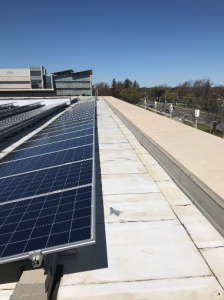
Skyline Mohawk CollegeTo that end, Mohawk is the first Ontario college to get a STARS® Gold Rating for sustainability achievements from the Association for the Advancement of Sustainability in Higher Education (AASHE). This is partly due to the 100+ solar panels found on the college’s various rooftops. 

Of course, the existence of any equipment on a roof raises important safety considerations. And as Mohawk College’s facility maintenance team was well aware, having solar panels covering much of Mohawk’s roof meant personnel had to walk within six feet of the roof’s edge to access multiple sections of the rooftop. This posed a risk that required a height safety solution. 

The facility maintenance team reached out to the rooftop safety specialists at Skyline Group to better understand their needs and the available solutions. Specifically, the Mohawk team was looking for a solution that was:

  • Quick and easy to install
  • Stocked and ready to ship
  • Non-penetrating, thereby eliminating the need to penetrate the roof membrane, which would require further repairs and costs to reseal those areas of the roof.
  • Compliant with Ontario height safety regulations and standards
  • Protected against corrosion during the winter months

In response, the Skyline Group recommended their RoofBarrier 5001 series, successfully meeting the college’s growing rooftop safety needs.

“I have worked with Skyline Group for a few years and have always had a great experience from working with the sales team to the team in production,” says Jeremy Dowling, Engineering Services Officer with Mohawk College, “The products have always been in stock and were ready to ship once the shop drawings were signed off. The safety guardrails are quick and easy to assemble.”

Learn more about Skyline Group’s rooftop safety products and services. 

Workers stress over cost of returning to the office

As food and gas prices remain high, nearly half of Canadian workers worry about the added costs of returning to the office full-time more than other issues like office politics or distractions. The Reinventing Work Study, from global technology provider Adaptavist, underscores the ‘cost of working crisis’ alongside other issues like hybrid versus in-office work life, productivity, collaboration and isolation and wellbeing.

The research is gathered from close to 3,500 Canadian, U.S., UK, and Australian respondents. In addition to wanting more vacation days and flexible work hours, 25 per cent of workers noted that free food and beverages would be an enticing perk to help get them into the office more frequently.

“Just as employees have grown accustomed to questioning the level of flexibility and freedom their organization provides, they’re now understandably considering the costs associated with heading back to the office, working from home or some combination of the two,” said John Turley, head of organizational transformation at Adaptavist. “Whether these costs are mental, emotional or financial, employees and employers will need to find a new equilibrium between business as usual and the way people want to work now—one that supports wellbeing as well as creating value for customers.”

While the price of returning to the office has become a concern, with the commute cited as a big driver behind the anxiety, Canada continues seeing a shift in hybrid versus in-office work options. Fifty-fifty per cent of workers indicated they are back in the office full time (or never left) while 28 per cent said they have a hybrid set up. Even fewer respondents—just 17 per cent—said they are fully remote.

Some employees have been asked to return to the office by management (57 per cent do not have the option to work remotely), while many have chosen to go back due to loneliness and isolation. The vast majority (86 per cent) said in-person connection with colleagues is important or critical. Yet, many employees (48 per cent) also believe they are at peak productivity in a hybrid environment and a further 40 per cent said they are too overwhelmed with work to talk to their colleagues anyway—a possible nod to the ‘quiet quitting’ movement.

A good-bye to the side hustle?

An estimated 42 per cent of employees are worried that a recession-driven work reset (more employers are demanding a return to the office) would eliminate essential workplace freedoms enjoyed in remote and hybrid setups. Some workers have been able to take on extra paid work over the past year. Losing this supplemental income with a full-time return  would likely be difficult as nearly 64 per cent of employees taking on second jobs report earning more than $7,500 annually through their side hustle.

Tool fatigue

People who work and communicate without the requirement of being ‘present’ at the same time, or asynchronous workers, experienced tool fatigue at a higher rate than non-asynchronous workers.

Close to half of employees said they lose time during the day due to task switching and 35 per cent note their organization has too many tools that perform the same function.

For 38 per cent, email remains the communication method employees use most at work, followed by in-person talking (14 per cent) and phone calls (14 per cent). Only 10 per cent use collaboration tools such as Slack as their primary communication method. Asynchronous workers within larger companies (250+ employees) were much more likely to make use of these tools and said that Microsoft Teams (69 per cent) and Zoom (46 per cent) are essential for work collaboration.

Measuring quality over quantity

Most respondents believe it’s time for companies to measure employee productivity based on the quality and output of work rather than the number of hours worked. The majority said they are currently working the same pre-pandemic hours, but hope to eliminate the 40-hour workweek. Almost half (49 per cent) believe the best flexible work option would be a four-day workweek, with one-fifth saying their employer has already given them that option.


Application for B.C. mentorship program opens

The Building Builders program, the only province-wide mentorship program serving B.C.’s construction industry, is open for applications.

The program created and managed by the BC Construction Association (BCCA) will connect under and un-employed workers with experienced mentors across all disciplines in the construction industry.

The program is intended to fill an important gap in an academic-leaning culture that often does not adequately encourage the skilled trades as a career path. The average age of an apprentice in B.C. is 27, and BCCA hopes that program will help first year apprentices get started earlier and stay in the system by providing personalized, ongoing career guidance.

“If you don’t have the right contacts, it can be hard to navigate a career in the construction industry,” says Chris Atchison, BCCA president. “Guidance counsellors, parents, and teachers aren’t always fully informed about the opportunities or encouraging of a non-academic path. BCCA is thrilled to connect industry leaders with young talent, get their questions answered, get them personal advice from experts who really know the way, and help them fulfill their career goals.”

Anyone seriously interested in exploring a construction career should apply for one of the 300 mentee positions. Building Builders will carefully match each mentee with a successful leader in construction who aligns with their goals and life experience. All mentors are carefully screened to ensure they have been working in the industry for at least 10 years, and program staff will stay connected and help facilitate a productive experience for everyone.

Building Builders is funded to run for three years, and support 300 mentees through a 12-month mentorship period.  Mentees will receive Site Ready safety training, and mentees and mentor companies will receive culture training through the Builders Code.

Early adopters of the program include Ellis Don, Penfolds Roofing, and Corrcoat Services Inc.

Mentors and mentees should go to www.buildingbuilders.ca to apply.

New family housing opens on SFU campus

Simon Fraser University (SFU) has opened two purpose-built, sustainably designed family housing at its Burnaby Mountain campus.

Located in UniverCity on the east side of the Burnaby campus, the two new buildings include 90 rental units—including three accessible units—consisting of studio, one-bedroom and two-bedroom apartments. The units are reserved for SFU students with a spouse or common-law partner and/or children.

“SFU is committed to creating an inclusive and welcoming environment for all SFU students, and that means building appropriate accommodations for students at every stage of their life journey,” says Joy Johnson, SFU’s president and vice-chancellor. “I cannot wait to welcome even more students and their families to our vibrant residence community on Burnaby Mountain.”

Reflecting SFU’s commitment to sustainability, the residence units have been built with a high level of thermal efficiency and design features to support passive heating and cooling, minimizing energy usage.

The two low-rise, wood-framed buildings are positioned around a central courtyard and a stand-alone community space, providing opportunities for parents and children to meet, play and build a sense of community. The buildings also feature study rooms, secure bike storage and a bike workshop space.

“We are thrilled to be opening these new residence halls and welcoming SFU students and their families to our SFU residence community,” says Zoe Woods, Director, Residence and Housing. “These residence halls are ideal for couples and families as they have been designed with community connection in mind. We know these accommodations are in high demand and are proud to be offering housing that is dedicated to SFU students and their families. This is an important part of our ongoing commitment to expanding on-campus housing options.”

SFU’s family housing complements the university’s five-phase Residence and Housing Masterplan. Phase 2 is currently underway and will provide additional housing to more than 350 students when it opens in 2023, providing students with lively, public spaces, rooms for socializing, and flexible spaces for experiential programming. When completed, the masterplan will see housing options at Burnaby campus expand to accommodate 3,250 students by 2035.

Building a fall facility maintenance checklist that ticks all the boxes

As September comes to an end, it’s time to finalize your fall facility maintenance checklist. When winter arrives later in the year, it brings its own unique challenges to your building, so handling issues like keeping unwanted pests away, updating or repairing equipment, and identifying upcoming expenses will help you stay prepared.

Here are a few other items to check off your list and help keep your building in great shape all season long:

Clean your gutters

This is often an out-of-sight-out-of-mind part of your building but it leaves and debris trap water in your gutters, which worsens with ice and snow accumulation. With fluctuating winter temperatures and the freeze-thaw cycle, this water can overburden your gutters, stopping them from doing their job: keeping water away from your building.

Take care of your sprinkler systems

Outdoor sprinkler systems need to be turned off and drained so that underground pipes don’t crack and break during that winter freeze-thaw. Indoor fire sprinkler systems need attention too, as they can also freeze in areas where your building gets the coldest, like warehouses and bays. Look for cracks or damage and plan for extra heat in these areas when temperatures become extremely low.

Audit your HVAC

Your HVAC system works hard all year to heat and cool your building, so make sure it’s working at maximum efficiency for the winter. Check things like filters, coils, water damage, and valves to save you the time and money it could take for an emergency repair, a shutdown, or increased costs from less efficiency.

Plan for snow removal

If you handle your own snow removal, you need a plan. Assess and service your equipment so you know you’re ready to clear your parking lot and walkways in that first snowfall. Snow strategy can be tricky to budget, but consider things like the manpower, mid-season equipment servicing, time, and supplies required. This will help give you an approximate idea of how much each snowfall will cost and you can use your record to get an idea for next year’s budget.

Having a fall checklist for preventative building maintenance will get you ready for winter and make it easier for your building to thrive well into the spring.

City of Guelph becomes Bird Friendly certified

The City of Guelph is the 17th city in Canada to become Bird Friendly certified.

Nature Canada developed The Bird Friendly City designation to encourage cities and municipalities to become safer places for birds as urban expansion continues. In each municipality seeking to become certified, Bird Teams are created and residents are actively engaged in protecting, monitoring and celebrating their local bird populations.

Guelph achieved Intermediate Bird-Friendly Status with a total score of 35 points – 13 in Section 1, Threat Reduction, 9 in Section 2, Habitat Protection, and 13 in Section 3, Community Outreach and Education. Initiatives include incorporating bird-friendly design and lighting guidelines, handing out window treatment kits, and rolling out the One Canopy Strategy with city-wide canopy cover targets.

According to the City of Guelph, all glass/glazing poses a collision risk to birds; however, buildings with high levels of glass/glazing that are located near vegetation are at greatest risk of causing bird-window collisions. As such, Guelph has been working to correct the issue,  alongside Bird Safe Guelph, The University of Guelph Arboretum, Nature Guelph and many other local organizations.

Angela Demarse, of Bird Safe Guelph, said that every year the city will have to review the bylaws and design standards that are still harming wildlife.

” I look up to the City of Toronto, because they’ve taken a strong, scientific approach that requires Bird Friendly standards for all new builds, not just the ones beside green spaces,” she said. “I’m grateful Guelph is such an environmentally progressive City!”

Photo by Mohan Nannapaneni 

Slate partners with Nova Scotia energy firm

Slate Asset Management has acquired an interest in Halifax-based Roswall Development Inc. The new buy-in is described as a “significant minority stake” to provide the renewable energy and energy services firm with capital to pursue more power development and retrofit business opportunities.

“We look forward to partnering closely with the Roswall team on integrations across our own real estate portfolio and supporting their mission of continuing to accelerate the energy transition worldwide,” says Christian Schmid, managing director and global head of infrastructure at Slate.

Roswall has a 15-year track record in the finance, construction and operation of wind and solar projects, and was awarded the first independent retail electricity licence to be issued in Nova Scotia in October 2021. Active largely in Atlantic Canada and the Caribbean, the company is also intent on expanding its energy services arm, focusing on commercial, institutional and industrial properties.

“The energy economy is changing at a dramatic pace,” observes Daniel Roscoe, Roswall’s chief executive officer. “We are excited to find a likeminded partner in Slate, with the capacity and experience to grow our approach and accelerate energy transition and climate action here in Nova Scotia and abroad.”