



Articles Archive - Page 179 of 927 - REMINET
REMI

Despite progress, workplace still not equal for Black Canadians

An estimated 53 per cent of Black Canadians said they experienced fewer instances of racism or microaggression in the workplace over the past year, yet 81 per cent were still victims of it in the last 12 months, a 10 per cent increase from 2022.

New research by KPMG in Canada, which surveyed 1,000 Canadians who self-identified as Black, found that companies have continued to make progress over the past year to create a more equitable and inclusive workplace for their Black employees. Three-quarters of Black Canadians say their co-workers’ understanding improved over the past year (up 13 per cent); 76 per cent said their manager or supervisor’s understanding improved (up 15 per cent) and 74 per cent of top management’s understanding improved (up 16 per cent).

There are also various discrepancies. Although the majority said they feel just as valued and respected as their non-Black colleagues, 78 per cent said they also have to work much harder to be recognized. This feeling has increased by eight per cent over last year.

Most Black Canadians are seeing their companies build a pipeline of Black talent with the goal of promoting them into the C-Suite. Compared to four years ago, more than three-quarters say their company now has a Black person in the C-suite or on the board of directors. Yet economic challenges have led to restructuring operations with delayed potential promotions. Eight in 10 Black Canadians also believe that Black or racialized people were among the first to lose their jobs since 2022.

In December 2023, Statistics Canada reported that the jobless rate rose 1.6 percentage points to 8.5 per cent for Black Canadians aged 25 to 54. Canada’s overall unemployment rate for the same age cohort was 4.8 per cent in December, up from 4.2 per cent a year earlier.

“Among the first steps towards change in the workplace are awareness and understanding of racial privilege across social, political, economic, and cultural environments,” explained Rob Davis, KPMG’s chief inclusion, diversity and equity officer. “The commitment organizations have made to address this within their workplaces is making a difference but unfortunately, progress is uneven.

“Employers need to keep in mind that their Black employees might be facing increased acts of aggression in their personal lives but also at work from customers, suppliers, and contractors. This makes it even more important that companies continue to stand fast on their commitments to combat racism within their organizations. It is critical they create inclusive and safe environments for all their people.”
Federal government extends foreign buyer ban

The federal government is extending its existing ban on foreign ownership of housing by another two years to ease housing affordability concerns across Canada.

The Prohibition on the Purchase of Residential Property by Non-Canadians Act was introduced in 2022 to prevent foreign investors from buying up residential real estate. The ban was set to expire on January 1, 2025, but will now end on January 1, 2027.

“By extending the foreign buyer ban, we will ensure houses are used as homes for Canadian families to live in and do not become a speculative financial asset class, Chrystia Freeland, deputy prime minister and minister of finance, said in a statement. “The government is intent on using all possible tools to make housing more affordable for Canadians across the country.”

Foreign commercial enterprises and people who are not Canadian citizens or permanent residents will continue to be prohibited from purchasing residential property in Canada.


New Burnaby North Secondary School opens

The new $116.6-million Burnaby North Secondary School has officially opened. With space for 1,800 students, it’s one of B.C.’s largest schools.

The replacement school includes child care, a school district conference centre and a neighbourhood learning centre with space for adult education and language development programs for the surrounding community.

“The newly opened Burnaby North Secondary provides students with a safe, modern learning environment so they can learn and thrive for many years to come,” Minister of Education and Child Care Rachna Singh.

Construction has also started on the new Stride Avenue Community School at 7014 Stride Ave. and is expected to be completed in fall 2025. The school will include 54 new child-care spaces for kids aged 30 months to school age.

“The new Burnaby North Secondary and the upcoming Stride Avenue Community school replacement reflect the board’s priority of providing modern, safe and sustainable environments for students and staff,” said Burnaby school board chair Bill Brassington. “We are proud that both projects also recognize that schools are the heart of our communities. Each building was planned to include space, such as child care, to help the whole community thrive. We’re grateful for our partnerships with the ministry and the city that help us to support children and youth.”

Approximately $252.1 million has been invested in the Burnaby school district since September 2017 to expand, seismically upgrade or replace seven schools, including the completed Armstrong Elementary, Parkcrest Elementary and École Seaforth Elementary.


OREA report calls for more bold action

The Ontario Real Estate Association (OREA) has released a new report, entitled Analysis of Ontario’s Efforts to Boost Housing Supply assessing the Ford government’s progress toward implementing the 55 recommendations issued by the Housing Affordability Task Force (HATF) in 2022.

OREA’s analysis found that of the 55 recommendations, 76 per cent have been fully implemented or are currently underway. Specifically, 18 have been fully implemented (33%), 9 are underway with major progress (16%), 15 are underway (27%) and 13 have yet to be acted on (24%).

“Ontario has set a bold goal to address the housing affordability crisis and while there has been substantial progress, we need to continue getting more shovels in the ground and bring more homes to market,” the group stated. “While initial legislative reforms were commendable — aligning official plans with provincial priorities, encouraging growth, and ensuring short-term land is available for homes — momentum has recently slowed due to high interest rates that are working against reforms. The Government of Ontario needs to continue to stand up against red tape and municipal NIMBYism, and keep up the momentum to solve the housing affordability crisis and create future generations of homeowners in the province.”

Building on HATF’s initial recommendations, OREA is recommending 10 new action items for 2024 it believes will further address Ontario’s housing supply crisis. These include:

  • Allowing water and wastewater services to be provided through a municipal services corporation, which would lower the upfront costs of building homes by allowing them to borrow and amortize costs among customers instead of using development charges.
  • Implementing land use changes to end exclusionary zoning, in order to unlock more housing supply in urban neighbourhoods.
  • Modernizing zoning to support commercial-to-residential conversions and greater density along transit corridors, which would bring more supply to market and save Ontarians time and money when commuting to work.

 “It used to be that every generation had a better shot at owning a home than the last, but the dream of homeownership is slipping away and there is an urgent need to address Ontario’s housing affordability crisis,” said OREA CEO Tim Hudak. “The Ford Government must keep its foot on the gas by continuing to champion pro-homeownership policies like the ones that Ontario REALTORS® continue to put on the table. We fully support the Provincial Government resuming, at full speed, their efforts to fulfill our housing ambition and bring affordability closer to home in Ontario.”

For more info, visit: CBF7E4C43A5740C79307625B05129F10.ashx (orea.com)


Navigating the new norm

In the wake of recent global events, the importance of disinfection has remained centre stage in our daily lives. The world has witnessed a paradigm shift, and with it, the way we approach cleanliness and hygiene has evolved. As the industry continues to move forward, let’s explore the latest trends and advancements in disinfection, shedding light on why it’s more critical than ever.

RELATED: 2024 commercial cleaning trends

How has disinfection evolved and what does the future look like?

The rise of antimicrobial technologies

In our continuing quest for heightened safety, traditional disinfection methods are being complemented by cutting-edge technologies. Antimicrobial coatings, for instance, are gaining popularity for their ability to inhibit the growth of microorganisms on surfaces. From door handles to smartphones, these coatings act as an additional line of defence against the invisible threats we encounter on a daily basis.

UV-C light: a game-changer in disinfection

One of the breakthroughs in the field of disinfection is the use of ultraviolet (UV) light, specifically UV-C light. Known for its ability to kill bacteria and viruses, UV-C light has found relevant applications in various settings, from hospitals to public transportation. Portable UV-C devices are now available, too, providing a convenient way to disinfect personal items and high-touch surfaces.

Smart disinfection systems

The integration of technology doesn’t stop at UV-C light. Smart disinfection systems, equipped with sensors and artificial intelligence, are being deployed in public spaces. These systems can detect high-traffic areas and automatically initiate disinfection processes, ensuring a continuous and proactive approach to hygiene with less labour required.

Smart systems also include surface imaging technology that allows facility managers and cleaning teams to assess surfaces for contamination, visually detect any risks, and fine-tune their cleaning practices for improved environmental monitoring, health and safety assurance, and facility performance. This allows cleaners to better allocate labour and resources where they are needed to get the job done.

Along with smart systems, cloud-based software also exists, providing a management system that allows facility teams to plan, conduct, track, and report site assessments regarding cleaning quality, surface cleaning validation, environmental monitoring, and auditing. With the evidence-based feedback gathered, managers can design and implement proactive and preventative cleaning protocols and processes.

Personal responsibility in a shared space

In today’s interconnected world, the responsibility for maintaining a safe and clean environment belongs to all of us. From workplaces to public spaces, individuals play a crucial role in adhering to hygiene practices. Simple habits such as regular handwashing, sanitizing personal items, and respecting distancing measures contribute significantly to the collective effort to curb the spread of infectious agents.

Navigating the future

In the last few years, disinfection has become a cornerstone of our daily routines, and staying informed about the latest advancements is key to navigating the new norm. As we embrace innovative technologies and eco-friendly solutions, the collective goal remains the same: creating a safer and healthier world for all.

In a world where cleanliness is paramount, staying updated on the latest in disinfection is not just a choice – it’s a necessity.

James Flieler is the VP of Sales North America for Charlotte Products Ltd. He is an industry expert coupled with a high level of enthusiasm, integrity, and common sense. These traits have made him a renowned speaker and trainer for local businesses, key regional players, and national corporations across North America.

Professional workwear drive to aid CRE aspirants

A newly launched campaign to collect and redistribute professional workwear adds another level of meaning to the term, return to office. Organizers are aiming to suit up aspiring and young careerists, extract longer-term value from wardrobe investments and, in some cases, enjoy their retirement with emptier closets.

A network of Toronto-based women in commercial real estate is involved in the effort with an eye to the next generation of talent that the industry, and the economy in general, needs. Beyond the sustainability payback of productively recirculating serviceable clothing, the drive for women’s business attire is a practical approach to assist affordability and perhaps help bolster the confidence of job candidates, interns and entry-level staff as they enter unfamiliar environments and take on new challenges.

KingSett Capital has provided space for a donation depot in the concourse level of Scotia Plaza at 40 King Street West in Toronto’s financial district. Professional workwear and accessories such as purses and briefcases can be dropped of from 8 to 9 a.m. and noon to 2 p.m., Monday to Friday, until February 16th.

In the next step, clothing will be offered, free of charge, at an event in a downtown Toronto location. Details are still in the works, but this may be coordinated with input from post-secondary real estate programs such as Toronto Metropolitan University’s faculty of real estate management.

For more information, contact Lisa Lafave at [email protected].

YYC awards west runway contract to PCL

Calgary International Airport (YYC) announced that PCL Construction has been selected as the construction manager for the airport’s West Runway Rehabilitation project.

“The West Runway Rehabilitation project is a keystone project for YYC and will play a pivotal role in the long-term success of our airport and the greater Calgary region,” said Chris Miles, COO for The Calgary Airport Authority. “Given PCL’s depth of experience, The Authority is confident in their ability to help contribute to this historic project in a safe and efficient manner.”

The rehabilitation will include removal and replacement of the existing pavement structure. Upgrades to the runway’s aging electrical and drainage systems and supporting infrastructure will also be included in the design scope. The project will also include improvements to existing taxiways and aircraft movement surfaces.

“Our team of industry-leading construction experts will ensure the airport’s world-class guest experience is maintained while we strategically rebuild one of three critical runways,” says Alistair McKnight, PCL’s district manager for Calgary and Southern Alberta. “We are grateful for The Authority’s continued trust and partnership with PCL as we embark on this important project with them.”

With sustainability as a priority, the Authority is proud to be working with PCL as well as contractors and consultants to deliver Canada’s first airport project to be certified under the Envision framework for sustainable infrastructure. Envision is a comprehensive framework for incorporating sustainability into the design, construction and operation of infrastructure systems and projects.


The Winter 2024 edition of Facility Cleaning & Maintenance is now available!

As we embark on the first quarter of 2024, it’s a time to embrace change and continue to move forward, enjoying the progress and evolution we’ve seen in commercial cleaning and maintenance through the last few years.

Our Winter 2024 issue starts the year off with an optimistic look at today’s landscape, tackling seasonal issues to exceed customer standards with more efficiency and better service.

Our cover story shines a light on the hardworking team that keeps the Royal Ontario Museum (ROM) looking its best, as they incorporate customer relations, troubleshooting, and beyond into their daily duties. The team is led with passion and compassion as they take good care of one of Ontario’s favourite attractions.

For our expert Q&A, we chat with Jonathan Adkins, ISSA’s Executive Vice President, as the association marks its one-hundredth anniversary. Applauding this milestone, we share stories, celebrate successes, and take a peek at what the future holds for ISSA. We get specific on last year’s accomplishments with a 2023 year-in-review, and we look ahead with a 2024 preview in our ISSA News section.

As more and more companies embrace technology, using today’s tools to boost efficiency, increase their efforts, and reach their goals, what’s on the horizon for smart washrooms? We take a look at top tech and the value it brings to business owners, maintenance managers, and cleaning companies. As part of a proactive approach, planning for the warmer months can help businesses avoid costly surprises and threats to the business. To that end, we focus on infrared thermography as a diagnostic tool that can help maintenance managers get a bigger picture of what’s happening in their buildings, identify areas of concern, and better budget for future expenditures.

In today’s landscape, commercial cleaners play an important role in helping businesses reach their ESG goals by prioritizing sustainability, creating healthier and more hygienic work environments, and boosting the brand. We examine what that looks like and how cleaning companies can help businesses streamline processes and save money with greener initiatives that benefit all businesses involved.

As winter progresses, we focus on the benefits of taking a practical approach to spring maintenance. The freeze-thaw cycle can add an element of risk to cleaning and maintenance, and we look at ways to avoid spring slip-and-fall accidents on your property. With these temperature changes comes the risk of pests in your building, so we offer some practical advice to safeguard your facility and protect your business.

This issue highlights some seasonal challenges for the cleaning and maintenance industry, offering insight and guidance as we head slowly towards spring and the warmer months.

Read the full Winter 2024 issue here.

Hotel sector projected to post modest growth

After a year of occupancy gains and buoyant earnings, the hotel sector is projected to experience more modest, but continued growth in 2024. Nationally, CoStar analytics reports an 18 per cent year-over-year jump in revenue per available room (RevPAR) over the course of 2023, while the average daily rate (ADR) for the fourth quarter was 6.2 per cent higher than in Q4 2022. With leisure travel as the driving force, the national occupancy rate climbed back to pre-pandemic levels.

However, business travel continues to lag, particularly demonstrated in lower weekday occupancies in Toronto, Montreal and Vancouver. Newly released analysis and projections from Marcus & Millichap attributes this to a combination of “the adoption of remote meetings, ESG compliance and businesses’ cost-cutting efforts”.

On the investment side, total sales value nudged up slightly over 2022, but with a significant uptick in the average price per room. Colliers Hotels reports a 2 per cent year-over-year increase in total sales volume, reaching $1.65 billion last year, while the average price per room soared by 31 per cent, to $178,300.

Looking to the coming year, new supply will be up modestly from 2023, but well behind the pre-pandemic pace. As well, it’s anticipated some existing space will be converted to other residential uses and proposed new regulations on short-term rental accommodations could have positive influence on hotel demand. International travel to Canada is also expected to increase, particularly from the United States.

“Despite a likely contraction in the broader economy, RevPAR continued its record-breaking streak in Q4 2023, achieving the highest level ever achieved in any Q4 on record,” observes Laura Baxter, director of hospitality analytics with CoStar. “In 2024, topline growth will be more muted. With costs throughout the P&L (profit and loss) still rising, hoteliers will be laser-focused on managing margins to preserve profits.”

Marcus & Millichap analysts foresee another year of rate growth, albeit at a slower pace than in 2023. Of the seven major markets analyzed, Montreal is alone in registering expectations for lower occupancy, while Vancouver is projected to hit a record-high, exceeding 80 per cent.

Nationwide increases in ADR and RevPAR are also expected. They’ll be most muted in Toronto, with just a 0.3 per cent rise in ADR and 1.5 per cent increase in RevPAR projected. Meanwhile, Edmonton is picked as the top performer on all fronts with a 400 basis point gain in occupancy, a 6.5 per cent increase in ADR and a 14 per cent jump in RevPAR.

Use AI to build your commercial cleaning business

As today’s technology continues to make its way into every industry, AI has become a highly useful tool for commercial cleaners looking to expand their client lists and grow their businesses. From marketing to management and more, AI can help you generate leads, grow your current business, and get to know your competition better so you can attract more attention for your business.

Creating content

In a recent episode of Take 5 with Cleanfax, Jeff Cross interviewed Frankie Fihn from Get Flood Jobs, and they discussed how AI can help commercial cleaners expertly create online content. Business owners are not all experts at content creation, and that’s understandable, but AI can help. Using AI, you can write any number of articles or blogs in a short amount of time using words that are popular in online searches, upping your SEO and your business profile.

Along with website content, AI can produce scripts for videos and can even create review responses, helping you build your brand and generate leads in as many places as possible.

Building the business

AI has access to a ton of data, so why not get it working for you? Research your competition, conduct market analyses, compile customer preferences, create marketing plans (and more) with today’s tools. While it does not have access to real-time data, like your stats, it can help you get a handle on the market and search for opportunities that could benefit your business. Be specific with your requests, adding info like cities, services, and scale to get the best results.

AI can also be relied upon to help better your business with features like predictive equipment maintenance, inventory management, route optimization, automated invoicing, and more. These tools help you better manage your labour and provide an optimal experience for your customers.

Managing customer service

Chatbots are growing in popularity, as businesses rely on technology to handle inquiries in real-time. This tool can answer questions, direct leads to the right place, and even book appointments, so you never miss an opportunity to schedule work. AI can also help you better tackle human resources, which means more efficient labour and more productive employees. Create staff training, manage schedules, automate your payroll, simplify onboarding to help you save time and resources for where you need them most.

From attracting and retaining customers to improving your online profile and boosting your businesses’ efficiency, AI is a tool that can help your commercial cleaning company set yourself apart from your competition.

Richmond district energy wins national award

The City of Richmond’s award-winning Lulu Island Energy Company has been named winner of the coveted 2023 National Energy Globe Award for the expansion of its City Centre utility.

Presented annually by the Energy Globe Foundation, an Austrian-based non-profit organization, the National Energy Globe Award recognizes projects focusing on energy efficiency, sustainability and the use of renewable energy or emission free sources in more than 180 countries.

The award celebrates the innovative City Centre District Energy Utility expansion, part of the Lulu Island District Energy system launched in 2013. The first three City Centre developments have already been connected to low carbon energy plants. By 2028, sewer heat recovery technology will be fully operational, fulfilling both climate action and circularity objectives of the City.

“The City of Richmond continues to be an international leader in reducing greenhouse gas emissions and the sustainable delivery of environmentally-friendly energy,” said Mayor Malcolm Brodie. “Over the next three decades, 70 per cent of our city’s growth will occur in and around the City Centre. This Lulu Island District Energy expansion will not only provide efficient low-carbon energy at competitive rates to residents and businesses in that area, but continue to meet our goals of net zero emissions by 2050.”

Once complete, the City Centre District Energy Centre (CCDEU) will be connected to 170 residential and mixed-use commercial development sites covering 50 million square feet. The CCDEU is projected to save over one million tonnes of carbon emissions compared to conventional energy systems.

This marks the third time the city has received the National Energy Globe Award. The city received the 2013 National Energy Globe Award for the Alexandra District Energy Utility first phase, and the 2020 National Energy Globe Award for the Garden City expansion of the Alexandra District Energy Utility.


The push for more purpose-built rental housing

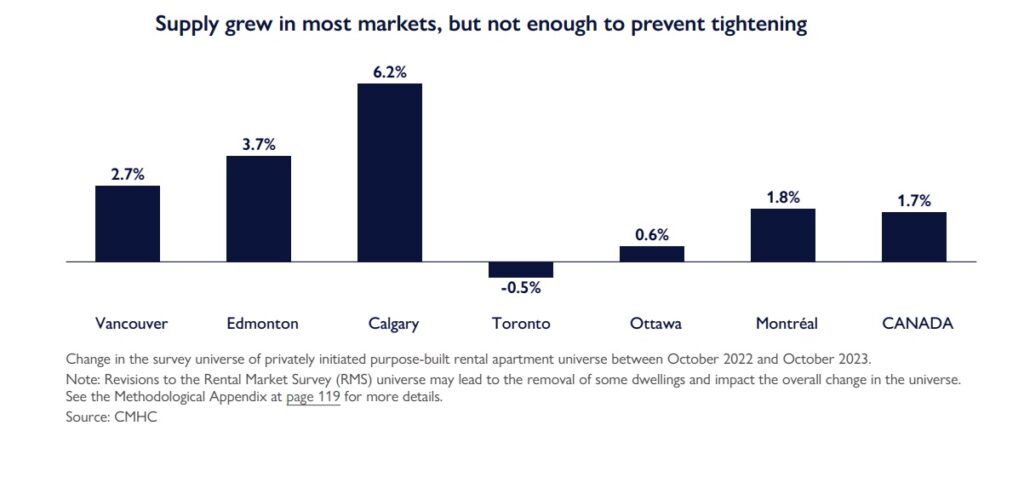
Strong rental demand continued to outpace supply in 2023, according to CMHC’s newly released 2024 Rental Market Report. This resulted in less available purpose-built rental apartments and lower affordability in Canada’s primary rental market.

As per the latest data, released January 31st, the national vacancy rate for Canada’s primary rental market reached a new low of 1.5 per cent in 2023, the lowest recorded rate since 1988 when CMHC began recording a national vacancy rate. Average rent growth for two-bedroom purpose-built units surveyed in both 2022 and 2023 reached 8 per cent in 2023, well above historical averages.

“Again in 2023, strong rental demand continued to outpace supply in communities across the country, making it very difficult for renters to find housing they can afford,” said Kevin Hughes, CMHC’s Deputy Chief Economist. “The vacancy rates and rent increases we are observing are further evidence the current level of rental supply in Canada is vastly insufficient and the need to increase this supply is urgent.”

Increased demand pressures

Although most Canadian cities saw an increase in rental supply, CHMC says it was not enough to keep pace with the increased demand pressures caused by high population and employment growth. Higher mortgage rates and persistently high home prices also continued to make it harder and less attractive for renters to transition to homeownership. As rental demand pushed up, the construction of new rental homes continued to be difficult for homebuilders facing higher costs for financing and construction materials, along with labour shortages.

In terms of escalating rent prices, average national rent growth for a 2-bedroom purpose-built apartment accelerated sharply to 8 per cent from 5.6 per cent over the previous 12-month period. This new high is well above the 1990 – 2022 average of 2.8 per cent and outpaced both inflation (4.7%) and wage growth (5%).

purpose-built rental chart CMHCCalgary tied Toronto in 2023 for the second-lowest vacancy rate out of the six largest Canadian cities, as Calgary was particularly affected by high levels of interprovincial migration, in addition to significant international migration. Montréal’s vacancy rate dropped to a low not seen since before the pandemic, while Calgary and Edmonton both saw their lowest vacancy rates in a decade. Meanwhile, vacancy rates held steady in Vancouver and Ottawa, with Vancouver remaining Canada’s tightest major rental market with the highest monthly average rents.



A challenging climate for developers

As purpose-built rental developers in Canada continue to face an increasing number of market challenges, including higher construction costs, government fees, and lending rates compared to a few years ago, housing experts are in agreement that more needs to be done to encourage new rental housing development. Although Canada and the Provinces introduced some promising new measures in 2023, including the Enhanced GST Rental Rebate program, according to a CMHC study released in December, achieving an adequate level of supply would require an investment of at least $1 trillion.

“The wavering economic environment characterized by higher interest rates, construction costs and development fees has put the financial feasibility of numerous planned rental projects to the test,” the report contends. “These more restrictive financial conditions have limited the flow of private investments into new purpose-built rental housing, resulting in a decrease of planned projects and further fueling the affordability crisis.”

CMHC research conducted earlier in 2023 showed that most of the recent purpose-built rental housing stock in Canada is owned and developed by the private sector. To launch the construction of new rental development projects, return expectations by investors need to be met. As a result, larger-scale developers with the deepest pools of capital and a greater ability to source upfront equity have been playing a significant role in the development of new rental housing. On the other hand, smaller developers with larger financial indebtedness were more likely to pause their new projects or reduce the number of future projects they’d originally planned to build. Of these, approximately 40 per cent indicated an intent to reduce the number of future projects while 30 per cent indicated they would put their new projects on hold.

For most rental projects paused or cancelled in 2022, the limited return premiums were what motivated the decision. Meanwhile, developers who decided to move along with their projects saw the need to raise rents to offset increasing borrowing, construction, and development costs as their primary strategy to incur profit.

Looking ahead

CMHC estimates that larger-scale developers (1,000+ units) will be responsible for more than three out of four new rental units in the coming years; they also represent roughly nine out of 10 developers that are currently leveraging public sector funding, such as CMHC programs – hence incorporating a greater share of affordable housing units into their portfolios. That said, market rent was mentioned as the most common product strategy.

Partnerships between larger institutional investors, such as pension funds and public companies (REITs), and private developers can allow for reduced upfront cost and greater access to alternative financing. These partnerships are critical moving forward and were mentioned by survey participants as being increasingly leveraged to build new rental housing.

“Larger-scale developers are seemingly putting more focus into creating affordable housing opportunities,” CMHC analysts noted. “Collaboration and partnerships between different development typologies and investors will be foundational in the future rental housing development ecosystem.”

For CMHC’s latest Rental Market Report, click here: Rental Market Report | CMHC (cmhc-schl.gc.ca)

New condo sales fall to 15-year low in GTA

New condo sales in the Greater Toronto Area are at their lowest since 2008 at 12,716 units, according to new data from Urbanation. Over the past 20 years, there have been two other times where sales have fallen below 13,000 units, but the long-term trend has been close to 25,000 sales annually.

Last year, the units sold represented a 41 per cent decline from 2022 and a 58 per cent fall from 2021. In Q4, there was a decline of 10 per cent year-over-year with 3,070 units sold.

“2023 was one of the most difficult years for the GTA condominium market in recent history, said Shaun Hildebrand, president of Urbanation. “While some improvement in sales activity can be expected given record-high population growth and an expected reduction in interest rates, the market will continue to face challenges as it works through a large number of completions this year. Looking forward a few years from now, the sharp reduction in new condo sales and construction starts experienced in 2023 will create severe supply shortages for the market.”

New condominium projects that launched for presales in 2023 sold an average of 48 per cent of their units, dropping from a 65 per cent absorption rate for new launches in 2022 and a record high 82 per cent absorption rate for new launches in 2021. The 10-year average absorption rate for new presale launches was 67 per cent.

Sales in 905 and City of Toronto

The 6,498 units sold in the City of Toronto in 2023 dropped 48% from 2022 to a more than 20-year low, whereas the 6,218 units sold in the 905 Region of the GTA declined 30% annually to a five-year low.

The share of new condo sales in the 905 Region increased from 41 per cent in 2022 to 49 per cent in 2023. There were 6,218 units sold, a drop of 30 per cent annually to a five-year low compared to a 48 per cent drop in the City of Toronto with 6,498 units sold— a more than 20-year low.

Record high unsold inventory

Condo developers launched 19,261 units in 2023, down 24 per cent from 2022 and 13 per cent below the 10-year average.

Sales slowed much faster than new supply entering the market, with new inventory increasing by 41 per cent year-over-year to a record high of 22,477 units in Q4-2023. The 15.5 months of inventory in the 905 Region was much lower than the 26.7 months of supply in the City of Toronto.

The slowdown in new sales in 2023 resulted in a substantial increase in pre-construction projects with low absorption levels at year-end. As of Q4-2023, a 31 per cent share of pre-construction projects in the GTA sold less than 30 per cent of their units, more than doubling the share in Q4-2022. Two years earlier in Q4-2021, there were no pre-construction projects that were less than 30 per cent sold.

New condo price drops to two-year low

The average asking price for remaining unsold new GTA condos was $1,403 psf, decreasing two per cent annually to reach a two-year low. Unsold prices were down four per cent annually in the City of Toronto to $1,524 psf, while increasing one per cent in the 905 region to a record high $1,186 psf.

Developers continued to increase incentives in the fourth quarter, with cash back offers, reduced deposits and higher broker commissions becoming more common.

Construction activity slowdown

There were 15,891 units that started construction in 2023, a 45 per cent decline from 2022. Construction activity slowed considerably in the second half of 2023, recording only 4,397 starts — a 72 per cent drop from the same period in 2022. Urbanation says it “defines construction starts at excavation, which is earlier in the process than CMHC’s definition for starts occurring at foundation.”

Condo completions

Condo completions are expected to multiply in 2024. Following the 20,165 new condominiums that reached occupancy in 2023, a record-high 26,934 units are scheduled for occupancy in 2024.

Delays are likely to cap completions below this level, but there are currently 17,918 units scheduled for the first half of the year. Urbanation explained this should result in completions for 2023 exceeding the 2020 high of 22,473 units.

Perkins & Will name new leaders

Susan Gushe has been named the new chief operating officer at Perkins & Will, succeeding Tyson Curcio, who has transitioned full-time into his role as chief practice officer.

Gushe was managing director of the firm’s Vancouver and Calgary studios for 12 years and 10 years, respectively. Under her leadership, the combined practices have grown their collective staff from 75 to 160 people, and increased their annual combined revenue by 268 per cent.

Having joined Perkins & Will in 1993, Gushe has served in numerous roles over the years, from project architect to director of operations to managing director. During her tenure as managing director, her commitment to championing sustainability as a key feature of design excellence has helped the studios earn more than 200 awards, as well as recognition as one of the most environmentally progressive practices in North America.

“Over the last decade, it’s been so rewarding to see our teams thrive in pursuit of Living Design,” said Gushe. “As I embark on this next chapter of my career, I’m looking forward to bringing the lessons I’ve learned at the local and regional leadership levels to the entire firm. My goal is to ensure our global operations run optimally for the benefit of our clients, and for the betterment of our practice, communities, and planet.”

Gushe succeeds Curcio, who held the chief operations officer position since 2015. After spending the last year and a half serving as both COO and chief practice officer, he now turns his attention full-time to the latter role.

“I look forward to partnering with Susan in the new year and know she will make a great addition to the executive leadership team,” said Curcio. “She’s already contributed so much to the success of our firm.”

Former principal Derek Newby takes over as managing director in Vancouver and Calgary. He joined the firm in 2011. Since then, he has led some of the studio’s most ambitious projects, advancing an innovative and environmentally-focused practice exploring mass timber, prefabrication, modular design, and comprehensive strategies to reduce carbon emissions. He intends to continue to advocate for innovation and environmentalism in his new role.

“Design is our business and that’s where we bring value to the world, that’s how we enrich people’s lives. I believe in the power of design to do those things. My goal is to continue to cultivate design solutions that can really allow clients to fulfill their aspirations,” said Newby.


Sustainable heat management for commercial properties

Sustainability and efficiency have become crucial for those looking to reduce their environmental impact, and efficient heat management can help you lower energy use and cut costs. But what does that actually mean for your workspace?

Choosing the right heating system can vastly impact your budget and the performance of your building. We’ll guide you through making the right choice, retrofitting old buildings without breaking the bank, and keeping them running for years to come.

RELATED: Boost energy efficiency in your building

Embracing heat pumps for energy efficiency

Think of heat pumps as the Swiss Army knives of the heating world: versatile, efficient, and surprisingly powerful. They’re not just gaining traction; they’re gaining popularity because they can reduce energy consumption by up to 50 per cent.

The real beauty lies in their ability to interact with renewable sources. When paired with solar panels or geothermal systems, electric heat pumps transform into green powerhouses that could cut carbon emissions down by an impressive 70 per cent, proving that going eco-friendly doesn’t require sacrificing performance.

This isn’t just about being green – it’s a smart business plan, too. Integrating renewables means betting on long-term savings over short-lived gains, proving once again that what’s good for the planet can be great for your wallet, too.

Choosing the best heat pump for your commercial property

When considering a heat pump for your commercial space, the first step is understanding the specific needs of your property. It’s crucial to consider the size, layout, and heating requirements of your building. Air-source heat pumps, known for their versatility and energy efficiency, are often an excellent choice for a wide range of commercial applications.

In commercial buildings, air-source heat pumps are king because they strike that perfect balance between cost and performance. With their ability to cut energy consumption by half compared to old-school heaters, their popularity is ever-increasing.

While air-source heat pumps are a reliable choice, water-source models provide even more efficiency when you have access to a water source nearby.

Retrofitting older buildings with modern solutions

Equipment in older buildings is not always super-efficient, so you might want to think about upgrading with newer, more efficient models.  Moving into modernity doesn’t just mean keeping up with trends, it means staying ahead of increasing operating costs and doing our part for the planet.

Maintenance practices for long-term sustainability

Just like most equipment, regular maintenance is key to keeping these systems performing at their best. Regular maintenance isn’t just about avoiding breakdowns, it could also mean increased energy savings. Sticking to a solid servicing schedule can uphold efficiency and reliability in the long run, saving you money and avoiding potential delays or work stoppage.

The role of sustainable building design and materials

In the evolving world of architecture and construction, sustainable building design and materials stand at the forefront of innovation. This approach is more than a trend; it’s a necessary shift towards creating environments that are not only aesthetically pleasing but also environmentally responsible and energy-efficient.

Heat pumps are game changers in sustainable heat management for commercial properties. They’re energy savers, decreasing costs and lowering carbon emissions. Combine renewable energy sources with heat pumps to create an environmentally friendly solution for commercial properties. Air-source or water-source? Choose what fits your business best.

Retrofitting isn’t just smart; it’s cost-effective too. With the right heat pump and heat management strategy, a regular maintenance program, and an eye on upcoming technological advances, you can lower your bills, increase efficiency, and reduce your building’s carbon footprint.

Metturan Ketheswaran, the driving force behind The Great Fire Company, combines his passion for sustainable energy with entrepreneurial flair. His store, a hub for innovative eco-solutions, reflects his deep commitment to environmental stewardship. As a leader in sustainable energy, Metturan’s expertise and dedication shine through in every aspect of his business and community outreach.

Maximizing efficiency and minimizing risk for landlord and tenant insurance policies

Landlords play a crucial role in ensuring the safety and well-being of their tenants, including encouraging them to carry adequate insurance. Tenant insurance goes beyond coverage of a rental property’s contents—it also protects against unforeseen events and liability.

The implications of not having coverage can be costlyIf a tenant leaves a tap running or leaves a pot on the stove that burns and sets off the sprinkler system, it is the renter’s insurance policy which should cover the damage. When a tenant is not insured, the cost either falls to the landlord to pay for the damage to the units out of pocket, or to submit a claim to their own insurer and pay the applicable deductible. This can be a huge expense. While a landlord can sue a tenant for repayment of damage occurred to the suite or building, the chances of a tenant having sufficient funds to cover a mid to large bill are slim. 

Safeguarding Investments

For landlords, enforcing a tenant insurance rule reduces landlord liability in the event of tenant-caused damage to the building. It allows landlords to potentially reduce the cost of their own insurance as tenant-caused damages would be covered under the tenant’s insurance policy rather than the property owner’s. Including a clause in lease agreements mandating tenants to maintain active insurance coverage not only safeguards the landlord’s investments, but also fosters a sense of responsibility among tenants. Tenant insurance complements the landlord’s coverage by safeguarding the tenant’s personal property and provides liability protection. A comprehensive tenant insurance policy is designed to protect tenants, their belongings and liability. It provides coverage for various scenarios, including Additional Living Expenses (ALE) in cases where the rented property becomes uninhabitable due to a covered event. 

Couple reviewing online insurance policyIn addition, when tenants have insurance, they are less likely to seek legal action against landlords for damages or losses, as they have coverage for their personal property and liability. Proactive education can have a profound impact on enhancing the overall well-being of rental properties. Landlords play a pivotal role in fostering a secure and harmonious rental environment. By prioritizing educational resources for both landlords and their tenants, landlords can mitigate risks, streamline communications, and effectively utilize technology. 

Insurance Status Reports

While landlords can request proof of insurance to ensure continuous coverage, keeping track of new and renewed policies from tenants is a time intensive administrative task. Despite the importance of tenant insurance, achieving universal compliance remains a challenge. Some tenants may overlook the necessity, leading to gaps in coverage. Landlords face the task of encouraging and enforcing insurance requirements consistently. Westland Express streamlines this process for landlords, by simplifying the insurance journey for both landlords and tenants through an easy-to-navigate online platform, providing landlords with valuable insights and comprehensive reports to streamline property management. This includes the ability for landlords to generate Tenant Insurance Status reports detailing the current insurance status of their tenants. Landlords can easily gather information on tenants with active insurance policies, allowing them to quickly assess the overall coverage within their rental properties.  

The Westland Express platform also provides insights into upcoming insurance policy cancellations and sends the landlord advance notice about policies set to expire, enabling them to proactively communicate with tenants to ensure continuous coverage. Likewise, when a new insurance policy is set up by a tenant, the landlord will receive a Policy Activation Notification. This real-time system keeps landlords informed about changes in insurance status, allowing for prompt updates to their records.  

These reports and insights are accessible through an intuitive and user-friendly dashboard within the Westland Express platform, empowering landlords with actionable information, allowing them to efficiently manage their properties and ensure the well-being of both their investments and tenants. 

When it comes to the claims process, apartment insurance can be intricate and time-consuming. Both landlords and tenants may encounter challenges when navigating through the paperwork and procedures with filling and processing claims. Streamlining and simplifying these processes is imperative. While advancements in technology have introduced digital platforms like Westland Express for insurance management, not all landlords and tenants may be technologically proficient. Bridging the digital divide and ensuring accessibility for all stakeholders is a priority for a comprehensive and inclusive insurance experience. 

Innovation Award Winner

Recipient of the Innovation Award at the 2023 Calgary Residential Rental Association Awards, Westland Express has been a leader in the digital insurance world for over a decade. The evolving nature of insurance risks including climate-related events and cybersecurity threats, requires the insurance industry to provide policies which adequately cover new types of threats. 

Addressing these problems requires a collaborative effort from insurance providers, regulatory bodies, landlords, and tenants. Continuous education, technological innovation, and a commitment to enhancing the overall insurance experience can contribute to fortifying the apartment insurance industry for the future. 

By partnering with Westland Express, landlords can leverage the power of tenant insurance to reduce liability, streamline administration, enhance tenant satisfaction, access valuable reports and insights, and ultimately create a safer, more secure rental environment. 


Provinces push ahead on mass timber construction

British Columbia, Ontario and Quebec are collaborating in an effort to open more doors for encapsulated mass timber construction (EMTC). The three provinces have jointly developed proposed code changes that would allow for taller mass timber office and residential buildings than are currently permitted, and introduce new eligibility for EMTC in long-term care, retail and low-to-medium-hazard industrial facilities and some assembly occupancies.

Public feedback is invited through the Canadian Board for Harmonized Construction Codes (CBHCC) portal until February 16. The exercise is the first time provinces have worked together to harmonize their codes ahead of a triggering initiative from Canada’s model national code developers. National review and adoption could occur later, but, for now, the CBHCC is acting simply as a facilitator and has not contributed to the proposed changes.

“If some provinces adopt these changes before they are included in the national construction codes, it could help to demonstrate a code development process that is more responsive to provincial priorities while maintaining consistent code requirements in the building codes of those provinces that choose to adopt them,” accompanying analysis on Ontario’s regulatory registry states.

The proposed changes establish varying height and total floor space thresholds for seven different occupancy categories, along with other design and safety conditions. Office and residential buildings would both be allowed to rise up to18 storeys, with offices given leeway for larger total area, maxing out at 77,500 square feet (7,200 square metres) versus 65,000 square feet (6,000 square metres) for residential.

Among the newly contemplated facilities, it’s proposed to allow: care homes of up to 10 storeys and 86,000 square feet (8,000 square metres); retail facilities up to 65,000 square feet; low-hazard industrial facilities up to 77,500 square feet; and medium-hazard industrial facilities up to 48,000 square feet (4,500 square metres).

“EMTC buildings have demonstrated that they can achieve the same health, safety, accessibility, fire and structural protection as other types of construction,” Ontario’s regulatory analysis states. “The use of mass timber also has environmental benefits, supports the forestry sector and results in quicker construction projects with less disruption to surrounding neighbourhoods.”
