





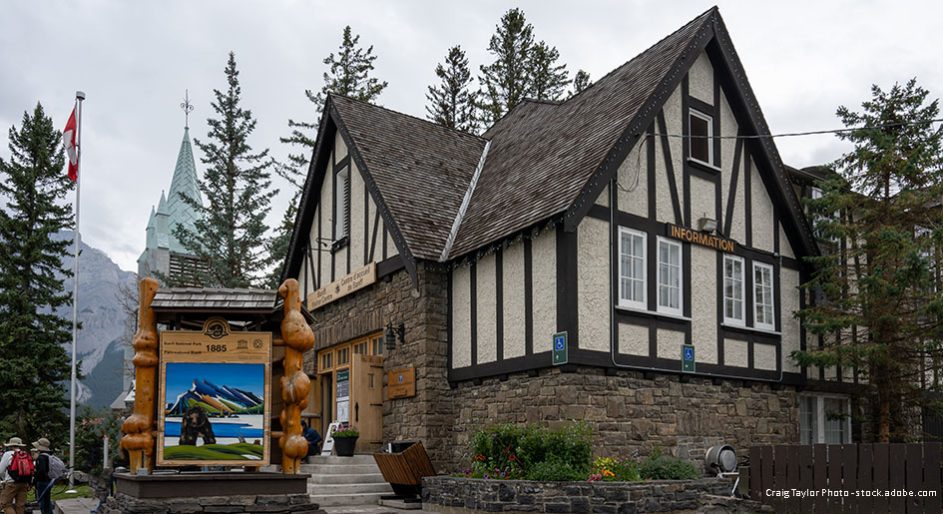
Parks Canada, in partnership with the Royal Architectural Institute of Canada (RAIC), announced the winning conceptual design of the international design competition for a reimagined visitor centre and community space through the 200‑Block Banff Avenue Redevelopment Project in Banff National Park.
The winning submission (Design #5) is from Paul Raff Studio and Kengo Kuma & Associates, bringing together Canadian and international design expertise. The design was recommended by an independent jury assembled by the RAIC following a rigorous and transparent evaluation process. All six submissions were treated equally from beginning to end and assessed against the same criteria, informed by technical review, Indigenous and public feedback, and expert advice throughout the competition.
“The jury’s decision was unanimous and confident. The winning design was selected not only for its design excellence, but for its flexibility and resilience, qualities that allow it to evolve without losing its essence. The jury was satisfied that advancing this design does not compromise its original spirit but rather provides the strongest framework for thoughtful refinement over time,” said Mike Brennan, RAIC CEO.
The jury identified the following strengths in the winning design:
- A strong and credible sustainability approach, ranking highest with the strongest sustainability strategy.
- Important value placed on landscape and architecture, with outdoor public space and connection to nature acknowledged as central to the project and complementary to the indoor space.
- A balanced approach to conservation, heritage, Indigenous perspectives, and visitor experience, representing a true-to-place experience in which Parks Canada’s identity is clear.
- Flexibility and resilience offering a concept that is technically feasible while able to be refined without compromising its original intent or spirit.
Parks Canada will work with Paul Raff Studio and Kengo Kuma & Associates to further refine the design, guided by continued engagement, environmental review, and Parks Canada’s mandate to protect and present places of national significance.
