




Articles Archive - Page 95 of 928 - REMINET
REMI

B.C. legislation to accelerate major infrastructure

Major infrastructure projects such as hospitals and post-secondary facilities will be constructed faster as British Columbia looks to speed up permitting and approvals through new legislation, tabled on May 1.

If passed, the infrastructure projects act will also support the work of the ministry of Infrastructure by speeding up approvals for other projects designated as provincially significant, including those delivered by other partners such as Crown corporations, local governments, First Nations, and private proponents.

To be designated as provincially significant, a project would need to create significant economic, social or environmental benefits for people in B.C. and contribute to priorities such as food security, critical mineral supply, replacement of U.S. imports and disaster recovery. Criteria for the designation of projects of provincial significance will be released in the coming weeks.

“At a time of uncertainty caused by Donald Trump’s tariffs, it’s more important than ever that we create more good-paying jobs by delivering the critical infrastructure projects people need – faster,” said Premier David Eby. “We are building a record number of new schools, hospitals and major transportation projects across B.C., but too many others face unnecessary and costly delays.”

The legislation will also:

    • prioritize and accelerate provincial permitting for provincial and other designated projects, including developing a qualified professionals reliance framework;
    • allow an expedited environmental assessment process so designated projects can be reviewed more quickly without compromising B.C.’s high environmental standards;
    • establish a framework for alternative permit authorizations, through an agreement-seeking approach with local governments, to get shovels in the ground faster for provincial and other designated projects;
    • put the authority of the new ministry into law so it can carry out its roles and responsibilities, such as policy development, project planning and prioritization, land acquisition, and procurement for vertical provincial projects; and
    • enable the ministry to work with school districts, health authorities and post-secondary institutions to deliver some projects on their behalf

This will allow government to group multiple projects into a single procurement or allow government to purchase project components for multiple projects at a single time. Working collaboratively with schools, health authorities and post-secondary institutions will help deliver projects are efficiently and cost-effectively.

During the past eight years, the province has embarked on the largest capital plan in its history to build schools, hospitals and student housing for growing communities. “This legislation is the next step forward,” said Bowinn Ma, Minister of Infrastructure. “As we work to deliver projects faster, this gives us the tools to accelerate key projects and help strengthen our province, while maintaining our commitments to advancing reconciliation and protecting the environment.”

Safeguarding against digital threats

In 2025, cyber threats are more sophisticated than ever, and the construction industry is no exception. While firms focus on physical job sites, cybercriminals are exploiting digital vulnerabilities in project management software, IoT devices, and cloud-based tools. From ransomware attacks to financial fraud, businesses handling sensitive project data and high-value transactions are prime targets.

Many construction companies mistakenly believe they aren’t at risk, assuming cybercriminals prioritize industries like finance or healthcare. However, hackers recognize the value of construction firms due to the multiple access points to critical information. Phishing scams —where fraudsters send emails posing as trusted contacts — are increasingly tailored to trick employees into revealing credentials, transferring funds, or downloading malware. Ransomware attacks can lock down project files, with criminals demanding payment for data restoration, yet even when paid, recovery isn’t guaranteed. Third-party vendors with weaker security also create vulnerabilities, allowing cybercriminals to access confidential financial and project data. Invoice fraud is another growing threat, where attackers manipulate communications to divert large transactions to unauthorized accounts.

The consequences of cyber incidents are severe: project delays, financial losses, regulatory fines, and reputational damage. A phishing attack compromising a firm’s email system could allow fraudsters to alter invoice details, redirecting funds away from subcontractors. A ransomware attack could halt operations, forcing costly downtime and legal repercussions. A data breach via a vendor could expose sensitive project blueprints or employee records, leading to regulatory scrutiny and potential lawsuits. These risks highlight the need for both proactive security measures and cyber insurance.

Mitigating Cyber Risks in Construction

A strong cybersecurity strategy involves proactive risk management, employee training, and comprehensive insurance coverage. Firms must regularly assess their vulnerabilities, monitor emerging threats, and implement security best practices. Multi-factor authentication (MFA) strengthens defenses by requiring multiple verification steps, while regular data backups ensure critical information is secure and retrievable in the event of an attack. Robust endpoint and network security —such as firewalls, antivirus software, and encryption —prevents unauthorized access.

Human error remains one of the biggest cybersecurity risks. Educating employees on identifying phishing attempts and fraudulent emails significantly reduces exposure to cyberattacks. As threats become more sophisticated, employee training should be an ongoing effort rather than a one-time initiative.

Even with strong security measures, no system is immune to cyber incidents —making cyber insurance a crucial safety net. A well-structured policy covers legal fees, regulatory fines, forensic investigations, business interruption costs, and crisis management expenses. It ensures companies can recover quickly, minimizing operational disruption and financial fallout.

The Evolving Threat Landscape

Cyberattacks are becoming more advanced, leveraging artificial intelligence (AI) to craft highly convincing phishing emails, deepfake videos, and fraud schemes that are increasingly difficult to detect. The widespread use of mobile devices on job sites presents additional risks, as compromised phones and tablets can provide attackers with direct access to project data. Meanwhile, the rise of Ransomware-as-a-Service (RaaS) has made cybercrime more accessible, allowing even inexperienced hackers to launch attacks.

Despite these escalating threats, some construction firms hesitate to invest in cyber insurance due to misconceptions. Many assume only large corporations are targeted, but in reality, small and mid-sized firms are frequent victims due to weaker defenses. Cybercriminals prioritize easy targets, not just high-profile ones. Another common belief is that cyber insurance policies rarely pay out, but in 2025, insurers continue to provide reliable coverage for data breaches, ransomware attacks, and fraud-related losses. Additionally, some firms mistakenly assume their general liability policies cover cyber incidents, but traditional policies typically exclude cyber risks, making dedicated cyber insurance essential.

Beyond financial protection, cyber insurance strengthens client trust and contract security. Many project owners and investors now require proof of cyber insurance before engaging with vendors, making it a valuable asset in securing contracts.

Building a Cyber-Resilient Future

As cyber threats continue to evolve, construction firms must integrate cybersecurity into their overall risk management strategy. Predicting threats, preventing incidents, and insuring against losses are key steps to safeguarding operations and ensuring business continuity. Investing in cybersecurity and cyber insurance is no longer optional — it’s a necessity for resilience in an increasingly digital world.


Nikki Keith is principal at Wilson M. Beck Insurance Services, and Robyn Wilson is vice president at the company. For more information about cyber exposures or cyber insurance solutions, visit www.wmbeck.com.


BC short-term rental rules now in effect

The Province of B.C. has issued an update on short-term rental registration (STR) numbers and deadlines ahead of the one-year anniversary of new restrictions aimed at reducing illegal listings and increasing the availability of long-term homes.

Effective May 1, 2025, all short-term rental listings must be registered with a provincial registration number. To date, more than 20,000 listings have been registered. When the STR legislation was introduced in 2023, there were an estimated 28,000 individual STR listings in B.C., indicating that more units are being converted to long-term homes.

The minister of housing and municipal affairs is extending the deadlines for STR platforms to validate registration numbers and remove illegal listings, as follows:

  • By June 2, 2025, platforms must stop advertising listings without valid registration numbers and prevent new bookings from those hosts. Previously, this deadline was May 1.
  • By June 23, 2025, platforms must cancel future bookings from hosts without valid registration numbers. Previously, this deadline was June 1.

During this period, the Province will continue working with STR platforms to ensure any technical challenges or concerns are addressed. Hosts are still expected to register their listings by May 1.

Visit gov.bc.ca/ShortTermRentals to learn more.

Library reno reinvents modernist school building

For more than 30 years, Centennial College’s Story Arts Centre has occupied a restored Toronto’s Teachers’ College building, designed 70-plus years ago by Peter Dickinson. The architect played a pivotal role in developing mid-century modern style in post-World War II Canada. An addition in the 1990s sharply contrasted with his original structure and was recently demolished during a renovation of the 500-square-metre library that now blends old and new with the existing landscape.

“There was a primary interest in understanding the architecture and design language of the Dickinson building,” says Tyler Sharp, principal at RDHA, the firm commissioned for the project. “We utilized a design process of analyzing the space, structural grids, materiality and details of this mid-century modernist building to help develop the new design which we see as being engaged in a thoughtful dialogue with the existing architectural condition.”

Such a feat would require maintaining the integrity of a design that won a Massey Medal for Architecture soon after it was erected in 1954. To reimagine the space, structural columns, partitions and a staircase were removed while existing mechanical and electrical systems were replaced and refurbished.

The library now features a glass pavilion that pours onto the landscape while respecting the past design. Vertical window bays and horizontal alignments align with the window pattern Dickinson used, while reducing glare and minimizing solar transmission into the building. In front, a new grey granite sliver and river rock reflecting pool blend the building into the surrounding green space.

library

The double-height reading room with soft hues. Photo by Tom Arban.

One of the key elements of the new aesthetic is the lightness one feels. The open-concept interior features a double-height reading atrium and general collections space with seating for private or group learning. Four-foot high stacks keep sightlines open and are movable for event planning.

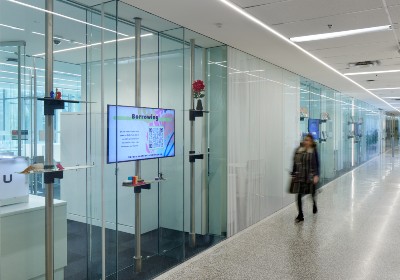
Glass-walled programming areas around the perimeter bring more transparency. Passersby can view inside the maker space and VR studio, study rooms and offices, and a computer lab/media screening room.

To foster a sense of exploration, a fully-glazed internal facade between the library and corridor draw light and views from the building’s interior courtyard and enhance connection between spaces of the past and present.


Furnishings and sectionals dotted throughout the library are upholstered in soft greys and greens inspired by the original architecture, while reflective materials like mirrors and glass maximize natural light. This complements other elements like custom desks that are fitted with tempered glass barriers to create the appearance of a display case.

library

Thick, tempered glass walls to the internal corridor provide structural support and an inviting display space. Photo by Tom Arban

A standard perforated corrugated metal screen shields a second-storey classroom and office yet draws light in like a scrim curtain with aluminum extruded LED hiding the joint so that it appears as one surface.

A floating ceiling nearby hides mechanical equipment and adds to the weightlessness of the interior.

RDHA views the project as an independent building element that provides the existing campus and neighbouring community with an example of how architecture might evolve to incorporate highly sustainable systems in a rhythmic and expressive manner.

Currently, the building houses the School of Communications, Media, Arts and Design, bringing various disciplines under one roof. Plans entail a different user may one day occupy the space as the campus is expected to close by sometime next year.

The school’s programs are being suspended or relocated to the main Scarborough campus. And while the building may hold other purposes in the future, it will continue thriving as a modernist jewel in Toronto—but now with a contemporary twist.

Free parking enacted at NS health facilities

Nova Scotia’s health care facilities will provide free parking for staff, patients and their visitors, beginning May 1, 2025. The new policy comes with an estimated $19 million annual cost for the provincial government, which has committed to reimburse the health care facilities that charge for parking for their lost revenue.

“I know people have been eager to see this change,” says Nova Scotia Premier Tim Houston, “Nova Scotians shouldn’t have to worry about parking fees when they’re sick and seeking health care or caring for our loved ones.”

Parking fees are currently charged at 39 of 97 lots across Nova Scotia Health’s various campuses, and at three on-site parking garages at the IWK Health Centre in Halifax. Some of those facilities will now be introducing a ticket validation system to ensure free parking is allotted only to eligible users. A government communique also advises available spaces may vary from site to site depending on “each facility’s unique infrastructure and capacity limitations”.

NRCA celebrates Constructing Excellence Awards

The Northern Regional Construction Association (NRCA) announced the winners of the 2025 Constructing Excellence Awards. These awards celebrate outstanding achievements and contributions within the construction industry, recognizing excellence in leadership, innovation, safety, and community impact across Northern BC.

The winners were honoured during the annual Constructing Excellence Awards Gala held at the Prince George Conference and Civic Centre where industry professionals gathered to celebrate the exceptional accomplishments of their peers.

Houle Electric took home three awards for Employer of the Year, along with the Safety Excellence Award, and the Electrical Contractor of the Year (Over $2 Million) for our work at Ksyen Regional Hospital.

“We’re proud to have received these awards, representing Houle’s commitment to safety, our people-first culture, and our ability to deliver increasingly complex projects. Rooted in our core values, our people-first culture cultivates a workplace where trust, respect, and opportunity thrive. We apply the same commitment to safety, ensuring that our policies, procedures, and practices prioritize the physical and mental well-being of our people and those around us,” said the company.

The 2025 recipients are:

Project Awards

  • Subcontractor, General – Under 2 Million: Admiral Roofing Ltd., Canfor Leisure Pool
  • Subcontractor, General – Over 2 Million: Admiral Roofing Ltd., Fort St James Hospital and Health Centre (Stuart Lake Hospital)
  • Electrical Contractor – Under 2 Million: Bryant Electric Ltd., Mills Memorial Hospital Redevelopment
  • Electrical Contractor – Over 2 Million: Houle Electric, Mills Memorial Hospital Replacement Project (Ksyen Regional Hospital)
  • General Contractor, Under 5 Million: Marmot Builders, Caribou Crossing Phase 1A
  • General Contractor, 5 to 10 Million: Wildland Development, 10 Homes for 10 Years
  • General Contractor, Over 10 Million: Enviro-Ex Contracting Ltd , West Fraser Road Flood Recovery Project

Awards of Excellence

  • Employee of the Year: Brian Vossen, Marmot Builders
  • Woman in Construction of the Year: Mandi Graham, Local Rental Solutions Ltd
  • U40 of the Year: Preston Aitchison, Marmot Builders
  • Supplier of the Year: Corestock Industrial Supply
  • Employer of the Year: Houle Electric
  • Members’ Choice: CIF Construction Ltd.

Safety Awards

  • Enviro-Ex Contracting Ltd
  • Houle Electric
  • Acres Enterprises Ltd.


Elevator safety enforcers to impose new fines

Inadequately monitoring elevator technicians’ credentials could have financial consequences for multifamily landlords, condominium corporations and long-term care home and student residence operators in Ontario, as of June 9, 2025. That’s when the provincial Technical Standards and Safety Authority (TSSA) is scheduled to begin imposing fines, known as administrative penalties, which were established in a 2021 enabling regulation.

Building owners/managers are already required to comply with the underpinning safety requirements for elevating devices, but the new fines are described as an “enforcement tool” for the TSSA. The regulation stipulates that elevating device owners are responsible for ensuring that:

  • all contractors involved in installing or altering those devices hold TSSA licences; and
  • only certified mechanics or mechanics-in-training under the supervision of a TSSA licence-holder undertake work on an elevating device.

Non-compliance with either of those requirements will warrant fines of $3,000 per contravention for subject elevating device owners and $5,000 per contravention for subject contractors. Other individuals deemed to be party to non-compliance could be fined $1,000 per contravention.

An additional $5,000 fine will come into force for contractors who fail to submit a written report to the TSSA within 24 hours of being informed about an injury or death related to an elevating device they are contracted to maintain.

“This enforcement tool will be applied as a measure to strengthen compliance with regulatory requirements and enhance public safety across Ontario,” the TSSA advises. “The administrative penalties will be imposed when a business or an individual fails to comply with the safety requirements.”

Capilano University opens childhood studies centre

Capilano University (CapU) officially opened the doors to the Fulmer Family Centre for Childhood Studies, the new home for the School of Education and Childhood Studies and a second childcare facility on the main campus in North Vancouver. The centre will also provide training for 20 early childhood educators (ECEs), doubling the practicum placements for students on campus.

Designed by Public Architecture, the 23,000-square-foot two-storey facility provides 74 new childcare spaces for the North Shore and enables CapU to increase enrolment in its early childhood care and education (ECCE) programs by 25 per cent.

As Western Canada’s only purpose-designed, integrated centre for early childhood care and education, the new building brings together researchers, students, educators and children under one roof to advance early years research, education and innovation. The building includes studio and lab space, classrooms, faculty offices and a children’s centre providing care and education for infants, toddlers and 3- to 5-year-olds starting in June.

The Fulmer Family Centre for Childhood Studies is Western Canada’s only degree-granting, integrated centre for early childhood care, research and education. The child care centre will be on the main floor and the education facility for ECE students will be upstairs.

“The opening of this innovative teaching, learning and research space reimagines how we prepare future educators to meet the needs of 21st century children and provides quality child care that is vital for children, families and communities to thrive,” said Brad Martin, dean, Faculty of Education, Health & Human Development.

The $25-million project received more than $11 million from the Government of British Columbia, including nearly $3 million from the ChildCareBC New Spaces Fund. Capilano University contributed more than $8 million toward the project, with nearly $6 million from donors.


Mississauga advances housing development efforts

The City of Mississauga announced it has made headway on initiatives to accelerate housing development, as it marks 100 days since the release of the Mayor’s Housing Task Force report.

“Addressing the housing crisis requires innovative solutions and a willingness to challenge the status quo,” said Mayor Carolyn Parrish. “Cities like Mississauga are leading by example, cutting red tape and doing things differently to meet the housing needs of our residents. When municipalities step up with bold actions and get support from other levels of government, real progress becomes possible. The strides we’ve made in 100 days show what can happen when we’re committed to change.”

Despite market challenges, the city anticipates 11,600 residential units progressing to building permit applications shortly—substantially surpassing the 2,557 permits submitted in 2024. Assembled last June, the Mayor’s Housing Task Force brought together over 30 experts from Ontario’s building and development sectors. Their recommendations, released in January, aim to remove barriers between industry and government to address housing shortages.

Key achievements include: 

  • Development Charge (DC) Relief: Mississauga introduced a 50 per cent DC discount for projects obtaining permits before November 2026 and eliminated DCs for family-sized units.
  • Tax Incentives: Peel Region approved a 35 per cent tax reduction for eligible multi-residential properties, spurring rental development.
  • New Official Plan: Policies now support 370,000 additional housing units by 2051, including taller buildings near transit stations.
  • Affordable Housing Funding: Conditional support was granted for over 1,400 rental units, with nearly 400 at affordable rates.
  • Transit-Oriented Development: Pre-zoning for Protected Major Transit Station Areas promises faster approvals and alignment with city goals.
  • Streamlined Processes: Adoption of surety bonds and delegated approval authority are reducing financial and administrative burdens for developers.

“We are committed to tackling housing challenges in Mississauga. But ultimately, actions speak louder than words,” said Andrew Whittemore, Commissioner, Planning and Building. “From announcing funding for new affordable rental projects to making it easier to develop homes around transit, we’ve taken decisive action in the last 100 days to make Mississauga a competitive, inclusive and prosperous place to live, work and visit.

For the full report, visit Mississauga.ca/housing-taskforce. 

IFMA launches lifecycle management initiative

A new collaboration between the International Facility Management Association and Autodesk aspires to unify commercial real estate stakeholders around a common approach to lifecycle management and help industry reduce costs and improve asset longevity while addressing decarbonization and regulatory challenges.

The Building Lifecycle Management Initiative (BLMI)  leverages global industry standards – like ISO 19650 (Building Information Modeling), ISO 8000 (Data Quality), ISO 41001 (Facility Management Systems), and OSCRE data models – to ensures that buildings are managed with consistency, efficiency and long-term value in mind.

“The commercial real estate industry has long struggled with inefficiencies due to fragmented data, disconnected systems and short-term decision making,” said Dean Stanberry, Past Chair of IFMA’s Global Board of Directors. “BLMI represents a turning point, providing a structured approach for aligning stakeholders, eliminating waste and unlocking the full potential of the built environment.”

The initiative places a strong focus on stakeholder collaboration, data governance, interoperability and advanced technology integration, such as building information modeling (BIM), digital twins, predictive analytics, and artificial intelligence for smarter decision making, reducing inefficiencies and creating a connected data ecosystem. The objective is to deliver tangible value to every sector of commercial real estate, including:

  • Owners & Investors: Extend asset lifespan, optimize operational costs and improve long-term financial performance.
  • Facility Operations: Move from reactive maintenance to proactive lifecycle management, improving efficiency and tenant satisfaction.
  • Architecture, Engineering, and Construction: Ensure design and construction integrate seamlessly with operational needs, reducing costly retrofits.
  • Technology & Service Providers: Align digital solutions with industry-wide standards for seamless adoption and interoperability.

“Advanced technology solutions, such as digital twins, rely on quality data to deliver powerful insights and 3D visualizations to facility operators,” added Robert Bray, vice president and general manager of Autodesk Tandem. “The Building Lifecycle Management Initiative seeks to resolve systemic issues related to data quality that span the building lifecycle,”

Using technology to improve warehouse operations

Robots and automation are making their way into almost every industry, including warehouse maintenance and management. From improved operations to performance data, inventory management, and more, today’s warehouse technology can save you time, enhance your results, and decrease your costs.

As of 2024, about 25 per cent of warehouses worldwide had adopted some form of automation, and the estimated ROI for that adoption is 20 per cent in the first two years. So not only can technology improve business, but it also helps managers stay competitive as technology adoption grows and evolves.

RELATED: The future of warehouses

Robotics

Using robots for picking and packing is one way to boost efficiency and decrease human error in your warehouse. Before you invest, however, assess whether your floor is level, whether your layout is accessible, and whether you have the space to accommodate a team of robots. Create floor plans and routes to maximize robotic performance within your space.

AI

The use of AI offers businesses the ability to better project sales, avoid disruption, and analyze historical data to detect patterns and areas for improvement. Accumulating this data can help managers improve supply chain processes, manage demand, and make well-informed business decisions to refine their operations. AI can also be applied to your warehouse equipment, predicting equipment lifespan and maintenance schedules based on real-time data from sensors and monitoring systems. This helps managers better budget for repair and replacement, as well as mitigate costly surprises and work disruption.

Digitalization

Digitalizing your warehouse can help improve operations and increase efficiency by quickly responding to and tracking customer orders, along with implementing faster order shipping and processing. By streamlining operations, cutting down on paperwork, and simplifying order processing management, digitalization can help you boost the bottom line. These types of automation tools can help you personalize customer experiences, improving service, stand out from the competition, and encourage customer loyalty.

Digitization can also help increase security with better data protection, with protocols like encryption, authentication, and authorization, so you can run your business safely as technology continues to evolve.

Warehouse operations involve many moving parts, and although technology adoption may seem daunting and costly initially, today’s innovation can help maintenance and facility managers better oversee operations and build the business.

Maintaining Safe and Reliable Housing

Black & McDonald (B&M) is proud to play a key role in the Single Room Occupancy (SRO) Renewal Initiative, a project dedicated to revitalizing 13 heritage hotels in Vancouver’s Downtown Eastside. With approximately 900 residential units, this initiative provides stable, reliable housing for individuals facing complex challenges.

Our team is responsible for Facility Maintenance, ensuring the functionality and safety of these essential buildings and enabling residents access to stable housing with integrated support services. Through a combination of self-performed services and strategic subcontracting, B&M delivers comprehensive mechanical, electrical, and plumbing solutions, as well as general maintenance for building systems, fire safety, and structural integrity.

A MULTI-TRADE APPROACH TO FACILITY MAINTENANCE

B&M’s scope of work encompasses a diverse range of services, ensuring every building remains operational and safe. Our responsibilities include:

  • Technicians performing all HVAC, mechanical, electrical, and plumbing services to the units
  • Extensive major maintenance, repairs, and replacements
  • Fire alarm and fi re safety systems upkeep
  • Cold water plumbing systems
  • Building make-up air supply and filtration
  • Base building maintenance

Through our Central Call Centre, we provide a streamlined response system for maintenance and repair requests. This communication method has ensured effective and efficient services. The Call Centre is also paramount in acting as the checkpoint for all work requests and prioritizing and dispatching them to ensure effective response to demand maintenance.

SUPPORTING BC HOUSING WITH RESPONSE & SPECIALIZED SERVICES

B&M is not only responsible for routine maintenance but also plays a critical role in responding to additional work requests. These requests vary from making additions to CCTV camera systems, rebuilding equipment damaged by fire or flood, and electrical upgrades to support the addition of cooling on site. By leveraging both self-performance and trusted subcontractors, we maintain service quality across all properties.

Our commitment to service excellence is further demonstrated through our ability to handle projects of varying sizes. Minor projects under $300K are efficiently executed while larger-scale renovations and system upgrades are carefully planned and managed to ensure a smooth project experience without interruptions.

INNOVATION AND EARLY INVOLVEMENT FOR BETTER OUTCOMES

One of B&M’s key strengths in this initiative is our proactive approach to project management. The contract has stringent requirements in place, requiring working with BC Housing and the non-profit service providers that are delivering services to residents who face complex challenges. By engaging with BC Housing from the bid stage, our operations team has helped shape the contract in a way that ensures maintainability, reliability, and serviceability. This early involvement has allowed us to anticipate challenges, optimize maintenance strategies, and contribute valuable lifecycle insights for ongoing renovations.

A LASTING IMPACT ON VANCOUVER’S HOUSING INFRASTRUCTURE

B&M’s continued involvement in the SRO Renewal Initiative demonstrates our expertise in heritage building facility management and our ability to provide solutions that support the infrastructure needs of BC Housing. By maintaining a balance between reactive and proactive maintenance, we ensure that each facility remains functional. Our team is committed to upholding the highest standards of service while adapting to the unique challenges of this initiative. By leveraging our technical expertise, we are not only meeting contract expectations but also supporting BC Housing in maintaining these important heritage buildings.

For more information, visit www.blackandmcdonald.com or reach out to [email protected]

Photo courtesy of: Sama Jim Canzian

BCCA launches construction education fund

The B.C. Construction Association (BCCA) announced the launch of the Past Chair Legacy Fund, a new education initiative designed to support the development of the construction industry.

The Past Chair Legacy Fund is a celebration of he association’s commitment to cultivating a skilled and professional workforce in the construction sector, and will provide funding for eligible trade and other professional construction career pathways, ensuring the continued growth and success of the industry. The BCCA encourages all eligible individuals to apply and take advantage of this educational opportunity.

“As an industry, we recognize that our most valuable asset is our people,” said Chris Atchison, president of the BCCA. “By offering an educational fund to construction industry workers, we are investing not only in their personal and professional growth but also in the future of the entire sector.”

The Past Chair Legacy Fund will award up to four applicants each year, with one recipient chosen from the Lower Mainland, Vancouver Island, Northern, and the Southern Interior regions respectively. The education fund is managed by the BCCA, who will oversee the application process, adjudication, and administration.

The timeline for the initiative is as follows:

  • Applications Open: April 28, 2025
  • Applications Close: June 15, 2025
  • Review by Fund Committee: June 15-July 15, 2025
  • Notification of Successful Applicants: July 30, 2025

“This initiative empowers workers to enhance their skills, adapt to evolving technologies, and take on leadership roles, ensuring our industry remains competitive and innovative,” added Atchison. “We are proud to support the hardworking individuals who are the backbone of our infrastructure and communities.”


Centennial enhances learning for next-gen cleaning managers

Centennial College launched a new course for second-year students in the Healthcare Environmental Services Management program. The HealthyClean Trained Manager Course, designed by CloroxPro Canada, includes microlearning modules that address some of the most challenging commercial cleaning tasks designed for cleaning managers.

Earlier this month, the school also kicked off the second year of its HealthyClean Trained Specialist Course for first-year students. The ground-breaking learning module teaches how to manage and mentor front-line staff working in healthcare settings.

“We’re always looking for ways in which to enhance our program and to keep up with industry’s evolving best practices,” said Karen Barnes, Program Coordinator and Professor, Healthcare Environmental Services Management at Centennial College. “Our offerings for students give them an education that truly prepares them for their careers, and this partnership with CloroxPro Canada helps our students stand out even more.

“The first-year program saw a 95 per cent participation rate from our students as they saw the incredible value this program would bring to them. We’re thrilled to be entering year two with both the trained specialist course for first-year students and the trained manager course for second-year students.”

Last year, five students were granted $1,000 scholarships from CloroxPro Canada upon completion of the course. “This program has taught me that small actions lead to big impacts when it comes to creating healthier spaces,” said Joannalyn Rosario, one of the winners. “This program has equipped me with the skills and knowledge to contribute to safer environments – an achievement I’ll carry into my career.”

Both courses lead to a Certificate of Mastery and a digital badge, which students can add to their portfolios, online signatures and social profiles, like LinkedIn.

“As someone passionate about contributing to a safer healthcare space, I’m excited to apply the skills (I learned) in the industry,” added Minjae Kim, another CloroxPro scholarship recipient.

HealthyClean is the only industry-wide certificate program designed for frontline cleaners and managers that is accredited by the American National Standards Institute National Accreditation Board and recognized by Innovation, Science and Economic Development Canada.

“We saw an opportunity to throw our support behind the next generation of environmental services professionals by bringing the first ever cohort of students free access to the HealthyClean Trained Specialist Course last year; and the reception has been phenomenal,” said Bilal Demachkie, business unit director, CloroxPro Canada. “We wanted to continue this legacy of championing the industry and working with these students again, so introducing the Trained Manager Course was the perfect next step.”

Feature photo by CloroxPro Canada: Centennial College Healthcare Environmental Services Management students.

LEED version 5 now open for registrations

Decarbonization and climate resilience are major elements of LEED version 5, the newest update to what has become the world’s most prevalent building rating and certification system. As of April 28, 2025, proponents can register for three certification streams: building design and construction (BD+C); interior design and construction (ID+C); and operations and maintenance (O+M). Further tools are promised in the coming months in the run up to certification reviews beginning this fall.

The Canada Green Building Council (CAGBC) manages LEED in Canada and contributed to the latest version through various channels of input to the United States Green Building Council (USGBC), which steered the development process. Two Canadian LEED accredited professionals participated in specially struck advisory committees, while CAGBC coordinated wider industry responses to two rounds of consultation on draft documents.

“Every new version of LEED raises the bar, balancing the limits of what is possible with industry readiness,” observes Thomas Mueller, CAGBC’s president and chief executive officer. “LEED v5 is ambitious with a stronger focus on decarbonization, resilience and health.”

Half of LEED v5’s credits are tied to decarbonization. The update also comes with new prerequisites to:

  • quantify projected operational carbon and develop a decarbonization strategy that includes pathways for reducing greenhouse gas emissions;
  • meet more rigorous energy performance standards; and
  • conduct climate resilience assessments to uncover risks and vulnerabilities, and to inform steps for reducing them.

As well, LEED v5 introduces new credits related to health and well-being of building occupants.

“Investors, owners, occupants and policymakers are asking for high-performing buildings that reduce emissions; mitigate climate risk; provide healthy, productive spaces; positively impact communities; and protect natural systems,” says Sarah Zaleski, the USGBC’s chief products officer. “LEED v5 provides the best practices and accountability to drive performance across all these dimensions, delivering tangible benefits to building owners and their stakeholders.”

Canada currently boasts more than 6,280 LEED-certified projects and is one of the top adopters of the program outside the U.S.. More than 500 CAGBC members submitted comments to the LEED v5 development process.

“Canadian feedback, amassed and summarized by the CAGBC, reflects our regional diversity, climate realities and innovative approaches to green building,” advises Marsha Gentile, director of sustainability with Ledcor Construction, who served on the 17-member LEED design and construction consensus committee.

LEED v5 will overlap with predecessor versions 4 and 4.1. Prospective proponents can still register for the latter until March 31, 2026 and will have until March 31, 2032 to submit for certification.

Iona Island Causeway upgrade receives $500,000

Improvements to the Iona Island Causeway is set to begin construction work with Metro Vancouver receiving a $500,000 B.C. Active Transportation Grant.

The Iona Island Causeway is the only access road to the Iona Island Wastewater Treatment Plant and to Iona Beach Regional Park. The narrow two-lane road needs to be upgraded to accommodate increased traffic volumes while enhancing safety for all road users as construction begins on the plant. Upgrades to underground utilities including electricity and natural gas are also required to support the plant.

“Projects as large as the Iona Island Wastewater Treatment Plant are only possible with the support of our partners,” said Mike Hurley, chair of Metro Vancouver’s board of directors. “The province’s investment in upgrading the Iona Island Causeway will facilitate better access for construction vehicles working on the wastewater treatment plant while also enhancing safety for visitors to enjoy Iona Beach.”

Causeway improvement construction is slated to begin later in the spring and continue into 2026. Once complete, the improvements will tie in with work completed last year in partnership with YVR along Ferguson Road to provide a cohesive and improved road corridor to Iona Island.

Work will include:

  • Transportation safety improvements to the road, including lane widening, adding a construction vehicle queue lane and bike lanes on both sides of the road
  • Upgrades to several underground utilities
  • Planting a landscaped boulevard
  • Construction of a greenway for pedestrians and recreational cycling

Metro Vancouver is planning upgrades to the existing wastewater treatment plant to ensure the continued protection of public health and the environment in a growing region. The existing plant, commissioned in 1963, currently provides only primary wastewater treatment.


Renters struggle to decode party promises

A national survey conducted by Rentals.ca reveals a significant disconnect between the housing policies Canadian renters say they support and the political parties they intend to vote for. When asked to select which housing policies they favour without being told which party proposed them, renters consistently chose ideas across the political spectrum and often backed policies from parties they weren’t planning to support.

Creating national rent control was the policy that garnered the most support, with 50 per cent of respondents decidedly in favour. However, only 13  per cent of those indicated that they intend to vote for the NDP. In contrast, 39 per cent of rent control supporters plan to vote Liberal, and 26 per cent plan to vote Conservative, neither of which have included national rent control in their platforms.

Similarly, 29 per cent of survey respondents said they support public housing as a top policy, which the NDP, Liberals, and Green Party all include in their housing platforms.  Among those who support the idea, 46 per cent said they plan to vote Liberal, 21 per cent Conservative, and only 16 per cent NDP.

A third policy—eliminating GST on homes under $1.3 million, a staple in the Conservative Party platform—also emerged as popular among renters. But the alignment was inconsistent, with 39 per cent of supporters planning plan to vote Liberal and just 31 per cent planning to vote Conservative.

According to Rentals.ca, these findings reflect a broader trend of renters prioritizing policy outcomes over party affiliation. When later shown which party proposed which policy, renters had already formed their views independent of political branding. Across both Rentals.ca surveys, party preferences remain closely split, with 30 per cent of renters planning to vote Conservative, 28 per cent Liberal, and 28 per cent still undecided.

The results suggest that renters could be a key swing demographic in today’s federal  election, driven more by policy effectiveness than party loyalty.