Articles Archive - Page 611 of 929 - REMINET
REMI

Cape Breton creative hub receives $5-mil federal investment

The federal government is investing $5 million to help create the Cape Breton Centre for Arts, Culture and Innovation, a new creative hub to be located in Sydney, N.S. The funding will be provided by the Canada Cultural Spaces Fund of the Department of Canadian Heritage.

The New Dawn Centre for Social Innovation (NDCSI) is a non-profit-subsidiary of New Dawn Enterprises Ltd., the oldest community development corporation in Canada. NDCSI will be receiving the funding for this project to transform the historic Holy Angels Convent into a creative hub for the community through extensive building renovations and the installation of specialized equipment. Planned upgrades include the addition of up to 25 artist studios, a multi-use gallery space, new elevators, upgraded lighting, sound-proof studios and rehearsal space, and new heating and ventilation systems.

The new creative hub will be an accessible venue for artists to create, collaborate, refine and share their work with the public. The federal government plans to invest in more creative spaces, which serve as incubators for innovation and artistic growth, as part of Creative Canada.

“It is no secret that Cape Breton Island is rich in its artistic and innovation heritage. The contribution provided by Canadian Heritage to the Cape Breton Centre for Arts, Culture and Innovation will enable us to provide a permanent home for more than 150 innovators and artists,” said Rankin MacSween, president and chief executive officer of New Dawn Centre for Social Innovation, in a press release. “It will allow us to rebuild this 130-year-old property for the next 130 years—retaining its character and its presence on George Street but with all of today’s modern systems and conveniences inside. This is a project that will undoubtedly contribute to the ongoing revitalization of the North End, Sydney’s downtown core and the Island.”

Focus on Affordable Housing

Now, more than ever, Canada needs affordable housing. In the interview ahead, Daniel Bragagnolo, First National’s Director of Commercial Financing, discusses the financing complexities of affordable housing and the advantages of CMHC’s new Flex Program.

What is the definition of affordable housing?

It’s an umbrella term that keeps expanding and really describes a whole continuum of housing. It can refer to social housing, including rent-geared-to-income units, assisted-living accommodations, and housing for the middle class that offers just below market rents.

What makes lending on affordable housing different than, say, lending on a regular apartment building?

The underwriting isn’t as simple as a typical apartment building where market conditions dictate the revenue and all rent comes from the tenants. In affordable housing, that’s not the case. There are many different funding or subsidy pools that affordable housing providers can access. Many times, these funding sources can have various restrictions, so it’s important as a lender to understand each one.

What is the CMHC Flex Program?

The CMHC Flex Program is a financing program aimed at facilitating more purpose-built rental construction when the developer agrees to certian affordable requirements within the building. Its main advantage is the significantly reduced equity requirement to start construction.. Aconventional construction loan may require 20-25% equity at the beginning and during construction where this program can go as low as 5% equity. This lower equity component increases the return on investment for the developer.  A potential project will also become more affordable for a developer based on significantly lower premiums than a normal CMHC insured mortgage.

The rental requirements to qualify for this program are either:

  • rents at 10% below the market potential for the planned project while also having 20% of the units at or below 30% of the median income for its region or;
  • the building can have a separate affordable rental agreement with their region or province to qualify for the program.

While developers benefit from lower equity contribution and a discount on the CMHC premium, tenants also benefit from below market rents and an increase in supply putting downward pressure on rents for that market place.

affordable housing

How does First National support clients in regards to this program?

As this is a new program for the lending sector, CMHC and developers there are a lot of nuances that need to be communicated and considered during project planning and the loan approval process. Given the elevated risk and importance on timing that comes with development projects, it is important that there are no surprises. Our in-depth knowledge of the needs of the development community and longstanding relationship with CMHC allows us to ask the important questions and provide the right advice to ensure all of the stakeholder’s expectations are met. it’s important to have a lender who can benchmark the application against other recent CMHC submissions and ensure the best deal possible for both the developer and CMHC.

So your role is both as an advisor and a lender?

The two go together. Our goal is not just to provide access to capital, but to provide strategies and innovative advice that results in greater flexibility for providers and developers to help them achieve their operating goals. We ultimately make a complex process simple for housing providers and developers who haven’t had to apply for a mortgage in 40 or 50 years or apartment developers who are new to the sector. Providing this advisory role in a complex industry is very rewarding, and we are proud to serve a sector whose importance to society is without question.

Any final thoughts?

Over the years, we’ve used our expertise to fund billions of dollars of first, second, and construction mortgages for affordable housing providers. In so doing, we’ve helped providers transition to a self-sustaining model and now with the new CMHC Flex Program are helping the industry provide more units to the market place across the country. Simply put, the affordable housing team at First National has the experience and is open for business.

To learn more about First National’s affordable housing mortgage strategies, call or email Daniel at 416.597.5460 or [email protected].

Last chance for Albertans’ input on improving condominium governance

Albertans that would like to provide input on ways the government can improve condominium governance and dispute resolution have until November 10 to do so.

An online survey is available for the public to take, covering a variety of topics about the day-to-day operations of living in a condo, including:

  • How condo board meetings are run and how votes take place
  • Rules on rental deposit for condos
  • Who should repair units and pay for insurance deductibles
  • How reserve funds are managed
  • What kind of say condo owners get in the rules the board makes
  • How to make sure condo boards have the support they need to fulfill their roles
  • How a condo tribunal could more easily resolve disputes as an alternative to the courts

“About one in five Albertans lives in a condo, and I am looking for the public’s input on ways we can make owning, managing and living in a condo better for everyone,” said Stephanie McLean, Minister of Service Alberta, in a press release.

The survey is available at condo.alberta.ca. The survey comes following a series of open houses that were held across the province during the summer, where more than 1,100 people shared their ideas.

Input from the survey and open houses will help the government create new regulations related to how condominiums are governed and the way disputes are resolved. The new rules are expected to be finalized in 2018.

GTA new condo sales slow as prices climb in Q3

A total of 4,577 new condominium apartments were sold in the third quarter of this year in the GTA, down 30 per cent compared to last year as fewer new projects came to market, according to Urbanation’s Q3-2017 market results.

Unsold new condo inventory across all stages of development increased for the first time since Q4-2015, reaching 7,618 units after falling to a 15-year low of 6,699 in the second quarter. Remaining inventory declined 38 per cent year-over-year and was 47 per cent below the 10-year average of 16,304 units.

So far in 2017, a total of 26,453 new condominium units were sold, as of the end of September. An additional 12,000 units could be brought to market during the fourth quarter, which is predicted to reach a new high for sales in 2017 estimated at 34,000 units, far surpassing last year’s record of 27,000 sales. Amid record demand and falling inventory, price growth for new condos continued to pick up speed. The price index for all sold units in development climbed 13 per cent year-over-year to reach $670 per square foot, with remaining units in Q3-2017 priced at an average of $816 per square foot, an increase of five per cent compared to Q2-2017 and 30 per cent compared to year-ago levels. In the former City of Toronto, the price for unsold inventory reached an average of $991 per square foot.

Due to this level of market activity in 2017, a slowdown in sales is expected next year, leading inventory levels to move up towards more historically normal levels and cause less upward pressure on pricing.

New condominium apartment price growth has started to deviate from recent resale market trends. Resale condominium apartment prices averaged $648 per square foot in the third quarter of this year, falling slightly compared to Q2-2017 ($650 per square foot) for the first time in over three years as sales fell 26 per cent year-over-year following the introduction of the Ontario Government’s Fair Housing Plan. However, market conditions remained firm with a sales-to-listings ratio of 60 per cent, keeping resale condo prices up 27 per cent compared to one year ago, a deceleration from the 31 per cent annual growth seen in Q2-2017.

Rising rents, which have been impacted by a decline in supply, are part of the reason why potential homebuyers are interested in investing in new condos in 2017. Average rents for condo units in Q3-2017 climbed 10 per cent annually to $2.98 per square foot as condo completions fell to a four-year low of about 15,000 units over the last year. However, the number of condominium units under construction reached a three-and-a-half year high of 54,715 in Q3. The number of completions are projected to reach 20,000 units in 2018, which should ease some pressure off the rental market.

Meanwhile, the recently announced stress test requirements for uninsured mortgage borrowers is expected to cause further declines in resale activity in early 2018, although the condo market is expected to remain relatively resilient due to its affordability. New condo sales should not be directly impacted by the new rules as pre-sale buyers were already required to qualify at posted mortgage rates. However, indirect effects caused by lower perceived investment returns should slow demand for new condos from current levels.

“After closing out 2017 with a record year, the new condo market is poised for moderation in 2018,” said Shaun Hildebrand, Urbanation’s senior vice president, in a press release. “A more cautious approach for both developers and buyers in the coming months will help to ensure the transition to a more sustainable pace of activity is orderly.”

Amazon to open second office in Vancouver

Amazon is opening a second corporate office in Vancouver, signing a lease for 150,000 square feet in a new, nine-storey office building at the southwest corner of Dunsmuir Street and Homer Street.

The office will allow Amazon to double its workforce in the city from 1,000 to 2,000. Designed by B+H Architects, the office by Oxford Properties is scheduled to open in 2020. The Seattle-based company’s first Vancouver office opened in 2015.

“Amazon is excited to continue growing our workforce throughout Canada,” said Alexandre Gagnon, vice president of Amazon Canada and Mexico. “We are among the largest employers of software engineers in Canada and look forward to continuing to create new job opportunities for Canadians.”

In addition to its office in Vancouver, Amazon also operates fulfillment centres in Delta and New Westminster, and a subsidiary Abebooks.com, based in Victoria.

“Vancouver’s innovation economy is booming and it’s exciting to have Amazon expand here, adding valuable job space for 1,000 more employees,” says Mayor Gregor Robertson. “Vancouver’s leading the way with the fastest growing, most resilient and greenest economy in Canada, and companies from all over the world, like Amazon, are moving to Vancouver with well-paying jobs to be a part of our success.”

The company is also expanding its operations into Alberta, reportedly building a 600,000-square-foot distribution centre in Balzac, just north of Calgary.

Amazon has still yet to announce the location of its second headquarters dubbed HQ2. The tech giant received more than 200 proposals from cities across North America and expects to invest more than $5 billion in construction.

Greenland reveals plans for Lakeside Residences in Toronto

Greenland Group (Canada) recently revealed official plans for Lakeside Residences – a 3.85-acre master-planned community to be located on Toronto’s waterfront at 215 Lake Shore Boulevard East.

The community, designed by Hariri Pontarini Architects, will consist of seven towers, housing over 2,000 residential units, amenities and over 30,000 square feet of retail space. Lakeside Residences will be located near Canada’s first ‘smart cities’ neighbourhood by Google’s Sidewalk Labs.

“We’re excited to be a part of Toronto’s emerging waterfront neighbourhood,” said Henry Cao, president of Greenland Group (Canada), in a press release. “Lakeside will be a highly-walkable vital new hub that connects the waterfront to Toronto’s downtown core.”

Lakeside Residences will feature all seven towers rising above a central courtyard. The tallest two towers, spanning 49- and 39-storeys, will frame the block. Cecconi Simone has been brought on to design interiors.

An amenity space will be located mid-way up one tower, featuring a new park for residents in the sky. Award-winning landscape designer Janet Rosenberg will be tasked with the community’s exterior courtyard, creating an urban backyard on the waterfront, highlighting the area’s walkability, surrounding parkland, opportunities for leisure, cafes and retail offerings.

“Greenland Group (Canada) held an international design competition for the project and we were instantly intrigued,” said David Pontarini. “Greenland has demonstrated an ambition to do something of significance and quality on the Toronto Waterfront and Hariri Pontarini Architects is excited to be a part of it.”

Lakeside Residences is the second project by Greenland Group in Canada, following the launch of King Blue by Greenland, a mixed-use development on Toronto’s historic Westinghouse site including a 122-room luxury boutique hotel, 44- and 48-storey residential high-rise towers and the revitalization of the highest heritage façade ever retained in Canada. Greenland is currently undertaking high-profile projects in New York, Los Angeles and Sydney.

Sales for Phase One of Lakeside Residences will officially begin later this fall.

GTA new condo sales keep pace with 10-year average

In September, the market for new construction homes in the GTA sped up, largely driven by sales of multi-family homes, condo apartments in high-rise and mid-rise buildings and stacked townhomes, according to the Building Industry and Land Development Association (BILD).

There were 2,101 new homes sold in September in the GTA, reports Altus Group, which provides BILD with new-home market intelligence. Approximately 83 per cent of these homes (1,749 units) were multi-family homes, and only 17 per cent (352) were low-rise single-family homes, such as detached and semi-detached houses and townhomes. Condo sales for the month were on par with the 10-year average of 1,810, while low-rise home sales fell below the 10-year average of 1,173.

By the end of September, there were a total of 33,871 new homes sold in the GTA in 2017, with condominium apartments in high-rise and mid-rise buildings and stacked townhomes accounting for 80 per cent of those sales.

“The GTA new home market is being driven by multi-family homes. Year-to-date, there have only been 6,718 new single-family low-rise homes sold, which is a level that we have not seen in more than a decade,” said Bryan Tuckey, BILD president and CEO, in a press release. “This is largely due to government intensification policy and the challenges low-rise builders face in bringing product to market, such as a lack of serviced and approved land.”

While the supply of new housing increased in September to top 10,000 units, it is still far below what is considered a healthy level. Supply of new housing is typically measured by the number of new homes available for purchase at the end of the month. At the end of September, the supply of multi-family homes sat at 9,389 units, while 2,607 single-family homes were available for sale in the GTA.

“The recent increase in single-family inventory was the result of more new project launches as well as additional product released at existing sites, both are which are typically up in September,” added Patricia Arsenault, Altus Group’s executive vice president of Research Consulting Services. “This increased inventory is setting the stage for some improvement in single-family new home sales this fall. But the launch frenzy that had characterized the market over the past year is over – buyers now feel that they can take a bit of time to shop around, without the fear of losing out.”

Prices of available homes in September fell for single-family low-rise homes, but rose for multi-family homes. The average price for available new single-family homes was $1,204,829, down from August’s levels, but still 21 per cent higher than September 2016’s average price of $992,391. The average price for available new detached homes was $1,608,909, and the average price of a townhome was $1,019,470.

For condominium apartments in high-rise and mid-rise buildings and stacked townhomes, the average price climbed to $661,188 in September, compared to August’s $644,327. This level is 36 per cent higher than September 2016 levels. The average price per square foot was $789, and the average unit size was 838 square feet.

Report renews calls for more family-friendly housing in the GTA

A new report from Ryerson City Building Institute and Urbanation has brought renewed urgency to calls for more family-friendly housing in the GTA, including ‘missing middle’ options such as stacked townhouses. Bedrooms in the Sky: Is Toronto Building the Right Condo Supply? predicts that baby boomers and their millennial kids will soon be competing for the same type of real estate: two- and three-bedroom units in low- and mid-rise buildings.

Greying boomers will cause the 65-plus set to swell by more than 484,000 in the coming decade, while maturing millennials will add 207,000 to the ranks of 35 to 44-year-olds. As boomers reach retirement age and millennials begin families, write report authors Cherise Burda, Graham Haines and Shaun Hildebrand, the elder demographic cohort will be looking to downsize from detached homes without giving up too much space and the younger demographic cohort will be looking to move up from bachelor and one-bedroom units to make room to raise kids of their own.

Detached homes are an increasingly unattainable move-up option for millennials, the report finds, as the gulf between the average cost of condo apartments and detached homes has widened by three-fold to $600,000 in the last 10 years, and this trend is expected to continue.

“Within the GTA, the best opportunity to provide affordable family-friendly units will come via built forms that fall between one-bedroom condo apartments and detached houses on the price spectrum — such as two- and three-bedroom units in mid-rise and low-rise multi-unit buildings,” states the report.

The supply of three-bedroom units has seen modest growth in recent years, thanks to prompting by the City of Toronto, but at an average price in the high six-figures, many buyers are unable to afford them. The supply of units with two or more bedrooms as a percentage of completed units has remained static in recent years and dropped from past levels, the report points out, having represented around two-thirds of condo apartments completed in the 1990s versus the two-fifths of condo apartments in the current development pipeline.

As the supply of two-bedroom units has declined as a percentage of completed units since the 1990s, the average height of condo buildings has shot up from 15 storeys to 21 storeys today in the GTA.

“Many downsizers and young families do not necessarily want to live in a 30- or 40-storey tower downtown, which is why it is important to examine where we are developing family-friendly condo units,” adds the report.

The City of Toronto is where the vast majority of condo projects are concentrated, as compared to the 905 region, which is home to slightly more than a third of condo projects. The 905 region represents an even lower share of the units coming down the development pipeline because its projects are more likely to take the form of mid- or low-rise buildings.

The record-high 105,000 condo apartments due to come online in the next five years are largely spoken for, with 94 per cent pre-sold. Investors have claimed half of those units at a minimum, according to Urbanation statistics tracking the supply of new condo apartments to the rental market.

As investors typically snag smaller units to lease to tenants, says the report, the larger units take time to reach the resale market. The alternative, for families to buy larger units pre-construction, is challenged by lags as long as five years.

“If these construction trends continue, the proportion of family-appropriate housing available in location-efficient neighbourhoods (close to transit, employment, schools and services) will decrease and affordability will erode further,” the report concludes.

How automation is changing the JanSan industry

A new report from CB Insights found that about 10 million service and warehouse jobs are at high risk of displacement within the next five to 10 years in the U.S. alone, including 3.8 million cleaner and janitorial jobs.

The report based the relative risk of automation on factors including tasks involved, current commercial deployment of technology, patent activity, investment activity, technological challenges and regulations.

Advances in robotics — where artificial intelligence software meets hardware — are taking automation beyond heavy industrial and manufacturing processes. This trend is already affecting sectors like physical security and cleaning services. For example, start-ups are developing commercial cleaning robots, and many early-stage startups in the U.S. like CleanRobotics, RanMarine, Adlatus Robotics and Avidbots have cropped up in the last two years. A late-stage company, Xenex Robots, develops UV disinfectant robots to reduce the rate of hospital-acquired infections in more than 400 healthcare facilities.

Canadian statistics mirror U.S. findings. Last year, a Brookfield Institute for Innovation + Entrepreneurship (BII+E) study found that nearly 42 per cent of the Canadian labour force is at a high risk of being affected by automation in the next decade or two. Expert methodologies combined with Canadian data found that janitors, caretakers and building supervisors earning less than $40,000 per year have a 66 per cent chance of being replaced. Facility operations and maintenance managers earning more than $60,000 face an 81 per cent risk. The number rises again with cleaning supervisors who are facing a 94 per cent risk of losing their jobs.

New technology will likely drive restructuring, but it will either replace certain jobs or complement them.

Some industry experts and start-up founders have been optimistic about the new jobs that will be created. BII+E found that occupations with the lowest risk of being affected by automation, which are correlated with higher earnings and education, are projected to produce nearly 712,000 net new jobs between 2014 and 2024.

But what the jobs of the future will look like remains to be seen. Automation in the JanSan industry is morphing every year, with new solutions coming to market. Many companies in the Canadian cleaning industry haven’t been early adopters, but they are starting to rethink how technology is making them more efficient and giving them a competitive edge when bidding for corporate businesses.

The companies that are thinking this way are rising to the top, according to CEO and founder of Cleaning Marketer Lisa Macqueen. She is also co-owner of Australian-based Cleancorp, a multi-million dollar global cleaning enterprise. Here, she discusses what the keys strengths of automation are, what facility service providers are missing out on if they don’t embrace it and what automation won’t ever be able to replace.

What are some key strengths that automation brings to the cleaning industry?

One area seeing fantastic results is on-site management systems, which are giving cleaning companies much more transparency; automation is allowing them to make better decisions around the facilities they manage, such as what tasks are delivered and when. They also allow cleaners to look at an app and see what work needs to be done on a particular floor. That kind of automation has started to make a big difference in service delivery.

Also, the cleaning staff is being cared for more. We know when they arrive and when they leave. If anything happens and they don’t log out, it can trigger an immediate alert. For example, if you had a cleaner working solo and they had a medical emergency – there is always the chance they may not be able to get the help they need in time. What this technology does is allows for supervisors and management to be alerted when someone has stayed too long on a site or hasn’t logged out, which provides a very clear way of managing the health and safety of employees and team members. By doing this, and showing our people that we care about them on every level within our business, it helps to build a much stronger culture within the organization, and helps to retain staff for much longer. Why? Because they feel valued.

Where do you think automation will be in ten years?

A report from Oxford University states nearly half of U.S jobs could be performed by machines within 20 years. High on this list are industries with a lot of turnover and less college-educated workers. There’s around a 65 per cent chance that janitorial workers will be replaced by computers and automation. Can that really happen? I don’t think so. I don’t think we can replace such a labour intensive job such as cleaning. The reality is you still need people. A lot of janitorial may be replaced, but as that happens, it’s not going to happen all at once. Even right now, floor scrubbing machines are becoming smaller so that equipment can reach smaller spaces, but the training for how to operate those machines requires people — now they are the ones driving the machines or programming them on site. I don’t think we will see a traumatic change, but efficiencies will be created, companies will save money and what they’ll do is use that money to redistribute the hours the janitors would have completed on more demanding, detail-oriented tasks that only a person can do.

Who is embracing automation the most, facilities or service providers?

First of all, it really depends on the facility. When you have this kind of equipment, you need to be able to house it somewhere. If the facility does have the available space, I’d say it will be facility-driven because for every facility manager in a large space, cleaning takes up a huge chuck of their overall budget. They will always be looking for ways to reduce the bottom line. At the same time, cleaning businesses are also looking to reduce costs. Both sides have a shared mission.

How can smaller facilities incorporate automation into their budgets?

Small facilities still have massive costs for cleaning. Those with time and management software on site find it helps them because they want to make sure they are getting value for their outlay. If cleaning is taking place over a short period of time, they may want to see if they can get more done. In other words, the days of service providers flying through a site in record time are over. Business and building owners and managers need to see a greater return on their investment for cleaning service, and those companies that can provide that transparency are winning customers because of it.

How can we protect jobs and also embrace technology?

Contract cleaning is a huge part of facility management. Having skilled staff on site is something that can’t be replaced. There is so much that automation cannot do in a building. Perhaps, janitors may become more upskilled so they can spend more time doing work that is less repetitive and more detail-focused. Janitors are the face of the cleaning business that has the contract – if the face of the business is just a robot, then it’s really easy for a customer to just replace you if they get a better offer.

We can’t forget the important role they play when interacting with customers face to face on a daily basis. That’s a really big job that they probably don’t get kudos for. People buy from people, and a piece of equipment will never be able to replace that human interaction. The people in your workforce are your biggest asset.

What are facility service providers missing out on if they don’t embrace automation?

Cleaning businesses have to start automating their workflow, sales and marketing, and their social media strategies to compete in the 21st century. The old ways just won’t cut it anymore, and any cleaning business owners (CBOs) who think that way will be left behind. And look, why wouldn’t you want to make changes that will simplify and speed up your own operation. One area many cleaning business owners overlook is how they can manage daily tasks in their offices; for example, issuing a new contract to a customer. I’ve worked with clients who have taken up to an hour to complete the process of issuing just one contract, but with automation, the exact same contract can be issued, with e-signing capabilities, in literally a couple of minutes. You’re not only saving time, but think about the staffing costs this improvement could save a business – it’s huge.

Can you expand on social media automation?

Many cleaning business owners are hesitant to take the step into using social media for their businesses, for one of two reasons. Either they don’t know what to do, and how to make it work for them, or they’re afraid of the amount of time it will take out of their already busy schedule. Here’s the thing though. What many CBOs may not know is you can also use automation for these processes. Tools like Dux-Soup for LinkedIn, Hootesuite, Buffer or Meet Edgar help you to ensure your social media goes out, without your even having to think about – meaning you and your business stay in front of your ideal prospects and clients, even if you’re away on vacation or having a really busy week. It’s awesome, and totally worth the very small monthly outlay to use these tools.

Lisa Macqueen is the co-founder of Cleancorp has more than 20 years of experience working in the cleaning industry. Her business, Cleaning Marketer (www.cleaningmarketer.com), coaches cleaning business owners on how to attract more prospects, make more sales and keep customers longer, using modern ideas and strategies specifically developed for the cleaning industry. She is a sought-after speaker, consultant and mentor in the U.S., Australia, Canada and New Zealand. You can contact her on Facebook at Cleaning Marketer, Twitter @cleaningmktr or at [email protected]

Rebecca Melnyk is online editor of Facility Cleaning & Maintenance

Don’t be overwhelmed by energy projects

Given today’s operating realities, making the right facility investments is critical. Many building owners and managers face budget constraints, changing regulations and shifting occupant expectations. These factors increase the pressure to invest wisely in projects that provide the greatest return and impact.

Building management solutions should result in improved facility performance — impacting energy efficiency and the bottom line. But addressing occupant comfort and regulatory standards are important considerations, as well.

The good news is these results can be achieved by starting small. Don’t be overwhelmed by the idea of building improvement projects. Large-scale energy audits that result in a long list of improvements are a good solution for many buildings. However, they may not be the best option for every situation. Small projects can have a significant impact on energy savings, building performance and occupant comfort.

Consider this model that works for many building applications: start small with energy management projects and repeat the cycle after validating the results. The initial investments may be smaller in scale, but these projects can yield big results.

Setting and prioritizing goals  

Having a strategy in place before starting is critical to the success of any building energy management project, no matter the size. The process should start with setting reasonable goals and prioritizing them, followed by validation after improvements are made.

The first step is considering what it is you want to accomplish. Ask yourself, “How will this meet my organization’s mission?” Be clear on what the end result should be and what resources are available, and then use that information to set and prioritize goals. From there, it’s easier to move ahead with gaining approval and allocating resources.

Because building managers and owners often have restricted funds to invest, prioritization is a vital part of determining which capital project that aligns with energy management will provide the greatest impact. It is important to consider the total cost of ownership over the entire life of the asset when determining the return on investment of a project. Energy management projects that reduce the lifecycle costs of operation allow organizations to invest in other priorities and make their building an asset that positively impacts the bottom line.

In some cases, it may be necessary to consider getting help from a partner. While some organizations have the internal skillset and staffing resources to implement energy management projects, others prefer to partner with a third-party provider that can offer expertise to help set goals, implement improvements and verify results.

Validating results

The validation step is where some projects falter, so keep in mind that implementing improvements is not the end of the process. Validation is critical because it ensures that progress is being made and it helps tie the actions taken to tangible business results. A key point to consider is if the investment met the goals and objectives set when the project was first approved.

Technology advancements in building equipment and systems, and the data-gathering capabilities and tools now available with some of these solutions, make it easier than ever to measure performance and verify results. Validation can prove the business impact of the improvements, but results also can be measured around other indicators, including progress toward sustainability goals, system reliability, or occupant complaint calls.

Following through with validation of the results helps to build support internally — a critical step in gaining the buy-in, resources and funding for additional energy management projects. Implementing a cycle of bite-sized investments, followed by validation, and then repeating the process can help build momentum for additional improvements over time.

Repeating this method for small energy management projects can help address some of an organization’s core goals for improvement.

Projects with big impact

Consider the example of a facility with remote chiller controls. Commercial buildings where the indoor environment and occupant comfort are important factors can realize numerous benefits from a building energy management system (BEMS) focused on performance and optimization. Benefits can include remote resolution of system alarms 24/7, energy usage reporting and visualization, and system-level optimization through analytics.

Other improvement steps can include enterprise-level building automation system (BAS) control, integration of lighting and building controls, and the ability to make scheduling and setpoint changes remotely. This also allowed for remote resolution of system alarms 24/7 and intelligent dispatching to mobile technology.

Summary

Small building projects have a significant impact on important key performance indicators such as energy efficiency, cost savings and occupant comfort and satisfaction.

Instead of taking a big step to improve building performance, in some cases it’s a better option to take smaller steps and prove the results along the way. Small projects for building energy management provide the potential for ongoing success and significant impact on building performance, operational efficiency and the bottom line.

Neil Maldeis, PE, CEM, is an energy solutions engineering leader for Trane, a provider of indoor comfort solutions and services and a brand of Ingersoll Rand. He has more than 30 years of experience as a mechanical/project engineer in building construction and energy conservation.


GTA home sales climb nearly 12 per cent in October

According to the Toronto Real Estate Board (TREB), Greater Toronto Area realtors reported 7,118 home sales in October 2017, representing an above-average increase of nearly 12 per cent between September and October, indicating stronger fall market conditions.

On a year-over-year basis, October sales were down compared to the 9,715 transactions that took place in October 2016. Total sales throughout 2017 so far amount to 80,198, down on a year-over-year basis from 99,233.

“Every year we generally see a jump in sales between September and October,” said Tim Syrianos, TREB president, in a press release. “However, this year that increase was more pronounced than usual compared to the previous 10 years. So, while the number of transactions was still down relative to last year’s record pace, it certainly does appear that sales momentum is picking up.”

The MLS Home Price Index Composite benchmark price climbed 9.7 per cent compared to October 2016. Annual rates of price growth were strongest for townhomes and condominium apartments. The average selling price for a home in October was $780,104, an increase of 2.3 per cent compared to the October 2016 average of $762,691.

“The housing market in the GTA has been impacted by a number of policy changes at the provincial and federal levels,” said Jason Mercer, TREB’s director of market analysis. “Similar to the track followed in the Greater Vancouver Area, it appears that the psychological impact of the Fair Housing Plan, including the tax on foreign buyers, is starting to unwind.”

“TREB will be undertaking its annual consumer polling process over the last two months of 2017.  This polling will include research into the impact of recent and proposed government policy changes on consumer intentions to buy and sell homes in the GTA, including the impacts of the new OSFI guideline and a potential vacancy tax in the City of Toronto,” added Syrianos. “In addition, TREB continues to work with different levels of government on solutions to the long-term housing supply issues in the region.”

Montreal’s Le Castelnau recognized with INOVA Award

At the recent INOVA Awards Gala, hosted by the Urban Development Institute of Quebec (IDU) and held on October 19 in Montreal, DevMcGill and TGTA were presented with an INOVA Award in the Multi-Residential Category for their project, Le Castelnau. The award was presented to a multi-residential project with construction costs exceeding $50 million.

“It is a great honour for DevMcGill and TGTA to receive such recognition,” said Stéphane Côté, DevMcGill president and Martin Galarneau, partner at TGTA, while accepting the award. “We hope to stay on this road paved by excellence and constant willingness to innovate and to which we have, to the best of our abilities, contributed to shine light on Montreal through building projects respectful of building heritage. We strive for very high standards in terms of quality and we believe this award is evidence.”

Le Castelnau is a high-end condominium project that emerged following the conversation and restoration of the Institut des Sourds-Muets, a historic Beaux-Arts grey stone building from 1921. Three phases rose surrounding the landmark building, as designed by Roch Cayouette and the firms Cardinal Hardy/Lemay Architects.

For DevMcGill and TGTA, the condominium project enhances the residential real estate offerings and actively contributes to the neighbourhood’s revitalization. The project aims to respect and enhance the symbolic value of the significant central building while remaining urban.

The IDU’s INOVA Awards highlight those that contribute to Quebec’s building industry. The awards recognize the most innovative projects in the fields of commercial, multi-residential, industrial and public services real estate, which significantly impact communities.

Edmonton detergent manufacturer penalized for high phosphorus levels

An Edmonton-based laundry detergent manufacturer was recently fined $600,000 for selling two commercial detergents (Zeplift and Classic TKO), which contained concentrations of phosphorus in excess of the allowable limit.

Commercial and industrial laundry detergents are restricted to no more than 2.2 per cent elemental phosphorus by weight. Phosphorus is an element commonly used in the manufacture of detergents and cleaners. When released into the environment it contributes to the over-fertilization of freshwater ecosystems and can result in the growth of harmful algal blooms in Canada’s lakes and rivers.

Acuity Holdings, Inc. plead guilty in the Provincial Court of Alberta to one count of contravening the Concentration of Phosphorus in Certain Cleaning Products Regulations under the Canadian Environmental Protection Act, 1999. The company manufactures and sells various cleaning products, including industrial and commercial laundry detergents, under the registered trade name Zep Manufacturing Company of Canada.

Environment and Climate Change Canada enforcement officers conducted the investigation. The fine will be directed to the Environmental Damages Fund.

Q3 2017 apartment market highlights

Overall, the Canadian real estate industry continues to be performing well in the back half of 2017, with the apartment sector holding strong. According to the 2018 Emerging Trends in Real Estate report, published by PwC Canada and the Urban Land Institute, one trend we’re seeing a lot of this year is the development of new mixed-use properties by major pension funds and large institutional investors (including REITs). These properties tend to be a combination of commercial, retail, service, and residential, creating brand new, mixed-use communities in Canada’s major urban centres.

Rental properties in Montreal, Quebec City and Halifax remain in high demand. Quebecers have long looked at rental favourably, and the market is particularly strong for those properties that are centrally located where residents can embrace a “live-work-play” lifestyle. Interest in Montreal rental property is so strong, in fact, that mid-sized players, as well as industrial and commercial developers, are beginning to take notice and move into the apartment market. In Halifax, a lot of the rental stock coming online is condo-quality.

In British Columbia, strong demand accompanied by even stronger pricing and highly compressed cap rates have convinced many long-term holders of multifamily properties in Metro Vancouver to cash out in the first half of 2017 amid a rising interest rate and bond yield environment that could move the market into a post-peak-pricing phase. According to Avison Young’s Fall 2017 British Columbia Multifamily Investment Report, sales of multifamily assets in the first half of 2017 roared back with 47 transactions valued at $658 million. The second half of 2016 had recorded just 30 transactions valued at $262 million while the first half of 2016 registered 43 transactions valued at $472 million. Multifamily investment activity in 2017 is on pace to easily surpass the 73 transactions valued at $734 million set in 2016. The record was set in 2015 when 80 properties valued at $1.41 billion traded hands.

Meanwhile in the GTA, product continues to be at a shortage. In its report, Avison Young cited that multi-residential properties were the least-traded asset class in Q3, despite investment dollar volume rising 43% quarter-over-quarter to $475 million. Nevertheless, year-to-date multi-residential sales are up 21% year-over-year to $1.1 billion.

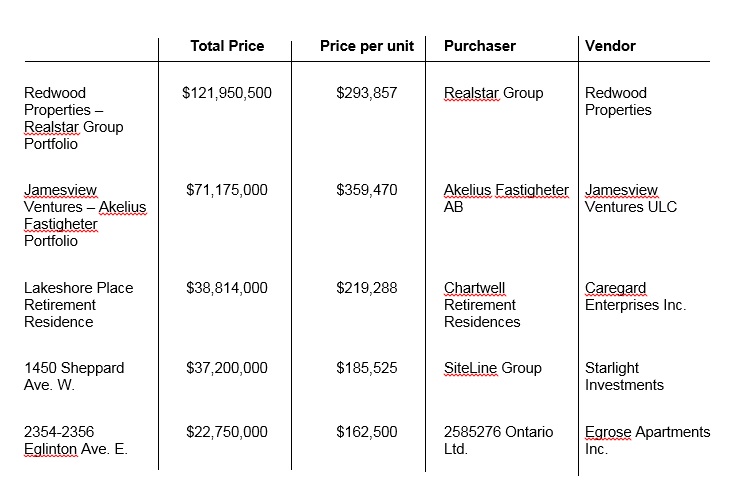
Two portfolio trades helped drive the sector’s quarterly performance: Redwood Properties sold two high-rise buildings (415 units) in Brampton to Realstar Group for $122 million, while Akelius purchased three properties (191 units) in the City of Toronto from Jamesview Ventures for $71 million.

Notable Q3 transactions:

Q3 2017 apartment market

Tips for selecting a new paint colour in condos

Could a paint colour change on a property land a condominium corporation in court? What about result in physical threats? The answer to both is yes. Experience painting condominiums confirms that colour can be a contentious issue.

Once a board decides to move ahead with painting maintenance, it must decide whether to match the existing colour or change it. Since paint colours fade over time, even matching the existing colour presents problems. What colour should be matched: the faded one or the one closest to the original?

Whether the project involves doors, siding or trim and fascia on a townhome site or suite doors, trim, balconies or interior or exterior walls in a high-rise building, colour is personal and change often generates volatile discussions. When a long-standing colour is changed, those charged with the responsibility of maintaining a building can find themselves maligned and accused of lack of taste by residents.

Many boards avoid the pitfalls of changing colours by repeating the existing paint colour. But making the decision to stay the status quo can leave a condominium looking dated, with reduced curb appeal — affecting every owner’s return on investment.

There are effective ways and not-so-effective ways to initiate a colour change in a condominium community.

Painters have had to be removed from a site after they were physically threatened by owners who disagreed with the new colour choice being applied to front doors. A large exterior painting project had to be put on hold as owners and management negotiated through court proceedings to stall a site-wide colour-change decision.

Conversely, when owners are engaged early and consensus is reached, residents have been excited to see the positive face lift of a condominium site with a simple, professionally executed colour change.

What can a board do to make the transition easier when considering a colour change?

Ask for volunteers

Canvass owners and residents, form a committee, and communicate plans to make colour changes well in advance to the condominium community. Engaging owners like this helps to diffuse or prevent accusations that a board operates in a vacuum.

Present a digital rendering

How colour will change a room or the exterior of a home can be hard to imagine. Colour rendering can often bridge this gap by helping owners and residents visualize what the space will look like.

Examine a full-size paint sample

The sample strips supplied by paint stores are just too small to use to make a large-scale decision. Also, the other colour shades on the sample strip have a tendency to influence a person’s eye, making the process even more difficult. A large sample board painted with the new colour can be moved to multiple locations with varying light exposures to get a better sense of what sort of result to expect.

Remember: While colour samples are typically examined under 100 per cent light, rarely do all of the surfaces on which the paint is applied receive 100 per cent light all of the time. Experience also suggests that colours chosen under artificial light can look very different — for example, washed out — when applied outside under natural light.

Use website galleries

Photos of buildings with similar architectural features and substrates painted in colours close to the newly proposed colours can be helpful in presenting a future vision to owners. Often these websites offer ‘before’ and ‘after’ photos, which can inspire design committees. Several websites offer the ability to test options online — just upload a photo and apply a variety of possible colour schemes.

Hire a professional

Many of these options require a working knowledge of architectural features and the overall impact of the colours being considered. What happens when a board just wants to update the colours but has no idea where to start?

A professional designer will bring experience picking colours. Colours are very much an individual preference but a designer will be able to gauge the vision and expectations of the condominium community. More importantly, by hiring a professional the colour decision is in the hands of a third-party expert, relieving the self-identified ‘resident designer’ from being subjected to criticism from their neighbours about their choices.

Have a mock-up done

For individuals who have difficulty visualizing the new colour or design, painting a complete wall, door, or unit will give the board and owners confidence that their decision best reflects their expectations.

A board can save a lot of time, energy, and money by trying to engage ownership early in the process of maintenance projects like this. Even for just a simple paint colour change, communication is key.

Phil von Massow is the owner of ArmourCo Solutions, which has more than 25 years of experience in the condominium industry. The company provides full-service maintenance including interior and exterior painting and caulking, flooring/membrane, repairs, and underground garage projects for townhome and high-rise condominiums.

Guidance for servicing appliances with non-HFC refrigerants

The home appliance industry is transitioning to the use of non-HFC refrigerants in refrigerators, freezers, ice makers, beverage coolers, room and portable air conditioners, and dehumidifiers. This transition will require service personnel to follow certain safety procedures when performing maintenance and repairs on these products.

The home appliance industry has already begun producing appliances that utilize these non-HFC refrigerants, which have a lower global warming potential. However, they also are flammable, which is why the new procedures are necessary.

The Association of Home Appliance Manufacturers (AHAM) has developed a document to assist manufacturers and service personnel with adopting the proper safety procedures and precautions necessary to mitigate the potential hazards related to the higher flammability of the new refrigerants.

Safe Servicing of Household Appliances with Flammable Refrigerants: Recommended Practices includes guidance for a pre-service safety check, leak detection and coolant-line repair, recharge and replacement of refrigerants, refrigerant removal, and post-service procedures.

As these new refrigerants are introduced to the market, AHAM states it is critical that those who service and maintain appliances that incorporate these refrigerants are familiar with this new guidance.

CSLA recognizes professional excellence

The 2017 Recognition Awards were handed out at the Canadian Society of Landscape Architects (CSLA) Gala in October. The CSLA Recognition Awards honour the work and commitment of Canadians to the profession of landscape architecture.

Natalie Goulet-Sorenson, BLA, AALA, CSLA, was the recipient of the Emerging Professionals Award from the Canadian Society of Landscape Architects.

The Emerging Professional Award demonstrates the CSLA’s commitment towards landscape architects in the early stages of their careers.

Goulet-Sorenson is a landscape architect with more than eight years of professional experience. Her education started at the Northern Alberta Institute of technology in Edmonton, Alberta, where she completed a diploma in landscape architectural technology. She continued her studies at the University of Idaho in Moscow, Idaho where she obtained her degree in landscape architecture.

Upon graduation, Goulet-Sorenson returned back to Edmonton, where she began working at Stantec Consulting. At Stantec, she’s had the opportunity to collaborate on a variety of diverse design and construction projects with the large multidisciplinary team in the office. Her project experience varies from high level master planning to the implementation of regional and neighbourhood parks, constructed wetlands, recreational trail networks, passive and creative play spaces, and open space rehabilitation- among other projects.

Currently, she is the president of the Alberta Association of Landscape Architects and sits on the steering committee for the 2017 Edmonton Urban Design Awards. She is an advocate for the profession and enjoys working with her colleagues to support landscape architecture.

The other recipients were:

  • Dr. Douglas Olson, CSLA’s Lifetime Achievement Award.
  • Professor Sean Kelly, CSLA’s Teaching Award.
  • Les Amis de la Montagne (Montreal), CSLA’s Community Service Award.