Articles Archive - Page 523 of 929 - REMINET
REMI

Senate of Canada Building officially opens

Ottawa’s former Beaux-Arts central train station, built in 1912, has officially reopened as the new Senate of Canada Building following its restoration.

Designed by Diamond Schmitt Architects and KWC Architects, the transformed building, which has largely been off-limits to the public for 50 years, now features committee and meeting rooms, offices and public space.

“This project provided a remarkable opportunity to investigate and engage in a range of design innovations to introduce a new program in a heritage building, to represent and raise the profile of the Senate’s role in Parliament, and to convey Canadian identity through contemporary interpretations of national symbols and iconography,” said Martin Davidson, principal at Diamond Schmitt Architects, in a press release.

Diamond Schmitt worked with the Dominion Sculptor of Canada and employed digital technologies, influenced by both traditional craft and contemporary fabrication techniques, to inform material selection and the design of a variety of details. The leaf pattern of 10 native maple trees, which appear in the wooden doors to committee rooms and the Senate Chamber, are hand-carved, scanned and CNC-carved. Perforated bronze panels frame committee rooms with large-scale images of landscapes rendered as half-tone images. The Senate Chamber, located in the former station Concourse, features the most detailed design elements.

The facility, which became home to the Government Conference Centre in 1973, required a complete overhaul of major building systems. It also had to be made compliant with seismic codes, accessibility and life safety upgrades. The exterior’s east façade, which used to be blank, is now reimagined as a modern interpretation of the building’s stone-columned, Beaux-Arts façade.

The Senate of Canada will occupy the building for 10 years during the restoration of Centre Block on Parliament Hill. After that point, the building is designed to accommodate conference and office use. The transformation of the historic building assures its use in the future.

B.C. first to allow 12-storey mass timber builds

B.C. will be first in Canada to allow 12-storey mass timber buildings. The current building code allows only six-storey mass timber buildings, but the national building code is expected to be revised to increase height limits to 12 -storeys in 2020.

“Changes to the national building code that allow for taller wood buildings take effect next year, but we’re not waiting to get started. Our government is ready to work with communities to build safe, secure and green tall wood buildings that will create jobs, grow B.C.’s value-added sector and realize our low-carbon future,” said Premier John Horgan, who made the announcement at the Structurlam production facility in Okanagan Falls.

B.C. has obtained permission from the National Research Council to use the encapsulated mass-timber construction provisions from the 2020 National Building Code through a jurisdiction-specific regulation.

The provincial government’s new policy effectively invites local and municipal governments regulated under the B.C. Building Code to voluntarily adopt the new policies, if they want.

A mass timber building is one where the primary load-bearing structure is made of either solid or engineered wood. Encapsulated mass timber is where the mass timber components are surrounded by fire-resistant materials like drywall.

“Mass timber technology allows faster construction where large sections of a building can be manufactured in a plant and then assembled on site,” said Selina Robinson, Minister of Municipal Affairs and Housing. “The faster we can deliver the homes that people need, the better for communities right across B.C.”

According to the government, mass timber buildings can be one-fifth the weight of comparable concrete buildings, while still meeting performance standards for safety, structural resilience and fire protection.

Studies have shown the environmental benefits of using mass timber. The estimated carbon benefit from the wood used in the Brock Commons building was equivalent to taking 511 cars off the road for a year.

The development of innovative and cost-effective low-carbon building solutions — like construction using mass timber technology — supports government’s CleanBC goal of making every building more efficient, while creating more jobs and economic opportunities for people, businesses and communities.

The technology has been reviewed by the national building code committees, as well as by experts such as fire safety specialists, structural engineers, architects, scientists and builders.

The Ministry of Municipal Affairs and Housing staff will contact local governments with a request for expressions of interest and detailing the next steps for any local governments interested in this voluntary program.

Winners announced for 2018 EQ Awards

At EnerQuality’s recent 2018 EQ Awards, held at the Toronto Marriott Markham on Feb. 28, guests celebrated 20 years of EnerQuality and feted the accomplishments of industry leaders as award winners were announced.

“It speaks volumes to see how the longevity of EnerQuality and our certifications like ENERGY STAR have continued to remain relevant and grow in impact over the years,” said Corey McBurney, president of EnerQuality, in a news release. “The 2018 EQ Awards allowed the industry to celebrate where we have come from and spotlight the pioneers who are joining forces to carve a new path for the future with programs such as our ENERGY STAR Multifamily High Rise certification.”

“Our certifications are voluntary investments by our builders. EnerQuality is committed to ensuring the greater public is aware of the investment these builders are making for the sustainability of these communities,” added Shannon Bertuzzi, vice president of market development at EnerQuality.

The 2018 EQ Award winners include Times Group, in the Building Innovation in the Mid/High Rise category; Minto Communities, which won the ENERGY STAR for New Homes Builder (Large Volume) award; Roya Khaleeli of Minto Communities, who won the Leader of the Year award; and Sifton Properties, which was presented with the Ontario Green Builder award.

The 2018 EQ Awards also featured special designations to highlight outstanding contributions by industry professionals, including the 2018 Hall of Fame award, which was presented to Sean Mason, president of Sean Mason Homes. His company was among the first three builders in Canada to participate in and certify with the ENERGY STAR program, and the first in Canada to make it their standard offering. Sean Mason Homes has previously won BILD’s 2015 Green Builder of the Year award, as well as EnerQuality’s ENERGY STAR Builder (Small Volume) in 2018.

The Impact Award 2018 was presented to Tamarack Homes for making significant long-term voluntary progress in cutting carbon emissions and achieving outstanding energy efficiency and sustainability practices.

Click here to view the full list of winners.

Manitoba sticks to optional new home warranty

Third-party warranties against construction deficiencies will continue to be a market-driven feature of new home sales in Manitoba rather than a regulatory requirement. After first postponing the date the legacy legislation from its predecessor would come into force, the provincial government now plans to repeal the New Home Warranty Act.

The announcement appears in the 2019 budget, released last week, and is characterized as a move to reduce red tape and cut costs for homebuyers. More than five years have elapsed since the previous government passed the Act, which was initially scheduled to take effect in January 2017.

“Changes in the housing market have eliminated the need for a costly new provincial regulatory system,” the budget document asserts. “This will reverse the implementation of over 250 new regulatory requirements that would have increased the cost of a new home by thousands of dollars.”

The now-hypothetical rules would have given unit owners and condominium corporations in newly constructed buildings an automatic cost-recovery mechanism for various inadequacies in design, structure, materials, components and workmanship. Mandated compensation and time periods for coverage were generally more generous than the third-party warranty programs currently available in the market.

Builders would have been required to secure minimum coverage of $100,000 per suite, and at least $2.5 million for common elements in buildings with upwards of 25 units or $100,000 per unit in smaller condo complexes. The stipulated minimum coverage period was set at: one year for defects within units due to design, materials or workmanship; 15 months for defects related to materials, workmanship and design of common elements; two years for defects in the building envelope and major building systems or for non-compliance with the Manitoba Building Code; and seven years for structural defects.

Compliance requirements called for administrative approvals and associated documentation at several steps of the process — all under the auspices of a new provincial registration agency — necessitating input from builders, warranty providers and municipal officials tasked with ensuring proof of warranty before building permits could be issued.

“I don’t disagree that the regulatory system would have been costly,” says Delaney Vun, a partner with Fillmore Riley LLP in Winnipeg and vice president of the Canadian Condominium Institute’s Manitoba chapter. “There was a lot of government oversight required in the regime that was envisioned. It was going to involve a number of bodies checking boxes and verifying compliance.”

While the legislation was still under debate in 2013, the Association of Manitoba Municipalities (AMM) voiced reservations about extra tasks for municipal staff, potential liability and/or legal costs to prove building permits had been issued in good faith, and pass-through costs for builders and homebuyers.

“The additional costs for provincial staff and other resources required to administer the program likely would have been passed along through the chain,” agrees Lanny McInnes, president and chief executive officer of the Manitoba Home Builders’ Association (MHBA).

Meanwhile, many builders are voluntarily opting to carry third-party coverage in response to market demand and/or because it is one of the criteria for MHBA membership. “From our members’ perspective, not having the increased administration and bureaucracy is going to be seen as a positive thing. From a customer perspective, nothing really changes,” McInnes says.

Four companies currently providing warranties for MHBA members and their clients offer varying coverage options for the condo sector, although one provider limits policies to low-rise developments of no more than three storeys. The best available per-unit coverage is $60,000, while three of the four providers top out at $50,000. Two of the four also offer up to $2.5 million to offset defects in common elements; another sets the maximum at $500,000.

MHBA takes credit for some of the changes in the housing market, which, the provincial government maintains, make a mandatory new home warranty program unnecessary.

“I think that argument likely has a lot to do with customers being more aware and more savvy than they were in the past,” McInnes suggests. “We always tell the general public: no matter what type of new home you are thinking of buying, ask your builders about warranty protection.”

Barbara Carss is editor-in-chief of Canadian Property Management.

GTA new home sales up 14 per cent in January

In January, sales of new homes the Greater Toronto Area experienced a moderate annual increase, reports the Building Industry and Land Development Association (BILD).

January 2019 saw the sale of 1,362 new homes, up 14 per cent compared to January 2018, according to Altus Group, BILD’s official source for new home market intelligence.

January saw the sale of 420 new single-family homes, including detached, linked and semi-detached houses and townhouses (excluding stacked townhouses), a figure that is 53 per cent below the 10-year average. There were 942 new condominium apartments, including units in low, medium and high-rise buildings, stacked townhouses and loft units sold in January 2019, five per cent below the 10-year average.

“This year is starting off on a positive note,” said Patricia Arsenault, Altus Group’s executive vice president, data solutions, in a press release. “The improvement in new home sales over last January is consistent with our outlook for somewhat higher annual sales in the GTA this year, following the drop in 2018.”

Benchmark prices of new homes continued along recent trends, with the benchmark price of single-family homes declining 8.1 per cent year-over-year to $1,130,046. Meanwhile, the benchmark price of a condominium apartment climbed 12.5 per cent on an annual basis to $803,638.

Since little new product was introduced to the housing market in January, remaining inventory fell slightly on a monthly basis to 15,530 units, comprised of 10,364 condominium apartment units and 5,166 single-family homes. Remaining inventory includes units in preconstruction projects, projects currently under construction and in completed buildings.

“It looks like the market is starting to return to typical levels after a particularly difficult year,” said David Wilkes, BILD’s president and CEO. “With the spring budget coming up, we are calling on the federal government to take steps to make it easier for first-time home buyers to get into the housing market.”

Communication planning for condo notice boards

It’s generally wellunderstood that good communication helps keep things running smoothly in a condo corporation. Good communication supports activities such as rules enforcement that serve to maintain the property as a nice place to live and therefore preserve property value.

Recently, this author’s company signed on a condo corporation that was keen to make the most of its new elevator screens as a communication tool. The board of directors, along with many tidy residents, had lost patience with the folks who continued to make a mess of the chute rooms, and they thought it was time to get tough.
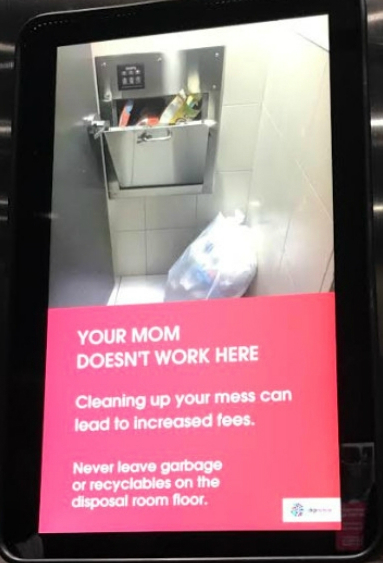
communication planningOne of the first notices that was created to tackle the problem (pictured left) was produced prior to any creative brief, which is developed through a sit-down between the creative lead, board and management team. There was some surprise when a resident took offence, claiming that the text “Your mom doesn’t work here” was sexist and suggestive of the antiquated idea that a mother’s role is to clean up after people.

But whether one agrees with that opinion or not (this business owner and mother of four teenagers didn’t take offence), there are a few things wrong with this picture that can be avoided through careful, upfront communication planning.

  1. Watch the tone

While the aim was to get tough on the litterbugs at the site, the tone of this notice is a bit harsh, and it all boils down to one word — “never.”  Using words like “don’t” or “never” or YELLING IN ALL CAPS are generally not too productive. Most people do their best listening when they detect whispering, and while the digital equivalent of a whisper takes practice, it’s very important to master if the audience is to notice, retain and heed the message.

  1. Know your audience

One of the most important things to do when broadcasting is to have a pretty good sense of who the audience is. That means understanding demographics such as age, gender and income — anything that gives insight into who the audience members are and who they perceive themselves to be.

This often requires ditching pre-conceived notions, too. (Contrary to popular belief, seniors have been the fastest growing segment of tech adopters.)

  1. Ditch the pic

Many, many times representatives of condo corporations have sent pictures of garbage, cigarette butts, even cars crashed into garage posts with the request to post IMMEDIATELY!!! (Yes, the caps were included.) Some even had angry red arrows, circles and other lines to make sure the viewer didn’t miss the point.

communication planningThis practice is generally discouraged because it can come off as tattletale-ish and finger-wagging — two practices that are more likely to have the opposite effect of what was intended. People who get told what to do can come right back and tell the messenger what to do (or where to go). Not only that, but garbage rooms are not generally the prettiest picture to display in the elevators for all to see (including would-be unit purchasers). Better to be subtle and get the audience’s attention and yes, even admiration, as in a notice that compared speedy drivers to race-car drivers (pictured right).

  1. Pick your battles

Some notices are purposely designed to shock and jolt the audience into a behaviour change, and that’s totally okay.

A “shame campaign” from a year or so ago got major reaction — and major results. Residents were quite upset when their inconsiderate behaviour was brought front and centre for all to see, but the facts were the facts. The board stuck to its guns and after just three days on the elevator screens, the difference on the property was quite pronounced.

In the case of the notice about the chute rooms, if someone perceives a message to be sexist, it may be best to remove, reword, or rework it entirely. It’s usually just a simple matter of careful thought and planning to achieve an eye-opening notice without offending, or at least without offending the non-target audience.

  1. The creative brief

As mentioned, the chute room notice was created before the creative brief was developed.

Establishing a creative brief upfront is absolutely critical to the success of a communication strategy. The process starts with an in-depth discussion between the board of directors and/or management team and the creative lead. Board members should be involved initially because, as residents, they have a unique perspective and can share their goals and objectives. It also helps to get the board and the management team on the same page, because quite often the communication priorities of one are quite different from the other.

Whether messages are intended for elevator screens or elsewhere, careful planning is key to good communication, and nothing keeps things running smoothly in a condo community like good communication.

Sue Langlois is the founder/CEO of DigiNotice, a digital display and creative notice service designed specifically for condos. Sue is on the CCI-Toronto board of directors and serves on the communication committees for both CCI-Toronto and CCI-National. She contributed the Communications chapter of CCI-T’s Board of Directors’ Tips, Tools and Techniques. Sue can be reached at [email protected].

The preceding article has been adapted and reprinted with permission from the Digi-Notice blog: https://digi-notice.com/anew/category/blog/.


Six trends in the cleaning industry impacting floor care

Gone are the days when we stripped and refinished our floors every summer, suffered through back pain associated with poorly designed vacuum cleaners or when we associated a clean floor with a strong scent. There have been some huge changes in the past decade that have changed the cleaning industry for the better, but the way we care for our floors may be the most changed.

From robots to Instagram, here are the trends we’re watching and what they mean for the way we care for floors:

A brighter spotlight on our industry
The cleaning industry now is under the microscope more than it ever has been before. Between the ever-present customer complaint system available on social media, an increase in slip-and-fall litigation and the buzz of employee wellness, our work is noticed and publicized, whether we like it or not. It’s great if we are doing our jobs well, but it does mean the pressure is on. As we know, floors are the major first impression our buildings give to the world. Adhering to a comprehensive floor care program that is often revisited, well-documented and constantly improving will be absolutely imperative if we want to keep up with the increased scrutiny. Floor care has never been a procedure that can be performed here and there. The most successful cleaning companies and departments treat floor care as a comprehensive and continuous system.

Increased transparency when it comes to ingredients
Now more than ever, the end user is looking for safer, more sustainable products that are not only good for the planet but also for the workforce. It wasn’t too long ago that the industry was using some nasty raw ingredients, and workers accepted that occupational hazards like asthma and headaches were just part of the job. Today, we know better. That means there’s more demand for safer items. Luckily for us, we have more ingredient transparency than ever before so that we are able to make educated purchasing decisions, knowing what is going into the cleaning products we choose. In the U.S., new laws in California and New York will make sure that all manufacturers make a complete list of raw ingredients transparent, which indicates a shift in this direction for all states in the future. If you aren’t paying attention to what’s in the cleaning products you’re purchasing now, it’s time you discover a third-party certification system like ECOLOGO, Green Seal or the U.S. EPA’s Safer Choice program to help you understand the products you’re purchasing and their effects on human health and the environment. Start with your floor cleaners, including some of the more complex and stronger formulations in strippers and floor finishes, and go from there.

Robots are coming for our floors
The cleaning industry has a laid back reputation when it comes to technology. For example, there is an old-fashioned cotton string mop that was popular in the 1940s that is still being used in some facilities today. However, we’re also seeing a huge amount of technological improvements and exciting advancements lately, especially in floor care. We always love to see the new software programs and apps for cleaning and troubleshooting that help us do our jobs better. But one of the most exciting advancements in floor care right now is the advent of robotic auto scrubbers. Manufacturers of cleaning equipment are partnering with robotics companies to implement this AI technology quickly. As they continue to improve designs and efficiencies, we are most excited to see how this type of technology can free up custodial workers to spend more time on high-level cleaning tasks, training and education, leaving the repetitive, back-breaking work to the machines. We see only upside for floor care programs and the profession from this development.

An influx of low-maintenance substrates
Back in the day, floor care meant we needed to strip, seal and finish our floors at least once a year. These labour intensive tasks took up a lot of time and a huge portion of our cleaning budget. Today, more and more new buildings are opting for low-maintenance substrates that don’t need to be stripped or refinished, ever. For example, terrazzo and concrete flooring are making a huge mark on the flooring industry and new and exciting treatment programs allow cleaning programs to completely forego stripping and recoating, opting for low-maintenance floor care programs instead. Luxury vinyl tile, engineered wood, marble and slate are all exciting new flooring substrates on the uptick in new and renovated buildings that don’t need polymer coatings but instead require a fresh approach to floor care and the correct training to make sure we know how to clean these new substrates without damaging them. In other words: the old strip-seal-refinish paradigm will not work here.

A changing custodial demographic
We are also noticing the natural ageing of our custodial population. In Canada, the average age of a custodial worker in the education sector is 52 years old. Many of our most experienced and knowledgeable custodians are retiring with 30 years of service. It’s a shame to say goodbye to all that experience, especially when it comes to such a specialized form of work like floor care. As we lose that knowledge base, we must dig deep to motivate, coach and mentor the younger generation of custodial workers. The need for documented training that verifies the people understand the elements of the cleaning process is needed now more than ever. The education we provide our teams should not just be based on the products themselves, but teaching our younger generation about the science behind what we do, the health and safety measures needed and finding engaging ways to motivate them to become vested in the important work they do.

The need for alternate knowledge sources
As this older generation retires out of the custodial force, we are also seeing distributors with the knowledge and experience retiring. We will need to seek out information for alternate sources, including manufacturers, conferences, reports and case studies and learn ways to educate ourselves to make up for the loss of the distributors’ deep knowledge base. Having a specialist there that they can rely on to be your number one expert or a reliable source to answer your questions will be imperative as you adapt your floor care program to the ties.

Charlotte Products is a manufacturer of cleaning products with manufacturing facilities in Canada and the U.S.

The preceding article has been adapted and reprinted with permission from the Charlotte Products blog.

Work-at-heights training program successful: study

According to a study by the Institute for Work and Health, Ontario’s working-at-heights training program is successful at preventing worker injuries, resulting in savings of up to $36 million in health, lost productivity and other costs for the business.

Over 550,000 Ontario workers, with the vast majority in the construction sector, have completed working-at-heights training since the program launched on April 1, 2015. According to the study, the training program prevented 220 workplace falls from heights across all sectors in 2017, with 111 of those potential falls in the construction sector.

“Our mandatory training program is saving lives in Ontario,” said Laurie Scott, Minister of Labour, in a press release. “Our government’s goal is to improve health and safety and prevent injuries and deaths of workers when working at heights.”

Falls from heights are a leading cause of work injuries and deaths at construction projects in the province. Working-at-heights training program standards are mandatory for workers who use travel restraint, fall restricting, fall arrest, safety nets, work belts and other fall protection systems in the construction sector. Up to 20 per cent of those attending the training program work in other sectors.

“Working-at-heights training is improving the falls prevention knowledge of workers and their supervisors,” said Scott. “We are enabling people to work safer on the job and helping businesses to reduce their costs.”

According to the province, businesses are benefitting from an almost 20 per cent reduction in lost-time injury (LTI) claims to the Workplace Safety and Insurance Board (WSIB). The reduction has the largest impact among the smallest employers and among six groups of employers with the highest rates of LTI claims.

Greybrook invests in Toronto mid-rise development

Greybrook Realty Partners Inc. recently announced the successful closing of an equity investment by its managed issuer of $27.6 million to acquire and oversee the development of a two-acre parcel of land in Toronto. Greybrook plans to develop the property into a mid-rise residential condominium in partnership with the developer, Tribute Communities.

The site, located east of Bayview Avenue at 680-688 Sheppard Avenue East, is right on the TTC’s Sheppard Avenue subway line, within walking distance to both Bayview and Bessarion stations. It also provides easy access to the Oriole GO station and the highway.

In recent years, the Sheppard Avenue East corridor has seen immense transformation and strong urban growth, particularly in regions near rapid transit infrastructure. Both public and private investments are being made in the area surrounding the development site.

Investments include the redevelopment and expansion of Bayview Village shopping centre, as well as the addition of a number of high-rise and mid-rise for-sale and purpose-built residential towers nearby. Other investments in the area include a proposed 209,000 square foot Bessarion Community Centre, which is expected to be one of the largest community centres in Toronto. The community centre is set to be completed by 2021 and will include recreation space, an aquatic centre, child care and a 13,000 square foot public library.

“We are thrilled to add this transit-oriented development site to our GTA portfolio in an area of the city that is seeing a considerable amount of activity,” said Alex Riajskikh, the executive director of private capital markets at Greybrook Realty Partners, in a press release. “From an investment perspective, this project offers our investors an opportunity to invest in an exciting Toronto-based development and to diversify their real estate investment portfolios.”

CMI and Marquette University create supply chain management course

ISSA’s Cleaning Management Institute (CMI) has collaborated with Marquette University (MU) to develop an online training course that introduces the seven critical areas of supply chain management.

“Supply chains – not companies – compete in today’s economy,” said Marko Bastl, assistant professor of supply chain management at Marquette University’s College of Business Administration in the press release. “How we manage the supply chain can become a competitive advantage. Companies need to understand the role that internal functions such as logistics and purchasing play in gaining a competitive edge.”

According to Bastl, you will gain “insights into how we can take an integrated view of the various supply chain-related functions – such as customer service, logistics and distribution, purchasing, and supply chain planning – and in doing so maximize our levels of customer service.”

“People in a number of different roles will get a lot of insight from this program,” added Brant Insero, director of education, training, and certification for ISSA. “Buyers in purchasing departments, production planners, and logistics analysts, in particular, are good candidates. Also, middle managers who are perhaps working in a narrow supply-chain-management area would benefit from better understanding their role in the broader context.”

For more information contact ISSA training specialist TJ Grim at [email protected] or visit CMI’s supply chain management web page.

The role of DINs in professional cleaning

Did you know many manufacturers in Canada as well as in the U.S., believe Drug Identification Numbers (DINs) are only placed on pharmaceuticals?

According to Avmor’s latest white paper some Canadian facility managers and cleaning contractors report that there is often confusion as to what is recognized as an independently verified disinfectant in Canada and this confusion extends to the U.S. and other manufacturers exporting disinfectants to Canada.

“It’s easy to determine if a disinfectant has been independently evaluated and determined to be an effective disinfectant,” says Mike Watt, head of training and new product development at Avmor in the news advisory.

Watt addresses the following questions about DINs:

What is a DIN?
A Drug Identification Number (DIN) is a computer-generated, eight-digit number assigned by Health Canada to a drug product before being marketed in Canada. The DIN verifies that the product has been independently tested and proven to be an effective disinfectant. A product will have a ‘DIN’ number on the label.

Is it just for drugs?
No. Most chemicals used in Canada as disinfectants or antimicrobials such as disinfectant cleaners, disinfecting wipes, antibacterial hand soaps, and sanitizers are regulated as drugs. So, that is the connection.

What does the DIN mean?
DINs are similar to an Environmental Protection Agency registration. When the EPA tests and verifies that a disinfectant is safe and effective, it is given an EPA registration number, noted on the product’s label. Health Canada functions in the same way. A DIN placed on a disinfectant means the product has also been proven safe and effective.

Does Health Canada do the testing?
No. In most cases, products are tested by independent laboratories. If it passes specific standards and criteria, a DIN is generated.

Do U.S. and European manufacturers selling disinfectants in Canada need a DIN?
Yes. If they are calling their product a disinfectant, to comply in Canada, it must have a DIN.

“Disinfectants used in Canada and around the world play a vital role in helping to keep people healthy,” Watt adds.

“Hopefully, this Q&A answers the key questions Canadians and U.S. chemical manufacturers have about DINs so we can make sure this continues to happen.”

Avmor is a leading Canadian manufacturer of professional cleaning solutions. To learn more about DINs, Mike Watt can be reached at [email protected].

Construction starts on Calgary Ring Road

Construction on Calgary’s southwest ring road is set to begin this spring after the province announced that contracts have been signed for two segments.

The 11 km road project is divided into three segments: the south that connects with the Southwest Calgary Ring Road, the north that meets the Trans-Canada Highway and a new bridge across the Bow River.

EllisDon was awarded the contract for the north segment, running between Old Banff Coach Road and the Trans-Canada Highway, while the West Bow River Bridge twinning project will be built by Flatiron and AECON.

“We look forward to working with our partner, Flatiron, to successfully and safely execute this important project for Albertans. This project will be a key component in the completion of Calgary’s ring road, providing vital infrastructure for the growing Calgary area,” said Jean-Louis Sevranckx, president and CEO, Aecon Group Inc.

Between now and 2022, the north segment of the West Calgary Ring Road will support 2,393 jobs, while the West Bow River Bridge will support 300 jobs.

“EllisDon is proud to be selected to build this important piece of infrastructure for the province of Alberta,” said Jeff Fox, senior vice-president and area manager of EllisDon Calgary. “We’re looking forward to delivering the next stretch of the 101-kilometre ring road, providing better free-flow access around the City of Calgary.”

The province will be issuing Request for Qualifications for the south segment of the West Calgary Ring Road, between Highway 8 and Old Banff Coach Road. A contractor is expected to be in place for the 2020 construction season.

The West Calgary Ring Road will be open during fall 2022, one year following the expected completion of the Southwest Calgary Ring Road project. When complete, the entire Calgary Ring Road will provide travellers with 101 kilometres of free-flow travel.

Cintas launches 10th annual Canada’s Best Restroom contest

Cintas Canada, Ltd. invites the public to help them find 2019’s Best Restroom. The contest is open to any non-residential washroom in Canada that is accessible to the general public.

“A customer’s washroom experience can have a significant impact on their impression of a business,” said Candice Raynsford, marketing manager, Cintas Canada, in the press release. “Through this contest, Cintas recognizes businesses that have invested in providing first-rate facilities to keep their customers coming back.”

Last year’s winner, St. Albert Honda in Alberta took home the title for its washrooms which promote cleanliness and convenience with automated fixtures, including a “stepNpull” door opener, and deluxe baby changing stations in both the female and male washrooms.

“We were blown away by the red-carpet experience that we received from Cintas Canada when we were named Canada’s Best Restroom,” said Ross Hodgins, Owner, St. Albert Honda in the press release. “The media coverage we received during the contest gave the dealership national exposure and we still have customers stopping in to see our washrooms. It’s great to know that so many Canadians take as much pride in clean washrooms as we do.”

Entries are judged based on five criteria: cleanliness, visual appeal, innovation, functionality and unique design elements. Five finalists will be announced in July and the public will have an opportunity to vote for this year’s winner.

Nominate your favourite public washroom now through June 14 at bestrestroom.com/Canada. The winner will receive $2,500 in facility services from Cintas to help maintain their award-winning washrooms.

For more information about the contest, contact Christina Alvarez at [email protected] or 708-908-0898.

VEC forecasts $3.3B demand for greener buildings

The Vancouver Economic Commission (VEC) has launched the Green Building Market Forecast, a report quantifying the potential economic impact of the BC Energy Step Code (ESC) in Metro Vancouver. The study identified a $3.3 billion market opportunity resulting from materials and manufacturing for newly constructed buildings to meet the energy requirements of the ESC between 2019–2032.

“Climate change is the most pressing issue facing the world today, and ambitious policies create huge new market opportunities,” says VEC CEO Catherine Warren. “With our engineering and construction know-how, the Vancouver region is ideally positioned to develop its local manufacturing sector to serve the green building industry.”

The global market for green building products is estimated to rise as high as $350 billion a year by 2020.

The economic impact of the ESC includes the potential to create 925 well-paying, sustainable manufacturing jobs throughout B.C., and at least 770 ongoing installation jobs in Metro Vancouver. The report also states that B.C. and Vancouver businesses should act now to take advantage of markets with similar climates and advanced green building codes, including those in the Cascadia mega-region, and throughout North America.

The ESC provides a predictable pathway for market transformation towards net-zero energy ready buildings. The steps were developed over two years through a consensus-building process, supported by energy modelling and analysis. The VEC built on this analysis to forecast the market demand for building products and technologies. The resulting report was developed in consultation with a wide range of real estate and construction industry experts, with modelling provided by Delphi Group and funding from Discovery Foundation and BC Housing.

The report is critical reading for the construction, development or manufacturing industries looking to understand and take advantage of upcoming trends in B.C.’s building sector. There are concrete data and analysis to help manufacturers and suppliers transition knowledge, equipment and investments and take advantage of growing demand for building products. Improving B.C.’s capabilities in this way will also improve access to – and affordability of – high performance products by creating more resilient and efficient local supply chains and reducing transportation costs.

VEC projects that demand for low-performance products – especially windows – evaporates after 2022. Manufacturers and suppliers must be aware of these significant market changes as soon as possible to grow business locally and capitalize on global trade. Conversely, demand for high performance systems will increase, including mechanical equipment such as heat pumps and heat recovery ventilators.

“We’ve been trying to encourage curtain wall and fenestration manufacturers from Europe making Passive House-certified units to bring their products to Canada, and they are looking for hard data and market information on which way the market is going. This report provides concrete market data, which can be very useful for them and other manufacturers, architects, municipalities, and developers,” says Cillian Collins, senior architect, Perkins+Will.

Soil sample results intensify cleanup demands

Hazardous contaminants from former industrial operations still linger in a now largely residential area of Edmonton. Newly released soil sample results reveal that more than 12 per cent of 1,457 soil samples collected in the 2017-18 period were contaminated with levels of dioxins and furans that pose a risk to human health.

An associated health risk assessment has detected an above-average number of three types of cancer among residents who have lived in the Homesteader neigbhourhood in the city’s northeast quadrant for at least 10 years. Public health officials are stressing that further study is required before definitive links can be drawn between the contaminants and elevated numbers of women with breast or endometrial cancer and men with lung cancer.

“Alberta Health will be working immediately with federal experts to conduct a field epidemiology investigation to understand more about the population health factors that might have contributed to higher rates of these three cancers,” states the public health communiqué that accompanied the Alberta government’s release of soil test data last week.

The issue has been in dispute since Alberta Environment and Parks refused to issue an remediation certificate for a proposed development site where treated wood products such as railroad ties and telephone/hydro poles had been produced for more than 60 years until the late 1980s. The owners subsequently appealed that ruling.

Nearby residents were alerted last year when the Alberta government ordered control measures and further testing. The vast majority of problematic soil samples were taken from vacant land that has been fenced off to prevent the public from gaining access, but health and environmental authorities are concerned that some contaminants have been carried off-site via groundwater or the removal of soil and debris that may have been used as fill in other construction projects.

“Because of the installed fencing, dust control and current snow cover, there is little risk of exposure,” the communiqué maintains. “As a precautionary measure, until more is known from the epidemiology investigations, women who have lived in this area for 10 or more years should talk to their doctors about the risks and benefits of starting breast cancer screening at the age of 40.”

The development site will remain idle until an okay to proceed is issued. Cleanup of “areas of specific concern” is promised later this spring, while the bill goes to the landowners.

“Remediation of those locations remains the responsibility of the companies previously ordered by Alberta Environment and Parks to clean up the site,” the Alberta government reiterates.

Webinar aims to train FMs on active shooter events

Over 250 active shooter events took place in the United States between 2000 and 2017, resulting in 2,217 victims, both killed and wounded. Statistics find that 45 per cent of active shooter events occur in businesses, while 25 per cent of events occurred at schools and a further 10 per cent took place in government facilities.

In an effort to help prepare real estate professionals for this possibility, the Institute of Real Estate Management (IREM) is holding a two-hour webinar event on April 17 to help train real estate managers and their staff for the risks and potential violence of active shooter events and help increase tenant and resident safety.

The webinar will be hosted by Tony Casper, CEO of Safe Passage Consulting. Casper is a long-time law enforcement professional and instructor in Counter-Terrorism Tactics and Active Shooter Response for both law enforcement officials and citizens. The webinar will address the implementation of safer workplace practices and will provide guidance on writing emergency response plans.

“A webinar about how to prepare for an active shooter is not something we want to be doing, but the reality is, it is a topic we need to address,” said Don Wilkerson, 2019 IREM president, in a press release. “By helping real estate managers to develop and rehearse a comprehensive shooter plan, they can better protect their tenants, residents and employees in the unfortunate event of an active shooter.”

Deferred maintenance hits home for legislators

The Manitoba government is warning that the provincial legislative building has fallen into serious disrepair. Due to mark its centennial in sync with Manitoba’s sesquicentennial next year, the Beaux Arts style landmark now requires more than $150 million worth of restorative upgrades.

The 2019 Manitoba budget, released last week, lists the work among unexpected cost outlays that cannot be postponed further. “There is a limited time to act in order to prevent this historic building from becoming permanently impaired. We will soon introduce legislation to ensure that the necessary repairs are completed,” it states.

The budget characterizes deferred maintenance as one of “a series of undisclosed or understated financial issues” the previous government handed on to its successor. However, the previous government instigated the building condition assessment that discovered the scope of the required work.

Major projects involving heritage restoration of two of the legislative building’s most noted features occurred during the previous government’s tenure. In 2002, a $1.1 million roof replacement included temporary removal and off-site maintenance of the iconic Golden Boy, which sits atop the cupola. In 2012, the nearly century-old skylight above the building’s grand staircase was replaced at a cost of $1.5 million.