Articles Archive - Page 450 of 928 - REMINET
REMI

Alberta is accelerating infrastructure projects

Alberta is accelerating infrastructure and transportation projects across the province to get thousands back to work and the economy back on track.

From renovating schools to repaving highways and upgrading bridges and culverts, hundreds of shovel-ready projects are moving ahead to create jobs and ensure important infrastructure is ready to support communities and job creators as the economy reopens.

In the first week of May, Alberta Infrastructure and Alberta Transportation together announced $426 million in capital maintenance and renewal funding to accelerate repairs and improvements that will support more than 3200 jobs. Government is quadrupling this year’s budget for pothole repairs and other critical safety-related activities by adding $60 million provincewide, which will support another 360 jobs.

“Every region of the province has felt the economic impact of the COVID-19 crisis and the collapse of energy prices. Road maintenance work will keep companies moving, extend the life of our infrastructure and provide more value for taxpayers. We are doing everything we can to get Albertans back to work, and these projects will create thousands of good jobs for Albertans in the short term while improving driving conditions and ensuring our important transportation corridors are ready to support the province’s businesses and job creators, once the economy recovers,” said Ric McIver, Minister of Transportation.

Project include:

  • five new schools in Calgary, Cochrane, Legal and Edmonton starting fall 2020.
    26 additional schools remain under construction and 47 are in the design and planning stages.
  • repaving highways, and replacing and rehabilitating bridges in southern Alberta.
  • repaving highways, rebuilding bridges and upgrading culverts in north central and northeastern Alberta.
  • repaving highways, regrading roads, and upgrading the Peace River Correctional Centre and courthouse in northwestern Alberta.
  • upgrading the Red Deer Provincial Building, Roland Mitchener Recreation Centre and Lac La Biche provincial building.
  • repairing potholes and other critical safety-related activities provincewide.


Outbreaks in congregate care homes rise dramatically

COVID-19 outbreaks in health and congregate care settings, including hospitals, long-term care, retirement homes, public health units and clinics are increasing dramatically, according to the most recent data from the Ontario Health Coalition.

The report shows that the numbers of those infected in health care settings are going up faster than ever. The document is now 133 pages long and tracks the outbreaks in each health and congregate care facility week by week since the pandemic began. The summaries show the devastating march of the virus, charting the significant numbers and sizes of outbreaks in public hospitals, private hospitals, mental health facilities, long-term care homes, retirement homes and congregate care homes. The Coalition has added a chart with all the large outbreaks (more than 10 people infected) in each type of setting to make them easier to find.

“The outbreaks are not under control,” said Natalie Mehra, executive director. “Clearly the infection control measures taken to date are insufficient. The fact is that by every set of data available the death toll has increased by more than 333 per cent in two weeks. We found a 156 per cent increase in the number of patients and residents infected in hospitals, long-term care, retirement homes and congregate care. The number of staff in health care infected in the last month has gone up by almost 3,000 people – a 67 per cent increase. We found that more staff than patients are now infected in public hospital outbreaks.”

Mehra points to the “inadequate” PPE that staff are able to access as one source of the problem, adding that testing, contract tracing, and isolation need to be ramped up and workers need to be supported to quarantine when they test positive. “From our provincial government we need a coherent plan including: concrete measures to improve supply, capacity and infection control; leadership and coordination to stem the tide of infections that is sweeping through our healthcare facilities,” she said.

More measures recommended by the Coalition include:

  • Better infection control, including better access to PPE;
  • Improved standards for infection control and appropriate equipment in abundant supply;
  • Infected staff supported to isolate at home;
  • Testing of all residents and staff in long-term care homes, retirement homes, and congregate care facilities (and shelters);
  • Ramped-up testing using Ontario’s full public capacity;
  • Recognizing that understaffing in long-term care is critical and must be addressed.

Key findings in the latest Ontario Health Coalition report:

  • The total number of people infected by COVID-19 in health and congregate care settings, including staff and patients/residents, is 7,894 as of May 5, up from the 3,783 reported prior to April 21. This total has almost doubled in two weeks.
  • From April 2 to May 5 there was an increase by 2,784 workers to 3,013 workers infected, an increase from 9.6 per cent to 16.1 per cent (an increase of 67.7 percent in a month).
  • The total number of outbreaks in health care and congregate care settings as of May 5 is 459 (including 107 resolved). These outbreaks are in 403 facilities including hospitals, long-term care homes, retirement homes, Public Health Units, clinics and other congregate care settings.
  • Despite the positive fact that some outbreaks have resolved, the net result remains that there are more outbreaks than two weeks ago and significantly more people infected.
  • In total, the Coalition has tracked 4,951 patients/residents who contracted COVID-19 in health and congregate care settings. This is an increase of 3,015 (or 155.7 percent) since April 21.
  • As of May 5, a total of 1,878 patients and residents died in outbreaks in health and congregate care settings, up from 433 deceased in the two weeks before April 21. That increase amounts to 1,445 residents and patients, representing an increase of 333.7 per cent.

CSLA Awards of Excellence winners announced

The Canadian Society of Landscape Architects (CSLA) has announced the recipients of the Awards of Excellence. This year, 13 projects received a national award.

These award-winning projects are preeminent examples of Canadian landscape architecture. They illustrate the range of what landscape architects do and how landscape architects are helping to reshape communities by defining the places where we live, work and play.

Landscape architects are leading sustainability, conservation and recreation by promoting a broad vision of our environment and being key players in planning our cities.

Winners were selected by a national jury of landscape architects. Criteria applied by the jurors included:

  • demonstration of a deep understanding of the craft of landscape architecture and attention to composition and detail
  • demonstration of excellence in leadership, project management, breadth of work, new directions or new technology
  • innovation in concept, process, materials or implementation
  • promotion of the discipline amongst related professions, clients and the general public
  • demonstration of exemplary environmental and/or social awareness.

A total of 68 submissions were received. Dialog was a multiple winner with three winning projects.

The 2020 National Award Recipients were:

  • Community Wellbeing: A Framework for the Design Professions, Dialog
  • Walterdale Bridge (Edmonton, AB), Dialog
  • Mechanized River Valley Access (Edmonton, AB), Dialog
  • Archaeology and Calgary Parks Uncovering Human History (Calgary, AB)
    City of Calgary
  • Aga Khan Garden (Edmonton, AB), Nelson Byrd Woltz Landscape Architects (photo above)
  • Rain City Strategy: A green rainwater infrastructure and rainwater management initiative (Vancouver, BC), City of Vancouver.


For full list of winners, visit CSLA.

New York State cracks down on illegal evictions

Rising concerns in New York State over illegal evictions during the lockdown period has prompted Attorney General Letitia James to issue guidelines for law enforcement departments responding to related calls.

In addition to the guidelines, a new provision has been added to New York’s Housing Stability and Tenant Protection Act of 2019 making it a crime for a person to either evict an occupant from their home without a court order, or to fail to restore an occupant who was evicted without court order. This new law empowers law enforcement to intervene when encountering unlawful evictions, as tenants continue to grapple with the economic challenges presented by the COVID-19 public health crisis.

“As the coronavirus rages on, many individuals are experiencing unprecedented financial instability, and it is important for everyone to understand the protections in place to guard against unlawful evictions at such a vulnerable time,” said Attorney General James. “I will continue to work with law enforcement to ensure that no New Yorker is illegally removed from their home during this pandemic.”

Attorney General James issued the following directions for law enforcement responding to unlawful evictions across New York State:   

  • It is an unlawful eviction if a person evicts or attempts to evict a person by:
    • Using or threatening the use of force;
    • Interrupting or discontinuing essential services (i.e. heat, water, electricity);
    • Removing the occupant’s possessions from the dwelling unit;
    • Removing the door at the entrance to the dwelling unit;
    • Removing, plugging, or otherwise rendering the lock on the entrance door inoperable;
    • Changing the lock on an entrance door without supplying the occupant with a key; and
    • Any other action which prevents or is intended to prevent the occupant from the lawful occupancy of the dwelling unit, which interferes or intends to interfere with the occupant’s use and occupancy of the dwelling unit, or induces the occupant to vacate.
  • The law protects any person who occupies a dwelling unit (which can be an apartment, a room, or a bed) through a written or oral lease, or who has occupied the unit for at least 30 days from the unlawful eviction, including tenants whose leases have expired, family members who have been in the dwelling unit for at least 30 days, and roommates or other licensees of tenants and occupants who have been in the dwelling unit for at least 30 days.
  • Furthermore, the law also requires an owner of the dwelling unit to take all reasonable and necessary actions to restore an occupant who has been unlawfully evicted to their unit. Alternatively, the owner can provide the occupant another habitable unit within the dwelling.

The Office of the Attorney General (OAG) says it will continue to actively monitor housing practices throughout the state to ensure that unlawful evictions do not occur.

OAG has sent cease and desist letters to multiple landlords who have unlawfully threatened tenants with eviction amidst the COVID-19 pandemic. Additionally, Attorney General James recently issued guidance to New Yorkers highlighting how to navigate tenant issues related to COVID-19.

Like most Canadian provinces, New York courts are not accepting any new eviction or foreclosure cases during the pandemic.


B.C. outlines plan to restart safely

British Columbians will move forward with safely restarting their province beginning in mid-May, according to a plan announced by Premier John Horgan.

Under B.C.’s Restart Plan, government will work closely with public health officials, businesses and labour organizations to lift restrictions in phases, gradually allowing for more social and economic activity, while closely monitoring health information to minimize the risk to the public.

“Our plan puts safety first. British Columbians have made enormous sacrifices so far, and it’s thanks to them that we’re able to begin to lift some restrictions,” said Horgan. “We’ll allow activities to resume as the evidence and experts tell us it is appropriate to do so. By moving carefully and deliberately, we will help British Columbians get to a ‘new normal,’ where more of our social and economic life can resume.”

Restarting economic activity will look different in B.C. than in other jurisdictions, because only a small number of sectors in the province were closed by public health order. Many other provinces are just now reaching the level of safe operations B.C. has been able to maintain throughout the pandemic.

B.C. is currently in Phase 1 of the restart plan. Phase 2, which will begin in mid-May, includes:

  • small social gatherings;
  • a resumption of elective surgeries and regulated health services like physiotherapy, dentistry, chiropractors and in-person counselling;
  • provincial parks open for day use;
  • opening more non-essential businesses in keeping with safe operations plans;
  • recalling the provincial legislature for regular sittings.

Sectors that were ordered closed will be asked to work with WorkSafeBC to develop plans to reopen safely. WorkSafeBC is developing industry-specific guidance to help employers bring workers and customers back safely. Any business restarting operations must ensure it is in compliance with the provincial health officer’s orders and in accordance with occupational health and safety guidance provided by WorkSafeBC.

The target date for the start of Phase 3, which will include opening up of additional businesses and services, is between June and September 2020, if transmission rates remain low or in decline.

Phase 4 will only be achieved when the threat of COVID-19 has been significantly diminished through widespread vaccination, broad successful treatments, evidence of community immunity, or the equivalent.

Survey finds 1 in 10 Canadians believe they’ll be renting forever

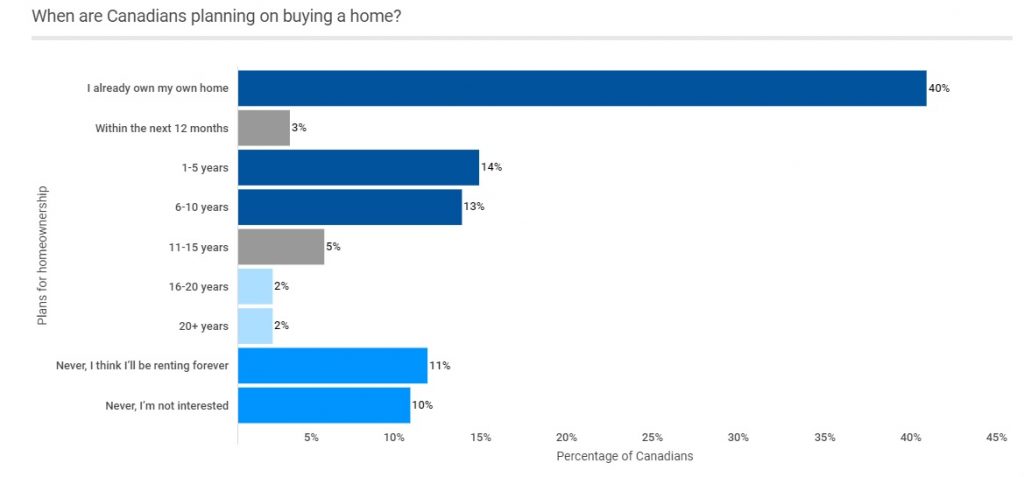
According to new research from global financial comparison platform Finder.com, more than 3.4 million Canadians believe homeownership may be  permanently out of reach, particularly in the frame of the current COVID-19 pandemic.

Of Finder’s 1,213 survey respondents, approximately 11 per cent said they will likely be ‘forever renters’, with females less hopeful than their male counterparts. 13 per cent  of women (compared to 9 per cent of men) stated they will likely never be able to afford a house, even though 7 per cent more women currently own their homes.

That said; younger Canadians appear to be the more hopeful despite the current economic crisis: 81 per cent of Gen Z (18-24) said they believe homeownership is in their near or distant future.

William Eve, Country Manager at Finder.com, said would-be first-time home buyers are facing an uphill battle with incredibly high home prices that have them feeling locked out of the real estate market: “It was surprising that 81 per cent of young Canadians are so optimistic they will be homeowners, despite the high housing costs they are facing, compared to previous generations. Still, record low interest rates have been the norm for most of their lives so even with a higher mortgage, home ownership may be seen as a smart and even affordable alternative to renting, especially in some of Canada’s biggest cities.”

Eve also stated there could be opportunity in the coming months for first-time home buyers that have been waiting to see price drops to break into the market.

“If these buyers can accept they will have fewer listings to choose from due to the impacts of the economic shutdown, the positive is they may have less competition from other buyers when putting in an offer in urban markets like Toronto or Vancouver, where bidding wars were often the norm pre-pandemic,” he said.

finders.com renting forever

For the full report, visit: www.finder.com/ca/generation-rent

Condo showings permitted in Ontario, clarifies OREA

In-person condo showings are permitted as long as real estate professionals follow provincial and local public health guidelines on social distancing and other safety measures, the Ontario Real Estate Association (OREA) clarified in a press release.

Real estate services are on the provincial government’s list of essential services, but what isn’t permitted during the state of emergency are in-person open houses.

OREA reports it is strongly encouraging its members to counsel clients to postpone any non-urgent real estate business until after the COVID-19 state of emergency has been lifted. However, some families and individuals will still need to urgently buy or sell homes including those who have lost their jobs, had a death in the family or who have already purchased a home and need to sell their current home to meet financing obligations.

“OREA urges its members to follow provincial guidelines around physical distancing and strongly recommends that no face-to-face business is conducted,” said Tim Hudak, OREA CEO. “We have recommended that realtors work with their clients to find technological alternatives through virtual showings, video conference calls and digital signings. However, for many people in dire circumstances who need to buy or sell a home, an in-person showing is a necessary part of a real estate transaction.”

The ability of realtors to do in-person showings is supported by the Real Estate Council of Ontario (RECO), the delegated administrative authority in the province, for the regulation of real estate. RECO’s recommendation is “that brokers and salespeople follow the direction of health officials by limiting showings to situations where they are absolutely necessary.”

Data centres gain traffic missing from highways

At least 84 commercial buildings nationwide have been abuzz during protracted COVID-19-related business shutdowns. They house the data centres that have literally underpinned the continued functioning of Canada’s economy and Canadians’ interconnectedness during the past weeks.

Even before a global pandemic wreaked havoc on the commercial real estate market, a handful of U.S. based data centre REITs dramatically outperformed office and retail REITs in that country’s FTSE Nareit index last year. JLL reports the five specialized REITs collectively delivered a 44.2 per cent return in 2019.

“Data centres have been in strong demand from the rapid growth in cloud services, especially with the growth in data and knowledge sectors and companies outsourcing. They are being used by various industries such as grocery fulfilment, retailers and banks,” says Kruti Desai, manager, national research insights, with Altus Group. “From an investment perspective, based on expected continued demand, data centres are still highly sought after, offering an alternative investment product and stable returns.”

Two data centre REITs — Digital Realty Trust and Equinix — hold properties in the Greater Toronto Area (GTA). Both sustained a drop in share price over the first three months of 2020, but both report revenue growth compared to the first and fourth quarters last year.

Equinix, which has two data centres in downtown Toronto, also reports a 20 per cent increase in internet exchange traffic over Q4 2019 and a 44 per cent upward spike from Q1 last year, “reflecting the impact of the sudden global shift to remote and work-from-home practices”. Yet, like conventional real estate providers, much remains dependent on stability all along its chain of users and suppliers.

“The full potential impact of the COVID-19 pandemic on our financial condition or results of operations remains uncertain and will depend on a number of factors, including its impact on our customers, partners and vendors, and the impact and functioning of the global financial markets,” the REIT’s recently released Q1 results state.

“While we have not experienced any significant business disruptions from the COVID-19 pandemic to date, we cannot predict what impact the COVID-19 pandemic may have on our future financial condition, results of operations or cash flows due to numerous uncertainties,” Digital Realty Trust’s Q1 report similarly notes.

Looking back just six months ago, Digital Realty, which operates two data centres in the GTA suburban cities of Markham and Vaughan, ranked Toronto in the top ten of 60 major international hubs for the digital economy. Based on indicators for economic growth, business and consumer demand, supporting infrastructure, labour force skills, openness to innovation, governance and quality of life, Toronto was also projected to nudge up two places on the so-called Digital Capitals Index, into 8th spot by 2029.

Cloud operators active in Toronto, Montreal and Vancouver

The two REITs’ holdings represent four of 33 data centres currently operating in the GTA and an even smaller fraction of national stock. Desai projects large cloud service providers will gain a greater market share as organizations increasingly outsource their in-house data management services, and keepers of highly sensitive information, such as insurance and financial services and health care provider, become more confident in these third parties.

“Cloud providers are attempting to meet the needs of higher compliance standards by offering more secured services aligned with FIPPA (Freedom of Information and Protection of Privacy Act) or PHIPA (Personal Health Information Protection Act) in Ontario,” she says. “Demand for data centres will likely remain high, but it is expected that the demand will mostly come from large cloud service providers.”

That’s already the case in Toronto and Montreal, which, together, are home to about 70 per cent of Canada’s data centres. Vancouver has the next highest concentration with 10, then there are four each in Calgary and Winnipeg.

“Toronto has experienced significant positive net absorption primarily driven by west coast U.S. based cloud operators. Montreal continues to grow and will further expand as telecommunications connectivity continues to improve. Demand is also primarily from U.S. west coast technology corporations,” reports Conan Lee, who is based in Seattle as managing director of JLL’s data centre and telecommunications advisory services. “Two major builds are occurring outside Vancouver to result in what will be the largest delivery of supply that British Columbia has ever experienced. The developments will be a true test to the theory that there is pent up data centre demand in this region.”

Among emerging trends, industry analysts like David Cappuccio of Gartner Research & Advisory point to something of an equivalent to last-mile delivery, which he terms an “infrastructure delivery strategy”.

“This puts workloads and data where they make the most sense for the business. Rather than data centers, we are moving toward centers of data, placed and optimized to provide the most business value. This also expands the role and responsibilities of central IT to one of a business enabler, rather than a purveyor of equipment and software,” he submits in a 2019 report entitled Infrastructure is Everywhere: The Evolution of Data Centers.

COVID-19’s longer term impact on that evolution is still to be determined. In the short term, data centres have clearly experienced surging traffic not recently seen on highways.

“Many companies’ technological capabilities have been tested as they’ve been forced to transition their employees to work from home and, for some, their overall digital strategy has been called into question,” Desai observes. “COVID-19 has pushed the workforce rapidly toward the digital economy.”


Think tank offers blueprint to guide housing market policies

A new C.D. Howe Institute report provides a blueprint for policymakers and regulators on the tools and timing of interventions in the housing market to address threats to financial stability.

In “Calibrating Macroprudential Policies for the Canadian Mortgage Market,” authors Scott A. Brave, Jeremy Kronick and Jose A. Lopez use four financial stability indicators—the house-price-to-rent ratio, the price-to-income ratio, the debt-servicing ratio and the household-credit-to-GDP ratio—to create a model to assist policymakers in anticipating future crises.

Macroprudential regulations aimed at ensuring financial stability have been on the rise since the 2007–2009 global financial crisis. In Canada, the primary policy tools that have been employed are related to the residential housing market – namely, changes in mortgage loan-to-value ratios and loan maturity requirements. In this report, the authors use an analytical framework to forecast the probability of a state of low financial stability in the Canadian economy and to recommend when such a policy action might be taken in light of its costs and benefits.

“While COVID-19 is obviously a significant stress on economies all over the world, including Canada’s,” said Kronick in a press release. “It is too soon to gauge its impact on the housing market, and this type of black swan event is nearly impossible to predict for regulators and policymakers looking at financial stability indicators.”

The authors’ analysis instead focuses on the types of decisions policymakers and regulators face in normal economic times, which can then be applied once the pandemic ends. Using the second quarter of 2019 as an example, their model suggests a low probability of a lengthy period of financial instability.

Even in light of this low probability, it still might be prudent to enact macroprudential policies if the costs of a financial crisis were large enough. However, based on calculations of the policy costs, such as lost access to credit by borrowers and lost residential investment growth, the authors recommend only continued monitoring of mortgage market and financial stability conditions in the near term.

Akelius denies UN allegations of wrongful renovictions

In a public statement issued on April 29, the UN has accused Sweden-based Akelius Residential of practicing renovictions, something the multinational housing corporation has denied.

Akelius, which owns more than 7,000 apartment units in Toronto and Montreal, is facing allegations by UN special rapporteur Leilani Farha that it initiated invasive upgrades to its properties in order to “charge substantially increased rents to both new and existing tenants, enabling it to circumvent vital rent-control regulations which commonly allow for above-control rent increases where modernization works are undertaken.”

Toronto-based Akelius executive Shelly Lee maintains that local tenants are not being mistreated or forced from their homes, telling news outlets that “our policy isn’t to force anybody out, and only to renovate vacant units.”

Meanwhile, residents at an Akelius-owned St. Joseph low-rise are complaining of loud, unnecessary building upgrades and frequent service disruptions. In response, Lee emphasised that Akelius’ strategy has always been to buy older buildings and upgrade them, and that “all work done is necessary.”

The full UN report won’t be available for another six weeks, once it has been reviewed by governments in Canada, the UK, and Germany.

Working within the law

Under the Residential Tenancies Act, a tenant’s rent can only be increased once every 12 months provided the landlord has given 90 days written notice. For 2020, landlords in Ontario can only increase residential rents by 2.2 per cent.

The amount of the increase depends on whether the tenant is paying the maximum rent allowed for the unit. A landlord can make an application to the Board to approve a rent increase above the guideline in certain instances, including if the landlord incurred extraordinary capital expenditures through significant renovations and repairs.

The term “renovictions” is used to describe the unlawful eviction of tenants during renovations in order to replace the evicted tenants with those who’ll pay higher rents after the work is complete.

RE/MAX INTEGRA initiative supports Canadian food banks

In an effort to support the growing needs of food banks in Canada during COVID-19, RE/MAX INTEGRA is asking Canadians and its network of brokers and agents to join them in raising funds to supply meals to local food banks across Ontario and Atlantic Canada for the next 30 days as part of the RE/STOCK with RE/MAX initiative.

To kick off the initiative, the founding families of RE/MAX INTEGRA—the Polzler, Schneider and Alexander families—are making a personal donation of $100,000 to support food banks in their local communities.

“We are so grateful to RE/MAX INTEGRA and its agents and brokers for this generous commitment,” says Carolyn Stewart, executive director at Feed Ontario. “This support will go a long way in helping us meet our goal to ensure everyone in our province has access to enough food to stay home safely during these uncertain times.”

A $30 donation buys one food box, which is the equivalent of a week’s worth of food. The boxes will be distributed to 130 communities across Ontario, with a goal to send 450,000 boxes in total.

“During these trying times, we realize that some tables are more bare than usual for millions of families across Canada,” says Shelby Schneider McDonald, vice-president of Corporate Synergy, North America, RE/MAX INTEGRA. “Over the next 30 days we want to raise funds to supply as many meals as possible to our friends and neighbors in need.”


GTA condo prices fall in April: TRREB

The condominium apartment sector in Toronto saw a year-over-year price drop of 4 per cent in April, according to new data released by the Toronto Regional Real Estate Board (TRREB). The GTA market dipped as well by 1.7 per cent, with an average sales price of $578,283.

Jason Mercer, TRREB’s chief market analyst, noted the relationship between sales and listings often dictates the pace of price growth.

“So, while the onset of COVID-19 has understandably shifted market conditions and resulted in average selling prices coming off their March peak, there has continued to be enough active buyers relative to available listings to keep prices in line with last year’s levels,” he said in a press release.

Average sales and listings were down for all homes types across the GTA with a 67 per cent drop year over year, but 2,975 properties still changed hands last month. The condo sector, which saw a 71. 6 per cent drop in sales, saw 667 properties sold, mainly in Toronto. Since 2020 began there have been a recorded 5,911 condo apartments sold in the GTA.

Rental transactions were also down for condo apartments. One- and two-bedroom rental transactions both dropped more than 50 per cent. A one-bedroom went for an average $2,107—down 2.7 per cent compared to April 2019. The average two-bedroom rent was $2,705—down 4.1 per cent.

TRREB CEO John DiMichele cautioned that past recessions and recoveries do not necessarily provide the best guide as to how the housing market will recover from the impact of the COVID-19 pandemic.

“A key factor for the housing market recovery will be a broader reopening of the economy, which will result in an improving employment picture and a resurgence in consumer confidence,” he said. “To this end, it is reassuring that the province is taking measured and carefully monitored steps towards safely opening up some parts of the economy.”


Multi-unit housing starts remained strong in April

Results from Canada Mortgage and Housing Corp’s monthly Starts and Completions Survey (SCS) reveals that construction of multi-unit housing projects remained strong in some provinces in the month of April despite the ongoing COVID-19 pandemic.

The survey estimates a 10.8 per cent month-over-month increase in its national seasonally adjusted annual rate for the month compared with March, with growth in multi-family starts in Ontario, Saskatchewan and Manitoba in April. The April seasonally adjusted annualized rate, excluding Quebec, was 166,415 units — up from 150,224 units in March. Quebec was excluded from the monthly national tally due to COVID-19 containment measures that were in place until April 20.

“Outside of Québec, the national trend in housing starts increased in April, despite the impact of COVID-19 containment measures.” said Bob Dugan, CMHC’s chief economist. “This reflects strong growth in multi-family starts in Ontario, Saskatchewan and Manitoba. We expect these provinces to register declines in the near term.”

Key highlights

Multiple dwelling starts in urban areas of Canada (excluding Quebec) were up 35.7 per cent from March, while urban single-family starts fell 27.1 per cent. Rural starts were estimated at 7,285 units.

Ontario accounted for the largest number of starts at 93,628, up 42 per cent.

British Columbia had the second-largest seasonally adjusted rate, at 27,767, down 10 per cent from March. Alberta’s starts were down 28 per cent from March, at a seasonally adjusted rate of 23,262 units.

CMHC uses the trend measure as a complement to the monthly SAAR of housing starts to account for considerable swings in monthly estimates and obtain a more complete picture of Canada’s housing market. In some situations, analyzing only SAAR data can be misleading, as they are largely driven by the multi-unit segment of the market which can vary significantly from one month to the next.


Cushman releases guide for reopening workplaces

Cushman & Wakefield has released its “Recovery Readiness: A How-to Guide for Reopening your Workplace,” a comprehensive guide for real estate tenants and landlords on reopening workplaces as stay-at-home restrictions are lifted. This follows the creation of the firm’s Recovery Readiness Task Force (RRTF) External Link and the launch of its new social distancing product Six Feet Office.

“It is extremely important to the health and safety of people around the world that organizations take well thought through precautions when introducing their employees back to the workplace,” said John Forrester, president of Cushman & Wakefield and Executive Chair of the RRTF.

“Our workplace experts, in conjunction with our top researchers, have created this guide to make this monumental migration from home more approachable – with quick and customizable solutions that are cost-effective to implement.”

In creating the recovery readiness guide, the firm leveraged insights and best practices from its recent experience moving 10,000 companies and nearly a million workers back into 800 million square feet of buildings it manages in China through a joint venture with Vanke Service.

The guide outlines “The Safe Six” workplace readiness essentials:

  1. Prepare the Building – implement cleaning plans, pre-return inspections, and HVAC and mechanicals checks.
  2. Prepare the Workforce – create policies for deciding who returns, shift/schedule management and employee communications.
  3. Control Access – enforce protocols for safety and health checks, building reception, shipping/receiving, elevators and visitor policies .
  4. Create a Social Distancing Plan – follow guidelines for decreasing density, schedule management and office traffic patterns.
  5. Reduce Touch Points & Increase Cleaning – implement open doors, clean-desk policy, food plans and regular cleaning of common areas.
  6. Communicate for Confidence – recognize the fear employees may feel in returning, communicate transparently and listen/survey regularly.

“The migration back to places of business will look different for every organization, but the principles outlined in this guide are applicable to nearly every real estate owner and occupier,” said Despina Katsikakis, head of Workplace Business Performance at Cushman & Wakefield. “As we navigate the complexity of this unprecedented situation together, our experts will continue to provide general guidance as well as bespoke solutions to our clients at every step of the way.”

Access Cushman & Wakefield’s “Recovery Readiness: A How-to Guide for Reopening Your Workplace.”

Details of CECRA program rollout still emerging

Canada Mortgage and Housing Corporation (CMHC), which is the entity responsible for administering the Canada Emergency Commercial Rent Assistance (CECRA) program, has provided additional clarification on the mechanics of the program. When the Federal government announced the CECRA program on April 24, 2020, many felt that it left many questions unanswered.

Prime Minister Justin Trudeau stated that the CECRA program would be fully flushed out by mid-May. As part of the CECRA program rollout, the following is a summary of some additional details released by CMHC:

Eligible Property Owners: To qualify for the CECRA, the owner of the property must:

  • own property that generates rental revenue from commercial real property located in Canada;
  • own commercial real property where an impacted small business tenant is located;
  • have a mortgage loan secured by the commercial real property, occupied by one or more small business tenants;
  • have entered or will enter into a rent reduction agreement for the period of April, May, and June 2020 that will reduce an impacted small business tenant’s gross rent by at least 75 per cent, and such gross rent reduction agreement must include a moratorium on eviction for the relief period; and
  • have declared rental income on its tax return (personal or corporate) for tax years 2018 and/or 2019.

Impacted Small Business Tenants: Impacted small business tenants are businesses, including non-profit and charitable organizations that:

  • pay no more than $50,000 in monthly gross rent per location (as defined by a valid and enforceable lease agreement);
  • generate no more than $20 million in gross annual revenues, calculated on a consolidated basis (at the ultimate parent level); and
  • have temporarily ceased operations (in essence, generating no revenues), or have experienced at least a 70 per cent decline in pre-COVID-19 revenues.

Calculations of Revenue Loss: To measure revenue loss, small businesses can compare revenues in April, May and June of 2020 to that of the same month of 2019. They can also use an average of their revenues earned in January and February of 2020.

Retroactive Effect: The CECRA can be applied retroactively. Eligible property owners may still apply for assistance once the three-month period has ended if they can prove eligibility during those months.

Flexibility and Tenant Rent Credit: Eligible property owners must refund amounts paid by the impacted small business tenant for the relief period. For example, if gross rent has been collected at the time of approval for the CECRA, a credit to the impacted small business tenant for a future month’s gross rent (e.g. July 2020 for April 2020) is acceptable, if agreed upon by both the eligible property owner and the impacted small business tenant. This can be a flexible three-month period.

Forgivable Loan Structure: CMHC will provide forgivable loans to Eligible Property Owners:

  • the loans will cover 50 per cent of the gross rent owed by impacted small business tenants during the three-month period of April, May and June 2020;
  • the eligible property owner will be responsible for no less than half of the remaining 50 per cent of the gross rent payments (paying no less than 25 per cent of the total); and
  • the impacted small business tenant will be responsible for no more than half of the remaining 50 per cent of the gross rent payments (paying no more than 25 per cent of the total).

No Recovery for Rent: The CECRA for small businesses loans will be forgiven if the eligible property owner complies with all applicable program terms and conditions including to not seek to recover gross rent abatement amounts after the program is over.

Eligible Property Owners with No Mortgage: CMHC has stated that property owners whose properties are not mortgaged will have an alternative mechanism for commercial rent assistance, to be outlined in the near future.

Deadline to Apply: August 31, 2020.

A few questions have now been answered, but there are more details and answers to come. It’s important to note that the CECRA program is voluntary, rather than mandatory. Consequently, not all landlords that could potentially take advantage of the CECRA program will necessarily take advantage of this program for various reasons.

Unless and until a landlord has entered into a rent relief agreement with a tenant in accordance with the terms of the CECRA program, the terms of existing leases and/or rent deferral agreements (to the extent that individual tenants and landlords have negotiated such agreements), shall continue to bind the parties.

Susan Rosen is a partner with Gowling WLG (Canada) LP.

Q1 stats reflect first quintile GTA investment

In not-so-long-ago pre-COVID-19 times, investment properties traded robustly in the Greater Toronto Area (GTA) in the first quarter of 2020 despite the hints of a looming pandemic. Altus Group reports $4 billion worth of transactions in the first three months of the year, a slip of just 3 per cent from Q1 2019. Meanwhile, deal volume jumped 5 per cent from the same period last year, totaling 530 sales.

Arguably, too, that more accurately reflects first quintile GTA investment activity since COVID-19 skittishness set in in earnest about the second week of March. “With the implementation of social distancing and stay-at-home measures, the investment market has temporarily paused in March and April,” Altus analysts conclude in their recently released Q1 GTA investment transaction overview.

Avison Young analysts, Bill Argeropoulos and Steven Preston, tally several uncertainties underpinning that pause — everything from a risk premium on debt as underwriters struggle to gauge the impact of rent deferrals on operating income to social distancing protocol inhibiting property tours — but maintain buyers and lenders are open to getting back into the game.

“There is strong interest from buyers generally, although difficulty in closing the bid-ask spread will remain for the short term. Many investors with capital are looking for opportunistic acquisitions,” they submit in Avison Young’s recent COVID-19 Impacts on Canadian Commercial Real Estate report. “Sentiment among lenders is that they are still hungry to place capital and fill their pipelines with new deals.”

Looking back to Q1, investors most actively acquired land, retail and industrial properties. Land accounted for 47 per cent of deal value, or $1.7 billion, with residential land standing out as the only asset class to surpass $1 billion in investment for the quarter.

“Although Toronto remained one of the top markets preferred by investors this quarter, buyer momentum declined from the previous quarter and from the same quarter last year,” Altus analysts note. “With transactions typically negotiated months prior to closing, we will likely not see the significant effects of this global pandemic until the second quarter of this year.”

Together, 137 retail transactions and 119 industrial transactions accounted for 48 per cent of deal volume. Sales values also nudged up slightly compared to Q1 2019 for both asset classes, albeit remaining well off the $1 billion mark. The apartment sector saw the steepest climb in sales value, up 164 per cent from Q1 2019, while office sales value experienced the steepest drop, down 43 per cent from Q1 last year.

Just three of the 503 deals hit or surpassed $100 million, all for development land. That includes residential land in close proximity to the Crosstown LRT, currently under construction along a 19-kilometre stretch of Eglinton Avenue, residential land on the downtown waterfront, and the City of Toronto’s purchase of a 0.65-acre downtown surface parking lot, which it intends to convert to parkland.

The $96.3 million acquisition of the Erindale Corporate Centre in Mississauga was the quarter’s most lucrative office trade. “This 342,606 square foot Class-A office complex was approximately 93% occupied at the time of sale with a weighted average lease term of approximately seven years,” Altus reports.

Q Residential’s $93 million purchase of an 18-storey, 325-unit apartment tower in northwest Toronto was the top multifamily trade. “The vendor (Minto Properties) had originally acquired this property in June 2017 for $55 million and subsequently made significant upgrades and renovations,” Altus reports.

Summit Industrial Income REIT purchased the six-building Cochrane Industrial Park in Markham from Public Sector Investment Pension Board, which was the top industrial property sale at $42.5 million. Altus analysts now predict industrial will be a preferably placed asset class as COVID-19 accelerates e-commerce market share and hits bricks-and-mortar retail hard.

“Investors are looking to put more money into industrial assets,” Argeropoulos and Preston concur.

“Canada still remains one of the most sought-after markets for investors that are seeking safe returns,” the Altus report contends. “During these challenging times, wary investors are carefully adapting to market changes by reassessing their strategies and reconsidering their capital flows and overall risk tolerance.”

Wilson Beck buys Marsh portfolio of business

Wilson M. Beck Insurance Services (WMB), a construction and surety-focused insurance broker in British Columbia and Alberta, has entered into a definitive agreement to buy a portfolio of business from global insurance brokerage Marsh.

The acquired accounts will strengthen WMB’s “position as a leading construction broker in Western Canada,” according to brokerage founder and chairman Wilson Beck. They primarily consist of independent commercial construction accounts, forestry and surety business, which were managed out of Marsh’s Victoria and Guildford offices in British Columbia. Following the deal, Marsh will continue to have a presence in these areas.

In addition to snapping up some new business, the family owned brokerage is welcoming some new team members. Carole Bissett, Dan Calderhead, Peter Pringle and James Clap will join WMB alongside members of their teams, continuing their long-standing relationships with WMB’s acquired accounts.

“We’re very happy to welcome the clients and new employees to our organization,” said David Beck, president of WMB. “We would also like to thank the many Marsh executives who worked with us to expedite the transaction.”

Terms of the transaction, which is expected to close in May, were not disclosed.

Headquartered in Burnaby, WMB was founded in 1981 and has three other offices in B.C. and one in Calgary, Alberta. The company specializes in risk management, surety, and insurance for the construction and development industry in Canada.