




Articles Archive - Page 45 of 928 - REMINET
REMI

Feds reiterate tax obligations for insurers

A proposed amendment to Canada’s Income Tax Act will expressly state that insurance companies must pay tax on income their foreign investment property arms generate if that income underpins policies held in Canada. The intended measure was initially announced in the 2025 federal budget last November, and is now open for public feedback until Feb. 27, 2026.

The federal finance department’s accompanying rationale acknowledges there are currently competing interpretations of how foreign accrual property income (FAPI) should be determined. Canadian businesses and individuals generally come under FAPI inclusion when they own more than 50 per cent of the shares in a foreign corporation, and are thus required to pay tax, as it accrues, on passive income they earn from that foreign affiliate, even if the income is not repatriated to Canada.

A rule specifically pertaining to insurance companies dictates that a foreign affiliate’s “insurance business income” is subject if it is used to insure or reinsure “risks in respect of persons resident in Canada, property situated in Canada or businesses carried on in Canada”. That broadens the scope of what’s typically taxable under FAPI to include active business income, but the finance department will now remove any inadvertent wiggle room in the terminology. It reiterates that it is a core business activity for insurers to invest funds garnered from premiums in both directly and indirectly held assets.

“Invested assets indirectly held by a foreign affiliate that are held to back Canadian risks are generally regarded as backing Canadian risks for actuarial and regulatory reporting purposes. In contrast, some taxpayers have taken the position that the specific FAPI rule does not apply to such investment income arising on such assets,” the consultation document observes.

The proposed amendment will clarify that it does. Once the legislation is updated, it will take effect for the 2026 tax year.

“Investment income derived from assets backing Canadian risks encompasses both income from assets held to back such risks and assets included in regulatory surplus that back such risks,” the consultation document states.

Lara McKendrick named new OAA president

Lara McKendrick has joined the Ontario Association of Architects (OAA) as its new president. The Ottawa-based architect brings 25 years of experience to the role, including as founder of Lara McKendrick Architecture Inc. (LMA), a firm specializing in adaptive reuse, custom residential projects, and deep energy retrofits.

“I am so excited for this opportunity to help lead our governing board of directors,” she says. “This is the final year of the OAA’s current Strategic Plan, which includes Climate Action and Equity, Diversity, and Inclusion as the two main lenses through which we view all the work we undertake. I was fortunate to be a Councillor when OAA Council and senior staff crafted this plan. As President, I will continue to pursue the worthy priorities and projects currently underway.”

Lara McKendrick

Lara McKendrick

McKendrick’s work is guided by a first-principles approach to sustainability, creating healthy, flexible, durable, and beautiful spaces. Before establishing her own practice in 2011, she worked with several prominent Ottawa firms, honing her expertise in institutional, commercial, and residential architecture.

A graduate of Carleton University’s School of Architecture, her passion for architecture began at an early age. “I wanted to be an Architect even when I was five years old. At one point, I considered engineering, but architecture won out after I attended school in Europe,” she shares, adding that her motivation to run for OAA Council President stemmed from a desire to give back to her profession.

“I initially ran for Council because I was at a point in my career where I had more control of my time and saw it as a way to do some work for my profession,” McKendrick adds. “I’ve learned that the OAA is not some overlord in isolation. For Architects and Licensed Technologists, this is our profession and our regulator—it is up to us to get involved. We rely on volunteers.”

McKendrick has been an active member of the OAA Council since 2021. Over the years, she has held numerous roles on council, including senior vice president and treasurer, as well as being on the complaints, registration, and finance and audit committees, and chairing the building committee and the Continuing professional education committee (CPEC). She has also sat on the board for Pro-Demnity Insurance Co.

Edmonton’s newest sport rec centre opens

Edmonton’s newest rec centre is now open. The 178,680 sq.ft. Coronation Park Sports and Recreation Centre is the first facility of its kind in North America and a community hub for recreation, sport and leisure.

The $153.4-million facility, which includes the Peter Hemingway Aquatic Centre, will offer many amenities, such as a 333-metre running track, 50-metre pool, indoor courts, bouldering wall, a unique urban court, a fitness centre, various functional training spaces, two training studios, an indoor playground, a cycling track and more. Clark Builders completed the project ahead of schedule and under budget.

According to the city, the pool, running and cycling track together make Coronation Park Sports and Recreation Centre the first indoor triathlon training centre in North America.

Designed by Dub Architects in joint venture with and FaulknerBrowns Architects and HCMA Architects, the centre showcases 60,000 square feet of exposed mass plywood panels (MPP) in its roof and walls, forming the largest installation of MPP in Canada to date.

“This is not just a facility — it is a destination, a community connector and a place where many amazing memories have been made, and will continue to be made, ” said Mayor Andrew Knack. “Beyond supporting community wellbeing, this project also serves as vital social infrastructure and a hub for economic development through its diverse services and resources.”

An above-ground link connects the rec centre with the architecturally award-winning Peter Hemingway Fitness and Leisure Centre. Rehabilitation work began on the aquatic centre in fall 2021 and was completed in late 2025.

Work included upgrades to its pool basin and its mechanical, structural and electrical systems, replacement of the glass curtain wall and lighting, and the addition of a cold plunge pool and an elevator.

In recognition of its significance to the city’s architectural and recreation history, city council declared the 56-year-old facility a Municipal Historic Resource.

CDM finishing kick saves energy and face

Ontario’s 2021-2024 conservation and demand management (CDM) framework fell short of its target, but an impressive finishing kick helped to reel the deficit back to a respectable gap. Newly released results from the Independent Electricity System Operator (IESO) report that the suite of provincial CDM programs delivered 3,570 gigawatt-hours (3.57 million megawatt-hours) of energy savings and 604 megawatts (MW) reduction in peak demand reduction for the four-year period, with more than 50 per cent of both tallies accomplished in 2024.

The dramatic performance improvement is attributed to additional program spending and offerings that rolled out over the course of 2023 and were fully available for 12 months of 2024. This was seen in an 75 per cent year-over-year uptick in energy savings coupled with a 480 per cent gain in peak demand savings over 2023.

With this final push, the CDM framework achieved 94 per cent of targeted energy savings and 83 per cent of targeted peak demand. Retrofit programs were the largest contributor, accounting for nearly 1,890 gigawatt-hours (GWh) of energy savings and 317 MW of peak demand reduction. However, the IESO also highlights the “exceptional performance” of the Peak Perks incentive for residential customers with smart HVAC controls, which is credited with nearly 186 MW of peak demand reduction for less than $31 million of spending.

The program — which has been expanded to include small business customers in the in-progress 2025-27 electricity demand side management (eDSM) framework — gives volunteer enrollees a $75 prepaid Mastercard when they first sign up and an additional $20 for each subsequent year they participate. In return, they agree to allow remote adjustments of their household cooling or heating when peak demand triggers the necessity. After the program was introduced in 2023, the IESO reports that 2024 enrollment grew to 206,000 participants, in a year when there were nine activation events.

Also making a debut in 2023, subsidies for LED lighting installations in the greenhouse sector delivered more than 729 GWh of energy savings by the end of 2024. As well, the IESO points to the Instant Discounts incentive, also known as the midstream lighting program, as an exceptional performer in 2024.

It was introduced in late 2023 to make energy-efficient lighting available to consumers with discounts built into the purchase price. More than 150 lighting distributors, collectively selling product through more than 500 outlets province-wide, had signed on for the program by the end of 2024. The IESO pegs the results at approximately 550,000 “efficient-lighting measures” before the CDM framework closed out.

Rental construction surged in Q4-2025

New data from Urbanation Inc. shows rental construction accelerated sharply in Q4‑2025, with 9,821 purpose-built rental units breaking ground—up 42 per cent from 2024 and the highest annual total since the 1970s. By year-end, the number of purpose-built rentals under construction across the GTHA climbed to 27,815, a 77 per cent increase over the past five years.

“Some developers are looking past the current softness in the market by starting construction on new rental projects, with an understanding that conditions will improve in the years ahead as condo supply dries up,” said Shaun Hildebrand, President of Urbanation. “But even with rental starts reaching nearly 10,000 units last year, it won’t likely be enough to move the needle on improving affordability. The GTHA currently has over 150,000 approved rentals in the pipeline waiting to become economically feasible.”

The acceleration in development occurred despite the rental market being at its weakest point since the pandemic. The vacancy rate for buildings completed since 2000 rose to 3.7 per cent in Q4‑2025, up from 3.4 per cent a year earlier and the highest level since Q4‑2020 (5.5%).

Purpose-built rental completions also reached a more than 40‑year high, with 6,379 units delivered in 2025. More than half of these units (59%) remained available for lease at year-end. In total, 44 buildings were still in their initial lease-up phase and had not yet reached stabilization (defined as 95% occupancy). This included 23 buildings completed in 2025, 14 completed in 2024, and seven completed between 2022 and 2023.

The softening in the rental market was driven not only by rising purpose-built supply but also by sustained high levels of condo completions—about half of which typically enter the rental pool—alongside slowing population growth, increased economic uncertainty, and ongoing affordability challenges. Among purpose-built rentals completed since 2000 and available for lease in Q4, average asking rents were $2,916 per month for an average unit size of 720 square feet. While this represented a 2% annual decline, rents remained 16% higher than five years earlier.

To attract tenants, rental operators continued to rely heavily on incentives. Two-thirds of buildings completed since 2000 offered some form of concession in Q4, with two months of free rent emerging as the most common incentive, offered by 35% of buildings. After adjusting for incentives, effective rents averaged $2,565—down 5.5 per cent from the incentive-adjusted average of $2,713 in Q4‑2024.

Purpose-built rentals also faced mounting competition from the condo rental market, where rents continued to fall. Condo rents declined by an average of 4.0 per cent in 2025, the steepest drop since 2020, when rents fell 6.7 per cent. This occurred despite a record 64,531 condo lease transactions last year. Investor-owned supply continued to grow even as many units generated deeply negative cash flow. For condo units completed in 2025, monthly ownership costs—including mortgage payments, condo fees, and property taxes—exceeded achieved rents by an average of $1,338.

Guelph unveils emissions reduction plan

The City of Guelph has released a new climate action plan that charts how the municipality can cut more than 10,000 tonnes of greenhouse gas emissions from its operations by 2035.

The strategies focus on buildings, vehicles, systems and policies that will  reduce energy use, lower emissions, and support long-term climate resilience. The city’s energy use has already dropped 17 per cent since 2018, with about 20 to 25 per cent coming from renewable sources.

The city intends to complete deep energy retrofits and construct new municipal buildings to meet zero-carbon standards. The plan also entails installing more rooftop solar on municipal buildings and exploring a large-scale solar project at the Eastview landfill. Aging gas-powered Guelph Transit buses and vehicles will be replaced with electric models, alongside low-emission options for waste collection.

The city is also modernizing solid waste and wastewater systems to cut energy use and expand renewable energy, while targeting corporate energy management standards, including maintaining ISO 50001 certification and developing consistent building temperature guidelines. The city will need an estimated $247-million investment to reach its per-capita emissions reduction target.

Winter storms and extreme weather are fueling heightened property concerns across Canada

As winter continues, the Farmers’ Almanac forecasted a classic Canadian winter for 2025–2026, featuring deep freezes, frequent snow, and powerful storms, along with occasional mild and rainy periods in Ontario, Quebec, and coastal provinces.

First Onsite Property Restoration, Canada’s leading property restoration company, has released its winter preparedness guides for commercial and residential property owners, residents, and property managers.

According to First Onsite’s annual property and weather survey, Canadians are increasingly concerned about winter-related risks.  Compared to 2024, the results showed a significant increase in concerns, with 71 per cent worried about winter storms, 68 per cent about extreme cold and burst pipes, and 66 per cent about severe rains and flooding.

Beyond weather, 75 per cent of Canadians are concerned about climate change, 70 per cent about power outages, 60 per cent about property fires, and 72 per cent about the cost of major renovations and repairs.

“Colder temperatures, melting snow, and freeze-thaw cycles increase risks to homes and commercial properties,” said Jim Mandeville, Senior Vice President, First Onsite Property Restoration. “That’s why it’s important to take the time now to inspect your property and ensure it’s prepared for severe winter weather.”

Facility and maintenance managers need to take steps to stay prepared and protect their buildings this winter by:

  • Assessing building risks– Check age, construction, insulation, and plumbing; address deferred maintenance issues.
  • Maintaining exterior grading and drainage – Ensure water drains away from the foundation to reduce freeze/thaw damage.
  • Assessing roof safety and maintenance – Inspect roofs, gutters, and downspouts; clear snow and assess snow load capacity.
  • Sealing openings and managing unused spaces – Ensure doors, windows, and utility openings are sealed; keep unoccupied areas minimally heated and inspected.
  • Checking on heating and power systems – Test generators, boilers, and HVAC systems; ensure backups are functional.
  • Maximizing fire safety – Keep nearby fire hydrants clear of snow for emergency access. 

As the weather becomes more extreme, facility and maintenance managers need to adapt a strategic approach to minimize damage and lower expenses this winter.

For First Onsite’s free guides for Canadian businesses, please visit this link.

New condo sales in GTHA fall to 34-year low

New condo sales in the Greater Toronto Hamilton Area (GTHA) declined for a fourth consecutive year amid buyer defaults and record high project cancellations. Urbanation released its 2025 Condominium Market Survey, revealing a 60 per cent drop from 2024 to 1,599 units, which marks the lowest sales level since 1991.

“As the condo market enters the fifth year of its largest ever correction, the duration of this downturn should be a significant cause for concern as it relates to future supply,” warned Urbanation President Shaun Hildebrand. “By the end of the decade, we know with certainty that there won’t be any new condo completions. What we don’t know is how far into the 2030s the supply crunch will last. If rental construction can’t fill the void, this raises serious questions around the impact on affordability.”

According to the report, sales decreased 91 per cent below the 10-year average and dropped 95 per cent from 2021. Q4 activity showed no improvement as 262 units sold marked the lowest quarterly total since Q3-1990.

Developers launched only 10 new condo projects in 2025. Buyers purchased only 22 per cent of the 1,425 new units on the market, down from a 24 per cent sales rate in 2024 and a high of 81 per cent in 2021.

Sales continued to fall despite average selling prices dropping to a five-year low of $1,123 per square foot—an 18 per cent decline from 2022. New condo prices remained at a significant premium over comparable resale units. Resale condos completed in the past three years averaged $856 per square foot in Q4.

The data also shows that cancelled units continue to climb. Last year, a record-high 28 active new projects totaling 7,243 units were scrapped,more than doubling the 3,469 units cancelled in 2024.

Eight condo projects switched to purpose-built rental last year, adding to the 1,434 units converted in 2024. However, the conversion of some cancelled condo projects to purpose-rental was not enough to help offset a steep decline in condo starts. While purpose-built rental starts grew 24 per cent from 6,908 units in 2024 to 8,545 units in 2025 (a multi-decade high), condo construction starts fell 63 per cent from 8,854 units in 2024 to 3,272 units in 2025 (a multi-decade low).
In the last three years, condo starts have plunged 88 per cent, bringing the total inventory under construction down to a 10-year low of 50,479 units.

New condo sales have also pivoted away from pre-construction projects towards newly completed projects. In 2025, a record high 33 per cent share of sales were in projects in the occupancy and registration stages, surging from a 9 per cent share in 2024 and a 2 per cent share in 2023.

There also appears to be a market shift towards more end-user purchasers as buyers have better deals with more unsold homes. Pre-construction projects have typically comprised more than 70 per cent of new condo sales, however, last year they represented less than half of sales for the first time.

As of year-end 2025, completed and unsold inventory reached a record high of 3,897 units, a 131 per cent increase from a year earlier (1,690 units) and five times higher than the level from two years ago (755 units). As well, developers are dealing with completed units that were pre-sold, but the purchaser failed to close. Urbanation’s research into land registry records shows that about 10 per cent of pre-sold new condos registered in 2025 were taken back by developers, equivalent to roughly 3,000 units.

Falling sales and record-high completions have pushed unsold inventory higher during the past two years. A total of 29,291 units were completed in 2025, nearly matching the record high of 29,924 units completed in 2024 and 50 per cent higher than the 10-year average. Completions are expected to drop by 25 per cent in 2026 to 22,066 units before dropping to 14,366 units in 2027—less than half the level in 2025.

By 2029, developers are expected to deliver virtually no new condos.

Graham selected for South Bearspaw pipe repair

Graham has been selected by the City of Calgary to deliver Phase B of the South Bearspaw Feeder main Repairs, continuing our work on one of the city’s most critical water infrastructure projects.

The award builds on the trust established during the 2024 emergency feeder main repairs, where Graham supported the city in rapidly restoring essential water service during a major system failure.

The South Bearspaw Feeder Main is recognized by the city as a critical and vulnerable component of Calgary’s drinking water network, requiring urgent replacement to protect regional water security. The project is being delivered in multiple phases, with Phase B extending work westward from 73 Street NW toward the Bearspaw Water Treatment Plant.

Graham’s award reflects a long-standing relationship with the city and a continued commitment to supporting essential public infrastructure. Our teams are trusted to deliver this high-risk, schedule-sensitive work within tight timelines, using proven expertise from our previous feedermain and emergency infrastructure response projects.

“As Calgary accelerates the replacement of the aging feeder main to ensure long-term system reliability, Graham remains honoured to support this critical effort and to continue building infrastructure that keeps communities safe and thriving,” said the company.

The project will add a parallel steel pipe of the same size as the existing Bearspaw South Feeder Main. Over time, this new pipe will take over service from the current line. The replacement pipe is anticipated to be completed in December 2026.


Maintaining your parking lot this winter

Winter is in full swing, and many regions have accumulated significant amounts of snow this year, making snow removal and storage a challenge to manage. Maintenance managers need to adopt a proactive approach to stay on top of the parking lot’s condition as part of their winter maintenance strategy.

Here are some tips for keeping your parking lot safe, accessible, and clear this winter:

  • Start by ensuring that you have the tools and supplies required for the remainder of the season. Stock up on salt, clear a spot for storage, and be sure to implement a maintenance plan for any equipment you will be using throughout the season.
  • While you want to use enough salt to keep walkways and parking lots slip-free, you don’t want to overuse it, as it can corrode pavement and cause environmental damage.
  • Keep an eye on the weather consistently so you can be proactive by putting salt down, managing snow plowing contracts, and scheduling maintenance staff accordingly.
  • Keep your parking lot maintained by clearing your drains, ensuring that fire hydrants and handicapped parking lots remain accessible, and marking any areas where the ground can be uneven and could impede snow removal.
  • Whether you are contracting out your snow removal or managing it in-house, choosing a place to store the snow is crucial. Keep in mind accessibility, visibility, drainage, and additional sites for storage, should the snowfall exceed your expectations or available space.
  • If you are clearing snow in-house, ensure that you are pushing snow away from your building, especially the entry points, so that during the freeze-thaw cycling, water does not flow towards your building.
  • Clearing snow during the snowfall can help you stay on top of the accumulation and avoid it from becoming compact and difficult to move. Plow during off-peak hours for ease and convenience.

Keeping your parking lot maintained throughout the winter season is an important part of your outdoor maintenance strategy to ensure that access to your building remains safe and available for your staff and guests.

Kamloops unveils future home of sports complex

Kamloops has announced the location for the next Build Kamloops project, unveiling that the future home of the curling and racquet sports complex is the 700 block of Victoria Street.

The location includes the existing Kamloops Curling Club, Memorial Arena, and the properties immediately to the east. The city already owns both the Kamloops Curling Club and the Memorial Arena properties and expanded the development potential by purchasing the adjacent properties at 761 Lansdowne Street and 770 Victoria Street to create a 3.6 ac. development site.

The transformative redevelopment of this city block will create a vibrant downtown hub for curling and racquet sports, with potential to incorporate other community uses and even housing—a central place for active living that revitalizes the east end of downtown.

As the third major initiative identified through the Build Kamloops program, the new complex will replace aging facilities with a modern, multi-purpose building designed to support active living year-round. The project aligns with the community priorities outlined in the 2019 Recreation Master Plan, emphasizing vibrancy, flexibility, and long-term sustainability.

The city will lead a multi-year, phased engagement process to gather input from users, interest holders, and the broader community. This collaborative approach will ensure the final design is functional, financially viable, and reflective of Kamloops residents’ needs and aspirations.

Construction of the new complex cannot begin until the new Kamloops Arena Multiplex opens, currently anticipated in 2029.

Build Kamloops is a multi-year, strategic investment program by the City of Kamloops designed to enhance community infrastructure, focusing on replacing aging recreational facilities and expanding amenities to solidify its reputation as Canada’s Tournament Capital.


Saskatchewan strives to bolster hospital safety

The Saskatchewan government will commission an independent, third-party review of hospital safety and security at the request of the Saskatchewan Health Authority (SHA). The move follows concerns raised by staff and patients and a rise in the volume of protective services interventions.

The Ministry of Health will select a qualified expert capable of undertaking it as quickly as possible. The review will examine current practices and provide recommendations to help improve safety for patients, visitors and staff across all SHA facilities.

“The safety enhancements underway starting this week at several facilities will help ensure that goal is met so that we can put patients first,” said Health Minister Jeremy Cockrill. “The independent review will give us an assessment of security currently in place at facilities and help identify improvements to support safer environments where people are providing and receiving care.”

The review will assess:

  • Current Protective Services’ standards, best practices and delivery models;
  • Opportunities to improve training, competencies, tools and infrastructure;
  • Ways to strengthen partnerships with Indigenous organizations and other health system partners; and
  • Lessons learned from past incidents to identify common themes and system-wide improvements.

The province has already installed metal detectors at emergency department entrances in Saskatoon, Regina, North Battleford and Prince Albert. It has also issued a request for proposals for third-party security services at facilities in La Loche, Shellbrook, Swift Current, Moose Jaw, Weyburn, Nipawin, Melfort and Kamsack, while an independent review shapes longer-term, systemwide changes.

“This independent review will ensure our security approaches continue to evolve to meet the needs of patients, families and staff, while reflecting best practices and cultural respect,” added SHA CEO Andrew Will. “We remain committed to accountability and to ensuring a safe care environment in SHA facilities.”

Coasts and prairie enjoy buoyant retail rents

Retail rents were particularly buoyant on Canada’s coasts and in the prairies during the second half of 2025, while generally holding steady in many of the 11 major regional markets CBRE Canada surveys. Rarer downward trends were almost entirely confined to urban shopping districts where smaller-sized, street-front venues prevail.

In a panoply of 120 different combinations of retail formats and regional markets nationwide, average rents rose in 37 cases and fell in eight. Vancouver, Saskatoon, Winnipeg and Halifax all saw rents increase across the majority of retail formats over the course of last summer and fall. Meanwhile, regional malls and select urban shopping districts continue to command the highest rents in every market.

“Sector-specific demand remains strong for fitness and wellness services, particularly in Ontario and Western Canada. In Calgary, physician recruitment initiatives have driven a notable increase in demand for medical clinics, while Edmonton is seeing success in backfilling large-format vacancies,” notes commentary from CBRE Canada’s senior vice president, Alex Edmison, and research manager, Christina Cattana. “Saskatoon and Halifax, meanwhile, are benefiting from rapid population growth and a scarcity of available space.”

Enclosed mall landlords have been focused on repositioning anchor space that has emptied due to Hudson’s Bay Company’s (HBC) bankruptcy, along with a spate of large format store closings by struggling chains such as Toys R Us, Linen Chest and JYSK. In some cases, new tenants such as Canadian Tire, Mark’s, Sport Chek and TJX have now signed leases. Elsewhere, new entertainment uses are contemplated, while some landlords are physically altering or demolishing former large boxes to make room for smaller retail units.

Occupiers confront tightening supply given the continued sluggishness of most types of new retail development other than grocery-anchored plazas, and the more recent drop-off in new starts of mixed-use or residential condominium projects with street-level retail space. Leisure space that’s already outfitted for food and beverage operations is likewise in high demand due to high construction costs for new build-outs.

Consumer demographics also play a key role. Notably, the slow return of federal government workers to formal office settings makes downtown Ottawa one of the more problematic markets for retail operators, while downtown Victoria is the beneficiary of a pickup in cruise ship dockings.

“When you drill into the numbers, retail performance continues to be highly situational. Local demographics, tenant mix and economic drivers can make or break retailers,” Edmison submits. “Strategic tenant relocations continue in response to these dynamics, particularly for flagships in high density areas.”

New home-selling conditions hit critical low in Canada

The Q4 2025 Housing Market Index from the Canadian Home Builders’ Association signals a further slowdown in future housing starts and warns that the industry’s capacity to build more homes could decline if layoffs continue.

Thirty-eight per cent of builders said that they (or their subcontractors) had to reduce staff due to market conditions  in the second half of 2025, marking the first time this figure surpassed those who had not implemented any layoffs.

The slowdown is also evident in the index data. The single-family HMI dropped 5.5 points to 19.6 (out of 100), the second consecutive record low and the first time it fell below 20. The multi-family HMI also recorded a second consecutive record low, falling to 14.7, down 7.3 points from a year ago.

Builders in Ontario and British Columbia continue to struggle and express the most pessimism. Both provinces are already extremely low, but sharp declines in the Prairie provinces drove the national HMI further down this quarter. Single-family builders in the Prairies recorded their first pessimistic reading in two years, while the multi-family HMI fell further into the negative and continued the downward trend that began in Q2 2024.

“The federal government has shifted its focus away from housing affordability for middle-income Canadians,” said CHBA CEO Kevin Lee. “Support for non-market housing is important, but it should not come at the expense of measures to improve market-rate housing affordability; both can be improved. It’s time for the government to re-focus on measures to support average Canadians and homeownership.”

A recent public opinion study by Abacus Data for CHBA showed that 88 per cent of Canadians under age 45 want to own a home one day. The data also shows that homeownership remains emotionally central as well as financially important to Canadians.

However, only 29 per cent of all non-homeowners are confident they’ll ever be able to buy a home. Canadians see the housing crisis as a systemic failure affecting the middle class as much as low-income households, and 66 per cent say the federal government is most responsible for solving the crisis.

Measures to support affordability

Builders uniformly agreed that the government could best improve new home-selling conditions by expanding the federal GST rebate on homes under $1.5 million to all buyers, rather than just first-time buyers. They also recommended extending the rebate to renovations that create new housing units. When paired with a provincial PST rebate, if matched by the Ontario government, buyers could save $100,000 on their purchase.

Development taxes also significantly contribute to the lack of affordability. CHBA urges the federal government to work with provinces and municipalities to lower them. Fixing the stress test would also help because it currently locks well-qualified buyers out of the market or prevents them from buying homes that best suit their needs.

“The Q4 Housing Market Index indicates that home selling conditions have reached a critical low point for future industry capacity, with 38 percent of members reporting layoffs,” said Lee. “If changes aren’t made now, it will be much harder for the residential construction industry to ramp up in the future and build the homes that Canada needs to correct the housing supply deficit and improve housing affordability for the next generation.”

Canada invests $10M to support P.E.I. wellness facility

A new facility in Stratford, Prince Edward Island, will advance healthy and active lifestyles in the community following a $10-million investment from the federal government.

The project team will design the Stratford Community Campus Wellness Centre to exceed energy-efficiency standards. The facility will feature an ice rink, an indoor turf field, cultural and social spaces, a library, a youth centre, and outdoor sports facilities.

Future phases will incorporate other amenities as funding and program requirements evolve. Once complete the multi-use public space will establish a benchmark for sustainable design through a net-zero-carbon approach and a framework that supports inclusive and adaptable future development.

“We look forward to formalizing the design of the facility and breaking ground later this year,” Mayor Steve Ogden stated on January 21. “The previous committed investment by the Province of PEI and Town, alongside the $10M today from the Federal Government is a great step forward for our community and we look forward to further partnerships with all levels of government as we construct this project in upcoming phases.”

Photo by Tony Schnagl

ICBA forecast: an ‘anemic’ economy for B.C. in 2026

The Independent Contractors and Businesses Association (ICBA) is forecasting a difficult year ahead, saying real GDP is expected to expand by only 1.1 per cent in 2026 – a level that signals an anemic economy and more financial and business pressure on contractors looking for work.

The warning comes in the newly released B.C. Construction Monitor, an ICBA publication that pairs analysis by ICBA Chief Economist Jock Finlayson with key economic statistics and indicators across the construction sector.

“A 1.1 per cent economy isn’t real growth or even a recovery – it’s essentially a flatline,” said Chris Gardner, ICBA president and CEO. “When growth stalls, it means fewer projects, job losses, slower investment decisions, and more uncertainty – that’s exactly what this forecast is telling contractors and other B.C. business owners to prepare for in 2026.”

A second red flag in ICBA’s B.C. forecast is housing. Housing starts are projected to fall sharply from 42,200 to 34,500 in 2026 – a steep decline from last year and a far cry from the high-water mark of 50,500 in 2023. This confirms what ICBA, homebuilders and industry experts have been saying for many years – the vast majority of housing programs coming out of Victoria, and from most city halls, are not working. This will ripple across the residential construction sector and reflects the rapidly deteriorating economics surrounding private sector homebuilding in the Lower Mainland and some other B.C. regions.

“When housing starts fall off a cliff, it’s not just numbers on a piece of paper – it’s businesses closing and families hit hard by layoffs,” said Gardner. “Construction is one of B.C.’s biggest employers, and when projects stall or get cancelled, it means apprentices who never get placed and skilled trades workers whose careers get derailed and who are forced to look for other opportunities or leave the province.”

ICBA says governments at every level need to stop driving up the “cost of delivery” with constantly changing rules, codes and permitting delays that make residential projects unviable.


Yardi forecasts stable yet vulnerable multifamily market

According to new data released from Yardi, Canada’s multifamily housing sector entered 2026 on unsteady footing after a year marked by slowing rent growth, softening demand and persistent affordability pressures. Although the country continues to face a structural housing shortage, helping to support generally solid occupancy, market fundamentals weakened noticeably through 2025 and are expected to remain fragile in the year ahead.

“Multifamily performance is healthy but fragile entering 2026,” Yardi analysts wrote. “The market faces decelerating rent increases, weaker demand and affordability challenges.”

Economic conditions played a central role in this shift, according to the report. After the initial shock of U.S. tariff policy early in 2025, Canada’s economy regained some stability in the second half of the year. Still, growth remains subdued. Consensus forecasts place 2026 GDP expansion in the modest 1.0–1.5 per cent range, well below the nation’s full potential. While tariffs created strain in key export industries such as autos, aluminum and steel, nearly 90 per cent of Canadian exports to the U.S. remain tariff‑free, helping ease fears of a deeper downturn.

Labour market performance mirrored the broader economic slowdown, according to Yardi analysts. Job creation lagged for much of 2025, pushing unemployment to 7.1 per cent in August. A late‑year rebound added 188,000 jobs in the final four months, bringing the annual total to 226,000 and nudging unemployment down to 6.8 per cent by December. Healthcare remained a bright spot for hiring, while professional and technical services struggled. Youth unemployment—nearly 15 per cent for young adults and 18 per cent for students—poses a particular challenge for apartment demand, as younger renters are more likely to delay household formation during periods of joblessness.

Yardi multifamily report

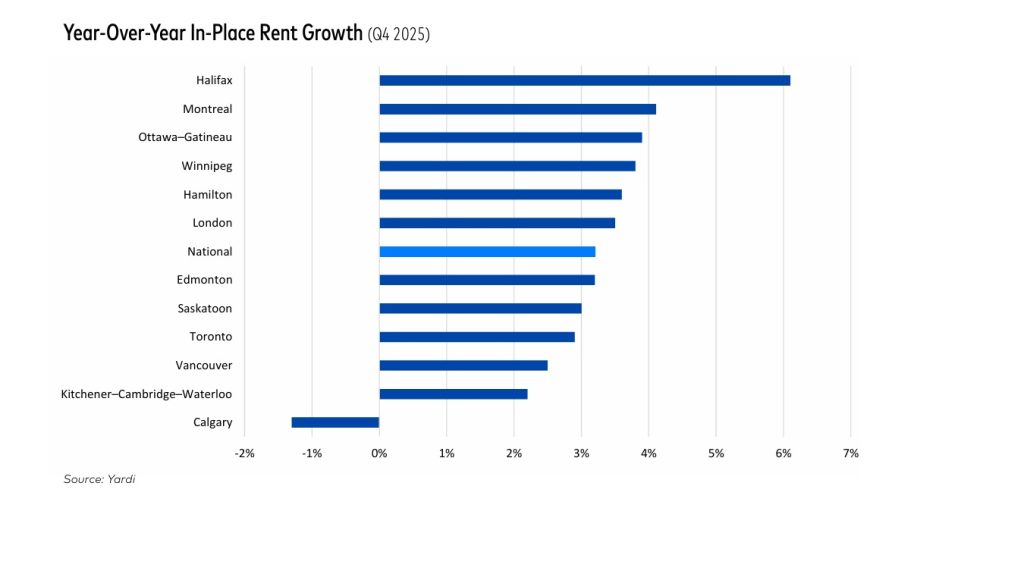
In terms of the housing market, high prices and economic uncertainty kept overall housing activity muted. Single‑family home values declined in expensive markets like Toronto and Vancouver, while multifamily rent growth slowed sharply across most of Canada, rising just $9 on average in Q4 2025. Halifax, Montreal and Ottawa–Gatineau posted the strongest gains, while Calgary saw a 1.3 per cent decline.

Supply trends offered mixed signals: deliveries in the six largest metropolitan areas totaled 94,611 units through November 2025, up slightly from the previous year but with notable declines in several major markets. That said, apartment construction starts surged, with more than 122,000 units underway in the first three quarters of 2025, representing an 8.1 per cent increase and positioning the country to surpass 2024’s record pace. Apartments accounted for 68.5 per cent of all housing starts, underscoring the sector’s long‑term importance despite near‑term fragility.

To download the full report, click here: Yardi Canada | Multifamily Market Reports