





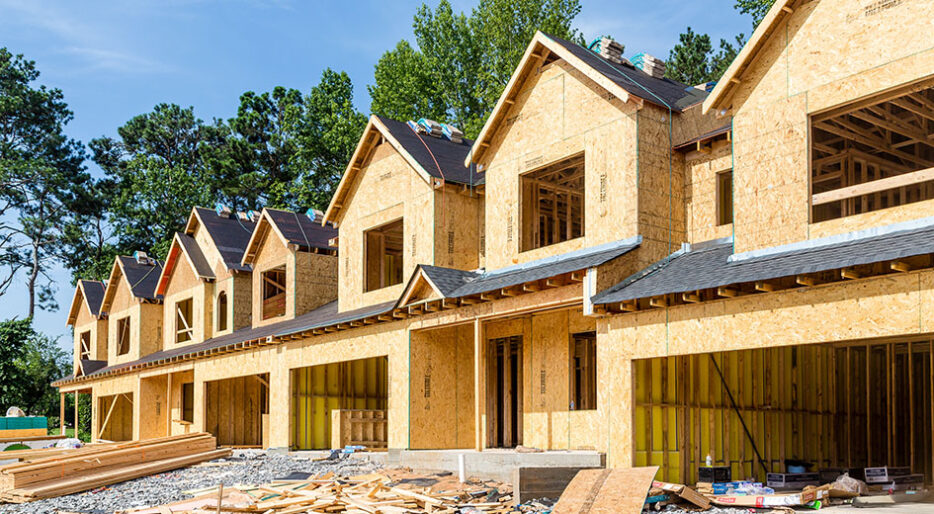
The Q4 2025 Housing Market Index from the Canadian Home Builders’ Association signals a further slowdown in future housing starts and warns that the industry’s capacity to build more homes could decline if layoffs continue.
Thirty-eight per cent of builders said that they (or their subcontractors) had to reduce staff due to market conditions in the second half of 2025, marking the first time this figure surpassed those who had not implemented any layoffs.
The slowdown is also evident in the index data. The single-family HMI dropped 5.5 points to 19.6 (out of 100), the second consecutive record low and the first time it fell below 20. The multi-family HMI also recorded a second consecutive record low, falling to 14.7, down 7.3 points from a year ago.
Builders in Ontario and British Columbia continue to struggle and express the most pessimism. Both provinces are already extremely low, but sharp declines in the Prairie provinces drove the national HMI further down this quarter. Single-family builders in the Prairies recorded their first pessimistic reading in two years, while the multi-family HMI fell further into the negative and continued the downward trend that began in Q2 2024.
“The federal government has shifted its focus away from housing affordability for middle-income Canadians,” said CHBA CEO Kevin Lee. “Support for non-market housing is important, but it should not come at the expense of measures to improve market-rate housing affordability; both can be improved. It’s time for the government to re-focus on measures to support average Canadians and homeownership.”
A recent public opinion study by Abacus Data for CHBA showed that 88 per cent of Canadians under age 45 want to own a home one day. The data also shows that homeownership remains emotionally central as well as financially important to Canadians.
However, only 29 per cent of all non-homeowners are confident they’ll ever be able to buy a home. Canadians see the housing crisis as a systemic failure affecting the middle class as much as low-income households, and 66 per cent say the federal government is most responsible for solving the crisis.
Measures to support affordability
Builders uniformly agreed that the government could best improve new home-selling conditions by expanding the federal GST rebate on homes under $1.5 million to all buyers, rather than just first-time buyers. They also recommended extending the rebate to renovations that create new housing units. When paired with a provincial PST rebate, if matched by the Ontario government, buyers could save $100,000 on their purchase.
Development taxes also significantly contribute to the lack of affordability. CHBA urges the federal government to work with provinces and municipalities to lower them. Fixing the stress test would also help because it currently locks well-qualified buyers out of the market or prevents them from buying homes that best suit their needs.
“The Q4 Housing Market Index indicates that home selling conditions have reached a critical low point for future industry capacity, with 38 percent of members reporting layoffs,” said Lee. “If changes aren’t made now, it will be much harder for the residential construction industry to ramp up in the future and build the homes that Canada needs to correct the housing supply deficit and improve housing affordability for the next generation.”

