





Articles Archive - Page 412 of 928 - REMINET
REMI

CERS draft legislation awaits adoption

On November 2, 2020, the federal government outlined the framework for the Canada Emergency Rent Subsidy (CERS), by introducing Bill C-9 An Act to amend the Income Tax Act (Canada Emergency Rent Subsidy and Canada Emergency Wage Subsidy).

CERS is a new program to support Canadian businesses affected by the COVID-19 pandemic and replaces the now-expired Canadian Emergency Commercial Rent Assistance (CECRA) program. CERS will provide rent support directly to tenants. Although the legislation remains in draft form, it appears that CERS will work as follows:

  • CERS will deliver direct rent support to qualifying tenants without the need to work though their landlords. In other words, no rent relief agreement will have to be entered into between tenants and landlords, although we suspect that for some tenants, funds received under CERS will be insufficient and, as such, they may approach their landlords for further rent relief.
  • The new program is structured as a subsidy and not a forgivable loan like CECRA. Therefore, no loan agreement is required. We understand that the federal government will seek to expedite payments (via direct cash deposits) to qualifying tenants.
  • In order to qualify for CERS, businesses, charities and not-for-profit organizations must have encountered a revenue drop. In such case, qualifying organizations will receive a percentage of their expenses reimbursed, on a sliding scale, of up to a maximum of 65 per cent of eligible expenses. To be eligible for the maximum subsidy of 65 per cent, a tenant must have suffered revenue losses of at least 70 per cent. In such case, for example, a tenant with a monthly rent of $10,000 would receive a subsidy of $6,500 from CERS.
  • A tenant can claim up to a maximum of $75,000 in rent per location, per qualifying period (being approximately one month), and that same tenant, together with its affiliates, can claim up to an overall maximum of $300,000 per period for all its locations. For greater certainty, although the maximum rent is $75,000, CERS’s maximum subsidy is 65 per cent of this $75,000, which represents a maximum subsidy of $48,750 for a qualifying period.
  • Unlike CECRA, there appears to be no restrictions on the types of tenants (big versus small) that can apply for CERS. If a tenant pays more than the maximum $75,000/ $300,000 amounts, they can still claim the first $75,000/ $300,000 under CERS.
  • Additionally, a top-up of up to a maximum of 25 per cent — referred to as Lockdown Support — will be made available for organizations that were forced to shut down for a period of at least one week due to public health restrictions (i.e., an order or decision by a qualifying public health authority made in response to the COVID-19 pandemic), in addition to the above-mentioned 65 per cent subsidy, for a total of 90 per cent. As the 25 per cent top-up is based on the duration of the shut down, it will vary following a sliding scale for organizations that did not close for the full period.
  • CERS is effective as of September 27, 2020, and will be available to tenants until June 2021. However, after December 19, 2020, the federal government will have the opportunity to adjust the current framework and make necessary adaptations to the subsidy rates, amounts, thresholds, etc.
  • Due to what appears to have been an error in drafting Bill C-9, tenants will be required to pay their landlord prior to being able to apply for CERS. As at the time of writing, it remains to be seen if this issue will be rectified so as to allow tenants to access the subsidy before they pay rent.

Program promised to be more accessible for a broader range of tenants

With the announcement of a new program offering support for commercial rent, it is interesting to look at the impacts of its predecessor, CECRA. As of October 2020, the government of Canada had delivered more than $1.8-billion in rent support through CECRA for small businesses. Despite this, the program faced numerous criticisms since its announcement on April 24, 2020.

Among frequently voiced complaints, the program was voluntary, which meant tenants whose landlords opted out were ineligible from receiving CECRA benefits. CECRA also imposed a revenue loss threshold which automatically disqualified some businesses that had still suffered significant losses. Finally, the program only covered business that paid up to $50,000 in monthly rent.

Even though the federal government appears to have addressed some of the shortcomings of CECRA, criticisms are already starting to surface regarding CERS. Impacts of this new program, which the government maintains will be more accessible and better suited for the tenants’ needs, are yet to be seen. One thing is certain: CERS comes just in time for landlords and tenants in the commercial real estate industry who were worried about CECRA coming to an end.

Géraldine Côté-Hébert practices commercial real estate law with Blake, Cassels & Graydon LLP in Montreal.
GRESB swaps GBCI umbrella for B-Corp status

GRESB, the global benchmark for environmental, social and governance (ESG) performance of commercial real estate portfolios and infrastructure investments, is moving out from the umbrella of the Green Building Certification Institute (GBCI) to establish independent oversight through a new non-profit foundation. The Netherlands-based private company will also pursue benefit corporation (B-Corp) certification to formally verify that it meets performance, transparency and accountability standards for generating profits that benefit society and the environment.

“We’re looking ahead to a new era for GRESB with deeper industry involvement in our governance and greater capacity to deliver the ESG data and insights needed to navigate the transition to sustainable real assets at the speed and the scale that is now required,” says Sander Paul van Tongeren, GRESB co-founder and managing director.

Under the new structure, GRESB investor members will make up the foundation board, which will be tasked with annually reviewing and approving the benchmark’s standards. Some major Canadian players — including Alberta Investment Management Corporation (AIMCo), Healthcare of Ontario Pension Plan (HOOPP), Ivanhoé Cambridge, Ontario Teachers’ Pension Plan, Oxford Properties Group and Presima — number among this group of more than 100 financial and institutional investors now relying on the data collected from a steadily expanding base of reporting entities.

Notably, 957 private real estate companies and funds, and 272 publicly traded companies and REITs participated in the 2020 real estate survey, representing more than 96,000 assets located in 64 countries. Results will be released later this month.

“We welcome the establishment of a truly independent GRESB foundation to govern the GRESB standards and continue their development as investor needs evolve. This is an important evolution to reinforce that GRESB is a by-industry, for-industry, mission-driven and investor-led organization,” maintains Patrick Kanters, managing director global real assets, with the GRESB investor member, APG Asset Management.

ESG champions in the Canadian commercial real estate industry likewise commend the new independent foundation, saying it will safeguard against outside parties influencing GRESB standards.

“This is global best practice now, and will make GRESB even more relevant going forward,” observes Michael Brooks, chief executive officer of REALPAC and a former GRESB board member. “The pivot to a benefit corporation reflects the fact that GRESB very much is a change agent for a better world, allowing real estate companies to compare themselves with each other on a number of metrics, so everyone can be a better corporate citizen on this planet.”

GRESB management teamed with the alternative investment firm Summit Partners to reacquire its independence from GBCI, which has held GRESB in its portfolio of green building and business standards since 2014.

Envoy Desks offers solution for safe workplaces

Envoy is releasing Envoy Desks, a new desk reservation system to help companies meet physical distancing guidelines for employees working in the office, and provide data-driven insights to optimize their space. As companies adapt to the coronavirus pandemic by adopting a flexible model for employees to work remotely or in an office, workplace leaders are reevaluating their space and looking for ways to make it more safe, flexible, and efficient.

“The future of work will be hybrid, at least for the next couple years. It’ll be a combination of working from home, the office, or even the nearby co-working space – each for only two or three days per week,” said Larry Gadea, founder and CEO of Envoy, “There’s inefficiency in holding permanent desks for people who will only be in an office part-time. Envoy Desks solves this by making desks bookable per day, allowing companies to optimize their use of space, reduce overall square footage and offer more flexibility for workers.”

Desks allows employees to book a desk for the day, right from their phone. Employees have the flexibility to choose where to sit, depending on what they need to get done that day. They may want to collaborate with a project team on-site, or want a quiet space for heads-down productivity that they can’t accomplish at home. They’re automatically assigned a desk when they sign-in for the day, or they can select a different seat from the interactive map in the app.

Desks offers employers a simple way to ensure teams can collaborate in person while maintaining social distance. As companies shift toward a hybrid approach, they’re redesigning spaces previously allocated for permanent seating to more adaptable spaces that can accommodate hot desking, group work, special events, or client meetings.

Envoy Desks is designed to support flexibility, especially as more people are returning to the office and there are changing guidelines around social distancing and capacity limits. Desks analytics can help optimize office layouts by reconfiguring unused space, ultimately reducing the office footprint and lowering real estate costs. Analytics can also be used by after-hours cleaning crews to know which desks and conference rooms to sanitize.

New GBAC STAR grants program now available for facilities

ISSA and GBAC have partnered with GP PRO, a division of Georgia-Pacific and a leading provider of advanced dispensing solutions for commercial facilities, to launch a GBAC STAR grant program for certain facilities.

The program offers GBAC STAR facility accreditation grants to qualifying public and commercial facilities committed to enhancing cleaning, disinfection, and infection prevention efforts that protect the health and safety of employees and guests.

“The demand for GBAC STAR continues to grow, and we want to ensure every facility has access to the necessary tools and knowledge to prepare for, respond to, and recover from biorisk situations,” said GBAC Executive Director Patricia Olinger. “This strategic partnership will enable facilities around the world to open their doors with confidence each day.”

Designed for facilities of all sizes, GBAC STAR accreditation is designed for facilities of all sizes, is performance-based, and provides the framework for a comprehensive system around cleaning, disinfection, and infectious disease prevention.

Qualifying grant applicants will connect with GBAC STAR’s team to complete the accreditation program’s 20 key elements. In addition to helping to offset the costs of GBAC STAR accreditation, the grant also lets facility managers apply for a free trial of the KOLO™ Smart Monitoring System cleaning task management software (basic plan), which uses data-driven cleaning to help boost hygiene and custodial efficiency.

“We see the GBAC STAR program as a natural extension of the work we’re already doing, and we’re excited to collaborate with ISSA and GBAC to help the cleaning industry improve cleaning and disinfection efforts today, tomorrow, and well into the future,” said Michael Slawson, vice president of Connected Solutions at GP PRO.

“As an association dedicated to advancing the world of cleanliness, the GBAC STAR Grants Program allows more facilities to discover the benefits that formal accreditation brings to their cleaning operations, their brand reputation, and their bottom line,” said ISSA Executive Director John Barrett. “We thank GP PRO for its support to make this opportunity available.”

To apply for the GBAC STAR Grants Program, or for more information, visit go.issa.com/gppro-gbac-stargrant/.

Starlight acquires tallest rental development in Western Canada

Skyline Investments has completed the acquisition of Western Canada’s tallest rental development, a high-rise, mixed-use, multi-residential building comprised of 398 rental units. Located at 900 Carnarvon Street in New Westminster, BC, the newly constructed property rises 40-storeys and and is connected to 4,600 square feet of retail.

“The acquisition of this signature property builds on Starlight’s presence in the Lower Mainland of British Columbia and demonstrates our strategy of acquiring top-quality, well-positioned and highly sought-after, high-rise, concrete buildings in desirable urban communities across Canada,” said Daniel Drimmer, Starlight’s President and Chief Executive Officer.

Upon inception of the lease-up campaign, BC’s tallest rental development was named Aqua. Centrally located near the New Westminster SkyTrain station, the building connects to numerous stores and services in the adjoining retail component. Residents at the property also have immediate access to the Shops at New West.

On-site amenities feature a two-storey lobby and several distinct spaces that flow naturally into one another. Integrated into the building is a terrace garden on the 6th floor and a terrace on the 37th floor with ocean views.

The 8,000 square foot amenity floor includes a well-equipped fitness centre, change rooms with steam showers and a multi-purpose lounge with access to the patio. There is also a garden, a games and an entertaining room, a full chef’s kitchen and a dining area.

Starlight already owns several properties in the New Westminster neighbourhood, including the 113-unit low-rise at 720 Queens Ave., which it purchased late in 2019.

Aqua will be managed by Gateway Property Management Corporation.

.


AIBC reveals 2020 Recognition Program recipients

The Architectural Institute of BC (AIBC) has announced the recipients of its 2020 Recognition Program.

Vancouver architect Nick Milkovich received the Lifetime Achievement Award from AIBC for his outstanding career-long body of work, which has enriched the built environment both locally and abroad.

With more than 50 years of professional practice, Milkovich’s body of work demonstrates creativity, public outreach, environmentally sensitive design, attention to detail, and use of advanced design technology. His focus on public and collective good, as well as upholding an inclusive and transparent engagement process, has ensured a collaborative approach which adds value to his projects.

“With sincere gratitude, I wish to thank the AIBC for bestowing upon me this great honour of the Lifetime Achievement Award,” said Milkovich. “I would also like to extend my gratitude to the colleagues who submitted supporting letters for my nomination. In my earliest stages, I was fortunate to be involved in a studio which engendered an educational environment of exploration and collaboration, which has guided my approach ever since. I wish to thank my mentors, colleagues, and friends who made my journey joyful and rich, with of course, the anchoring support of my family.”

Abdel Munem Amin was awarded the Barbara Dalrymple Memorial Award for Community Service given his dedication to the profession and community as a volunteer and mentor.

Amin has worked in the architectural field in the public and private sectors, and is currently a senior architect for the federal government. As a registered architect, he has worked on residential, retail, transportation and institutional projects. Notably, he contributed to the City of Vancouver’s Canada Line infrastructure project for the 2010 Winter Olympics. As an advisor for design professionals around the world, his most recent work includes projects in New York City, Berlin, Tokyo, and Vienna.

AIBC volunteers, whose work is critical to furthering the public-interest mandate of the Institute, were also recognized as part of the Recognition Program. The AIBC has more than 25 committees, panels and working groups, which are comprised of nearly 200 volunteers.

In this extraordinary and unprecedented year, the Institute is recognizing all AIBC volunteers and the work they have contributed over 2020. So far this year, nearly 200 volunteers collectively contributed nearly 8,500 hours to the Institute’s initiatives and programs.

Building support for mental health

When it comes to mental health issues in the construction industry, the ongoing COVID-19 pandemic is raising concerns and emphasizing the importance of having strategies in place to provide support.

The high level of uncertainty and stress created by the crisis can lead to anxiety, substance use and depression. There is a real need to transition workplace cultures in meaningful ways to allow for open conversations about mental health. COVID-19 has brought mental health, along with other safety issues, to the forefront like never before.

With construction deemed an essential service early in the pandemic, companies had to react quickly to implement new public health measures to continue working.

“One of the advantages we had as a construction industry is we do have a lot of health and safety protocols in place already that are required,” said Darin Hughes, president of Scott Construction. “For us, it was really about understanding what we needed to do immediately to ensure that our workers are safe.”

Hughes was one of several industry experts that met for a virtual summit to discuss mental health strategies as part of the BC Municipal Safety Association’s free psychological support toolkit, developed to provide workers with resources to cope during the pandemic.

For the construction industry, collaboration and sharing protocols was key to getting through the initial stage of the pandemic, said Hughes, and then through the summer, it almost felt normal.

“Now we’re at this stage where we’re starting to see the long-term effects of being in this state of hyper attention to COVID,” he continued. “What we’re seeing now is… people definitely having anxiety, seeing some absentee issues and we are also seeing a general irritation on a day-today basis.”

Hughes explained it’s important to allow mental health to be an approachable subject and deliver the information easily and in “digestible size” content to those who need it.

Moving forward, he said it’s important to watch workers closely, identify what are the signs and provide the right support. Scott Construction’s mental health committee has focused on making information as easy to access and as frequently available as possible.

“The key for us is to make sure they know what supports are out there. We’re not going to solve the issues around mental health necessarily but we’re able to direct them and guide them. From our standpoint, that’s what we’re trying to do,” he said. “But we can do a lot better to continue to make the information available.”

Scott Construction created a mental health committee several years ago to assist workers who need help with their mental health and wellness. The volunteer committee assists and teaches what to notice, what to do, and how to be proactive with someone struggling with mental illness.

COVID has also made substance abuse, already a challenging problem, worse in the industry. Hughes explained that construction work is very physical that can cause repetitive strains and injuries, driving workers to seek relief with alcohol or other substances.

“This is a very hard subject to talk about. When you look at the numbers and how they relate to our industry specifically – it’s daunting,” he said. “We’re a male dominated industry and the way males typically deal with mental health is through substance abuse.”

Although there is more awareness about mental health, the biggest barrier to mental illness assistance is the stigma that still exists. COVID has put a greater focus on mental health and substance abuse, which Hughes feels will be the upside that comes out of this.

“I think putting the spotlight on these issues for the construction industry is needed,” he said. ““There will be a much greater focus on it going forward – how do we provide the resources to the people who need it and how do we identify it. We have a lot more awareness in our industry and I’m excited about where we can take that.”

Cheryl Mah is managing editor of Construction Business. 

Seismic rebuild planned for Museum of Anthropology

The Museum of Anthropology (MOA) at UBC has begun preparations for a rebuild of its iconic Great Hall that will upgrade the resiliency of the space and protect its collection in the event of a major earthquake.

Opened in 1976, the Arthur Erickson-designed museum was inspired by the cedar post-and-beam construction of traditional west coast Indigenous villages. The Great Hall houses an extraordinary collection of massive carvings from northwest coast First Nations that have deepened visitors’ understanding of this land, its people, and their history.

The most recent round of UBC building evaluations, undertaken as part of a campus-wide seismic resilience plan, has identified the Great Hall as one of the spaces at greatest seismic risk. Based on simulations for major earthquake scenarios, it was quickly elevated on the university’s priority list for seismic upgrading.

The university essentially had two options: reinforce the Great Hall’s existing structure, or rebuild it completely. To reinforce the existing structure to today’s building standards would require significant modifications to its columns, plus the addition of new columns and brackets that were never part of Erickson’s vision. Alternatively, a complete rebuild of the Great Hall could retain the appearance of Erickson’s original design, preserving the clean lines and distinctive silhouette for which it is known.

As the undertaking calls for a sensitive approach given the heritage value of both the building and its site, the university met with the Arthur Erickson Foundation, which advocates for proper stewardship of Erickson’s legacy. Representatives from the Musqueam Indian Band also participate in planning meetings and provide a critical cultural perspective for the project team to take into account. Indigenous communities and families whose cultural objects must be relocated elsewhere in the museum during construction are providing input into protocols around moving the objects and re-installing them after the Great Hall is rebuilt.

“This seismic work is critical to preserving the integrity of this architectural gem,” says MOA director Anthony Shelton. “It also provides long-term safety for the cultural objects displayed within this space, ensuring the rich Indigenous knowledge and cultures represented in these objects are preserved for many generations to come.”

The seismic upgrades will be achieved using base isolation technology. In this type of construction, the Great Hall will be placed over rubber or sliding bearings (known as base isolators) in between the foundation (footings) and the superstructure (columns and beams). As the ground shakes, the isolators will allow the building to move, taking up most of the energy and protecting the building’s structure.

Construction is expected to progress throughout 2021, with the aim of re-opening the Great Hall in late 2022. MOA will remain open during the seismic upgrades of the Great Hall.

Photo by Cory Dawson 

Wood Solutions Conference showcases innovation

The latest innovations and solutions for wood design and building will be presented next week (November 16-20) at the national 2020 Virtual Wood Solutions Conference.

The conference, hosted by the Canadian Wood Council and its Wood WORKS! Program, typically held annually in the Wood WORKS! regions, will be presented nationally and virtually this year.

Along with a lineup of 16 distinguished Canadian and international speakers, there will be an exhibit hall with industry leaders, design innovators and product experts on hand virtually to answer questions and provide wood design and building ideas and solutions. Attendees can obtain up to 14 continuing education credits.

“A virtual and national conference enables the Wood WORKS! programs across the country to provide Canadian designers and builders with an expanded and enriched educational opportunity to increase their wood knowledge and proficiency,” explains Etienne Lalonde, VP, market development & Wood WORKS! national director. “Featuring topics, projects, speakers and exhibitors at the forefront of innovation in wood design and building, this conference will inform and inspire, and will ultimately advance wood use along with imperative climate-friendly building solutions for the future.”

The week will feature three workshop days, hosted by three provincial Wood WORKS! programs – Alberta (4 speakers – Monday, November 16), BC (6 speakers – Wednesday, November 18) and Ontario (4 speakers – Friday, November 20), showcasing more regional-specific innovative advancements and applications for wood products and building systems in design and construction.

Attendees will learn about both architectural and structural applications with wood through technical sessions based on inspiring and innovative projects in Canada and beyond. Some of the presentations include: Mass Timber Structural Design and Performance-based Fire Engineering; Unique Timber Systems and Connections; and T3 Bayside: The Design Challenges of a Mass Timber Office Building.

The 2020 Virtual Wood Solutions Conference will feature two keynote speakers, including Michael Green, principal – MGA|Michael Green Architecture, with his presentation on Tuesday, November 17: How Timber will Define the Skylines of our Future Climate.

Architect Leon Rost, a partner with the renowned international firm, BIG – Bjarke Ingels Group, will be the keynote speaker on Thursday, November 19 with his presentation, From Product to Planet: Mass Integrated Timber.


B.C.’s freeze on rent extended to July 2021

The Province of B.C. announced it has extended the freeze on rent increases until July 10, 2021, under the powers of the Emergency Program Act and COVID-19 Related Measures Act.

According to a government update posted on November 12, increases set to happen on Dec. 1, 2020, are now cancelled along with all pending increases through to July.

“We know many renters are still facing income loss and even the slightest increase in rent could be extremely challenging,” commented Selina Robinson, Minister of Municipal Affairs and Housing. “For that reason, we are extending the freeze on rent increases to provide more security for renters during the pandemic. We are all in this together, and it is important for both renters and landlords that people can stay in their homes.”

Back in March, the Province originally froze rent increases with the ban set to expire December 1st. The extension comes as concerning news to the province’s hard hit landlords, according to Vancouver-based association, LandlordBC.

“Needless to say, this decision is very concerning,” the group responded in a blog post. “Our sector is on a negative financial trajectory and we need support for rental property owners. While not insensitive to the challenges many renters have faced during the pandemic, the reality is that our sector has also been challenged with significant disruptions, risks and costs as a result of the pandemic.”

As the leading voice for owners and managers of rental housing in British Columbia, LandlordBC says it will continue to advocate on behalf of  members and the broader sector to ensure the government understands and responds appropriately to the group’s concerns.

“[In] the absence of rent increases for existing tenancies to better cover cost inflation like taxes, utilities, insurance, maintenance, etc., our financial challenges will be further exacerbated and threatens our ability to ensure British Columbian’s have continued access to a safe, secure, sustainable rental housing,” the association wrote.

You can read the complete response here: landlordbc.ca.

BCBT names interim executive director

The BC Building Trades Council (BCBT) executive board has announced the appointment of Brynn Bourke to the position of interim executive director. The board is beginning an executive search process to replace Andrew Mercier, who was elected to represent Langley during the B.C. provincial election.

Bourke, who had been in the role of senior director of engagement, brings extensive experience to the position. She served eight years with the council as director of campaigns and research and also held the role of executive director of the BC Federation of Labour.

“Brynn knows construction, she knows training and apprenticeship, she knows the issues facing our sector and she has the abilities, insight and instinct to skillfully guide the unionized construction sector through this transition,” said BCBT president Al Phillips.

Mercier joined the council in 2019, replacing long-time director Tom Sigurdson. The council noted that during his tenure, Mercier led the building trades during an incredibly difficult time for construction workers. His advocacy efforts on behalf of the council to ensure the health and safety of construction workers during the COVID-19 pandemic contributed to increased site inspections, enforcement of occupational health and safety guidelines, and application of provincial COVID-19 health orders.

“We’ve been benefiting from Andrew’s passion, knowledge and skills since he joined the council, and now his election to government allows him to work for all British Columbians,” said Phillips.

Phillips added that Mercier’s political experience and passion have been assets to the Building Trades, and his voice in government is a voice for workers across B.C.

The BCBT council represents 25 local craft construction unions belonging to 13 international unions.

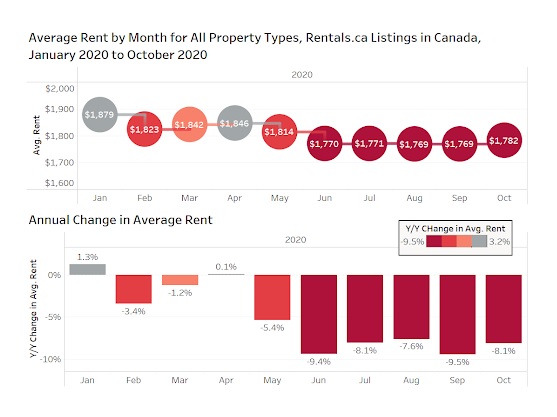
Average rent down 8.1% in Canada: October 2020

New rental data for October 2020 shows that average rents are down in most large metros, particularly for smaller luxury units located in busy downtown neighbourhhoods.

In Toronto, rents have declined 17 per cent for a one-bedroom home and 14 per cent for a two-bedroom home; in Montreal, however, rents are up 15 per cent for a one-bedroom and 9 per cent for a two-bedroom.

Trending since the pandemic began in March, tenants have been seeking out rental units close to grocery stores and parks, as opposed to busy high density neighbourhoods close to office towers.

The average rent for all Canadian properties in October 2020 increased slightly over September (0.7 per cent)  to $1,782, after four months of almost no change, according to the latest data from Rentals.ca and Bullpen Research & Consulting. Year over year, the average rent for all property types listed on Rentals.ca is still down but improving.

average rent Canada October“The average rent in Canada trended up in October, which we partially attribute to an increase in new purpose-built rental apartment listings,” said Matt Danison, CEO of Rentals.ca. “We continue to see an increase in listings nationally, which tells us that supply is outpacing demand. This market imbalance suggests soft rental market conditions will continue for the rest of the year.”

Average rent in specific GTA cities

North York finished first among 35 cities for highest average monthly rent in October 2020, surpassing both Toronto and Vancouver due to a number of new purpose-built apartments beginning pre-leasing programs, which pulled the average up. Month over month, average rent for a one-bedroom in North York was up 7 per cent ($1,945) and 12.4 per cent ($2,459) for a two-bedroom.

Mississauga finished fourth on the list for average monthly rent for a one-bedroom home ($1,877) and seventh for average monthly rent for a two-bedroom ($2,150). Year over year, rents are down for both unit sizes in Mississauga, at 5.6 per cent and 10.2 per cent respectively.

Etobicoke finished fifth for average monthly rent for a one-bedroom ($1,861) and fourth for average monthly rent for a two-bedroom ($2,306). Year over year, average monthly rent was down 9.1 per cent for a one-bedroom and 8.9 per cent for a two-bedroom.

Rising rents in secondary markets

As several of Canada’s major cities continue to see declining rental rates, many secondary markets are seeing rents increase. Demand is down and supply is up overall, but demand is shifting geographically.

Data backs up the “Urban Exodus” theory in Ontario, with average rents declining in places like North York, Etobicoke, Toronto and East York, while cities such as Kitchener, Hamilton and London are still seeing double-digit rent growth with annual increases of 14 per cent, 15 per cent and 17 per cent respectively.

As more tenants work from home, less expensive units in smaller communities are drawing attention. Municipalities in Ontario with the biggest growth in pageviews on Rentals.ca are: Kingston, Guelph, Windsor, Barrie, Cambridge, Whitby, Brantford, Hamilton, Burlington and Woodstock.

“The rising rents in several smaller municipalities, as well as the significant increase in web traffic on Rentals.ca in Ontario suggests many prospective tenants are widening their search area when looking for a rental property,” said Ben Myers, president of Bullpen Research & Consulting, “With many choosing to go back to where they grew up or attended university to avoid the lofty Toronto area rental rates.”

Vancouver

Like Toronto, rents for condominium and rental apartments in Vancouver have declined year over year with one-bedroom suites down 3 per cent and two-bedroom suites down 6 per cent.

Meanwhile things are looking good in Montreal, where year-over-year average monthly rents are up 15 per cent for a one-bedroom and 9 per cent for a two-bedroom.


Highstreet, Skyline Living celebrate opening of new Vernon property

Kelowna-based property developer Highstreet Ventures, and Guelph-based property manager Skyline Living, recently celebrated the grand opening of their new Vernon property, Creekview Heights Apartments.

Developed by Highstreet and managed by Skyline, the three-building, 216-suite luxury B.C. rental complex was completed in June 2020.

To commemorate the grand opening of the new Vernon property and give back to the community, Highstreet and Skyline have jointly donated $20,000 to the local shelter, Archway Society for Domestic Peace.

“Highstreet is dedicated to creating a positive impact in the communities that we build in,” said Christina Wilson, Vice President of Development and Sales at Highstreet. “This year has had a tremendous effect on everyone’s living situation, which is why we selected the Archway Society for this donation.”

“Skyline Living is committed to building strong, caring, and vibrant communities, and to working with companies who share that vision,” said BJ Santavy, Vice President, Skyline Living. “Highstreet and Skyline Living have previously partnered on several residential developments in Western Canada. We are pleased to have joined with Highstreet in contributing to Archway Society, which plays such an important role for children and families in Vernon.”

Like many non-profit and community organizations across the country, Archway Society has seen its fair share of challenges due to COVID-19.

“We were thrilled and honoured to receive the generous donation from Highstreet and Skyline Living, and it was truly serendipitous as the funds could not have come at a better time,” said Sherry Demetrick, Co-Executive Director at Archway Society. “Domestic violence has been at epidemic levels for years, but since the arrival of COVID-19, we’ve seen increased needs for our services.”

Ontario invests extra $761-mil into long-term care

The Ontario government is investing an additional $761 million to build and renovate 74 long-term care homes across the province, creating close to 11,000 spaces.

More than 38,500 people are on the waitlist to access a long-term care bed, as of June 2020. The new investment comes from the province’s new funding model that helps accelerate the construction of these urgently needed projects.

Details were provided at a press conference at the Maple View Lodge on November 12.

“Bringing the long-term care funding model into the 21st century means we have a targeted approach for improving and expanding long-term care capacity in our communities,” said Steve Clark, minister of municipal affairs and housing and MPP for Leeds—Grenville—Thousand Islands and Rideau Lakes. “For example, under the modernized funding model, Maple View Lodge will receive an additional investment of close to $7 million. This will help the United Counties of Leeds and Grenville build 132 new and much needed spaces in Athens township sooner.”

Through the funding model, the government plans to create 30,000 beds over 10 years, moving away from a one-size-fits-all approach, and instead, providing tailored incentives to address the needs of developers in different markets. It also introduces an up-front development grant to address high-cost barriers to construction.

The government is also selling surplus lands with the requirement that long-term care homes be built on portions of the properties. The Accelerated Build pilot program is also fast-tracking 1,280 spaces.

The funding model has already boosted support for 74 projects, representing 10,753 long-term care spaces: 3,957 new beds, and 6,796 older beds being redeveloped to modern standards. Of the 74 projects, 49 involve the construction of a brand-new building.

Asia-Pacific provides climate for insurtech

Smart technology and climate volatility underpin emergent property insurance products and the growing demand for them in the Asia-Pacific region. A new report from the data analytics firm, GlobalData, projects USD $85.6 billion in written property insurance premium across the region by 2023, representing 4.6 per cent compound annual growth from the USD $71.5 billion tally in 2019.

Advancements in the collection of real-time data is accelerating and refining damage assessment and processing of claims. Dubbed insurtech, it includes on-site monitors gathering insight on safety and risk situations, along with the ability to harness drones or satellites to quickly investigate property damage.

Through insurtech, some property owners in the Asia-Pacific now have new insurance options for a pre-agreed payout when a triggering event occurs. For example, data from the Hong Kong Observatory triggers typhoon-related payouts for Swiss Re’s recently introduced property insurance product in Hong Kong.

“The property insurance industry is expected to evolve driven by technological developments, which allow insurers to provide customized and event-specific insurance,” observes Manisha Varma, an insurance analyst with Global Data.

Construction and manufacturing activity are also central to rising property insurance demand in a dynamic region, in which China is a predominant player. “Despite the initial slowdown in 2020 due to COVID-19 pandemic, many economies are now exhibiting signs of recovery following the lifting of lockdown restrictions,” Varma says.

Niagara Welland Commons comes to light

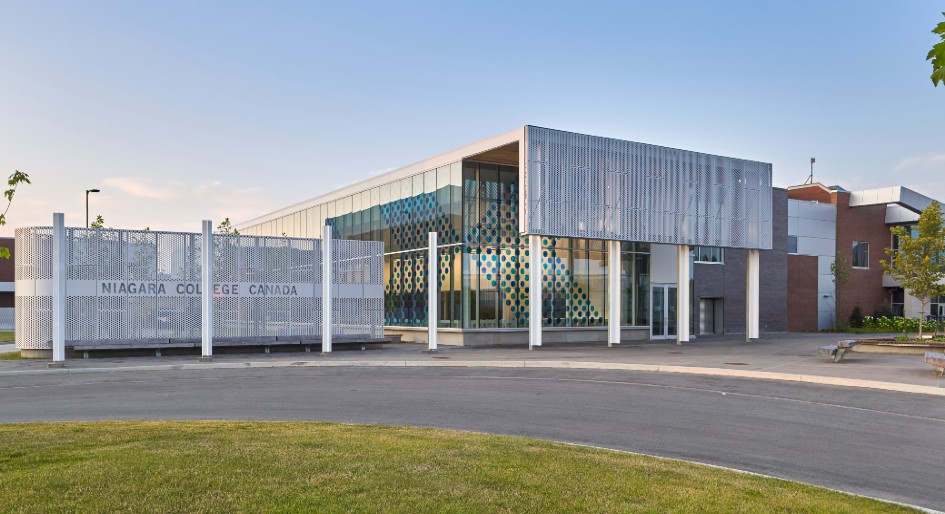
It’s a feast of light at Niagara Welland Commons. Crafted into a mix of interconnected brick buildings circa 1970, its modern glass facade glows from across the campus at night and brings natural light into the space by day.

Situated on the Welland campus of Niagara College Canada, a rural community college focused on applied arts and technology, the two-storey hub was completed this year at a total cost of $15 million.

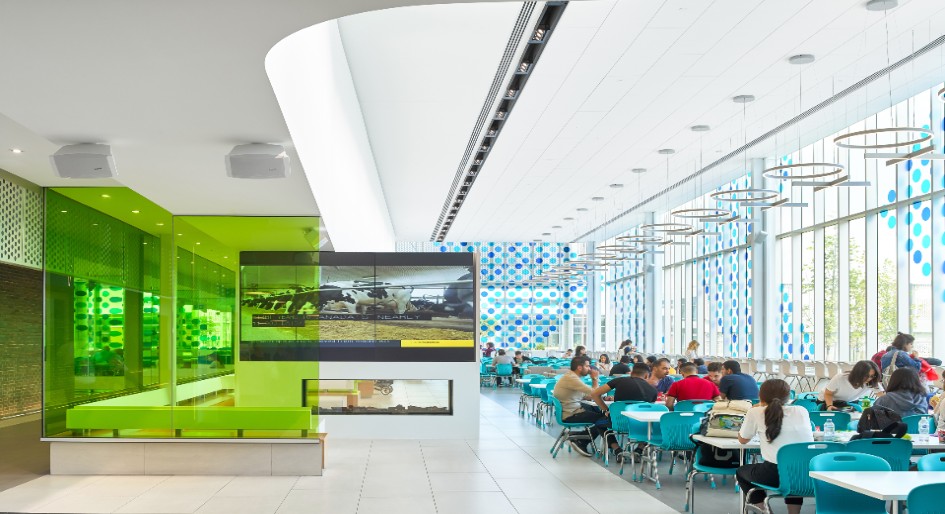
The 33,000-square-foot addition, partially open to students and staff due to the pandemic, brings new classrooms, a welcome centre, a retail space and a student activity room. Tucked-away areas bring rest and collaboration. A food court serves a 450-seat cafeteria that transforms into event space for large culinary gatherings or faculty speeches. Commissioned to give students a dedicated space to eat, socialize, study and lounge, the Gow Hastings Architects’ design commands a bold presence that is both playful and functional.

Outside, large-scale perforated metal panels mark the new north-facing entrance and stand parallel to a parade of columns that light up the way. The metal screen carries through the space as a wayfinding element—hinting at what else lies inside.

Like many campuses, rather than walk from building to building through a connected exterior, students travel through a labyrinth of existing buildings. Bright colours and patterns work as visual cues to guide people into the much taller space with ceilings 30 feet high.

“There are numerous, small interconnected corridors with ceilings eight-foot high , and if you’re a first time visitor to the campus, these are really hard to negotiate,” says Gow Hastings’ Design Director Jim Burkitt. “We were trying to provide one large, easy to navigate open space that is different from everything else on campus, because it’s for everybody.”

Niagara Welland Commons

Large-scale perforated metal panels mark the new north-facing entrance to Niagara College Canada. Photo by Scott Norsworthy.

Designed to connect

Supergraphics echo the schools’ branding in various shades of blue. A window frit inspired by the perforated screen “serve different functions throughout the project.” As one drives around the east side of campus, giant chevrons illuminate the exterior, pointing to the entrance outside while bringing playful dots into the cafeteria. Next to oversized lettering at the terminus of the corridor, the dots offer security, abstractly, directing one to the student commons.

Natural light also acts as a wayfinding of sorts, growing brighter as one walks through the corridors’ nooks and crevices and into the new space of high curtain-wall glazing. “Further in, the existing design didn’t have a lot of windows,” says Burkitt. “We really wanted to bring in that natural light as deep as we could.”

A row of clerestory windows above the food hall are framed with a cascade of mirrors so the natural light bounces down into the spacious corridor. As the bulk of students typically go through the program during the colder, darker months of the year—September to May—light was thought of in such a way to bring access to the outdoor landscape.

In the cafeteria, floor-to-ceiling windows allow light to drench the space. A series of LEDs are tucked into the ceiling above, shining onto the white walls to make them glow. There are light fixtures in the shape of Xs and Os. “We custom-made those lights in combination with a standard circular light fixture to add another dimension of scale and a playful flair,” adds Burkitt.

An indigo blue felt wall reaching 45 to 50 feet high, expands above the student activity room, while absorbing sound. Embedded with long, linear LEDs, this graphic element invites users into what is a bookable, yet configurable space with non-fixed seating. Large white swinging doors into the room recall “open-air cafes” of more urban locales. Here, students can meet, practice yoga or study. The room also expands the main space for larger events.

Niagara Welland Commons

Green-hued glass partitions wrap around a row of back-lit oak benches, which surround a fireplace and large TV array. Photo by Scott Norsworthy

Around the perimeter of the cafeteria, counter-height tables and tall chairs are places to hang out and view the landscape. Light-weight stackable furniture complements the flexibility of various seating areas.

Green-hued glass partitions wrap around one such niche of space where back-lit oak benches surround a fireplace and large TV array. “The hope is that this is the hearth of the space, and students feel warm and comfortable the whole time,” says Burkitt. “We gave a lot of thought to how different seating arrangements can impact the student experience t.”

This tucked away area in Niagara Welland Commons is conducive to studying and socializing at the same time, but also for those craving a private moment.

“With a lot of academic campuses, there has been a real awareness that student spaces are not only places for studying,” Burkitt adds. “They need to address the times when students are in-between study periods—at lunch, at breaks, and for those who aren’t living close to the campus and need a comfortable spot.”

Photos of Niagara Welland Commons by Scott Norsworthy. 

Canadian construction continues to rebound

Procore has published the latest worker hours report for the Canadian construction industry which showed construction activity during the COVID-19 pandemic continues to recover in Canada after an initial drop in the spring.

Procore’s Construction Activity Index tracks weekly changes in worker hours from a baseline beginning the week of March 16 through the week of September 28, 2020. The most recent update includes data from British Columbia, Alberta, Ontario and Quebec.

Overall, Canadian worker hours rose 11 per cent above the March 16 baseline during the weeks of August 17 and September 14. These are the highest levels of activity tracked by the index.

However, activity in each province has differed (compared to the March 16 baseline):

  • Ontario has been recovering since the week of May 25, with activity reaching a peak of 25 per cent above the baseline the week of September 14.
  • Quebec saw the sharpest initial decline in activity, with worker hours dropping 97 per cent below the baseline the week of April 5, before recovering through May and June. During the Quebec construction holiday the weeks of July 20 and July 27, activity within Procore briefly dipped again (92 per cent and 95 per cent below baseline, respectively) and has been strong since then.
  • In Alberta, activity has hovered around the baseline, rising to a peak of six per cent above baseline the week of April 20. But since the week of June 8, activity has been below the baseline for 17 consecutive weeks.
  • Of all the provinces, British Columbia has been least affected. Its activity has been consistently above the baseline with the exception of a few small drops in April and June. At its highest, activity was 31 per cent above the baseline the weeks of June 15 and September 28.
“The pandemic continues to challenge everyone, and the construction industry is no exception,” said Jas Saraw, vice president, Canada, at Procore. “The latest insights from Procore’s Construction Activity index shows that while construction continues to experience periods of recovery across Canada in the fall, conditions vary from province to province. Construction organizations are learning to adapt and move forward while the industry continues to deal with the pandemic and a new way to work. We hope the index provides useful context for industry leaders navigating this ongoing challenge.”
Provincial and national data from the Procore Construction Activity Index is available for download here.
