Articles Archive - Page 408 of 928 - REMINET
REMI

The GTA condo market: its not all bad news

Canadian real estate has been remarkably resilient in the face of COVID-19, but despite record-breaking home sales and continued price growth across many markets, the Greater Toronto Area’s condo segment hasn’t emerged completely unscathed. But it’s not all bad news.

What shocked everyone in the wake of the pandemic, is despite the lockdown and its economic aftermath, housing prices continued to rise. Market matchers predicted declines and bursting bubbles—forecasts that have not yet materialized as we approach the end of 2020. While the prediction was contested by RE/MAX, nobody could have foreseen what’s actually transpired.

Data released by the Toronto Regional Real Estate Board (TRREB) reveals that home sales in the GTA in October 2020 were up 25 per cent year-over-year. Prices followed suit, reaching an average $968,318. The average detached home now carried a price tag of $1,204,844, a 14.8-per-cent increase year-over-year. The housing market’s rapid return in the summer months can be attributed to pent-up demand from the delayed spring market, coupled with severely limited supply, low borrowing costs and a slow but steady economic recovery. The continuing strength through the fall speaks to a broader trend of growing demand overall which is likely to continue.

Meanwhile, condos in the 416 were the only property segment to see a decline in sales and a plateau in prices, which increased just 0.7 per cent to $622,122 year-over-year in October.
This is certainly a far cry from the condo sector’s meteoric growth over the last decade. As the price of detached homes reached record-breaking highs time and time again, an increasing number of homebuyers sought condos as a viable option for ownership in a city where “home” was quickly becoming an unaffordable, unattainable dream. As demand for condos grew, so too did their prices.

By the same principles that previously prompted skyrocketing housing prices (which continues to be the case across the detached housing segment), condos have lost some of their lustre. Demand has waned due to the halt in immigration, business and tourist travel, stricter short-term rental rules and a shift in consumer demand toward larger suburban homes.

Indeed, condo market research firm Urbanation reported a vacancy rate in the GTA of 2.4 per cent in Q3-2020, which is three times higher than it was in Q3-2019, and the highest in the last 10 years. Those investors who were once accused of monopolizing the GTA’s lucrative condo market and driving up prices, were now flooding it with listings thanks to long-term uncertainty.

According to TRREB, new condo listings coming on stream more than doubled in October 2020 compared to year-ago levels, and sales were only up 2.2 per cent over the same period. If this trend were to become more pronounced, prices may start to decline. But that’s just speculation at this point.

What we’re experiencing right now is a softening GTA condo market. This is not a bubble on the verge of bursting, but a slight deflation. And this could be the break first-time homebuyers and young families need, in order to achieve ownership in this pricey market. From an end-user’s perspective, current market conditions mean more choice, less competition and a real chance at a secure place to call “home” at a price they can afford. For investors the view may be dimmer, but there is light ahead.

Borders will eventually reopen, travel and immigration will resume, and the world will return to a version of its former self. In the meantime, right now is the best opportunity to buy a condo in the GTA in years. There’s lots of inventory, which means great selection for buyers with room to negotiate. Before COVID-19 closed borders, Canada was welcoming roughly 300,000 new Canadians every year, which carried a substantial demand for homes. Those numbers have been cut dramatically due to restricted travel and immigration; however, the federal government recently announced its intention to increase immigration to Canada by 1.2 million newcomers over three years as part of its 2021-2023 Immigration Levels Plan. In my humble opinion, Canada—and specifically the GTA—is still among the best places in the world to live.

Christopher Alexander is the executive vice-president and regional director of RE/MAX INTEGRA Ontario-Atlantic Canada. Christopher is responsible for all areas of day-to-day operations including franchise management, membership services, training and development, marketing, advertising, promotions and finance.

Townhouse demand up during pandemic: report

Demand for affordable, ground‐oriented housing options has been robust since the start of the pandemic. Altus Group’s latest report shows that townhouses have captured a larger share of the new home sector and demand is up or stable in many cities across Canada.

As the markets deal with the second wave of COVID‐19, low interest rates, increased home buying intentions and shifts to flexible work, a few factors are expected to keep townhouse demand resilient in 2021.

Many millennials delayed forming families and are in search of affordably priced options with room to grow, in a family friendly built form. Given the single‐family price affordability challenges in the major markets, and economic uncertainty resulting from the pandemic, demand for affordable townhouses is anticipated to continue to grow.

Since fall 2019, intentions to buy have risen among current renters across the country, except in Manitoba and Saskatchewan. Demand has been strongest in the suburban regions of the major metropolitan areas where prices for townhouse units are often lower than two‐bedroom condo apartments in more central areas. New townhouse buyers are said to be a diverse group, but the built form is becoming increasingly popular with younger consumers with or without children.

All this being said, the supply of townhouse land remains scarce, the report states. As a key component of the ‘missing middle,’ this land is often prohibitively expensive in urban areas.

City views

Vancouver saw townhouse volumes double 2019 levels, with strong sales occurring at affordably priced townhouse developments in Surrey, Langley and Coquitlam.

In Calgary and Edmonton, sales were down slightly in 2020, but have been comparatively robust given the weak economy in Alberta.

The Greater Toronto Area has seen a sharp increase in demand for all single-family built forms, but townhouse activity has seen the biggest improvement over 2019. Outside the GTA in the broader GGH, townhouse volumes are the highest recorded since tracking began in 2014.


Ontario’s new standard lease form

The Province of Ontario has updated its standard lease form to take into account RTA changes that were introduced last July by Bill 184. Beginning March 1, 2021, landlords must use the new form for all new lease agreements entered on or after that date.

According to Joe Hoffer of Cohen Highley Lawyers, this means that lease agreements made prior to March 1 can remain on the current form even if the lease begins on or after March 1, 2021. There are no penalties or fines in the RTA for landlords who do not use the proper form of the standard lease; however, the failure to use the proper form can allow tenants to break their fixed term lease early, so landlords should be ready to use the new version prior to March 1.

“The industry lease that we have drafted and which is licensed to major landlord associations across the province will also be updated for use with the new standard lease and will be ready for implementation as “Additional Terms” to the standard lease well before March 2021,” Hoffer said.

In terms of what’s changed, here is a summary of what he calls the most significant updates:

  • The requirement to serve new tenants with the “electricity consumption” form for sub-metered units is gone (Bill 184 repealed that requirement)
  • In the preamble to the “General Information” section following the signature page, the web address for the LTB/RTA has been changed
  • In Part D, the narrative has added additional grounds for ending the tenancy (landlord’s own use, etc.)
  • The fines payable by landlords who evict tenants unlawfully or give notices of termination in bad faith have been increased per Bill 184 and are shown in Part D of the narrative
  • In Part I, the narrative has been changed to reflect the “Post November 15, 2018” (“new construction”) rent control exemptions from the Guideline
  • In Part Q, there is clarification in the narrative, making it clear that if the tenant rents the entire unit to a third party, the person is not a “guest” and the landlord’s permission may be required. (This is to address Airbnb type situations)
  • At the end of the narrative there is a section called “Guide to the Standard Lease” which provides a web address in multiple languages
  • And finally, the document is now 14 pages instead of 13

A link to the new Standard Lease Form can be found here: Ontario Central Forms Repository – Form Identification (gov.on.ca)

Edit Studios delivers stunning office renovation

In a year where few companies have dared to undertake a major office expansion, Edit Studios is unveiling a space that eschews the conservative design aesthetic generally associated with wealth management firms in favour of a more modern and welcoming approach.

Located in Vancouver’s iconic Marine Building and designed for BlueArck Private Equity, the space mixes the elegant comfort of French country with the sophistication of a modern Parisian office. This innovative design move is a reflection of BlueArck’s corporate culture and its desire to foster a diverse and inclusive work environment. 

The conventional dark woods and leather chesterfields of the typical private equity office have been swapped for a soft grey palette, herringbone floors, and luxurious drapery. The move towards a warmer atmosphere was a deliberate choice designed to address the imbalance between the number of men versus women that the profession usually attracts.

“From my first conversation with BlueArck, it was clear that the founder is committed to a culture of balance, not only between work and life, but also in the composition of his team,” says Janay Koldingnes, founder of Edit Studios. “The space had to reflect this balance. From soft draperies to cozy chairs and reading lamps, we created an environment of comfort and warmth, with all the functionality of the modern workplace.”

The main entrance reveals a reception area that feels more like a living room for family and friends. Likewise, the modern bar is outfitted with all the comforts of home highlighted by book-matched black and white marble with gold accents. 

Inspired by the hidden passageways in an old French château, the office’s inner workings are tucked behind hidden doors that are masked by intricate mouldings. Soft draperies provide a way for staff to share spaces that can be easily cordoned off for privacy. Crown moulding and wainscoting accent the walls, while modern furniture pieces, rich marbles and traditional French light fixtures juxtapose old with new. 

“Edit Studio’s design perfectly articulates our culture,” says Aleem Ahamed, managing partner at BlueArck Private Equity. “We now have a warm, sophisticated, welcoming space that our team will feel comfortable transitioning back to.”

The process of transforming the space started in March 2020 right as the province went into lockdown, and businesses and governments were scrambling to adapt to the new reality of remote working. Forced to adapt themselves, the Edit Studios team immediately transitioned to working online, and began using FaceTime and other video conferencing tools for meetings with suppliers, contractors, and the client.

Construction partner Etro Construction also began using 3D scanning tools to give the design team project updates without the need for in-person site visits. This not only allowed Edit Studios to follow COVID-19 protocols and keep their employees safe, but also had the benefit of speeding up project timelines and saving money thanks to reduced travel time and greater productivity. 

With international supply chains disrupted by the pandemic, Edit Studios moved quickly to find and source replacement products like flooring and glazing from local suppliers.

With city hall closed, the permitting process looked especially daunting. Thankfully, procedural changes made by the City of Vancouver’s Planning Department in response to the pandemic allowed developers and design teams to submit drawings and documentation online for the first time ever. The changes also allowed what were previously in-person meetings to be conducted virtually, saving developers and design teams considerable time and travel costs.  

“The City of Vancouver’s move to a digitized planning process enabled us to work more efficiently and get our permits approved in record time despite the challenges posed by COVID-19,” says Koldingnes. “This is a great first step and it is our hope that the city will continue to digitize all aspects of the permitting process. As it stands, physical copies are still required to be stamped, sealed and sent to city hall. Other cities like Toronto and Edmonton have already eliminated this, and we hope that Vancouver will also move in this direction.”


Photos: Ema Peter Photography

Requisitions: waiting on changes to the Condo Act

Potentially lost in all of the ongoing changes to the Condominium Act, 1998 (the “Act”) since 2017 (really, 2015) are the proposed amendments concerning requisition meetings, which have not yet been proclaimed into force. Those amendments will drastically change the requisition process.

Requisitions are essentially petitions signed by at least 15 per cent of owners requesting that a condominium call an owners’ meeting for a particular purpose. The most serious and common requisition would be a requisition for a meeting to remove and replace one or more of the directors from a condominium board.

One fundamental feature of the process has been the authority of requisitionists to call their own official owners’ meeting if the condominium board does not do so within 35 days: a ‘self-help’ remedy.

That said, it has always been exceedingly difficult for requisitionists to actually call their own meeting. In particular, if the requisition is to remove board members, a condominium board may take the position that the requisition is invalid. If the requisitionists disagree and decide to proceed to call and hold a meeting, there is potential to elect a ‘competing’ board. These situations can create chaos for a condominium, and often result in expensive litigation.

A case in point is the recent decision of the Ontario Superior Court of Justice in Toronto Standard Condominium Corporation No. 2510 v. All Unit Owners (2020 ONSC 6582; October 27, 2020). Here, a requisition to remove board members was submitted to the condominium, which took the position that the requisition did not meet the requirements of the Act.

The requisitionists attempted to call the meeting, but the condominium applied to Court to prevent the meeting from proceeding.

Ultimately, the Court found that the requisitionists had failed to comply with all requirements of the Act relating to calling owners’ meetings including: providing 14 days notice of the meeting instead of 15, not using the mandatory form of Notice of Meeting, and apparently delivering the notice of meeting through social media (at least in part) which is not a permitted method of service.

The facts of this case also raise other interesting legal issues such as whether a requisition can be ‘supplemented’ by sending additional owner signatures after the initial submission of a requisition, and also whether requisitionists may withdraw their signatures. These issues were not addressed in any final way since the requisitionists had failed to call the meeting properly.

It is also worth pointing out that the requisitionists in this case made several substantive procedural errors. What is less clear is whether or not more limited, technical errors in procedure would also invalidate such a meeting. Would some extra procedural flexibility be permissible in the midst of the pandemic?

All of which demonstrates that requisitions and the self-help remedy can be extremely complex, not to mention the litigation that may ensue. In the aforementioned case, the court made a very clear statement in bold text, as follows, in part: “As they have learned in this endeavour, this is a complicated field in which to navigate.”

So, how will amendments to the Act (the “Amendments”) presumably improve the requisition process as discussed above? The main changes to the procedure pursuant to the Amendments would essentially be as follows:

a. the requisition itself will be on a new mandatory form;

b. upon receipt of the requisition, the board will have 10 days (or another time period as per the regulations) to respond to the requisitionists, either confirming that the owners’ meeting will be held, or stating that the meeting will not be called, and stating the reasons why not;

c. if the board does not respond as per (b) above, then it is deemed to agree to proceed to call the meeting;

d. the board essentially has 40 days to call and hold the owners’ meeting if it has confirmed that it will do so, or if deemed to respond in such manner as per (c) above;

e. the requisitionists will have 10 days (or another time period as per the regulations) to revise a requisition if they deem fit;

f. where a board responds to state that it is not calling an owners’ meeting, the requisitionists will have 20 days in which to apply to the Condominium Authority Tribunal (“CAT”) for a ruling on the requisition (or apply to the Superior Court if the CAT’s jurisdiction has not been expanded to include such requisition matters). If such an application is not made, the requisition would be deemed to be abandoned.

The primary change is to eliminate the self-help remedy of requisitionists calling their own meeting. This is substituted with the option to apply to Court or the CAT, as the case may be, for a resolution.

This feature alone should help eliminate the complications associated with requisitionists calling their own meetings. What remains to be seen is how efficient the process will be for requisitionists to apply to Court or the CAT.

It would seem that having requisitionists apply to Court may be an inefficient procedure with what presumably would be a potentially significant delay. Hopefully, the CAT’s jurisdiction would be expanded to include handling requisition matters, at the same time when the Amendments come into force.

Provided the CAT can efficiently (both in terms of cost and time) address the requisition issues, and subject to actually reviewing the regulations, these improvements to the Act should be welcome and address the growing complexity associated with the self-help remedy as discussed above.

David Thiel is a partner in the condominium law group at Fogler, Rubinoff LLP. He can be contacted at [email protected] or 416.941.8815.


CAPREIT acquires newly completed Halifax rental property

CAPREIT announced it has purchased a newly constructed Halifax rental property, located in the suburb of Bedford, for $11.9 million.

Completed in July 2020, the Halifax rental property, known as “the Madison”, features 38 large, two-bedroom units with wide plank flooring, stainless steel appliances, quartz countertops and large walk-in closets.

Located close to grocery stores, pharmacies, restaurants and banks, amenities include a spacious modern common room, 59 parking spaces with a car wash bay, and a fully-equipped fitness facility. Each suite is individually metered for power, and occupancy currently stands at 97.4 per cent.

“We are pleased with the addition of this high-quality acquisition and continue to increase our presence in the very strong Halifax market,” said Mark Kenney, President and CEO. “Combined with our large portfolio acquisition last year, we are among the largest providers of high-quality rental accommodation in the region.”

In addition to this Halifax rental property, CAPREIT owns or has interests in approximately 67,400 residential apartment suites, townhomes and manufactured housing community sites across Canada, in the Netherlands and Ireland. More information can be found at www.caprent.com.


BMO Centre enters next construction phase

The BMO Convention Centre expansion project in Calgary has completed construction of the new Exhibition Hall F, consisting of 100,000 square foot exhibition space on the north side of the existing convention. The next phase of the project is removal of the Stampede Corral and BMO Centre Exhibition Hall A, beginning this month.

“Over the past 18 months, our project team has made significant progress on the preparatory work required to support the successful delivery of the BMO Centre expansion,” says Kate Thompson, president and CEO, Calgary Municipal Land Corporation. “While we’ve certainly had to adapt and respond to health guidelines brought forward from the pandemic, we are now moving into the next stage which lays the groundwork for the expansion to be built – it’s a major step for the project and the realization of Calgary’s Culture & Entertainment District.”

The visually stunning BMO Centre expansion, valued at $500 million, will significantly grow and modernize the facility and enable Calgary to host major conventions on a global scale. Funded equally by the federal, provincial and municipal governments, the BMO Centre will become the largest convention centre in western Canada and will significantly increase Calgary’s profile in the international meetings and conventions industry.

In preparation for the external demolition, crews have been working to remove materials from the interior of both buildings, upgrading and relocating underground utilities and technology services, and removing the Plus 15 walkway on the south side of the Corral.

“As we prepare to say goodbye to the Corral, we are proud to be building the future of Stampede Park with the BMO Centre as a catalyst for Calgary’s continued economic growth and diversity.” says Jim Laurendeau, vice president of park planning & development, Calgary Stampede. “Despite current challenges, there remains no better way to learn and share ideas than to do so gathered together in person. The 2024 opening of the building is perfectly timed to make this possible.”

The ground-breaking for construction of the BMO Centre expansion remains on schedule for spring of 2021, with project completion in 2024.

Inside one condo board’s COVID-19 response

In February, before the World Health Organization declared a global pandemic, talk among the condo board at Palace Pier was of various news reports piling in. Wuhan. Most of China. All of a sudden, Italy.

“It was very mysterious and scary in the sense that nobody really knew what to expect, and nobody really knew what the ultimate ramifications were,” says Condo Board President Al Pace. “We seriously thought we needed to look into this matter and be on top of it and, frankly, get ahead of it.”

There were under 15 confirmed cases in Canada at the time when Board Secretary Thelma Beam walked down to the lobby and saw the property manager had placed hand sanitizer stations everywhere. That was two weeks before any official confirmation on March 11. “I thought to myself, I guess it’s here now. We then realized we were in a situation that was going to get a lot worse.”

Emails that were bouncing back and forth between the board members—what they should be doing, how they should be doing it—swiveled into weekly COVID-related Zoom meetings, starting at 9 a.m. every Friday and lasting for one hour.

“During that [initial] meeting, we found it to be incredibly productive; each and every one of us had been bringing more facts and information to the table to consider, and then we decided we should have a meeting the following week; it was very organic,” says Pace. “Nothing will be able to replace seeing the other member in-person, even if it is electronically.”

Palace Pier stands in the Humber Bay Shores neighbourhood of Toronto. When it was designed in 1978, the 433-unit, 46-floor tower was the tallest residential building in Canada at the time. According to its website, residents can walk, jog or cycle on the Martin Goodman Trail, which runs along the water and through parkland. Dining and entertainment are within walking distance as well as marinas, boating and the TTC’s Humber loop.

This year, residents have been spending a lot more time at home. How they were kept up-to-date with weekly highlights was one reason why CCI Toronto and Area Chapter recently named Palace Pier Condo of the Year 2020. Of the condos’ response to the pandemic, Chair of CCI-Toronto’s Marketing Committee Farzad Lahouti said, “As a condo director myself, I can’t help but be impressed at what Palace Pier has accomplished.”

“Palace Pier Responds With Covid-19 Plan” was the title of a newsletter sent out in February to the community. Beam, who is the editor, remembers wanting to call it the “pandemic edition”; instead it was deemed a “special edition” because the WHO hadn’t yet officialized it. A first sentence, “Coronavirus is here in Ontario. Should we be worried?” begins a long list of facts and to-dos, including a sanitizer recipe and advice for residents returning from affected areas.

“We have a lot of travelers here. So we wanted to make sure that people knew what they had to do when they returned,” she says. “We couldn’t take the risk—that people wouldn’t take it seriously and do nothing.”

Property management and the security department sat down and compiled a list of travelers, many of whom spend winters in the U.S. Others were in China or Europe; some in hot spots. The team then called people to find out their plans for returning.

“As soon as we had that schedule in place, we contacted every single person and helped them with accommodations here as much as we could,” says Senior Property Manager Donald Balla. “When they were quarantined, we followed-up with them on a daily basis to see how they were doing.”

As normal operating procedures like the valet service grinded to a halt, rather than furlough anyone, valets were re-deployed with different duties, such as delivering mail, groceries and packages, and picking up garbage for those in quarantine. The valets also took on specific cleaning routines, a need which had ramped up considerably.

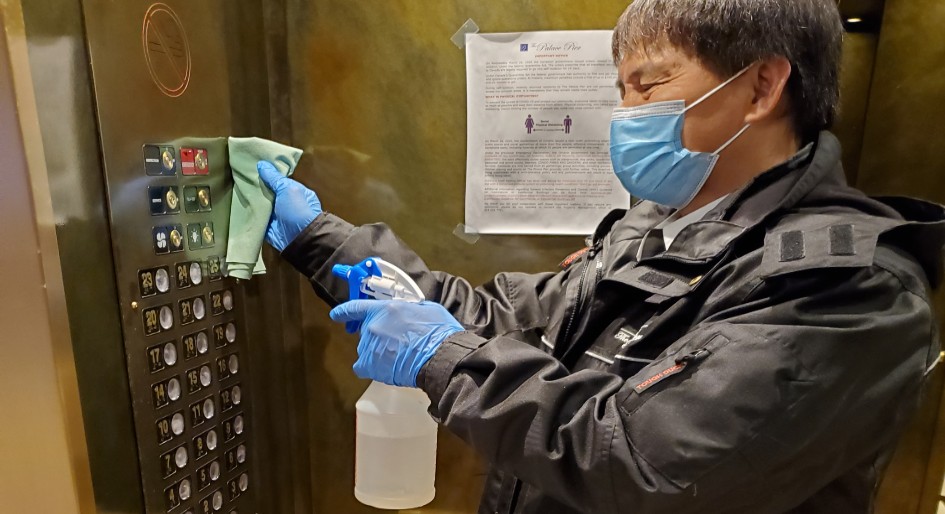
“Seeing the valet personnel cleaning the elevator buttons from inside and outside every time someone left the elevator created a sense of security for the owners,” says Balla. “They really felt comfortable that our board and management were taking every action possible to keep them safe.”

condo board

Valets were re-deployed with different duties, such as delivering mail, groceries and packages.

condo board

Elevator buttons in the condo are cleaned after each use.

One of the first protocols implemented at Palace Pier was shutting down amenities in early March.

“A lot of people thought that was a little draconian, but in retrospect, it ended up being the right thing to do,” says Pace. “We were kind of going out on a limb, but we had the full consensus of the entire board; we knew it wouldn’t be the most popular decision with all of our residents, but we knew it was the right thing to do.”

To close or not to close. To re-open or not to re-open. Those were questions many condos were mulling over in the past few months. “There were some critics who suggested we shut everything down very quickly,” says Pace. “Even though we were among the first, if not the first building (under Crossbridge Condominium Services’ portfolio), to shut down all of our amenities, we were also one of the first to start re-opening our amenities on a very case-by-case and surgical basis.”

“Our community is a bit of a dichotomy in the sense that there are people who want to keep everything shut down and people who can’t have it open up quickly enough,” says Beam. “We have to tread a very fine line in how we manage this.”

In light of wavering restrictions [at the time this article was written Toronto was in a modified Stage Two], there is dismay when having to take a step back. Some residents in the building “felt the whole pandemic ruling was overblown and [they] should get back to ‘business as usual,’ as quickly as possible,” says Beam. A majority, however, wants the board to take necessary precautions to keep the building safe.

“We get that people are feeling frustrated. There is bound to be frustration and fear of further restrictions. We sympathize,” she says. “But at the end of the day, the corporation must comply with the law.”

At its weekly Friday COVID meetings, the condo board assesses amenities to see if any are affected by new legislation.

“As a manager, I find these board meetings to be the best thing I have experienced in my career in the condo industry,” says Balla. “The way we discuss things and the way that we reach conclusions are so beneficial to me and my staff.”

He recalls someone asking him a few months ago if anyone from the board worked for the government. “This is how important those COVID meetings with the board were because we were steps ahead; every time the government made a formal decision, we had already done it.”

“Even though there are more meetings, you sort of get a lot of things done that would take up a tremendous amount of time at a board meeting,” adds Pace. He cites Zoom as one silver lining to the crisis. “We never did that before, and this really gives us a lot more flexibility. Going forward, we’re going to be able to have our meetings anyplace, anytime, and having shorter meetings to deal with issues of importance is going to be something we’ll be able to do more often.”

Pre-pandemic, the board has always strived to be on top of issues as they arise.

“Proactivity is something we’ve always been conscious of and sensitive to,” says Pace. “We’ve got a great board though; it’s a functional board. That isn’t always the case; there are some different factions in different buildings. Even though everyone on the board has some strong opinions, we’ve got common sense and allow everyone to completely voice their opinions and positions and the facts they’re basing their suggestions on. We always move forward on a consensus basis; it’s a huge strength that we have.”


Dexterra & FSI Canada: A Partnership Taking FM to New Heights

It’s hard to overstate the demands on modern facilities management providers. Under growing pressure to drive efficiencies, push sustainability and maximize asset performance, embracing technology has become more and more pivotal to the work FMs do every day.

An organization that vividly understands this need is Dexterra. With 90 years’ experience in 11 of Canada’s 13 provinces – managing and maintaining over 50 million square feet of space for clients in defense & security, healthcare, education, retail, social housing and beyond – Dexterra are true leaders in the delivery of fully integrated FM solutions, driven by the technology they harness throughout their sites.

That is where FSI and our Concept Evolution platform enter the frame. Dexterra has worked with us the past six years, utilizing our CAFM technology to provide the most complete support to their clients possible. Through this, they consistently meet the ever-growing demands facing the industry and go above-and-beyond for their clients.

To hone in on how Dexterra is achieving this, here we will focus on one of their most prominent P3 sites: The Forensics Services & Coroner’s Complex in Toronto, Ontario. Discover how CAFM sits at the heart of their successful management of this critical building, and hear from two of their key team members – Craig Francis (Facility General Manager) and James Quinn (Facility Maintenance & Operations Manager) – on how Concept keeps them at peak performance.

The Forensics Services & Coroners Complex: A Background

The Forensics Services & Coroner’s Complex is one of Toronto’s most prevalent government buildings. As well as housing the Office of the Chief Coroner, the Ontario Forensic Pathology Service and the Centre of Forensic Sciences in the same facility, the building is the reporting command centre for any emergency in Ontario, be it a flood, earthquake or missing person.

In addition, the centre:

  • Accommodates over 2,500 autopsies per year
  • Handles over 15,000 forensic science cases per year
  • Houses 2 courtrooms for inquests for the Chief Coroner’s office

With this in mind, it’s impossible to downplay how important it is that all 652,000 square feet of the building are performing as they should at all times. That makes the work of Dexterra’s team all the more vital, as they are responsible for the site’s hard and soft services, covering:

  • Asset Management
  • Plant Operations & Maintenance
  • Fabric Maintenance & Repair
  • Energy Management
  • Facility Cleaning & Grounds Maintenance
  • Customer Care
  • Space Planning
  • Housekeeping & Food Service
  • Environmental Services
  • Materials & Logistics
  • Security

Furthermore, as a P3 (Public Private Partnerships) project, every aspect of managing and maintaining the centre is underpinned by significant penalties if SLAs are not met. These penalties would be taken out of Dexterra’s service payment, and this covers everything from salaries and subcontractor fees to the costs of equipment and software.

As Craig Francis points out: “A potentially big pitfall with P3 is that everything is governed by financial penalties.”

“Without a good CAFM, there is no way you can keep a handle on the number of calls coming in or the number of PPMs that needs to be completed, and under a P3 any failure to manage these means you’re going to be paying out more money.”

Yet, despite the immense responsibility and risk attached to managing every facet of a building like this, the Dexterra team is consistently rising to the challenge and exceeding expectations. This is evidenced by the project achieving both the Universal and National Green Earth Awards from BOMA Canada in 2020.

At the centre of this success is Dexterra’s Concept Evolution platform, which has empowered their whole team to control every aspect of the site with effortless efficiency.

“Concept plays such an important role in our ability to manage assets and report in a credible fashion to our clients,” says Craig.

“In fact, the contract with the Forensics Complex specified that a CAFM system must be present and used, which is an indication of how central it is to our account’s overall success.”

CAFM: Total Control for FM Providers

“It’s central to everything. Everything we touch, Concept has an impact on,” – Craig Francis

So, how does a CAFM solution like Concept Evolution enable organizations to meet the ever-increasing duties associated with a full-service FM offering? Let’s break down what the system achieves for Dexterra and the benefits this brings.

Asset Management & Maintenance

Ensuring all assets at The Forensics Services & Coroner’s Complex are properly tracked and maintained is a crucial element of the project. Establishing effective PPM and PDM schedules to maximize their lifecycles is vital to keeping costs down, while never allowing performance to drop due to the presence of suboptimal or broken assets.

“FSI’s platform is incredibly powerful – we rely on this not only for tracking the lifecycle of assets and understanding the equipment, but over time we get a stronger understanding of how particular assets function long term,” says James Quinn.

“At any time I can pull a trend on an asset and know every incident relating to the asset, so we can mitigate risk and reduce downtime by planning and scheduling resources to manage that issue.”

By seamlessly allowing the Dexterra team to automatically plan PPMs and PDMs and instantly distribute tasks to their relevant engineers, this maintenance management software enables them to work at peak efficiency, and make strategically-driven decisions over whether the costs of maintaining an asset are less than the cost of replacing it outright.

The significance of effective asset maintenance was key to Dexterra’s decision to introduce a BIM modelling system. Thanks to Concept’s versatility in integrating third-party software, the FSI Canada team was able to embed the BIM software (provided by Planit Measuring) into the system.

This has been incredibly useful for Dexterra, as now their engineers can visually identify any asset across their facilities with total ease. This ensures any issues are swiftly located and resolved – nothing ever gets missed.

This is further enhanced by Concept’s barcode scanning tool. Whenever an engineer has a task to perform, they will scan the barcode of an asset or room number using their FSI GO application on their smartphone. Not only does this demonstrate to Dexterra’s management team and their client that an engineer turned up and resolved the issue, but they can build a complete history of that asset’s lifecycle.

Through this history, Dexterra can understand the performance of every asset at a granular level. With this data, they can determine if PPM schedules need to be modified, and identify any common trends in faults or issues with an asset.

“FSI GO was involved in the ongoing platform of BIM modelling in the system. As soon as the modelling was done, it was like an airplane landing,” says James.

“FSI took traction immediately and rectified all asset tags so that it spoke hand-in-hand with our operations – the history behind each asset, their identification number – they brought that all together, so we can quickly find an asset and completely understand it and what has happened with it.”

“FSI is very good at implementing various software and techniques into the system to find solutions that work for us.”

Energy Management & Smart Buildings

One of Dexterra’s core focuses is sustainability. Everything from the products their cleaners use to how they handle waste is rooted in being as green as possible.

This extends to how they employ their CAFM system. Dexterra utilizes Concept’s Energy Management modules to push conservation across their sites, and develop smarter, more sustainable buildings.

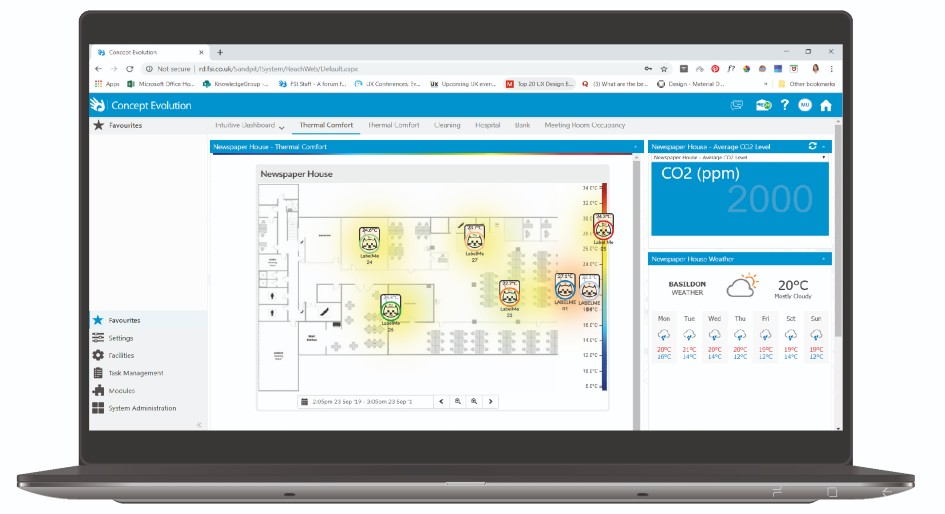
Responding to the fact that the modern workplace is increasingly flexible, from how many people are on-site at any given time to the different hours people work, Dexterra will soon incorporate energy management software and sensors into Concept.

Through this, sensors and the IoT will be able to identify when spaces are either occupied or vacant, and respond accordingly with regards to lighting, heating, ventilation and more. This will enhance energy-efficiency at times where occupancy is low, while also ensuring that spaces provide maximum comfort for employees when they are present.

“The normal unoccupied/occupied core hours of a building has changed. We have to adapt to a smarter system to support the functionality of these buildings moving forward,” says James.

“Working with FSI, we want to be able to pursue the future of BIM modelling and how it helps you understand every aspect of a building and the assets within it, and tie this into the development of modern, smart buildings.”
FSI Canada

Project Management

Dexterra also relies on their CAFM solution in how they manage projects across their site. Be it routine cleaning or maintenance work to larger developments involving subcontractors, Concept offers total reassurance that everything is under control.

“By being able to monitor all tasks on a dashboard, it prevents any failures,” says James.

“It prevents any task going unnoticed. It helps us understand why any tasks are taking long to complete, so we can determine ways to fast-track these. It enabled us to fine tune the system in relation to failed tasks and classify tasks by their importance.”

Craig continues: “We have monitors in the offices of every supervisor and manager on site. At a glance, everyone can see what’s going on with the tasks they are responsible for on the dashboard. I can look at overall performance across all sections at a glance, and that was a neat innovation FSI introduced to us.”

Inventory Management

Across all their sites, Dexterra is responsible for tens of thousands of assets and enormous inventories. Ensuring the team is fully aware of what is in their inventories, what has been taken out of inventory day-to-day and when it needs replenishing, is essential for buildings running seamlessly.

Again, a CAFM solution is crucial to tracking this immense amount of information and guaranteeing that inventories are well-stocked at all times. As well as contain all of this data and any movement of inventory, the system automatically sends a report to the finance team, so they are aware of what’s changed and any orders they need to make.

“If inventory management had to be done manually, it would mean increasing staff and taking more time, which translates to higher costs. At the very basic level, Concept is a powerful cost-saving tool,” says Craig.

“As multiple different sites utilize this united system, it prevents procuring any equipment on a site which others have demonstrated isn’t effective, and if a site needs a particular asset in a hurry, we can send a replacement if another site has it in their inventory, rather than go out and buy a new one, which may take more time than required,” James adds.

Reporting & Client Relationships

As noted earlier, the penalties associated with a P3 project such as The Forensics Services & Coroner’s Complex place a major priority on the strength of Dexterra’s reporting. As a self-reporting organization, Concept Evolution’s “Audit Now” module automatically generates custom-made reports for Dexterra and their clients’ requirements, providing a huge boost to their productivity and credibility.

“By enrolling every moveable component of the site into the system, every department head is able to capture all necessary pieces of information for their reporting,” says James.

Craig continues: “If we were to just type something up on a piece of paper saying we had no failures this month, the government would never accept that as a credible way to report.”

“Having access to these automated, customized reports lends credibility to what we do here. That credibility translates into cost savings, as it means we don’t need to worry about penalties.”

Indeed, thanks to the strength of Dexterra’s CAFM solution, they have been able to reduce their SLA chargebacks of this site to around zero, making it one of the only buildings in all of Canada to hold this distinction and saving Dexterra thousands of dollars each month.

In addition, Concept comprehensively tracks all client calls or complaints that Dexterra receives, so tasks can be created to resolve the issue as swiftly as required, and then automatically send out a transaction survey to their client to rate their satisfaction with how the rectification was handled.

Through this information stored on their CAFM system, Dexterra can pull out satisfaction trends in a single-click, and proactively course-correct if trends start to decline.

Dexterra & FSI: A True Partnership

While the CAFM system Dexterra employs is all-encompassing in how they manage their wide range of projects, it would not be nearly as effective without the incredible relationship between both their team and our team at FSI Canada.

“When I talk to JB (Jon) Benjamin at FSI Canada, it is not a typical vendor-client relationship – it’s more of a partnership,” says Craig.

“For example, Jon and his team were the ones that introduced the BIM modelling system to us because they saw the value it could bring to our operations. We looked at it, we also saw the value, and we executed it.”

“It’s not a situation where a vendor is trying to increase their sales as the only goal – that is not the relationship we have with Jon. He presents things to us, and they always carry value. We truly appreciate that, as it’s not always easy to track the latest developments in the CAFM industry when you’re working day-to-day. To have a partner adding this value through this is a breath of fresh air.”

“The engagement with FSI Canada is very enlightening,” James echoes.

“We believe that there is a strong voice behind FSI in Canada. They quickly rectify any issues we encounter and allow us to voice our unique service requirements, and build their platforms for us so we can utilize them in-line with our needs.”

Having a strong bond between a CAFM provider and those using it every day is essential to getting the absolute most out of this technology. It is something we delighted to share with the team at Dexterra, enabling them to realize the full potential of their platform.

A Future Crafted by CAFM

With their eyes firmly focused on expanding their reach across Canada and entering new industries, Dexterra certainly consider Concept Evolution central to fulfilling these ambitions:

“By partnering with FSI Canada and growing this relationship over time, we have been able to extract more and more out of Concept than when we first started,” says Craig.

“I don’t see it going anywhere – every single site we’ve acquired uses Concept, even legacy sites where we’ve been able to integrate their existing systems into Concept.”

We are excited to support Dexterra towards their goals moving forward, and to continue to work closely with their team to enhance and evolve that CAFM solution to continue to deliver the FM services that keep them at the forefront of FM in Canada.

About FSI

Established in 1990, FSI is a global leader in CAFM / IWMS solutions, with headquarters in the UK, offices in Australia, Dubai, Hong Kong and Canada, plus an international partner network. The portfolio includes Concept Evolution CAFM / IWMS, Concept Advantage Workplace apps, and FSI GO Mobile Workforce apps.

Through our powerful software and extensive support network, we enable FM teams worldwide to harness the extraordinary potential of Concept Evolution for their specific requirements.

To learn more about our software and services, visit our website: https://www.fsifm.com/en-ca/

COVID-19 related investment unveiled

The commercial real estate, facilities management and construction/retrofit sectors appear poised to capture a share of pending COVID-19 related investment announced earlier this week in the Canadian government’s fall economic statement. Finance Minister Chrystia Freeland characterized the new and continued relief measures for 2021 and beyond as a down payment on a future $70 to $100 billion spending plan.

She pledged the equivalent of three to four per cent of GDP will be allocated to range of green and social well-being investments with job creation potential once health-related COVID-19 concerns subside. That’s to be scoped to a three-year period unlikely to begin until after next year. More details are promised in the 2021 federal budget.

In the interim, Freeland rolled out funding for a package of economic jumpstart measures deemed safe to implement now. She also confirmed continuation of the Canada Emergency Rent Subsidy at current funding levels for the period from December 20, 2020 to March 13, 2021, and a higher maximum ceiling for the Canada Emergency Wage Subsidy during the same period.

“We will support Canadians and Canadian businesses in a way that is targeted and effective,” Freeland said. “We will ensure the Canadian economy that emerges from this pandemic is greener, more inclusive, more innovative and more competitive than the one that preceded it.”

Grants hold promise to trigger additional spending

Perhaps most significantly for green building and energy retrofit enterprises, $2.6 billion over seven years is promised for residential energy efficiency upgrades, and for recruitment and training of energy auditors to help homeowners and landlords find and capture energy savings. It’s envisioned the funds will underwrite as many as a million free home energy audits and provide 700,000 grants of up to $5,000 for energy-efficient home improvements.

An additional low-cost loan fund is planned. Further details are pending, but grants for qualified recipients will be retroactive to December 1, 2020.

“The government also recognizes that homeowners and landlords need to be able to access simple and affordable financing to make deeper home energy retrofits,” the financial statement notes. “Over the coming months the government will outline details of a low-cost loan program that integrates and builds on available energy audits and grants, and which can be easily accessed by Canadians.”

That seems to align with the government’s stated strategy to leverage pent-up household savings. The economic statement observes that many “household balance sheets are now in a better place than would normally be the case” due to the combination of COVID-19 related financial supports and reduced spending opportunities linked to public health restrictions.

“This positions households to be a central force within our economic recovery,” it reasons. “These savings are a preloaded stimulus Canadians will be able to deploy once the virus is vanquished and the economy fully reopens.”

Up to $122 million of the seven-year program budget is slated to be allocated ahead of the 2021-2022 budget. Nearly $300 million has been earmarked for next year, but the bulk of the spending — more than $1.6 billion — is scheduled for budget cycles in the 2023-2025 period.

Prompts for households, developers and institutional investors

Expanded eligibility for the First-time Home Buyer Incentive, which subsidizes borrowing costs for the purchase of first homes, also seems designed to tap into individuals’ and households’ accumulated savings. New rules will come into effect in Toronto, Vancouver and Victoria in the spring of 2021, lifting the annual income threshold to qualify for the incentive to $150,000 (from the current $120,000) in those three markets.

Eligible applicants can now receive loan cost assistance for the purchase of homes worth up to 4.5 times their household income versus the current cap at four times annual earnings. That adjusts the maximum house price the program will cover from $505,000 to $722,000 in the three cities.

There is also an investment prompt for rental housing developers through an extra $458 million over seven years for Canada Mortgage and Housing Corporation’s (CMHC) low-interest loan fund known as the Rental Construction Financing Initiative. That’s projected to be leveraged into an additional $12 billion of lending capacity that could underwrite 28,500 units of new rental housing. The loan fund’s current lending capacity is estimated at $13.75 billion.

Beginning in 2021-22, more funds will be available to support construction of charging and fueling stations for zero-emission vehicles. The promised $150 million over three years augments an existing fund, with an initial $20 million to be added next year.

As was recently announced with the tabling of the proposed Canadian Net-Zero Emissions Accountability Act, the Finance Minister will be reporting annually on measures taken to manage financial risks and opportunities related to climate change. The financial statement commits $7.3 million over three years to establish and support a public-private Sustainable Finance Action Council, which will be tasked with developing investment standards and disclosure protocol related to climate change, as well as offering guidance on data required to support investment decisions.

Health-related investments in public facilities

Among health-related expenditures to commence during the next 12 months, $150 million over three years has been earmarked for ventilation upgrades in public buildings. It’s to be dispersed through two existing programs for resilient infrastructure and safe school facilities, with $30 million slated to be delivered ahead of the 2021-22 budget year.

“This will help provincial, territorial, municipal and local governments and Indigenous communities fund projects that increase air quality and circulation, such as upgrades or conversions of heating, ventilation and air conditioning systems,” the economic statement declares.

In addition, a nearly $300 million top-up of the federal fund for ameliorating homelessness will be specifically applied to mitigate the risk of outbreaks in shelters — described in the economic statement as steps “to enable physical distancing, enhanced cleaning and other emergency health and safety measures”. That’s all to be allocated in 2021-22.

Turning to chronic health conditions, the economic statement commits $500 million in capital funds to build mercury poisoning treatment centres to serve the Asubpeeschoseewagong and Wabaseemoong First Nations. Their territories continue to be afflicted due to externally instigated dumping and environmental degradation that first began in the 1960s.

“Residents experience higher rates of chronic health problems related to mercury exposure. Community members are often required to travel to urban centres for extended stays to receive specialized treatment or access long-term care,” the economic statement acknowledges. “These centres will offer specialized care for residents to address their unique health care needs, as well as supported living for those who require it.”

The $500 million capital outlay also comes with ongoing annual operating support of $300,000.

Cleaning within the NHL bubble

The coronavirus pandemic swept into Canada in early 2020 with a ferocity that brought the country to a grinding halt. With many individuals out of work and hope of a return to normalcy quickly diminishing, hockey fans across the country rejoiced with news that the National Hockey League (NHL) would resume play, and a Stanley Cup champion would be awarded. And all this in an NHL bubble on Canadian soil.

Thanks to an effective plan unrolled by the NHL, and the expertise of the team at Scandinavian Building Services to bring this plan to fruition, hockey within the Edmonton, AB, NHL bubble was set for success.

“The NHL created a world-class standard and wanted a world-class facility, and that’s what they had with Rogers Place,” said Scandinavian President and CEO, Russell Hay. “It wasn’t just about the look and feel of the centre, but cleanliness was obviously one of the major points. We were certainly prepared to rise to the challenge and ensure that world-class standards were not only met, but surpassed.”

Experience in the field

The cleaning and sanitization of sports and entertainment complexes wasn’t anything new for Scandinavian. In fact, after Hay’s father, Terry, purchased the company in 1982, he won the bid to clean Edmonton’s Northlands Coliseum, a complex he serviced for 20 years.

“Over the past 30 years, we took that 20-year experience from Northlands Coliseum and developed our proprietary quality assurance program,” Hay said. “That’s how we were selected by Rogers Place. They knew we were an Edmonton-based company with extensive experience in similar facilities across the country, and they were passionate about revitalizing downtown Edmonton. We were behind that re-vitalization 100 per cent, so there was a great synergy there.”

But it wasn’t just Rogers Place that Scandinavian was responsible for. In fact, the bubble comprised of not only the arena but the neighbouring hotels and outside recreational facilities as well.

“The bubble encompassed a three-block radius around Rogers Place, and included three hotels and a large plaza area where players and support staff could lounge and relax on their off-time,” said Scandinavian Northern Alberta Regional Director, Dino Dinicola. “These three blocks were cordoned off to the public and were patrolled by 24-hour security.”

In addition to Rogers Place arena and the surrounding area, Scandinavian was also responsible for the nearby Terwillegar Community Recreation Centre, which provided a practice facility for the teams housed in the bubble. Although it was 20 minutes away from the downtown venue, the Terwillegar complex was treated as its own separate bubble.

A phased approach

According to Scandinavian Operations Manager, Alex Aguilar, there were four phases of the NHL protocol to successfully unroll the 2020 playoff schedule. “There were strict rules developed by the NHL, and we had to develop our protocols to be in line with theirs,” Aguilar said.

The first phase was to develop an understanding of the requirements and adapt them to company protocols. The second phase was the introduction of the players, support staff, technicians, and Scandinavian’s cleaning team into the bubble. Phase three was when the players started utilizing the facilities and consisted of strict protocols that had to be followed. The final phase occurred when the play-offs actually began.

“Phase four saw games and practices occurring daily,” said Dinicola. “There were a lot of moving parts as far as people moving from space to space, as well as all the activity that was happening day-to-day.”

Meticulous preparation

With the responsibility of cleaning a world-class facility, Scandinavian was well prepared and selected a world-class cleaning crew well before the start of phase one. The credentials of each staff member were provided to the NHL, and it was only those team members who were allowed entry once play resumed.

“When we realized the bubble was coming to Edmonton and we were going to be cleaning it, we took the pandemic cleaning protocols we had already established and adapted them to the NHL’s requirements,” Hay explained. “We then trained not only our professional cleaners who were directly involved within the bubble but the entire Scandinavian team across the country. We have 6000+ staff, and it was all hands on deck.”

Not only was training provided in person, with participants wearing masks and practicing social distancing, but the company also provided extensive online video training and video conference calls to prepare and educate the entire team.

Caution and care

The Scandinavian crew within the main bubble comprised of 20 cleaners during the day and 50 at night. The Terwillegar site was a smaller venue and comprised of four cleaners during the day and 10 at night. Although the team of 84 was not mandated to remain on-site at all times, there were strict rules which had to be followed, including not being able to work at any other site outside of the bubble.

Additionally, in an effort to protect against potential contamination, all-day team members – due to their proximity to the players and support staff – were required to undergo daily testing, while the night crew were tested on alternate days.

When it came to the physical cleaning of the facilities, the Scandinavian team was prepared to tackle the monumental task at hand. According to Dinicola, at one point, there were 12 NHL teams (and approximately 700 people) within the bubble, as well as five active practice rinks in operation, so time management became a critical priority.

According to Aguilar, once a team vacated a dressing room, the day crew were given 20 minutes to go in and manually clean the dressing rooms, offices, and bathrooms before the next team was scheduled to arrive. Day cleaning consisted of manually sanitizing all areas and high-touch points, while the deep cleaning and disinfection processes were conducted during the night.

Products and protocols

When it came to products and equipment, Scandinavian opted for Oxivir TB for manual disinfection procedures, and Oxivir Plus for electrostatic fogging using Victory backpack sprayers. Additionally, the company also utilized the Clorox 360 system of chemicals and sprayers. All of the systems utilized had to be in-line with NHL protocols.

“The equipment and chemicals we utilized weren’t used every day, and trying to get Oxivir TB during COVID-19 was no easy feat. Clorox 360 products were also difficult to procure,” Hay said. “Fortunately, we were very pro-active from the start, and ordered electrostatic sprayers for use across the country, not to mention a stockpile of 50-gallon drums of Oxivir. We were able to work with our suppliers and manufacturers and obtain enough stock to last the entire length of the bubble.”

Manufactured by Diversey, Oxivir TB was the disinfectant of choice because of its exceptional one-minute dwell/kill time, which is currently the industry’s top standard. In conjunction with a microfibre system, this Oxivir TB was used to disinfect all high-touch areas and surfaces. The Clorox 360 electrostatic sprayers provided further deep cleaning and disinfection to all surfaces.

“When you only have 20 minutes to clean, you’ve got to get in and out very quickly,” Hay said. “You can electrostatic spray everything, but you also have to make sure you’re cleaning all the toilets and sinks. The beauty of the electrostatic spray is that it doesn’t leave a residue so everything in the dressing room could be sprayed. Obviously, when we sprayed the mirrors, we would have to go back and ensure they were spot-free. Together, these two processes allowed us to effectively ensure that everything was clean and disinfected for the next team coming in.”

Numerous challenges

When it came to challenges during the bubble experience, Hay said there were many. “I didn’t understand the definition of “pivot” but now I do, and I can really appreciate the word itself,” he said. “It wasn’t just with Rogers Place, but things were changing so rapidly every day.

In addition to keeping up with the protocols, there was the matter of optics. People wanted to see high-touch points being disinfected and surfaces being sprayed with the electro-static system.” According to Dinicola, “with the NHL really taking their time to properly plan the entire process, what we witnessed as a cleaning company – and being responsible for the actual cleaning of these facilities – was that the NHL protocols, along with the procedures Scandinavian had previously developed, really helped keep COVID-19 out of that bubble.”

“Things were changing by the minute at Rogers Place, and we had to adapt very quickly,” he said. “Everyone collaborating, and coming together and following protocol to a tee ensured that everyone within that bubble remained safe.”

Mission accomplished

And safe the bubble was. In fact, at no time during the entire NHL playoff series was there a confirmed case of COVID-19. That speaks volumes but it also brightens the spotlight placed on the professional cleaning industry as a whole.

“The janitorial industry has never really been recognized,” Hay said. “In the past, it’s always been a no news is good news type of business. But, through this entire COVID-19 experience, I know it meant so much to the industry and all of our frontline workers when the Prime Minister thanked them on national television. That’s probably the first time custodial staff have been recognized and applauded by a country leader, and it meant so much. There is a lot of hard work that goes into cleaning day in and day out, seven days a week, so it was so nice to see that hard work finally being appreciated.”

When it came to ensuring the safety of the players and staff within the Edmonton bubble, the Scandinavian team was confident in its ability to tackle this memorable task. “We are an incredibly blessed company with our incredible cleaners,” Hay said. “They are our everything, and they keep our company going. Every one of them was so proud of their efforts to protect Canadians. We provided them with the tools and education to be safe, and they confidently went to work each and every day, and put those skills to action.”

When the Tampa Bay Lightning won the NHL Finals on September 28 and were awarded the 2020 Stanley Cup, not only did the Canadian public celebrate the return of sport, but the team at Scandinavian also celebrated their outstanding success. “Throughout this entire process, it was always service with a smile,” Hay said. “I know all of our valued cleaning staff will remember this experience for the rest of their lives.”

Tanja Nowotny is Director of Marketing and Communications for ISSA Canada. This article was originally published in ISSA Canada’s Contractor’s Corner.

Innovative workspaces reinvent Royal Bank Plaza

Walking out of Union Station onto Front Street, the Royal Bank Plaza isn’t hard to miss. Clad in 24-carat gold reflective glass, its two towers illuminate the downtown Toronto skyline, attracting the attention of financial companies and law firms for more than 40 years. Now, the complex is looking to entice a new generation of tenants: small- to medium-sized tech companies that could one day become the next Shopify.

“Banks do a considerable amount of leasing in downtown Toronto, but it’s the tech companies that are explosive,” says John Peets, vice-president of leasing for Oxford Properties, which manages Royal Bank Plaza.

More than one third of downtown Toronto office demand is coming from this sector. As research from the 2019 Toronto Employment Survey indicates, tech jobs are way up. They jumped 85 per cent since 2014. More recently, Toronto was ranked as the fourth top market in North America for tech talent, according to CBRE’s 2020 Scoring Tech Talent Report. The pandemic is further pushing this industry to new heights, with various tech sectors rising in importance.

In turn, traditional landlords are considering new types of offices with a variety of flexible settings. Earlier this year, pre-pandemic, Oxford approached Toronto-based designers and contractors and asked them to team up for an “Iron Chef meets Homes on Homes” competition. The goal was to create individual workplaces on the 10th floor of the North Tower. In what seems to be a Toronto first, each of the four teams were given a random space with mechanical and electrical infrastructure and a budget of $120 per square foot for an eight to ten-week build-out. Tasked with manifesting a design and furniture solution that would meet the criteria of flexibility, efficiency, aesthetics, sustainability and wellness, the offices had to be innovative yet leasable.

The results challenge traditional views of what an office in the financial district looks like, while embracing shorter lease terms. It’s a combination that works for a tech company unsure of its business plan 12 months down the road, let alone five years, says Peets. Subsequently, the flexibility aligns with what is also a new path for companies as they think about easing into office space during a pandemic.

“Many people look to the office as an extension of their social life since we spend most of our lives working,” he says. “So, naturally during these times, people are pining to get back to the office, (once it’s safe to do so), working face to face with their coworkers and being more productive than what is presently the case.”

Here, the four design teams discuss the vision of their workplace layouts and the flexibility of the design.

Waste Free and Flexible
District One: Connect Resource Managers and Planners Inc.

Royal Bank Plaza

Named the winner of the competition, Connect was selected for its efficient and sustainable design. With a desire to rethink the definition of a flexible workplace, the team created a concept they called “the Puzzle”—four potential layouts that are reconfigurable.

Moveable panels wrapped with either a writable surface or tackable cork slide along an overhead track system to partition the open space into smaller areas. Furniture on wheels and folding work surfaces can be sorted together for teams of various sizes. Adding an industrial flair, power sources dangle from the ceiling above—not the typical and costly floor monument solution. “A user may reconfigure their workstation and always have pull down power at their fingertips providing the ultimate in flexible office space” says Intermediate Designer Kimberley Green. “It also eliminates tripping hazards caused by core drill power in inconvenient places when reconfiguring an office.”

By the entrance, a large glass-enclosed meeting room fills with light from the nearby atrium glass. Past there, the suite expands into a variety of workspaces. Efficient plywood and stackable box-type seating, for instance, fits into the saw-tooth configuration of the windows, to be used for more casual meetings or town halls. During construction, the design team also wanted to generate the least amount of waste possible. “We wanted to push the boundaries of the design and really think about the environment first,” says Connect Principal Dave Saunders.

Rather than use traditional materials like drywall to construct partitions, they favoured a digital component construction product to allow for zero waste at installation. Remarkably, by the end of the project, one small garbage bin of landfill waste remained.

Less Polish and More Freedom
District Two: Gensler

Working with the smallest suite in the competition didn’t stop the design team from realizing big ideas. They created a space that can grow and transform alongside any small company, where every area has more than one function. The office is the antithesis of glossy—a “start-up for the sneakers-and-hoodies intelligentsia,” as Annie Bergeron, principal and design director in Gensler’s Toronto office, calls it. “Innovation doesn’t thrive in spaces that are too precious and polished; it thrives in an environment where people feel they can move around,” she adds. “Nothing was sacred in this space; everything could be challenged and reconsidered.”

Pops of bright colour complement the light-filled office, while geometric forms accent meeting room walls, charging those spaces with creative energy. Since many tech start-ups might use a mix of random chairs and desks, the designers sourced only existing furniture from their partner’s basement inventory to convey a “rough-and-tumble” mentality.

A private room offering enclosed, casual meeting space—also where the competition jury chose to deliberate— doubles-up as a wellness area, purpose-finished with a couch and blankets. Other areas are more open and dedicated to team-building. “For a young start-up company, the best way to attract and retain talent is to supercharge their cultural growth, and the best way to do that is by having a social space,” says Bergeron.

To elevate this idea in the workplace, a barista bar and reception counter is at the heart of the office, to be used for morning scrum meetings or a place to pop open chips or drinks on a Friday, promoting face-to-face interaction. As the company grows, the counter could transform into a reception desk, yet remain a hang-out place for employees. “Our research shows that teams who trust each other and have the highest levels of trust and empathy for one another are also the most innovative,” Bergeron adds. “Every aspect of this office was geared to provide tools for innovation.”

Calm and Functional
District Three: Ray Inc.

workspaces

With wellness and a human-centric approach in mind, circadian lighting was a revolving aspect of the design. A product made with quantum dot technology, one offering the most accurate simulation of sunlight available on the market, was integrated and custom made into light fixtures for the space. The office is first to use this circadian formula, developed by the WELL Building Institute Standards team.

According to Tulin Artan, associate and design director at Ray, regulating your circadian rhythm boosts productivity, energy and mood. As the lighting adapts to an occupant’s circadian rhythm, the user can adapt to the workplace. Adaptability has been proven to contribute to a person’s sense of comfort

Emphasis was placed on individual flexibility, with an array of multi-functional spaces, from lounge areas to mobile tables and sit-stand workstations. Workers’ physical needs change throughout the day, so providing choices was also key to the design, which relates back to well-being. “Not everyone can work in an open office, so having a variety of workspaces to suit those different styles is so important,” adds Artan. “What makes the open space successful is providing a private oasis and rooms where workers can step away from the open plan.”

Well-being was further realized through biophilic design principles. Patterns found in nature enliven the room, both visually and subconsciously. Art, lighting fixtures and decorative panels feature circles or vertical stripes—sequences based on the building blocks of nature. They are also made of colours and materials that hint at nature, such as wood. A white, rock-like motif adorns the wall of a decompression room where preserved greenery hangs from above.
Both calm and functional, light and airy, it’s a space where employees can have down time and also access tools to foster productivity. “It was about satisfying the physical, cognitive and emotional needs of the employee to make it a healthier workspace, addressing those items, not just the aesthetic,” says Artan.

Free Flowing and Multi Purpose
IBI Group – District Four

workspaces

When the designers set out to create this office space, they did so with a digital avatar in mind—a female entrepreneur with a fashion start-up, growing out of her home office in the Queen West neighbourhood and in need of a downtown office with new talent.

Emerging from that idea is an open workspace for collaboration and respite. A glass-encased central pavilion—featuring a semi-amphitheatre—invites people to congregate for town halls or meetings. Around the periphery, different areas reflect the flavours of home. Neutral and berry tones dot the multi-purposes spaces: a park, a library, a decorative floral rest zone that transforms into collaboration space in a matter of minutes. Grey chairs tuck into the saw-tooth window configuration of the building, transforming the jagged spaces into individual quiet zones that muffle out noise.

“Typically, offices tend to be developed from everything being on the outside with people working in the middle,” says Joe Pettipas, senior practice lead, interior design. “In this office, all people work on the outside and come to the middle to gather. We wanted to create an environment that was non-traditional and uber-flexible.”

Such a layout echoes a new generation of workers with changing needs. “Flexibility being key,” says Pettipas, “but also this whole idea behind purpose-built space having no purpose. Not that it doesn’t have a function, but that it can support any function. A space where employees can readily invite their customers to brainstorm and work on solutions.”

It’s an office that could support a variety of work styles. “It’s not something you’d expect walking into an office in downtown Toronto with high rents,” says Peets. “Here, value is placed on the real estate.” He adds, such a space would normally be densified with as many workstations as possible, rather than free-flowing and flexible to the users’ needs.

For Jane Juranek, manager of interior design, creating the space in the Royal Bank Plaza has been a future-forward opportunity. “Testing out this floor with community space is allowing different industries to fill the core,” she says. “We know the generation out there is tech-savvy, but they still want to live downtown, walk to work and not depend on cars. I think this is a really exciting step forward.”

Canteen – Britacan Facilities Management Group

All four offices are privy to the communal Canteen, a 15,000-square foot area for eating, working, socializing and events. The design had to consider all four tenants on the floor, so creating a shared common space was challenging. The idea was to be more neutral and consistent throughout, with no one suite in mind. “Our vision was to consider an open seating concept, but without looking like a typical brick-and-beam building,” says designer Oliver Tan of Britacan Facilities Management Group.

Sophisticated materials create a rough and refined space with a flexible, community neighbourhood-feel. Communal tables, booths and high bar stools nudge employees to leave their desks and walk around, a critical aspect of employee well-being. “It’s wi-fi enabled and intended for people to break-away from the office,” adds Peets. “People can take their laptop into a different setting, resembling a Starbucks or a cafe where remote workers would work offsite.”

An elevator lobby, also designed by Britacan, is another space on the 10th floor, with dramatic patterns inspired by the zig-zag perimeter glazing of the building itself.

B.C. offers new infrastructure grants for COVID-19

The Province of B.C. is accepting applications from local governments, Indigenous communities and not-for-profit organizations for nearly $136 million in infrastructure grants for communities to develop COVID-19 responses.

The funding is in partnership with the Government of Canada. The funds are being made available as part of the new COVID-19 Resilience Infrastructure Stream (CVRIS), a new stream under the Investing in Canada Infrastructure Program (ICIP).

CVRIS will support projects that focus on retrofits, rehabilitation and upgrades to existing local government and Indigenous community buildings, COVID-19 response infrastructure, active transportation and disaster mitigation.

“This new fund will create new opportunities for communities to build the infrastructure needed to help them respond to the challenges presented by COVID-19,” said Josie Osborne, B.C.’s Minister of Municipal Affairs. “The accelerated approval process is part of our efforts to support economic recovery for people and communities in B.C. by identifying projects for funding as early as spring 2021.”

CVRIS is accepting applications through two ministries:

  • up to $80 million is available for projects administered by the Ministry of Municipal Affairs; and
  • up to $56 million is available for flood mitigation and adaptation projects administered by Emergency Management B.C. (EMBC).

“We want to ensure British Columbians are resilient to hazards like flooding, and that means we have to ensure the structural and natural infrastructure is in place to protect communities,” said Mike Farnworth, Minister of Public Safety and Solicitor General. “These funds are another way we are providing targeted funding toward projects that local governments and Indigenous communities have identified to lessen the impact floods have on their communities.”

The province and the federal government recently signed an amendment to their joint agreement under the ICIP in order to create the new CVRIS.

“British Columbians and all Canadians have demonstrated incredible solidarity during this pandemic, and the Government of Canada has been there to support them,” said Catherine McKenna, federal Minister of Infrastructure and Communities. “Our COVID-19 stream provides up to 80 cents on every dollar to help communities adapt, with projects like upgrading hospitals, long-term care homes and schools, building new parks, cycling and walking paths, or dissuaded mitigation projects that protect against floods and wildfires. These projects will create good jobs and build cleaner, more inclusive communities in B.C.”

Lincor wins 2020 ICBA Gord Stewart Award

Lincor Enterprises Ltd. has won the 2020 ICBA Gord Stewart Award for its outstanding Industrial Athletes Injury Prevention Program.

The Gord Stewart Award is presented annually by Independent Contractors and Businesses Association of B.C. and WorkSafeBC to acknowledge individuals and companies for their efforts in the prevention of workplace incidents, injuries and illnesses. The award recognizes the employee or team of employees who come up with an innovative program, policy, tool or project that demonstrates a proven accomplishment in the area of health and safety for the construction industry sector. The award comes with a $5,000 prize.

In 2020, Lincor Enterprises started a pilot program using technology and a team of contracted physiotherapists to provide a personalized, engaging and comprehensive physiotherapy program. This innovative new program initiative is designed to add value to their existing health and wellness program by connecting staff with a unique set of services not previously available to construction companies in B.C.

A key driver for this program was the current basic approach to injuries on site: send someone home or work through the pain. This new innovative program provides construction workers access to a personalized physiotherapy program as well as a physio on demand through zoom, phone or text during regular working hours.

A major barrier Lincor had to overcome was combating the stigma associated with workers looking “soft” on the jobsite by doing yoga exercises or warming up in a group setting each morning. Another barrier was the technology required to provide an app-based program allowing video calling, text surveys and confidential relaying of information between the physio clinic and company employees.

The innovation reduces workplace risks by making construction workers aware of ongoing injuries, wear and tear, and things they may typically work through. Additionally, workers are being contacted by the same physiotherapist week after week and developing a relationship while working towards improving their baseline health and mobility. There is a mental health and wellbeing component that can be associated to this type of care.

Is Your Condo Well Managed?

A condominium is more than a mere asset; it is possibly the largest investment the owner will ever make; and, more importantly, it is their home. Understandably, condominium boards and owners want the best for their homes, and that extends to how they are managed. As such, they are motivated to hire a property management firm and condo manager with the necessary expertise, experience, and customer-focus to best serve their interests, protect their investment, and provide a desirable place to live.

Finding a condo manager and property management firm that fits this description can be tricky. While mandatory licensing provides some level of assurance that management firms and managers can do the job, it is no guarantee. There are advantages to seeking professionals committed to rising above minimum standards.

In addition to the condo-specific knowledge and expertise necessary to manage a condo community in accordance with the Condo Act, management firms and managers must be skilled communicators, problem solvers, decision-makers, team leaders and community-builders. Above all, they must be skilled in the art of client service and adept at dealing with the unexpected, as was the case with the 2020 pandemic.

“Even before the pandemic, the role of the condominium manager was beginning to grow more complex,” says Eric Plant, Director with Brilliant Property Management Inc. “In addition to tracking and implementing an ever-changing set of provincial and municipal regulations, managers have largely had to go digital in an industry that requires a high degree of in-person interaction.”

Trusted Designations

“Having a license is basically the minimum table stakes to get into the condo management game,” notes Paul MacDonald, Executive Director with ACMO. “Given how the condominium management profession and its’ challenges have evolved and grown, there is a need and opportunity for those willing to exceed that minimum.”

Enter ACMO’s Registered Condominium Manager (RCM) designation for condominium managers, and the ACMO 2000 Certification for property management firms. These voluntary programs go above and beyond mandatory licensing requirements.

“Managers who have the RCM are, by definition, people who want to take a more challenging path, and who want to invest more in their education and career,” notes Plant. “Using an RCM in buildings ensures that the manager not only has the technical skills needed, but the hands-on experience. It also ensures the building has a manager who takes their own education and career seriously and is committed to exceeding industry expectations and delivering a higher standard of service to their clients.”

Earning the RCM designation is no easy task. In addition to successfully completing ACMO’s four condominium management courses through a recognized college and securing a General License, RCM hopefuls must have two consecutive years of full-time condo management experience (approximately 3,500 – 4,000 hours), complete a host of additional management and administrative tasks not required with the general license, and achieve a minimum score of 75% on ACMO’s comprehensive RCM exam. Furthermore, RCMs must complete 10 hours of continuing education seminars each year to maintain the designation and stay up to date on industry regulations, best practices, and trends.

Notwithstanding these differences, perhaps the most important distinction between a general license and RCM designation is that the former is mandatory while the latter is voluntary. It speaks to a different attitude and higher level of commitment to the profession. In a recent ACMO survey asking RCM holders why they pursued the designation, the most popular response was “To demonstrate to clients that I am competent and have achieved a higher standard”.

Similarly, ACMO 2000 Certified condominium management firms have secured their mandatory provider license but go further by committing to a quality management system like the ISO 9001 standard. ACMO 2000 Certified firms adhere to a series of vigorous management and operational standards, principles and best practices and undergo regular independent audits to ensure ongoing compliance. Like the RCM, these firms strive to deliver a higher level of service to their clients.

Exceeding expectations

Neither the RCM designation or ACMO 2000 Certification are an industry requirement, so it is important that condo boards and owners understand that they represent a standard above the minimum as set out by the Condominium Management Services Act

“While those standards were an important step in the evolution of our profession, the RCM and ACMO 2000 certification go a step above,” adds Dean McCabe, Founder and President of Meritus Group Management. “Condo boards should insist on these qualifications to give their owners greater peace of mind that their home is in good hands.”

McCabe notes that the RCM designation and ACMO 2000 Certification will continue to keep pace with the evolution of property management profession and represent brands delivering a higher standard of performance in condominium management services compared to the minimum government standard.

“Our goal has been, and will continue to be, to help our members differentiate themselves as the gold standard in condominium management services,” he adds.

To learn more about ACMO, or to find an Registered Condominium Manager or ACMO 2000 Certified management firm, visit acmo.org or call 905-826-6890.

SFU building achieves LEED gold certification

Simon Fraser University’s (SFU) School of Sustainable Energy Engineering has earned the Leadership in Energy and Environmental Design (LEED) Gold certification—one of LEED’s highest ratings—in recognition of its sustainable design and operations.

Opened in 2019, the striking, five-storey building, located adjacent to the Surrey campus main building, was designed by Revery Architecture (formerly Bing Thom Architects, and conceived by the late Bing Thom) and built by Bird Construction.

The building, touted as a ‘living lab’ for its sustainable spaces and operations, is the university’s first major step in expanding beyond its Central City campus, creating an integrated academic precinct within Surrey’s evolving City Centre downtown core.

“The LEED designation demonstrates SFU’s commitment to being a leading post-secondary institution in sustainability research, learning, innovation, outreach and practice,” says Larry Waddell, SFU chief facilities officer.

“The new Surrey building is an example of how we can use campus infrastructure and operations to be living environments in which interdisciplinary learning, applied research and practical work can advance sustainability and resiliency on campus and beyond.”

The building comprises teaching and research labs, study and lounge spaces, offices, an open atrium and a 400-seat lecture hall, serving the campus as well as the broader community.

Its award-winning façade is composed primarily of framed, high-performance, undulating precast concrete panels. Its distinctive design is derived from abstracted circuit board imagery, which symbolizes the technological subject matter being taught in the building.

Steve Dooley, executive director of SFU’s Surrey campus, says the LEED Gold certification reflects the foresight of those who conceived its unique design. “The visionary work of the late Bing Thom has led to the truly unique designs of both campus buildings in Surrey,” says Dooley, noting that the main campus design, set atop Central City Mall, has reaped international acclaim.

“We’re proud of how the new building speaks to a sustainable future through its structure and its status as a ‘living lab’. It is another strong example of SFU’s commitment to the transformation of Surrey City Centre.”

Multifamily energy performance typically vexing

Multifamily and industrial properties are routinely lumped together as favoured investment assets for these pandemic times, but they present divergent degrees of difficulty for asset managers seeking to mine value from energy performance and emissions reductions. Panellists speaking last week at the release of the 2020 GRESB environmental, social and governance (ESG) benchmarking results for Canadian commercial real estate portfolios advise that deep savings should be easily achievable in one property type, while long-term capital investment strategies may be required to meaningfully curb energy use and carbon intensity in the other.

“New industrial developments are the most viable to go net-zero,” said Jamie Gray-Donald, vice president, sustainability, environmental health and safety, with QuadReal Property Group. “With multifamily, it’s the one asset that’s been really resistant to energy efficiency improvements.”

QuadReal, the real estate arm of BC Investment Management Corporation (BCI), emerged as a global sector leader for private diversified portfolios in this year’s GRESB assessment and also attained a 4-star rating in the field of 1,229 participating portfolios, collectively holding 96,000 real estate assets valued at USD $4.8 trillion. Among its ESG efforts, Gray-Donald reports the company has launched an ambitious 20-year strategy to dramatically shrink its carbon footprint through fuel-switching and long-term power purchase agreements for clean power. That’s in keeping with what he sees as a wider willingness to set aggressive targets.

“I think there’s a real shift happening at QuadReal and across the industry where we’re going from: Hey, let’s figure out what this sustainability thing is, and we must get 20 per cent better, 30 per cent better,” he mused. “We’re now quickly realizing that we need to get 100 per cent better.”

In its industrial portfolio — reported at approximately 15 million square feet earlier this year in Canadian Property Management’s 2020 Who’s Who in Canadian Real Estate survey — pilot projects to target net-zero energy are in the works.

“They’ve got large roof spaces. They’ve got simpler mechanical systems. Heat pumps could replace rooftop units,” Gray-Donald tallied. “It’s much harder with the density of office buildings and other types of properties to get to net-zero.”

The 2020 GRESB assessment data paints a similar picture. Industrial properties were the best energy performers with an average energy-use intensity pegged at 82 kilowatt-hours per square metre (kWh/m2) based on 5,278 reporting assets. The residential average was 148 kWh/m2 across 8,100 assets, while the retail (196 kWh/m2 for 3,918 assets) and office (208 kWh/m2 based on 9,960 assets) averages were even higher.

Fuel-switching economics work when tied to sub-metering

Within QuadReal’s approximately 8.2 million square feet of multifamily apartments, an energy use assessment revealed relatively lacklustre improvement against a 2007 baseline despite effort and investment. Looking to data indicating the same improvements that routinely cut energy use in office buildings delivered negligible results in the multifamily portfolio, the QuadReal team refined the game plan.

“The challenge in multifamily is the building operators and asset managers feel that they don’t control things. It’s a variation on the split incentive in office,” Gray-Donald recounted. “For example, when we replace a piece of equipment, we’d think, ‘oh, we just put a variable speed drive in, we should see a 10 per cent reduction’ and then (in multifamily) we tend to see next to nothing. So we’re changing tactics.”

As with office, there is a continued emphasis on smart metering to collect real-time electricity, water and gas data to inform web-connected building automations systems. That’s coupled with a longer-term strategy to replace natural gas boilers with either in-suite or central heat pumps and to sub-meter suites as tenants turn over.

“The economics actually work in multifamily. When we sub-meter tenants on suite turnover we’re seeing, with no change in the building, 30 to 40 per cent reduction with utilities when a tenant pays for it,” Gray-Donald said. “So we feel comfortable putting additional equipment in their suites because the result is improved comfort, reduced carbon impact, reduced expenses.”

While he acknowledged it has also taken some time “getting upper management comfortable with modelling those savings out,” other modest investments with impressive returns — such as a $150,000 water bill saving from a $3,000 expenditure to replace toilet gaskets — have delivered more timely paybacks.

Net-zero targets influencing decision-making

Conan O’Connor, vice president, technology, with the energy management and analytics firm, Energy Profiles Limited, emphasized that low-cost and big-ticket investments are both contributing factors to energy-efficient, low-carbon building performance. What’s changing, he concurred with Gray-Donald, is the context for those decisions.

“The industry is taking a hard look at strategies for better performance in this bigger picture of trying to go to net zero, as opposed to incrementally reducing energy and emissions over time, which has been kind of the historical strategy,” O’Connor submitted.

“There really are two sides to driving the strategy of performance going forward. One is continuing good building operations — continuing using analytic tools to drive performance and to drive down operating costs on an ongoing basis,” he added. “The other is about the intelligent flowing of capital into projects that are going to make a real significant impact when they come along — it could be 10- 20- or 30-year projects at a given building — but making sure that those decisions, when they need to be made, are made well.”

While GRESB’s roster of investor members — more than 100 institutional and financial investors, including several large Canadian pension funds, that subscribe to the database —have perhaps been the major driver of ESG disclosure and performance benchmarking in the Canadian and global commercial real estate industry thus far, panellists also note that other influential forces are now seeking the same information and assurance. Governments at all levels, insurers and lenders are making more pressing demands.

“ESG is moving into the money,” Gray-Donald observed. “Increasingly, there’s legislation, whether it’s in Toronto or Vancouver or New York, setting it up so that if you’re ignoring your carbon intensity, you’ll be paying a heavy, heavy penalty. The money is going to start getting real, and fast.”

That’s also seen in the readjustment of the GRESB scoring factors in 2020 to give more weight to asset-level results for energy and water-use intensity, emissions and solid waste output. Despite new reporting requirements and the general upheaval of COVID-19, two additional Canadian companies joined this year — taking participation up to 28 prominent portfolios, representing private companies, investment advisors, property funds and real estate investment trusts.

As one of this year’s newcomers, CAPREIT is proudly pointing to its achievement of a Green Star rating and a sixth place ranking for listed multifamily companies in the North and South America region. “Integrating sustainable practices into all aspects of our corporate culture will drive results and support CAPREIT’s long-term strategy, which will ultimately deliver better-measured results to our unitholders,” asserts Mark Kenney, CAPREIT president and chief executive officer.

In addition to QuadReal and CAPREIT, other Canadian GRESB participants with multifamily properties include: BentallGreenOak; Boadwalk REIT; Colliers Canada; GWL Realty Advisors; Healthcare of Ontario Pension Plan (HOOPP); InterRent REIT; Killam Apartment REIT; Manulife Investment Management; Minto Properties; and Oxford Properties.

Barbara Carss is editor-in-chief of Canadian Property Management.