Articles Archive - Page 405 of 928 - REMINET
REMI

The coronavirus mutates & spreads: what does that mean?

We’ve entered a tough period of the COVID-19 pandemic.

On the one hand, the Pfizer vaccine has already been approved and started being rolled out in Canada and the Moderna vaccine could soon follow within the next few weeks.

On the other hand, we are deep into a second wave of the virus, with many experts suggesting things could get worse before they get better.

Perhaps most concerningly, the emergence of a 70 per cent more infectious, aggressive mutated form of the coronavirus is now crossing international borders.

But what does that mean?

In a new episode of Straight Talk!, the ISSA webcast hosted by ISSA editorial director Jeff Cross that spotlights cleaning industry issues, Dr. Gavin Macgregor-Skinner, director of the Global Biorisk Advisory Council (GBAC), explains below what we need to know right now.

Listen to Dr. Macgregor-Skinner’s thoughts below or here.

The Straight Talk! program features an open forum for providing a wide variety of topics to all ISSA members and the global cleaning industry.

Established in 2020, the webcast series boasts more than 100 episodes spotlighting the facility, contract cleaning, specialty cleaning and restoration, residential cleaning, distribution, and manufacturing segments of the global cleaning industry.

Shifting the conversation

The coronavirus pandemic has changed the conversation across the building industry. For interior designers, the conversation with clients has shifted to virtual platforms, changing the dynamic of the design process.

Collaboration and consultation have created new challenges and opportunities to work differently with clients. Interior designers are finding themselves leading the conversation in more meaningful ways as the pandemic has forced clients to re-evaluate their spaces and needs.

“How we’re facilitating discussions with clients certainly has changed,” said Lisa Fulford-Roy, senior vice president, client strategy at CBRE Limited. “Because of the pandemic, we’ve converted client engagements to a virtual platform which was a little stressful at the beginning but has certainly worked well.”

She was one of four panelists at Buildex Alberta’s interior design roundtable where the discussion touched on some of the changes driven by the pandemic. Moving to online meetings was one of the first big changes identified by the panelists. Virtual collaboration, which is here to stay, offers benefits such as connecting from anywhere in the world, real time design and feedback, and cost effectiveness compared to physical meetings and travelling.

While interior designers have adapted to the new health and safety restrictions by moving away from the norm of facilitating focus groups and in-person visioning sessions, Fulford-Roy noted it is still critically important to have “meaningful connections with clients and not doing everything through Zoom” and make it “as human as possible.”

“I think the combination of phygital is here to stay and it’s an opportunity to add speed and efficacy and quality where we need to…it starts to erase all those physical boundaries that can sometimes get in the way,” she said, explaining virtual meetings are providing a higher level of inclusivity  and accessibility that wasn’t possible before.

Suzanne Wilkinson, principal at Figure3, agreed and added, “We’re much more real time design now with our clients. Also the questions we are asking are so different now. We’re talking about why do you need a workplace, what does your space need to do for you, why are people going to come in. The conversations have changed quite a bit. I actually think it’s for the better – to think more deeply about the purpose of the workplace.”

The pandemic has also presented opportunities to showcase the value that interior designers bring to the table.

“As designers, I believe we have had an identity crisis in the last couple of years. We were expected to just deliver on work – produce beautiful things, write great specs, have technically sound drawings,” said Ian Rolston, founder of Decanthropy. “But now the conversation is shifting for us to take our rightful place in leading the conversation of how we’re developing space that really connect things that matter for end users and clients.”

The use of virtual tools is allowing designers to rethink how to communicate and collaborate with clients. It is an opportunity to innovate in the delivery of design, service and strategy, noted Fulford-Roy, but a downside is burnout.

“Clients assume you’re on and available. The expectation is you’re going to make time and you’re available in a moment’s notice because you’re virtual,” she said, adding in the future, ground rules will need to be set for expectations as well as which meetings are in held the office or virtually.

In terms of workplace strategies, the ability to work from anywhere is changing priorities and approaches to space.

Solutions still need to be client specific and human-centric, said Wilkinson, but there is a heightened awareness about flexible work strategies and space needs to be more tailored by worker profiles because so many people are working from home.

According to Fulford-Roy, companies they are helping to transition back to the office are re-entering with social distancing and making minor physical changes in the short term to their spaces like plexiglass in reception, hand sanitizer and allocated desk use. “But longer term, it’s going to be really different,” she said. “I see a lot of anti-microbial finishes being specified and touchless technology integrated into high quality design. Health and safety cleaning practices are changed forever as a result of this.”

The pandemic has given designers an opportunity to elevate the conversations around operations and maintenance especially with building systems.

“We’re going to have a more holistic influence on the entirety of the environment – occupancy as well as operations and maintenance,” said Rolston.

Fulford-Roy also sees companies carrying percentages again for future growth because of the inability to forecast regardless of flexibility, and the inability to forecast people’s sentiment around working from home longer term.

“Pre-pandemic, work from home programs had greater emphasis in physical space for team project collaboration training spaces and less emphasis on individually allocated spaces,” she said. “We might see some organizations taking on more space but flipping the role of the office to a hub of collaboration teamwork and connection with lots of social spaces rather than a lot of individual spaces.”

Wikinson believes the office will be about coming together in the future. “It’s to interact with people, experience the environment and socialize. The office needs to be that hub for connections,” she said, noting that technology such as touchless was available before the pandemic but it was a question of affordability for landlords. “I think it’s no longer a choice. It’s the new standard.”

Cheryl Mah is managing editor of Design Quarterly.

New guidelines for homebuilders kick in early 2021

The Home Construction Regulatory Authority (HCRA) has posted new licensing fees along with guidelines for builder conduct and consumer complaints.

Effective February 1, 2021, the HCRA will be designated by the Ontario government as the regulatory authority under the New Home Construction Licensing Act, 2017 to assume responsibility for regulating and licensing the people and companies who build and sell new homes in Ontario. The HCRA will take over the licensing function from Tarion Warranty Corporation. Tarion will continue to deliver Ontario’s new home warranty and protection program.

“The HCRA will enforce high professional standards for competence and conduct in the homebuilding industry, giving new home buyers confidence in one of the biggest purchases of their lives,” said Tim Hadwen, interim CEO of the HCRA. “We will also ensure consistency across the sector, curtailing unethical and illegal builders and maintaining a fair marketplace.”

Licensing fees will cover all costs for the HCRA to oversee a new modern licensing regime for builders and protect consumers when purchasing a new home.

A new regulatory oversight fee—a flat fee paid on a per-home basis—will enable the HCRA to continue monitoring licensed homebuilders and vendors, identify and take action against illegal and unethical builders, manage the complaints process for consumers, provide educational materials, and maintain the Ontario Builder Directory as the official source of background information about Ontario’s more than 5,000 homebuilders and vendors.

Guidelines posted on the HCRA’s website include:

  • Guide to Good Conduct for Builder/Vendors: setting out the behaviour expected of all new homebuilders, acting with honesty and integrity.
  • Consumer Complaints Guideline: explaining a streamlined complaints process

Ontario entering province-wide shutdown effective Dec 26

As COVID-19 cases continue to rise at an alarming rate, the Ontario government, in consultation with the Chief Medical Officer of Health, is imposing a province-wide shutdown effective Saturday, December 26, 2020. The government also revealed details about the new Ontario Small Business Support Grant, which will provide a minimum of $10,000 and up to $20,000 to eligible small business owners impacted by the lock-down measures.

“The number of daily cases continue to rise putting our hospitals and long-term care homes at risk,” said Premier Ford. “We need to stop the spread of this deadly virus. That’s why, on the advice of Dr. Williams and other health experts, we are taking the difficult but necessary decision to shut down the province and ask people to stay home. Nothing is more important right now than the health and safety of all Ontarians.”

New province-wide shutdown measures will include:

  • Restricting indoor organized public events and social gatherings, except with members of the same household (the people you live with). Individuals who live alone may consider having exclusive close contact with one other household.
  • Prohibiting in-person shopping in most retail settings – curbside pickup and delivery can continue. Discount and big box retailers selling groceries will be limited to 25 per cent capacity for in-store shopping. Supermarkets, grocery stores and similar stores that primarily sell food, as well as pharmacies, will continue to operate at 50 per cent capacity for in-store shopping.
  • Restricting indoor access to shopping malls – patrons may only go to a designated indoor pickup area (by appointment only), essential retail stores that are permitted to be open (e.g. pharmacy, grocery store), or, subject to physical distancing and face covering requirements, to the food court for takeout purchases. Shopping malls may also establish outdoor designated pickup areas.
  • Prohibiting indoor and outdoor dining. Restaurants, bars and other food or drink establishments will be permitted to operate by take out, drive-through, and delivery only.

Evaluating new “time-limited” measures

The current COVID-19 Response Framework will be paused when the shutdown comes into effect on Boxing Day. The impacts of these time-limited measures will be evaluated throughout the 14 days in Northern Ontario and 28 days in Southern Ontario to determine if it is safe to lift any restrictions, or if they will need to be extended.

“This was not an easy decision before the holidays, but we have reached a tipping point,” said Minister Elliott. “We continue to see sharp increases in hospitalizations and occupancy in intensive care units is reaching concerning levels. Urgent action must be taken to prevent our health care system from becoming overwhelmed. By implementing a Provincewide Shutdown, we can work to stop the virus in its tracks, safeguard hospital capacity, and save lives.”

High-risk communities

The government is also providing $12.5 million to implement a High Priority Communities Strategy to contain the virus in high-risk communities. The strategy will take a tailored, community-based approach to fund community agencies in 15 priority communities in the York, Peel, Durham, Ottawa, and Toronto regions. The funding will also allow for the hiring of community ambassadors to make people aware of available services and assistance, for coordination of increased testing opportunities and for the arrangement of wraparound supports for those who are COVID-positive. Additional funding of $42 million will also be available to establish isolation centres.

The province will work with its local municipal partners throughout the province-wide shutdown to establish new isolation centres to help those who may need to isolate following testing.

“We continue to see the number of cases in the province grow and the trends in public health indicators worsen. Additional measures are needed provincewide in order to interrupt this concerning growth,” said Dr. Williams. “We must work together to enable everyone to follow these new and time-limited restrictions and protect our health system and our communities.”

To help support essential businesses in their efforts to keep workers safe, the government will be working with the Ministry of Labour, Training and Skills Development, a leading a multi-ministry COVID-19 Safety Team. The team will partner with local authorities to carry out additional enforcement blitzes in sectors where they are needed most.

New school protocols

Despite the Ontario government’s continued assurance that transmission in schools has been low, all publicly funded and private elementary and secondary schools are to move to teacher-led remote learning beginning January 4, 2021. Elementary school students are planned to be able to return to in-person learning on January 11, 2021, and secondary school students will continue learning remotely until January 25, 2021.

During this period, child care centres, authorized recreational and skill building programs and home-based child care services will remain open. From January 4-8, 2021, when elementary students move to remote learning, before and after school programs will be closed and emergency child care for health care and frontline workers will be provided. As part of the government’s efforts to protect the most vulnerable, boards will be required to make provisions for continued in-person support for students with special education needs who cannot be accommodated through remote learning for whom remote learning is challenging.

“While our schools are not a source of rising community transmission, we can play an important part of the solution to save lives from COVID-19,” said Minister Lecce. “During this period, students will pivot to teacher-led online learning, with child care provided for our frontline workers. We are taking proactive and preventative action to protect schools following the holiday break to ensure kids can continue in-class learning — something we believe is so important — for the remainder of the year.”

The new Ontario Small Business Support Grant

As announced, small businesses impacted by the new public health measures will be eligible for the the new Ontario Small Business Support Grant, which will provide a minimum of $10,000 and up to $20,000 to eligible small business owners to help navigate this challenging period.

“Ontario’s business owners have shown remarkable resolve and ingenuity throughout the pandemic. They know better than anyone what they need to come through this very difficult time, so they can continue to serve and employ people in their communities,” said Rod Phillips, Minister of Finance. “The new Ontario Small Business Support Grant will provide significant financial support to eligible small business owners in addition to the other supports made available to our small business community.”

Small businesses required to close or restrict services under the province-wide shutdown will be able to apply for this one-time grant. Each small business will be able to use the support in whatever way makes the most sense for their individual business. For example, some businesses will need support paying employee wages or rent, while others will need support maintaining their inventory.

Eligible small businesses include those that:

  • Are required to close or significantly restrict services subject to the province-wide shutdown effective 12:01 a.m. on December 26, 2020;
  • Have less than 100 employees at the enterprise level; and
  • Have experienced a minimum of 20 per cent revenue decline in April 2020 compared to April 2019.

Starting at $10,000 for all eligible businesses, the grant will provide businesses with dollar for dollar funding to a maximum of $20,000 to help cover decreased revenue expected as a result of the Provincewide Shutdown. The business must demonstrate they experienced a revenue decline of at least 20 per cent when comparing monthly revenue in April 2019 and April 2020. This time period was selected because it reflects the impact of the public health measures in spring 2020, and as such provides a representation of the possible impact of these latest measures on small businesses.

Essential businesses that are allowed to remain open will not be eligible for this grant. More information about the Ontario Small Business Support Grant is available here. Further details, including how to apply, will be announced in January 2021.

Businesses that are impacted by the province-wide shutdown will also be eligible for the property tax and energy cost rebates. In November, the government launched a program to provide rebates to offset fixed costs such as property tax and energy bills for businesses that are required to shut down or significantly restrict services due to provincial public health measures. These Ontario Small Business Support Grant rebates will continue to be available for businesses impacted by the new shutdown and earlier restrictions. Business can apply for the rebates here.


 

Firms selected to design Canadian research facilities

FRAMEWORK Design Partners, a joint venture of leading Canadian design firms Stantec, Merrick and Dialog, was recently awarded a base contract by the Government of Canada to support the renewal of government research facilities across Canada.

FRAMEWORK will develop laboratory standards, functional programming, and concept designs for federal research and laboratory facilities over the next five years. The total potential contract value is $100 million for architecture, engineering, and laboratory design.

“As a global leader committed to sustainable design that positively impacts the communities around us, this transformational program allows our team to support the evolution of science for the next generation,” said Leonard Castro, Stantec’s executive vice president for buildings. “This team of design partners has previously collaborated on 25 projects and brings an extensive pool of resources to achieve Canada’s goals.”

The contract includes a series of projects to be initiated under the government’s $2.8 billion commitment to launch the first phase of Laboratories Canada, an enterprise-wide portfolio approach to strengthen federal science in Canada. The effort involves innovative delivery models to renew aging science infrastructure and create a modern platform to support sustainable scientific and research program delivery.

“As a team, we commit to harvesting knowledge from around the globe to bring to the design of Canadian laboratories, and to share with the world the state-of-the-art in lab design as part of the project,” said Jeff DiBattista, practice principal with Dialog. “And we commit to keeping people first, creating lab environments that serve and enable our scientists to practice at the leading edge in service of all Canadians.”

The scope of work includes the development of state-of-the-art science infrastructure solutions that can meet today’s science program needs and can be quickly adapted and expanded to support future programs and priorities.

“Science laboratories of the future will be designed by FRAMEWORK based on the past and present successes with advanced focus on digital transformation, automation, robotics, artificial intelligence and human collaboration in sciences to improve the health of our world and protecting its resources,” said Paul Langevin, lab design specialist/technical engineering lead with Merrick. “Adaptive, flexible, attractive and sustainable laboratory solutions will be integrated across the country to ensure Canada’s global reputation and competitive advantage will be enhanced.”

Toronto opens first modular supportive housing building

The City of Toronto has opened its first modular, supportive housing building just eight months after receiving approval from city council to proceed. Part of the Modular Housing Initiative, the building at 11 Macey Avenue will be joined by a second building located at 150 Harrison St. for a total of 100 new affordable, supportive homes within the next several weeks.

The new homes will house individuals exiting the shelter system and requiring safe, welcoming accommodations. Comprised entirely of studio apartments, common areas will include a dining room, program space and administrative offices.

“We have worked to be able to quickly welcome 56 residents to their brand-new home with support services,” said Mayor John Tory. “The City’s Modular Housing Initiative is an innovative and cost-effective way in which we are building affordable housing while providing a quick, long-term response to help those experiencing homelessness. A big component of our housing plan is to invest in and create more supportive housing options which will help ensure that people are able to get the services they need. We know we need to build housing options quickly, modular housing is an innovative way for us to speed up the process and provide housing stability for residents across this city.”

The Neighbourhood Group and COTA Health were selected to operate and provide support services at both locations. The operators will provide 24/7 on-site staffing and will offer a number of supports to tenants.

Each home is approximately 300 square feet and comes with a built-in kitchen (including a stove top), microwave and fridge. The homes are furnished with a twin bedframe and mattress, a lounge chair, dining table and chairs and a dresser. Twenty-five per cent of the homes are accessible.

The City’s Modular Housing Initiative will see 250 new homes built in two phases. The first 100 homes are Phase I. In Phase II, the City will deliver an additional 150 supportive homes in 2021. The full capital cost for the 250 homes is $47.5 million. Funding of $28.75 million is coming from the City’s Development Charges Reserve Fund for Subsidized Housing, and $18.75 million is from the Government of Canada through Canada Mortgage and Housing Corporation’s Affordable Housing Innovation Fund in grants and recoverable loans.

More information about the plan is available online: https://www.toronto.ca/community-people/community-partners/affordable-housing-partners/housingto-2020-2030-action-plan/

Canada’s first multi-level industrial project breaks ground

Oxford Properties has broken ground on Canada’s first large-scale multi-level industrial project. The project is located at Oxford’s Riverbend Business Park in Burnaby. The site of a former paperboard milling operation, Oxford has transformed the brownfield site into a progressive and environmental award-winning 1.35 million master planned business park. Oxford first announced in November 2019 its intention to build the project on a speculative basis and, with all required municipal approvals received, the building has now broken ground with anticipated completion in 2022.

Oxford’s development will be on two levels. The ground floor comprises 437,000 square feet with 32-foot clear heights. The second storey, which is accessible to full size transport trailers via a heated ramp, consists of 270,000 square feet, 28-foot clear heights and a 130-foot truck court with dock loading doors.

Anticipated for completion in 2022, the building at Riverbend Business Park can provide a single customer 707,000 square feet of contiguous space, making it the largest available industrial property in the Greater Vancouver Area. Located close to the intersection of Marine Way and Highway 91A in Burnaby, it is ideally situated for attracting labour and can serve a population of 1.4 million within a 30-minute drive.

“The pandemic has accelerated the penetration of e-commerce into our daily lives and will put additional demand for infrastructure such as logistics space to service the growing digital economy.” commented Jeff Miller, head of industrial at Oxford Properties. “With Vancouver one of the tightest and most land-constrained industrial markets in the world this requires bold solutions. We’ve learned from some of the most innovative industrial projects from across the globe to execute on our plan to develop Canada’s first multi-level industrial property. Given its proximity to the urban areas of Greater Vancouver, the development provides excellent infrastructure for last-mile delivery as consumers come to increasingly expect next-day and even same-day delivery.”

Industrial has emerged as one of the most resilient asset classes in the face of the pandemic due to the acceleration of the trend of a secular shift to e-commerce and evolving supply chain requirements. Demand for industrial space continues to outpace supply with Vancouver recording 1.1 million square feet of positive net absorption in Q3 2020. This extends the region’s record-setting run of interrupted positive industrial absorption to a full seven years.

“Oxford has built close to five million square feet of industrial space across Canada and each park starts with a vision made in collaboration with municipalities and stakeholders. Breaking ground and going vertical is an important milestone in our stated ambition to deliver Canada’s first large-scale multi-storey industrial facility,” said Rob Wheler, vice president of development at Oxford Properties.

BGIS Global CEO Gord Hicks receives the Order of Canada

BGIS has announced that its Global CEO Gord Hicks was appointed to the Order of Canada on November 27, 2020, for environmental leadership in the real estate industry, mental health advocacy, and community engagement.

A BGIS release notes that the Order of Canada is one of the country’s highest civilian honours. Its Companions, Officers, and Members take to heart the motto of the Order: DESIDERANTES MELIOREM PATRIAM (“They desire a better country”).

Created in 1967, the Order of Canada recognizes outstanding achievement, dedication to the community and service to the nation. More than 7,000 people from all sectors of society have been invested into the Order. Those who bear the Order’s iconic snowflake insignia have changed our nation’s measure of success and, through the sum of their accomplishments, have helped to build a better Canada.

BGIS says Gord Hicks has been a lifelong steward of the environment, both at work and in his personal life. “His commitment and passion for living sustainably has been the single driving force for our industry and serves as a constant reminder for all of us to aim for the highest environmental standards in everything we do so that our actions can ultimately lead to preserving our planet for future generations.”

In the last decade under Hicks’ leadership, BGIS has continually strived to live sustainably. Supported by its clients, it has prevented millions of tonnes of greenhouse gas emissions from spewing into the atmosphere, conserved millions of litres of water, and kept thousands of tonnes of waste from ending up in landfills.

Hicks continues to provide thought leadership and advocacy for the environment through his involvement as a board member in a number of climate-focused organizations such as the International Facility Management Association (IFMA), the Canada Green Building Council (CaGBC), and Corporate Knights Executive Council for Clean Capitalism. He also recently founded and is the first Chair of the Board for the Building Energy Innovators Council (BEIC) to help accelerate the adoption of clean building technologies and support the shift in North America to a prosperous low-carbon economy. Hicks also served on the Board of the Canadian Breast Cancer Foundation Leaders for the Cure for five years, the last three which he co-chaired.

BGIS says this very well-deserved award will take its place as the crown jewel amongst the many other industry awards he has received over the years for his environmental stewardship.

  • In 2012, Gord Hicks was recognized by the CaGBC with the prestigious Industry Leadership Award for his commitment to the green building movement.
  • In 2014, he was named one of Canada’s Clean 16, and named Canada’s Clean50 for 2019.
  • In 2015, he was named Canada’s Greenest CEO by Corporate Knights, in recognition of his leadership role in creating awareness around the impact of buildings on the environment.

BGIS adds that Hicks’ and his family’s commitment to the mental health of young people and, specifically, anxiety is “near and dear” to the company’s heart. Through the Hicks family’s Cam’s Kids Foundation, founded in memory of his late son Cameron, the Hicks family constantly strives to help young people overcome obstacles as his son did in becoming the confident, bright and dynamic young man that many of us personally knew and loved.

The release concluded: “You fill us with pride in being a part of this important journey towards true sustainability and we are so proud of the recognition that you are so personally deserving of. ‘Living Sustainably’ continues to be a source of inspiration for all of us. You have proven through your deep sense of care, your passion for innovation, and unwavering integrity that one person’s actions can make a huge difference in the industry, in our communities and globally.

“On behalf of the entire organization, we wish to congratulate you on your accomplishment and wish you continued success as we continue our journey together. A big and heartfelt thank you for your leadership and friendship in heading the BGIS family.”

SOURCE: BGIS

Housekeeping staff are among those receiving priority vaccination in the U.S.

The United States appears to be prioritizing housekeeping staff along with medical personnel for early COVID-19 vaccination.

CNN reports the first person to be inoculated south of the border was Andrew Miller, a housekeeper in the Environmental Management Service, on December 14.

Miller has been followed by others in his field, including a housekeeping staff member at Baptist Health Lexington in Kentucky, and several at Mercy Hospital South in St. Louis. In both of those cases, housekeeping staff were not prioritized above medical workers but were given equal billing.

The U.S. Centers for Disease Control and Prevention (CDC) advisory group had previously recommended that frontline healthcare workers and residents of long-term care facilities should be the first to receive the vaccine. These calls were echoed by organizations like ISSA and the American Cleaning Institute.

It looks set to continue, too. UVA Health in Charlottesville, Virginia, expects to vaccinate 9,000 to 10,000 employees, including housekeeping staff. Costi Sifri, MD, director of hospital epidemiology at UVA Health, said: “Everybody, we think, who is seeing a patient deserves a vaccine if they want a vaccine.”

Ai-Jen Poo, executive director of the National Domestic Workers Alliance, told CNN that domestic workers often don’t receive the same labour protections that are extended to other workers. Housekeepers have been found to be among the most vulnerable workers during the pandemic. An estimated 65 per cent of them don’t have health insurance, 60 per cent spend more than half of their income on rent or mortgage payments, and an overwhelming majority do not have paid sick days or paid time off.

New energy ACP available to Canadian projects

The unique needs of the Canadian market were reflected in the latest addenda to the Leadership in Energy and Environmental Design (LEED) rating system. They include an alternative compliance pathway (ACP) that shifts the focus from energy cost to energy usage.

The LEED v4 and LEED v4.1 zEPI Pilot ACP was accepted by the U.S. Green Building Council (USGBC), LEED’s governing body, before being included in the most recent addenda. It follows over a year of effort by the Canada Green Building Council (CaGBC) Technical Advisory Group and Steering Committee volunteers as well as key stakeholders.

“The Canadian building sector operates in an evolving market driven by changing climate change policy and regulation,” said Mark Hutchinson, vice president of green building programs at CaGBC. “The ACP process enables us to identify and research approaches that evolve LEED for the needs of the Canadian market and deliver on more efficient, climate-resilient buildings.”

As an option, LEED projects can now use reductions in energy consumption and GHG emissions to evaluate energy performance by leveraging the Zero Energy Performance Index (zEPI) calculation methodology.

With this new ACP, projects can use any version of the National Energy Code of Canada for Buildings (NECB) or ASHRAE 90.1 cited by the local authority and avoid the need to perform additional energy modelling under a different standard or version.

By shifting focus to energy consumption rather than energy cost, projects can avoid distortions caused by differences in fuel costs. Taken together, energy consumption and GHG metrics will help incentivize efficient, low-carbon designs and align LEED with Canadian market conditions and requirements.

It is anticipated that these addenda, including this ACP, represent the last significant updates to LEED v4.1 BD+C and ID+C before going to ballot, likely in 2021.

North American Construction names new CEO

North American Construction Group (NACG) has named Joseph “Joe” Lambert to the position of president and CEO, effective January 1, 2021. He will also join the board at that date.

Lambert takes over from Martin Ferron, who joined the company as president and CEO in 2012. He will assume the role of executive chairman and resign as CEO. This will facilitate transitional oversight and support to the executive team throughout 2021. Beyond that, Ferron plans to remain as non-executive chairman of the board of directors and as a major shareholder.

“I am very proud of the many achievements NACG has attained during my eight-plus years tenure as CEO. None more so than the development of Joe Lambert into the right person to succeed me. From the outset, he impressed me as an operating executive of the highest caliber and has since applied himself with complete dedication to become the CEO this company needs to take it through and beyond its next phase,” said Ferron.

“Joe has extensive experience in mining support services and construction, both in North America and Australia, and so is extremely well suited to be the leader of our important diversification strategy, building our presence in other geographies and natural resource industries while we continue to fully satisfy our customers in the Canadian oil sands.”

Lambert joined North American Construction Group in 2008 as general manager of mining after an extensive career in the mining industry and was promoted to vice president, oil sands operations in September of 2010, before shifting to chief operating officer in June of 2013.

“I am pleased to be given this opportunity and look forward to leading this outstanding organization. Working with the great team of people here that I know well, I can assure all stakeholders we will continue the journey of safely achieving our strategic objectives,” said Lambert. “Despite the COVID-19 pandemic and enduring a very difficult Q2 this year, our business is recovering well and I am eager to continue this current positive momentum.”

9 Block Project by students creates vibrant change

For years, officials in Calgary, Canada have been concerned with improving the perceived sense of safety and vibrancy in the city’s downtown core. The 9 Block project is a series of safety initiatives to improve vibrancy and safety in the nine blocks around City Hall.

At its centre, the area includes Calgary’s City Hall and Municipal Building, the American Consulate, Olympic Plaza, Arts Commons, and the Glenbow Museum, as well as other significant landmarks including the City Building Design Lab, a collaborative research satellite for the University of Calgary’s School of Architecture, Planning, and Landscape (SAPL).

Despite its urban significance, the city’s downtown area is not without challenges frequently seen in urban areas and sometimes perceived as unsafe, especially at night. In 2020, the City of Calgary partnered with the architecture school to develop a temporary, experimental installation specifically tailored to improve the perceived sense of safety and vibrancy in the area. Under the supervision of Professor Mauricio Soto-Rubio and robotics specialist Guy Gardner, a team of students designed and built a 70-feet long lightweight wooden canopy equipped with fully interactive 3D printed lighting fixtures. The project has drastically and comprehensively changed how the area between the City Hall and the City Building Design Lab is perceived, providing it with a safer, more dignified, and vibrant character.

The president of the University of Calgary, Dr. Ed McCauley, describes the 9 Block project as “a wonderful example of the creativity and talent among our students in the School of Architecture, Planning, and Landscape. The 9 Block initiative launched near the start of this year with the goal of strengthening a key area in the downtown core. We wanted to address the issues surrounding safety and vibrancy, and we wanted to create solutions that reflected the characteristic energy and can-do spirit of our city”.

The design approach is based on the premise that making public spaces more inclusive and welcoming can actually improve social behaviour. In sharp contrast, previous interventions in the area included protecting the buildings with fences, anti-people spikes, security cameras, and other defensive urban architecture mechanisms. The canopy defines and activates the space beneath it and provides an extra degree of weather protection along the façade of the architecture school. New fixtures improve the level of lighting in the area at night and give it a unique and vibrant character.

These colourful, fully interactive, 3D printed, LED lights are fitted with sensors that playfully respond to pedestrians walking underneath. The lamps vary in size from approximately 16 inches to 40 inches in diameter and were developed by means of an algorithmic script that controlled their dimensions, number of LEDs, individual geometry, and formal relation with the rest of the structure. The pieces were 3D printed by students using PLA plastic: a biodegradable, recyclable material that does not emit toxic emissions.

The canopy is part of a year-long study aimed at identifying the potential of fast-tracked, low-cost, architectural interventions to strategically improve the perceived sense of safety in urban settings. The City is conducting a survey to determine how the area was perceived before and after the completion of the design intervention.

The team developed an innovative connection system, because of the temporary nature of the project that allowed the canopy to be installed on the building without permanently altering its façade. The custom-made steel brackets rely exclusively on friction without the use of mechanical or chemical anchors. This system facilitates the possibility for future designs to be attached to existing buildings in an attractive, seamless manner—independently of building protection requirements or heritage status.

The wooden canopy was also built taking into consideration the extreme conditions of Canadian winters.

The cantilevered parallel-strand-lumber beams support a series of undulating slats made with plywood specifically made for long-term outdoor use. The ¾ inch pressure-treated poplar plywood is both lightweight and weather resistant. The slats also adapt to the existing location and size of the urban trees present on-site and them to continue to grow without interruption. These pieces were fabricated following a strict zero-waste policy where forms were always mirrored and nested in standard 4’x 8’ sheets sizes producing no material left over.

“As students, being able to work through various iterations of the design, to make real-world decisions, and to work with contractors to assemble the design we proposed provides a learning opportunity not possible in a classroom,” says Jonathan Monfries, an architecture student who participated in the project.

The project demonstrates how design schools can actively collaborate with local government agencies to target real-life issues affecting cities.


Study: Small businesses face extreme uncertainty

Small businesses across Canada are feeling the financial crunch from coronavirus restrictions that have millions of people taking refuge from the virus outbreak by staying at home and avoiding unnecessary shopping trips. That’s according to new research published by Vancity, VCIB, and the Canadian Urban Institute, that assesses seven of Canada’s main urban streets and quantifies just how much small businesses and local neighbourhoods are struggling.

The research study looked at blocks in the following neighbourhoods in Ontario and British Columbia: The Beaches in Toronto; Surrey-Newton, BC; Downtown Hamilton; Wexford Heights, Toronto; Downtown Victoria; Strathcona-Vancouver; and the North Shore in Kamloops.

Insights from April to July showed that despite the pandemic, the business community had the space to find innovative ways to adapt during the summer by taking advantage of conditions such as relaxed restrictions and lower COVID-19 case numbers. Strong local economies and connections to the community were also helping businesses fare. However, visitation data shows foot traffic on main streets has fallen since September with each block reporting visits to be down between 35-70 per cent compared to the same time last year, and 58 per cent of businesses are operating with reduced revenues – often less than half of pre-COVID levels.

In addition to revealing a reduction in footfall and revenues, the in-depth look at main street blocks across the country also shows that businesses in downtown and downtown-adjacent areas – where many are struggling with issues related to the worsening housing and addiction crises – are struggling to draw local shoppers back to the area. While most blocks saw month-over-month gains in visitors, Vancouver’s Strathcona neighbourhood, for example, which borders the Downtown Eastside, saw footfall down 42 per cent in April, and declining further year-over-year in September, by 48 per cent. Business owners reported that vandalism, street activity and crime were on the rise, and while they recognize the social issues are complex, they worry this is pushing local shoppers to take their business elsewhere.

Over 60 per cent of businesses have built an online presence, but the overall loss in visitors – which averaged just below 500,000 for a small two-block segment of a main street – will be difficult to make up for, particularly as public health restrictions are being tightened at the very moment when the holiday shopping season is starting.

“This is a crucial time for our main street businesses. Community members can continue to support their local shops, especially throughout the holiday season. These businesses also need support from all levels of government. The stories, data, and insights from these block studies guide policymakers to implement measures to help main street businesses weather these challenging times. Consumers and government must step in right now and take action to bring back our main streets – the heart of Canadian communities,” said Mary Rowe, president and CEO, Canadian Urban Institute.

Key findings of the research study include:

  • Visits to the seven blocks were down between 30-70% compared to pre-COVID levels. Downtown Victoria in B.C. saw almost a million fewer visits from April to September compared to the same time last year. In The Beaches neighbourhood in Toronto, there were 550,000 fewer visits and in North Shore Kamloops, a small community in B.C., there were 140,000 fewer visits.
  • Business owners in downtown blocks report an exponential increase in vandalism, including graffiti and broken windows, that they fear is keeping local residents off the main street. In Victoria and Strathcona in BC, 77% and 67% of businesses respectively, said their biggest challenge is increased safety issues in the neighbourhood.
  • More than 25% of businesses say that selling more online and through delivery applications have positively affected their business. And while these services have become a significant source of revenue for restaurants, the high commission rates charged by mainstream meal delivery services continues to put a strain on profits.
  • Encouraging local shopping was the most widely cited example of a meaningful support business owners wanted from government (57%). It was more popular than creating a more competitive tax environment (40%) or better access to financing (20%) as the most important thing governments and other main street advocates should do to support them going forward.
  • There is a growing presence of REITS and large investment companies on main streets, which tend to be less invested in the well-being of businesses and local neighbourhoods.

A hopeful outlook for Canada’s rental market

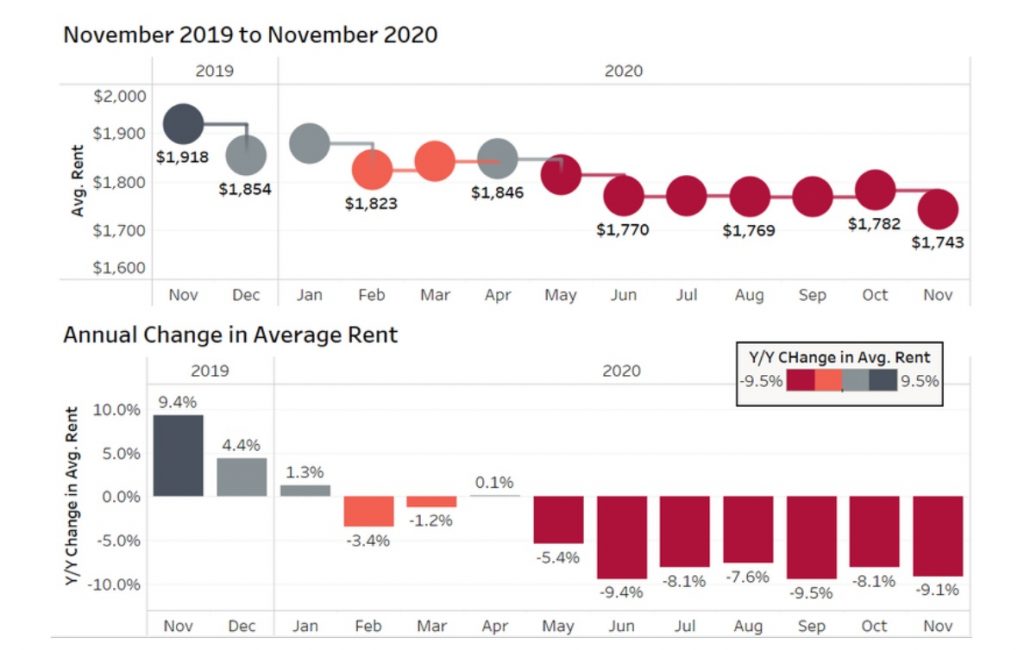
As the average rent in Canada dropped to a record low of 9.1 per cent from a year ago, analysts share a hopeful outlook for Canada’s rental market in 2021, with rents forecast to increase 3 per cent by the second half of next year.

The latest report from Bullpen Research and Rentals.ca compares current data to that of 2019, when rents rose 9.4 per cent from the average recorded in December 2018. And as we’ve learned throughout this pandemic, it’s Canada’s largest urban centres that experienced those nasty double-digit declines.

“2020 has been the most unpredictable year of my nearly 20-year career as a housing analyst,” said Ben Myers, president of Bullpen Research & Consulting. “It is unlikely that even the most bearish market watcher would have predicted a 20 per cent annual decline in average rents in the former city of Toronto. For 2022, we believe the rental market will really take off, with double-digit rent growth in Vancouver and Toronto, and both markets will approach or surpass their fall 2019 market highs.”

What’s ahead for five Canadian cities in 2021

Forecasts are on the hopeful side, according to the December National Rent Report. Here is a closer look and what we can expect for key markets in the coming months.

Toronto rents to increase 4 per cent annually:

After topping out at over $2,600 per month in late 2019, the average rent in Toronto (city boundaries prior to amalgamation) is expected to decline to $2,040 per month in December 2020, a decline of 21 per cent annually. The average rent is expected to continue to drop in the first quarter of 2021, but slowly start to recover in the second half of the year, finishing at $2,120 per month on average in December 2021, a 4 per cent annual increase.

Montreal rents to increase 6 per cent annually:

Montreal is expected to be the top major market in Canada next year with rent growth of 6 per cent, rising from $1,665 per month forecast for December 2020 to $1,760 per month at the end of next year. There is no urban exodus in Montreal. Despite the strong rent growth in 2019, and the above-inflation increase in 2020, average rents are still relatively affordable compared to Toronto and Vancouver.

Vancouver rents to increase 3 per cent annually:

Vancouver is expected to finish the year with average rent down 9 per cent to $2,170 per month and continue to decline in early 2021. As the vaccine rolls out and consumer confidence returns, average rents will increase 3 per cent annually in 2021 to $2,240 per month.

Calgary rents to remain flat next year:

The average rent in Calgary at the end of 2020 is expected to be about $1,350 per month, a 3 per cent annual decline. The forecast calls for rents to remain flat in 2021.

Mississauga rents to increase 2 per cent annually:

The average rent in Mississauga is expected to top Toronto at $2,045 per month in December 2020, an 11 per cent annual decline. But rents are forecast to improve to $2,090 in December 2021, a 2 per cent increase year over year.

What else to expect from Canada’s rental market

Rentals.ca and Bullpen Research tell us to anticipate an ongoing decline in rental rates that will persist into early 2021, as the continued lockdown limits in-person viewings, COVID cases increase, and the border remains mostly closed to new immigrants.

The decrease in demand will be met with an increase in supply. Based on data from CMHC, 2020 will likely set a 30-year high for new apartment completions (condo and rental) of about 100,000 suites.

A crackdown on short-term rentals in the city of Toronto, plus the potential for a vacant homes tax will increase supply further in Canada’s largest rental market.

With the COVID-19 vaccine on the way, it is likely that some tenants will try to time the bottom of the rental market and jump back in during the spring of 2021. Bullpen and Rentals.ca expect a sizable increase in demand in the fall of 2021, driving rents above December 2020 levels in most major markets.

Demand down, supply up

The downtown markets in Toronto and Vancouver have taken the biggest hits in 2020, due to the fact that they are more expensive, more affected by the lack of immigration and student populations, and more impacted by the loss of new graduates entering the rental market for job purposes.


All this amounts to demand being “way down” and supply being “way up”, with former short-term rentals also being offered in the long-term rental market and new unit completions on the rise.

In November 2019, the opposite was true with the average rent for one- and two-bedroom apartments increasing by 7 per cent in Toronto and 10 per cent in Vancouver. Although both cities continue to be the priciest for renters as we end off this year, both have also weathered steady declines since the pandemic began last March.

For all the latest data on Canada’s rental market, see the complete report here: Rentals.ca December 2020 Rent Report


ASHRAE partners with CIBSE to encourage safe and sustainable environments

The American Society of Heating, Refrigerating and Air-Conditioning Engineers (ASHRAE) and the Chartered Institution of Building Services Engineers (CIBSE) have signed a Strategic Partnership Agreement (SPA) formalizing the organizations’ relationship.

The SPA, signed on December 10, outlines how the two organizations will work cooperatively to promote the advancement of a more sustainable built environment through HVAC&R technologies and their applications.

Areas of collaboration will include:

  • Joint initiatives aimed at accelerating the progression of digital technologies and research.
  • Virtual design and construction to improve the resilience of buildings and the health of occupants in an increasingly challenging climate.
  • Coordinated promotion of joint grassroots meetings and conferences.
  • Advocacy and work on common public affairs goals and ideologies.
  • Consistent leadership communication
  • Publication development and distribution.
  • Education and professional development co-development and cross-marketing.

“Our continued collaboration with CIBSE provides a meaningful opportunity to coordinate efforts on innovative technologies and resources to advance the growth of the built environment,” said ASHRAE President Charles E. Gulledge III. “We value this partnership with CIBSE and are excited to leverage this collaboration to move the industry and buildings towards a more sustainable future.”

“We are delighted to sign this agreement with ASHRAE and strengthen the long-standing relationship between our organizations,” added Stuart MacPherson, CIBSE President. “The increasing local and global challenges of maintaining safe, healthy and efficient built environments marks this as a particularly auspicious time to share knowledge and expertise to enhance our offerings for the benefit of both our members and wider society.”

The agreement marks the renewal and the formalizing of a partnership that has existed since 2017.

This fall, ASHRAE unveiled its new global headquarters focused on delivering high-level 21st-century energy performance and physically embodying the global society’s mandate to advance human well-being through sustainable technology in the built environment.

Greyspring Apartments acquires Montreal rental building

Greyspring Apartments announced it has acquired a 13-storey, 105-unit rental apartment located at 1951 Maisonneuve Boulevard East in Montreal, Québec. Greyspring Apartments will oversee the execution of a comprehensive value-add program, which will include common area and suite improvements, the creation of a rooftop amenity space, and building efficiency enhancements.

Conveniently located in Ville-Marie, just east of Montreal’s downtown core, the property features unobstructed views of the city and benefits from being across from the Papineau metro station. The area is highly walkable and a short distance from the St. Lawrence River, Parc des Faubourgs, Parc des Royaux and La Fontaine Park. Currently, there are a number of transformative mixed-use developments planned nearby.

The property has a mix of studios, one-bedroom and two-bedroom units with two ground floor commercial units and four levels of underground parking. The asset will bring the expanding Greyspring Apartments portfolio up to over 1,600 units across Quebec and Ontario.

“We are very pleased to have closed on this acquisition in Montreal, a core market for Greyspring that strengthens our presence in the city,” said Karl Brady, President, Greyspring Apartments. “This property presents another great opportunity for us to execute our value-add program, improve the overall quality of the asset, and create additional economies of scale across our portfolio in Montreal.”

Greyspring is a rapidly growing asset management firm that acquires, strategically repositions and manages multifamily assets in growing and stable markets within Canada. With an expanding portfolio of more than 2,000 units and over CAD$395 million in assets under management, Greyspring is focused on effectively implementing value-add programs that improve the quality of its rental communities and provide an enhanced living experience for its tenants.

Builders Code Champion Awards winners revealed

The Builders Code is honouring six employers with Builders Code Champion Awards for leading the way in advancing the culture of B.C.’s industrial, commercial, and institutional construction sector. Their efforts have contributed to an increase in the participation of women in B.C.’s construction trades from 4.6 to 6 per cent since 2018.

The Builders Code Champion Awards were launched last year to recognize companies that are taking proactive measures to eliminate discrimination, hazing, bullying and harassment on worksites in B.C., and to create a safety standard that prioritizes the importance of psychological as well as physical safety for all workers.

The 2020 Builders Code Champion Award categories and winners are:

  • Recruiting & Hiring Champion: Chinook Scaffold Systems
  • Loyalty Champion: Westcana Electric
  • Workplace Culture Champion: RAM Consulting Ltd. (medium sized employer) and Lafarge Canada (large employer)
  • Community Champion: Houle Electric
  • Contractor of the Year: Mazzei Electric

“On behalf of everyone at BCCA, Minerva BC and all our Builders Code partners, I want to thank our winners for their support of the Builders Code and their leadership across the province during this challenging year,” said Chris Atchison, president, BCCA. “These award recipients, the other nominees and the companies throughout B.C. who have adopted Builders Code are helping to shape a new workplace culture for construction and encouraging others to get involved. They recognize that the Builders Code has helped them set clear behaviour expectations among employees and supported them in the development of company policies all of which are contributing to attracting and retaining employees in a tight labour market.”

BCCA also released their fall 2020 stat pack, which shows that more tradeswomen are working in the sector. BCCA said the Builders Code and other initiatives are contributing to improved acquisition and retention of tradeswomen in B.C.’s construction industry.

The BCCA stat pack also shows that while continuing to adapt to the supply chain, worksite and other challenges caused by COVID-19, the construction industry’s contribution to B.C.’s GDP has risen from $21.2 billion to $22.7B (8.6 to 8.9 per cent) over the past year and the sector continues to be the No. 1 employer in B.C.’s goods sector.