Articles Archive - Page 35 of 928 - REMINET
REMI

Spring cleaning and maintenance to reduce allergens

Spring has officially arrived, and as the temperatures rise, so too, do allergens and allergy symptoms. From outside sources like pollen to interior dust mites and mould, cleaning and maintenance to reduce allergens helps improve occupant health, increase productivity, and reduce absenteeism. Research shows that 46 per cent of people have seasonal allergies, and 22 per cent have missed work or school because of their symptoms.

With a targeted focus on cleaning on maintenance, facility managers can reduce occupant exposure to common allergens.

Improving air quality

Keeping airborne allergens to a minimum means improving your IAQ and your HVAC system is a good place to start. Upgrading to HEPA filters, completing regular filter changes, and adding portable air purifiers will help remove any dust and dirt from the air. Pollen is a common allergen, and it can enter the building on clothing, through an open window, or via the HVAC system. Keeping windows or bay doors closed, deep cleaning, and improving IAQ can help keep pollen out of the air in your building.

Minimizing mould

Mould can bring on allergy symptoms, as well as causing expensive damage, so be proactive in avoiding mould in your building. Identify early signs of mould, like moisture, staining, or odour to treat these areas as soon as they occur. Ensure that your humidity levels are below 50 per cent, using a dehumidifier, if necessary. Look for potential leak areas, where water may be able to enter your building through the walls or the roof, and ensure that your building remains as dry as possible to deter any mould growth.

Deep cleaning

Keeping a regular cleaning schedule can also help keep allergens to a minimum. Practice damp dusting surfaces, light fixtures, and electronics to remove dust without letting particles get into the air. Dust mites and particles can collect in carpet fibres, so regularly clean your carpets, upholstery, and fabrics with a HEPA filter vacuum to pick up tiny particles. Chemicals can encourage allergy symptoms, so look for cleaning products with green certifications and natural, unscented, chemical-free ingredients.

Removing allergens from your building requires a regular, dedicated effort in maintaining optimal air quality, keeping a sharp eye on any moisture, and creating a regular deep cleaning schedule throughout the spring and summer.

QuadReal affirms conviction to U.K. self-storage

QuadReal Property Group has acquired a portfolio of 27 self-storage properties in the United Kingdom to be operated by its new joint venture partner, Clear Sky Capital. The ₤280 million (CAD $515 million) purchase from the vendor, Padlock Euro Storage Fund 1, adds another 1.2 million square feet to QuadReal’s global self storage portfolio, boosting it to 6.3 million square feet in more than 80 facilities in the U.K., Canada and the United States.

QuadReal has also committed an additional ₤200 million (CAD $368 million) of equity to the joint venture with Clear Sky Capital to invest in self storage in the U.K.. Cinch Self Storage, an operating arm of Sky Capital, will manage the properties, while QuadReal holds a 95 per cent ownership interest.

“Self-storage is a key area of conviction for QuadReal,” says Thomas Blangy, the company’s senior vice president, international real estate. “By partnering with Clear Sky and Cinch, we are securing critical mass in a sector characterised by fragmented ownership.”

“QuadReal’s global experience and long-term investment approach make them an ideal partner as we scale the platform and capitalize on the structural demand–supply imbalance in the U.K. self-storage market,” says Iyngaran Muniandy, head of Europe for Clear Sky.

GWLRA transforms lobby at Toronto’s Berczy Square

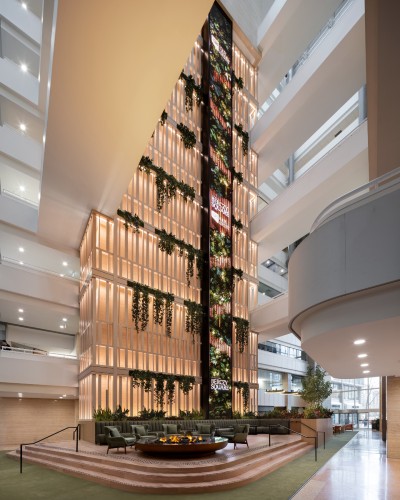
The only atrium-style lobby in Toronto’s financial district was recently transformed into a wellness-inspired town square with greenery-filled interiors. GWL Realty Advisors (GWLRA) unveiled extensive renovations to Berczy Square, which include a 90-foot LED screen that displays atmospheric digital art.

The new lobby, located on the ground floor of the 13-storey office and retail tower, is part of a two-year rebranding project at 33 Yonge. Other upgrades include a new private fitness facility, showers and lockers for commuters who bike and walk, five outdoor patios, two coffee shops, and grab-and-go retail.

“In today’s market, landlords have to earn the commute,” says Devan Sloan, vice president, asset management and leasing at GWLRA. “Tenant needs and expectations are evolving, and the best office buildings are adapting.”

Alison McNeil, partner at architecture firm DIALOG, oversaw a redesign that evokes a Zen, natural landscape with tree-like columns at the Yonge Street entrance, a reflecting pool, a vapor-based fire pit, hanging moss pendants, plenty of greenery and new seating. All materials used in the renovation are 100 per cent Canadian.

Berczy Square

Photo by Scott Norsworthy.

A trellis wraps the elevator bay, anchors the screen and preserves the original Travertine wall.

The centre section below the screen and trellis features an elevated deck area with custom-designed banquettes and communal tables. The section adjacent to Berczy Park is styled like a backyard, with lounge chairs and picnic tables.

“No longer simply a place to pass through, we’ve reimagined the lobby as a destination for gathering and connection — a space that reflects both the building’s location and identity,” says McNeil. “We call this design concept Pause because it invites people to slow down, look up, and take a moment to breathe.

“We amplified the openness of the original atrium by layering it with new materials and uses tailored to the needs of today’s employees. Purposeful spaces to work, wait, or relax draw inspiration from Ontario’s natural landscape and materiality, reinforcing a sense of place.”

The 90-foot-tall, six-foot-wide screen runs the full spine of the building and features original digital art by Montreal-based creative multimedia studio Gentilhomme, which has created large-format immersive art for the Burj Khalifa in Dubai, George Bush Intercontinental Airport in Houston and Cirque du Soleil.

For Berczy Square, the company’s team designed and produced a series of original artworks called “capsules.” This generative content responds to a constant flow of data, such as the time, the weather, the seasons and sports games happening in Toronto on a given day, causing the images to morph in real time and triggering “easter eggs” to appear.

The four capsules include Living Architecture, the hero piece: a tree that grows by the hour and transforms with the seasons. Breach of Light offers an ambient, hypnotic flow of continuous movement. Mirror of Light presents a calm, passive, dreamlike sky. Surreal Hourglass is the most literal timekeeper, with a parkour for descending balls that mark the passing hours.

“The artwork is the heartbeat of Berczy Square; it responds to the city and the rhythm of the people within it,” says Thibaut Duverneix, founder and executive creative director of Gentilhomme. “We have treated the screen as an architectural feature, a canvas for atmospheric art rather than advertising, to create a landmark experience that invites the community to slow down and look up.”

Feature photo by Scott Norsworthy.

Ontario Teachers’ forges German partnership

Ontario Teachers’ Pension Plan has acquired four fully leased multifamily properties in Germany as a launching point to its new joint venture with DW Effectum (DWE) Residential. The partnership with the Munich-headquartered residential investment asset manager is aimed at adding further multifamily assets in major German cities and expanding the pension fund’s holdings across Europe.

“We focus on markets where active asset management and local expertise create lasting value and DWE’s market knowledge and operational capability make them the right partner to enhance asset performance and resident outcomes over the long term,” says Jenny Hammarlund, executive managing director, real estate, at Ontario Teachers’.

DWE has €700 million (CAD $1.1 billion) in assets under management. “We are very grateful for our new joint venture with Ontario Teachers’,” says Daniel Filser, managing director with DWE. “This transaction marks the beginning of a broader living strategy, and we are excited to further grow this portfolio over the coming years.”

Meeting the NSF/ANSI 56 Benchmark in Clinical Cooling: Protecting Patients and Inventory

In a 24/7 healthcare environment, equipment failure is a risk to patient safety. While refrigeration and ice machines are often seen as “background” utilities, they play a bigger role than providing ice and water for drinking — they play an important role in infection control and medication efficacy.

For every patient in a clinical setting, it takes an average of 3 to 5lbs of ice to provide comfort and hydration. With an overall facility demand estimated at 10lbs of ice per bed for therapeutic and clinical needs, the refrigeration and ice-making machinery components in a hospital — typically needed on every floor — are critical to the effectiveness of patient care.

Medical refrigeration is specifically designed to maintain stable 2–8°C cabinet temperatures with tight uniformity, forced-air circulation, rapid temperature recovery, and integrated alarm monitoring. Standard consumer refrigeration products do not meet the criteria to support medical products such as vaccines and pharmaceuticals, which must be kept in a stable and controlled environment for greatest efficacy.

Decoding the NSF/ANSI 456 Mandate 

The NSF/ANSI 456 standard was developed in 2021 to ensure a mandated level of refrigeration for performance in vaccine storage. This includes ensuring consistency no matter how much or little is kept in the refrigerator, or how often the door is opened. It also means that doors must be self-closing, and there must be audible and visual alarms for temperatures outside acceptable parameters.

The standards set by BSF/ANSI 456 and CDC-compliancy are the benchmark of medical cooling equipment. Hoshizaki healthcare refrigerators and freezers are both NSF/ANSI 456 and CDC-compliant and are engineered to remain cool even when under pressure.

Using integrated digital monitoring and alarm features to alert staff of deviations in temperature, the Hoshizaki range of medical-grade refrigeration features audio and visual alarms, providing a safety net to prevent loss of important and expensive inventory.

Ice in Patient Care 

In clinical applications, ice is essential for therapeutic cooling, specimen transport, and keeping patients hydrated. Capable of producing between 100lbs and over 600lbs of ice per day, Hoshizaki ice machines easily meet the demand of ice per patient and can mass-produce soft “nugget” ice, a type preferred in hospitals as patients find it easier to chew and cools faster for therapeutic use. Of note, Hoshizaki ice machines produce hard, dense ice which melts slowly, helping support consistent hydration for patients, especially when fluid intake is being monitored.

Combating the Invisible Threat

Cross-contamination threats via physical touch and airborne bacteria are common in medical settings. Touchless ice and water dispensers — such as the Hoshizaki OptiServe™ series with infrared sensor activation — eliminate touchpoints, reducing the risk of cross contamination. Hoshizaki’s touchless dispensers, self‑draining storage, and NSF-certified sanitation features promote hygienic ice production.

Since healthcare facilities never close, the refrigeration and cooling equipment procurements must be resilient. Hoshizaki refrigeration and cooling machines are built to manage around-the-clock operation and are strongly reputed for their durability. For instance: instead of nickel-plated copper, Hoshizaki ice machines use a stainless-steel evaporator plate since it is more resistant to corrosion and harsh cleaning chemicals, thus reducing material breakdown. As well, a closed water circuit design reduces scale buildup, limiting exposed spray components and supporting more predictable cleaning and maintenance schedules.

For peace of mind, Hoshizaki Healthcare Series refrigeration products can be connected to backup power systems, ensuring continuous operation even during power interruptions.

Modern healthcare requires more than just “cooling”; it requires a strategic approach to refrigeration management and ice production. Advances in ice-making technologies such as rapid production, energy-efficient systems, touchless dispensing and automated cleaning, allow healthcare facilities to ensure continuous ice availability, improving workflow efficiency and guaranteeing that ice is always there, chilling.

Hoshizaki ENERGY STAR®-certified products reduce energy consumption, lower utility costs, and minimize environmental impact, supporting sustainable operations. They are also backed by a “7-7-7” warranty covering seven years of labour, parts, and compressor protection.

In-efficient refrigeration products compromise the integrity of life-saving medications and biologics. Contact your local Carrier Enterprise Refrigeration Specialist to learn more, or for a free quotation.

Find your Refrigeration Specialist by region: 
Ontario: [email protected]
BC, Alberta, Saskatchewan & Manitoba: [email protected]
Quebec: [email protected]
Maritimes: [email protected] 

To view the full range of products available, visit Carrier Enterprise at www.cehvac.ca


Cowichan hospital wins health design award

The Cowichan District Hospital Replacement Project – recently named Quw’utsun Valley Hospital – has been selected as the Gold Level winner of the 2026 Touchstone Award from the Center for Health Design.

Touchstone Awards recognize exceptional achievement in applying evidence-based design (EBD) principles. Evidence-based design uses credible research to help guide decisions that improve patient outcomes, staff experiences and system sustainability.

“Receiving the Gold Touchstone Award affirms the values that guide Island Health. Quw’utsun Valley Hospital / Quw’utsun Hulitun-ew’t-hw reflects our commitment to putting people first. With safety at the centre, this project supports high quality care for patients and families and strengthens the wellbeing and experience of our healthcare teams. This thoughtful, forward-looking design will help build a sustainable system and make a meaningful difference for patients, staff, volunteers and the communities we are honoured to serve,” said Leah Hollins, Island Health board chair.

Designed by Parkin Architects, the project was recognized for its alignment of vision, goals and objectives with EBD principles, strong research foundations and robust plans for future post‑occupancy evaluation and knowledge sharing. EllisDon is general contractor.

The hospital is designed to improve quality, safety and patient experience while making daily operations more efficient. Inpatient rooms at Quw’utsun Valley Hospital will be safer by design. Architects and clinical leads used evidence and research to develop an inpatient room that is designed to reduce patient falls and staff injuries.

“At Quw’utsun Valley Hospital, evidence-based design shaped how we approached patient safety, staff well-being, infection prevention and operational safety through standardization in tangible ways. What truly defines this project, however, is the collaboration behind it. The trust built with Island Health, local Nations, clinicians and patient partners created a hospital that reflects the values and identity of the Cowichan community,” said Kyle Basilius, principal, Parkin Architects.


B.C. campaign for protecting labour agreements

The B.C. Building Trades has launched a campaign to protect Community Benefit and Project Labour Agreements to ensure major public projects are built by local, skilled workers from British Columbia, while expanding apprenticeships, training, and providing safe working conditions and paying family sustaining wages.

In early March, the B.C. Conservatives introduced legislation that would ban Community Benefits and Project Labour Agreements on all public projects.

“Community Benefit Agreements and Project Labour Agreements ensure B.C. workers build B.C. infrastructure and train the next generation of trades workers. At a time when we’re facing a skilled labour shortage, major private-sector projects are choosing to sign agreements with the BC Building Trades to secure skilled labour. The B.C. Conservatives’ bill would move B.C. backwards, preventing public projects from signing agreements and accessing that same stable labour supply,” said Brynn Bourke, executive director for the B.C. Building Trades.

“We’ve seen what can happen when public projects are built without these agreements,” continued Bourke. “The B.C. Conservatives want to take us back to a time when public projects like the Canada Line were built using temporary foreign labour. On that project, foreign workers were paid less than $4 an hour.”

The bill was applauded by the Independent Contractors and Businesses Association, saying the requirement of labour-neutral procurement on all public sector construction projects will save taxpayers billions of dollars over the next decade.


Tourism promoters make pitch to CRE investors

Tourism promoters are pitching Canada as a destination for investment returns. Several organizations recently joined forces to highlight potential opportunities in recreational, leisure and entertainment assets at MIPIM, the international gathering of property professionals occurring annually in Cannes, France.

“The level of interest in Canada from investors and media across the real estate, hospitality and mixed-use sectors at MIPIM exceeded our expectations,” reports Gracen Chungath, senior vice president, with Destination Canada, a federal Crown corporation that provides marketing, research and facilitation services for the tourism industry.

Last year, Canada’s tourism sector generated an estimated $134 billion in revenue — flowing through to roughly 265,000 businesses in 5,000 regions and communities nationwide — and those annual earnings are projected to reach $178 billion by the end of this decade. International visitors constitute a Canadian export market, with the added bonus that the goods and services they consume while in the country are tariff-free.

Foreign travellers are tapped as a lucrative customer base toward the target of doubling Canadian exports outside the United States over the next 10 years. It’s envisioned that visitors from countries other than the U.S. could pump an extra $24 to $30 billion annually into the Canadian economy by 2035, but tourism promoters identify a corresponding need for attractions and related services to complement and augment existing lures.

The 30-member Team Canada delegation to MIPIM included representatives from Vancouver, Kamloops, Winnipeg, Toronto, Ottawa, the Tahltan Nation in northwest British Columbia and the Cape Breton region of Nova Scotia seeking to forge connections with prospective investors in a range of projects that could serve the sector. That includes experiential retail, accommodations, venues for culture, entertainment and recreation, and sustainable and regenerative approaches to tourism.

“The collective approach we took at MIPIM across jurisdictions, levels of government and the public and private sectors will continue to guide this work,” Chungath says.

Timing for the up cycle

The timing could be right to capitalize on Canada’s growing share of global tourism spending and perceived bargains in its institutional grade assets. Canada was one of the worst performers in MSCI’s global property index for 2025, posting an average all-asset total return of 1.3 per cent and the fourth consecutive year of declining capital value, averaged across 2,171 assets held in 50 institutional portfolios in MSCI’s Canada property index. However, industry insiders suggest that could deliver an upside here that won’t be found so readily in markets closer to the peak of their cycles.

“If you’re an investor, do you want to go hunting now in Europe?” Ugo Bizzarri, chief executive officer of Hazelview Investments, observed earlier this winter when called upon to assess the 2025 investment results. “I’m selling Europe and buying Canada.”

Meanwhile, CBRE Canada’s 2026 survey of 47 financial institutions that collectively hold more than $200 billion worth of Canadian commercial real estate loans reveals 38 per cent are planning to increase their loan books for hotels this year and 55 per cent have expanded budgets for retail. Lenders ranked hotels (9th) and entertainment-focused retail (11th) relatively favourably among 22 asset sub-classes.

Hotel demand

Digging deeper into the survey findings in a presentation during last month’s Real Capital conference in Toronto, Joshua Sonshine, a senior vice president with CBRE Capital, noted that lenders have generally had more success fulfilling their budget intentions for hotels than other property types within the sought-after alternative assets class that are still at a more nascent scale in the market.

“Hotels have seen fundamentals improve. Financing is available, accretive and competitive, and the deal flow is much more tangible than data centres and life sciences,” he said.

Colliers Canada’s recently released 2026 Canadian hotel investment report concurs that there is “robust” availability of capital, supplied by schedule 1 banks, cooperatives and credit unions. Hotel investment companies, real estate owners/investment managers seeking portfolio diversification and non-traditional hotel developers that see promise in current hotel room shortages in some markets could all potentially be players. Nevertheless, Colliers analysts caution that foreign investors have historically preferred “large portfolio acquisitions” over one-offs and the economics of new construction may not yet be workable.

Last year saw $2.3 billion worth of transactions, a 16 per cent jump from 2024, while the average per room price of $219,000 was up 36 per cent year-over-year. In contrast to the years of pandemic fallout earlier in the decade, just 1 per cent of last year’s sales volume was due to distressed sales and just 2 per cent of transactions removed hotel stock to be converted to other uses. Both domestic and international travel are identified as drivers of demand.

“A weaker Canadian dollar and the rebound of long-haul markets, including China, continue to enhance Canada’s global value proposition,” the Colliers report states. “Resort and gateway markets — from Vancouver Island, Whistler and Alberta’s mountain regions to Toronto, Vancouver and Montreal — remain highly sought after, supported by strong air connectivity.”

Transformative retail

The upheaval that the Hudson’s Bay Company’s (HBC) bankruptcy caused for owners of super-regional malls is apparent in the Canada property index. In 2024, the sub-asset class delivered a 6.1 per cent average total return; in 2025, that plummeted to negative 0.2 per cent.

In 2024, retail was the top performer among the four asset classes monitored in the index, with an average total return of 6.5 per cent — breaking down to 0.8 per cent capital growth and 5.6 per cent income return. In 2025, retail fell to third place, behind industrial and office, while recording a 1.9 per cent average total return and suffering an average 3.6 per cent decline in capital value. A spate of regional mall sell-offs also underpins the net divestment of nearly $1.8 billion worth of retail property from the index over the course of the year.

Yet, looking to the future, those dynamics could gel with tourism promoters’ aims. Participating in a panel discussion in conjunction with the release of the 2025 investment results, Tamara Lawson, chief financial officer with QuadReal Property Group, cited her company’s success in fully leasing the ambitious, high-end redevelopment of the Oakridge Park retail centre in Vancouver.

That was to have included a space for the incumbent tenant, Hudson’s Bay Company, which has now been freed up for other retailers and uses. She speculated that other mall operators have likewise moved beyond the initial shock of the sudden vacancy to adopt an upbeat outlook on the prospect for more dynamic tenants with the potential to pull in more customers.

“Our focus is really on transformative retail,” Lawson said. “It’s no secret that Hudson’s Bay wasn’t paying a lot of rent. When it has all worked through the system, people actually talk about it as a positive.”


Lengthening the life span of your mower

Spring has arrived and the need for seasonal outdoor maintenance is approaching. While lawns do not sprout up overnight, your mower is a piece of equipment that you will definitely need as the weather improves. Whether your business has a large groundskeeping area or a small lawn that offers curb appeal, keeping your mower in great working order is in your best interest.

RELATED: Getting a jump on landscaping season

On average, commercial mowers last between 1,500 to 2,000 hours, but lack of maintenance, frequent use, and rough terrain can negatively affect this lifespan. Here are some steps maintenance managers can take to maintain their mowers, and avoid work disruption, repair, or replacement this season:

  • Create – and follow – a regular preventative maintenance plan to help prolong the life span of most equipment. Start with a spring tune-up and stick to the manufacturer’s recommendations for mower maintenance, paying attention to which fuel and lubricants are recommended, rather than substituting for less expensive alternatives.
  • Regular maintenance on a commercial lawn involves a few common steps: change the oil as needed, replace the fuel filter when clogged, clean or replace spark plugs, check tire pressure, lubricate moving parts, check for loose bolts or cracked components, and inspect the mower for debris when in regular use. These simple steps can alert you to any upcoming issues before they happen and encourage a longer life span for your mower.
  • Pay special attention to small engine repair needs, like replacing worn-out parts like belts or blades, to help reduce excessive wear and prevent breakdowns.
  • For battery-powered mowers, other than the engine component, the maintenance is very similar. Battery storage is vital though, so ensure that you are storing the batteries somewhere where they will not be affected by temperature change to keep them at the optimal working order.

Like most maintenance equipment, staying on top of regular, preventative maintenance will keep you apprised of any upcoming expenses and lengthen the lifespan of your mower, reducing the risk for expensive surprises and work delays. Keep your mower working and your grounds looking great with an early spring maintenance plan.

Canadians maintain homeownership goals in tough market

One-third of Canadians plan to purchase a house or condo within the next two years, however, affordability concerns are rising. According to RBC’s Spring Home Ownership Poll, an estimated 44 per cent constantly worry about the cost to achieve this dream—up from 37 per cent in 2025.

The online survey of 1,719 Canadians, aged 18 to 64, was conducted between January 7 and January 25, 2026. Among those planning to buy their first home, 62 per cent feel closer to their goal and 71 per cent have a savings plan in place, with an average of $110,339 saved. Seven-in-10 are aiming to use the tax-free First Home Savings Account (FHSA).

“Despite a complex and uncertain market, Canadians still aspire to home ownership and the perception of financial independence that comes with it,” says Janet Boyle, Senior Vice President of Home Equity Finance, RBC. “What’s changed is that many buyers’ mindsets have shifted from the fear of missing out to concern about making the right move at the right time.”

The majority of respondents are ready to buy but don’t feel their finances are in order. To save, many will continue living with their parents, delay having children or pursue side hustles.

Next-time buyers eye move to suburbs

The majority of current owners looking to buy their next home see this as good investment. About 75 per cent are willing to move to the suburbs or a rural area to obtain a larger home and more space, while 42 per cent expect to buy sooner because of lower interest rates.

Although rising costs are a concern, 38 per cent are using lower interest rates to pay down their principal and 29 per cent are paying off their mortgage faster than expected.

“There is a lot of cautious optimism amongst our clients these days” says Brad Evjen, senior mortgage specialist at RBC. “While you can’t time the market, you can make educated decisions. Considering cash flow, debt management strategies and future goals all factor into buying or owning a home.”

Amrize launches Product of Canada label

Amrize has launched a “Product of Canada” cement label, designed to offer builders the assurance of Canadian-made manufacturing and quality, supporting local jobs and communities.

The ‘Product of Canada’ label signifies that all aspects of the cement are made in Canada from raw materials and processing to manufacturing, meeting applicable national requirements. This label will be rolled out at key Amrize cement operations in the country, beginning at its flagship Exshaw cement plant in Alberta, the largest cement plant in Canada, as well as at its Bath cement plant in Ontario.

“With our ‘Product of Canada’ label, we are giving customers confidence that their building solutions are made in Canada with local-to-local service,” said Cory Cannon, senior vice president of Canada Cement Commercial for Amrize.

To expand its “Product of Canada” cement offering, Amrize is investing to increase production capacity across its cement network nationwide from Exshaw, Alberta to St. Constant, Quebec. This is part of Amrize’s plan to invest $900 million in capital investments across its operations in 2026.

According to the Cement Association of Canada, the cement industry contributes $5 billion to the Canadian economy every year and supports over 62,000 Canadian jobs. Cement is essential to housing, transportation, energy, and critical infrastructure – building Canadian cities, communities and future.


CAGBC: cost of retrofits and GHG reduction

According to a new report by the Canada Green Building Council (CAGBC), deep energy retrofits could reduce commercial building’s greenhouse gas (GHG) emissions by 40 per cent by 2030, at an average incremental cost of 10 dollars per square foot.

But financing barriers, and lack of clarity around cost and return on investment, and a fragmented policy landscape remain top barriers to achieving retrofits at scale.

These findings are being published in a market sounding report: “Accelerating Deep Retrofits – A Year of Insights on Progress and Barriers.” The report also shares insights about current attitudes and emerging trends on building retrofits across Canada, drawing from participants in The Purpose Retrofit Accelerator.

“Growing transition and physical risks combined with economic and geopolitical uncertainty, are creating headwinds for the building sector that did not exist 12-18 months ago,” said Thomas Mueller, CAGBC president and CEO. “In our ongoing efforts to scale retrofits, we are providing owners and investors with new insights, data, and transition planning resources to effectively close the gap between sustainability targets and core financing needs.”

Launched in April 2024 by Purpose Building in partnership with CAGBC, the Accelerator is supported with funding from Natural Resources Canada’s Deep Retrofit Accelerator Initiative. The program helps owners and managers of large buildings plan, finance, and implement energy and carbon retrofits.

“The market lacks clear data on the upfront cost of meaningful building decarbonization retrofits,” says Eric Chisholm, principal, Purpose Building. “Decarbonization can’t be – and isn’t – a blank cheque. Our inaugural dataset is starting to reveal cost trends that improve transparency and will help turn more sustainability ambitions into action.”


Ontario eyes HST relief for all new home buyers

The Ontario government is expected to waive the 8 per cent provincial portion of the Harmonized Sales Tax (HST) on the purchase of all newly constructed homes as part of its spring budget, to be released on Thursday, March 26.

The news follows a more limited plan introduced during the fall economic statement, which only provided tax relief to first-time homebuyers. That initiative allocated $470 million over three years to improve affordability.

“This is certainly a step in the right direction,” said Michelle Campbell, president of Canadian Mortgage Brokers Association of Ontario (CMBA Ontario). “It’s not only a win for prospective homebuyers, but also a positive signal for investors and builders looking to play a bigger role in the development of Ontario.”

The HST announcement also follows a federal government commitment to allow first-time buyers to save up to $130,000 on a new home under $1 million, and lower rebates for homes costing up to $1.5 million.

Advocacy groups are hoping eligibility for the Ontario rebate reflects that of the federal program, so as not to include homes not occupied by the owner or for investment properties.

As the provincial government returns to the legislature and prepares to release Budget 2026 on March 26, CMBA Ontario is also advocating for the land transfer tax rebate, which has been frozen at $4,000 since 2017. Since then, the average cost of a home in Ontario has increased by more than $300,000. Raising the rebate to $8,000 would correct its divergence from the pace of related costs and address another major obstacle to homeownership in Ontario.

A living demonstration of circular design

After more than two decades in its previous location, 2024 marked a year of change for Perkins+Will’s Vancouver studio.

With a record number of employees and adjusting to a post-pandemic world, the firm wanted a new space to embrace an evolving workplace and create an environment that fosters collaboration, flexibility, and wellness.

The solution was found on the 22nd floor of the iconic Arthur Erickson Place, a 1968 heritage tower renamed after its famed architect in downtown Vancouver.

“The new studio represented a moment of self-reflection and redefinition, and is the result of extensive engagement with staff,” says Markus Brown, associate, senior interior designer, Perkins+Will.

The team adopted bold design strategies to honour the building’s architectural legacy, promote sustainability, and showcase adaptability. By reimagining materials, engaging deeply with staff, and integrating the firm’s Living Design framework, the result is a flexible, wellness-orientated workspace that serves as a living example of innovation in modern office design.

Consistent with the building architecture, the colour and materials palette are inspired by Canadian artist Emily Carr’s west coast artwork, creating a connection to nature with natural healthy materials, a green wall, and warm earthy tones.

Challenges included an aggressive project schedule, salvaging materials from a 20 plus year-old studio and downsizing to a single floor, nearly 40 per cent smaller than the previous space.

By repurposing 50 per cent of materials, including furniture, wood surface, textiles and plants, the project reduced embodied carbon emissions by more than half.

“We maximized the use of existing materials from the previous studio. Using a circular design approach, we selected material components and parts to give them a second life; they were reused, reassembled, or reimagined for a wide variety of uses, such as desks and shelving,” says Brown. “Even our previous green wall was propagated to create a new green wall. This approach reduced embodied carbon emissions by more than 50 per cent.”

The new Vancouver studio for Perkins+Will is a living demonstration of circular design, showcasing an innovative approach for architectural heritage preservation, sustainability and adaptive reuse. The project has achieved REST Air accreditation and is on track to achiee WELL v2 Gold certification.

“When we moved in everything worked and the space felt like us from the very beginning. I’d taken many clients through this process before but never done it myself,” says Brown. “I cannot recommend enough putting yourself through the process. It solidified what I had been taught, and clarified what is important.”

The compelling project earned multiple honours at the 2026 Shine Awards of Excellence. It won the coveted Robert Ledingham Award as well as an Award of Merit, Workplace and Climate Action Award of Excellence.

“The awards are recognition for our team’s hard work and dedication to the principles of good design. I was lucky to have been in a position to be part of this project that is beyond my time,” says Brown. “Good design is intergenerational – it counts on us making the best of what our predecessors did and setting up our successors for a quality future.”


Quebec pledges heat pump and check valve funds

The Quebec government has earmarked nearly $584 million to promote heat pumps and flood protection measures, but little of it is likely to roll out before the provincial election that’s slated for no later than Oct. 5 this year. The newly released 2026-27 Quebec budget announces the funding, with more details promised in the pending 2026-31 climate change action plan, which will outline approximately $8.2 billion in total expenditures to be funded from Québec’s carbon market revenues.

Nearly $159 million over four years is promised to subsidize heat pump installations in multifamily rental buildings. That’s to be channelled through Hydro-Quebec’s LogisVert program, which currently provides incentives for energy-efficiency improvements primarily in the low-rise residential sector. Only about 15 per cent of the envisioned “enhancement” to the LogisVert pot is scheduled to become available in the next 12 months.

The budget also pledges $425 million over five years to launch a new climate change adaptation stream of the Rénoclimat program, which currently offers energy-use evaluations and subsidies on various upgrade measures for the residential sector. As part of that, owners of multifamily buildings can qualify for rebates on insulation, air-sealing, window and/or door replacement, heat recovery ventilation systems and drain heat recovery systems.

The budget document advises the new Rénoclimat adaptation program “will provide citizens with financial support for work to protect foundations or install a check valve as protection against stormwater flooding in areas at risk”. More than 80 per cent of pledged funds will not be available until after March 2028, with just $25 million expected to be delved out in 2026-27.

Applications open for Dialog scholarship

Applications for Dialog’s 2026 Architectural Scholarship in Honour of Michael Evamy is open.

This scholarship is open to students enrolled in a Canadian architecture school who are entering their final year of a professional architecture degree program.

The scholarship includes $5,000 CAD in funding for the recipient’s final research thesis, $3,000 CAD to cover travel and project-related expenses, and a public presentation.

It provides financial assistance to the selected student to undertake a specific research project based on a field of study of their interest. The intent of the study is to enrich and advance the candidate’s personal and professional experience and knowledge of a topic relevant to the practice of architecture.

Selection will be based on the candidate’s expressed interest in the scholarship and their chosen field of study, the specific nature of the investigation relative to their chosen field of study, and demonstrated academic achievement and leadership abilities.

To be eligible, applicants must confirm their willingness to work within the available funds and their willingness to prepare a talk for public presentation and publication. Dialog will organize the presentation, followed by a reception, and travel expenses will be funded separately from the scholarship. They must also use the award money within one calendar year following notification of the award.

Applications can be submitted electronically or by mail, and are due on May 22, 2026.

The Architecture Scholarship was established in honour Michael Evamy, a partner at Dialog who was instrumental in building the practice.


New Brunswick looks for cost savings

The New Brunswick government is looking for cost savings in its real estate holdings. The newly released 2026-27 provincial budget announces public access will be shuttered at up to six heritage sites and four provincial parks unless community-based sponsors can step in to assume operations.

The move comes as the Province prepares for spending to exceed revenues by roughly $1.4 billion over the coming fiscal year, but has pledged to find savings within its own departments and agencies. That includes a 12 per cent reduction in civil service personnel, expected to deliver $100 million in labour cost cuts over three years, and a pullback on outside consulting services.

Along with plans to transfer facilities management or close heritage sites and provincial parks that draw fewer than 5,000 visitors a year, Finance Minister René Legacy confirmed that underused government buildings and schools with enrollment of fewer than 100 students are under scrutiny. Property tax exemptions have also been flagged for review, in step with an in-progress overhaul of the provincial property tax and assessment system to “ensure they remain justified and equitable”.

“I have asked Finance and Treasury Board staff to dig deeper and work on a granular level with departments on reducing expenses and curbing continued structural increases to our budget,” Legacy told the New Brunswick legislative assembly. “They will be required to report on what they have identified as an opportunity for change — for restructuring, for innovation, for elimination.”