




Articles Archive - Page 33 of 928 - REMINET
REMI

When Tech Isn’t Enough: The Human Element of the Full Unit Turn

An efficient unit turn is highly time-sensitive, requiring a “domino effect” of tasks to form a chain reaction. To make a unit move-in ready goes beyond simply cleaning — it includes the careful coordination of licensed trades to reach the tenancy deadline — the cumulative result being a clean and desirable living space, ready for the next tenant. But when things don’t go according to plan, whether through delays attributed to contractor schedules or miscommunication, each day is potential lost rental revenue for owners and unit management.

It’s no secret that the intense coordination needed to get a unit prepared for a new tenancy, especially during peak end-of-month periods, can be chaotic. Property managers are often forced to act as full-time dispatchers, wasting valuable hours traveling from building-to-building to check on the progress of each unit, then following up with contractors to ensure all work is moving along according to plan. With so much going on, it can be easy to lose track of which jobs are in progress, which are completed, and which require extra attention.

Centralizing the process has been made easier through the abundance of property management tech available today; however, relying solely on an app can be frustrating. A well-managed full unit turn requires a combination of competent technology, physical service delivery, and human operational support. In many cases — especially when time is a factor — there is no substitution for a one-on-one conversation.

Blending Technology with Human Touch

Property managers need both the balance and ease of completing tasks remotely alongside the importance of human connection. But finding a compatible solution hasn’t been easy. Luckily, through invested tech like iRestify, property managers can verify the quality of work through the simplicity of an app and still reach a dedicated account manager when they need support.

iRestify launched in Canada in 2018 in residential cleaning and today focuses on the multi-residential and commercial marketplace. Now tailored to offer a full restoration of a unit from move out to move in, iRestify’s proprietary tech handles cleaning, and each step of contractor repairs and maintenance needed to make a unit ready for the next tenant.

Offering the convenience of a central tech hub for property management and the peace of mind from having a direct representative, iRestify’s on-the-ground quality assurance supervisors manage the real-time workflow of contractors, auditing each unit to completion. The physical labour is executed by iRestify’s background-checked cleaning experts, as well as a pool of pre-approved, proven licensed trades who share the same high standards and expectations.

While GPS tracking ensures accountability on cleaners’ and trades’ arrival and departure times, tailored, interactive digital checklists track the specific requirements and progress of each unit to allow managers a full sense of control over the workload. As work progresses, account managers provide proactive communication with managers and owners, letting them know if there are expected delays. Instead of wasting time calling vendors, push notifications instantly alert managers the moment their unit is ready, allowing for perfect efficiency.

Managers can view the status of multiple units from the central dashboard. From the central hub, they can see what work was completed, when it was done, and review time-stamped before-and-after photos for visual proof of service.

Financial Predictability and Data-Driven Efficiency

Through iRestify’s financial predictability program, pricing is guaranteed through transparent, pre-agreed rates based on unit size, thus eliminating the shock of unexpected trade costs and escalating invoices. Notably, iRestify’s tracking data for unit start and finish times generates back-end analytics which, over time, may even reduce the per-unit pricing for a client. Customizable solutions can be tailored to integrate with a building’s existing in-house staff and technology and adapted based on layout and traffic frequency.

iRestify offers multiple layers of quality control to ensure consistent service delivery. For a perfectly coordinated, stress-free, tenant move-in — even in peak turnover periods — contact www.irestify.com

Ontario directs budget funds to community facilities

The Ontario government’s 2026 budget announced a series of investments that target sports and recreation infrastructure and new hospitals and educational facilities across the province.

A $300-million top-up over six years to the Community Sport and Recreation Infrastructure Fund (CSRIF) will support repairs, upgrades, and the construction of local facilities to train next-generation athletes and promote healthy living.

Combined with a prior $200-million commitment, it marks the province’s largest investment in sport and recreation infrastructure. The first round of funding has already supported nearly 100 projects, including the construction of 17 new facilities and the revitalization of 77 more. Local communities have been grappling with the increasing pressure from aging buildings and higher participation demands.

“Across Ontario, we have seen the positive impact that the previous funds have provided, ensuring older or newly built facilities are accessible and up to current AODA standards,” explained James Murphy, executive director of ParaSport Ontario. “This continued investment will ensure more facilities remove physical barriers to inclusion for people with disabilities and is an important first step to offer adapted sport programming that is available and welcoming to all!”

Funding health infrastructure

Ontario is also pledging to spend about $64 billion over the next decade on new health infrastructure, with $50 billion in capital grants being directed to more than 50 major hospital projects that will add an estimated 3,000 beds.

This includes the new Fancsy Family Hospital project in Windsor and Essex County that aims to consolidate acute care services from two hospitals into one site with a capacity of 594 beds (including 101 new beds). The project is currently accepting request for qualifications, and will ultimately rise across three building phases.

East of that region, the William Osler Health System’s Peel Memorial Hospital will advance work on its phase 2 redevelopment, which includes a 12-storey tower to accommodate nonacute inpatient services. Lakeridge Health’s Bowmanville Hospital redevelopment will more than double the hospital’s capacity by adding 32 new beds and expanding inpatient and ambulatory care services and the emergency department.

The Peter Gilgan Mississauga Hospital will continue building the largest teaching hospital in Canada, tripling the size of the existing facility to care to an estimated 2.2 million people.

Further east, the Ottawa Hospital is aiming to build a Civic Campus, which will serve as the lead acute care centre for Ottawa and Eastern Ontario.

The funding will also help build a new Orillia Soldiers’ Memorial Hospital and a new South Niagara Hospital which, once completed in summer 2028, will feature 469 beds and expand 24/7 emergency, diagnostic, surgical, and therapeutic services for patients and families across that region.

The plan to build 58,000 new and upgraded long-term care beds by 2028 is still on track with a $6.4 billion investment that has been in place since 2019. As of February 2026, nearly 26,000 beds (164 projects) are either open, under construction or approved to start construction.

A capital plan for educational facilities

A new funding model will inject $6.4 billion over four years into the post-secondary sector, boosting annual operating funding to $7 billion—a 30 per cent increase and record high. It will add 70,000 in-demand seats and support rural, Northern, French-language and Indigenous institutions, building on previous investments.

As part of this investment, the province already committed $57 million over three years to nine Indigenous Institutes, as it announced last month.

Three Institutes supporting Anishinabek Nation communities in Anishinabek-led post-secondary learning: Kenjgewin Teg, Shingwauk Kinoomaage Gamig, and the Anishinabek Educational Institute, welcomed the news.

“At a critical time, this funding provides greater stability beyond short-term project funding and strengthens our ability to deliver culturally grounded, wraparound supports that are essential to the success and wellbeing of First Nations and urban Indigenous learners,” said Mary Wabano-McKay, president and CAO of Shingwauk Kinoomaage Gamig. “Rooted in Anishinaabe aadziwin, our approach connects mental health, culture, and community—ensuring students are supported not only academically, but holistically.”

Also in the budget, a 10-year, $30-billion boost for educational spaces includes $22 billion in capital grants for new and redeveloped schools and child care projects, such as a new English public elementary school in Savant Lake, a French Catholic elementary school in Orléans, an English Catholic elementary and secondary school in Kitchener, a new French public elementary school in North York and an addition to Holy Trinity Catholic High School in Bradford West Gwillimbury.

The postsecondary education sector is on the receiving end of a $5.5-billion investment over ten years, with more than $2.2 billion in capital grants to help colleges, universities and Indigenous Institutes make critical repairs, improve energy efficiency and modernize facilities by upgrading technology.

Alberta Trades Discovery Centre opens this fall

The Government of Alberta is launching the Alberta Trades Discovery Centre in Calgary this fall. The industry-led initiative will give junior high and high school students hands-on exposure to careers in the skilled trades before they graduate.

The centre will provide a dedicated, professional space where students can explore construction trades, learn directly from experienced tradespeople and discover what they’re good at and what they enjoy, helping them make informed choices about high school courses, post-secondary pathways and future careers.

The Alberta Trades Discovery Centre will be governed by a board with representatives from Alberta’s construction sector, including the Alberta Construction Association, Building Trades of Alberta, Construction Labour Relations Alberta, and OpenCircle, reflecting a shared commitment to growing the province’s skilled trades workforce.

“This is a professional environment where experiences are developed and facilitated directly by seasoned trades professionals. By proving this concept in Calgary, we are building a sustainable model that honors the dignity of the trades and empowers young Albertans to build both our province and their own successful futures.” said Warren Singh, board chair, Alberta Trades Discovery Centre, and executive director, Alberta Construction Association.

Alberta’s government is investing $6 million over three years towards the initial implementation and operation of the Alberta Trades Discovery Centre.


B.C. celebrates construction month and excellence

The British Columbia Construction Association (BCCA) is celebrating the ninth annual Construction and Skilled Trades Month by recognizing the many accomplishments and contributions of the construction industry in building a stronger, more sustainable and resilient B.C.

“Time and time again, the construction industry has proven itself to be critical to our province’s success,” said Chris Atchison, president of the BCCA. “The industry exemplifies resilience, dedication, and leadership, pulling together to build the communities and infrastructure that keep British Columbians housed, healthy, and connected.”

Over the past year, the industry has navigated unprecedented economic, trade, and supply chain uncertainty, rising costs, and shifting market conditions. Despite these challenges, trends continue to show an increase in the number of workers in construction and trades roles, creating jobs and generating additional economic impact.

Individuals and organizations have demonstrated extraordinary resilience, innovation, and leadership. This includes cultivating an environment of physical and psychological safety within their teams and contributing to a construction industry that works for everyone.

The BCCA Builders Code 2026 Champion Award winners and honourable mentions are:

Award Winners:
  • EllisDon BC (Vancouver/Lower Mainland)
  • PATH Developments (Vancouver Island/Coastal BC)
  • Acres Enterprises (Southern Interior)
  • IDL Projects Inc. (Northern BC)
Honourable Mentions:
  • Emil Anderson Group (Southern Interior)

For more information about the winners, visit BCCA Builders Code Champion Award.

Maintaining proper sanitation and hygiene across facilities

As hygiene and sanitation remain a vital part of facility cleaning and maintenance, managers need a strategy for providing a clean and safe environment for staff and visitors. Goodway Technologies, a global leader in industrial maintenance and cleaning solutions, is sharing best‑practice recommendations to help facilities strengthen sanitation and hygiene protocols. As organizations continue to prioritize health, safety, and operational reliability, effective cleaning and sanitation practices remain essential for protecting employees, customers, and production quality.

“Maintaining a clean environment isn’t just about appearance, it’s about keeping the occupants safe while ensuring equipment and processes run at peak performance,” said Tim Kane, President and CEO of Goodway Technologies. “With the right tools, training, and maintenance plans, facilities can significantly reduce contamination risks and improve overall operational efficiency.”

Key tips for maintaining proper sanitation and hygiene:

  • Implement a structured cleaning schedule: Establish daily, weekly, and monthly cleaning tasks tailored to high‑touch surfaces, equipment, and production areas.
  • Use the right tools for the job: Specialized equipment such as industrial steam cleaners, HEPA‑filtered vacuums, and surface sanitation systems helps remove debris, film, and pathogens more effectively than manual cleaning alone.
  • Prioritize high‑risk areas: Focus on zones where contaminants are most likely to accumulate, including HVAC systems, food‑contact surfaces, drains, and hard‑to‑reach equipment components.
  • Train staff regularly: Proper sanitation requires proper technique. Routine training ensures teams understand cleaning procedures, chemical handling, and equipment operation.
  • Adopt environmentally responsible practices: Choose cleaning solutions and technologies that reduce water usage, minimize chemical exposure, and support sustainability goals without compromising sanitation standards.
  • Document results: Maintain logs, conduct routine inspections, and use testing or verification tools to ensure cleaning protocols are effective and compliant with industry regulations.

“Our goal is to make sanitation easier, safer, and more effective,” added Kane. “By combining proven technology with practical guidance, we help facilities maintain the highest standards of cleanliness and compliance.”

Canada bolsters biosafety oversight

Amendments to the Human Pathogens and Toxins Act (HPTA) have received Royal Assent. The federal government announced the changes will strengthen mitigation measures against potential biosafety incidents and bolster national resilience and emergency preparedness.

The HPTA regulates the use and possession of human pathogens and toxins across all sectors, including research at universities and hospitals, vaccine development in the pharmaceutical industry and quality control in the food industry. This research requires strong security measures to prevent misuse.

“These amendments will reduce red tape and improve regulatory efficiency, while protecting public health and safety and supporting the important scientific research that takes place in Canada,” said Minister of Health Marjorie Michel.

The HPTA came into force on December 1, 2015. It supports both the biomanufacturing and global health security agendas in addition to Canada’s international obligations under the Biological and Toxins Weapons Convention.

The amendments will provide clarity for regulated parties around roles and responsibilities, authorities, and give them the most up-to-date information on pathogens and toxins to better support the research they conduct. There are also added provisions related to remote technology access to containment facilities to respond to threats and support emergency preparedness

The measures will further boost security screening requirements and safeguards against potential threats, reduce the reporting threshold to prevent underreporting of potentially dangerous incidents, and modernize compliance and enforcement measures.

Workplace safety leaders cite budget priorities

The majority of safety leaders plan to maintain or increase their budgets over the next two years as workplace incidents persist globally. In a recent study, Keeping People Safe: Global Data on the State of Workplace Safety, most respondents said they will focus on training and engaging workers, as well as investing in new technology.

The report, commissioned by Canadian safety technology provider Blackline Safety and conducted by NewtonX, surveyed 200 senior safety and operations professionals at companies worldwide with at least 500 employees on current industry practices and future outlooks.

“It’s clear from the survey that a majority of experts support a change in safety culture across industries,” said Christine Gillies, chief product and marketing officer at Blackline Safety. “As a result, we’ll see safety increasingly becoming a holistic, enterprise-wide operating system instead of a compliance function, and companies that treat it this way will close the protocol-behavior gap, creating safer and more productive workplaces.”

Feedback from those surveyed points to potential reasons for this gap, including disconnections between people, process, and technology, a lack of understanding of a worksite’s day-to-day realities by protocol-creators, and additional processes being created that fail to address root causes of safety issues.

“Three pillars make up a strong safety culture – training and communication, tools and technology, and data and reporting,” added Gillies. “Most organizations have all three, yet few have them working together, which means gaps persist even when investment increases.”

Safety leaders stated their top five budget priorities are worker training (46 per cent), workforce engagement (41 per cent), improvements of infrastructure to reduce risk (34 per cent), new technology (30 per cent), and internal advocacy to promote the value of safety (29 per cent).

Organizations are investing in a multitude of safety tools and devices to meet safety, compliance, and productivity needs, including Personal Protective Equipment (PPE), walkie-talkies/radios, and advanced technologies. Yet leaders said only 36 per cent of workers have a great deal of trust in their companies’ tools and procedures, while 92 per cent have some level of trust.

Nearly one third of respondents see relevant, continuous and two-way training as a key way to build worker trust, rather than relying on a top-down approach.

Looking to the future, an estimated 65 per cent of leaders expect AI risk prediction tools to become increasingly important. In particular, they have a great deal or fair amount of trust in AI tools when it comes to safety data analytics and reporting, training and simulation, and predictive risk analytics. While most respondents said they review incident reports and near-miss records, only a third  spend time on predictive analytics to forecast risk.

Updated glossary introduces new twist on ESG

The ESG Action Council is rebranding in an effort to broaden its appeal to prospective stakeholders. The organization, which will now be known as the Coordinating Office for Various Early and Responsive Tactics (COVERT), promises to uphold its commitment to sustainability, climate risk resilience, diversity, equity and inclusion and responsible governance, but not explicitly.

“We’re still urging our members to walk the talk, while imploring them not to talk the walk,” reports Tim Idmore, COVERT’s executive director. “The old acronym conveniently aligns with our new resolve to enjoy silent gains. It’s more strategic and arguably more alluring to potential recruits if we can cultivate the mystique of a secret society.”

Earlier today, COVERT released a revised glossary of terms to help adherents navigate the evolving lexicon. Resource perpetuation (formerly known as sustainability) professionals are advised to employ neutral language, emphasize financial and operational efficiency paybacks, and steer clear of provocative claims about the benefits of scientific reasoning.

“We want to inspire goals, not trolls,” says Freya DeCat, chair of the trigger word identification and substitution taskforce (TWIST) that spearheaded the glossary update. “Why preach to the choir when you can send a secure, encrypted signal?”

In addition to “resource perpetuation”, the COVERT glossary endorses the following replacements:

  • DEI = human capital;
  • climate change mitigation and adaptation = resilience;
  • emissions reduction = utilities and materials rationalization;
  • renewable energy = above-ground and atomic-activated fuels; and
  • green = SCCBY, a catchy acronym for secondary colour composed of blue and yellow.

Climate value at risk will continue to be known as climate value at risk because it was already a muddled term with the attributive adjective attached to the wrong noun.

Blue bins defunct in Ontario’s outdoor spaces

Blue bins for recyclable materials have become tantamount to false advertising in Ontario’s parks, playgrounds, transit stations and sidewalks since the Jan. 1, 2026 switchover to a new provincial system that no longer relies on municipalities as the collection agents. Under the rules set out in Ontario’s blue box regulation, the entities mandated to provide recycling services are not responsible for pickup from outdoor public spaces.

Toronto City Council is now grappling with how to counteract the public’s ingrained assumptions and habits, while also urging the Ontario government to revise its rules. A motion adopted at last week’s Council meeting agrees to explore options to either resume recycling in targeted locations through municipal services or remove approximately 15,000 recycling bins now dispersed throughout the city.

The latter option is deemed to “be in the interest of transparent and truthful waste collection practices” and would have to be aligned with procurement to replace existing receptacles that combine recyclable and waste collection in a single multi-purpose container. The motion, which was forwarded by Councillor Lily Cheng, also suggests encouraging the public to adopt the “carry in, carry out” practice of taking recyclable materials home rather than discarding them during their outings.

As well, Toronto Council will formally request that the Ontario government re-establish recycling obligations for outdoor public space, and will lobby for additional rules to compel retailers to accept and ensure recycling of packaging materials at the point of purchase.

For now, recyclable materials deposited into blue bins in Toronto’s outdoor spaces end up mixed into the waste stream that is sent to landfill. That could continue unabated for several more months since Council’s motion calls for a strategy to be ready for its infrastructure and environment committee’s consideration in 2027.

“Many residents reasonably believe that putting their recyclables into blue bins and receptacles labelled as recycling in public spaces contributes to waste diversion and environmental protection,” the preamble to the motion states. “This disconnect between public perception and operational reality undermines trust and transparency.”

BGO to bolster U.S. multifamily holdings

BentallGreenOak (BGO) will pump up its multifamily holdings in the United States with its parent company’s acquisition of Bell Partners and a portfolio of approximately 70,000 apartment units. The newly announced deal between Sun Life Financial and the U.S.-based private multifamily operator is expected to close in the second half of 2026, after which, Bell Partners will be integrated into BGO’s platform as a distinct business line retaining its existing leadership.

“This partnership reflects our strong conviction in the U.S. multifamily market and underscores our commitment to building deep expertise in sectors where we believe there is significant long-term opportunity,” says Amy Price, co-president of BGO.

Bell Partners marks its 50th anniversary this year, following USD $1.3 billion (CAD $1.8 billion) worth of acquisitions in 2025 to add more than 4,700 units across 10 regions of the U.S.. The pending deal will add roughly USD $10 billion (CAD $14 billion) in assets to BGO’s portfolio, bolstering it to about USD $100 billion (CAD $140 billion) in assets under management.

“This opportunity will extend Bell’s operating and investment expertise across a larger residential platform and strengthen our depth and reach,” observes Lili Dunn, chief executive officer and president of Bell Partners. “It is a natural step in our evolution, preserving the essence of what has made us successful, while also opening new opportunities for the future.”

RCMP facility in Pitt Meadows completes

The City of Pitt Meadows announced the substantial completion of the new autonomous RCMP detachment, marking a major milestone in the city’s transition to an independent RCMP model.

With construction now complete, the city will work closely with the Pitt Meadows RCMP as they move forward with detachment equipment, move-in and preparations for operational readiness. The current target operational date of the detachment is anticipated to be spring 2026.

The new 19,000 sq ft detachment, located at 12486 Harris Road, was designed to support autonomous RCMP operations and includes modern amenities, a dedicated ground-level volunteer/flex space and mass timber structural components in the lobby.

“Completing construction of the autonomous detachment is the result of years of careful planning, collaboration and community engagement,” says Chief Administrative Officer Mark Roberts. “This facility provides the foundation needed to support independent RCMP operations and reflects the City’s long-term commitment to effective governance, operational readiness and enhanced public safety for our residents.”

Kenaidan Contracting Ltd. was the general contractor and KMBR Architects Planners Inc was the lead architect.


Generations Toronto celebrates official opening

Generations Toronto, a multi-generational, community‑focused housing development supported by the federal government, officially opened March 30, 2026, at 325 Moriyama Drive. The project delivers 390 rental homes and acts as a model for how housing, health services, and community supports can be woven together to create inclusive, sustainable neighbourhoods. The opening drew multiple government representatives alongside His Highness the Aga Khan, underscoring the collaborative nature of the project and its significance for Toronto’s Ismaili community.

“Our Government is committed to driving housing supply to bring housing costs down. Generations Toronto creates more much-needed rental homes for the people living and working in Toronto,” commented Federal Housing Minister Gregor Robertson. “It’s an example of what’s possible when all levels of governments and communities work together. It’s also another step forward in our bold, ambitious plan to build Canada strong.”

Treasury Board President Shafqat Ali echoed this sentiment, noting the broader community impact of the development. “Projects like Generations Toronto make communities better, and better communities benefit us all. By combining expertise, investment, and shared purpose, this partnership is transforming how we approach housing and community building. Our government is proud to have been a part of making this happen. This is more evidence of what we can do, as a country, when we work together.”

Other leaders—including Ontario Premier Doug Ford, His Highness the Aga Khan, Toronto Mayor Olivia Chow, and Councillor Jon Burnside—also praised the project’s vision and the collaboration that made it possible. Key investments include $130 million in federal financing through the Apartment Construction Loan Program (ACLP) and $17.5 million in incentives, including development charge exemptions and permit fee waivers, from the City of Toronto.

The federal government describes Generations Toronto as a demonstration of what multi‑level collaboration can achieve: a place where seniors, families, and individuals can live, receive care, and build community together. With its mix of housing, long‑term care, and community services, the development offers a blueprint for future projects aimed at addressing Canada’s evolving housing needs.


Skills Ontario supports critical skilled trades investment in the 2026 Ontario Budget

Skills Ontario welcomes the 2026 Ontario Budget: A Plan to Protect Ontario, released by the Ontario Government and Minister of Finance Peter Bethlenfalvy, and applauds the continued commitment to investing in skilled trades, technologies, and workforce development.

Skills Ontario was pleased to see the government maintain and strengthen its support for skilled trades promotion, education and training—an essential pillar for Ontario’s economic resilience and future prosperity.

“It is essential that we continue to promote and develop skilled trades and technology careers for our future workforce,” said Ian Howcroft, CEO of Skills Ontario. “Given the economic challenges and pressures Ontario is facing, sustained investment in these critical sectors is more important than ever.”

Skills Ontario also welcomed the government’s continued investments in post-secondary education, particularly in Ontario’s college sector, a key partner in delivering skilled trades and technical training across the province.

“Skills Ontario has consistently called for increased funding for the college sector, recognizing the vital role colleges play in training Ontario’s skilled workforce,” added Howcroft. “We are encouraged to see additional investment in this year’s budget. While there is still more work to be done, this funding represents a meaningful step in the right direction and reinforces the importance of colleges as a cornerstone of Ontario’s skilled trades system.”

Skills Ontario applauds the government’s commitment to helping more Ontarians access rewarding careers in skilled trades and technologies, including the following investments outlined in the 2026 Budget:

  • $64.2 million over three years to create up to 4,000 new training seats each year for apprentices, improving access to in class training and covering $10 per day Level 1 classroom fees.
  • An additional $6.4 billion investment in the post-secondary education sector over four years, increasing annual operating funding to $7 billion, further strengthening Ontario’s colleges and universities.
  • $5.5 million in 2026–27 for the Women’s Economic Leadership and Legacy (WELL) Fund, creating more opportunities for women to gain skills, advance their careers, and step into leadership roles.

Skills Ontario looks forward to continuing its collaboration with the Ontario Government, the college sector, industry partners, and communities across the province to inspire, educate, and support the next generation of skilled trades and technology professionals.

Rental units shrink as space becomes more costly

A new analysis from Rentals.ca and Urbanation reveals that although rents across Canada have begun to stabilize, renters are effectively paying more as the average size of rental units continues to decline. Using data from the Rentals.ca National Rent Report, the analysis shows that rental apartments and condominiums have become smaller in recent years, even as rent per square foot remains high in Canada’s largest cities.

“While headline rents have moderated, many renters are still feeling the impact of affordability pressures,” said Shaun Hildebrand, President of Urbanation. “Smaller unit sizes mean renters may be getting less space for their money, particularly in Canada’s largest cities.”

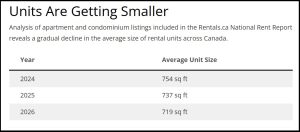
Since 2024, the average size of rental units has decreased from 754 square feet to 719 square feet—a reduction of roughly 35 square feet (4.6%).

Vancouver remains the most expensive market on a per‑square‑foot basis, with renters paying an average of $4.11 per square foot—more than double the rate in cities like Edmonton. Toronto follows at $3.52 per square foot, while Ottawa also exceeds $3 per square foot, placing it among the pricier markets relative to unit size.

By contrast, Calgary and Edmonton offer larger units at lower per‑square‑foot rents, with Edmonton averaging $1.99 per square foot, the lowest among the cities studied.

The analysis suggests that the decline in average unit size is partly driven by shifts in the composition of new rental supply. While the size of individual unit types has remained relatively stable, a growing share of studio and one‑bedroom units in newer developments is pulling down overall averages.

Much of the recent housing supply in major Canadian cities has come from condominium developments, where smaller units make up a significant portion of new inventory. At the same time, strong demand for centrally located housing continues to support more compact living arrangements.

Although rent per square foot has eased slightly in line with broader rent trends, it remains elevated in high‑demand urban markets, underscoring the ongoing affordability challenges facing renters.

For the full analysis, visit If Rents are Falling, Why Does it Feel More Expensive?

Toronto unveils major deal to cut development charges

The City of Toronto, the Government of Canada, and the Province of Ontario have announced a landmark multi‑billion‑dollar agreement that will significantly reduce development charges on new housing while advancing one of the city’s most important transit projects: the Waterfront East Transit line. Under the new agreement, the federal and provincial governments will fund a reduction in development charges by up to 50 per cent, directly supporting the infrastructure required to build more homes across the city. Toronto will work with the province to identify growth‑enabling projects that can be jointly funded, allowing development charges to be lowered without compromising on  critical infrastructure delivery.

This new deal builds on a series of “bold steps” Toronto has already taken to lower costs and accelerate housing construction. To date, it has invested more than $760 million to reduce development charges and incentivize new housing, including:

  • Eliminating development charges for 6,128 purpose‑built rental units
  • Providing a 15% property tax reduction for new multi‑residential buildings
  • Freezing development charge rates at 2024 levels
  • Deferring development charge payments for condo units (pre‑Bill 17)
  • Ending the conditional permit policy, allowing developments to secure the DC rate frozen at the time of planning application
  • Exempting developments with up to six units—plus a garden or laneway suite—from development charges and other fees

For developers navigating tight proformas and rising construction costs, these measures collectively represent a meaningful shift in project viability.

Waterfront East Transit

The announcement also confirms major federal and provincial funding for the Waterfront East Transit project, complementing the City’s own $1‑billion investment. The new transit line will connect the eastern waterfront to the Port Lands, unlocking a significant  future residential district.

“I’m pleased to join with the federal and provincial governments in this partnership to build more housing, transit and support good jobs,” said Mayor Olivia Chow. “The City of Toronto has taken bold steps to cut development charges on new homes, speeding up our development timeline and investing in affordable housing. Further, we have invested in the design of the Waterfront East Transit. Today’s historic announcement takes our work further and will deliver thousands more affordable homes and better transit, benefiting our City for generations.”

The announcement reinforces Toronto’s role as a global economic and cultural hub. Home to more than three million residents, the city continues to rank among the world’s most livable and diverse urban centres. As an Official Host City for the FIFA World Cup 2026 and the fourth‑largest city in North America, Toronto remains a leader in technology, finance, film, music, culture, innovation, and climate action—strengthened by ongoing investment from government, residents, and businesses.

Surrey unveils eCheck tool for residential approvals

The City of Surrey has launched an innovative digital compliance tool designed to streamline the residential plan review process. eCheck provides rapid, automated reviews of building plans to help home designers identify potential zoning compliance issues before submitting a formal building permit application. This tool is now available for all residential designers.

“The launch of eCheck marks a major step in modernizing how we support home designers and applicants,” said Ron Gill, general manager of planning & development. “By leveraging technology, we’re improving efficiency, reducing delays, and making it easier for applicants to navigate the permitting process.”

How eCheck is expected to make home building faster:

  • Reduces costly and time-consuming resubmissions
  • Improves accuracy and completeness of applications
  • Accelerates residential permit timelines
  • Supports collaboration between applicants and staff.

“We’re thrilled to partner with the City of Surrey to support their development objectives using Archistar,” said Joe Philbrook, vice president of customer at Archistar. “By automating newly defined houseplex design compliance reviews, we’re helping the City accelerate housing delivery for Surrey residents.”

The city is rolling out eCheck in phases beginning with single family homes, coach houses, garden suites, duplexes and houseplexes for R3 zones, with expansion to additional zones in the coming months. This approach ensures designers and homeowners can quickly benefit from faster, more accurate permit reviews.


Allyship for women requires action

Meaningful change for women in construction requires allies who actively provide support and challenge the status quo. While more women are entering the industry today, there’s still much more to do. Inclusivity and diversity continue to be hampered by a resistant workplace culture and systemic gender bias.

That was the general consensus of a panel of male leaders at the third annual LEAP conference, hosted by the Vancouver Regional Construction Association and Canadian Construction Women.

Held at the Fairmont Waterfront in Vancouver, the sold-out event brought together industry leaders, tradeswomen and executives for a full day of discussions focused on leadership and inclusion under the theme “Women Who Build.”

The Allies in Action panel featured a discussion around how male allies can use their influence to champion inclusive workplaces and support the advancement of women in construction by moving beyond awareness and passive support to active, structural change. The panel included Jorge Gutiérrez (4C Services), Amit Patel (Turner Construction), Jesse Percy (Port of Vancouver), and James Zelinski (Pitt Meadows Plumbing).

“In construction, male allyship has often been framed as encouraging – well intentioned. But real allyship shows up in policies, hierarchy decisions, jobsite culture. It requires serious structural change to a long established status quo. Allyship is not about optics – it’s about ensuring women don’t have to be resilient just to survive in this industry – that they are encouraged to lead, advance, stay and thrive,” said BCCA president Chris Atchison, who was the moderator.

The session stressed that the conversation has to change from merely acknowledging women to actively breaking down barriers – moving from allyship to sponsorship.

The labour shortage stats show the industry is heading for a cliff, said Zelinski. “And if we cut out half of the population, we can’t do the things we need to do. If we think our only pipeline is a single demographic, we’re screwed.”

The panelists all noted that some of the best leaders that they have worked with have been women, and that their companies have a zero-tolerance policy for harassment and discrimination.

At Turner Construction, Patel said they have a confidential hotline and reporting system and it was an “eye opener” when they started receiving anonymous calls about how women were being treated on the jobsite.

You must have clear accountability for the behaviour that you want on the team and hold everyone accountable, he shared.

Another issue is the tendency to follow the status quo which is familiar and safe, rather than having those difficult conversations for change.

“Oftentimes it’s very easy to get lazy,” commented Zelinski, noting that many trades (especially those who have been around for a long time) don’t understand and make excuses when it comes to recognizing gender equality. “If you take the time and do the work, building a heterogeneous team, you will get more out it than a homogenous team. A homogenous team is easier because nobody’s going to challenge the team construction and what’s always been done. But we need different thinking.”

Women continue to leave the industry due to unsupportive work environments and it is important that men challenge other men on gender bias to open doors.

“It’s about changing the norm and changing behaviour patterns. Men hire men – that needs to change,” said Percy. “Being an ally is really about being a good leader. Ask the difficult questions. If you see something that you don’t agree with, maybe provide another perspective and have that conversation.”

What should women expect working in construction?

“Women should expect same opportunity, promotions, a safe environment and a voice at the table,” said Gutiérrez.

“Even though we’ve come a long way, I would say – be prepared to be disappointed. You are trailblazers in an industry that doesn’t want to change,” said Zelinski.


Cheryl Mah is managing editor of Construction Business.

