Articles Archive - Page 290 of 928 - REMINET
REMI

Looking to hire workers? Meet them with money

Cleaning and janitorial companies, BSCs, property managers, and related companies are still struggling to bridge the labour gap that has plagued businesses in recent months. Demand is high, supply is low, and competition is stiff. And, while things such as time off, flexibility, and company culture are undoubtedly important factors in employee attraction and retention, money is still the main allure for workers.

A new survey from CareerBuilder has found that, amid a 40-year high in the Canadian inflation rate, employees prefer a pay raise over additional vacation.

The survey of U.S. adults conducted by The Harris Poll found that two-thirds (66 per cent) would prefer a 10 per cent pay increase over an additional week of paid time off. Among employed adults, 47 per cent said they most appreciate a good salary alongside job security.

The survey also revealed that nearly nine in 10 (89 per cent) of employed adults expect an annual pay increase from their company. Nearly half (46 per cent) look for a raise of at least five per cent and 16 per cent expect a yearly raise of 10 per cent or more each year.

In addition, half (49 per cent of) employees are confident that the rise in wages will keep up with inflation, with Gen Z (55 per cent) and millennials (62 per cent) more optimistic than Gen X (38 per cent) and baby boomers (20 per cent).

However, many workers – more than half, at 53 per cent – feel that working a single job is no longer enough to make ends meet. That includes 66 per cent of millennials, 57 per cent of men, and 49 per cent of women.

“In our most recent survey, the data shows that worker expectations are shifting right alongside inflation. Americans are looking for a larger than average annual pay raise at the same time we’re seeing an increase in the price of consumer goods and services,” said Susan Arthur, CEO of CareerBuilder. “Folks want to be able to earn a salary that matches the rising gas prices or hike in rent, for example.”

Toronto basketball court revitalization project launches 

Basketball courts across Toronto are tagged a refurbishment priority as part of a new initiative between residential builder Lifetime Developments and adidas Canada.

The inaugural year of the Homecourt Advantage revitalization project will include r​​enovations and creating public art at Stanley Park and Oak Street Park. Both courts will be completely revamped, including a new court surface and basketball net system. There will also be some additional landscaping and seating improvements surrounding the court.

Construction is expected to start in July 2022, with the courts being ready for public use by Fall 2022.

Two Canadian artists are partnering to enhance each project. Bryan Espiritu, a Toronto-born painter, product designer and graphic artist, will be focused on Stanley Park (890 King Street West, near Liberty Village) and Blake Angeconeb, an Anishinaabe woodlands artist who hails from Treaty 3 territory, will be working on Oak Street Park (165 River Street in Cabbagetown).

The disruption of COVID-19 inspired the Homecourt Advantage program. The idea is to provide a healthy, outdoor space where youth can be active, safe and social within their communities, and basketball was targeted as a sport  accessible to all ages, background and skills.

“Not only are we beautifying two local parks, but we’re also supporting the sport of basketball and its impact on the community, bringing together diverse players and serving as a platform to increase confidence and build friendships,” says Brian Brown, principal, Lifetime Developments and chair, Lifetime Charitable Foundation. “We are grateful to be partnering with adidas Canada on this program – an inspiring and innovative brand who shares our values and is equally as committed to providing a platform for local communities to be unified through basketball and art.”


Photo: rendering of Stanley Park basketball court.

Venture capital offered for smart water tech

Canadian start-ups are invited to take up the global water challenge, a competition to gain access to up to €3 million (CAD $4 million) in venture capital for smart technologies that can automate and optimize processes within water utilities and business-to-business scenarios. The Spanish investment fund, GoHub Ventures, is sponsoring the challenge, and joining forces with the Toronto Region Board of Trade, the Quebec government and the Canadian embassy in Spain to encourage participation in Canada.

“We’re excited to be collaborating with GoHub to develop more sustainable infrastructure innovation through Canadian businesses as part of our commitment to fostering a sustainable climate economy,” says Leigh Smout, president of World Trade Centre-Toronto, the Board of Trade’s trade services arm.

To qualify, start-ups must already be in the process of raising capital for an initiative that uses agnostic technology — such as applied artificial intelligence, industrial IoT, no-code, edge computing, augmented and virtual reality, synthetic data, cybersecurity, 5G, digital twins or quantum computing — and have established business dealings as a provider of software-as-a-service (SaaS) with annual earnings of at least $200,000. They’ll have until October 12, 2022 to register for the challenge.

Selection of five finalists will be made prior to the Smart City Expo World Congress in Barcelona, November 15-17, where the winner is to be announced. Meanwhile, Canada is seen as an obvious place to recruit contestants.

“Canada is one of the most powerful ecosystems in the world in AI solutions and has become one of the most important clusters in water technologies,” reports GoHub’s managing director, Patricia Pastor. “It is, therefore, a very attractive country for entrepreneurs where GoHub must be present.”

GTA new home market quiet in May

The new home market in the Greater Toronto Area (GTA) continued to slow down in May, the Building Industry and Land Development Association announced Wednesday.

Sales of new condominium apartments, including units in low, medium and high-rise buildings, stacked townhouses and loft units, with 2,058 units sold, were down 31 per cent from May 2021 and 10 per cent below the 10-year average.

Single-family homes, including detached, linked, and semi-detached houses and townhouses (excluding stacked townhouses), accounted for 491 units sold, down 62 per cent from last May and 58 per cent below the 10-year average.

“GTA new homes sales eased in May as consumers deal with rising mortgage rates and growing economic concerns,” said Edward Jegg, research manager at Altus Analytics, Altus Group. “Inventory levels are moving higher but benchmark prices are showing resiliency.”

The benchmark price for new condominium apartments in May was $1,176,080, which was up 10.5 per cent over the last 12 months and the benchmark price for new single-family homes was $1,814,774, which was up 31.5 per cent over the last 12 months.

Total new home remaining inventory increased compared to the previous month, to 10,004 units, comprised of 8,050 condominium apartment units and 1,954 single family lots.

“While short term macro-economic trends point to an easing of housing demand in the coming months, failure to plan to ensure a consistent pipeline of new housing of all types will result in a future resurgence of the tight market conditions of the last few years,” said BILD President & CEO Dave Wilkes. “This was the pattern following the 2017 market correction and the introduction of the mortgage stress test. Given present projected population growth, it is prudent for governments and industry to use this time to collectively plan for another period of renewed demand.”

New report details steps to restore housing affordability

A new report from CMHC entitled, Canada’s Housing Supply Shortages: Estimating what is needed to solve Canada’s housing affordability crisis by 2030 takes initial steps to determine how much supply is needed to restore housing affordability in Canada by 2030. With a particular focus on the four largest provinces of Ontario, Quebec, British Columbia, and Alberta, the report looks at the housing supply gap relative to the state of housing affordability for the entire housing system.

“The scale of the challenge identified in this report is more important than the exact number of housing units required,” said Aled ab Iorwerth, Deputy Chief Economist, CMHC. “Canada’s approach to housing supply needs to be rethought and done differently. There must be a drastic transformation of the housing sector, including government policies and processes, and an ‘all-hands-on-deck’ approach to increasing the supply of housing to meet demand.”

CMHC projects that if the current rate of new construction continues as is, housing stock will increase by 2.3 million units, reaching close to 19 million housing units by 2030. But, to achieve affordability for everyone in Canada by 2030, it estimates we will need an additional 3.5 million units, climbing to over 22 million total units for the country.

The report contends that increasing housing supply in both the rental and homeownership market is critical to achieving affordability, and that delivering more housing supply beyond predicted growth in the number of households will enable better matching of households with the right type of housing for their needs.

“More housing units created in the housing market will create opportunities for households to move into housing that responds to their demands,” the report states, pointing out that this ‘filtering process’ naturally frees up housing to improve housing affordability over time. Additionally, it states that not all the new housing units need to be new, purpose-built construction, citing increased co-living arrangements and the redevelopment of existing residential, commercial, and industrial properties as examples of alternative approaches.

For more information on housing affordability in Canada, visit: Canada Mortgage and Housing Corporation | CMHC (cmhc-schl.gc.ca)

.

Survey reveals impacts of market conditions on renters

A new survey from Canada Life reveals that current market conditions are changing people’s home ownership plans in a way that could impact their future retirement.

The survey found that market conditions such as high real estate prices are not only preventing many renters from entering the housing market, they’re also causing current homeowners to feel “house poor.” Almost half of the renters who responded (45 per cent) said they will either continue renting indefinitely or “aren’t sure” when they will buy a house.

“Canadians are at an investments crossroads,” said Paul Orlander, Executive Vice-President, Individual Customer, Canada Life. “While buying a home can help you build equity that could be valuable to one’s long-term financial plans, renting may provide more peace of mind around affordability, flexibility and lower housing costs which could leave more for savings and investments each month.”

Key highlights from the study include:

  • Almost three-quarters (73 per cent) of respondents said “it’s a bad time to buy a house” with renters citing their top three reasons as 1) high real estate prices, 2) lack of money for a downpayment, and 3) not having enough income to qualify for a mortgage;
  • While 79 per cent agreed that homeownership is a good investment, 64 per cent said they felt breaking into the market would be too difficult unless they had financial support from someone  such as a family member;
  • Canadians aged 25-29 are two times more likely never to purchase a home or continue renting indefinitely compared to those aged 30-49; and
  • 24 per cent of homeowners said they feel “house poor” today.

“Home ownership is one of the most important investments in one’s lifetime and with the right advice and long-term planning, a plan to build home equity should be one that is within reach for first-time homebuyers in Canada,” said Hugh Moncrieff, Executive Vice-President, Advisory Network and Industry Affairs, Canada Life. “Whether renting or buying, an advisor can help you plan for whichever works best for you. They can help you build an effective investment strategy, explain the long-term value of real estate within that strategy, knowing your first home isn’t always your forever home.”

For more on how market conditions are influencing future retirment planning, visit: Retirement (canadalife.com)

Minoru Centre receives facility award

The City of Richmond has received the 2022 Bill Woycik Outstanding Facility Award from the Recreation Facilities Association of British Columbia (RFABC) for the Minoru Centre for Active Living.

The prestigious award, presented annually, recognizes a new or relatively new recreation, sport or leisure facility that meets a demonstrated community need through innovations in design, energy management, operations, revenue generation and services.

“Since being fully open to the community in 2020, the Minoru Centre for Active Living has become a recreational, social and cultural hub for the community that showcases the city’s commitment to innovation, design and environmental efficiency,” said Mayor Malcolm Brodie. “The Minoru Centre for Active Living serves as an important place where Richmond’s diverse and intergenerational community can come together to be active and create connections.”

The Minoru Centre for Active Living at 7191 Granville Avenue houses one of the province’s premier aquatic centres, along with a seniors centre, event centre and an 8,500 square foot fitness centre. Accessibility was a key focus during the design, resulting in features such as automated doors, transfer edges for easy and comfortable access to the pools, universal change rooms, high contrast signage and lower counter heights.

The Minoru Centre for Active Living is equipped with energy saving equipment such as high performance windows, demand control ventilation and LED lights with occupancy sensors that, together, help to reduce the building’s energy consumption by 49 per cent compared to similar but more conventional facilities elsewhere.

“The Minoru Centre for Active Living is not only an aesthetically stunning facility in design, but has incorporated impeccable energy efficiencies and sustainability initiatives in its construction,” said Jenna Stevens, RFABC president-elect.

Anthem acquires 95-acre industrial site in Calgary

Anthem has purchased 95 acres of industrial land in southeast Calgary. The former site of a welded steel pipe manufacturing facility will be turned into a multi-phase business park with facility options for small- to medium-format occupiers, along with ancillary retail components.

The development project—the latest in a series of acquisitions from the company’s newly formed industrial team—sits at the busy corner of Barlow Trail SE and Glenmore Trail SE in the mature Foothills industrial node.

Alberta’s industrial market has seen heightened demand for industrial product and the lowest vacancy rates since 2014. Since August 2021, Anthem’s industrial portfolio in Calgary has grown by more than 375 per cent with the acquisition of five existing industrial properties, totaling upwards of 650,000 square feet of gross leasable area, along with about 290 acres of industrial development land.

“Regional and national distributors and logistics companies are looking to Alberta,” says Sean Day, Anthem’s vice-president of industrial. “Calgary’s excellent transportation infrastructure, low cost of living, young and dynamic population, availability of developable land and more economic rents compared to Toronto or Vancouver make it one of the hottest markets for industrial right now.”

The project will complement Anthem’s two other industrial development projects in the rapidly expanding distribution hub of Balzac, immediately north of the Calgary city limit. Those future logistics parks will be designed with medium- to large-format distribution/logistics tenants in mind.

“Our Barlow development will supply more industrial density to the area, transforming the site from a low-density heavy industrial usage to high-density light industrial,” says Day. “There is relatively limited supply of modern small- to medium-format industrial space in southeast Calgary, so we’re aiming to provide some relief to the market in that regard.”

“It’s our goal to be able to offer various options to different business types across the region. “We are devoted to meaningful, long-term investment in Alberta. Calgary is just the beginning.”

Living with dignity in multi-generational housing

These days, when real estate broker Chris Cansick is touring buyers through Toronto’s costly housing market, he’s more consistently seeing clients looking to co-own with other family members so they can afford to live downtown.

“Once upon a time, not too long ago, it was extremely common to be living with your in-laws,” says the Bosley Real Estate professional. “It’s hard to find an old stock Toronto home in Little Portugal or Little Italy that doesn’t have two kitchens. But today, we’ve become so accustomed to living individually that we think it’s odd people would live with parents.”

In a supply-dry city, where the cost of living rose 38 per cent since last year, and where the population is projected to add 966,000 by 2046— the average price of a home in April was more than $1.3 million. As of May, the average price in the GTA hit around the $1.2-million mark.

The choices are slim for young families wishing to stay put. “Your choice will become, do I want to live in a tiny condo or do I want to pool my assets together and try to buy a freehold property, which makes sense if you think about the prices of condos,” says Cansick.

Affordability aside, family dynamics have changed. During the pandemic, parents working without childcare and skepticism over the adequacy of long-term care meant more reliance on the family, says Frances Martin-DiGiuseppe, founding principal, Q4 Architects Inc.

“We saw a heightened loneliness as people were forced to shelter in place. Even for parents living independently, the lack of seeing family became a huge issue,” she says. “We also saw that in young people living alone—wanting to join the family bubble meant living together.”

Yet the construct of an extended family looking out for everyone’s well-being under one roof is enshrined in old traditions that have become hard to physically realize in Ontario.

A report last year from Q4 Architects and Housing Lab Toronto, Resilient Ontario:Housing & Community Planning for Multi-Generational Living, states that the province doesn’t just have a housing supply problem; it has a housing type problem that is not responding to trends like an aging population that faces spiraling elder care costs and social service deficiencies.

And more needs to be done. The latest Canadian census shows that between 2016 and 2021, the number of people 65 and older rose 18 per cent to seven million. In more detail, the 85-plus age group reached 861,000, a number that is projected to triple by 2046.

Canada also expects over 432,000 more immigrants in 2022 and even higher numbers in 2023 and 2024, who bring with them cultural norms that disrupt the concept of a post-World War II nuclear family house, Martin-DiGiuseppe notes.

With new Canadians in particular, who also look to sponsor relatives, many end up in precarious multi-generational living situations due to lack of city planning.

The Q4 Architects/Housing Lab Toronto report details, in part, how an influx of large numbers of immigrants is causing them to live in overcrowded housing. In Brampton, secondary suites have become so popular within the immigrant community that the building department created a multilingual guide to assist homeowners with permits and construction.

“In 2019, the City of Brampton received 1,577 complaints about illegal or unregistered secondary suites or basement apartments,” the report states. “This shows the desire for home sharing is outpacing the legal framework allowing it.”

“I think there’s a real opportunity to create better multi-gen homes: attached, contained, within, adjacent, but separate facilities so both families can live with dignity,” says Martin-DiGiuseppe, who is also leading the charge when it comes to designing these spaces.

Making it work

Multi-generational homes are often an afterthought for builders who continue to favour housing geared to nuclear families. Rarely do municipalities legislate them.

Particularly for townhomes in suburban communities, solutions proposed in the Q4 report are varied, but include flexible zoning that allows for garage conversions into secondary suites by reducing parking requirements, and zoning that allows for more than one “dwelling unit” within or adjacent to the primary dwelling unit.

Various housing models could address an array of multi-gen situations: more stacked townhomes, a front load townhouse with separate suite and shared kitchen for meal sharing, or a rear load townhouse with a coach house for increased privacy.

Inside, adaptable designs like movable partitions between rooms separate disruptive activities in open-concept spaces; kitchen triangles—typically designed for gender roles—can be replaced with larger prep zones and pathways, with an extra sink and counter space. Garages that convert into multi-generational suites should rough-in electrical capacity and supply and insulate exterior walls and under slabs.

Design norms and existing provisions rarely acknowledge the future of multi-gen living. Basements, for instance, are often designed with inadequately sized windows for secondary egress. “We know that basements are being converted; we know that they are becoming rental suites, so we’d like to see basement apartments made safe and habitable,” says Martin-DiGiuseppe.

As well, the floor between a secondary suite and the primary dwelling must be constructed as a fire separation and cannot be interconnected. “What we’re advocating for is a recognition of multi-gen in the building code that is different from secondary rental suites; its families living together; they will protect each other; they’re interested in family security,” says Martin-DiGiuseppe. We don’t need the same kind of onerous and expensive requirements separating two suites.”

When it comes to condos, there’s not a whole lot of multi-generational design. Suites have become smaller and not larger. “Some families are buying several suites, choosing to live together in the same building to assist with childcare or aging parents,” says Martin-DiGiuseppe. “But with condos, we haven’t seen how [developers] plan to address multi-gen. There’s always a fear of doing something outside of the market.”

Amenities that cater to various generations are more likely found: daycares, senior facilities for social activities and co-working areas, for instance. Living arrangements are more challenging. “There are a lot of hurdles to jump through, but if you could have a connected suite that allows your parents to live independently, but be right there, you could combat loneliness, mental health, personal care, and family inclusion,” she adds.

Sandy Chen, broker for RE/MAX Ultimate Realty Inc, has clients who have purchased condo units in the same building as their kids or parents. “To have their own space, but close enough to help out,” she says.

But when it comes to families under one roof, she sees multi-gen as more of a trend with freehold homes. “I have had situations where both the children and parents sell their homes and purchase a larger one together,” she says. “I do not find townhouses as popular for multi-generational purposes because there are too many stairs, and the space is not big enough.”

“I know for certain cultures it is more common.” Speaking about the Chinese community in Markham and Richmond Hill, she says the needs of multi-gen homes are not necessarily separate apartments within the same house. “Everyone lives together in the same space, the house just needs to be big enough.”

Amy Youngren, founder of North Group, says with housing prices hitting all-time highs in Toronto and the GTA, multi-gen living is “becoming more and more prevalent.” She concurs that such dwellings are more common in the suburbs, outside of urban locales due to cultural values, extra square footage and lot sizes.

“It remains to be seen where our market goes in the coming months and years, but we do anticipate that the desire for multi-generational living will continue to grow,” she says.

Feature photo: Royal Oaks in Oakville, designed by Q4 Architects. Rendering by NAK.



Engaging next-gen condo managers

Ontario’s condo management industry has rapidly evolved over the last few years with the emergence of licensing and regulatory requirements. But now it faces a staffing crisis at an unprecedented level, with many seasonal managers and executives leaving the industry due to retirement or other opportunities.

To woo talented and futuristic candidates, management service providers attempt to sway the troops with top dollar and the promise of a great community, but rarely discussed are the reasons why someone should join, or even remain within, this somewhat unknown career path.

There are valid reasons deterring people from the profession, namely difficult personalities. Managers might be cursed at and threatened throughout the course of their career; their names, and the management service provider, might be dragged through the mud in the media for something that they have no control over. There may be instances of unethical behaviour they are powerless to stop, and interpersonal conflict will be a daily occurrence because the Condo Act and various condo documents are adversarial in nature. Ultimately, this breeds contention. A manager may feel anxious, frustrated, alone and ask: “Why am I here”?

Nor is this a 9-to-5 career. Clients have monthly meetings with often late nights; the workload keeps managers past “office hours,” into the weekend sometimes. Calls come in past 5:00 p.m. to address various types of emergencies, ranging from multi-floor floods to fires and major equipment breakdowns.

Managers now face a high risk of burnout and there is a mental health crisis in the industry with few resources to help. Meanwhile, condo boards today want a manager who is capable of withstanding all this pressure.

But for those keen on dealing with people from all walks of life, while not being glued to a desk, this is also a wonderful time to work in this profession. Managers get to service communities and residents, learn new and exciting topics, which make for a well-rounded working life, and become leaders in the corporations they service, in the industry and in the communities where they live.

Crisis management will be your forte. People skills will be your sword and shield. Knowledge and ability to adapt will be your power.

Duty to serve

The rush from successfully problem-solving an issue is intriguing, with time spent prolonging the lifespan of equipment through proper maintenance and adhering to manufacturers’ recommendations and best industry practices.

Managers are involved in replacing major components of the building’s assets to preserve the best interests of the corporation, formulating and maintaining an annual plan that keeps the wheels of the corporation turning, and servicing residents administratively.

There is a higher purpose in this line of work. Over a million residents live in condos, and more buildings are being built today than ever before. To provide service to residents, especially in the vicinity of their home, is a challenging and fulfilling task. To preserve their assets and the assets of the corporation is the obligation and duty under the Act. That ultimate sense of duty to serve is what calls to this industry. This is the most opportune time to answer the call.

Opportunity for life-long learning

To be able to execute on a high level in a fast-paced environment, learning is the key ingredient. During the span of a condo management career, people learn about the building and workings of condo communities, as well as other aspects of professional life.

There are great service professionals, trades and vendors to meet. Through them or inadvertently, there is much to learn about laws, government structures and corporate governance affecting condo corporations. There are opportunities for public speaking, chairing meetings, record keeping and minute taking, and the chance to wear many hats—to be a generalist.

Becoming a leader

For those looking to display their leadership qualities, this is an industry in need of strong leaders. A manager is the front-and-centre person for the corporation in its day-to-day operations and beyond, dealing with various stakeholders and managing multiple staff. Residents and owners will look to you for guidance about their home and their role in the condominium.

More beneficially, many managers are joining the board of directors in the communities where they live to serve as a volunteer member. Managers are also stepping-up and joining volunteer industry organizations to promote education, higher service standards and to shine a light on issues facing condominiums.

A number of management service providers have opened charity organizations, giving back to the communities in their respective regions. Managers are also organizing charity drives in partnership with other stakeholders to raise awareness and funds for a particular cause. There are many opportunities to volunteer and give back in this sector, which is a fulfilling experience.

Being a condo manager is not the most glamorous of professions by any means; it is an industry rapidly evolving, with many challenges and opportunities to grow. There will be difficult times and many will likely reconsider this path, but to truly succeed in the field, one should embrace the challenges and accept the obstacles The satisfaction of solving issues is unparalleled.

Bogdan Alexe is President and CEO of B1 Management Group Inc. B1 Management Group provides expert condominium management and consulting services for clients in the GTA, employing the latest technology and 20+ years of hands-on experience. B1managementgroup.com

Val Khomenko is a Senior Condominium Manager with ICON Property Management Ltd. based in Toronto, Ontario providing condominium management services in the Greater Toronto Area. Val can be reached at [email protected]

Citric acid: a sustainable cleaning solution?

The professional cleaning industry has been making giant strides in the past two decades by manufacturing, developing, and using cleaning solutions that have a reduced impact on the user, building users, and the environment.

But when the pandemic arrived, the world was in a health crisis. Facility managers wanted to do whatever they could to keep their facilities as healthy as possible. Whether the products were environmentally safe became less of a consideration, and some of what the industry had learned about safer cleaning solutions took a back seat.

However, as we inch our way back to normal, managers and cleaning professionals now realize that many of the cleaning methods and solutions they used during the crisis may have done more harm than good. This is especially true of some traditional disinfectants, particularly those misted or sprayed onto surfaces.

Case in point

With great fanfare, 90-day “mist” disinfectants were introduced during the pandemic. Manufacturers claimed these had antimicrobial properties that would continue to eliminate bacteria and viruses for up to three months. Many were designed to be sprayed onto surfaces. This way, they could be applied to all types of surfaces, high and low, in a facility.

Initially, this sounded like a major success, especially when used to clean and disinfect schools. Instead of applying disinfectants to specific surfaces as frequently as every day, which was costly and time-consuming, one application could be applied to many surfaces and would last 90 days.

However, a short time after these long-lasting disinfects were introduced, tests found that they were most effective in low-traffic areas of a facility. In heavily trafficked areas, the applications could become overwhelmed quickly as people touched surfaces where they were applied. The result: the disinfectant could lose its effectiveness in days, giving people a false sense of protection that the surfaces were virus- and bacteria-free when, in reality, they were not.

But that was not the only problem. The U.S. Environmental Protection Agency reminded school administrators that every disinfectant and disinfectant cleaning wipe sold in the U.S. must include this statement on the label: “keep out of reach of children.” Similar statements are found on disinfectants marketed in Canada.

There is a serious reason for this. Traditional disinfectants are very powerful cleaning solutions. In the U.S., they are classified as pesticides because they kill living things. If touched regularly, they can have harmful effects on children and those with weakened immune systems.

This is because children touch surfaces and then touch their eyes, nose, or mouth. According to a study in the American Journal of Infection Control, children have been observed touching their faces as often as 23 times per hour – and adults are not far behind. If the disinfectant is on their fingers, it can be absorbed into the body.

And there is one more problem. Traditional disinfectants can negatively impact indoor air quality. This is especially true of chlorine-based disinfectants. Further, they contain volatile organic compounds (VOCs). Inhaled in large amounts for an extended period and, once again, they can harm human health.

Looking for safer alternatives

The professional cleaning industry today is seeing a resurgence in the use of safe cleaning solutions that also promote sustainability. Safe cleaning solutions have a minimal impact on the user and the environment and promote sustainability. If the product is deemed sustainable, it has been made from readily available natural resources.

This is where citric acid cleaning solutions come into the picture. Made from citrus fruits such as lemons, limes, and even pineapples, these products have been used safely for centuries.

To better understand citric acid and its use in professional cleaning, I turned to Lee Chen, president and COO of ProNatural Brands, manufacturers of cleaning solutions made from citric acid, for some questions:

When was citric acid first used in cleaning?

Chen: We believe the ancient Egyptians first used citric acid as an antifungal or antibacterial in cleaning. They used it because it was an effective disinfectant and because the ingredients used to make it were plentiful. This was long before the use of bleach.

In more recent years, where was citric acid most often used?

Chen: It had several industrial applications. Citric acid is safe on many metals, so it was used for cleaning different types of metals used in manufacturing and or industrial applications. It has also been used for cleaning parts in auto engines such as radiators.

It’s considered safe, but it is also an acid. Is this a concern?

Chen: On a pH scale, citric acid has a pH level of between 3 and 6. The pH scale span is 0 to 14, with 0 being very acidic, 14 being the least acidic (also called “basic”), and 7 being considered neutral. This means citric acid is a relatively weak acid. As with any cleaning solution, if misused, there could be a risk, but overall, it is considered very safe and certainly safer than most traditional cleaning solutions.

Are there citric acid disinfectants?

Chen: At least one has been approved and registered as a disinfectant by the U.S. Environmental Protection Agency (EPA). This means that when used per the manufacturer’s instructions, the EPA verifies the product will eliminate (kill) pathogens as listed on the label. Further, at least one is now on the EPA’s List-N, meaning it is proven to eliminate the pathogen that causes COVID. The conclusions of the EPA and the Canadian Environmental Protection Act typically parallel each other.

How important is it that citric acid is derived from sustainable resources?

Chen: Sustainability is going to become the watchword of the 21st century. When facility managers and cleaning contractors consider selecting a product, they traditionally ask about durability, effectiveness, performance, and cost. Now they are going to also ask about the product’s sustainability. We can expect sustainability to become increasingly important in years to come.

Brookfield eager to deploy decarbonization fund

Brookfield Asset Management has raised USD $15 billion to channel toward decarbonization with the institutional close of its inaugural Brookfield global transition fund (BGTF). The asset manager reports more than a hundred institutional investors worldwide have put up capital for what’s now the world’s largest private fund targeting investments aligned with achieving net-zero carbon.

“That means deploying capital across the economic spectrum from scaling clean energy generation, to transforming traditional utilities and to providing sustainable solutions for heavy industries like steel and cement,” advises Mark Carney, Brookfield’s vice chair and head of transition investing.

Thus far, about USD $2.5 billion has been tapped for solar power, carbon capture and storage, and battery and battery storage ventures, while “a robust pipeline of potential investments” is indicated.

Brookfield itself is the largest investor in the fund, which exceeded its initial hard cap and was oversubscribed. Although now closed to institutional investors, it remains open to private wealth investors.

“Investor demand for this fund has been exceptionally strong,” says Connor Teskey, chief executive officer of Brookfield Renewable. “Our investment partners are looking for an experienced investor who can guide their contribution to what is both a critical requirement and a major global opportunity.”

The fund will report to investors on both its financial and environmental impact performances.

BCCA launches mentorship program

The BC Construction Association (BCCA) has launched Building Builders mentorship program with funding of $3.6 million from the Ministry of Employment and Social Development Canada.

Encouraging Canadians to explore career opportunities and develop connections with employers in the skilled trades is a key priority for Canada’s Skilled Trades Awareness and Readiness (STAR) Program. There is currently no established mentorship program for B.C.’s construction industry.

To reduce skilled workforce shortages, the Building Builders program will connect under and un-employed workers, labourers and unregistered apprentices working in B.C.’s construction industry with established credentialed tradespeople, executives, and industry leaders who have been working in construction in B.C. for a minimum of 10 years. These mentorships will provide career guidance for workers and a talent acquisition opportunity for employers who are seeking new workers during the ongoing labour shortage.

The program objectives are to:

  • attract non-traditional workers to the industry,
  • retain existing workers who are not yet on a solid career path and potentially not supported in apprenticeship by their current employer,
  • lower the average age of apprenticeship initiation (currently 27),
  • improve apprenticeship registration and completion rates,
  • Place mentees in employment with mentor companies.

“Mentorship is a tradition in the construction industry, where apprentices learn their craft under the experienced guidance of an accredited journeyperson,” says Chris Atchison, president of the BCCA. “Building Builders amplifies the role of mentorship well beyond the apprentice/journey relationship, giving job seekers and those workers who are under employed in their current construction job a way to connect to employers and mentors who might otherwise be out of reach.”

Mentees will receive one-to-one coaching, job leads, and work experience. Program staff will provide connection, support, opportunities, and guidance for both the mentor and the mentee throughout the program.

In B.C. there are 27,630 anticipated job openings in construction by 2027 due to expansion and retirement; many of those jobs need to be filled from outside the industry by new entrants without established connections, and through much better retention of current workers. Building Builders seeks to establish a greater sense of community that will result in more institutionalized support for newcomers to the industry.

The Building Builders program will open to applications from mentors and mentees in August 2022.

The program is funded to run for approximately two years and will seek to support 300 mentees through a 12-month mentorship period. Mentees will receive Site Ready safety training, and mentees and mentor companies will receive culture training through the Builders Code.

Majority of Ontarians feel priced-out of own towns

More than half of Ontarians believe they may never afford a home in their current city or town, according to new data from Right at Home Realty. The study conducted in mid-May also found 54 per cent of parents in the province are not planning on helping their children buy a future home.

Only 19 per cent of potential first-time homebuyers plan to purchase in the next two to three years, compared to 30 per cent in 2021, an overall decrease of 56 per cent year-over-year.

“The impact of rising mortgage rates has reduced the buying power of potential homebuyers. Additionally, the minimum mortgage stress test rate will climb to seven per cent or higher,” said John Lusink, President of Right at Home Realty.

“Another impact of the rising rates is the financial disincentive created for those thinking of selling but are now faced with much higher financing costs when considering buying their next home. While we will continue to see a drop in market activity, we do not anticipate this will lead to a market crash.”

Affordable housing concerns persist

The data found that 61 per cent of those in the GTA and 74 per cent of those in 416 regions believe they may never be able to afford a home in their current city or town. Additionally, more than half (54 per cent) of Ontarians said economic uncertainties are impacting their decision to buy a home and nearly half (45 per cent) reported that housing affordability challenges have led them to consider moving or buying a home in another city or town.

“The cost of house prices is an issue, especially amongst my millennial clients,” said Milli Pajpani, Sales Representative, Right at Home Realty. “Most millennials want a property – either to reside in or invest in – however, many do not have the savings to make those purchases happen because of the current prices.”

Younger buyers are more likely to feel the impact of rising interest rates

Interest rate changes have become more of a concern this year. This is reflected in the 12 per cent year-over-year decrease of respondents who said a mortgage rate increase would impact their decision to buy a home.

Nearly two-thirds of all respondents said a mortgage rate increase of 150 basis points (1.5 per cent) or less would have no impact on the decision to purchase a home, compared to 70 per cent in 2021.

Significant discrepancies were identified among different age brackets, with younger age groups being more impacted by mortgage rate increases. Two-fifths (41 per cent) of Ontarians aged 18 to 34 said mortgage rate increases would not impact their decision to buy a home, compared to 61 per cent and 76 per cent for those aged 35-54 and over the age of 55, respectively.

“News of rising mortgage rates may be a deterrent for some, however, those that take the time to do the calculations are often pleasantly surprised that the difference in the monthly payment is not as high as they would have expected,” said Christina O’Dea, Broker, Right at Home Realty.

Most homeowners are staying put

While 80 per cent of respondents cited they are not planning to sell their homes in the next two to three years, the reasons for those who are interested in selling vary. The top reasons include downsizing (33 per cent), moving out of the city (26 per cent) and taking advantage of the current market (23 per cent).

The number of homeowners stating they would sell their homes to take advantage of the current market has doubled since last year. This indicates a dramatic shift in the housing market, and only seven per cent of respondents who identified plans to sell in the next two to three years said it would be to upsize/buy a bigger house. In 2021, a substantial 39 per cent said upsizing is a reason for selling, reflecting a sizeable decrease of 82 per cent in this year alone.


Quebec leaves uncontested rent period in place

Developers and landlords in Quebec can continue to count on uncontested rent for the first five years newly constructed rental housing is occupied, at least while the provincial government studies the matter further. An amendment to Quebec’s Civil Code that would have allowed for rent adjustments after three years was withdrawn from recently adopted omnibus legislation, following warnings that it could stifle new rental housing supply.

Under the current rules, which date back to 1980, there is no right to appeal annual rent increases to the Administrative Housing Tribunal for a five-year period after a unit first comes onto the market. However, landlords are required to explicitly state that in the lease.

Earlier this spring, Benoit Ste-Marie, executive director of Quebec’s largest rental housing industry association, CORPIQ (Corporation des propriétaires immobiliers du Québec), defended the policy to a committee of Quebec’s National Assembly — arguing that developers need the flexibility to offer competitive rents during the lease-up phase, and then scale them up to reflect operating costs and obtain a more realistic return on investment. He defined it as a stabilization period that is weighted in tenants’ favour at the front end.

“The purpose of this clause is to promote the arrival of new tenants so that the profitability of the building is possible in the medium and long term,” states an associated English-language summary from CORPIQ. “It is a risky business model because the revenues are to be expected in the years to come, unlike the sale of condos where the sums are collected before the occupant even takes possession. In a condo building, it is the occupants who manage the maintenance of the building over the years and assume the corresponding costs. It is the owner of an apartment building who must assume this risk.”

Other elements of the legislation, known as Bill 37, An Act to amend various legislative provisions mainly with respect to housing, have now been adopted. That includes a requirement for Ministerial authorization before a non-profit or cooperative housing corporation can sell a building, and establishment of rules for repayment from tenants who no longer comply with income requirements for residency in subsidized housing.

Coast Mountain College boosts Indigenous student housing

Coast Mountain College students in Terrace, northwest British Columbia, have completed their first full academic year living in the Wii Gyemsiga Siwilaawksat Student Building, with accommodation expected to be at full capacity by September.

Following a $18.7-million investment from the British Columbia government, the three-storey building replaced 40-year-old-student housing that was no longer fit for purpose.

Since about 48 per cent of the student population is Indigenous, the facility was designed to empower Indigenous students to flourish in post-secondary education.

The campus sits on the traditional territory of the Tsimshian Kitsumkalum people, serving six different Nations – Haida, Haisla, Nisga’a, Wet’suwet’en, Gitxsan, Tsimshian, and 21 distinct First Nation communities.

Wii Gyemsiga Siwilaawksat translates from local First Nations language Sm’algyax into English as, “where learners are content and comfortable”. The College developed the original project brief using a decolonized, indigenized approach to engage and understand the needs of its communities.

Designed by hcma, Indigenous art, culture, language and ceremony experts informed the process, led by hcma, Principal-in-Charge Karen Marler and hcma Project Architect Aiden Callison, IDL Projects was the design build contractor on the project.

The building is made up of modular student housing units grouped around a purpose-built central atrium. Inside, it houses a large cultural space, 108 student beds, two hotel suites, an elder suite, six shared kitchens, two collaboration areas, a computer lab, an Esports room, a maker space, and bike storage.

Coast Mountain College

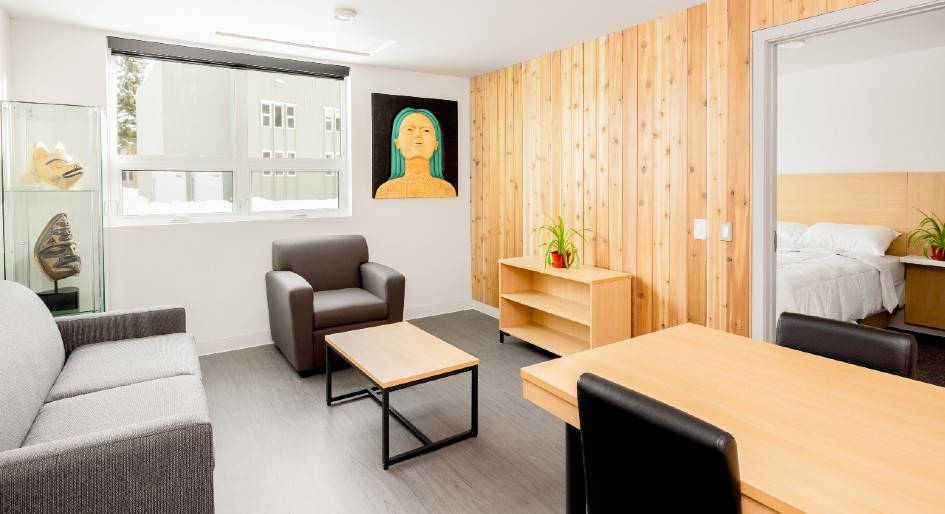
An elder’s suite. Photo by Bright Photography. Art: Sculptured panel by Nakkita Trimble, Nisga’a nation; Alder mask by Shawn Aster, Tsimshian nation; Bronze mask by Dempsey Bob, Tahltan/Tlingit nations.

Indigenous design principles that represent the Northwest Coast region and the First Nations communities the College are embedded throughout the building.

“Indigenization and decolonization creates informed and mutually respectful citizens,” says Callison. “It means better outcomes for everyone by delivering Indigenous ways of learning and culturally appropriate support, while also fostering cross-cultural learning for the broader student body.”

Sacred cedar

The old growth cedar tree is a symbol of the northwest coast. Used for shelter, clothing, transportation, ceremony, and spiritual beliefs, it’s been integral to local First Nations’ culture for thousands of years. It felt appropriate for this sacred material to inform the building’s expression.

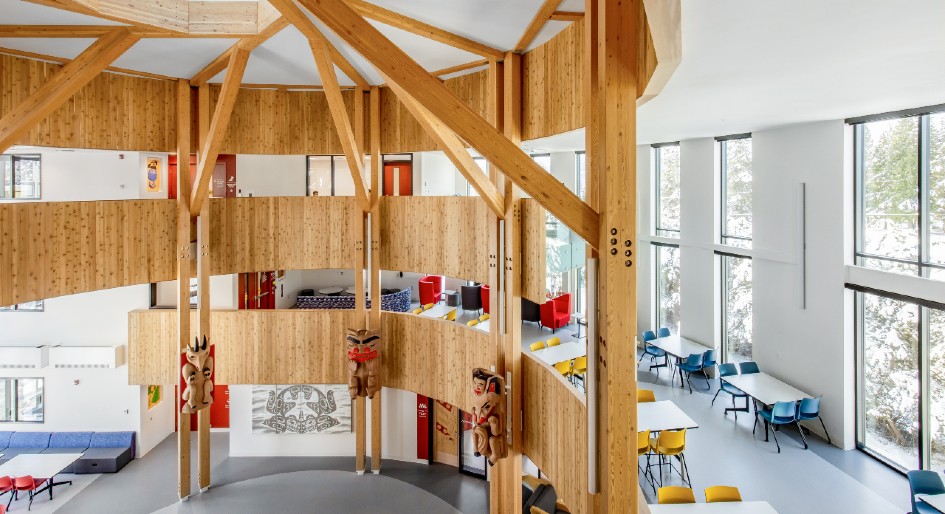
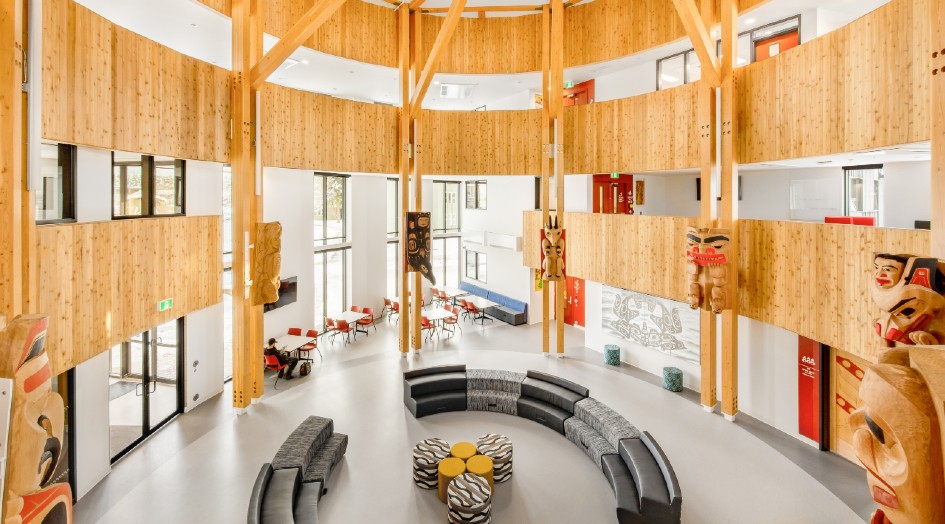
For the exterior cladding, Tsimshian weaving patterns seamlessly unite the building’s two student housing wings, while mimicking the expression of cedar bark. Inside, a cedar-clad central lobby space — akin to a hollow cedar tree, or heartwood — hosts gatherings and ceremony.

Each of its three levels are connected by house posts, while a glulam pin-wheel structure—inspired by traditional Northwest Coast Indigenous architecture—honours each Nation the college serves, symbolizing connection, strength, and unity.

Integrating Indigenous art

To help students feel represented, over 70 different art installations were designed by Indigenous artists and are integrated throughout the building.

“Collaborating with local artists and designers has added a rich layer of storytelling to the space that roots the student housing in its community,” says Marler.

Coast Mountain College

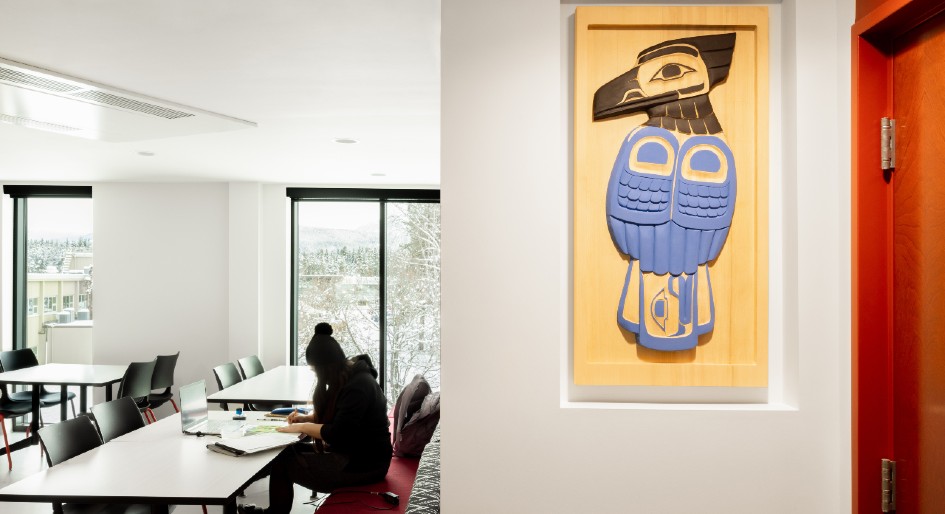
The entrance to Blue Jay wing. Photo by Bright Photography. Art: Gwisgwaas by Paula Wesley, Tsimshian nation.

They include master carvers and Coast Mountain College instructors, Stan Bevan and Ken McNeil, who led the procurement process and collaborated with students and alumni of the Freda Diesing School of Northwest Coast Art.

The central celebration space hosts eight, six-foot tall cedar house posts, each telling unique stories of the First Nations communities the school serves, while each student housing floor has a theme that represents their distinct cultures expressed through artwork and carved cedar panels.

Coast Mountain College

Central celebration space study areas. Photo by Bright Photography.  Art: Beaver by Arlene Ness, Gitxsan nation; Raven by Stan Bevan, Tsimshian/Talhtan nations; Goat by Nathan Wilson, Haisla nation; and Bear by Ken McNeil, Nisga’a/Talhtan nations.

Coast Mountain College

Central celebration space. Photo by Bright Photography. 

A safe space for spiritual practice

Coast Mountain College’s First Nation Council identified key cultural spaces to integrate throughout the building. An Elders suite and two suites for visiting families provide accommodation and facilitate the traditional practice of Elders and family supporting students through their education. A cultural room offers a safe space for knowledge sharing and cultural practice, with a carved door and appropriate ventilation for smudging. Elsewhere, a maker space allows students to integrate art and craft into their day-to-day lives.

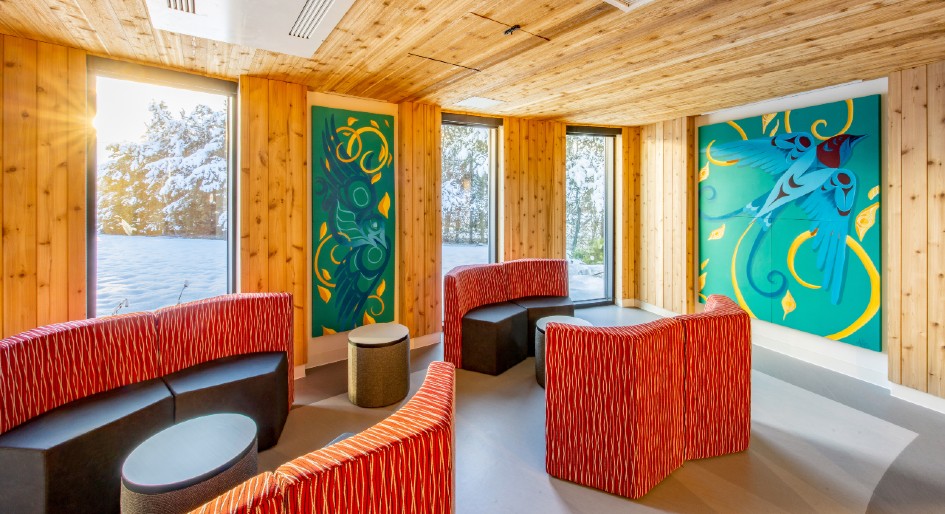
A lounge. Photo by Bright Photography. Art: Panels by Stephanie Anderson, Wet’suwet’en nation & Amanda Hugon, Salish nation.

Strengthening language through co-created signage

To revitalize and strengthen Sm’algyax—the local First Nations language where the building resides—two Tsimshian territory holders and Kitsumkalum Elders translated signage into Sm’algyax.

As some spaces use colonial terms with no direct translation in Sm’algyax, the territory holders had the right to determine translations that were culturally appropriate, recognizing the rich nuances between languages that can make direct translation difficult or impossible. Tsm’syen/Nisga’a fine arts student Shawna Kiesman collaborated with hcma’s communication designers to transform signage iconography into custom formline design.

Energy efficiency and seamless construction

Wii Gyemsiga Siwilaawksat’s housing integrates 36 prefabricated modules. Each one was built off-site to enable faster delivery times. The central structure was site-built, allowing for a unique cultural expression and creating a seamless transition between the modular construction.

The building has met British Columbia Energy Step Code 4, achieving the high energy-efficiency standard through increased insulation, careful attention to detailing, minimizing heat loss, increased level of air-tightness, and triple pane glazing.


A net zero future for windows

What will new codes and a net zero future mean for glazing and windows? The 2022 publication of Canada’s 2020 National Building Code (NBC) tiered energy code highlights a future of “net zero ready” type homes and buildings as it relates to higher standards of energy efficiency.

Andrew Oding, vice president and director of building science of Building Knowledge Canada and Jeff Baker, president of WESTLab Canada, discussed Canada’s efforts to achieve their energy efficiency goals by 2030 at the 2022 Fenestration and Glazing Industry Alliance (FGIA) virtual summer conference.

The two spoke on a panel called “Fenestration – The Path to 2030 in Canada,” moderated by FGIA director of Canadian and Technical Glass Operations, Amy Roberts.A New Code for CanadaThe two panelists provided a brief history of the evolution of window energy performance from 2004 to 2022. Then the pair shared results of a recent NRCan research project investigating current window designs, including how they are already achieving the 2030 aspirational goal and what design elements are needed to achieve different performance levels on the path to 2030.

“The NBC was published in 2022 and there are plans to harmonize [the new 2020 codes] within 18-22 months, putting us somewhere in 2024,” said Oding. “It will take jurisdictions and designers some time to get used to this.”Oding said he wanted to not just address challenges, but also opportunities. That said, he made it clear he was talking in terms of strictly energy-reduction, not carbon. “Decarbonizing discussions are just now getting underway,” he said.

Oding credited the U.S. for pioneering in some areas, including the fact that 27 states require blower door testing prior to occupancy. “The U.S. residential energy code adoption has been rapid,” he said. “It’s not just a Canadian thing. If anything, we are playing catchup.”Windows and Energy UseWindows must have a fairly good U-Value, said Oding, but noted that, as codes move forward, a risk zone is entered. “We start to risk comfort, wetting and/or indoor air quality risks when advanced enclosures are more airtight.” Baker pointed out that, out of everything else, windows are the most impactful materials in a two-storey townhome interior unit when it comes to embodied carbon.The Impact of Using More GlazingToday’s homes have lots of glass, said Oding, and cooling loads today are driven by glass. “Because of climate change and more, we are starting to see we may need a backstop on solar heat gain,” he said. “Changing a little solar heat gain can allow for homes to have smaller air conditioning systems, leading to energy savings for homeowners.”Oding recommended windows keep the relative humidity at about 35-45 per cent in the winter and 45-50 per cent in summer. Otherwise, homeowners can get dehydrated within hours, he said.A Window into the Future“The day will come in five to 10 years where the metric for homes will no longer be energy efficiency,” said Oding. “It will be carbon emissions reduction.”Baker agreed, adding that how each product is selected is going to become more and more important when it comes to solar heat gain, plus including multiple low-E coatings or low-E coatings on all three panes will also be beneficial.

“A trend we are seeing in triples is centre-of-glass coating for triple glazed glass units with argon fill,” he said, adding that those who are not yet making triples might consider doing so.When it comes to frames, there is work to be done in the future, according to Baker. “Some are trying to come up with better frame designs,” he said. “But if you are going to redesign a frame in the next few years, make sure it is scalable for the future.”