CFMD July/August 2022
Reply





Green Seal, an industry-leading environmental standard development and certification organization, now prohibits all per- and polyfluoroalkyl substances (PFAS) in certified cleaning and personal care products.
PFAS are a large group of synthetically produced chemicals that have a history of use dating back to the 1940s. The category includes over 12,000 chemicals that are often found in food packaging, coatings, personal care and cosmetics, paints, textiles, cookware, and even some cleaning products.
PFAS have carbon-fluorine bonds that make them very stable and effective at repelling oil, water, and heat, but this unique chemical structure also makes them persistent in the environment. There is evidence that some chemicals are so resistant to degradation that they could persist for hundreds of years; hence their nickname of “forever chemicals”.
They are now found in drinking water and bioaccumulate in both soil and humans, with some chemicals taking more than eight years to reach their half-life — or reduce their concentration by 50 per cent in the human body.
PFAS are associated with numerous adverse health effects, including impacts on the endocrine and reproductive systems; increased risks of prostate, testicular, and kidney cancer; and decreased immune responses — including the body’s ability to develop beneficial antibodies in response to vaccines.
“Eliminating all PFAS from the supply chain for consumer and professional care products is a critical step in protecting human health and ending the environmental contamination caused by releases of these chemicals,” says Green Seal.
Green Seal’s standards have long prohibited long-chain PFAS formally classified as hazardous. However, a growing body of evidence indicates that short-chain PFAS known as “safer substitutes” actually have the same harmful health and environmental effects as the legacy PFAS they are replacing. Green Seal’s newly expanded prohibition on all PFAS in certified cleaning and personal care products promotes safer options for consumers and recognizes industry leaders who are taking important steps to protect human health and reduce environmental pollution.
Green Seal says it is taking a product-category approach to developing PFAS restrictions as part of a multi-year phased initiative to ensure that certified products in all categories have leadership restrictions on PFAS. A product-category approach is critical to ensure our policy effectively addresses manufacturing and use considerations that vary by product category, including exposure pathways, functional performance, and regrettable substitutes.
Providing transparency
It can be challenging for consumers and even manufacturers to be sure that products do not use PFAS. For example, the chemicals are often used in raw materials, the formulas for which are often not fully disclosed to the final manufacturer.
To increase supply chain transparency and encourage the use of safer alternatives, Green Seal added criteria to prohibit PFAS in standards for the following product categories:
Green Seal focused first on eliminating PFAS in formulas for certified cleaning and personal care products because the chemicals are non-essential for the performance of these types of products. Manufacturers are now given one year to document that their certified products comply with the updated criteria.
Green Seal is now turning its attention to establishing requirements for other product category standards.
“Purchasers and manufacturers know the hazards of this class of toxic chemicals but lack reliable ways to ensure products are PFAS-free,” says Doug Gatlin, CEO of Green Seal. “Green Seal’s standard criteria now eliminate PFAS throughout the product formula supply chain for certified cleaning and personal care products while maintaining performance requirements, so buyers can choose safer, healthier, and effective products with confidence.”
Researchers at the University of Stirling in Scotland have emphasized that removing pathogens from a facility via waste disposal doesn’t eliminate the threat of infection entirely.
The research, published in the journal Environmental Pollution, found that viruses can survive and remain infectious by binding with plastics in water sources. The result is that even when pathogens are cleared from facilities via cleaning and flushing them into sewers, they remain hazardous.
In fact, rotavirus can survive and remain infectious for up to three days when binding with microplastics. The study also found that gastrointestinal viruses in sewage are able to bind to small bits of plastic waste and then enter waterways, including rivers and lakes.
Although pathogens and viruses with lipid coatings such as the flu virus died quickly when in the freshwater environment, those without lipid coatings, such as the norovirus, could survive.
“Even if a wastewater treatment plant is doing everything it can to clean sewage waste, the water discharged still has microplastics in it, which are then transported down the river, into the estuary, and end up on the beach,” said Richard Quilliam, a professor of environment and health at Stirling University and coauthor of the study. “We weren’t sure how well viruses could survive by ‘hitch-hiking’ on plastic in the environment, but they do survive, and they do remain infectious…It doesn’t take many virus particles to make you sick.”
Ultimately, the report concluded that companies and facilities can go some way to helping to prevent infectious viruses in the waterways by decreasing their use of plastics and following proper plastic disposal/recycling protocols.
The challenges of managing building maintenance services can be daunting for property managers and are growing even more so with rising inflation.
In light of recent news about its extent and effects, inflation, in combination with tight labour markets, is compounding the rising wages in the frontline service workforce.
That is concerning as building maintenance services are mostly performed by frontline service personnel.
As inflation rates across Canada hit a new all-time high of 7.7 per cent in May 2022, frontline service personnel are increasingly demanding higher wages in order to keep up with the cost of living.
This high inflation is not only confined to Canada, as inflation in the United States reached a 40-year high of 8.6 per cent in May 2022.
The past few years have seen a trend of wage erosion for frontline service personnel that has accelerated with the pandemic. This recent inflation, however, has caused an unprecedented decline in their purchasing power for the first time in decades, leading them to an increasingly difficult financial position.
Basic necessities account for a higher proportion of wages for frontline service personnel. With over 10 per cent increases across essential goods and services, they’re now spending even more on basic living expenses, such as groceries and rent to make ends meet. Therefore many of them are pushing for higher wages to keep up with the rising cost of living.
Property managers and building owners are also beginning to feel the effects of rising costs as they attempt to compete in a market that is becoming increasingly more expensive.
Existing contracts with service providers offer some protection against the rising costs, but as costs continue to rise, property managers and building owners will need to adjust to these trends in their budgets.
We can already see this from the recent pushback by janitors in Toronto who came to an agreement in early May 2022 for a wage increase of 6.4 per cent in the first year of their new agreement, and a 16.6 per cent increase over the life of a three-year deal. This is the largest wage increase ever won by janitors in the service industry.
One way that property managers are trying to combat the increasing cost of frontline service work is by signing longer-term maintenance service contracts. By locking in a price for a longer period of time, they hope to avoid having to increase their budget due to inflation.
However, these contracts are becoming increasingly expensive as suppliers need to offset their rising costs due to their already strained margins. This cost would be carried on to property managers and building owners, who may have no choice but to either reduce their spending in other areas or accommodate the rising costs in their budgets.
Some property managers have also adapted by attempting to more collaboratively work with their service providers on the scope of work for their buildings – adjusting frequency and expectations, reassessing live-in superintendent strategy in the face of increased rent and a smaller pool of candidates, or bundling up properties under the same provider to reduce service provider fragmentation.
Even if inflation diminishes over time, wages of frontline service personnel are expected to continue rising or level at a new higher standard due to the tightness in the labour market which is contributed by:
For service work outside metropolitan areas, the impact of labour market tightness is even more pronounced. The reduced availability of frontline personnel in smaller population pools leads to higher expectations in wages and benefits, which can have a significant impact on the overall cost of service work.
This problem is emphasized as now tenant expectations only grew in scrutinizing the cleaning practices and standards in their building due to the pandemic and considerable rent increase they have experienced.
Additionally, the tight labour market and flat rates for service providers force many providers to employ whomever they can find, leading to high attrition, loss of consistency, and in many cases, a less experienced workforce.
So while property managers may be able to employ short-term solutions through contractually locked prices and other means, service provider prices will have to go up to balance the rapid increase in worker compensation in the mid-long term.
The tightness of the market when it comes to service personnel is in direct contradiction with the expectation of tenants, residents, and visitors to buildings where cleanliness and maintenance are a top priority for tenants and visitors; especially since the pandemic brought building cleanliness and maintenance to the forefront of people’s minds.
Moving forward, the industry must monitor the market closely to understand the developing trends and work with property managers to make the best decisions moving forward.
Charlotte Gummesson is co-founder of iRestify and strives to modernize antiquated industries to create and drive greater efficiencies. Through the combination of a fully integrated tech platform and professional cleaning and management teams, iRestify has been vastly improving service levels for many of the top brands in North America.
Industry veteran Wilson M. Beck, founder of Wilson M. Beck Insurance Services, has passed away.
Beck was an active member of the business community serving on a variety of boards. He was the past chair of the Terminal City Club, the Vancouver Regional Construction Association and the BC Construction Association. He was also an active member of the BC Roadbuilders Association and a Lifetime Member of the Independent Contractors and Businesses Association.
Beck, the youngest of nine siblings, was born in Peterborough, Ontario. His family moved to B.C. when he was three months old. A few years after graduating from high school, he began his career in the insurance industry in 1957. After working his way up in the industry, he founded his namesake brokerage in 1981 with seven other people, specializing in in the niche of contract bonding and insurance for the construction industry. He was very proud to see his once small firm grow to become one of Canada’s largest privately held commercial insurance brokerages now with more than 250 staff in offices spanning from Victoria to Toronto.
The family says he was very grateful for the many enduring friendships he forged during his 65 years in the industry. He wanted to extend a heartfelt “thank you” to all of the clients, staff and insurance and surety companies with whom he had the fortune to work with over the past many decades.
Beck is survived by his wife and large extended family. In lieu of flowers, Wilson’s family would encourage donations be made to the North Shore Hospice or a charity of your choice.
** From Construction Business, publisher, Dan Gnocato:
“I had the pleasure of directly working with Wilson in the very early years of WMB while building the WMB brand to what it is today. Wilson was always a gentleman and an integral part of the B.C. Construction family. I have fond memories of great laughs and brainstorming marketing initiatives in his office. My condolences to David, the Beck family and the entire WMB team. “
Victoria has introduced a new bylaw designed to salvage valuable wood and other construction materials from homes being demolished in the city.
The new rules are expected to divert up to 3,000 tonnes from landfill each year. Victoria is the first community on Vancouver Island, and one of only three in Canada, to implement such a bylaw.
Construction waste makes up more than one-third of all waste generated in the city. Each demolition under the new bylaw will recover more than five tonnes of old-growth lumber that would otherwise be sent to the landfill, in addition to 50 tonnes of recyclable building materials. City staff will work closely with industry to guide them through meeting the established salvage targets.
The new regulations were developed in consultation with industry in order to create a bylaw that works for Victoria and the construction and demolition sector.
The new rules will be phased in to give industry time to prepare for the new requirements. The first phase will come into effect in September and will apply to demolition of single-family dwellings and duplexes built before 1960 that are being demolished to build another single-family dwelling or duplex.
The second phase, starting in May 2025, will apply to demolition of all single-family dwellings and duplexes built before 1960, including those being demolished to build multi-family housing.
After the bylaw has been in place for one year, a fee will be applied to permits that is fully refunded when builders meet the wood salvage targets set under the new regulations.
Reducing construction waste was one of the priority actions identified in Zero Waste Victoria approved by council in December 2020. The plan guides Victoria’s transition to a future where products and materials are avoided, reduced and reused instead of disposed in the landfill.
Canada continues to contribute leaders and exemplary buildings to guide the international membership of the Building Owners and Managers Association (BOMA). Randal Froebelius, president of Equity ICI Real Estate Services, officially took office as BOMA International’s 2022-23 chair earlier this week during the organization’s annual conference and expo in Nashville, Tennessee, while three Canadian buildings secured International TOBY awards, the top prize in a three-stage competition recognizing operational and managerial excellence.
The owner/manager team of Canada Life Assurance Company and GWL Realty Advisors received two separate TOBY honours for:
Meanwhile, the TOBY in the industrial building category was awarded to 6990 Creditview Road, Mississauga. It is owned by MNBP Single and Flex Holdings Inc. and managed by QuadReal Property Group.
Froebelius advances to his new role after being elected as vice chair in 2020. He is a past chair of BOMA Toronto and BOMA Canada, and carries the prestigious the BOMA Fellow designation. He has more than 25 years of experience in commercial real estate industry, currently in providing leasing, property and facilities management services to institutional owners and as part of the real estate operations team at Toronto’s innovation incubator, MaRS Discovery District.
Reflecting on BOMA International conference events — which also saw Keith Major, managing partner and head of Canadian real estate management with BentallGreenOak, inducted into the select group of BOMA Fellows and Laura Sharen, a senior property manager with Canderel Management in Edmonton, named the Canadian regional member of the year — BOMA Canada president and chief executive officer Benjamin Shinewald maintains it’s indicative of Canadian influence in the commercial real estate industry globally.
“Individually and collectively, this is the best of Canada, and we’re energized and excited to deepen our impact in making our industry smarter, healthier, more sustainable and more diverse,” he asserts.
The Ontario government has set the 2023 rent increase guideline at 2.5 per cent, a rate much lower than inflation. This represents the maximum amount a landlord can increase rent during the year for most tenants without the approval of the Landlord and Tenant Board.
The guideline is based on Ontario’s Consumer Price Index, a measure of inflation calculated monthly by Statistics Canada using data that reflects economic conditions over the past year. Due to recent inflation, a 2023 guideline of 5.3 per cent might have been expected by many; however the government said it set the guideline lower to protect vulnerable tenants.
“As Ontario families face the rising cost of living, our government is providing stability and predictability to the vast majority of tenants by capping the rent increase guideline below inflation at 2.5 per cent,” said Steve Clark, Minister of Municipal Affairs and Housing. “We continue to look for ways to make homes more attainable for hardworking Ontarians, while making it easier to build more houses and rental units to address the ongoing supply crisis.”
The guideline applies to the vast majority of rental households (approximately 1.4 million) covered by the Residential Tenancies Act. It does not apply to rental units occupied for the first time after November 15, 2018, vacant residential units, community housing, long-term care homes or commercial properties.
Rent increases are not automatic or mandatory. Landlords may only raise rent if they gave tenants at least 90 days’ written notice using the correct form. In addition, at least 12 months must have passed since the first day of the tenancy or the last rent increase.
For more information, click here.
The Highway 91/17 Upgrade Project in Delta, B.C. is nearing a milestone with two new interchanges opening this summer.
These interchanges will provide time savings and better safety for local and commercial vehicle traffic south of the Fraser River.
The first to open will be the interchange at Highway 91C and Nordel Way in early July. In addition to improving the movement of goods through the province, local benefits of this interchange include:
The interchange at Highway 17 and Highway 91 Connector (Sunbury) is expected to open this summer. Key benefits of this interchange include:
Various lane closures will be in effect while crews work to complete the two intersections.
The $260-million Highway 91/17 and Deltaport Way Upgrade Project was designed to improve road safety and support growing economic and trade development.
Funding partners include the Government of Canada, through the National Infrastructure component of the New Building Canada Fund, the Province of British Columbia and the Vancouver Fraser Port Authority.
The $5.2-million 27B Avenue upgrades component of this project is complete. It was funded by the Tsawwassen First Nation.
The Highway 91/17 and Deltaport Way Upgrade Project is being managed by the Ministry of Transportation and Infrastructure, and is on track for substantial completion in fall 2022.
Vancouver city council has approved the Broadway Plan, providing a 30-year framework that will integrate new housing, job space, and amenities with the new Broadway Subway line.
The Broadway Plan will guide growth and change in the area that is generally located east to west between Clark Drive and Vine Street, and north to south between 1st and 16th Avenues.
“The Broadway Plan is an important opportunity for our city to leverage the significant investments in the Broadway Subway that improves transit access to the rest of the city and the region,” said City of Vancouver general manager of planning, urban design and sustainability Theresa O’Donnell.
“It’s a plan that will work to meet the needs of today’s residents and generations in the future by adding much-needed housing for all incomes, especially renters. This plan will create more job space near transit to support our growing economy and will make it easier to live, work and get around in lively, diverse neighbourhoods.”
A key goal of the Broadway Plan over the next three decades include adding up to 30,000 additional homes at all income levels with 46 per cent of the homes classified as market rentals, 12 per cent social housing, seven per cent below-market rentals and 34 per cent as market strata.
Other goals include:
The Broadway Subway project is scheduled to complete in 2025.
A newly released examination of deep retrofit logistics finds that few of the existing technologies projected to help dramatically curb greenhouse gas (GHG) emissions have yet conquered their market categories. The study from the Canada Green Building Council (CAGBC) and the Delphi Group assesses 27 strategic building products and systems for availability, affordability and degree of adoption within the industry, and concludes that only eight figure positively for all three of those considerations.
“In this moment of supply challenges and climate crisis, there is an opportunity to redefine the building sector by shifting our focus to sustainable building technologies and products,” the study authors maintain. “There are clear technical interventions needed to achieve energy and carbon reductions in Canada’s building stock. The readiness of key technology and products will inhibit or accelerate the market’s capacity to undertake green retrofits.”
Electrical and mechanical equipment have made greater progress toward being the status quo, while more obstacles to market penetration are noted for building envelope technologies and renewable energy systems. The eight products already enjoying wide uptake include: LED lighting products; lamps and ballasts; premium efficiency motors; variable air volume (VAV) systems; airside economizer damper controls; modulating burners; demand-controlled ventilation; and distribution system insulation.
The study reiterates that market awareness, a steady supply chain and competitive pricing will be needed to encourage the rollout of low-carbon technologies on the scale required to achieve emissions reduction goals. It also calls for a priority focus on six key technologies identified as “having greater relevance on the future of building improvements”. These are:
Heat and energy recovery systems are deemed to have the narrowest gap to close. The assessment concludes that the industry has a good grasp on how to specify, install and operate the technology and that it is readily available in Canada, but that it still comes at a moderately higher price than conventional alternatives. Currently, the systems — which can extract waste heat from ventilation systems, chillers, hot water drains and/or sewage — are more typically a feature of new construction than retrofits.
Cost and requirements for a certain level of operational proficiency are considered the main impediments for building automation systems, which optimize performance through the smart integration of multiple systems, including HVAC, lighting and security. Meanwhile, the study contends the North American market is far from embracing the full potential for heat pumps, which come with some cost hurdles and other complications for retrofit projects.
“Air-to-water and cold climate air-source heat pump technology do exist but the number of options available in the North American marketplace is still very limited. High-efficiency electric technology for central domestic hot water applications is less widely available, especially for larger commercial and institutional applications,” it states. “In the case of retrofits, the installation of heat pumps may also be reliant on drilling wells in parking lots which require skills and equipment that is not widely accessible.”
Of the remaining key technologies, energy storage and BIPV rank somewhat higher for industry familiarity than wall recladding systems, but all three struggle with cost and availability factors. In a rare example, wall recladding was a major contributor to last year’s Passive House certification of the Ken Soble Tower, an aging building in the City of Hamilton’s subsidized housing portfolio and the largest residential building in the world thus far to be retrofitted to the Passive House standard.
“Wall cladding involves laying material over another material to form a ‘skin’ on the walls to increase efficiency. Wall recladding systems are not widely available and can be expensive. They are not in use across the industry despite being associated with substantive carbon and energy savings,” the deep retrofit logistics study affirms.
Related to the building envelope, BIPV are solar power generating products or systems incorporated into facades, roofs and/or windows. They are reportedly experiencing “substantive market growth in Europe and the United States” but are seldom seen in Canadian retrofit projects.
Energy storage is considered instrumental to peak demand management, the transition to renewable power sources and climate change resiliency — allowing for offloading from the electricity grid or providing backup power. For now, the deep retrofit logistics study deems it is “not yet widely available or cost-effective in the Canadian marketplace”.
Other building products and technologies identified as having made few inroads in market awareness, availability and affordability include: high-efficiency curtain walls; roll-up receiving doors with high R-value; and hybrid wind and photovoltaic renewable energy systems.
Related to the building envelope, thermal break technology and energy-efficient windows and doors are deemed widely available, but still pricier than conventional alternatives and lacking industry uptake. Perhaps more curiously, reflective roofs are flagged as affordable and widely available, but still short on industry buy-in.
Aside from heat pumps, electric high-efficiency domestic hot water is the only mechanical technology where analysts conclude across-the-board improvement is needed in awareness, availability and affordability. Electric vehicle chargers are similarly characterized among electrical equipment.
In large part, green building specialists link the varied pace of industry uptake to the likewise diverse life cycles of building systems and components. While it’s a certainty that some equipment will be replaced multiple times before 2030 or 2050, there will be far fewer opportunities to invest in other technologies.
“Different parts of the building last different lengths of time and you have to look for these natural inflection points of when the boiler is actually due to be replaced, the windows are due to be replaced, the roof is due to be replaced,” Steve Kemp, a principal with RDH Building Science, told attendees at CAGBC’s recent annual conference in Toronto. “Wall systems last a long, long time so we may not be getting all buildings replacing their walls in time to help us make these targets.”
That said, he welcomes new technologies and products.
“We have equipment gaps,” Kemp advised. “We need kit for repurposing existing buildings.”
ISSA, the worldwide cleaning association, has announced the formation of the ISSA Sustainability Council.
A release notes that the ISSA Board of Directors “realizes there is a significant need to take a leading role in the cleaning industry to assist ISSA members with their sustainability efforts”.
Under the leadership of ISSA Board members Amir Karim and Ailene Grego, the Sustainability Council will include members from manufacturing, distribution, and service providers.
The ISSA Sustainability Council members include:
“The official launch of the ISSA Sustainability Council was a critical next step in helping our members define sustainability and begin building out resources to help them navigate this ever-changing topic,” said ISSA Director of Education, Training, Certification & Standards Brant Insero.
The ISSA Sustainability Council has approved an ISSA Alliance Membership with The Value Reporting Foundation’s Sustainability Accounting Standards Board (SASB) Standards. This new alliance membership allows ISSA to directly assist with standards development for sustainability so that the voice of the association’s members will be heard.
As part of the alliance membership, ISSA will work with Value Reporting Foundation to provide content, standards, and support related to the reporting of data points supporting environmental, social, and governance (ESG) that are relevant to the financial performance of the industry.
In addition, the council will participate in a panel discussion on sustainability at the ISSA Show North America 2022 in Chicago on October 10 at 3 p.m. An All-Access Pass is required to attend all educational programming.
For more information on the council, visit https://www.issa.com/about-issa/committees-councils/sustainability-committee.
The Canada Green Building Council (CAGBC) is aiming to simplify the criteria for complying with its zero carbon design standard, while also pushing forward with more rigorous performance goals. The newly released version 3 of the zero carbon building (ZCB) design standard relaxes the earlier thermal energy demand intensity (TEDI) target for projects that eliminate gas-fired systems for space heating, and introduces a new prerequisite related to embodied carbon.
The trade-off on TEDI in favour of electrification gives more budgeting flexibility for project proponents to prioritize either HVAC or building envelope options. However, in all cases, the updated standard consigns combustion heating to backup status with the requirement that it only be used when outdoor temperatures fall below minus 10 Celsius — a threshold reflective of the functional capability of most currently available heat pump products.
The new prerequisite for embodied carbon gives project proponents the option of choosing an absolute target or relative improvements over a baseline figure. The updated standard also promises “more flexibility to better recognize smart design choices” in calculating energy performance.
“These updates to the ZCB-design standard are informed by two years of market and project feedback, as well as changing market expectations of operational and embodied carbon emissions,” reports Thomas Mueller, the CAGBC’s president and chief executive officer.
“The intent is to reduce the cost and effort required to achieve the desired outcomes of certification, and to open the standard to as many projects as possible,” concurs Doug Webber, principal and co-founder of the consulting engineering firm Purpose Building, and chair of the zero carbon steering committee.
The average monthly rent in the Greater Toronto Area (GTA) has increased 16.5 per cent since May 2021, according to the latest report from Bullpen Research & Consulting and TorontoRentals.com.
Although average rents are still a little below what they were in May 2019, reduced supply coupled with increased demand from immigration, the return of students, and recent graduates moving out of their parents’ homes have contributed to the rapid rise that we will likely continue to see throughout the year.
“The average GTA rent shot up month over month in May, rising by 5.7 per cent, the highest monthly increase since this data was first reported in 2018,” observed Ben Myers, president of Bullpen Research & Consulting. “Investor-owned condominiums led the way, experiencing significant annual growth of 25 per cent from May of last year. High demand for downtown rental properties, coupled with less supply due to rates hikes and delayed occupancies of new projects as a result of labour stoppages and supply chain issues are all contributing factors to the rent inflation.”
Adding to these tight conditions, fewer people tend to move during uncertain economic times, and thus more would-be first-time home buyers are remaining in the rental market.
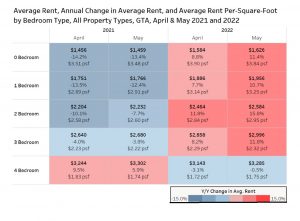 Key facts & stats
Toronto had the highest average monthly rent for condominium rentals and apartments at $2,438, an annual increase of 19.8 per cent.
Burlington and Etobicoke followed closely, with average monthly rents of $2,233 and $2,263 per month respectively, with year-over-year increases of 18.3 per cent 17 per cent over May of last year.
The highest rents in GTA neighbourhoods from January to May for condominium rentals and apartments were in the Bay Street Corridor at $2,764 per month, an increase of 12 per cent over 2021 overall, and 1 per cent over 2019, the year when rents peaked.
The highest rent growth overall has occurred in Mississauga’s city centre, with rent for condo rentals and apartments up 28 per cent annually to $2,728 per month. Core rents are 17 per cent higher than they were in 2019.
Areas with annual rent growth of 16 per cent to 19 per cent include North St. James Town, Kensington-Chinatown, The Annex, Mimico and Niagara.
For the full report, visit Toronto GTA June Rent Report 2022 (torontorentals.com)
The Ontario government is signifying extra emphasis on housing with the addition of an Associate Minister for the file. Michael Parsa, the member of provincial parliament for Aurora-Oak Ridges-Richmond Hill, will take on the role alongside Steve Clark, who stays in place as the Minister of Municipal Affairs and Housing.
Premier Doug Ford’s newly sworn-in 29-member cabinet returns several Ministers to portfolios they represented prior to the June 3 provincial election. In addition to Clark, some of the continuity in key roles includes: Peter Bethlenfalvy as Minister of Finance; Todd Smith as Minister of Energy; Vic Fedeli as Minister of Economic Development, Job Creation and Trade; Monte McNaughton as Minister of Labour, Immigration, Training and Skills Development; Caroline Mulroney as Minister of Transportation; and David Piccini as Minister of the Environment, Conservation and Parks.
Of interest to property and facility management, Raymond Cho also remains in the role of Minister of Seniors and Accessibility. Meanwhile, Kinga Surma continues on as Minister of Infrastructure, but now has an expressly stated additional mandate for government real estate. Paul Calandra remains Government House Leader, but adds a new responsibility as Minister of Long-term Care.
“It’s all hands on deck,” Ford declares. “With big challenges ahead, including an uncertain global economic climate, now is the time for unity and working together.”
Kryton International has opened a new state-of-the-art manufacturing facility in Calgary. The plant is operated by Cementec Industries Inc., a wholly owned subsidiary of Kryton, and replaces Cementec’s previous plant, which had reached the end of its design life and was no longer able to keep up with the rapidly growing demand for Kryton’s innovative and sustainable building products.
“These innovative materials, developed in Calgary, extend the service life of concrete structures and infrastructure while greatly reducing their carbon footprint — both in their construction and over their life span,” said president and CEO of Kryton Kari Yuers. “These products appeal to designers and builders who are looking to build more sustainable, climate-resilient structures, and we are now exporting Hard-Cem beyond North America to China, Australia, Mexico, and Europe.”
The new facility is itself sustainably built and incorporates the products produced there into its own construction. Designed to achieve 10 times the capacity of the old plant, the new plant is highly automated and is expected to deliver great gains in energy efficiency and productivity.
The Honorable Jonathan Wilkinson, Canada’s Minister of Natural Resources, offered congratulations to the team from Kryton International and Cementec.
“The global economy is changing rapidly. Around the world, financial markets are increasingly pricing climate risk into investment decisions. Canadian businesses can choose to be leaders in the global economic shift that is happening or they can have it happen to them,” said Minister Wilkinson. “I am very pleased that Kryton International, through its subsidiary Cementec Industries, has chosen to be a leader with homegrown Hard-Cem technology that kills two birds with one stone. It increases concrete durability while reducing lifetime carbon emissions. It’s good for the planet and good for industry — an industry that will be extremely important to Canada’s decarbonization efforts. Investments like this clearly demonstrate the economic opportunities presented in Alberta and right across this country as we shift to a lower carbon future.”
In keeping with the team’s rebuild, the Ottawa Senators are bringing a new roster of development players to a revived proposal for a downtown home for the city’s National Hockey League (NHL) franchise. The National Capital Commission (NCC) has signed a memorandum of understanding (MOU) with the consortium, Capital Sports Development Inc. (CSDI), towards a future ice arena, entertainment venue and adjoining mixed-use development on the vast tract known as LeBreton Flats.
“This is another important step in the implementation of our Building LeBreton plan: the start of an incredibly exciting and transformative city-building project that will become a landmark and major destination in the National Capital Region,” says the NCC’s chief executive officer, Tobi Nussbaum.
The MOU follows the abandonment of an earlier attempt to build a major sports facility on the long-vacant lands near the Ottawa River waterfront. This time, the consortium includes: Sterling Project Development, the developer and project manager behind the recently constructed new facility for the NHL’s New York Islanders; the global design firm, Populous, which brings experience in designing major sports facilities in North America and United Kingdom; the sports finance and advisory firm, Tipping Point Sports; and the event producer and promoter, Live Nation.
“We believe that this development will have a major impact on both the National Capital Region and our franchise — one that will help to shape the future of the city,” says Anthony LeBlanc, president of business operations for the Ottawa Senators. “We thank the NCC for their collaboration, and look forward to working alongside them as we take the next steps on this exciting journey.”
The two parties to the MOU are aiming to have an implementation plan and a long-term lease agreement in place for autumn 2023.

