



Articles Archive - Page 286 of 928 - REMINET
REMI

Property tax relief looks iffy in New Brunswick

Property tax relief could be short-lived for New Brunswick’s commercial and industrial ratepayers. Beginning in 2023, municipalities will have flexibility to pull more revenue from their non-residential tax base, potentially cancelling out a phased 15 per cent reduction in the provincial property tax rate that was introduced earlier this year.

“The provincial tax rate in New Brunswick was the highest in Canada. It was offside,” says André Pouliot, senior manager, property tax, with the Atlantic Canada based real estate advisory firm, Turner, Drake & Partners. “Basically, 50 per cent of the (property) taxes you paid in New Brunswick went to the province.”

That’s a burden assigned to residential landlords, commercial and industrial property owners since owner-occupiers of residential properties have long been exempt from the provincial levy. Notably, non-occupier-owned residential properties are now in line for a phased 50 per cent provincial tax cut, to be complete by 2024, in tandem with the phased 15 per cent decrease for non-residential properties.

Meanwhile, the provincial property tax reduction is one of just three new measures the New Brunswick government adopted in a roughly six-month period between December 2021 and June 2022. Last fall, it stretched the allowable residential-to-non-residential property tax ratio from the traditional 1-to-1.5, giving municipalities leeway to tax non-residential properties at anywhere from 1.4 to 1.7 times the residential rate.

This spring, it carved out a new heavy industrial tax class encompassing a range of defined activities such as manufacturing, mining, milling, electricity generation, oil/natural gas extraction, processing and storage, along with the manufacturing/processing of “products, material or substances” and other uses that might be prescribed in future regulations. This allows for the application of differing tax rates on heavy industrial versus commercial/light industrial properties, although the latter uses will be taxed at the heavy industrial rate if they are located on an integrated campus with heavy industrial activities.

Municipalities will have these new taxing opportunities in place for the 2023 tax year, presenting the possibility that some non-residential ratepayers could see further tax relief if local councils opt to adjust the rate down to 1.4. However, most informed observers suggest that won’t be the prevailing trajectory. Pouliot also notes that New Brunswick’s residential-to-non-residential ratio is deceptive in the context of national surveys that peg the average discrepancy much wider — for example, at 2.73 times the residential rate in 2021.

“1.5 times is actually a pretty competitive multiplier if you look at it compared to other jurisdictions, but when you factor in that non-residential pays provincial taxes and homeowners don’t, the multiplier ends up being close to three times,” he advises.

New tax class creates uncertainty around a peculiar assessment rule

Creation of the new heavy industrial tax class is seen as a response to active lobbying from the City of Saint John. Elsewhere, Pouliot speculates most municipalities wouldn’t derive a lot of extra revenue from singling out such properties for a steeper tax allocation. Alternatively, it might be used as a means to give those industries a tax break compared with commercial/light industrial properties.

In an online commentary following the early June introduction of the enabling legislation, Rob Newman, director of property tax with Altus Group in New Brunswick, expressed trepidation about the provincial government’s ability to designate further categories of property as heavy industrial through future regulations. He called that particularly egregious in combination with one of the marked peculiarities of New Brunswick’s property assessment system, which does not provide an avenue to challenge the property classification once assessors have established it.

“In essence, anything can be prescribed as heavy industrial at the province’s discretion. The bill is extremely open-ended and affords much power to municipalities and the province,” Newman maintained. “Yet, in New Brunswick, according to the Assessment Act, classifications cannot be questioned or reviewed in any court, leaving taxpayers at a real disadvantage.”

“It’s completely unreasonable,” Pouliot concurs. “In a system where the government determines the value, the government determines the tax class and the onus is on property owners to prove they’re right if they challenge that, it’s absurd that they can tell you: This is your class and you don’t have any recourse to disagree.”

That said, the language in the Assessment Act refers to whether a property is deemed residential or non-residential so he interprets that as a potential opening to appeal wrongful categorization within what are now two non-residential classes. “If you’re a commercial owner who ended up in the heavy industrial class for some reason, you should be rightly entitled to take it to a hearing,” Pouliot submits.

As municipalities get leeway to collect more revenue from non-residential property owners, it hasn’t yet been made clear how the province will recoup the property tax it will be foregoing. “Do they collect more income tax? Is it carbon tax that they’re going to use to offset it? We don’t know what the future looks like,” Pouliot says.

The New Brunswick government has historically redistributed some of its share of the levy as equalization grants to assist municipalities where the per capita value of their assessment base falls below a certain threshold. This year, $53.2 million in equalization grants were paid out to 68 municipalities in sums ranging from a few thousand dollars to upwards of $15 million for Saint John. A pullback from the practice would likely be more encouragement for municipalities to push their non-residential tax rates up above 1.5.

“The question would be whether the municipalities that get equalization would get enough to cover it from that multiplier change or whether they would have to increase the base rate as well. Under that scenario, homeowners and businesses would be paying more, and non-residential would get hit on both the base rate and the tax rate,” Pouliot muses.


Lien rights upon termination of head contract

A recent decision of the British Columbia Supreme Court re-visits the issue of when the lien period starts to run upon termination of a head contract.

In Frontier Kemper Constructors, Inc. v. Rio Tinto Alcan Inc., 2022 BCSC 868 (Frontier), the owner brought a preliminary application to the court to strike a Claim of Lien, arguing it was filed out of time based on the date that the head contract was terminated.  The court was not asked to decide, however, the validity of the termination, which was disputed by the Contractor. The court’s reasoning and conclusions provide an important reminder to owners and contractors that the means and methods of termination of a head contract could impact key timelines for lien rights.

The Builders Lien Act, S.B.C. 1997, c. 45 (BLA) creates the right to place a lien on title to land, thereby securing the rights of those who contribute to improving land. The BLA was drafted with the intent of balancing the interests of those who perform work with those who receive the benefit of that work.  As the BLA creates rights not otherwise available in law, its provisions must be strictly followed and the courts have no power to extend the timelines allowed for filing liens. These overriding principles guide courts in their interpretation of the BLA.

The fact pattern in Frontier is not unusual. In early April 2020, the owner provided the contractor with a default notice indicating that the contractor was in breach of the contract by ceasing production and reducing its workforce on site. As was required by the contract, the owner provided the contractor with notice that it was required to remedy the breach.

On April 22, the owner provided notice to the contractor that it had failed to rectify the breach and accordingly the contract was terminated effective immediately. On June 8, 2020, the contractor placed a $96.9M lien on title to the lands, securing its claim for unpaid work.

Section 20(2)(a) of the BLA provides that a claim of lien may be filed no later than 45 days after a head contract has been terminated (this clause does not apply to a trade contract or subcontract). The date of termination of the head contract, therefore, triggers the commencement of the 45 day deadline to file a claim of lien.  An owner may apply to strike a claim of lien where it is defective, but when an application to strike is brought in the early stages of litigation, a court has a limited scope of review as the issues have not been fully determined between the parties.

In Frontier, the owner brought an application to strike the lien, arguing that the lien was filed out of time because it had not been filed within 45 days of the date of the termination notice. The owner argued that it had followed the terms of the contract which required it to provide a default notice, an opportunity to rectify the default, and then a termination notice. While the owner acknowledged that on this preliminary application the court was not being asked to determine the validity of the termination itself, it had complied with the requirements of the contract and therefore had “terminated” the contract for the purpose of the BLA.

While the contractor accepted receipt of the termination notice, it disputed that the contract was validly terminated. The owner could have only provided a proper default notice if the contractor had breached the contract – and that had not yet been established. Additionally, the owner could only have terminated the contract on April 22 if the contractor had failed to rectify the breach – and that had not yet been established.  As this was a preliminary application brought to cancel the lien, the contractor argued that it was outside of the court’s powers to determine the contract had been terminated on April 22, for the purpose of striking the lien.

The court considered whether it was possible for it to make a finding that the owner had terminated the contract for the purpose of s. 20(2)(a) of the BLA, by satisfying the notice requirements for termination found in the contract, but still leave the issue of the validity of the purported termination unresolved. Noting that “termination” is not defined in the BLA, the court reviewed the purposes of the BLA and the wording of section 20 which requires that the contract “has been … terminated”. Ultimately, the court concluded that it would be inconsistent with the objectives of the BLA if a contract could be terminated for the purpose of the BLA when a court might later decide that it had not been properly terminated.

Accordingly, the court concluded that it could only strike a lien on a summary basis based on the expiration of the 45 day time limit for filing a claim of lien under section 20(2) of the BLA in circumstances where the parties agree that the contract between them was terminated, where one party expressly accepted the other party’s election to terminate the contract, or where the head contract allowed one party to terminate unilaterally.

From an owner’s perspective, the effect of this decision is that, the only way an owner who is contemplating the termination of a head contract can guarantee for itself that the 45 day period to file a lien will start to run upon termination is if the owner unilaterally terminates the head contract. Under standard construction contracts, however, the unilateral termination of a contract will trigger financial obligations payable by the owner to the contractor. Leaving some uncertainly as to the closing of the 45 day lien period may outweigh the financial obligations that could arise from unilateral termination.

However, from a contractor’s perspective, this decision does not render the 45 day lien period irrelevant upon termination of a head contract. While the court was unable on this preliminary application to determine whether the head contract had been validly terminated, the validity of the termination remains alive for an eventual determination on the merits and a lien filed after 45 days could still be found out of time.

Accordingly, contractors, whether they agree as to the validity of a termination notice, must still ensure that they file claims of lien within 45 days of any purported termination of the head contract. However, a prudent contractor may also choose to dispute the validity of a head contract termination notice to potentially postpone the commencement of the 45 day lien period, particularly in circumstances where there is uncertainty as to the closure of the lien period.


Rebecca Cleary is associate counsel and member of the construction and engineering practice at Alexander Holburn Beaudin & Lang LLP.

Stantec selected as PMC for Iona treatment plant

Stantec has been selected as the program management consultant (PMC) for the Iona Island Wastewater Treatment Plant (IIWWTP) projects in Vancouver. The $9.9 billion multi-year program includes construction of a new tertiary treatment facility and a range of ecological restoration and off-site works projects that will improve the connection between infrastructure, the community, and the environment.

The IIWWTP projects are the largest capital program ever undertaken by Metro Vancouver—a federation of 23 municipalities, one electoral area, and one treaty First Nation that collaboratively plans for and delivers regional-scale services.

As the selected PMC, Stantec will provide a multi-disciplinary team of resources to deliver a broad range of program management and technical support services. The Stantec team will integrate with Metro Vancouver staff, working together collaboratively to manage the development and implementation of the Program.

“It’s a privilege to help deliver such a transformational project with Metro Vancouver,” said Ryan Roberts, Stantec’s North American water business leader. “Our local and global experts have extensive experience delivering major, multi-year wastewater programs that will work in partnership to achieve Metro Vancouver’s safety, schedule, budget, and quality objectives for this critical program. This program will be a shining example for large water infrastructure programs for communities around the world.”

The IIWWTP will be designed with consideration of local First Nations and community stakeholders and will increase the level of treatment to improve both water quality and the surrounding marine environment.

With a focus on recovering sustainable energy from wastewater, it will integrate with surrounding ecological restoration efforts and provide economic opportunities for First Nation entities. The project also aims to improve seismic resiliency to withstand earthquakes, combat potential sea level rise, and mitigate other anticipated impacts a changing climate may have on the facility throughout the 21st century.

BMO Centre expansion taking shape in Calgary

The BMO Centre expansion, on schedule for its opening in June 2024, has begun to take its dramatic shape in Calgary. One third of the project’s 9,000 metric tonnes of steel is already rising high above the Midway.

The $500M expansion is already garnering significant interest for groups vying to bring their events and conventions to the facility. The team at the Calgary Stampede is preparing to once again welcome the world when the convention centre opens.

“The sheer scale of the building and its dramatic addition will be clear to guests the minute they set foot onto Stampede Park,” says Joel Cowley, chief executive officer, Calgary Stampede. “The expanded BMO Centre will showcase both the bright future of the Stampede as well as the welcoming western hospitality that sets the Stampede apart from other convention venues.”

Featuring over 1 million sq. ft. of space in the heart of Calgary’s emerging Culture + Entertainment District, when the expansion is complete, the BMO Centre will be Western Canada’s largest convention centre.

“We’re thrilled to see this big, important new landmark take shape. This is an extremely complex project, and we’ve worked tirelessly alongside our partners at the Calgary Stampede to deliver a world-class facility that’s right for Calgary, while carefully balancing the coordination of hundreds of events that take place on Stampede Park every year, and in close proximity to other major construction projects, like the 17 Ave SE Extension and Victoria Park/Stampede Station Rebuild. It is no doubt one of the one of the most active and robust construction areas in Calgary right now,” says  Kate Thompson, President and CEO of CMLC.

The BMO Centre expansion is designed by architects from Stantec, Populous and S2 Architecture. PCL is leading construction on the project.


An architecturally unique parkade

Located along 9th Avenue SE at 3rd Street SE in Calgary, the 9th Avenue Parkade + Innovation Centre is a unique mixed-use building with 280,000 square feet of parking.

The dynamic facility both serves community parking needs and creates a hub for Calgary’s burgeoning innovation ecosystem. The building design by 5468796 Architecture in collaboration with Kasian Architecture, Interior Design and Planning pushes the concept of a traditional parkade, allowing for future conversion of the 510-stalls into an office, light industrial or residential building.

The project broke ground in December 2018, the result of a partnership between the Calgary Municipal Land Corp., the Calgary Parking Authority and Platform Calgary, a non-profit organization supporting and advocating for the local technology sector.

The project site – adjacent to the new Calgary Library, Calgary City Hall and the Studio Bell, (the National Music Centre) – included an unbuildable easement for an underground light rail tunnel, which cuts through the middle of the project site and represents what the city determined was a 20 per cent loss in buildable area.

The design team’s solution is a building in the form of an elliptical helix, bridging the easement and thereby recapturing much of the lost land value. Vehicles enter at grade, directly over the easement. The ellipse creates a street-wide interior courtyard and 12-metre shallow floor plates allow daylight and ventilation to pervade the interiors from multiple directions – critical features should the structure be converted to a new use. The floor plates ascend on a 1-2% gradual slope to avoid the need for vehicular ramps that would require eventual removal. Ceiling heights of 4-metres, clear spans, and universal load-bearing capacity contribute to a variety of gradual or wholesale changes with low-cost ramifications.

The vehicle entrance, with clearances that allow for maintenance of the underground tunnel, is flanked by pedestrian and bicycle entrances, and activities such as a basketball court. These activate the frontage along 9th Avenue SE and frame the southern edge of the developing East Village neighbourhood.

Spherical bollards, coloured concrete patterns under foot, and a traffic mirror ceiling ensure the central courtyard is a lively and vibrant place with a distinctive and memorable aesthetic, enriched by additional public amenities including a cafe patio and an outdoor exhibition space.

Platform occupies the first two levels of the building to animate the street frontage. Inside, Platform is imagined as a space ripe with opportunities for work and collaborative potential. Its relatively raw and generic 4,500 square meters can be adapted and appropriated by tenants at will — even for light industrial use.

The nexus connecting the two levels is a pitch stage that cuts through the second floor, connecting the principal entrance with both floors and encouraging both organized and impromptu meetings. The space is designed to enable evolution over time. An ‘Infrastructure Frame’ hangs overhead but within reach, suspended from the ceiling to a datum at 2400mm above the floor, to facilitate easy connections and reconfigurations, thereby providing ultimate flexibility for any layout. Beneath the ‘Infrastructure Frame’ are generic pods that vary in openness — from fully open to closed. Users and staff can easily access power from overhead, and arrange the portable lights and mobile furniture to meet their individual or group requirements.

Beyond providing the necessary urban infrastructure to serve the city, as well as an overarching design intention to see the structure’s use transform for the needs of the future, the design of the 9th Avenue Parkade and Innovation Centre contributes to the urban fabric of the City of Calgary in a distinct way.

Opened in 2021, the success of the project is the result of a diverse design and client team demanding more of the project brief and developing innovative, business-conscious solutions in order to integrate a long-term, iconic design into Calgary’s urban identity.


Science on display at Memorial University

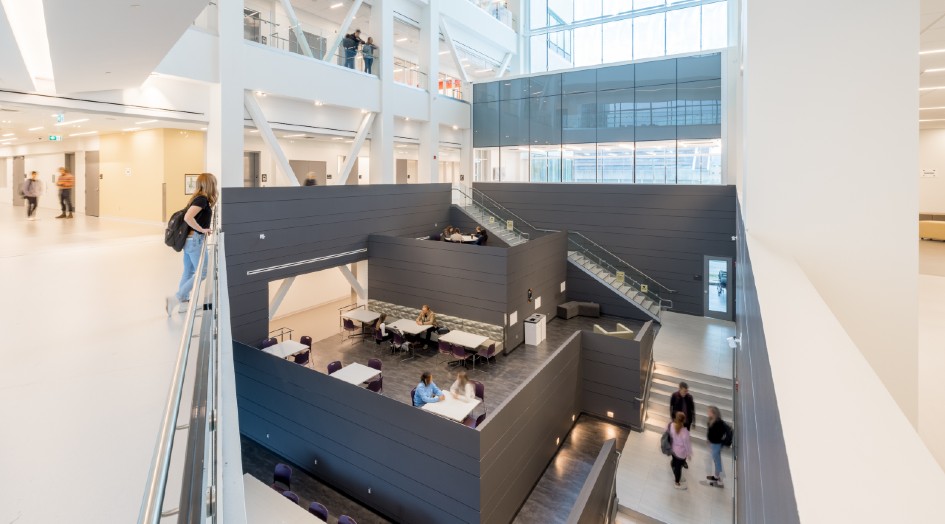
A blue whale skeleton, 25 metres long, suspends from the ceiling of the new Core Science Facility at Memorial University—as though it is swimming in empty space.

The 30-metre-high, light-filled west atrium is suitable for displaying the remains of Earth’s largest known creature and reflects the motto of Newfoundland and Labrador’s only university—Provehito in Altum, which means “launch forth into the deep.”

Soon after the carcass washed ashore in Bonne Bay in 2014, the Royal Ontario Museum and Research Casting International restored the marine specimen, which was central to the facility design, led by HOK Architects and Hearn Fougere Architects. The whale skull was so large it had to be brought into the building during construction to properly fit.

The 6,500-pound skeleton, from a species that’s been declining exponentially over the past century, is submerged into the aesthetic with its commanding presence meant to inspire a new generation of scientists and the school’s oceans-related research.

Gazing in from outside, the whale is a prominent fixture for passersby—an iconic touch to a structure intended to be a gateway for the St. John’s campus. “We took a lot from the ocean vernacular—using the iceberg as inspiration for form and colour of the exterior,” says Jeff Churchill, the regional leader of Science + Technology for HOK’s Toronto studio.

The colourful painted houses in downtown St. Johns—a bright palette of what’s called “Jellybean Row”—are reflected in the facility’s colour-coded floors as a form of wayfinding. A floating box in a lounge area of the west atrium draws upon the fishing huts along the coastline.

The building is made of three tower block pavilions separated by two tall vertical atrias. From the west, through a connecting promenade, students converge on a series of platforms in the east atrium to study and collaborate in between classes— a feature, which plays upon the province’s rugged shelf-like coast.

Memorial University

Icebergs in the nearby ocean inspired the exterior of the facility at Memorial University. Photo by Jane Brokenshire.

Students converge in a floating lounge area at Memorial University. Photo by Jane Brokenshire.

Making waves 

The 475,000-square foot building—delivered on a budget of $325 million, with funding from Memorial University, the provincial government and Canada’s New Building Canada Fund—merges collaborative student spaces with teaching labs for the Faculty of Science and the Faculty of Engineering and Applied Science, as well as labs from the Core Research Equipment and Instrument Training (CREAIT) network.

Electrical and computer engineering programs in the province are in tremendous demand from both Canadian and international students. “Our undergraduate computer engineering class is growing, our research-based graduate student population has grown substantially and we’ve just added new graduate programs in artificial intelligence and software engineering,” the university said via correspondence with CFM&D. “Despite all of this growth, the local industry needs more highly-qualified ECE grads.”

Memorial University

Windows display the computer science design studio for passersby. Photo by Karl Hipolito.

Memorial University

The inorganic chemistry lab at Memorial University. Photo by Karl Hipolito.

With existing campus facilities nearing the end of their design life cycle, this new space is also poised to attract and retain prominent faculty and source external research funding through shell space and industry partnerships, while creating opportunities for students inside the classroom and within the community.

The idea is that it also lasts 50 to 100 years. Materials used for construction were selected with the local climate in mind. Robust exterior pre-cast panels made of three million pounds of sand and 1.5 million pounds of cement strengthen the building envelope, while mechanical, electrical and laboratory systems are designed to be flexible for future changes to the research and curriculum programs.

As the body of scientific knowledge constantly evolves, the facility is also reducing the barriers that separate academic disciplines. As the university explained, “while we don’t know what the future will hold, it is reasonable to assume that the problems that will be addressed will become increasingly complex and often beyond the realm of a single academic discipline to solve.”

To cut down the time it takes to start conducting work, individual research spaces for new faculty members have been swapped with shared spaces with like-minded faculty. A more novel design is the CREAIT network, which makes major research infrastructure accessible to the entire university community, rather than residing within the lab of the individual who wrote the grant.

An explosion-proof corridor 

In a building laden with 3,500 lab fixtures, are more high-tech hopes as design provisions allow for rooftop renewable energy teaching and research labs for solar panels and wind turbines.

Currently in place is dedicated routing technology that delivers chemicals and lab-related hazardous materials throughout the facility. The idea is to reduce the life safety risks associated with transporting chemicals and cut down delivery time.

Chemicals leave the ground-level stores department and immediately travel to the penthouse level via an adjacent service elevator. An exclusive, explosion-proof penthouse corridor runs the entire length of CSF—almost two football fields long.

From this corridor, each of the buildings’ three pavilions can be directly accessed via separate service elevators. The service elevators are located at each of the five lab levels and are centrally positioned to quickly access laboratories upon exit.

See-through labs

Large laboratory windows further the collaborative intention of the space. As students and the public walk past, they can observe experiments in motion. For instance, swarm robotics work could be on display in CSF-4101—a room for research projects involving small commercial drones.

There are also plans for ground station displays for the Killick-1 CubeSat. The student-built observation satellite, funded by the Canadian Space Agency’s Canadian CubeSat Project, will collect big data on sea ice and ocean conditions and be a first in Newfoundland and Labrador.

“Some rationale behind [the displays] is to entice students from undergrad to continue to pursue careers in science through the upper levels of research,” says Churchill. “We also situated some undergrad spaces adjacent to some more advanced research spaces, which allows for students to come in contact with the research projects going on in the upper years.”

The facility opened its doors to students in September 2021, with plans for future occupants, including the Department of Psychology, the Ocean Frontier Institute and the Memorial Centre for Artificial Intelligence.

Feature photo by Jane Brokenshire.


Alberta funds new apprenticeship pilot program

The Alberta Government is investing $3.2 million to train more Albertans in the construction industry through the Trade Pathways Program. The program will target unemployed or underemployed young Albertans and provide them with on-the-job mentorship and apprenticeship training.

The 33-month pilot program is in partnership with the Alberta Construction Association, End Poverty Edmonton, and the Edmonton Mennonite Centre for Newcomers.

The initiative will provide hands-on training to prepare Albertans for jobs in the trades. Apprentices will have the opportunity to train under several Alberta Construction Association member companies, developing comprehensive, job-ready skills and experience.

“Our members have identified a need for skilled labourers to meet ever-increasing industry demands. We are proud to partner with the Government of Alberta on this initiative which responds to this need and also helps young Albertans gain the hands-on experience and skills they need to find employment in the construction industry,” said Ken Gibson, executive director, Alberta Construction Association.

Funding will support wage top-ups, preparatory training and personal protective equipment/tool costs for apprentices.

“Alberta’s construction sector is integral to the growth and economic prosperity of our province. As outlined in the Alberta 2030: Building Skills for Jobs strategy, we are focused on building a highly skilled and competitive workforce that will be ready to meet increased industry demands while helping young Albertans access the training they need to find good-paying jobs,” said Demetrios Nicolaides, minister of advanced education.

Laurie Hauer, director of programs and services with the Edmonton Mennonite Centre for Newcomers, said the Trade Pathways will provide newcomers with hands-on training and experience to be competitive in the labour market.

“New Canadians face many barriers to successful employment. Simply gaining enough experience to be competitive in the labour market can be difficult, which is why the Trade Pathways program is important,” she said.


SOFIAC to pursue decarbonization beyond Quebec

Quebec-based energy services provider, SOFIAC, is stretching its reach to the rest of Canada with $185 million in seed capital to pursue decarbonization of commercial, industrial and multifamily buildings. Desjardin Global Asset Management (DGAM) is joining the now national venture, which was launched in 2021 with the backing of the labour-supported investment fund, Fondaction, the global energy advisory firm, Econoler, Canada Infrastructure Bank, Fiera Private Debt and the Quebec government.

“By 2040, the Desjardins Group aims to achieve net-zero emissions on extended operations and on the financing and investment activities of its own funds in three key carbon-intense sectors: energy, transportation and real estate,” advises DGAM president and chief executive officer, Nicolas Richard.

SOFIAC, an acronym for Société de financement et d’accompagnement en performance énergétique, provides a comprehensive suite of financial and technical services for deep energy retrofits, including upfront financing, in turn for a share of the generated savings. Retrofit projects target a 30 to 50 per cent reduction in greenhouse gas (GHG) emissions and an associated 25 to 40 per cent energy cost saving. To qualify, proponents must have portfolio-wide annual energy costs of at least $500,000.

With its expanded geographic outlook, SOFIAC has added Stuart Galloway as executive vice president and Ivan Gerginov as director of operations to steer business in Ontario and western Canada. Michel Méthot has been appointed executive vice president for Quebec and Atlantic Canada.

“We invite businesses throughout the country today to benefit from a unique financing and support offer that has proven its worth in Quebec,” says Geneviève Morin, president and chief executive officer of Fondaction.

Current clients include ADM Aéroports de Montréal, with projects underway at both Trudeau International Airport and Aerocity of Mirabel, and Collège Jean de le Mennais in La Prairie, Quebec.

More interest rate hikes to follow in 2022, economists predict

The interest rate hike by a full percentage point came as a surprise to a panel of economists who collectively predicted a 75bp rise in Finder’s BoC Interest Rate Forecast.

Nearly half of the experts, consisting of academics and financial professionals, predict a 15 per cent to 20 per cent drop in housing prices by the end of 2022, with most believing new housing supply won’t bring prices down more than higher interest rate hikes. The cost of living is also expected to rise in six months, along with household debt.

Ahead of today’s news, the panel had agreed in the report that an aggressive increase for July is the right move. “Inflation has not yet peaked and it is important for the Bank to show some of its commitment to do whatever it takes,” said Angelo Melino, a professor at the University of Toronto.

The current consensus is that at most overnight rate meetings this year there will be increases. The majority of economists see the overnight rate rising at least twice more this year, in September and October, with 35 per cent believing there will be yet another end-of-year hike in December.

Most economists cited inflation and the prospect of recession as the main causes for concern.

“The level of inflation is indeed way too high, which warrants active monetary policy,” said Murshed Chowdhury, associate professor, University of New Brunswick. “However, the Bank needs to be cautious regarding raising rates as the impacts are heterogeneous on households’ income, debt and wealth.”

Tony Stillo, director of Canada economics at Oxford Economics, believes macro headwinds are impacting inflation and predicts a possible path forward.

“The Bank of Canada has made it clear that its primary focus is returning inflation to target and that it will be ‘forceful’ if need be. So, with CPI inflation hitting a 40-year high of 7.6% y/y in May, we now expect 3 more 50bp hikes will lift the policy rate from its current 1.5% level to 3% by October.

“This would reach the top of the Bank’s 2–3% range for the neutral rate but be above our 2% estimate. In our view, this would bring rates well into restrictive territory. We then expect the Bank will reduce the policy rate to its neutral level of 2% in H2 of 2023, once it has sufficient evidence that inflation and the broader economy are slowing.”

Recession risk a question of when—not if

The majority (69 per cent) of the panel expect the Canadian economy to go into a recession between now and 2025, with half forecasting the recession to hit in 2023

Moshe Lander, senior lecturer of economics at Concordia University, is among those forecasting a slowdown in the first half of 2023, even though he believes the technical definition of a recession (two quarters of negative GDP) may be avoided.

“There is no question that Canada is heading for a slowdown. A slowdown/recession should be welcomed, he said. “There are a lot of imbalances that have developed trying to survive the various COVID restrictions and lockdowns. Pushing weak and inefficient businesses to sharpen up is not a bad thing and a slowdown is the best way to focus minds and finances.”

Melino also sees a recession hitting by early 2023.”We will need a lot of good luck to avoid a recession,”he said. “Inflation will have to come down quickly (good harvests, peace in Ukraine, low COVID cases next winter).”

On the other hand, Atif Kubursi, president and emeritus professor at Econometric Research and McMaster University, believes a recession will occur in the second half of 2023. “The BoC has little options, but if it is aggressive in its fight to wrestle inflation it may exceed what is required to tame inflation and nudge the economy into recession,” he said. “Canadians are over-indebted and the government debt service will rise leaving little room for additional expenditure. Given the war in Ukraine, there will be pressures for increased defence expenditures and aid to Ukraine that add fuel to inflation.”

Other economists figure differently.

“We are clearly heading for slower growth next year,” said Charles St-Arnaud, chief economist, Alberta Central. “Whether it will be a recession remains uncertain.”


Rent price trends from coast to coast

The average rent price in June 2022 for all Canadian properties listed on Rentals.ca was $1,885, an increase of 9.5 per cent versus a year ago. But, as pointed out in the latest edition of the National Rent Report, that’s still 3.5 per cent lower than the pre-pandemic level of June 2019, which came in at $1,953 for all property types.

With Canada Mortgage and Housing Corporation recently suggesting that rental housing in Canada remains significantly undersupplied, rising interest rates, persistent inflation, supply chain issues, record high immigration levels and employers’ decisions about requiring in-office work are also impacting the rental market. Analysts at Bullpen Research & Consulting and Rentals.ca say they expect rents to continue to rise throughout the remainder of the year, especially with a resale housing market correction underway.
“The average rent for all property types in Canada declined slightly in June compared to a month earlier, but is up almost 10 per cent annually,” said Ben Myers, president of Bullpen Research & Consulting. “The monthly dip can be attributed to a decline in Quebec, as rents in B.C., Alberta, Ontario and Nova Scotia all experienced increases in average rent from May to June. Despite data showing that the share of employees returning to the office has stalled after a year of steady increases, average rents in Canada’s largest cities are still surging, with condominium and rental apartments seeing rents jump 26 per cent annually in Calgary, 25 per cent annually in Vancouver and 20 per cent annually in Toronto.”

average rent priceAverage rent, city by city

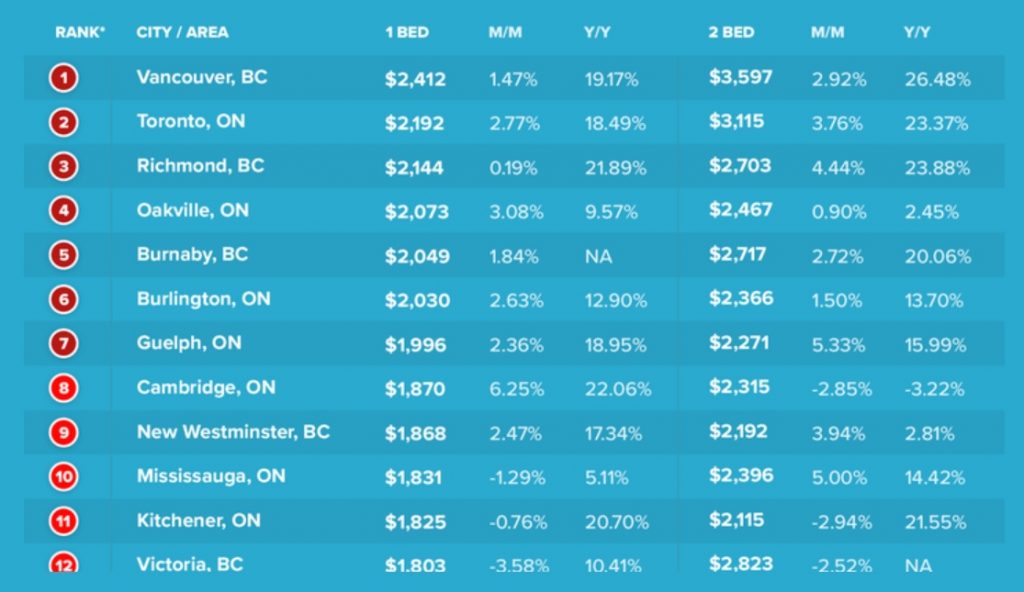
Vancouver once again topped the list of 35 cities for average monthly rent price, with one-bedroom rentals going for $2,412, and two-bedrooms for $3,597. Since a year ago, rent in June for a one-bedroom in Vancouver has shot up 19.2 per cent and a whopping 26.5 per cent for two-bedrooms.

Toronto, meanwhile, finished second on the list for average monthly rent price with one-bedrooms going for $2,192 and two-bedrooms for $3,115. Year over year, that’s an increase of 18.5 per cent and 23.4 per cent.

In 23rd spot, rent in Montreal for a one-bedroom home came in at approximately $1,525 and $1,939 for a two-bedroom, up 5.5 per cent and 2.1 per cent since last year.

London, Calgary, and Kitchener also experienced significant increases in average monthly rents in June by 29 per cent, 26 per cent and 21 per cent respectively. Overall, five cities of the 35 included in the report recorded 20 per cent (or higher) rent price increases since a year ago. While Toronto and Vancouver had the highest monthly rents in Canada, Regina had the lowest at $1,014.

Smaller units returning to favour 

The narrative throughout the pandemic has been that tenants were renting larger units as they were mandated to work from home, but with the easing of COVID measures, June 2022 data shows that the trend appears to be changing. Average unit sizes for listings across all property types has increased to 909 square feet—the highest it’s been since December 2019—suggesting more large units are becoming available as the market demands shift.

For the full National Rent Report, visit: Rentals.ca July 2022 Rent Report


Toronto’s Wallace Emerson Community and Child Care Centre breaks ground

The Wallace Emerson Community and Child Care Centre broke ground this week at the site of the future 20-acre Galleria on the Park master-planned community.

Developer Almadev (formally Elad Canada) partnered with the City of Toronto to bring the project to fruition.

“The design fosters connections between the interior space and surrounding parkland,” said Andrew Frontini, principal and design director at Perkins&Will. “To us it demonstrates the potential for a community building to dynamically showcase programs and embrace urban space.”

The plans call for a facility divided into two pavilions, both clad in green terracotta tiles that emphasize the fluid shape of the building and enhance the interior to exterior connections.

The centre will bring flexible and programmed spaces to the community and those who visit. Activities are geared to a multi-generational demographic, including an aquatic centre, a childcare centre, a dance and aerobics studio, a gym with a running track, and a community kitchen.

Wallace Emerson Community and Child Care Centre

The Wallace Emerson Community and Child Care Centre is a partnership between Almadev and the City of Toronto.

“We hosted over 40 community consultation meetings to develop community infrastructure that serves everyone, and we’re proud that Galleria on the Park will be a place where everyone is welcome,” Almadev CEO Rafael Lazer said at a groundbreaking ceremony at the site. “We look forward to seeing this community become a destination in Toronto.”

Phase one of Wallace Emerson Park also began. Landscape architecture firm Public Work is creating an almost eight-acre park to connect to the new centre and designed a tree-lined boulevard, a children’s garden, and an active roof atop the community centre.

Activities planned for the expanded greenspace include a central plaza and performance area that converts to a winter leisure skating pad and trail, a BMX/skateboard park, a multi-purpose court with basketball hoops and a splash pad.

As it sets out to transform the existing 1970’s-era Galleria Shopping Centre, Galleria on the Park will also bring together eight mixed-use buildings with nearly 2,900 condo residences, 150 affordable rental units and about 300,000 square feet of retail.

Photo: From left to right: Warren Saks, Development Manager, Almadev; Ana Ana Bailão, Deputy Mayor; Rafael Lazer, CEO, Almadav; Vadim Granovski, Vice President, Finance, Almadev.

Detoxifying the condo manager’s workplace

It’s hard to imagine that there’s a condo manager anywhere in Ontario who would describe their job as easy. The breadth and depth of knowledge required to do the job well are astounding. The hours are long, and condo managers rarely get to “switch off.” They are never more than a few feet away from their phone, even when taking a shower.

Soft skills are necessary to do the job well, including communication, time management, and people management. On any day, a condo manager can be pulled in many different directions, depending on the latest crisis or deadline.

Casting a shadow over all these challenges to perform is the worry that an owner will file a complaint with the CMRAO against the manager because he or she didn’t like a board decision or how long it took to respond to emails. For some owners who are angry or distrustful of the condo manager or the board, this frustration escalates into actual harassment.

While there are no statistics, anecdotal evidence suggests that almost every condo manager has experienced some form of workplace disrespect, and a majority have experienced workplace harassment. Hopefully, only a very few were subjected to physical threats or assault; but there shouldn’t be any at all.

Condominium corporations have a duty to protect their directors, manager, staff, and owners. There are plenty of stories and increasing court cases and CAT decisions that shine a light on some outrageous behaviour.

Recent court decisions denounce owners’ abusive behaviour

Section 117 (1) of the Condominium Act states: “No person shall, through an act or omission, cause a condition to exist or an activity to take place in a unit, the common elements or the assets, if any, of the corporation if the condition or the activity, as the case may be, is likely to damage the property or the assets or to cause an injury or an illness to an individual.”

In TSCC 2519 v. Emerald PG Holdings et al., 2021, the Superior Court of Justice ruled that injury “includes psychological harm that is beyond a trifling nature.”

The Ontario Superior Court of Justice has also now ruled that the right to accommodate a disability is no longer the ultimate “right” (MTCC 580 vs Mills, 2021). Those in the condominium community also have a right to be protected from harassment or oppressive behaviour.

Workplace safety legislation also protects against harassment. In TSCC 2519 v Emerald PG Holdings et al., 2021, the ruling stated that when a unit owner or owners engage in threats of litigation, intimidation and excessive hostility toward a board and its property management, such actions constitute workplace harassment. The ruling states, “The verbal abuse, door banging, physical intimidation, accusations of wrongdoing, shouting, and micromanaging constitute workplace harassment within the meaning of the OHSA (Occupational Health and Safety Act).

If a condo manager or director is subject to harassment or abusive behaviour, it is vital to keep records of the incidents, either copies of emails or diarized descriptions of the interaction. The corporation should consider seeking legal advice from its solicitor early in the process. Early intervention, a lawyer’s letter to the owner, for instance, may help stop the situation from escalating. It will also demonstrate that the corporation takes the situation seriously and acts promptly to protect its directors and management. It may also be necessary to contact the police.

In extreme cases, the lack of respect shown to managers, the board, or other residents escalates into a messy situation involving the police or the courts. Although it may be a lengthy process, legal tools are available to stop excessive abuse.

Andrea Lusk, a lawyer with Gardiner Miller Arnold LLP, has provided helpful comments about de-escalation.

“A common preamble to written decisions from court or CAT where harassment is alleged is how poor communication or failure to deal with a legitimate request can cause bad feelings,” she says. “These initial bad feelings snowball a non-dispute into a claim of mutual harassment. Often, harassment is not found— just frustration by all sides.”

For example, a slow or non-response to a standard request—for records, maintenance, or enforcement—may cause an owner to then question management and the board. That owner may then consider communicating their displeasure to fellow owners or to management, repeatedly. When we get past the “normal complaints” stage, the owner and the condo are put onto two sides, and many get trapped in those roles. What could have been a short response has now turned into exponentially more work for the manager. If the condo’s lawyer has to get involved, it escalates.

Absent an actual physical threat or emergency, many items presented as “urgent” can probably wait a day, or a week, and be dealt with in due course with no hard feelings. It’s best practice to acknowledge a request, what must be done to address it and communicate the timeline to the person making the request.

Diarize the timeline for yourself. If you have communicated a reasonable timeframe for a response (even saying “the board meets once a month, this is on the agenda and I will reply to you after their next meeting” or “we’ve called the contractor, we will let you know when they get back to us”) you have done what you can on that item until you have more information. Continue to communicate progress but otherwise keep your boundaries.

The underlying foundation of some of the abuse and harassment that a condo manager or director experiences is the general lack of respect for the work they do.

A recent Ontario Superior Court ruling (Niagara South Condominium Corporation No. 12 v. Kore et al., 2021) contains a very astute observation, “It comes down to respect: Respect for the rules. Respect for employees, the board and one’s neighbours. Respect for the common and shared space of others.” Even though most condo managers are not employed directly by a condominium corporation, it is reasonable to assume that “respect for employees” is intended to include the condo manager.

Replenishing the condo manager shortage

Many condominium managers are subject to a lack of respect for their ability to do such a challenging job. That was supposed to change with licensing: condo managers would be considered professionals like lawyers and engineers.

Condo managers also deserve respect because this industry is in crisis. Unless something changes, there simply won’t be enough professionals to meet the legal requirements of having each condominium corporation managed by a licensed manager.

There are 12,120 condo corporations in Ontario but only 2,270 general licensees and 1,399 limited licensees. Burnout or disillusionment is a real issue contributing to why condo managers, both new and experienced, are leaving their jobs.

There is no sign that the shortage will improve in the near future, so it’s critical that current condo managers want to stay in the profession. Managers, management companies and boards need to work together to reduce the incidents of abuse or harassment and encourage respect for the condo manager.

Given this growing shortage, a community must treasure a good manager. There is no guarantee that the next condo manager will meet the high standards of a demanding board—the grass is not always greener. This is especially true for ACMO Registered Condominium Managers. An RCM is best-in-class in the profession and has plenty of employment choices. Less than a quarter of all condominium managers hold this designation. RCMs have always been committed to high standards and continuing education, and they can find a new job almost immediately.

Top 7 signs a condo manager is respected

1. No tolerance for abuse: It should go without saying that threats or physical abuse warrant police involvement and advice from the corporation’s solicitor. There’s a perception by some that verbal or psychological abuse is “part of the job” and isn’t a “big deal.” Foul language or verbal abuse should not be tolerated. Boards have accountability for making the bad behaviour stop. Trying to avoid legal expenses should not be a barrier to protecting the condo manager. Have a Workplace Harassment Policy in place and enforce it.

2. Perspective. The manager has probably done 50 (or 100?) things right today. Going off the deep end about the one or two things that weren’t done right, including a typo in a notice, is an over-reaction. The courts have said that corporations aren’t expected to be perfect, so the manager shouldn’t be either. Ask rather than accuse when in doubt about something a manager has done.

3. Realistic expectations. Acknowledgement that a manager can’t get everything done at once and tasks need to be prioritized. Major physical building projects, legal disputes, ongoing noise complaints and flood investigations all take time away from regular duties. Sometimes a manager might feel like a magician when they have accomplished so much in a day or solved a particularly complex problem, but they don’t actually have a magic wand. There are only eight hours in a workday and five days in a workweek.

4. Work-life balance. Recognition that the manager has a right to personal time. Perhaps a meeting can be held at 8 a.m. or 5 p.m. instead of 8 p.m. so that the manager can enjoy time with their family. Equally, if a condo manager stays late for a meeting, it should be standard practice to come in late or leave early the following day. With no commuting time and less socializing, Zoom meetings are more productive and more respectful of the manager’s time.

5. Contract hours do not equal office hours. The manager has many tasks and duties which require quiet concentration or private time for confidential discussions with a resident. If the posted office hours when residents can drop by are from 9 a.m. to 5 p.m., when does the manager find that quiet time? Would it truly negatively impact residents if the hours were, for example, 9 a.m. to 3 p.m.? This would provide the manager with two hours a day of valuable uninterrupted time.

6. Appreciation. The manager is thanked for their efforts, their guidance and their long hours. In many condominiums, the manager will be thanked only once a year (at the AGM), and sometimes not even then. It makes a huge difference to the work environment when a condo manager feels supported by the board and the community.

7. Compensation. Fairly compensated for their knowledge and expertise and skills, especially in a workforce which is experiencing shortages.

Juliet Atha, RCM, has been a condominium manager for ten years and now heads the team at Best Practices Property Management. She holds an MBA from Ivey Business School (Western University) and has been an instructor of the ACMO Financial Planning and Admin courses at Humber. Juliet is the Executive Member at Large on the ACMO Board of Directors.

Kelowna Airport to showcase mass timber

The Kelowna International Airport expansion will showcase mass timber construction. The nearly 8,000-square-metre airport expansion project will reinterpret its original 1960s modernist aesthetic with a two-storey prefabricated mass timber structure featuring a long-spanning signature “waffle-slab” roof design.

Once completed, the large-scale roof structure will serve as an industry example of highly efficient timber construction, showcasing the availability and affordability of mass timber.

“I’m thrilled to see that the terminal expansion will use mass timber, showcasing the versatility and design capabilities of B.C. lumber, while also contributing to the local economy. As YLW is the gateway to the Okanagan, the choice to use mass timber is an important decision to highlight the characteristics reflective of the region,” said Colin Basran, mayor, City of Kelowna.

The Airport Terminal Building Expansion project is anticipated to break ground in 2023 and will receive $500,000 from the province to help with costs associated with the use of mass timber. The funding will also help with the creation of a digital construction twin, advanced fire modelling and life-cycle assessment of building materials.

The use of prefabricated mass-timber panels will reduce construction time by an estimated 25 per cent and will result in less construction traffic to the site. Canada’s 10th largest airport will remain open and fully operational throughout construction.

The first phase entails an expanded departures lounge to improve connections to gates and increase food and beverage options, an expanded security screening area, and new direct access to south gates.

The project team includes PCL Construction and office of mcfarlane biggar architects + designers.

The complete Kelowna International Airport expansion project is expected to open to travellers in 2026.

The Mass Timber Demonstration Program is delivered by Forestry Innovation Investment on behalf of the Province.

Essity acquires Canadian apparel manufacturer Knix Wear Inc.

Global hygiene and health company Essity has acquired 80 per cent of Canadian apparel manufacturer Knix Wear Inc. for US$320 million. Toronto-based Knix designs and produces a variety of leakproof apparel for periods and incontinence.

In a release, Essity says it anticipates the demand for such clothing to have an expected annual growth rate of more than 20 per cent over the next five years. The company is already active in the leakproof apparel market within feminine care with brands such as Libresse, Bodyform, Saba, and TOM Organic, and within Incontinence Products with the TENA brand.  It has been active in increasing its stake in the market, acquiring Australian manufacturer Modibodi in a US$92 million deal earlier this month.

“I am delighted to welcome Knix to Essity. It’s a successful company with an impressive track record. Essity is now becoming the global market leader in leakproof apparel, which is an important step towards our goal of being the world’s fastest-growing company in intimate hygiene, providing increased well-being for customers and consumers,” said Magnus Groth, Essity president and CEO.

Knix was founded in 2013 by CEO Joanna Griffiths with the mission to redefine intimates. Knix and their teen brand, Kt by Knix, offer a broad assortment of intimate apparel with leading positions in the growing leakproof apparel category. The company., which has approximately 200 employees and headquarters in Toronto, has a strong presence in U.S. and Canada and sells mainly direct-to-consumer through online channels, supplemented by six Knix retail stores. Griffiths will hold the remaining 20 per cent share post-acquisition and will stay on as President of Knix

The transaction is subject to customary regulatory approvals and is expected to be finalized in the second half of 2022.

Toronto Aboriginal Support Services Council getting permanent home

The Government of Canada is giving $2 million to the Toronto Aboriginal Support Services Council (TASSC) so it can purchase and renovate a permanent office and community meeting space.

The Daniels Corporation also contributed $300,000 towards the partial construction costs and about $94,000 to reduce to the purchase price, with the City of Toronto shovelling in $650,000.

As an umbrella organization to more than 18 partners, TASSC lost its commercial space in 2020 during the pandemic and has been unable to fully operate and support those front line service organizations.

Plans are to relocate to the Regent Park neighbourhood where a prevalent Indigenous presence already exists. The space is envisioned to be Indigenous-owned and operated, with programs, meetings, events, ceremony, and other activities for TASSC member agencies and the community members they serve in the area.

“TASSC was built on the traditional concepts of friendship and collaboration. It is a collectivist mindset that brings us together,” said TASSC Executive Director Lindsay Kretschmer. “This space will offer us the opportunity to continue to collaborate in the spirit of friendship and unity; grounded in our ways of knowing, seeing, being and doing, now and for generations to come.”

Federal funding was administered through the urban component of the Indigenous Community Infrastructure Fund at Indigenous Services Canada. There are currently more than 32 urban Indigenous coalitions across the country.


ISSA Hygieia Network opens registration for women’s leadership conference

ISSA Hygieia Network, an ISSA Charities™ signature program dedicated to the advancement and retention of women in the cleaning industry, has opened registration for the Networking and Leadership Conference: Unlocking Women’s Leadership Potential on September 13 in Chicago.

The half-day conference will bring together attendees who hold positions across all cleaning industry areas and levels, covering issues affecting opportunities for advancement and more.

“We’re excited to provide a space for professionals to come together and gain resources that help women advance in the cleaning industry,” said Dr. Felicia Townsend, Program Director, ISSA Hygieia Network. “We can’t thank our guest speakers enough for providing their vital knowledge and giving attendees the necessary tools to accelerate their careers.”

RELATED: ISSA Hygieia launches new community for female professionals

The conference will feature presentations from three executive leaders: Kim Price, vice president of market sales, GP Pro, a division of Georgia-Pacific; Marcela Sztainberg, senior vice president of human resources, Essendant; and Tracey York, executive vice president of human resources health, hygiene and specialties, Berry Global.

The program will start with a career development workshop from Dr. Tatum Thomas, dean of DePaul University’s School of Continuing and Professional Studies, and will conclude with a panel discussion facilitated by Stephenie Henderson, vice president of sales-strategic accounts at Berry Global.

4 tips for retaining employees and boosting morale

Facility management and cleaning and maintenance are just two industries that continue to be afflicted by a labour shortage. As the impacts continue, it’s critical for businesses to provide a clean, enjoyable, and supportive work environment. Cintas has shared four tips for enhancing a business’ workplace atmosphere and retaining employees at a time when they are needed most.

“Providing solutions that help employees complete their jobs effectively and with ease is an essential component to promoting a culture of positivity and wellness,” said John Engel, Director of Marketing, Cintas Facility Services. “Outsourcing difficult or unpleasant tasks along with implementing wellness products shows that you value your employees’ health, safety and happiness.”

Cintas offers the following tips to help promote a positive work environment:

Implement high-quality, anti-fatigue mats

For employees required to stand for long periods of time, provide anti-fatigue mats to deliver standing comfort throughout the day. Not all anti-fatigue mats are created equal, so it’s important to research options and select quality products with bounce-back technology that is proven to reduce discomfort. This will help employees feel more comfortable and productive throughout the workday. Other mat attributes to consider are easy-to-clean surfaces and a dual gripper system to help them stay in place on both hard surfaces and carpet.

Outsource washroom deep cleaning and stocking

Everyone loves a clean washroom, but not everyone loves cleaning it. Consider partnering with a provider for deep washroom cleaning to take the heavy-duty tasks off of employees. This will ensure washrooms are professionally cleaned and sanitized on a regular basis, enabling employees to complete daily washroom maintenance with ease. In addition, consider a washroom supply service to guarantee the washroom is always stocked with quality products for employees. Supplies to consider include hand soap, paper towels, toilet paper, air fresheners and toilet seat cleaners.

Supply hand hygiene products

To promote a healthy environment and help prevent the spread of germs, provide hand sanitizer dispensing stations. Select quality sanitizer that kills 99.9 per cent of bacteria, but is gentle enough for everyday use. Look for a sanitizer that contains a moisturizing agent to help keep hands soft and protect against drying skin.

Clean regularly with safe, effective tools and chemicals

Employees value cleaning transparency from their employers. Implement microfiber mops, wipes and duster tools for effective, sustainable cleaning. In addition, consider a cleaning chemical service that offers properly diluted, Green-Seal-certified chemicals that are proven safe for health and the environment. For added protection, consider disinfectant and sanitizer spray services to help eliminate germs, viruses and bacteria from surfaces.