Articles Archive - Page 251 of 928 - REMINET
REMI

Protracted construction prompts aid for TO BIAs

Businesses in some of Toronto’s protracted construction zones could receive modest recompense from one of the chief perpetrators. City officials are now accepting applications for a new grant program to offset the negative impacts of transit expansion projects.

That includes a commitment of $600,000 over three years from Metrolinx — developer of the Eglinton Crosstown Light Rail Transit (LRT) line, which is now in its 12th year of construction — to be specifically channelled to seven business improvement areas (BIAs) along the route. However, BIAs and not-for-profit organizations citywide are eligible for the larger pot of funds to be allocated as grants of $50,000, $25,000 or $10,000 with a maximum annual outlay of $50,000 per applicant.

The program is meant to respond to multi-year transit construction projects that infringe on commercial areas with a density of retail and service establishments — creating pedestrian detours and/or traffic lane closures and/or impeding access to parking or existing public transit. As outlined in a report to Toronto City Council last year, it’s also seen as an instrument that could “make it easier in the future to secure additional funding for construction business mitigation purposes from other sources, including the provincial and federal governments” to address disincentives for consumers, temporary inconveniences such as utility shutoffs and more chronic issues of noise, vibration, dust and unsightly streetscapes.

“While investments in transit infrastructure are essential for Toronto’s continued growth and prosperity and provide benefits that are recognized by a broad cross-section of the city’s population, the negative impacts of construction sometimes fall disproportionately upon retailers and other small businesses near construction zones,” the report acknowledged.

Eligible organizations can apply for funding from up to two years before a major transit project is scheduled to begin to one year following its completion. Approved recipients may use the grant for a range of purposes including: marketing and communications; public art projects; community events; research, data collection and analytics; consulting services; salaries and/or honorariums for volunteers. That must occur no later than two years (730 days) after the completion of construction, which potentially presents a long horizon for the required spending.

This year’s deadline for applications is March 2, 2023, but there are few instructions openly available and no portal for online submissions. Rather, prospective applicants are advised to contact program administrators via email.

Applications will be assessed on a first-come, first-served basis. However, as endorsed by Toronto City Council, administrators will be looking for proposals that align with the goals to test “innovative and effective construction mitigation strategies” that could be replicated throughout the city and serve as a model for BIAs and business communities elsewhere.

Focusing on student wellness and sustainability

Ryder Architecture and Hotson Architecture, in collaboration, recently designed tə šxʷhəleləm̓s tə k̓ʷaƛ̓kʷəʔaʔɬ (The Houses of the Ones Belonging to the Saltwater), a series of five student residences at the University of British Columbia (UBC).

The project addresses the importance of student wellness, inclusivity, and sustainable design through its dynamic programming, visual transparency and context-responsive materiality.

A lack of affordable off-campus student rentals in Vancouver makes these nearly 1,000 beds a desirable alternative for students. The new residences opened its doors for the first time during the 2021-2022 academic year after the global pandemic caused an 18-month period of upheaval and disruption that essentially shut down on-campus student life.

Although considered an infill project, the seven- to 10-storey buildings are in a prime location near the central bus loop, which provides a vital link between Vancouver and this campus of over 58,000 students, with approximately 13,000 students currently living on campus.

The Musqueam Indian Band generously bestowed the names to UBC in their hən̓q̓əmin̓əm̓ language as a gift in spring 2021. The buildings are stitched together with understated landscape architecture, creating an urban streetscape along Student Union Boulevard adjacent to the bus loop, ensuring a high degree of site safety, visibility and accessibility.

Active ground-level student amenities support a dynamic and welcoming street presence. These shared student spaces—often double-height and always filled with plenty of natural daylight—include lounges, study areas, fitness, music and dance studios, as well as “front desk” administrative offices. Living arrangements include a mix of four-bedroom and studio apartments that provide upper-year students with suites equipped with individual bathrooms and shared functional kitchens.

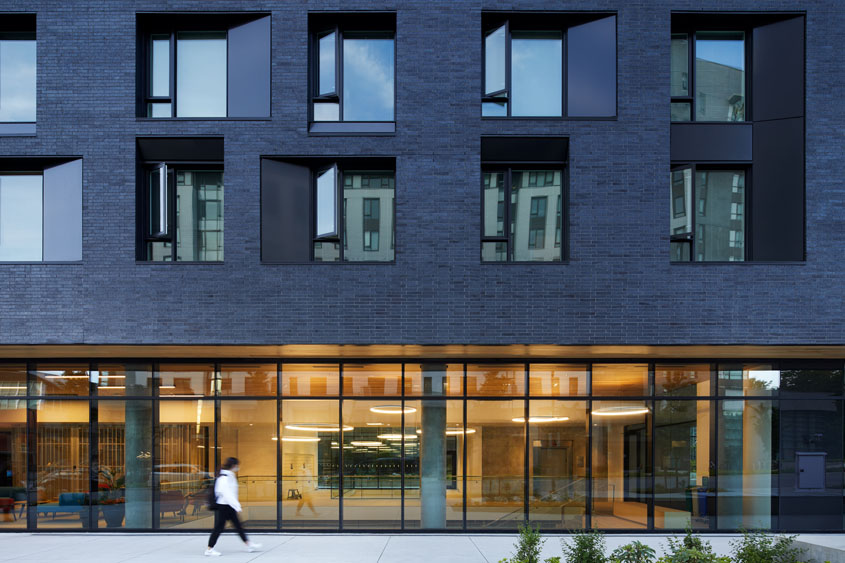
The material palette and consistent formal language of these mid-rise buildings enable the massing of this string of residences to be broken down into individual blocks that facilitate visual and pedestrian connections to the campus, including the adjacent Walter Gage Residence precinct.

Ground floor conditions encourage connectivity through visual transparency, such as exterior wood soffits, which transition into interior ceiling treatments. Entries and communal spaces are “carved” from each building mass with recesses and cantilevers. The highly insulated wall assembly provides an opportunity to express a greater sense of depth within the façade through angled metal accent panels that frame and accentuate the often-irregular fenestration pattern.

In addition to targeting LEED Gold certification with a specific mandate to address greenhouse gas emissions, designs were tested and modelled to ensure the project’s maximum resiliency against future climate change.

Guided by the UBC Green Building Action Plan, the design team adopted a rigorous approach to sustainability and environmental performance. Building performance was measured against projected climate scenarios for 2050 and 2080, with mitigation features such as a high-performance building envelope, active cooling, high-efficiency heat recovery ventilation, and connection to UBC’s district energy system. A 55% reduction in building carbon emissions was targeted compared to current local building practices.

Ryder and Hotson Architecture led a digital design and construction process, leveraging Ryder’s in-house BIM expertise to enable an accelerated schedule and allow the project to open on schedule, with construction proceeding throughout the pandemic.

With these recent student residences at UBC, Ryder and Hotson demonstrate the importance of emphasizing and promoting livability, sustainable design and welcoming spaces that encourage vibrant on-campus student life.


One-window guide for EV charger grants opens

Prospective investors in electric vehicle (EV) charging equipment can now look to a one-window guide of the grants available through various Canadian government programs. The new online reference hub has been designed to steer businesses, not-for-profit groups and municipalities to applicable options coordinated by Natural Resources Canada (NRCan), Canada Infrastructure Bank (CIB) or designated delivery agents of the zero-emission vehicle infrastructure program (ZEVIP).

Current programs are targeted to a range of potential proponents from landlords seeking to install EV charging stations in commercial or multifamily buildings to developers of commercial-scale EV charging operations to municipalities investing in zero-emission transit fleets. The new reference hub includes a basic questionnaire to help identify the best fit for funding candidates’ needs, and provides a gateway to details and application processes for each program.

“Investments in infrastructure that accelerate Canada’s transition toward net-zero are a key element of the CIB’s mandate,” affirms Ehren Cory, chief executive officer of Canada Infrastructure Bank, which collaborated with NRCan in the development of the online guide.

The site also features a portal for recruiting organizations potentially positioned to coordinate and deliver ZEVIP funding in their communities or regions. For EV drivers, it offers a locator app to identify EV charging and alternative fuelling stations throughout Canada and the United States.

Protect outdoor maintenance workers in the winter

As temperatures drop during the winter months, staying safe and protected while you work outside is an important part of outdoor maintenance. Cold temperatures pose a real threat when removing snow, cleaning windows, completing outdoor repairs, and beyond. Being unprepared or under-equipped means risking illness or injury when exposed to extreme winter weather.

In extremely cold temperatures, spending extended periods of time outside can result in “cold stress,” which happens when weather conditions cause someone’s external temperature to drop, eventually lowering their internal temperature, resulting in hypothermia or frostbite. According to the Government of Canada, cold stress occurs when the body temperature is no longer maintained at 36-37˚ Celsius.

“It’s about safety,” says Randy Cross, president of Fish Window Cleaning. “Winter means keeping our teams warm and dry.”

It’s important to take the necessary steps to stay safe and protected from the elements while on the job.

Take a proactive approach to prevention

When conditions fall below -7˚ Celsius, bare contact with cold surfaces present a risk. In temperatures below -17.5˚ Celsius, protective equipment needs to be part of your health and safety practice. These conditions can also be present inside, of course, when warehouses or open space areas are part of the job.

There are several factors to consider, as you prioritize protection during outdoor work for you and your team:

  • Wherever possible, use outdoor huts as a place to warm up or place heaters in enclosed spaces to keep the air warm. Depending on the work, tents or tarps can offer shelter from precipitation and the wind and may also cut down on the time it takes to complete the job.
  • Create a break schedule to warm up between work. Getting indoors or even out of the elements for a few minutes could lessen the risk of exposure and offer a chance to regulate body temperature.
  • Dress appropriately by wearing loose layers to encourage the body to trap heat and keep warm. Avoid overdressing, as it may cause the body to sweat, which cools and freezes as the day progresses.
  • When heaters are not possible, rely on winter gear to keep you warm. Fabrics like wool, polyester fleece, and polypropylene retain warmth, even after they get wet. Cotton and goose down stay warm if they stay dry, but as soon as they become moist, they lose the power to insulate, detracting from their protection.
  • Keep extremities warm with hats, and face and hand coverings. Mitts are not always practical for detailed work, but by layering gloves under the mitts, you can take them on and off as required.

On-the-job safety is key, but there’s more to consider. “It’s not just about staying warm,” Cross explains. “There is also the issue of transportation from job to job through the ice and snow. That plays a part in staying safe and needs to be prioritized.” If you’re traveling to more than one location, having an adaptable schedule simplifies the process when the weather gets too extreme. When multiple locations are involved, keep transportation in mind when planning for safety and prevention.

Training your team

Assess the risks, set the expectations, create a plan, and teach your team so everyone stays safe. Wearing proper attire, identifying symptoms, warming up, reporting an incident, and taking emergency measures should all be part of your fall maintenance checklist, so you’re ready when colder weather hits.

Cross’ window cleaners work in pairs, typically one inside and one outside the building. This type of buddy system means teams can keep an eye on one another and check for signs of cold stress. Catching symptoms early means they can be addressed quickly before turning into a severe illness or injury.

Listening to your team and encouraging feedback can be a great way to implement a plan that works. Your team can provide valuable insight into what they need when they are spending extensive time outdoors. Continue to expand and improve your plan based on employee input to stay current and ensure your plan suits your needs.

With the coldest temperatures typically arriving through January and February, outdoor maintenance workers may still have a significant amount of winter left to endure. Stay safe and protected by being proactive and prepared, using the proper tools and equipment, and including education as an important part of your outdoor maintenance plan.

GTA condominium rents up 17% in 2022

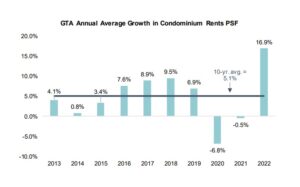
According to the latest data from Urbanation, the annual rate of rent growth in the GTA, as measured through condo lease transactions, averaged 16.9 per cent during 2022 following a 0.5 per cent decrease in 2021 and a 6.8 per cent decrease in 2020. On balance, rent inflation was below normal over the past three years at an average of 3.2 per cent compared to the latest 10-year average of 5.1 per cent.

“After surging throughout most of 2022, rents started to show signs of levelling out towards the end of the year, which should provide some temporary relief for renters,” said Shaun Hildebrand, President of Urbanation. Nonetheless, it’s clear that the negative direction for new construction and positive outlook for demand will continue placing strong upward pressure on rents in the years to come unless more action is taken to boost rental supply.”

For units transacting in Q4-2022, average rents decreased 1.6 per cent quarter-over-quarter, back in line with typical seasonal trends. As Urbanation points out, these growth rates are exclusive to units that turned over into the unregulated market. The vast majority of units do not turn over annually, are built before November 15, 2018, and are subject to the provincial rent increase guideline of 1.2 per cent.

Condominium lease transactions totaled 42,190 units in 2022, down 12 per cent from the 2021 record high of 48,256 but still well above historical averages. Lease volume decreased last year as the surge in tenant turnover caused by pandemic-related upheaval during 2021 subsided. At the same time, lease activity remained above normal due to an expansion in demand — primarily driven by a surge in immigration and foreign students, strong growth in employment, and a drop-off in first-time homebuying — as well as an increase in new supply as the condo stock increased by 19,340 units (compared to a 10-year average increase of 17,441 units) and investors opted to hold onto their units in the rental market.

More investors held units as rentals

A 33.3 per cent share of newly registered condominium units were rented out via MLS during 2022, rising from a 27.4 per cent share in 2021 and reaching the second highest level of the past decade behind 2015 (34.2%). Investors added more rental supply to the market despite the large increase in borrowing costs, motivated by quickly rising rents, a softening resale market, and a positive outlook for rental demand given the government’s increased immigration targets.

As of Q4-2022, average transacted condominium rents reached $2,752 per month ($3.81 per square foot), $391 more than a year ago in Q4-2021 ($2,361) and $334 more than the pre-pandemic average in Q4-2019 ($2,418). Over the past three years, the number of units renting for under $2,000 per month dropped 87 per cent, representing only 1.4 per cent of leases in Q4-2022.

The vacancy rate in purpose-built rental projects completed since 2005 averaged 1.5 per cent in Q4-2022, declining from 2.4 per cent in Q4-2021 and 5.7 per cent in Q4-2020, effectively returning to pre-pandemic levels.

Purpose-built rental construction

Purpose-built rental construction starts in the GTA fell 54 per cent in 2022 to 3,442 units after reaching a multi-decade high of 7,557 starts in 2021, caused by the sharp increases in interest rates, construction costs and development charges. A total of 19,679 purpose-built rentals were under construction in the GTA at year-end, up slightly from a year earlier (18,955 units).

Hildebrand predicts that as supply temporarily rises, the economy begins to slow following aggressive interest rate hikes, and renters face affordability constraints, rent inflation will moderate towards more historically normal levels in the 5 per cent range. While a record-high anticipated for combined condominium and purpose-built rental apartment completions in 2023 will bring more availability to the market, it will be met with strong demand as immigration continues rising and homeownership affordability remains low, supporting further rent increases.

Urbanation calculated that as of Q4-2022, the difference in monthly costs between owning a condo (mortgage with 20% down plus condo fees, property taxes, and home insurance) and renting a similar unit reached a record high $997 ($3,749 versus $2,752), compared to a pre-pandemic difference of $202 in Q4-2019.

Get the full picture at www.urbanation.ca   

ISSA Official Cleaning Times Validation now available

In October 2022, Cleaning Times Validated Product Directory was added to ISSA’s  Official Cleaning Times and Tasks guidebook, adding more value to this trusted industry resource with its latest evolution.

ISSA’s Official Cleaning Times and Tasks guidebook, created in the 1960’s, helps service providers determine the amount of time it will take to maintain a facility using pre-determined practices and products. This guide has been adopted as the standard for many industries, including healthcare, government, education, and others, as well as incorporated into a wide variety of programs as the default for standardized cleaning task times.

The benefits of validation

Cleaning Times identifies efficiencies with intended increased productivity with a variety of equipment, tools, and technology, focusing on five factors: task, tool, time, total units, and training.

The Official Cleaning Times Validation confirms manufacturer data on the length of time it takes to complete cleaning-related tasks by solidifying production rate claims. This helps facility managers accurately predict the time and labour required to maintain their facility and make informed choices for increased productivity, using those validated products and brands.

Serving as an effective tool for building service operators, the validation makes it easier to serve customers better, increase bidding accuracy, and reach a higher level of competition.

Earning validation

How long does validation take? If you are a manufacturer seeking to apply, the process takes 60 days between the processing of the application and receiving the full report back. Once a validation and case study are elected, that time increases to a maximum of 90 days.

GP PRO (a division of Georgia-Pacific), specializes in advanced dispensing solutions for commercial facilities, and has earned the honour of becoming the first dispenser manufacturer to be certified through the Official ISSA Cleaning Times Validation Program.

Interested in applying for validation? Visit the ISSA website for more information and the application.

Image courtesy of ISSA website. 

B.C. hatchery achieves a gold accessibility first

The Mossom Creek Hatchery and Education Centre has achieved an Accessibility Certified Gold rating under the Rick Hansen Foundation Accessibility Certification (RHFAC) program.

Mossom is the first site in Port Moody B.C and first hatchery in Canada to achieve Gold certification under the RHFAC program, making it the blueprint for hatcheries across the nation.

Achieving a score of 84 out of 100 points, this Gold rating is a significant milestone in the hatchery‘s journey towards accessibility, demonstrating its commitment to removing barriers and supporting the inclusion of people of all ages and abilities.

Based on extensive community input, the site has a broad range of accessibility features that led to its Gold rating. Features included automatic door operators, the installation of safety vision strips to glass doors and sidelights at the education centre, deck glazing, enhancements to the accessibility pathway with a resting bench, and the additional wayfinding signage to exterior locations such as the Intake Trail and Viewing Ramp.

“The journey towards certification for the Mossom Creek Hatchery has been extremely enriching and educational in terms of how we view accessibility and how much I did not know,” said Patrick Dennett, volunteer project manager. “The idea of accessibility and inclusiveness goes beyond having mobility access and also addresses the needs of people with visual and hearing barriers. Through the RHFAC rating process, enhancements to the hatchery will ensure all members of the Port Moody community and beyond are able to experience and participate in hands-on educational and nature experiences and help strengthen our ecosystem.”

The RHFAC program allows organizations to rate the level of meaningful access of sites, based on the holistic user experience of people with varying disabilities affecting their mobility, vision and hearing.

To-date, more than 1,921 sites across Canada have been rated through the program. In addition to removing barriers for people with disabilities, the conservation of sturgeon and salmon and their ecosystems has been a strong priority for Rick Hansen throughout his life. This important project is a perfect combination of both of these priorities.


Is it time to replace your windows?

As a facility maintenance manager, you need to take care of the building from top to bottom, and that includes your windows. Typically, windows last anywhere from 20 to 50 years, so how do you know when it’s time for replacement?

Whether it’s higher energy bills, heat loss, drafts, moisture, or wear and tear, there are several signs indicating when your windows have started to fail or are in need of an update.

No matter the reason, if you’ve determined that it’s time to replace your windows, there are several things to consider before committing the expense to your budget.

Assess your needs

What are you looking to accomplish and what do you need? Consider your building use and structure when making your choice. For example, for mid-rise buildings, options with four-inch frames are popular for accommodating common deep-wall structure cavities.

Decide whether you want the windows to open or to remain fixed, depending on where they are located in your building. Also, if your area experiences extreme weather, durability may need to be factored in to extend the lifespan of your investment.

If you are looking to cut down on your energy bills, look for low emissivity coatings (Low-E), double or triple-paned glass, and argon or krypton gas between panes. These features allow heat in when it’s cold and reflect heat when the weather warms up, to save on your heating and cooling costs.

RELATED: Energy-saving tips for your building

 Look at your budget

Replacing your windows can be a huge undertaking, but it doesn’t have to be a one-stop project. Budget accordingly, spacing out the project into several phases to meet your needs.

Take a practical approach to your budget. While wood frames may be more appealing to you, vinyl frames generally cost less and are longer-lasting, so that offer better value.

Take everything into consideration, so there are no surprises later. Do you have blinds or shades installed? Do your windows with alarm sensors? Budget the time and cost to have them removed and reinstalled as part of your upcoming expenses.

Late spring, summer, and early fall are the most convenient times of the year to replace your windows, so winter is the perfect time to assess your needs, look at your budget, and plan for your upcoming window replacement project.

Cosmetic pesticides okayed for use in Manitoba

Manitoba property managers will have the option to apply cosmetic pesticides on private green space when this year’s growing season arrives. Recently adopted amendments to the provincial Environment Act repeal a prohibition that had been in place since 2014 and allow retailers to again freely sell federally approved pesticides. However, that comes with an expanded list of designated publicly trafficked areas where pesticides will continue to be banned.

“Health Canada approves all cosmetic pesticides used in Canada, which must meet strict health and safety measures,” Jeff Wharton, Manitoba’s Minister of Climate, Environment and Parks, observed when he first introduced the legislation last year. “The federal government has a robust approval process that assesses the risk of pesticides to human health and the environment, and they have deemed products safe when used appropriately.”

The Association of Manitoba Municipalities (AMM) and the Manitoba Nursery Landscape Association also voiced support for returned leeway to use federally approved pesticides on lawns, boulevards, sidewalks, rights-of-way and fairgrounds. Municipal governments in particular had complained about the premium cost and reduced effectiveness of permitted weed-control products under the previous rules, which included iron-based solutions, horticultural vinegars, corn gluten meal and bio-pesticides.

In opposition, a coalition of 32 public health, environmental and community organizations called for a continued ban, citing research that has linked pesticides to a range of reproductive, neurological and respiratory health conditions in humans. Additionally, pesticides pose threats to pollinators and can contaminate storm water runoff.

“Protecting human health is a higher priority than accommodating an aesthetic preference for weed-free lawns,” the coalition asserted in a letter to the Ministers of Health and Environment, Climate and Parks.

The new rules prohibit pesticide use on school, hospital and childcare centre properties, provincial parks, picnic areas, municipal playgrounds and dog parks.

Affordability payments now available in Alberta

Effective January 18, 2023, eligible Alberta families and seniors can apply to receive $600 in affordability payments over the next six months. The targeted relief measure for those facing economic hardship is one of several supports introduced by the government to help offset the high cost of living.

“Eligible seniors and parents can apply for $600 in affordability payments over six months to help offset inflationary pressures,” said Matt Jones, Minister of Affordability and Utilities. Eligible households can apply for affordability payments for each child under 18 and each senior 65 and up, which will help to keep Alberta affordable.”

Families with household incomes below $180,000 are eligible to receive the $100 monthly affordability payments while seniors 65 or older who have household incomes below $180,000 and do not receive the Alberta Seniors Benefit can also apply.

Those unable to access the secure online portal may do so in person through any registry agent or Alberta Supports in up to 50 locations. Applications will be accepted any time between January 18 and June 30, 2023.

“We know rising inflation is forcing families to make choices they should not have to make, and kids are feeling the impacts of the financial stress at home,” said Mickey Amery, Minister of Children’s Services. These affordability payments will make a difference for parents and caregivers across Alberta who are struggling to keep up with rising costs. My hope is that by reducing some of the financial pressure on parents and caregivers, our youngest Albertans can focus on kid’s stuff, not their parents’ bills.”

The government says the application portal for direct supports was designed with personal privacy and security in mind. To apply, eligible parents and seniors must have a confirmed or pending Verified Account, which allows Albertans to prove who they are online without paper documents or face-to-face visits.

Those receiving benefits through Assured Income for the Severely Handicapped (AISH), Income Support or the Alberta Seniors Benefit, or services through the Persons with Developmental Disabilities (PDD) program are already registered and will automatically receive their $100 payments starting January 31. In other words, recipients of these programs need not apply.


Multi-unit projects drive 2022 housing starts

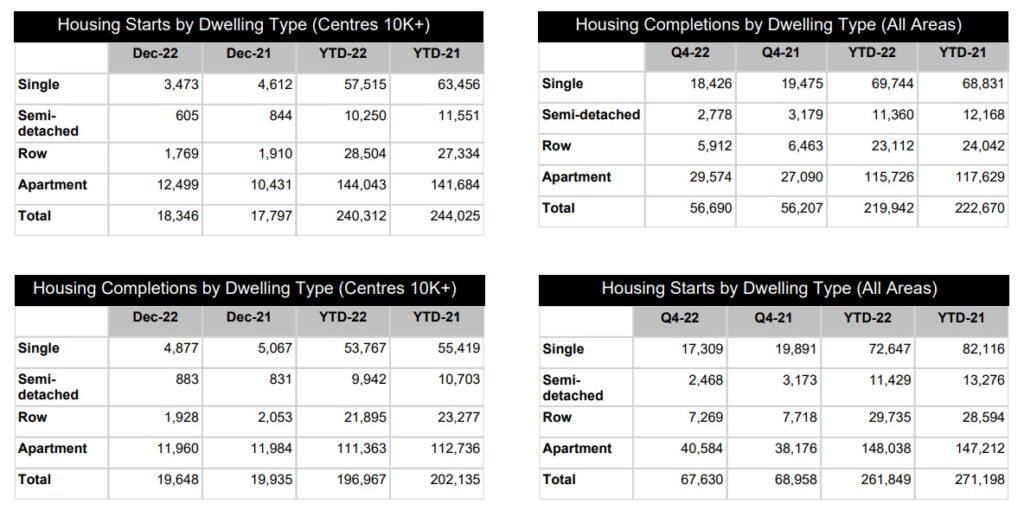
Overall, housing starts activity remained high in 2022 with December trending slightly lower than previous months. In Toronto, Montreal and Vancouver, multi-unit construction led the way, with rental apartments and condominiums accounting for the majority of housing projects.

CMHC describes housing starts as “an economic indicator” reflecting the number of residential housing projects that have been started over a specific length of time. For the month of December, total housing starts in both urban and rural areas declined five per cent to 248,625 units compared to November 2022. Specifically, multi-unit urban starts decreased four per cent to 182,850 units while single-detached urban starts fell 11 per cent to 44,858 units.

“The 2022 year ended with a slight decline for both the monthly SAAR of housing starts and the trend at the national level in December;” said Bob Dugan, CMHC’s Chief Economist. “However, Toronto, Montreal, and Vancouver all posted increases in total SAAR housing starts, with Toronto posting a significant increase of 72 per cent in December. The rate of new construction continued at an elevated pace in 2022 overall, ending the year with actual total urban starts at 240,590 units (-1%) in Canada, similar to levels observed in 2021 (244,141 units). While these additional units will provide much needed supply on the market, demand for housing in the country will continue to grow. We need to find innovative ways to deliver more housing supply and keep building at a higher pace in the coming years in order to improve affordability.”

Housing starts in the Toronto Census Metropolitan Area (CMA) reached 45,109 units, which is 7.6 per cent higher than the previous year. In fact, this marked the highest level since 2012 (48,105 units) and the fourth highest number on record. CMHC said the  growth in Toronto’s housing starts was “entirely attributable to the multi-unit segment” comprised of semi-detached homes, row homes, and apartments. In all, there were 38,780 multi-unit starts in 2022—the largest number on record—with the majority being  apartments and condominiums.

Meanwhile in Montreal, activity was in line with pre-pandemic levels with 24,000 overall housing starts, down 25 per cent from the record year experienced in 2021. This decrease was observed across all market types (homes, rentals and condos), with rental apartments continuing to drive housing starts in the area. In 2022, rental projects in Montreal represented 61 per cent of all housing starts.

Housing starts in the Vancouver CMA totaled 25,983 units in 2022, unchanged overall from 2021 (26,103 units). Builders in the region are continuing to operate near capacity and at an elevated pace, in keeping with the trends seen there over the past five years. As construction of rental apartments surged due to strong demand, condominium starts fell, indicating developers took a more cautious approach to the segment. With higher mortgage interest rates limiting the budgets of homebuyers, CMHC believes some of the demand from ownership in Vancouver has switched to rental.

December 2022 highlights: 

  • The trend in total housing starts across Canada was 269,930 units in December 2022, down from 273,801 units in November 2022.
  • 2022 ended with a slight decline for both the monthly seasonally adjusted annual rate (SAAR) of housing starts and the trend at the national level in December.
  • Toronto, Montréal, and Vancouver all posted increases in total SAAR housing starts, with Toronto posting a significant increase of 72% in December.
  • The rate of new construction continued at an elevated pace in 2022 overall, ending the year with actual total urban starts at 240,590 units in Canada. This is similar to levels observed in 2021 (244,141 units).

For more on Monthly Housing Starts and Other Construction Data visit the CMHC Housing Market Information Portal.


Okanagan College offers Women of Steel program

Okanagan College (OC) is launching a new program designed specifically to encourage women to consider a career in welding.

The Women of Steel: Forging Forward Program, supported by the CWB Welding Foundation, is being offered in just 14 locations across Canada.

As one of the host sites, students who choose OC will not only gain skills related to welding, but will also have opportunities that foster education, personal growth, confidence, and experiential learning.

“We continue to look for new opportunities that will support students to gain the skills they need now, helping them get good jobs in industries where communities need them,” says Dr. Neil Fassina, president, Okanagan College. “This partnership with the CWB Welding Foundation will help connect women with career opportunities and support our vision of transforming lives and communities. Skilled trades professionals are critical to the ongoing health and growth of our economy in this region and across the province.”

With many skilled trades professionals retiring locally and across the country, there are many opportunities for a career in the industry. Welding and welding fabrication provide a gateway to skilled trades and other related professions.

This pre-employment program is tuition-free and includes practical theory, hands-on welding training, and skills development in a safe and supportive environment, with a schedule designed to help students balance their school land personal lives. Short training periods will be used to train the participants in several welding processes, with the ability to obtain multiple CWB welding qualifications in various positions with multiple processes making graduates ready for apprenticeship, post-secondary, and employment.

The program will run March 27 and runs for 12 weeks, with in-person training provided at Okanagan College’s Penticton campus.


NFPA Fire Safety Handbook updates risk menu

The latest update to the NFPA Fire Safety Handbook brings new considerations for evolving risks in the built environment, including climate hazards, renewable energy systems and various toxic substances. The soon-to-be-released 21st edition of the widely used reference guide introduces 14 new chapters outlining preventative safety, design, maintenance and training measures for fire risks that have emerged or become more prominent since the handbook was last updated in 2008.

Related to building innovation, new chapters address photovoltaic and energy storage systems, smart infrastructure and modular construction. Looking at external threats, one new chapter focuses on wildfires and their potential interface with urban areas. Looking inwards, two new chapters provide insight on facilitating occupant movement during emergencies and responding to active shooters or other hostile episodes.

More than 200 industry specialists contributed to the update, which, along with the new topics, encompasses 210 chapters of fire safety information organized into 21 key subject areas. The resulting two-volume handbook represents the required body of knowledge for candidates pursuing NFPA’s certified fire protection specialist (CFPS) designation.

The 21st edition of the Fire Safety Handbook is set for release this fall, 127 years after it was first published.

Calgary enjoys rising industrial market in 2022

In a field of all round upbeat results, Calgary stands out as Canada’s rising industrial market of 2022. The vacancy rate dropped 180 basis points (bps), down to 2.1 per cent, over the course of 12 months, while average net asking rent climbed by $3.48 per square foot (psf) to reach $11.79 psf. That occurred along with more than 11.6 million square feet of positive absorption.

Although the vacancy rate and average net asking rent are still below the national average — pegged at 0.9 per cent and $12.77 psf in Colliers Canada’s newly released stats for the fourth quarter of 2022 — the firm’s analysts place Calgary among the best industrial performers across 12 major Canadian markets.

“The amount of annual positive absorption was the highest in the country, the year-over-year decrease in vacancy was the largest, and asking net rents increased every quarter,” they report. “With a promising development pipeline, 2023 will look to continue 2022’s strong showing.”

More than 7.6 million square feet of new space came onto the market last year, coupled with a high level of pre-leasing. Nearly 5 million square feet is currently under construction.

Meanwhile, rent escalation was the story in the big three markets where there wasn’t a lot of room for the vacancy rate to fall lower over the course of 2022. Montreal registered the steepest growth with the average net asking rent gaining $6.94 psf relative to Q4 2021 to hit $16.17 psf.

“Many industrial developments have been put on hold due to increased construction costs, from the force of rising interest rates. This delay will push net rents even higher for available product,” Colliers analysts project.

Currently, there is slightly more than 4 million square feet of new supply under construction, or about 86 per cent more than the 2.1 million square feet that came onto the Montreal market last year. The industrial vacancy rate nudged down 20 bps, to 0.6 per cent, over the course of 2022 along with 2.5 million square feet of positive absorption.

Vancouver’s year-over-year vacancy rate likewise fell 20 bps, to 0.2 per cent, while the average net asking rent jumped by $4.79 psf to reach $21.10 psf. The year saw 4.4 million square feet of new absorption and just slightly less than that amount coming onto the market as new supply. Nearly 7 million square feet of new industrial space is currently under construction.

Toronto’s year-over-year vacancy rate held steady at 0.3 per cent while the average net asking rent surged $4.43 psf during 2022 to reach $17.09 psf. The year saw about 11.5 million square feet of absorption and nearly 11.3 million square feet of new supply come onto the market. More than 13.5 million square feet of new supply is currently under construction. However, Colliers analysts note a slowing of rental rate growth in Q4 and pullback from both institutional investors and prospective tenants.

“Some tenants are now choosing to ride out current rents and gamble on future rates, rather than locking in now,” they observe. “With the rising interest rates, the pool of buyers and sales prices have fallen on the institutional side. Investment in industrial land will also continue to slow down given the increased cost of lending.”

As of year-end 2022, Ottawa’s industrial vacancy rate sits at 1.1 per cent, 20 bps above the national average, while its average net asking rent of $16.05 exceeds the national average by a far greater margin. Ontario’s Waterloo region and Halifax posted respective vacancy rates of 0.3 per cent and 2 per cent. Average net asking rents in the two markets hovered below the national average, but surpassed rents commanded in the five prairie cities.

Edmonton, continues to post the highest industrial vacancy rate among the 12 Canadian markets — at 4.1 per cent — but registered gains last year. That includes a 130 bps drop in vacancies since Q4 2021 along with a $0.98 increase in net average asking rent, taking it up to $10.33 psf. There was more than 6.3 million square feet of positive absorption in 2022, and about 3.7 million square feet of new space under construction, which is more than 30 per cent pre-leased.

Elsewhere in the prairies, Winnipeg’s industrial vacancy rate is at an all-time low of 1.3 per cent, down 150 bps since the end of 2021, while average net asking rent climbed from $7.95 to $10.18 psf in the same 12-month period. The market saw nearly 1.9 million square feet of positive absorption and a modest amount of new supply at just 70,200 square feet. However, approximately 690,000 square feet is currently under construction.

Saskatchewan is an anomaly with net average asking rent slipping relative to 12 months earlier in both Saskatoon and Regina. In Q4 2021, the two cities commanded the highest net average rent on the prairies — at $12.31 psf and $11.43 psf respectively. Over the course of 2022, Regina’s average net asking rent fell to $10.69 psf, while Saskatoon’s dropped to $11.47 psf.

In contrast, both cities experienced a tightening in the industrial vacancy rate during 2022. Saskatoon saw a 120 bps decrease, taking it down to 1.5 per cent, coupled with 172,000 square feet of positive absorption. Regina registered a 70 bps decline, with the rate dropping to 1.8 per cent, along with 237,000 square feet of absorption.

At Scarborough’s newest collaborative workspace

Something is popping at the latest collaborative workspace in Scarborough, Ontario, and it’s not just the sound of the sparkling water flowing right from the tap in the cafeteria.

At Merge Spaces, ideas are bubbling. A vibrant mix of people brainstorm in the cafe while drinking bottomless coffees, learn breath techniques on Wellness Wednesdays, and celebrate victories by snapping content-worthy selfies with a “high five” mural in the corner—all in the course of a day’s work.

Those who have worked at home over the last while will understand the balance of comfort versus connection. Yes, it’s nice to be home and throw in the odd load of laundry—but you also miss interacting.

Merge Spaces has changed that. Each of the creators displays genuine excitement when talking about the project, which began with the vision of LCH Developments to bring something unique to the empty retail space on the ground floor of a condominium at 2229 Kingston Road in the growing community of Cliffside Village.

“LCH Developments decided to be different and creative,” said Carrie Pidgeon, Community Manager of Merge Spaces who has been with the project from the start. “It was just concrete, open space. I watched it develop and start to fill up—it’s my baby.”

Originally working with a single storey, LCH brought in RAW Design who transformed the space into a ground floor and mezzanine level to maximize the available space. “It doesn’t appear very low, but the ground floor is only eight feet high,” said Taylor Roth, interior designer with RAW Design.

To add character, RAW Design created offices with vaulted roofs, now branded with names like Cabin, Cottage, and Chateau,

“We came up with a visual of doing a peaked roof, so in came this house-like structure,” explained Roth. “In the background, LCH was coordinating with their marketing and branding team, and their logo came out and it was a little house. So, it all came full circle.”

The steady communication between the design team and the developers was appreciated, she added. “They (LCH) were cognizant of our opinions and kept us in the loop. It was clear they valued our opinion from a design point.”

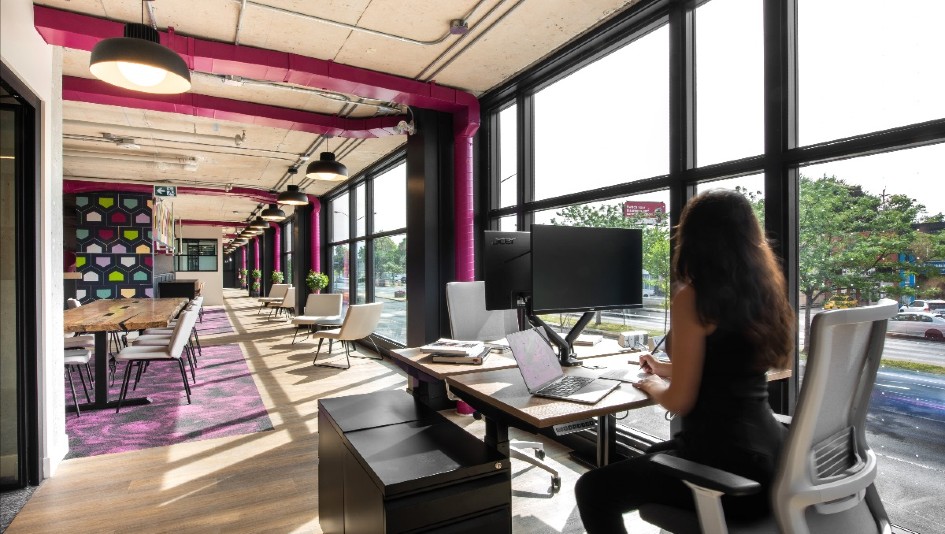
One of the initial challenges was disguising the ductwork and piping that weaved through the 22-foot high ceiling space. Blocking them in wasn’t an option, so they painted them magenta to match the Merge Spaces promotional colour schemes. “Very early on, our aesthetic was going to be neutral and warm, and then just to emphasize the ductwork,” said Roth. “We wanted to celebrate the thing which created our issues, so we came up with this beautiful magenta—a colour seen in their branding.”

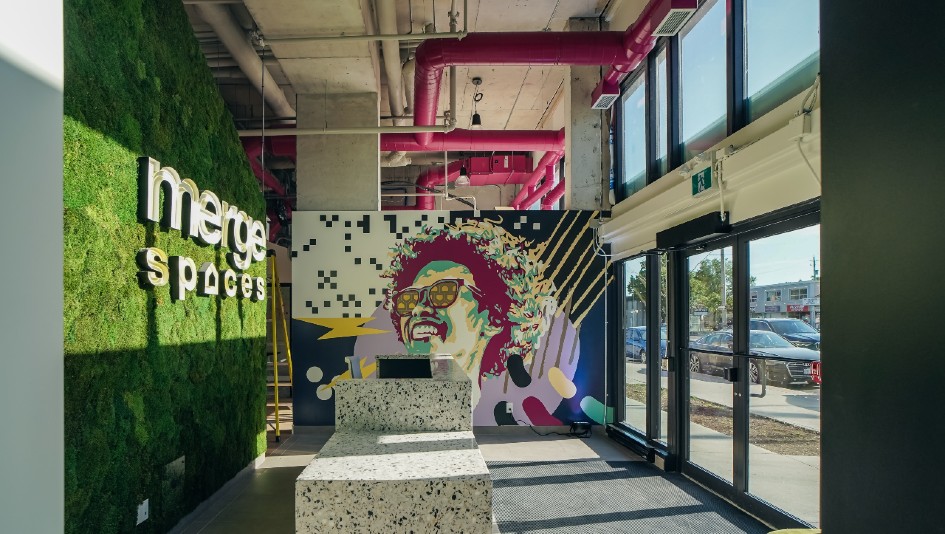
The space is balanced acoustically through the use of live moss walls attached to a sound buffering backdrop, and the space mixes clean, fluid lines with earth tones and custom-made maple harvest tables.

If you’re not too busy admiring the terrazzo concierge desk or stroking the moss wall behind it, you’ll likely be taking in one of the murals providing colour and energy. You may even notice Drake perched on the side of the Scarborough bluffs—a request which came from Carrie, the community manager, herself.

The series of twelve stunning visuals were created by Toronto-based artists Mel Coleman and Cesar Rodriguez, who partnered together to produce textured murals using a mix of collage, realism, and graphic elements.

“We wanted to create something cohesive for the space—something edgy and powerful,” said Coleman. “I’ve always loved collage, so we played with that and tried to come up with a variety of colour schemes with their branding, creating a dynamic kind of imaging.”

And there is no shortage of light streaming through the windows to show off the artwork. “We ended up redesigning the facade so that it would better connect with the street,” said Roth. “We orientated all the offices towards the front of the space while keeping the back of the space open to below. When you design for co-working, you are designing for multiple personalities and companies coming together in one space. Some people will want to sit in an open area and send emails on their laptop, and others will be a little more introverted and want to be in their closed office.”

workspace

COMMUNAL HARVEST TABLES AND SHARED DESKS IN THE WORKSPACE ENCOURAGE SPONTANEOUS INTERACTIONS AND BRAINSTORMING. PHOTO BY ARTHUR MOLA.

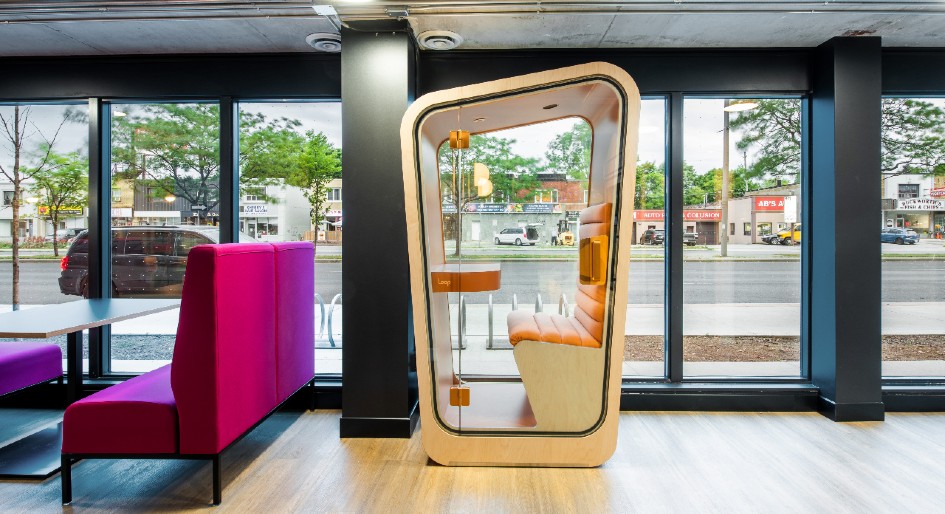
For those seeking complete audio privacy, pink soundproof pods provide a dedicated quiet space for making important phone calls. “They give someone confidence that what they are saying is in the confidence of the pod.”

Scarborough

BOOTHS ARE QUIET ENCLAVES TO RETREAT FOR HEADS-DOWN PRIVACY OR TELEPRESENCE. PHOTO BY ARTHUR MOLA.

When the lights go down, black light paint used by Cesar Rodriguez in the murals ignites features which can’t be seen in regular daylight.

Scarborough

TEXTURED MURALS ADORN THE LOBBY. LIVE MOSS WALLS BALANCE ACOUSTICS. PHOTO BY ARTHUR MOLA.

Currently using the workspace is a mix of tech start-ups, marketing and branding companies, and remote workers. LCH have also made it their head office.

Overall flexibility plays a prominent role in the project. Like other newly renovated workplaces in the past year, the hub encourages spontaneous social connections for those in between work moments. A games room is a place to mingle with other entrepreneurs and creatives.

The Treehouse is a presentation space by the café that holds lounge and booth seating. Workspace on the second floor is a mix of dedicated desks, communal harvest tables and shared desks that offer an office experience one might not find at home.

“It’s about creating that harmonious nature in an environment where it is strangers coming together and working together,” said Roth.

Judging by the hustle and bustle in the offices, the strategy seems to be working.

Sarah Farr is a writer, researcher and condo geek based in Hamilton, Ontario.

Feature photo by Arthur Mola.


ICBA: labour shortages and higher wages

B.C. construction companies expect a year of labour shortages and historically high wage increases, according to the results of a new survey by the Independent Contractors and Businesses Association (ICBA).

The survey found four out of every five B.C. construction companies (80 per cent) say they don’t have enough workers – up from last year. And 77 per cent of employers say this is their company’s single biggest challenge in 2023.

“The shortage of people is intensifying as Canada continues to go over a demographic cliff,” said ICBA president Chris Gardner. “B.C. construction companies are increasing pay and benefits, adopting new technology faster than ever, and recruiting everywhere they can – but they’re still falling short of filling positions.”

ICBA members report the average trade wage (excluding benefits, bonuses and overtime) is expected to increase by 6 per cent this year. Construction in B.C. now employs nearly 250,000 people and accounts for almost 10 per cent of the provincial GDP.

“For construction professionals, there has never been more opportunities or higher compensation,” said Gardner. “More than 90 per cent of our members expect 2023 to be as busy – or busier – than 2022. There has been no better time to pursue a career in construction than today.”

The labour shortage, supply chain issues, and growing burden of red tape has resulted in record discontent with government. Only two per cent of survey respondents said the government is on the right track in terms of how it deals with their business and more than 55 per cent said the government is on wrong track.

The survey also noted:

  • Vancouver Island: 48 per cent of contractors expect more work in 2023 than last year; 83 per cent say they are short of workers, steady from 84 per cent in 2022.
  • Lower Mainland: 50 per cent of contractors expect more work in 2023 than last year; 80 per cent say they are short of workers, up from 76 per cent in 2022.

Water IOT

In the insurance world, it’s often said that ‘water’ is the new ‘fire.’ And the new normal for annual catastrophic losses related to water damage is around $2 billion, according to the Insurance Bureau of Canada (IBC).

But the problem is even more acute in high-rise construction projects, where it can be hard to pinpoint a leak, or when a leak occurs at night, or on the weekend when the site is unoccupied. That means a small leak can turn into millions of dollars in damage during a project.

Severe water damage causes several challenges for construction companies. Related project delays can translate into increased costs in labour and materials and can also drive up financing costs from lenders to finish the project, heavily impacting developers’ bottom lines. The reality is that water damage during the construction stage of a building is one of the largest risks to completing a project on time and on budget.

“Water damage is a very common occurrence these days with high-rise construction, in both residential and commercial occupancies. Each loss is unique but the common denominator is water and gravity — a destructive combination,” says Jonathan Graham, Underwriting Director of Construction & Contracting with Northbridge Insurance, a leading Canadian commercial insurance provider.

“We look at the frequency and severity of water losses, and in the last five years both have been trending in the wrong direction,” he says.

The impact on losses and project delays is why both the insurance and construction industries have begun seeking out risk mitigation strategies, such as water leak and flood protection technology. This technology – widely being retrofitted for years into existing buildings and structures — also has applications during the construction phase of a building.

Recently, Northbridge worked with two developers and their brokers to roll out water IoT (Internet of Things) technology during the construction phase of two high-rise projects. The goal was to test the technology’s effectiveness in mitigating and reducing water damage. To better support the construction industry, Northbridge has since partnered with a leading water IoT solutions provider to offer discounts to customers on construction water leak and flood protection.

Here’s how the technology works: Temperature, humidity, moisture, and water detection sensors are strategically placed around a building and communicate via a Long Range Wide Area Network (LoRaWAN) — since construction projects are unlikely to have internet availability. The sensors are connected in real-time to a dashboard and mobile app, providing 24/7 monitoring. If water is detected where it shouldn’t be, or water supply exceeds a predetermined parameter, alerts are sent to key contacts and water valves are shut off automatically or remotely through the app.

The technology is sophisticated enough to sense moisture levels and to differentiate between normal and excess water flow for a duration of time. And while it may not prevent a leak from happening, it can catch a leak in real time to mitigate damage.

On a project in partnership with Northbridge, Jones DesLauriers Insurance Management Inc. (JDIMI), a professional services firm specializing in corporate risk management and employee benefits solutions, worked with Tribute Communities, a builder of high-rise and low-rise communities. Together, they tested a water IoT solution in a high-rise construction project which was of particular interest to Tribute, as they’d had to make four water-related claims on a state-of-the-art commercial space about a decade ago. As a result of the damage, they had to rebuild the space three times over the life of that project.

“Those four leak claims cost us close to a year and a half,” says Gus Stavropoulos, Chief Financial Officer with Tribute Communities. “We learned a lot in that building and we learned there has got to be a better way to do this.”

When they rolled out water IoT sensors during the recent construction project, they didn’t have any significant water claims and credit the risk mitigation benefits of the technology for that outcome.

“We had one case where we got ahead of it,” he says. “There was a report of a pressure leak, and our staff quickly got the alert and dealt with it, and it was done. It was a loose valve, but that could have turned into a quarter-of-a-million-dollars in damage— and a couple turns of a wrench saved us a lot of problems.”

He believes water IoT technology will revolutionize loss exposure on high-rise construction projects — and that the industry as a whole needs to be at the forefront.

“I wish this technology was available 10 years ago when we had a $3.5 million water damage loss,” says Michael Kucharuk, Partner and Account Executive with JDIMI. “Overall, I’m glad to hear Northbridge is proactively addressing water damage in construction projects through technology and connecting with GCs and brokers on the issue.”

While there are hundreds of insurance providers registered in Canada, only a handful specialize in course of construction projects.

“There are definitely fewer insurers now than prior to 2020. Of those still available, they may not be comfortable covering 100 per cent of the risk and so multiple insurers are needed to cover a portion of the risk to reduce their exposure in the event of a loss. This means that more negotiations are required due to the nature of having multiple insurers participate — especially on large multi-tower projects,” says Cathy Ciccolini, Partner at Masters Insurance Limited, which also partnered with Northbridge on a water IoT pilot project.

She believes water IoT technology will be useful to the construction industry in the future — it may even become a requirement, like sprinklers or smoke detectors. Future projects will be marketed with ‘no water damage claims’ from past projects, allowing new insurers to offer potentially more capacity, as well as better rates and deductibles.

“I strongly recommend developers adopt this type of protection. Most of them have had a water damage claim — some small, some larger,” says Ciccolini. “I impress upon them that water damage claims will affect the next project I have to place for them.”

“While it is still very much in its infancy in this part of the world, genuine interest from both developers and insurers is prevalent and gaining momentum,” Kucharuk says. “Not that long ago, developers heard about IoT technology as a new ‘thing’ that may come to fruition one day. This clearly isn’t the case anymore — forward thinking developers are familiar with how to use the technology to their benefit.”

Indeed, he says it’s a natural, pragmatic progression to help reduce both frequency and severity of claims, which is key for insurers and vital to developers — as it will greatly aid in keeping their construction timelines on track and reducing water damage costs.

“There’s a lot of opportunity to reduce the likelihood but also the size of a water leak, so we can prevent or mitigate the risk by using this technology. It’s about identifying where the issues are and also being able to act remotely,” says Christopher Mastro, Director of Risk Services with Northbridge Insurance.

Developers also have the ability to pass on the cost of water IoT technology to the building owner once the project has wrapped up. And building owners can benefit from the technology post-construction, as it can help mitigate potential ongoing risks and insurance costs.

“It’s probably more cost-effective to put it in during construction because you can protect the site and ensure owners occupy the building on time. If your building is 98 per cent done and a hose comes off a toilet on the 12th floor, you could set your whole project back by months,” says Mastro. “But for building owners, it offers ongoing risk management.”

While the technology can’t necessarily prevent the frequency of water-related events, it can have a dramatic impact on severity — providing timely insights to reduce the severity of loss — which is a win-win-win for construction companies, insurers and ultimately building owners.

Northbridge Insurance, Northbridge and the Northbridge Insurance Logo are trademarks of Northbridge Financial Corporation, licensed by Northbridge General Insurance Corporation (insurer of Northbridge Insurance policies). This resource is provided for information only and is not a substitute for professional advice. We make no representations or warranties regarding the accuracy or completeness of the information and will not be responsible for any loss arising out of reliance on the information.

Water IOT