Articles Archive - Page 231 of 928 - REMINET
REMI

Engineering excellence earns ACEC-BC Awards

The Association of Consulting Engineering Companies – British Columbia (ACEC-BC) celebrated innovation and technical excellence at its annual Awards of Engineering Excellence held in Vancouver.

“The ACEC-BC Awards for Engineering Excellence celebrate the exceptional work of our members to imagine, design, deliver, and manage infrastructure around the world and right here in B.C. Their personal and professional contributions positively impact how people and communities experience life every day. It is a privilege to shine a light on these outstanding people and organizations,” said Caroline Andrews, ACEC-BC president and CEO.

BBA won the top Lieutenant Governor’s Award along with an Award of Excellence in the Municipal and Civil Infrastructure category for the Woodworth Dam project in Prince Rupert. The new structure, a 15-metre-high concrete gravity dam, was built downstream from the existing dam in a rocky canyon and will provide a stable water supply for the next 50 to 100 years.

Award of Excellence winners:

  • Stantec, British Columbia Institute of Technology Health Sciences Centre (Buildings)
  • Gygax Engineering Associates, Ah ta apq Creek Hydroelectric Project (Energy & Industry)
  • Mott McDonald, Spirit Trail over Lynn Creek (Transportation & Bridges)
  • Westmar Advisors, Wuikinuxv Debris Wall and Wharf Facility Reconstruction (Natural Resource & Habitat)
  • McElhanney, Kitimat Flood Risk Management Strategy (Soft Engineering)
  • Associated Engineering, Baxter Bridge Rehabilitation – A Community Lifeline Restored  (Projects under $2.5 Million)

The District of Kitimat received the Client of the Year Award, recognizing the benefits that result from positive collaboration and good client relationships. And RAM Consulting is the organizational recipient of ACEC-BC’s first Equity, Diversity & Inclusion Award.

ACEC-BC and its members also recognize individuals for career contributions to the consulting engineering profession, industry, and the broader community.

Meritorious Achievement Award: Mike Currie, P.Eng., FEC, a principal and senior Water Resources Engineer with Kerr Wood Leidal,

Young Professional Award: Katherine Miller, P.Eng., rail and transit project manager, Mott MacDonald.

Equity, Diversity & Inclusion Award: Katie Au, P.Eng., PMP, national practice leader, engineering at BBA.


Tips for effective pressure washing

Pressure washing can be a maintenance manager’s best friend, from cleaning out garbage cans to getting rid of graffiti to removing persistent dirt and grime in the warehouse. While pressure washers are relatively simple to use, there are various factors to consider for faster, more effective results.

Here are some top tips for getting the most out of your pressure washer:

  • Start by testing out the flow to make sure you have enough water pressure to get the job done. Send your spray into a five-gallon bucket and if takes two minutes or less to fill, that indicates a sufficient water flow.
  • All nozzles are different, so be sure you have the correct one for each task. You don’t want to inadvertently take the paint off a surface you are just trying to clean. The narrower the spray, the more forceful it is, so be mindful of how strongly you want the water to come out.
  • Water is not always enough to get the job done, so you may need to add chemicals or detergents for best results. Give the chemicals some time to work their magic, but not so much time that they dry before you rinse. Some detergents need a set amount of time for suspension or emulsification before they can be released from the substrate, so read the instructions carefully.
  • If dirt is really caked on, soaking it with a wet cloth and detergent can be a great way to prep the area ahead of time.
  • For high-pressure, low-volume cleaning, like stripping paint, cold water is recommended. For most other applications, warm water will yield the best results.
  • For longer jobs, try using the pressure washer in five-minute intervals to get maximum exposure, while minimizing the chance of burning out your machine.
  • Keep your pressure washer in good working order by storing it safely at the end of the season so it’s ready for the next time you need it.

A pressure washer can be a useful tool to help maintenance managers keep the building looking great throughout the spring and summer months.

RAIC College of Fellows selects new chancellor

Gerrie Doyle, an Ottawa-based architect and Fellow of the Royal Architectural Institute of Canada, has been elected chancellor of the RAIC College of Fellows for a three-year term beginning June 2023.

Doyle will succeed Susan Ruptash, FRAIC, from Toronto, who began her term in 2020. Ruptash, decided not to run for a second term.

“During the election period I heard from members about their concerns, and three main issues were most often raised. Firstly, we need to foster greater engagement with our more diverse younger generation – including students, interns, new graduates, and young architects. Secondly, members would like to see greater advocacy on their behalf. I believe the RAIC currently engages in a lot of advocacy, and our members should be made more aware of these initiatives. The third issue is that we need to boost representation in the province of Quebec. I would like to increase the RAIC’s membership there, and build a stronger relationship between Quebec and the RAIC College of Fellows. I look forward to working with everyone over the next three years and helping to realize our collective goals going forward,” said Doyle.

Doyle offers more than 14 years of volunteering experience with both the Royal Architectural Institute of Canada (RAIC) and the Ontario Association of Architects (OAA). She has been instrumental in the positive changes within the RAIC through her volunteer work on various committees. While serving in various roles on the OAA Council, she served on over ten OAA committees or task groups.

“As only our second female chancellor in history, I’d like to sincerely congratulate Gerrie Doyle on her election,” said RAIC president Jason Robbins, FRAIC. “I’m looking forward to the value and perspective she will bring to the Board in her role as chancellor.”


Commercial cleaning in allergy season

It’s allergy season, and that makes it a great time to review your products and practices as part of your spring maintenance to find opportunities to minimize exposure to common allergens.

The most common office allergies are dust, mould, mice, fragrances, and cleaning products, and there are a few ways you can focus on reducing those allergens with your cleaning products and practices.

Dust

Reducing the dust in your space is mostly a maintenance issue that can be addressed by dusting surfaces daily. Washing window treatments, changing your HVAC filters, and cleaning your air ducts will also help keep dust to a minimum.

High-efficiency vacuums with HEPA filters help to get dust and pollutants out of the air, collecting extremely small micron particles that may otherwise be floating around. Don’t forget to stay on top of cleaning your mats, too, as they can trap and hold onto dust and dirt that can get into the air.

Mould

Mould is most often caused by the combination of moisture, oxygen, and a food source like wood, paper, or insulation. Controlling the moisture in your building is the key to keeping mould at bay. Leaks and water damage are the primary sources of mould, so conduct regular inspections of the interior of your building to notice whether you have any issues that need addressing.

RELATED: Why storm season matters for facility maintenance managers

Controlling the humidity levels is another way to avoid mould. According to the Environmental Protection Agency (EPA), optimal humidity for your building is 30 to 50 per cent, so keeping your humidity levels within that range will help you avoid having to address mould in your building.

Mice

While the nights are still cool, rodents tend to seek refuge (and food) indoors. As well, look for signs of mice like damage or droppings to know if they are present and if there is already an issue.

Mice can enter through small holes and cracks, breeding quickly and causing an infestation. Cut down on the chance of mice entering your building by checking for any possible points of entry and sealing those up. As well, keep large entryways like bay doors closed when not in use, and remove any garbage or food promptly that may attract them.

Fragrances and cleaning products

Many common commercial cleaning products – even when labeled ‘healthy’ – contain popular allergens that could make allergy symptoms worse. It can be difficult to look deeply into the ingredients list of many products because there can be ambiguous categories like ‘fragrance’ or ‘preservatives’ that don’t disclose the exact information. Some cleaners also have the added irritant of ‘colour,’ another ingredient that does not disclose its exact makeup.

With cleaners, your best bet is to try and find unscented, natural products with as few questionable ingredients as possible to try and stay away from common allergy irritants.

Allergy season is here, and prioritizing cleaning to limit allergens raises your cleaning standards while providing a more pleasant experience for your visitors and staff.

BC Housing confirms Vincent Tong in top job

BC Housing has confirmed Vincent Tong as its permanent chief executive officer after he stepped into the role in an acting capacity last September. Previously, he served as vice president of development and asset strategies at the provincial agency, which oversees the development, management and administration of subsidized housing, as well as the licensing of residential builders and associated consumer protection programs.

“Under Vincent’s leadership, BC Housing has been taking significant steps to strengthen our organizational structure and capacity, financial systems, governance practices and policies related to oversight, transparency and conflict of interest,” says Allan Seckel, chair of BC Housing’s board of commissioners.

Since last fall, Tong is credited with hiring more in-house legal counsel to better ensure legal, regulatory and privacy compliance, strengthening standards for conduct and creating new whistleblower protections.

“This is a pivotal time in B.C. where people are struggling to secure affordable housing. I am committed to ensuring BC Housing delivers on our mandate,” Tong says. “I look forward to continuing to work with BC Housing’s dedicated employees, along with our provincial partners, the non-profit housing sector and municipal partners as we work together to address the housing crisis that affects us all.”

Prior to joining BC Housing in 2021, he spent a decade working at Toronto Community Housing, rising to the role of chief development officer and guiding the revitalization of aging social housing communities. He is a registered professional planner and a member of the Urban Land Institute.

Canada’s sizzling hot apartment market

Apartment owners across Canada are reaping the rewards of a favourable supply-demand equation fuelled by robust population and job growth, a growing preference for renting vs. owning, and a housing shortage limiting tenants’ options. According to Yardi’s latest national multifamily report, rents are expected to keep accelerating at “above-trend levels” for both new leases and renewals given the limited number of new units currently in the development pipeline, and the lack of tenant turnover.

“Canada’s economic conditions mostly support the bullish apartment outlook,” the report contends, adding that jobs are increasing at a steady rate, while population growth continues unabated. In fact, Yardi says the economy exceeded expectations by adding nearly 35,000 jobs in March, led by high wage segments including transportation/warehousing (41,000), building and support services (31,000) and finance, insurance, and real estate (19,000). Hourly wages were up 5.4 per cent as of February.

Meanwhile, the unemployment rate remained near record lows at 5 per cent as inflation fell to 4.3 per cent in March, its lowest level since August 2021. Unlike the U.S. central bank, the Bank of Canada (BOC) has decided to “hit the pause button” with short-term rates at 4.5 per cent. The BOC forecasts inflation to gradually recede to target levels over the next two years and is betting that costs will decelerate without more action on its part.

apartment market Yardi

Average in-place rents

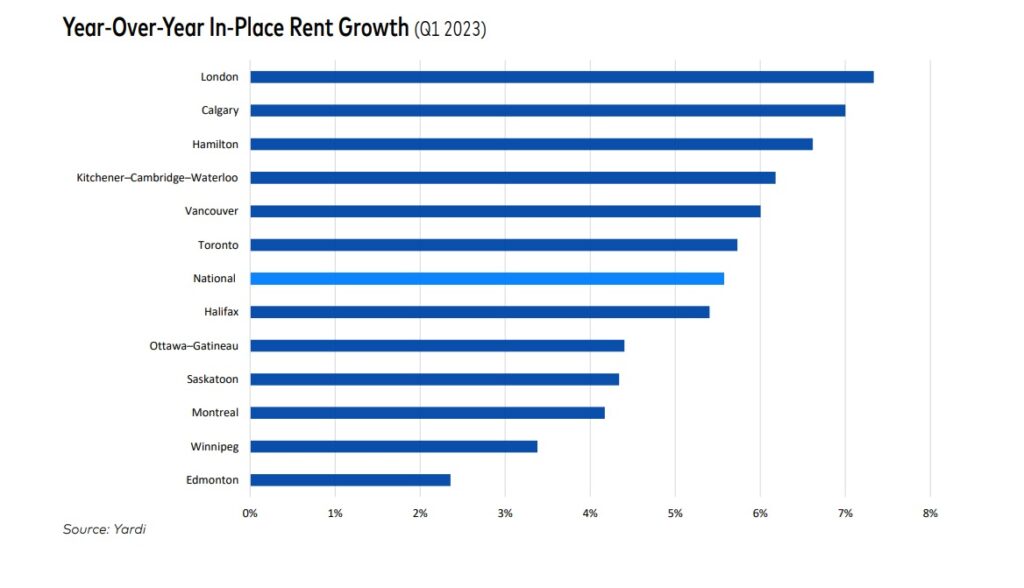
Across Canada, “in-place rents”—meaning all rents in one Census Metropolitan Area, including new leases, renewals, and existing leases—climbed again to reach record highs in Q1 2023. The average in-place rent increased $21 in the first quarter to $1,411. Year-over-year growth also accelerate, to 5.6 per cent, up 80 basis points from the fourth quarter and more than double the 2.7 per cent growth rate in Q1 2022.

Canada’s population grew by a record 1.1 million in 2022, up 2.7 per cent—the highest since 1957. Growth was concentrated in permanent and temporary foreign residents, which increased by 1 million.

Single-family home sales increased 2.3 per cent month-over-month in February, but were down 40 per cent year-over-year, according to the Canadian Real Estate Association. Population growth, higher mortgage rates, the increasing unaffordability of single-family homes and the growing number of ‘renter by-choice’ households all contribute to demand for apartments.

Yet supply is not keeping pace. Apartment buildings are not coming to market as quickly as they are needed. According to Yardi, this is due to policies such as rent control and strict zoning regulations “putting a lid on new supply,” which is an increasing problem as demand for purpose-built rentals mushrooms. According to a recent report by the Royal Bank of Canada, a 25,000- to 30,000-unit deficit currently exists in purpose-built rental stock, and that is likely to grow to around 120,000 units over the next four years as demand soars.

“Canada will need to add 332,000 units to its current rental stock between now and then to achieve a balanced market with rent stability,” the report states. “That would represent roughly a 20 per cent increase in the annual pace of construction achieved in 2022, when 70,000 rental units were completed.”

Additional facts & figures

  • Between 1996 and 2012, growth in purpose-built rentals in Canada reached as much as 1 per cent of stock just once, and most years during that period it was either negative (as some units became obsolete) or barely positive (source: CMHC Rental Market Data, Statistics Canada and RBC Economics).
  • The annual average growth rate of purpose-built rentals has moved closer to 2 per cent over the last decade, but the long-term deficit will take years of building to fix, especially now that the population is growing more rapidly.
  • Eight of the top 12 CMAs tracked by Yardi recorded double-digit gains year-over-year, led by three in Ontario: Kitchener-Cambridge-Waterloo (19.6 per cent), Toronto (18.6 per cent) and London (16.7 per cent).
  • Rent growth is lowest in the Winnipeg CMA (2.1 per cent) and the province of Manitoba (2.2 per cent).

For the full report, visit: https://info.yardi.com/multifamily-market-reports-for-canada

Andrew Blair joins Colonnade BridgePort

Andrew Blair has joined ColonnadeBridgePort as managing partner of its investment and fund management business. He comes to his new role with extensive senior executive experience, most recently as the head of real estate investments in the Americas for Canada Pension Plan Investment Board. He was also previously chief operating officer and executive vice president with TrizecHahn Development.

Blair will lead ColonnadeBridgePort’s fund for private equity and institutional clients, focused both on institutional-quality developments in Ottawa and expansion to markets throughout Canada. Prioritizing urban infill residential and mixed-use projects, the company strategizes to address Canada’s market housing shortage in a climate-friendly format, while creating value for investors.

“We’re delighted that Andrew’s return to his hometown of Ottawa has resulted in him taking on this leadership role with Colonnade BridgePort. He brings a depth of experience and of perspectives that will clearly enhance our ability to connect the needs and objectives of our institutional investment partners with those of investors in our private equity funds,” says Hugh Gorman, Colonnade BridgePort’s chief executive officer.

Brady Welch to act as Slate REIT’s interim CEO

Brady Welch is stepping in as interim chief executive officer of Slate Office Real Estate Investment Trust (REIT) in place of the departing Steve Hodgson. Welch is the co-founder of Slate Asset Management and will apply 30 years of industry experience to his additional role.

“With the global office sector facing significant headwinds, Brady’s decades of experience navigating through various economic cycles in Canada, the U.S. and Europe will help us further strengthen the REIT’s position to execute on our strategy for long-term performance,” says Monty Baker, chair of Slate Office REIT’s board of directors.

“I believe we are well-positioned to navigate the headwinds facing the office sector,” Welch says. “Slate Office REIT has grown into a stable, global platform with a portfolio of high-quality office real estate.”

Welch has also served as a trustee of the REIT’s board since its inception and will continue to do so during his interim tenure in the C-suite. Hodgson is stepping down to pursue other opportunities as of May 12.

“Steve was instrumental in navigating the REIT through the challenges of the pandemic and driving the early execution of the REIT’s ongoing repositioning strategy,” Baker says. “We wish him all the best in his future endeavors.”

ISSA Hygieia Network launches Educational Programs Grant

ISSA Hygieia Network, an ISSA Charities™ signature program dedicated to the advancement and retention of women in the cleaning industry, has announced the launch of its Educational Program Grants for cleaning industry professionals, along with access to Hygieia’s numerous educational webinars, and the DePaul Career Edge certificate.

RELATED: ISSA Hygieia launches new community for female professionals

The ISSA Hygieia Network will award a limited number of Educational Program Grants that will provide recipients from the commercial and residential cleaning industry access to all of Hygieia’s online educational programs and one in-person Networking and Leadership Conference.

Applicants must be ISSA and ISSA Hygieia Network members, currently employed in the commercial or residential cleaning industry for a minimum of 12 months. They must submit a letter of recommendation, personal statement, and online application to be considered.

There is no guarantee that a grant will be awarded if you apply. The Grant Program is subject to the availability of the grant funds, which are limited. Therefore, not all who apply and qualify will be awarded a grant under the Grant Program.

Grants will be awarded to those who qualify on a first-come, first-served basis until such time as the grant funds are exhausted. Therefore, applicants are encouraged to apply as early as possible.

To learn more about the requirements and to apply for an Educational Program Grant, click here.

To learn more about ISSA Charities and to make your own donation, visit issacharities.org.

Calgary arena and event centre moves forward

A new world-class arena and event centre is coming to downtown Calgary.

The City of Calgary has reached agreements, in principle, with the Province of Alberta (Province), Calgary Sports and Entertainment Corporation (CSEC) and Calgary Stampede (CS) to proceed with a significant phase of the Culture + Entertainment District.

“This new arena and event centre will be at the heart of Calgary’s sports, entertainment and cultural scene for generations, and will result in billions of dollars of economic activity and a higher quality of life for millions of Albertans, says Premier Danielle Smith. “Along with Edmonton’s Rogers Place, Alberta will now have two of the best and most modern event centres in all the world.”

This area will feature a suite of public amenities and public infrastructure, including a new community rink, improvements to public spaces and connections to The District, and commercial opportunities, all of which will be anchored by a new publicly-owned modern event centre.

The Calgary Construction Association (CCA) welcomed the news, stating that the development will not only enhance the entertainment options in the area but also provide significant economic benefits for the construction industry through jobs and follow-on investment in the Rivers’ District.

“The construction industry is poised to play a major role in bringing this new facility to life, and we are proud to support this project. Our association is committed to working closely with all stakeholders as an advisor to ensure that this project is delivered on time, within budget, and to the highest level of quality,” said CCA.

Formal discussions on definitive agreements is expected to be underway through spring and summer 2023. The project team is preparing to begin the design and development of the event centre, as well as the supporting infrastructure in the area.

“This project is another signal to the market that Calgary is making strong investments in its future,” said Mayor Jyoti Gondek. “The partnership approach we have taken accomplishes two things: we are building an event centre, and we are also creating the public amenities needed within the Rivers District to build community and enhance quality of life for all Calgarians.”


FCM’s Spring 2023 issue is out now!

What does facility cleaning and maintenance look like in spring 2023? We’ve written a lot over the last few years about sanitation, hygiene, and health and safety as we navigated through unprecedented times, but now it’s time to forge ahead to a brighter future in commercial cleaning.

Our spring 2023 issue of Facility Cleaning and Maintenance features a look at retail and hospitality, highlighting the challenges and opportunities that come with keeping public spaces clean and maintained. We cover how to adopt a common-sense approach to cleaning common areas, emphasizing the shift to new, post-pandemic practices.

We also offer a fresh take on investing in air quality and air-powered washroom technology, as it relates to customer-facing industries. As the weather turns warmer and public spaces become more crowded,  hand hygiene and air purification are a topic of discussion, along with the importance of implementing an integrated pest management system for your building.

In our cover story, we take a look at outdoor maintenance with a focus on sustainability, spotlighting the City of Waterloo’s green fleet management program as they lead the way for other municipalities to go greener. We talk about how their fleet management program is benefiting the city and the planet, with eco-friendly initiatives like zero-emission vehicles, solar panels, and detailed reporting.

For our expert Q&A, we share our interview with Rob Scott, executive vice president at Bee-Clean Building Maintenance, diving into the value of membership, designations and their benefits, and what consistency brings to the cleaning industry as a whole.

We also look ahead to the upcoming ISSA Canada Show happening in Toronto on June 14 and 15. This year’s theme is CLEAN: A New Way of Thinking, and with over 200 exhibitors, the show will feature educational opportunities, certification, networking, and more!

This issue highlights key challenges in cleaning and maintenance today and a few of the ways we can look to improve our efforts as we move through spring and summer.

Read the full issue here.

Ontario awaits patchy debut of discount power

Ultra-low overnight (ULO) electricity rates will make a patchy debut in Ontario next week with seven of the province’s 60 local distribution companies (LDCs) ready to offer the new pricing scheme to residential and small business consumers on the regulated price plan (RPP). The release of the rate schedule earlier this month makes it clear that most condominium corporations and rental housing landlords will need to make capital investments in energy storage alongside electric vehicle (EV) charging infrastructure to realize the benefits.

The ULO rate has been set at 2.4 cents per kilowatt-hour (kWh) from 11 p.m. to 7 a.m., which is 67.5 per cent lower than the off-peak rate of 7.4 cents/kWh that’s in place from 7 p.m. to 7 a.m. through the RPP’s standard time-of-use pricing. However, that comes with a counterbalancing on-peak rate of 24 cents/kWh in the hours between 4 and 9 p.m., and a mid-peak rate of 10.2 cents/kWh in place 7 a.m. to 4 p.m. and 9 p.m. to 11 p.m.

“The 10-to-1 ratio, on-peak to off-peak, is quite extreme,” observes Peter Love, an energy consultant who served as Ontario’s chief energy conservation officer from 2005 to 2009. “This rate is meant for people with EVs. That’s clearly what the intention is. They are primarily the people for whom this makes sense.”

“There will be cases where ULO rates might benefit EV drivers in multifamily buildings, but would result in higher costs for the entire common area or bulk account unless other strategies are employed to shift building consumption to the overnight period,” advises Rob Detta Colli, energy and sustainability manager with Crossbridge Condominium Services. “However, having ULO opens the door to consider things like pre-cooling and/or energy storage strategies. For example, that could be something like making ice, using cheaper overnight rates, then melting it to offset chiller use during the heat of the day.”

In announcing the ULO rate schedule, the Ontario government presented it as an opportunity for hydro customers who work evening shifts, heat their homes with electricity or have an EV charger tied to their account to potentially save about $90 per year. Perhaps more importantly, it is intended to have broader benefits for the entire electricity system, shifting demand to a period when there is typically surplus power capacity and easing peak demand at other periods of the day.

In ULO rate design recommendations submitted to the Minister of Energy in the spring of 2022, the Ontario Energy Board projected that a relatively modest enrollment of 23,000 customers, including 9,800 EV owners, could cut average annual peak demand by about 3 megawatts (MW). A more vigorous uptake of 318,000 consumers, including 32,000 EV owners, was projected to deliver about 40 MW of average annual peak demand reduction.

Shoring up the erosion of time-of-use pricing

Love has long been an advocate for greater differentiation in on-peak and off-peak prices, maintaining that 4-to-1 or 5-to-1 is a more effective ratio to promote energy-saving behaviour. Instead, the on-peak and off-peak rates have moved closer together, going from an approximate 3-to-1 ratio when time-of-use was first introduced in 2006 to a 2-to-1 ratio since 2009. As well, the Ontario Energy Board has begun to grant approval for LDCs to charge transmission and distribution fees at a fixed rate in place of heretofore variable rates tied to thresholds of consumption.

“That is disappointing. No matter how good you are at conservation or how bad you are, you’re going to pay the same distribution rate. It’s not a big impact, but it does dampen the impact of time-of-use,” Love says. “The new ultra-low overnight rate is the right move. We have a lot of off-peak power and it has always been the ideal that electric vehicles would charge at night when the system is at a low peak. It could also signal to people that maybe this would be a great time to buy an EV because this rate is very attractive.”

He cites the work of energy analyst Brian Lapp, who has calculated the annual cost to power his EV at the ULO rate should be about $97 versus the approximate $2,200 expenditure needed to fuel a gas-powered vehicle. ULO adopters could also see further benefits with adjustments to other aspects of their electricity consumption.

“It is an opportunity for people with air-conditioning heat pumps to use their programmable thermostats to keep the heating or cooling very low during the day when they are not at home and then, in the summer, really cool it down at night,” Love recommends.

Uptake could be straightforward in scenarios where apartment dwellers have exclusive use of a specified charger in a sub-metered building. Through their sub-meterer, they could opt in to the ULO rate for both their suite and the charger, thus shouldering any problematic on-peak costs separate from the building’s common area account.

“A sub-meter on an EV charger in the parking garage could be bound to one suite and that owner or tenant would get a bill (from the sub-meterer) with two meters shown on it,” explains Brian Aitken, senior manager, commercial accounts, with the meter provider, QMC Metering Solutions.

Meanwhile, investments needed to effectively benefit from the ULO rate in common areas and elements would generally also reduce greenhouse gas (GHG) emissions. That may align with the corporate mandates of some multifamily landlords or the directions that condo boards are receiving from their members.

Among possible complications, energy management specialists caution that energy storage systems could require a level of operational expertise that on-site building operators or superintendents may not have. “It’s a big investment so there would also be concern about a switch in political direction and the rules changing again,” adds Scott Rouse, managing partner of the consulting firm, Energy@Work.

For now, a lot of the province is still waiting for the ULO rates to become available since LDCs have until November 1 to get their programs in place. The keener cohort that is ready to roll out the new pricing option on May 1 includes: Toronto Hydro; London Hydro; Centre Wellington Hydro; Hearst Power; Renfrew Hydro; Wasaga Distribution; and Sioux Lookout Hydro.

Barbara Carss is editor-in-chief of Canadian Property Management.

Vancouver reveals West End waterfront designs

The Vancouver Board of Parks and Recreation and the City of Vancouver have revealed three preliminary design approaches for the future of the West End waterfront.

The West End Waterfront Plan is focused on the area commonly known as English Bay, Sunset Beach Park, Alexandra Park, Morton Park, and Beach Avenue. The project area stretches from the Burrard Street Bridge up to, but not including, Stanley Park. The plan will help shape the direction of this area for the next 30 years and beyond.

Vancouver-based landscape architectural firm PFS Studio and Oslo-based Snohetta was contracted in September 2020 to perform design and planning work.

The project team has prepared three approaches to help guide the plan. All three approaches explore different ways to achieve the same goals, and elements from each one can be combined. For example, all approaches include elements to make the area resilient to future sea level rise. These concepts are a work in progress and will continue to be developed to get to one conceptual design for the area.

The three different design concepts:

  1. Weave emphasizes and celebrates park activation, public life, and the movement of people by weaving diverse activities throughout the length of the park.
  2. Carve focuses on the dynamic qualities of water, by integrating ways for people to experience fresh and salt water throughout the area.
  3. Seed emphasizes and celebrates ecology and biodiversity and is influenced by the forests of Stanley Park and the historic salt marsh of False Creek.

Public feedback will help shape a preferred design concept, which will be shared in a future round of engagement later this year. A final plan is expected to go to the Park Board and City Council for approval in winter 2024.


Teams shortlisted for Surrey SkyTrain systems

Three pre-qualified teams have advanced to the request for proposals (RFP) stage to design, build and install the electrical systems and trackwork for the Surrey Langley SkyTrain.

The teams invited to participate in the RFP stage are:

Transit Integrators BC

  • Graham Infrastructure LP
  • SNC-Lavalin Major Projects Inc.
  • SNC-Lavalin Inc.
  • Western Pacific Enterprises Ltd.

Surrey Langley SkyTrain Connectors

  • Aecon Infrastructure Management Inc.
  • SICE Canada Inc.
  • Parsons Inc.

Kiewit Infrastructure BC ULC

  • Kiewit Infrastructure BC ULC
  • Mass. Electric Construction Canada Co.
  • Mass. Electric Construction Co.

The contract includes the design and installation of the SkyTrain track work, as well as the design, installation and integration of electrical systems, such as power, telecommunications and automatic train control.

The province anticipates the preferred proponent will be announced in early 2024.

The Surrey Langley SkyTrain project is a 16-kilometre extension of the Expo Line from King George Station to Langley City Centre, the first rapid transit expansion south of the Fraser River in more than 30 years.

Once complete, the project will provide high-quality and low-cost transportation for people in Surrey, Langley and throughout Metro Vancouver. Major construction on the Surrey Langley SkyTrain is expected to begin in 2024.

Scheduled for completion in 2028, the Surrey Langley SkyTrain is being delivered through three separate contracts for the guideway, stations, and systems and trackwork.

In January 2023, the RFP for the first contract to build the elevated guideway, roadworks and utilities, as well as cycling and pedestrian paths along the extension, was issued to two shortlisted teams. The contract award is expected in fall 2023.

The second RFP, announcing the firms shortlisted to design and build eight new stations for the Surrey Langley SkyTrain, as well as cycling and walking paths around the new stations, was posted in March 2023. The contract award is anticipated in late 2023.

VICA Awards honours 2023 winners

After two years of virtual awards, the 4th annual VICA Awards was held in person at VICA’s 2023 Vancouver Island Construction Conference, in conjunction with BCCA’s Construction Month.

The awards recognize the work of members across Vancouver Island, the Gulf Islands, and coastal British Columbia. VICA received 20 project submissions in six categories.

The awards are open to all VICA members in good standing at time of submission and are judged by a panel of esteemed industry professionals from across the industrial, commercial, institutional, civil and multi-family residential construction sectors.

“The VICA Awards are a symbol of pride as we showcase and celebrate the contributions and achievements of VICA member companies,” said Rory Kulmala, CEO. “The crop of winners for this year’s awards reaffirms that Vancouver Island is home to some of British Columbia’s most competent, detail-focused and dedicated construction companies”

The 2023 VICA Awards winners:

Prime Contractor Project Achievement Award, Over $20 Million
Casman Projects, Cameo ft. Star Cinema Movie Theatre

GENERAL CONTRACTOR AWARD $10 TO $20 MILLION
Kinetic Construction, Canadian Coast Guard Base, Hardy Bay

GENERAL CONTRACTOR AWARD $5 TO $10 MILLION
CGI Constructors, 1810 Blanshard St.

GENERAL CONTRACTOR AWARD UNDER $5 MILLION
Knappett Projects – Craigflower Hall

SUBCONTRACTOR AWARD $2 TO $5 MILLION
DenMar Electric – Berwick Parksville

SUBCONTRACTOR UNDER $2 MILLION
Kerr Controls – Pexsisen Elementary & Centre Mountain Lellum Middle School

Individual winners:

EMPLOYER OF THE YEAR
Osprey Electric

EMPLOYEE OF THE YEAR
Sherry Bailor, Knappett Projects

WOMAN IN CONSTRUCTION OF THE YEAR
Kerri Ellis, TLC Victoria

EDUCATION LEADERSHIP AWARD
Anna Hargreaves, VIU

U40 PERSON OF THE YEAR
Diana Demmers, EllisDon

VICA MEMBER OF THE YEAR AWARD

RC Roofing Ltd. (1 – 20 Employees)
Victoria Drain Services Ltd. (21 – 50 Employees)
Western Grater Contracting Ltd. (51+ Employees)


All the winners will be featured in the Construction Business May issue. 

Canada-U.S. industrial markets diverge in Q1

Toronto and Vancouver posted the tightest industrial markets among major urban centres in Canada and the United States in the first quarter of 2023. Lee & Associates pegs the vacancy rate at 1.2 per cent in the two Canadian cities, 90 basis points (bps) below the lowest U.S. rate in Miami, Florida.

This latest North American report adds a third Canadian market — Calgary — to Lee & Associates’ quarterly overview for the first time, bumping its total survey base up to 61 markets. With an industrial vacancy rate of 2.6 per cent, Calgary also falls well below the U.S. index average of 4.4 per cent.

“Net absorption in the first quarter totaled 39.4 million square feet (in the U.S.), a 57 per cent drop from the record set a year ago. Demand for Canadian industrial space in Q1, however, gained nearly 21 per cent year-over-year,” the report notes.

Just 17 of the surveyed U.S. markets recorded vacancy rates below 3 per cent, while some of highest levels of vacancy are found in San Francisco (7.4 per cent), Denver (6.5 per cent), Nashville (6.1 per cent), Chicago (5.8 per cent) and Dallas/Fort Worth (5.6 per cent). The U.S. index for highest rent is USD $11.40 per square foot (psf), well above the Canadian index of USD $8.70 psf (CAD $11.76).

“U.S. and Canadian landlords in Q1 are expecting annualized 9.9 per cent and 14.1 per cent rent growth respectively. But those gains appear less likely to materialize as 2023’s record levels of deliveries will see 250 million square feet added in the second quarter and 650 million square feet projected this year,” the report hypothesizes.

For Q1, San Francisco commanded the top net asking rent rate at USD $27.12 psf and the highest sale price at USD $504 psf. Vancouver registered the top Canadian sale price at CAD $334 psf (USD $237 psf), but the gap is much closer on a national level with the USD index top sale price at USD $162 psf and the Canadian index price at CAD $215 psf (USD $159 psf).

Vancouver and Toronto are among the five markets with the lowest cap rates — at 4 per cent and 4.1 per cent respectively — along with three Californian markets: Inland Empire; Los Angeles; and Orange County. The U.S. index cap rate is 6 per cent versus a 4.9 per cent average in Canada.

Dallas/Fort Worth currently has the largest amount of space in the construction pipeline without about 76.7 million square feet in progress. That exceeds the amount of industrial space under construction Canada-wide, which is pegged at 61.5 million square feet.

Looking to other asset classes, Toronto and Vancouver also posted Q1’s lowest multifamily rental vacancy rates, at 0.6 and 0.8 per cent, respectively, and the lowest cap rates, pegged at 2.4 per cent in Vancouver and 3.4 per cent in Toronto. Vancouver also boasts one of the five lowest office vacancy rates — tied with Naples, Florida at 5.5 per cent — and registered the quarter’s lowest office cap rate at 3.9 per cent.

First net-zero home rises in Markham

The first net-zero home in Markham, Ontario, is designed to reduce energy consumption by 60 per cent and carbon emissions by 36 per cent, while protecting against rising energy costs.

The newly completed project from Minto Communities GTA and Metropia was unveiled last week in Union Village. The master-planned community is now under construction and intends to incorporate 22 net-zero ready homes in the development’s second phase.

A ribbon-cutting ceremony marked the first home’s certification by the Canadian Home Builder’s Association (CHBA), which manages Canada’s sole labeling program for net-zero or net-zero ready homes.

Features are highly efficient and boost comfort. For instance, a better building envelope with more insulation, triple-pane windows, improved air tightness, a dual-fuel air source heat pump system and multi-zoned HVAC. A net-zero home is expected to produce as much energy as it consumes in one year.

net-zero

A peek inside the home. Photo by STAKreative.

In a statement, Brent Strachan, president of Minto Communities Canada, reflected back to 2008 when they built one of Canada’s first net-zero homes. “Since then, our teams have prioritized finding ways to bring these beautiful and efficient homes to market for prospective homebuyers,” he said. “As always, we will continue prioritizing sustainability as one of our core values, and remain committed to pushing the envelope on more sustainable building for both our low-rise and high-rise communities.”

“Our work on Net Zero is also a stepping stone to stay ahead of upcoming regulatory shifts towards reducing carbon emissions,” added Carl Pawlowski, senior manager, sustainability, Minto Communities GTA.

Net zero upgrades were introduced to Union Village in the second phase of sales in April 2022. Markham itself intends to be a net zero community by 2050.

Feature photo by by STAKreative.